Preprint
Article

This version is not peer-reviewed.

Techno-Economic and Multi-Criteria Evaluation of LNG Regasification Alternatives under Capacity Scaling

Submitted:

29 April 2026

Posted:

30 April 2026

You are already at the latest version

Abstract

This study evaluates the techno-economic feasibility of LNG regasification alternatives, including offshore platform conversion, floating storage and regasification unit (FSRU) retrofit, and onshore LNG terminals, under conceptual design conditions at a capacity of 100 MMSCFD. The analysis integrates cost estimation, project schedule, and technical maturity within a multi-criteria decision-making framework based on the Analytic Hierarchy Process (AHP), combining quantitative techno-economic results with expert judgment to support structured comparison of alternatives. Cost estimation is conducted using two approaches, namely cost–capacity scaling and analogous estimation, to examine their influence on feasibility outcomes. The results indicate that the conventional scaling method, using an exponent of 0.6, produces inconsistent results across configurations, overestimating costs for offshore-based systems while underestimating costs for onshore LNG terminals. Back-calculation of effective scaling exponents yields values of approximately 0.43 for offshore platform conversion, 0.37 for FSRU retrofit, and 0.78 for onshore LNG terminals, demonstrating that cost–capacity relationships are configuration-dependent and cannot be represented using a single uniform exponent. The AHP evaluation, conducted under two scenarios based on the applied cost estimation methods, shows that offshore platform conversion consistently achieves the highest feasibility ranking, followed by FSRU retrofit and onshore LNG terminals. While the ranking remains unchanged, the choice of cost estimation method influences the magnitude of score differences, affecting the strength of preference among alternatives. These findings highlight the limitations of conventional scaling approaches and demonstrate that offshore platform conversion can serve as a cost-competitive and time-efficient alternative for LNG infrastructure development, particularly in regions with existing offshore assets.

Keywords: 
;  ;  ;  ;  ;  

1. Introduction

Liquefied natural gas (LNG) regasification infrastructure plays a critical role in ensuring reliable natural gas supply, particularly in regions where domestic production is declining, demand is geographically dispersed, or pipeline connectivity is limited [1,2,3]. In such contexts, LNG imports provide a flexible alternative to conventional pipeline-based systems and have become an integral component of modern energy supply strategies.
In the early stages of LNG infrastructure development, decision-making typically focuses on key factors such as capital cost, project schedule, and technical feasibility rather than detailed process optimization. During the conceptual design phase, multiple technological alternatives with distinct characteristics are evaluated to support strategic planning and investment decisions [4,5,6].
Indonesia provides a particularly relevant context for comparative evaluation of LNG regasification solutions due to its archipelagic geography and dispersed gas demand. The country has developed a diverse portfolio of LNG infrastructure, including onshore terminals and FSRUs, primarily to support power generation and address regional supply–demand imbalances [7,8]. In this setting, solution selection is strongly influenced by cost efficiency, rapid deployment, and adaptability to local conditions [9,10].
At the same time, Indonesia faces structural challenges related to the decommissioning of aging offshore oil and gas facilities. More than 70% of installed offshore platforms have reached or are approaching the end of their design life, leading to increasing financial and regulatory burdens associated with decommissioning obligations [11,12,13]. In response, alternative strategies such as repurposing offshore platforms have been explored to extend asset utilization while reducing decommissioning costs [14,15,16].
One emerging approach involves converting existing offshore platforms located near demand centers into LNG regasification terminal integrated within the gas supply chain. Previous studies have demonstrated the technical feasibility and cost competitiveness of such conversions at a capacity of 20 MMSCFD, showing promising results compared to onshore terminal and FSRU solutions at the conceptual level [17].
However, the validity of these findings under larger capacity conditions remains uncertain. In practice, LNG infrastructure projects in Indonesia are often designed with higher capacities to ensure long-term supply reliability across multiple demand centers [8]. Under such conditions, capital costs, project schedules, and system configurations may change significantly, potentially altering the relative competitiveness of different regasification alternatives.
This study addresses this gap by conducting a comparative techno-economic evaluation of LNG regasification solutions at a capacity of 100 MMSCFD. The analysis includes offshore platform conversion, FSRU retrofit, and onshore LNG terminal alternatives, with particular emphasis on cost estimation, project schedule considerations, and technical maturity. Furthermore, by comparing results between 20 MMSCFD and 100 MMSCFD cases, this study investigates the scalability and robustness of offshore platform conversion concepts.
To achieve this objective, a comparative techno-economic framework is developed for LNG regasification systems at a capacity of 100 MMSCFD using representative data from Indonesia, covering offshore platform conversion, FSRU retrofit, and onshore LNG terminal configurations. Cost estimation is performed in accordance with AACE International guidelines using both cost–capacity scaling and analogous estimation approaches. This enables a systematic assessment of how different system configurations influence cost behavior, particularly under capacity expansion where structural and installation characteristics may exhibit non-linear effects.
The main contributions of this study are threefold. First, it evaluates the feasibility of multiple LNG regasification alternatives at a higher capacity level, extending previous work beyond single-case analysis. Second, it examines the limitations of conventional cost–capacity scaling by comparing it with analogous estimation, demonstrating that cost behavior is configuration-dependent rather than uniform. Third, it integrates techno-economic results with a multi-criteria decision-making framework based on the Analytic Hierarchy Process to assess how variations in cost estimation influence the overall feasibility ranking of LNG regasification alternatives.

2. Literature Review

2.1. LNG Regasification Technologies and Evaluation Frameworks

LNG regasification infrastructure is generally classified into three main types: onshore LNG terminal, floating storage and regasification units (FSRUs), and offshore or nearshore regasification facilities. These alternatives differ in terms of configuration, environmental conditions, permitting requirements, and offshore interface complexity, leading to variations in cost, project schedule, and operational risks [9,18,19,20,21].
As a result, decision-making in LNG infrastructure development typically relies on multi-criteria evaluation frameworks that integrate economic, technical, and scheduling considerations. Rather than identifying a single optimal solution, existing studies emphasize comparative feasibility assessments to evaluate the relative suitability of each alternative. However, most previous studies focus on onshore terminals and FSRUs, while offshore platform–based regasification solutions remain underexplored, particularly under varying capacity conditions.

2.2. Comparative Characteristics of LNG Regasification Alternatives

Onshore LNG terminals are the most mature solution, offering high operational stability and scalability. However, they require substantial capital investment and long development timelines due to extensive civil works and permitting processes [19,22,23,24,25,26].
FSRUs provide greater flexibility and shorter deployment times, with lower initial capital requirements due to reduced onshore infrastructure. Nevertheless, they introduce operational risks related to offshore transfer, process stability, and long-term cost variability associated with charter agreements [27,28,29,30,31,32,33].
Offshore platform conversion has emerged as a potential alternative in response to increasing decommissioning obligations. Existing offshore structures may be reused to reduce capital costs and leverage proximity to demand centers. However, feasibility depends on structural constraints and integration complexity, and remains less studied compared to conventional solutions [34,35,36,37,38].

2.3. Research Gap

Previous studies have demonstrated the feasibility of LNG regasification solutions, including offshore platform conversion, at a capacity of 20 MMSCFD, showing competitive cost performance compared to onshore LNG terminal and FSRU systems [17]. However, these findings are limited to a single capacity scenario and do not provide insight into scalability under higher capacity conditions.
Existing comparative analyses of LNG regasification infrastructure remain largely focused on conventional alternatives, with limited inclusion of offshore platform–based systems within a consistent evaluation framework. In addition, most studies rely on simplified cost estimation approaches without critically examining their validity as system configuration, installation complexity, and process design evolve with increasing capacity.
At larger scales, these factors may introduce non-linear cost behavior, which may significantly influence economic feasibility. However, limited studies have systematically evaluated how variations in cost and capacity scaling affect the comparative feasibility and overall ranking of LNG regasification alternatives.
This gap highlights the need for an integrated evaluation approach that combines techno-economic analysis with structured decision-making to assess how capacity scaling and cost estimation methods influence the overall feasibility ranking of LNG regasification alternatives.

3. Methodology

3.1. Research Framework

This study adopts a structured techno-economic evaluation framework to assess the feasibility of LNG regasification solutions at the conceptual design stage. The analysis begins with a review of LNG regasification technologies, followed by the definition of three development alternatives: offshore platform conversion, floating storage and regasification unit (FSRU) retrofit, and onshore LNG regasification terminal.
Subsequently, cost estimation is conducted using two approaches, namely capacity scaling and cost–analogous estimation, to capture potential variations in cost behavior under increased capacity conditions. The techno-economic results are then integrated into a multi-criteria decision-making framework based on the Analytic Hierarchy Process (AHP), which is used to systematically compare the alternatives and determine their overall feasibility ranking.

3.2. Case Study Description and Assumptions

This study investigates the feasibility of converting an existing offshore platform into an LNG regasification facility at a conceptual design level. The analysis focuses on three primary evaluation metrics: project cost, development schedule, and technical maturity.
To ensure a consistent comparison, all alternatives are evaluated under equivalent design capacity, operational requirements, and system boundaries. The regasification capacity is set at 100 MMSCFD, representing a typical scale for regional gas supply development.
The offshore platform conversion concept is based on representative platform characteristics observed in Indonesia. Existing topside systems are partially removed, while structurally viable components are retained for reuse. The available deck space is assumed to accommodate two 50 MMSCFD regasification modules and two LNG buffer tanks. This configuration reflects a typical offshore reuse scenario and forms the basis for the conceptual design.
To ensure comparability across alternatives, consistent system boundaries (battery limits) and interface definitions are applied. Key differences in scope among the three alternatives are summarized in Table 1.
All alternatives are designed under a common technical basis, including send-out capacity and pressure conditions, process safety requirements, pipeline design criteria, and LNG transfer system configuration in accordance with standard industry practices and international guidelines.
Detailed engineering specifications and EPC-related assumptions are provided in Appendix A.

3.3. Cost Estimation Methods

Cost estimation is performed to evaluate the economic feasibility of each LNG regasification alternative at the conceptual design stage. The estimation follows the guidelines of AACE International for early-stage project evaluation, where Class 4–5 estimates are typically applied [6].
Two complementary cost estimation methods are employed in this study:
  • analogous estimation, and
  • cost–capacity scaling.

3.3.1. Cost–Capacity Scaling Method

The cost–capacity scaling method is used to estimate cost variations associated with changes in facility capacity. This method assumes a power-law relationship between cost and capacity.
C o s t B =   C o s t A × C a p a c i t y B C a p a c i t y A   n
Where:
  • CostA and CostB represent facility costs,
  • CapacityA and CapacityB represent respective capacities,
  • n is the cost–capacity scaling exponent.
A commonly applied exponent value of 0.6 is adopted in this study, consistent with conventional preliminary estimation practices [39,40,41].

3.3.2. Analogous Estimation

Analogous estimation is a top-down approach that derives project costs based on data from similar projects. This method is particularly suitable for early-stage feasibility studies where detailed engineering information is limited [42].
The estimation process involves identifying reference projects with comparable characteristics and adjusting cost values to reflect differences in capacity, location, and system configuration.

3.4. Multi-Criteria Decision Analysis (AHP)

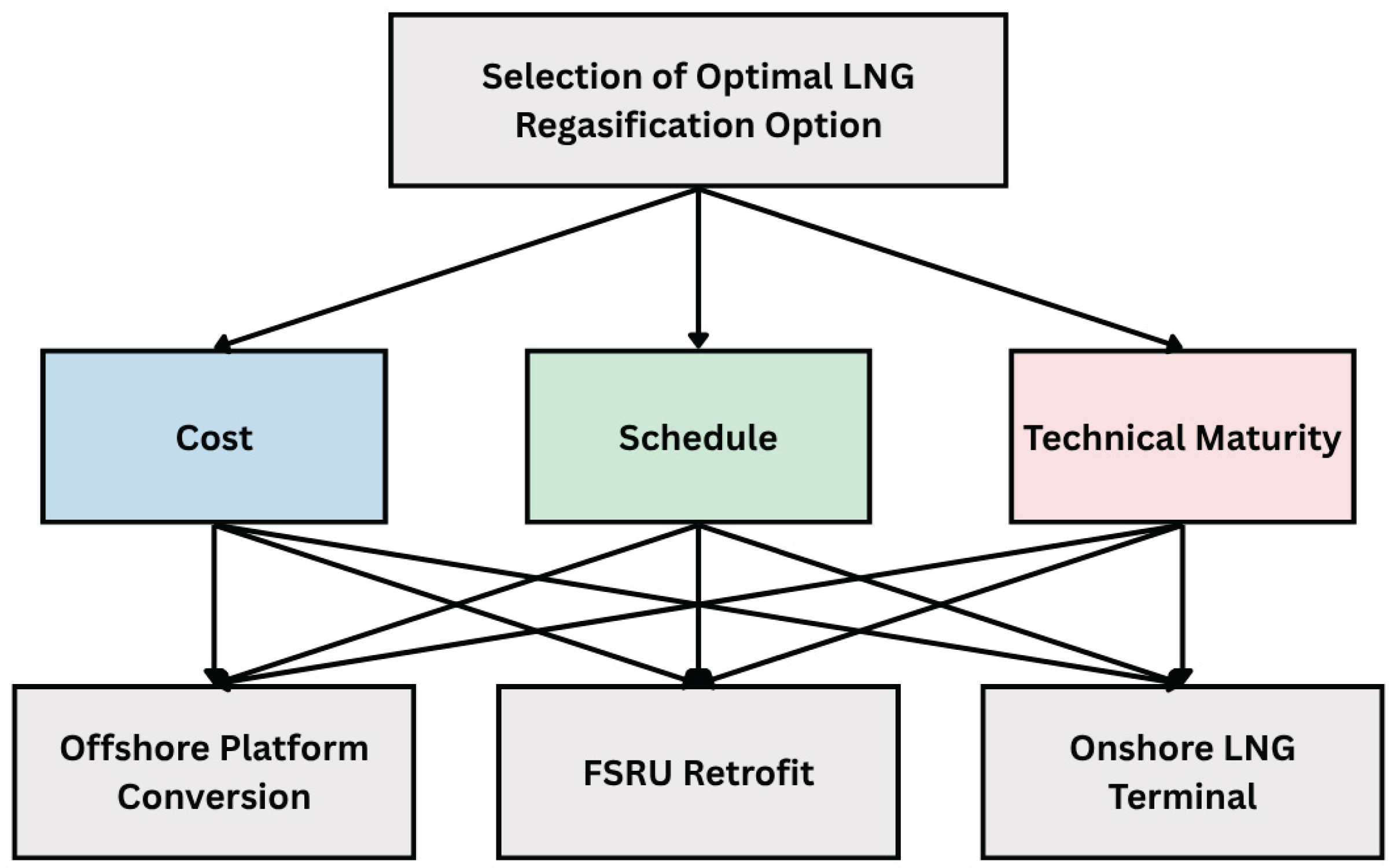
To evaluate the relative feasibility of LNG regasification alternatives, the Analytic Hierarchy Process (AHP) is applied [43]. The decision problem is structured into three hierarchical levels consisting of:
  • • the goal (selection of the optimal LNG regasification alternative),
  • • evaluation criteria (cost, project schedule, and technical maturity), and
  • • alternatives (offshore platform conversion, FSRU retrofit, and onshore LNG terminal).

3.4.1. AHP Using Expert Judgment

Expert judgment is employed within the AHP framework to determine both the relative importance of evaluation criteria and the technical maturity of each LNG regasification alternative. Pairwise comparisons are conducted using Saaty’s fundamental scale, ranging from 1 (equal importance) to 9 (extreme importance), to express the relative preference between elements.
The comparisons are structured into a reciprocal pairwise comparison matrix, where each element represents the relative importance of one element over another [43].
A = 1 a 12 a 13 1 a 12 1 a 23 1 a 13 1 a 23 1
The priority weights are derived through normalization of the pairwise comparison matrix, resulting in a weight vector that reflects the relative importance of each criterion or alternative.
w i = 1 n j = 1 n a i j i = 1 n a i j
For technical maturity, pairwise comparisons are conducted among the alternatives (offshore platform conversion, FSRU retrofit, and onshore LNG terminal) to evaluate their relative performance in terms of technology readiness, integration complexity, operational reliability, and implementation feasibility.
For criteria weighting, pairwise comparisons are performed among the evaluation criteria (cost, project schedule, and technical maturity) to determine their relative contributions to the overall decision.
The expert judgments are obtained through a focused group discussion (FGD) involving professionals from academia, engineering companies, oil and gas companies, government institutions, and research organizations. All experts possess more than 15 years of experience in the energy sector, covering both upstream and midstream domains.
To ensure the reliability of the judgments, the consistency of the pairwise comparison matrix is evaluated using the Consistency Ratio (CR).
C I = λ m a x n n 1
C R = C I R I
A CR value below 0.1 indicates that the comparisons are logically consistent and acceptable [43].

3.4.2. Integration of Quantitative Data into AHP

Quantitative criteria, including cost and project schedule, are incorporated into the AHP framework using a ratio-based transformation approach. In this method, pairwise comparison values are constructed directly from numerical data by calculating relative ratios between alternatives [44].
Since both cost and project schedule are minimization-type criteria, an inverse ratio is applied to ensure that lower values correspond to higher preference in the pairwise comparison matrix. Specifically, alternatives with lower cost or shorter project duration yield larger relative values, reflecting their superior performance within the AHP framework.
This approach enables the objective integration of techno-economic results into the AHP structure while maintaining consistency with the fundamental preference interpretation of AHP, without relying solely on subjective judgment.
a i j = x j x i
A = 1 x 2 x 1 x 3 x 1 x 1 x 2 1 x 3 x 2 x 1 x 3 x 2 x 3 1

3.4.3. Overall Evaluation and Synthesis

The overall evaluation is performed by synthesizing the priority weights of each criterion with the corresponding performance scores of alternatives [43].
S i = k = 1 m w k . p i k
The final ranking of LNG regasification alternatives is obtained by aggregating the weighted scores across all criteria.

3.4.4. Sensitivity Analysis

A sensitivity analysis is conducted to assess the robustness of the AHP results with respect to variations in criteria weights. The analysis applies a one-at-a-time approach, where the weight of a single criterion is varied while the remaining weights are proportionally adjusted to maintain normalization.
Several variation levels are considered to represent deviations from the baseline weights. For each scenario, the AHP synthesis is repeated to obtain updated priority scores and rankings. This approach enables evaluation of the stability of the decision results and identification of criteria that significantly influence the overall ranking [45].

4. Results and Discussion

4.1. Cost Estimation Results

4.1.1. Reference Cost at 20 MMSCFD

As a baseline for cost estimation, reference cost data at a capacity of 20 MMSCFD are adopted from a previous study. These values represent conceptual-level estimates and serve as the starting point for evaluating cost behavior under capacity expansion.
The cost breakdown includes major components such as engineering, project management, platform modification, LNG infrastructure, utilities, and EPC-related costs. The detailed cost structure for all LNG regasification alternatives at this capacity is presented in Table 2.
As shown in Table 2, the offshore platform conversion alternative exhibits the lowest cost (42.8 MUSD), followed by the onshore LNG terminal (60.8 MUSD) and the FSRU-based system (85.8 MUSD). The lower cost of the offshore platform alternative is primarily attributed to the utilization of existing infrastructure, while the onshore LNG terminal requires extensive civil works and land development. The FSRU alternative reflects higher costs associated with vessel conversion and offshore integration.

4.1.2. Cost Estimation Using Cost–Capacity Scaling

To estimate the cost at a larger capacity, the cost–capacity scaling method is applied to extrapolate the cost from the 20 MMSCFD baseline to 100 MMSCFD. This method assumes that cost follows a power-law relationship with capacity, as expressed in Equation 9.
C o s t 100 m m s c f d =   C o s t 20 m m s c f d × 100   m m s c f d 20   m m s c f d   0.6
Using a commonly adopted scaling exponent of 0.6, the estimated cost for each LNG regasification alternative at 100 MMSCFD is calculated based on the 20 MMSCFD reference case. The results of the scaling-based estimation for all alternatives are presented in Table 3.
As shown in Table 3, the scaling method provides estimated costs for offshore platform conversion, FSRU retrofit, and onshore LNG terminal based on extrapolation from the baseline capacity. These values reflect the assumption of consistent cost–capacity behavior across different system configurations.

4.1.3. Cost Estimation Using Analogous Method

In addition to the scaling-based approach, cost estimation at 100 MMSCFD is conducted using an analogous estimation method. This approach directly estimates project cost based on representative LNG projects with similar capacity and system characteristics, without relying on extrapolation from lower-capacity data.
The analogous estimation incorporates major cost components, including engineering, procurement, construction, commissioning, and project indirect costs. In addition, system-specific elements such as vessel acquisition, offshore integration, and infrastructure requirements are explicitly considered, allowing the method to better reflect actual project conditions.
The detailed cost estimation results for all LNG regasification alternatives at 100 MMSCFD are presented in Table 4.
As shown in Table 4, the offshore platform conversion alternative results in a total CAPEX of 86.1 MUSD, followed by 109.8 MUSD for FSRU retrofit and 295.1 MUSD for onshore LNG terminal. The offshore platform alternative demonstrates the lowest cost among the evaluated alternatives, primarily due to the utilization of existing infrastructure, which reduces the need for extensive new construction and civil works.
In contrast, the onshore LNG terminal exhibits significantly higher costs, driven by large-scale civil works, land acquisition, and permitting requirements. The FSRU retrofit alternative shows moderate cost levels, reflecting the balance between vessel-based infrastructure and offshore installation requirements.
Overall, the analogous estimation provides a direct cost representation at the target capacity, capturing variations in system configuration and infrastructure requirements across different LNG regasification alternatives. These results serve as a reference for subsequent comparison with scaling-based estimation in the following section.

4.2. Comparative Analysis of Cost Estimation Methods

A comparative analysis is conducted to evaluate the consistency between the cost–capacity scaling method and the analogous estimation approach for LNG regasification systems at a capacity of 100 MMSCFD. The comparison is based on the scaling results presented in Table 5.
For the offshore platform conversion alternative, the scaling method yields an estimated cost of 112.40 MUSD, while the analogous estimation results in 86.10 MUSD. This corresponds to an absolute difference of 26.30 MUSD, or approximately 30.6%, indicating that the scaling method overestimates the cost for this configuration.
For the FSRU retrofit alternative, the scaling-based estimate is 159.76 MUSD compared to 109.80 MUSD from the analogous method. The resulting difference of 49.96 MUSD, or approximately 45.5%, further confirms the tendency of the scaling approach to overestimate costs for offshore-based systems.
In contrast, for the onshore LNG terminal, the scaling method produces a lower estimate of 220.19 MUSD, whereas the analogous estimation results in 295.10 MUSD. This corresponds to an absolute difference of −74.91 MUSD, or approximately −25.4%, indicating that the scaling method underestimates the cost for this alternative.
These results reveal a clear inconsistency in the performance of the cost–capacity scaling method across different LNG regasification configurations. The method tends to overestimate costs for offshore-based systems while underestimating costs for onshore LNG terminal.
The observed variation suggests that the use of a single scaling exponent assumes a uniform cost–capacity relationship that does not adequately capture differences in system configuration, infrastructure requirements, and construction scope. In contrast, the analogous estimation approach reflects these variations through the use of representative project data, resulting in a more realistic estimation of cost at the target capacity.

4.3. Analysis of Cost–Capacity Scaling Behavior

4.3.1. Back-Calculation of Effective Scaling Exponent

To further investigate the discrepancy between the cost–capacity scaling method and the analogous estimation results, a back-calculation approach is applied to derive the effective scaling exponent for each LNG regasification alternative.
Based on the cost–capacity relationship presented in Equation (1), the scaling exponent can be derived as:
n * = ln C 100 a n a l o g o u s   e s t i m a t e / C 20 ln 100 / 20
In this analysis, the reference cost at 20 MMSCFD is used as C 20 , while the cost at 100 MMSCFD obtained from the analogous estimation is used as C 100 . This approach allows the identification of the implied scaling behavior based on empirical data.
The calculated effective scaling exponents for each LNG regasification configuration are summarized in Table 6.

4.3.2. Interpretation of Alternative-Specific Scaling Behavior

The variation in effective scaling exponents indicates that cost–capacity relationships differ across LNG regasification configurations.
Offshore platform conversion exhibits a lower exponent (≈0.43) due to infrastructure reuse, which reduces additional construction requirements. The FSRU retrofit shows an even lower exponent (≈0.37), reflecting its modular vessel-based system that enables relatively efficient capacity expansion. In contrast, the onshore LNG terminal demonstrates a higher exponent (≈0.78), driven by the dominance of civil works and site-specific infrastructure that scale more aggressively with capacity.
These results indicate that the assumption of a uniform scaling exponent does not adequately represent different system configurations. Instead, scaling behavior is configuration-dependent and influenced by the degree of infrastructure reuse and construction intensity.
Based on these findings, this study identifies alternative-specific effective scaling exponents that may serve as indicative references for similar LNG regasification projects at the conceptual design stage.

4.4. Schedule Estimation Results

The project schedule for each LNG regasification alternative is estimated using a top-down approach at the conceptual design stage, considering key factors such as engineering complexity, long-lead equipment procurement, offshore installation constraints, and construction sequencing.
Key activities influencing the project timeline include the procurement of major equipment such as vaporizers, LNG pumps, and utility systems, as well as installation constraints related to offshore operations and weather conditions. In addition, onshore LNG terminal development involves extensive civil works and permitting processes, which significantly affect the overall project duration.
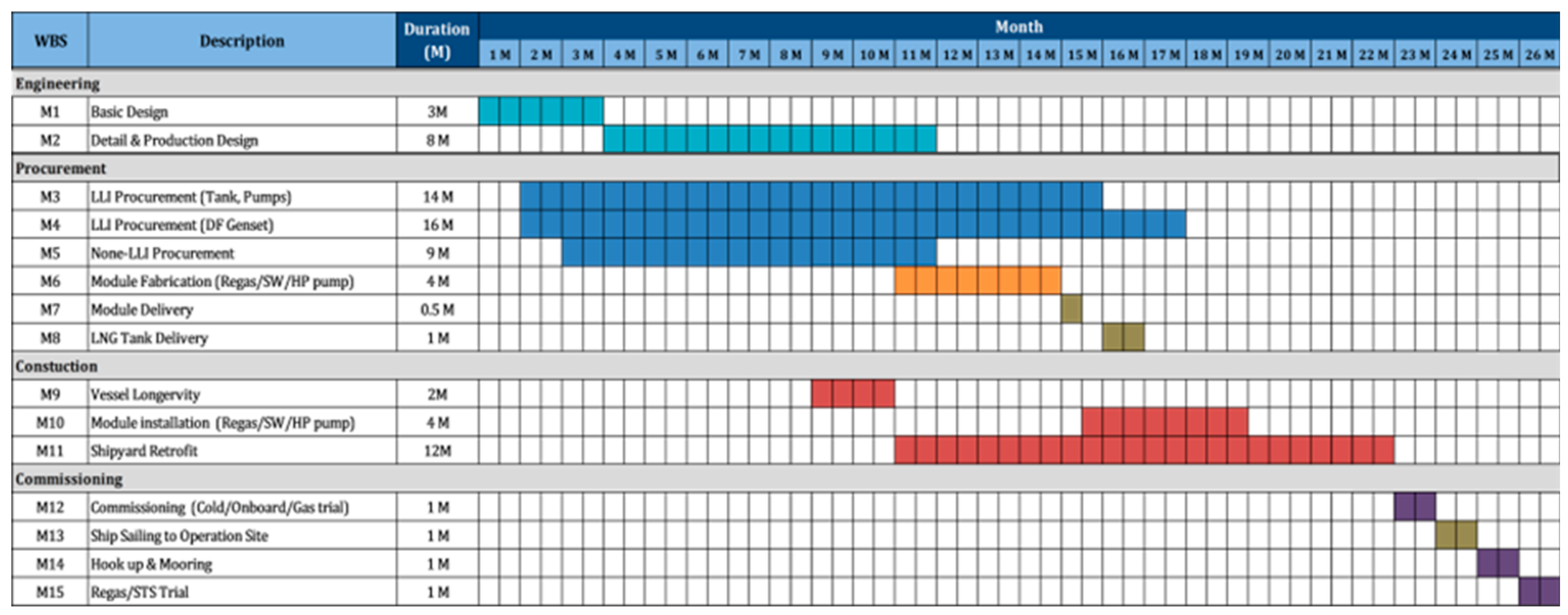
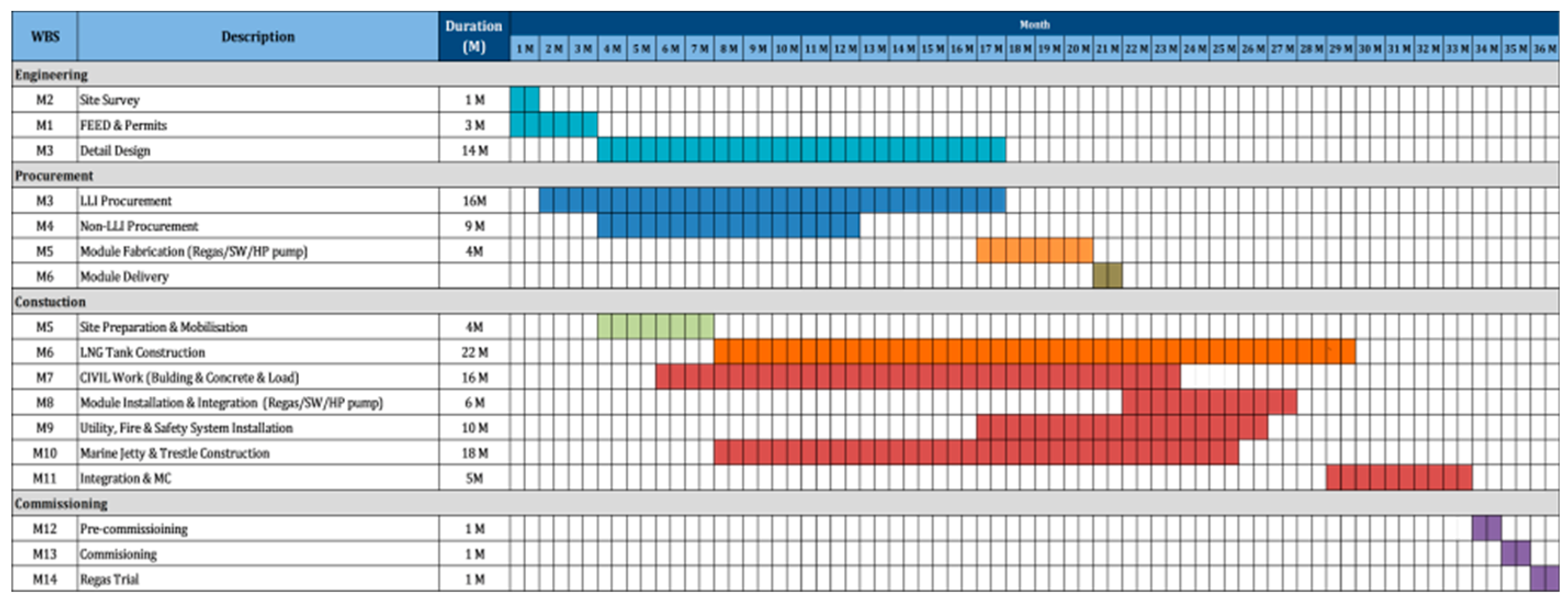
The estimated project durations for each LNG regasification alternative are summarized in Table 7.
As shown in Table 7, offshore platform conversion provides the shortest development timeline, followed by the FSRU retrofit, while the onshore LNG terminal requires significantly longer construction time.
The shorter schedule for offshore platform conversion is primarily attributed to the reuse of existing infrastructure, which reduces the need for extensive construction and installation activities. The FSRU retrofit alternative also benefits from relatively faster deployment due to its modular nature, although additional time is required for vessel conversion and offshore integration.
In contrast, the onshore LNG terminal exhibits the longest project duration, driven by large-scale civil works, land preparation, and more complex permitting requirements. These factors contribute to extended construction timelines and higher exposure to project delays.
To further illustrate the sequencing of major project activities, the detailed master schedules for each alternative are presented in Figure 1, Figure 2 and Figure 3.

4.5. Technical Maturity Assessment

To incorporate qualitative aspects that cannot be directly quantified through techno-economic analysis, the technical maturity of each LNG regasification alternative is evaluated using expert judgment through a focused group discussion (FGD).
The assessment considers factors such as technology readiness, system complexity, operational reliability, and ease of implementation. Experts are asked to perform pairwise comparisons between alternatives using the AHP scale to determine which alternative is more technically mature and easier to implement. The results of these evaluations are structured into a pairwise comparison matrix, as shown in Table 8.
The pairwise comparison results are aggregated using the geometric mean method to obtain a representative judgment across all experts. The resulting comparison matrix is then normalized to derive the priority weights for each alternative, as presented in Table 9.
The results indicate that the onshore LNG terminal achieves the highest technical maturity score (41.76%), followed by the FSRU retrofit (33.02%) and offshore platform conversion (25.22%).
This ranking reflects the maturity level of each system configuration. Onshore LNG terminals are widely implemented and supported by established engineering practices, resulting in higher confidence in their operability and reliability. The FSRU retrofit alternative demonstrates moderate technical maturity due to its proven deployment in various regions, although it involves offshore integration challenges.
In contrast, offshore platform conversion shows the lowest technical maturity, primarily due to its dependence on platform-specific conditions, structural constraints, and integration complexity. As a relatively less established approach, it introduces higher uncertainty compared to conventional LNG regasification systems.
The results satisfy the consistency requirement, indicating that the pairwise comparisons are consistent.

4.6. Multi-Criteria Evaluation Using AHP

4.6.1. AHP Framework and Hierarchical Structure

To complement the techno-economic analysis, a multi-criteria evaluation is conducted using the Analytic Hierarchy Process (AHP) to assess the overall feasibility of LNG regasification alternatives.
The evaluation is based on three main criteria, namely cost, project schedule, and technical maturity, as defined in Section 3.4. Quantitative criteria, including cost and schedule, are derived from the techno-economic analysis results presented in Section 4.1 and Section 4.4, respectively, while technical maturity is assessed based on expert judgment as discussed in Section 4.5. The hierarchical structure of the AHP model used in this study is illustrated in Figure 4.

4.6.2. Scenario Definition for AHP Evaluation

To evaluate the influence of cost estimation methods on the overall feasibility assessment, two evaluation scenarios are defined based on different cost estimation approaches applied to the 100 MMSCFD case.
  • Case 1: Cost estimation derived using the cost–capacity scaling method.
  • Case 2: Cost estimation derived using the analogous estimation method.
These scenarios are incorporated into the AHP evaluation to assess how differences in cost estimation influence the overall feasibility ranking of LNG regasification alternatives.

4.6.3. Cost Pairwise Construction

To incorporate cost as a quantitative criterion within the AHP framework, the cost estimation results presented in Section 4.1 are transformed into pairwise comparison matrices using a ratio-based approach. In this method, the relative preference between alternatives is determined based on the ratio of their estimated costs, where lower cost indicates higher preference.
Given that two cost estimation approaches are applied in this study, namely cost–capacity scaling and analogous estimation, the pairwise comparison for cost is constructed separately for each scenario. This allows the evaluation to capture how differences in cost estimation methods influence the relative preference between LNG regasification alternatives.
For the scaling-based scenario, the pairwise comparison matrix is derived from the estimated costs obtained using the cost–capacity scaling method. The resulting matrix reflects the relative cost efficiency among offshore platform conversion, FSRU retrofit, and onshore LNG terminal, as shown in Table 10.
The normalized priority weights obtained from the scaling-based pairwise matrix indicate that offshore platform conversion has the highest cost preference, followed by the FSRU retrofit and the onshore LNG terminal, as detailed in Table 11.
Similarly, for the analogous estimation scenario, the pairwise comparison matrix is constructed using cost values derived from representative project data at 100 MMSCFD. This approach captures system-specific cost characteristics that are not reflected in the scaling-based method, as summarized in Table 12.
The resulting priority weights from the analogous-based matrix show a similar ranking pattern, with offshore platform conversion remaining the most cost-efficient alternative, followed by the FSRU retrofit, while the onshore LNG terminal exhibits the lowest cost preference, as documented in Table 13.
It is noted that the normalized values across columns in the cost priority weights are identical. This occurs because the pairwise comparisons are constructed directly from quantitative cost ratios, resulting in a perfectly consistent matrix. Consequently, the normalization process yields uniform values across columns, reflecting the deterministic nature of the data-driven comparison.
Overall, the transformation of cost data into pairwise comparisons enables consistent integration of quantitative cost information into the AHP framework, while also allowing the influence of different cost estimation methods to be explicitly evaluated in the decision-making process.

4.6.4. Schedule Pairwise Construction

To incorporate project schedule as a quantitative criterion within the AHP framework, the estimated project durations presented in Section 4.4 are transformed into pairwise comparison matrices using an inverse ratio-based approach. In this method, alternatives with shorter project durations are assigned higher preference, reflecting their advantage in faster implementation.
The pairwise comparison values are derived by comparing the relative project durations among offshore platform conversion (19 months), FSRU retrofit (26 months), and onshore LNG terminal (36 months). The resulting ratios indicate that offshore platform conversion is preferred over both FSRU and onshore alternatives, while FSRU is preferred over onshore due to its shorter development timeline, as established in Table 14.
The normalized priority weights derived from the schedule pairwise matrix indicate that offshore platform conversion has the highest preference in terms of schedule efficiency, followed by the FSRU retrofit and the onshore LNG terminal, as displayed in Table 15.
Similar to the cost criterion, the normalized values across columns are identical. This is due to the use of direct ratio-based transformation from quantitative schedule data, resulting in a perfectly consistent pairwise comparison matrix. As a consequence, the normalization process yields uniform values across columns, reflecting the deterministic nature of the schedule evaluation.
Overall, this approach enables the integration of schedule performance into the AHP framework in a consistent and objective manner, ensuring comparability with other evaluation criteria while preserving the underlying quantitative characteristics of project duration.

4.6.5. Criteria Weighting

The AHP evaluation incorporates expert judgment obtained through a focused group discussion (FGD) to determine the relative importance of the evaluation criteria. This approach enables the inclusion of qualitative considerations, such as technology readiness, integration complexity, and implementation feasibility, which cannot be directly quantified at the conceptual design stage.
Through pairwise comparisons among criteria, the corresponding weights are derived within the AHP framework, as presented in Table 16.
The calculated CR value is 0.031, indicating acceptable consistency of the pairwise comparisons.

4.6.6. Overall Evaluation Results and Ranking

The overall evaluation results for Case 1 and Case 2 are presented in Table 17 and Table 18, which summarize the aggregated scores of each LNG regasification alternative based on the weighted criteria of cost, schedule, and technical maturity.

4.6.7. Interpretation of Scenario-Based Results

The evaluation results for Case 1 and Case 2 consistently identify offshore platform conversion as the most feasible alternative, followed by the FSRU retrofit, while the onshore LNG terminal remains the least favorable alternative. This consistency indicates that the overall ranking is robust with respect to the cost estimation approach.
However, the influence of cost estimation methods becomes evident in the magnitude of the evaluation scores. Under Case 1, where cost is derived using the cost–capacity scaling method, the overall score of offshore platform conversion is relatively lower (0.399), resulting in a narrower gap with the FSRU retrofit (0.323). In contrast, under Case 2, where cost is estimated using the analogous method, the offshore alternative achieves a higher overall score (0.412), increasing its separation from the FSRU alternative (0.349).
These results indicate that the cost–capacity scaling method tends to reduce the relative advantage of offshore platform conversion, whereas the analogous estimation approach enhances its competitiveness. The difference arises from how each method captures cost behavior at higher capacity: the scaling method applies a uniform assumption that does not capture infrastructure reuse effects, while the analogous method incorporates system-specific characteristics more explicitly.
As a result, although the ranking remains unchanged, the strength of preference varies across scenarios. This highlights that cost estimation methods influence not only absolute cost values but also the degree of confidence in the decision outcome.

4.6.8. Sensitivity Analysis

A sensitivity analysis is performed by varying the criteria weights (cost, schedule, and technical maturity) while maintaining normalization through proportional adjustment. The analysis is based on the analogous estimation case presented in Table 18, and the results are summarized in Table 19, Table 20 and Table 21.
In contrast, variations in technical maturity significantly affect the ranking. As its weight increases, the onshore LNG terminal, which has the highest technical maturity score, improves its position and eventually surpasses the offshore alternative. This indicates that the evaluation is sensitive to changes in technical maturity.

4. Conclusions

This study presents an integrated techno-economic and multi-criteria evaluation of LNG regasification alternatives at the conceptual design stage, comparing offshore platform conversion, FSRU retrofit, and onshore LNG terminal under a 100 MMSCFD capacity scenario. By combining cost estimation, project schedule assessment, and technical maturity evaluation within an AHP framework, the study provides a structured basis for comparing alternative infrastructure solutions.
The results demonstrate that the conventional cost–capacity scaling approach, when applied using a uniform exponent of 0.6, does not adequately capture the cost behavior of different LNG regasification configurations. The method tends to overestimate costs for offshore-based systems while underestimating costs for onshore terminal. Through back-calculation, this study identifies alternative-specific effective scaling exponents, approximately 0.43 for offshore platform conversion, 0.37 for FSRU retrofit, and 0.78 for onshore LNG terminal. These results indicate that cost–capacity relationships are strongly influenced by system characteristics such as infrastructure reuse, modularity, and construction intensity. While these values are not intended to be universally applicable, they provide indicative references that highlight the limitation of applying a single uniform scaling exponent across different system configurations.
The multi-criteria evaluation results indicate that offshore platform conversion consistently achieves the highest feasibility ranking across both evaluation scenarios, followed by FSRU retrofit, while the onshore LNG terminal ranks lowest. Although the ranking remains unchanged, the analysis shows that the choice of cost estimation method affects the magnitude of score differences, thereby influencing the strength of preference among alternatives. In particular, the use of analogous estimation enhances the relative competitiveness of offshore-based solutions, whereas the scaling method tends to reduce this advantage.
From a methodological perspective, this study demonstrates the importance of integrating quantitative techno-economic data with structured decision-making tools in early-stage project evaluation. The findings highlight that cost estimation methods influence not only absolute cost values but also decision outcomes within multi-criteria frameworks. From a practical standpoint, offshore platform-based LNG regasification emerges as a competitive alternative, particularly in regions with existing offshore assets and decommissioning pressures.
Nevertheless, this study is limited by its reliance on conceptual-level cost estimates based on AACE Class 5 and case-specific assumptions related to system configuration and input data. The derived scaling exponents should therefore be interpreted as indicative rather than universally applicable. Future research should incorporate higher-accuracy cost estimates, detailed engineering design, and broader datasets to further validate the observed scaling behavior and improve the robustness of decision-making frameworks.

Author Contributions

Conceptualization, L.S.D. and C.H.C.; methodology, C.H.C.; formal analysis, C.H.C. and E.B.T.; investigation, C.H.C.; data curation, C.H.C.; writing—original draft preparation, C.H.C.; writing—review and editing, L.S.D., K.S.J., K.H.S., and E.B.T.; validation, E.B.T.; visualization, C.H.C.; supervision, L.S.D.; project administration, L.S.D. All authors have read and agreed to the published version of the manuscript.

Funding

This research was supported by the Korea Institute of Marine Science & Technology Promotion (KIMST), funded by the Ministry of Oceans and Fisheries (Grant No. RS-2025-02314766).

Data Availability Statement

The original contributions presented in the study are included in the article; further inquiries can be directed to the corresponding author.

Conflicts of Interest

The authors declare no conflicts of interest.

Abbreviations

The following abbreviations are used in this manuscript:
AACE Association for the Advancement of Cost Engineering International
AHP Analytic Hierarchy Process
BOG Boil-Off Gas
CAPEX Capital Expenditure
CI Consistency Index
CR Consistency Ratio
EPC Engineering, Procurement, and Construction
ESD Emergency Shutdown
FGD Focused Group Discussion
FSRU Floating Storage and Regasification Unit
FSU Floating Storage Unit
HP High Pressure
IFV Intermediate Fluid Vaporizer
LNG Liquefied Natural Gas
LNGC Liquefied Natural Gas Carrier
MMSCFD Million Standard Cubic Feet per Day
MUSD Million US Dollars
ORV Open Rack Vaporizer
PRU Platform Regasification Unit

Appendix A. Supporting Technical Data

Appendix A.1 Specification Comparison of LNG Regasification Alternatives

The detailed technical specifications of the LNG regasification alternatives considered in this study are summarized in Table A1.
Table A1. Specification Comparison of LNG Regasification Alternatives.
Category Rig Conversion (PRU + FSU) FSRU Retrofit (Conversion) Onshore LNG Terminal
Overall Concept Existing offshore platform converted into a Platform Regas Unit (PRU) with LNG supply from a separate FSU. Second-hand LNGC retrofitted to function as a Floating Storage & Regasification Unit (FSRU). Full greenfield EPC development for LNG receiving storage, regasification, and delivery.
Key Regasification Equipment •Modular Regas skids installed on deck
• 2 × 50 m³/hr HP pumps
• 2 × SW/GW heaters
• 2 × GW pumps
• Modular Regas skids installed on deck
• 2 × 50 m³/hr HP pumps
• 2 × SW/GW heaters
• 2 × GW pumps
• ORV-based regasification system
• 2 × SW pumps
NG Transfer System Cryogenic hose transfer from FSU via QCDC/ESD-capable system Cryogenic hose transfer from FSU via QCDC/ESD-capable system Jetty-mounted MLA (liquid + vapor arms) for LNG unloading
Storage System • FSU: full LNG storage
• two 1,000 m³ buffer tanks on deck for flow/temperature stability
• Combined LNG storage and regas capability
• BOG management system
• Two full-containment onshore tanks (130,000 m³ total)
Power / Utility Systems Reuse of existing power, utilities, and safety systems Dedicated power generation sized for regas + utilities; additional BOG management Onshore power supply, instrument air, water, drain, flare systems
Pipeline System Reuse of existing subsea export pipeline, reinstated for continuous gas send-out New subsea gas export pipeline to onshore tie-in Onshore cryogenic & send-out pipeline to national grid
Construction & Installation Characteristics • Removal of legacy topside
• Deck reinforcement
• Modular installation via offshore lift-and-hook-up
• Shipyard retrofit of hull and systems
• Nearshore spread mooring installation
• Extensive civil works (roads, drainage, buildings)
• Tank foundation & erection
• Marine infrastructure package (jetty/trestle)
Major Excluded Scope Mooring system installation (separate package) Mooring installation (separate marine package) Jetty & trestle civil works (separate marine package)

Appendix A.2. Engineering Overview

The engineering characteristics of each LNG regasification alternative, including design type, complexity, and duration, are presented in Table A2.
Table A2. Engineering comparison of LNG regasification alternatives.
Aspect Rig Conversion FSRU Conversion Onshore Terminal
Type Retrofit Retrofit Greenfield
Engineering Focus Interface & modular integration Shipyard retrofit & power/safety upgrade Civil, marine & tank design
Design Complexity Low–Medium High Very High
Class / Permit Requirement MODU re-approval IGC & hull modification approval Full national civil construction approval
Engineering Duration Shortest (6 months) Moderate (11 months) Longest (17 months)

Appendix A.3. Procurement Data and Equipment Specification

Detailed procurement requirements, including key equipment specifications and lead times, are summarized in Table A3.
Table A3. Procurement comparison of LNG regasification systems and equipment.
Equipment Category Rig Conversion FSRU (Conversion) Onshore LNG Terminal Lead Time (M)
LNG Vaporizers 2 × 50 MMSCFD S/T Type with SW/GW heating 2 × 50 MMSCFD S/T Type with SW/GW heating 2 × 50 MMSCFD ORV systems with seawater heating Rig 10
M FSRU 10M Onshore 15M
HP LNG Pumps 2 × 100 m³/h HP Pump (75 barg send-out), skid-mounted 2 × 100 m³/h HP Pump (75 barg send-out), skid-mounted 2 × 100 m³/h HP Pump (tank to vaporizer) 12M
LNG Storage 2 × 1,000 m³ Suction Tanks + 135,000 m³ FSU capacity 135,000 m³ Storage capacity 2 × 65,000 m³ Full Containment Tanks (130,000 m³ total)
Rig 14M FSRU 14M Onshore 24M
BOG Compressor & Recondenser Reuse existing compressor 3 Sets LP BOG Compressor + LNG Recondenser 900 kg/h (8 barg) 3 Sets LP BOG Compressor + LNG Recondenser 900 kg/h (8 barg) FSRU 12M Onshore 12M
Cryogenic Transfer System Cryogenic hose system (QCDC, ESD-capable) connected to FSU Cryogenic hose (QCDC, ESD-capable) for LNGC STS loading Marine loading arms at jetty (MLA set)
Rig 9M FSRU 9M Onshore 16M
Power Generation Use existing rig power system (no new gensets) 2 × Dual-Fuel Gensets (gas/diesel, 2 MW total) Grid connection + 1 × ESG (Emergency Standby Generator) FSRU 16M Onshore 9M
Seawater System 2 × SW Pumps (1,400 m³/h) + plate heat exchanger 2 × SW Pumps (1,400 m³/h) + plate heat exchanger 2 × SW Intake Pumps + filtration unit on structure 12M
GW Circulation System 2 × GW Pumps (900 m³/h) + closed-loop piping 2 × GW Pumps (900 m³/h) + closed-loop piping Not applicable (ORVs used)
Rig 6M FSRU 6M
Send-out Pipeline Reuse existing subsea export line New subsea pipeline to shore New onshore cryogenic and send-out pipeline FSRU 12M Onshore 9M
Metering System Reuse existing system New NG metering system New NG metering system FSRU 8M Onshore 8M
Safety Equipment Modify and reuse HVAC, ESD, F&G, and nitrogen systems New F&G, Nitrogen, Air Compressor, Firefighting System Firewater, HVAC, Nitrogen Skid, Instrument Air, Flare System
Rig 6M FSRU 8M Onshore 12M
Other Utility Systems Reuse Sewage, FW, FW Supply Add Sewage Treatment for Crew Service Water, Fire Water, Sanitary, Diesel Tank for ESG
Rig 6M FSRU 9M Onshore 12M
C&I System Modify existing IAS, add PSD/ESDS Modify existing IAS, add PSD/ESDS New ICSS System
Rig 8M FSRU 8M Onshore 10M
Telecommunication System Modify and reuse PAGA, CCTV, Radio, SSL Add PAGA, CCTV, Radio, SSL PAGA, CCTV, SSL System
Rig 6M FSRU 8M Onshore 12M

Appendix A.4. Construction Characteristics

The construction philosophies, locations, and implementation approaches for each LNG regasification alternative are presented in Table A4.
Table A4. Construction characteristics of LNG regasification alternatives.
Category Rig Conversion (FRU + FSU) FSRU Conversion Onshore LNG Terminal
Construction Philosophy Modular pre-fabrication with offshore lift-and-hook-up; reuse of existing structure and pipeline. Shipyard retrofit of hull, utilities, safety, and Regas system; short offshore hook-up. Greenfield civil-first development with tank, utility, and Regas installation.
Construction Location & Accessibility Modules fabricated onshore; installation at offshore site with limited access and weather dependency. Retrofit performed in shipyard (good accessibility); offshore tie-in afterward. Work executed mainly at onshore site with broad access; heavy equipment logistics required.
Offshore / Onshore Interface Interfaces: FRU–FSU SBS transfer, subsea send-out tie-in; limited marine works. Interfaces: FSRU–shore subsea pipeline + onshore receiving facility. Interfaces: MLA–jetty–cryogenic pipe; marine and land interfaces throughout construction.
Safety Considerations Offshore SIMOPS, heavy lifting, weather window control. Shipyard hot-work control, confined-space retrofit, class-supervised safety review. Wide-area civil works, heavy transport, marine jetty operations, extensive HSE management.
Construction Sequencing Module transport → heavy lift → hook-up → commissioning (shortest). Shipyard retrofit → transport → offshore connection → commissioning. Civil works → tank foundation/erection → utilities/regas installation → commissioning (longest).

References

  1. International Energy Agency, I. 6 20 How Flexible Are LNG Markets in Practice?; 2016;
  2. U.S. Energy Information Administration, E. Liquefied Natural Gas Available online: https://www.eia.gov/energyexplained/natural-gas/liquefied-natural-gas.php (accessed on 31 March 2026).
  3. International Energy Agency, I. Security of Gas Supply in Open Markets : LNG and Power at a Turning Point; OECD/IEA, 2004; ISBN 9264108068.
  4. Gas Processing Liquefaction Production Exploration and Development Transport LNG Regasification Distribution and Transport Marketing and Sales Global LNG Fundamentals;
  5. Kristian Danielsen, H.; Andreassen, G.; Norske Veritas, D. The Commercial Advantages and Limitations-Onshore versus Offshore LNG Import Facilities; 2008;
  6. Bredehoeft, P.R.; Dysert, L.R.; Hollmann, J.K.; Pickett, T.W. COST ESTIMATE CLASSIFICATION SYSTEM-AS APPLIED IN ENGINEERING, PROCUREMENT, AND CONSTRUCTION FOR THE PROCESS INDUSTRIES; 2019;
  7. International Trade Administration Indonesia Energy LNG Infrastructure Available online: https://www.trade.gov/market-intelligence/indonesia-energy-lng-infrastructure (accessed on 31 March 2026).
  8. U.S. Energy Information Administration, E. Country Analysis Brief: Indonesia; 2025;
  9. Berkeley Research Group, L. Study on Optimal Use of Small-Scale Shallow-Draft LNG Carriers and FSRUs in the APEC Region APEC Energy Working Group; 2020;
  10. Setyorini, P.D.; Dinariyana, A.A.B.; Akbar, T.A. A Combined AHP and PROMETHEE Method for Selecting the LNG Receiving Terminal with Additional Safety Perspective; 2019;
  11. Nugraha, R.B.A.; Basuki, R.; Oh, J.S.; Cho, I.H.; Naibaho, N.; Secasari, Y.; Mbay, L.O.N. Rigs-To-Reef (R2R): A New Initiative on Re-Utilization of Abandoned Offshore Oil and Gas Platforms in Indonesia for Marine and Fisheries Sectors. In Proceedings of the IOP Conference Series: Earth and Environmental Science; IOP Publishing Ltd, March 28 2019; Vol. 241, p. 241.
  12. Amelia1, S.; Rarasati2, A.D.; Santos3, A.J. Universuum of Institutional Development for Post Production Offshore Platform Decommissioning in Indonesia. INTERNATIONAL JOURNAL OF BUSINESS STUDIES ipmi 2020, 4.
  13. Triatmodjo, M.; Muhdar, M.; Kurnia, M. Indonesia’s Offshore Oil and Gas: Decommissioning Uncertainty and the Legal Struggle. Australian Journal of Maritime & Ocean Affairs 2024, 17, 1–14. [CrossRef]
  14. Watson, S.M.; McLean, D.L.; Balcom, B.J.; Birchenough, S.N.R.; Brand, A.M.; Camprasse, E.C.M.; Claisse, J.T.; Coolen, J.W.P.; Cresswell, T.; Fokkema, B.; et al. Offshore Decommissioning Horizon Scan: Research Priorities to Support Decision-Making Activities for Oil and Gas Infrastructure. Science of The Total Environment 2023, 878, 163015. [CrossRef]
  15. Chalkina, A.A.; Lobanov, A. V Second Life of Offshore Oil and Gas Platforms. Power Technology and Engineering 2024, 58, 563–570. [CrossRef]
  16. Wan Abdullah Zawawi, N.A.; Liew, M. s; Na, K.L. Decommissioning of Offshore Platform: A Sustainable Framework; 2012; ISBN 978-1-4673-4615-3.
  17. Artana, K.B.; Prastyasari, F.I.; Wicaksana, M.R. Preliminary Study of Reutilization of an Offshore Platform as LNG Terminal in Indonesia Case Study: An Offshore Platform in West Part of Java; 2023;
  18. Songhurst, Brian. The Outlook for Floating Storage and Regasification Units (FSRUs); Oxford Institute for Energy Studies, 2017; ISBN 9781784670894.
  19. Agarwal, R. STATUS & OPTIMISATION OF LNG REGASIFICATION VALUE CHAIN; 2023;
  20. Wyllie, M. OIES Paper: NG 172 Developments in the “LNG to Power” Market and the Growing Importance of Floating Facilities. 2021.
  21. Gervois, G.; Daniel, L.; Jestin, N.; Kyriacou, A. Floating LNG - A Look At Export And Import Terminal. 2005. [CrossRef]
  22. Zhang, J.; Yin, X.; Lei, Z.; Wang, J.; Fan, Z.; Liu, S. Economic Feasibility of LNG Business: An Integrated Model and Case Study Analysis. Energies (Basel). 2024, 17, 3351. [CrossRef]
  23. Parfomak, P.; Flynn, A. Liquefied Natural Gas (LNG) Import Terminal: Siting, Safety and Regulation. 2004, 33.
  24. Wijngaarden, W.; Oomen, H.; Hoorn, J. Offshore LNG Terminal: Sunk or Floating? Offshore Technology Conference 2004. [CrossRef]
  25. el Ghazi, F.; Sedra, M.; Akdi, M. Natural Gaz Profitability Study for Future Importing Terminal Project in Morocco. Renewable Energy and Sustainable Development 2019, 5, 80. [CrossRef]
  26. First Gas Ltd New Zealand LNG Feasibility.
  27. Acer Analysis of the European LNG Market Developments 2024 Market Monitoring Report; 2024;
  28. Ji, C.; Yuan, S.; Jiao, Z.; Pettigrew, J.; El-Halwagi, M.M.; Pasman, H.J. Risk Informed Floating Storage and Re-Gasification Unit (FSRU) Location Selection for Local Natural Gas Supply. Ocean Engineering 2023, 268, 113357. [CrossRef]
  29. Martins, M.R.; Pestana, M.A.; Souza, G.F.M.; Schleder, A.M. Quantitative Risk Analysis of Loading and Offloading Liquefied Natural Gas (LNG) on a Floating Storage and Regasification Unit (FSRU). J. Loss Prev. Process Ind. 2016, 43, 629–653. [CrossRef]
  30. Bogdevicius, M.; Semaskaite, V.; Paulauskiene, T.; Uebe, J. Impact and Technical Solutions of Hydrodynamic and Thermodynamic Processes in Liquefied Natural Gas Regasification Process. J. Mar. Sci. Eng. 2024, 12, 1164. [CrossRef]
  31. Maksym, K.; David A., W. Floating Storage and Regasification Units Face Specific LNG Rollover Challenges: Consideration of Saturated Vapor Pressure Provides Insight and Mitigation rnative. Natural Gas Industry B 2018, 5, 391–414. [CrossRef]
  32. Devaraj, Devasant.I.; Donnellan, P.; Syron, E. Incorporation of LNG into Small Gas Networks via FSRUs. International Journal of Energy Production and Management 2019, 4, 53–62. [CrossRef]
  33. Dimitriou, D.; Zeimpekis, P. Appraisal Modeling for FSRU Greenfield Energy Projects. Energies (Basel). 2022, 15, 3188. [CrossRef]
  34. Vreeburg, J.R.; Garcia-Navarro, J.C. The Potential of Repurposing Offshore Natural Gas Infrastructure on the Dutch Continental Shelf for Hydrogen Production and Transport. Int. J. Hydrogen Energy 2025, 115, 37–48. [CrossRef]
  35. Klabučar, B.; Sedlar, D.; Smajla, I. Analysis of Blue Energy Production Using Natural Gas Infrastructure: Case Study for the Northern Adriatic. Renew. Energy 2020, 156. [CrossRef]
  36. Carpignano, A.; Gerboni, R.; Mezza, A.; Pirri, C.; Sacco, A.; Sassone, D.; Suriano, A.; Uggenti, A.C.; Verga, F.; Viberti, D. Italian Offshore Platform and Depleted Reservoir Conversion in the Energy Transition Perspective. J. Mar. Sci. Eng. 2023, 11. [CrossRef]
  37. Braga, J.; Santos, T.; Shadman, M.; Silva, C.; de Assis Tavares, L.; Estefen, S. Converting Offshore Oil and Gas Infrastructures into Renewable Energy Generation Plants: An Economic and Technical Analysis of the Decommissioning Delay in the Brazilian Case. Sustainability 2022, 14, 13783. [CrossRef]
  38. Zanuttigh, B.; Dallavalle, E.; Zagonari, F. A Novel Framework for Sustainable Decision-Making on Reusing Oil & Gas Offshore Platforms with Application to the Adriatic Sea. Renewable and Sustainable Energy Reviews 2025, 211, 115252. [CrossRef]
  39. Hyun-Joong, K.; Jaehyun, C. Development of a Methodology for Preliminary Estimation for Plant Construction Projects. Journal of the Korea Construction Management Association 2019, 20, 141–150. [CrossRef]
  40. Factorial Techniques Applied in Chemical Plant Cost Estimation: A Comparative Study Based on Literature and Cases;
  41. Tribe, M.A.; Alpine, R.L.W. Scale Economies and the “0.6 Rule.” Engineering Costs and Production Economics 1986, 10, 271–278. [CrossRef]
  42. A Guide to the Project Management Body of Knowledge; Project Management Institute, Inc., 2017; ISBN 9781628253900.
  43. Saaty, T.L. How to Make a Decision: The Analytic Hierarchy Process. Aestimum 2009. [CrossRef]
  44. Wedley, W.C. Combining Qualitative and Quantitative Factors-An Analytic Hierarchy Approach; 1990;
  45. Muanley, Y.Y.; Son, A.L.; Mada, G.S.; Dethan, N.K.F. Analisis Sensitivitas Dalam Metode Analytic Hierarchy Process Dan Pengaruhnya Terhadap Urutan Prioritas Pada Pemilihan Smartphone Android. VARIANSI: Journal of Statistics and Its application on Teaching and Research 2022, 4, 173–190. [CrossRef]
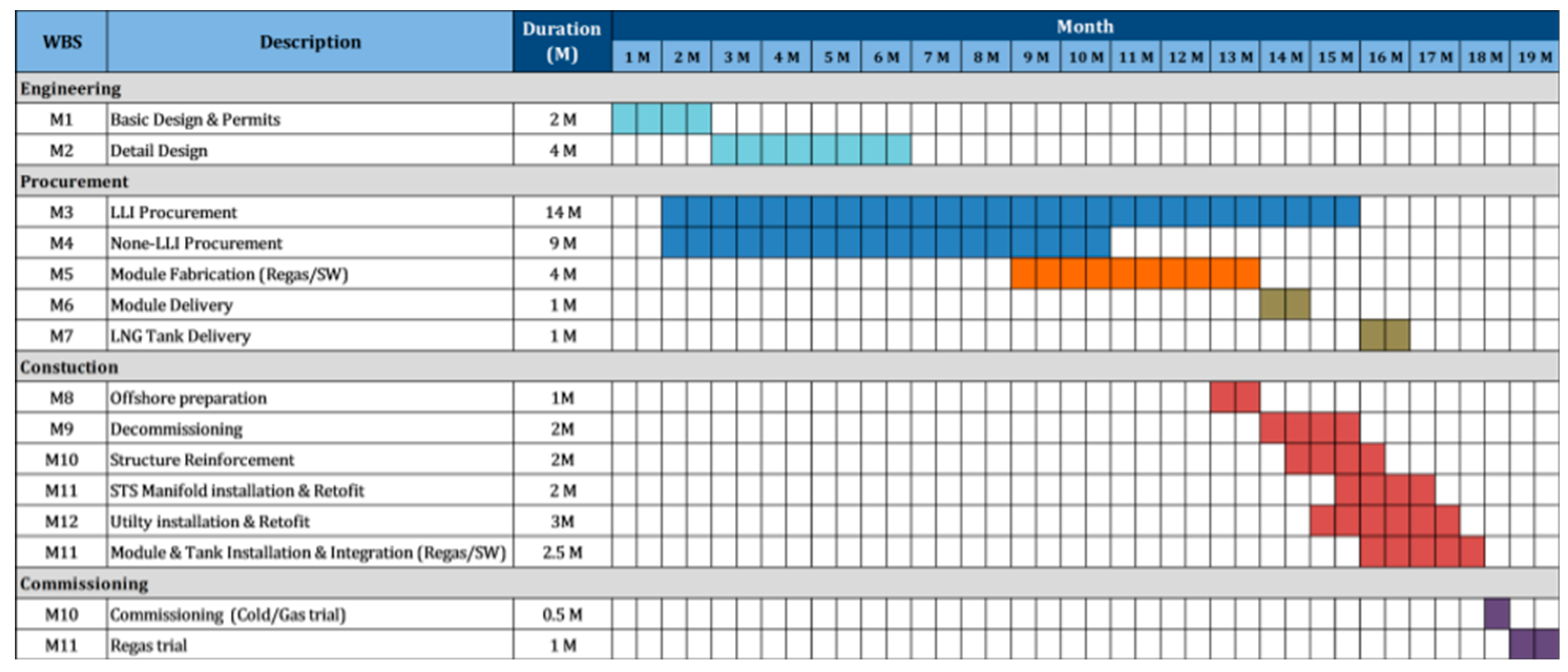
Figure 1. Gantt Chart of Project Schedule for Offshore Platform Conversion.
Preprints 211087 g001
Figure 2. Gantt Chart of Project Schedule for FSRU Retrofit.
Preprints 211087 g002
Figure 3. Gantt Chart of Project Schedule for Onshore LNG Terminal.
Preprints 211087 g003
Figure 4. AHP Hierarchical Structure.
Preprints 211087 g004
Table 1. Scope Comparison of LNG Regasification Alternatives.
Category Offshore Platform Conversion FSRU Retrofit Onshore LNG Terminal
Overall Description Repurposing existing offshore platform into LNG regas facility with modular regas system Conversion of LNG carrier into FSRU with integrated storage and regasification Full greenfield LNG terminal with storage, regas, and delivery system
Key Construction / Installation Scope Removal of legacy topside, deck reinforcement, modular regas installation, reuse of subsea pipeline Vessel retrofit, regas module installation, utility upgrade, subsea pipeline connection Civil works, LNG tank construction, regas installation, utility systems, pipeline to grid
Storage System LNG supplied via FSU, with buffer tanks on platform Integrated LNG storage and regas system Onshore LNG storage tanks (full containment)
Battery Limits (Upstream–Downstream) LNG transfer from FSU to existing subsea pipeline tie-in LNG transfer system with subsea pipeline to onshore facility LNG unloading via jetty to national gas grid connection
Key Interfaces FSU, offshore installation contractor, subsea pipeline operator Shipyard, subsea contractor, mooring and utility systems Marine EPC contractor, utilities, permitting authorities
Scope Exclusions Mooring system installation Mooring system installation Jetty and marine infrastructure handled separately
Table 2. Cost Breakdown of LNG Regasification Alternatives (20 MMSCFD).
Category LNG Platform-Based Modification Cost (USD) Onshore LNG Terminal Cost (USD) Floating Regasification Unit (FSRU) Cost (USD)
Engineering Engineering 420,000 Engineering 1,500,000 Engineering 350,000
Project Management Project Management Team 500,000 Project Management Team 750,000 Project Management Team 750,000
Platform / Infrastructure Topside & Structure 4,500,000 Jetty (0.5 km) & Dredging 8,000,000 FSRU (Conversion from Barge) 30,000,000
Platform / Infrastructure Conductor, Pipeline, Umbilical and Riser 1,500,000 Marine Loading Arm 5,340,000 Mooring System (Spread Mooring) 2,100,000
LNG Infrastructure Mooring System (SPM) 8,000,000 Cryogenic Pipeline 1,105,000 Flexible Hose (Cryogenic) 2,400,000
LNG Infrastructure Flexible Hose (Cryogenic) 2,400,000 LNG Storage 5,000,000 Subsea Gas Export Pipeline (10 km) 11,200,000
LNG Infrastructure LNG Storage (Type C) 5,000,000 Regasification System 1,960,000 Gas Export Pipeline 7,000,000
LNG Infrastructure Regasification System (IFV) 2,400,000 Utilities 4,032,500 EPC Cost 11,737,500
Utilities Utilities 8,900,000 Gas Export Pipeline 7,000,000 Permit & Social Cost 1,000,000
Other EPC Cost 8,175,000 Land Requirement 18,000,000 EPC Cost 16,296,875
Other Permit & Social Cost 1,000,000 EPC Cost 5,838,750 Permit & Social Cost 3,000,000
Other - - Permit & Social Cost 2,300,000 - -
Total Total Cost 42,795,000 Total Cost 60,826,250 Total Cost 85,834,375
Table 3. Cost Estimation Results using Cost–Capacity Scaling (100 MMSCFD).
Alternatives Cost (20 MMSCFD) Cost (100 MMSCFD)
Offshore Platform Conversion 42.80 112.40
FSRU Retrofit 60.83 159.76
Onshore LNG Terminal 83.83 220.19
Table 4. Cost Estimation Based on Analogous Method (100 MMSCFD).
Category Medium Classification Case A) Platform Retrofit LNG Terminal Case B) FSRU Retrofit Case C) Onshore LNG Terminal
Engineering Design, Safety, Permits & Project Management 4.3 6.5 12
Procurement Regas System, Utilities, Structure & Materials 20.2 30.7 83.7
Construction & Commissioning Site Prep, Civil Works, Installation & Tie-in 4.6 13.1 175
Commissioning Pre-commissioning, Testing & Materials 0.6 1.4 2.5
Direct Cost Subtotal 29.7 51.7 273.2
Project Indirect Supervision, Insurance & Admin 0.9 1.6 8.2
Contingency Design Changes, Weather Delay & Permitting 1.5 2.6 13.7
Indirect Cost Subtotal 2.4 4.1 21.9
EPC Total 32.1 55.8 295.1
Vessel Purchase¹ 40 40 NA
FSU Conversion 12 NA NA
Pipeline Cost NA 12 Included in EPC
Mobilization / Transition 2 2 NA
Total CAPEX (MUSD) 86.1 109.8 295.1
Table 5. Comparison of Cost Estimation Methods at 100 MMSCFD.
Alternative Cost–Capacity Scaling (MUSD) Analogous Method (MUSD)
Offshore Platform Conversion 112.4 86.1
FSRU Retrofit 159.76 109.8
Onshore LNG Terminal 220.19 295.1
Table 6. Table 6. Effective Scaling Exponent for LNG Regasification Alternatives.
Alternative Effective Scaling Exponent (n*)
Offshore Platform Conversion 0.43
FSRU Retrofit 0.37
Onshore LNG Terminal 0.78
Table 7. Table 7. Schedule Comparison of LNG Regasification Alternatives.
Alternative Estimated Duration
Offshore Platform Conversion 19 months
FSRU Retrofit 26 months
Onshore LNG Terminal 36 months
Table 8. Expert Pairwise Comparison Results for Technical Maturity.
Criteria Offshore FSRU Onshore
Offshore 1.000 0.794 0.581
FSRU 1.260 1.000 0.822
Onshore 1.721 1.217 1.000
Table 9. Normalized Priority Weights for Technical Maturity.
Criteria Offshore FSRU Onshore Overall Score
Offshore 0.251 0.264 0.242 0.252
FSRU 0.316 0.332 0.342 0.330
Onshore 0.432 0.404 0.416 0.418
Table 10. Pairwise Comparison Matrix for Cost Criterion Based on Scaling Method.
Criteria Offshore FSRU Onshore
Offshore 1.000 1.421 1.959
FSRU 0.704 1.000 1.378
Onshore 0.510 0.726 1.000
Table 11. Cost Priority Weights (Scaling Method).
Alternatives Offshore FSRU Onshore Overall Score
Offshore 0.452 0.452 0.452 0.452
FSRU 0.318 0.318 0.318 0.318
Onshore 0.231 0.231 0.231 0.231
Table 12. Pairwise Comparison Matrix for Cost Criterion Based on Analogous Method.
Alternatives Offshore FSRU Onshore
Offshore 1.000 1.275 3.427
FSRU 0.784 1.000 2.688
Onshore 0.292 0.372 1.000
Table 13. Cost Priority Weights (Analogous Method).
Alternatives Offshore FSRU Onshore Overall Score
Offshore 0.482 0.482 0.482 0.482
FSRU 0.378 0.378 0.378 0.378
Onshore 0.141 0.141 0.141 0.141
Table 14. Schedule Pairwise Matrix.
Alternatives Offshore FSRU Onshore
Offshore 1.000 1.368 1.895
FSRU 0.731 1.000 1.385
Onshore 0.528 0.722 1.000
Table 15. Schedule Priority Weights.
Alternatives Offshore FSRU Onshore Overall Score
Offshore 0.443 0.443 0.443 0.443
FSRU 0.324 0.324 0.324 0.324
Onshore 0.234 0.234 0.234 0.234
Table 16. AHP Criteria Weights and Descriptions.
Criteria Description Weight (%)
Cost Relative CAPEX requirement and cost efficiency 43.17%
Schedule Construction duration and exposure to delays 31.91%
Technical Maturity Engineering complexity, integration effort, and operability 24.92%
Table 17. Overall AHP Evaluation Results and Ranking (Case 1).
Alternatives Cost (43.17%) Schedule (31.91%) Technical maturity (24.92%) Overall results
Offshore Platform Conversion 0.452 0.443 0.252 0.399
FSRU Retrofit 0.318 0.324 0.330 0.323
Onshore Terminal 0.231 0.234 0.418 0.278
Table 18. Overall AHP Evaluation Results and Ranking (Case 2).
Alternatives Cost
(43.17%)
Schedule
(31.91%)
Technical maturity (24.92%) Overall results
Offshore Platform Conversion 0.482 0.443 0.252 0.412
FSRU Retrofit 0.378 0.324 0.330 0.349
Onshore Terminal 0.141 0.234 0.418 0.239
Table 19. Sensitivity Analysis Results (Cost).
Sensitivity Criteria Variable Initial Weight Weight Change Alternative Ranking Change
Increase 10% Increase 30% Increase 50% Decrease 10%
Weight
Cost Cost 43.17% 53.17% 73.17% 93.17% 33.17% No change in ranking
Schedule 31.91% 26.30% 15.07% 3.84% 37.53%
Technical Maturity 24.92% 20.54% 11.77% 3.00% 29.30%
Alternative
Offshore 0.406 0.424 0.449 0.473 0.400
FSRU 0.338 0.354 0.364 0.374 0.343
Onshore 0.257 0.222 0.187 0.152 0.257
Table 20. Sensitivity Analysis Results (Schedule).
Sensitivity Criteria Variable Initial Weight Weight Change Alternative Ranking Change
Increase 10% Increase 30% Increase 50% Decrease 10%
Schedule Cost 43.17% 36.83% 24.15% 11.47% 49.51% No change in ranking
Schedule 31.91% 41.91% 61.91% 81.91% 21.91%
Technical Maturity 24.92% 21.26% 13.94% 6.62% 28.58%
Alternative
Offshore 0.406 0.417 0.426 0.435 0.408
FSRU 0.338 0.345 0.338 0.330 0.352
Onshore 0.257 0.238 0.237 0.235 0.240
Table 21. Sensitivity Analysis Results (Technical Maturity).
Sensitivity Criteria Variable Initial Weight Weight Change Alternative Ranking Change
Increase 10% Increase 30% Increase 50% Decrease 10%
Technical Maturity Cost 43.17% 37.42% 25.92% 14.42% 48.92% There is a change in ranking
Schedule 31.91% 27.66% 19.16% 10.66% 36.16%
Technical Maturity 24.92% 34.92% 54.92% 74.92% 14.92%
Alternative
Offshore 0.406 0.391 0.348 0.306 0.433
FSRU 0.338 0.346 0.341 0.336 0.351
Onshore 0.257 0.263 0.311 0.358 0.216
Disclaimer/Publisher’s Note: The statements, opinions and data contained in all publications are solely those of the individual author(s) and contributor(s) and not of MDPI and/or the editor(s). MDPI and/or the editor(s) disclaim responsibility for any injury to people or property resulting from any ideas, methods, instructions or products referred to in the content.
Copyright: This open access article is published under a Creative Commons CC BY 4.0 license, which permit the free download, distribution, and reuse, provided that the author and preprint are cited in any reuse.
Prerpints.org logo

Preprints.org is a free preprint server supported by MDPI in Basel, Switzerland.

Subscribe

© 2026 MDPI (Basel, Switzerland) unless otherwise stated

Accessibility

Disclaimer

Terms of Use

Privacy Policy

Privacy Settings