
Submitted:
30 April 2026
Posted:
30 April 2026
You are already at the latest version
Abstract
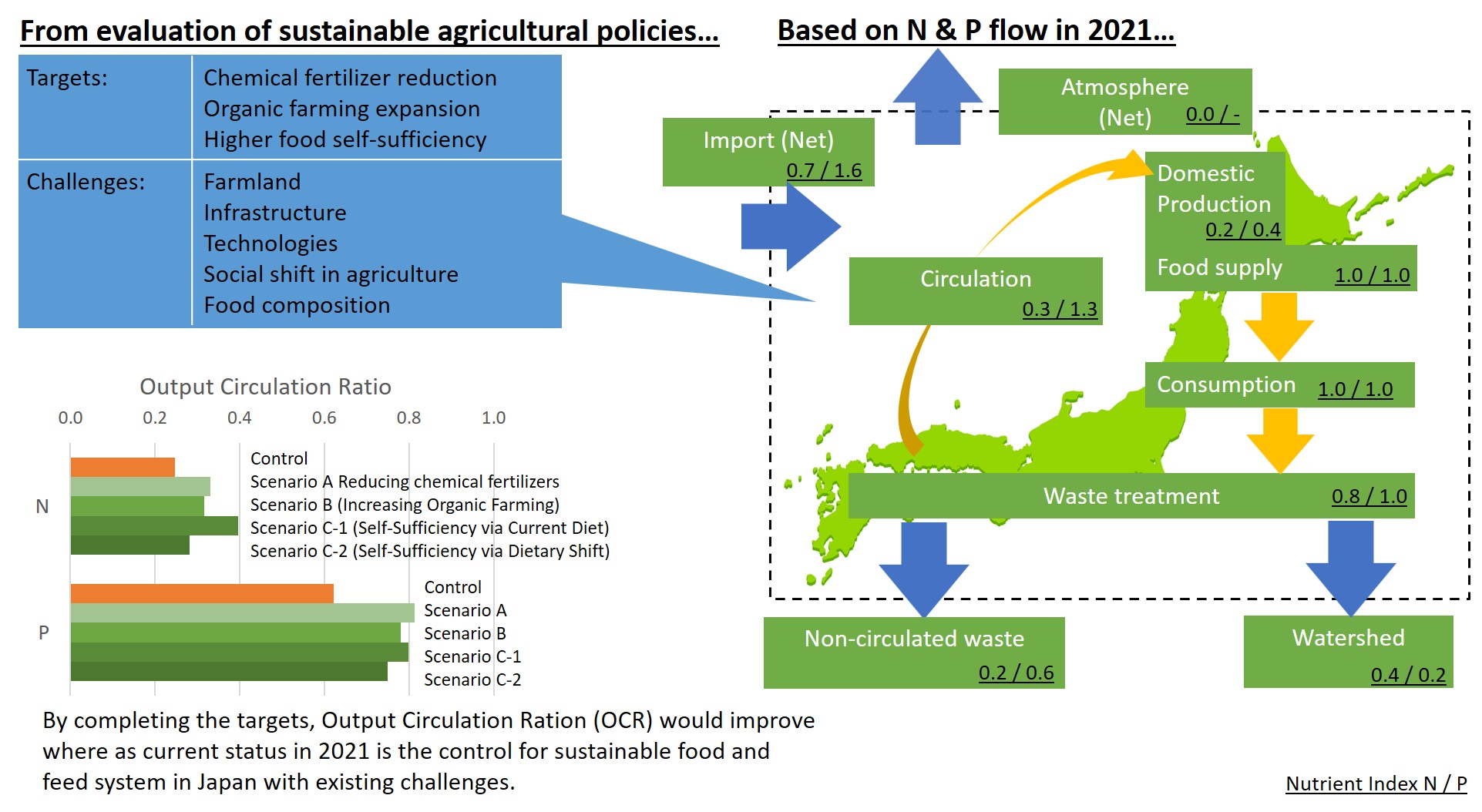
Recently, the Japanese government has introduced ambitious policies for agricultural sustainability, specifically the MIDORI Strategy, aimed at reducing chemical fertilizer use, expanding organic farmland, and increasing calorie-based food self-sufficiency. To evaluate the feasibility of these goals, this study quantified nitrogen and phosphorus flows within the 2021 food and feed system using a normalized “Nutrient Index.” A scenario analysis was conducted using policy targets as parameters, where currently non-circulated waste streams were modeled as potential sources for domestic nutrient recovery. The results indicate that Scenario A (a 30% reduction of chemical fertilizers) is the most feasible, achieving significant improvements in circulation ratios through recovery of nutrients from sewage and livestock waste. While Scenario B (increasing organic farmland) shows similar trends, its success depends on technological advancements to mitigate the yield gap between organic and conventional systems. Scenario C (increasing calorie-based food self-sufficiency) presents the greatest challenge: maintaining current dietary patterns requires a 20% expansion of farmland and total nutrient recovery from waste. However, shifting dietary habits toward higher domestic rice consumption (Scenario C-2) significantly mitigates land and fertilizer demand. Achieving these targets requires a holistic approach that integrates technological infrastructure with socio-political shifts in land use planning and consumer behavior.
Keywords:
nitrogen and phosphorus flow
; food and feed systems
; sustainable agriculture
; MIDORI strategy
; scenario analysis
Copyright: This open access article is published under a Creative Commons CC BY 4.0 license, which permit the free download, distribution, and reuse, provided that the author and preprint are cited in any reuse.


