

Submitted:
28 April 2026
Posted:
29 April 2026
You are already at the latest version
Abstract
The escalating demand for sustainable metallurgical practices necessitates innovative approaches to manganese production. The smelting-aluminothermic reduction of hydrogen pre-reduced manganese ores in a direct current (DC) arc furnace offers a resilient and sustainable trajectory for optimizing manganese recovery efficiencies while minimizing waste generation under low-carbon operating conditions. This study presents a comparative of smelting-aluminothermic reduction of two Mn ores pre-reduced with hydrogen using two distinct approaches, namely, a packed-bed vertical retort and a plasma rotary furnace. A 200 kW DC arc furnace was used for smelting. The scope of this assessment integrates technical, environmental and operational metrics of smelting-aluminothermic reduction. For energy, the considered metrics are power stability metrics, specific energy requirement, furnace thermal efficiency and load factor/power-on time. The metrics considered for material are reductant efficiency, elemental accountability, elemental recovery, elemental deportment and slag-to-metal ratio. For process sustainability, refractory and electrode consumption were considered. The environmental indicators considered includes CO2-equivalent emissions per ton of product, dust and particulate emissions, NOx/SOx emissions. This research provides critical insights into the viability and environmental advantages of hydrogen pre-reduction coupled with smelting-aluminothermic reduction for cleaner manganese production.
Keywords:
smelting-aluminothermic reduction
; hydrogen pre-reduced manganese ore
; DC arc furnace
1. Introduction
Manganese is a critical element in the steel industry, primarily used as a deoxidizer, desulfurizer, and alloying agent to enhance steel’s strength and abrasion resistance [1,2]. The global demand for Mn alloys is substantial, with millions of tonnes of high-carbon ferromanganese and silicomanganese produced annually [3]. Traditionally, ferromanganese alloys are produced through carbothermic reduction of manganese ores in submerged arc furnaces[4,5,6]. This conventional method is highly energy-intensive, consuming 2000–3500 kWh per tonne of alloy, and is a significant contributor to greenhouse gas emissions, typically releasing 1–1.4 tonnes of CO2 per tonne of metal produced due to the reliance on metallurgical coke as both a reductant and energy source [4,5,6,7].
The urgent need to align with global climate targets, such as the Paris Agreement’s goal of decreasing CO2 emissions by 45% by 2030 and achieving net-zero by 2050, necessitates the development of innovative and sustainable manganese production processes [6].
Current pyrometallurgical processes face challenges related to high energy consumption, substantial carbon emissions, and the generation of large volumes of by-products like slag [7,8]. These challenges highlight a critical research gap: the need for cleaner, more efficient, and environmentally benign technologies for manganese extraction.
Smelting-aluminothermic reduction presents a promising alternative to carbothermic processes. This method utilizes aluminum as a reducing agent, which is a highly exothermic reaction, potentially reducing external energy input and offering a pathway for valorizing aluminum-containing industrial wastes like Al dross [3]. Furthermore, the integration of hydrogen (H2) pre-reduction can significantly improve the overall sustainability of the process. Hydrogen pre-reduction has been shown to accelerate the decomposition of carbonates and facilitate the metallization of manganese oxides, offering a low-emission pathway by reducing reliance on carbon-based reductants and lessening atmospheric gaseous carbon release [2,6,9]. Studies have investigated the effects of various factors, including temperature, gas composition, and ore characteristics, on the H2 reduction process, noting that H2 addition can increase the rate of reduction [6].
The use of direct current arc furnaces in metallurgical applications has gained traction due to several advantages over traditional alternating current furnaces, including better power efficiency, reduced electrode consumption, lower noise levels, and improved heat distribution [10]. These characteristics make DC arc furnaces particularly suitable for processes aiming for high energy efficiency and operational stability.
This study aims to provide a comprehensive comparison of the smelting-aluminothermic reduction of hydrogen pre-reduced manganese ores in a 200 kW DC arc furnace. Specifically, we investigate the comparative performance of two different H2 pre-reduction approaches (packed-bed vertical retort and plasma rotary furnace) in conjunction with smelting-aluminothermic reduction. The assessment integrates a wide array of technical, environmental, and operational metrics, including energy and resource efficiencies, environmental burdens (e.g. GHG intensity, waste generation), eco-efficiency ratios, and operational sustainability indicators. By doing so, this research seeks to demonstrate the potential of this integrated process for achieving resilient, sustainable, and optimized manganese recovery with minimal environmental impact. The findings contribute to the ongoing efforts towards decarbonizing the metallurgical industry and advancing circular economy principles in metal production.This study is further seeks to demonstrate the HAlMan process on higher technology readiness level (TRL 6) level. For the background and description of the HAlMan process, the reader is referred else where [11,12]
2. Materials and Methods
2.1. Materials
Two manganese ores were used in this study, namely, United Manganese of Kalahari (UMK) ore and Nchwaneng ore. Both ores originates from the Kalahari Manganese Field (KMF), located in the Northern Cape Province of South Africa. The two ores differ in mineralogy and grades, and are mined by different companies (e.g. UMK ore is mined by United Manganese of Kalahari (UMK) (Pty) Ltd, whereas Nchwaning ore is mined by Hotazel Manganese Mines (HMM)). The Nchwaning ore employed in the was procured through Assmang (Pty) Ltd., Cato Ridge, South Africa. UMK ore was supplied by Transalloys (Pty) Ltd, South Africa.The as-received lumpy ores were subjected to comminution and granulometric classification into the –20 mm + 6 mm fraction to conform with the stringent operational specifications of Mintek’s feed system.
Two distinct pre-reduction approaches were deployed for the hydrogen-mediated conditioning of these ore fragments at elevated temperatures (700–900 °C): (i) a vertical retort packed-bed furnace (Figure 1) and (ii) rotary plasma furnace (sample pre-reduced by SINTEF).
Complementary raw materials incorporated into this study includes flux (burnt lime) which was supplied by local supplier and reductant (metallic aluminium), procured from Alitrop (Pty) Ltd. Burnt lime was also subjected to crushing and granulometric refinement (–20 mm + 6 mm) to ensure feed-system compatibility, while the aluminium required only screening to the prescribed size interval for operational integration. The images showing the appearance of pre-reduced Nchwaning ore, pre-reduced UMK ore, burnt lime and aluminium are presented in Figure 2.
2.1.1. Chemical Analyses
UMK pre-reduced ore, Nchwaning pre-reduced ore (both from Mintek and from SINTEF) and lime were subjected to chemical analyses which employed Inductively Coupled Plasma – Optical Emission Spectrometry (ICP-OES). The Mintek internal reference material, SARM16, was used. These methods The obtained results are summarized in Table 1 and Table 2. Species with concentrations of parts per million (as well as loss on ignition) are not reported in Table 1,
and that thus the percentages will not add to 100 percent. For mineral-assay reconciliations, the inductive coupled plasma optical emission spectroscopy (ICP-OES) results were used to validate the mineral abundance data obtained from X-ray diffraction (X-Ray Diffraction).
2.1.2. Mineralogical Analyses
For XRD mineralogical analyses, pre-reduced manganese ores we first pulverised samples and then micronized to achieve particle size below m to ensure the acquisition of more representative data for minerals and elements quantification. The samples were subjected to the Bruker D8 diffractometer equipped with Fe-filtered Co K radiation, and ran over a 2 theta range of 5-80 degrees with a step size of 0.02 degrees 2 theta. Minerals were initially identified using Bruker EVA® software, while the quantification of minerals was done using TOPAS® software. Since pre-reduction was done batch-wise, XRD results of the successive tests were used to inform on optimizing the operating conditions (e.g. temperature, holding time, gas-to-solid ratio and so forth) for the next batch.
2.2. Smelting Operations
The 200 DC arc furnace testing facility housed at the Bay 1 area of Mintek was used in this study. A schematic representation of the facility layout is presented in Figure 3, highlighting the major operational domains. For brevity, auxiliary systems (e.g., the cooling-water circuit, gas pipelines and so forth) are not depicted in the diagram. The facility extends over two floors, and consists of three primary operational domains, namely:
- Feed section: this domain is endowed with raw material hoppers, conveyor systems, and a mixing bin for charge preparation.
- Furnace section: this zone incorporates a hydraulic electrode-control system, a robust furnace shell lined with refractories, and integrated cooling-water circuits.
- Off-gas handling section:this section is furnished with an off-gas port, dedicated extraction lines, and a baghouse system for effective dust capture and emissions control.
The feed and furnace sections are equipped with instrumentation network, enabling real-time, remote monitoring and precise operational control. Conversely, the off-gas realm is not endowed with instrumentation, compelling persistent on-site vigilance and physical inspections to ensure reliability and continuity of operation. Thermal management was ensured through a dedicated cooling-water circuit that continuously cycled water through both furnace and off-gas ducting components. The facility is equipped with gas pipeline infrastructure, ensuring reliable supply of essential utilities such as compressed air and oxygen.
2.2.1. Experimental Framework
Part of the experimental framework of HAlMan Campaign 1 (Table 3) was systematically configured to investigate four critical process and operational conditions during the smelting of Nchwaning samples pre-reduced via packed-bed vertical retort furnace (Mintek) and rotary plasma furnace (SINTEF), respectively. It is important to highlight that the first part of Campaign 1 was dedicated to smelting-aluminothermic reduction of high carbon ferromanganese slag (HCFeMn slag).
A pivotal transition from HCFeMn slag to Nchwaneng ore pre-reduced using packed-bed vertical retort furnace induced reduced slag volumes and elevated bath temperatures, necessitating specific energy requirement (SER) modulation (0.95 to 0.85, in taps 24 through 26) to re-anchor the system at 1550 °C. For the Nchwaning ore pre-reduced using the rotary plasma furnace, MnO suppression of MnO in slag (<4 mass%) was again realized by increasing Al additions (26.0 to 28.6 kg, in taps 27–29). The final condition (taps 30–36) explored the flux–reductant synergy, wherein lime addition was increased from 26.7 to 30.0 kg and Al additions were increased from 28.6 to 32.0 kg. Overall, these trials provided information towards of Nchwaning ore pre-reduced to employing two different approaches, namely, packed-bed vertical retort furnace and rotary plasma furnace.
The experimental framework of HAlMan Campaign 2 (Table 4) is comprised of nine conditions designed to investigate the furnace stability, compositional control, ore transitions and power scaling. Condition 1 (taps 1–5) sought to stabilize the furnace with regard to energy and mass, yet arc instability at 100 V necessitated reduction to 70 V, alongside increases in SER (0.85 to 0.95). In pursuit of alloy and slag compositions targets, both the reductant (Al) and the flux (lime) were increased, namely aluminium (9 to 30 kg), and lime (20 to 28 kg). With targets unmet, Condition 2 (taps 6–8) further intensified reagent inputs (Al: 30 to 34 kg; CaO: 28 to 32 kg) and raised SER (0.95 to 1.0). Condition 3 (taps 9–11) explored lime fineness under 90 V, while Condition 4 (taps 12–15) saw the increase in power from 130 kW to 150 kW at 100 V.
Condition 5 (taps 16–18) marked the transition from pre-reduced UMK ore to pre-reduced Nchwaning ore, with slag withheld at tap 16 and voltage reduced to 90 V. Analogous to earlier UMK ore, Condition 6 (taps 19–21) increased SER, Al, and lime modestly (to 1.05, 36 kg, 34 kg, respectively), while Condition 7 (taps 22–24) advanced these inputs further (SER 1.15, Al 40 kg, CaO 38 kg). Condition 8 (taps 25–27) revisited high-power operation (150 kW, 100 V), which was carried forward as Condition 9 (taps 28–30).
Together, these conditions established a systematic progression of operational perturbations, elucidating the coupled roles of voltage, SER, fluxing additions, and ore transition in stabilizing furnace operations and aligning slag–alloy compositions. Campaigns 1 and 2 generated data towards that integrates technical, environmental and operational metrics of smelting-aluminothermic reduction. In this study, a detailed energy and material balances, quantification of environmental burdens, and indicators of process sustainability are covered, thereby extending beyond conventional eco-efficiency analyses.
3. Results
3.1. Effect of Pre-Reduced Ores Properties
3.1.1. Energy
A. Power Stability Metrics: Arc Stability, Voltage/Current Fluctuations
The stability of the electric arc, along with the degree of voltage and current fluctuations, are critical operational indicators in electric arc furnaces. These metrics directly influence energy efficiency, electrode and refractory life, and overall process performance [13,14].
Figure 4 shows the comparison of the set-points (current, voltage and power) against experimental observed values for the (a) UMK ore pre-reduced in a packed-bed retort furnace, and (b) Nchwaning ore pre-reduced in a packed-bed retort furnace. The voltage instabilities and voluntary voltage reduction directly affects the power stability and reduces delivered power. In many EAF operations, control systems aim to minimize variations in arc voltage and current to maximize power input and stabilize the process [15].
B. Specific Energy Requirement
The specific energy requirement (in kWh/kg), is a critical performance indicator in metallurgical processes. In this study, eq:SER was employed to calculate the specific energy requirement, SER, where the obtained results are plotted in Figure 5.
Changes in target SER setpoints, for instance, increases from 0.85 to 0.95, then to 1.05, and 1.15 (Conditions 1, 6, and 7, respectively), guide the operational modifications of other parameters like aluminum and lime additions and feed rate, all aimed at achieving the desired energy input per unit of processed material [16]. Increasing Al and lime additions (e.g., in Condition 1, 2, 6, 7) affects the chemical energy balance of the furnace.
The specific energy requirement of the process can also be estimated from the slope of a plot of average power against average feed rate (Figure 6), independently of heat losses. The y-intercept of this plot provides an estimation of the heat losses.
C. Furnace Thermal Efficiency
The energy losses to the environment are a critical factor in determining the thermal efficiency of pyrometallurgical equipment. The energy losses to the environment, used in the energy balance calculations, relate directly to the thermal efficiency of the equipment. Overall energetic efficiency in pyrometallurgical operations can be defined as the ratio of theoretical energy requirement to real energy output [8]. In this study, eq:thermalefficiency was used to define the thermal efficiency.
This method of calculating thermal efficiency usually provides a very good correlation for this facility. However, in this process, with the addition of energy from the smelting-aluminothermic reduction reaction, a low thermal efficiency is sometimes calculated, as shown in Figure 7, that gives the furnace power vs thermal efficiency.
C. Load Factor/Power-on Time
The operational efficiency of a smelting process is critically influenced by its load factor (), which represents the proportion of effective smelting time () relative to the total operational cycle, including downtime (). A high load factor signifies optimized furnace utilization, crucial for economic viability and increased productivity in industrial applications. This section details the calculated load factors for the three experimental campaigns, providing insight into the operational performance of the respective pre-reduction routes and smelting.
The is defined as the sum of all tap durations, and is the sum of all downtimes, calculated using the following formulas:
The calculated operational metrics for each pre-reduced manganese ore are summarized in Table 5.
3.1.2. Materials
A. Reductant Efficiency
The efficiency of aluminum as a reductant is a pivotal metric in pyrometallurgical operations, particularly when leveraging secondary aluminum sources. It quantifies the effectiveness with which supplied aluminum is consumed for the intended reduction of target metal oxides, specifically manganese, iron, and silicon. Achieving high reductant efficiency is paramount for both economic viability and minimizing the environmental footprint of such processes [3,18]. As defined in Reductant efficiency1, represents the ratio of aluminum stoichiometrically consumed to produce Mn, Fe, and Si to the total aluminum fed into the furnace. Attaining high reductant efficiency is essential for both economic viability and minimizing the environmental footprint of such pyrometallurgical operations.
The reductant efficiencies observed in this study (as shown in Figure 8), demonstrate variability depending on the properties of the respective pre-reduced ores. Nchwaning manganese ore pre-reduced in a retort packed bed furnace exhibited efficiencies between 30.89% and 55.32%. This can be attributed to the pre-reduction extent of the respective ores via respective pre-reduction approaches, whereas for UMK manganese ore, also pre-reduced in a retort packed bed furnace, the efficiencies spanned from 19.46% to 56.67%.
B. Elemental Accountability
The overall mass accountability provides a measure of the closure of the elemental balance across the smelting system. It compares the total elemental input (from feeds such as dross, lime, and pre-reduced ores) with the total output (in metal, slag, and dust streams).
In this study, the accountability of each element was determined to evaluate the degree of mass balance closure within the reduction process. It is defined as the ratio of the total mass of each element exiting the system through all product and by-product streams to the total mass entering the system through feed materials, as given in Equation 7.
where is the mass of element i in all output streams (metal, slag, and dust), and is the corresponding mass of element i in all input materials.
Figure 9 presents the overall calculated elemental accountabilities for Al, Ca, Fe, Mg, Mn, and Si for Campaign 2 (Taps 1C2 to 30C2). The overall accountability values ranged from approximately 95.40% for Mn to 103.46% for Fe. Specifically, Al accountability was 97.93%, Fe was 103.46%, Mn was 95.40%, and Si was 96.34%. These values generally exceed 95%, indicating a satisfactory overall mass balance.
C. Elemental Recovery
Elemental recovery quantifies the extent to which target species were transferred from the feed materials into the metallic phase. It is a key indicator of the process efficiency and reflects both thermodynamic and kinetic factors governing reduction, phase separation, and alloy formation. The recovery of each element was calculated using eq:recovery1.
where is the mass of element i recovered in the metallic product, and is the total mass of that element charged to the system via all input materials.
The overall elemental recovery values into the metal phase are shown in Figure 10. In the metal stream, Fe exhibited a high recovery of 96.44%, and Mn recovery was 65.92%. Si recovery was 42.28%, while Al showed a minor recovery of 3.87%. The elements that were recovered in the slag stream are Al: 94.02%, Fe: 6.61%, Mn: 29.20%, Si: 53.85%, whereas those in the dust stream are Al: 0.04%, Fe: 0.40%, Mn: 0.28%, Si: 0.21%.
D. Elemental Deportment
Deportment describes the distribution of each element among the various product phases, viz:metal, slag, and dust, and provides insight into the selectivity and completeness of reduction reactions. It complements the recovery analysis by indicating how effectively elements were partitioned into their thermodynamically preferred phases [19,20]. The elemental deportment (%) to each phase was determined using eq:deportment1.
where is the mass of element i in phase j (metal, slag, or dust), and is the total mass of that element in all output streams.
Figure 11 illustrates the elemental deportment behavior across the process. Fe and Mn predominantly reported to the metallic phase, with 93.22% of Fe and 69.09% of Mn deporting to metal. Si showed a significant deportment to metal at 43.88%. Al, however, was primarily concentrated in the slag (96.01%). Minor amounts of elements were found in the dust stream.
E. Slag-to-Metal Ratio
The slag-to-metal ratio (SMR), defined as the mass of slag produced per unit mass of metal tapped (kg slag / kg metal), is a key metric for assessing material efficiency, energy demand, and downstream waste management in ferroalloy production. A lower SMR generally indicates more efficient utilization of raw materials and energy, reduced slag handling requirements, and a lower environmental burden. The experimental slag and metal masses obtained in this study are summarized, and the calculated overall SMRs for each campaign are presented in Table 6, derived from the aggregated mass of slag and metal from all taps where both products were successfully obtained, providing a more representative average for each campaign. The overall SMRs ranged from 1.34 kg/kg to 1.87 kg/kg. The individual tap-wise SMRs are also depicted in Figure 12.
3.1.3. Process Sustainability
A. Refractory Consumption
Refractory lining degradation is a critical operational and economic factor in high-temperature metallurgical processes, including ferroalloy production. The wear rate of refractory materials directly influences furnace longevity, maintenance schedules, energy efficiency, and overall production costs [21]. In electric arc furnaces, refractory consumption is primarily driven by thermomechanical stress, chemical corrosion by molten slag and metal, and erosion [22]. This section quantifies the refractory consumption during the experimental campaigns and discusses its implications.
Refractory consumption, specifically the loss of magnesia from the furnace lining, was estimated by calculating the difference between the cumulative MgO leaving the system in the slag and the cumulative MgO introduced with the feed materials over each campaign. The results, expressed as kilograms of MgO consumed per kilogram of metal produced, are summarized in Table 7 and in Figure 13.
The refractory consumption rates varied between 0.1051 kg MgO/kg metal and 0.1828 kg MgO/kg metal across the two pre-reduced ores. Refractory consumption rates are highly dependent on specific furnace design, operating parameters (e.g., temperature, slag chemistry, specific energy input), and the type of refractory material used.
B. Electrode Consumption
Electrode consumption is a significant operational cost and an important environmental consideration in electric arc furnace metallurgical processes. The rate of electrode wear is influenced by various factors including electrical parameters (current, voltage), furnace atmosphere, slag chemistry, operating temperature, and the specific composition of the electrode material itself [22]. Minimizing electrode consumption is crucial for improving the overall economic efficiency and reducing the carbon footprint of ferroalloy production. This section quantifies the electrode consumption during the experimental campaigns and discusses its implications.
The total mass of electrode consumed during each campaign was measured and then normalized by the total mass of metal produced to derive a specific electrode consumption rate, expressed in kilograms of electrode per kilogram of metal. The results are summarized in Table 8.
The specific electrode consumption rates varied considerably across the three experimental campaigns, ranging from a notably low 0.0014 kg electrode/kg metal for the Nchwaning ore pre-reduced in a retort packed-bed furnace to 0.1105 kg electrode/kg metal for the UMK ore pre-reduced in a retort packed-bed furnace. The Nchwaning ore pre-reduced in a plasma rotary furnace showed an intermediate consumption rate of 0.0596 kg electrode/kg metal.
The exceptionally low consumption rate observed for the Nchwaning ore pre-reduced in a retort packed-bed furnace (0.0014 kg/kg) is striking and warrants further investigation into the specific operational conditions, slag chemistry, and/or metal tapping procedures during this campaign that might have contributed to such minimal electrode degradation. This value, if representative, signifies a major advantage for this particular processing route.
3.1.4. Environmental Indicators: CO2-Equivalent Emissions per Ton of Product, Dust and Particulate Emissions, NOx/SOx Emissions
Environmental impacts were quantified using attributional life-cycle assessment principles in accordance with ISO 14040 and ISO 14044 standards [23]. The system boundary for this assessment included direct process emissions, as well as indirect emissions associated with electricity generation and reductant production. The functional unit for all impact assessments is defined as one tonne of final alloy product. This evaluation combined direct process emissions measured by an accredited environmental monitoring laboratory with indirect emissions from literature-based estimates.
A. Stack Emissions and Atmospheric Pollutants
Stack monitoring of the 200 kW DC arc furnace was performed by Rayten Engineering Solutions Ltd., an independent laboratory accredited to ISO/IEC 17025:2017 standards by SANAS (T0894) [24]. The measurements were conducted during the June 2025 Mintek Campaign 2, utilizing internationally accepted reference methods that comply with the National Environmental Management: Air Quality Act of 2004 (Act 39 of 2004), specifically US EPA Methods 1, 2, 3A, 4, 5, 6C, and 7E for the respective pollutants [24]. Sample ports on the stack were utilized for volumetric flow rate and isokinetic measurements [24].

Table 9.
Average measured gaseous emissions from the 200 kW DC arc furnace.
| Parameter | Units | Value | Uncertainty |
|---|---|---|---|
| Average Particulate Matter | mg/Nm3 | 3.5 | ±1.14 mg |
| Average Sulphur Dioxide (SO2) | mg/Nm3 | 0 | ±18.87 ppm (detection limit) |
| Average Oxides of Nitrogen (NOx) | mg/Nm3 | 3.49 | ±6.67 ppm |
| Average Carbon Dioxide (CO2) | mg/Nm3 | 775 | N/A (ambient background) |
| Average Oxygen (in stack) | %v/v | 20.8 | ±0.22% |
3.2. Effect of Pre-Reduction Approach
3.2.1. Energy
3.2.1.1. A. Power Stability Metrics: Arc Stability, Voltage/Current Fluctuations
Figure 14 shows the comparison of the set-points (current, voltage and power) against experimental observed values for the (a) Nchwaning ore pre-reduced in a rotary plasma furnace, and (b) Nchwaning ore pre-reduced in a packed-bed retort furnace.
C. Load Factor/Power-on Time
The calculated operational metrics for each pre-reduced manganese ore are summarized in Table 10.
Both pre-reduction approaches demonstrated gave a load factor of 96.89 %. This indicates a remarkably efficient utilization of the experimental furnace across all tests, characterized by minimal inter-tap downtime.
3.2.2. Materials
A. Reductant Efficiency
The reductant efficiencies observed for the two approaches employed in this study are shown in Figure 15, and demonstrate variability depending on the specific pre-reduction approach. For Nchwaning manganese ore lumps pre-reduced in a plasma rotary furnace, efficiencies ranged from 28.98% to 75.34%. Nchwaning manganese ore pre-reduced in a retort packed bed furnace exhibited efficiencies between 30.89% and 55.32%. This can be attributed to the pre-reduction extent of the respective ores via respective pre-reduction approaches.
B. Slag-to-Metal Ratio
The experimental slag and metal masses obtained in this study (for the two approaches) are given in Table 11, alongside the Slag-to-metal ratios. The overall SMRs were 1.34 kg/kg and 1.79 kg/kg, for rotary plasm furnace and vertical retort furnace approaches, respectively. The individual tap-wise SMRs are also presented in Figure 16.
3.2.3. Process Sustainability
3.2.3.1. A. Refractory Consumption
4. Discussions
4.1. Effect of Pre-Reduced Ores Properties
4.1.1. Energy
A. Power Stability Metrics: Arc Stability, Voltage/Current Fluctuations
Despite furnace electric arc stability , voltage and current being critical operational indicators, the deviations between target and experimental values are inherent to electric arc furnace operations and reflect the dynamic nature of the arc, the varying charge characteristics, and the control system’s response [25,26]. The observed fluctuations (in Figure 14) are direct indication of arc instability, which can also be influenced by factors such as arc movement and plasma jet length variations [27,28].
Critically, voltage instabilities and voluntary voltage reduction directly affect power stability and reduce delivered power [10,29]. In this experimental framework, initial arc instability at 100 V necessitated a reduction in target voltage to 70 V for some trials with UMK ore, indicating a necessary operational adjustment to maintain a stable process and avoid excessive fluctuations. Control systems in many EAF operations aim to minimize variations in arc voltage and current to maximize power input and stabilize the process [26,30].
Large and frequent deviations and transients are known to increase electrode erosion significantly [31]. This occurs through enhanced oxidation at hot spots during arc wandering, mechanical tip wear during electrode slipping and re-striking, and localized hot-spot evaporation or chemical attack of the electrode and refractory lining [31]. The impact on refractory life is also pronounced, as arc wandering and poor heat coupling increase local refractory heating, which can shorten the lining’s operational lifespan[31]. High voltage and current fluctuations are also associated with increased wear on furnace components and higher energy losses [29].
Arc stability in EAFs is not typically measured by a single universal efficiency percentage. Instead, it is often quantified using statistical indices of voltage and current signals, such as standard deviation, variance, or specific power factor ranges [32,33] . High voltage and current fluctuations indicate a less stable arc, leading to erratic heat transfer and higher energy losses [29].
Researchers have proposed various metrics and models, including the Arc Quality Index, to evaluate arc quality and stability [34]. In this study, power stability in a DC arc furnace is assessed using three complementary, quantitative metrics, namely, current-tracking error (percentage deviation between measured and set-point current), voltage deviation (percentage deviation between measured and set-point voltage), and realized power deviation (percentage deviation between measured and target active power).
These quantitative metrics can be defined by
These metrics together quantify how closely the furnace follows operator setpoints and the degree of transient disturbances that can increase electrode wear and refractory attack [13]. The observed statistics, indicating a systematic shortfall of realized current and power relative to set-points (mean deviations approximately -10% to -12%) with moderate shot-to-shot variability (standard deviations 4% to 6%), can be attributed to factors such as arc instabilities, occasional electrode slipping/immersion transients that reduce effective current transfer, variations in bath impedance during feed events, and voltage reduction initiated by unstable arc conditions [35].
B. Specific Energy Requirement
The Specific energy requirement (SER) is influenced by a range of operational factors, including voltage and power adjustments [36], targeted SER setpoint changes, the addition of reductants and fluxes (such as lime, coke, and oxygen) [14,37], transitions in ore type [14,38], and variations in feed rate [16]. Therefore, operational adjustments, such as an initial arc instability at 100 V leading to a reduction to 70 V to stabilize power delivery, and subsequent increases in power (from 130 kW to 150 kW) and voltage (to 100 V), had a direct impact on the total energy input and, consequently, the calculated SER.
For high-carbon ferromanganese production in submerged arc furnaces, typical specific energy requirements range between 2.0 and 3.5 MWh per tonne of alloy [39]. The innovative HAlMan process, which leverages on smelting-aluminothermic reduction, has demonstrated the potential for substantially lower specific energy requirement values. Reported figures indicate values around 880 kWh/tonne for similar eco-friendly, low-carbon manganese ferroalloy production methods, representing a significant energy reduction compared to conventional processes [40]. This aligns with findings where pre-treated materials can lead to over 50% reduction in electricity demand for HCFeMn production [41]. The current SER values, ranging from 0.8 to 1.15 kWh/kg (equivalent to 800-1150 kWh/tonne), fall within a competitive range, particularly when considering the aluminothermic nature of the process [12,42,43].
C. Furnace Thermal Efficiency
The thermal efficiency for a small-scale furnace is expected to be significantly lower than that of a commercial or large-scale pilot plant facility. Since smelting-aluminothermic reduction reactions are exothermic, the heat losses appear greater than the electrical power input due to the additional energy released during the smelting-aluminothermic reduction reactions. The furnace thermal efficiency calculated on a tap-by-tap basis is shown in Figure 7.
As illustrated in Figure 7, the addition of energy from the smelting-aluminothermic reduction reaction can, at times, lead to a calculated low thermal efficiency. This phenomenon occurs because the significant energy released during the smelting-aluminothermic reduction reactions can cause the measured heat losses to exceed the apparent power input [3,44]. This highlights the complex energy dynamics within the furnace where internal exothermic processes contribute substantially to the overall thermal state, impacting the traditional interpretation of efficiency metrics.
D. Load Factor/Power-on Time
The observed high load factors (95.89 % and 96.89 % for Nchwaning and UMK ores respectively) aligns well with the inherent operational flexibility and process control advantages offered by DC arc furnace technology, which often translates to higher furnace availability and lower heat losses during operation compared to other furnace types. Such high operational continuity is highly advantageous in industrial settings, suggesting that these smelting routes, particularly when coupled with efficient material handling, can achieve superior productivity. Industrial electric arc furnaces, particularly in sectors such as steelmaking and ferroalloy production, target high utilization rates to maximize throughput and cost-effectiveness. For instance, the average capacity utilization factor for scrap-based EAFs in the EU has been reported around 83% [45].
For the UMK ore, it’s notable that one tap (Tap No. 1C2) registered 0.0 h tap duration, which might indicate a non-operational or aborted run. While this specific instance would contribute to downtime if it were a planned part of the cycle, its impact on the overall load factor, given the very low summed values, suggests that the typical operational flow between taps was very efficient.
4.1.2. Materials
A. Reductant Efficiency
The high reductant efficiency (reported in par:Reductant efficiency) can be associated with factors such as the aluminum content in the charge and critical aspects of slag chemistry [3]. Optimized slag conditions, characterized by carefully controlled basicity, viscosity, and liquidus temperature, are essential for efficient metal-slag separation and high recovery rates of manganese [46,47]. Variations in these parameters can significantly impact the effectiveness of aluminum as a reductant, affecting overall efficiency and metal yield.
Furthermore, process parameters such as pre-reduction methods, furnace design and the inherent characteristics of the manganese ore (e.g., mineralogy, particle size) play a crucial role in determining reductant efficiency [4,5,48] . Excess aluminum additions, oxidation losses, and the efficiency of recovery in the final alloy also contribute to the overall reductant utilization [49]. Higher efficiency values indicate a substantial proportion of the added aluminum actively participates in the desired reduction reactions, leading to improved recovery of valuable metals and a reduction in energy consumption [49]. Continuous optimization of these integrated process elements is vital for advancing sustainable and economically viable manganese production [12,18].
B. Elemental Accountability
The observed deviations from 100% accountability can be attributable to a combination of experimental and analytical uncertainties. These can include significant measurement errors, material heterogeneity, and sampling errors during the characterization of inputs and outputs [50,51]. Incomplete recovery of fine particles, minor losses through volatilization, or unquantified dust streams can also contribute to these discrepancies [52]. Such challenges are common in high-temperature metallurgical processes, where precise measurement of flows and concentrations can be sparse [51], and the incorporation of an uncertainty model is crucial for a realistic evaluation of mass balance reliability [52,53]. For instance, uncertainties in raw material composition and weighing, as well as element distribution factors, are known to influence mass balance closure in industrial operations [54].
The accountability results are consistent with literature observations for similar pyrometallurgical reduction systems, where acceptable mass balance closures typically fall within ±10% [3]. Industrial smelting operations often report elemental accountabilities between 90% and 110% due to inherent process heterogeneity, complex phase interactions, and practical sampling constraints [7]. Therefore, the values obtained in this study confirm the reliability of the mass balance and validate the analytical methodology used for subsequent recovery and deportment analyses.
C. Elemental Recovery
The high recoveries for Mn and Fe suggest favorable thermodynamic conditions for their reduction and subsequent capture in the metallic phase. The relatively lower Si recovery indicates that a significant portion remained in the slag phase, which is expected due to its higher stability in oxide form under certain conditions. The presence of Al recovery, even if minor, suggests its co-reduction or entrapment, influenced by the reductant used and reaction temperature.
These findings are consistent with recent studies on manganese and aluminum recovery via high-temperature smelting-aluminothermic reduction processes [3,55] . The HAlMan process, for instance, highlights efficient Mn and Al-Mn alloy production through hydrogen pre-reduction followed by smelting-aluminothermic reduction, aiming for low energy consumption and carbon footprint [12,42].
Comparatively, literature reports for smelting-aluminothermic reduction or carbothermic smelting of manganese alloys show Fe and Mn recoveries typically between 85–95% under optimized industrial conditions. The recoveries obtained in this study, especially for Fe and Mn, fall within or approach this range, confirming that the process achieved near-industrial efficiency for the primary target metals despite the use of secondary aluminum as the reductant. The overall recovery data aligns with expectations for such processes and underscores the impact of process conditions and pre-reduction methods, such as hydrogen-based pre-reduction of ferromanganese oxides [9], on overall process efficiency.
Overall, the recovery data validate the process performance and demonstrate that the reduction pathway effectively transferred target metals into the alloy phase while maintaining acceptable slag compositions for subsequent handling or recycling.
D. Elemental Deportment
The observed deportment patterns confirm the strong reducibility and affinity of Fe and Mn for alloy formation, leading to their preferential partitioning into the metal phase. The high concentration of Al in the slag indicates that this element predominantly remained in its oxide form, aligning with its thermodynamic stability under the experimental conditions.
The substantial deportment of Si to the metal phase suggests effective co-reduction of silica under these process parameters. This selective partitioning is a key aspect of element distribution in silicomanganese production processes, where pilot-scale studies confirm the distribution of minor and trace elements across product streams [56]. Minimal dust losses generally signify efficient capture within the primary phases. Moreover, in the smelting-aluminothermic reduction there is no gas generation via the chemical reactions, and hence the transport of fine particles is minimal due to more natural convection.
The deportment behavior observed here agrees with reported findings for smelting-aluminothermic reduction of manganese and iron oxides, where Fe and Mn exhibit preferential reduction and metallic enrichment, while Al, Si, and Ca (if present) remain slag-associated [3,55]. The effective partitioning of Mn and Fe into the metal phase and the confinement of Al and a significant portion of Si in the slag phase (though less for Si in this overall data) indicate effective process selectivity and minimal contamination of the metallic product. Studies on slag properties in ferroalloy production further elucidate these phase distributions [5,57] .
The deportment results demonstrate that the process achieved stable and predictable phase separation, with elemental distributions consistent with thermodynamic predictions and industrial benchmarks. This confirms the reproducibility and robustness of the reduction–tapping sequence for alloy recovery.
E. Slag-to-Metal Ratio
The ratio of slag to metal is an important measure of how efficient and sustainable manganese ferroalloy manufacturing is, especially in the HAlMan process. The SMRs for industrial high-carbon ferromanganese production using submerged arc furnaces are usually between 1.0 and 1.6 kg/kg, however these numbers might change depending on the grade of the ore and the conditions under which it is being worked. The HAlMan method, which uses smelting-aluminothermic reduction, shows competitive SMRs. For example, the Nchwaning ore (retort packed-bed) has an SMR of 1.34 kg/kg, which is in line with or even higher than the upper end of usual industrial ranges. Aluminothermic methods naturally make alumina-rich slag. The exact SMR depends on how much reductant is used and the stoichiometry of the reaction. One of the main benefits of employing pre-reduced manganese ores, as this study does, is that it lowers the overall volume of slag compared to smelting raw ores. This results in lower SMRs and better energy efficiency. It is worth noting that more optimization of the process and reaching high Mn yields will reduce the slag mass and increase the metal mass, and hence lowers the SMR.
A favorable SMR has a big impact on both the cost of the process and the way waste is handled. A lower SMR means that less raw materials are used, less energy is needed to melt and heat the slag, and the furnace works better since it can process more metal. From an environmental point of view, reducing slag production directly lowers disposal costs and makes the operation more sustainable, which is important because of increased regulatory pressure on solid waste management. Changes in pre-reduction approach and how the plant runs also affect the SMRs that are seen. For instance, Nchwaning ore that was pre-reduced in a retort packed bed furnace had a lower SMR (1.34 kg/kg) than the same ore that was pre-reduced in a plasma rotary furnace (1.79 kg/kg). To get the best metal recovery and SMR, it’s important to change operational parameters like adding aluminium and changing the chemistry of the slag. The study shows that pre-reducing manganese ore, especially Nchwaning ore in a packed-bed retort furnace, can lead to competitive SMRs. This means that there is room for additional optimisation to improve both economic and environmental performance.
4.1.3. Process Sustainability
A. Refractory Consumption
Refractory consumption rates in experimental campaigns ranged from 0.1051 to 0.1838 kg MgO/kg metal, influenced by furnace design, operating parameters like temperature and slag chemistry, and the refractory material itself. Minimizing refractory wear is crucial in industrial ferroalloy production due to its impact on costs and campaign life. While specific figures for experimental manganese ferroalloy smelting are scarce, general industry benchmarks for electric arc furnace operations, especially with aggressive slags, highlight the challenge of refractory degradation. DC arc furnaces, like the one used in this study, offer flexibility but can also contribute to refractory erosion due to intense localized heat and stirring. The observed refractory consumption rates have significant implications for the HAlMan process’s economic viability and operational stability. Lower consumption directly reduces material and labor costs associated with maintenance. Slower wear extends furnace campaign life, improving availability and productivity by reducing shutdowns. Consistent refractory wear also contributes to more stable furnace operation, mitigating risks of failures. These differences in consumption are linked to pre-reduction approach and slag characteristics, with slag chemistry and basicity being a major factor. Aggressive slag components can accelerate refractory dissolution, suggesting that a lower SMR and corresponding lower consumption, as seen with Nchwaning ore, likely resulted from a less aggressive slag composition or a more stable slag-refractory interface.
B. Electrode Consumption
The specific electrode consumption rates varied considerably across the three experimental campaigns, ranging from a notably low 0.0014 kg electrode/kg metal for the Nchwaning ore pre-reduced in a retort packed-bed furnace to 0.1105 kg electrode/kg metal for the UMK ore pre-reduced in a retort packed-bed furnace. The Nchwaning ore pre-reduced in a plasma rotary furnace showed an intermediate consumption rate of 0.0596 kg electrode/kg metal.
The exceptionally low consumption rate observed for the Nchwaning ore pre-reduced in a retort packed-bed furnace (0.0014 kg/kg) is striking and warrants further investigation into the specific operational conditions, slag chemistry, and/or metal tapping procedures during this campaign that might have contributed to such minimal electrode degradation. This value, if representative, signifies a major advantage for this particular processing route.
Electrode consumption rates in industrial ferroalloy production are typically higher than those observed in steelmaking EAFs due to the more aggressive nature of ferroalloy slags and often longer processing times. In the HAlMan process, there is no CO2 gas formation in the smelting-aluminothermic reduction furnace, and therefore there is no electrode consumption via the Boudouard reaction at elevated temperatures, which is a mechanism of graphite electrode consumption in the ferroalloys furnaces.
While precise, universally comparable figures for electrode consumption in laboratory or pilot-scale DC EAFs for ferromanganese are not readily available, for high carbon ferromanganese production in submerged arc furnaces, energy consumption typically ranges from 2.0 to 3.5 MWh per tonne of alloy [5]. Electrode consumption is a component of overall production cost, and reducing it is a continuous goal in the industry [58]. Using manganese blends with a higher Mn/Fe ratio can reduce coke consumption, which in turn can lead to reduced electrode consumption [59].
Environmental Indicators: CO2-Equivalent Emissions per Ton of Product, Dust and Particulate Emissions, NOx/SOx Emissions
4.1.4.1. A. Stack Emissions and Atmospheric Pollutants
The summary of measured stack gas parameters for the 200 kW DC arc furnace during HAlMan process Campaign 2 operation have shown a CO2 concentration of 775 mg/Nm3, which represents ambient background levels, not a process emission from the furnace [24]. The observed high oxygen content of 20.8 %v/v indicates that the oxidizing off-gas conditions and minimal formation of reducing gases such as CO, which was measured at 0 mg/Nm3 [24]. These values are well below typical industrial thresholds, indicating a low atmospheric impact; however, no specific regulatory limits were compared against as this was the first run of the process [24].
Assuming a representative volumetric flow rate of 1,200 Nm3 h−1 and an alloy production rate of 10 kg h−1, the corresponding mass emission rates and emission factors were calculated. These translate to emission factors of 26 kg PM, 0.8 kg SO2, 2.4 g NOx, and 0.34 kg CO per tonne of alloy. Compared with typical values for conventional carbothermic HCFeMn smelting (PM 1–3 kg t−1, SO2 0.3–0.8 kg t−1, NOx 0.2–0.6 kg t−1; [7,60]), the HAlMan process exhibits a substantially lower gaseous emission intensity and a cleaner overall profile.
B. Greenhouse-Gas Emissions
Direct CO2 emissions from the furnace are negligible owing to the absence of carbon reductants. The total CO2-equivalent impact therefore consists of indirect contributions from electricity generation and aluminum reductant production:
For a specific energy consumption of 1,500 kWh t−1 and a South African grid emission factor of 0.8 kg CO2 kWh−1, the electricity-related contribution () is calculated as 1.20 t CO2-eq t−1. Assuming 0.30 t Al t−1 alloy and an embodied carbon intensity of 0.5 kg CO2 kg−1 for recycled aluminum , the aluminum production contribution () is 0.15 t CO2-eq t−1. This gives a total CO2-equivalent impact of 1.35 t CO2-eq t−1.
C. Aggregate Environmental Load
To express a single environmental-load index, the individual impact categories were weighted following the approach of [63] and [64], employing ReCiPe midpoint normalization (eqn:Environmental load). The specific weighting factors (, , , and ) correspond to the relative environmental relevance of each category (CO2, SO2, NOx, and PM, respectively).
where weighting factors , , , and correspond to the relative environmental relevance of each category (ReCiPe midpoint normalization). The resulting aggregate impact for the HAlMan process is dominated by indirect CO2 emissions, while contributions from acidifying and particulate pollutants remain minor.
4.2. Effect of Pre-Reduction Approach
4.2.1. Energy
A. Power Stability Metrics: Arc Stability, Voltage/Current Fluctuations
Figure 14 shows the comparison of the set-points (current, voltage and power) against experimental observed values for the (a) Nchwaning ore pre-reduced in a rotary plasma furnace, (b) UMK ore pre-reduced in a packed-bed retort furnace, and (c) Nchwaning ore pre-reduced in a packed-bed retort furnace.
Deviations between target and experimental values are inherent to electric arc furnace operations and reflect the dynamic nature of the arc, the varying charge characteristics, and the control system’s response [25,26]. The observed fluctuations (in Figure 14) are direct indication of arc instability, which can also be influenced by factors such as arc movement and plasma jet length variations [27,28].
Critically, voltage instabilities and voluntary voltage reduction directly affect power stability and reduce delivered power [10,29]. In this experimental framework, initial arc instability at 100 V necessitated a reduction in target voltage to 70 V for some trials with UMK ore, indicating a necessary operational adjustment to maintain a stable process and avoid excessive fluctuations. Control systems in many EAF operations aim to minimize variations in arc voltage and current to maximize power input and stabilize the process [26,30].
Large and frequent deviations and transients are known to increase electrode erosion significantly [31]. This occurs through enhanced oxidation at hot spots during arc wandering, mechanical tip wear during electrode slipping and re-striking, and localized hot-spot evaporation or chemical attack of the electrode and refractory lining [31]. The impact on refractory life is also pronounced, as arc wandering and poor heat coupling increase local refractory heating, which can shorten the lining’s operational lifespan[31]. High voltage and current fluctuations are also associated with increased wear on furnace components and higher energy losses [29].
Arc stability in EAFs is not typically measured by a single universal efficiency percentage. Instead, it is often quantified using statistical indices of voltage and current signals, such as standard deviation, variance, or specific power factor ranges [32,33] . High voltage and current fluctuations indicate a less stable arc, leading to erratic heat transfer and higher energy losses [29].
Researchers have proposed various metrics and models, including the Arc Quality Index, to evaluate arc quality and stability [34]. In this study, power stability in a DC arc furnace is assessed using three complementary, quantitative metrics, namely, current-tracking error (percentage deviation between measured and set-point current), voltage deviation (percentage deviation between measured and set-point voltage), and realized power deviation (percentage deviation between measured and target active power).
These quantitative metrics can be defined by
These metrics together quantify how closely the furnace follows operator setpoints and the degree of transient disturbances that can increase electrode wear and refractory attack [13]. The observed statistics, indicating a systematic shortfall of realized current and power relative to set-points (mean deviations approximately -10% to -12%) with moderate shot-to-shot variability (standard deviations 4% to 6%), can be attributed to factors such as arc instabilities, occasional electrode slipping/immersion transients that reduce effective current transfer, variations in bath impedance during feed events, and voltage reduction initiated by unstable arc conditions [35].
B. Load Factor/Power-on Time
All experimental campaigns, including both the Nchwaning manganese ore lumps pre-reduced in a plasma rotary furnace and the UMK and Nchwaning ores pre-reduced in retort packed bed furnaces, demonstrated exceptionally high load factors, ranging from approximately 95.89% to 96.89%. This indicates a remarkably efficient utilization of the experimental furnace across all tested pre-reduction routes, characterized by minimal inter-tap downtime. Such high operational continuity is highly advantageous in industrial settings, suggesting that these smelting routes, particularly when coupled with efficient material handling, can achieve superior productivity. This performance aligns with the inherent operational flexibility and process control advantages offered by DC arc furnace technology, which often translates to higher furnace availability and lower heat losses during operation compared to other furnace types.
For the UMK ore, it’s notable that one tap (Tap No. 1C2) registered 0.0 h tap duration, which might indicate a non-operational or aborted run. While this specific instance would contribute to downtime if it were a planned part of the cycle, its impact on the overall load factor, given the very low summed values, suggests that the typical operational flow between taps was very efficient. The very high load factors observed for the retort packed bed furnace campaigns indicate that the downtime associated with cooling, material discharge, and subsequent reloading, although inherent to batch processes, was managed very effectively in these experimental setups, resulting in minimal idle periods. While pilot-scale experimental facilities typically experience more frequent interruptions for process adjustments, sampling, and maintenance compared to optimized industrial plants [21,67], the consistently high load factors observed across all campaigns suggest robust operational management during these trials.
Industrial electric arc furnaces, particularly in sectors such as steelmaking and ferroalloy production, target high utilization rates to maximize throughput and cost-effectiveness. For instance, the average capacity utilization factor for scrap-based EAFs in the EU has been reported around 83% [45].
The high load factors achieved in all experimental campaigns, notably exceeding typical industrial averages, suggest a strong potential for industrial scaling and commercial viability for these manganese production routes. This indicates that the operational aspects, at least in terms of furnace availability and minimized idle time, are highly favorable. High downtime, conversely, leads to significant economic penalties due to lost production and sustained energy losses from refractory linings in intermittent operations [67].
The presented load factors underscore that the choice of pre-reduction approach, while influencing chemical and metallurgical efficiencies, was implemented in a manner that ensured high operational continuity in the subsequent smelting process. This operational analysis provides crucial quantitative data for comprehensive techno-economic assessments and informs strategic decisions regarding the industrial scalability and commercial viability of these novel manganese production routes. Future work might focus on maintaining these high load factors during scale-up to larger industrial operations, considering the challenges associated with managing larger material volumes and more complex operational logistics.
4.2.2. Materials
A. Reductant Efficiency
The reductant efficiencies observed in this study (as shown in Figure 15), demonstrate variability depending on the specific pre-reduction method and ore type. For Nchwaning manganese ore lumps pre-reduced in a plasma rotary furnace, efficiencies ranged from 28.98% to 75.34%. When UMK manganese ore was pre-reduced in a retort packed bed furnace, the efficiencies spanned from 19.46% to 56.67%.
The complete reduction of manganese oxide via the aluminothermic process is fundamentally influenced by factors such as the aluminum content in the charge and critical aspects of slag chemistry [3]. Optimized slag conditions, characterized by carefully controlled basicity, viscosity, and liquidus temperature, are essential for efficient metal-slag separation and high recovery rates of manganese [46,47]. Variations in these parameters can significantly impact the effectiveness of aluminum as a reductant, affecting overall efficiency and metal yield.
Nchwaning manganese ore pre-reduced in a retort packed bed furnace exhibited efficiencies between 30.89% and 55.32%. This can be attributed to the pre-reduction extent of the respective ores via respective pre-reduction approaches.
Furthermore, process parameters such as pre-reduction methods, furnace design and the inherent characteristics of the manganese ore (e.g., mineralogy, particle size) play a crucial role in determining reductant efficiency [4,5,48] . Excess aluminum additions, oxidation losses, and the efficiency of recovery in the final alloy also contribute to the overall reductant utilization [49]. Higher efficiency values indicate a substantial proportion of the added aluminum actively participates in the desired reduction reactions, leading to improved recovery of valuable metals and a reduction in energy consumption [49]. Continuous optimization of these integrated process elements is vital for advancing sustainable and economically viable manganese production [12,18]. The process was implemented at elevated temperatures and the charged aluminum metal was in exposure to air for some time before the start of reduction reactions, and this may oxidize a portion of the aluminum metal, and hence reduce the redundant efficiency. Hence, using a protective gas may provide higher reduction efficiency.
B. Slag-to-Metal Ratio
Comparing these values to industrial and literature benchmarks reveals insights into the efficiency of the HAlMan process.
- Industrial High Carbon Ferromanganese Production: Conventional industrial HCFeMn production via submerged arc furnaces typically operates with SMRs in the range of 1.0 to 1.6 kg/kg, although values can vary depending on ore quality, furnace type, and operating practices [69]. The HAlMan process, which utilizes smelting-aluminothermic reduction, has been benchmarked for its eco-efficiency against industrial carbothermic HCFeMn production, with positive findings regarding energy consumption and emissions. The reported SMRs in this study, particularly the 1.34 kg/kg for Nchwaning ore (retort packed-bed), fall within or are competitive with the upper end of typical industrial ranges for HCFeMn.
- Aluminothermic Reduction: Aluminothermic processes, by their nature, can generate significant amounts of alumina-rich slag. The specific SMR for smelting-aluminothermic reduction largely depends on the reductant usage, slag former additions, and overall process stoichiometry. Generally, processes aiming for high metal recovery might produce more slag to ensure efficient separation and impurity removal. It is worth noting that the obtained slag byproduct is valuable and consumable and can be utilized for smelter grade alumina production for the primary aluminum production.
- Pre-reduced Ores: The use of pre-reduced manganese ores, as in this study, is expected to reduce the overall slag volume compared to smelting raw ores, as a significant portion of oxygen has already been removed. This should inherently contribute to lower SMRs and improved energy efficiency.
Implications for Process Economics and Waste Management:
The SMR directly impacts the economic and environmental sustainability of the process:
-
Process Economics: A lower SMR leads to several economic advantages:
- Reduced Raw Material Consumption: Less slag formers are required, decreasing raw material costs.
- Lower Energy Demand: Less slag to melt and heat reduces specific energy consumption per unit of metal produced.
- Increased Furnace Productivity: A lower slag volume allows for a higher throughput of metal, improving furnace capacity utilization.
-
Waste Management: Slag generation is a major waste stream in ferroalloy production. A lower SMR translates directly to:
- Reduced Slag Disposal Costs: Significant cost savings on landfilling or further processing of slag.
- Lower Environmental Impact: Minimizing solid waste contributes to a more sustainable operation and addresses increasing regulatory pressures. Studies highlight the importance of characterizing and valorizing metallurgical slags to reduce environmental impact and conserve resources.
Relationship to pre-reduction approach and operational adjustments:
The observed SMRs can be related to the choice of pre-reduction technology and operational parameters:
-
Pre-reduction approach:
- Nchwaning ore pre-reduced in a packed bed vs. Nchwaning ore pre-reduced in a rotary plasma furnace: The Nchwaning ore pre-reduced in the retort packed bed furnace yielded a lower SMR (1.34 kg/kg) compared to the same ore pre-reduced in the plasma rotary furnace (1.79 kg/kg). This difference could be attributed to variations in the degree of pre-reduction achieved by each method, or differences in the residual gangue composition and morphology after pre-reduction. A more selective or efficient removal of gangue components during pre-reduction in the retort packed-bed could lead to a cleaner feed for the smelting furnace, thus requiring less slag generation.
- UMK: The UMK ore pre-reduced in the retort packed bed furnace resulted in the highest SMR (1.87 kg/kg) among all campaigns. This suggests that the specific characteristics of the UMK ore, even after pre-reduction in the retort, might necessitate a higher slag volume during smelting to achieve desired metal recovery or impurity removal. Ore composition, particularly the ratio of manganese oxides to silica and alumina, heavily influences the required slag volume and composition.
-
Operational Adjustments: While the provided data does not directly detail SER modulation or specific Al additions per tap, these operational parameters are crucial in influencing SMR.
- Aluminium Additions: In smelting-aluminothermic reduction, the amount of aluminium reductant added directly impacts the quantity and composition of the alumina-rich slag formed. Precise control of Al additions is vital to optimize both metal recovery and SMR.
- Slag Chemistry and Basicity: Adjustments to slag chemistry (e.g., lime or silica additions) to achieve optimal basicity and fluidity for efficient metal-slag separation and impurity removal will directly influence the slag volume and, consequently, the SMR. These adjustments are often fine-tuned based on the specific feed material and desired product quality.
The SMRs achieved in this study demonstrate that manganese ore pre-reduction, particularly with the Nchwaning ore in a packed-bed retort furnace, can lead to competitive SMRs when compared to industrial benchmarks. Further optimization of pre-reduction processes and smelting parameters, especially regarding aluminum utilization and slag chemistry, can further enhance these ratios, driving improved economic and environmental performance.
4.2.3. Process Sustainability
A. Refractory Consumption
Refractory consumption, specifically the loss of magnesia from the furnace lining, was estimated by calculating the difference between the cumulative MgO leaving the system in the slag and the cumulative MgO introduced with the feed materials over each campaign. The results, expressed as kilograms of MgO consumed per kilogram of metal produced, are summarized in Table 12 and in Figure 17.
The refractory consumption rates varied between 0.1051 kg MgO/kg metal and 0.1838 kg MgO/kg metal across the experimental campaigns. Refractory consumption rates are highly dependent on specific furnace design, operating parameters (e.g., temperature, slag chemistry, specific energy input), and the type of refractory material used. In industrial ferroalloy production, minimizing refractory wear is a continuous objective, given its direct impact on operational costs and campaign life.
- Ferroalloy Production: While precise, universally comparable figures for refractory consumption in experimental manganese ferroalloy smelting are scarce, general industry benchmarks for EAF operations, particularly those involving aggressive slags, often highlight the challenge of refractory degradation. For example, specific refractory consumption in steelmaking EAFs can range significantly, but typical values are often targeted below 1 kg/tonne steel. Given the nature of manganese alloys and the typically more aggressive slags, these values might be higher for ferroalloy production.
- DC Arc Furnaces: The DC arc furnace used in this study is known for its ability to operate with greater flexibility in terms of raw materials and slag chemistry compared to AC furnaces. However, the intense localized heat and strong stirring action caused by the arc can also contribute to refractory erosion if not properly managed [21]. In ferroalloy furnaces, there is usually a cold burden or frozen slag in contact with the refractory, and therefore much less refractory interaction occurs in comparison with EAF in which molten slag is in contact with molten slag.
Implications for Process Economics and Operational Stability:
The observed refractory consumption rates have significant implications for the economic viability and operational stability of the HAlMan process:
- Cost Reduction: A lower refractory consumption rate, as achieved with the Nchwaning ore pre-reduced in a retort packed-bed furnace, translates directly into reduced material costs for refractories and decreased labor costs associated with patching and relining the furnace.
- Increased Furnace Availability: Slower refractory wear extends furnace campaign life, leading to fewer planned and unplanned shutdowns for maintenance. This improves furnace availability and overall productivity, directly impacting the process’s economic performance [67].
- Operational Stability: Consistent and predictable refractory wear contributes to more stable furnace operation, reducing the risk of breakouts or other refractory-related failures.
Relationship to pre-reduction approach and operational adjustments:
The differences in refractory consumption rates can be linked to the pre-reduction approach and the resulting slag characteristics:
- Slag Chemistry and Basicity: The most significant factor influencing refractory wear in smelting is the chemical interaction between the molten slag and the refractory lining. Higher slag basicity and the presence of certain aggressive components (e.g., highly oxidizing conditions or specific oxides) can accelerate refractory dissolution. The lower SMR for the Nchwaning ore (retort packed-bed) and its corresponding lower refractory consumption suggest that this combination might have produced a less aggressive slag composition or a more stable slag-refractory interface. The specific composition of the slag (e.g., MgO content, silica content) dictates its corrosivity to MgO-based refractories [21].
B. Electrode Consumption
The specific electrode consumption rates varied considerably across the three experimental campaigns, ranging from a notably low 0.0014 kg electrode/kg metal for the Nchwaning ore pre-reduced in a retort packed-bed furnace to 0.1105 kg electrode/kg metal for the UMK ore pre-reduced in a retort packed-bed furnace. The Nchwaning ore pre-reduced in a plasma rotary furnace showed an intermediate consumption rate of 0.0596 kg electrode/kg metal.
The exceptionally low consumption rate observed for the Nchwaning ore pre-reduced in a retort packed-bed furnace (0.0014 kg/kg) is striking and warrants further investigation into the specific operational conditions, slag chemistry, and/or metal tapping procedures during this campaign that might have contributed to such minimal electrode degradation. This value, if representative, signifies a major advantage for this particular processing route.
Electrode consumption rates in industrial ferroalloy production are typically higher than those observed in steelmaking EAFs due to the more aggressive nature of ferroalloy slags and often longer processing times.
While precise, universally comparable figures for electrode consumption in laboratory or pilot-scale DC EAFs for ferromanganese are not readily available, for high carbon ferromanganese production in submerged arc furnaces, energy consumption typically ranges from 2.0 to 3.5 MWh per tonne of alloy [5]. Electrode consumption is a component of overall production cost, and reducing it is a continuous goal in the industry [58]. Using manganese blends with a higher Mn/Fe ratio can reduce coke consumption, which in turn can lead to reduced electrode consumption [59].
4.3. Comparative Benchmarking
When benchmarked against industrial carbothermic HCFeMn production, the HAlMan process exhibits substantial improvements in multiple performance indicators: (i) a marked reduction in specific energy consumption, (ii) significantly lower CO2-equivalent emissions, (iii) precipitously lower NOx/SOx stack outputs under the pilot operating conditions, and (iv) superior eco-efficiency indices. These improvements collectively validate the environmental and economic promise of the HAlMan approach for valorising HCFeMn slag.
Table 13 summarises the pilot (200 kW DC arc furnace) results and places them in the context of typical industrial ranges for conventional carbothermic HCFeMn and related ferroalloy production routes.
Interpretation and Scale-Up Implications
The pilot results demonstrate a clear energy advantage for the HAlMan route: the measured SER ( MWh t−1) is 56-75% lower than the commonly reported SAF benchmarks (2.0-3.5 MWh t−1), reflecting the combined effect of the aluminothermic exotherm and the DC arc furnace configuration. The estimated cradle-to-gate CO2-intensity ( t CO2-eq t−1) likewise compares favourably with typical carbothermic values (≈ 3–4 t CO2-eq t−1), indicating major potential for GHG mitigation when secondary (recycled) aluminium and low-carbon electricity are used.
However, several caveats must be considered for upscaling:
- Slag volumes: The SMR observed in this study was 1.34 kg/kg and 1.79 kg/kg for the Nchwaning pre-reduced ores in a retort furnace and plasma furnace, respectively. For the UMK ore pres-reduced in the retort furnace, the SMR was observed to be 1.87 kg/kg.
- Emission normalisation and abatement: Pilot stack concentrations indicate low gaseous emissions by concentration, but normalised emissions (kg t−1) are sensitive to assumed flue volumes and capture efficiency. Industrial implementations would need robust abatement and continuous monitoring to ensure compliance and low net emissions after normalisation.
- Operational stability: Measured current/voltage/power deviations (mean deviations ∼10–12%) show room for process-control improvements; stability gains typically reduce electrode/refractory wear and raise delivered power, improving SEC further at scale.
- Economic balance: The pilot energy efficiency indicator (EEI) and cost assessment (CAE) indicator in Section 3.1.1 suggest favourable eco-economic outcomes under the study assumptions (product price, aluminium costs, grid factor). Full techno-economic analysis (including capex, slag conditioning and transport, and regulatory compliance) is required before firm commercial viability claims.
Overall, the pilot campaign results indicate that the HAlMan process can deliver major energy and emission advantages versus conventional carbothermic HCFeMn production, while presenting specific challenges (notably slag volumes and process stability) that must be targeted in scale-up and integration studies.
Conclusions
This investigation involved examining the smelting-aluminothermic reduction of hydrogen pre-reduced manganese ores within a 200 kW DC arc furnace with the interest on the effects properties pre-reduced UMK and Nchwaning manganes ores and the effect of two pre-reduction approaches, namely,the vertical retort packed-bed furnace and the rotary plasma furnace. The scope integrated technical, material, environmental, and operational sustainability metrics to establish the viability of the novel HAlMan process route.
From an energy perspective, stable furnace operation was consistently achieved across all experimental campaigns, with load factors regularly reaching 96.89%, demonstrating efficient furnace utilization. Despite arc instability observed at higher voltages (100 V), necessitating voltage adjustments in specific trials, the DC arc furnace exhibited robust adaptability to variations in feed composition, specific energy requirement setpoints, and flux/reductant additions. The SER was effectively maintained within the targeted range of 0.80–1.15 kWh/kg, and thermal efficiency calculations underscored the significant energetic contribution of exothermic aluminothermic reactions. The strong correlation between average power and feed rate further validated the reliability of the applied energy balance methodology at this pilot scale.
Material efficiency indicators confirmed satisfactory system performance. Overall elemental accountability consistently exceeded 95% for all major elements, indicating robust mass balance closure. High iron recovery (approximately 96%) to the metallic phase was observed, while manganese recovery reached about 66%, with the remainder predominantly partitioning to the slag. Silicon exhibited moderate recovery, whereas aluminum primarily reported to the slag, aligning with its role as the primary reductant. Reductant efficiencies varied between approximately 19% and 75%, influenced by ore characteristics and pre-reduction approach, thus emphasizing the critical roles of pre-reduction extent and slag chemistry in optimizing aluminum utilization.
The slag-to-metal ratio varied from 1.34 to 1.87 kg/kg. Nchwaning ore generally produced lower SMRs compared to UMK ore, signifying improved material efficiency and reduced slag generation. Comparing pre-reduction approaches, the vertical retort route demonstrated a lower SMR (1.34 kg/kg) and reduced refractory consumption rate (0.1051 kg MgO/kg metal) than the rotary plasma route. These findings suggest notable advantages for downstream smelting performance and furnace lining longevity. Refractory consumption rates, ranging from 0.1051 to 0.1838 kg MgO/kg metal, reflected the interplay of slag chemistry and thermal conditions. Electrode consumption also varied significantly; notably, Nchwaning ore pre-reduced in a vertical retort furnace exhibited an exceptionally low specific consumption (0.0014 kg/kg metal), highlighting the strong correlation between arc stability, slag characteristics, and electrode wear.
An environmental assessment, conducted according to ISO 14040 and ISO 14044 attributional LCA principles, confirmed low measured stack emissions. Average particulate matter (3.5 mg/Nm3), negligible SO2, and low NOx concentrations demonstrate that this integrated hydrogen pre-reduction and smelting-aluminothermic reduction route can operate within stringent regulatory frameworks. The minimal direct CO2 emissions from the furnace, coupled with the potential for low-carbon hydrogen and renewable electricity, positions this process as a highly promising pathway toward decarbonized manganese alloy production.
In summary, the integration of hydrogen pre-reduction with smelting-aluminothermic reduction in a DC arc furnace offers a technically robust and environmentally advantageous alternative to conventional carbothermic submerged arc furnace routes. The vertical retort pre-reduction approach demonstrated superior overall smelting performance concerning slag generation, refractory wear, and electrode consumption, while both approaches ensured high furnace utilization and stable operation. These findings affirm that hydrogen-assisted pre-reduction combined with smelting-aluminothermic reduction significantly enhances manganese recovery, reduces carbon intensity, and improves operational sustainability. Future research should prioritize optimizing pre-reduction extent, refining aluminum dosing strategies, enhancing manganese recovery from slag, and conducting detailed techno-economic analyses at industrial scale to fully establish the commercial viability of this low-carbon manganese production pathway.
Author Contributions
•Dursman Mchabe: Conceptualization, Methodology,Campaign Execution, Data curation, Writing – original draft, review & editing; •Sello Tsebe: Conceptualization, Methodology, Formal analysis, Technical supervision, Writing – review; •Madinoge Mampuru: Conceptualization, Methodology,Campaign Execution, Formal analysis, Writing – review; •Elias Matinde: Conceptualization, Methodology, Formal analysis, Technical supervision, Writing – review; • Jafar Safarian: Conceptualization, Methodology, Data curation, Writing, Review & editing.
Funding
This study was financially supported by the European Union’s Horizon Europe program HAlMan project under the grant number of 101091936.
Data Availability Statement
Raw research data will be made available upon formal request.
Acknowledgments
The authors wish to acknowledge SINTEF for supplying the Nchwaning manganese ore pre-reduced in a rotary plasma furnace, which was essential for the comparative scope of this study. The authors further extend sincere and deep appreciation to Mintek for support through technical acumen and operational diligence. We remain indebted to all HAlMan consortium partners for their valuable discussions and insights, which contributed to the interpretation and contextualization of the results.
Conflicts of Interest
The authors declare no conflicts of interest.
References
- Han, Y.; Li, C.; Wang, H. Primary Study on Medium and Low Carbon Ferromanganese Production by Blowing CO2-O2 Mixtures in Converter. Metals 2022, 12, 682. [Google Scholar] [CrossRef]
- Davies, J.; Tangstad, M.; Schanche, T. L.; du Preez, S. P. Pre-reduction of United Manganese of Kalahari Ore in CO/CO2, H2/H2O, and H2 Atmospheres. Metall. Mater. Trans. B 2023, 54, 515–535. [Google Scholar] [CrossRef]
- Kudyba, A.; Akhtar, S.; Johansen, I.; Safarian, J. Aluminothermic reduction of manganese oxide from selected MnO-containing slags. Materials 2021, 14, 356. [Google Scholar] [CrossRef]
- Mukono, T.; Reiersen, H.S.; Schanche, T.L.; Wallin, M.; Tangstad, M. Prereduction Behavior of Manganese Ores With Solid Carbon and in CO/CO2 Gas Atmosphere. Metall. Mater. Trans. B 2022, 53, 3292–3305. [Google Scholar] [CrossRef]
- Mukono, T.; Wallin, M.; Tangstad, M. Phase Distribution During Slag Formation in Mn Ferroalloy Production. Metall. Mater. Trans. B 2022, 53, 1122–1135. [Google Scholar] [CrossRef]
- Sarkar, A.; Schanche, T.L.; Wallin, M.; Safarian, J. Evaluating the Reaction Kinetics on the H2 Reduction of a Manganese Ore at Elevated Temperatures. J. Sustain. Metall. 2024, 10, 2085–2103. [Google Scholar] [CrossRef]
- Surup, G.R.; Trubetskaya, A.; Tangstad, M. Life Cycle Assessment of Renewable Reductants in the Ferromanganese Alloy Production: A Review. Processes 2021, 9, 185. [Google Scholar] [CrossRef]
- Harvey, J.-P.; Courchesne, W.; Vo, M.D.; Oishi, K.; Robelin, C.; Mahue, U.; Leclerc, P.; Al-Haiek, A. Greener reactants, renewable energies and environmental impact mitigation strategies in pyrometallurgical processes: A review. MRS Energy Sustain. 2022, 9, 212–247. [Google Scholar] [CrossRef]
- Bajpai, A.; Ratzker, B.; Shankar, S.; Raabe, D.; Ma, Y. Sustainable Pre-reduction of Ferromanganese Oxides with Hydrogen: Heating Rate-Dependent Reduction Pathways and Microstructure Evolution. arXiv 2025, arXiv:2507.10451. [Google Scholar] [CrossRef]
- Al-Nasser, M.; Kharicha, A.; Barati, H.; Pichler, C.; Hackl, G.; Gruber, M.; Ishmurzin, A.; Redl, C.; Wu, M.; Ludwig, A. Toward a Simplified Arc Impingement Model in a Direct-Current Electric Arc Furnace. Metals 2021, 11, 1482. [Google Scholar] [CrossRef]
- HAlMan EU Project. Sustainable Hydrogen and Aluminothermic Reduction Process for Manganese . Available online: https://halman-project.eu/ (accessed on 14 April 2026).
- Safarian, J. The Production of Manganese and Its Alloys Through the HAlMan Process. Miner. Met. Mater. Ser. 2023, 749–756. [Google Scholar] [CrossRef]
- Moskal, M.; Migas, P.; Karbowniczek, M. Multi-Parameter Characteristics of Electric Arc Furnace Melting. Materials 2022, 15, 1601. [Google Scholar] [CrossRef]
- Logar, V.; Škrjanc, I. The Influence of Electric-Arc-Furnace Input Feeds on its Electrical Energy Consumption. J. Sustain. Metall. 2021, 7, 1013–1026. [Google Scholar] [CrossRef]
- Hernández, J.D.; Onofri, L.; Engell, S. Modeling and Energy Efficiency Analysis of the Steelmaking Process in an Electric Arc Furnace. Metall. Mater. Trans. B 2022, 53, 3413–3441. [Google Scholar] [CrossRef]
- Wanjari, A. Methods to optimize energy consumption in Conarc furnaces. SN Appl. Sci. 2021, 3. [Google Scholar] [CrossRef]
- Ohol, S.M. V. K.; Shinde, S. U.; Balachandran, G. Heat balance analysis in electric arc furnace for process improvement. E3S Web Conf. 2020, 170, 02012. [Google Scholar] [CrossRef]
- Safarian, J.; Kolstad, H.; Tangstad, M. A sustainable process to produce manganese and its alloys. Processes 2025, 10, 27. [Google Scholar] [CrossRef]
- Finnholm, T.; Klemettinen, L.; Tammela, J.; Taskinen, P.; O’Brien, H.; Michallik, R.M.; Lindberg, D. Deportment of Minor Elements in Industrial Copper Smelting. JOM 2025. [Google Scholar] [CrossRef]
- Pankka, I.; Salminen, J.; Taskinen, P.; Lindberg, D. Thermodynamic Modeling of Elemental Distributions of Trace Elements in Non-ferrous Iron Residue Hydrogen Reduction. JOM 2023, 75, 2026–2033. [Google Scholar] [CrossRef]
- Steenkamp, J.D.; Banda, K.W.; Bezuidenhout, P.J.A.; Denton, G.M. New Laboratory and Pilot Techniques Applied at Mintek in Aid of Furnace Containment System Designs. JOM 2021, 74, 203–212. [Google Scholar] [CrossRef]
- Timoshenko, S.; Gubinski, M.; Niemtsev, E. Energy-efficient solutions of foundry class steelmaking electric arc furnace. Nauk. Visnyk Natsionalnoho Hirnychoho Universytetu 2021, 81–87. [Google Scholar] [CrossRef]
- Windsor, R.; Cinelli, M.; Coles, S.R. Comparison of tools for the sustainability assessment of nanomaterials. Curr. Opin. Green. Sustain. Chem. 2018, 12, 69–75. [Google Scholar] [CrossRef]
- Mokgosi, M.; Faulds, B.; Dube, J. STACK Emissions Monitoring Report. 2025, July 2025. [Google Scholar]
- Perroy, É.; Lucas, D.; Debusschere, V. Provision of Frequency Containment Reserve Through Large Industrial End-Users Pooling. IEEE Trans. Smart Grid 2019, 11, 26–36. [Google Scholar] [CrossRef]
- Kleimt, B.; Krieger, W.; Mier Vasallo, D.; Arteaga Ayarza, A.; Unamuno, I. Model-Based Decision Support System for Electric Arc Furnace (EAF) Online Monitoring and Control. Metals 2023, 13, 1332. [Google Scholar] [CrossRef]
- Mauer, G. Multiple Electrodes and Cascaded Nozzles: A Review of the Evolution of Modern Plasma Spray Torches. J. Therm. Spray. Technol. 2024. [Google Scholar] [CrossRef]
- Jones, R.T.; Reynolds, Q.G.; Alport, M.J. DC arc photography and modelling. Miner. Eng. 2002, 15, 985–991. [Google Scholar] [CrossRef]
- Mironov, Y.M. Effect of arcing on the electrical parameters and the technical-and-economic indices of an arc furnace. Russ. Metall. (Metally) 2019, 2019, 1238–1244. [Google Scholar] [CrossRef]
- Paranchuk, Y.; Lis, M. Double-circuit adaptive system of fuzzy phase-autonomous and energy-efficient control of arc furnace electric modes. Energies 2023, 16, 5350. [Google Scholar] [CrossRef]
- Bergman, K.; Kjellberg, B. DC arc furnace technology applied to smelting applications; 2001; pp. 80–89. [Google Scholar]
- Guerra-Serrano, J.; Sánchez Roca, Á.; González-Yero, G.; Sánchez Orozco, M.C.; Pérez, M.; Jiménez Macías, E.; Blanco-Fernández, J. New arc stability index for industrial AC three-phase electric arc furnaces based on acoustic signals. Sensors 2020, 20, 6840. [Google Scholar] [CrossRef] [PubMed]
- Trembach, B.; Silchenko, Y.; Sukov, M.; Sadovyi, K.; Knyazev, S.A.; Krbata, M.; Balenko, O.; Kniazieva, H.; Kabatskyi, O. Investigation of the arc stability during self-shielded flux-coated arc welding with exothermic additions. Res. Sq. 2023. [Google Scholar] [CrossRef]
- Blažič, A.; Škrjanc, I.; Logar, V. Arc Quality Index Based on Three-Phase Cassie–Mayr Electric Arc Model of Electric Arc Furnace. Metals 2024, 14, 338. [Google Scholar] [CrossRef]
- Narzullayev, B.; Eshmirzaev, M.A. Causes of the appearance of current waves in high voltage electric arc furnaces, and methods of their reduction. E3S Web Conf. 2023, 417, 3003. [Google Scholar] [CrossRef]
- Fleuriault, C.; Grogan, J.; White, J. Electric arc smelting: Fleuriault, Grogan, and White. JOM 2019, 71, 321–322. [Google Scholar] [CrossRef]
- Xi, X.; Li, S.; Li, C.; Pan, H.; Wang, J.; Zhu, R. Research on technical parameters of electrical arc furnace steelmaking based on direct reduced iron as raw material. Ironmak. Steelmak. Process. Prod. Appl. 2024, 51, 947. [Google Scholar] [CrossRef]
- Gregurek, D.; Peng, Z.; Wenzl, C.; White, J. F. Fe alloys: Production and metallurgical aspects: Part II. JOM 2016, 69, 323–324. [Google Scholar] [CrossRef]
- Mukono, T.; Gjøvik, J. E.; Gärtner, H.; Wallin, M.; Ringdalen, E.; Tangstad, M. Extent of ore prereduction in pilot-scale production of high carbon ferromanganese. SSRN Electron. J. 2021. [Google Scholar] [CrossRef]
- Randhawa, N. S.; Minj, R. K.; Kumar, K. Eco-friendly low-carbon manganese ferroalloy production for cleaner steel technologies. Clean. Eng. Technol. 2024, 21, 100784. [Google Scholar] [CrossRef]
- Hockaday, L.; Dinter, F.; Reynolds, Q. G. The thermal decomposition kinetics of carbonaceous and ferruginous manganese ores in atmospheric conditions. J. South. Afr. Inst. Min. Metall. 2023, 123, 391–398. [Google Scholar] [CrossRef]
- Kumar, P.; Safarian, J. Effect of pre-reduction of manganese ore by hydrogen on its smelting behavior and interaction with stable oxides. J. Sustain. Metall. 2025, 11, 2980–3000. [Google Scholar] [CrossRef]
- Kar, M. K.; Safarian, J. Studying the alkaline leachability of calcium aluminate slag produced from aluminothermic reduction of a hydrogen reduced manganese ore. Sep. Purif. Technol. 2025, 382, 135878. [Google Scholar] [CrossRef]
- Fu, D.; Wang, Y.; Di, Y.; Peng, J.; Feng, N. Factors affecting reduction efficiency in industrial retorts for Mg production by aluminothermic process. Trans. Nonferrous Met. Soc. China 2024, 34, 1288. [Google Scholar] [CrossRef]
- Boldrini, A.; Koolen, D.; Crijns-Graus, W.; Worrell, E.; van den Broek, M. Flexibility options in a decarbonising iron and steel industry. Renew. Sustain. Energy Rev. 2023, 189, 113988. [Google Scholar] [CrossRef]
- Li, R.; Liu, L.; Zhang, L.; Sun, J.; Shi, Y.; Yu, B. Effect of squeeze casting on microstructure and mechanical properties of hypereutectic Al–xSi alloys. J. Mater. Sci. Technol. 2017, 33, 404–410. [Google Scholar] [CrossRef]
- Rimal, V.; Tangstad, M. Kinetics of manganese reduction comparing synthetic slags and ores for ferromanganese production. Metall. Mater. Trans. B 2025, 56, 2731–2747. [Google Scholar] [CrossRef]
- Kumar, P.; Safarian, J. Aluminothermic Reduction of HCFeMn Slag and Hydrogen Based Pre-reduced Mn Ore. HAlMan Bi-Annu. Meet. WP 3-Task 3.2 Prog. Rep. unpublished. 2024. [Google Scholar]
- Ahmed, A.; Halfa, H.; El-Fawakhry, M. K.; El-Faramawy, H.; Eissa, M. Parameters Affecting Energy Consumption for Producing High Carbon Ferromanganese in a Closed Submerged Arc Furnace. J. Iron Steel Res. Int. 2014, 21, 666–672. [Google Scholar] [CrossRef]
- Vasebi, A.; Poulin, É.; Hodouin, D. Selecting proper uncertainty model for steady-state data reconciliation – Application to mineral and metal processing industries. Miner. Eng. 2014, 65, 130–144. [Google Scholar] [CrossRef]
- Bascur, O.A.; Linares, R. Solving Metal Losses Problems: Metallurgical Mass Balances. IFAC Proc. Vol. 2004(37), 143–148. [CrossRef]
- Teixeira, P.; Lopes, H.; Gulyurtlu, I.; Lapa, N. Uncertainty estimation to evaluate mass balances on a combustion system. Accred. Qual. Assur. 2012, 17, 159–166. [Google Scholar] [CrossRef]
- Subasinghe, G.K.N.S. A transparent technique for mass balancing and data adjustment of complex metallurgical circuits. Miner. Process. Extr. Met. Trans. I.M.M. Sect. C 2009, 118, 162–167. [Google Scholar] [CrossRef]
- Arzpeyma, N.; Alam, M.; Gyllenram, R.; Jönsson, P.G. Model Development to Study Uncertainties in Electric Arc Furnace Plants to Improve Their Economic and Environmental Performance. Metals 2021, 11, 892. [Google Scholar] [CrossRef]
- Kudyba, A.; Safarian, J. Manganese and Aluminium Recovery from Ferromanganese Slag and Al White Dross by a High Temperature Smelting-Reduction Process. Materials 2022, 15, 2907. [Google Scholar] [CrossRef]
- Ma, Y.; Moosavi-Khoonsari, E.; Kero, I.; Tranell, G. Element Distribution in the Silicomanganese Production Process. Metall. Mater. Trans. B 2018, 49, 2444–2457. [Google Scholar] [CrossRef]
- Tangstad, M.; Bublik, S.; Haghdani, S.; Einarsrud, K.E.; Tang, K. Slag Properties in the Primary Production Process of Mn-Ferroalloys. Metall. Mater. Trans. B 2021, 52, 3688–3707. [Google Scholar] [CrossRef]
- Eissa, M.; El-Faramawy, H.; Farid, G. Production of high carbon ferromanganese using manganese rich slag in the charge. Steel Res. 1998, 69, 373–380. [Google Scholar] [CrossRef]
- Eissa, M.; El-Faramawy, H.; Ahmed, A.; Nabil, S.; Halfa, H. Parameters Affecting the Production of High Carbon Ferromanganese in Closed Submerged Arc Furnace. J. Miner. Mater. Charact. Eng. 2012, 11, 1–20. [Google Scholar] [CrossRef]
- Wei, W.; Samuelsson, P.; Jönsson, P.G.; Gyllenram, R.; Glaser, B. Energy Consumption and Greenhouse Gas Emissions of High-Carbon Ferrochrome Production. JOM 2023, 75, 1206–1220. [Google Scholar] [CrossRef]
- Edwards, L.; Hunt, M.; Weyell, P.; Nord, J.A.; Côté, J.; Coulombe, P.; Morais, N. Quantifying the Carbon Footprint of the Alouette Primary Aluminum Smelter. JOM 2022, 74, 4909–4919. [Google Scholar] [CrossRef]
- Acheampong, T.; Tyce, M. Navigating the energy transition and industrial decarbonisation: Ghana’s latest bid to develop an integrated bauxite-to-aluminium industry. Energy Res. Soc. Sci. 2023, 107, 103337. [Google Scholar] [CrossRef]
- Leme, R.D.; Nunes, A.O.; Costa, L.B.M.; Silva, D.A.L. Creating value with less impact: Lean, green and eco-efficiency in a metalworking industry towards a cleaner production. J. Clean. Prod. 2018, 196, 517–534. [Google Scholar] [CrossRef]
- Van Berkel, R. Eco-efficiency in the Australian minerals processing sector. J. Clean. Prod. 2006, 15, 772–781. [Google Scholar] [CrossRef]
- Trembach, B.; Silchenko, Y.; Sukov, M.; Sadovyi, K.; Knyazev, S.A.; Krbata, M.; Balenko, O.; Kniazieva, H.; Kabatskyi, O. Investigation of the arc stability during self-shielded flux-coated arc welding with exothermic additions. Res. Sq. 2023. [Google Scholar] [CrossRef]
- Blažič, A.; Škrjanc, I.; Logar, V. Arc Quality Index Based on Three-Phase Cassie–Mayr Electric Arc Model of Electric Arc Furnace. Metals 2024, 14, 338. [Google Scholar] [CrossRef]
- Spooner, M.P. Methods and Tools for the Statistical Data Analysis of Large Datasets Collected from Bio-Based Manufacturing Processes; Technical University of Denmark: Denmark, 2018; p. 152. Available online: https://local.forskningsportal.dk/local/dki-cgi/ws/cris-link?src=dtu&id=dtu-c044b23c-a1c1-4a9c-a2cd-bac25ea815a4&ti=Methods%20and%20tools%20for%20the%20statistical%20data%20analysis%20of%20large%20datasets%20collected%20from%20bio-based%20manufacturing%20processes (accessed on 15 February 2026).
- Yang, Y.; Loxton, R.; Rohl, A.L.; Bùi, H.T. Long-term maintenance optimization for integrated mining operations. Optim. Eng. 2023, 25, 1817–1848. [Google Scholar] [CrossRef]
- Kero, I.; Eidem, P.A.; Ma, Y.; Indresand, H.; Aarhaug, T.A.; Grådahl, S. Airborne Emissions from Mn Ferroalloy Production. JOM 2018, 71, 349–365. [Google Scholar] [CrossRef]
- Trejo, E.; Martell, F.; Micheloud, O.; Teng, L.; Llamas, A.; Montesinos-Castellanos, A. A novel estimation of electrical and cooling losses in electric arc furnaces. Energy 2012, 42(1), 446–456. [Google Scholar] [CrossRef]
- Oterdoom, H.; Reuter, M.; Zietsman, J. DC Ferrochrome Smelting: The Arcing Zone and Its Influence on Energy Transport and Exergy Dissipation. Metall. Mater. Trans. B 2024, 56, 890–912. [Google Scholar] [CrossRef]
- Gao, K.; Chen, L.; Wu, Y. CFD simulation of high-temperature DC arc furnace for manganese alloys. Appl. Therm. Eng. 2020, 174, 115110. [Google Scholar] [CrossRef]
- Zhdanov, A.V.; Zhuchkov, V.I.; Dashevskiy, V.Ya.; Leontyev, L.I. Wastes generation and use in ferroalloy production. In Proceedings of the Fourteenth International Ferroalloys Congress, 2015; pp. 754–758. [Google Scholar]
- Holappa, L.; Xiao, Y. Slags in ferroalloys production—review of present knowledge. In Journal of the Southern African Institute of Mining and Metallurgy; Southern African Institute of Mining and Metallurgy, 2004; Volume 104, 7, pp. 429–437. [Google Scholar]
- Digernes, M. N.; Rudi, L.; Andersson, H.; Stålhane, M.; Wasbo, S. O.; Knudsen, B. R. Global optimisation of multi-plant manganese alloy production. Comput. Chem. Eng. 2018, 116, 138–154. [Google Scholar] [CrossRef]
- Buruiana, D. L.; Obreja, C.; Herbei, E. E.; Ghisman, V. Re-Use of Silico-Manganese Slag. Sustainability 2021, 13, 11771. [Google Scholar] [CrossRef]
- Ayala, J.; Fernández, B. Recovery of manganese from silicomanganese slag by means of a hydrometallurgical process. Hydrometallurgy 2015, 158, 68–73. [Google Scholar] [CrossRef]
Figure 1.
A schematic representation of the vertical retort facility.
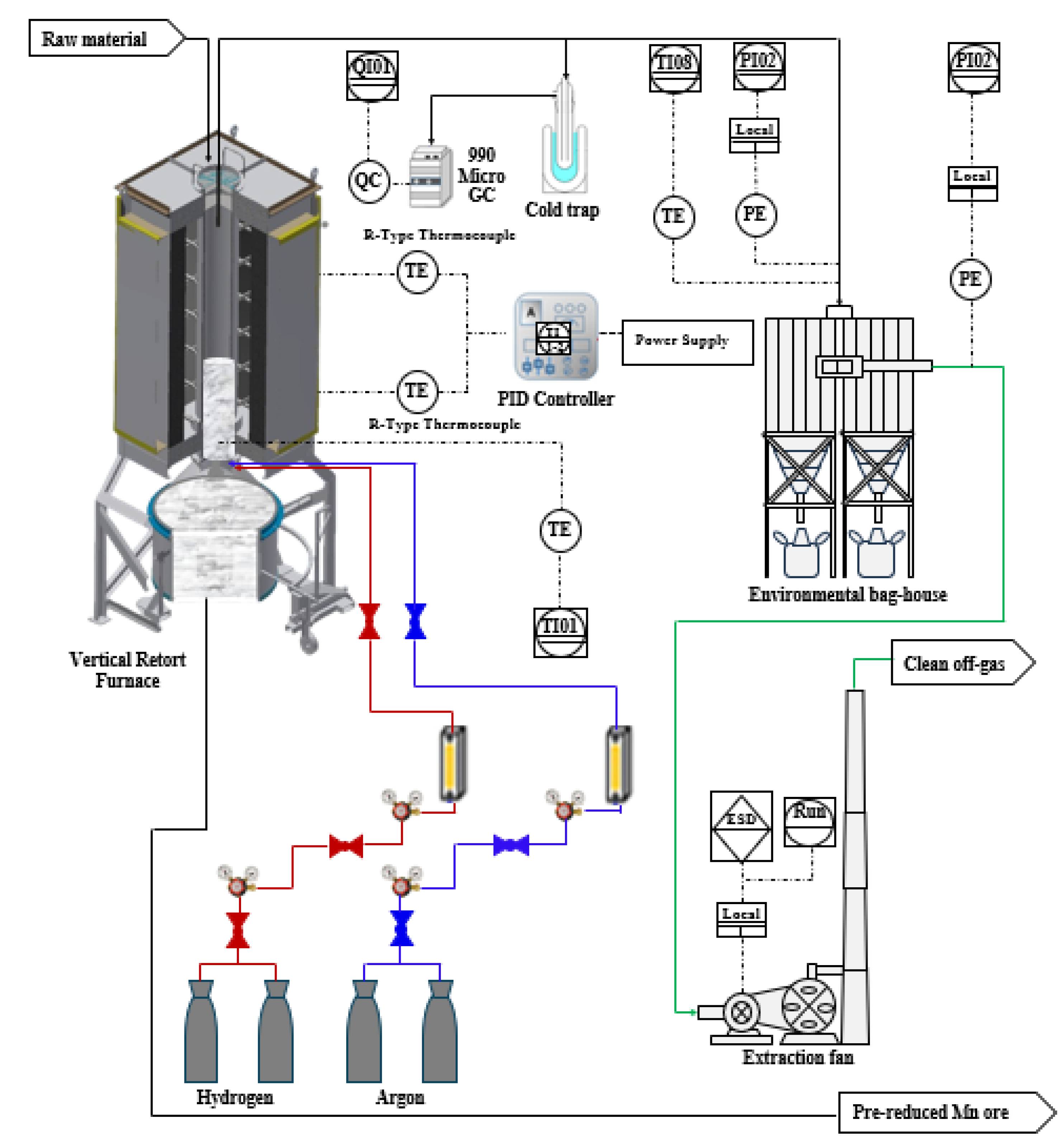
Figure 2.
Appearence of: (a) Nchwaning ore, (b) UMK ore, (c) burnt lime and (d) aluminium on the feed-system’s designated conveyor belts.
Figure 2.
Appearence of: (a) Nchwaning ore, (b) UMK ore, (c) burnt lime and (d) aluminium on the feed-system’s designated conveyor belts.
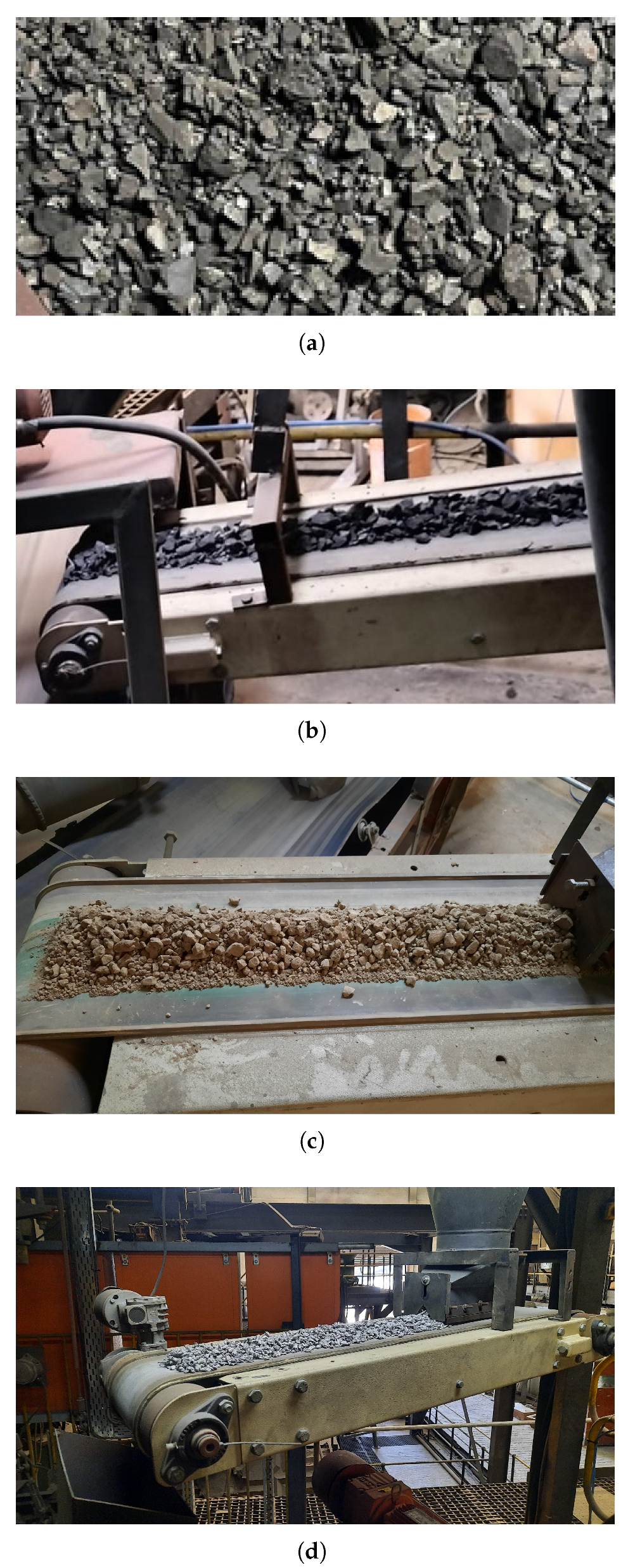
Figure 3.
A schematic representation of the Mintek pilot-scale 200 kW DC arc furnace facility layout showing the three section, namely, feed, furnace and off-gas handling section.
Figure 3.
A schematic representation of the Mintek pilot-scale 200 kW DC arc furnace facility layout showing the three section, namely, feed, furnace and off-gas handling section.
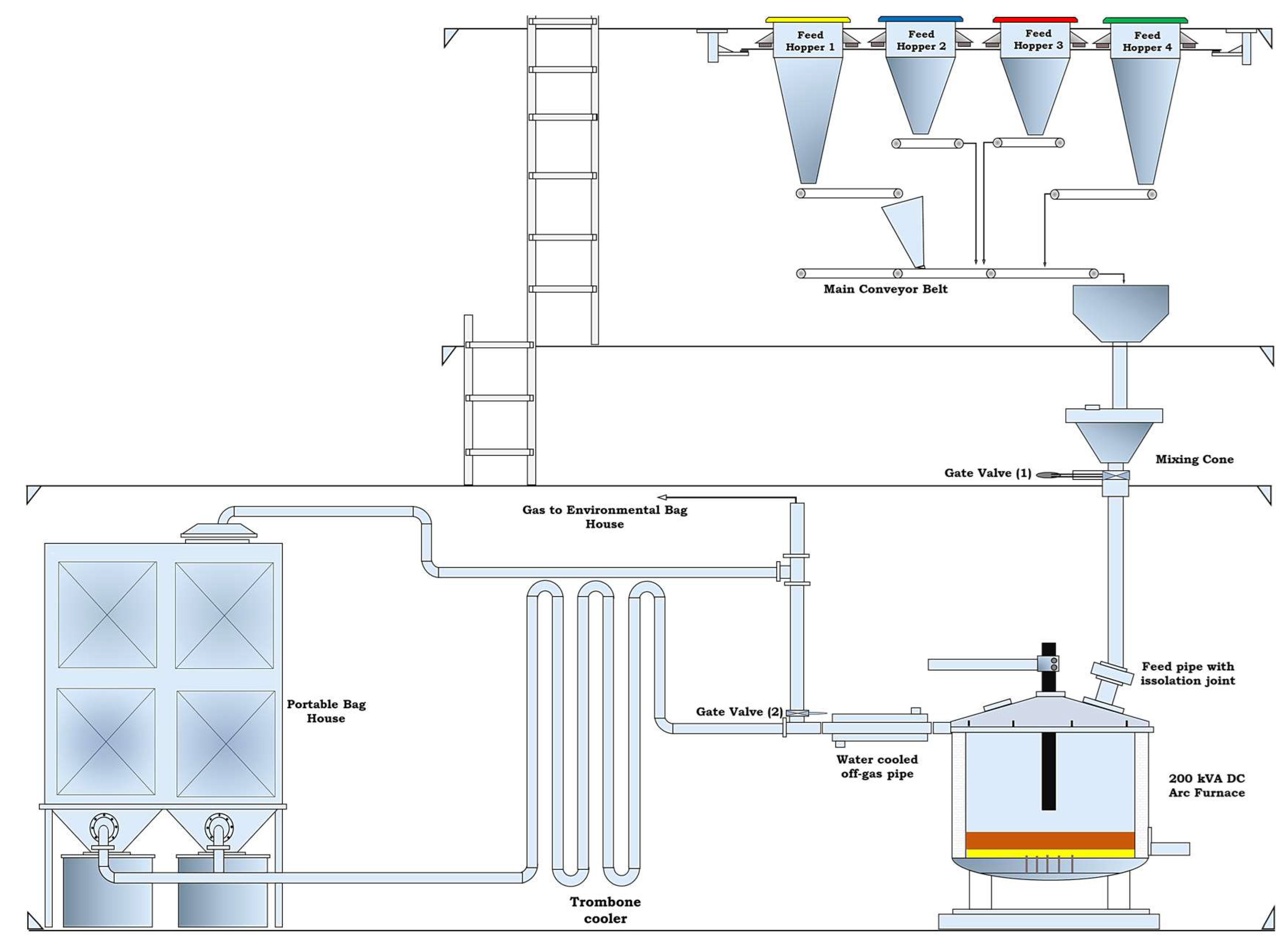
Figure 4.
Power stability metrics during smelting of pre-reduced manganese ores: (a) UMK ore pre-reduced in a packed-bed retort furnace; (b) Nchwaning ore pre-reduced in a packed-bed retort furnace.
Figure 4.
Power stability metrics during smelting of pre-reduced manganese ores: (a) UMK ore pre-reduced in a packed-bed retort furnace; (b) Nchwaning ore pre-reduced in a packed-bed retort furnace.
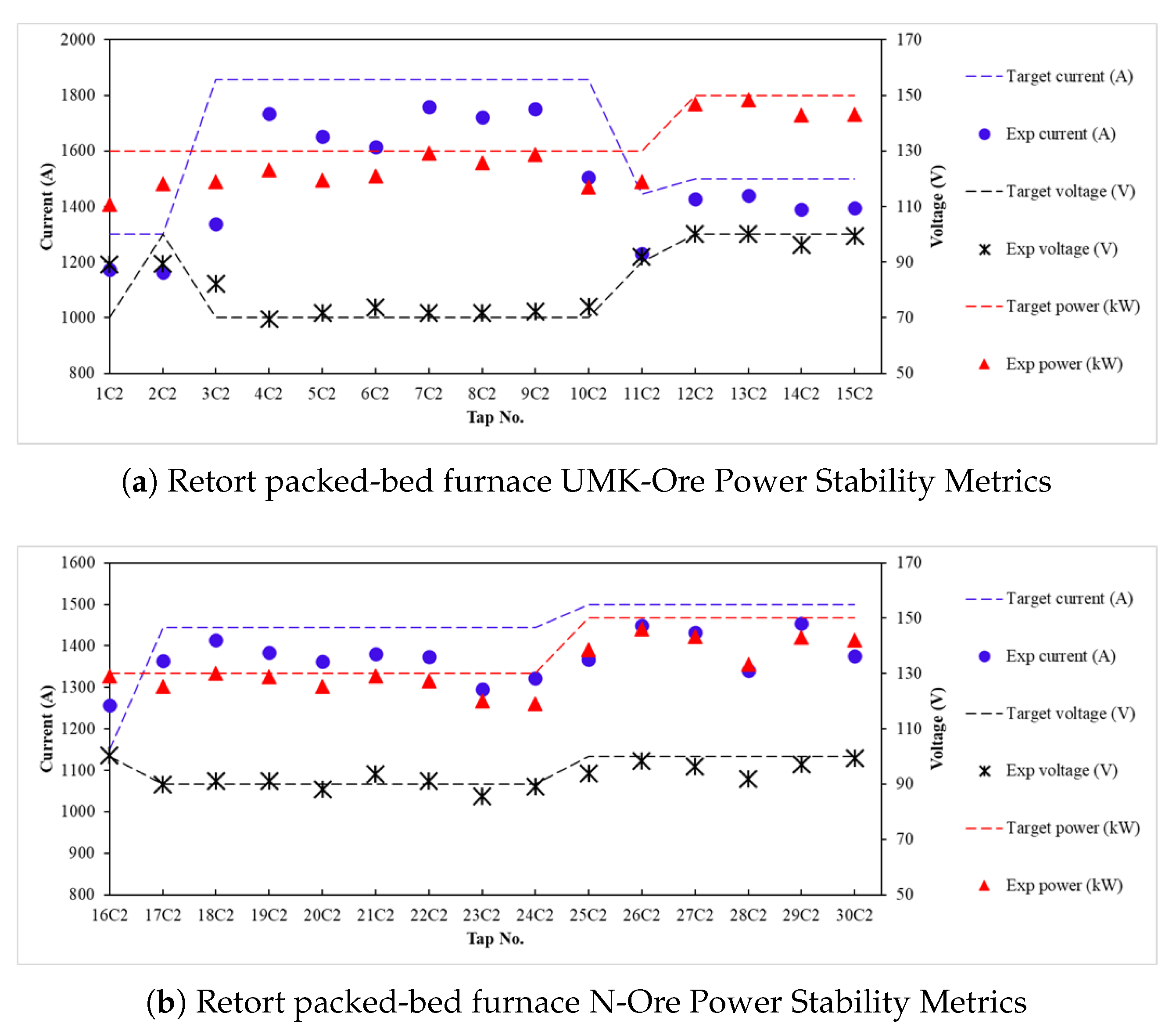
Figure 5.
Specific energy requirement.
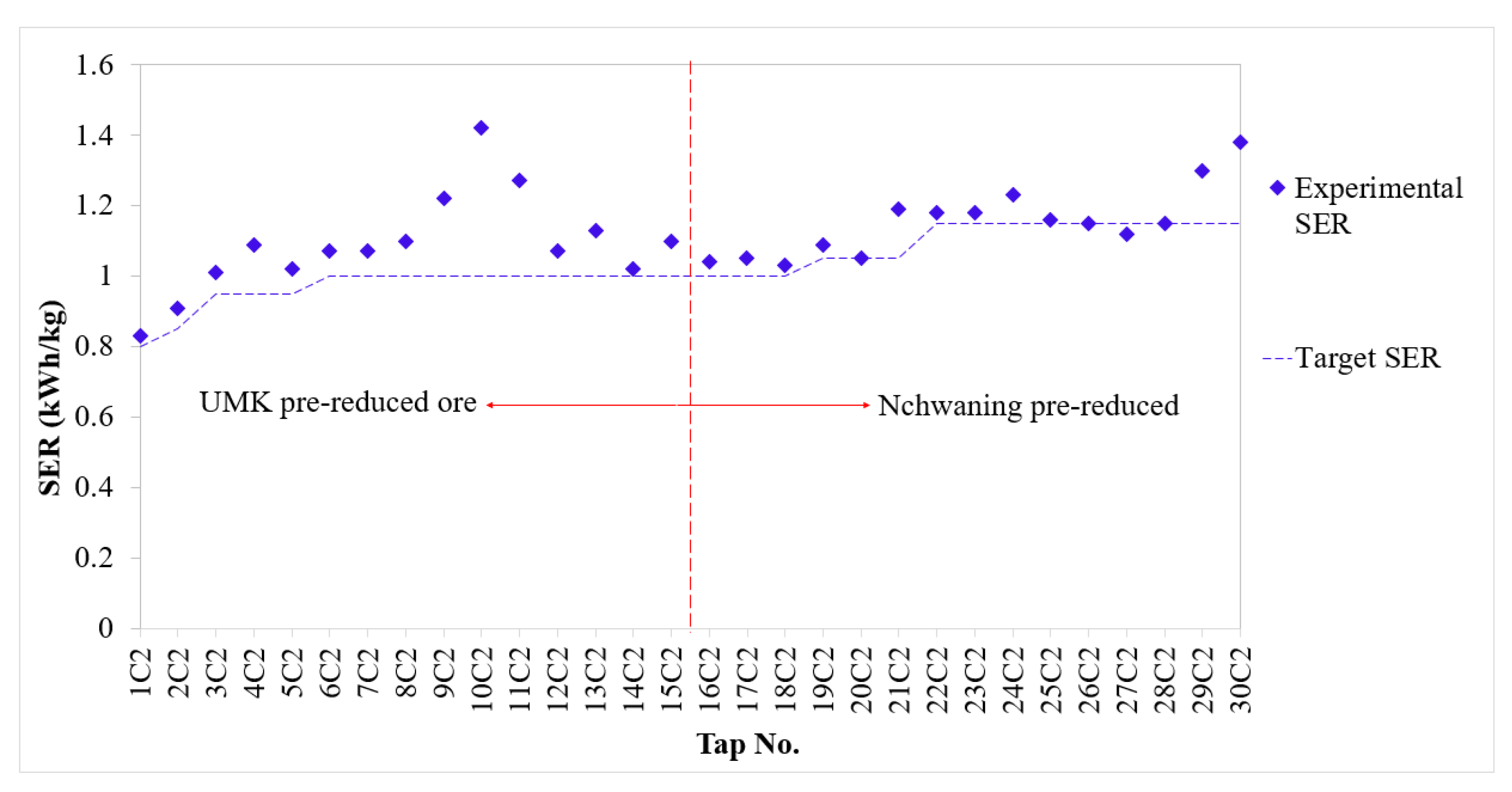
Figure 6.
Plot of average furnace power against average feed rate.
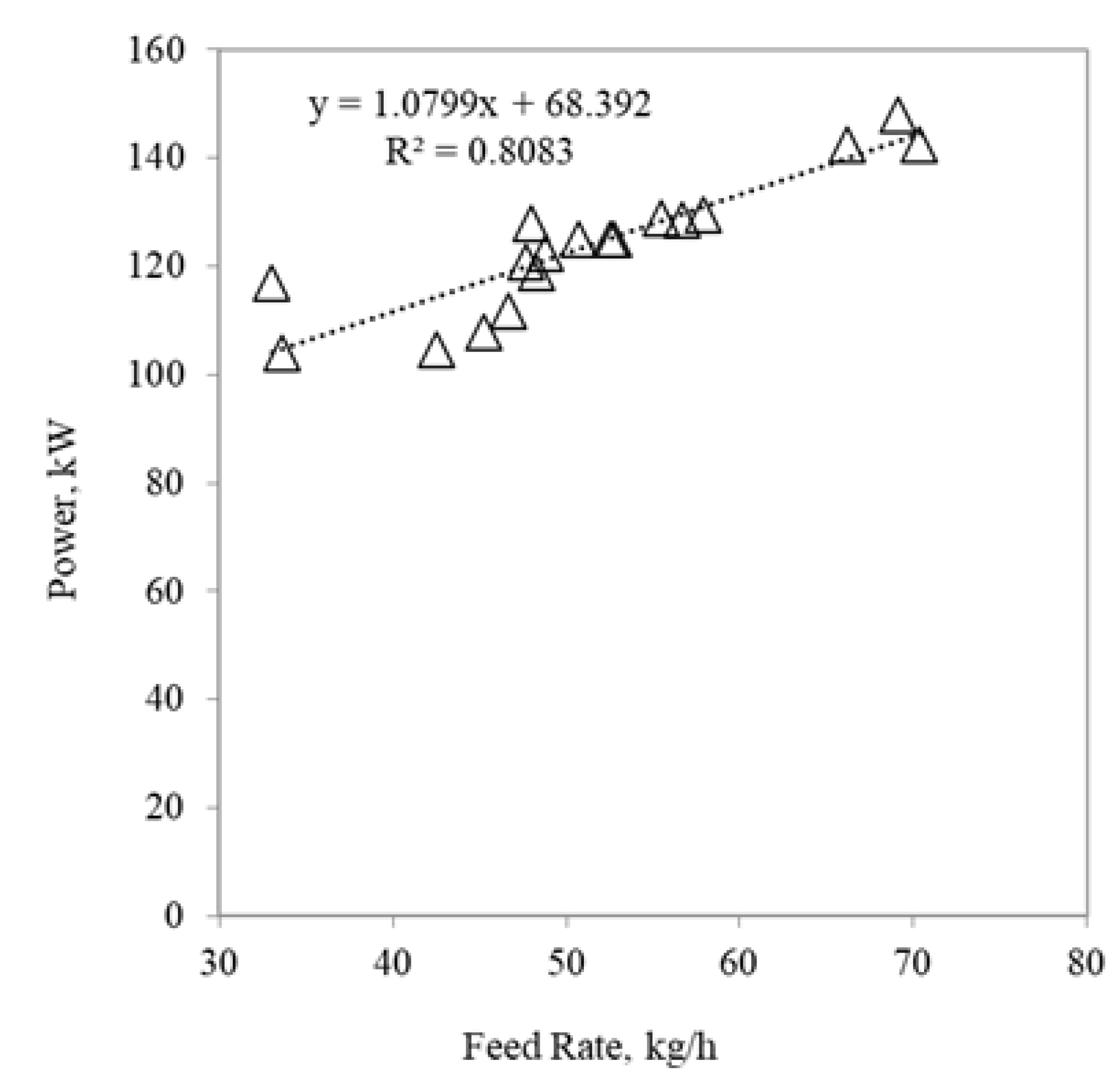
Figure 7.
Furnace power vs thermal efficiency.
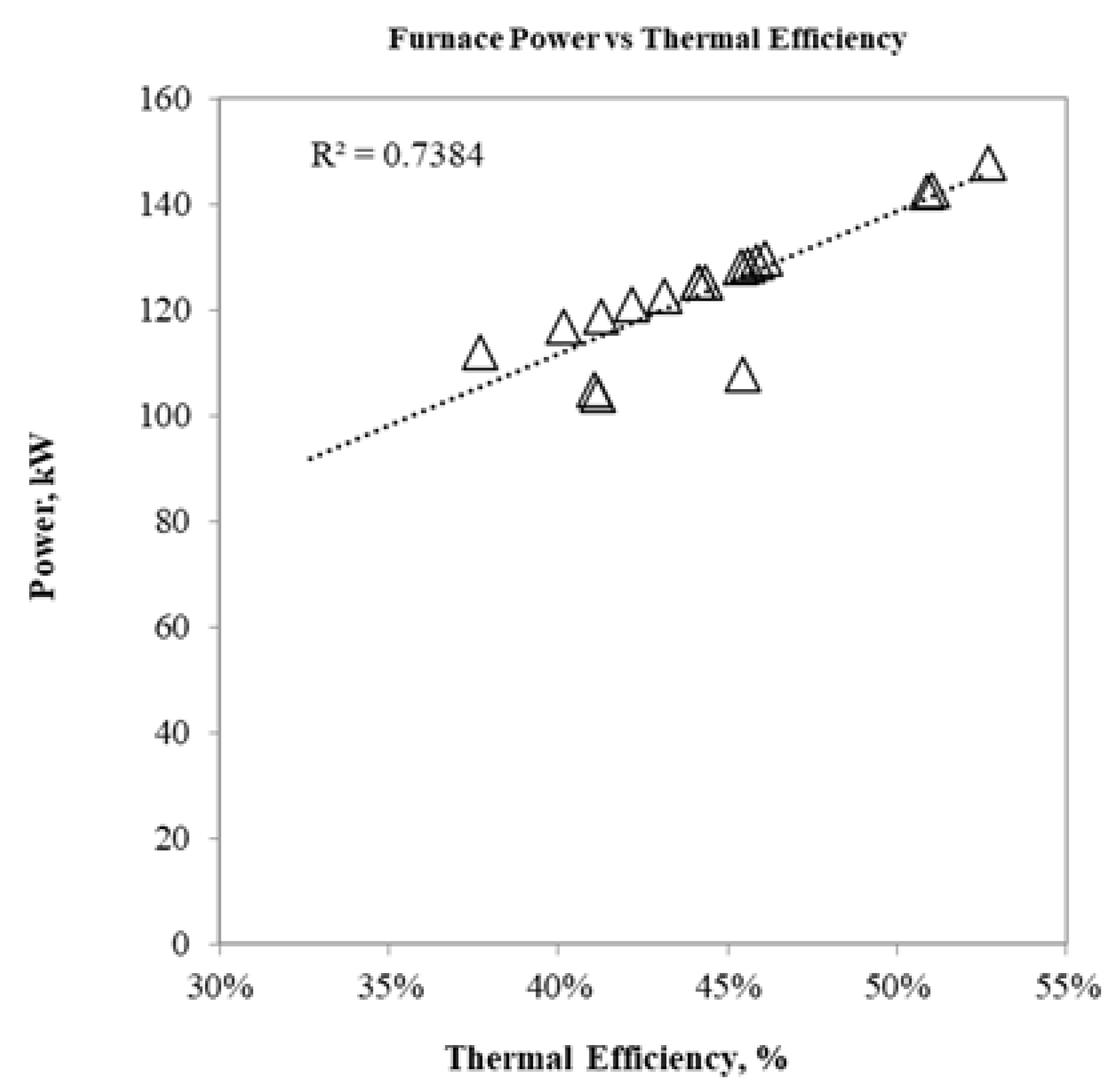
Figure 8.
Reductant efficiencies during smelting of pre-reduced manganese ores in a packed-bed vertical retort furnace.
Figure 8.
Reductant efficiencies during smelting of pre-reduced manganese ores in a packed-bed vertical retort furnace.
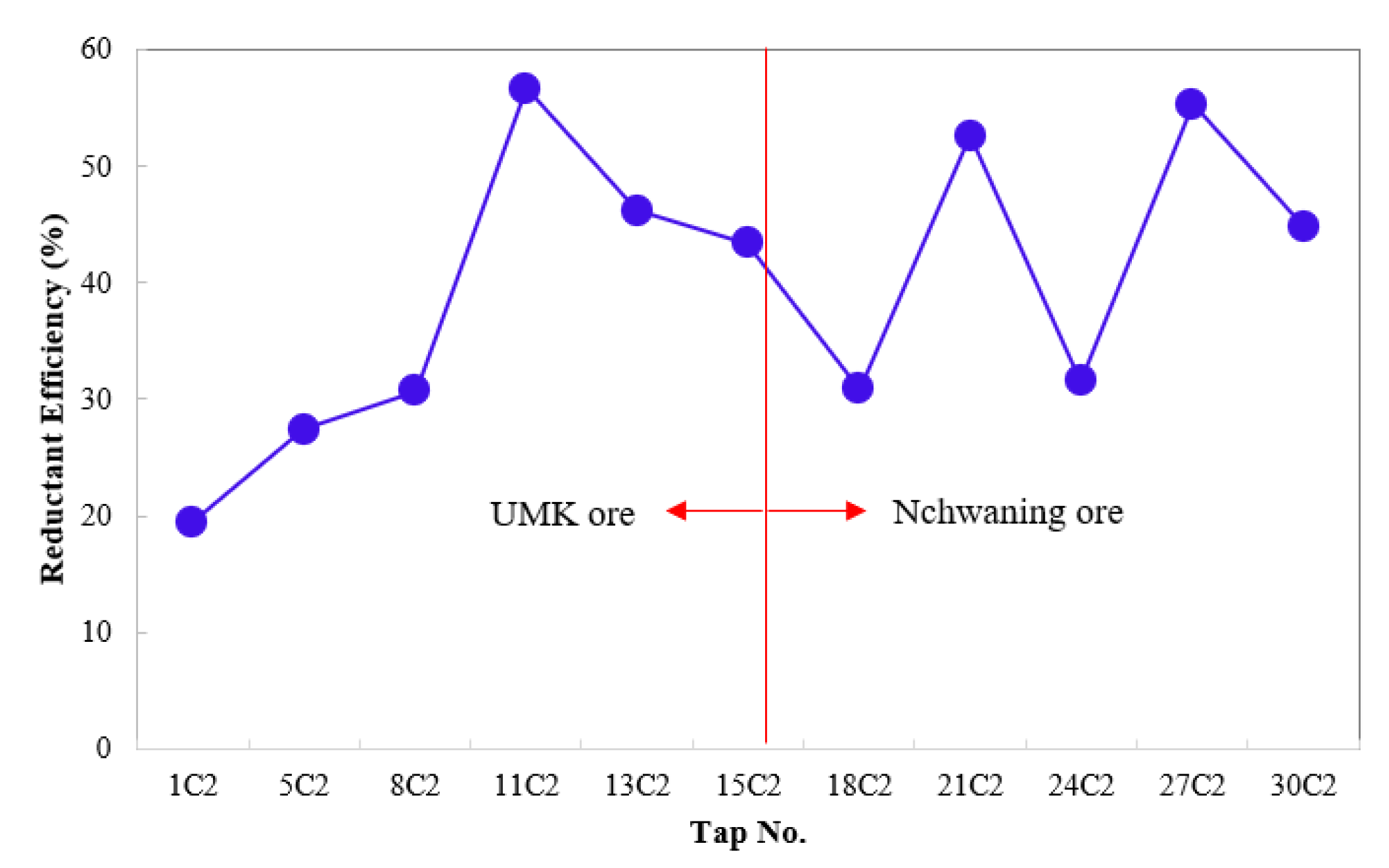
Figure 9.
Overall accountability of elements during Campaign 2 (Taps 1C2 to 30C2).
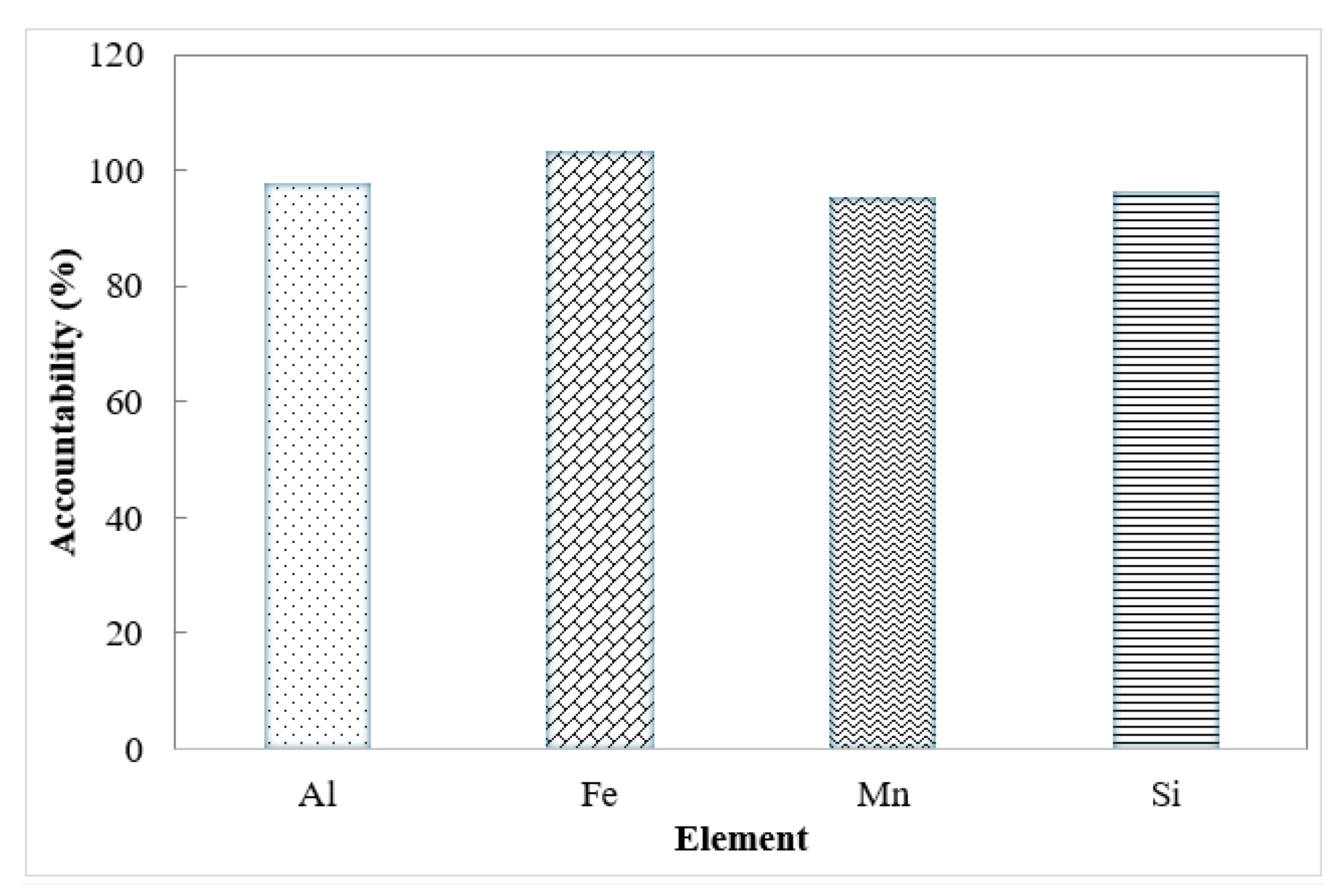
Figure 10.
Overall recovery of elements during Campaign 2 (Taps 1c2 to 30C2).
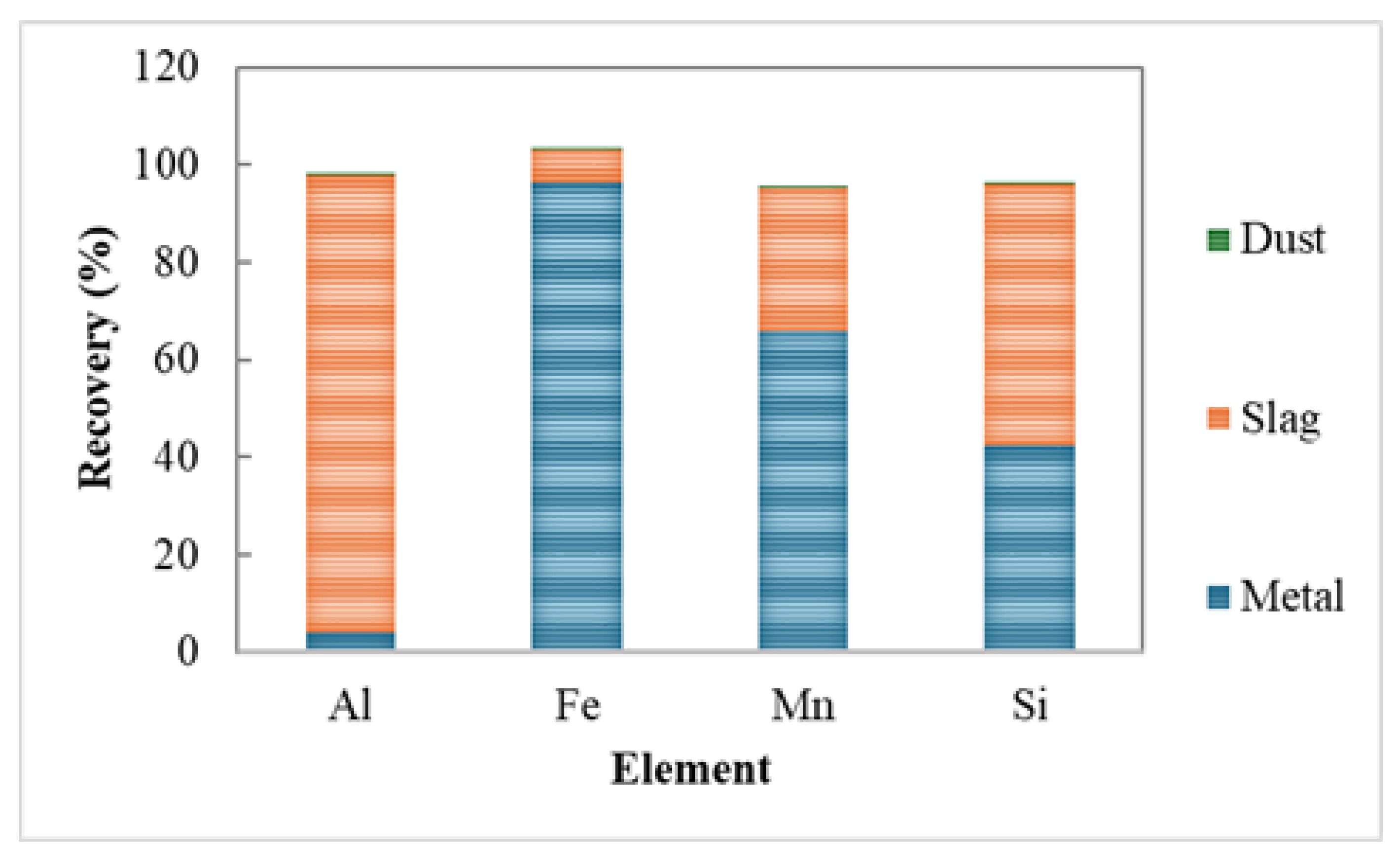
Figure 11.
Overall deportment of elements during Campaign 2 (Taps 1C2 to 30C2).
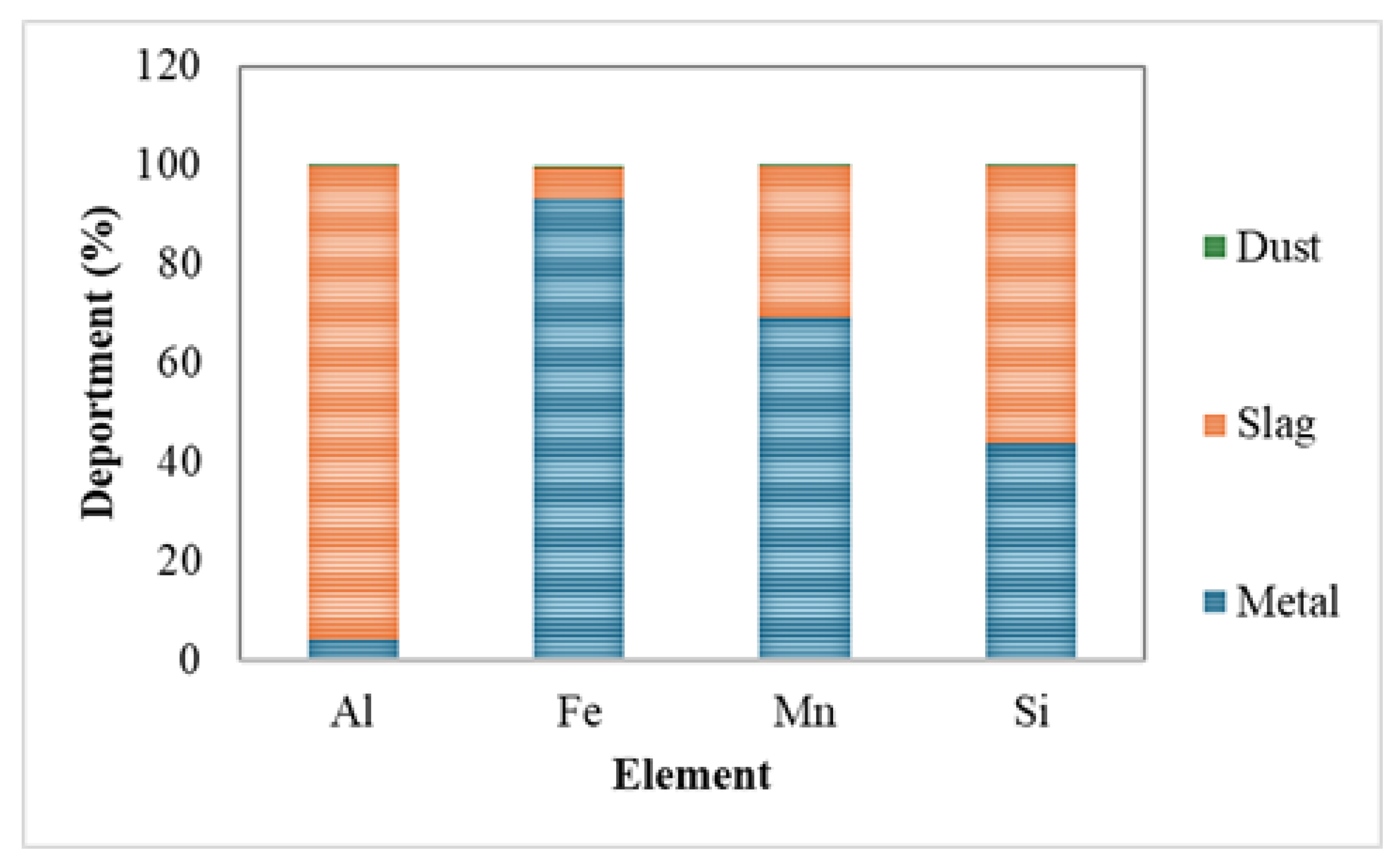
Figure 12.
Slag-to-metal ratios during smelting of pre-reduced Mn ores in a packed-bed retort furnace.
Figure 12.
Slag-to-metal ratios during smelting of pre-reduced Mn ores in a packed-bed retort furnace.
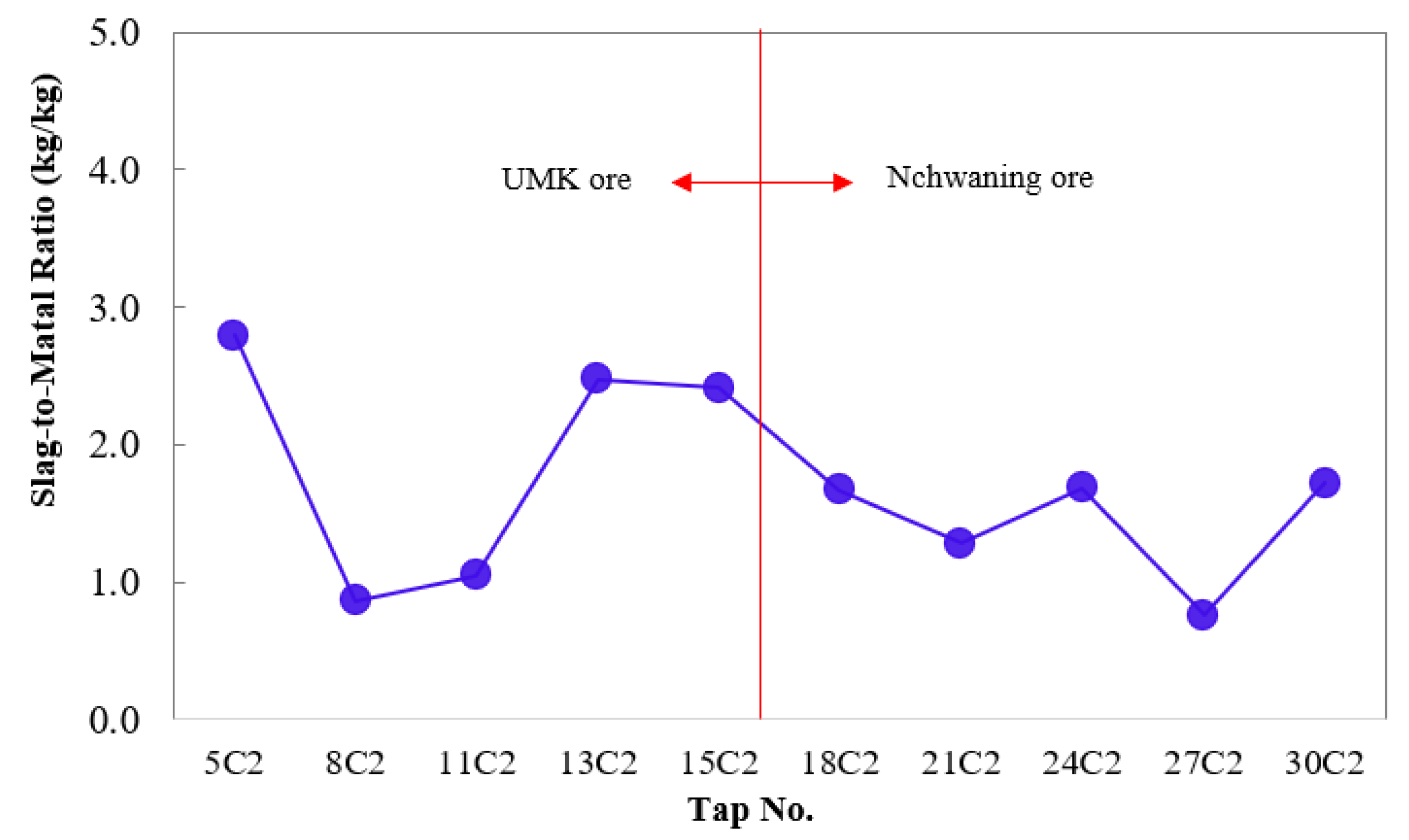
Figure 13.
Refractory consumption during smelting of pre-reduced Mn ores: (a) UMK ore pre-reduced in a packed-bed retort furnace, (b) Nchwaning ore pre-reduced in a packed-bed retort furnace
Figure 13.
Refractory consumption during smelting of pre-reduced Mn ores: (a) UMK ore pre-reduced in a packed-bed retort furnace, (b) Nchwaning ore pre-reduced in a packed-bed retort furnace
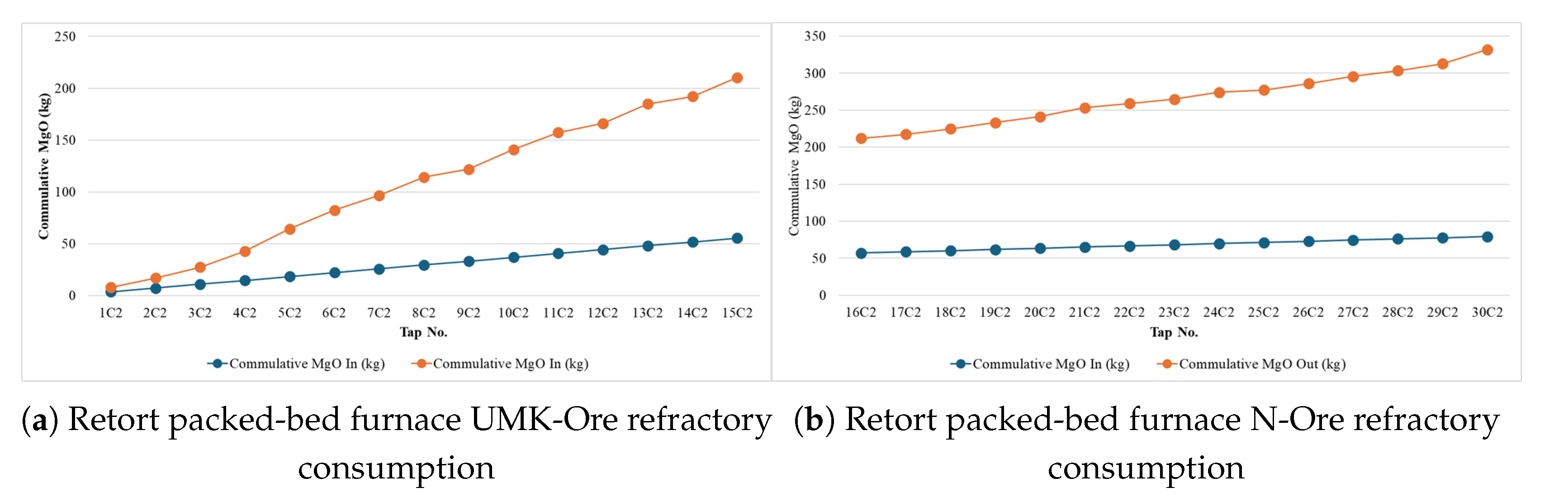
Figure 14.
Power stability metrics during smelting of pre-reduced Mn ores: (a) Nchwaning ore pre-reduced in a rotary plasma furnace, (b) Nchwaning ore pre-reduced in a packed-bed retort furnace.
Figure 14.
Power stability metrics during smelting of pre-reduced Mn ores: (a) Nchwaning ore pre-reduced in a rotary plasma furnace, (b) Nchwaning ore pre-reduced in a packed-bed retort furnace.
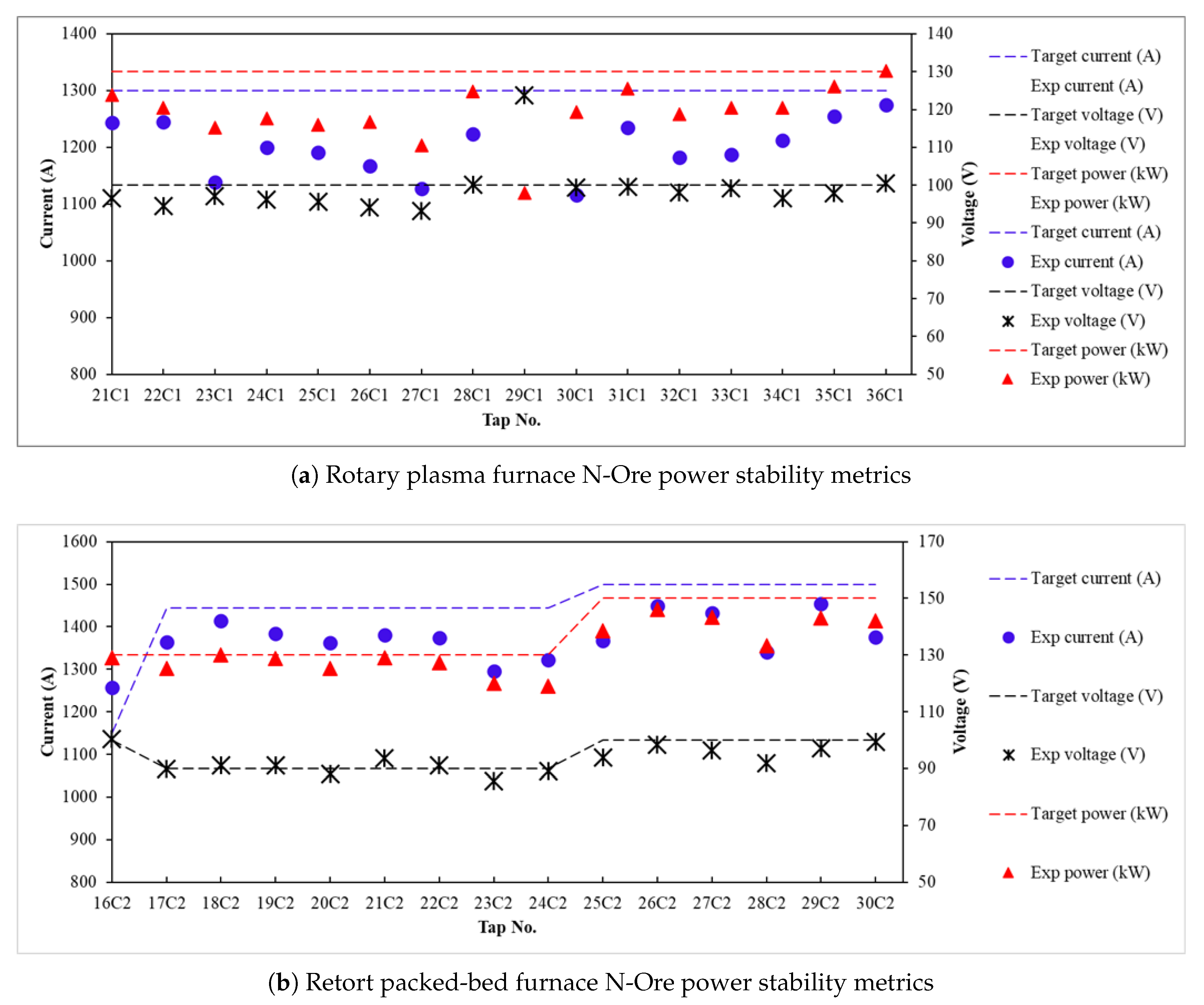
Figure 15.
Reductant efficiencies during smelting of manganese ores pre-reduced using two approaches.
Figure 15.
Reductant efficiencies during smelting of manganese ores pre-reduced using two approaches.
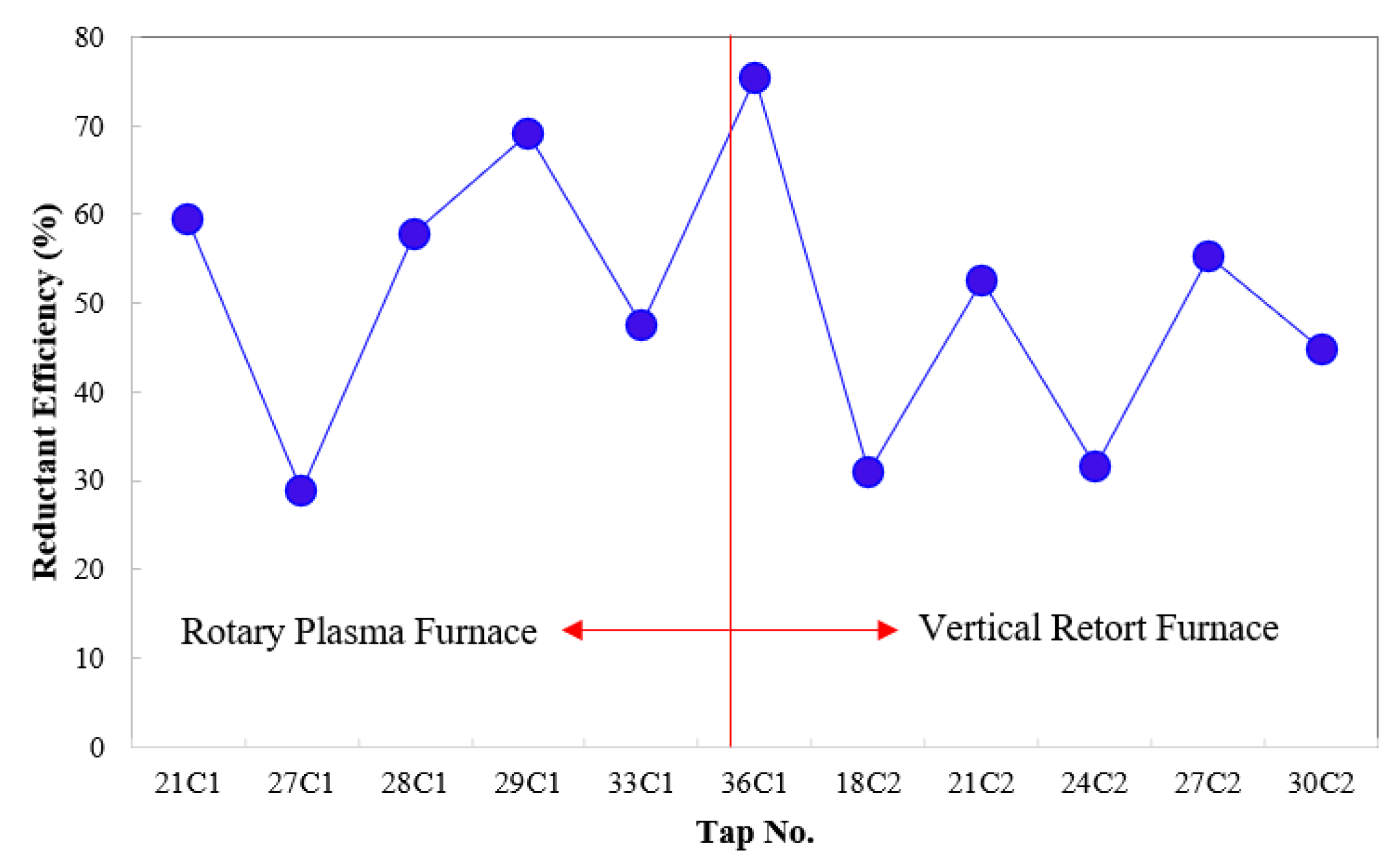
Figure 16.
Slag-to-metal ratios during smelting of Mn ores pre-reduced using two approaches.
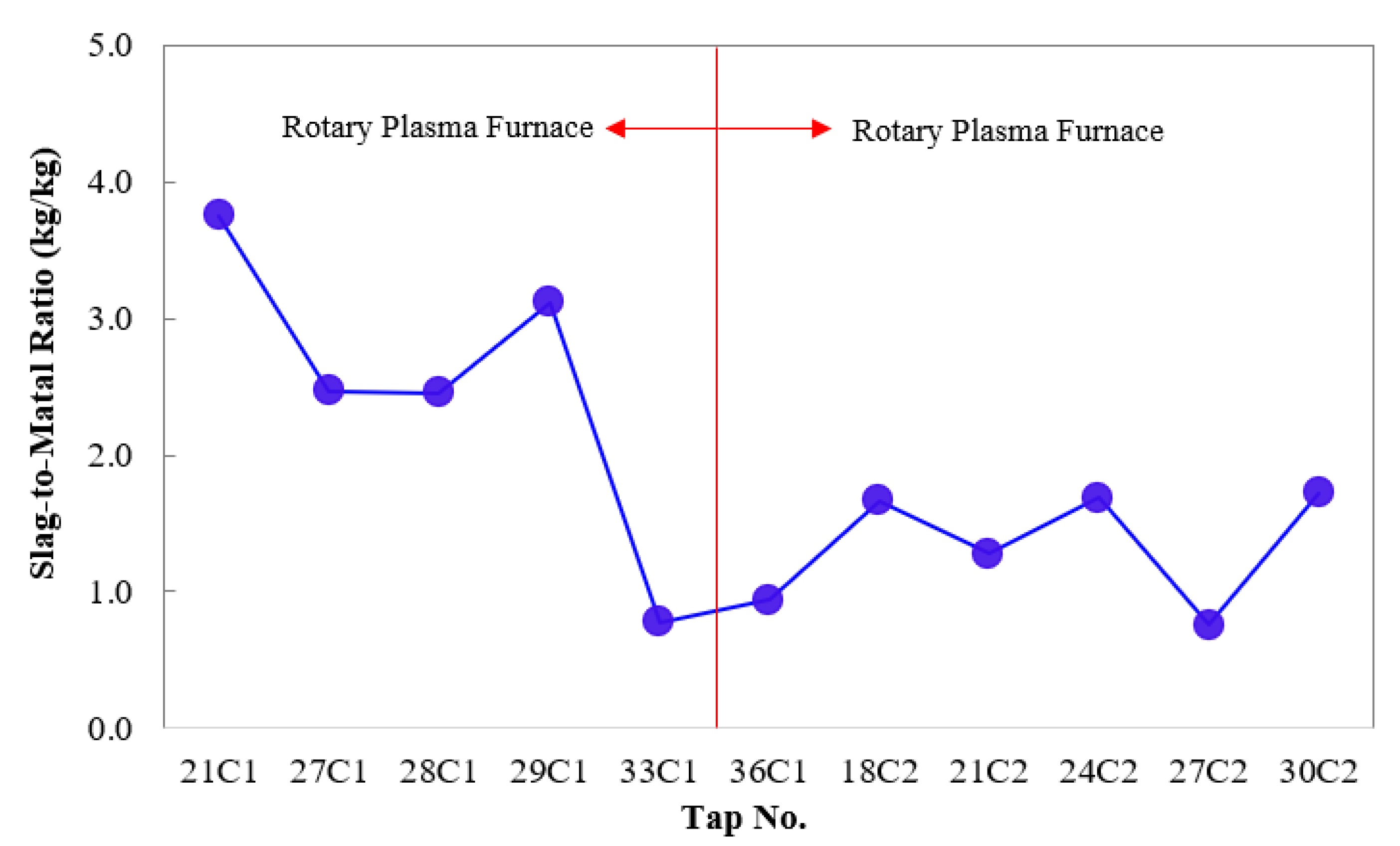
Figure 17.
Refractory consumption during smelting of pre-reduced Mn ores: (a) Nchwaning ore pre-reduced in a rotary plasma furnace, (b) Nchwaning ore pre-reduced in a packed-bed retort furnace
Figure 17.
Refractory consumption during smelting of pre-reduced Mn ores: (a) Nchwaning ore pre-reduced in a rotary plasma furnace, (b) Nchwaning ore pre-reduced in a packed-bed retort furnace
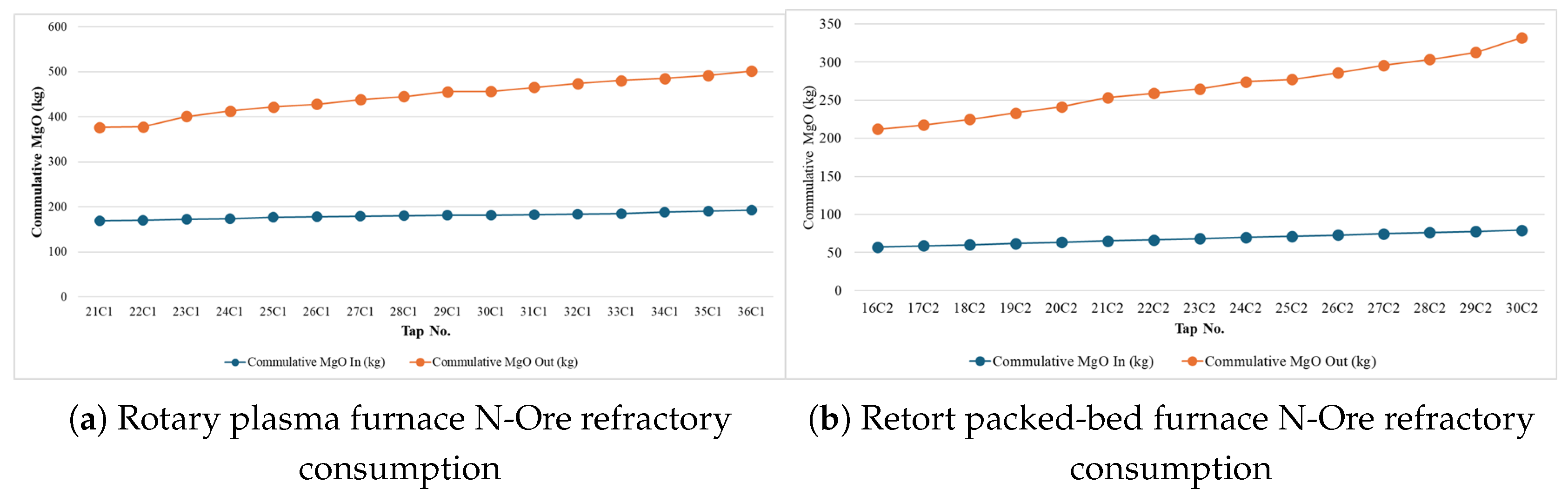
Table 1.
Chemical composition of UMK ore pre-reduced in a VRF, Nchwaning ore pre-reduced in a VRF, Nchwaning ore pre-reduced in a PRK and lime (mass %).
Table 1.
Chemical composition of UMK ore pre-reduced in a VRF, Nchwaning ore pre-reduced in a VRF, Nchwaning ore pre-reduced in a PRK and lime (mass %).
| CaO | MgO | MnO | ||||
|---|---|---|---|---|---|---|
| UMK pre-reduced in VRF | 0.33 | 16.54 | 9.73 | 3.70 | 54.90 | 5.65 |
| N-Ore pre-reduced in a PRK | 0.41 | 8.17 | 18.21 | 1.54 | 66.78 | 2.95 |
| N-Ore pre-reduced in a VRF | 0.31 | 7.43 | 15.89 | 1.58 | 62.78 | 3.70 |
| Lime | 0.30 | 91.93 | 0.30 | <0.005 | 0.90 | 1.99 |
Table 2.
X-Ray Fluorescence analyses of aluminium dross (mass %).
| Al | Si | Cu | Zn | Fe | Mn | Mg | |
|---|---|---|---|---|---|---|---|
| Aluminium dross | 92.50 | 3.00 | 1.70 | 1.40 | 0.80 | 0.30 | 0.30 |
Table 3.
Mintek campaign 1 experimental plan.
| Condition | Tap No | SER | Power | Heatloss | Feedrate | Tap Time | Pre-reduced N-ore | % Al & CaO addition | Al & CaO masses, kg | Process and operational changes | |||
|---|---|---|---|---|---|---|---|---|---|---|---|---|---|
| (kWh/kg) | (kW) | (kW) | (kg/h) | (h) | Mintek (kg) | SINTEF (kg) | Lime | Al metal | Lime | Al metal | |||
| 6 | 21–23 | 0.95 | 130 | 70 | 63.35 | 2.41 | 100 | 0.00 | 0.27 | 0.26 | 26.70 | 26.00 | New feed material. Transition and stabilisation condition. |
| 7 | 24–26 | 0.85 | 130 | 70 | 70.84 | 2.16 | 0.00 | 100 | 0.27 | 0.26 | 26.70 | 26.00 | New feed material. Reduced SER due to high slag temperature. Reduced SER due to high slag temperature. Reduced SER due to high slag temperature. |
| 8 | 27–29 | 0.85 | 130 | 70 | 92.74 | 1.67 | 0.00 | 100 | 0.27 | 0.29 | 26.70 | 28.60 | Increased Al addition to reach MnO target in slag. Increased SER to increase the slag temperature. |
| 9 | 30–36 | 0.80 | 130 | 70 | 75.00 | 2.16 | 0.00 | 100 | 0.30 | 0.32 | 30.00 | 32.00 | Increase lime to 30% and Al to 32%, and the SER to 0.800. |
Table 4.
Mintek campaign 2 experimental plan
| Condition | Tap No. | SER | Power | Power Density | Voltage | Heatloss | Feedrate | Time | Pre-reduced Ore, kg | % Al & CaO Addition | Al & CaO Masses, kg | Process and operational changes | |||
|---|---|---|---|---|---|---|---|---|---|---|---|---|---|---|---|
| (kWh/kg) | (kW) | (kW/m2) | (V) | (kW) | (kg/h) | (h) | UMK | N-ore | Al | Lime | Al | Lime | |||
| Warm-up | 0 | 12.00 | |||||||||||||
| 1 | 1–5 | 0.80 | 130 | 260 | 70 | 70 | 75 | 2.22 | 100 | 0.09 | 0.20 | 9 | 20 | Thermal and chemical stabilisation condition. Drop voltage to 70V in next tap. Increased SER, and lime and Al additions. | |
| 2 | 6–8 | 1.00 | 130 | 260 | 70 | 70 | 60 | 3.27 | 100 | 0.34 | 0.32 | 34 | 32 | Changed Al and CaO addition as well as SER. | |
| 3 | 9–11 | 1.00 | 130 | 260 | 70 | 70 | 60 | 3.27 | 100 | 0.34 | 0.32 | 34 | 32 | Increased voltage to 90 V. | |
| 4 | 12–15 | 1.00 | 150 | 300 | 100 | 70 | 80 | 2.58 | 100 | 0.34 | 0.32 | 34 | 32 | Increased power to 150 kW and voltage to 100 V. Tap metal, approx. half a ladle, stop when there is slag. Drain furnace to prepare for ore change. | |
| 5 | 16–18 | 1.00 | 130 | 260 | 100 | 70 | 60 | 3.27 | 100 | 0.34 | 0.32 | 34 | 32 | Slag was not tapped in order to rebuild buffer slag in furnace. Chemical stabilisation condition of new Mn ore. Drop voltage to 90V to lower shell temperatures. | |
| 6 | 19–21 | 1.05 | 130 | 260 | 90 | 70 | 57 | 3.48 | 100 | 0.36 | 0.34 | 36 | 34 | Increase Al, lime, and SER. | |
| 7 | 22–24 | 1.15 | 130 | 260 | 90 | 70 | 52 | 3.91 | 100 | 0.40 | 0.38 | 40 | 38 | Increase Al, lime, and SER. | |
| 8 | 25–27 | 1.15 | 150 | 300 | 100 | 70 | 70 | 3.06 | 100 | 0.40 | 0.38 | 40 | 38 | Increased power, voltage, and SER. | |
| 9 | 28–30 | 1.15 | 150 | 300 | 100 | 70 | 70 | 3.06 | 100 | 0.40 | 0.38 | 40 | 38 | Maintain power, voltage, and SER. | |
Table 5.
Summary of calculated load factors for experimental campaigns.
| Ore Type | (h) | (h) | (%) |
|---|---|---|---|
| UMK retort packed bed furnace | 48.50 | 2.08 | 95.89 |
| Nchwaning retort packed bed furnace | 50.55 | 1.62 | 96.89 |
Table 6.
Overall Slag-to-metal ratios for experimental campaigns.
| Ore | Total Slag (kg) | Total Metal (kg) | Overall Slag-to-Metal Ratio (kg/kg) |
|---|---|---|---|
| UMK | 1015 | 543 | 1.87 |
| Nchwaning | 944.33 | 704 | 1.34 |
Table 7.
Refractory consumption rates for experimental campaigns.
| Ore | MgO Consumed (kg) | Metal Produced (kg) | Refractory Consumption Rate (kg MgO/kg metal) |
|---|---|---|---|
| UMK retort packed bed furnace | 99.28 | 543 | 0.1828 |
| Nchwaning retort packed bed furnace | 74.03 | 704 | 0.1051 |
Table 8.
Electrode consumption rates for experimental campaigns.
| Ore | Pre-reduction | Mass Electrode Consumed (kg) | Mass Metal Produced (kg) | Electrode Consumption Rate (kg/kg) |
|---|---|---|---|---|
| UMK | Retort packed bed furnace | 60 | 543 | 0.1105 |
| Nchwaning | Retort packed bed furnace | 1 | 704 | 0.0014 |
Table 10.
Summary of calculated load factors for Mn ores pre-reduced via rotary plasma and vertical retort pre-reduction approaches.
Table 10.
Summary of calculated load factors for Mn ores pre-reduced via rotary plasma and vertical retort pre-reduction approaches.
| Pre-reduction approach | (h) | (h) | (%) |
|---|---|---|---|
| Nchwaning plasma rotary furnace | 42.74 | 1.37 | 96.89 |
| Nchwaning retort packed bed furnace | 50.55 | 1.62 | 96.89 |
Table 11.
Overall Slag-to-metal ratios for experimental campaigns.
| Pre-reduction approach | Total Slag (kg) | Total Metal (kg) | Overall Slag-to-Metal Ratio (kg/kg) |
|---|---|---|---|
| Rotary Plasma Furnace | 1143 | 638 | 1.79 |
| Vertical Retort Furnace | 944.33 | 704 | 1.34 |
Table 12.
Refractory consumption rates for experimental campaigns.
| Pre-reduction approach | MgO Consumed (kg) | Metal Produced (kg) | Refractory Consumption Rate (kg MgO/kg metal) |
|---|---|---|---|
| Rotary Plasma Furnace | 117.27 | 638 | 0.1838 |
| Vertical Retort Furnace | 74.03 | 704 | 0.1051 |
Table 13.
Comparative benchmarking of key technical, environmental, and economic metrics. Industrial ranges are indicative of typical benchmarks reported in the literature for conventional SAF or carbothermic HCFeMn production.
Table 13.
Comparative benchmarking of key technical, environmental, and economic metrics. Industrial ranges are indicative of typical benchmarks reported in the literature for conventional SAF or carbothermic HCFeMn production.
| Metric | Units | 200 kW (this study) | Industrial relevance / Typical range |
|---|---|---|---|
| Specific Energy Consumption (SEC) | kWh t−1 product | ≈880 (0.88 MWh/t) | Typical SAF HCFeMn: 2,000–3,500 kWh t−1 (2.0–3.5 MWh/t) [5,6]. |
| Energy Utilization | % | ≈46.8% (mean; 40–57%) | EAF/EAF-like systems: 40–70% depending on design and heat integration [70,71]. |
| Power Stability / Arc Control | Dimensionless indices | , , | Industrial DC furnaces aim for minimal current and voltage deviation; modern systems achieve superior stability with advanced controls [15]. |
| CO2-equivalent Emissions | t CO2-eq t−1 product | ≈1.35 (including Al embodied CO2) | Carbothermic HCFeMn: ∼3.0–4.0 t CO2-eq t−1; varies with grid mix and reductant [7,60]. |
| Stack Gas Composition | mg Nm−3 (measured) | PM: 216.8; SO2: 6.84; NOx: 0.02; CO: 2.81; O2: 20.9% | Typical SAF stack emissions depend on abatement; conventional processes show higher PM and SOx levels. |
| Dust / Particulate Emissions | kg t−1 product | ∼26 (normalised) | Industrial HCFeMn operations: 1–3 kg t−1 after abatement [7]. |
| Metallurgical Yield / Recovery (Fe, Mn) | % | Fe: >90%; Mn: 47–80% (improving with tap number) | Industrial operations: 85–95% (ore-based); pilot trend approaches industrial range [58,72]. |
| Slag-to-Metal Ratio (SMR) | kg slag kg−1 metal | 1.34–1.87 | Conventional HCFeMn: 0.5–1.5 [73,74,75]. |
| Refractory Consumption | kg t−1 product | Not quantified (pilot-scale) | Industrial: strongly dependent on furnace design and lining composition. |
| Electrode Consumption | kg t−1 product | Not quantified (pilot; qualitative) | Modern EAF fleets: ∼1–3 kg t−1. |
| Slag Valorisation Rate | % reused | Potentially high-low-Mn slag suitable for cementitious or aggregate use. As part of the HAlMan project, pilot and lab-scale investigation are currently underway with upto 86 % alumina recovery reported. | Industrial reuse depends on composition and leachability; FeMn/SiMn slags often reused [76,77]. |
| Water Consumption & Recycling | m3 t−1 product | Not normalised (pilot) | Conventional plants employ closed-loop cooling; footprints vary by scale. |
| Operating Cost (indicative) | USD t−1 product | ∼1,400 (electricity + Al + labour) | Highly site-specific; depends on reductant and power costs. |
Disclaimer/Publisher’s Note: The statements, opinions and data contained in all publications are solely those of the individual author(s) and contributor(s) and not of MDPI and/or the editor(s). MDPI and/or the editor(s) disclaim responsibility for any injury to people or property resulting from any ideas, methods, instructions or products referred to in the content. |
© 2026 by the authors. Licensee MDPI, Basel, Switzerland. This article is an open access article distributed under the terms and conditions of the Creative Commons Attribution (CC BY) license (http://creativecommons.org/licenses/by/4.0/).
Copyright: This open access article is published under a Creative Commons CC BY 4.0 license, which permit the free download, distribution, and reuse, provided that the author and preprint are cited in any reuse.