

Submitted:
28 April 2026
Posted:
29 April 2026
You are already at the latest version
Abstract
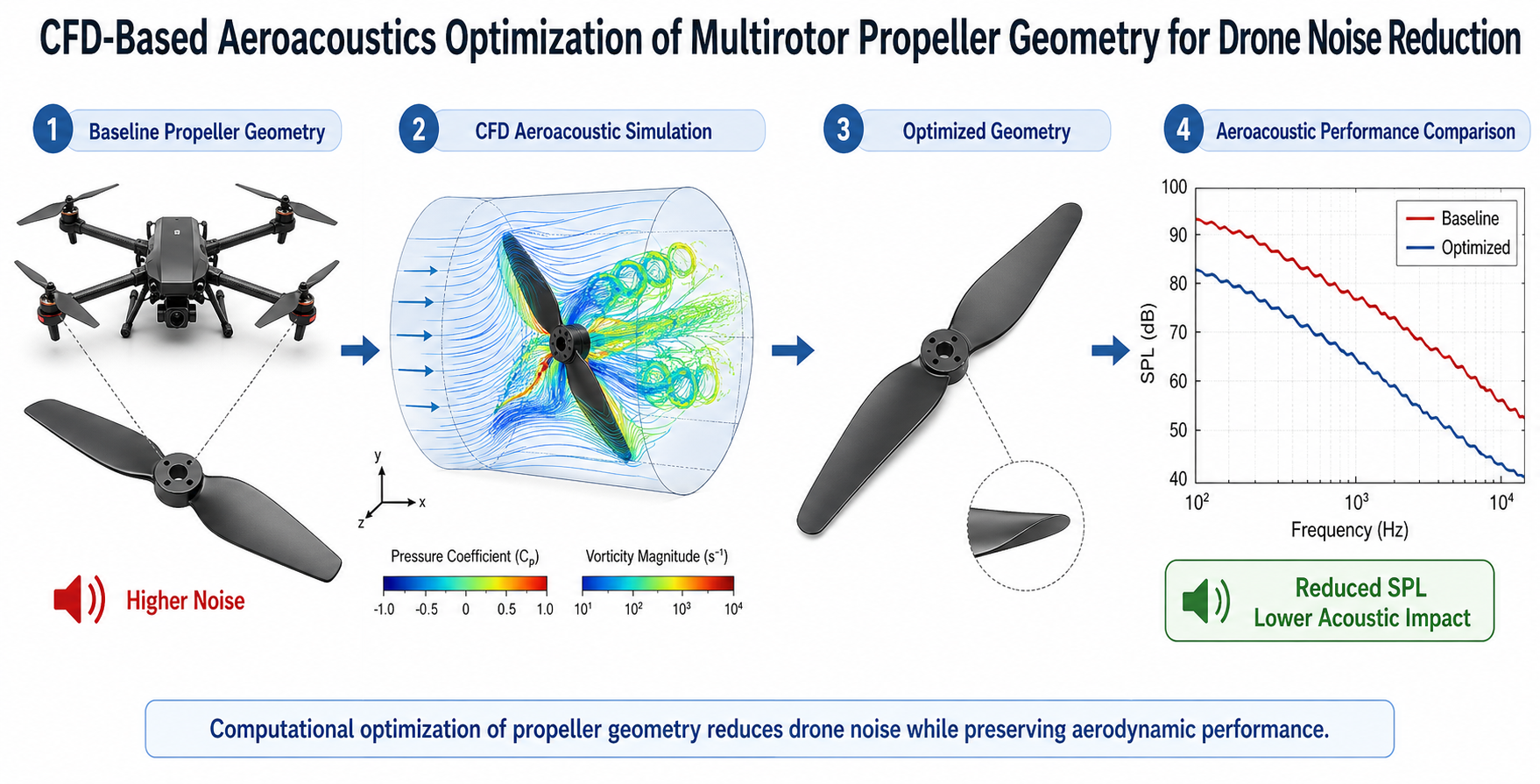
The rapid proliferation of unmanned aerial vehicles (UAVs) in urban and peri-urban environments has increased concern regarding drone-generated acoustic emissions, particularly in multirotor platforms whose tonal and broadband noise is strongly influenced by propeller blade geometry. This study presents a CFD-based aeroacoustic assessment framework to examine the influence of key geometric modifications on the acoustic signature of a representative multirotor propeller while preserving aerodynamic performance. A baseline quadrotor propeller was analyzed using Reynolds-Averaged Navier–Stokes (RANS) simulations coupled with the Ffowcs Williams–Hawkings (FW-H) acoustic analogy and Brooks–Pope–Marcolini (BPM) broadband noise estimation. The blade geometry was parameterized in terms of leading-edge sweep, tip chord, blade twist, and trailing-edge serration features, and representative low-noise configurations were evaluated under operating conditions ranging from 3000 to 6000 RPM and advance ratios between 0 and 0.3. The results indicate that combined swept-serrated geometries provide the most favorable noise–performance trade-off, with a predicted reduction of up to 4.8 dB(A) relative to the baseline at the design condition, while maintaining thrust and figure of merit within practical engineering margins. The proposed framework provides a transferable computational basis for the systematic design of low-noise propellers for surveillance UAVs, commercial multirotors, and emerging urban air mobility applications.
Keywords:
drone noise reduction
; multirotor aeroacoustics
; CFD propeller assessment
; Ffowcs Williams–Hawkings analogy
; UAV acoustic signature
; RANS simulation
; trailing-edge serrations
; low-noise blade design
; urban air mobility
; tonal noise
Copyright: This open access article is published under a Creative Commons CC BY 4.0 license, which permit the free download, distribution, and reuse, provided that the author and preprint are cited in any reuse.


