
Submitted:
28 April 2026
Posted:
30 April 2026
You are already at the latest version
Abstract
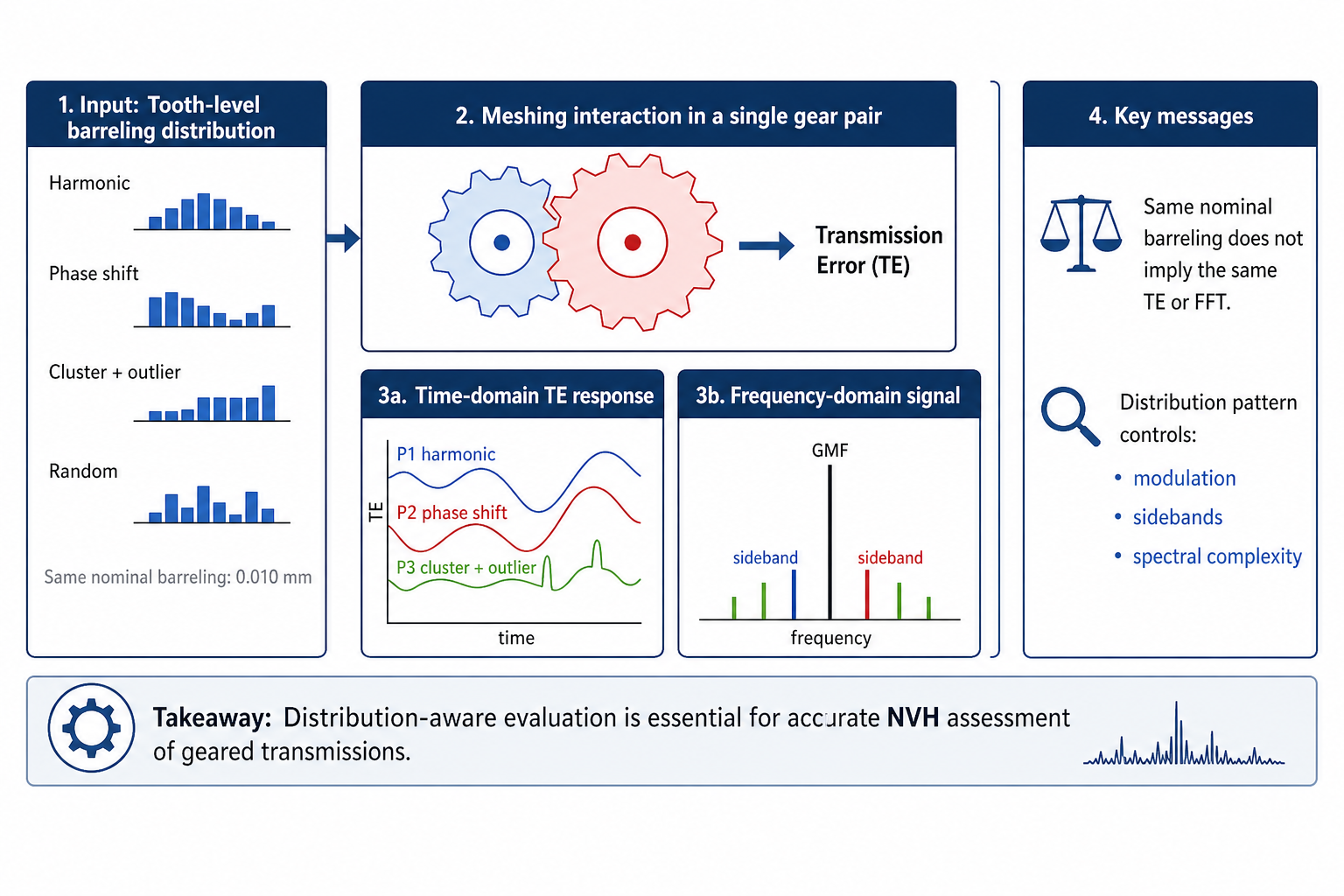
Transmission error (TE) is widely recognized as the primary internal excitation source in geared systems and plays a central role in vibration and noise generation. While micro-geometry modifications such as barreling are typically defined through nominal parame-ter values, the spatial distribution of tooth-level deviations is often neglected in simula-tion-based NVH assessments. In this study, the influence of tooth-by-tooth barreling dis-tribution on TE and its frequency-domain response was investigated using a controlled single gear-pair simulation model. A constant nominal barreling value was maintained across all cases, while only the spatial distribution of deviations was varied. Four repre-sentative patterns were considered: harmonic, phase-shifted harmonic, clustered with an outlier, and random.The results show that different distribution patterns lead to clearly distinguishable TE signals and FFT spectra, despite identical nominal modification levels. Harmonic distributions produce regular, periodic responses with clean spectral signa-tures. In contrast, phase-shifted patterns introduce modulation effects and sideband structures around the gear mesh frequency (GMF). Clustered deviations generate localized peaks and fault-like spectral features, while random distributions result in broader, less structured excitation. These findings indicate that the NVH-relevant effect of microgeome-try cannot be described solely by nominal amplitude. The spatial distribution of tooth-level deviations significantly influences both the temporal structure and spectral content of TE. The study highlights the importance of incorporating distribution-aware approaches in simulation-driven gear NVH analysis.
Keywords:
gear dynamics
; transmission error
; barreling
; microgeometry
; tooth-to-tooth variability
; gear mesh frequency
; sidebands
; modulation
; NVH
; multibody simulation
Copyright: This open access article is published under a Creative Commons CC BY 4.0 license, which permit the free download, distribution, and reuse, provided that the author and preprint are cited in any reuse.


