

Submitted:
28 April 2026
Posted:
29 April 2026
You are already at the latest version
Abstract
This study advances a modular microfoundational framework to examine how individual-level actions aggregate into macro-level technological innovation capabilities and operational performance in innovation intermediaries in emerging economies. Grounded in microfoundations theory (Coleman's bathtub model) and cybernetic principles (Viable System Model), we dissect three interdependent modules to diagnose systemic issues within institutional voids: (i) macro-level system viability and technological emergence; (ii) meso-level organizational practices mediating R&D collaboration; and (iii) micro-level behaviors of boundary-spanning agents driving knowledge integration. Empirical evidence from a Brazilian Research and Technology Organization (RTO) reveals how context-specific microfoundations determine operational efficiency and technological emergence. Theoretically, we contribute by operationalizing Coleman's micro-macro link to enable cross-context benchmarking of innovation intermediaries and decoding how meso-micro-level actions co-evolve with ecosystem-level innovation. By shifting the diagnostic focus to the fine-grained dynamics of individuals and their interactions, our study offers actionable levers for managers and policymakers to optimize operational viability in contexts of institutional uncertainty. Implications for innovation policy, ecosystem governance, and the design of intermediary organizations in late-development settings are discussed.
Keywords:
microfoundations
; innovation intermediaries
; innovation capabilities
; institutional voids
; operational viability
; R&D management
; emerging economies
; viable system model
; technology innovation
; ecosystem governance
1. Introduction
Innovation emerges from the coevolutionary interactions of multiple actors (firms, universities, and innovation intermediaries) that collaborate to develop and stabilize new technological artifacts [1]. Among these actors, Research and Technology Organizations (RTOs) — a specific type of innovation intermediary — play a crucial mediating role in industrial innovation processes [2,3], particularly in emerging economies where institutional voids create distinct operational challenges [4,5]. These challenges include stakeholder articulation, public ownership issues, and political influences [6,7], all of which require specialized analytical attention.
Recent publications on innovation intermediaries in emerging economies have highlighted how systemic institutional gaps demand adaptive, project-based approaches to collaboration [8,9]. However, these studies primarily focus on macro-structural or meso-level determinants, leaving a significant gap in understanding the microfoundations of operational viability, specifically, how individual-level actions, capabilities, and interactions aggregate into macro-level innovation outcomes under conditions of institutional uncertainty.
The literature presents various approaches to improve innovation intermediary effectiveness [10,11,12], yet the evident divergence in key factors highlights how contextual heterogeneity impacts coordination [13,14]. As Villa-Enciso et al. [15] recently argued for the Latin American context, understanding how knowledge-producing organizations navigate institutional voids is essential for designing effective innovation policies. A critical gap remains: the frequent neglect of micro-level dynamics [6,16], which limits theoretical understanding of how internal factors (e.g., autonomy, creativity) balance with external constraints to maintain organizational adaptation and innovation performance.
To investigate this gap, our study develops a novel framework combining microfoundations theory [17,18,19] with cybernetic principles from the Viable System Model (VSM) [20,21]. This integrated approach allows us to examine innovation intermediary operations through three interconnected modules: (i) macro-level system viability outcomes in institutional voids; (ii) meso-level practices facilitating collaboration amid resource constraints; and (iii) micro-level behaviors of interface agents managing coordination tensions, including international partnerships. The concept of institutional voids is central to our analysis, as RTOs in emerging economies must often compensate for institutional deficiencies by building alternative governance mechanisms and relational capital.
Thus, this study addresses two research questions: (1) How does a modular microfoundational framework trace micro-level actions, meso-level practices, and macro-level structures to collectively shape the operational viability and technological innovation capabilities of innovation intermediaries in emerging economies? (2) What are the implications of these multi-level dynamics for innovation policy and ecosystem governance in late-development contexts?
By shifting the diagnostic focus from macro-structural determinants to the fine-grained dynamics of individuals and their interactions, our study offers actionable levers for RTO managers and innovation policymakers. We contribute to innovation management research by: operationalizing Coleman's micro-macro link to enable cross-context benchmarking of innovation intermediaries; decoding how meso-micro-level actions (e.g., boundary-spanning practices) co-evolve with ecosystem-level innovation; and providing a granular framework to analyze the microfoundations of collaborative innovation in resource-constrained settings. Empirical evidence from a Brazilian RTO —a critical case in a late-development context — reveals how context-specific microfoundations determine operational efficiency and technological emergence.
The paper is organized as follows: Section 2 presents the research design. Section 3 introduces our conceptual framework. Section 4 applies this framework to a case study of a Brazilian RTO. Section 5 discusses the framework's contributions to innovation theory and policy, and Section 6 reflects on broader implications and future research.
2. Methodological Design
This study was conducted in three sequential stages: 1) literature mapping, 2) development of conceptual-theoretical constructs, and 3) empirical application and validation of these constructs. Our overall approach is hypothetical-deductive [22], employing a multi-method qualitative design that integrates various data collection and analysis techniques (Figure 1).
2.1. Research Methods and Techniques for Defining the Constructs
Systemic modeling [23,24] grouped system-oriented concepts and practices to address the identified problematic system, resulting in conceptual-theoretical constructs and testable propositions. The modeling of these variables, summarized in Section 3, involved a systematic literature review (detailed in previous publication, authorship omitted for peer review) to identify relevant ontologies from systems thinking, system-oriented perspectives, and operations management, as well as bibliographic research based on qualitative comparative analysis [25] to extract insights on RTO management from existing studies.
RTOs exhibit the characteristics of complex adaptive systems, given their common objectives and the intricate interplay of human interactions and environmental engagement. Consequently, we adopted a System of Systems Methodology (SOSM) [26], selecting the "complex-unitary" paradigm. This choice is deliberate, as it allows for the integration of organizational cybernetics (VSM) with the nuanced, collaborative dynamics peculiar to RTOs. This integrated perspective, informed by complexity and microfoundations theories, is thus ideal for developing constructs that explain interaction dynamics across multiple levels, including international partnerships.
2.1.1. Critical Case Selection and Transferability of the Framework
We employed a single case study to conduct a falsification test [22], aiming to assess the practical applicability of the modular microfoundational framework. The central goal is not to verify the framework, but to subject it to rigorous testing to identify its limits and refine the underlying theory. The single case thus serves as a critical experiment capable of challenging or supporting the derived propositions.
Following Yin [27], a critical case meets three conditions: (i) it tests a well-formulated theory under circumstances where the theory's propositions are likely to be confirmed or refuted; (ii) it represents a "most-likely" or "worst-case" scenario for the theoretical claims; and (iii) it permits analytical (rather than statistical) generalization.
Our selected Brazilian RTO satisfies these conditions. First, it operates under severe institutional constraints (public ownership, political volatility), creating a context where our microfoundational variables could easily fail (i.e., if the framework holds here, it is likely to hold in more favorable settings). Second, Brazil represents a most-likely case for institutional voids among emerging economies [5], yet this RTO has maintained viability for over a century, making it ideal for testing how microfoundations compensate for macro-level deficiencies.
Third, the case enables analytical generalization to other innovation intermediaries facing similar boundary conditions: institutional voids, resource constraints, and knowledge-intensive operations. The modular structure (macro-meso-micro) allows each module to be independently adapted to different institutional settings. To support transferability [28] we provide thick description of the case (Section 4), explicit coding rules (Table 1; Appendix B), and comparative table (Table 2).
2.1.2. Data Collection and Analysis
We selected this Brazilian RTO for its representativeness and its strategic positioning in a late-development context, which makes it an ideal environment for testing the proposed micro-meso-macro relationships within the framework. The RTO is headquartered in São Paulo city, has over a century of experience, annual revenues of approximately 36 million USD, and operates across seven technological domains. Our analysis focused specifically on its collaborative interface business units in biotechnology, advanced materials, and digital technologies.
The data collection process followed a rigorous case study protocol based on Yin [27], encompassing planning, collection, validation, and reliability procedures (detailed in Appendix A). Our primary source of evidence was semi-structured interviews with six professionals (E₁–E₆) involved in operations and coordination, including researchers, scientific managers, and executives. Conducted online between October 2020 and January 2021, these interviews featured open-ended questions derived from our theoretical constructs (Table 1). All interviews were transcribed and subsequently validated for accuracy.
To ensure data triangulation, we analyzed a range of secondary sources from the five-year period of 2019 to 2024. These sources included eleven documents (D₁–D₁₁) such as management reports and policies; five archival records (R₁–R₅), including patent catalogs and organizational charts; and four institutional videos (V₁–V₄). All validated transcripts and secondary materials were compiled into a research database. We analyzed the data using Bardin's categorical content analysis [29], applying a deductive approach with pre-defined categories derived from our framework (Table 1). This technique was selected to support replicable inferences [30], while the final interpretation of the results was validated for accuracy via member checking [31].
3. Conceptual-Theoretical Constructs
Our constructs are grounded in systems thinking, which posits that the relationships between components are often more critical than the components themselves [22,32]. This study leverages the principle of recursivity, i.e., the idea that characteristics of a whole system are mirrored in its subsystems [26,34]. Therefore, by analyzing the micro-level operations of RTOs, we can derive insights into the dynamics of the entire organization.
To analyze this micro-level subsystem, we adopt Coleman’s modular microfoundations [17]. His "bathtub" model is particularly suitable for RTOs, as it illustrates how macro-level viability emerges from the micro-level orchestration of internal actions and external partnerships. This dynamic is especially critical in emerging economies, where international collaborations are key for knowledge transfer and technological advancement [35,36]. However, while open innovation models champion such partnerships [37], a research gap persists: a lack of microfoundational analysis explaining how these cross-level connections actually function [38].
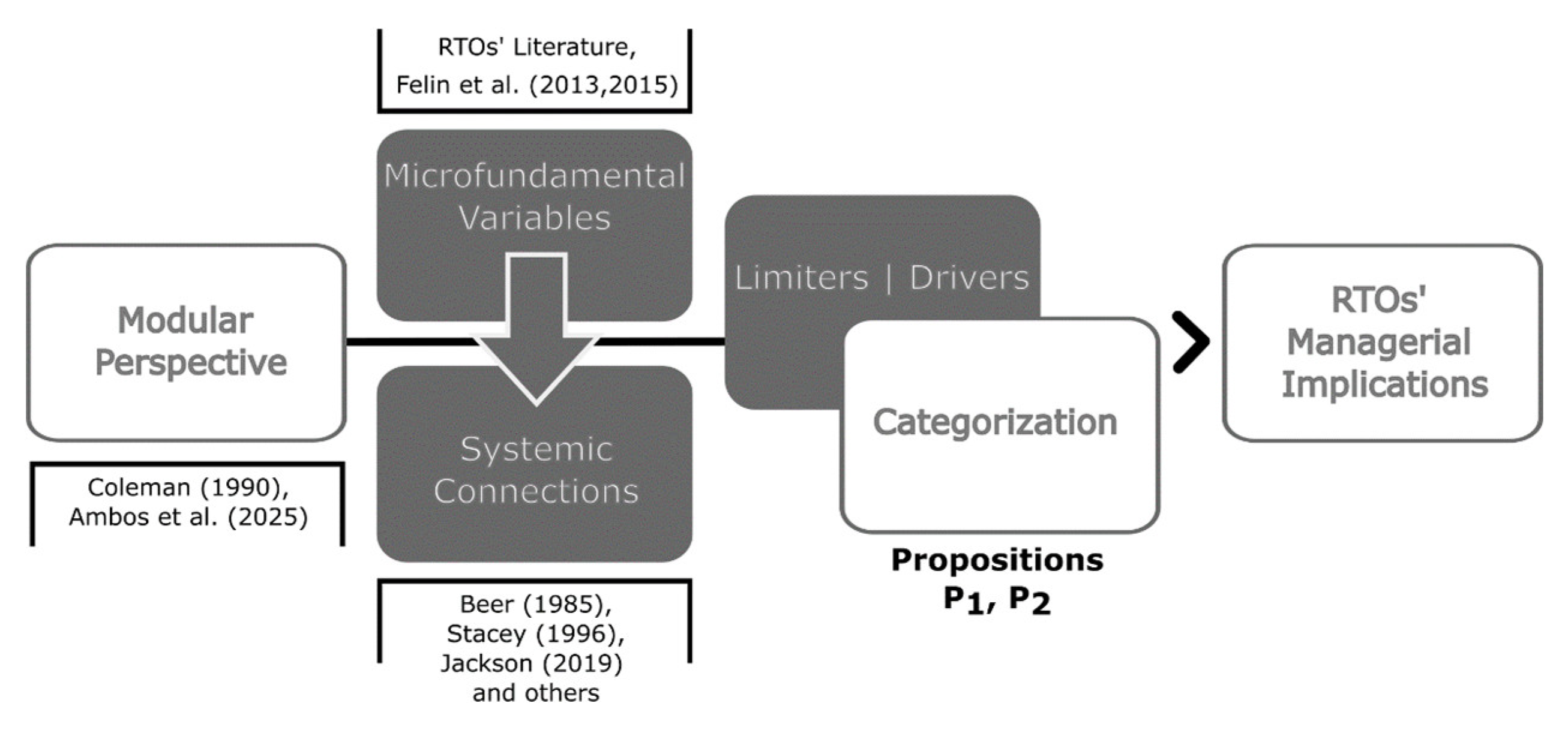
Our core argument, built upon this foundation, is that specific managerial factors act as either drivers (enablers) or limiters (impediments) to these cross-level connections. To develop this argument, this chapter unfolds in a structured sequence. We begin by delineating the RTO operations subsystem to define its components and boundaries (Section 3.1). We then introduce the modular microfoundational variables and the cybernetic channels that animate these components (Section 3.2 onward). This detailed exploration culminates in two formal propositions (P1 and P2) in Section 3.4, which specify how these factors ultimately shape an RTO's technological innovation capabilities.
Figure 2.
Conceptual-theoretical constructs.
3.1. Delineation of the Operations Subsystem of RTOs
To delineate RTOs' operations, two principles are considered: boundaries [20,34,39] and perspectives of analysis [39,40]. The boundaries considered are a function of macroenvironmental agents involved in operations, including funding agencies, RTO intermediaries and national and international partnerships. The details of these agents in the case study align with Brazilian innovation policy [41].
From an internal perspective, this subsystem possesses its own viability, allowing it to adaptively pursue objectives set by upper management while remaining connected to the broader organization through feedback loops [26,34]. This subsystem is composed of core operational processes. Drawing on cross-functional process analysis [42] and a multilevel microfoundational lens [18,19], we identify four primary processes common to RTOs (develop and manage operational strategies; develop and manage projects/portfolios; manage services; and manage technology transfer) [43]. The integrated management of these processes is what converts resources into technological outputs and generates value.
The emergent and interconnected nature of these processes requires a robust framework for managing complexity. Beer's (1985) Viable System Model (VSM) [21] provides such a tool. The VSM is designed to achieve homeostasis between management and operations through regulatory feedback, enabling an organization to adapt to its environment — including the complexities of global R&D networks — while maintaining viability.
While the VSM describes five interacting subsystems, i.e., Implementation (System 1: operationalization of organizational purposes, which takes place at the operations level); Coordination (System 2); Operational Control (System 3); Development (of the macro-organization, in relation to its internal and external environment, System 4); and Policy (System 5, planning of directives that guarantee continuous organizational adaptation in the long term) [20,44,45], our analysis concentrates on the first (Implementation), which represents the operational level.
From the broader VSM framework, we specifically apply the concepts of recursion and dynamic information channels to analyze the connections within and between the RTO's operational processes.
3.2. Cybernetics of Connections and Factors that Affect them
Our framework (Figure 3), grounded in cybernetic principles [21,26], models three critical channels of interaction. In addition to (1) horizontal interrelationships among operational processes and stakeholders, and (2) vertical channels for top-down regulation [46], we introduce a third crucial element: (3) a bottom-up flow representing emergent human and social interactions. At the operational level, our analysis aims to identify the factors affecting these channels, thereby influencing resource optimization, communication effectiveness, and overall performance [6].
From a macro perspective, vertical channels (2) facilitate traditional top-down management. Through them, executive managers coordinate and control operations, providing feedback and establishing regulatory loops — such as standardization and audits — to ensure alignment with organizational objectives and maintain systemic cohesion [34]. However, an RTO's long-term adaptability depends on navigating more than just formal controls [47]. While top-down regulation is essential, RTOs face a critical complexity: emergent, bottom-up behaviors (3) arising from human and social interactions often influence and shape strategies in unforeseen ways [44,48]. Understanding this dynamic is crucial for achieving internal stability and long-term goals [26].
These emergent behavioral dynamics represent a blind spot for traditional management models and the VSM, which prioritize formal control and resource allocation [49]. This oversight is critical, as operational units, often guided by the informal rules of their members, can collectively build, or impede, the emergence of value, independent of formal strategy [48]. To address this gap, we advance a modular microfoundational framework that synthesizes Felin et al.'s focus on micro-to-macro explanations [18,19] with the systemic logic of Coleman's bathtub model [19]. This approach is operationalized through three interconnected analytical modules, as detailed in the following section.
3.3. Modular Microfoundations
The microfoundational variables operate through modular logic [19], where structure establishes the macro-to-micro conditions (Module A-B) that enable or constrain organizational actions [17,50]. These structural parameters dynamically interact with practices (Module B-C), the meso-level processes that institutionalize social interactions and coordinate organizational connections [18], ultimately shaping innovation and adaptation capabilities [51]. At the micro-level (Module C-D), individuals serve as the cognitive nuclei that activate these capabilities through purposeful agency [13], completing Coleman's bathtub sequence.
As Ambos et al. [38] demonstrate, this modular decomposition allows examining how structural constraints (A-B), practice-mediated interactions (B-C), and individual actions (C-D) collectively determine RTOs' operational viability, particularly in managing the tension between autonomy and national and international cooperation in innovation ecosystems. This macro-meso-micro lens provides the analytical foundation for the variables detailed in the following dimensions.
3.3.1. Structure: Organization and Communication for Decision-Making
Organizational architecture and communication channels for decision-making play a dual role in RTOs. Formalized structures, including those incorporating international representation (e.g., advisory boards; co-funding partnerships), enhance operational efficiency by facilitating information processing, knowledge acquisition, and coordination. These mechanisms are vital for the efficient allocation of public resources [52,53] and for bridging communication between national and international stakeholders.
Specifically, international cooperative structures serve as instruments of foreign policy, advancing a nation's strategic interests abroad [54,55], and become central to innovation by effectively integrating local and international knowledge networks [56]. Thus, structural variables represent the essential Module A-B (macro-to-micro) conditions that set the stage for action.
Conversely, the literature also highlights a significant tension: rigid, hierarchical structures can stifle the autonomy and flexibility essential for technological research and development [13,16,57]. Excessive formalization is reported to hinder scientific knowledge integration and effective coordination [13,16], leading to proposals for more adaptive, organic organizational models [57].
Ultimately, these structural variables define the formal landscape of an RTO, establishing the critical balance between operational control and creative freedom. They set the stage for how internal and external players, resources, and processes interact. However, structures are static; it is through organizational practices that this formal landscape is brought to life.
3.3.2. Operational, Support, and Management Practices
Practices constitute critical microfoundations for RTO efficacy. The literature identifies several enabling practices, including process-based road-mapping for knowledge integration [58,59], open innovation strategies[12], and quality management initiatives, such as targeted trainings and surveys, that enhance organizational alignment and cooperation [60].
Beyond general procedures, specific practices are crucial for managing the complexity of collaboration. These include formal mechanisms like terms of reference to ensure strategic alignment [3] and, critically for cross-border work, specialized information systems for managing cooperation projects [36]. Furthermore, the active exploitation of both national and international S&T infrastructure is achieved through targeted practices such as technology networks, joint international research projects, and the management of bi-national science parks and incubators [61]. These practices embody the meso-level mechanisms (Module B-C) that translate structural conditions into coordinated organizational action.
3.3.3. Individuals: Values for Cooperation, Values for Professionalization, and Leadership Profile
Individuals represent a critical microfoundation for understanding complex organizations [48] like RTOs. Three key individual-level variables emerge from the literature as influential for operations management: values for cooperation, values for professionalization, and leadership profile.
The values individuals hold directly impact coordination and control. While researchers are essential for formulating and implementing international S&T collaboration [54], a divergence between individual and organizational goals can hinder the achievement of effective research outcomes and disrupt behavioral coherence within the organization [47,48]. This is often compounded by a prevalent belief among researchers that the uncertainty of technological research cannot be managed by formal systems, creating a significant barrier to adopting management standards [11,60,62].
In contrast, strong leadership is consistently identified as a critical success factor for fostering a successful organizational environment and achieving positive outcomes in RTOs [43,62,63,64]. In summary, individual agency and cognition are the ultimate micro-foundations (Module C-D) from which macro-level outcomes emerge. These variables govern the human and social dynamics of the RTO, representing the source of the bottom-up emergent behaviors discussed earlier. It is through the aggregation of these individual actions that formal strategies are either realized or reshaped, ultimately determining the collective achievement of organizational goals.
3.4. Synthesis of the Constructs
Table 1 synthesizes our conceptual constructs, which are operationalized through two core propositions linking the microfoundational variables to the systemic dynamics of RTO operations:
Proposition 1.(P1): Structural (Module A-B) and Practice-based (Module B-C) variables directly shape an RTO’s formal and informal networks, internal integration, and operational optimization. These variables primarily influence the systemic channels of interrelationship and regulation, while also contributing to bottom-up integration.
Proposition 2 (P2):Individual-level (Module C-D) variables are the primary determinants of social integration and the quality of relationship networks, including cross-border collaborations. These variables are the core source of the bottom-up integration channel.
Inspired by Cooper [65], our framework categorizes drivers and limiters by their systemic function, offering a clear diagnostic tool for RTO managers. This distinction provides a strategic roadmap, as interventions targeting interrelationship and regulation factors can yield short-term impacts on operational efficiency. Conversely, addressing the more complex bottom-up integration factors requires sustained, long-term initiatives, which are crucial for shaping organizational culture and sustaining innovation outcomes, including the context of international collaborations.
Implications for innovation systems and policy are also briefly mentioned.
3.5. Implications for Innovation Systems and Policy
The modular framework carries direct implications for innovation policy and ecosystem governance in contexts of institutional voids [8,9]. Extending the VSM's logic to innovation intermediaries requires attention to how policy instruments interact with microfoundational variables. Rather than imposing uniform structural reforms, policymakers can use our three-module diagnostic (macro-meso-micro) to identify which specific level constitutes the binding constraint on operational viability. Where institutional voids primarily affect resource access, interventions might focus on funding mechanisms; where collaboration failures dominate, meso-level practice reforms are more appropriate; where leadership gaps are critical, micro-level capacity building becomes the priority.
Intermediary structures (such as Technology Innovation Centers and Support Foundations) function as cybernetic regulators [34] that buffer RTOs from institutional volatility while amplifying their strategic reach. Policymakers in emerging economies can leverage such intermediaries to de-risk international collaborations and reduce transaction costs [15]. In addition, the framework's boundary conditions (institutional voids, resource constraints, and knowledge-intensive operations) provide criteria for policy transfer across contexts without assuming universal validity.
4. Results
This section presents the empirical application of the theoretical constructs, detailing the microfoundational dynamics within business units of a Brazilian RTO. The findings are structured to first establish the macro-contextual conditions, then trace their manifestation in meso-level practices, and finally examine their implications for micro-level individual actions. This analysis reveals how macro-level operational viability is shaped by the interplay of structure, practices, and individuals, with a particular focus on how these cross-level interactions enable strategic shifts toward international collaboration. The results are organized through a categorical analysis that explicates these relationships across the entire micro-meso-macro spectrum.
The units’ operational planning is embedded within a multi-level strategic framework. Its annual action plans and indicators are derived from a five-year strategic plan, which itself is informed by macro-organizational debates and aligned with the multiyear plan of the São Paulo state government. A significant restructuring initiated in 2022 aimed to bolster its innovation ecosystem. This strategic shift involved creating an Internationalization Advisory Office and an Innovation Hub to foster an open innovation culture. These structural changes (Module A-B) are designed to facilitate partnerships with multinational companies and develop the national innovation system, marking a transition from identifying market opportunities through prospection to a strategic intent (macro-level outcome) of building collaborative innovation environments.
The approach to external technological demands is evolving from a decentralized, passive model to a coordinated, strategic one. Goals for 2024 explicitly prioritize expanding national and international operations. Initial negotiations are conducted discreetly by representatives from operations, the Technological Innovation Center (NIT), and administrative areas, reflecting specialized coordination practices (Module B-C). Project administration and financial management are executed collaboratively, relying on a division of labor overseen by a project office, administrative manager, and controller, with crucial support from the Support Foundation for administrative intermediation.
When internal competencies are insufficient, the unit activates collaborations with national and international universities and RTOs. A key meso-level practice is the use of partnerships with funding agencies to subsidize projects, mitigate risk, and generate revenue. These partnerships, particularly with governmental bodies, enable the structuring of international technological cells, such as unit for applied research in artificial intelligence, a fruit of a multilateral agreement supported by an International Advisory Board, highlighting its global integration.
Concurrently, a suite of support practices is employed for competency development and information control. These include mentoring, performance evaluations, management rotation programs, and the use of information systems (intranet, performance dashboards, project management blogs). Within laboratories, a flexible, autonomous dynamic for project execution is maintained, with basic rules and deliverables monitored by a project manager in a matrix-like structure, ensuring operational coordination. Final technology transfers involve onsite visits from prototype to production scale, while the Directorate of Innovative Environments and NIT handles legal aspects of intellectual property and funding.
The micro-level (Module C-D) analysis centers on individual agency and competencies. The technical-scientific capabilities are evidenced by volumes of technological deliverables and patents. The organizational culture emphasizes research professionalization, yet cooperation values and researcher profiles reveal a dependence on relational attributes (such as history of interactions, affinity, and trust) for conducting multidisciplinary research. This suggests a tendency toward forming closed relational networks among specific researcher groups.
Challenges include potential dedication conflicts and difficulties in maintaining a uniform sense of urgency across teams where researchers are not managers, pointing to a need for enhanced soft skills development. There is a clear appreciation for researchers with multiple competencies (both soft and hard) to occupy strategic positions. The profile of the operations executive director was highlighted as pivotal for maintaining intense communication and coordination among business unit directors, sharing research demands, and addressing challenges related to researchers in leadership positions, noting that "the researcher's comfort zone is the technical area" (E1). Similarly, international collaborative technology projects appear to depend heavily on the multiple competencies of the principal investigators for project structuring and coordination.
In summary, the evidence reveals an RTO navigating a pivotal transformation. While its strong technical culture and autonomous practices have historically ensured its complexity management [21], the organization is now undergoing a strategic conscientization: a growing recognition that future success depends on strategic reorganization. This shift aims to cultivate essential interpersonal competencies and build more enabling structures, consciously designed to foster the robust internal and international collaborations required for its next stage of evolution.
4.1. Factors Affecting Operations Management
Table 2 compiles the structured drivers and limiters, along with the sources of evidence used in their categorization (detailed information is available in Appendix B) and an emphasis on future short and long-term intervention actions.
As Jackson asserts, “Operations seeking to thrive in their macro environments need to balance their varieties” [26, p. 300]. The findings reveal that this balance is achieved through a complex interplay of factors across macro, meso, and micro levels, with international collaboration emerging as a strategic dimension.
At the macro level (Module A-B), operational homeostasis in the short and medium term is significantly driven by interactive relationships and robust information systems. The century-long experience of the RTO has cultivated a unique competency in building and maintaining these relationships, supported by a robust administrative structure. This includes the NIT, which operates as a key macro-level function for competitive intelligence and managing intellectual property. This foundation is now being strategically extended through new structural mechanisms, such as the recently established Internationalization Advisory Office and the Innovation Hub. These initiatives represent a concerted shift in strategy aimed at fostering an open innovation culture and are already serving as pivotal instruments for facilitating nascent partnerships with multinational companies and integrating the RTO into global knowledge networks.
Furthermore, the information systems not only enhance the knowledge base for problem-solving and decision-making but also foster collaboration and creativity in information synergy creation, enabling greater centralization without bureaucratization [57,66]. Conversely, the limiter failures in the operationalization of practices points to inefficiencies in some pilot-tested or discontinued practices, hindering the full optimization of these macro-level connections.
At the meso level, this strategic shift is supported by two institutional pillars: centralized project control and the continuous development of technical competencies. This control is exercised through a robust structure for monitoring and decision-making, which includes dedicated staff structures within the operations directorate, such as the project office, and key intermediary structures like the Support Foundation. These structures enable cooperative intervention and resource balancing, attenuating horizontal operational varieties without stifling project execution.
The technical-scientific capabilities, a noted competitive differential, are further enhanced through targeted training programs and, crucially, through partnerships with national funding agencies. These agencies play a pivotal meso-level role (Module B-C) by subsidizing integrative collaborative projects, which include international partnerships with multinational companies, universities, and other RTOs, thereby helping to mitigate risks and providing essential extra-budgetary resources for modernizing infrastructure. This support structure directly boosts the unit's market competitiveness and long-term capacities.
Ultimately, the success of these macro and meso-level initiatives hinges on the micro-level dynamics of bottom-up integration, driven by the development of general skills and integrative leadership, yet challenged by a need for further developed soft competencies. As the cognitive nuclei of the technological research and innovation process [67], researchers and internal agents are indispensable. Their existing values for research professionalization are evident. However, the study provides evidence that effective collaboration, including on international projects, is often dependent on relational attributes like trust, affinity, and the multiple competencies of principal investigators. Integrative leadership, exemplified by the operations executive director, is a critical driver for maintaining intense communication, sharing research demands, and fostering synergies across business units [11,60,68]. These leadership skills, which can be cultivated through existing practices like mentoring and management rotation programs, are vital for promoting both internal and external collaborations.
The current tendency towards closed relational networks and challenges in leading scientific teams highlight the strategic limiter: the need to develop soft skills to a greater degree. As Espinosa et al. note, balancing varieties requires “trained and engaged individuals” [69, p. 642], and soft competencies are essential for achieving the “adequate intensity” of integration that fosters, rather than prevents, the emergence of new valuable connections [48, p. 180]. Without such competencies, international technological collaboration may not be effectively realized
5. Discussion
Our study responds to calls for microfoundational analysis in innovation management by integrating cybernetic principles (VSM) and systems thinking with Coleman's modular framework. This approach allowed us to dissect the operational viability and technological emergence of an emerging-economy RTO through the interplay of macro-structural conditions, meso-level practices, and micro-level individual agency. Theoretically, this integration is a core contribution to organizational systems theory and the management of technological innovation. We adapted the VSM, which traditionally underemphasizes social variables and agent motivation [70], by incorporating bottom-up interaction flows and microfoundational dimensions. This unique synthesis establishes a novel diagnostic lens for identifying factors that affect systemic operational connections crucial for efficient R&D and innovation outcomes.
Applying this framework reveals the RTO's strategic intent to internationalize, a journey still in its early stages. Macro-level strategic restructuring, evidenced by the creation of an Internationalization Advisory Office and Innovation Hub, signals a concerted shift toward external engagement and the systemic management of innovation. However, unlike RTOs from advanced economies that may pursue more direct forms of international expansion [71], this RTO's path is characterized by a project-based, network-driven model. This pattern reflects its emergent strategy and the constraints of its late-development context, where global integration is pursued incrementally through collaboration and knowledge exchange rather than asset ownership. This finding directly illustrates how institutional voids shape strategic choices, as discussed in Section 3.5.
This project-based innovation is fundamentally enabled by meso-micro dynamics. At the meso-level, robust intermediary structures like the Support Foundation and practices involving national funding agencies are crucial. They subsidize collaborative R&D projects, mitigate risk, and provide essential resources, acting as key systemic regulators that enhance operational competitiveness.
As Vallejo et al. [8] observed in Sub-Saharan African innovation intermediaries, such structures compensate for weak market institutions by building alternative governance mechanisms. Simultaneously, at the micro-level, the success of collaboration depends on individual agency—specifically, the relational capital, multiple competencies, and integrative leadership of principal investigators. This underscores that without strong soft skills and leadership to foster trust and manage coordination, technological innovation may not be effectively realized. Osorno-Hinojosa et al. [9] similarly found that value co-creation in emerging economy platforms depends on micro-level actors who bridge institutional gaps.
Consequently, the RTO's operational viability and continuous innovation capability hinge on strengthening these meso-micro foundations. For an innovation intermediary where human capital is crucial [13], this goes beyond efficiency; it requires prioritizing systematized mechanisms that increase knowledge and collaboration prospects [57]. This entails investing in change-readiness programs [47] and, critically, cultivating leadership that embodies a sense of mission and can establish effective linkages with both internal and external collaborators [64]. Villa-Enciso et al. [15] reached a similar conclusion regarding Latin American universities, emphasizing that transformative innovation policy must address micro-level capacity building alongside structural reforms.
A core tenet of our hypothetical-deductive approach is to critically evaluate our own constructs against the empirical evidence. The analysis of the propositions proceeds as follows. Proposition P1 was partially verified. The structural configurations and practical variables were indeed central to optimizing and regulating operations. The robust project control intermediation and the organization of research teams in informal matrix structures facilitated coordination based on mutual adjustment and cooperative intervention [26], achieving significant R&D efficiencies.
The macro-level structure plays a vital role in balancing internal and external varieties, particularly evident in the strategic treatment of external complexity as a quality indicator in science and technology contexts [54,71]. The establishment of the Internationalization Advisory Office exemplifies a structural mechanism designed to attenuate the complexity of external engagement and amplify the RTO's strategic reach. However, no direct factor linking structural variables to bottom-up integration emerged. This may be associated with the inherent tension between the hierarchical nature of formal structure and the flexibility required to manage complexity, which often necessitates non-hierarchical methods [46,48]. Future refinements to the constructs could include variables that better capture this interface.
Proposition P2 was fully verified. The values for cooperation, values for professionalization, and leadership profile were representative of the behavioral dynamics important for project execution. A key finding was the critical dependence on individuals — specifically the principal investigators — to structure technological partnerships, including international ones. Their relational capital, multiple competencies, and leadership are indispensable. This finding is consistent with the nature of complex adaptive systems, where value emerges from formal, spontaneous, and informal relationships between individuals [48]. The profile of researchers themselves emerged as an unforeseen but significant variable, directly impacting the execution and outcomes of multidisciplinary R&D projects.
The empirical test highlights the robustness of our framework's micro-level components (P2) while revealing the complex and sometimes indirect influence of macro-level structures on bottom-up dynamics (P1). This critical evaluation not only validates the core tenets of our model but also points to clear avenues for its future refinement. The identification of the "researcher profile" as an unforeseen variable suggests a promising path for expanding the framework, particularly in how RTOs manage and develop their operational human capital.
To evolve its management practices and solidify its innovation trajectory, the organization could distribute specific actions among agents at the subsystem's frontier, as suggested by literature on RTOs [7,62]. These include developing robust evaluation mechanisms to measure collaborative activities against both technological and long-term innovation criteria; actively encouraging partnerships among agents to exchange management experiences; and benchmarking with other RTOs to incorporate international good practices. Analyzing discontinued practices could also clarify whether failures stem from ad hoc demands, resource gaps, or institutional prioritization issues, providing clearer direction for future interventions
6. Final Considerations
This study addressed two research questions: how multi-level dynamics shape the operational viability and innovation capabilities of innovation intermediaries in emerging economies, and how external partnerships influence these dynamics. Our modular framework confirms that an RTO's viability is an emergent property of macro-structural conditions, meso-level practices, and micro-level individual agency. The management of external complexity functions as both a strategic outcome and a catalytic force, implemented through a project-based, network-driven approach suited to late-development contexts.
As theoretical contributions, first, we operationalize Coleman's micro-macro link with the VSM, creating a diagnostic tool for innovation intermediaries that enables cross-context benchmarking of operational drivers and limiters. Second, we adapt the VSM to address social variables and micro-dynamics, moving beyond its traditional emphasis on formal structures and responding to recent calls in cybernetics literature.
Third, we provide a context-sensitive lens for innovation intermediaries operating in institutional voids, directly aligning with the Journal of Innovation's scope on innovation under uncertainty. These contributions advance both innovation management research and systems theory by decoding how micro-level actions (e.g., boundary-spanning of principal investigators) co-evolve with ecosystem-level innovation.
Regarding policy implications, our findings offer three actionable leverage points for innovation policymakers and ecosystem managers. First, at the macro-level, investing in specialized intermediary structures, such as Internationalization Advisory Offices and Innovation Hubs, helps manage external operational complexity and fosters open innovation cultures. Second, at the meso-level, leveraging funding agencies and support foundations to de-risk collaborative R&D projects is critical for mitigating institutional voids.
Third, at the micro-level, prioritizing the development of integrative leadership and soft skills among researchers is indispensable for successful multidisciplinary and international R&D projects. The modular nature of our framework allows policymakers in different contexts (e.g., Sub-Saharan Africa, Southeast Asia, Latin America) to adapt specific modules under the three boundary conditions specified in Section 2.1.1: institutional voids, resource constraints, and knowledge-intensive operations.
As limitations, the primary constraint is the inside-out perspective, relying on internal views of the RTO. Future work incorporating external viewpoints from partners (funding agencies, client firms, international collaborators) would provide more comprehensive triangulation. Additionally, while validated in this critical case, the constructs would benefit from application in other emerging economies to test their generalizability across different institutional configurations.
Future research could also apply our framework to assess how innovation intermediaries contribute to grand challenges such as net-zero transitions and inclusive innovation. By focusing on the microfoundational drivers of operational viability, this study provides a framework for building more resilient innovation intermediaries capable of navigating institutional voids and fostering sustainable development.
Author Contributions
Conceptualization, M.G.M.M and S.L.S; methodology, M.G.M.M, S.L.S and F.G.M; software, M.G.M.M.; validation, S.L.S.; formal analysis, M.G.M.M; investigation, M.G.M.M.; data curation, S.L.S.; writing—original draft preparation, M.G.M.M; writing—review and editing, S.L.S; visualization, M.G.M.M.; supervision, S.L.S; project administration, M.G.M.M. All authors have read and agreed to the published version of the manuscript.
Funding
This research received no external funding.
Informed Consent Statement
Informed consent was obtained from all subjects involved in the study.
Conflicts of Interest
The authors declare no conflicts of interest.
Abbreviations
The following abbreviations are used in this manuscript:
| APQC | American Product and Quality Center |
| MDPI | Multidisciplinary Digital Publishing Institute |
| NIT | Nucleo de Inovação Tecnológica (Technological Innovation Center) |
| R&D | Research and Development |
| RTO | Research and Technology Organization |
| RTOs | Research and Technology Organizations |
| S&T | Science and Technology |
| SOSM | System of systems methodologies |
| VSM | Viable System Model |
Appendix A. Protocol for the Case Study
A.1. Objective
Apply (test) the constructs of the theoretical conceptual tool; and verify their validity.
A.2. Research Questions for the Field Study
How is the business unit's operations managed? What are the dynamics of carrying out operations? How does it impact the structuring of connections between parties involved with operations?
A.3. Procedures for Data Collection and Criteria for Quality Assurance (as Planned)
The representative of the executive management must be explained about the objectives of the study and asked to indicate the advisees who can contribute to the research, according to delimitations on the representativeness of the professionals defined in the model. They must be contacted in advance to present the research and define the interview schedule. Check with the representative of the executive management the possibility of using the institutional name for the purpose of publicizing the study.
Four instruments were defined for data collection, so that data triangulation is possible. Semi-structured interviews; documentation analysis (checking live access documents available on institutional websites, as well as the possibility of accessing internal documents, as mentioned by interviewees); recording in archives; institutional videos. Data collection from interviews should be duly noted in a logbook and immediately transcribed for data reporting. Permission should be sought for recording of interviews. The script should be printed. Draft individual reports should be submitted for review by interviewees. Once validated, they will be consolidated into a single file for the formation of the database with the evidence collected.
*********
Semi-structured Interview Script
(1) Identification of the Interviewee
Name:
Position:
Time in the institution:
(2) Structure and practices
(2.1) How are strategy and operational opportunities developed?
(2.2) How are projects/project portfolio developed and managed?
(2.3) Is there service provision? How is it managed?
(2.4) How is technology transfer managed?
(2.5) What are the institutional support mechanisms for operations not directly related to operations that contribute to their successful completion?
(3) Behavior
(3.1) How can the business unit be described in terms of: (3.1.1) Collaboration between teams (general; project teams); (3.1.2) Acceptance of managerial/administrative practices and interventions?
(3.2) What is the performance of scientific leaders like? How are their competencies developed?
(3.3) What are the dynamics of the executive officers' actions?
(4) Others
(4.1) In your opinion, what drives the success of technology deliveries? What are the opportunities for improvement?
(4.2) Are there other aspects not identified above that could be reported to enrich the research?
*********
Appendix B. Categorization of Factors
The categorization of the factors (Drivers/Limiters) followed the steps below:
- (1)
- Transcription, validation of the interviews and listening to the audio of the interviews.
- (2)
- Selection of speech excerpts (context units), inclusion in the driver or limiter worksheet, and naming (code) for each speech. Speeches that dealt with the same subject received the same code.
- (3)
- Selection of excerpts from the reports and other secondary data, following the criteria in item 2.
- (4)
- Grouping of codes into categories of factors according to the identified relationships (ie, between microfoundations dimensions and systemic connections).
- (5)
- The coded factors most mentioned in interviews (mentioned by four or more data) were considered.
Categorization data available for referees at: https://docs.google.com/spreadsheets/d/1OzQdNYHWhIPEoqPs2Ecc80ppL-UhrBqK/edit?usp=sharing&ouid=105702777672378104778&rtpof=true&sd=true
References
- Arnaldi, S.; Neresini, F. The role of intermediary organizations in the mainstreaming of Responsible Research and Innovation in the Italian industrial sector. J. Responsible Innov. 2019, 6, 361–367. [Google Scholar] [CrossRef]
- Giannopoulou, E.; Barlatier, P.J.; Pénin, J. Same but different? Research and technology organizations, universities and the innovation activities of firms. Res. Policy 2019, 48, 223–233. [Google Scholar] [CrossRef]
- Steen, M.; Nauta, J. Advantages and disadvantages of societal engagement: A case study in a research and technology organization. J. Responsible Innov. 2020, 7, 598–619. [Google Scholar] [CrossRef]
- Mrinalini, N.; Nath, P. Knowledge management in research and technology organizations in a globalized era. Perspect. Glob. Dev. Technol. 2008, 7, 37–54. [Google Scholar] [CrossRef]
- Salles-Filho, S.; Bin, A.; Bonilla, K.; Colugnati, F.A.B. Effectiveness by design: Overcoming orientation and transaction related barriers in research-industry linkages. Rev. Adm. Contemp. 2021, 25, e190346. [Google Scholar] [CrossRef]
- Adler, N.; Elmquist, M.; Norrgren, F. The challenge of managing boundary-spanning research activities: Experiences from the Swedish context. Res. Policy 2009, 38, 1136--1149. [Google Scholar] [CrossRef]
- Zylberberg, E. Beyond research and technology organization (RTO) benchmarking: Towards a typology of innovation intermediaries. In Innovation in Brazil: Advancing Development in the 21st Century; Reynolds, E.B., Schneider, B.R., Zylberberg, E., Eds.; Routledge: London, UK, 2019; p. 165--184. [Google Scholar]
- Vallejo, B.; Oyelaran-Oyeyinka, B.; Ozor, N.; Bolo, M. Open Innovation and Innovation Intermediaries in Sub-Saharan Africa. Sustainability 2019, 11, 392. [Google Scholar] [CrossRef]
- Osorno-Hinojosa, R.; Koria, M.; Ramírez-Vázquez, D.d.C.; Calvario, G. Designing Platforms for Micro and Small Enterprises in Emerging Economies: Sharing Value through Open Innovation. Sustainability 2023, 15, 11460. [Google Scholar] [CrossRef]
- Åström, T.; Eriksson, M.L.; Niklasson, L.; Arnold, E. International Comparison of Five Institute Systems; Forsknings- og Innovationsstyrelsen: Copenhagen, Denmark, 2008. [Google Scholar]
- Biasini, V. Implementation of a quality management system in a public research centre. Accred. Qual. Assur. 2012, 17, 621–626. [Google Scholar] [CrossRef]
- Munkongsujarit, S.; Srivannaboon, S. Managing open innovation: A case study of the National Science and Technology Development Agency (NSTDA). In Proceedings of the Portland International Conference on Management of Engineering and Technology (PICMET), Portland, OR, USA, 9—13 July 2017. [Google Scholar]
- Adegbile, A.S.; Sarpong, D.; Kolade, O. Environments for joint University-Industry laboratories (JUIL): Microlevel dimensions and research implications. Technol. Forecast. Soc. Change 2021, 170, 120888. [Google Scholar] [CrossRef]
- Villani, E.; Rasmussen, E.; Grimaldi, R. How intermediary organizations facilitate university—industry technology transfer: A proximity approach. Technol. Forecast. Soc. Change 2017, 114, 86–102. [Google Scholar] [CrossRef]
- Villa-Enciso, E.; García-Mosquera, J.; Valencia-Arias, A.; Medina-Valderrama, C.J. Exploring the Role of Latin American Universities in the Implementation of Transformative Innovation Policy. Sustainability 2023, 15, 12854. [Google Scholar] [CrossRef]
- Boardman, C.; Ponomariov, B. Management knowledge and the organization of team science in university research centers. J. Technol. Transf. 2014, 39, 75–92. [Google Scholar] [CrossRef]
- Coleman, J.S. Foundations of Social Theory; Harvard University Press: Cambridge, MA, USA, 1990. [Google Scholar]
- Felin, T.; Foss, N.J.; Heimeriks, K.H.; Madsen, T.L. Microfoundations of routines and capabilities: Individuals, processes, and structure. J. Manag. Stud. 2012, 49, 1351–1374. [Google Scholar] [CrossRef]
- Felin, T.; Foss, N.J.; Ployhart, R.E. The microfoundations movement in strategy and organization theory. Acad. Manag. Ann. 2015, 9, 575–632. [Google Scholar] [CrossRef]
- Beer, S. The Heart of Enterprise; John Wiley & Sons: Chichester, UK, 1979. [Google Scholar]
- Beer, S. Diagnosing the System for Organizations; John Wiley & Sons: Chichester, UK, 1985. [Google Scholar]
- Popper, K. The Logic of Scientific Discovery; Cultrix: São Paulo, Brazil, 2008. [Google Scholar]
- Willow, C.C. Qualitative decision making with integrated systems design methodology: A case study. J. Eng. Technol. Manag. 2007, 24, 262–286. [Google Scholar] [CrossRef]
- Dresch, A.; Lacerda, D.P.; Antunes, J.A.V., Jr. Design Science Research: A Method for Science and Technology Advancement; Springer: Cham, Switzerland, 2015. [Google Scholar]
- Ragin, C.C.; Rihoux, B. Qualitative Comparative Analysis (QCA): State of the art and prospects. Qual. Methods 2004, 2, 3–13. [Google Scholar]
- Jackson, M.C. Critical Systems Thinking and the Management of Complexity; John Wiley & Sons: Hoboken, NJ, USA, 2019. [Google Scholar]
- Yin, R.K. Case Study Research and Applications: Design and Methods, 6th ed.; Sage: Thousand Oaks, CA, USA, 2018. [Google Scholar]
- Lincoln, Y.S.; Guba, E.G. Naturalistic Inquiry; Sage: Beverly Hills, CA, USA, 1985. [Google Scholar]
- Bardin, L. Content Analysis; Editions 70: São Paulo, Brazil, 2011. [Google Scholar]
- Krippendorff, K. Content Analysis: An Introduction to Its Methodology, 2nd ed.; Sage: Thousand Oaks, CA, USA, 2004. [Google Scholar]
- Krefting, L. Rigor in qualitative research: The assessment of trustworthiness. Am. J. Occup. Ther. 1991, 45, 214–222. [Google Scholar] [CrossRef]
- Cilliers, P. The architecture of complexity (introduction). Emerg. Complex. Organ. 2005, 7, 138–154. [Google Scholar]
- Deming, W.E. The New Economics for Industry, Government, and Education; MIT Press: Cambridge, MA, USA, 1993. [Google Scholar]
- Espejo, R.; Gill, A. The Viable System Model as a Framework for Understanding Organizations; Metaphorum, 2011. [Google Scholar]
- Da Silva, D.H. International cooperation in science and technology: Opportunities and risks. Rev. Bras. Polít. Int. 2007, 50, 5–28. [Google Scholar]
- Laaziri, M.; Benmoussa, K.; Khoulji, S.; Larbi, K.M. Outlining an intelligent tutoring system for a university cooperation information system. Eng. Technol. Appl. Sci. Res. 2018, 8, 3427–3431. [Google Scholar] [CrossRef]
- Chesbrough, H. Open Innovation Results: Going Beyond the Hype and Getting Down to Business; Oxford University Press: Oxford, UK, 2020. [Google Scholar]
- Ambos, T.C.; Andersson, U.; Drogendijk, R.; Lunnan, R.; Scott, P.S.; Yildiz, H.E. Revealing the promise of microfoundations for international business research: A modular approach. J. World Bus. 2025, 60, 101610. [Google Scholar] [CrossRef]
- Phillips, M.A.; Ritala, P. A complex adaptive systems agenda for ecosystem research methodology. Technol. Forecast. Soc. Change 2019, 148, 119739. [Google Scholar] [CrossRef]
- Kouamé, S.; Langley, A. Relating microprocesses to macro-outcomes in qualitative strategy process and practice research. Strateg. Manag. J. 2018, 39, 559–581. [Google Scholar] [CrossRef]
- Brasil. Lei nº 13.243, de 11 de janeiro de 2016. Dispõe sobre estímulos ao desenvolvimento científico, à pesquisa, à capacitação científica e tecnológica e à inovação. In Diário Oficial da União; 2016. [Google Scholar]
- American Productivity and Quality Center (APQC). Process Classification Framework (PCF); APQC: Houston, TX, USA, 2022. [Google Scholar]
- Rush, H.; Hobday, M.; Bessant, J.; Arnold, E. Strategies for best practice in research and technology institutes: An overview of a benchmarking exercise. R&D Manag. 1995, 25, 17–31. [Google Scholar] [CrossRef]
- Espinosa, A.M.; Walker, J.; Grover, K.; Vachkova, M.V. The viability and sustainability approach to support organisational resilience: Learning in a recent case study in the health sector. Syst. Res. Behav. Sci. 2023, 40, 689–700. [Google Scholar] [CrossRef]
- Liboni, L.B.; Cezarino, L.O.; Donaires, O.S.; Zollo, M. Systems approach in dynamic capabilities. Syst. Res. Behav. Sci. 2022, 39, 766–778. [Google Scholar] [CrossRef]
- Donaires, O.S.; Martinelli, D.P. Evolutionary management: From theory to action. Syst. Res. Behav. Sci. 2019, 36, 66–86. [Google Scholar] [CrossRef]
- Bin, A.; Salles-Filho, S. Science, technology and innovation management: Contributions to a methodological framework. J. Technol. Manag. Innov. 2012, 7, 73–86. [Google Scholar] [CrossRef]
- Stacey, R.D. Complexity and Creativity in Organizations; Berrett-Koehler: San Francisco, CA, USA, 1996. [Google Scholar]
- Kazakov, R.; Howick, S.; Morton, A. Managing complex adaptive systems: A resource/agent qualitative modelling perspective. Eur. J. Oper. Res. 2021, 290, 386–400. [Google Scholar] [CrossRef]
- Lam, A. Organizational innovation. In The Oxford Handbook of Innovation; Fagerberg, J., Mowery, D.C., Nelson, R.R., Eds.; Oxford University Press: Oxford, UK, 2005; pp. 115–147. [Google Scholar]
- Gibson, R.; Skarzynski, P. Inovação: Prioridade Número 1; Elsevier: Rio de Janeiro, Brazil, 2008. [Google Scholar]
- Leme, A.P.F.P.; Salgado, P.A.R.; Rebelo, G.H.; Ungar, M.; Pereira, T.Z.D.; Sousa, V.L. The implementation of open innovation: A case study of managerial levels in a centenary public research institute. In Proceedings of the Portland International Conference on Management of Engineering and Technology (PICMET), Portland, OR, USA, 2—5 August 2015. [Google Scholar]
- Cheah, S.L.; Ho, Y.P. Effective industrial policy implementation for open innovation: The role of government resources and capabilities. Technol. Forecast. Soc. Change 2020, 151, 119845. [Google Scholar] [CrossRef]
- Domingues, A.A. The strategic coordination of international collaboration science and technology policy. Conj. Glob. 2015, 4, 351–368. [Google Scholar]
- Hernández-Socha, Y.; Zuluaga-Jiménez, J.C. Innovation intermediaries, knowledge infrastructure and technological opportunities in emerging markets: The case of research and technological centers in the Colombian agricultural sector. Innov. Dev. 2022, 14, 265–295. [Google Scholar] [CrossRef]
- Conlé, M.; Zhao, W.; Brink, T. Technology transfer models for knowledge-based regional development: New R&D institutes in Guangdong, China. Sci. Public Policy 2021, 48, 132–144. [Google Scholar]
- Barlatier, P.J.; Giannopoulou, E. The dual perspective of sustainable development in service innovation: A conceptual model proposition for research and technology organizations. In Proceedings of the Second International Conference IESS, Geneva, Switzerland, 2—4 February 2011. [Google Scholar]
- Koppinen, S.; Lammasniemi, J.; Kalliokoski, P. Practical application of a parallel research—business innovation process to accelerate the deployment of research results. R&D Manag. 2010, 40, 101–106. [Google Scholar]
- Ahlqvist, T.; Halonen, M.; Eerola, A.; Kivisaari, S.; Kohl, J.; Koivisto, R.; Myllyoja, J.; Wessberg, N. Systemic transformation, anticipatory culture, and knowledge spaces: Constructing organisational capacities in roadmapping projects at VTT Technical Research Centre of Finland. Technol. Anal. Strateg. Manag. 2012, 24, 821–841. [Google Scholar] [CrossRef]
- Poli, M.; Pardini, S.; Passarelli, I.; Citti, I.; Cornolti, D.; Picano, E. The 4A's improvement approach: A case study based on UNI EN ISO 9001:2008. Total Qual. Manag. Bus. Excell. 2015, 26, 1113–1130. [Google Scholar] [CrossRef]
- Ferreira, M.L.A.; Ramos, R.R. Making university-industry technological partnerships work: A case study in the Brazilian oil innovation system. J. Technol. Manag. Innov. 2015, 10, 9–21. [Google Scholar] [CrossRef]
- Casati, A.; Genet, C. Principal investigators as scientific entrepreneurs. J. Technol. Transf. 2014, 39, 11–32. [Google Scholar] [CrossRef]
- Meesapawong, P.; Rezgui, Y.; Li, H. Perceiving societal value as the core of innovation management in public research and development organizations. In Proceedings of the IEEE International Conference on Management of Innovation and Technology (ICMIT), Bali, Indonesia, 2—5 June 2010. [Google Scholar]
- Schwartzman, S. Universities and Development in Latin America: Successful Experiences from Research Centers; Edelstein Center for Social Research: Rio de Janeiro, Brazil, 2008. [Google Scholar]
- Cooper, R.G. The drivers of success in new-product development. Ind. Mark. Manag. 2019, 76, 36–47. [Google Scholar] [CrossRef]
- Espejo, R. The enterprise complexity model: An extension of the viable system model for emerging organizational forms. Syst. Res. Behav. Sci. 2020, 37, 1–17. [Google Scholar] [CrossRef]
- Coccia, M. A basic model for evaluating R&D performance: Theory and application in Italy. R&D Manag. 2001, 31, 453–464. [Google Scholar] [CrossRef]
- Poli, M.; Cornolti, D.; Pardini, S.; Iervas, G. How and why to implement a performance management system in public research institutions: The approach and the experience of a large multidisciplinar Italian centre. Int. J. Qual. Res. 2018, 12, 757–772. [Google Scholar]
- Espinosa, A.; Harnden, R.; Walker, J. A complexity approach to sustainability — Stafford Beer revisited. Eur. J. Oper. Res. 2008, 187, 636–651. [Google Scholar] [CrossRef]
- Espinosa, A.; Harnden, R. Team syntegrity and democratic group decision making: Theory and practice. J. Oper. Res. Soc. 2007, 58, 1056–1064. [Google Scholar] [CrossRef]
- Berger, M.; Hofer, R. The internationalisation of Research and Technology Organisations (RTOs) — Conceptual notions and illustrative examples from European RTOs in China. Sci. Technol. Soc. 2011, 16, 99–122. [Google Scholar] [CrossRef]
Figure 1.
Methodological Design.
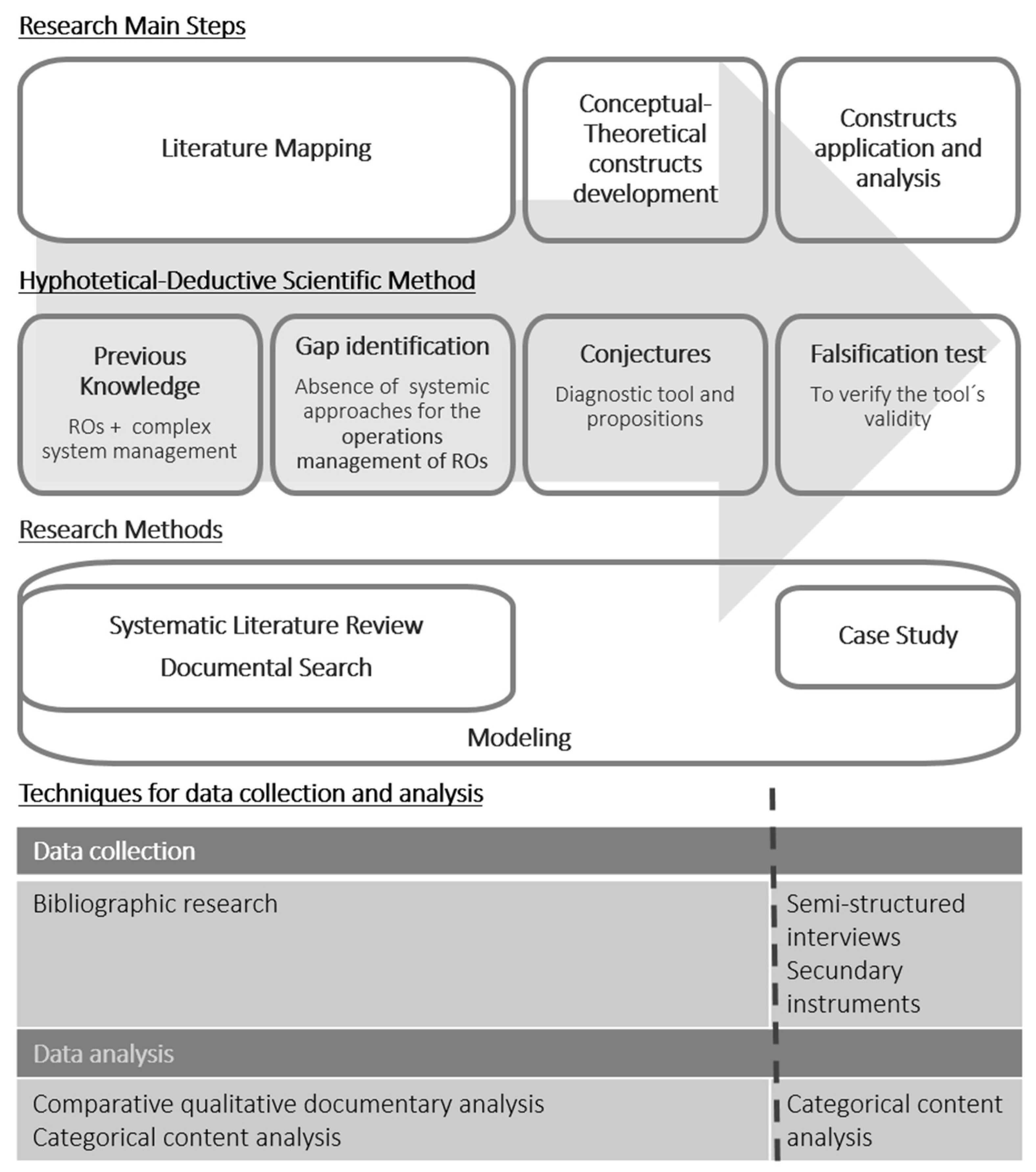
Figure 3.
Parts, connections and modular microfoundations for evaluating the operations management of RTOs.
Figure 3.
Parts, connections and modular microfoundations for evaluating the operations management of RTOs.
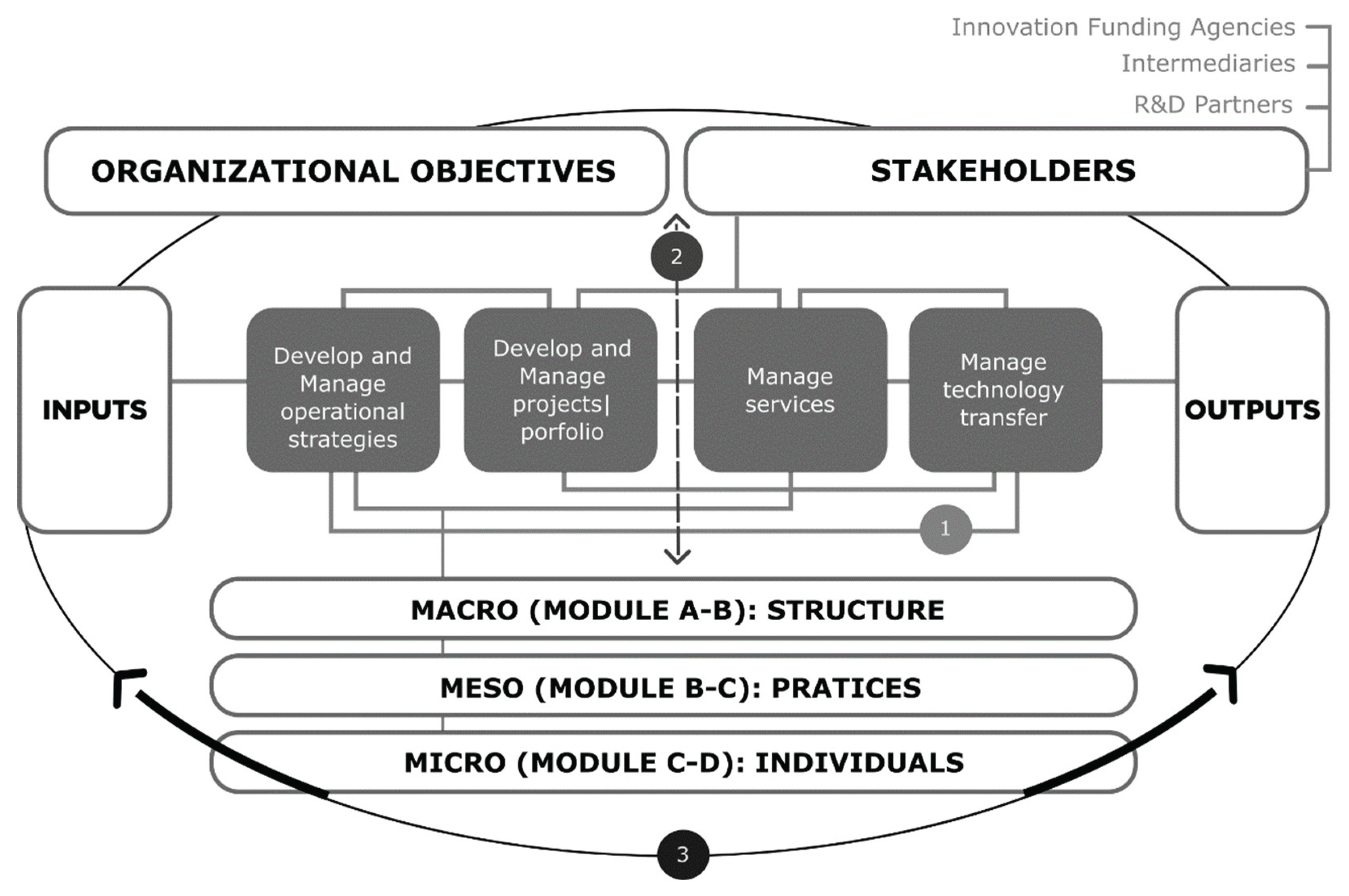

Table 1.
Constructs of the diagnostic tool.
| Analysis Variable | Connections | Factor | Drivers (+)|Limiters (-) | Emphasis |
|---|---|---|---|
| Structure: division of labor; communication for decision-making Practices: operational, support and management Individuals: values for cooperation; values for professionalization; leadership profile |
Interrelationships among processes, resources, and stakeholders | Factors that drive (+) or limit (-) interrelationships among processes, resources, and stakeholders (P1) |
Operational |
| Regulation of operations | Factors that drive (+) or limit (-) the regulation of operations (P1) |
Tactical | |
| Bottom-up integration | Factors that drive (+) or limit (-) the integration between parts (P2) | Strategic |
Table 2.
Summary of factors that affect the operations management of RTOs.
| Factor Category | Drivers (+), Limiters (-) | Sources of Evidence | Emphasis |
|---|---|---|
| Interrelationships among operations, resources, and stakeholders |
(+) Interactive relationships | E1, E2, E3, E4, E5, E6, D1, D6, D8, D9, D11 ; Information systems | E1, E2, E3, E4, E6, D1, D3, D4; (-) Failures in the operationalization of practices | E1, E2, E3, E4, E6, D4 |
Operational |
| Regulation of operations | (+) Centralized project control| E1, E3, E4, E5, E6, D1, D2, D3,D4; Development of technical and scientific competencies | E1, E3, E4, E5, D2, D3, D4, D9, D10, D11 | Tactical |
| Bottom-up integration | (+) Development of (general) skills | E1, E2, E3, E5, D4; (+) Integrative Operations Leadership | E2, E3, E4, E6, D11; (-) Soft competencies (to be developed) | E1, E2, E3, E4, E5, E6 |
Strategic |
Disclaimer/Publisher’s Note: The statements, opinions and data contained in all publications are solely those of the individual author(s) and contributor(s) and not of MDPI and/or the editor(s). MDPI and/or the editor(s) disclaim responsibility for any injury to people or property resulting from any ideas, methods, instructions or products referred to in the content. |
© 2026 by the authors. Licensee MDPI, Basel, Switzerland. This article is an open access article distributed under the terms and conditions of the Creative Commons Attribution (CC BY) license (http://creativecommons.org/licenses/by/4.0/).
Copyright: This open access article is published under a Creative Commons CC BY 4.0 license, which permit the free download, distribution, and reuse, provided that the author and preprint are cited in any reuse.


