

Submitted:
28 April 2026
Posted:
30 April 2026
You are already at the latest version
Abstract
It is necessary to develop a sensitive and selective analytical method for detecting organophosphate insecticides, such as malathion, for environmental protection. Herein, we have designed an innovative sensing platform that incorporates silver nanoparticles (AgNPs) into molecularly imprinted polymers (MIPs), with AgNPs synthesized via in situ silver ion reduction during the precipitation polymerization of the MIP. Integrating AgNPs into MIP allows us to leverage both the selectivity and high sensitivity of molecular imprinting technology and the enhanced surface-enhanced Raman scattering (SERS) properties of AgNPs. The sensors demonstrate a linear detection range of 0.005-5 µg/ml and a limit of detection (LOD) of 0.005 µg/ml for malathion in water solution. The sensor is tested and evaluated in spiked drinking and tap water, obtaining recovery rates ranging from 93% to 100.5%. The AgNPs@MIP SERS sensor provides a rapid, selective, and sensitive approach for malathion detection, promising to develop an analytical tool for environmental and agricultural monitoring of organophosphate compounds.

Keywords:
molecularly imprinted polymers
; surface enhanced raman scattering
; silver nanoparticles
; malathion
; environmental monitoring
1. Introduction
Environmental pollution continues to threaten sustainability, public health, and the global economy [1,2], largely due to human activities that introduce pollutants into water, air, and soil [3]. Malathion, a widely used organophosphate pesticide (OPP), is used extensively in agriculture to control pests and ensure productivity [4]. However, less than 0.1% of applied pesticides reach their intended targets, leading to significant environmental contamination from pesticide residues [5]. Malathion residues have been detected in various environmental matrices, including fruits and vegetables, drinking water, river water, agroecosystem sediments, and even urine [4]. Therefore, there is a critical need to develop rapid and precise sensing techniques, such as chemosensors, to accurately determine pesticide residue levels in the environment and safeguard both ecosystems and public health [6,7].
Sensor technology offers significant potential to address the challenge of detecting pollutants, such as pesticide residues, amid global environmental pollution [8]. Although conventional analytical methods such as high-performance liquid chromatography (HPLC) and gas chromatography-mass spectrometry (GC-MS) have been widely used for pesticide detection, their high cost, time-consuming procedures, and technical complexity make them less suitable for rapid, in-field monitoring applications [8,9,10]. As a result, a class of chemosensors known as molecularly imprinted polymers (MIPs) has emerged as a promising approach for detecting pesticide residues such as malathion in complex environmental matrices, owing to their specificity, sensitivity, and selectivity [7].
MIPs are synthetic polymeric materials designed to mimic the molecular recognition capabilities of biological systems, such as antibody-antigen interactions. They are primarily fabricated using an imprinting technique, in which a template molecule is used during polymerization to create specific binding sites with high affinity and selectivity for the target analyte [7,11,12]. As a result, MIP-based chemosensors hold great promise for environmental applications, enabling trace-level detection of pollutants in complex matrices without extensive sample pretreatment and facilitating rapid, real-time monitoring of contaminated samples [13].
Additionally, surface-enhanced Raman scattering (SERS) has emerged as a powerful, non-destructive sensing technique that offers enhanced sensitivity and rapid analysis [14,15]. SERS substrates, such as silver nanoparticles (AgNPs) and other noble metals, can amplify Raman signals, enabling the detection of analytes at trace levels [14,16]. The combination of MIPs with SERS substrates further enhances sensitivity and specificity, facilitating the detection of organophosphate pesticides such as malathion in complex environmental matrices [11,17]. AgNPs, in particular, are effective supports for chemical sensing applications due to their excellent optical properties, including localized surface plasmon resonance (LSPR), as well as their high thermal and electrical conductivity [18,19]. Integrating AgNPs with a polymeric platform for pesticide residue sensing significantly improves the detection of trace pollutants in the environment [20,21,22,23].
In this study, we investigated the incorporation of AgNPs into MIPs to create active SERS substrates (AgNPs@MIPs) for the recognition and detection of malathion in drinking and tap water samples. To the best of our knowledge, there is limited information on the in-situ synthesis of silver MIP-SERS substrates for malathion or other OPP detection. We developed and characterized an AgNPs@MIP platform and evaluated its performance for malathion detection. The novelty of this platform lies in the synergistic combination of the MIP’s specific recognition capabilities with the signal-amplification properties of SERS substrates, resulting in outstanding sensitivity and selectivity for the target analyte malathion. This MIP-SERS technology represents a promising analytical method for the detection of target analytes in complex matrices [24,25] and offers an innovative solution for enhanced selectivity in malathion detection. This MIP-SERS chemosensor developed here demonstrates significant potential as a rapid analytical tool for environmental monitoring applications.
2. Results and Discussion
2.1. Synthesis and Characterization of AgNPs@MIPs
In general, noble metals have proven to be excellent substrates for SERS application due to their enhanced sensitivity, ease of preparation, and chemical stability [26]. Although gold nanoparticles possess enhanced chemical stability, their SERS activity is not as strong as that of AgNPs [27]. Thus, AgNPs are considered in this work due to their excellent SERS properties and are incorporated into the MIP synthesis.
Efficient incorporation of AgNPs into a polymer matrix is challenging, as achieving uniform dispersion within the MIP platform is difficult and can limit the effectiveness of molecular recognition in analytical detection applications [28,29,30,31]. To address this, we adopted an in situ synthesis approach to achieve uniform integration of AgNPs within the MIP platform [14].
The nanostructures and morphologies of the AgNPs@MIPs and AgNPs@NIPs were characterized and evaluated by SEM, as elucidated in Figure 1. Figure 1A,B highlight the morphologies of the AgNPs@MIPs before (non-eluted) and after (eluted) template removal, respectively, aligned with the malathion template removal process. It was evident that the successful removal of the malathion template with the organic solvent blend of methanol and acetic acid created cavities in the MIP [32] and ensured a mesoporous morphological feature [33], thus activating the binding sites of the AgNPs@MIP for the target analyte, malathion [34]. Figure 1C,D present the non-eluted and eluted AgNPs@NIPs, respectively. However, in the case of the NIP, organic residues are removed from the platform, thus creating a porous substrate.
Both the AgNPs@MIPs and AgNPs@NIPs exhibited AgNPs distributed on their surfaces and within the polymer matrix. TEM images in Figure 1E,F confirm the presence of spherically shaped AgNPs doped in the AgNPs@MIP and AgNPs@NIPs, with average sizes of 20 nm and 5 nm, respectively. The dense, uniform distribution of AgNPs within the imprinted matrix and on its surface provides an excellent host for SERS-active agents, which is highly beneficial for sensitive detection of malathion.
Both the SEM and TEM results indicate the successful integration of uniform AgNPs in the polymers. This method uses a homogeneous mixture to ensure uniform distribution of the AgNO3 precursor throughout the polymer matrix. Reduction of the silver ions by sodium borohydride leads to the formation of AgNPs inside the polymer matrix in the presence of template molecules. During template removal, organic solvents are essential for achieving successful imprinting [7,11,35]. As a result, recognition cavities are formed in the MIP, with SERS-active AgNPs positioned near the active sites, thereby enhancing signal amplification for detecting the target analyte, malathion [7].
2.2. UV-Vis Analysis and AgNPs@MIPs Template Removal Process
UV-Vis spectroscopy was used to confirm the removal of the template from the MIP platform [36]. Also, an observed shift in the UV-Vis spectrum confirms the complete removal of the malathion template from the MIP platform, as shown in Figure S1. Initially, as seen in Figure S1A, pure malathion is UV-active and exhibits a UV-vis spectrum at 252 nm; a second spectrum at 262 nm is attributed to AgNPs@MIP before the silver ions were reduced. However, after NaBH4 treatment of the MIP platform, a typical surface plasmon resonance peak at ~402 nm was evident, confirming the formation of AgNPs within the MIP platform. In addition, Figure S1B, the UV-Vis spectrum depicting a peak of 406 nm of the eluted AgNPs@MIP and AgNPs@NIP, validates and confirms the presence of AgNPs doped into the MIP platform after the successful removal of the template malathion, thus activating the binding sites of the MIP and increasing its affinity for any reaction mechanism with a target analyte. During the template removal process (Figures S1C and S1D, respectively), a blend of two organic solvents (methanol/acetic acid) is first employed to remove the malathion from the AgNPs@MIP, which shows a peak around 252 nm. Interestingly, the AgNPs@NIPs also exhibited similar characteristics; however, the pseudo-malathion characteristics of the AgNPs@NIPs were associated with the functional monomer, methyl acrylate, as both MMA and malathion possess a similar chemical fingerprint, as confirmed by FTIR analysis of these chemical agents. The final organic solvent used for the AgNPs@MIP elution process was methanol, which also demonstrated successful template removal, as evidenced by a shift in the UV-Vis spectrum to 216 nm. Generally, the disappearance of the UV absorbance peak of the malathion or template molecule after solvent elution indicates successful removal of the template molecule from the MIP platform, as reported in the literature [14,24].
2.3. UV-Vis Analysis and AgNPs@MIPs Template Removal Process
The development of MIPs with increased surface area and mesoporous nature is an excellent attribute for the efficient and selective rebinding of target analytes such as malathion. Thus, to assess the rebinding performance of the AgNPs@MIPs, UV–vis spectroscopy was used to monitor the kinetic binding of the MIP and the NIP with malathion, as shown in the adsorption kinetic curves (Figure S2).
The adsorption of malathion by the AgNPs@MIPs reached equilibrium in approximately 20 minutes. In contrast, the AgNPs@NIPs reached equilibrium slightly faster, likely because malathion interacts with the NIP surface, facilitating easier diffusion. The interaction between AgNPs@NIP and malathion is attributed to non-specific binding, whereas the AgNPs@MIPs exhibit enhanced selective adsorption at the recognition sites specifically imprinted for malathion.
2.4. X-Ray Diffraction (XRD) Analysis of AgNPs@MIPs
To confirm the presence and doping of AgNPs in the MIP platform, further characterization of the AgNPs@MIP was performed using X-ray diffraction (XRD). As elucidated in Figure S3, five predominant diffraction peaks were observed, and all were consistent with the (1 1 1), (2 0 0), (2 2 0), (3 1 1), and (2 2 2) of the face-centered cubic (fcc) of AgNPs, indicating the formation of crystalline AgNPs within the MIP platform. The observed diffraction peaks of AgNPs at 37.9o, 44.3o, 64.5o, 77.3o, and 81.7o within the MIP were confirmed and consistent with results from other studies [14,36,37], corroborating the crystallinity of the AgNPs observed in the synthesized AgNPs@MIP.
2.5. Fourier Transformed Infrared (FTIR) Analysis of the AgNPs@MIPs
In the development of MIP substrates, the use of FTIR as a characterization tool is of prime importance, as it helps distinguish the chemical bonds formed and associated with the core elements of the MIP, such as the functional monomer and the template molecule [38,39]. Thus, the FTIR analysis confirmed the presence of distinct functional groups resulting from interactions among malathion (template molecule), the functional monomer (MMA), and the cross-linker (EGDMA). Figure 2A shows the characteristic peaks of the malathion, the MAA, the eluted and non-eluted AgNPs@MIP as well as the eluted and non-eluted AgNPs@NIP, respectively. A strong peak at 1724 cm−1 in all evaluated samples (malathion, MAA, NIP, MIP) confirmed the C=O stretching of the ester group in MAA, and its interaction with the cross-linker (EGDMA) confirmed the formation of AgNPs@MIP [40,41,42]. However, in the case of the NIP, the observed peak at 1724 cm−1 was attributed solely to the C=O stretching of the ester group in the MAA [24,43]. Another strong peak at 1140 cm−1 observed in the MAA, MIP, and NIP could be attributed to the C=O stretch of the ether group in the MAA. Similarly, the observed peak at 1140 cm−1 in the MIP is closer to the peak at 1158 cm−1 observed in malathion, which could confirm the MIP’s interaction with the malathion template. Also, the peaks in the range of 500–1000 cm−1 in the malathion spectrum are attributed to the vibrational stretching of the functional groups (P=S, P-O-C, and P-O) [44,45].
A medium peak at 2950 cm−1, prominent in all the spectra, likely corresponds to C-H stretching of alkyl groups in both pure malathion and the functional monomer (MAA). In the MIP, this C-H stretch at 2950 cm−1 results from interactions among the alkyl groups in MAA, malathion, and EGDMA [46]. A similar peak in the NIP is attributed to the C-H stretch from the interaction between MAA and EGDMA. Additionally, a broad peak at 3500 cm−1 observed in the non-eluted MIP may be due to the O-H stretching in the carboxylic group in the MAA [46], which disappears after template removal by solvent elution.
Also, Figure 2B confirms the characteristic similarities in the FTIR analysis between AgNPs@MIP and AgNPs@NIP. The strong peak at 1724 cm−1 confirms the C=O stretch of the carboxylic group in MAA and its interaction with the cross-linker EGDMA. Also, the observed peak at 1140 cm−1 is indicative of the C-O stretching vibration of the carboxylic acid group in MAA. The other medium peaks at 750 cm−1, 985 cm−1, and 1452 cm−1 are attributed to C-H and C-O stretches in the MAA and its interaction with the EGDMA. The peak at around 2950 cm−1 is attributed to the C-H stretch of MAA and its interaction with EGDMA.
2.6. SERS Analysis of AgNPs@MIPs
SERS is a highly sensitive, non-invasive technique capable of detecting a wide range of analytes, including malathion. Incorporating SERS substrates into MIP platforms enhances analytical detection by amplifying signals through plasmonic or chemical effects from Raman-active molecules, such as AgNPs. This amplification produces distinct vibrational Raman spectra that serve as fingerprints of the target analyte upon binding [11]. Accordingly, the SERS mechanism was investigated by examining the rebinding of malathion with both AgNPs@MIP and AgNPs@NIP, as shown in Figure 3.
The observed Raman shift upon analyte binding to the eluted MIP substrate was confirmed within the range of 500-2500 cm−1. The pure malathion standard depicted significant Raman bands within the range of 500 -1600 cm−1, which corresponded to the vibration of molecules from the malathion template molecule, hence, the vibration of the malathion characteristic bands within this range could be ascribed or assigned to the stretching of the P=S, P-O-C, and the P-O bonds within the compound. Also, the Raman bands of the AgNPs@MIP were significantly pronounced o the platform, with the doped AgNPs enhancing SERS signal amplification. The observed characteristic bands are evidence of the interaction between the AgNPs and the malathion-imprinted polymer. It was also evident that a characteristic fingerprint and peak region between 1500 cm−1 and 1600 cm−1 had intense SERS amplification and was related to the electromagnetic enhancement of the Ag substrate within the MIP [14]. This characteristic fingerprint in the MIP was also confirmed to be AgNPs, as reported Joshi et al. [47] in a study of synthesized AgNPs. This fingerprint region thus became a signature peak for the AgNPs@MIP’s rebinding event with the malathion template and specifically showed a significantly enhanced Raman peak at 1580 cm−1, which was evident in all samples reacted with the malathion solution.
On the contrary, only a few Raman bands were observed for AgNPs@NIP, with the AgNPs signature peak showing SERS enhancement between 1500 cm−1 and 1600 cm−1. This observation was expected as the polymers were non-imprinted and there was limited interaction between the AgNPs and the NIP platform due to weak adsorption and non-specific recognition of the analyte [24]. On the contrary, after rebinding the AgNPs@NIP with 10 µg/mL, the Raman bands were slightly more pronounced than in the control AgNPs@NIP, which could be attributed to SERS enhancement of the AgNPs@NIP upon reaction with the malathion solution. Interestingly, upon rebinding of the eluted malathion AgNPs@MIP with the same malathion concentration (10 µg/mL), the signature peak showed greater SERS enhancement at 1580 cm−1, as previously confirmed in Figure 3. It was also worth noting that, after the rebinding event of the AgNPs@MIP with the malathion solution, the Raman bands between 500 cm−1 and 1000 cm−1 were all remodeled and depicted an umbrella-like figure signifying the strong specific-recognition and hydrogen bonding and electrostatic interaction of the AgNPs@MIP with the malathion [24].
2.7. SERS Assay and Calibration of AgNPs@MIP with Malathion
The SERS activity of AgNPs@MIP was evaluated using malathion solutions at concentrations ranging from 0.005 µg/mL to 50 µg/mL, as shown in Figure 4A. The characteristic SERS peak at 1580 cm−1 was observed in all spectra, with the strongest enhancement at the highest malathion concentration (50 µg/mL). An incubation time of approximately 30 minutes was sufficient to achieve equilibrium, allowing effective adsorption and enrichment of the target analyte within the MIP matrix. The densely packed AgNPs in the MIP supported strong electromagnetic field enhancement, resulting in intense SERS signals for sensitive malathion detection [25,48]. The SERS intensity at 1580 cm−1 increased proportionally with malathion concentration, confirming the selective and sensitive detection capability of the AgNPs@MIP platform.
The linearity of the SERS method for malathion detection was evaluated by using four standard calibration points at characteristic peak intensities at 1580 cm−1 for concentrations ranging from 5 µg/mL to 0.005 µg/mL. The Raman band at 1580 cm−1, assigned to the vibrational stretch of the electrostatic interaction between the AgNPs and the P=O and P-O groups in malathion, was considered due to its distinct, strong intensity relative to other bands in the spectrum [49,50]. The logarithmic transformation of data with a wide range of dispersion has proven very useful, particularly for SERS calibration curves [51,52]. Thus, the logarithmically transformed concentration and peak area yielded a linear response over the evaluated concentrations, as elucidated in Figure 4B. The logarithm (log C) of the malathion concentrations had a good linear relationship with the logarithm (log A) of the Raman peak area intensity at 1580 cm−1. The linear equation was log A = 2.60445 + 0.73673 × log C (R2 = 0.99367). In general, the rule of thumb for the standard minimum detection limit is that when the ratio of the signal intensity (S) to the noise intensity (N) of the tested sample is greater than or equal to 3, the signal is considered effective. Therefore, the minimum detection limit of this novel SERS method was reported to be 0.005 µg/mL.
2.8. Selectivity of AgNPs@MIPs
The selectivity of the fabricated AgNPs@MIP was evaluated to determine the MIP’s SERS sensing capability for potential OPP target analytes. In this instance, two pesticides, namely dimethoate and parathion, were evaluated separately and in combination with a malathion solution at a concentration of 5 µg/mL, as highlighted in Figure 5.
As shown in Figure 5A, the characteristic SERS peak at 1580 cm−1 was observed after incubating the AgNPs@MIP with a blend of malathion and dimethoate, each at 5 µg/mL. A similar peak, but much weaker, was also detected when the AgNPs@MIP was incubated with a dimethoate-only solution. This result suggests that dimethoate, like malathion, can interact weakly with the MIP due to their shared aliphatic nature [53], leading to similar SERS responses. Therefore, the AgNPs@MIP demonstrates selectivity for malathion and may also detect other aliphatic OPPs in complex matrices, highlighting its potential as a versatile sensing platform. The selectivity is determined by the template molecules used in the MIP platform synthesis.
In Figure 5B, which had the blend of malathion and parathion at the same concentration (5 µg/mL), it was observed that when the AgNPs@MIP was incubated with the parathion solution only, no characteristic SERS peak was observed at 1580 cm−1. This thus inferred that there was no affinity or binding event at the sites of the AgNPs@MIP, as there was no recognition of the target analyte parathion by the MIP, since parathion possesses aromatic domains completely different from those of malathion, an aliphatic OPP [54]. However, when the blend of malathion and parathion was incubated with the AgNPs@MIP, the characteristic SERS peak at 1580 cm−1 was observed. This observation is largely due to the AgNPs@MIP binding sites reacting with and exhibiting strong affinity for the malathion solution. In addition, since the parathion interfered with malathion in the OPP blend, the SERS intensity was moderately enhanced compared to that observed in Figure 5A.
2.9. Detection of Malathion Spiked in Water Samples
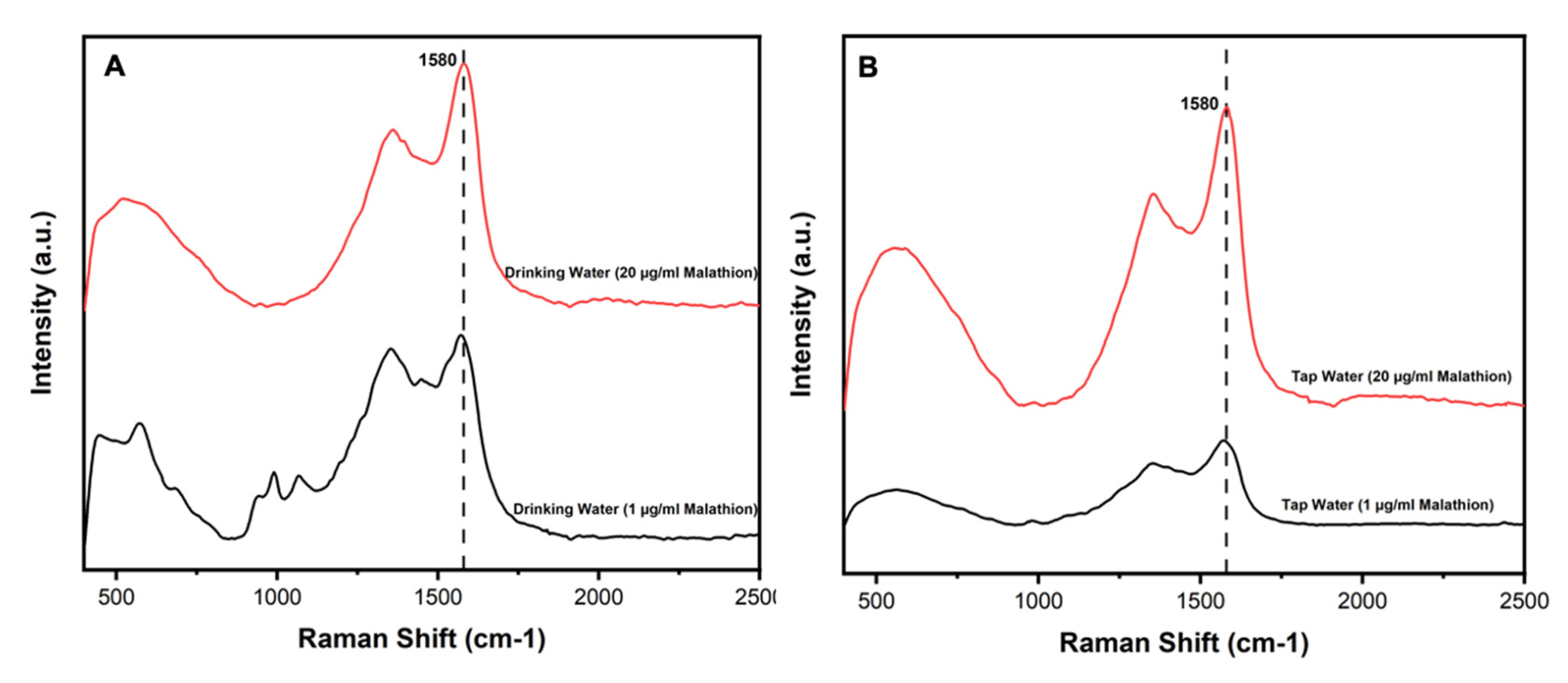
To better understand the SERS sensing performance of AgNPs@MIP, it was necessary to evaluate with real samples, such as spiked bottled drinking water and tap water, at malathion concentrations of 20 µg/mL and 1 µg/mL, as confirmed in Figure 6A and Figure 6B, respectively. The successful detection of malathion in spiked drinking water was confirmed, as observed in Figure 6A. The characteristic SERS peak at 1580 cm−1 was confirmed by enhanced SERS intensity; thus, a higher spiked concentration yielded a higher SERS intensity.
In addition, it was observed that the lowest spiked concentration of drinking water (1 µg/mL) also exhibited a distinct SERS intensity peak at 1580 cm−1; however, the Raman shift range between 500 cm−1 and 1000 cm−1 also showed other sensitive Raman bands that were highlighted during the SERS enhancement.
For the tap water sample as well, the unique SERS peak at 1580 cm−1was confirmed. It was also significant that the SERS intensity was directly proportional to the spiked tap water concentrations, with the 20 µg/mL malathion sample exhibiting a strong SERS Raman band. Ultimately, the cavities in the MIP platform exhibited enhanced binding potential for malathion and effectively detected it in the water sample. Another factor that could support enhanced SERS detection by AgNPs@MIP in both drinking and tap water is the phosphorus mineral content of these samples. Tap water typically contains higher levels of phosphorus due to the addition of orthophosphate during water treatment [55], whereas drinking water generally has moderate phosphate content due to the use of a chemical softener [56]. Notably, the AgNPs@MIP demonstrated excellent recovery rates in these samples, as shown in Table 1.
In addition to assessing the practical application of our work, we provided a comparison with other methods in Table 2. It was evident that our work demonstrated excellent sensitivity and a wide linear range for detecting malathion, owing to enhanced SERS sensitivity and the synergistic effect of the molecularly imprinted technique.
3. Materials and Methods
All chemicals and reagents used were of analytical grade. Malathion pesticide (pestanal analytical), Methacrylic acid (MAA), ethylene glycol dimethacrylate (EGDMA), 2,2′-azobisisobutyronitrile (AIBN), acetonitrile (ACN), silver nitrate (AgNO3, > 99%), and sodium borohydride (NaBH4) were purchased from both Sigma-Aldrich and Fisher Scientific (USA). All purchased chemicals were used as received without further purification. Deionized water (18 MΩ cm) used in this work was acquired from the centralized distillation utility facility at our university.
A schematic of the synthesis process and the development of the silver molecularly imprinted polymer is illustrated in Scheme 1.
After several parameter optimizations and using a response surface methodology, the best MIP synthesis blend was employed to develop AgNPs@MIP via precipitation polymerization. Firstly, 38 mg of malathion was mixed with 2 mL of the functional monomer (MAA) and 1.5 mL EGDMA (crosslinker). The mixture was sonicated and homogeneously mixed for 20 minutes in a sample container. A solution of 40 mg of AIBN (initiator) in 25 mL of acetonitrile containing 400 mg of AgNO3 was added to the mixture and sonicated for another 20 minutes. The chemical structure of the template molecule, initiator, crosslinker, and functional monomer employed in the MIP synthesis is depicted in Figure S4.
The homogeneous mixture of all the chemical agents, including the template malathion and AgNO3, was then transferred to a round-bottom flask and purged with nitrogen gas for 10 minutes. The polymerization of the purged sample was done using an oil bath at a temperature of 65°C for 12 hours under controlled stirring at 100 rpm. During polymerization, the pre-complex and the entire mixture gradually solidify. A color change from transparent to brown occurs after 7 hours and continues until the polymerization reaction is complete. The rigid polymerization was then ground and sieved through a mesh steel sieve (200 µ). About 20 g of the above malathion-MIP powder doped with AgNO3 was then dispersed in 10 mL of 1 mM sodium borohydride (NaBH4) to reduce the silver precursor to AgNPs. During the addition of the borohydride solution, effervescence occurred in the suspension and the mixture turned completely dark brown. The solution was filtered through a Whatman filter paper, and the malathion-AgNPs@MIP was collected and dried under vacuum overnight until a constant weight was obtained.
Soxhlet extraction was employed to remove the template molecule from malathion-AgNPs@MIP. In brief, the dried powdered AgNPs@MIP sample was reacted with 200 mL of methanol/acetic acid (9:1, v/v) for 72 hours, and further reacted with an organic solvent, methanol (200 mL) for 24 hours for complete removal of the template malathion.
Meanwhile, a non-imprinted polymer (AgNPs@NIP, the control) was also synthesized with the same approach as AgNPs@MIP, without adding malathion as a template molecule.
The AgNPs@MIP and AgNPs@NIP were characterized to determine their chemical structures and morphological characteristics. Fourier transform infrared spectroscopy (FTIR) was conducted on the MIP and NIP samples using an Agilent 670 FTIR Spectrometer w/ATR (USA) instrument within a scan range of 4000 to 400 cm−1. To confirm the successful doping of AgNPs into the MIP platform, a Rigaku SmartLab X-ray diffractometer (XRD) instrument was used. Also, a Scanning Electron Microscope (SEM), specifically a JEOL JSM-IT800 Schottky FESEM instrument, was used to understand the morphological features of the synthesized samples. The synthesized AgNPs were also characterized using a TEM instrument (JEOL JEM-2100 plus). UV-Vis absorption spectra were measured on an Agilent Cary 60 instrument (USA) to validate the complete removal of the template molecule from the MIP samples. Raman Spectra were also obtained for the samples using a Horiba XploRA Raman Confocal Microscope (USA) with an 1800 grating, a 532 nm laser source, and a 50× long-working-distance microscope objective. The measurements were performed four times with an average acquisition and accumulation time of 5s with a scan range of 400 cm−1 to 2500 cm−1.
To evaluate the binding affinity of the fabricated MIP platform, a series of kinetic adsorption tests was conducted to confirm the specific affinity of AgNPs@MIP for malathion. A kinetic adsorption test was conducted by mixing 10 mg of AgNPs@MIP and AgNPs@NIP with 2 mL of malathion methanol solution (10 µg/mL) at room temperature. The mixture was incubated for 0-60 min in the malathion methanol solution at 25 °C. After centrifugation, the supernatant was analyzed by UV–vis spectroscopy to determine the residual malathion. The adsorption efficiency was then calculated according to Eq. 1.
where Ci is the initial concentration of malathion (mg/L), Cf is the final malathion concentration in the supernatant (mg/L), V is the volume of solution (L), and m (mg) is the dry weight of MIPs@AgNPs or NIPs@AgNPs nanocomposites in each adsorption solution.
The SERS activity of the AgNPs@MIP and the AgNPs@NIP substrates were investigated by incubating (30 minutes) with different concentrations of malathion solutions (0.005 µg/mL to 50 µg/mL) collected using a Horiba XploRA Raman Confocal Microscope instrument (Texas, USA) with optimized parameters: 1800 grating, excited at 532 nm, scanning range between 400 cm−1 and 2500 cm−1, objective lens 50X, laser power 0.5mW, acquisition and accumulation time 5s respectively.
Two water samples were evaluated: a bottled drinking water purchased from a supermarket in Greensboro, USA, and municipal tap water from the nanochemistry laboratory at the Joint School of Nanoscience and Nanoengineering, University of North Carolina, Greensboro, USA. Each 10 mg AgNPs@MIP sample was spiked with 2 mL of the water samples containing malathion at 20 µg/mL and 1 µg/mL, respectively, and incubated for 30 minutes. The SERS activity of the AgNPs@MIP was then collected using the optimized Raman parameters (excitation at 532 nm, spectral range 400 - 2500 cm−1, objective lens 50X, laser power 0.5 mW, acquisition and accumulation time 5s, respectively).
To evaluate the selectivity of AgNPs@MIP, two other organophosphate pesticides (dimethoate and parathion) were used. In this instance, a 1:1 ratio of malathion and dimethoate, each at 5 µg/mL, was prepared. Similarly, another blend of malathion and parathion at the same concentration (5 µg/mL) was also prepared. 10 mg of AgNPs@MIP was mixed with and incubated with 2 mL of each of the two blends of malathion/dimethoate and malathion/parathion solutions for 30 minutes. The SERS activity of the AgNPs@MIPs was then collected with the same optimized parameters as previously established.
For all analyses, each sample was scanned three times, and the average signal was recorded as UV-Vis, FTIR, and SERS spectra, respectively. All spectral data were analyzed in OriginPro 10.05 software (OriginLab Corporation, MA, USA).
4. Conclusions
An enhanced and efficient AgNPs@MIP SERS sensor was developed by integrating AgNPs into the MIP matrix via in situ synthesis, thereby enabling Raman signal amplification and sensitive, selective detection of malathion, an organophosphate pesticide, in water. The sensor demonstrated a promising limit of detection of 0.005 µg/mL and exhibited a linear SERS intensity response across malathion concentrations ranging from 0.005 to 50 µg/mL. The AgNPs@MIPs also showed excellent selectivity and performance in spiked tap and drinking water samples at concentrations of 20 µg/mL and 1 µg/mL, with near 100% recovery rates. This malathion AgNPs@MIP sensor has excellent potential for environmental monitoring applications and could be recommended for analytical detection of malathion in complex matrices.
5. Patents
A US patent titled: Integrated Molecularly Inprinted Polymer & Surface Enhanced Resonance (SERS) Substrates: Method and Applications, has been submitted to US Patent and Trademark Office, Application # 63/735,878, 12/18/2024.
Supplementary Materials
The following supporting information can be downloaded at the website of this paper posted on Preprints.org, Figure S1. Illustrates the UV-Vis analysis before and after the template removal process and the formation of AgNPs within the MIP platform; Figure S2. Kinetic adsorption of the AgNPs@MIPs and the AgNPs@NIP with variable concentrations of malathion at a given time; Figure S3. The X-ray diffraction (XRD) of the AgNPs@MI; Figure S4. The chemical structure of the MIP agents employed for the malathion Ag@MIP synthesis.
Author Contributions
Conceptualization, J.W. and S.O.; methodology, J.W, S.O, and R.A.; validation, R.A., J.W. and S.O.; formal analysis, R.A. and J.W; investigation, R.A., J.W, and S.O; resources, J.W. and S.O; data curation, B.A., G.P., S.M., O.A. and K.N.; writing—original draft preparation, R.A.; writing—review and editing, J.W.; supervision, J.W. and S.O; project administration, J.W. and S.O; funding acquisition, J.W. and S.O. All authors have read and agreed to the published version of the manuscript.
Funding
We acknowledge support from the US NSF EiR research grant (award#: 2401975) and the NSF-funded STEPS Center (award#: CBET-2019435).
Acknowledgments
This work was conducted at the Joint School of Nanoscience and Nanoengineering (JSNN), a member of the Southeastern Nanotechnology Infrastructure Corridor (SENIC) and National Nanotechnology Coordinated Infrastructure (NNCI), which is supported by the US National Science Foundation (ECCS-2025462).
Conflicts of Interest
The authors declare no conflicts of interest.
References
- Fuller, R.; Landrigan, P. J.; Balakrishnan, K.; Bathan, G.; Bose-O’Reilly, S.; Brauer, M.; Caravanos, J.; Chiles, T.; Cohen, A.; Corra, L.; Cropper, M.; Ferraro, G.; Hanna, J.; Hanrahan, D.; Hu, H.; Hunter, D.; Janata, G.; Kupka, R.; Lanphear, B.; Lichtveld, M.; Martin, K.; Mustapha, A.; Sanchez-Triana, E.; Sandilya, K.; Schaefli, L.; Shaw, J.; Seddon, J.; Suk, W.; Téllez-Rojo, M. M.; Yan, C. Pollution and health: a progress update. Lancet Planet. Health 2022, 6, e535–e547. [Google Scholar] [CrossRef]
- Cao, Z.; Lai, Z.; Bilawal Khaskheli, M.; Wang, L. The Risk of Global Environmental Change to Economic Sustainability and Law: Help from Digital Technology and Governance Regulation. Sustainability 2025, 17, 7094. [Google Scholar] [CrossRef]
- Shetty, S. S.; D, D.; S, H.; Sonkusare, S.; Naik, P. B.; Kumari N, S.; Madhyastha, H. Environmental pollutants and their effects on human health. Heliyon 2023, 9, e19496. [Google Scholar] [CrossRef]
- Anjitha, R.; Antony, A.; Shilpa, O.; Anupama, K. P.; Mallikarjunaiah, S.; Gurushankara, H. P. Malathion induced cancer-linked gene expression in human lymphocytes. Environ. Res. 2020, 182, 109131. [Google Scholar] [CrossRef]
- Duke, S. O. Pesticide Dose – A Parameter with Many Implications. In Pesticide Dose: Effects on the Environment and Target and Non-Target Organisms; American Chemical Society, 2017; Volume 1249, pp. 1–13. [Google Scholar]
- Gurusamy, L.; Cheng, R.-W.; Anandan, S.; Liu, C.-H.; Wu, J. J. Detection of Environmentally Harmful Malathion Pesticides Using a Bimetallic Oxide of CuO Nanoparticles Dispersed over a 3D ZnO Nanoflower. Materials 2023, 16, 7065. [Google Scholar] [CrossRef] [PubMed]
- Ayivi, R. D.; Obare, S. O.; Wei, J. Molecularly imprinted polymers as chemosensors for organophosphate pesticide detection and environmental applications. TrAC Trends Anal. Chem. 2023, 167, 117231. [Google Scholar] [CrossRef]
- Zhang, Y.; Zhu, Y.; Zeng, Z.; Zeng, G.; Xiao, R.; Wang, Y.; Hu, Y.; Tang, L.; Feng, C. Sensors for the environmental pollutant detection: Are we already there? Coord. Chem. Rev. 2021, 431, 213681. [Google Scholar] [CrossRef]
- Li, H.; Haruna, S. A.; Sheng, W.; Bei, Q.; Ahmad, W.; Zareef, M.; Chen, Q.; Ding, Z. SERS-activated platforms for chemical contaminants in food: Probes, encoding methods, and detection. TrAC Trends Anal. Chem. 2023, 169, 117365. [Google Scholar] [CrossRef]
- Krämer, J.; Kang, R.; Grimm, L. M.; De Cola, L.; Picchetti, P.; Biedermann, F. Molecular Probes, Chemosensors, and Nanosensors for Optical Detection of Biorelevant Molecules and Ions in Aqueous Media and Biofluids. Chem. Rev. 2022, 122, 3459–3636. [Google Scholar] [CrossRef] [PubMed]
- Ayivi, R. D.; Adesanmi, B. O.; McLamore, E. S.; Wei, J.; Obare, S. O. Molecularly Imprinted Plasmonic Sensors as Nano-Transducers: An Effective Approach for Environmental Monitoring Applications. Chemosensors 2023, 11, 203. [Google Scholar] [CrossRef]
- Fu, Q.-B.; Sun, X.; Liu, L.; Zhao, R.-S.; Wang, X. Current Progress of Molecularly Imprinted Polymers for Emerging Pollutants Analysis in Food. J. Agric. Food. Chem. 2025, 73, 25103–25127. [Google Scholar] [CrossRef]
- Ramajayam, K.; Ganesan, S.; Ramesh, P.; Beena, M.; Kokulnathan, T.; Palaniappan, A. Molecularly Imprinted Polymer-Based Biomimetic Systems for Sensing Environmental Contaminants, Biomarkers, and Bioimaging Applications. Biomimetics 2023, 8, 245. [Google Scholar] [CrossRef]
- Wang, Z.; Yan, R.; Liao, S.; Miao, Y.; Zhang, B.; Wang, F.; Yang, H. In situ reduced silver nanoparticles embedded molecularly imprinted reusable sensor for selective and sensitive SERS detection of Bisphenol A. Appl. Surf. Sci. 2018, 457, 323–331. [Google Scholar] [CrossRef]
- Szaniawska, A.; Kudelski, A. Applications of Surface-Enhanced Raman Scattering in Biochemical and Medical Analysis. Front. Chem. 2021, 9, 664134. [Google Scholar] [CrossRef] [PubMed]
- Sultangaziyev, A.; Ilyas, A.; Dyussupova, A.; Bukasov, R. Trends in Application of SERS Substrates beyond Ag and Au, and Their Role in Bioanalysis. Biosensors 2022, 12, 967. [Google Scholar] [CrossRef]
- Feng, S.; Hu, Y.; Ma, L.; Lu, X. Development of molecularly imprinted polymers-surface-enhanced Raman spectroscopy/colorimetric dual sensor for determination of chlorpyrifos in apple juice. Sens. Actuator B-Chem. 2017, 241, 750–757. [Google Scholar] [CrossRef]
- Zhang, X.-F.; Liu, Z.-G.; Shen, W.; Gurunathan, S. Silver Nanoparticles: Synthesis, Characterization, Properties, Applications, and Therapeutic Approaches. Int. J. Mol. Sci. 2016, 17, 1534. [Google Scholar] [CrossRef] [PubMed]
- Sultan, A.; Mohammad, F. Chemical sensing, thermal stability, electrochemistry and electrical conductivity of silver nanoparticles decorated and polypyrrole enwrapped boron nitride nanocomposite. Polymer 2017, 113, 221–232. [Google Scholar] [CrossRef]
- Willner, M. R.; Vikesland, P. J. Nanomaterial enabled sensors for environmental contaminants. J. Nanobiotechnol. 2018, 16, 95. [Google Scholar] [CrossRef]
- Çakır, O.; Bakhshpour, M.; Göktürk, I.; Yılmaz, F.; Baysal, Z. Sensitive and selective detection of amitrole based on molecularly imprinted nanosensor. J. Mol. Recognit. 2021, 34, e2929. [Google Scholar] [CrossRef]
- Hoang, V.-T.; Dinh, N. X.; Nhat Trang, N. L.; Khi, N. T.; Quy, N. V.; Tuan, P. A.; Tri, D. Q.; Thang, L. H.; Huy, T. Q.; Le, A.-T. Functionalized silver nanoparticles-based efficient colorimetric platform: Effects of surface capping agents on the sensing response of thiram pesticide in environmental water samples. Mater. Res. Bull. 2021, 139, 111278. [Google Scholar] [CrossRef]
- Jiang, G.-y.; Liu, L.; Wan, Y.-q.; Li, J.-k.; Pi, F.-w. Surface-enhanced Raman scattering based determination on sulfamethazine using molecularly imprinted polymers decorated with silver nanoparticles. Microchim. Acta 2023, 190, 169. [Google Scholar] [CrossRef]
- Hu, R.; Tang, R.; Xu, J.; Lu, F. Chemical nanosensors based on molecularly-imprinted polymers doped with silver nanoparticles for the rapid detection of caffeine in wastewater. Anal. Chim. Acta 2018, 1034, 176–183. [Google Scholar] [CrossRef]
- Neng, J.; Liao, C.; Wang, Y.; Wang, Y.; Yang, K. Rapid and Sensitive Detection of Pentachloronitrobenzene by Surface-Enhanced Raman Spectroscopy Combined with Molecularly Imprinted Polymers. Biosensors 2022, 12, 52. [Google Scholar] [CrossRef] [PubMed]
- Zeng, Z.; Liu, Y.; Wei, J. Recent advances in surface-enhanced raman spectroscopy (SERS): Finite-difference time-domain (FDTD) method for SERS and sensing applications. TrAC Trends Anal. Chem. 2016, 75, 162–173. [Google Scholar] [CrossRef]
- Reguera, J.; Langer, J.; Jiménez de Aberasturi, D.; Liz-Marzán, L. M. Anisotropic metal nanoparticles for surface enhanced Raman scattering. Chem. Soc. Rev. 2017, 46, 3866–3885. [Google Scholar] [CrossRef] [PubMed]
- Krystosiak, P.; Tomaszewski, W.; Megiel, E. High-density polystyrene-grafted silver nanoparticles and their use in the preparation of nanocomposites with antibacterial properties. J. Colloid Interface Sci. 2017, 498, 9–21. [Google Scholar] [CrossRef]
- Montes-Hernandez, G.; Di Girolamo, M.; Sarret, G.; Bureau, S.; Fernandez-Martinez, A.; Lelong, C.; Eymard Vernain, E. In Situ Formation of Silver Nanoparticles (Ag-NPs) onto Textile Fibers. ACS Omega 2021, 6, 1316–1327. [Google Scholar] [CrossRef]
- Zhang, C.; Chen, S.; Jiang, Z.; Shi, Z.; Wang, J.; Du, L. Highly Sensitive and Reproducible SERS Substrates Based on Ordered Micropyramid Array and Silver Nanoparticles. ACS Appl. Mater. Interfaces 2021, 13, 29222–29229. [Google Scholar] [CrossRef]
- Xu, K.; Zhou, R.; Takei, K.; Hong, M. Toward Flexible Surface-Enhanced Raman Scattering (SERS) Sensors for Point-of-Care Diagnostics. Adv. Sci. 2019, 6, 1900925. [Google Scholar] [CrossRef]
- Kadhem, A. J.; Gentile, G. J.; Fidalgo de Cortalezzi, M. M. Molecularly Imprinted Polymers (MIPs) in Sensors for Environmental and Biomedical Applications: A Review. Molecules 2021, 26, 6233. [Google Scholar] [CrossRef] [PubMed]
- Susanti, I.; Hasanah, A. N. How to develop molecularly imprinted mesoporous silica for selective recognition of analytes in pharmaceutical, environmental, and food samples. Polym. Adv. Technol. 2021, 32, 1965–1980. [Google Scholar] [CrossRef]
- Kimani, M.; Kislenko, E.; Gawlitza, K.; Rurack, K. Fluorescent molecularly imprinted polymer particles for glyphosate detection using phase transfer agents. Sci. Rep. 2022, 12, 14151. [Google Scholar] [CrossRef]
- Amarh, F. A.; Kangmennaa, A.; Agorku, E. S.; Voegborlo, R. B. A state-of-the-art review of trends in molecularly imprinted polymers in the clean-up of pesticides in environmental samples. Sustain. Environ. 2024, 10, 2298067. [Google Scholar] [CrossRef]
- Ali, M. H.; Azad, M. A. K.; Khan, K. A.; Rahman, M. O.; Chakma, U.; Kumer, A. Analysis of Crystallographic Structures and Properties of Silver Nanoparticles Synthesized Using PKL Extract and Nanoscale Characterization Techniques. ACS Omega 2023, 8, 28133–28142. [Google Scholar] [CrossRef]
- Oliveira, A. E. F.; Pereira, A. C.; de Resende, M. A. C.; Ferreira, L. F. Synthesis of a silver nanoparticle ink for fabrication of reference electrodes. Talanta Open. 2022, 5, 100085. [Google Scholar] [CrossRef]
- Kalogiouri, N. P.; Kabir, A.; Furton, K. G.; Samanidou, V. F. A tutorial on the synthesis and applications of molecularly imprinted polymers in analytical chemistry. J. Chromatogr. Open. 2025, 8, 100244. [Google Scholar] [CrossRef]
- Gong, Y.; Chen, X.; Wu, W. Application of fourier transform infrared (FTIR) spectroscopy in sample preparation: Material characterization and mechanism investigation. Adv. Sample Prep. 2024, 11, 100122. [Google Scholar] [CrossRef]
- Royani, I.; Widayani; Abdullah, M.; Khairurrijal. An Atrazine Molecularly Imprinted Polymer Synthesized Using a Cooling-Heating Method with Repeated Washing: Its Physicochemical Characteristics and Enhanced Cavities. Int. J. Electrochem. Sci. 2014, 9, 5651–5662. [Google Scholar] [CrossRef]
- Askari, F.; Zandi, M.; Shokrolahi, P.; Tabatabaei, M. H.; Hajirasoliha, E. Reduction in protein absorption on ophthalmic lenses by PEGDA bulk modification of silicone acrylate-based formulation. Prog. Biomater. 2019, 8, 169–183. [Google Scholar] [CrossRef]
- Roland, R. M.; Bhawani, S. A.; Ibrahim, M. N. M. Synthesis of molecularly imprinted polymer by precipitation polymerization for the removal of ametryn. BMC Chem. 2023, 17, 165. [Google Scholar] [CrossRef] [PubMed]
- Roland, R. M.; Bhawani, S. A.; Ibrahim, M. N. M. Synthesis of molecularly imprinted polymer for the removal of cyanazine from aqueous samples. Chem. Biol. Technol. Agric. 2023, 10, 92. [Google Scholar] [CrossRef]
- Aheto, J. H.; Huang, X.; Tian, X.; Zhang, X.; Zhang, W.; Yu, S. Activated carbon@silver nanoparticles conjugates as SERS substrate for capturing malathion analyte molecules for SERS detection. J. Food Saf. 2023, 43, e13072. [Google Scholar] [CrossRef]
- Al’Abri, A. M.; Abdul Halim, S. N.; Abu Bakar, N. K.; Saharin, S. M.; Sherino, B.; Rashidi Nodeh, H.; Mohamad, S. Highly sensitive and selective determination of malathion in vegetable extracts by an electrochemical sensor based on Cu-metal organic framework. J. Environ. Sci. Health B 2019, 54, 930–941. [Google Scholar] [CrossRef] [PubMed]
- Roland, R. M.; Bhawani, S. A. Synthesis and Characterization of Molecular Imprinting Polymer Microspheres of Piperine: Extraction of Piperine from Spiked Urine. J. Anal. Methods Chem. 2016, 2016, 5671507. [Google Scholar] [CrossRef]
- Joshi, N.; Jain, N.; Pathak, A.; Singh, J.; Prasad, R.; Upadhyaya, C. P. Biosynthesis of silver nanoparticles using Carissa carandas berries and its potential antibacterial activities. J. Sol.-Gel Sci. Technol. 2018, 86, 682–689. [Google Scholar] [CrossRef]
- Guo, X.; Li, J.; Arabi, M.; Wang, X.; Wang, Y.; Chen, L. Molecular-Imprinting-Based Surface-Enhanced Raman Scattering Sensors. ACS Sens. 2020, 5, 601–619. [Google Scholar] [CrossRef]
- Aboualigaledari, N.; Jayapalan, A.; Tukur, P.; Liu, M.; Tukur, F.; Zhang, Y.; Ducatte, G.; Verma, M.; Tarus, J.; Hunyadi Murph, S. E.; Wei, J. Surface-enhanced Raman scattering enhancement using a hybrid gold nanoparticles@carbon nanodot substrate for herbicide detection. Analyst 2024, 149, 5277–5286. [Google Scholar] [CrossRef]
- Tukur, F.; Tukur, P.; Hunyadi Murph, S. E.; Wei, J. Advancements in mercury detection using surface-enhanced Raman spectroscopy (SERS) and ion-imprinted polymers (IIPs): a review. Nanoscale 2024, 16, 11384–11410. [Google Scholar] [CrossRef] [PubMed]
- Xu, Y.; Aljuhani, W.; Zhang, Y.; Ye, Z.; Li, C.; Bell, S. E. J. A practical approach to quantitative analytical surface-enhanced Raman spectroscopy. Chem. Soc. Rev. 2025, 54, 62–84. [Google Scholar] [CrossRef]
- Tarannum, N.; Kumar, D.; Yadav, A.; Yadav, A. K. Raman spectroscopy-based molecularly imprinted polymer sensor for sensitive detection of lysophosphatidic acid in serum. J. Raman Spectrosc. 2024, 55, 809–818. [Google Scholar] [CrossRef]
- Lazarević-Pašti, T.; Jocić, A.; Milanković, V.; Tasić, T.; Batalović, K.; Breitenbach, S.; Unterweger, C.; Fürst, C.; Pašti, I. A. Investigating the Adsorption Kinetics of Dimethoate, Malathion and Chlorpyrifos on Cellulose-Derived Activated Carbons: Understanding the Influence of Physicochemical Properties. C 2023, 9, 103. [Google Scholar] [CrossRef]
- Wu, H.; Luo, Y.; Huang, Y.; Dong, Q.; Hou, C.; Huo, D.; Zhao, J.; Lei, Y. A Simple SERS-Based Trace Sensing Platform Enabled by AuNPs-Analyte/AuNPs Double-Decker Structure on Wax-Coated Hydrophobic Surface. Front. Chem. 2018, 6, 482. [Google Scholar] [CrossRef] [PubMed]
- Pan, W.; Johnson, E. R.; Giammar, D. E. Lead Phosphate Particles in Tap Water: Challenges for Point-of-Use Filters. Environ. Sci. Technol. Lett. 2021, 8, 244–249. [Google Scholar] [CrossRef]
- Jereb, G.; Poljšak, B.; Eržen, I. Contribution of Drinking Water Softeners to Daily Phosphate Intake in Slovenia. Int. J. Environ. Res. Public Health 2017, 14, 1186. [Google Scholar] [CrossRef]
- Alizadeh, T. High Selective Parathion Voltammetric Sensor Development by Using an Acrylic Based Molecularly Imprinted Polymer-Carbon Paste Electrode. Electroanalysis 2009, 21, 1490–1498. [Google Scholar] [CrossRef]
- Yao, G.-H.; Liang, R.-P.; Huang, C.-F.; Wang, Y.; Qiu, J.-D. Surface Plasmon Resonance Sensor Based on Magnetic Molecularly Imprinted Polymers Amplification for Pesticide Recognition. Anal. Chem. 2013, 85, 11944–11951. [Google Scholar] [CrossRef]
- Wang, Y.-L.; Gao, Y.-L.; Wang, P.-P.; Shang, H.; Pan, S.-Y.; Li, X.-J. Sol–gel molecularly imprinted polymer for selective solid phase microextraction of organophosphorous pesticides. Talanta 2013, 115, 920–927. [Google Scholar] [CrossRef]
- Wang, F.-R.; Lee, G.-J.; Haridharan, N.; Wu, J. J. Electrochemical Sensor Using Molecular Imprinting Polymerization Modified Electrodes to Detect Methyl Parathion in Environmental Media. Electrocatalysis 2018, 9, 1–9. [Google Scholar] [CrossRef]
Figure 1.
SEM images of the non-eluted AgNPs@MIP (A), eluted AgNPs@MIP (B), non-eluted AgNPs@NIP (C), and eluted AgNPs@NIP (D), respectively. The template removal process creates cavities in the MIP, thereby enhancing its recognition and binding affinity for the target analyte, malathion. The TEM image of the in-situ synthesized spherically shaped AgNPs (20 nm) produced in the AgNPs@MIP (E) and AgNPs@NIP (F), respectively.
Figure 1.
SEM images of the non-eluted AgNPs@MIP (A), eluted AgNPs@MIP (B), non-eluted AgNPs@NIP (C), and eluted AgNPs@NIP (D), respectively. The template removal process creates cavities in the MIP, thereby enhancing its recognition and binding affinity for the target analyte, malathion. The TEM image of the in-situ synthesized spherically shaped AgNPs (20 nm) produced in the AgNPs@MIP (E) and AgNPs@NIP (F), respectively.
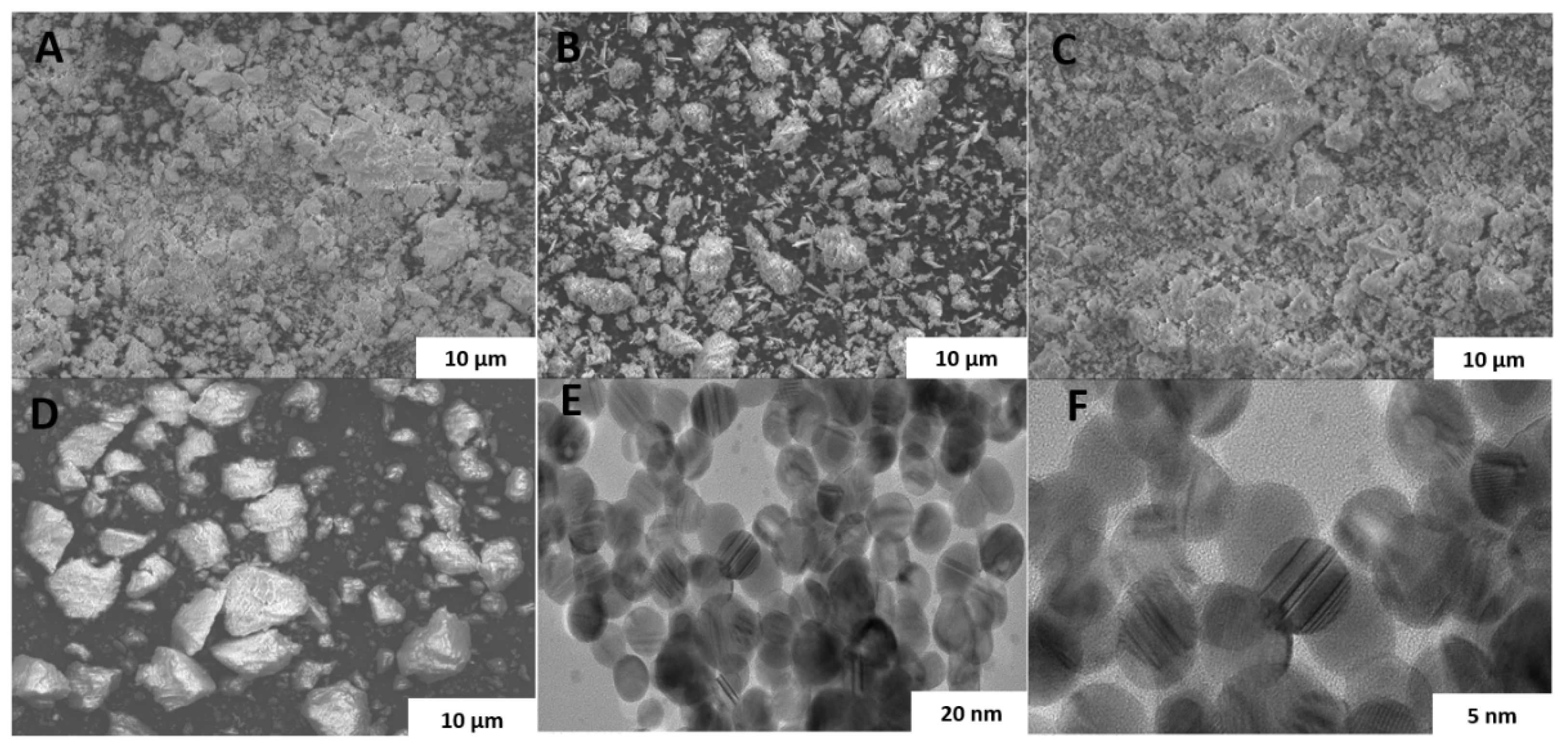
Figure 2.
(A) FTIR of the AgNPs@MIPs and other chemical agents employed for the synthesis of the MIP showing the characteristics of functional groups that were identified. (B) The FTIR of the synthesized malathion AgNPs@MIP and AgNPs@NIP.
Figure 2.
(A) FTIR of the AgNPs@MIPs and other chemical agents employed for the synthesis of the MIP showing the characteristics of functional groups that were identified. (B) The FTIR of the synthesized malathion AgNPs@MIP and AgNPs@NIP.
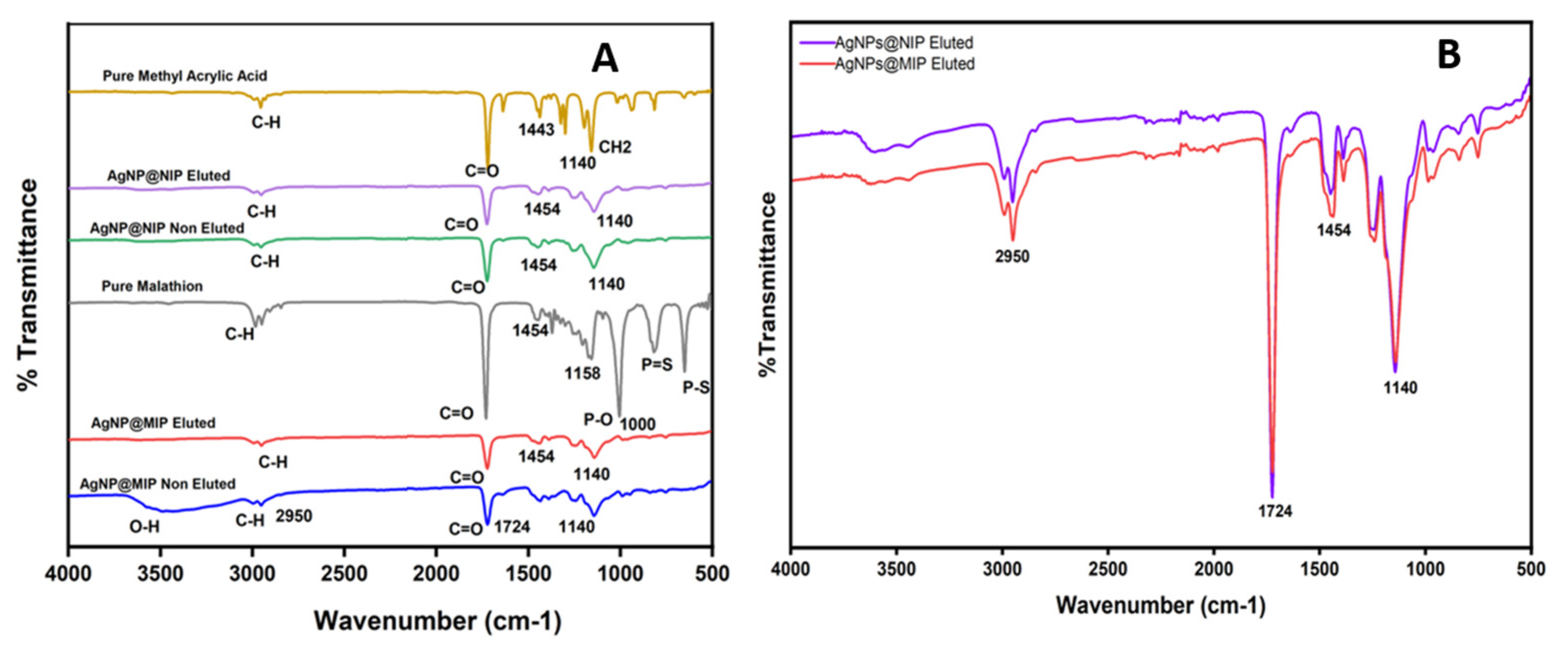
Figure 3.
Raman spectra of pure malathion, malathion AgNPs@MIP (AgNPs@MIP after template removal), AgNPs@NIP (non-imprinted polymer), AgNPs@NIP (AgNPs@NIP incubated with 10 µg/mL) and malathion AgNPs@MIP (AgNPs@MIP incubated with 10 µg/mL).
Figure 3.
Raman spectra of pure malathion, malathion AgNPs@MIP (AgNPs@MIP after template removal), AgNPs@NIP (non-imprinted polymer), AgNPs@NIP (AgNPs@NIP incubated with 10 µg/mL) and malathion AgNPs@MIP (AgNPs@MIP incubated with 10 µg/mL).
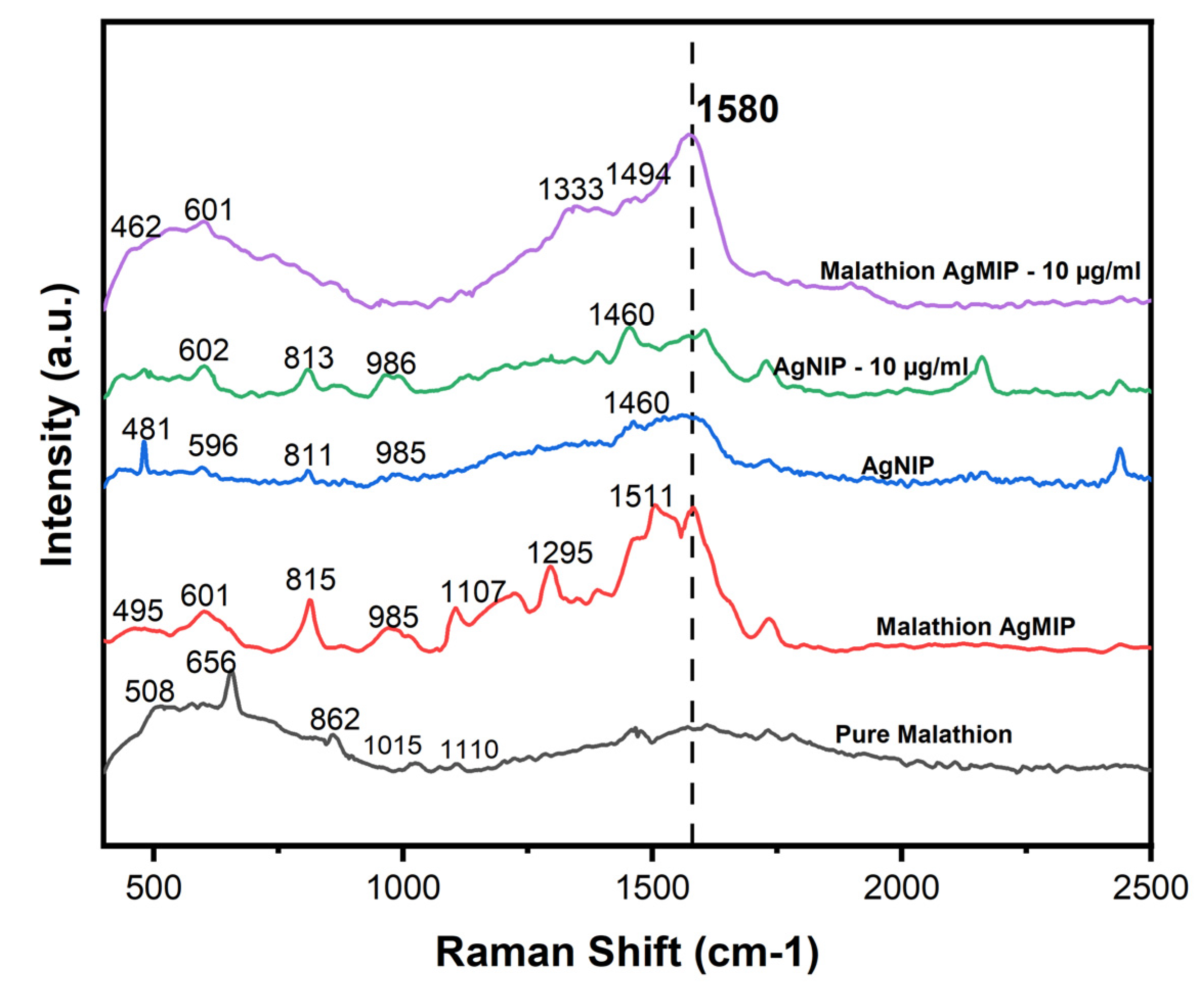
Figure 4.
(A) Raman spectrum of pure malathion (a), SERS spectrum of eluted malathion AgNPs@MIP (b), SERS spectra of AgNPs@MIP incubated with malathion solution at concentrations of 0.005 µg/mL (c), 0.05 µg/mL (d), 0.5 µg/mL (e), 5 µg/mL (f), and 50 µg/mL (g), with SERS intensity of malathion detected at 1580 cm-1 by the AgNPs@MIP. (B) The linear correlation of the logarithmic peak intensity at 1580 cm-1 versus the logarithmic concentrations of malathion.
Figure 4.
(A) Raman spectrum of pure malathion (a), SERS spectrum of eluted malathion AgNPs@MIP (b), SERS spectra of AgNPs@MIP incubated with malathion solution at concentrations of 0.005 µg/mL (c), 0.05 µg/mL (d), 0.5 µg/mL (e), 5 µg/mL (f), and 50 µg/mL (g), with SERS intensity of malathion detected at 1580 cm-1 by the AgNPs@MIP. (B) The linear correlation of the logarithmic peak intensity at 1580 cm-1 versus the logarithmic concentrations of malathion.
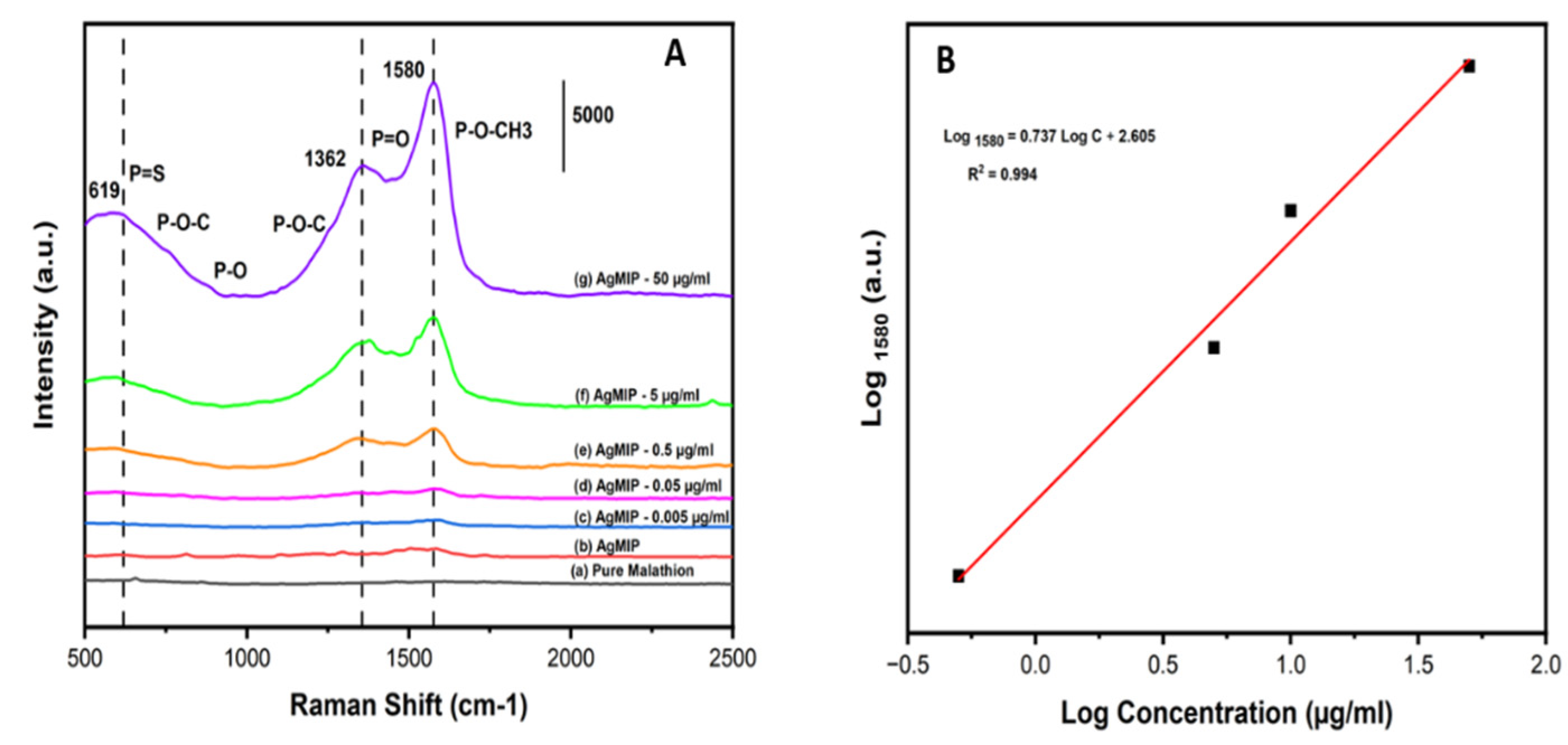
Figure 5.
Raman spectra showing the selectivity: (A) SERS spectrum of AgNPs@MIP incubated with a blend of malathion and dimethoate (5 µg/mL) solution, and (B) SERS spectrum of AgNPs@MIP incubated with malathion and parathion solution (5 µg/mL).
Figure 5.
Raman spectra showing the selectivity: (A) SERS spectrum of AgNPs@MIP incubated with a blend of malathion and dimethoate (5 µg/mL) solution, and (B) SERS spectrum of AgNPs@MIP incubated with malathion and parathion solution (5 µg/mL).
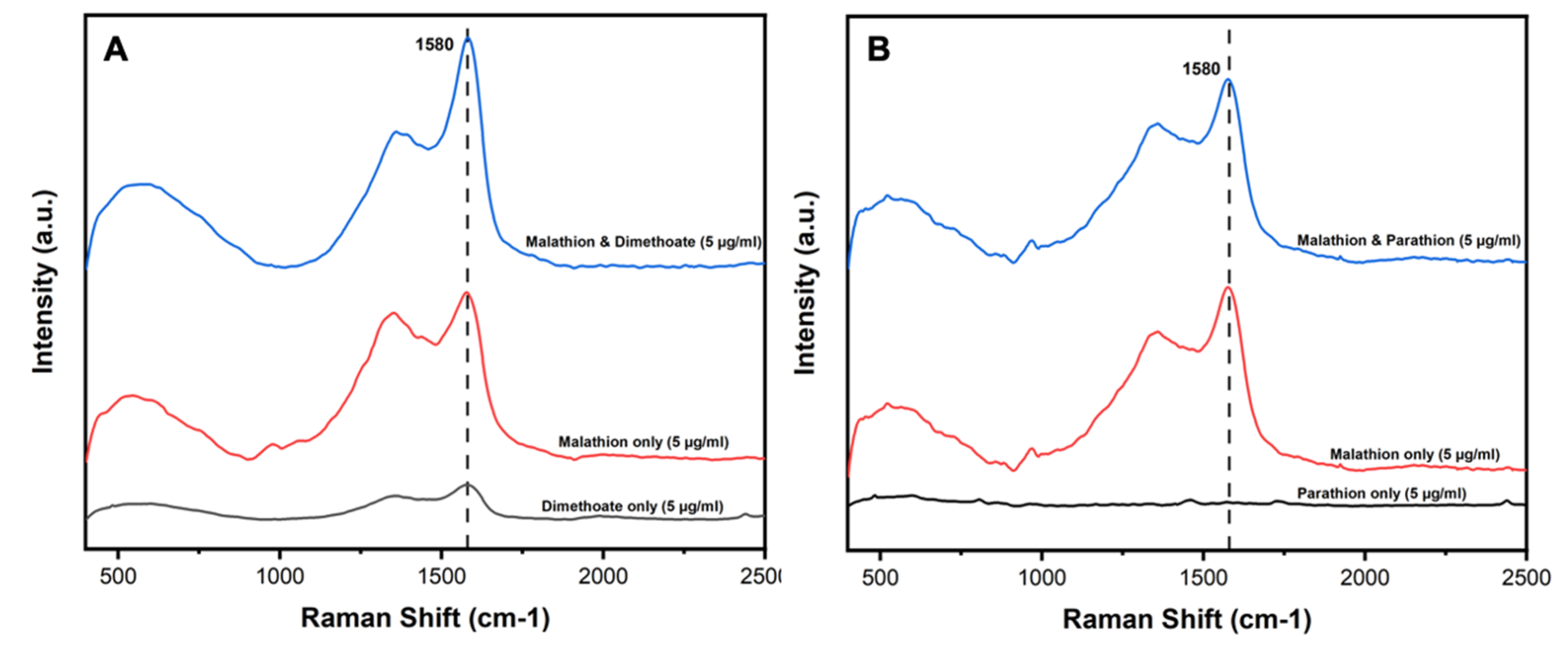
Figure 6.
Raman spectra showing: (A) SERS spectrum of AgNPs@MIP incubated with spiked drinking water at 20 µg/mL and 1 µg/mL) of malathion solution, respectively, and (B) SERS spectrum of AgNPs@MIP incubated with spiked tap water at 20 µg/mL and 1 µg/mL) of malathion solution, respectively.
Figure 6.
Raman spectra showing: (A) SERS spectrum of AgNPs@MIP incubated with spiked drinking water at 20 µg/mL and 1 µg/mL) of malathion solution, respectively, and (B) SERS spectrum of AgNPs@MIP incubated with spiked tap water at 20 µg/mL and 1 µg/mL) of malathion solution, respectively.
Scheme 1.
The schematic illustration of the AgNPs@MIP synthesis for a SERS sensor substrate. The component size ratio is not consistent with a real case.
Scheme 1.
The schematic illustration of the AgNPs@MIP synthesis for a SERS sensor substrate. The component size ratio is not consistent with a real case.
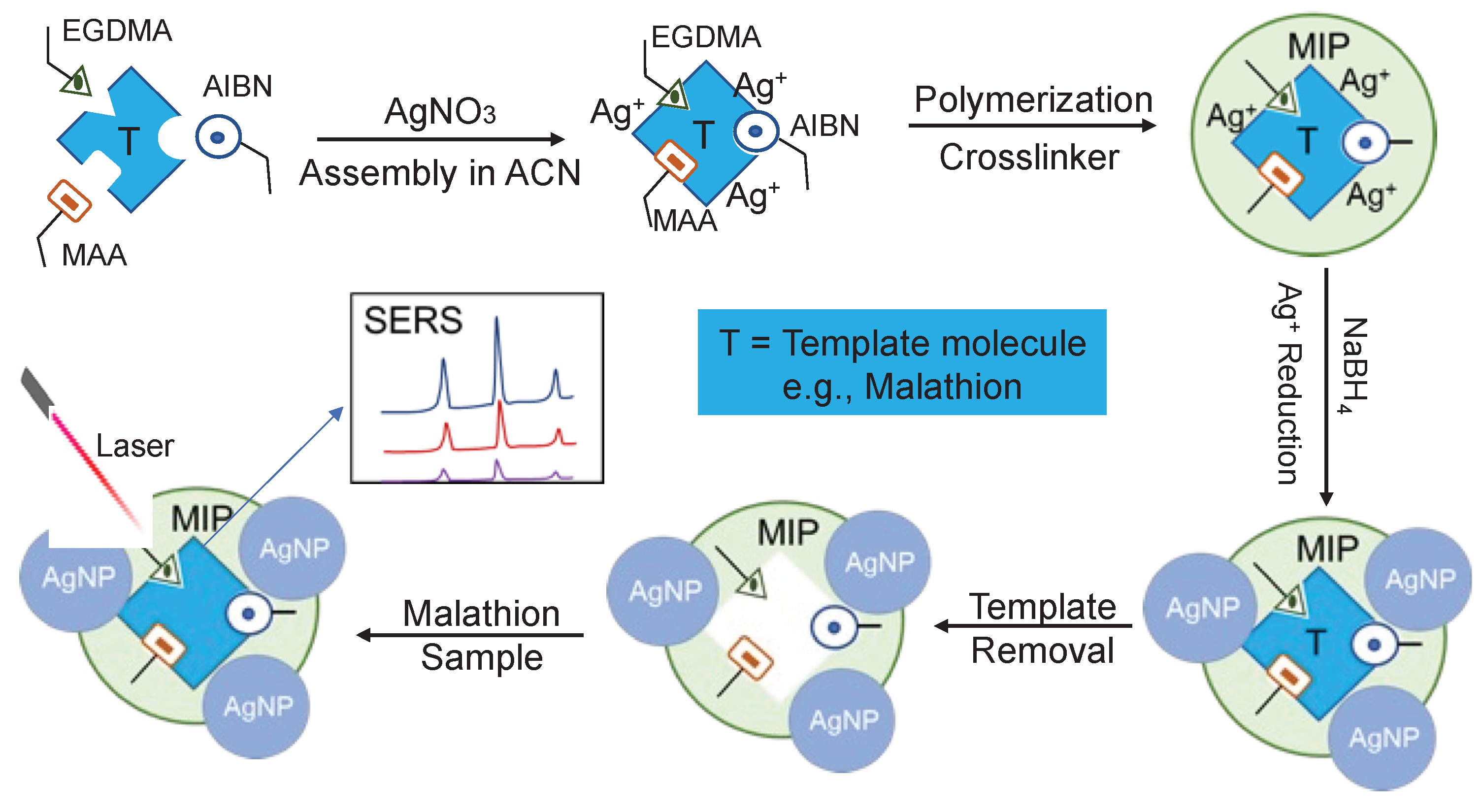

Table 1.
Detection and removal of malathion from environmental samples.
| Sample | Spiked (µg/mL) | Mesured (µg/mL) | Recovery (± RSD) |
|---|---|---|---|
| Drinking Water | 1 | 0.93 | 93.00% ± 0.05% |
| Drinking Water | 20 | 19.88 | 99.40% ± 0.43% |
| Tap Water | 1 | 0.99 | 98.00 ± 0.71% |
| Tap Water | 20 | 20.10 | 100.50 ± 0.35% |
Table 2.
Comparison of some organophosphate pesticide MIP detection methods in real samples.
| Polymerization Technique | MIP Sensing Technique | Template /Analyte | Sample Source | LOD (µg/mL) | Linear range (µg/mL) | Ref. |
|---|---|---|---|---|---|---|
| Precipitation | Electrochemical | Parathion | Cabbage | 1.46 × 10⁻⁴ | 4.95 × 10⁻⁴ – 0.262 | [57] |
| Magnetic Imprinting | SPR | Chlorpyriphos | Apple Juice | 2.66 × 10⁻⁴ | 3.51 × 10⁻⁴ – 3.51 | [58] |
| Sol-Gel | SPME-GC | Diazinon | Vegetable | 4.8 × 10⁻⁵ | 1.7 × 10⁻⁵ – 7.7 × 10⁻⁴ | [59] |
| Surface Imprinting | Electrochemical | Methyl Parathion | Tangerine Juice | 2.63 × 10⁻³ | 0.013 – 3.95 | [60] |
| Precipitation | Surface Enhanced Raman | Malathion | Tap / Drinking Water | 0.005 | 0.005 – 50 | This Work |
Disclaimer/Publisher’s Note: The statements, opinions and data contained in all publications are solely those of the individual author(s) and contributor(s) and not of MDPI and/or the editor(s). MDPI and/or the editor(s) disclaim responsibility for any injury to people or property resulting from any ideas, methods, instructions or products referred to in the content. |
© 2026 by the authors. Licensee MDPI, Basel, Switzerland. This article is an open access article distributed under the terms and conditions of the Creative Commons Attribution (CC BY) license.
Copyright: This open access article is published under a Creative Commons CC BY 4.0 license, which permit the free download, distribution, and reuse, provided that the author and preprint are cited in any reuse.


