
Preprint
Brief Report

This version is not peer-reviewed.

Validity of Stryd Leg Stiffness Against the Morin (2005) Sine-Wave Method: A Level-1 Assessment on Flat and Uphill Treadmill Running

Submitted:

28 April 2026

Posted:

30 April 2026

You are already at the latest version

Abstract

This study evaluated the validity of the leg stiffness metric provided by the Stryd running power meter against the Morin (2005) sine-wave spring-mass model. Twenty-three highly trained trail runners (11 women) completed a 12-min uphill time trial at +12% grade and one hour of submaximal level running. Leg stiffness was calculated from contact time, flight time, running speed, and leg length using the Morin’s method, and compared with Stryd values. Agreement was assessed following the Dhahbi and Chamari Level-1 analytical framework, including intraclass correlation coefficient (ICC2,1), Bland-Altman analysis, mean absolute percentage error (MAPE), and paired t-tests. Stryd and Morin estimates showed excellent agreement in both conditions: uphill running: ICC2,1 = 0.96 (95%CI: 0.91–0.98), bias = −0.02 kN·m−1, limits of agreement (LoA) = [−0.61, 0.58] kN·m−1, MAPE = 2.5% (p = 0.803), and level running: ICC2,1 = 0.97 (95%CI: 0.93–0.99), bias = −0.04 kN·m−1, LoA = [−0.62, 0.54] kN·m−1, MAPE = 2.6% (p = 0.505). The Stryd sensor provides valid leg stiffness estimates in highly trained trail runners on both level and inclined terrain. The negligible systematic bias and narrow limits of agreement support the use of Stryd for leg stiffness monitoring in field and laboratory settings.

Keywords: 
;  ;  ;  

1. Introduction

The Stryd running foot pod (Stryd Inc., Boulder, CO, USA) has become one of the most widely adopted wearable devices in running and trail running research. An expanding body of peer-reviewed literature has used Stryd-derived data to investigate running power output, biomechanics, and performance across laboratory and field settings [1,2,3,4]. This proliferation creates a scientific obligation: each metric must be independently validated against established references before use with confidence in research or applied practice 5.
Several Stryd metrics have been formally validated. Stride kinematics such as cadence, stride length, and contact time have demonstrated strong concurrent validity against optical and force-plate references across a range of running velocities [2,6]. Running power has been evaluated against metabolic cost and mechanical power with good linear agreement [1]. Reliability under inclined and trail conditions has been confirmed for speed, cadence, and contact time [7], and Stryd biomechanical parameters have been shown to predict performance in trained runners [3]. In contrast, leg spring stiffness (kleg) has received comparatively little analytical attention. The spring-mass model conceptualizes the runner as a mass oscillating on a linear spring that compresses and recoils during ground contact [8,9], with kleg directly linked to running economy and stride regulation. To date, only Imbach et al. [1] have compared Stryd kleg against a laboratory reference (i.e., force platform), finding acceptable agreement in a sample of six recreational runners on flat treadmill running. No study has examined the validity of Stryd kleg on inclined terrain, even though uphill running is a defining feature of trail running and mountain racing, contexts in which Stryd is increasingly deployed.
The Dhahbi & Chamari [5] standardization framework for wearable assessment technologies prescribes Level-1 analytical validation (i.e., direct comparison against an established reference, with ICC > 0.7, Bland-Altman analysis, and MAPE as primary metrics) as the mandatory first step before applied adoption. Morin et al. [10] validated a sine-wave method to estimate kleg from body mass, velocity, leg length, contact time, and flight time, reporting biases of 0.12–6.93% against force platforms. The purpose of this study is therefore to conduct a Level-1 analytical validation of Stryd kleg against the sine-wave method [10] under flat (0%) and inclined (+12%) treadmill running conditions.

2. Materials and Methods

Twenty-three highly trained trail runners (12 males, 11 females; body mass 67.7 ± 9.4 kg; height: 1.73 ± 0.1; leg length: 0.92 ± 0.1) participated in the parent study (Jaén-Carrillo et al., in press) [11], from which this work constitutes a secondary analysis; full protocol details are reported there. Data were collected under two treadmill conditions (hp cosmos, h/p/cosmos sports & medical GmbH, Nussdorf-Traunstein, Germany) separated by 48 hours: (i) Uphill running: a 12-minute time trial at +12% gradient performed in fresh state (mean speed 2.59 ± 0.34 m·s−1); and (ii) level running: the first hour of a 180-minute submaximal treadmill run at 85% of the speed corresponding to the lactate threshold +0.5 mmol·L−1 at 0% gradient (mean speed 3.10 ± 0.41 m·s−1). All data represent condition-level participant means recorded by the Stryd foot pod. The study conformed to the Declaration of Helsinki; all participants provided written informed consent.
The Stryd foot pod, clipped to the laces of the running shoes, provided contact time (CT, ms), flight time (FT, ms), running speed (v, m·s−1), and leg stiffness (kN·m−1).
Leg stiffness was estimated following Morin et al. sine-wave method 10. Modelled peak ground reaction force:
F^max = m·g·(π/2)·(tf/tc + 1)
where m is body mass (kg), g = 9.81 m·s−2, tf = flight time (s), tc = contact time (s). Vertical centre-of-mass displacement:
Δŷc = F^max·tc2 / (m·π²) − g·tc2/8
Peak leg spring compression:
ΔL^ = L − √(L² − (v·tc/2)²) + Δŷc
Leg stiffness:
kleg = F^max / ΔL^
Leg length was estimated as L = 0.53·h using sex-based mean heights (males: 1.78 m, L = 0.943 m; females: 1.65 m, L = 0.875 m). Morin et al. [10] reported only 1.94 ± 1.51% error using this approach versus directly measured leg length.
The statistical analysis followed Dhahbi & Chamari [5]. Level-1 validation included: (i) ICC(2,1) with absolute agreement (two-way random effects, single measures), threshold ICC > 0.7; (ii) Pearson r and R²; (iii) Bland-Altman analysis (mean bias and 95% LoA); (iv) MAPE; and (v) paired t-test (α = 0.05). ICC 95% CIs were computed via the F-distribution method 12. All analyses used Python 3.10 (SciPy 1.11).

3. Results

The uphill running condition (+12%) yielded shorter flight times and longer contact times than level running, reflecting the mechanical response to uphill running. Mean kleg was similar across conditions and methods (Table 1).

3.1. Level-1 Analytical Validation

All Level-1 criteria were met and substantially exceeded in both conditions (Table 2). For TT-Control (+12% grade): ICC(2,1) = 0.959 (95%CI: 0.903–0.982, p < 0.001), Pearson r = 0.958 (R² = 0.919), Bland-Altman bias = −0.016 kN·m−1, 95% LoA [−0.595, +0.628] kN·m−1, MAPE = 2.44%, paired t: p = 0.803. For Stage-S1 (0% grade): ICC(2,1) = 0.970 (95%CI: 0.929–0.987, p < 0.001), Pearson r = 0.969 (R² = 0.940), bias = −0.043 kN·m−1, 95% LoA [−0.549, +0.634] kN·m−1, MAPE = 2.59%, paired t: p = 0.505. Scatter plots and Bland-Altman plots are presented in Figure 1.

4. Discussion

Applying the Level-1 framework of Dhahbi & Chamari [5], Stryd kleg satisfies all prescribed validation criteria with large margins. ICC(2,1) values of 0.959 and 0.970 far exceeded the threshold of 0.70, falling within the ‘excellent’ range (> 0.90) 12. MAPE values below 3% and near-zero Bland-Altman biases (< 0.05 kN·m−1) are comparable to the reference-model biases of 0.12–6.93% reported by Morin et al. [10] against force platforms. These findings considerably extend the sole prior comparison by Imbach et al. [1], limited to six recreational runners on flat terrain, by confirming validity in a larger sample and under a +12% gradient.
The validity of Stryd kleg on inclined terrain is particularly relevant given the growing application of Stryd in trail running and mountain racing [4,7]. The +12% gradient condition yielded negligible mean bias (−0.016 kN·m−1) and narrow LoA, despite the fact that the sine-wave model [100] was originally validated for horizontal running. That agreement remained excellent at this gradient suggests that the Stryd algorithm may account for gradient-induced mechanical changes, though the specific mechanism cannot be determined from available data. The slightly wider LoA at +12% versus 0% grade (±0.61 vs. ±0.59 kN·m−1) are consistent with expected additional noise on inclines and remain within acceptable ranges.
While cadence, stride length, contact time, and power have been progressively validated [1,2,6] kleg had remained the least characterized Stryd output, closing a key evidence gap. Future work should extend this validation to downhill and outdoor trail conditions. Level-2 and Level-3 validation represent the next logical steps.
Leg spring stiffness recorded by the Stryd foot pod can be used with confidence as a valid field measure during both level and uphill treadmill running, requiring no instrumentation beyond the device already used for power and pace monitoring. The low MAPE (< 3%) and negligible systematic bias indicate that Stryd kleg values are interchangeable with Morin-derived estimates for routine monitoring, eliminating the need for laboratory-based calculations. This is particularly relevant for trail running and mountain racing, where uphill running constitutes a substantial portion of total load and Stryd validity on inclined terrain was previously unvalidated. Given that leg stiffness is associated with running economy, fatigue-induced gait alterations, and musculoskeletal injury risk, continuous Stryd kleg monitoring may enable real-time detection of stiffness drift during prolonged efforts, with potential applications in pacing strategy and fatigue management.

5. Conclusions

This study provides Level-1 analytical validation of the Stryd leg stiffness metric against the Morin (2005) sine-wave reference method. Stryd kleg demonstrated excellent agreement under both level running (ICC = 0.970, MAPE = 2.6%) and uphill treadmill running at +12% grade (ICC = 0.959, MAPE = 2.4%), with negligible mean bias and no statistically significant systematic error in either condition. Given the growing use of Stryd in running and trail running research and the scarcity of prior evidence on kleg validity, particularly on inclined terrain, these results fill a critical evidentiary gap. Stryd kleg satisfies all Level-1 validity thresholds and may be used with confidence as a continuous wearable field measure of leg spring stiffness.

Author Contributions

Data curation Diego Jaén-Carrillo; Formal analysis, Antonio Cartón-Llorente and Diego Jaén-Carrillo; Investigation, Antonio Cartón-Llorente and Diego Jaén-Carrillo; Methodology, Antonio Cartón-Llorente and Diego Jaén-Carrillo; Supervision, Diego Jaén-Carrillo; Writing – original draft, Diego Jaén-Carrillo; Writing – review & editing, Antonio Cartón-Llorente.

Funding

This research received no external funding.

Institutional Review Board Statement

The study was conducted according to the guidelines of the Declaration of Helsinki and approved by the Institutional Ethics Committee of the University of Innsbruck (no. 109/2024).

Data Availability Statement

The data presented in this study are available on request from the corresponding author. The data are not publicly available due to authors preferences.

Acknowledgments

The authors would like to express our sincere gratitude to all participants for accommodating this study within their demanding training schedules. Their commitment, cooperation, and consistently positive attitude, demonstrated by the goodwill with which they entered and left the laboratory, were essential to the successful completion of this research.

Conflicts of Interest

The authors declare no conflict of interest.

Abbreviations

The following abbreviations are used in this manuscript:
Units of measurements
kN·m⁻¹ kilonewtons per meter
m·s⁻¹ Meters per second
ms milliseconds
kg kilograms
m metres
% percentage
mmol·L⁻¹ Millimoles per liter
Biomechanics and running variables
kleg Leg spring stiffness
CT Contact time
FT Flight time
v Running speed
L Leg length
F^max modeled peak ground reaction force
Δŷc peak leg spring compression
g Acceleration due to gravity (9.81 m·s⁻2)
Statistics
ICC Intraclass correlation coefficient
MAPE Mean absolute percentage error
LoA Limits of agreement
95% CI 95% confidence interval
r Pearson correlation coefficient
R2 Coefficient of determination
SD Standard deviation
BIAS Systematic error of mean difference

References

  1. Imbach, F.; Candau, R.; Chailan, R.; Perrey, S. Validity of the Stryd power meter in measuring running parameters at submaximal speeds. Sports 2020, 8(7), 103. [Google Scholar] [CrossRef] [PubMed]
  2. Cartón-Llorente, A.; Roche-Seruendo, L.E.; Jaén-Carrillo, D.; Marcen-Cinca, N.; García-Pinillos, F. Absolute reliability and agreement between Stryd and RunScribe systems for the assessment of running power. Proceedings of the Institution of Mechanical Engineers, Part P: Journal of Sports Engineering and Technology 2021, 235(3), 182–187. [Google Scholar] [CrossRef]
  3. Jaén-Carrillo, D.; Ruiz-Alias, S.A.; Olaya-Cuartero, J.; García-Pinillos, F. Stryd biomechanical parameters as indicators of running economy and performance. Proceedings of the Institution of Mechanical Engineers, Part P: Journal of Sports Engineering and Technology 2024, 17543371231220760. [Google Scholar] [CrossRef]
  4. Jaén-Carrillo, D.; Ruiz-Alias, S.A.; García-Pinillos, F. Does the terrain influence running critical power and biomechanics? An in-field study with highly trained trail runners. Eur. J. Appl. Physiol. 2025, 1–10. [Google Scholar] [CrossRef] [PubMed]
  5. Dhahbi, W.; Chamari, K. The Algorithmic Athlete: A Call to Standardize Assessment of Sensor Technologies and Artificial Intelligence. Int. J. Sports Physiol. Perform. 2026, 1(aop), 1–2. [Google Scholar] [CrossRef] [PubMed]
  6. García-Pinillos, F.; Roche-Seruendo, L.E.; Marcén-Cinca, N.; Marco-Contreras, L.A.; Latorre-Román, P.A. Absolute reliability and concurrent validity of the Stryd system for the assessment of running stride kinematics at different velocities. J. Strength Cond. Res. 2021, 35(1), 78–84. [Google Scholar] [CrossRef] [PubMed]
  7. Berzosa, C.; Comeras-Chueca, C.; Bascuas, P.J.; Gutiérrez, H.; Bataller-Cervero, A.V. Assessing trail running biomechanics: A comparative analysis of the reliability of StrydTM and GARMINRP wearable devices. Sensors 2024, 24(11), 3570. [Google Scholar] [CrossRef] [PubMed]
  8. Jaén-Carrillo, D.; Roche-Seruendo, L.E.; Felton, L.; Cartón-Llorente, A.; García-Pinillos, F. Stiffness in running: a narrative integrative review. Strength Cond. Journal. 2021, 43(2), 104–115. [Google Scholar] [CrossRef]
  9. Blickhan, R. The spring-mass model for running and hopping. J. Biomech. 1989, 22(11-12), 1217–1227. [Google Scholar] [CrossRef] [PubMed]
  10. Morin, J.-B.; Dalleau, G.; Kyröläinen, H.; Jeannin, T.; Belli, A. A Simple Method for Measuring Stiffness during Running. J. Appl. Biomech. 01 May. 2005 2005, 21(2), 167–180. [Google Scholar] [CrossRef] [PubMed]
  11. Jaén-Carrillo, D.; Bruce, C.D.; Gobbo, C.; Howe, C.; Lawley, J.S. Durability in trail running: Coupled physiological and biomechanical responses to prolonged submaximal and repeated uphill time trials in trained trail runners. Int. J. Sports Physiol. Perform. 2026. [Google Scholar] [CrossRef]
  12. Koo, T.K.; Li, M.Y. A guideline of selecting and reporting intraclass correlation coefficients for reliability research. J. Chiropr. Med. 2016, 15(2), 155–163. [Google Scholar] [CrossRef] [PubMed]
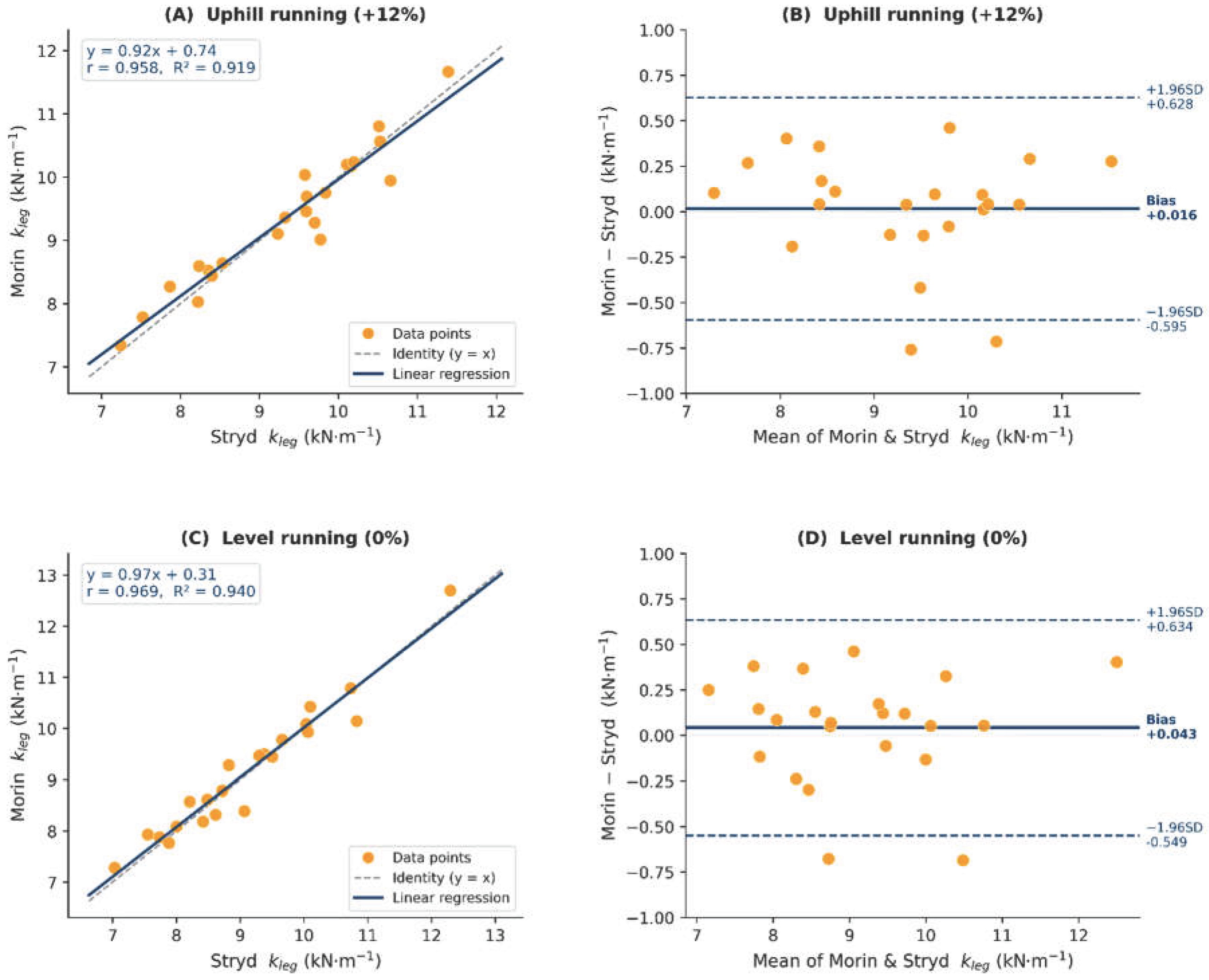
Figure 1. Scatter plots and Bland-Altman plots for the comparison between Stryd-reported and Morin (2005) sine-wave estimates of leg spring stiffness (kleg) under two treadmill conditions. Upper row (panels A–B): uphill running at +12% gradient). Lower row (panels C–D): level running at 0% gradient. Panels A and C (left): individual data points with the identity line (y = x, dashed) and the linear regression line (solid). Panels B and D (right): Bland-Altman plots displaying the mean difference (Stryd − Morin; central solid line) and the 95% limits of agreement (±1.96 SD; outer dashed lines), with numerical values annotated on the right side of each panel.
Preprints 210797 g001
Table 1. Descriptive statistics and leg stiffness by condition (mean ± SD).
Variable Uphill running (+12%) Level running (0%)
Speed(m·s⁻¹) 2.59 ± 0.34 3.10 ± 0.41
Contact time (ms) 290.5 ± 29.0 262.2 ± 26.1
Flight time (ms) 56.7 ± 29.7 96.0 ± 19.4
k_Stryd (kN·m⁻¹) 9.33 ± 1.09 9.09 ± 1.22
k_Morin (kN·m⁻¹) 9.35 ± 1.05 9.14 ± 1.22
Bias: Stryd−Morin −0.02 ± 0.31 −0.04 ± 0.30
MAPE 2.5% 2.6%
k_Stryd = Stryd-reported leg spring stiffness; k_Morin = leg spring stiffness estimated via the sine-wave method; Bias = k_Stryd − k_Morin; MAPE = mean absolute percentage error.
Table 2. Level-1 analytical validation statistics.
Statistic (threshold) Uphill running (+12%) Level running (0%)
ICC(2,1) [threshold: > 0.7] 0.959 0.970
95% CI for ICC(2,1) [0.903, 0.982] [0.929, 0.987]
Pearson r (R²) 0.958 (0.919) 0.969 (0.940)
Paired t / p 0.25 / 0.803 0.68 / 0.505
Bland-Altman Bias (kN·m⁻¹) −0.016 −0.043
LoA (kN·m⁻¹) [−0.595, +0.628] [−0.549, +0.634]
MAPE 2.44% 2.59%
ICC(2,1) = intraclass correlation coefficient, two-way random effects model, absolute agreement, single measures; 95% CI = 95% confidence interval computed via the F-distribution method; R² = coefficient of determination; paired t/p = paired t-test statistic and p-value comparing k_Stryd and k_Morin; LoA = 95% limits of agreement (mean bias ± 1.96·SD); MAPE = mean absolute percentage error.
Disclaimer/Publisher’s Note: The statements, opinions and data contained in all publications are solely those of the individual author(s) and contributor(s) and not of MDPI and/or the editor(s). MDPI and/or the editor(s) disclaim responsibility for any injury to people or property resulting from any ideas, methods, instructions or products referred to in the content.
Copyright: This open access article is published under a Creative Commons CC BY 4.0 license, which permit the free download, distribution, and reuse, provided that the author and preprint are cited in any reuse.
Prerpints.org logo

Preprints.org is a free preprint server supported by MDPI in Basel, Switzerland.

Subscribe

Disclaimer

Terms of Use

Privacy Policy

Privacy Settings

© 2026 MDPI (Basel, Switzerland) unless otherwise stated
