

Submitted:
29 April 2026
Posted:
29 April 2026
You are already at the latest version
Abstract
Melanoma treatment has been transformed by immune checkpoint blockade, yet many patients still experience primary resistance, limited durability of response, or acquired resistance. These limitations underscore the need for additional targets that reflect melanoma biology while enabling new therapeutic strategies. The B7-H6/NKp30 axis has gained attention as a link between tumor cell stress, immune recognition, and therapy-related adaptation. B7-H6 (NCR3LG1), an inducible ligand for NKp30, has been detected in melanoma cell lines and tumor specimens, and soluble B7-H6 has been identified in a subset of patients. Membrane-bound B7-H6 may support NK-cell activation, whereas ligand shedding and accumulation of soluble B7-H6 may reduce effective antitumor recognition and promote immune evasion. Emerging evidence further suggests that B7-H6 expression may be linked to tumor-intrinsic programs relevant to melanoma cell survival, migration, and adaptation to therapeutic stress. In this review, we examine the role of the B7-H6/NKp30 axis in immune surveillance, tumor escape, biomarker development, and therapeutic targeting, and discuss its translational potential in melanoma.
Keywords:
B7-H6
; NKp30
; melanoma
; natural killer cells
; immune surveillance
; immune escape
; bispecific engagers
; CAR-T
; soluble B7-H6
1. Introduction
Melanoma remains one of the most immunologically dynamic solid tumors, yet durable disease control remains limited by primary resistance, incomplete durability of response, or acquired resistance [1]. Although immune checkpoint blockade and MAPK-targeted therapy have improved outcomes in selected patients, their clinical benefit is frequently limited by primary resistance and eventual relapse, underscoring the need for additional targets that reflect melanoma biology and therapeutic vulnerability [1,2].
The B7-H6/NKp30 axis has emerged as a candidate. B7-H6, encoded by NCR3LG1, was originally identified as a tumor-associated ligand for the activating natural cytotoxicity receptor NKp30 and is notable for its minimal expression in most healthy tissues under normal conditions [3]. This pattern immediately suggested translational potential: a stress-inducible surface ligand preferentially associated with malignant cells offers both targeting potential and biomarker interest. Since its initial description, the pathway has expanded from a tumor-recognition mechanism to a broader framework that includes ligand shedding, stress-dependent regulation, receptor-based engineering, and T-cell–redirecting strategies [4,5,6,7].
Several observations support examining this pathway in melanoma. First, NK-cell biology remains important in melanoma, particularly in disease states that may be less accessible to conventional T-cell-mediated pressure [11,12,13]. Second, B7-H6 has been detected in melanoma cell lines, melanoma tumor specimens, and circulating serum samples from patients with melanoma, supporting the presence of this axis in melanoma [7,14]. Third, this axis already offers several translational opportunities, including biomarker development, engineered cell- and antibody-based targeting, and rational combination strategies aimed at increasing B7-H6 surface density or limiting its proteolytic shedding [7,15,16]. For these reasons, in settings of impaired antigen presentation or dedifferentiated/stress-adapted phenotypes, natural killer (NK) cell surveillance may become important [8,9,10,11].
In this review, we examine the B7-H6/NKp30 axis in melanoma through four connected lenses: immune surveillance, tumor immune escape, tumor-intrinsic function, and therapeutic targeting. We argue that this pathway merits attention not only as a route of NK-cell recognition, but also as a marker of stress-adapted melanoma states. Figure 1 summarizes this conceptual framework.
2. B7-H6/NKp30 Axis in Immune Surveillance in Melanoma
Natural killer cells are central mediators of innate antitumor immunity and may be especially important in tumors with impaired antigen presentation or T-cell escape [13,17]. NK cells detect transformed cells by integrating activating and inhibitory signals through the missing-self and induced-self mechanisms [18,19]. In melanoma, both processes are relevant, as tumor progression is frequently associated with reduced HLA class I expression, while many melanoma cells retain expression of stress-induced activating ligands that support NK-cell recognition [20,21]. In melanoma, NK cells contribute to immunosurveillance through direct cytotoxicity, cytokine production, and interaction with dendritic cells and adaptive immune populations. This may be especially important in therapy-adapted melanoma states with reduced visibility to conventional T-cell-mediated immunity [6,7].
NKp30 is a major activating receptor on human NK cells. Its interaction with B7-H6 provides a direct route for recognition of stressed or transformed cells [3,4,5]. Structural studies established the molecular basis of NKp30–B7-H6 engagement, and showed that this receptor–ligand pair represents a dedicated activating interaction rather than an inhibitory checkpoint-like pathway [4,5]. Because the axis promotes immune activation rather than immune restraint, it offers a distinct route of tumor–immune recognition in melanoma [4,5].
In metastatic disease, altered NK-receptor programs and reduced NK-cell fitness have been associated with progression and outcome, while distinct NKp30 transcript patterns have been described in clinically defined melanoma subsets [22]. These findings do not, on their own, establish B7-H6 as a validated therapeutic target, but they indicate that the biology engaged by the pathway already has biologic importance in melanoma. In other words, this axis extends beyond target expression alone and includes the NK-cell circuitry that shapes disease evolution [22].
Notably, the functional significance of this axis in melanoma is shaped not only by ligand availability on tumor cells, but also by progressive dysfunction of the NK-cell compartment within the tumor microenvironment. Experimental co-culture studies have shown that melanoma cells can downregulate NKp30 on NK cells and reduce cytolytic activity. In parallel, melanoma-associated fibroblasts have been shown to suppress NK-cell cytotoxicity, inhibit IL-2-driven NKp30 upregulation, and impair acquisition of cytotoxic granules [23]. Together, these findings suggest that melanoma undermines NK-cell surveillance through both tumor-intrinsic and microenvironmental mechanisms, reinforcing the idea that the B7-H6/NKp30 axis should be viewed as a framework shaped by both target expression and effector-cell competence.
Thus, in melanoma, the B7-H6/NKp30 axis matters not only for immune surveillance but also for therapeutic design because it identifies a route of tumor recognition that may remain actionable even as other mechanisms of immune escape emerge.
3. Tumor Escape Mechanisms: Shedding, Soluble B7-H6, and Target Loss
Although the B7-H6/NKp30 interaction can promote immune recognition, melanoma cells are not passive participants in this process. A key escape mechanism is proteolytic shedding of B7-H6 from the tumor cell surface, primarily mediated by A disintegrin and metalloproteinase domain-containing protein 10 (ADAM10) and 17 (ADAM17) [7]. This process directly reduces the amount of membrane-bound ligand available for NKp30-dependent recognition while simultaneously generating a soluble form detectable in patient serum [7]. In this regard, detection of soluble B7-H6 in patients with melanoma provides not only evidence of clinical detectability, but also a reminder that target presence and target accessibility are not necessarily equivalent states.
Biologically, this is a direct mechanism of tumor adaptation. A surface ligand that would otherwise signal tumor stress and susceptibility to NK-cell attack is converted into an escape-associated state characterized by reduced membrane density and the release of soluble antigen. In melanoma, this matters because emerging surface-directed therapeutic strategies, including CAR-based cellular therapies and bispecific antibodies, rely on adequate target display at the tumor cell surface. Consistent with this, CAR-T studies in melanoma have shown reduced killing when target antigen density is low [24,25,26]. If B7-H6 is actively shed, then target positivity in tissue may not fully capture real-time therapeutic accessibility.
Soluble B7-H6 is not simply a passive cleavage product. Prior work indicates that extracellular B7-H6 can contribute to impaired NK-cell function and dysregulated NKp30-dependent responses [27]. This suggests a two-part escape mechanism: melanoma cells may reduce direct surface recognition while also blunting effective effector responses. This interpretation is consistent with broader evidence that NK-cell dysfunction is a feature of melanoma in both experimental systems and patients, further supporting the view that shedding should be understood not only as a mechanism of target loss, but also as part of a wider process of effector-cell disengagement.
These findings have direct therapeutic implications. Membrane-bound and soluble B7-H6 should not be considered equivalent, because surface-retained ligand supports NKp30-dependent recognition, whereas soluble B7-H6 reflects shedding-associated target loss and may carry different biologic and therapeutic meaning [7,28]. Accordingly, development of B7-H6-directed therapies in melanoma will likely require more than baseline tissue staining alone. Serial assessment of soluble ligand and treatment-associated changes in target form may be important, and spatial heterogeneity in surface retention should also be considered when interpreting response and resistance [7,29,30].
The shedding mechanism also raises the possibility of therapeutic intervention at the level of target retention. Pharmacologic inhibition of ADAM10/17 increased surface B7-H6 and enhanced NK-cell-mediated killing, suggesting that ligand stabilization may improve the effectiveness of B7-H6-directed therapy [7]. Even if broad metalloprotease inhibition proves clinically difficult, the principle remains important: successful targeting of this axis will likely require attention to how melanoma regulates target availability. Importantly, this shedding process may be more dynamic than a fixed constitutive event. The incomplete suppression of B7-H6 release after ADAM10/17 inhibition suggests that additional regulatory inputs influence membrane ligand retention. In melanoma, these mechanisms remain incompletely defined and should currently be viewed as plausible rather than established.
4. Regulation and Tumor-Intrinsic Functions
B7-H6 expression can be shaped by cellular stress, inflammatory cues, oncogenic transcriptional programs, and post-translational processing, including shedding and glycosylation. This makes the pathway biologically rich, but also more nuanced to interpret. In melanoma, where therapy-driven state transitions and phenotypic plasticity are pervasive, B7-H6 may be better understood as a dynamic readout of tumor state than as a fixed antigenic label [16,31,32].
At the transcriptional level, one of the clearest regulatory mechanisms involves c-Myc. Textor and colleagues showed that Myc directly drives B7-H6 transcription and that Myc inhibition reduces B7-H6 expression and impairs NKp30-dependent NK-cell degranulation [22]. This links ligand availability to tumor-intrinsic oncogenic programming, suggesting that Myc-related perturbations may alter target visibility in clinically important settings.
Stress-pathway regulation further expands this concept. Across tumor systems, B7-H6 can be induced by genotoxic stressors such as chemotherapy and radiotherapy, by inflammatory cues including TNF-α, by non-lethal heat shock, and by activation of integrated stress response pathways [16,31]. In melanoma, this matters because advanced disease is shaped by chronic cellular stress, nutrient limitation, microenvironmental pressure, and the adaptive consequences of prior therapy. These conditions may induce B7-H6 expression and help define the melanoma cell states in which this axis becomes most prominent under stress or treatment pressure [16,31,33]. Additional support for this model comes from melanoma-relevant stress settings. Endoplasmic reticulum stress and integrated stress response signaling have been shown to increase B7-H6 surface expression in melanoma cell lines, raising the possibility that B7-H6 may mark stress-adapted tumor states rather than a static antigenic identity [16,34].
Beyond regulation, emerging evidence suggests that B7-H6 may have tumor-intrinsic roles. In cutaneous melanoma, B7-H6 silencing reduced survival, migration, and clonogenicity while increasing sensitivity to dacarbazine in A375 cells [14]. Although these findings remain limited and require validation across broader melanoma models, they are nonetheless informative. They suggest that B7-H6 expression may mark melanoma cells with distinct survival or adaptive properties [14]. In addition, B7-H6 knockdown combined with dacarbazine was associated with reduced STAT3 protein expression in A375 melanoma cells, suggesting that the tumor-intrinsic effects of B7-H6 in melanoma may also involve survival-linked signaling programs. However, this observation remains limited and is currently based on a single model.
Post-translational regulation may add another layer of complexity to this axis. N-linked glycosylation can influence both NKp30 binding and membrane stability, supporting the idea that glycan state may affect the balance between membrane-bound and soluble B7-H6. Functional studies have identified distinct glycosylation sites with separable roles, including N208, which appears to support membrane stability and whose loss is associated with increased shedding, while N43 primarily affects NKp30 binding affinity [32]. Although this has not yet been defined in melanoma, altered glycosylation is a common feature of malignancy and can influence the stability and proteolytic processing of immune surface proteins [35,36].
5. Expression Landscape and Biomarker Opportunities
Evidence for B7-H6 expression in melanoma remains limited, but it is sufficient to justify translational interest. In the original description of the ligand, melanoma cell lines were included within the early tumor expression landscape of B7-H6 [3]. Beyond its restricted tumor-associated expression, the NKp30–B7-H6 axis is also mechanistically notable because it functions as an activating rather than inhibitory immune interaction. Engagement of NKp30 by B7-H6 promotes NK-cell activation, including cytotoxic degranulation and proinflammatory cytokine release. Unlike classical inhibitory checkpoint pathways, this interaction is structurally and functionally activating, with NKp30 engaging B7-H6 through both the front and back β-sheets of its IgV-like domain [4]. Together, these features support the NKp30–B7-H6 axis as a mechanistically distinct immunotherapeutic target and provide a strong rationale for examining this axis in melanoma. More direct melanoma-specific evidence later showed B7-H6 expression in melanoma specimens in situ and detected soluble B7-H6 in the serum of a subset of patients [7]. Taken together, available data indicate that B7-H6 expression in melanoma is detectable across experimental and clinical contexts, but heterogeneous in magnitude and form [37]. Because B7-H6 is inducible, this variability is not unexpected. However, it has clear translational implications, because therapeutic tractability depends less on transcript abundance alone than on whether B7-H6 is present in a therapeutically accessible surface form.
An important advance came from work showing that B7-H6 transcripts are detectable in primary melanoma samples, whereas surface expression is variable and does not necessarily correlate with transcript abundance, consistent with additional post-transcriptional regulation [37]. This has direct implications for therapeutic development. In melanoma, the key question is not simply whether B7-H6 is expressed, but whether it is expressed in a form and at a density that can support intervention.
Soluble B7-H6 could serve as a minimally invasive biomarker reflecting ongoing shedding activity and changes in target form, and may also capture broader features of tumor state with potential clinical value [7,38]. In melanoma, where spatial heterogeneity and multiple metastatic sites often complicate tissue-based evaluation, such a circulating readout could be particularly useful. It is unlikely to replace tissue profiling, but it may complement it by enabling serial assessment of the evolving target landscape during treatment.
At the same time, biomarker development for this axis should be approached cautiously. Membrane-bound and soluble B7-H6 likely capture different aspects of tumor biology and therapeutic accessibility [7,38]. A tumor with abundant soluble B7-H6 but limited membrane retention may still be biologically informative, yet less amenable to surface-directed intervention than one with stable cell-surface expression. Future biomarker strategies should therefore move beyond binary positivity and incorporate target density, target form, timing, and, where feasible, spatial distribution. Melanoma-centered evidence supporting this axis is summarized in Table 1.
6. Therapeutic Targeting of the B7-H6/NKp30 Axis
In melanoma, this axis is attractive because B7-H6 is relatively tumor-restricted, biologically relevant, and compatible with multiple therapeutic platforms. Together, these features support development of B7-H6-directed strategies across several modalities, including receptor-based cellular therapies, T-cell engagers, cytokine-augmented dual-engagement approaches, and strategies aimed at increasing surface target availability by modulating target density or limiting ligand shedding [3,7,14,32,37,40]. The main therapeutic frameworks and their melanoma-specific development considerations are summarized in Table 2.
The sections below highlight the platforms most pertinent to melanoma translation and emphasize how target form, target density, and treatment context may influence therapeutic applicability. Because B7-H6 can be assessed in both membrane-bound and soluble forms, this axis may also support biomarker-guided development strategies that integrate tissue- and circulating-based readouts rather than relying on a single pretreatment assay.
6.1. T-cell Redirection and Bispecific Engagers
B7-H6-directed bispecific engagers are among the most advanced therapeutic strategies in this space. These constructs recruit T cells to B7-H6-expressing tumor cells independently of conventional peptide–MHC recognition, a feature that may be especially useful in melanoma, where resistant lesions can exhibit impaired antigen presentation, HLA class I downregulation, and dedifferentiated cell states [42,44]. Preclinical studies have shown that B7-H6-specific bispecific T-cell engagers can induce potent tumor clearance and promote host antitumor immunity [42]. In melanoma, where the endogenous immune response may be present but ineffective, this strategy could help restore antitumor pressure, even in lesions that have already been adapted to evade checkpoint-based therapies.
The B7-H6/CD3-engaging BI 765049 further reinforces the tractability of the target by demonstrating that industrial and early clinical development of this pathway are feasible [15]. Although most public data are not melanoma-specific, the existence of a clinically developed B7-H6-directed engager supports the broader proposition that this axis is druggable in a therapeutically meaningful way.
6.2. NK Cell–Engaging Approaches
Because B7-H6 is the natural activating ligand for NKp30, NK cell-oriented strategies have especially strong biologic grounding. Affinity-matured B7-H6-based bispecific immunoligands that engage NKp30 have shown enhanced NK-cell-mediated tumor-cell lysis and increased proinflammatory cytokine release [43]. Such formats may be particularly useful in melanoma lesions with modest B7-H6 surface expression, where native receptor–ligand affinity could otherwise limit therapeutic performance. By increasing the functional efficiency of the interaction, these agents may broaden the range of target-positive disease states that can be therapeutically exploited.
More recent dual-engagement approaches have extended this concept by combining B7-H6-targeted bispecific antibodies with IL-15/IL-15Rα signaling, thereby enhancing both NK-cell- and T-cell-mediated activity in chemo-resistant solid-tumor models [45]. An important feature of this design is that IL-15 activity was tumor-anchored through B7-H6-directed delivery, offering a way to enhance local effector-cell activation while reducing the limitations of unrestricted cytokine exposure [45]. In that study, NK-cell-engaging formats combined with localized IL-15 showed particularly strong activity, further supporting NK-centered, cytokine-augmented strategies as a promising direction for resistant solid tumors.
6.3. NKp30-Based CAR Therapies
NKp30-based CARs use the physiologic receptor domain to recognize B7-H6-positive tumor cells, thereby preserving a direct conceptual link between endogenous immune surveillance and engineered cellular therapy [29,40]. This is especially appealing in melanoma, where therapeutic success increasingly depends on identifying vulnerabilities that remain accessible after conventional adaptive immune targeting has failed.
Engineering refinements have strengthened this platform. Directed evolution of NKp30 has generated variants with improved binding properties and functional performance [41], while CRISPR/Cas9-edited, TCR-deleted NKp30 CAR-T strategies have shown preclinical anti-melanoma activity [37]. Together, these advances move the field beyond initial proof-of-concept toward more refined engineered cell products.
At the same time, these strategies remain subject to the core biological constraints of the axis: heterogeneous expression, soluble ligand generation, and target instability under treatment pressure. The success of NKp30-based CAR approaches will likely depend on both receptor engineering and control of target biology.
7. Combination Strategies and Clinical Positioning
One obvious direction is combination with immune checkpoint blockade. In principle, B7-H6-directed cellular therapies or engagers could complement checkpoint inhibitors by broadening immune attack beyond classical T-cell-restricted recognition. This may be most useful in checkpoint-resistant, HLA-low, or dedifferentiated melanoma states that remain accessible through stress-linked surface targets such as B7-H6.
Combination with stress-inducing or target-inducing therapies is another attractive strategy. Experimental studies have shown that conventional anticancer stressors, including chemotherapy, radiotherapy, heat shock, and inflammatory cytokine exposure, as well as integrated stress response pathways, can increase B7-H6 expression [16,31]. This may be particularly relevant for cell-based or engager-based strategies, whose efficacy could depend on transient increases in membrane B7-H6 under treatment-related stress.
However, not all therapeutic combinations are likely to be favorable. Histone deacetylase inhibitors, for example, have been shown to downregulate B7-H6 through Histone deacetylase 2/3 (HDAC2/3)-dependent mechanisms, leading to impaired NK-cell recognition [46].
These considerations argue for dynamic target assessment, including serial evaluation of tissue and soluble B7-H6 when feasible, rather than relying solely on baseline positivity. Clinically, B7-H6 is not yet a validated predictive biomarker or an established therapeutic class in melanoma. However, the strongest near-term opportunity is likely to involve biologically enriched settings, particularly checkpoint-resistant, HLA-low, dedifferentiated, or therapy-adapted melanoma states, in which stress-linked surface vulnerabilities may remain accessible despite failure of conventional immune control. In that context, B7-H6 warrants focused translational study as both a target and a state-linked biomarker.
8. Conclusions
The B7-H6/NKp30 axis sits at the intersection of immune surveillance, tumor escape, and therapeutic development in melanoma. Initially described as a mechanism of NK-cell recognition, this pathway now has broader relevance: B7-H6 is linked to membrane targetability, soluble biomarker potential, protease-mediated escape, and emerging tumor-intrinsic functions related to survival and migration.
At the same time, the biology of the axis argues against overly simplistic interpretation. In melanoma, B7-H6 appears heterogeneous, dynamically regulated, and influenced by target form, shedding, and treatment pressure. Accordingly, this pathway is best viewed not as a static antigenic marker, but as a context-dependent indicator of targetable tumor state.
A major strength of the axis is its translational flexibility across bispecific, NK-engaging, and NKp30-based CAR platforms. This breadth supports therapeutic development in melanoma settings where conventional immune control is limited, including immune-excluded, antigen-presentation-defective, and therapy-adapted states.
The key challenge now is prioritization. Future work should define where B7-H6 is most meaningfully expressed in melanoma, how membrane-bound and soluble forms should be interpreted together, and which disease states are most suitable for early clinical translation. The strongest near-term opportunity may lie not in unselected melanoma, but in biologically enriched settings such as checkpoint-resistant, HLA-low, dedifferentiated, or stress-adapted disease, where stress-linked surface vulnerabilities may remain actionable. In that context, the B7-H6/NKp30 axis warrants focused translational study as both a therapeutic target and a dynamic biomarker.
Author Contributions
Conceptualization, A.P.M.; writing—original draft preparation, A.P.M., K.M.T.B., RC.C, C.L., Y.G., and N.C.N.; writing—review and editing, K.T.A. and A.P.M. All authors have read and agreed to the published version of the manuscript.
Funding
This research received no external funding. KTA was funded by Swim Across America.
Data Availability Statement
No new data were created or analyzed in this study. Data sharing is not applicable to this article.
Conflicts of Interest
The authors declare no conflict of interest.
Abbreviations
The following abbreviations are used in this manuscript:.
| B7-H6 | B7 homolog 6 |
| NKp30 | Natural cytotoxicity receptor 3 (NCR3) |
| ADAM10 | A disintegrin and metalloproteinase domain-containing protein 10 |
| ADAM17 | A disintegrin and metalloproteinase domain-containing protein 17 |
| CAR-T | Chimeric antigenic receptor T-cell therapy |
| c-Myc | Cellular homolog of v-Myc oncogene |
| PERK | Protein kinase R (PKR)-like endoplasmic reticulum kinase |
| CRISPR/Cas9 | Clustered regularly interspaced short palindromic repeat/CRISPR-associated protein 9 |
| HDAC2/3 | Histone deacetylase 2/3 |
References
- Haugh, A.M.; Salama, A.K.S.; Johnson, D.B. Advanced Melanoma: Resistance Mechanisms to Current Therapies. Hematol Oncol Clin North Am 2021, 35, 111-128. [CrossRef]
- Fenton, S.E.; Sosman, J.A.; Chandra, S. Resistance mechanisms in melanoma to immuneoncologic therapy with checkpoint inhibitors. Cancer Drug Resist 2019, 2, 744-761. [CrossRef]
- Brandt, C.S.; Baratin, M.; Yi, E.C.; Kennedy, J.; Gao, Z.; Fox, B.; Haldeman, B.; Ostrander, C.D.; Kaifu, T.; Chabannon, C.; et al. The B7 family member B7-H6 is a tumor cell ligand for the activating natural killer cell receptor NKp30 in humans. J Exp Med 2009, 206, 1495-1503. [CrossRef]
- Li, Y.; Wang, Q.; Mariuzza, R.A. Structure of the human activating natural cytotoxicity receptor NKp30 bound to its tumor cell ligand B7-H6. J Exp Med 2011, 208, 703-714. [CrossRef]
- Pinheiro, P.F.; Justino, G.C.; Marques, M.M. NKp30 - A prospective target for new cancer immunotherapy strategies. Br J Pharmacol 2020, 177, 4563-4580. [CrossRef]
- Kaifu, T.; Escalière, B.; Gastinel, L.N.; Vivier, E.; Baratin, M. B7-H6/NKp30 interaction: a mechanism of alerting NK cells against tumors. Cell Mol Life Sci 2011, 68, 3531-3539. [CrossRef]
- Schlecker, E.; Fiegler, N.; Arnold, A.; Altevogt, P.; Rose-John, S.; Moldenhauer, G.; Sucker, A.; Paschen, A.; von Strandmann, E.P.; Textor, S.; et al. Metalloprotease-mediated tumor cell shedding of B7-H6, the ligand of the natural killer cell-activating receptor NKp30. Cancer Res 2014, 74, 3429-3440. [CrossRef]
- Jerby-Arnon, L.; Shah, P.; Cuoco, M.S.; Rodman, C.; Su, M.J.; Melms, J.C.; Leeson, R.; Kanodia, A.; Mei, S.; Lin, J.R.; et al. A Cancer Cell Program Promotes T Cell Exclusion and Resistance to Checkpoint Blockade. Cell 2018, 175, 984-997.e924. [CrossRef]
- Landsberg, J.; Kohlmeyer, J.; Renn, M.; Bald, T.; Rogava, M.; Cron, M.; Fatho, M.; Lennerz, V.; Wölfel, T.; Hölzel, M.; et al. Melanomas resist T-cell therapy through inflammation-induced reversible dedifferentiation. Nature 2012, 490, 412-416. [CrossRef]
- Sade-Feldman, M.; Jiao, Y.J.; Chen, J.H.; Rooney, M.S.; Barzily-Rokni, M.; Eliane, J.-P.; Bjorgaard, S.L.; Hammond, M.R.; Vitzthum, H.; Blackmon, S.M.; et al. Resistance to checkpoint blockade therapy through inactivation of antigen presentation. Nature Communications 2017, 8, 1136. [CrossRef]
- Sottile, R.; Pangigadde, P.N.; Tan, T.; Anichini, A.; Sabbatino, F.; Trecroci, F.; Favoino, E.; Orgiano, L.; Roberts, J.; Ferrone, S.; et al. HLA class I downregulation is associated with enhanced NK-cell killing of melanoma cells with acquired drug resistance to BRAF inhibitors. Eur J Immunol 2016, 46, 409-419. [CrossRef]
- Lehmann, J.; Caduff, N.; Krzywińska, E.; Stierli, S.; Salas-Bastos, A.; Loos, B.; Levesque, M.P.; Dummer, R.; Stockmann, C.; Münz, C.; et al. Escape from NK cell tumor surveillance by NGFR-induced lipid remodeling in melanoma. Sci Adv 2023, 9, eadc8825. [CrossRef]
- Porgador, A.; Mandelboim, O.; Restifo, N.P.; Strominger, J.L. Natural killer cell lines kill autologous beta2-microglobulin-deficient melanoma cells: implications for cancer immunotherapy. Proc Natl Acad Sci U S A 1997, 94, 13140-13145. [CrossRef]
- Mohammadi, A.; Najafi, S.; Amini, M.; Baradaran, B.; Firouzamandi, M. B7H6 silencing increases chemosensitivity to dacarbazine and suppresses cell survival and migration in cutaneous melanoma. Melanoma Res 2023, 33, 173-183. [CrossRef]
- Zhang, W.; Auguste, A.; Liao, X.; Walterskirchen, C.; Bauer, K.; Lin, Y.H.; Yang, L.; Sayedian, F.; Fabits, M.; Bergmann, M.; et al. A Novel B7-H6-Targeted IgG-Like T Cell-Engaging Antibody for the Treatment of Gastrointestinal Tumors. Clin Cancer Res 2022, 28, 5190-5201. [CrossRef]
- Obiedat, A.; Charpak-Amikam, Y.; Tai-Schmiedel, J.; Seidel, E.; Mahameed, M.; Avril, T.; Stern-Ginossar, N.; Springuel, L.; Bolsée, J.; Gilham, D.E.; et al. The integrated stress response promotes B7H6 expression. J Mol Med (Berl) 2020, 98, 135-148. [CrossRef]
- Laskowski, T.J.; Biederstädt, A.; Rezvani, K. Natural killer cells in antitumour adoptive cell immunotherapy. Nature Reviews Cancer 2022, 22, 557-575. [CrossRef]
- Lanier, L.L. NK cell recognition. Annu Rev Immunol 2005, 23, 225-274. [CrossRef]
- Kärre, K. Natural killer cell recognition of missing self. Nat Immunol 2008, 9, 477-480. [CrossRef]
- Kageshita, T.; Hirai, S.; Ono, T.; Hicklin, D.J.; Ferrone, S. Down-regulation of HLA class I antigen-processing molecules in malignant melanoma: association with disease progression. Am J Pathol 1999, 154, 745-754. [CrossRef]
- Morgado, S.; Sanchez-Correa, B.; Casado, J.G.; Duran, E.; Gayoso, I.; Labella, F.; Solana, R.; Tarazona, R. NK cell recognition and killing of melanoma cells is controlled by multiple activating receptor-ligand interactions. J Innate Immun 2011, 3, 365-373. [CrossRef]
- Textor, S.; Bossler, F.; Henrich, K.O.; Gartlgruber, M.; Pollmann, J.; Fiegler, N.; Arnold, A.; Westermann, F.; Waldburger, N.; Breuhahn, K.; et al. The proto-oncogene Myc drives expression of the NK cell-activating NKp30 ligand B7-H6 in tumor cells. Oncoimmunology 2016, 5, e1116674. [CrossRef]
- Balsamo, M.; Scordamaglia, F.; Pietra, G.; Manzini, C.; Cantoni, C.; Boitano, M.; Queirolo, P.; Vermi, W.; Facchetti, F.; Moretta, A.; et al. Melanoma-associated fibroblasts modulate NK cell phenotype and antitumor cytotoxicity. Proc Natl Acad Sci U S A 2009, 106, 20847-20852. [CrossRef]
- Jilani, S.; Saco, J.D.; Mugarza, E.; Pujol-Morcillo, A.; Chokry, J.; Ng, C.; Abril-Rodriguez, G.; Berger-Manerio, D.; Pant, A.; Hu, J.; et al. CAR-T cell therapy targeting surface expression of TYRP1 to treat cutaneous and rare melanoma subtypes. Nat Commun 2024, 15, 1244. [CrossRef]
- Anikeeva, N.; Panteleev, S.; Mazzanti, N.W.; Terai, M.; Sato, T.; Sykulev, Y. Efficient killing of tumor cells by CAR-T cells requires greater number of engaged CARs than TCRs. J Biol Chem 2021, 297, 101033. [CrossRef]
- Tang, J.; Gong, Y.; Ma, X. Bispecific Antibodies Progression in Malignant Melanoma. Front Pharmacol 2022, 13, 837889. [CrossRef]
- Ponath, V.; Hoffmann, N.; Bergmann, L.; Mäder, C.; Alashkar Alhamwe, B.; Preußer, C.; Pogge von Strandmann, E. Secreted Ligands of the NK Cell Receptor NKp30: B7-H6 Is in Contrast to BAG6 Only Marginally Released via Extracellular Vesicles. Int J Mol Sci 2021, 22. [CrossRef]
- Gutierrez-Franco, J.; Hernandez-Gutierrez, R.; Bueno-Topete, M.R.; Haramati, J.; Navarro-Hernandez, R.E.; Escarra-Senmarti, M.; Vega-Magaña, N.; Del Toro-Arreola, A.; Pereira-Suarez, A.L.; Del Toro-Arreola, S. Characterization of B7H6, an endogenous ligand for the NK cell activating receptor NKp30, reveals the identity of two different soluble isoforms during normal human pregnancy. Immunobiology 2018, 223, 57-63. [CrossRef]
- Lee, S.; Kim, J.H.; Jang, I.H.; Jo, S.; Lee, S.Y.; Oh, S.C.; Kim, S.M.; Kong, L.; Ko, J.; Kim, T.D. Harnessing B7-H6 for Anticancer Immunotherapy: Expression, Pathways, and Therapeutic Strategies. Int J Mol Sci 2024, 25. [CrossRef]
- Reuben, A.; Spencer, C.N.; Prieto, P.A.; Gopalakrishnan, V.; Reddy, S.M.; Miller, J.P.; Mao, X.; De Macedo, M.P.; Chen, J.; Song, X.; et al. Genomic and immune heterogeneity are associated with differential responses to therapy in melanoma. npj Genomic Medicine 2017, 2, 10. [CrossRef]
- Cao, G.; Wang, J.; Zheng, X.; Wei, H.; Tian, Z.; Sun, R. Tumor Therapeutics Work as Stress Inducers to Enhance Tumor Sensitivity to Natural Killer (NK) Cell Cytolysis by Up-regulating NKp30 Ligand B7-H6. J Biol Chem 2015, 290, 29964-29973. [CrossRef]
- Chen, H.; Zhang, Y.; Shen, Y.; Jiang, L.; Zhang, G.; Zhang, X.; Xu, Y.; Fu, F. Deficiency of N-linked glycosylation impairs immune function of B7-H6. Front Immunol 2023, 14, 1255667. [CrossRef]
- Rambow, F.; Marine, J.C.; Goding, C.R. Melanoma plasticity and phenotypic diversity: therapeutic barriers and opportunities. Genes Dev 2019, 33, 1295-1318. [CrossRef]
- Vendramin, R.; Katopodi, V.; Cinque, S.; Konnova, A.; Knezevic, Z.; Adnane, S.; Verheyden, Y.; Karras, P.; Demesmaeker, E.; Bosisio, F.M.; et al. Activation of the integrated stress response confers vulnerability to mitoribosome-targeting antibiotics in melanoma. J Exp Med 2021, 218. [CrossRef]
- Čaval, T.; Alisson-Silva, F.; Schwarz, F. Roles of glycosylation at the cancer cell surface: opportunities for large scale glycoproteomics. Theranostics 2023, 13, 2605-2615. [CrossRef]
- Rodriguez, E. Tumor Glycosylation: A Main Player in the Modulation of Immune Responses. Eur J Immunol 2025, 55, e202451318. [CrossRef]
- Givi, S.; Lohnes, B.J.; Ebrahimi, S.; Riedel, S.; Khokhali, S.; Khan, S.A.; Keller, M.; Wölfel, C.; Echchannaoui, H.; Bockamp, E.; et al. CRISPR/Cas9 TCR-Edited NKp30 CAR T Cells Exhibit Superior Anti-Tumor Immunity to B7H6-Expressing Leukemia and Melanoma. Int J Mol Sci 2025, 26. [CrossRef]
- Rusakiewicz, S.; Perier, A.; Semeraro, M.; Pitt, J.M.; Pogge von Strandmann, E.; Reiners, K.S.; Aspeslagh, S.; Pipéroglou, C.; Vély, F.; Ivagnes, A.; et al. NKp30 isoforms and NKp30 ligands are predictive biomarkers of response to imatinib mesylate in metastatic GIST patients. Oncoimmunology 2017, 6, e1137418. [CrossRef]
- Messaoudene, M.; Fregni, G.; Enot, D.; Jacquelot, N.; Neves, E.; Germaud, N.; Garchon, H.J.; Boukouaci, W.; Tamouza, R.; Chanal, J.; et al. NKp30 isoforms and NKp46 transcripts in metastatic melanoma patients: Unique NKp30 pattern in rare melanoma patients with favorable evolution. Oncoimmunology 2016, 5, e1154251. [CrossRef]
- Zhang, T.; Wu, M.R.; Sentman, C.L. An NKp30-based chimeric antigen receptor promotes T cell effector functions and antitumor efficacy in vivo. J Immunol 2012, 189, 2290-2299. [CrossRef]
- Butler, S.E.; Brog, R.A.; Chang, C.H.; Sentman, C.L.; Huang, Y.H.; Ackerman, M.E. Engineering a natural ligand-based CAR: directed evolution of the stress-receptor NKp30. Cancer Immunol Immunother 2022, 71, 165-176. [CrossRef]
- Wu, M.R.; Zhang, T.; Gacerez, A.T.; Coupet, T.A.; DeMars, L.R.; Sentman, C.L. B7H6-Specific Bispecific T Cell Engagers Lead to Tumor Elimination and Host Antitumor Immunity. J Immunol 2015, 194, 5305-5311. [CrossRef]
- Pekar, L.; Klausz, K.; Busch, M.; Valldorf, B.; Kolmar, H.; Wesch, D.; Oberg, H.H.; Krohn, S.; Boje, A.S.; Gehlert, C.L.; et al. Affinity Maturation of B7-H6 Translates into Enhanced NK Cell-Mediated Tumor Cell Lysis and Improved Proinflammatory Cytokine Release of Bispecific Immunoligands via NKp30 Engagement. J Immunol 2021, 206, 225-236. [CrossRef]
- Lee, J.H.; Shklovskaya, E.; Lim, S.Y.; Carlino, M.S.; Menzies, A.M.; Stewart, A.; Pedersen, B.; Irvine, M.; Alavi, S.; Yang, J.Y.H.; et al. Transcriptional downregulation of MHC class I and melanoma de- differentiation in resistance to PD-1 inhibition. Nature Communications 2020, 11, 1897. [CrossRef]
- Ma, X.; He, H.; Zhu, Y.; Zuo, D.; Wang, F.; Feng, M.; Ji, K.; Chen, X. Dual T/NK cell engagement via B7-H6-targeted bispecific antibodies and IL-15 eradicates chemo-resistant solid tumors. Front Immunol 2025, 16, 1625813. [CrossRef]
- Fiegler, N.; Textor, S.; Arnold, A.; Rölle, A.; Oehme, I.; Breuhahn, K.; Moldenhauer, G.; Witzens-Harig, M.; Cerwenka, A. Downregulation of the activating NKp30 ligand B7-H6 by HDAC inhibitors impairs tumor cell recognition by NK cells. Blood 2013, 122, 684-693. [CrossRef]
Figure 1.
Conceptual framework of the B7-H6/NKp30 axis in melanoma. Membrane-bound B7-H6 on melanoma cells can promote NKp30-dependent immune recognition and NK-cell activation. Protease-mediated shedding reduces surface ligand availability and generates soluble B7-H6, a process that may contribute to immune escape and limit target accessibility. Emerging evidence also suggests that B7-H6 expression may be linked to tumor-intrinsic programs relevant to survival, invasion, and adaptation to therapeutic stress.
Figure 1.
Conceptual framework of the B7-H6/NKp30 axis in melanoma. Membrane-bound B7-H6 on melanoma cells can promote NKp30-dependent immune recognition and NK-cell activation. Protease-mediated shedding reduces surface ligand availability and generates soluble B7-H6, a process that may contribute to immune escape and limit target accessibility. Emerging evidence also suggests that B7-H6 expression may be linked to tumor-intrinsic programs relevant to survival, invasion, and adaptation to therapeutic stress.
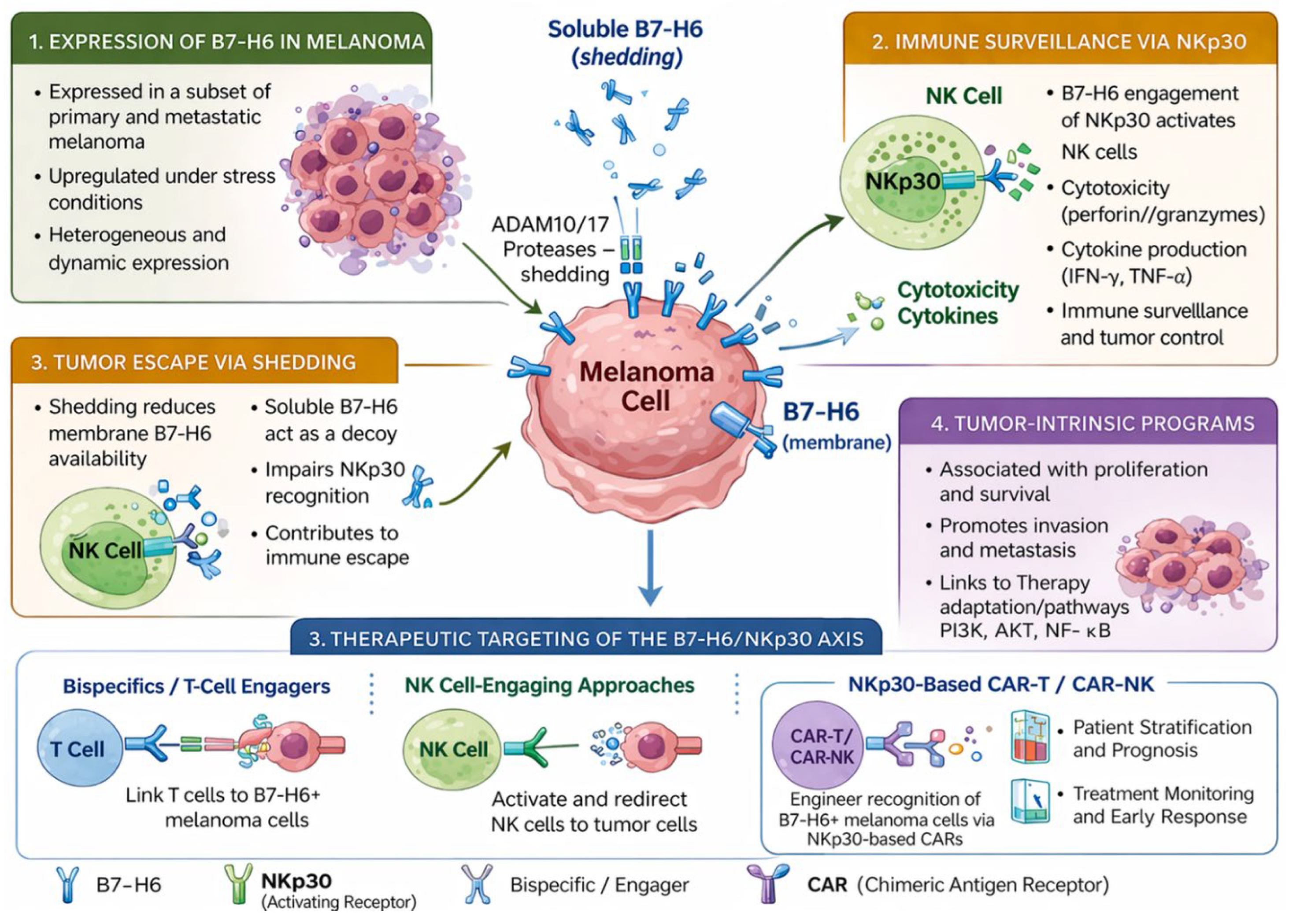

Table 1.
Melanoma-Relevant Evidence Supporting B7-H6/NKp30 as a Therapeutic Target and Biomarker Opportunity.
Table 1.
Melanoma-Relevant Evidence Supporting B7-H6/NKp30 as a Therapeutic Target and Biomarker Opportunity.
| Study | Key melanoma-linked observation | Targeting implication | Main limitation |
|---|---|---|---|
| Brandt et al. (2009) [3] | Identifies B7-H6 as the human tumor-cell ligand for NKp30; melanoma cell lines were among the first reported to express the target. | Establishes melanoma as a plausible cell-surface targeting context for the NKp30/B7-H6 axis. | Primarily discovery-phase; limited melanoma-specific clinical annotation. |
| Schlecker et al. (2014) [7] | Shows ADAM10/17-mediated shedding of B7-H6, elevated soluble B7-H6 in melanoma serum, and increased tissue expression in melanoma specimens in situ. | Directly links melanoma biology to target loss, soluble biomarker potential, and a defined resistance mechanism. | Subset-based serum analysis; no therapeutic intervention study. |
| Messaoudene et al. (2016) [39] | Defines unusual NKp30 transcript patterns in metastatic melanoma and rare mucosal melanoma. | Supports the importance of the receptor side in clinically distinct melanoma states. | Does not directly measure tumor-cell B7-H6. |
| Obiedat et al. (2020) [16] | Integrates stress response and PERK signaling increased B7-H6 expression; ISR inhibitor reversed this effect. | Provides a rationale for pharmacologic target induction and combination design. | Preclinical and not melanoma-specific, but mechanistically informative. |
| Mohammadi et al. (2023) [14] | B7-H6 silencing in A375 melanoma cells reduces survival, migration, clonogenicity, and increased dacarbazine sensitivity. | Suggests that B7-H6-positive melanoma states may have therapeutic importance beyond immune recognition. | Single-cell-line study; no in vivo melanoma validation. |
| Givi et al. (2025) [37] | Primary melanoma samples and melanoma cell lines express B7-H6; CRISPR/Cas9-edited NKp30 CAR-T cells showed in vitro cytotoxicity and in vivo control in an A375 xenograft model. | Strengthens the translational case for B7-H6-directed cellular therapy and highlights protein-level heterogeneity. | Small melanoma sample set; broader clinical heterogeneity remains untested. |
This table emphasizes the melanoma-centered evidence most useful for target validation, biomarker strategy, resistance interpretation, and development planning.
Table 2.
Therapeutic Strategies Targeting B7-H6/NKp30 and Their Development Relevance for Melanoma.
| Platform | Mechanistic concept | Development strength | Key caveat |
|---|---|---|---|
| Native NKp30-based CAR-T | Uses the natural NKp30 extracellular domain to recognize tumor-cell B7-H6 | In vivo proof-of-concept: receptor biology is directly linked to targeting | Native receptor affinity may be modest; potential off-tumor concerns remain |
| Affinity-matured NKp30 CARs | Directs evolution generates higher-affinity NKp30 variants for CAR recognition | Expands binding range and may improve performance in lower-density target states | Still preclinical; performance in melanoma-specific models remains limited |
| B7-H6/CD3 T-cell engager BI 765049 | Bispecific binder links B7-H6-positive tumor cells to CD3-positive T cells | Demonstrates the feasibility of industrial and clinical development for the target | Most public efficacy data are outside the melanoma setting |
| CRISPR/Cas9 TCR-edited NKp30 CAR-T | Engineered T cells combine NKp30-based recognition with TCR deletion | Direct melanoma activity has been shown in vitro and in vivo; the platform allows precise product engineering | Manufacturing, persistence, antigen heterogeneity, and safety questions remain |
| Dual T/NK + cytokine-anchored strategies | Combine B7-H6-targeted immune redirection with tumor-localized IL-15/IL-15Rα signaling to amplify effector-cell activation at B7-H6-positive tumor sites | Extends the platform beyond target binding alone; supports both NK- and T-cell activity, with particularly strong preclinical activity in NK-engaging formats in resistant solid-tumor models | Not melanoma-specific; cytokine dosing, safety, and generalizability remain to be defined |
| Antigen-priming approaches | Stress-inducing therapies or ISR activation may raise B7-H6 density before cell-based or engager-based treatment | Creates a route to rational combinations and biomarker-guided scheduling | Timing, dosing, and simultaneous induction of shedding require resolution |
| Shedding-aware strategies | Reduce ADAM10/17-mediated B7-H6 shedding and consider soluble B7-H6 as a complementary pharmacodynamic biomarker | Strong mechanistic rationale based on melanoma serum data and established shedding biology | No melanoma-specific intervention study has yet shown clinical benefit, and direct metalloprotease inhibition remains difficult to implement therapeutically |
Disclaimer/Publisher’s Note: The statements, opinions and data contained in all publications are solely those of the individual author(s) and contributor(s) and not of MDPI and/or the editor(s). MDPI and/or the editor(s) disclaim responsibility for any injury to people or property resulting from any ideas, methods, instructions or products referred to in the content. |
© 2026 by the authors. Licensee MDPI, Basel, Switzerland. This article is an open access article distributed under the terms and conditions of the Creative Commons Attribution (CC BY) license.
Copyright: This open access article is published under a Creative Commons CC BY 4.0 license, which permit the free download, distribution, and reuse, provided that the author and preprint are cited in any reuse.


