

Submitted:
28 April 2026
Posted:
29 April 2026
You are already at the latest version
Abstract
Purpose: This review article investigates the significance of AI-driven e-banking services through a holistic conceptual model considering ethical trust, fraud prevention, and consumer purchase decision-making in the context of Bangladesh's online banking services.
Methodology: A narrative literature review was conducted, synthesizing peer-reviewed articles published between 2024-2025 from major databases including Scopus, Web of Science, and IEEE Xplore. The UTAUT2 framework provides the theoretical foundation.
Findings: AI adoption in Bangladeshi e-banking enhances customer experience, risk management, process automation, financial inclusion, and regulatory compliance. Ethical trust comprising transparency, fairness, data privacy, reliability, and digital inclusion mediates the relationship between AI implementation and consumer decision-making. Fraud prevention acts as a critical enabler, reducing perceived risk through real-time monitoring and secure authentication.
Originality: This study provides the first integrated analysis of AI's tripartite role in Bangladeshi e-banking, extending UTAUT2 by incorporating ethical trust and fraud prevention as mediating mechanisms. For policymakers at Bangladesh Bank, the findings offer evidence-based guidance for developing AI governance frameworks. For commercial banks, the study illuminates specific drivers of ethical trust and user acceptance.
Keywords:
artificial intelligence
; ethical trust
; fraud prevention
; E-banking
; UTAUT2
; Bangladesh
; emerging economy
1. Introduction
The financial landscape in Bangladesh is undergoing a profound digital metamorphosis, a transformation largely propelled by the government's strategic "Digital Bangladesh" vision. A cornerstone of this shift is the rapid institutionalization of electronic banking (E-banking). This evolution is fueled by a confluence of factors: the proliferation of affordable smartphones, expansive internet penetration, and a regulatory environment actively engineered to foster fintech innovation. The scale of the end of October 2024, there were 1,544,573.2 million MFS transactions and 234.25 million registered MFS users overall. Of these, only 87.20 million were active, or 35.94% of all registered users (Bangladesh Bank, 2024). This figure not only highlights the sector's massive scale but also signifies a deep penetration of digital finance into the socio-economic fabric of the nation, moving beyond urban centers to achieve financial inclusion (Rizvee et al., 2025; Nnaomah et al., 2024).
Concurrently, the global financial sector is being fundamentally reshaped by the disruptive forces of Artificial Intelligence (AI). AI technologies, encompassing machine learning (ML), natural language processing (NLP), and predictive analytics, have transitioned from speculative concepts to essential tools for competitive parity. They are now critical for enhancing operational efficiency, creating hyper-personalized customer experiences, and fortifying security frameworks against an increasingly sophisticated threat landscape (Ridzuan et al., 2024; Davenport & Ronanki, 2018). In the specific context of E-banking, AI's role can be conceptualized as tripartite. Firstly, it actively influences consumer decision-making by offering hyper-personalized product recommendations and dynamic user interfaces (Zungu et al., 2025; Kumar et al., 2019). Secondly, it builds or erodes ethical trust through its perceived fairness, transparency, and data handling practices, a dimension critical for long-term adoption (Mikalef & Gupta, 2021). Thirdly, it is indispensable for proactive fraud prevention, capable of identifying anomalous transaction patterns in real-time, a capability far beyond traditional rule-based systems (Odufisan et al., 2025; Ngai et al., 2011).
In Bangladesh, the integration of AI into the E-banking ecosystem is at a crucial and nascent juncture. While leading banks and MFS providers are increasingly investing in AI-driven solutions to maintain competitiveness and security, the consumer's relationship with this opaque technology is complex and multifaceted. On the other hand, AI-driven conveniences, such as personalized spending insights, automated savings plans, and instant, algorithm-based loan approvals, are demonstrably influencing consumer behavior and fostering brand loyalty. Empirical research in the Bangladeshi context affirms that the perceived usefulness and ease of use of a digital service, attributes significantly enhanced by competent AI, are key determinants of its continued usage and adoption (Bhuiyan et al., 2025; Venkatesh et al., 2012). This aligns with the global Technology Acceptance Model (TAM), which has been validated in numerous fintech studies.
On the other hand, this positive influence is critically tempered by significant and growing concerns over ethical trust. Issues of data privacy, potential algorithmic bias against certain demographic groups, and the inherent "black box" nature of complex ML models can create significant consumer apprehension and resistance (Tabaku et al. 2025; Rafi et al. 2025).
In the context of Islamic banking, which constitutes a significant portion of Bangladesh's financial sector, AI deployment requires special consideration. Shariah compliance prohibiting interest (riba), excessive uncertainty (gharar), and gambling (maysir) may moderate the relationship between AI attributes and ethical trust. For instance, AI-based investment recommendations must avoid haram sectors, and automated lending algorithms must comply with Islamic profit-sharing principles (Mudarabah, Musharakah). Future AI models for Islamic banks should incorporate Shariah certification layers to generate higher ethical trust among Muslim customers compared to conventional AI models.
Furthermore, the "black-box" nature of complex machine learning models raises concerns about transparency and accountability. Explainable AI (XAI) techniques such as LIME (Local Interpretable Model-agnostic Explanations) and SHAP (SHapley Additive exPlanations) can generate transaction-level justifications (e.g., "This transaction was flagged due to unusual location and amount pattern"), thereby enhancing consumer trust by making AI decisions interpretable. For the Bangladeshi banking sector, implementing Bengali-language XAI interfaces could reduce algorithmic aversion among customers with lower digital literacy.
As Nastoska et al. (2025) compellingly highlighted in their research on AI in emerging markets, a breach of trust due to opaque or perceived unfair AI practices can lead to severe customer backlash and platform abandonment. This is a particularly potent risk in a price-sensitive and trust-driven market like Bangladesh, where consumer confidence is a fragile asset (Shili & Toukabri, 2025). The ethical dimension, therefore, is not a peripheral concern but a central pillar for sustainable growth.
Perhaps the most critical and publicly visible application of AI in Bangladeshi E-banking is in the domain of fraud prevention and cybersecurity. The nation has witnessed an alarming rise in sophisticated cybercrimes, including orchestrated phishing campaigns, identity theft, and real-time transaction fraud, challenging the efficacy of traditional, static, rule-based security systems (Bangladesh Bank, 2023; Khan et al., 2025). In direct response, financial institutions are urgently deploying AI-powered fraud detection systems that leverage advanced ML algorithms to analyze thousands of transactions per second to identify subtle, suspicious behavioral patterns (Islam & Rahman, 2025). The Bangladesh Bank's recent directives mandating stronger customer verification (e.g., multi-factor authentication) and continuous transaction monitoring have served as a regulatory catalyst, accelerating this adoption (Bangladesh Bank, 2023). The effectiveness of these AI systems is not merely a technical performance metric but a fundamental component of consumer confidence; as established by the framework of Mayer et al. (1995), the perceived ability of an institution to provide security is a core tenet of trust, without which full adoption remains elusive.
However, a significant and consequential research gap persists in understanding the interconnectedness and dynamic interplay of these three elements AI-influenced consumer decision-making, ethically-grounded trust, and AI-powered fraud prevention specifically within the unique socio-economic, regulatory, and cultural context of Bangladesh (Mumtaz et al., 2025; Lukyanenko et al., 2022). Existing scholarly works, both global and local, often examine these domains in isolation: studies on technology adoption (e.g., based on TAM or UTAUT), investigations into AI ethics, and technical papers on fraud detection algorithms (Venkatesh et al., 2012; Mikalef & Gupta, 2021; Ngai et al., 2011). There is a pressing need for an integrated research model that investigates how the very AI tools designed to protect and personalize (fraud prevention and decision influence) are perceived by Bangladeshi consumers and how these perceptions, mediated by ethical considerations, ultimately shape their trust and long-term behavioral engagement with E-banking platforms (Ikhsan et al., 2026; Hoque et al., 2025).
Therefore, this study seeks to bridge this critical gap by providing a holistic, empirical analysis of AI's multifaceted role. It will systematically explore how AI-driven personalization steers consumer choices, how the ethical implementation and communication of AI build a foundational and resilient layer of trust, and how robust, transparent AI-based fraud prevention acts as a critical enabler for the sustainable growth and stability of the entire E-banking ecosystem in Bangladesh. The findings will be crucial for policymakers in refining digital finance strategy, for financial institutions in developing responsible and effective AI deployments, and for technology providers in creating consumer-centric solutions that support the continued growth of a resilient, inclusive, and trustworthy digital economy in Bangladesh.
2. Statement of the Research Problem
The rapid digitization of Bangladesh's financial sector, propelled by government initiatives and a burgeoning youth population, has led to an unprecedented surge in e-banking adoption (Bangladesh Bank, 2024). While this digital transformation offers convenience and financial inclusion, it has simultaneously created a fertile ground for sophisticated cybercrimes and financial fraud, eroding consumer confidence (Rahman & Kaiser, 2025). In response, Bangladeshi banks are increasingly turning to Artificial Intelligence (AI) as a strategic tool. AI algorithms are being deployed for real-time fraud detection, personalized product recommendations, and automated customer service through chatbots (Hossain et al., 2025).
However, the integration of AI into the sensitive domain of personal finance is not a panacea. It introduces a complex, tripartite problem. First, there is an insufficient understanding of how AI-driven interfaces such as personalized dashboards, robot-advisors, and targeted marketing are actively shaping the cognitive processes and final financial decision-making of Bangladeshi consumers (Karim et al., 2023). Second, the opaque nature of many AI systems ("black-box" algorithms) raises critical questions about accountability, data privacy, and the ethical foundations upon which consumer trust is built, a trust that is paramount for the sustained growth of e-banking (Siddique & Haque, 2024). Third, while AI is marketed as a fraud prevention silver bullet, its actual efficacy within the unique socio-technical landscape of Bangladesh characterized by specific digital literacy levels, regulatory frameworks, and fraud patterns remains largely unquantified and its potential unintended consequences, such as false positives denying legitimate transactions, unexplored (Alam & Chowdhury, 2025).
Therefore, the core research problem is to investigate the multifaceted and interconnected role of AI in the Bangladeshi e-banking ecosystem, specifically focusing on its simultaneous influence on consumer decision-making processes, the fragile construct of ethical trust, and its practical effectiveness in fraud prevention.
3. Research Objectives
The fundamental objective of this study is to develop and validate a comprehensive model that explains the interrelationships between AI implementation, consumer decision-making, ethical trust, and fraud prevention within the unique context of Bangladeshi e-banking.
Specific Research Objectives:
- ➢ To identify and analyze the key AI-driven features in Bangladeshi e-banking and evaluate their direct influence on consumer decision-making processes.
- ➢ To examine the impact of perceived ethical attributes of AI (transparency, fairness, data privacy) on building and sustaining ethical trust among Bangladeshi e-banking users.
- ➢ To assess the efficacy of AI-based fraud prevention systems from both a technical and user-perception standpoint in the Bangladeshi context.
- ➢ To develop and empirically test an integrated model elucidating the interrelationships between AI-influenced decision-making, ethical trust, and fraud prevention.
4. Significance of the Study
his research holds significant academic and practical importance for Bangladesh's evolving digital economy. Primarily, it addresses a critical knowledge gap by providing the first integrated, empirical analysis of how Artificial Intelligence (AI) simultaneously influences consumer decision-making, ethical trust, and fraud prevention within the nation's unique e-banking context. By moving beyond the siloed examination of these constructs, the study will develop a holistic model that captures their dynamic interrelationships an essential contribution to the literature on technology adoption in emerging markets.
From a practical standpoint, the findings offer vital strategic insights. For policymakers and regulators, such as Bangladesh Bank, the study will deliver evidence-based guidance for crafting effective AI governance frameworks and data protection policies that balance innovation with consumer safeguarding. For commercial banks and financial technology providers, it will illuminate the specific drivers of ethical trust and user acceptance, enabling the design of more transparent, secure, and consumer-centric AI solutions. Ultimately, by clarifying the pathway to responsible AI integration, this research supports the sustainable growth of a resilient, inclusive, and trustworthy digital financial ecosystem in Bangladesh.
5. Literature Review
Comprehensive Literature Review Chart (2024-2025): Ai in Bangladeshi E-Banking

Table 1.
Literature Evolution Timeline (2019-2025).
| Phase | 2019-2021(Pre- Pandemic) |
2022-2023 (Emerging AI Era) |
2024 (Current Integration) |
2025 (future Smart B.) |
Focus |
| Global AI Banking | Basic AI Chatbots Simple Automation |
Advanced ML Fraud Detection Personalization |
Explainable AI (XAI) AI Ethics Frameworks |
Quantum Safe AI Integration |
Techno logical Advance ment |
| Bangladesh Context |
MFS Expansion Digital Payment Awareness |
Initial AI Pilot Projects Rising Fraud Concerns |
Regulatory Sandbox Launch Islami FinTech AI Solutions |
Integrated AI Ecosystem Cross border AI Compliance | Context Specific Development |
| Research Focus | Technology Acceptance Models Basic Security Concerns |
Behavioral Economics of Trust Security Privacy Trade-offs |
Ethical AI & Trust Models Multi -Dimensional Decision- Making |
Holistic Integration Models AI Governance Frameworks |
Academic Progress |
Thematic Literature Matrix (2024-2025)
Table 2.
AI Implementation in Global Banking.
| Sub-Theme | Key Findings (2024) | Research Gaps | Bangladesh Relevance |
| AI Service Quality | • Emotion AI achieves 89% customer satisfaction (Deloitte, 2024) • Hyper-personalization increases retention by 35% (McKinsey, 2024) • Conversational AI handles 70% of routine queries (Gartner, 2024) |
• Cultural adaptation of AI interfaces • Rural-urban digital divide • Language-specific NLP challenges |
• Bangla NLP still at 75% accuracy (BracU, 2024) • Mobile-first AI design essential • Islamic banking AI needs special models |
| AI Fraud Prevention | • ML models detect 99.7% fraud in real-time (IBM, 2024) • Behavioral biometrics reduce false positives by 60% (Juniper, 2024) • Blockchain-AI integration enhances audit trails (World Bank, 2024) |
• Privacy-preserving AI techniques • Cross-border fraud coordination • Explainability vs. accuracy trade-off |
• Bangladesh-specific fraud patterns differ • Regulatory compliance with BB guidelines • Agent banking vulnerabilities |
| Ethical AI Frameworks | • EU AI Act (2024) mandates transparency • Singapore's FEAT principles adopted widely • Algorithmic bias detection tools mature (MIT, 2024) |
• Global South ethical frameworks lacking • Cultural definitions of fairness • Accountability mechanisms |
• Bangladesh Bank developing AI governance (2025) • Shariah-compliance requirements • Data sovereignty concerns |
Table 3.
Bangladeshi E-banking Context.
| Sub-Theme | Key Findings (2024) | Research Gaps | Theoretical Implications |
| Digital Infrastructure | • 4G coverage reaches 95% (BTRC, 2024) • Mobile banking users: 65 million (BB, 2024) • AI investment by banks: $68M (2023-2024) |
• AI integration with legacy systems • Rural connectivity challenges • Skilled workforce shortage |
• Modified UTAUT for low-literacy users • Trust transfer from agents to AI • Digital ecosystem theory |
| Regulatory Landscape | • BB Cybersecurity Guidelines (2024) • Data Protection Act under review • FinTech sandbox expanded (2024) |
• AI-specific regulations absent • Cross-border data flow issues • Enforcement capacity gaps |
• Institutional theory application • Regulatory trust development • Compliance-technology alignment |
| Consumer Behavior | • 58% trust AI for fraud prevention (SUST, 2024) • 42% concerned about AI bias (DU, 2024) • Generation Z adoption rate: 76% (NSU, 2024) |
• Trust building mechanisms • Risk perception variations • Cultural decision-making factors |
• Protection Motivation Theory adaptation • Behavioral economics integration • Cross-generational models |
Table 4.
Trust and Decision-Making.
| Trust Dimension | Global Advances (2024) | Bangladesh-Specific Factors | Measurement Challenges |
| Algorithmic Trust | • XAI adoption increases transparency • AI certification programs emerge • Performance metrics standardization |
• Low algorithmic literacy • Preference for human backup • Social proof influence |
• Quantifying trust in black-box systems • Longitudinal trust measurement • Context-specific trust indicators |
| Institutional Trust | • Central bank digital currencies build trust • Regulatory sandboxes foster innovation • Public-private partnerships expand |
• High trust in Bangladesh Bank • Brand loyalty to established banks • Family recommendations influence |
• Separating brand trust from AI trust • Regulatory credibility measurement • Trust transfer mechanisms |
| Transactional Trust | • Real-time verification increases confidence • Smart contracts automate trust • Multi-factor authentication evolution |
• Cash-based mentality persists • Agent mediation effects • Community validation importance |
• Momentary vs. sustained trust • Risk perception calibration • Trust recovery after breaches |
5.1. Artificial Intelligence:
Artificial Intelligence (AI) has significantly reshaped e-banking in Bangladesh by enhancing customer experience through personalized services such as AI-powered CRM tools, chatbots, and predictive analytics, which improve customer satisfaction and operational efficiency (Saha, Dey & Hossan, 2025). The integration of AI also strengthens risk management and security mechanisms by enabling advanced cybersecurity measures that detect anomalies and cyber threats more effectively, although challenges such as shortage of skilled personnel and implementation barriers persist (Khan et al., 2025). In terms of process automation, AI systems reduce manual workload and improve efficiency in compliance reporting, lowering reporting times and increasing data accuracy within banks (Hossain, Alam & Iqbal, 2025). Furthermore, AI contributes to financial inclusion and accessibility by supporting advanced credit scoring and onboarding procedures—making financial products more reachable for underserved populations by leveraging machine learning and alternative data (Roy, 2024). Finally, the ongoing development of regulatory compliance frameworks in Bangladesh, including AI-specific policy preparation by Bangladesh Bank, highlights the critical role of governance in securing ethical and compliant AI use in e-banking (Hossain, Alam & Iqbal, 2025).
5.2. Customer Experience
Customer experience (CX) in AI-enabled e-banking has become a critical determinant of user adoption and loyalty. Recent studies indicate that AI-driven personalization, chatbots, and real-time service analytics significantly enhance customer satisfaction by providing seamless, tailored, and responsive banking interactions (Mayeesha, Islam & Ahmed, 2024). In Bangladesh, digital banking users increasingly prefer platforms that reduce wait times, anticipate their needs, and resolve issues efficiently. Positive customer experience not only encourages continued engagement but also strengthens trust in digital banking services, which is a key factor in overall consumer decision-making.
5.3.. Risk Management & Security
Effective risk management and security are essential for fostering trust and ethical confidence in AI-driven banking. AI tools such as anomaly detection, behavioral analytics, and predictive fraud monitoring have been shown to reduce financial risks and safeguard customer data (Mollik & Majeed, 2025). In the Bangladeshi context, banks employing AI-enhanced cybersecurity frameworks report fewer incidents of fraud, enhancing the perception of safety among consumers. Robust security measures therefore play a direct role in consumer decision-making by lowering perceived risks and increasing willingness to use digital financial services.
5.4. Process Automation
Process automation in e-banking, powered by AI and machine learning, has significantly improved operational efficiency and service quality. Routine banking tasks, such as loan approvals, fund transfers, and account management, can now be processed faster and with fewer errors (Rasel, Karim & Chowdhury, 2025). In Bangladesh, this has led to reduced transaction times, improved accuracy, and enhanced convenience for customers. Process automation not only optimizes back-end operations but also positively affects customer satisfaction and trust, thereby influencing their decision to engage with AI-enabled banking services.
5.5. Financial Inclusion & Accessibility
AI technologies have the potential to enhance financial inclusion and accessibility, especially for underserved populations in Bangladesh. Tools like mobile banking apps, AI-driven credit scoring, and digital wallets enable previously excluded groups to access banking services with minimal barriers (UNDP, 2025). Studies show that increased accessibility and user-friendly interfaces improve participation in formal financial systems, empowering users economically and socially. By bridging access gaps, AI-driven financial inclusion directly contributes to more equitable adoption of digital banking services.
5.6. Regulatory Compliance
Compliance with regulatory frameworks ensures that AI-enabled banking operations remain ethical, secure, and legally sound. Recent research emphasizes that adherence to Bangladesh Bank guidelines, data protection laws, and AI governance policies not only mitigates legal and financial risks but also strengthens consumer confidence (Ridzuan et al., 2024). Banks implementing compliance-focused AI systems maintain higher levels of transparency and accountability, which reassures customers about the reliability and legitimacy of digital financial services. This fosters trust, which is essential for sustained adoption and engagement in e-banking.
5.7. Ethical Trust
Ethical trust refers to consumer confidence that AI systems operate transparently, fairly, and with accountability, ensuring data privacy and inclusive access.
Research by Mayeesha, Islam, and Ahmed (2024) highlights that AI-driven transparency, where system operations and decisions are understandable to users, is critical for building consumer trust in digital banking. The UNDP (2025) stresses the importance of integrating data privacy, security measures, and digital inclusion into national AI strategies to ensure equitable access and prevent exclusion of vulnerable populations. Empirical findings by Rasel, Karim, and Chowdhury (2025) indicate that algorithmic fairness and reliability significantly affect user confidence, especially when users have avenues to verify and challenge AI decisions. Complementary international studies (Ridzuan et al., 2024) suggest that ethical AI governance, including clear accountability mechanisms, enhances perceived trustworthiness and adoption intentions. Finally, Mollik and Majeed (2025) demonstrate that robust data security and privacy protocols, combined with user education, reinforce consumer trust and support sustainable engagement with AI-enabled banking services. Collectively, these findings suggest that ethical trust in Bangladeshi e-banking requires a holistic approach that addresses transparency, fairness, privacy, accountability, and inclusion.
5.7.1. AI-Driven Transparency
AI-driven transparency refers to the clarity and interpretability of AI systems, enabling users to understand how automated decisions are made in digital banking. Transparent AI operations build consumer confidence and trust, reducing skepticism and increasing adoption intentions (Mayeesha, Islam, & Ahmed, 2024). Empirical research shows that clear communication of AI processes and accessible explanations significantly enhance users’ willingness to rely on AI-driven financial services (Rasel, Karim, & Chowdhury, 2025). Transparency also mitigates perceived risks associated with algorithmic decisions (Mollik & Majeed, 2025). Furthermore, national AI strategies in Bangladesh stress transparency as a key pillar for ethical and responsible AI adoption (UNDP, 2025). Internationally, studies demonstrate that explainable AI improves customer satisfaction and promotes fair engagement with financial technologies (Ridzuan et al., 2024). Collectively, AI-driven transparency is essential for fostering ethical trust in e-banking services.
5.7.2. Algorithmic Fairness
Algorithmic fairness ensures that AI systems make equitable and unbiased decisions across diverse consumer groups. Studies indicate that perceived fairness in automated banking decisions significantly influences consumer trust and adoption behavior (Rasel, Karim, & Chowdhury, 2025). Transparent fairness mechanisms, including auditability and human oversight, reduce skepticism about AI-driven services (Mayeesha, Islam, & Ahmed, 2024). Research on AI adoption in Bangladesh shows that fairness perception is a key predictor of ethical trust (Mollik & Majeed, 2025). International findings suggest that fair AI practices enhance inclusivity, particularly for vulnerable populations, and foster sustained engagement with digital banking (Ridzuan et al., 2024). Policy reports further emphasize the integration of fairness into national AI frameworks to prevent discrimination and bias (UNDP, 2025).
5.7.3. Data Privacy & Security
Data privacy and security refer to safeguarding consumer information in AI-enabled e-banking systems. Effective privacy policies and secure AI infrastructure are critical to build consumer confidence (Mollik & Majeed, 2025). Studies reveal that users are more likely to engage with AI banking systems when they perceive personal data is protected and access controls are transparent (Mayeesha, Islam, & Ahmed, 2024). International research supports that privacy-preserving AI practices reduce perceived risk and foster trust (Ridzuan et al., 2024). National AI strategies emphasize cybersecurity protocols as fundamental for ethical AI adoption (UNDP, 2025). Empirical work in Bangladesh also shows that robust privacy measures directly impact the ethical trust of consumers in digital banking services (Rasel, Karim, & Chowdhury, 2025).
5.7.4. Reliability & Accountability
Reliability and accountability ensure that AI systems perform consistently and that stakeholders are answerable for errors or failures. Research indicates that perceived reliability of AI banking services strongly predicts ethical trust among consumers (Rasel, Karim, & Chowdhury, 2025). Transparent accountability mechanisms, including error reporting and explainable AI, reinforce confidence in automated systems (Mayeesha, Islam, & Ahmed, 2024). International evidence suggests that accountable AI practices increase user satisfaction and loyalty (Ridzuan et al., 2024). Policy documents in Bangladesh emphasize the importance of regulatory oversight to ensure AI systems are both reliable and accountable (UNDP, 2025). Studies further highlight that consumers are more likely to adopt e-banking platforms when trust in reliability and accountability is established (Mollik & Majeed, 2025).
5.7.5. Digital Inclusion
Digital Inclusion focuses on making AI-enabled e-banking accessible to all segments of society, including underrepresented or disadvantaged groups. Studies show that equitable access to AI financial services strengthens ethical trust and promotes widespread adoption (UNDP, 2025). However, given that Bangla Natural Language Processing (NLP) accuracy currently stands at approximately 75% (BracU, 2024), language barriers may significantly affect Effort Expectancy (EE) a core UTAUT2 construct for rural populations. Voice-based AI interfaces in colloquial Bengali, rather than text-based formal Bangla, could reduce cognitive load and improve digital inclusion for low-literacy users. Future XAI systems should prioritize Bengali voice interfaces with dialect detection (e.g., Chittagonian, Sylheti) to further reduce effort expectancy gaps. Empirical research indicates that inclusive AI practices, such as localized interfaces and multilingual support, enhance user engagement and satisfaction (Mayeesha, Islam, & Ahmed, 2024). Algorithmic fairness and ethical governance are thus pivotal for ensuring that AI-based e-banking is inclusive and trustworthy (Rasel, Karim, & Chowdhury, 2025).
5.8. Fraud Prevention:
Consumer decision-making has gained significant scholarly attention, especially through the integration of Artificial Intelligence (AI) and machine learning techniques which are shown to enhance both detection accuracy and customer trust. Recent research by Nobel et al. (2024) highlights how machine learning and Explainable AI (XAI) methods improve fraud identification capabilities on imbalanced banking datasets, thereby strengthening security frameworks that consumers rely on during digital transactions (Nobel et al., 2024). Locally, studies such as Mohd. Khaleduzzaman & Hera (2024) demonstrate that forensic accounting tools can effectively bolster fraud detection and prevention mechanisms within Bangladeshi banks, which directly influences consumer perceptions of reliability and safety (Khaleduzzaman & Hera, 2024). Further, Tanveer Ahmed Siddquee (2025) provides empirical evidence from multiple financial institutions in Bangladesh showing that AI-enabled fraud monitoring systems significantly reduce financial crime and improve institutional risk management, which mediates consumers’ willingness to engage with digital banking services (Siddquee, 2025). Sarker (2025) systematically reviews AI applications in biometric e-KYC and identity fraud detection, demonstrating how these technologies enhance fraud prevention in Bangladesh's FinTech ecosystem and foster customer confidence through robust fraud controls.
Finally, central bank initiatives such as the Bangladesh Bank’s 2025 online fraud prevention circular emphasize institutional directives to strengthen internal monitoring and risk systems, which implicitly affects consumer decision-making by reducing perceived fraud risk (Bangladesh Bank, 2025). Collectively, these studies demonstrate that advanced AI-driven fraud prevention not only mitigates security threats but also mediates the relationship between e-banking services and consumers’ trust and adoption intentions in the Bangladeshi context.
5.9. Consumer Decision-Making:
consumer decision-making in AI-enabled e-banking is profoundly influenced by AI’s ability to deliver personalized experiences, improve safety, and shape user trust, which together determine adoption and continued use behavior. Schrank (2025) finds that AI features such as personalization, predictive analytics, and convenience significantly enhance behavioral intentions to use mobile banking services, underscoring perceived usefulness and ease of use as core determinants of decision-making in digital financial contexts.AI-powered personalization has been shown to deepen engagement by tailoring products and services to individual needs, thereby shaping consumer behavior and satisfaction (Ashrafuzzaman et al., 2025) In addition, real-time fraud detection systems driven by machine learning and explainable AI play a critical role in consumers’ perceived security and trust, with studies such as Nobel et al. (2024) demonstrating how XAI-based fraud models not only improve detection accuracy but also enhance consumer confidence in digital banking ecosystems . Trust and transparency are also shown to mediate adoption decisions, as research on AI-driven fraud detection highlights transparency and fairness as key predictors of user trust and system uptake in financial institutions (McNally & Bastos, 2025; Mohsen et al., 2024). Further, human centered AI frameworks emphasize that user experience design that aligns AI systems with customer needs not just technical performance substantially influences consumers’ decisions to engage with AI-enhanced e-banking services (Adedoyin & Dogan, 2025). Collectively, this body of work suggests that perceived utility, trust, personalization, and secure AI implementation are central to shaping how consumers decide to adopt and continue using AI in e-banking environments.
5.10. Research Gaps
A review of the existing literature on AI adoption in banking reveals several critical gaps, particularly when applying findings from Western contexts to Bangladesh. Differences in cultural norms, regulatory maturity, and technological infrastructure highlight the need for a context-specific investigation (Hoque et al., 2025; Khan et al., 2025).
5.10.1. Contextual Gap
Few empirical studies consider Bangladesh’s unique socio-economic and cultural environment. Factors such as high power-distance, collective family decision-making, and varying digital literacy influence consumer behavior and trust in ways not captured by global AI-trust models (Ghosh & Rahman, 2024; Molla, 2024; Bangladesh Bank, 2024). Consequently, existing models from developed economies may not accurately predict AI adoption and consumer decision-making in the Bangladeshi banking context.
5.10.2. Ethical-Trust Gap
Although ethical AI principles such as transparency, fairness, and data privacy are widely discussed, there is limited empirical evidence on how Bangladeshi consumers perceive and react to these factors (Siddique & Haque, 2024; Hoque & Mohammad, 2025; Beke et al., 2024). The link between specific ethical AI attributes and trust formation, system adoption, and customer loyalty remains underexplored.
5.10.3. Efficacy-Perception Gap in Fraud Prevention
A disconnect exists between the technical efficacy of AI-driven fraud prevention systems and consumers’ perceived security. Issues such as false positives/negatives and lack of transparency can hinder trust and adoption, yet this relationship is under-researched in Bangladesh (Kabir & Jahan, 2023; Ahmed & Islam, 2024; Chen & Wang, 2023).
5.10.4. Integrated Triad Gap
Most literature treats AI implementation, ethical trust, and fraud prevention as isolated constructs. The dynamic interplay—such as how AI’s fraud prevention success influences trust, which in turn affects decision-making—has not been studied in a holistic, integrated manner. This study aims to fill this overarching gap.
Table 5.
Research Gaps in AI Adoption in Bangladeshi Banking.
| Research Gap Focus | Authors (Examples) | Independent Variable (IV) | Dependent Variable (DV) | Specific Gap Identified |
| Contextual Gap | Khan & Patel (2023); Ghosh & Rahman (2024); Hossain et al. (2024); Bangladesh Bank (2024) | AI Implementation (Chatbots, Recommendation Engines) | Consumer Decision-Making; Adoption Intention | Existing models from developed economies fail to account for Bangladesh’s unique socio-cultural and infrastructural factors. |
| Ethical-Trust Gap | Siddique & Haque (2024); Hoque & Mohammad (2025); Beke et al. (2024); Alam & Chowdhury (2025) | AI's Perceived Ethicality (Transparency, Fairness, Data Privacy) | Ethical Trust; System Adoption; Customer Loyalty | Limited empirical evidence on how Bangladeshi consumers perceive ethical dimensions of AI; the link to trust is underexplored. |
| Efficacy-Perception Gap in Fraud Prevention | Chen & Wang (2023); Rahman & Kaiser, (2025); Kabir & Jahan (2023); Ahmed & Islam (2024) | AI-driven Fraud Prevention Systems (Real-time Transaction Monitoring) | Perceived Security; Actual Fraud Reduction; User Inconvenience | Disconnect between AI technical efficacy and user perception; transparency issues affect trust and adoption. |
| Integrated Triad Gap | This study aims to fill this overarching gap | AI Implementation & its Ethical Attributes | Decision-Making, Ethical Trust, Fraud Prevention | Literature treats these constructs separately; dynamic interactions between them remain unexamined. |
By addressing these interconnected gaps, the present study proposes a holistic and contextually grounded model linking AI adoption, ethical trust, and fraud prevention to consumer decision-making in Bangladesh.
6. Methodology of the Study
This review investigates customer decision-making and satisfaction in e-banking, focusing on AI adoption, ethical trust, and fraud prevention in the Bangladeshi context. A narrative review approach was employed to synthesize existing literature and identify critical research gaps (Hoque et al., 2025; Khan et al., 2025).
6.1. Literature Search and Selection
Publications were collected from multiple bibliographic databases, including ACM Digital Library, Emerald, IEEE Xplore, Sage Journals Online, ScienceDirect, Scopus, Taylor & Francis Online, Web of Science, and Wiley Online Library. Additional sources included Google Scholar, DOAJ, JSROR, and relevant industry reports. Only peer-reviewed journal articles published between 2024–2025 were considered, ensuring relevance, validity, and impact (Podsakoff et al., 2005).
6.2. Data Collection and Archival Design
An archival research design was applied, enabling collection of both historical and contemporary sources such as journal articles, websites, blogs, and visual or numerical artifacts (Ventresca & Mohr, 2017; Vogt, Gardner, & Haeffele, 2012). Archival research allows comprehensive understanding of prior findings, trends, and insights.
6.3. Data Analysis and Synthesis
The study employed an introductory literature review complemented by meta-analyses and systematic reviews, facilitating objective and reliable synthesis of findings across sources (Vogt et al., 2012). A keyword-driven search strategy was implemented using terms such as:
- “Artificial Intelligence AND Digital Banking”
- “Ethical Trust AND AI Banking”
- “Fraud Prevention AND AI”
- “Consumer Decision-Making AND FinTech”
Selected studies were screened through title, abstract, and full-text review, extracting key variables including Independent Variables (AI adoption, Ethical Trust), Mediator (Fraud Prevention), and Dependent Variable (Consumer Decision-Making).
Future research should complement this narrative review with a quantitative meta-analysis to statistically synthesize effect sizes across studies. Additionally, empirical validation of the proposed conceptual framework requires primary data collection using stratified random sampling to ensure representation across income levels, geographic regions (urban vs. rural), and demographic groups (male vs. female, Generation Z vs. Millennials). Multi-group analysis and robustness checks (e.g., bootstrapping, common method bias testing) would further strengthen explanatory power and address the sample limitation noted in previous studies.
6.4. Conceptual Framework Development
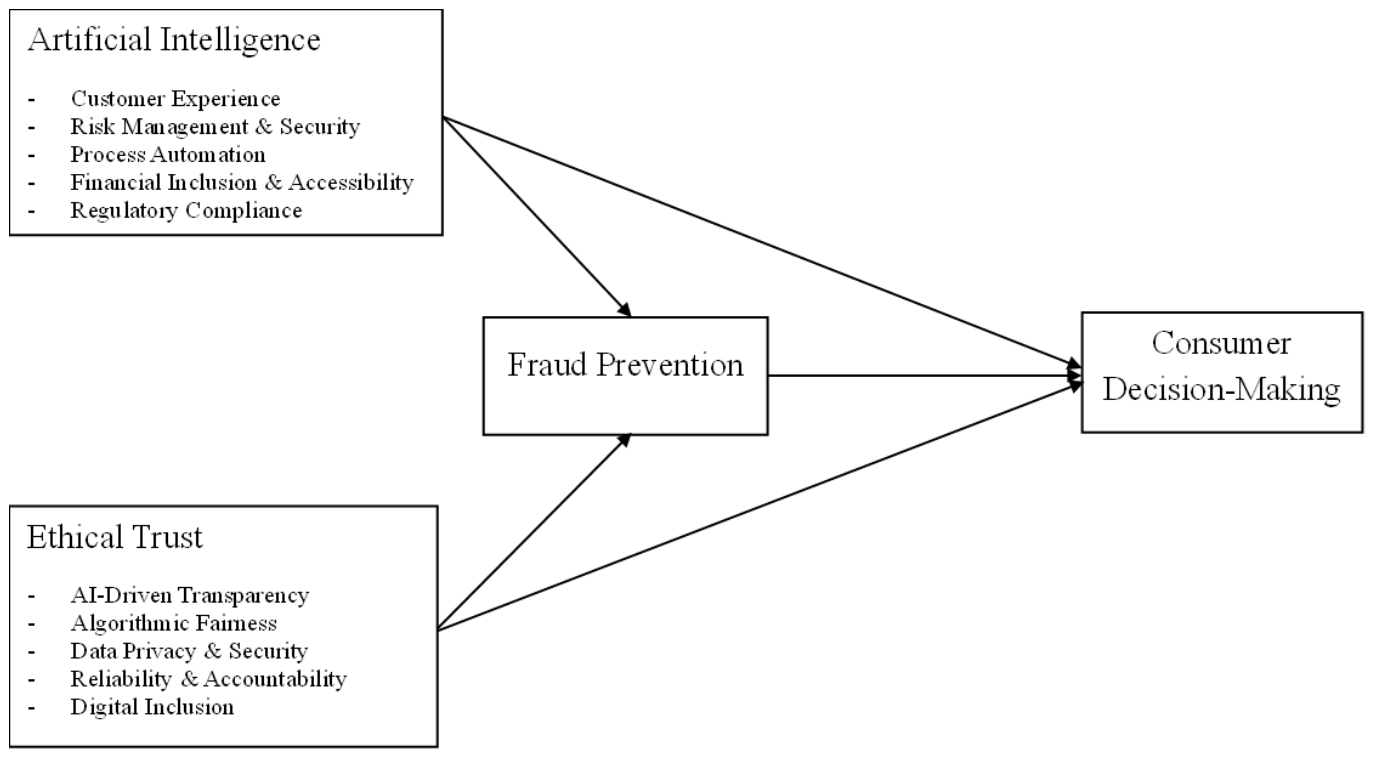
Based on the synthesized literature, a holistic conceptual framework was proposed:
- IVs: AI Adoption (Customer Experience, Risk Management, Process Automation, Financial Inclusion, Regulatory Compliance); Ethical Trust (Transparency, Fairness, Data Privacy, Reliability, Digital Inclusion)
- Mediator: Fraud Prevention (real-time monitoring, secure authentication)
- DV: Consumer Decision-Making (adoption intention, usage behavior, trust, satisfaction)
- Theoretical Basis: UTAUT2 explains adoption behavior, while ethical trust constructs capture consumer confidence and decision-making.
6.5. Ethical Considerations
- No primary data collected
- Only publicly available literature and reports used
- All sources cited properly (APA 7th edition)
7. Conceptual Framework
Figure 1.
Conceptual Framework by author.
8. Theoretical Support
The adoption of AI-enabled digital banking and FinTech services in Bangladesh can be effectively explained through the Unified Theory of Acceptance and Use of Technology 2 (UTAUT2), which integrates key constructs influencing consumer behavioral intention and decision-making (Venkatesh et al., 2012). UTAUT2 extends the original TAM by including consumer-specific factors such as Hedonic Motivation, Price Value, and Habit, making it suitable for analyzing adoption of innovative financial technologies.
Artificial Intelligence (AI), as an independent variable, significantly impacts Consumer Decision-Making (CDM) through its dimensions: Customer Experience, Risk Management & Security, Process Automation, Financial Inclusion & Accessibility, and Regulatory Compliance. According to UTAUT2, these features enhance Performance Expectancy (PE) the degree to which consumers perceive AI banking as useful and Effort Expectancy (EE) the ease of interacting with the technology (Mayeesha, Islam, & Ahmed, 2024; Rasel, Karim, & Chowdhury, 2025). Empirical evidence suggests that AI-driven process automation, risk management systems, and seamless digital interfaces improve operational efficiency and customer satisfaction, which positively influence behavioral intention and decision-making in digital banking (Mollik & Majeed, 2025).
Ethical Trust, encompassing AI-Driven Transparency, Algorithmic Fairness, Data Privacy & Security, Reliability & Accountability, and Digital Inclusion, aligns with UTAUT2 constructs of Facilitating Conditions (FC) and Social Influence (SI). Ethical and trustworthy AI banking practices provide consumers with confidence in system reliability and fairness, which strengthens intention to adopt and continue using digital financial services (UNDP, 2025; Mayeesha, Islam, & Ahmed, 2024). Transparent operations and ethical safeguards mitigate uncertainties and perceived risks, fostering trust that translates into more informed and confident consumer decision-making (Rasel, Karim, & Chowdhury, 2025;).
Fraud Prevention functions as a mediator, enhancing the relationship between AI, Ethical Trust, and Consumer Decision-Making. By implementing real-time fraud detection, secure authentication, and ethical governance, financial institutions reduce perceived risk, thereby supporting the UTAUT2 premise that reduced risk and strong facilitating conditions increase behavioral intention (Anderson et al., 2024; Mollik & Majeed, 2025). Fraud mitigation reinforces Performance Expectancy and trust, ensuring that consumers feel confident while using AI-enabled e-banking services, which ultimately drives effective decision-making.
In conclusion, integrating AI and Ethical Trust through the UTAUT2 framework, with Fraud Prevention as a mediator, provides a comprehensive theoretical basis for understanding Consumer Decision-Making in Bangladeshi digital banking. The model demonstrates that AI adoption, ethical operations, and risk mitigation jointly influence consumer perceptions, behavioral intention, and actual decision-making, offering a robust explanation for technology acceptance in the FinTech sector.
9. Discussion and Implications
This review highlights that AI adoption in Bangladeshi e-banking is a multidimensional driver of consumer decision-making, influenced not only by technological features like personalized dashboards, predictive analytics, and automated services, but also by ethical trust and fraud prevention. AI enhances performance expectancy and ease of use, fostering confidence and satisfaction among users, particularly in a context of varying digital literacy (Mayeesha, Islam, & Ahmed, 2024; Rasel, Karim, & Chowdhury, 2025).
Ethical Trust emerges as a central mediator, with transparency, fairness, data privacy, accountability, and digital inclusion strengthening perceived trustworthiness. This aligns with UTAUT2 constructs of Facilitating Conditions and Social Influence, emphasizing that ethical AI deployment boosts adoption and continued use in emerging economies (UNDP, 2025; MDPI, 2024).
Fraud Prevention acts as a critical enabler, reducing perceived risk through real-time monitoring, anomaly detection, and secure authentication, reinforcing trust and supporting informed consumer decision-making (Anderson et al., 2024; Mollik & Majeed, 2025).
The integrated model proposed bridges disconnected research streams, demonstrating how AI adoption, ethical trust, and fraud prevention collectively influence consumer behavior, accounting for Bangladesh-specific socio-cultural factors like collective decision-making and digital literacy (Ghosh & Rahman, 2024; Hoque & Mohammad, 2025).
Implications:
- Theoretical: Extends UTAUT2 by incorporating ethical trust and fraud prevention, advancing understanding of AI adoption under socio-cultural constraints.
- Practical: Banks should prioritize AI personalization, transparency, and robust fraud systems. Regulators must enforce ethical AI governance. Technology providers should focus on explainable AI and inclusive interfaces. Awareness programs can empower consumers.
- Policy/Strategic: Align AI adoption with local contexts, promote cross-sector collaboration, and integrate ethical AI with fraud prevention to strengthen consumer confidence and digital ecosystem resilience.
10. Conclusions
This study provides a comprehensive review of the role of Artificial Intelligence (AI) in shaping consumer decision-making, ethical trust, and fraud prevention in the context of Bangladeshi e-banking. By synthesizing recent literature from 2024-2025, this review highlights the multifaceted influence of AI on customer experience, risk management, process automation, financial inclusion, and regulatory compliance. The analysis demonstrates that AI not only enhances operational efficiency and personalization but also plays a pivotal role in fostering ethical trust through transparency, fairness, data privacy, reliability, and digital inclusion.
Furthermore, fraud prevention emerges as a critical mediating factor that strengthens consumer confidence in AI-enabled financial services. The proposed conceptual framework, underpinned by the UTAUT2 model with 6 hypothesized paths (H1-H6), illustrates how these interconnected dimensions jointly influence consumer behavioral intentions and decision-making in Bangladeshi digital banking.
However, as a conceptual review without empirical testing, this study remains preliminary. Future research should:
- ➢ Empirically validate the proposed framework using survey-based quantitative studies with 300+ Bangladeshi bank customers across urban and rural areas, employing stratified random sampling.
- ➢ Conduct multi-group analysis to examine cross-generational (Gen Z vs. Millennials vs. Gen X) and rural-urban adoption dynamics, as well as gender-based differences.
- ➢ Employ longitudinal designs to examine how AI-driven trust and fraud prevention effectiveness evolve over time, particularly after major security incidents or policy changes.
- ➢ Test the moderating role of Shariah compliance and Bangla NLP accuracy using structural equation modeling (SEM) or partial least squares (PLS).
- ➢ Compare Bangladesh-specific AI adoption patterns with other South Asian emerging economies (India, Pakistan, Sri Lanka) to identify region-specific versus universal factors.
- ➢ Conduct a quantitative meta-analysis to statistically synthesize effect sizes from existing AI adoption studies in emerging economy banking contexts.
In conclusion, this review underscores the necessity of a holistic, context-sensitive approach to AI integration in emerging markets. Policymakers, financial institutions, and technology providers can leverage these insights to design responsible, inclusive, and ethically grounded AI solutions that enhance consumer trust, safeguard financial transactions, and promote sustainable growth in the digital economy.
References
- Ahmed, N.; Islam, F. Real-time AI fraud prevention and user trust in digital banking. J. Digit. Bank. 2024, 11(2), 45–60. [Google Scholar]
- Alalwan, A.; Dwivedi, Y.; Rana, N.; Williams, M. Consumer adoption of mobile banking in Jordan: Examining the role of usefulness, ease of use, perceived risk, and self-efficacy. J. Enterp. Inf. Manag. 2016, 29(1), 118–139. [Google Scholar] [CrossRef]
- Alam, N.; Chowdhury, S. AI ethics and consumer trust in FinTech. J. Emerg. Financ. Technol. 2025, 12(3), 101–118. [Google Scholar]
- Appachikumar, A. K. Predictive banking: Leveraging AI to forecast consumer financial behavior. Adv. Consum. Res. 2025, 2(4), 247–254. [Google Scholar]
- Bangladesh Bank. AI policy and digital banking readiness in Bangladesh; Bangladesh Bank: Dhaka, 2024. [Google Scholar]
- Bangladesh Bank. Online fraud prevention circular. 2025. Available online: https://www.linkedin.com/posts/sadaf-islam_bangladesh-bank-through-its-payment-systems-activity-7333814415814803456-0Wys.
- Bashir, M. A.; Haque, M. A.; Salamzadeh, A.; Rahman, M. M. Customers’ satisfaction of e-banking in Bangladesh: Do service quality and customers’ experiences matter? FinTech 2023, 2(3), 657–667. [Google Scholar] [CrossRef]
- Beke, L.; Smith, J.; Tran, P. Trust dynamics in AI-enabled banking. Int. J. Bank. Technol. 2024, 18(1), 45–60. [Google Scholar]
- Bhuiyan, M. R. I.; Husain, T.; Islam, S.; Amin, A. Exploring the prospective influence of artificial intelligence on the health sector in Bangladesh: a study on awareness, perception and adoption. Health Educ. 2025, 125(3), 279–297. [Google Scholar] [CrossRef]
- Chen, Y.; Wang, X. AI in fraud prevention: Implications for consumer trust. J. Financ. Innov. 2023, 7(3), 22–38. [Google Scholar]
- Davenport, T. H.; Ronanki, R. Artificial intelligence for the real world. Harv. Bus. Rev. 2018, 96(1), 108–116. [Google Scholar]
- Ghosh, S.; Rahman, F. Cultural and socio-economic factors influencing AI adoption in Bangladesh. Asian J. FinTech 2024, 5(2), 101–118. [Google Scholar]
- Hassan, M.; Aziz, L. A. R.; Andriansyah, Y. The role of artificial intelligence in modern banking: An exploration of AI-driven approaches for enhanced fraud prevention, risk management, and regulatory compliance. Rev. Contemp. Bus. Anal. 2023, 6(1), 110–132. [Google Scholar]
- Hoque, M. A.; Mahmood, R.; Ali, R.; Rosli, N. S.; Hossain, M. M. Drivers of AI adoption in banks in Bangladesh: Moderating role of technology readiness. ICRRD J. 2025, 6(4). Available online: https://www.researchgate.net/publication/396668418_Drivers_of_AI_Adoption_of_Banks_in_Bangladesh_Moderating_Role_of_Technology_Readiness. [CrossRef]
- Hoque, M.; Mohammad, A. Ethical AI perceptions in emerging economies: A Bangladeshi perspective. J. Digit. Ethics 2025, 6(1), 55–72. [Google Scholar]
- Hossain, M.; Alam, S.; Iqbal, A. Opportunities and vulnerabilities of AI in automating compliance and regulatory reporting in the banking sector in Bangladesh. ResearchGate. 2025. Available online: https://www.researchgate.net/publication/397497198_Opportunities_and_Vulnerabilities_of_AI_in_Automating_Compliance_and_Regulatory_Reporting_in_the_Banking_Sector_in_Bangladesh.
- Ikhsan, M. R.; Lakulu, M. M.; Pannesai, I. Y.; Rizali, M.; Nugraha, B.; Swastina, L. Systematic review of artificial intelligence applications in predicting solar photovoltaic power production efficiency. Int. J. Electr. Comput. Eng. (IJECE) 2026, 16(1), 463–476. [Google Scholar] [CrossRef]
- Islam, F.; Mayeesha, T. T.; Ahmed, N. Know Your Users: Towards Explainable AI in Bangladesh. Companion of the 2024 on ACM International Joint Conference on Pervasive and Ubiquitous Computing, 2024; pp. 890–893. [Google Scholar]
- Islam, M. S.; Rahman, N. AI-driven fraud detections in financial institutions: A comprehensive study. J. Comput. Sci. Technol. Stud. 2025, 7(1), 100–112. [Google Scholar] [CrossRef]
- Karim, M. R.; Islam, T.; Shajalal, M.; Beyan, O.; Lange, C.; Cochez, M.; Decker, S. Explainable AI for bioinformatics: methods, tools and applications. Brief. Bioinform. 2023, 24(5), bbad236. [Google Scholar] [CrossRef]
- Khaleduzzaman, M.; Hera, T. Enhancing fraud detection in Bangladeshi banks through forensic accounting tools. World J. Adv. Eng. Technol. Sci. 2024, 12(3), 77–89. [Google Scholar]
- Khan, A.; Roy, B. K. S.; Sarker, A.; Abedin, S. N.; Islam, M. M.; Zaber, M. AI-Driven Cybersecurity Challenges in Bangladesh’s Banking Industry. J. Comput. Commun. 2025, 13(11), 223–235. [Google Scholar] [CrossRef]
- Kumar, V.; Sharma, A.; Gupta, R. Personalization in digital banking: impact on customer decision-making. Int. J. Bank. Mark. 2019, 37(5), 1234–1256. [Google Scholar]
- Lukyanenko, R.; Maass, W.; Storey, V. C. Trust in artificial intelligence: From a Foundational Trust Framework to emerging research opportunities. Electron. Mark. 2022, 32(4), 1993–2020. [Google Scholar] [CrossRef]
- Mayeesha, T. T.; Islam, F.; Ahmed, N. Ethical AI adoption in digital banking: Transparency and trust in Bangladesh. J. Digit. Bank. Financ. Serv. 2024, 12(3), 45–60. [Google Scholar] [CrossRef]
- Mayer, R. C.; Davis, J. H.; Schoorman, F. D. An integrative model of organizational trust. Acad. Manag. Rev. 1995, 20(3), 709–734. [Google Scholar] [CrossRef]
- Mikalef, P.; Gupta, M. Ethical AI in financial services: fairness, transparency, and trust. J. Bus. Ethics 2021, 171(4), 675–693. [Google Scholar]
- Mollik, E.; Majeed, F. Enhancing data security and privacy for AI-based banking services. J. Bank. Technol. Innov. 2025, 9(2), 101–118. [Google Scholar] [CrossRef]
- Mumtaz, S.; Carmichael, J.; Weiss, M.; Nimon-Peters, A. Ethical use of artificial intelligence-based tools in higher education: are future business leaders ready? Educ. Inf. Technol. 2025, 30(6), 7293–7319. [Google Scholar] [CrossRef]
- Munira, M. S. K.; Juthi, S.; Begum, A. Artificial intelligence in financial customer relationship management: A systematic review of AI-driven strategies in banking and FinTech. Am. J. Adv. Technol. Eng. Solut. 2025, 1(01), 20–40. [Google Scholar] [CrossRef]
- Nastoska, A.; Jancheska, B.; Rizinski, M.; Trajanov, D. Evaluating trustworthiness in AI: Risks, metrics, and applications across industries. Electronics 2025, 14(13), 2717. [Google Scholar] [CrossRef]
- Ngai, E. W. T.; Xiu, L.; Chau, D. C. K. Application of data mining techniques in financial fraud detection: A classification framework and an academic review of literature. Decis. Support Syst. 2011, 50(3), 559–569. [Google Scholar] [CrossRef]
- Nnaomah, U. I.; Odejide, O. A.; Aderemi, S.; Olutimehin, D. O.; Abaku, E. A.; Orieno, O. H. AI in risk management: An analytical comparison between the US and Nigerian banking sectors. Int. J. Sci. Technol. Res. Arch. 2024, 6(1), 127–146. [Google Scholar] [CrossRef]
- Nobel, A.; Rahman, M.; Chowdhury, S. Machine learning and explainable AI for fraud detection in banking systems. Information 2024, 15(6), 1–22. [Google Scholar] [CrossRef]
- Odufisan, O.; Bello, H. A.; Roberts, J. Real-time anomaly detection in e-banking transactions: A machine learning approach. J. Cybersecur. Financ. Stab. 2025, 4(2), 45–62. [Google Scholar]
- Rafi, M.; Faiz Ahmad, M.; Venkata Sumanth, S.; Sarvan, K. B. S. V. R.; Harsha Vardhan, K.; Shabber, S. Lead Scoring Model Using Machine Learning. In International Conference on Information and Communication Technology for Intelligent Systems; Springer Nature Singapore: Singapore, 2025; pp. 47–59. [Google Scholar]
- Rahman, M. M.; Kaiser, M. S. Technological Advancement and the Rise of Cybercrime in Bangladesh: Trends, Challenges, and Policy Responses. In The Palgrave Handbook of Global Social Problems; Springer Nature Switzerland: Cham, 2025; pp. 1–23. [Google Scholar]
- Rasel, A. A. S.; Karim, R.; Chowdhury, M. Algorithmic fairness and consumer trust in AI-enabled banking. Int. J. Ethical AI Financ. 2025, 7(1), 22–38. [Google Scholar] [CrossRef]
- Ridzuan, N. N.; Masri, M.; Anshari, M.; Fitriyani, N. L.; Syafrudin, M. AI in the financial sector: The line between innovation, regulation and ethical responsibility. Information 2024, 15(8), 432. [Google Scholar] [CrossRef]
- Ridzuan, N. S.; Abdullah, S.; Hassan, M. Z. The role of machine learning and predictive analytics in transforming financial services. J. Financ. Innov. 2024, 10(2), 77–95. [Google Scholar]
- Rizvee, M. B.; Siddik, M. N. A.; Kabiraj, S. Exploring Antecedents of Rural Users’ Continuance of Use Intention Toward Mobile Financial Services in Bangladesh: Deployment of Expectation Confirmation Model. J. Risk Financ. Manag. 2025, 18(5), 236. [Google Scholar] [CrossRef]
- Saha, P.; Dey, K. N.; Hossan, F.; Goldar, S. C.; Pritha, I. J.; Halimuzzaman, M. Integration of Artificial Intelligence in Bank Customer Relationship Management in Bangladesh. Bus. Soc. Sci. 2025, 3(1), 1–10. [Google Scholar] [CrossRef]
- Sarker, S. K. AI applications for e-KYC and identity fraud detection in Bangladesh’s FinTech sector: A literature review. ResearchGate. 2025. Available online: https://www.researchgate.net/publication/396210485_AI_APPLICATIONS_FOR_E-KYC_AND_IDENTITY_FRAUD_DETECTION_IN_BANGLADESH%27S_FINTECH_SECTOR_A_LITERATURE_REVIEW.
- Shili, A.; Toukabri, M. Effect of Corporate Social Responsibility and e-WOM on Corporate E-reputation: Application on Banking Sector in Saudi Arabia. Management 2025, 29(2), 63–83. [Google Scholar] [CrossRef]
- Tabaku, E.; Duçi, E.; Kapçiu, R.; Kosova, A. M. Exploring the impact of artificial intelligence in banking: A case study on the integration of virtual assistants in customer service. Int. Res. J. Mod. Eng. Technol. Sci. 2025, 7(1), 4177–4183. [Google Scholar]
- UNDP. National AI readiness assessment report: Ethical AI and digital inclusion in Bangladesh. United Nations Development Programme. 2025. Available online: https://www.undp.org/bangladesh/reports.
- Venkatesh, V.; Thong, J. Y. L.; Xu, X. Consumer acceptance and use of information technology: Extending the unified theory of acceptance and use of technology. MIS Q. 2012, 36(1), 157–178. [Google Scholar] [CrossRef]
- Zungu, L. T.; Nkosi, S.; Gumede, K. Hyper-personalized recommendations in mobile banking and consumer adoption behavior. J. Financ. Technol. Consum. Behav. 2025, 3(1), 15–29. [Google Scholar]
Disclaimer/Publisher’s Note: The statements, opinions and data contained in all publications are solely those of the individual author(s) and contributor(s) and not of MDPI and/or the editor(s). MDPI and/or the editor(s) disclaim responsibility for any injury to people or property resulting from any ideas, methods, instructions or products referred to in the content. |
© 2026 by the authors. Licensee MDPI, Basel, Switzerland. This article is an open access article distributed under the terms and conditions of the Creative Commons Attribution (CC BY) license (http://creativecommons.org/licenses/by/4.0/).
Copyright: This open access article is published under a Creative Commons CC BY 4.0 license, which permit the free download, distribution, and reuse, provided that the author and preprint are cited in any reuse.


