

Submitted:
16 April 2026
Posted:
29 April 2026
You are already at the latest version
Abstract
The research profession is undergoing its most profound transformation since the industrialization of R&D. As artificial intelligence automates the mechanics of technical work, professional value is migrating from execution to architecture, from knowledge recall to creative problem formulation. Operating under the materialist premise that human cognition is ultimately replicable, we argue the current ``human-in-the-loop'' paradigm is transient. The profession is increasingly moving towards Extremistan, where scalability creates winner-take-all dynamics and only transcendent outliers remain visible. Institutions face a Jevons Paradox: as intelligence becomes cheaper, demand for orchestration explodes, creating bottlenecks at the architectural layer. The central message: competence is no longer sufficient. Survival demands cultivating what machines currently lack—physics intuition, scientific taste, and the ability to formulate problems worth solving.
Keywords:
artificial intelligence
; research and development
1. The Premise: Trajectory of Artificial Competence
Before we examine the mechanics of this transformation, we must establish a clear baseline regarding the future of intelligence itself. We operate under a pragmatic, materialist assumption: the human brain, while complex, is ultimately a biological machine. Therefore, there is no fundamental reason to believe that any aspect of human cognition—from pattern recognition to creative intuition to collective intelligence and reasoning—is immune to being imitated and eventually surpassed by artificial systems1.
However, to navigate the present reality effectively, we must rigorously diagnose what AI currently lacks compared to a capable human researcher. These deficits currently preserve the human role:
- Contextual Architecture: The narrative that AI is entirely self-sufficient is premature. While models generate higher-fidelity results than ever before, they function best as components within a human-led architecture rather than as independent replacements. True utility requires a user to supply the big picture context—the why and the what—that binds disparate automated tasks into coherent value. Without this human glue, AI agents remain brilliant but disjointed islands of competence.
- Tacit vs. Explicit Knowledge: Neural networks excel at learning explicit, codified knowledge (epistēmē) found in textbooks and papers, but struggle with embodied craft knowledge (technē)—the feel of an experiment or intuition of a design rarely captured in data. However, as autonomous robotic systems interact with the physical world, they are slowly digitizing this embodied intuition.
- Agency vs. Imitation: Current models mimic the symptoms of high agency—taking action, solving problems, operating autonomously—without possessing the source: genuine intent, desire, and self-determination. They lack what has been termed a “Terminal Creed”—intrinsic motivation or core values that drive autonomous goal selection [1]. AI acts as a prosthesis for human agency, extending reach but not replacing drive. It multiplies existing human intent rather than generating its own.
- Reliability and Consistency: AI systems exhibit extreme variability across domains and over time—performing brilliantly on specific tasks while failing catastrophically on seemingly similar ones, or producing different quality outputs for identical prompts. While a transient effect, this inconsistency means researchers cannot treat AI as a dependable autonomous colleague but must architect continuous verification loops and quality control mechanisms into every workflow.
Crucially, these limitations are transient. The evolution of AI is rapidly progressing from System 1 (fast, automatic perception) and System 2 (slow, careful reasoning) toward System 3—a newly emerging layer responsible for long-term behavior, identity, and self-improvement [1].
In the interim, we are witnessing a Jevons Paradox of Intelligence [2]: as the marginal cost of cognitive tasks plummets to near-zero, demand for complex, multi-agent architectures explodes rather than contracts. The bottleneck shifts from execution to the “Architect”—the human needed to design workflows that consume this abundance of cheap intelligence. This creates a cascading complexity problem: AI-enabled simulations become so voluminous that we require additional AI agents simply to monitor, filter, and summarize the outputs of other agents—creating layers of synthetic intermediaries whose sole function is to surface actionable insights for the human orchestrator.
Yet, the “human-in-the-loop” paradigm is transient. We must anticipate a future where agents possess the meta-cognitive ability to perceive the research landscape and self-formulate problems—where the human role shifts from managing workflows to auditing outcomes of a self-sustaining synthetic economy.
2. Historical Context: The Parallel Races
In the mid-19th century, roughly 60% of workers were farmers. Within two generations, that world was transformed. New materials like alloys and inventions like the railroad moved people from the fields to factories and laboratories. Fast forward, this shift created the modern Research and Development (R&D) sector we recognize today.
Throughout this history, the researcher’s tools have evolved in three major steps. Two hundred years ago, a researcher’s greatest assets were a library card and a pen. By the 1990s, these were replaced by the computer terminal and the digital database. Today, a new tool has arrived: an intelligence that can process in seconds what once took a human an entire career to synthesize.
For decades, experts predicted that the next wave of automation would primarily replace physical labor. Conventional wisdom held that robots would displace truck drivers and factory technicians, while intellectual desk jobs remained secure. The reality has proven strikingly different. The current AI revolution is advancing faster in the cognitive domain than the physical one. Intellectual professions—lawyers, writers, and especially R&D researchers—now face the most profound transformation in their work.
Why this time is different?
Every technological revolution has followed a pattern: the human brain developing tools to enhance the body’s impact—the lever for the arm, the engine for the muscle, the computer for the memory and brain’s computing power. The age of Artificial Intelligence represents a fundamental break from this history. For the first time, the architect is not designing a tool for the body; it is designing a successor for itself. This explains why the current wave feels qualitatively different: AI has arrived as an augmentation to our cognitive reach, but has the potential to replace it altogether.
The contemporary technological landscape is characterized not by a single race toward Artificial General Intelligence (AGI), but by a constellation of parallel competitions. The most immediate and consequential of these is what we term the Great Race—the drive to automate AI research itself, and as a consequence to automate R&D in general. Simultaneously, Local Races are unfolding across every engineering domain, as researchers adapt AI tools to accelerate discovery in their specific fields—from materials science to drug development. Finally, the Final Race looms on the horizon: the pursuit of AGI itself, where success would commoditize intelligence entirely and shift competitive advantage from cognitive capacity to physical infrastructure. While AGI remains aspirational, requiring multiple fundamental breakthroughs, the automation of research processes is actively reshaping every field of inquiry.
This raises the critical question for researchers, namely in engineering fields: What becomes of our profession when the tools of discovery themselves become autonomous?
The professional researcher value is migrating from execution to architecture, from knowledge recall to creative problem formulation, and toward a winner-take-all dynamic reminiscent of what Nassim Taleb describes as Extremistan—a world where minor advantages compound into outsized outcomes.

Table 1.
The Three Parallel Competitive Phases in AI-Driven Research
| Race Phase | Primary Focus | Key Technologies | Characteristic Output |
|---|---|---|---|
| The Great Race | Automating the meta-research process | Multi-agent orchestration, foundation models, self-improving research loops | Automated hypothesis generators, autonomous experimental design |
| Local Races | Domain-specific application of AI tools | Derivative tools, specialized solvers, agentic workflows | Optimized designs, novel materials, accelerated domain breakthroughs |
| The Final Race | AGI and commodity intelligence | Massive compute clusters, energy-efficient infrastructure, data moats | Resource-constrained autonomous discovery at scale |
3. The Great Race: Automating [AI] Research
The most intense competition today is not toward AGI, but toward automating the research process in AI itself, which aims at the core of intellectual labor: hypothesis generation, literature synthesis, and experimental design [3,4]—and then, closed-loop iteration of this. Current technological breakthroughs in large language models and multi-agent orchestration have enabled a transition from AI-assisted analysis to somewhat-autonomous discovery.
Systems such as Sakana AI’s The AI Scientist is an example of this movement, attempting to simulate the end-to-end scientific workflow [5]. Early evaluations in February 2025 highlighted a baseline of brittleness, with Beel et al. identifying a 42% failure rate in experimental execution due to coding errors and novelty detection gaps [6]. However, the velocity of refinement has rendered these early benchmarks a moving target. By the third quarter of 2025, next-generation frameworks like DeepScientist had already demonstrated a leap in reliability, achieving better-than-human-baseline solutions on 77.9% of algorithmic tasks with an average 16.6x speedup [7].
This rapid ascent suggests that the limitations observed in early 2025 were not fundamental ceilings but transient growing pains. By late 2025, specialized environments like the Stanford Biohub Virtual Labs reported experimental success rates exceeding 90% in targeted domains such as protein engineering [8]. This transition from brittle templates to robust, agentic orchestration confirms that autonomous research is no longer a speculative future but an accelerating reality where performance metrics are rewritten every few months.
Conversely, where AI is positioned as a high-velocity accelerator within a hybrid human-machine framework, the results are already transformative. In materials discovery, AI-driven autonomous laboratories have identified novel battery chemistries in weeks that would have taken traditional researchers years—achieving a 10x reduction in the cost floor [9]. Similarly, in drug discovery, agentic workflows have successfully identified promising lead compounds with a 300% increase in hit rates compared to classical high-throughput screening [10]. These metrics suggest that while The AI Scientist is still maturing, the AI-accelerated researcher is already outperforming their peers in every measurable dimension.
This meta-level race has profound implications: AI researchers automate their own work first, creating compounding advantages, while other fields must adapt tools built for different purposes. Evidence from 2024 and 2025 suggests that the primary constraint is migrating from software capabilities to hardware access [11,12]. Recent systems like Step-DeepResearch demonstrate that cost-effective research automation is possible: a 32B-parameter model achieving expert-level performance at one-tenth the cost of commercial alternatives [13]. However, even these systems require sophisticated error-correction loops and multi-agent verification workflows, confirming that fully autonomous research is far from mature.
3.1. The Rise of the Architect
As execution commoditizes, a new professional archetype emerges: the Architect. This role transcends the traditional researcher who executes experiments and derives equations. The Architect defines what problems matter, why they matter, and orchestrates fleets of AI agents to execute the how. This is not automation replacing humans—it is humans operating at a higher level of abstraction, transforming from computational laborers to conceptual orchestrators. The Architect’s value lies not in speed or volume, but in judgment, taste, and the ability to design systems that consume cheap synthetic intelligence toward meaningful ends. The following section examines the specific capabilities that define this emerging role.
4. Near-Term Dynamics: The New Competitive Advantages
Historically, the hallmark of a successful researcher—particularly in engineering—was the dual mastery of conceptualization and execution: the ability to navigate the intricacies of literature synthesis to identify meaningful gaps, and the technical skill to master the How—deriving complex mathematical models, writing efficient simulation code, and executing rigorous laboratory protocols. However, as the Great Race to automate the research process itself accelerates, these once-scarce execution skills are rapidly commoditizing [5,6]. The differentiator between professional irrelevance and global impact lies increasingly in Engineering Sense, first-principles intuition, and the ability to orchestrate high-level systems of automated inquiry [14].
As intelligence and execution become commodities, professional value is shifting. The transition from execution-based engineering to intent-based engineering mirrors broader shifts in software development, where developers now focus on desired outcomes rather than infrastructure management [14,15]. In the short to mid-term—before AGI—the competitive landscape is being redefined along clear fault lines:
Table 2.
The Value Shift in [Engineering] Research
| Depreciating Assets | Appreciating Assets |
|---|---|
| Memory / Knowledge Recall: Search engines and LLMs retrieve information at near-zero cost. | Physics Intuition: Internalized “feel” for the real world and first-principles thinking. |
| Pure Mathematical Formalism: Abstract mathematics without application context is increasingly automated. | Architectural Orchestration: Defining system-level intent and managing hybrid human-AI workflows. |
| Syntax / Boilerplate Coding: Implementation mechanics are automated by AI coding assistants. | Scientific Taste: Choosing the most meaningful and aesthetically compelling problems. |
| Incremental Improvement: AI excels at “normal science” iteration and optimization. | Black Swan Thinking: Identifying non-obvious, paradigm-shifting breakthroughs. |
4.1. Physics Intuition: The Anchor of Quality Control
While AI is beginning to exhibit forms of embodied intelligence—demonstrated by the rapid progress in self-driving systems and autonomous robotics—it still lacks the robust, generalized “weight” of the real world that humans possess. Michael Polanyi’s theory of Tacit Knowledge is the description of human intuition which to date remains the primary quality-control mechanism in engineering [16,17,18] and remains essential for recognizing when an AI-generated solution violates fundamental laws of physics. Mathematics exemplifies both the promise and peril of AI in fundamental research. Proof discovery is fundamentally a search through vast combinatorial spaces—precisely where foundation models excel, rapidly exploring solution pathways beyond human capacity. Yet this strength reveals a critical vulnerability: the verification bottleneck. In theoretical research, the author is with the most at stake and serves as the primary verifier. The reputation that the author attaches to the claims is the ultimate driver to spot the work’s pressure points often sooner—and more reliably—than outside readers or reviewers. AI disrupts this trust loop: it can generate hundreds of complex, superficially plausible proofs that overwhelm peer review systems. The current crisis in ML conference reviews—where volume has outpaced quality control—foreshadows a more severe problem in mathematics and theoretical physics [19,20]: unverifiable results that are formally consistent but humanly incomprehensible.
Figure 1.
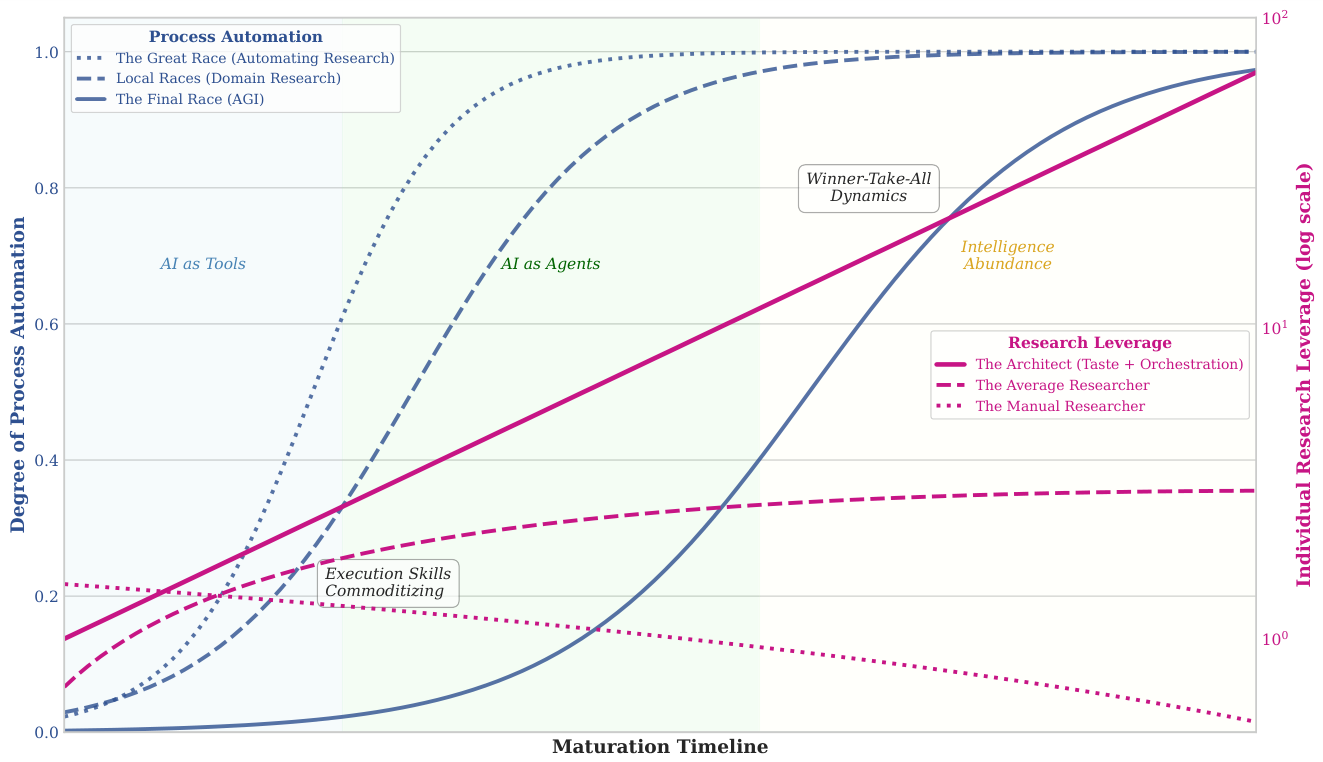
The Extremistan Divergence: How Automation Reshapes Research Leverage. The figure illustrates two parallel transformations. Left y-axis (blue): The maturation of three automation processes—the Great Race (automating AI research itself), Local Races (domain-specific engineering), and the Final Race (toward AGI)—depicted as S-curves reaching different stages of completion. Right y-axis (magenta, in log scale): Individual research leverage trajectories diverge dramatically. The Manual Researcher (dotted) experiences declining relevance as execution commoditizes. The Average Researcher (dashed) initially benefits from AI tools but plateaus as noise overwhelms signal. The Architect (solid) achieves exponential leverage through taste-driven orchestration, exemplifying winner-take-all dynamics in the Intelligence Abundance phase.
Figure 1.
The Extremistan Divergence: How Automation Reshapes Research Leverage. The figure illustrates two parallel transformations. Left y-axis (blue): The maturation of three automation processes—the Great Race (automating AI research itself), Local Races (domain-specific engineering), and the Final Race (toward AGI)—depicted as S-curves reaching different stages of completion. Right y-axis (magenta, in log scale): Individual research leverage trajectories diverge dramatically. The Manual Researcher (dotted) experiences declining relevance as execution commoditizes. The Average Researcher (dashed) initially benefits from AI tools but plateaus as noise overwhelms signal. The Architect (solid) achieves exponential leverage through taste-driven orchestration, exemplifying winner-take-all dynamics in the Intelligence Abundance phase.
This inconsistency stems from what Demis Hassabis describes as the “Jagged Frontier” of AI intelligence [21]—models can perform at PhD level in specific narrow domains (such as winning Math Olympiad medals) while simultaneously failing at basic high school logic or simple reasoning tasks in adjacent areas. For researchers, this creates an irreducible dependency on human quality control: AI serves as a brilliant specialist that can outperform humans in targeted tasks, yet lacks the broad, consistent reliability of a competent human colleague.
This problem manifests concretely in physics-informed neural networks (PINNs), where standard models can achieve high predictive accuracy on training data while systematically violating fundamental physical laws such as conservation of mass or energy [22]. The network learns statistical patterns rather than causal mechanisms, producing outputs that appear plausible but collapse when boundary conditions change. Physics intuition becomes the essential filter—the ability to recognize when an AI solution, despite its formal elegance, violates fundamental principles that any undergraduate would catch.
4.2. Architectural Mastery: Defining the What and How
The shift to intent-based engineering transforms the researcher’s role from builder to architect [14]. A clear parallel exists in the evolution of Kubernetes and Cloud-Native Infrastructure. Instead of manually managing individual servers or networking protocols (the How), developers now define a desired state or intent for their application—resource limits, scaling policies, and availability (the What). The orchestration layer then handles the complex mechanics of realization.
In research, this requires meta-design—the orchestration of automated components toward a coherent goal. As junior talent spends less time producing first drafts and more time directing AI systems, demand increases for generalists who can manage hybrid human-agent workflows [23]. The architectural role demands systems-level thinking: understanding how components interact, where trade-offs lie, and which design choices cascade through the solution space.
4.3. Scientific Taste: The Selection of Significance
The most elusive yet critical asset is what Poincaré and Hadamard termed Scientific Taste (goût scientifique)—the ability to distinguish beautiful ideas that will lead to productive results from those that lead nowhere [24,25,26]. Poincaré argued that taste allows a researcher to subconsciously select significant problems and recognize promising solution paths, functioning as an aesthetic heuristic for truth.
Yet taste is not merely aesthetic—it is fundamentally an efficiency and risk-mitigation mechanism. In an era where AI can generate thousands of plausible research directions at near-zero cost, taste determines which paths warrant human attention and institutional resources. Poor taste leads to costly dead-ends; refined taste identifies high-impact opportunities before competitors. For research leaders allocating finite budgets and talent, taste represents the capacity to de-risk investment by selecting problems that are both solvable and significant—avoiding the twin traps of triviality and impossibility.
In engineering, taste manifests as the ability to select the right problems to solve (the Why). While AI can analyze vast datasets and propose hypotheses, it does not want anything. It lacks the human desire and passion that Polanyi identified as essential motivators for discovery [17]. Evaluations of current AI research systems reveal they struggle with conceptual fusion—finding novel connections across heterogeneous fields—which remains a uniquely human capacity [6].
Taste operates at the intersection of technical judgment and creative vision. It is the researcher who asks: “Is this result merely correct, or is it important? Does it open new questions, or does it close off inquiry?” In an era where AI can generate technically sound work at scale, taste becomes the differentiator between the cemetery of competent research and the breakthrough that reshapes a field.
This is especially critical given the homogenization risk: when researchers converge on the same foundational models and training data, outputs trend toward statistically probable centers, suppressing the rare, paradigm-breaking insights [27]. Taste serves as the antidote to algorithmic convergence—the uniquely human capacity to recognize and pursue the sublime but unlikely over the plausible but conventional [28].
4.4. The Paradigm Shift
The transition is clear: From execution to architecture. Fromhowtowhatandwhy. From computational labor to conceptual orchestration. Value migrates from building to defining, from syntax to taste, from volume to precision. This mastery enables Black Swan Thinking—the identification of paradigm-shifting breakthroughs that lie outside the statistically likely outcomes of standard models.
5. The Extremistan Effect: Winner-Take-All Dynamics
The most profound implication of AI in research is the field’s transition from “Mediocristan” to “Extremistan.” Nassim Taleb distinguishes these domains based on the scalability of outcomes and the impact of extreme outliers [29].
5.1. From Mediocristan to Extremistan
In traditional research (Mediocristan), a researcher’s reach was limited by physical hours in the lab or the local market for their niche sub-field. Research was for the most part non-scalable. In this domain, averages matter: if you are good enough, you are compensated accordingly. Inequalities exist, but they are mild—a thousand researchers in different universities can each carve out sustainable niches.
The introduction of AI makes research far more scalable, like a digital recording or a software product. In Extremistan, inequalities become monstrous. Empirical data reveals that this trend predates AI but is being aggressively accelerated by it. Between 2000 and 2015, the top 1% of most-cited scientists increased their cumulative share of global citations from 14% to 21%, while the Gini coefficient for citation imbalance rose from 0.65 to 0.70 [30]. AI is acting as a force multiplier on this existing divergence.
This power law distribution is now mirroring itself in compensation. Just as the scalability of digital products created tech billionaires, the scalability of autonomous discovery is creating research billionaires. In 2025, reports surfaced of top-tier AI researchers at major tech firms like Meta negotiating compensation packages exceeding $250 million—a figure nearly 100 times the lifetime earnings of a typical tenured professor [31]. In this landscape, a 1% quality advantage in a foundational model or material discovery translates to near-total market dominance, rendering average researchers invisible.
5.2. The Superstar Paradox
This creates what we term the Superstar Paradox: AI makes it easier to try to be a superstar researcher (by lowering execution barriers and democratizing access to powerful tools), but the constant upward movement of the quality threshold makes it far harder to actually become one [29].
The arithmetic of visibility is stark. If AI tools increase the total volume of plausible research by 10×, they simultaneously commoditize competence. In a field previously producing 1,000 papers with 10 outliers, an AI-augmented landscape generates 10,000 papers containing 100 such outliers. These 100 now fight for the same finite attention span that previously filtered only 10. While the supply of excellent papers increases by 10×, the community’s attention budget remains fixed (or shrinks due to noise). Therefore, the probability of any single excellent paper being read drops. Consequently, “excellence” is no longer sufficient; to be seen, one must be effectively “transcendent”—an extreme deviation in a sea of high-quality noise.
5.3. The Cemetery of Letters
Extremistan is further characterized by what Taleb describes as the “Cemetery of Letters”—the vast pool of unsuccessful participants who are invisible in retrospect [29]. In the age of AI, this cemetery will be populated by thousands of competent researchers producing technically correct but unremarkable work. Richard Hamming’s warning about becoming the “janitor of science” suddenly applies to a much larger subset of research workers [32]. Their studies will be generated efficiently, peer-reviewed by AI systems, and published in credible venues—yet they will vanish into obscurity because they lack the distinctive insight that captures attention in a winner-take-all environment.
The implication is stark: competence is no longer sufficient. The researcher who can orchestrate AI to execute flawlessly but cannot identify problems worth solving, or who lacks the aesthetic judgment to recognize breakthrough results, will join the cemetery. Survival demands the ability to operate at the extremes—to ask questions no one else is asking, to see patterns others miss, to combine engineering sense with creative audacity. The cemetery will not only hold unremarkable work, but also hallucinated work—studies that are statistically plausible to an AI but physically impossible in reality.
Yet, the paradoxical nature of this research landscape is not easy to grasp. While individual competition becomes fiercer, the aggregate scope of inquiry expands. As AI automates the known maps of engineering, it simultaneously reveals vast new territories of the unknown. New areas of research will emerge—synthetic biology, autonomous infrastructure, cognitive physics—requiring legions of researchers (both natural and synthetic) to pursue these fresh frontiers. Simultaneously, as AI brings the marginal cost of research to near-zero, the demand for solving problems that were deemed costly before will explode (the Jevons Paradox). The very tools that threaten the average researcher also provide the pickaxes to mine these new, widening veins of discovery.
6. Strategic Implications for Researchers and Leaders
The transition from computational labor to conceptual orchestration demands a fundamental retooling of strategy—not just for individual researchers, but for the leaders and institutions that hire and manage them.
6.1. For Individual Researchers: The Pivot to Architecture
In the near term, the researcher’s primary function will pivot from execution to architecture. Those who thrive will develop AI fluency, treating AI not merely as a tool but as a sophisticated research partner to master the art of agentic orchestration. However, this velocity comes with a risk: in an era of cheap, plausible answers, the ability to cultivate engineering intuition—the feel for when a result is physically impossible—will become the ultimate quality check. Consequently, value capture will migrate decisively from solving given problems to the ability to prioritize problem formulation, making the question itself significantly more important than it has always been [32].
Furthermore, the dynamics of Extremistan will force a change in how research is shared. Researchers must embrace speed, leveraging AI to compress the idea-to-prototype cycle and increase their surface area for luck. As the noise floor rises, successful individuals will build in public, sharing their architectural thinking and intermediate insights to establish the reputational moats necessary to withstand winner-take-all dynamics.
6.2. For Research Leaders: The New Talent Filter
The resume of the previous decade—defined by library knowledge and syntactic fluency—is rapidly depreciating. When execution is automated, the primary talent filter must shift from assessing capacity to solve to assessing capacity to define.
The Technical Interview Must Invert. The standard coding exam is obsolete. Leaders should replace it with what might be called an Inverse Turing Test—not in the CAPTCHA sense of machines testing humans, but as a quality control mechanism: presenting candidates with AI-generated solutions that are formally elegant but physically flawed. The “pass” is not the ability to write the code, but the intuition to spot the subtle violation of reality that the model missed.
Hire for Taste, Not Volume. In an era of infinite synthetic output, the scarcest asset is Scientific Taste. Assessment should focus on a candidate’s portfolio of questions rather than their repository of answers. The ideal candidate is no longer the candidate who can execute a task fastest, but the one who can identify which tasks are irrelevant before they start.
6.3. For Organization Leaders: Inverting the Pyramid
The industrial-era research pyramid—legions of juniors performing manual data labor to support a few seniors—is an economic liability in the age of AI. The efficient structure is no longer a pyramid, but a Network of Orchestration. Workflows will shift from linear hand-offs to hybrid and iterative workflows with loops of Human Intent → AI Execution → Human Critique → Refinement.
6.3.0.2. The Death of Ratios and the Mentorship Tax.
Organizations must abandon traditional staffing ratios. The future unit of research is not “One Senior + Three Juniors,” but “One Architect + One Hundred Agents.” However, this efficiency creates a dangerous Mentorship Tax. Because autonomous agents are faster, cheaper, and more compliant than human novices, senior researchers now face a perverse economic incentive to bypass the apprenticeship model entirely. The rational short-term choice for a Principal Investigator—eliminating the “slow” junior in the loop—generates a catastrophic long-term debt in the human talent pipeline. Career ladders must therefore be restructured to reward leverage, but funding models must explicitly subsidize the “inefficiency” of human training to prevent a hollowed-out generation.
The Pedagogical Defense. However, to prevent the “hollowed-out architect,” organizations must mandate artificial friction. Just as pilots must log manual flight hours, researchers must be forced to perform manual derivation and experimentation—not for productivity, but to build the tacit knowledge required to audit the machines they will eventually command.
6.4. Long-Term Positioning (Post-AGI Preparation)
While the Architect role offers a robust competitive advantage in the medium term, we must confront the implications of Sutton’s “Bitter Lesson” [33]. History demonstrates that human-crafted heuristics—whether in chess, computer vision, or discovery itself—are eventually superseded by methods that leverage massive computation and scale. In the limit of the Final Race, the Architect is likely a transitional fortress. Just as execution was commoditized by tools, Scientific Taste (a high-level human heuristic) will eventually be rivaled by the sheer scale of search and optimization in the solution space. Therefore, the Architect is not the final destination of human relevance, but the bridge to an era where intelligence is a utility.
In this post-AGI era, as cognitive labor reaches marginal cost near zero, the differentiators shift to hardware ownership, energy access, and proprietary experimental data [11,12]. Table 3 summarizes the evolution of competitive moats across this transition.
Looking toward this horizon, strategic advantage will consolidate around uniquely human domains and physical infrastructure. Researchers should specialize in uniquely human domains requiring ethical weight, normative intent, and embodied experimentation—the last mile where digital intelligence still struggles to bridge the gap to physical reality. Simultaneously, as intelligence becomes abundant, scarcity shifts to the physical layer. Resilient institutions must pursue access to build moats around proprietary data, unique experimental facilities, and compute clusters. Ultimately, the defining characteristic of the next era will be to bet on collaboration via Human-AGI teaming, where the researchers who today define the protocols for value alignment will write the rules for the future of discovery, ensuring the superior AI remains aligned with the human’s physical and ethical constraints.
7. Conclusion: From Mechanics to Meaning
The anatomy of research work is undergoing a fundamental reordering that demands a shift from computational labor to conceptual orchestration. The mechanics of literature review, code generation, and simulation are commoditizing, while the value of physics intuition, scientific taste, and the ability to define strategic intent is appreciating.
Engineering researchers must navigate an environment characterized by Extremistan dynamics: high scalability, extreme inequalities, and the constant threat of disruptions. In this landscape, the average researcher becomes invisible. Survival and success require the cultivation of what Polanyi called Personal Knowledge—the tacit, embodied understanding that allows a human to serve as quality-control for machine-generated abstractions. The transition from computational labor to conceptual orchestration is not a loss, but an opportunity—to return focus to the fundamental physics, first principles, and creative leaps that define breakthrough innovation.
The question is not whether AI will replace researchers, but whether researchers can transition from being the engine of discovery to being the steering wheel.
This transition precipitates a set of fundamental inquiries that will define the next decade of research strategy. Several critical frontiers remain:
- The Limits of Autonomy: At what threshold of complexity does intent become irreducible? We must determine which classes of discovery require the biological desire to solve—a quality currently absent in synthetic systems—and identifying the specific aspects of high-dimensional problem formulation that resist automation in principle.
- The Metabolic Moat: While synthetic intelligence relies on massive, centralized energy consumption, biological intelligence operates on approximately 20 watts. As the “Great Race” matures, we face a thermodynamic inquiry: Will the brute force of silicon scalability always win, or will natural evolution’s millions of years of energy optimization create a lasting niche for biological cognition in energy-constrained environments?
- The Taste Gap: If generative models naturally converge on the statistically probable, how do we mathematically encode the appreciation for the sublime but unlikely? The challenge lies in teaching machines to recognize the beauty of paradigm-breaking hypotheses that appear irrational to standard optimization functions.
- The Pedagogical Paradox: How do we design curricula that allow students to master AI-augmented intent without losing the foundational execution skills required to identify the silent failures of the machines they manage? How do we train Architects who have never been Bricklayers? What is the specific amount of manual execution required for students to build the intuition necessary to audit super-human systems without being trapped in obsolete labor.
- The Ground Truth Anchor: As the digital commons floods with synthetic data, the role of the physical laboratory will undergo a fundamental transformation from discovery to validation. Which physical laboratories will remain relevant? Rather than mere workspaces for exploration, they will likely evolve into the most expensive and prestigious judges of truth in a world of infinite simulation—the final judges that distinguish physical reality from statistically plausible hallucination.
Acknowledgments
The author would like to thank Ingrid van de Voorde, Dima Patek, and Frederik Vandeputte for their thoughtful review of the manuscript and for the stimulating discussions. Their critical feedback was instrumental in refining the strategic outlook presented in this work.
References
- Sun, M.; Hong, F.; Zhang, W. Sophia: A Persistent Agent Framework of Artificial Life, Foundational work on System 3 thinking and persistent agent identity. arXiv 2025, arXiv:2512.18202. [Google Scholar]
- Socher, R. The Jevons Paradox of Intelligence: Why Cheaper AI Means More Consumption; 2024. [Google Scholar]
- Wei, J.; Yang, Y.; Zhang, X.; Chen, Y.; Zhuang, X.; Gao, Z.; Zhou, D.; Wang, G.; Gao, Z.; Cao, J.; et al. From AI for Science to Agentic Science: A Survey on Autonomous Scientific Discovery. arXiv 2025, arXiv:2508.14111. [Google Scholar] [CrossRef]
- Eren, M.E.; Perez, D.M. Rethinking Science in the Age of Artificial Intelligence, 2025, Comprehensive analysis of AI’s transformation of the research lifecycle from ideation to experimentation. arXiv 2025, arXiv:2511.10524. [Google Scholar]
- Sakana, A.I. The AI Scientist: Fully Automated Open-Ended Scientific Discovery. Technical report, 2024. First comprehensive system for end-to-end research automation [6, 7, 8].
- Beel, J.; Kan, M.Y.; Baumgart, M. Evaluating Sakana’s AI Scientist: Bold Claims, Mixed Results, and a Promising Future? arXiv 2025, arXiv:2502.14297. [Google Scholar] [CrossRef]
- Weng, Y.; Zhu, M.; Xie, Q.; Sun, Q.; Lin, Z.; Liu, S.; Zhang, Y.; Zhang, Y. DeepScientist: Advancing Frontier-Pushing Scientific Findings Progressively. arXiv 2025, arXiv:2509.26603. [Google Scholar]
- Swanson, K.; Wu, W.; Bulaong, N.L.; Pak, J.E.; Zou, J. The Virtual Lab of AI agents designs new SARS-CoV-2 nanobodies. Nature 2025, 646, 716–723. [Google Scholar] [CrossRef]
- Aqueous Battery Consortium. ECS Meet. Abstr. 2025, MA2025-02, 926. [CrossRef]
- Zhang, K.; Yang, X.; et al. Artificial intelligence in drug development. Nat. Med. 2025, 31, 45–59. [Google Scholar] [CrossRef] [PubMed]
- World Bank. Digital Progress and Trends Report 2025: Strengthening AI Foundations. Technical report, 2025. Analysis of the global compute divide and infrastructure centralization [29, 30]. [CrossRef]
- Council, F.T. From Velocity to Scarcity: Evolving Moats on the Path to AGI. Analysis of competitive moats shifting from software velocity to hardware/energy access constraints. Forbes 2025. [Google Scholar]
- Hu, C.; Du, H.; Wang, H.; Lin, L.; Chen, M.; Liu, P.; Miao, R.; Yue, T.; You, W.; Ji, W.; et al. Step-DeepResearch Technical Report. arXiv 2025, arXiv:2512.20491. [Google Scholar]
- Bain & Company. From Pilots to Payoff: Generative AI in Software Development Technology Report 2025. Technical report, Bain & Company, 2025. Analysis of intent-based engineering and the meta-design shift.
- Capital One. What is Intent-Based Engineering? IBE and the Developer Experience 2025. Case study on the shift from ’How’ to ’What’ in technical workflows.
- Polanyi, M. The Tacit Dimension; Doubleday, 1966. Origin of the concept that ’we know more than we can tell’ [17, 18, 19].
- Polanyi, M. Personal Knowledge: Towards a Post-Critical Philosophy Foundational work on the personal coefficient in science and discovery [17, 18]; University of Chicago Press, 1958. [Google Scholar]
- Carter, E. Essay 2 | Intuition in the Age of AI 2025. Analysis of intuition as a ’Quality-Control Mechanism’ for AI.
- Chen, N.; Duan, M.; Lin, A.H.; Wang, Q.; Wu, J.; He, B. Position: The Current AI Conference Model is Unsustainable! Diagnosing the Crisis of Centralized AI Conference. arXiv 2025, arXiv:2508.04586. [Google Scholar] [CrossRef]
- Messeri, L.; Crockett, M.J. Artificial intelligence and illusions of understanding in scientific research. Argues that AI tools may produce "scientific" outputs that are formally persuasive but epistemically hollow or unverifiable. Nature 2024, 627, 49–58. [Google Scholar] [CrossRef] [PubMed]
- Hassabis, D. Demis Hassabis: The Interview. YouTube, 2025. Discussion of jagged intelligence frontier and AI capabilities in scientific research.
- Karniadakis, G.E.; Kevrekidis, I.G.; Lu, L.; Perdikaris, P.; Wang, S.; Yang, L. Physics-informed machine learning Comprehensive review of physics-informed neural networks and their limitations in preserving physical laws. Nat. Rev. Phys. 2021, 3, 422–440. [Google Scholar] [CrossRef]
- Boston Consulting Group. Agents Accelerate Next Wave of AI Value Creation. Technical report, Boston Consulting Group, 2025. Economic analysis of hybrid workflows and workforce rebalancing.
- Poincaré, H. Science and Method; Flammarion, 1905. Classical theory on the role of ’Scientific Taste’ in selection.
- Hadamard, J. The Psychology of Invention in the Mathematical Field ; Princeton University Press, 1945; Expansion of Poincaré’s aesthetic heuristic theory. [Google Scholar]
- Carter, E. Essay: Intuition and Taste in the Age of AI 2025. Analysis of intuition as a ’Quality-Control Mechanism’ for AI.
- Sourati, Z.; Ziabari, A.S.; Dehghani, M. The Homogenizing Effect of Large Language Models on Human Expression and Thought. arXiv 2025, arXiv:2508.01491. [Google Scholar] [CrossRef]
- Enthought. 2025 Predictions for Scientific Computing and AI in R&D. Technical report, Enthought, 2025. Industry predictions identifying scientific taste and creative ideation as the ultimate differentiator in AI-augmented research.
- Taleb, N.N. The Black Swan: The Impact of the Highly Improbable ; Random House, 2007; Framework for Extremistan, scalable labor, and the ’Cemetery of Letters’ [12, 13, 14, 15, 16]. [Google Scholar]
- Nielsen, M.W.; Andersen, J.P. Global citation inequality is on the rise. Analysis of 26 million papers showing top 1% citation concentration increasing from 14% to 21%. Proc. Natl. Acad. Sci. (PNAS) 2021, 118. [Google Scholar]
- Thomlinson, J. A.I. Researchers Are Negotiating $250 Million Pay Packages. Res. News 2025. Report on AI researcher compensation trends at Meta and major tech firms. [Google Scholar]
- Hamming, R. Hamming, “You and Your Research” (June 6, 1995). YouTube, 2012.
- Sutton, R. The Bitter Lesson. Incomplete Ideas (blog) 2019, 13. [Google Scholar]
| 1 | Unless one holds a metaphysical belief that the mind relies on something non-physical, we must concede that the timeline for AI to match and surpass human intelligence is merely a question of when, not if. A notable physicalist objection is the Penrose-Lucas argument, which posits that human consciousness involves non-computable processes relying on undiscovered quantum effects. If correct, this would extend the AI timeline by requiring fundamentally new types of machines rather than stopping it entirely. |
Table 3.
The Evolution of Competitive Moats in the AI Era
| Moat Type | Current Mechanism | Post-AGI Reality |
|---|---|---|
| Compute Moat | Algorithm optimization, model efficiency | Hardware ownership (GPU clusters, data centers, infrastructure capital) |
| Energy Moat | Cooling efficiency, computational optimization | Direct access to energy generation (nuclear, renewable contracts, SMRs) |
| Data Moat | Web scraping, public datasets | Proprietary experimental ground truth, sensor networks, unique test environments |
| Regulatory Moat | Compliance readiness | Agentic trust frameworks, liability structures, access restrictions and sovereign AI, autonomous system governance |
Disclaimer/Publisher’s Note: The statements, opinions and data contained in all publications are solely those of the individual author(s) and contributor(s) and not of MDPI and/or the editor(s). MDPI and/or the editor(s) disclaim responsibility for any injury to people or property resulting from any ideas, methods, instructions or products referred to in the content. |
© 2026 by the authors. Licensee MDPI, Basel, Switzerland. This article is an open access article distributed under the terms and conditions of the Creative Commons Attribution (CC BY) license (http://creativecommons.org/licenses/by/4.0/).
Copyright: This open access article is published under a Creative Commons CC BY 4.0 license, which permit the free download, distribution, and reuse, provided that the author and preprint are cited in any reuse.


