
Submitted:
21 April 2026
Posted:
29 April 2026
You are already at the latest version
Abstract
As a G-type main-sequence star (G2V), the Sun is approximately 4.6 billion years old and obtains its energy through the nuclear fusion of hydrogen into helium in its core, a process that directly affects its energy output, mass, and structural transformations. This paper provides an overview of the expected evolution of the Sun over a span of 12 billion years, moving from its current state as a middle-aged star to its final phase as a white dwarf, highlighting the changes in its mass and temperature. The findings suggest that the rate of mass ejection starts to rise after 6 billion years, with a significant increase in the mass loss rate occurring at 10 billion years until the formation of the central compact object. Furthermore, its surface temperature swiftly declines after 7 billion years, begins to oscillate, and ultimately stabilizes at 3000K. However, the core temperature experiences a dramatic increase at 10 billion years, followed by a decrease, eventually remaining constant after approximately 12.4 billion years.
Keywords:
star
; sun
; evolution
; mass ejection
; white dwarf
1. Introduction
The occurrence of solar mass loss is a subject of considerable interest and importance within the realm of astrophysics. The Sun, classified as a star of typical size and mass, undergoes a slow and steady loss of mass as time progresses. This phenomenon, referred to as stellar mass loss, carries significant implications for our comprehension of the stellar life cycle and the dynamics governing our solar system and the universe at large. Through the examination of the Sun’s case, researchers can acquire essential insights into the mechanisms and elements that lead to mass loss in stars, illuminating the wider processes that influence the cosmos.
Our Sun, the unwavering core of our solar system, is not the everlasting, unchanging light it seems to be. It is a vibrant, transforming star, presently in a stable middle age fueled by the nuclear fusion of hydrogen at its core. This stability, however, is not permanent. The Sun’s ultimate fate a transition towards a compact, Earth-sized ember referred to as a white dwarf is determined by a fundamental interaction between mass loss and variations in internal temperature. This evolution unfolds as a grand tale of gravitational contraction, nuclear ignition, and stellar demise, where the gradual loss of mass ultimately shapes the final, frozen condition of our star.
The true transformation commences once the core’s hydrogen fuel is exhausted. With fusion ceasing, the core contracts and heats up dramatically, eventually reaching temperatures ( ∼ 100 million °C) sufficient to ignite hydrogen fusion in a surrounding shell. This new, more vigorous energy output causes the Sun’s outer layers to expand by over a hundredfold, turning it into a red giant. During this turbulent phase, mass loss becomes the dominant evolutionary driver. Intense stellar winds, pulsations, and thermal pulses will strip away nearly half of the Sun’s current mass, expelling its outer atmosphere into space in a series of powerful ejections.
Thus, from its current golden equilibrium to its eventual crystalline oblivion, the Sun’s evolution is a magnificent demonstration of stellar physics, where the gradual loss of mass unlocks successive changes in temperature and structure, charting a course from a giant of fusion to a dwarf sustained by quantum laws.
The Sun, a seemingly constant presence in our sky, is in fact a dynamic star with a finite lifespan governed by the laws of stellar physics. Its evolution from a collapsing cloud of gas to its eventual end is a complex narrative that unfolds over billions of years. By placing the Sun within the broader context of stellar evolution observed in other "suns" across the galaxy, scientists can reconstruct its past and predict its future . This journey is marked by stable phases of nuclear fusion and dramatic transformations that will ultimately reshape our entire solar system [1].
The Sun’s story begins with its formation from a giant molecular cloud about 4.6 billion years ago and will end with its remains cooling as a white dwarf . The table below outlines the key phases of this long-term evolution [2].
The Sun’s current stability is powered by nuclear fusion in its core, where extreme temperatures (15 million °C) and pressure force hydrogen nuclei to fuse into helium, converting matter into vast amounts of energy (Fusion on the Sun. EUROfusion,Nuclear fusion in the Sun. Energy Education) . This process, while stable, is gradually changing the Sun’s composition and structure. Models indicate the Sun has grown 40% brighter since its formation 6. This steady brightening, driven by an increasing core temperature as helium accumulates, poses a long-term challenge for planetary climates and is a key factor in the "faint young Sun paradox" for early Earth [3]. In approximately 4.6-5 billion years, the Sun will exhaust the hydrogen fuel in its core, marking the end of its main-sequence life 10. With the loss of outward pressure from fusion, the core will contract and heat up [2]. This will ignite hydrogen fusion in a shell around the core, causing the Sun’s outer layers to expand dramatically into a red giant. It is expected to swell beyond the orbit of Earth, while its core temperature rises enough to ignite helium fusion.
The Sun’s final act will be relatively brief and dramatic. After phases of unstable shell burning and tremendous mass loss, its outer layers will be gently ejected into space, forming a beautiful planetary nebula. The remaining core, no longer supported by fusion, will collapse under gravity until it is stabilized by quantum mechanical pressure. This creates an Earth-sized, incredibly dense white dwarf with an initial temperature of over 100,000 K, which will then spend trillions of years slowly fading [4,5].
The temperature within the core is approximately 15 million Kelvin, sufficiently hot for Hydrogen fusion to transpire, but not warm enough for Helium fusion [9]. Conversely, the temperature outside the core is cooler and does not meet the necessary conditions for Hydrogen fusion to occur. Consequently, no nuclear reactions are possible, resulting in a lack of energy sources to generate outward pressure capable of counterbalancing gravity. Consequently, the star’s core will gradually undergo collapse, leading to an increase in temperature.
During the phase of shell-hydrogen burning, the hydrogen shell around the inert Helium core heats up to 15 million K and begins to fuse. This process produces more energy than in the main sequence phase due to the higher temperature [8]. However, the inert Hydrogen outside of the shell hinders the movement of photons, which results in radiation pressure. The extra photons produced in the shell of hydrogen push outwards on the outer layers of the star, causing them to expand and cool down. As a result, the star’s surface temperature is lower, making it appear redder than during the main sequence phase [10]. These dynamic change of mass and temperature need analysiss for more understanding of the Sun’s evolution.
1.1. Low and Intermediate-Mass Stars Mass -Loss
The AGB, or asymptotic giant branch, represents the final stage of nuclear burning for stars with low and intermediate masses, typically ranging from 0.8 to 8 solar masses [7]. A research conducted by [6] reveals that single stars with low and intermediate masses (LIMS) have initial masses of 6-7 . These stars eventually evolve into white dwarfs with masses around 0.6-1.4 , having lost the remaining mass during their nuclear-burning lifetimes. The specific question that arises is the extent of mass loss that occurs within a given lifetime.
Low-mass stars, being the most enduring energy producers in the cosmos, have an unparalleled lifespan. Despite their vast abundance, they possess the lowest luminosity, making them exceedingly challenging to observe. Certain low-mass stars have the potential to persist for countless trillions of years.
Low and intermediate-mass stars, with masses below 8, are commonly found in galaxies across the Universe. These stars go through core hydrogen and helium burning, eventually transforming into red giant stars that lose a significant amount of mass. According to single stellar evolution, these stars ultimately become carbon-oxygen (C-O) white dwarfs, which do not undergo any further nuclear burning. These low- and intermediate-mass stars contribute to the production of dust and gas, which may contain enriched nucleosynthesis products and have a significant impact on the chemical evolution of galaxies [7]. Although the AGB phase of evolution is relatively short, accounting for less than 1 percent of the main-sequence lifetime, it is during this phase that the most extensive nucleosynthesis occurs for stars within this mass range.
Stars exist in a delicate state of balance between two opposing forces: outward pressure and the gravitational pull. The gravitational force is determined by the star’s mass, and in order to counteract this force, the star generates energy within its core. This energy production precisely matches the thermal pressure required to sustain the star against gravity, striking a perfect equilibrium. The amount of energy generated is directly influenced by the star’s mass, which ultimately determines the star’s fate. The lifespan and eventual demise of a star are determined by its initial mass and the rate at which it loses mass. In this study, we will focus on the mass loss rate of low-mass stars, specifically those with a mass less than 2 . The Sun, being a low-mass star, falls into this category. All stars within this range follow a similar fundamental pattern. Moving up the scale, intermediate-mass stars have masses ranging from 2 to 8.
The mass loss of low and intermediate-mass stars is some what similar, thus we will address both categories together, as their lives share commonalities. Ultimately, these stars often evolve into white dwarf stars.
On the other hand, stars belonging to the third category possess high masses exceeding 8 solar masses, resulting in distinct outcomes compared to their lower mass counterparts. These massive stars have the potential to undergo explosive Supernovae events, transform into intriguing entities such as neutron stars and black holes, and exhibit various other phenomena.
2. Mass Loss in Sun Like Stars
The Sun possesses a certain amount of mass that can be utilized as “fuel," specifically the mass located in its core, which accounts for roughly 10% of its total mass. It is important to note that when four hydrogen nuclei combine to form a helium nucleus, approximately 0.7% of the hydrogen’s mass is transformed into energy, as described by the equation E = m.
We are set to simulate the Sun’s mass ejection rate, temperature, radius, and age as they change over time. However, it is important to recognize that the Sun’s evolution across billions of years presents a complex stellar evolution challenge. We will employ simplified models along with established data points pertaining to the Sun’s main sequence phase and subsequent stages. We will examine the Sun’s age ranging from 0 to approximately 12 billion years, with its current age being 4.6 billion years. Stellar evolution models will be utilized to estimate the Sun’s radius and temperature throughout this period. Regarding mass ejection, it is noteworthy that the Sun loses mass through solar wind and, more significantly, during the red giant phase.
3. Numerical Result
Using the current solar parameters age 4.6 billion years, mass ejection rate ∼ 1.3 , temperature 5778 K, radius: 1.00 , luminosity: 1.00 , remaining mass: 0.9999
We categorize the lifespan of the Sun into two main phases: the Main Sequence (lasting from 0 to roughly 10 billion years) and the Post-Main Sequence (the red giant stage, which extends from approximately 10 to 12 billion years). We utilize the following approximations: For the Main Sequence (with age t in years, where t varies from 0 to 10 ): Radius: (this serves as a very basic approximation suggesting that the Sun’s radius grows by about 10% during the main sequence). Temperature: We may either presume it stays relatively stable (around 5778 K) or adopt a more intricate model. In actuality, the Sun’s luminosity and temperature do experience a slight increase, but for the sake of simplicity, we will consider it to remain constant.
During the Red Giant Phase radius experiences a substantial increase, reaching approximately 200 . Temperature: experiences a decline (resulting in a redder appearance). It is important to observe that the mass ejection rate: Throughout the main sequence, the solar wind contributes to a mass loss of roughly solar mass annually. In contrast, during the red giant phase, the mass loss escalates significantly, reaching between and . We will establish arrays for time intervals from 0 to years (in increments of years) and perform calculations:
For the main sequence (t ), R(t) = (in units of current solar radius), T(t) = 5778 [K]. For the red giant phase (t ). We will model the radius as increasing exponentially until it reaches approximately 200 at t = 12 . We can express this as: . This is arbitrary, but our goal is to achieve ∽ 200 at 12 . In fact, let us consider a linear increase from 1.1 to 200 between 10 and 12 . Thus: R(t) = . Regarding temperature, during the red giant phase, it decreases to about 3000-4000 K. We will assume it decreases linearly from 5778 K to 3500 K. T(t) = . However, it is important to note that the mass ejection during the red giant phase is not constant, The mass-loss rate () = , linear in log space. Actually, we can do linear for simplicity, but note that mass loss rate is often exponential. However, for simplicity we do linear. But note: the mass loss rate and radius don’t increase linearly. We can also use an exponential growth for the radius and mass loss rate in the red giant phase. Eventhoug, the problem does not specify, so we use a linear interpolation for simplicity. Alternatively, we can use a step function at 9.6 years for mass loss rate and radius, but that would be less realistic.
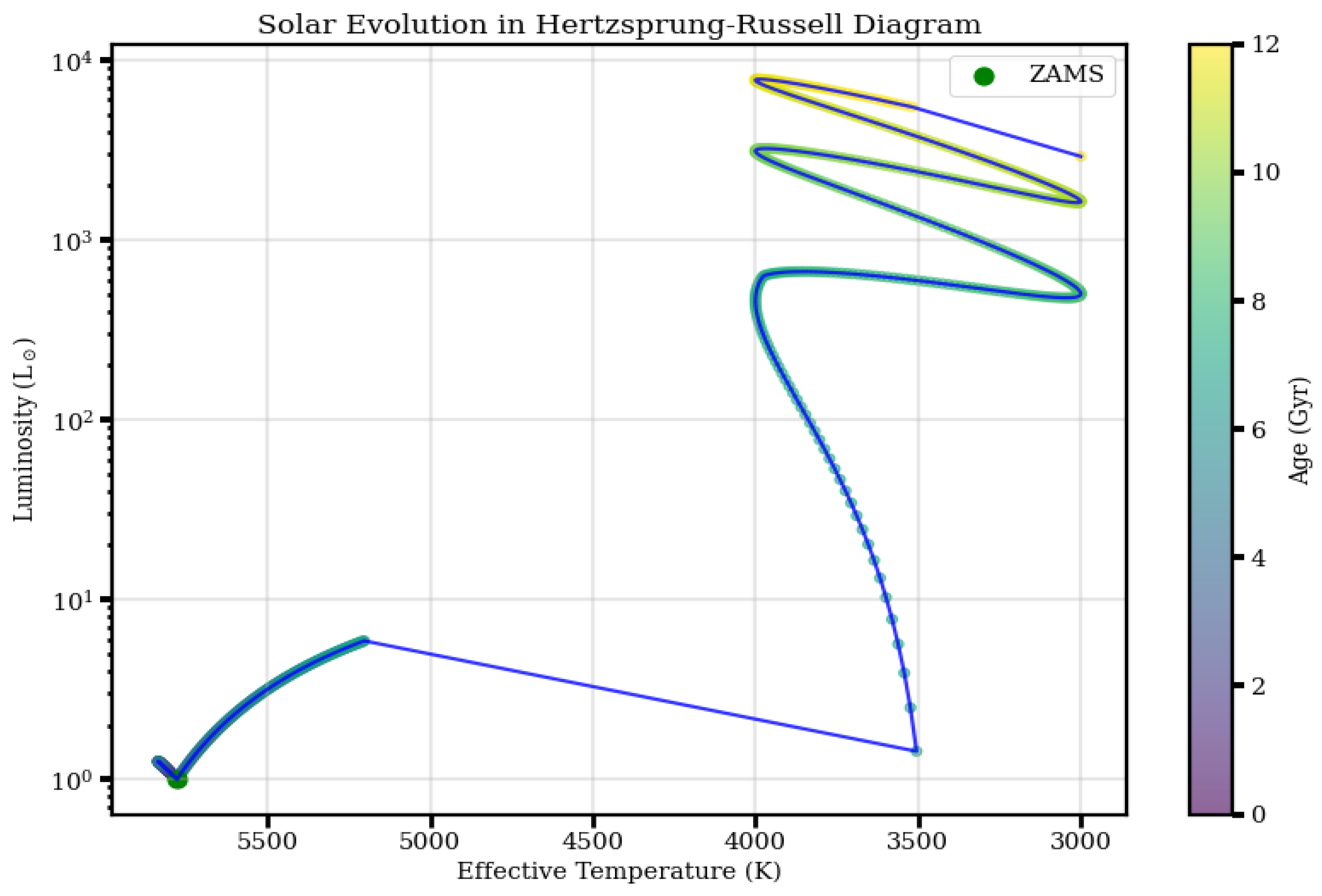
Figure 1,Figure 2,Figure 3,and Figure 4 show the evolution of the sun’s parameters like core temperature, luminosity, mass, and cummulative mass ejection in terms of time respectively. The comparison between the lifetime and mass loss rate of the Sun reveals intriguing insights into the dynamics of our star. Furthermore, the plot depicted in the left panel of Figure 5 illustrates the increase in the mass expelled from the sun starts after a period of 6 billion years. This rise can be attributed to the depletion of the sun’s outer surface, leaving behind a compact and dense core. Then the dramatic and rapid increase of the ejection will begin at 10 billion years which supports the current theory of solar evolution. The surface temperature reducing through time and dramatically falling after 7 billion years and then oscillating, Smultaneously the radius begins drastically to rise after 7 billion years as the figure By examining these two factors, scientists can gain a deeper understanding of the Sun’s evolution and its impact on the surrounding environment like planetary atmosphere. When analyzing the Sun’s lifetime and mass loss rate, significant disparities emerge, shedding light on the complex nature of stellar processes. Exploring these contrasting aspects provides valuable knowledge about the Sun’s lifespan and the gradual depletion of its mass over time. Figure 6 shows the evolution of the surface temperature in time. Regardless of the raise of the core temperature the surface temperature dramatically falls.
Low-mass stars (like the Sun) do not have sufficient mass to reach the core temperatures needed to fuse carbon and oxygen. Therefore, their evolution ends with the white dwarf stage. They do not explode as supernovae (unless they are in a binary system and accrete mass). For a star such as our Sun, the evolution that extends beyond 10 billion years encompasses a significant sequence of changes. Although these concluding phases are relatively short in comparison to its extensive, stable main-sequence existence, they play a vital role in returning material to the space. Stars that possess considerably less mass than the Sun (approximately below 0.5 solar masses) take a distinct and considerably slower evolutionary route. They maintain a fully convective and stable state for trillions of years—outlasting the present age of the universe. Rather than transforming into red giants, they will ultimately deplete their hydrogen and transition directly into white dwarfs.
4. Conclusion
The study of the Sun’s evolution over a 12-billion-year timeline shows a dynamic lifecycle driven by the fundamental interactions of nuclear fusion, gravitational contraction, and mass loss. Initially, during the main sequence phase, the Sun burned hydrogen in its core with notable stability for around 10 billion years, maintaining a nearly constant luminosity and radius. During this extended period, mass loss due to the solar wind was minimal yet ongoing, having a minor impact on structural changes.
The following evolution of the Sun involves significant changes. As hydrogen is depleted in its core, the Sun exits the main sequence and moves into the red giant branch (RGB) and subsequently the asymptotic giant branch (AGB) phases. During this time, the rate of mass loss increases significantly, becoming the primary factor in its evolution. Through strong stellar winds and possibly pulsation-driven ejections, the Sun is expected to lose nearly half of its initial mass. This substantial loss of mass has two important effects: it reveals the hot, degenerate core and determines the final mass of the white dwarf that will eventually form.
The evolution of temperature occurs along a complex, non-linear trajectory. As the Sun expands into a cooler, distended red giant, its effective surface temperature will initially decrease. In contrast, the temperature of the exposed core will rise significantly, briefly reigniting fusion in outer shells and culminating in a final, bright thermal pulse phase. This process concludes with the formation of a hot white dwarf, which starts with a surface temperature surpassing 35,000 K and will gradually cool and diminish over billions of years.
The long-term fate of the Sun involves gradual disintegration rather than explosive destruction. The rate at which it loses mass is a key factor affecting its lifespan after the main sequence, the chemical enrichment of the surrounding interstellar medium, and the physical characteristics of its remnant. The evolution of temperature from a stable main-sequence star to a cooler giant and eventually to a hot compact remnant illustrates the changes in energy production and the star’s structure. This lifecycle highlights an important principle in stellar astrophysics: for stars with a mass similar to the Sun, steady mass loss, rather than catastrophic events, shapes the final stages of stellar evolution and contributes to the distribution of elements necessary for forming future stars and planets . Furtheremore, the study will help in studying the day to day mass ejection effect on the planetary atmosphere.
Ethics Approval
State that the research did not involve human participants or animal subjects and that all data used was publicly available, the materials reviwed are acknowledged and cited following the ethical principles of research.
Funding
No funding: The author(s) received no financial support for the research, authorship, and/or publication of this article.
Acknowledgments
I express my gratitude to the Space Science and Geospatial Institute (SSGI), Entoto Observatory and Research Center (EORC), Department of Astronomy and Astrophysics for offering a conducive research environment.
References
- Vidotto, Aline A. The evolution of the solar wind. Living Rev. Sol. Phys. 2021, 18.1, 3. [Google Scholar] [CrossRef] [PubMed]
- Pols, Onno R.; et al. Stellar evolution models for Z= 0.0001 to 0.03. Mon. Not. R. Astron. Soc. 1998, 298.2, 525–536. [Google Scholar] [CrossRef]
- Ross, Hugh. Fine-Tuning For Life On Earth. In Reasons to Believe; 2004; p. 8. [Google Scholar]
- Fleck, Robert. "Stellar Evolution: The Life Cycle of Stars." We Are Stardust: Stellar Evolution and Our Cosmic Connection; Springer Nature Switzerland: Cham, 2024; pp. 69–141. [Google Scholar]
- Payne, Cecilia H. Stellar Evolution. Sci. Mon. 22.5(1926), 419–423.
- Wood, P. R. Mass Loss from Low-and Intermediate-mass Stars. AIP Conference Proceedings, 2007; American Institute of Physics; Vol. 948. [Google Scholar]
- Karakas, Amanda I. Low-and Intermediate-Mass Stars. In Handbook of Supernovae; Springer: Cham, 2017; pp. 1–21. [Google Scholar]
- Fiorentini, Giovanni; Ricci, Barbara; Villante, Francesco L. Nuclear fusion in the sun. Prog. Theor. Phys. Suppl. 2004, 154, 309–316. [Google Scholar] [CrossRef]
- Blanch, G.; et al. The Internal Temperature-Density Distribution of the Sun. Astrophys. J. 1941, vol. 94, 37 94 37. [Google Scholar] [CrossRef] [PubMed]
- Formicola, Alba; Corvisiero, Pietro; Gervino, Gianpiero. The nuclear physics of the hydrogen burning in the Sun. Eur. Phys. J. A 2016, 52.4, 73. [Google Scholar] [CrossRef]
Figure 1.
The Sun’s core temperature evolution.
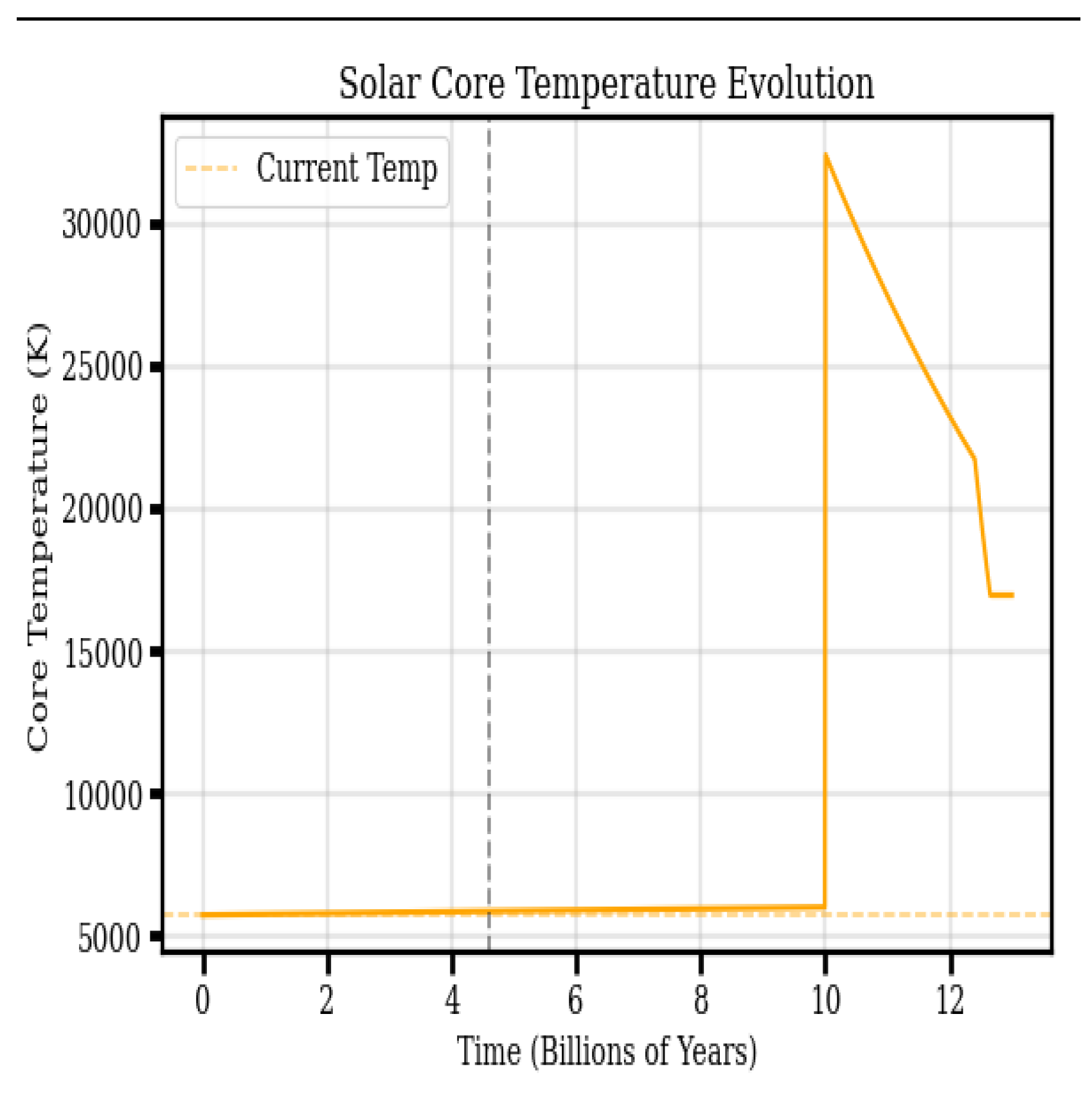
Figure 2.
The Sun’s mass evolution.
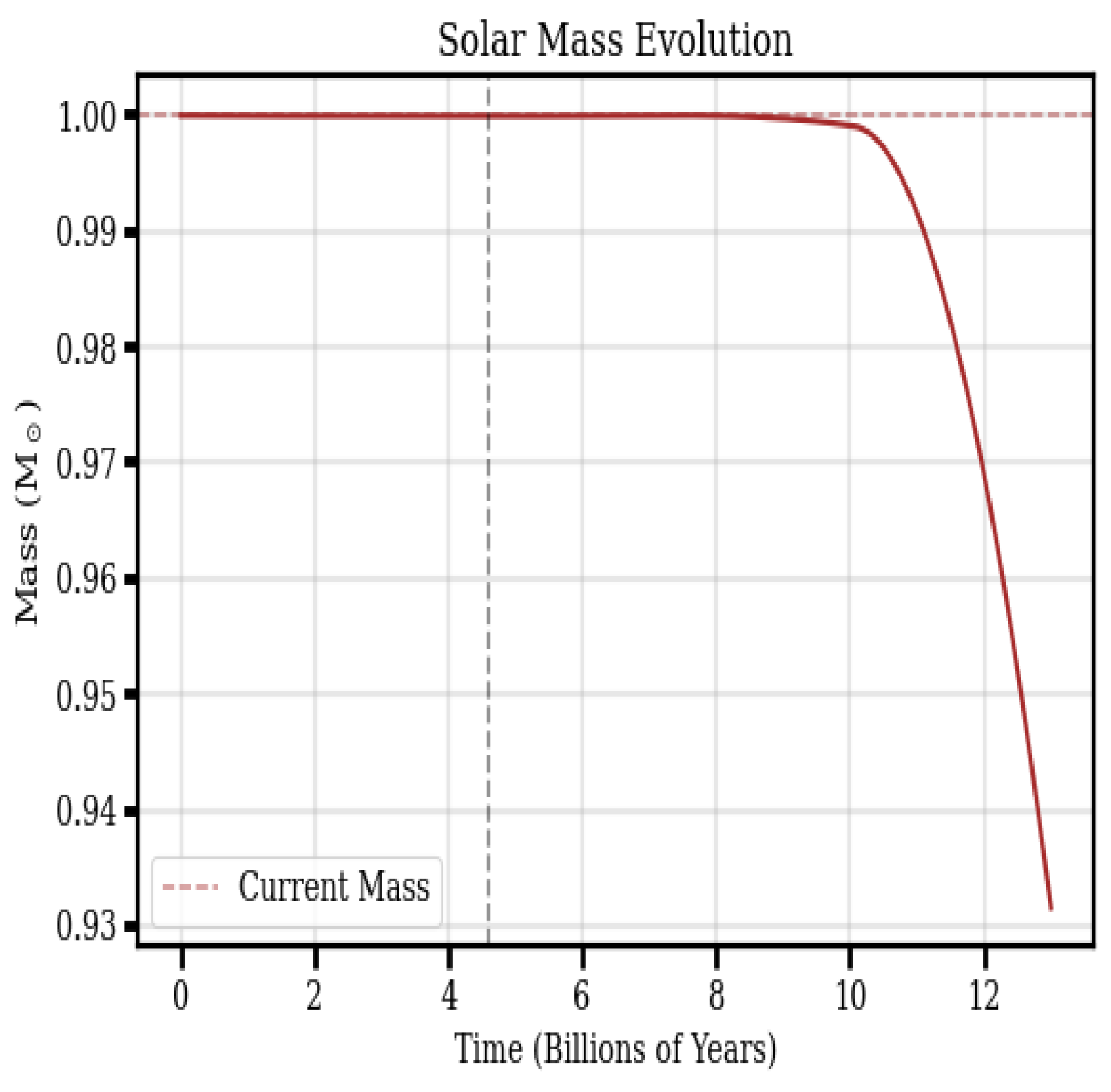
Figure 3.
The Sun’s core luminosity evolution.
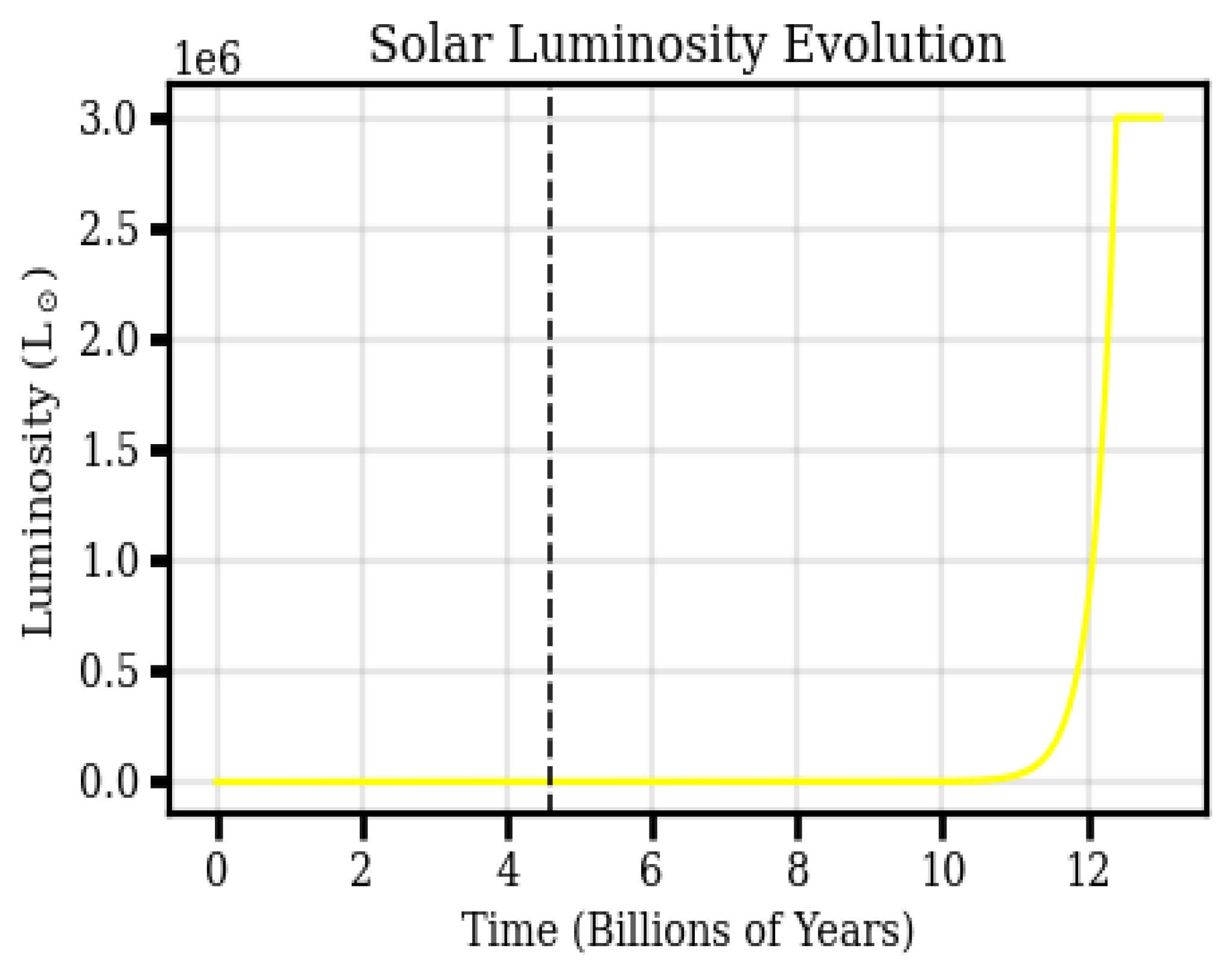
Figure 4.
The Sun’s cummulative mass ejection.
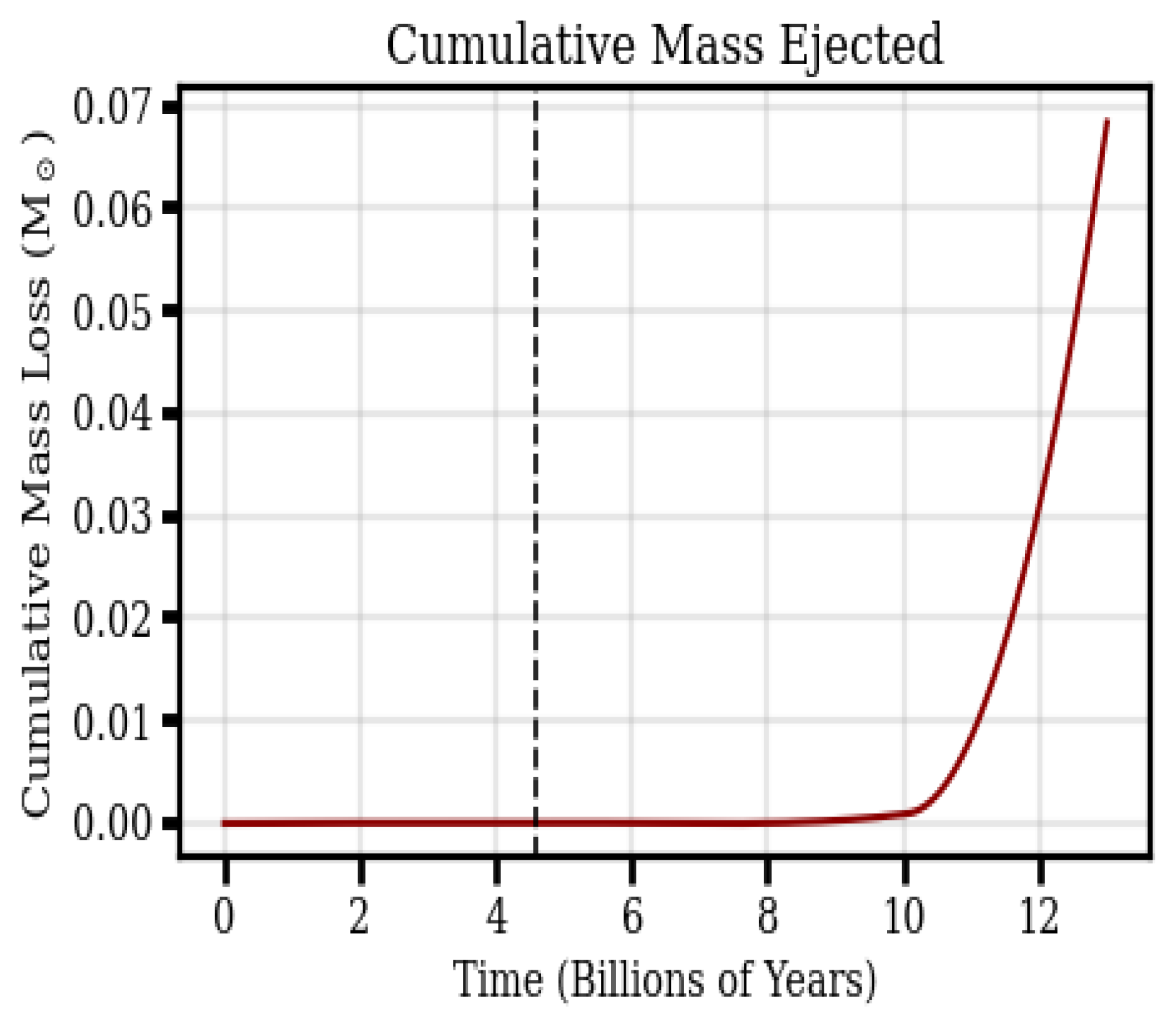
Figure 5.
The age of the Sun in relation to its evolution parameters.
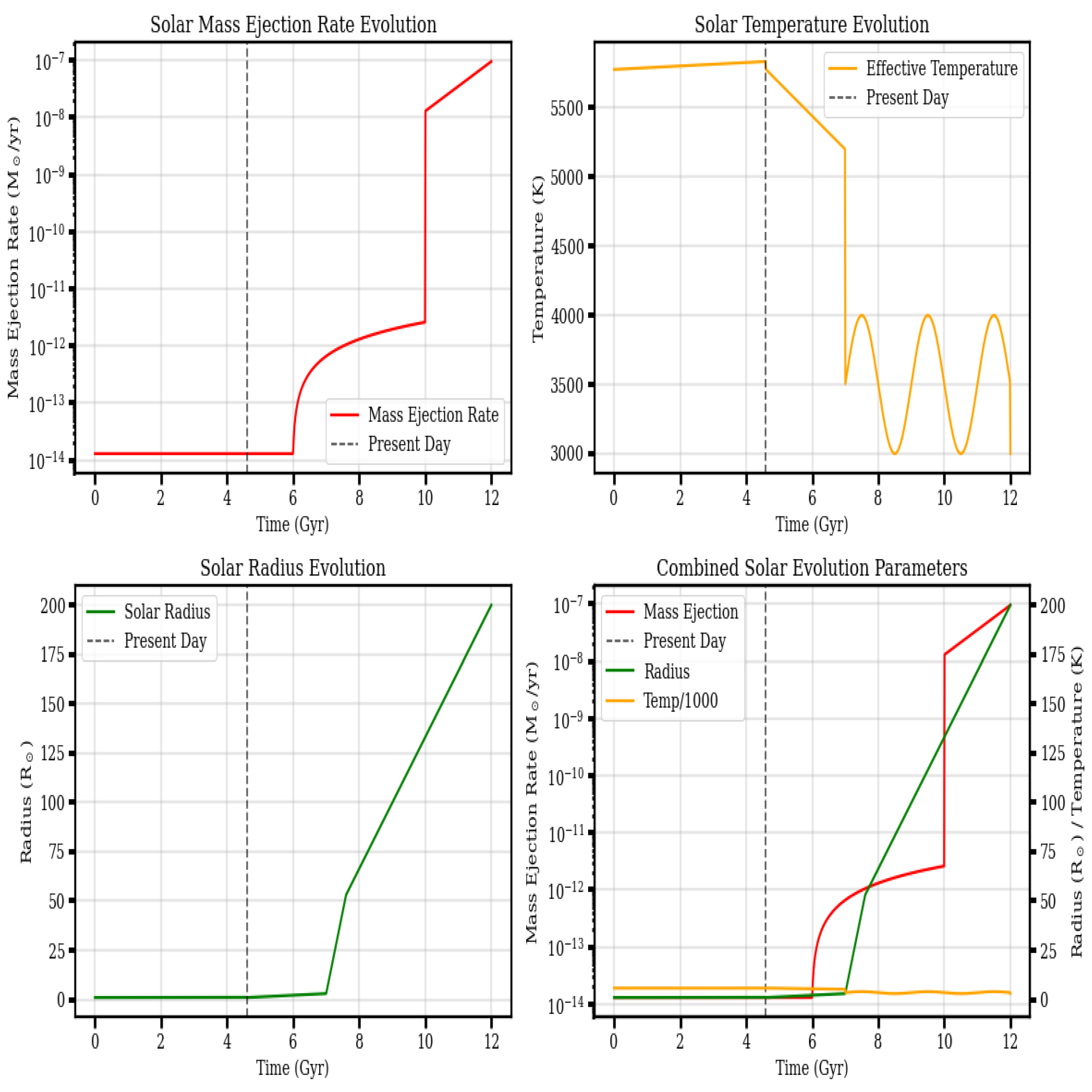
Figure 6.
The evolution of the Sun in HR diagram. This figure shows the surface temperature reduceses in time.
Figure 6.
The evolution of the Sun in HR diagram. This figure shows the surface temperature reduceses in time.
Disclaimer/Publisher’s Note: The statements, opinions and data contained in all publications are solely those of the individual author(s) and contributor(s) and not of MDPI and/or the editor(s). MDPI and/or the editor(s) disclaim responsibility for any injury to people or property resulting from any ideas, methods, instructions or products referred to in the content. |
© 2026 by the authors. Licensee MDPI, Basel, Switzerland. This article is an open access article distributed under the terms and conditions of the Creative Commons Attribution (CC BY) license (http://creativecommons.org/licenses/by/4.0/).
Copyright: This open access article is published under a Creative Commons CC BY 4.0 license, which permit the free download, distribution, and reuse, provided that the author and preprint are cited in any reuse.