

Submitted:
27 April 2026
Posted:
29 April 2026
You are already at the latest version
Abstract
Gibberellins (GAs) is a key endogenous hormone regulating chrysanthemum flowering, and Gibberellin INSENSITIVE DWARF1 (GID1) is the core receptor of the gibberellin (GA) signaling pathway. However, the functional mechanism of CmGID1A remains unelucidated. Here, we constructed CmGID1A-RNAi silencing lines, and characterized the biological function of CmGID1A by phenotypic identification, protein interaction assays, qRT-PCR and RNA-seq. The results of RT-qPCR showed that CmGID1A responds to short days and gibberellins. Inhibition of the expression of CmGID1A can significantly promote the transition of chrysanthemum from the vegetative growth stage to the reproductive growth stage and accelerate its flowering process. Bimolecular fluorescence complementation (BiFC) and yeast two-hybrid (Y2H) assays confirmed that CmGID1A interacts with the DELLA protein CmRGL1 in a gibberellin-dependent manner. RNA-seq results revealed that silencing of CmGID1A leads to a significant up-regulation of downstream Ethylene Response Factor 6 (ERF6) expression. Collectively, CmGID1A acts as a GA receptor to mediate GA signal transduction via interacting with CmRGL1, and regulates the expression of CmERF6 and other downstream genes, thereby participating in the regulation of floral transition in chrysanthemum. This study clarifies the core role of CmGID1A in the GA signaling pathway and provides novel experimental data for enriching the molecular regulatory mechanism of GA in floral transition in chrysanthemum.
Keywords:
chrysanthemum
; gibberellins
; DELLA protein
; flowering
1. Introduction
Flowering is a crucial developmental transition in the plant life cycle, during which plants integrate environmental and endogenous signals through a complex network to regulate flowering time [1,2]. Gibberellins (GAs) are among the core hormones governing plant growth and development and serve as key endogenous signals regulating flowering[3,4]. The molecular regulatory mechanism of GA signal transduction is a major research focus in floral transition. As a specific GA receptor, GIBBERELLIN INSENSITIVE DWARF1 (GID1) is the initial key component of the GA signaling pathway. Three homologous GID1 genes, GID1A, GID1B, and GID1C, have been identified in Arabidopsis[5]. DELLA proteins, as core negative regulators of the GA signaling pathway, can regulate the expression of hormone response and growth/development-related genes at the transcriptional level by interacting with various transcription factors[6,7,8]. Five DELLA proteins have been identified in Arabidopsis, namely REPRESSOR OF GA1-3 (RGA), GIBBERELLIC ACID INSENSITIVE (GAI), RGA-LIKE 1 (RGL1), RGA-LIKE 2 (RGL2) and RGA-LIKE 3 (RGL3)[9]. The GA-dependent interaction between GID1 and DELLA is a core molecular event of GA signal transduction. Upon binding to GA, GID1 undergoes a conformational change, subsequently interacts with DELLA proteins and mediates their ubiquitination and degradation. This relieves the transcriptional repression of GA signaling by DELLA proteins, ultimately initiating the expression of downstream target genes[10,11,12]. This interaction mechanism has been thoroughly analyzed in model plants; however, in non-model plants, the interaction characteristics and functional differentiation of GID1 homologous genes with DELLA proteins and the regulatory network of downstream key transcription factors remain to be systematically verified.
Ethylene, a classic phytohormone, is also an important signaling molecule involved in regulating plant growth and development. Ethylene Response Factors (ERFs), which belong to the APETALA2/ERF transcription factor family, are integral components of the ethylene signaling and response pathway and play crucial roles in plant growth and development, flowering, and stress responses[13,14,15]. In Arabidopsis thaliana, ERF1 negatively regulates flowering time by inhibiting FLOWERING LOCUS T transcription[16]. In Pak-choi (Brassica campestris ssp. chinensis), the ethylene response factor BcERF070 delays flowering by inhibiting the promotion of BcLEAFY by the BcMLP328-BcbHLH30 complex and directly promoting the expression of the flowering repressor BcBBX29[17]. However, whether it coordinately regulates plant flowering with GA signaling remains unknown.
Chrysanthemum is a typical short-day (SD) perennial herb, and its floral transition is tightly associated with the induction of exogenous environmental cues, endogenous phytohormones and developmental signals. And the flowering of chrysanthemum is highly dependent on GAs[18,19,20,21,22,23]. We previously reported that SDs can regulate GA biosynthesis and GA perception in chrysanthemum, which activates GID1B transcription, thereby promoting flowering[24]. However, the downstream response factors of gibberellin signaling regulating flowering in chrysanthemum, as well as the mechanism of its coordinated regulation with other hormones, remain unclear. This study focused on the gibberellin receptor gene CmGID1A in chrysanthemum. Using RNAi silencing, phenotypic analysis, protein interaction assays, qRT-PCR and RNA-seq, we confirmed that CmGID1A modulates flowering in chrysanthemum through a GA-dependent interaction with the DELLA protein CmRGL1, examined the expression of downstream flowering-related genes, and validated the up-regulated gene CmERF6. These results clarify the key function of CmGID1A in GA signaling-regulated flowering and its downstream regulatory network in chrysanthemum, providing experimental evidence for the molecular mechanism of GA signaling and its crosstalk with other hormones, and a theoretical basis for the genetic improvement of plant growth and flowering.
2. Results
2.1. Expression of CmGID1A Responds to Short-Day Conditions and Gibberellins
To investigate how short-day (SD) conditions induce gibberellins (GAs) to promote flowering in chrysanthemum, we identified the GA-receptor GA INSENSITIVE DWARF1 A (CmGID1A) in chrysanthemum. To explore the function of CmGID1A in flowering in chrysanthemum, the expression of CmGID1A in apical buds and leaves at different developmental stages were detected by RT-qPCR. The results showed that the expression of CmGID1A was low in apical buds and leaves at the seedling and vegetative growth stages. After entering the floral bud differentiation stage, its expression gradually increased and peaked from the squaring stage to the flower bud coloration stage, with a marked increase in leaves (Figure 1A). This indicates that the expression of CmGID1A is significantly up-regulated during development and plays a key role especially in the reproductive stage. Analysis of the organ-specific expression of CmGID1A revealed high expression in leaves and flowers (Figure 1B), suggesting that CmGID1A participates in floral transition in chrysanthemum.
To examine whether the expression of CmGID1A is affected by SDs, we measured the expression of CmGID1A in leaves and apical buds of chrysanthemum plants grown under long-day (LD) conditions for 60 d and then transferred to SDs or maintained under LDs (as control). Compared with the control, the expression of CmGID1A significantly increased in SDs treatment for 6–9 d in apical buds, whereas no obvious change was observed in leaves (Figure 1C), demonstrating that the expression of CmGID1A is induced by SDs, and is more sensitive in apical buds, likely mediating SDs-induced floral transition in chrysanthemum.
To explore the effect of gibberellins on CmGID1A, we measured the expression of CmGID1A in leaves of chrysanthemum plants treated with exogenous GAs. Compared with the control, the expression of CmGID1A rapidly decreased within 2 h after GA treatment (to approximately 50% of the control level), then gradually increased and recovered to the control level at 14 h (Figure 1D), indicating that CmGID1A is transiently inhibited by GAs.
These data suggest that CmGID1A may participate in SD-induced floral transition in chrysanthemum through the GA pathway.
2.2. CmGID1A Regulates Flowering in Chrysanthemum
To investigate whether CmG1D1A influences the floral transition, we knocked down CmGID1A transcript levels in WT chrysanthemum by generating CmGID1A-RNAi (RNA interference) lines (Figure 2B). We grew these lines alongside the wild type (WT) in non-inductive LD conditions for 60 days before transferring them to inductive SD conditions and assessing their flowering phenotype. Flower buds emerged on WT plants after 90 days of growth, by contrast, on the two CmGID1A-RNAi transgenic lines after 80 days of growth, 10 days earlier than WT (Figure 2, A and C). And fully open flowers observed on the two CmGID1A-RNAi transgenic lines after 120 days, but WT plants remained in bud (Figure 2A), indicating that silencing CmGID1A can significantly promote the transition from vegetative growth to reproductive growth, and accelerate the flowering process in chrysanthemum.
Since the chrysanthemum GID1 family comprises three members with functional redundancy, we examined the expression levels of CmGID1B and CmGID1C in CmGID1A-RNAi transgenic lines, and found their expression was significantly elevated in the silenced lines (Figure 2D), suggesting that plants may compensate for the loss of CmGID1A function by upregulating the expression of the other 2 GID1 members to maintain basal homeostasis of GA signaling.
2.3. The Interaction Between CmGID1A and CmRGL1 is Strictly GA-dependent
Previous studies have shown that DELLA is the key repressors of gibberellin signal transduction, and the GA-GID1-DELLA trimer is the core of gibberellin signaling [10,11,12]. Therefore, we detected the interaction between CmGID1A and DELLAs after gibberellin treatment. The results of the yeast two-hybrid (Y2H) assay showed that the yeast strain co-transformed with BD-CmGID1A and AD-CmRGL1 could only grow normally on the GA-supplemented selective medium (SD-Trp/Leu/His/Ade/GA), but failed to grow on the GA-free selective medium (SD-Trp/Leu/His/Ade) and the empty vector control groups (Figure 3A). In the bimolecular fluorescence complementation (BiFC) assay, we fused CmGID1A to the N-terminal half of yellow fluorescent protein (YFP) and CmRGL1 to the C-terminal half of YFP and co-infiltrated the encoding constructs in N. benthamiana leaves. We only observed the reconstitution of YFP fluorescence signals in the nucleus of the co-expression group of CmGID1A-YFPN and CmRGL1-YFPC under GA treatment conditions, as evidenced by colocalization with a nuclear marker, whereas we detected no YFP fluorescence signals in the Mock control and the single vector expression groups (Figure 3B). These results indicate that CmGID1A interacts with CmRGL1 in a GA-dependent manner to initiate GA signal transduction.
2.4. Analysis of CmGID1A Downstream Regulation Network
In order to show the molecular mechanism of CmGID1A regulating floral transition in chrysanthemum, we identified differentially expressed genes between the leaves of the WT and CmGID1A-RNAi plants (obtained from preliminary research) [24] by transcriptome deep sequencing (RNA-seq). We obtained 156 differentially expressed genes (DEGs; using the criteria |Log2[fold-change]| ≥ 1 and q-value 102 ≤ 0.05 for CmGID1A-RNAi plants), of which 74 were upregulated and 82 were downregulated relative to the WT (Figure 4A). KEGG (Kyoto Encyclopedia of Genes and Genomes) pathway enrichment analysis of these DEGs indicated that terms associated with ‘photosynthesis - antenna proteins’, ‘protein processing in endoplasmic reticulum’ and ‘biosynthesis of amino acids’ are significantly enriched (Figure 4B). COG (Clusters of Orthologous Groups) function classification of the DEGs indicated terms associated with ‘posttranslational modification, protein turnover, chaperones’, ‘defense mechanisms’ and ‘secondary metabolites biosynthesis, transport and catabolism’(Figure 4C). GO (Gene Ontology) enrichment classification showed that DEGs were mainly enriched in metabolic processes, cellular processes and stimulus response (biological process), cell, membrane and organelle (cellular component), and catalytic activity and binding (molecular function) (Figure 4D), indicating core roles of CmGID1A in metabolic regulation and environmental adaptation.
2.5. CmERF6 is a Key Downstream target of CmGID1A-GA Signaling
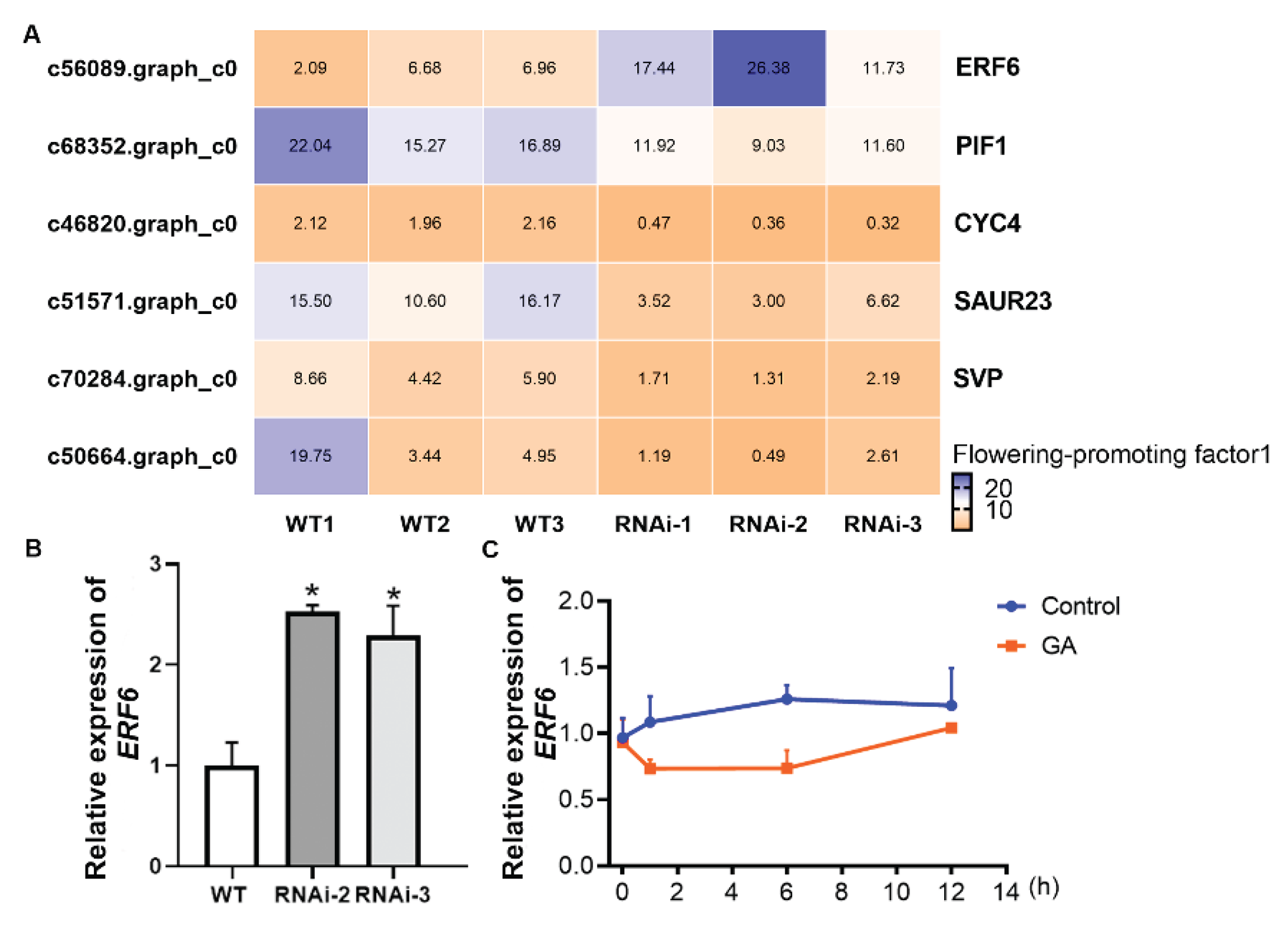
After further analysis of the transcriptome data, we focused on DEGs annotated as components of the following plant hormone signal or flowering pathways. Heatmap analysis showed that the CmGID1A-RNAi lines led to dramatic upregulation of ERF6 and downregulation of genes including PIF1, SAUR23, SVP, and flowering-promoting factor 1 compared with WT (Figure 5A). ERF6 is a key transcription factor of the plant AP2/ERF family, which mainly mediates ethylene signal and plays a core regulatory role in disease resistance, stress tolerance, growth and development [13,14,15]. qRT-PCR further verified the significant elevation of CmERF6 expression in the CmGID1A-RNAi lines (Figure 5B), consistent with transcriptomic data. To investigate whether GA regulates CmERF6, we detected the expression of CmERF6 after GA treatment. It was found that within 14 hours after GA application, the expression of CmERF6 was slightly downregulate (Figure 5C), indicating that CmERF6 was inversely regulated by the CmGID1A/GA signaling pathway and significantly involved in floral transition in chrysanthemum, representing an important downstream factor for dissecting the mechanism by which GA regulates flowering.
3. Discussion
Gibberellins (GAs) are pivotal phytohormones that regulate diverse aspects of plant growth and development, including the critical transition from vegetative to reproductive growth [25,26,27]. In this study, we elucidated the functional mechanism of the gibberellin receptor CmGID1A in Chrysanthemum. The results demonstrated that CmGID1A is a key component of gibberellin signaling. As a gibberellin receptor, CmGID1A interacts with the DELLA protein CmRGL1 in a gibberellin-dependent manner, regulating the expression of downstream hormone and flowering-related genes, such as CmERF6, and may cooperate with ethylene signaling to regulate the flowering process of chrysanthemum. This work provides new insights into the molecular interaction between gibberellin and ethylene signaling during the flowering transition in chrysanthemum.
It is well established that chrysanthemum is a typical short-day (SD) plant, and its flowering is tightly coupled with photoperiodic cues and endogenous hormone levels [19]. Our data revealed that CmGID1A expression is developmentally regulated, showing low levels during the vegetative stage but a significant upsurge during the reproductive phase, particularly in leaves and apical buds (Figure 1A, B). This organ-specific expression pattern suggests that CmGID1A plays a distinct role in floral meristem differentiation. Our findings specifically demonstrate that the expression of the GA receptor CmGID1A itself is induced by SD conditions, particularly in the apical buds (Figure 1C). This indicates that the apical bud serves as the primary site for GA signal perception during floral induction. Furthermore, exogenous GA application leads to the transient suppression of CmGID1A (Figure 1D), which aligns with the classic feedback regulatory mechanism in the GA signaling pathway—wherein activation of the pathway typically triggers downregulation of its receptor to maintain homeostasis [28].
Contrary to the well-known role of GAs in promoting flowering in long-day plants like Arabidopsis, our phenotypic analysis of CmGID1A-RNAi lines revealed that silencing this GA receptor accelerates flowering in chrysanthemum (Figure 2A, C). Intriguingly, this early-flowering phenotype occurred alongside a significant upregulation of other GA receptor genes, notably CmGID1B and CmGID1C (Figure 2D). This suggests a complex regulatory interplay within the chrysanthemum GID1 family. Rather than acting as a direct repressor, the downregulation of CmGID1A may trigger a compensatory mechanism, leading to the enhanced expression of functionally dominant homologs like CmGID1B, which has been shown to be a key integrator of photoperiod signals promoting flowering. This functional redundancy and hierarchical compensation highlight the sophisticated nature of GA signaling in regulating meristem identity in chrysanthemum.
The core mechanism of GA signaling relies on the hormone-dependent interaction between GID1 receptors and DELLA proteins, leading to DELLA degradation [29,30,31]. Our yeast two-hybrid (Y2H) and bimolecular fluorescence complementation (BiFC) assays provided direct evidence that CmGID1A interacts strictly with CmRGL1 in the presence of GA (Figure 3). This confirms that CmGID1A is a functional receptor that adheres to the canonical ‘molecular glue’ mechanism. In the absence of GA, CmRGL1 likely represses transcription factors necessary for flowering. Upon GA binding, CmGID1A captures CmRGL1, targeting it for degradation and thereby derepressing downstream genes.
One of the most significant findings of this study is the identification of CmERF6 as a key downstream target. Transcriptome analysis revealed that CmERF6 is dramatically upregulated in the CmGID1A-RNAi plants (Figure 5A, B). This is particularly intriguing because ERF6 is a member of the AP2/ERF family, which are central mediators of ethylene signaling and stress responses [32,33]. In Arabidopsis, AtERF1 and AtERF6 have been shown to act as repressors of flowering by directly inhibiting FT expression [14]. Our data suggest that CmGID1A may play a similar role in chrysanthemum: when CmGID1A is silenced, the inhibition of CmERF6 is relieved, thereby promoting flowering. The reverse regulation of CmERF6 by gibberellin (Figure 5C) further supports a model in which the gibberellin-CmGID1A signaling pathway typically suppresses the expression of CmERF6. This indicates that the early flowering phenotype observed in CmGID1A-RNAi might be mediated by the release of the inhibition on CmERF6. This interaction suggests that chrysanthemum integrates hormone signals (auxin and ethylene) to precisely regulate its flowering time in response to environmental stress and photoperiodic changes.
In conclusion, we propose a mechanistic model in which CmGID1A acts as a gibberellin-dependent receptor that physically engages CmRGL1 to orchestrate the transcriptional regulation of downstream target genes—most notably the ethylene-responsive transcription factor CmERF6.
4. Materials and Methods
4.1. Plant Materials and Growth Conditions
This study utilized CmGID1A-RNAi and WT chrysanthemum (Chrysanthemum morifolium ‘Fall Color’). To construct the RNAi vector, a 459-bp sense fragment and its corresponding antisense fragment of CmGID1A were cloned into the pFGC1008 vector via AscI/SwaI and BamHI/PacI restriction sites, respectively. This resulted in an RNA expression vector driven by the 35S promoter, containing an intron-spliced “hairpin” structure. The recombinant vector was subsequently transformed into Agrobacterium tumefaciens strain EHA105. Chrysanthemum leaf discs were used as explants for infection and transformation. Hygromycin-resistant plants were obtained through selection. Primers used are shown in Supplementary Data Set 1.
Forty-day-old plants were transplanted into pots (9 cm in diameter) containing a peat:vermiculite (1:1, v/v) mixture and grown in a growth chamber. The growth conditions were as follows: temperature 23 ± 1 °C, relative humidity 40%, light intensity 100 μmol·m⁻²·s⁻¹, under either a long-day (LD) photoperiod (16 h light/8 h dark) or a short-day (SD) photoperiod (8 h light/16 h dark).
4.2. RNA Extraction and RT-qPCR
The fully expanded fourth leaf was harvested from five biological replicates at Zeitgeber time 8 (ZT8). Total RNA was extracted from these samples using RNAiso Plus (TaKaRa, Japan) following the manufacturer’s instructions. First-strand cDNA was synthesized from 1 μg of total RNA using HiScript II Q RT SuperMix for qPCR (with gDNA wiper) (Vazyme, Nanjing, China). Quantitative real-time PCR (RT-qPCR) was performed on the StepOne Real-Time PCR System (Applied Biosystems, USA) under standard cycling conditions, using 2× Realtime PCR Super Mix (SYBR Green, with anti-Taq antibody) (Mei5 Biotechnology Co., Ltd., China). Expression of the CmUBI gene (GenBank accession: NM_112764) served as an internal reference. Relative transcript levels were calculated using the 2−ΔΔCT method [34]. Primers used are shown in Supplementary Data Set 1.
4.3. GA Treatment
WT tissue-cultured seedlings were grown under long-day (LD) conditions for 40 days, then transferred to an LD growth chamber for an additional two weeks. Subsequently, the plants were shifted to short-day (SD) conditions and sprayed with 100 μM GAs. GA4+7 was dissolved in 3% (v/v) DMSO, with an equivalent concentration of DMSO solution serving as the control. During the treatment period, plants were sprayed once every five days for one month.
4.4. Yeast Two-Hybrid Assays
The yeast two-hybrid (Y2H) assay was performed using the Matchmaker GAL4 Two-Hybrid System (Clontech, Shiga, Japan). The open reading frame (ORF) sequence of CmRGL1 was amplified and inserted into the pGADT7 vector [35] via EcoRI/BamHI restriction sites. The ORF sequence of CmGID1A was amplified and inserted into the pGBKT7 vector [36] via EcoRI/SalI restriction sites. The recombinant plasmids pGADT7 and pGBKT7 were co-transformed into the yeast strain Y2HGold. The GUS ORF sequence was inserted into either the pGADT7 or pGBKT7 vector as a negative control. Transformants were cultured on SD/-Trp-Leu medium, subsequently transferred to SD/-Trp-Leu-His-Ade medium, and then spotted onto plates containing GA for further analysis. Primers used are shown in Supplementary Data Set 1.
4.5. BIFC
The open reading frame (ORF) of CmRGL1 without a terminator was inserted into the 35S-SPYCE(M) vector via XbaI/KpnI restriction sites, and the ORF of CmGID1A was inserted into the 35S-SPYNE(R) 173 vector via XbaI/KpnI restriction sites. Subsequently, the recombinant vectors or control vectors were transformed into Agrobacterium tumefaciens strain GV3101. The bacterial suspensions were adjusted to an OD600 of 1.0 using infiltration buffer. Agrobacterium cultures expressing CmGID1A-YFPN, CmRGL1-YFPC, or control vectors were mixed at a 1:1 volume ratio and infiltrated into leaves of Nicotiana benthamiana using a needleless syringe. After 3 days of incubation, GA was sprayed onto the corresponding tobacco leaves prior to imaging. Yellow fluorescent protein (YFP) fluorescence imaging was performed using a Nikon A1 confocal laser scanning microscope (Nikon, Japan). YFP was excited with a 488 nm laser and detected at 525 nm; red fluorescent protein (RFP) was excited with a 561 nm laser and detected at 610 nm. Primers used are shown in Supplementary Data Set 1.
4.6. RNA-Seq Analysis
WT and CmGID1A-RNAi tissue-cultured seedlings were grown under long-day (LD; 16 h light/8 h dark) conditions for 40 days, then transferred to an LD growth chamber (same photoperiod) for an additional 2 weeks, followed by a 2-week exposure to short-day (SD; 8 h light/16 h dark) conditions. When the shoot apical meristem had nearly completed differentiation into floral primordia, the fourth fully expanded leaf—counted from the apical meristem—was harvested from three biological replicates for total RNA extraction. RNA sequencing was performed on the Illumina HiSeq 2000 platform at Novogene Co., Ltd. (Beijing, China; http://www.novogene.com/). RNA-seq data were processed, assembled, and annotated as previously described [37].
4.7. Statistical Analysis
All experiments included at least three biological replicates. Statistical significance of differences was assessed using one-way analysis of variance (ANOVA) followed by Duncan’s multiple range test for comparisons among ≥3 groups, or two-tailed Student’s t-test for pairwise comparisons, as implemented in GraphPad Prism v8.0 (GraphPad Software, San Diego, CA, USA).
5. Conclusions
This study clarifies the core function and regulatory mechanism of the GA receptor CmGID1A in GA signaling pathway and floral transition in chrysanthemum. CmGID1A is a key component of GA signaling, which interacts with the DELLA protein CmRGL1 in a strictly GA-dependent manner to mediate GA signal transition.
CmGID1A is highly expressed during the reproductive growth stage of chrysanthemum, responds to short-day conditions and GA, and participates in SD-induced floral transition. Silencing CmGID1A significantly promotes floral transition and accelerates flowering in chrysanthemum, accompanied by the up-regulation of CmGID1B and CmGID1C to compensate for its functional loss. Additionally, silencing CmGID1A alters the expression of downstream hormone- and flowering-related genes, particularly the significant up-regulation of Ethylene Response Factor 6 (CmERF6).
In summary, CmGID1A acts as a GA receptor, interacts with the DELLA protein CmRGL1 in a GA-dependent manner, regulates the expression of downstream hormone- and flowering-related genes such as CmERF6, and may coordinate with ethylene signaling to jointly regulate the flowering process in chrysanthemum. This study enriches chrysanthemum GA signal regulatory networks, provides gene targets and theoretical basis for genetic engineering of chrysanthemum flowering and agronomic traits, and offers references for GID1 family functional differentiation and GA signaling in non-model plants.
Supplementary Materials
The following supporting information can be downloaded at the website of this paper posted on Preprints.org. Supplementary Data Set 1. List of primers used in this study.
Author Contributions
A.P. conceived and designed the experiments; WW.L. performed most of the experiments; WW.L. contributed to the chrysanthemum transformation; HL.Y. and X.Z. contributed to GA treatment experiments; HL.Y. and WW.L. conducted RT-qPCR experiments; X.Z. provided technical support and conceptual advice; A.P. and WW.L. analyzed the data and wrote the manuscript.
Funding
This research was supported by the National Natural Science Foundation of China (Project No. 32460776) and the National Postdoctoral Funding (Project No. 2505BSHJJ).
Data Availability Statement
he original contributions presented in this study are included in the article/Supplementary Material. Further inquiries can be directed to the corresponding author.
Acknowledgments
This research was supported by the National Undergraduate Innovation and Entrepreneurship Training Program of Xinjiang Agricultural University and the “Tianchi Talent” Introduction Program of Xinjiang Uygur Autonomous Region Talent Development Fund.
Conflicts of Interest
The authors declare no conflicts of interest.
References
- Amasino, R.M.; Michaels, S.D. The timing of flowering. Plant Physiol. 2010, 154, 516–520. [CrossRef]
- Wahl, V.; Ponnu, J.; Schlereth, A.; Arrivault, S.; Langenecker, T.; Franke, A.; Feil, R.; Lunn, J.E.; Stitt, M.; Schmid, M. Regulation of flowering by trehalose-6-phosphate signaling in Arabidopsis thaliana. Science. 2013, 339, 704–707. [CrossRef]
- Kumar, S.V.; Lucyshyn, D.; Jaeger, K.E.; Alós, E.; Alvey, E.; Harberd, N.P.; Wigge, P.A. Transcription factor PIF4 controls the thermosensory activation of flowering. Nature. 2012, 484, 242–245. [CrossRef]
- Yan, J.; Li, X.; Zeng, B.; Zhong, M.; Yang, J.; Yang, P.; Li, X.; He, C.; Lin, J.; Liu, X.; Zhao, X. FKF1 F-box protein promotes flowering in part by negatively regulating DELLA protein stability under long-day photoperiod in Arabidopsis. J. Integr. Plant Biol. 2020, 62, 1717–1740. [CrossRef]
- Nakajima, M.; Shimada, A.; Takashi, Y.; Kim, Y.C.; Park, S.H.; Ueguchi-Tanaka, M.; Suzuki, H.; Katoh, E.; Iuchi, S.; Kobayashi, M. Identification and characterization of Arabidopsis gibberellin receptors. Plant J. 2006, 46, 880–889. [CrossRef]
- Wang, J.W. Regulation of flowering time by the miR156-mediated age pathway. J. Exp. Bot. 2014, 65, 4723–4730. [CrossRef]
- Wang, H.; Pan, J.; Li, Y.; Lou, D.; Hu, Y.; Yu, D. The DELLA-CONSTANS transcription factor cascade integrates gibberellic acid and photoperiod signaling to regulate flowering. Plant Physiol. 2016, 172, 479–488. [CrossRef]
- Xu, F.; Li, T.; Xu, P.B.; Li, L.; Du, S.S.; Lian, H.L.; Yang, H.Q. DELLA proteins physically interact with CONSTANS to regulate flowering under long days in Arabidopsis. FEBS Lett. 2016, 590, 541–549. [CrossRef]
- Jiang, C.; Fu, X. GA action: turning on de-DELLA repressing signaling. Curr. Opin. Plant Biol. 2007, 10, 461–465. [CrossRef]
- Griffiths, J.; Murase, K.; Rieu, I.; Zentella, R.; Zhang, Z.L.; Powers, S.J.; Gong, F.; Phillips, A.L.; Hedden, P.; Sun, T.P. Genetic characterization and functional analysis of the GID1 gibberellin receptors in Arabidopsis. Plant Cell 2006, 18, 3399–3414. [CrossRef]
- Murase, K.; Hirano, Y.; Sun, T.P.; Hakoshima, T. Gibberellin-induced DELLA recognition by the gibberellin receptor GID1. Nature 2008, 456, 459–463. [CrossRef]
- Sun, T.P. The molecular mechanism and evolution of the GA-GID1-DELLA signaling module in plants. Curr. Biol. 2011, 21, R338–R345. [CrossRef]
- Müller, M.; Munné-Bosch, S. Ethylene response factors: A key regulatory hub in hormone and stress signaling. Plant Physiol. 2015, 169, 32–41. [CrossRef]
- Dubois, M.; Van den Broeck, L.; Claeys, H.; Van Vlierberghe, K.; Matsui, M.; Inzé, D. The ETHYLENE RESPONSE FACTORs ERF6 and ERF11 antagonistically regulate mannitol-induced growth inhibition in Arabidopsis. Plant Physiol. 2015, 169, 166–179. [CrossRef]
- Li, T.; Peng, Z.; Kangxi, D.; Inzé, D.; Dubois, M. ETHYLENE RESPONSE FACTOR6, a central regulator of plant growth in response to stress. Plant Cell Environ. 2025, 48, 882–892. [CrossRef]
- Chen, Y.; Zhang, L.; Zhang, H.; Chen, L.; Yu, D. ERF1 delays flowering through direct inhibition of FLOWERING LOCUS T expression in Arabidopsis. J. Integr. Plant Biol. 2021, 63, 1712–1723. [CrossRef]
- Yu, Z.; Chen, X.; Li, Y.; Shah, S.H.A.; Xiao, D.; Wang, J.; Hou, X.; Liu, T.; Li, Y. ETHYLENE RESPONSE FACTOR 070 inhibits flowering in Pak-choi by indirectly impairing BcLEAFY expression. Plant Physiol. 2024, 195, 986–1004. [CrossRef]
- Pharis, R.P.; King, R.W. Gibberellins and reproductive development in seed plants. Annu Rev Plant Physiol. 1985, 36, 517–568. [CrossRef]
- Yang, Z.Q.; Luo, W.H.; Chen, F.D.; Xie, Y.P.; Zhang, M.Q. Effects of gibberellin on development and external quality of single flower cut Chrysanthemum morifolium Ramat. Plant Physiol. Commun. 2008, 44, 1095–1098.
- Sumitomo, K.; Li, T.; Hisamatsu, T. Gibberellin promotes flowering of chrysanthemum by upregulating CmFL, a chrysanthemum FLORICAULA/LEAFY homologous gene. Plant Sci. 2009, 176, 643–649. [CrossRef]
- Yuan, W.; Cui, Y.; Kong, Y.; Zhang, Q.; Liu, J. Effects of different concentrations of gibberellin on the flowering of ground-cover Chrysanthemum ‘Zichonglou’. Chin. Agric. Sci. Bull. 2012, 28, 46–57. [CrossRef]
- Yang, Y.; Ma, C.; Xu, Y.; Wei, Q.; Imtiaz, M.; Lan, H.; Gao, S.; Cheng, L.; Wang, M.; Fei, Z. A zinc finger protein regulates flowering time and abiotic stress tolerance in chrysanthemum by modulating gibberellin biosynthesis. Plant Cell 2014, 26, 2038–2054. [CrossRef]
- Zhu, L.; Guan, Y.; Liu, Y.; Zhang, Z.; Jaffar, M.A.; Song, A.; Chen, S.; Jiang, J.; Chen, F. Regulation of flowering time in chrysanthemum by the R2R3 MYB transcription factor CmMYB2 is associated with changes in gibberellin metabolism. Hortic. Res. 2020, 7, 96. [CrossRef]
- Zhao, X.; Liu, W.; Aiwaili, P.; Zhang, H.; Xu, Y.; Gu, Z.; Gao, J.; Hong, B. PHOTOLYASE/BLUE LIGHT RECEPTOR2 regulates chrysanthemum flowering by compensating for gibberellin perception. Plant Physiol. 2023, 193, 2848–2864. [CrossRef]
- BRIAN PW. Role of gibberellin-like hormones in regulation of plant growth & flowering. Nature. 1958, Apr 19;181(4616):1122-3. [CrossRef]
- Mutasa-Göttgens,Effie,Hedden,et al.Gibberellin as a factor in floral regulatory networks.Journal of Experimental Botany, 2009. [CrossRef]
- Tamotsu Hisamatsu, Rod W. King, The nature of floral signals in Arabidopsis. II. Roles for FLOWERING LOCUS T (FT) and gibberellin, Journal of Experimental Botany. 2008, Volume 59, Issue 14, October 2008, Pages 3821–3829, . [CrossRef]
- Lee, S., Cheng, H., King, K.E., Wang, W., He, Y., Hussain, A., Lo, J., Harberd, N.P., & Peng, J. Gibberellin regulates Arabidopsis seed germination via RGL2, a GAI/RGA-like gene whose expression is up-regulated following imbibition. Genes & development, 2002, 16 5, 646-58 .
- Björn C. Willige, Soumya Ghosh, Carola Nill, Melina Zourelidou, Esther M.N. Dohmann, Andreas Maier, Claus Schwechheimer, The DELLA Domain of GA INSENSITIVE Mediates the Interaction with the GA INSENSITIVE DWARF1A Gibberellin Receptor of Arabidopsis, The Plant Cell, 2007, Volume 19, Issue 4, April 2007, Pages 1209–1220. [CrossRef]
- Nguyen TTT, Le QT, Lee HK, Chung EH, Lee H. CRY1-Dependent DELLA Accumulation via GA Signaling Compromises Salt Tolerance in Arabidopsis thaliana. Physiol Plant. 2025, Nov-Dec;177(6):e70678. [CrossRef]
- Cole-Osborn LF, Soens N, Bernal-Franco D, Prifti O, Cram EJ, Lee-Parsons CWT. Identification of DELLA and GID1 genes in Catharanthus roseus and their potential role in regulating vindoline biosynthesis. Plant Mol Biol. 2025, Jun 5;115(3):72. [CrossRef]
- Berrocal-Lobo, M., Molina, A. and Solano, R. Constitutive expression of ETHYLENE-RESPONSE-FACTOR1 in Arabidopsis confers resistance to several necrotrophic fungi. The Plant Journal. 2002, 29: 23-32. [CrossRef]
- Licausi, F., Ohme-Takagi, M. and Perata, P. APETALA2/Ethylene Responsive Factor (AP2/ERF) transcription factors: mediators of stress responses and developmental programs. New Phytol, 2013, 199: 639-649. [CrossRef]
- Livak, K.J.; Schmittgen, T.D. Analysis of relative gene expression data using real-time quantitative PCR and the 2−ΔΔCT method. Methods. 2001, 25, 402–408. [CrossRef]
- Chien, C.T.; Bartel, P.L.; Sternglanz, R.; Fields, S. The two-hybrid system: A method to identify and clone genes for proteins that interact with a protein of interest. Proc Natl Acad Sci USA. 1991, 88, 9578–9582. [CrossRef]
- Louvet, O.; Doignon, F.; Crouzet, M. Stable DNA-binding yeast vector allowing high-bait expression for use in the two-hybrid system. Biotechniques. 1997, 23, 816–818. [CrossRef]
- Wei, Q.; Ma, C.; Xu, Y.; Wang, T.; Chen, Y.; Lü, J.; Zhang, L.; Jiang, C.; Hong, B.; Gao, J. Control of chrysanthemum flowering through integration with an aging pathway. Nat. Commun. 2017, 8, 1. [CrossRef]
Figure 1.
Figure 1.CmGID1A responds to short-day photoperiod and GA. (A) Relative CmGID1A expression analyzed by RT-qPCR in chrysanthemum from vegetative growth to flowering. AB, Apical bud; F, Flower; L, Leaf; 1, Seedling stage; 2, Vegetative growth stage; 3, Flower bud differentiation stage; 4, Early budding stage; 5, Budding stage; 6, Flower bud coloration stage; 7, Full flowering stage. (B) Relative CmGID1A expression analyzed by RT-qPCR in different organs of chrysanthemum. (C) Relative CmGID1A expression analyzed by RT-qPCR in leaves and apical buds of chrysanthemum plants grown under long-day (LD) conditions for 60 d and then transferred to short-day (SD) conditions or maintained under LDs as control. (D) Relative CmGID1A expression analyzed by RT-qPCR in chrysanthemum after 100 µM GA4+7 or 3% (v/v) dimethyl sulfoxide (DMSO) only as control treatment for 14 h. UBIQUITIN (UBI) was used as an internal control. The results are the means of 3 biological replicates with standard deviation.
Figure 1.
Figure 1.CmGID1A responds to short-day photoperiod and GA. (A) Relative CmGID1A expression analyzed by RT-qPCR in chrysanthemum from vegetative growth to flowering. AB, Apical bud; F, Flower; L, Leaf; 1, Seedling stage; 2, Vegetative growth stage; 3, Flower bud differentiation stage; 4, Early budding stage; 5, Budding stage; 6, Flower bud coloration stage; 7, Full flowering stage. (B) Relative CmGID1A expression analyzed by RT-qPCR in different organs of chrysanthemum. (C) Relative CmGID1A expression analyzed by RT-qPCR in leaves and apical buds of chrysanthemum plants grown under long-day (LD) conditions for 60 d and then transferred to short-day (SD) conditions or maintained under LDs as control. (D) Relative CmGID1A expression analyzed by RT-qPCR in chrysanthemum after 100 µM GA4+7 or 3% (v/v) dimethyl sulfoxide (DMSO) only as control treatment for 14 h. UBIQUITIN (UBI) was used as an internal control. The results are the means of 3 biological replicates with standard deviation.
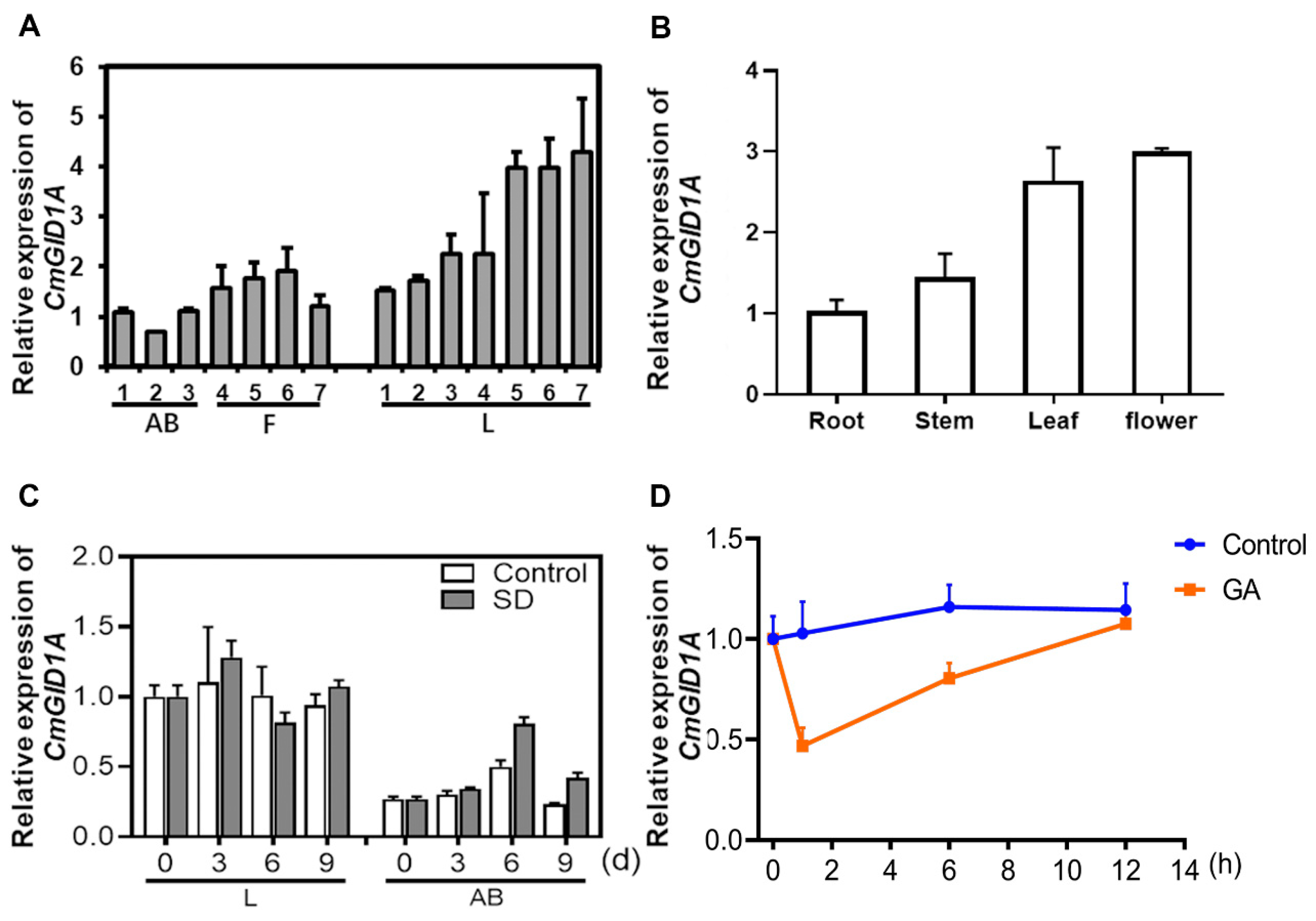
Figure 2.
CmGID1A regulates flowering of chrysanthemum. (A) Representative phenotypes of CmGID1A-RNAi lines. WT and CmGID1A-RNAi plants at 60 d, 90 d or 120 d under SDs, including 60 d of LDs and 0 d, 30 d or 60 d of SDs. Scale bars, 2 cm. (B) Relative CmGID1A expression analyzed by RT-qPCR in WT and CmGID1A-RNAi plants grown for 40 d under LDs. (C) Time to flower bud emergence of WT and CmGID1A-RNAi plants. Six samples were used to calculate the days to flower bud emergence. (D) Relative CmGID1B and CmGID1C expression analyzed by RT-qPCR in WT and CmGID1A-RNAi plants grown for 40 d under LDs. UBI was used as an internal control for RT-qPCR. The results are the means of 3 biological replicates with standard deviation. Asterisks indicate significant differences according to a Student’s t-test in (B) and (D) (*P < 0.05).
Figure 2.
CmGID1A regulates flowering of chrysanthemum. (A) Representative phenotypes of CmGID1A-RNAi lines. WT and CmGID1A-RNAi plants at 60 d, 90 d or 120 d under SDs, including 60 d of LDs and 0 d, 30 d or 60 d of SDs. Scale bars, 2 cm. (B) Relative CmGID1A expression analyzed by RT-qPCR in WT and CmGID1A-RNAi plants grown for 40 d under LDs. (C) Time to flower bud emergence of WT and CmGID1A-RNAi plants. Six samples were used to calculate the days to flower bud emergence. (D) Relative CmGID1B and CmGID1C expression analyzed by RT-qPCR in WT and CmGID1A-RNAi plants grown for 40 d under LDs. UBI was used as an internal control for RT-qPCR. The results are the means of 3 biological replicates with standard deviation. Asterisks indicate significant differences according to a Student’s t-test in (B) and (D) (*P < 0.05).
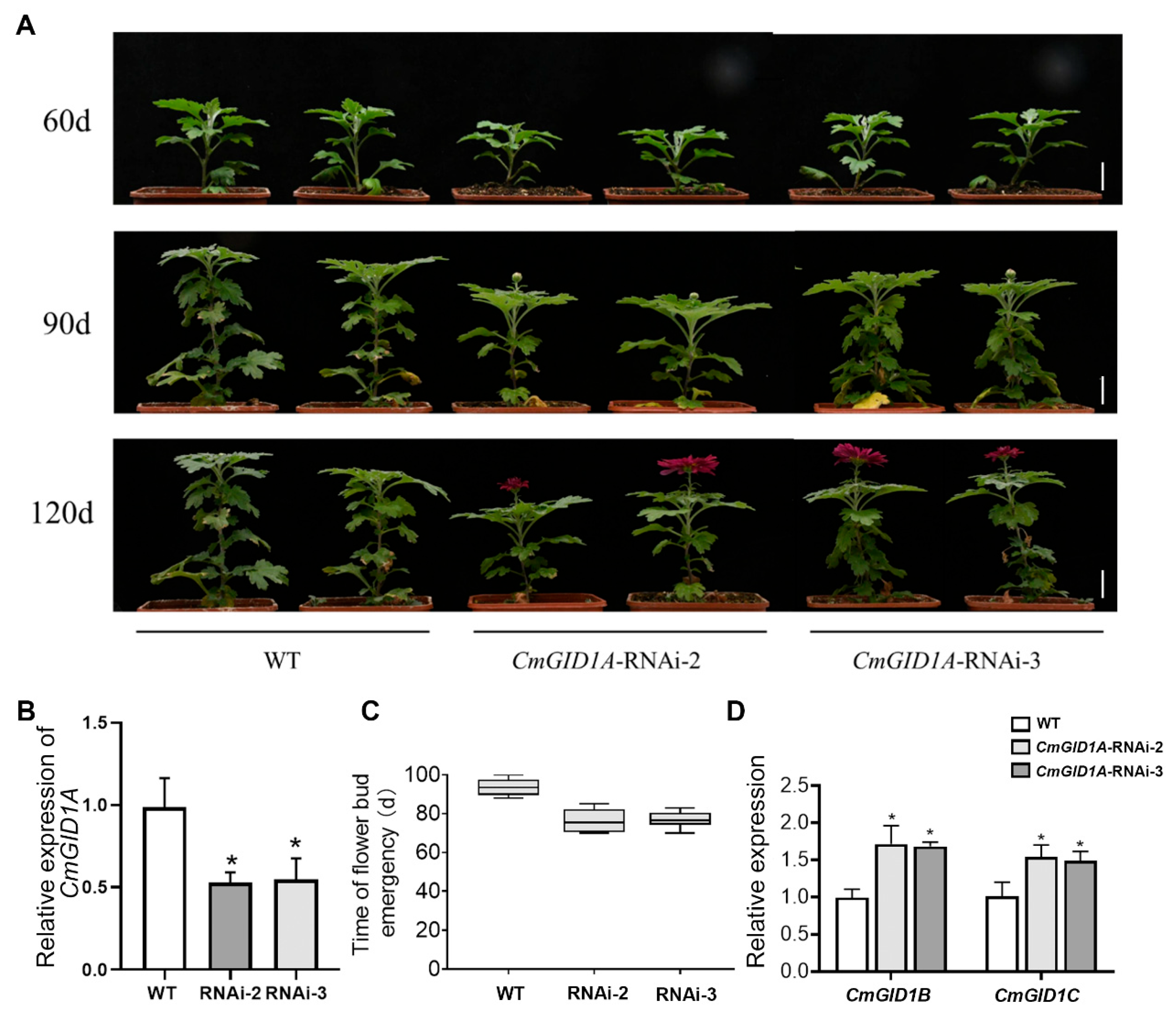
Figure 3.
CmGID1A interacts with CmRGL1 in a GA-dependent manner. (A) Y2H assays evaluating the interaction between CmGID1A and CmRGL1. The bait BD-CmGID1A and prey AD-CmRGL1 plasmids were cotransferred into yeast strain Y2HGold. Transformants were grown on synthetic defined (SD) medium lacking Leu and Trp (SD-TL) and then transferred to SD medium lacking Leu, Trp, Ade, and His and with 10 µM GA4+7. pGADT7 or pGBKT7 as a negative control. (B) Interaction of CmGID1A and CmRGL1 in a BiFC assay. N. benthamiana leaves were co-infiltrated with CmGID1A-YFPN and CmRGL1-YFPC constructs and visualized by confocal microscopy 3 d after infiltration. Combinations of CmGID1A-YFPN and YFPC, and CmRGL1-YFPC and YFPN were used as negative controls. The green fluorescence is the YFP, and the red fluorescence is the nucleus marker RFP (red fluorescent protein with H2B). Scale bars, 100 μm.
Figure 3.
CmGID1A interacts with CmRGL1 in a GA-dependent manner. (A) Y2H assays evaluating the interaction between CmGID1A and CmRGL1. The bait BD-CmGID1A and prey AD-CmRGL1 plasmids were cotransferred into yeast strain Y2HGold. Transformants were grown on synthetic defined (SD) medium lacking Leu and Trp (SD-TL) and then transferred to SD medium lacking Leu, Trp, Ade, and His and with 10 µM GA4+7. pGADT7 or pGBKT7 as a negative control. (B) Interaction of CmGID1A and CmRGL1 in a BiFC assay. N. benthamiana leaves were co-infiltrated with CmGID1A-YFPN and CmRGL1-YFPC constructs and visualized by confocal microscopy 3 d after infiltration. Combinations of CmGID1A-YFPN and YFPC, and CmRGL1-YFPC and YFPN were used as negative controls. The green fluorescence is the YFP, and the red fluorescence is the nucleus marker RFP (red fluorescent protein with H2B). Scale bars, 100 μm.
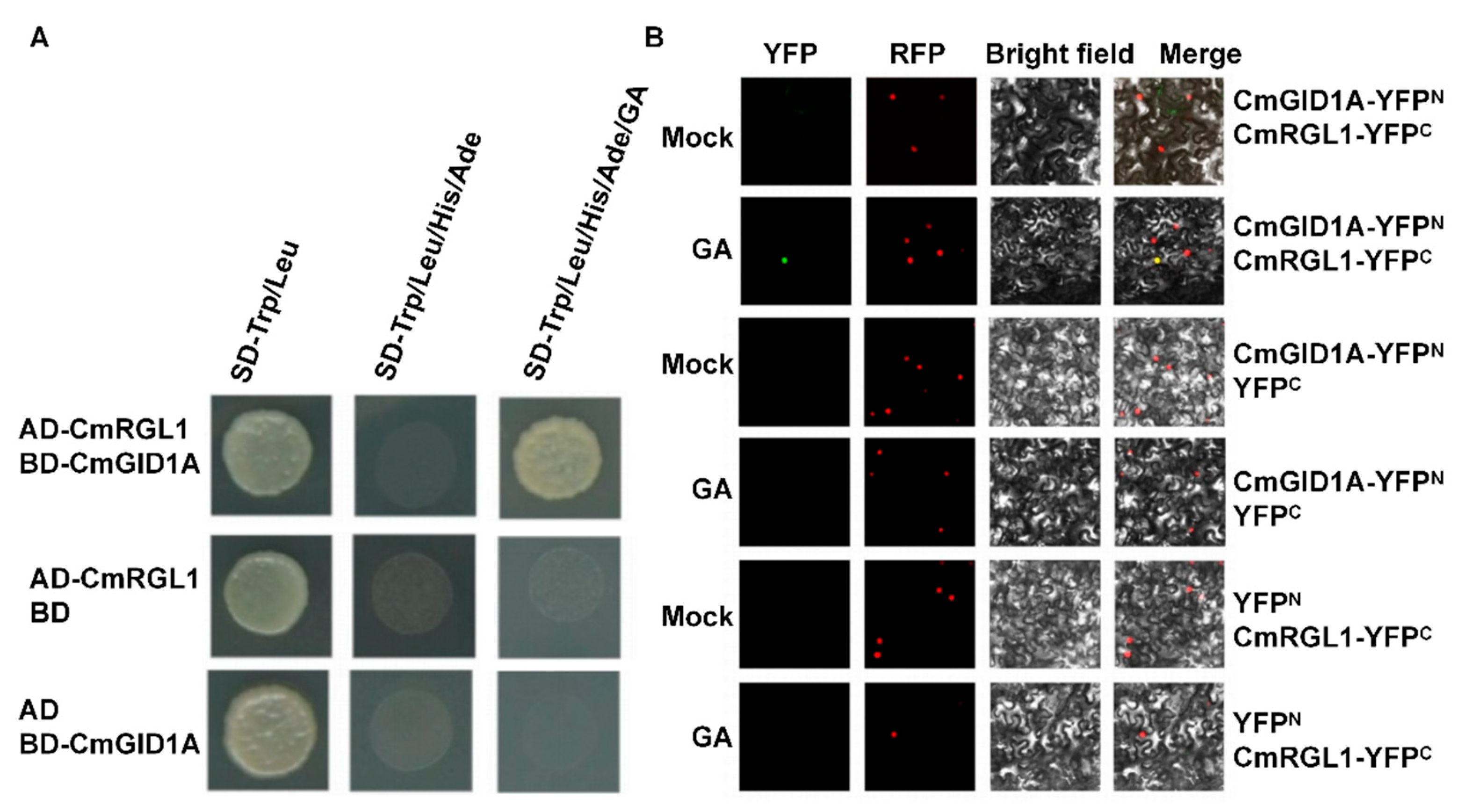
Figure 4.
Analysis of CmGID1A downstream regulation network. (A) Volcanic map of WT vs CmGID1A-RNAi in shoot apical meristems. The abscissa represents the change of gene expression multiple, and the ordinate represents the significance level of differential genes. Red is upregulated, green is downregulated, and black is non-differentially expressed. (B) The scatter plot for pathway enrichment analysis of DEGs. Top statistics of KEGG pathway enrichment for WT vs CmGID1A-RNAi. The Rich Factor is the ratio of differentially expressed gene numbers annotated in this pathway terms to all gene numbers annotated in this pathway term. q ≤ 0.05 is significantly enriched. (C) Histogram presentation of the COG classification of the differentially expressed genes in one comparison of WT vs CmGID1A-RNAi in shoot apical meristems. The capital letters in the x-axis indicate the COG categories as listed on the right and the y-axis indicates the number of DEGs in each category. (D) GO functional classification of DEG Unigenes and all Unigenes. Bar chart showing the functional distribution (percentage and number) of differentially expressed genes (DEG Unigenes) and all Unigenes across biological process, cellular component, and molecular function.
Figure 4.
Analysis of CmGID1A downstream regulation network. (A) Volcanic map of WT vs CmGID1A-RNAi in shoot apical meristems. The abscissa represents the change of gene expression multiple, and the ordinate represents the significance level of differential genes. Red is upregulated, green is downregulated, and black is non-differentially expressed. (B) The scatter plot for pathway enrichment analysis of DEGs. Top statistics of KEGG pathway enrichment for WT vs CmGID1A-RNAi. The Rich Factor is the ratio of differentially expressed gene numbers annotated in this pathway terms to all gene numbers annotated in this pathway term. q ≤ 0.05 is significantly enriched. (C) Histogram presentation of the COG classification of the differentially expressed genes in one comparison of WT vs CmGID1A-RNAi in shoot apical meristems. The capital letters in the x-axis indicate the COG categories as listed on the right and the y-axis indicates the number of DEGs in each category. (D) GO functional classification of DEG Unigenes and all Unigenes. Bar chart showing the functional distribution (percentage and number) of differentially expressed genes (DEG Unigenes) and all Unigenes across biological process, cellular component, and molecular function.
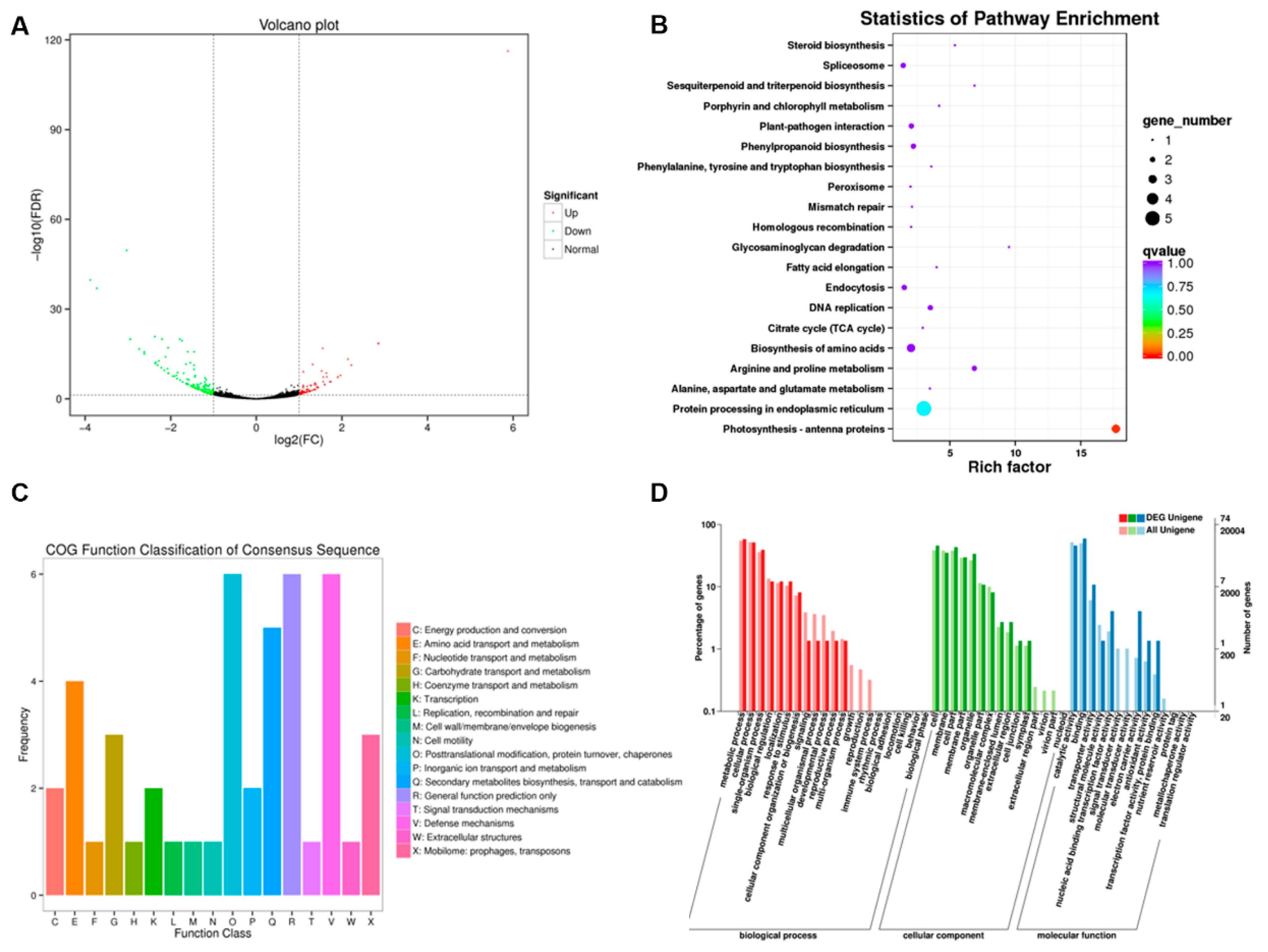
Figure 5.
ERF6 is a key downstream target of CmGID1A-GA signaling. (A) Heatmap of DEGs include transcription factors related to hormone and flowering in WT and CmGID1A-RNAi plants. Red represents high expression levels. (B) Relative CmERF6 expression analyzed by RT-qPCR in WT and CmGID1A-RNAi plants grown for 40 d under LDs. (C) Relative CmERF6 expression analyzed by RT-qPCR in chrysanthemum after 100 µM GA4+7 or 3% (v/v) dimethyl sulfoxide (DMSO) only as control treatment for 14 h. UBI was used as an internal control for RT-qPCR. The results are the means of 3 biological replicates with standard deviation. Asterisks indicate significant differences according to a Student’s t-test in (B) (*P < 0.05).
Figure 5.
ERF6 is a key downstream target of CmGID1A-GA signaling. (A) Heatmap of DEGs include transcription factors related to hormone and flowering in WT and CmGID1A-RNAi plants. Red represents high expression levels. (B) Relative CmERF6 expression analyzed by RT-qPCR in WT and CmGID1A-RNAi plants grown for 40 d under LDs. (C) Relative CmERF6 expression analyzed by RT-qPCR in chrysanthemum after 100 µM GA4+7 or 3% (v/v) dimethyl sulfoxide (DMSO) only as control treatment for 14 h. UBI was used as an internal control for RT-qPCR. The results are the means of 3 biological replicates with standard deviation. Asterisks indicate significant differences according to a Student’s t-test in (B) (*P < 0.05).
Disclaimer/Publisher’s Note: The statements, opinions and data contained in all publications are solely those of the individual author(s) and contributor(s) and not of MDPI and/or the editor(s). MDPI and/or the editor(s) disclaim responsibility for any injury to people or property resulting from any ideas, methods, instructions or products referred to in the content. |
© 2026 by the authors. Licensee MDPI, Basel, Switzerland. This article is an open access article distributed under the terms and conditions of the Creative Commons Attribution (CC BY) license (http://creativecommons.org/licenses/by/4.0/).
Copyright: This open access article is published under a Creative Commons CC BY 4.0 license, which permit the free download, distribution, and reuse, provided that the author and preprint are cited in any reuse.


