

Submitted:
30 April 2026
Posted:
05 May 2026
You are already at the latest version
Abstract
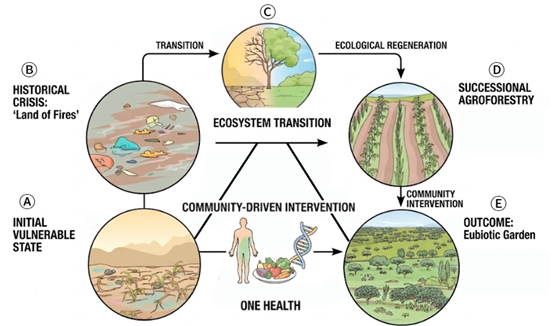
Quantitative results demonstrate that the 4D stratified model significantly improved soil quality and vertical structural complexity; vegetation density increased from 5 to 35 plants/m², while species richness exhibited a fourfold increase. Beyond biophysical restoration, the intervention catalyzed a "narrative inversion," transitioning the site from a stigmatized wasteland to a socio-ecological hub that fosters collaborative health literacy and community resilience. By integrating agroecological practices with the EcoFoodFertility clinical framework, the project illustrates the potential of localized interventions to function as "preventive infrastructures" within a One Health paradigm. The findings suggest that SAFS represents a scalable laboratory for territorial re-signification, offering transferable insights for aligning ecological restoration with social innovation in degraded peri-urban landscapes, in accordance with Nature-Based Solutions (NBS) and European Green Deal objectives.
Keywords:
Land of Fires
; peri-urban agroforestry
; successional agroforestry systems
; territorial resignification
; socio-ecological transition
; One Health
; collaborative health literacy
; regenerative agriculture
; community resilience
Copyright: This open access article is published under a Creative Commons CC BY 4.0 license, which permit the free download, distribution, and reuse, provided that the author and preprint are cited in any reuse.


