

Submitted:
27 April 2026
Posted:
28 April 2026
You are already at the latest version
Abstract
Background: Mean arterial pressure (MAP) is widely used to guide hemodynamic management, yet it provides limited insight into the underlying physiological determinants of circulation. Identical MAP values may reflect markedly different states of cardiac output and vascular tone. The arterial pressure waveform contains rich physiological information beyond static pressure values, but this information is rarely quantified in a simple, continuous, and interpretable manner. Objective: To evaluate the relationship between a novel arterial waveform–derived metric, the Pulse Energy Ratio (PER), and reference cardiac output in a large intraoperative dataset. Methods: We performed a retrospective observational analysis using the VitalDB database, including 248 patients with concurrent high-resolution arterial pressure waveforms and cardiac output measurements obtained from an EV1000 volumetric monitoring system. PER was calculated as the area of the arterial waveform above the diastolic baseline normalized to the diastolic pressure–time integral for each cardiac cycle. Beat-level and rolling 10-beat averaged PER values (PERC) were analyzed. Correlations with cardiac output were assessed using aggregated time-segment data to account for repeated measures, with additional sensitivity analyses including first-differenced signals and mixed-effects modeling. Results: PER demonstrated strong positive correlation with cardiac output across a wide range of intraoperative conditions. Beat-level PER correlated with cardiac output at r = 0.781, while PERC showed r = 0.797. Rolling 10-beat averaging further strengthened these relationships (PER r = 0.834; PERC r = 0.822; all p < 0.001). These associations remained consistent across multiple analytic approaches designed to account for temporal dependence and within-subject clustering. Conclusions: The Pulse Energy Ratio is a physiologically grounded, waveform-derived metric that correlates strongly with cardiac output without requiring calibration or additional hardware. By quantifying the pulsatile component of the arterial waveform, PER may provide continuous insight into the interaction between forward flow and vascular tone. This approach has the potential to enhance interpretation of arterial pressure and support more physiologically informed hemodynamic monitoring, warranting prospective validation.
Keywords:
hemodynamics
; shock
; monitoring
; intensive care
; critical illness
Introduction
Hemodynamic monitoring remains central to the management of critically ill and perioperative patients. In clinical practice, while clinicians most commonly rely on mean arterial pressure (MAP) as the primary endpoint to guide resuscitation, vasopressor titration, and overall hemodynamic management, this has shortcomings particularly when used in isolation. Although stroke volume/cardiac output, large arterial compliance, and systemic vascular resistance represent the fundamental physiological determinants of arterial pressure, these variables are more complex and less frequently measured continuously at the bedside. As a result, MAP is often used as a surrogate for hemodynamic adequacy despite its known limitations in reflecting underlying cardiovascular physiology. (1)
Mean arterial pressure is fundamentally determined by the interaction between cardiac output and vascular properties, particularly vascular tone, and therefore similar MAP values may reflect markedly different physiological states. (2) A given MAP may be sustained by preserved forward flow, or alternatively by high vascular tone with reduced cardiac output. These physiologically distinct states may carry different implications for tissue perfusion, organ function, and therapeutic decision-making. Despite this, current bedside monitoring offers limited tools to distinguish between these scenarios using continuously available signals.
The arterial pressure waveform contains substantially more physiological information than isolated systolic and diastolic values. (3) The morphology of the waveform reflects the interaction between ventricular ejection, arterial properties, and vascular tone. (4) The amplitude, width, and overall contour of the waveform are influenced by stroke volume, ventricular performance, arterial compliance, and systemic vascular resistance. Despite this rich physiologic content, waveform interpretation in clinical practice remains largely qualitative, and quantitative extraction of waveform-derived physiologic information remains underdeveloped outside of proprietary pulse contour algorithms which require hardware.
Existing arterial waveform-based cardiac output estimation methods typically rely on complex mathematical modeling, calibration procedures, and population-derived assumptions regarding arterial compliance. While these approaches have demonstrated reasonable performance in selected settings, they often lack transparency, may perform inconsistently across patient populations, and frequently require dedicated monitoring platforms. In contrast, a physiologically grounded waveform metric that may serve as a surrogate marker of pulsatile ventricular ejection and vascular loading conditions without calibration may provide a simpler and more interpretable approach to hemodynamic monitoring.
The Pulse Energy Ratio (PER) is a novel arterial waveform-derived index designed to quantify the pulsatile component of the arterial pressure waveform during each cardiac cycle relative to the diastolic pressure baseline. Conceptually, PER represents the integrated area of the arterial pressure waveform above the diastolic pressure across an entire cardiac cycle over the diastolic pressure–time integral - the theoretical “rectangle” upon which the pulse is added (Figure 1). The concept of pressure-time interval is already widely used in echocardiography. (5) This formulation incorporates both waveform amplitude and duration, thereby generating a single continuous dimensionless metric that may serve as a surrogate of pulsatile ventricular ejection and vascular loading conditions without requiring identification of specific waveform landmarks.
Physiologically, higher stroke volumes are expected to produce broader, possibly taller, arterial waveforms and therefore higher PER values, whereas lower stroke volumes and vasoconstricted states may produce narrower waveforms and lower PER values. As such, PER may provide a continuous morphological signal that serves as a surrogate for changes in forward flow and vascular tone.
In this context, waveform-derived energy metrics may provide insight into the physiological quality of arterial pressure. Two patients with identical MAP values may exhibit markedly different waveform energy profiles, reflecting differences in stroke volume, ventricular performance, and vascular tone. Continuous assessment of waveform features may therefore enable clinicians to distinguish between pressure supported primarily by forward flow versus pressure maintained predominantly by vasoconstriction. Such distinctions may be particularly relevant during resuscitation, where therapeutic interventions aim not only to restore pressure but also to improve effective forward flow and tissue perfusion.
The present study was designed to evaluate the relationship between arterial waveform-derived pulse energy ratio and reference hemodynamic measurements in a large retrospective intraoperative dataset. Using high-resolution arterial pressure waveforms from the VitalDB database, we calculated beat-by-beat PER and compared it with simultaneously measured cardiac output obtained from a validated volumetric monitoring system. We hypothesized that PER would demonstrate a positive correlation with cardiac output consistent with its physiological basis.
By establishing the relationship between arterial waveform-derived PER and reference hemodynamic variables, this study aims to provide the physiological and empirical foundation for the pulse energy ratio as a novel, continuous, and calibration-free hemodynamic monitoring parameter. This retrospective analysis represents the first step toward prospective clinical evaluation of the usefulness of PER as a hemodynamic metric.
Methods
Study Design and Data Source
This study was a retrospective observational analysis using the VitalDB open-access intraoperative physiological dataset. Cases were included if they contained concurrent recordings of high-resolution arterial pressure waveforms and cardiac output (CO) data. A total of 248 patient records met inclusion criteria.
Arterial waveform data were obtained from radial arterial catheters (SNUADC/ART channel), while reference cardiac output was derived from the EV1000 volumetric monitoring system (Edwards Lifesciences). These data streams were temporally aligned for subsequent analysis.
Arterial Waveform Processing
High-resolution arterial pressure waveforms were analyzed using proprietary signal processing software developed by ResusCareAI Inc. The software performed beat-by-beat segmentation of arterial waveforms using automated peak detection and quality filtering algorithms.
For each cardiac cycle, the Pulse Energy Ratio (PER) was calculated as the integrated area of the arterial pressure waveform above the diastolic pressure baseline, normalized to a diastolic pressure–time reference over the duration of the cardiac cycle. This calculation incorporated the full waveform morphology without requiring identification of waveform landmarks such as the dicrotic notch.
In addition to beat-level PER, a macro-averaged variant (PERC, over 10 beats) was computed to reduce sensitivity to beat-to-beat variability. Rolling 10-beat averages were calculated for both PER and PERC to evaluate the effect of temporal smoothing and improve robustness against transient waveform artifacts, respiratory variation, and ectopic beats.
Quality control filters excluded beats with (1) signal dropout, (2) non-physiologic pressure excursions, (3) irregular segmentation artifacts and (4) incomplete waveform capture. Only valid beats meeting predefined signal quality criteria were included in the final analysis.
Reference Hemodynamic Measurements
Reference cardiac output and calculated systemic vascular resistance were obtained from the EV1000 volumetric monitoring platform (Edwards Lifesciences). Cardiac output was obtained from the EV1000 platform, which uses arterial waveform analysis scaled by intermittent transpulmonary thermodilution calibration.
Reference measurements were synchronized with waveform-derived PER values to allow beat-by-beat and rolling-window correlation analysis.
Statistical Analysis
This was performed using Pearson correlation coefficients to evaluate relationships between waveform-derived indices and cardiac output. To account for the repeated-measures structure of the data and avoid inflation of association strength from beat-level autocorrelation, waveform-derived metrics were aggregated over time segments corresponding to stable reference cardiac output measurements, and correlations were computed using these aggregated observations. Additional sensitivity analyses were performed to ensure robustness of the observed relationships, including first-differenced signal analysis (ΔPER vs ΔCO) to reduce temporal autocorrelation, adjustment for effective sample size to account for residual dependence, and linear mixed-effects modeling with patient-level random intercepts to account for within-subject clustering and temporal trends. Across these approaches, the association between PER and cardiac output remained consistent.
Primary comparisons included:
- PER vs cardiac output
- PERC vs cardiac output
Rolling 10-beat averaged indices were also evaluated to assess the impact of smoothing on correlation strength.
Absolute-value correlations were calculated to assess the strength of association independent of direction, capturing both positive and inverse relationships.
Given the large number of observations, statistical significance was defined as p < 0.001 for all comparisons. The analysis was considered exploratory and hypothesis-generating, and no adjustment for multiple comparisons was applied.
Results
Study Population and Data Availability
A total of 248 intraoperative patient records from the VitalDB database met inclusion criteria, with concurrent availability of high-resolution arterial waveform data and cardiac output (CO) derived from the EV1000 volumetric monitoring system. Arterial waveforms were obtained from radial arterial catheters and processed using beat-by-beat segmentation with subsequent calculation of Pulse Energy Ratio (PER) and macro-averaged Pulse Energy Ratio (PERC). Rolling 10-beat averages were computed to evaluate the effect of temporal smoothing on correlation performance.
Pulse Energy Ratio Correlation with Cardiac Output
Pulse Energy Ratio demonstrated strong positive correlations with reference cardiac output. Beat-level PER correlated with CO at r = 0.781, while PERC demonstrated a slightly stronger correlation (r = 0.797). Application of rolling 10-beat averaging further strengthened these relationships, with PER roll10 achieving r = 0.834 and PERC roll10 achieving r = 0.822 (all p < 0.001).
These findings indicate that PER is strongly associated with changes in cardiac output across a wide range of intraoperative hemodynamic conditions. The improvement observed with rolling averaging suggests that smoothing reduces beat-to-beat variability related to respiratory variation, ectopy, and transient waveform noise while preserving physiologic trends.
Summary of Primary Findings
Across 248 intraoperative patients:
Strong positive correlation between PER and cardiac output
PER: r = 0.781
PERC: r = 0.797
PER roll10: r = 0.834
PERC roll10: r = 0.822
All correlations were statistically significant (p < 0.001).
Discussion
In this retrospective analysis of 248 intraoperative patients, arterial waveform–derived Pulse Energy Ratio (PER) demonstrated strong correlation with reference cardiac output. These findings support the hypothesis that PER, as a waveform-derived surrogate index, may reflect aspects of cardiovascular performance and vascular tone. Correlation strength improved with rolling averaging, suggesting that temporal smoothing reduces transient beat-to-beat variability while preserving the observed associations
These findings suggest that PER as a physiologically grounded, waveform-derived metric that may provide continuous insight into hemodynamic state using signals already available in routine clinical care. Unlike many existing cardiac output monitoring systems, PER does not require additional hardware, calibration, or invasive procedures beyond standard arterial pressure monitoring.
Understanding the Generation of Diastolic Pressure
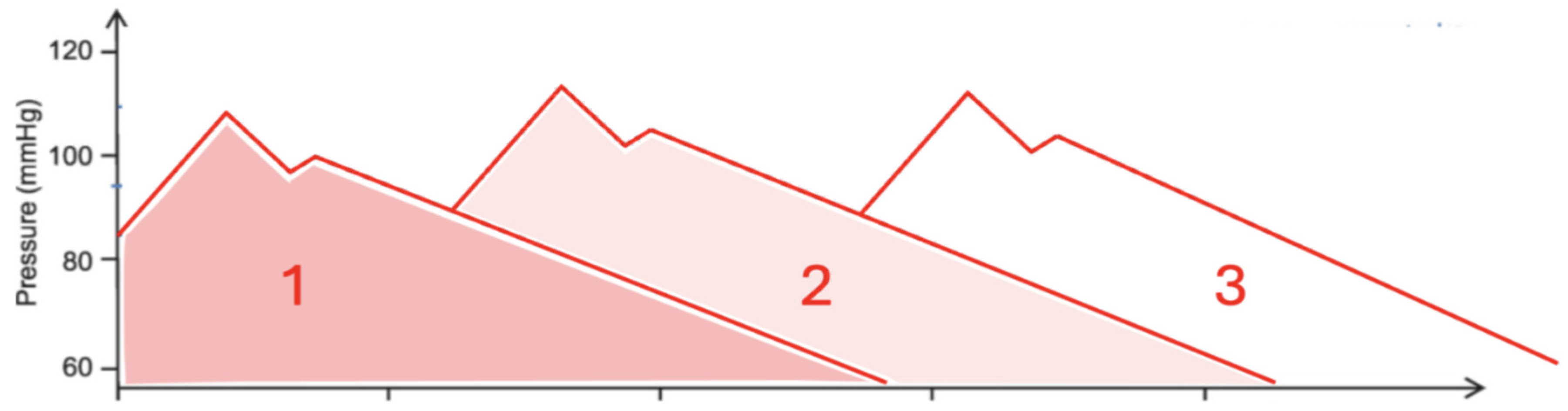
Diastolic pressure is not a static reservoir but the cumulative result of residual elastic energy from prior systolic ejections interacting with continuous distal runoff. Each cardiac cycle contributes to a temporally overlapping decay curve, such that the observed diastolic pressure represents a dynamic equilibrium between arterial recoil and peripheral flow. (Figure 2)
Physiological Interpretation: Not All MAP Is Created Equal
Mean arterial pressure remains the most commonly used endpoint for resuscitation and hemodynamic management. However, MAP alone provides limited insight into the underlying physiological determinants of circulation. Because MAP is governed by both cardiac output and systemic vascular resistance, identical MAP values may reflect markedly different hemodynamic states. One patient may maintain MAP through robust stroke volume and forward flow, while another may maintain the same pressure through vasoconstriction with a concomitantly reduced cardiac output.
The PER provides a continuous morphological assessment of the arterial waveform that reflects this distinction. Higher PER values are associated with broader, higher-amplitude arterial waveforms consistent with greater forward flow, while lower PER values are associated with narrower waveforms consistent with increased vascular tone or reduced stroke volume. In this way, PER may provide insight into the physiological "quality" of arterial pressure, helping to distinguish pressure supported by flow from pressure supported by vasoconstriction.
This distinction may be particularly important during resuscitation, where therapeutic interventions such as fluid administration, vasopressors, and inotropes may produce similar changes in MAP but have different effects on cardiac output and tissue perfusion. Continuous waveform-derived monitoring may therefore provide additional context for interpreting changes in arterial pressure and guiding therapeutic decisions.
Importance of Trending and Continuous Monitoring
From a clinical perspective, the most valuable feature of waveform-derived indices such as PER is their ability to provide continuous trending information. In hemodynamic monitoring, trends are often more informative than isolated values, as they reflect the physiologic response to interventions and allow early detection of evolving instability. (6)
Because PER can be derived continuously from the arterial waveform, directional changes may provide real-time insight into whether therapeutic interventions are improving or worsening cardiovascular performance. For example, an increase in PER following fluid administration may reflect improved stroke volume and forward flow, whereas a decrease in PER despite stable MAP may suggest worsening cardiac performance or increasing vascular tone. Similarly, an increase in MAP following vasopressor initiation accompanied by a decrease in PER may indicate ventriculo-arterial uncoupling, prompting reassessment of perfusion and cardiac function, while concordant increases in both MAP and PER would support true hemodynamic improvement.
Importantly, changes in PER may precede changes in conventional vital signs. Progressive reductions in PER may signal declining cardiac output or increasing vascular tone before a fall in MAP becomes apparent, offering an earlier warning of hemodynamic deterioration. This may be particularly valuable in perioperative and critical care settings, where rapid physiologic changes are common.
By enabling continuous, real-time assessment of physiologic response, PER provides an additional signal to guide fluid therapy, vasopressor titration, and inotropic support. Rather than relying solely on static pressure targets, clinicians may assess whether interventions are moving the patient toward improved hemodynamic conditions and adequate forward flow.
Increasing Capability of Basic Invasive Monitoring
A particularly important implication of this work is that PER requires only an adequate arterial pressure waveform. No additional sensors, calibration procedures, or invasive devices are necessary beyond standard arterial line monitoring, which is already widely used in perioperative and critical care settings.
Because PER is derived from waveform morphology, the analysis can be implemented in software and integrated directly into existing patient monitoring systems. This creates the potential for broad deployment without additional hardware costs or procedural risks. In principle, any monitor capable of displaying a continuous arterial waveform could incorporate PER analysis.
Furthermore, advances in computer vision and artificial intelligence may extend this concept even further. Waveform analysis could potentially be performed using camera-based systems capturing monitor displays, enabling retrospective or real-time analysis without direct integration into monitoring hardware. Such approaches could expand access to advanced hemodynamic interpretation in settings where proprietary monitoring platforms are unavailable.
These possibilities suggest a pathway toward democratizing hemodynamic monitoring. Rather than requiring specialized and often expensive cardiac output devices, physiologic insight could be derived from routinely available waveform data using software-based analysis. This approach may be particularly valuable in resource-limited environments, smaller hospitals, or settings where advanced hemodynamic monitoring is not routinely available.
Comparison with Existing Monitoring Approaches
Traditional cardiac output monitoring systems rely on thermodilution, pulse contour analysis, bioreactance, or Doppler-based approaches, often requiring additional hardware, calibration, or operator expertise. While these technologies provide valuable information, they may be limited by cost, invasiveness, or operational complexity.
In contrast, PER is derived directly from the arterial waveform without calibration or model-based assumptions regarding arterial compliance. This simplicity may offer advantages in robustness, ease of implementation, and interpretability. Additionally, because PER reflects waveform morphology rather than absolute volumetric measurements, it may be particularly useful for trending physiologic changes over time.
The correlation magnitudes observed in this study are comparable to those reported for uncalibrated pulse contour methods in perioperative populations. (7,8) While correlation does not imply interchangeability with cardiac output measurement, these findings support the potential clinical utility of waveform-derived morphology metrics as physiologic surrogates.
Limitations
This study has several limitations. First, the retrospective observational design limits causal inference and does not allow assessment of clinical outcomes associated with PER-guided management. Second, correlation analysis does not establish interchangeability with cardiac output measurement, and future studies using agreement and trending analyses are warranted. Thirdly, the reference cardiac output was derived from a semi-calibrated pulse contour system, which may introduce measurement variability, particularly between calibration intervals. Fourth, patient-level clinical variables such as vasopressor use, fluid administration, and surgical factors were not controlled for in this analysis. Fifth, this correlation was done using radial artery catheter data, while many resuscitationists have transitioned to using femoral arterial lines, hence this should be repeated with more central catheters.
Additionally, arterial compliance varies between patients and may influence waveform morphology independently of cardiac output or systemic vascular resistance. Future studies may explore whether patient-specific factors influence PER performance.
Finally, this dataset was derived from intraoperative patients at a single institution, which may limit generalizability to other clinical environments such as intensive care or emergency settings.
Future Directions
These findings support further investigation of waveform-derived Pulse Energy Ratio in prospective clinical studies. Future work may include:
- Prospective validation studies
- Trending and concordance analysis
- Evaluation in critically ill populations
- Assessment of therapeutic responsiveness
- Integration into bedside monitoring systems
Additionally, integration of PER into machine learning–based waveform analysis platforms may enable multi-parameter hemodynamic interpretation and automated clinical decision support.
Conclusion
The evolution of resuscitation is increasingly moving toward targeted, precision-based care guided by bedside physiology rather than protocol-driven management. Standardized algorithms, while useful for initial stabilization, often fail to account for the dynamic and heterogeneous nature of hemodynamic instability. The Pulse Energy Ratio (PER) provides a continuous, waveform-derived metric that may reflect the interaction between stroke volume and vascular tone, allowing clinicians to identify underlying pathophysiology in real time using data already available from an arterial line.
Pulse Energy Ratio derived from the arterial pressure waveform demonstrated strong correlation with cardiac output and moderate inverse correlation with calculated systemic vascular resistance in a large intraoperative dataset. Notably, PER demonstrated strong correlation with a semi-calibrated pulse contour system despite relying solely on raw waveform morphology, without model-based assumptions or external calibration.
The ability to continuously trend waveform-derived pulsatile energy may allow clinicians to monitor physiologic responses to interventions and detect early cardiovascular deterioration although this requires prospective validation. Because PER requires only a standard arterial pressure waveform and software-based analysis, this approach may enable broader access to physiologic hemodynamic monitoring and represents a step toward more accessible and democratized hemodynamic assessment.
References
- Magder S. The meaning of blood pressure. Crit Care. 2018 Oct 11;22(1):257. PMID: 30305136; PMCID: PMC6180453. [CrossRef]
- Hall, John E.. Guyton and Hall textbook of medical physiology, 14th international edition,. 14 Philadelphia: Elsevier, 2021. Text.
- Saugel B, Kouz K, Scheeren TWL, Greiwe G, Hoppe P, Romagnoli S, de Backer D. Cardiac output estimation using pulse wave analysis-physiology, algorithms, and technologies: a narrative review. Br J Anaesth. 2021 Jan;126(1):67-76. Epub 2020 Nov 24. PMID: 33246581. [CrossRef]
- Westerhof N, Lankhaar JW, Westerhof BE. The arterial Windkessel. Med Biol Eng Comput. 2009 Feb;47(2):131-41. Epub 2008 Jun 10. PMID: 18543011. [CrossRef]
- Otto CM. Textbook of Clinical Echocardiography. 7th ed. Elsevier; 2023.
- Pinsky MR. Hemodynamic evaluation and monitoring in the ICU. Chest. 2007 Dec;132(6):2020-9. PMID: 18079239. [CrossRef]
- Critchley LA, Critchley JA. A meta-analysis of studies using bias and precision statistics to compare cardiac output measurement techniques. J Clin Monit Comput. 1999 Feb;15(2):85-91. PMID: 12578081. [CrossRef]
- Cecconi M, Corredor C, Arulkumaran N, Abuella G, Ball J, Grounds RM, Hamilton M, Rhodes A. Clinical review: Goal-directed therapy-what is the evidence in surgical patients? The effect on different risk groups. Crit Care. 2013 Mar 5;17(2):209. PMID: 23672779; PMCID: PMC3679445. [CrossRef]
Figure 1.
The PER concept and calculation is shown in panel A, and panel B illustrates that blood pressure values may be nearly identical but represent very different hemodynamic states.
Figure 1.
The PER concept and calculation is shown in panel A, and panel B illustrates that blood pressure values may be nearly identical but represent very different hemodynamic states.
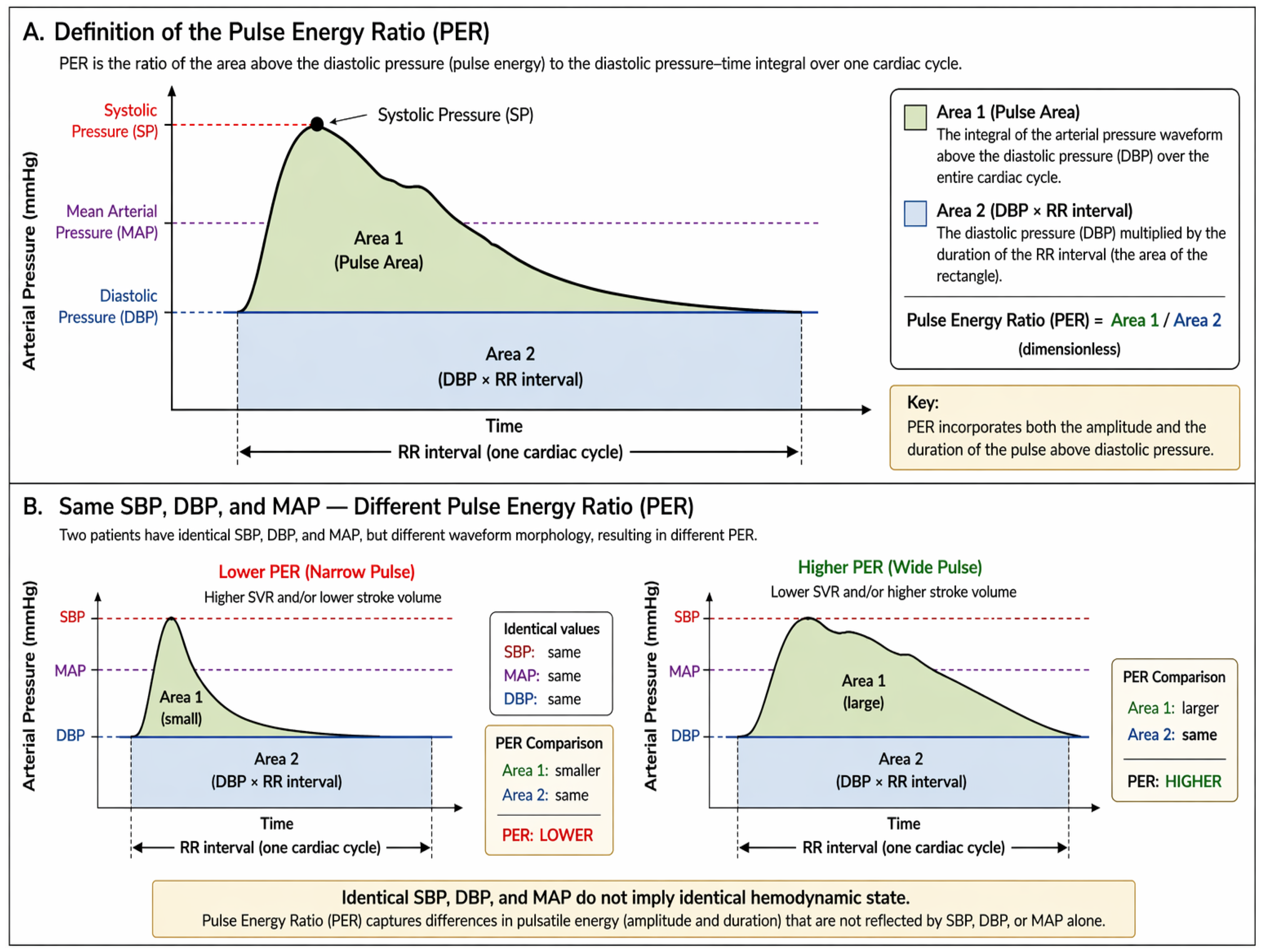
Figure 2.
Theoretical diagram of the contribution of preceding pulses to the generation of the diastolic blood pressure.
Figure 2.
Theoretical diagram of the contribution of preceding pulses to the generation of the diastolic blood pressure.
Disclaimer/Publisher’s Note: The statements, opinions and data contained in all publications are solely those of the individual author(s) and contributor(s) and not of MDPI and/or the editor(s). MDPI and/or the editor(s) disclaim responsibility for any injury to people or property resulting from any ideas, methods, instructions or products referred to in the content. |
© 2026 by the authors. Licensee MDPI, Basel, Switzerland. This article is an open access article distributed under the terms and conditions of the Creative Commons Attribution (CC BY) license (http://creativecommons.org/licenses/by/4.0/).
Copyright: This open access article is published under a Creative Commons CC BY 4.0 license, which permit the free download, distribution, and reuse, provided that the author and preprint are cited in any reuse.


