
Submitted:
28 April 2026
Posted:
28 April 2026
You are already at the latest version
Abstract
Oculomotor dysfunction is an eye movement disorder frequently experienced in patients with Parkinson’s disease. While this neurodegenerative disorder is often characterised by tremors, rigidity and slow movement, many patients tend to experience visual symptoms during its early stages and this can exacerbate cognitive symptoms when visual tasks become more demanding. This review provides an update on the recent advances in the neurorehabilitation of oculomotor dysfunction, and it uses a sensory-motor integration framework for understanding the vision-related symptoms and the functional challenges imposed on the patient’s activities of daily living. This is categorized in terms of visual sensory, visual motor, visual perceptual, cognitive processing, and psychosocial challenges, and this understanding is vital for accurate diagnosis, monitoring, and implementing effective strategies to improve their visual function and overall quality-of-life. By fostering interdisciplinary collaboration, healthcare professionals can take proactive steps to address the vision-related challenges faced by patients with Parkinson’s disease and effectively manage the challenges faced by patients with Parkinson’s disease.
Keywords:
Parkinson’s disease
; oculomotor dysfunction
; convergence insufficiency
; vestibular dysfunction
; neuro optometric rehabilitation therapy
1. Introduction
Parkinson’s disease is a progressive neurodegenerative disorder characterised by tremors, rigidity and slow movement (Bradykinesia). These motor disorders usually present unilaterally in its early stages before affecting both sides of the body when the condition advances, and this can impact their activities of daily living where even simple tasks like writing, buttoning clothes or walking can become arduous. However, eye movement disorders are often overlooked during its early stages as routine eye examination of the patient’s visual acuity often show normal results, and subtle decline in contrast sensitivity and colour vision are often missed [1,2,3].
Oculomotor dysfunction, or ocular motor dysfunction, refers to the neurological disorders of eye movement control and coordination, a condition that is frequently observed in patients with Parkinson’s disease [4]. This condition encompasses challenges in relation to the execution of saccadic eye movement, pursuit eye movement, vergence, accommodation, and its integration with the vestibular system [4], and this is distinctively different from oculomotor disorders arising from cranial nerve palsies, such as third (oculomotor) cranial nerve palsy, as the latter are not usually observed in patients with Parkinson’s disease and are managed differently. In Parkinson’s disease, the neural deficits of the oculomotor dysfunction arise primarily from axonal damages and dopamine deficiencies due to disease progression, although this also involves multiple neurotransmitters, such as the cholinergic, GABAergic, and glutamatergic pathways [5,6].
Given that oculomotor dysfunction is frequently experienced in patients with Parkinson’s disease, nearly 43% have complaints about their vision [7], ranging from mild symptoms, such as eyestrain (asthenopia) and visual fatigue [8,9], to more severe symptoms, such as double vision (diplopia) and headaches [10]. These symptoms are related to binocular vision disorders and oculomotor dysfunction but it can occur independent of the patient’s general motor severity [2]. This can affect visual perception and visuomotor function, which negatively impact the patient’s overall prognosis [11], as their symptoms tend to share some similarities with patients suffering from traumatic brain injury and concussion due to its widespread changes in the brainstem, cerebellum, basal ganglia and frontal lobe [4]. Since the inhibitory and excitatory signals are similar, it can be difficult to distinguish between reduced dopamine levels or a direct effect of oculomotor dysfunction based on the symptoms alone. Thus, it is necessary to evaluate the oculomotor function of patients with Parkinson’s disease in order to manage these symptoms.
2. The Evaluation of Oculomotor Dysfunction in Parkinson’s Disease
In Parkinson’s disease, oculomotor dysfunction may be first identified as part of a comprehensive neurological examination by the neurologist within the broader context of this complex neurodegenerative disorder, whereas eye diseases or structural problems are typically ruled out by ophthalmologists and/or neuro-ophthalmologists in hospitals. The detailed clinical evaluation and management of oculomotor dysfunction, however, often take place during rehabilitation or in community settings, because hospitals tend to prioritise the patient’s acute medical needs whereas the manifestation of oculomotor dysfunction tends to be more apparent during functional tasks.
A comprehensive evaluation of oculomotor dysfunction entails specialised tests in the context of functional tasks that stresses on oculomotor control and coordination, so its evaluation is often omitted under the time constraints in acute hospitals [12]. In contrast, there is a higher chance for the physical therapists (physiotherapists), occupational therapists and optometrists in the community to identify the often overlooked symptoms of oculomotor dysfunction because the patient’s neurorehabilitation tend to be structured and goal-oriented with the objectives to improve movement, balance, and independence [13]. For example, it is more likely for the rehabilitation team to observe a patient’s struggle to track a moving target during a balance exercise, or difficulty in performing fine motor tasks or reading.
To diagnose oculomotor dysfunction, the clinical evaluation should entail a battery of neuro optometric tests to evaluate the patient’s fixation, vergence, accommodation, saccades and pursuit, and a comprehensive evaluation of visual acuity, refraction, binocular vision, stereopsis (depth perception) and ocular health [4]. These visual functions must be coordinated in relation to vestibular function (in the inner ear, for balance) to accurately direct and stabilize the eye’s gaze to obtain a sharp retinal image. While advanced eye-tracking technologies can quantify and monitor saccadic impairments, fixation instability, and pursuit deficit, this is not absolutely necessary during the evaluation and rehabilitation of the patient because the neuro optometric evaluation techniques of oculomotor function are well established [14], and many of these technologies are currently not optimised to accurately capture information on vergence and accommodation [15].
The eye’s fixation refers to the ability to steadily hold one’s gaze on a stationary target, and this is crucially coupled with vergence (the eye’s ability to move simultaneously in opposite directions) and accommodation (the eye’s ability to rapidly adjust focus on near objects) to maintain binocular single vision and accurate stereopsis. One common example of a vergence disorder is convergence insufficiency, which affects nearly 50% of patients with Parkinson’s disease [8,9]. A third of those with convergence insufficiency tend to experience diplopia in the distance due to hypertropia, exotropia, or esotropia [10], and nearly all patients with diplopia have convergence insufficiency [10]. These deficits may in turn affect saccadic eye movements (which are intended to rapidly shift the fovea from one place to another), and pursuit eye movements (which are intended to enable the fovea to maintain a clear, steady, and continuous image on a slow-moving target).
Since saccadic and pursuit eye movements are supposed to be conjugate with equal velocity and amplitudes, it requires the accommodative and vergence of the visual system to be tightly coupled in the process of fixation [4]. If vergence and/or accommodation are poorly coordinated, its fixation and movements can become unstable due to inaccurate spatial localisation, alignment and poor stereopsis. For example, the eyes may tend to make several small corrective saccades (e.g., saccadic intrusions and anti-saccades) instead of converging smoothly on a target [10]. Thus, patients with Parkinson’s disease often produce hypometric saccades where the eyes undershoot the intended target instead of a single and complete movement [16], and it may take longer to initiate the movement (increased latency), and slowdown (i.e., bradykinesia of saccades) [17]. This can hinder the reading speed given the poor accuracy of eye movement control in patients with Parkinson’s disease [18]. The neural correlates of poor stereopsis are related to reduced grey matter volume in the extrastriate visual areas [19], motion perception impairments are related to deficits in the middle temporal area (MT/V5) [20], poor pattern recognition and figure-ground discrimination are associated with reduced grey matter density in the superior parietal lobes [21], and difficulties in orientation judgements may be related to parietal lobe lesions [22].
In terms of general ocular health and vision, it is essential to determine if there are other age-related conditions (e.g., glaucoma, cataract, macular degeneration) and treat these conditions accordingly. Although contrast sensitivity and colour vision deficiency are relatively less common in the early stages of Parkinson’s disease, it can be an indication of problems when the disease advances [2,3]. Some of the earliest neurological changes can be observed from the eye, including the thinning of the retinal nerve fibre layer (RNFL) and macular ganglion cell-inner plexiform layer (GCIPL) [23], which can be observed from optical coherent tomography (OCT) and can even serve as potential biomarkers for its diagnosis and progression. It is necessary to assess the patient’s refractive status because uncorrected refractive errors can have negative effects on vergence and accommodation [24,25,26]. For example, outdated spectacle prescriptions tend to exacerbate the patient’s symptoms because blurred vision can disrupt the delicate balance and coordination required for efficient visual processing [24,25,26]. Furthermore, medications such as anticholinergics (e.g., benzhexol and diphenhydramine) and antivirals (e.g., amantadine) can affect accommodation [8], benzhexol can cause angle closure of the eye [27], and also abnormalities in blinking, such as reduced blinking rate and blepharospasm which may lead to dry eyes [27]. Therefore, these problems need to be investigated by optometrists and ophthalmologists.
3. Implications of Oculomotor Dysfunction in Parkinson’s Disease
The signs and symptoms of oculomotor dysfunction in patients with Parkinson’s disease are largely dependent on its disease stage, subtype, comorbidities, age-related changes (e.g., cataract), medications [27,28], and compensatory mechanisms (e.g., head movements) when eye movements are impaired [29,30]. In general, there are six key implications to consider in patients with Parkinson’s disease, and this is summarised within a sensory-motor integration framework for understanding the vision-related symptoms and challenges (Figure 1). This is categorised in terms of visual sensory, visual motor, visual perceptual, cognitive processing, and psychosocial challenges, and explores how these challenges impact their symptoms, mobility and postural stability, spatial awareness and eye-hand coordination, processing speed, and quality-of-life.
Firstly, there may be increased asthenopia and visual fatigue during prolonged near tasks [8,9], where greater visual demands tend to increase the level of difficulty for the patients. For example, 17% perceived words moving while reading [7], nearly 50% experienced headaches [31], and 18% complained about diplopia [7]. These symptoms are likely due to the stress on the accommodative and vergence systems as the visual system may be unable to sustain an accurate focus and alignment of the two eyes to perceive comfortably.
Secondly, oculomotor dysfunction can affect tasks that require higher cognitive demand [32,33]. For example, cognitive symptoms may increase due to the extra effort required to control eye movements, and this could drain cognitive resources, making it harder to concentrate, process information, or perform multi-tasking activities [26]. This can affect reading efficiency, as it depends on stable fixation, accurate forward saccades, and minimal regressions [18,34]. Furthermore, comprehension may reduce, fatigue, feeling distracted, or a feeling of “things feeling worse” given the increased cognitive load.
Thirdly, this can impact the patient’s visual perception. For instance, 12.5% have reported misjudging objects when walking [7], which may be related to poorer stereopsis, visuospatial awareness, balance, accuracy in scanning their environment for obstacles, and difficulty in judging distances. This can affect their mobility, sense of orientation, and navigating obstacles as this involves visuo-perceptual processing, executive functioning, praxis and motor planning [25]. Approximately 30% have experienced “freezing of gait” in narrow spaces [35], difficulties in maintaining balance when walking or standing, and feeling uncomfortable when turning the head due to postural instability and oscillopsia [25].
Fourthly, this can impact the patient’s activities of daily living especially if the tasks require fine visual motor control [1,25,26]. For example, they may experience difficulties with the clock drawing test, drawing houses, mental rotations, and when copying complex figures (e.g., intersecting pentagons). Given that motor automaticity is often poor, there may be greater tendency to rely more on visual information for motor and postural control [36], and this can interfere with motor planning and increase the chances of making errors (e.g., in cognitive tasks that involve matching objects). There may also be challenges in balancing due to poor integration with the vestibular and proprioceptive systems.
Fifthly, the cumulative effect of functional impairments can be debilitating, and this can lead to a cascade of negative effects, such as frustration, anxiety, depression, social isolation, and social withdrawal if these functional deficits remain unaddressed [37]. This can diminish quality-of-life, increase the risks of falls, reduce their confidence in walking especially in busy or unfamiliar environments, decrease independence, and lead to greater reliance on caregivers. For example, lateral axial dystonia (LAD) is a relatively common type of postural abnormality that makes it difficult for a person to walk [38].
Sixthly, prominent abnormalities of oculomotor function may be early indicators of cognitive decline as it is known that some patients may progress to dementia [11]. Patients with oculomotor dysfunction may tend to have poorer prognosis, and recurrent complex visual hallucinations are more frequently experienced in those with dementia (89%) [35] than those without dementia (17-30%) [7,35].
4. Clinical Management and Rehabilitation
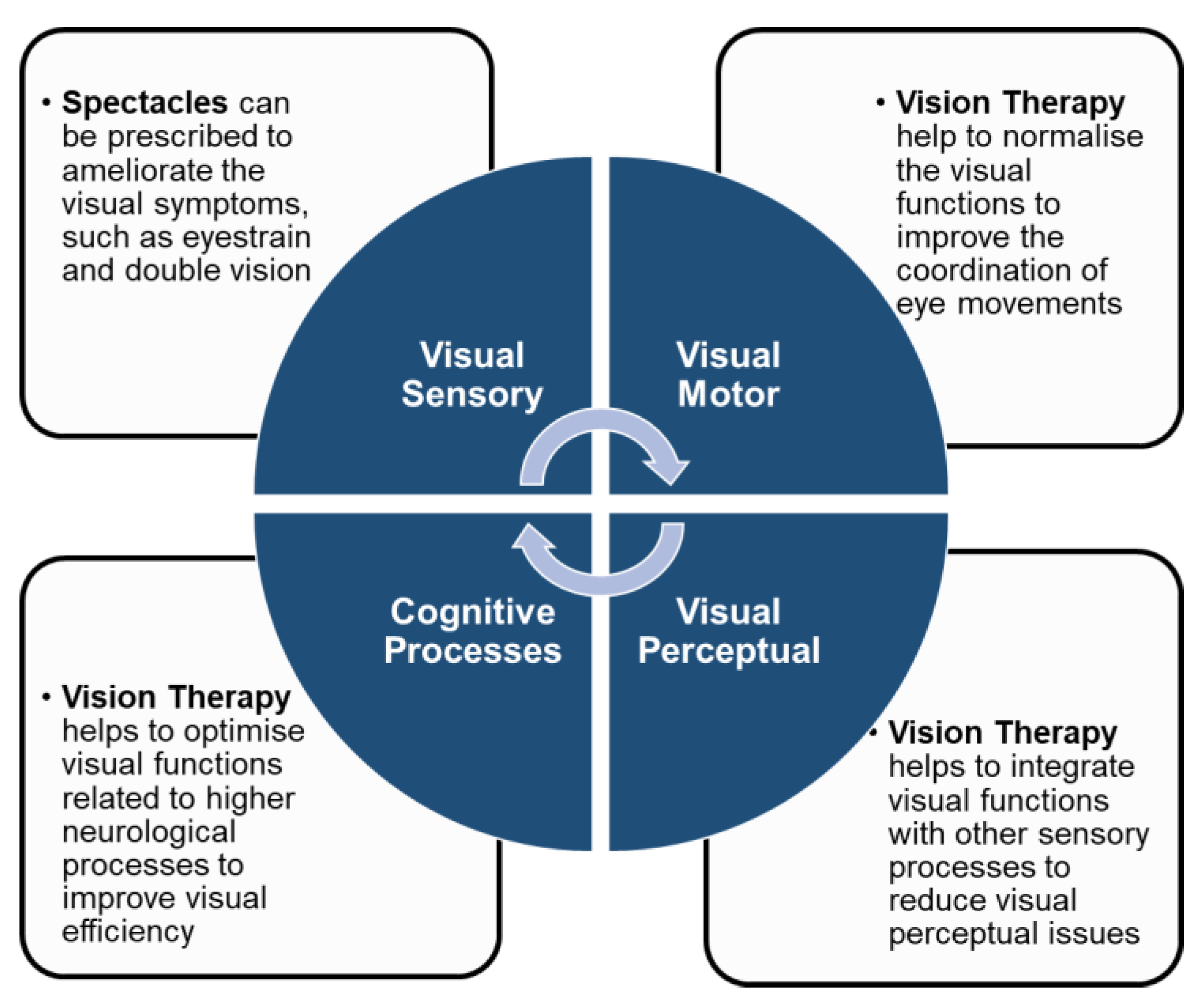
The neurorehabilitation of oculomotor dysfunction is aimed firstly to ameliorate the symptoms, secondly to normalise the visual functions, thirdly to integrate each of these visual functions with one another, and fourthly to address the visual deficits in relation to higher neurological processes (Figure 2). This helps to restore the eye-movement coordination, and to address the poor spatial localisation, which can in turn improve postural stability and reduce the risk of falls. These approaches can typically be achieved from a well-planned structured neuro optometric vision rehabilitation program that is customised according to their specific visual deficits. Alternatively, patients who are less inclined to start neuro optometric treatment can explore compensatory approaches, such as relying on visual cues to help to improve walking patterns and overcome “freezing of gait” (e.g., lines on the floor), using head turns to assist with gaze shifts, or optimize visual tasks with appropriate lighting and contrast adjustments.
Prior to commencing the neurorehabilitation of oculomotor dysfunction in patients with Parkinson’s disease, symptoms may be reduced with dopamine medications (e.g., levodopa) as prescribed by their medical doctors, but non-motor symptoms like visual fatigue may be improved by updating the spectacle prescription and lifestyle modifications, such as exercises, nutrition, and rest. Early losses of the eye’s contrast sensitivity may typically improve with the medication but it may be less effective in more moderate to advanced stages [1]. If the symptoms fluctuate under “on” and “off” medication states, it may be possible to optimise the timing and/or dosage of the medication to reduce the symptoms. Treatments for dry eyes [39], depression [40], anxiety [41], and sleep disturbances [42] may help to reduce symptoms, prescription spectacles should be dispensed when needed to minimise asthenopia, proper task lighting can help to improve visual comfort, larger font sizes can help to reduce visual stress when reading, and the reduction of clutter can help to minimise visual distractions. However, it is important to note that these approaches generally do not address the root causes of the oculomotor dysfunction, which must be carefully examined through a neuro optometric evaluation.
The neurorehabilitation of oculomotor dysfunction in patients with Parkinson’s disease should begin with the provision of an optimal spectacle prescription to reduce the symptoms and to meet the specific visual demand of the patient [8,24,25,26]. In cases of binocular diplopia, ophthalmic prism lenses can be prescribed in the spectacles to assist with the fusion of images, especially during near visual tasks like reading [8]. Even in the absence of diplopia, the appropriate spectacle prescription can help to reduce asthenopia and visual stress, and reduce oculomotor-related postural deficits [38]. For example, yoked prism lenses can be prescribed to shift the visual field image to recalibrate the patient’s internal sense of “straight ahead” and correct the leaning posture and gait instability through prism adaptation during neuro optometric rehabilitation therapy [25,43,44]. This differs from ophthalmic base-in prism lenses which uses opposing orientations to help both eyes turn inward for reading and to eliminate diplopia [45]. In contrast, yoked prisms are often considered during neuro optometric rehabilitation therapy to improve postural control and gait [25,43,44].
Neuro optometric vision rehabilitation therapy can focus on specific functional vision deficits to improve stereopsis, reduce saccadic hypometria, improve smooth pursuit eye movements, and integrate these visual functions with the vestibular system to improve visuomotor control, posture, and balance. Treatment plans can take into consideration the higher neurological processes, including the ventral stream (e.g., V1 through areas V2 and V4 to the inferior temporal cortex) that is responsible for object identification, and the dorsal stream (e.g., V2 and V3 to the superior temporal cortex and the parietal cortex) which processes spatial relations and movement [25]. In addition, care can improve visual guidance skills which is critical for the patient to orientate and navigate in crowded environments, and perform activities of daily living.
The treatment plans in neuro optometric vision rehabilitation therapy can be broadly conceptualised using the Skeffington’s four circles [46], a well-established concept of behavioural optometry, to improve coordination of the visual system in relation to the other senses and the body, namely: (1) the volume of space (i.e., centering), (2) the process of identification, (3) gravity and the sense of orientation (i.e., anti-gravity) and (4) the ability to share information (speech-auditory). For example, the centering of attention enables patients to use vergence to assess the difference between his own internal perception of visual space and the actual physical space (i.e., “where is it”); whereas identification involves the process of accommodation and recognition (i.e., “what is it”) [46]. The Skeffington’s concepts of centering and identification are akin to the concept of peripheral and central vision where patients with exophoric postures tend to overemphasise on the latter while reducing peripheral awareness [46], and these are mediated by the dorsal and ventral streams in the brain respectively [47]. Thus, neuro optometric rehabilitation therapy activities can be implemented to improve the processing of central-peripheral so that the patient can integrate both detailed central vision and the broader visuo-spatial information in the periphery [25].
To improve the sense of orientation, the treatment plan can involve the strong interplay between the visual system, vestibular system, and proprioception, where movements can be considered as successive changes in relation to gravity (“anti-gravity”), and posture can be considered the relative position of the physical parts of the body in relation to each other and relative to gravity [25]. For example, some of the therapeutic activities involve the use of a balance board and movement (e.g., walking a balance beam or use of a trampoline) to encourage the visual system to work with the vestibular system in maintaining balance and spatial awareness [25]. Thus, neuro optometric rehabilitation therapy can help to integrate these systems to improve visual guidance skills in patients with Parkinson’s disease. In addition, the integration of visual processing with speech-auditory processing can improve visual attention, sequencing, and the ability to organize visual information, which indirectly supports auditory processing and communication [25]. For example, this can involve timing the prescribed vision activities using a metronome, or matching visual cues with auditory instructions to train the brain to process both sensory inputs simultaneously.
Regular follow-ups are crucial to monitoring patients with oculomotor dysfunction, and it is important to keep spectacle prescriptions up-to-date, and modify the neurorehabilitation strategies as needed. If treatments are implemented, it is best to involve an optometrist who has a special interest in neuro optometric vision rehabilitation as specialised treatment plans are typically involved during the neurorehabilitation.
5. Conclusion
Oculomotor dysfunction is a significant and multifaceted aspect of Parkinson’s disease. Understanding these eye movement abnormalities is vital for accurate diagnosis, monitoring, and implementing effective strategies to improve a patient’s visual function and overall quality-of-life. By fostering interdisciplinary collaboration in physical, occupational and neuro optometric rehabilitation therapy, healthcare professionals can take proactive steps to address the vision-related challenges faced by these patients and help them to maintain optimal visual function and more effectively manage their challenges. This can help them to navigate environments more safely with enhanced spatial awareness, and maintain greater levels of independence and engagement in daily activities.
Institutional Review Board Statement
Not applicable.
Informed Consent Statement
Not applicable.
Acknowledgments
The author wishes to thank Dr Nancy Mackowsky, OD, FNORA, Dr Cathy Stern, OD, FNORA, and the Neuro Optometric Rehabilitation Association, International, USA.
Conflicts of Interest
The author, Dr Yap Tiong Peng, OD, PhD, FNORA, is a U.S. board-certified provider of vision therapy and neuro optometric rehabilitation who is based in Singapore.
References
- Weil, R.S.; Schrag, A.E.; Warren, J.D.; Crutch, S.J.; Lees, A.J.; Morris, H.R. Visual dysfunction in Parkinson’s disease. Brain A J. Neurol. 2016, 139(11), 2827–2843. [Google Scholar] [CrossRef]
- Mleczek, J.; Forjindam, A.; Shaikh, A.; Ghasia, F. Color Vision Deficits and Binocular Vision Dysfunction in Parkinson’s Disease. Brain Sci. 2026, 16(2). [Google Scholar] [CrossRef] [PubMed]
- Nowalk, N.; Matthews, J.; Walley, M.; Salmasinia, D.; Maitland, C. Investigational Study on the Degree of Contrast Sensitivity Visual Acuity Defects in Early Stages of Parkinsonism (P06.001). 2013, 80((7_) supplement, P06.001–P006.001. [Google Scholar] [CrossRef]
- Yap, T.P.; Stern, C. Advances in the Management of Oculomotor Dysfunction in Adults and Children with Concussion. In Current Advances in Optometry.; Shu, D., Singh, R.B., Ichhpujani, P., Eds.; Springer Nature Singapore: Singapore, 2024; pp. 59–75. [Google Scholar]
- Obeso, J.A.; Rodríguez-Oroz, M.C.; Rodríguez, M.; et al. Pathophysiology of the basal ganglia in Parkinson’s disease. Trends Neurosci. 2000, 23((10) Suppl, S8–19. [Google Scholar] [CrossRef] [PubMed]
- Hikosaka, O.; Takikawa, Y.; Kawagoe, R. Role of the basal ganglia in the control of purposive saccadic eye movements. Physiol. Rev. 2000, 80(3), 953–978. [Google Scholar] [CrossRef]
- Urwyler, P.; Nef, T.; Killen, A.; et al. Visual complaints and visual hallucinations in Parkinson’s disease. Park. Relat. Disord. 2014, 20(3), 318–322. [Google Scholar] [CrossRef]
- Irving, E.L.; Chriqui, E.; Law, C.; et al. Prevalence of Convergence Insufficiency in Parkinson’s Disease. Mov. Disord. Clin. Pract. 2017, 4(3), 424–429. [Google Scholar] [CrossRef]
- Repka, M.X.; Claro, M.C.; Loupe, D.N.; Reich, S.G. Ocular motility in Parkinson’s disease. J. Pediatr. Ophthalmol. Strabismus 1996, 33(3), 144–147. [Google Scholar] [CrossRef]
- Lepore, F.E., Md. Parkinson’s Disease and Diplopia. Neuro-Ophthalmology 2006, 30(2-3), 37–40. [Google Scholar] [CrossRef]
- Diotaiuti, P.; Marotta, G.; Di Siena, F.; et al. Eye Tracking in Parkinson’s Disease: A Review of Oculomotor Markers and Clinical Applications. 2025, 15(4), 362. [Google Scholar] [CrossRef]
- Dæhlen, A.; Heldal, I.; Ali, Q. Technologies Supporting Screening Oculomotor Problems: Challenges for Virtual Reality. 2023, 12(7), 134. [Google Scholar] [CrossRef]
- Health Policy Institute; American Optometric Association. Care Coordination between Optometry (OD), Occupational Therapy (OT), Physical Therapy (PT) and Other Rehabilitation Team Members for PatientCentric Care; 2023. [Google Scholar]
- Yaramothu, C.; Morris, C.J.; d’Antonio-Bertagnolli, J.V.; Alvarez, T.L. OculoMotor Assessment Tool Test Procedure and Normative Data. Optom. Vis. Sci. 2021, 98(6), 636–643. [Google Scholar] [CrossRef]
- González-Vides, L.; Hernández-Verdejo, J.L.; Cañadas-Suárez, P. Eye Tracking in Optometry: A Systematic Review. J. Eye Mov. Res. 2023, 16(3). [Google Scholar] [CrossRef]
- Shaikh, A.G.; Ghasia, F.F. Chapter 5—Saccades in Parkinson’s disease: Hypometric, slow, and maladaptive. In Progress in Brain Research.; Ramat, S., Shaikh, A.G., Eds.; Elsevier, 2019; Volume 249, pp. 81–94. [Google Scholar]
- Fooken, J.; Patel, P.; Jones, C.B.; McKeown, M.J.; Spering, M. Preservation of Eye Movements in Parkinson’s Disease Is Stimulus- and Task-Specific. J. Neurosci. 2022, 42(3), 487–499. [Google Scholar] [CrossRef]
- Herrero-Gracia, A.; Hernández-Andrés, R.; Merino, C.V.; Muedra, C.P.; Ciuffreda, K.J.; Díez-Ajenjo, M.A. Parkinson’s disease and reading performance. Ophthalmic Physiol. Opt. 2025, 45(7), 1653–1661. [Google Scholar] [CrossRef] [PubMed]
- Koh, S.B.; Suh, S.I.; Kim, S.H.; Kim, J.H. Stereopsis and extrastriate cortical atrophy in Parkinson’s disease: a voxel-based morphometric study. Neuroreport 2013, 24(5), 229–232. [Google Scholar] [CrossRef]
- Liu, L.D.; Pack, C.C. The Contribution of Area MT to Visual Motion Perception Depends on Training. Neuron 2017, 95(2), 436–446.e433. [Google Scholar] [CrossRef] [PubMed]
- Lawton, T.; Shelley-Tremblay, J. Training on Movement Figure-Ground Discrimination Remediates Low-Level Visual Timing Deficits in the Dorsal Stream, Improving High-Level Cognitive Functioning, Including Attention, Reading Fluency, and Working Memory. Front. Hum. Neurosci. 2017, 11, 236. [Google Scholar] [CrossRef]
- Karnath, H.O. Spatial orientation and the representation of space with parietal lobe lesions. Philos. Trans. R. Soc. Lond. Ser. B Biol. Sci. 1997, 352(1360), 1411–1419. [Google Scholar] [CrossRef]
- Salehi, M.A.; Rezagholi, F.; Mohammadi, S.; et al. Optical coherence tomography angiography measurements in Parkinson’s disease: A systematic review and meta-analysis. Eye 2023, 37(15), 3145–3156. [Google Scholar] [CrossRef] [PubMed]
- Gupta, P.; Beylergil, S.; Murray, J.; et al. Effects of Parkinson Disease on Blur-Driven and Disparity-Driven Vergence Eye Movements. J. Neuro-Ophthalmol. Off. J. North Am. Neuro-Ophthalmol. Soc. 2021, 41(4), 442–451. [Google Scholar] [CrossRef]
- Padula, W.V.; Subramanian, P.; Spurling, A.; Jenness, J. Risk of fall (RoF) intervention by affecting visual egocenter through gait analysis and yoked prisms. NeuroRehabilitation 2015, 37(2), 305–314. [Google Scholar] [CrossRef]
- P. D.culomotor Dysfunction in Parkinson’s Disease. Eur. J. Geriatr. Gerontol. 2020, 2(3), 87–89. [CrossRef]
- Armstrong, R.A. Visual symptoms in Parkinson’s disease. Park. Dis. 2011, 2011, 908306. [Google Scholar] [CrossRef] [PubMed]
- Friedman, Z.; Neumann, E. Benzhexol-induced blindness in Parkinson’s disease. Br. Med. J. 1972, 1(5800), 605. [Google Scholar] [CrossRef]
- Leigh, R.J.; Zee, D.S. The Neurology of Eye Movements.; Oxford University Press, 2015. [Google Scholar]
- Terao, Y.; Fukuda, H.; Ugawa, Y.; Hikosaka, O. New perspectives on the pathophysiology of Parkinson’s disease as assessed by saccade performance: a clinical review. Clin. Neurophysiol. Off. J. Int. Fed. Clin. Neurophysiol. 2013, 124(8), 1491–1506. [Google Scholar] [CrossRef] [PubMed]
- Angelopoulou, E.; Papadopoulos, A.N.; Spantideas, N.; Bougea, A. Migraine, Tension-Type Headache and Parkinson’s Disease: A Systematic Review and Meta-Analysis. Medicina 2022, 58(11). [Google Scholar] [CrossRef]
- Jeffery, K.; Guo, W.; Ball, D.; Rodriguez-Sanchez, J. Visual imagination and cognitive mapping of a virtual building. J. Navig. 2022, 75(1), 1–14. [Google Scholar] [CrossRef]
- Diotaiuti, P.; Marotta, G.; Di Siena, F.; et al. Eye Tracking in Parkinson’s Disease: A Review of Oculomotor Markers and Clinical Applications. Brain Sci. 2025, 15(4). [Google Scholar] [CrossRef]
- Rayner, K. Eye movements in reading and information processing: 20 years of research. Psychol. Bull. 1998, 124(3), 372–422. [Google Scholar] [CrossRef]
- Archibald, N.K.; Clarke, M.P.; Mosimann, U.P.; Burn, D.J. Visual symptoms in Parkinson’s disease and Parkinson’s disease dementia. Mov. Disord. Off. J. Mov. Disord. Soc. 2011, 26(13), 2387–2395. [Google Scholar] [CrossRef]
- Lewis, G.N.; Byblow, W.D.; Walt, S.E. Stride length regulation in Parkinson’s disease: the use of extrinsic, visual cues. Brain A J. Neurol. 2000, 123 Pt 10, 2077–2090. [Google Scholar] [CrossRef]
- Aarsland, D.; Marsh, L.; Schrag, A. Neuropsychiatric symptoms in Parkinson’s disease. Mov. Disord. Off. J. Mov. Disord. Soc. 2009, 24(15), 2175–2186. [Google Scholar] [CrossRef] [PubMed]
- Geroin, C.; Artusi, C.A.; Gandolfi, M.; et al. Does the Degree of Trunk Bending Predict Patient Disability, Motor Impairment, Falls, and Back Pain in Parkinson’s Disease? Front. Neurol. 2020, 11, 207. [Google Scholar] [CrossRef] [PubMed]
- Savitt, J.; Aouchiche, R. Management of Visual Dysfunction in Patients with Parkinson’s Disease. J. Park. Dis. 2020, 10(s1), S49–s56. [Google Scholar] [CrossRef]
- Raggi, A.; Serretti, A.; Ferri, R. Treatment options for depression in Parkinson’s disease: a mini-review. Int. Clin. Psychopharmacol. 2025, 40(6), 312–320. [Google Scholar] [CrossRef]
- Berry, A.J.; Costello, H.; Jesús, S.; Price, G.; Jha, A. Management of Anxiety in Parkinson’s Disease. Mov. Disord. Clin. Pract. 2025, 12(10), 1490–1501. [Google Scholar] [CrossRef]
- Amara, A.W.; Chahine, L.M.; Videnovic, A. Treatment of Sleep Dysfunction in Parkinson’s Disease. Curr. Treat. Options Neurol. 2017, 19(7), 26. [Google Scholar] [CrossRef] [PubMed]
- Nemanich, S.T.; Earhart, G.M. Prism adaptation in Parkinson disease: comparing reaching to walking and freezers to non-freezers. Exp. Brain Res. 2015, 233(8), 2301–2310. [Google Scholar] [CrossRef]
- Meglio, M.; Olivola, E.; Santilli, M.; et al. Effects of Prismatic Lenses on Lateral Axial Dystonia in Parkinson’s Disease: A Pilot Study. Innov. Clin. Neurosci. 2021, 18(1-3), 39–42. [Google Scholar]
- Borm, C.; Bloem, B.R.; Hoyng, C.; de Vries, N.M.; Theelen, T. The Many Faces of Blurry Vision in Parkinson’s Disease: An Illustrative Case Series. Case Rep. Neurol. 2022, 14(1), 173–178. [Google Scholar] [CrossRef]
- Shayler, G. The Use of Models to Help Our Understanding of Vision; 2015. [Google Scholar]
- Milner, A.D.; Goodale, M.A. Two visual systems re-viewed. Neuropsychologia 2008, 46(3), 774–785. [Google Scholar] [CrossRef]
Figure 1.
Summary of the vision-related symptoms and the challenges in activities of daily living that are related to oculomotor dysfunction and its impact on patients with Parkinson’s disease.
Figure 1.
Summary of the vision-related symptoms and the challenges in activities of daily living that are related to oculomotor dysfunction and its impact on patients with Parkinson’s disease.
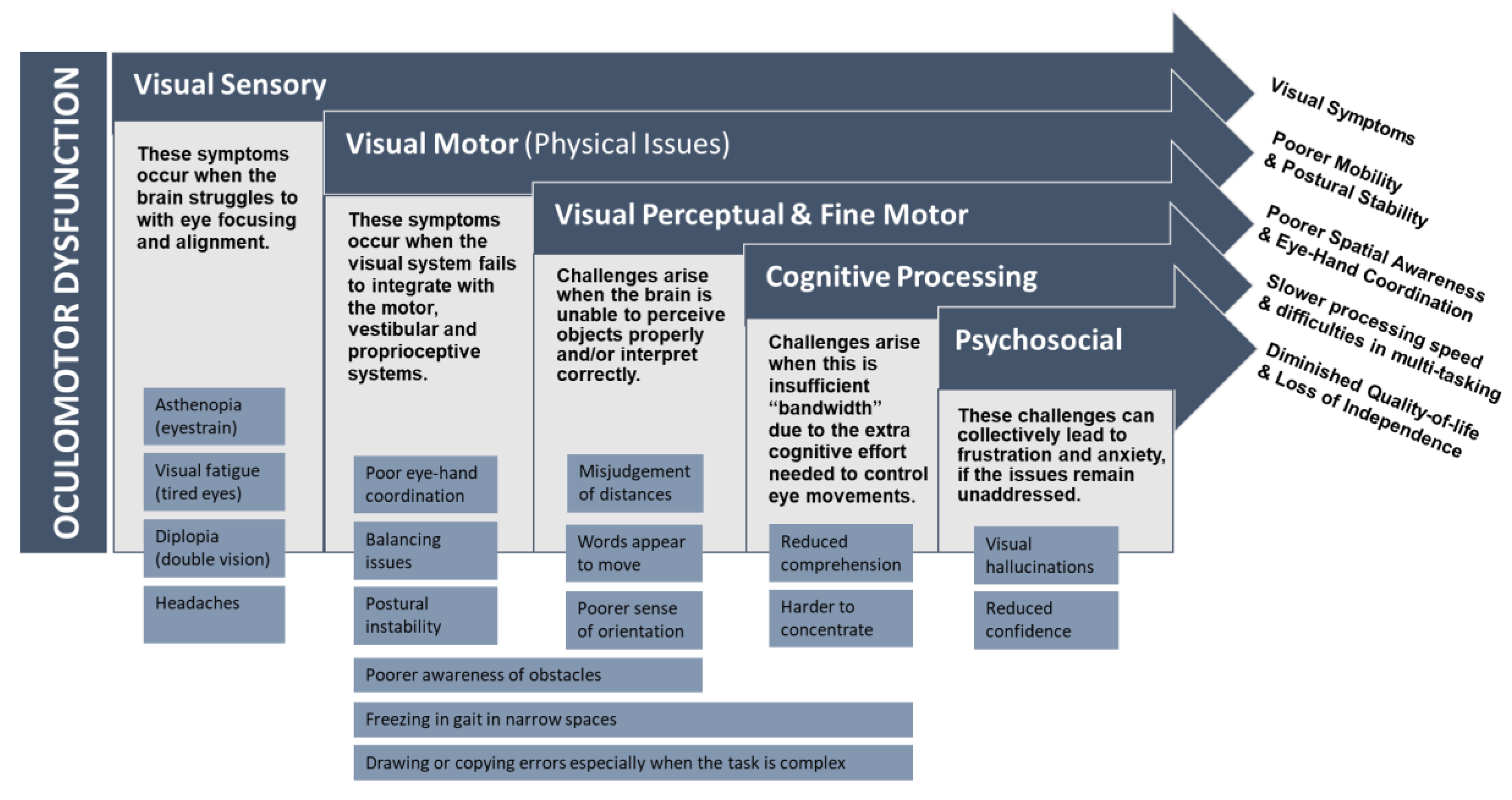
Figure 2.
Neurorehabilitation of oculomotor dysfunction in patients with Parkinson’s disease and ways to address their symptoms and the challenges on activities of daily living.
Figure 2.
Neurorehabilitation of oculomotor dysfunction in patients with Parkinson’s disease and ways to address their symptoms and the challenges on activities of daily living.
Disclaimer/Publisher’s Note: The statements, opinions and data contained in all publications are solely those of the individual author(s) and contributor(s) and not of MDPI and/or the editor(s). MDPI and/or the editor(s) disclaim responsibility for any injury to people or property resulting from any ideas, methods, instructions or products referred to in the content. |
© 2026 by the authors. Licensee MDPI, Basel, Switzerland. This article is an open access article distributed under the terms and conditions of the Creative Commons Attribution (CC BY) license (http://creativecommons.org/licenses/by/4.0/).
Copyright: This open access article is published under a Creative Commons CC BY 4.0 license, which permit the free download, distribution, and reuse, provided that the author and preprint are cited in any reuse.


