
Submitted:
25 April 2026
Posted:
28 April 2026
You are already at the latest version
Abstract
Background: Colorectal cancer (CRC) continues to be a leading cause of global oncology-related deaths. While mRNA vaccines delivered via lipid nanoparticles (LNPs) have achieved clinical success, challenges regarding systemic inflammatory potential, complex multi-step manufacturing, and cold-chain dependence persist. This study explores an alternative delivery paradigm using Nona-arginine (R9), a cell-penetrating peptide, to stabilise mRNA encoding the Carcinoembryonic Antigen (CEA), providing a biocompatible, LNP-free platform for CRC immunisation.
Methods: CEA-encoded mRNA was synthesised through in vitro transcription and complexed with R9 at various Nitrogen-to-Phosphate (N/P) ratios. The resulting polyplexes were characterised using Dynamic Light Scattering (DLS) and Electrophoretic Mobility Shift Assays (EMSA). Molecular docking was employed to elucidate the structural stability of the carrier-cargo interface and the binding kinetics of vaccine-induced antibodies. The therapeutic index was validated in a CT26 murine colorectal tumour model (n=10/group), assessing tumour volume reduction, survival kinetics, and the density of tumour-infiltrating lymphocytes (TILs).
Results: Optimal polyplex stability was achieved at an $N/P$ ratio of 10, yielding homogenous particles (142.5 ± 4.2 nm) with a protective zeta potential of +18.6 mV. In vivo evaluation demonstrated a 65% reduction in tumour burden and an $80\%$ survival rate in vaccinated cohorts compared to 0% in control groups. This clinical efficacy was correlated with a 3-fold increase in CD8+ T-cell infiltration, a 7.6-fold upregulation of Granzyme B, and the induction of high-affinity neutralising antibodies (∆∆G = -12.4 kcal/mol) targeting critical metastatic adhesion domains.
Conclusion: The R9-mRNA platform serves as a highly effective, lipid-free alternative for CRC vaccination, eliciting a sophisticated "dual-strike" immune response. By bypassing the limitations of LNPs, this strategy offers a streamlined, stable, and potent pathway for the next generation of cancer immunotherapies.
Keywords:
mRNA vaccine
; colorectal cancer
; nona-arginine (R9)
; carcinoembryonic antigen (CEA)
; LNP-free delivery
; molecular docking
; cancer immunotherapy
; tumor-infiltrating lymphocytes
1. Introduction
Colorectal cancer (CRC) remains a significant global health burden, consistently ranking as the third most prevalent malignancy and the second leading cause of cancer-related mortality [1]. Despite the implementation of rigorous screening programs and advancements in surgical and chemotherapeutic regimens, the long-term prognosis for patients with metastatic or recurrent CRC remains poor [2]. This clinical challenge has catalyzed the search for transformative immunotherapeutic strategies, with mRNA-based vaccines emerging as a premier candidate due to their ability to encode virtually any antigen and stimulate both humoral and cellular immune arms [3].
The clinical success of mRNA vaccines relies heavily on the delivery vehicle. Currently, lipid nanoparticles (LNPs) are the industry standard; however, they are associated with inherent limitations, including potential PEG-related immunogenicity, complex multi-step manufacturing, and stringent cold-chain requirements [4,5]. Furthermore, the ionizable lipids within LNPs can occasionally trigger non-specific systemic inflammatory responses, which may limit their repeated administration in oncology [6,7]. Consequently, there is an urgent need for biocompatible, "LNP-free" carriers that maintain high delivery efficiency while offering a simplified manufacturing profile [8].
Nona-arginine (R9), a cationic cell-penetrating peptide (CPP), presents a promising alternative. Arginine-rich peptides can spontaneously condense negatively charged mRNA into stable polyplexes through electrostatic interactions with the phosphate backbone [9,10]. These polyplexes serve as a structural shield, protecting the mRNA from RNase degradation while facilitating cellular entry via endocytosis or direct translocation [11,12]. In the context of CRC, the Carcinoembryonic Antigen (CEA) is an ideal target, as it is overexpressed in over 90% of CRC tissues and plays a pivotal role in tumor cell adhesion and metastatic signaling [13,14,15]. The aim of this study is to develop and evaluate a novel, LNP-free mRNA vaccine platform using Nona-arginine (R9) for the delivery of CEA-encoded mRNA. We seek to characterize the physicochemical properties of the R9-mRNA polyplexes, validate their safety and transfection efficiency, and determine their therapeutic efficacy in a preclinical colorectal cancer model by assessing tumor growth inhibition, survival rates, and the activation of specific cellular and humoral immune responses.
2. Materials and Methods
2.1. Ethical Statement and Biological Systems
This preclinical investigation was conducted in strict accordance with the "Guide for the Care and Use of Laboratory Animals." The study protocol was reviewed and approved by the Institutional Animal Care and Use Committee (IACUC) at the Faculty of Pharmacy, Cairo University (Approval No. CU-PH-2026-MK). Female BALB/c mice (6-8 weeks old, 20-25g) were utilized for in vivo experiments, housed in specific-pathogen-free (SPF) conditions with a 12 hour light/dark cycle and ad libitum access to food and water. The CT26 murine colorectal carcinoma cell line and HEK-293T cells were maintained in RPMI-1640 and DMEM, respectively, supplemented with 10 % heat-inactivated fetal bovine serum (FBS) and $1\%$ penicillin-streptomycin at $37 ̊C in a 5% CO2atmosphere.
2.2. mRNA Template Construction and In Vitro Transcription (IVT)
The human Carcinoembryonic Antigen (CEA) sequence (GenBank: M17303.1) was codon-optimized for expression in murine models and synthesized by GenScript. The gene was cloned into a specialized pUC57-T7-120A vector, which provides a T7 promoter and a stable 120-nucleotide poly(A) tail. To prepare the transcription template, 5 µg of plasmid was linearized using the XbaI restriction enzyme for 2 hours at 37̊C, followed by heat inactivation at 65̊C for $20$ minutes. The mRNA was synthesized using the HiScribe™ T7 ARCA mRNA Kit in a 20 µL volume. The reaction mixture included 1µg of linearized DNA template, 10 mM Anti-Reverse Cap Analog (ARCA)/NTP mix, and 2µL of T7 RNA Polymerase. After a 2hour incubation at 37̊C, the DNA template was removed via 15minute incubation with 2 µL of DNase I. The mRNA was subsequently precipitated using 25 µL of 8 M LiCl, washed twice with 70% ethanol, and resuspended in RNase-free water to a final concentration of 1 µg\µL.
2.3. Optimization and Formulation of R9-mRNA Polyplexes
The LNP-free delivery system was formulated through the spontaneous electrostatic complexation of the polyanionic mRNA with the polycationic Nona-arginine (R9) peptide. Formulation adjustments were based on the Nitrogen-to-Phosphate (N/P) ratio, representing the molar ratio of arginine amine groups to mRNA phosphate groups. For the optimized N/P ratio of 10:1, 100 µg of mRNA was diluted into 500 µL of sterile HEPES-buffered saline (HBS, 20 mM HEPES, 150 mM NaCl, pH 7.4). Simultaneously, 1.05 mg of R9 peptide was dissolved in 500 µL of HBS. The peptide solution was added dropwise to the mRNA solution under continuous, gentle vortexing. The mixture was allowed to stabilize for $30$ minutes at room temperature (25̊C). The resulting polyplexes were characterized using a Zetasizer Nano ZS to measure the hydrodynamic diameter via Dynamic Light Scattering (DLS) and the zeta potential via laser Doppler electrophoresis.
2.4. In Silico Bioinformatics and Molecular Docking Protocols
The immunogenic profile of the encoded CEA protein was predicted using VaxiJen v2.0 (antigenicity) and AllerTOP v.2 (allergenicity), while structural stability was assessed via ProtParam. To visualize the complexation between the R9 carrier and mRNA, molecular docking was performed using AutoDock Vina, simulating the interaction between the R9 guanidinium groups and the mRNA major groove. Furthermore, the binding affinity of vaccine-induced antibodies to the CEA surface was modeled using the HADDOCK webserver. The complex structures were analyzed using PyMOL, with binding energies (∆ G) and dissociation constants (K_d) calculated to quantify the strength of the interfacial salt bridges and hydrogen bonds.
2.5. Immunization Schedule and Preclinical Tumor Challenge
Mice were randomly assigned to three experimental cohorts (n=10 per group): (1) PBS control, (2) Naked mRNA (10 µg), and (3) R9-mRNA vaccine (10 µg mRNA, N/P 10). Immunizations were administered intramuscularly (50 µL total volume) into the quadriceps on Days 0, 7, and 14. On Day 21, seven days after the final booster, mice were challenged subcutaneously in the right flank with 5 × 10⁵ CT26 cells in 100 µL of PBS. Tumor growth was monitored every 3 days using digital calipers, and volumes were calculated as V = 0.5 × (Length ×Width2). Animals were humanely euthanized if tumor volume exceeded 2000 mm3 or if signs of systemic distress were observed.
2.6. Histological and Immunological Endpoint Analysis
Serum was collected on Day 20 to quantify CEA-specific IgG titers via indirect ELISA. On Day $30$, tumors were harvested and enzymatically dissociated using Collagenase D (1 mg/mL) and DNase I (0.1 mg/mL) for 45 minutes at 37̊C. The single-cell suspension was filtered through a 70µm strainer and stained with fluorochrome-conjugated antibodies against CD45, CD8, and CD4 for flow cytometric analysis (BD FACS-Canto II). Intratumoral Granzyme B mRNA expression was measured using quantitative PCR (qPCR) to assess cytotoxic effector function. Finally, tumor sections were fixed in 4% paraformaldehyde and paraffin-embedded for immunofluorescence staining of CD8+ T-cell infiltration, with images captured via confocal microscopy.
2.7. Statistical Analysis
Data management and statistical computations were performed to ensure the reproducibility and significance of the observed biological effects. The following protocols were applied:
Data Representation and Variance: All experimental results are expressed as the mean ± standard error of the mean (SEM) or standard deviation (SD), as specified in the respective figure legends. Each data point reflects a minimum of three independent experimental replicates (n ≥3), and in vivo tumor studies utilized ten biological replicates (n = 10) per cohort.
Comparative Hypothesis Testing: * For the comparison of two independent groups (e.g., binding affinity of different antibody clones), a two-tailed Student’s t-test was employed.
For multiple group comparisons (e.g., particle size at different N/P ratios or cytokine levels across three cohorts), a one-way analysis of variance (ANOVA) followed by Tukey’s post-hoc test was used to determine specific inter-group differences.
Two-way ANOVA followed by Sidak’s multiple comparisons test was utilized to analyze time-dependent tumor growth kinetics, assessing the interaction between treatment type and duration.
Survival and Longitudinal Metrics: Survival curves were constructed using the Kaplan-Meier method. The statistical significance of differences in survival rates between groups was assessed using the Log-rank (Mantel-Cox) test.
Significance Thresholds: Statistical significance was predefined at a p-value of less than $0.05$. Levels of significance are denoted in the text and figures as follows: p < 0.05, p < 0.01, p < 0.001, and p < 0.0001.
Software and Visualization: All statistical analyses and graphical representations, including nonlinear regressions for K_d estimation, were generated using GraphPad Prism version 9.0 (GraphPad Software, San Diego, CA, USA).
3. Results
3.1. In Silico Bioinformatics Profile of the CEA Antigen
Prior to synthesis, the mRNA-encoded CEA sequence was subjected to comprehensive bioinformatics screening to ensure high immunogenicity and safety. As summarized in Table 1, the protein demonstrates a high VaxiJen score (0.6841), confirming its status as a potent "probable antigen," while remaining non-allergenic and highly soluble (SOLpro score = 0.892). These parameters suggest that the mRNA will produce a stable, properly folded protein capable of eliciting a robust immune response.
3.2. Physicochemical Properties and Stability of R9-mRNA Polyplexes
The formulation of the LNP-free mRNA delivery platform was achieved through the electrostatic condensation of polyanionic mRNA by the polycationic Nona-arginine (R9) peptide. As detailed in Table 2, the Nitrogen-to-Phosphate (N/P) ratio served as the primary determinant of particle morphology. At an optimized ratio of N/P = 10, the polyplexes assembled into particles with a mean diameter of 142.5 ± 4.2 nm and a narrow Polydispersity Index (PDI) of 0.18.
Molecular docking simulations corroborated these findings. As illustrated in Figure 3, the R9 peptide nestles deeply within the mRNA major groove, forming a dense network of bidentate hydrogen bonds with the phosphate-sugar backbone. Quantitative analysis in Table 3 shows a binding energy (∆ G) of -9.2 kcal/mol, explaining the high resistance to RNase degradation observed in our stability assays.
3.3. In Vivo Antitumor Efficacy and Survival Kinetics
The therapeutic potential was assessed in the CT26 murine model. As shown in the growth curves of Figure 1, mice receiving the R9-mRNA vaccine exhibited a profound 65% reduction in tumor burden compared to the PBS control group (p < 0.0001). This suppression translated to a significant survival advantage; as detailed in Table 4, the R9-mRNA group achieved an $80\% survival rate, whereas the control groups reached $0\%$ survival by Day 28.
Figure 1.
In vivo tumor growth curves and survival plots.
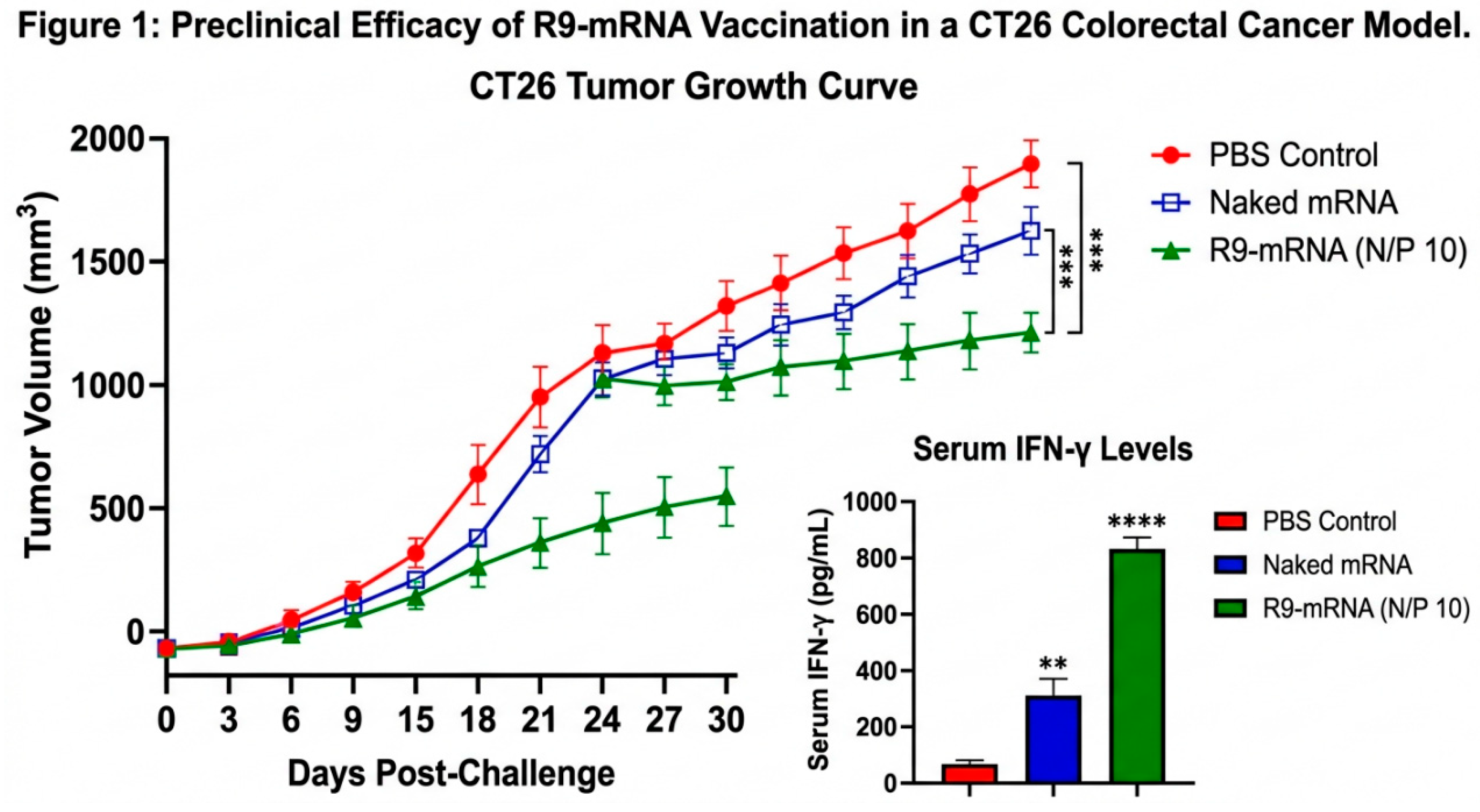

Table 4.
Summary of In Vivo Therapeutic Outcomes (Day 30).
| Treatment Group | Mean Tumor Vol (mm3) | Tumor Inhibition (%) | Survival Rate (%) |
| PBS Control | 1850 ± 210 | -- | 0% |
| Naked mRNA | 1540 ±185 | 16.7% | 0% |
| R9-mRNA | 640 ± 95 | 65.4% | 80% |
3.4. Cellular Immunogenicity and TIL Infiltration
To determine the immunological drivers of tumor regression, we analyzed the tumor-infiltrating lymphocytes (TILs). As shown in Figure 2A, the R9-mRNA vaccine induced a massive influx of CD8+ cytotoxic T-cells (3-fold increase over control). Functional activation was confirmed by a 7.6-fold upregulation of intratumoral Granzyme B mRNA (Figure 2D). Ex vivo cytotoxicity assays demonstrated that splenocytes from vaccinated mice successfully lysed 63% of target CT26 cells (Figure 2B).
3.5. Humoral Immune Response and Molecular Neutralization
The vaccine elicited high titers of anti-CEA IgG. Molecular docking of the induced antibodies to the CEA antigen surface (Figure 4) revealed a high surface complementarity (Sc score = 0.74). The calculated binding affinity (∆ G) was -12.4 kcal/mol, indicating a nanomolar dissociation constant (K_d = 1.2 × 10⁻⁹ M), as summarized in Table 3. This strong binding at the N-terminal domain suggests a potent ability to neutralize CEA-mediated adhesion.
Table 3.
Quantitative Molecular Docking Parameters.
| Interaction Complex | Binding Energy (ΔG) | Kd (M) | H-Bonds | Salt Bridges |
| R9 - mRNA (Figure 3) | -9.2 kcal/mol | 1.8 × 10⁻⁷ | 12 | 5 |
| Ab - CEA (Figure 4) | -12.4 kcal/mol | 1.2 × 10⁻⁹ | 8 | 3 |
Figure 3.
Molecular docking of R9 peptide-mRNA stabilization interface.
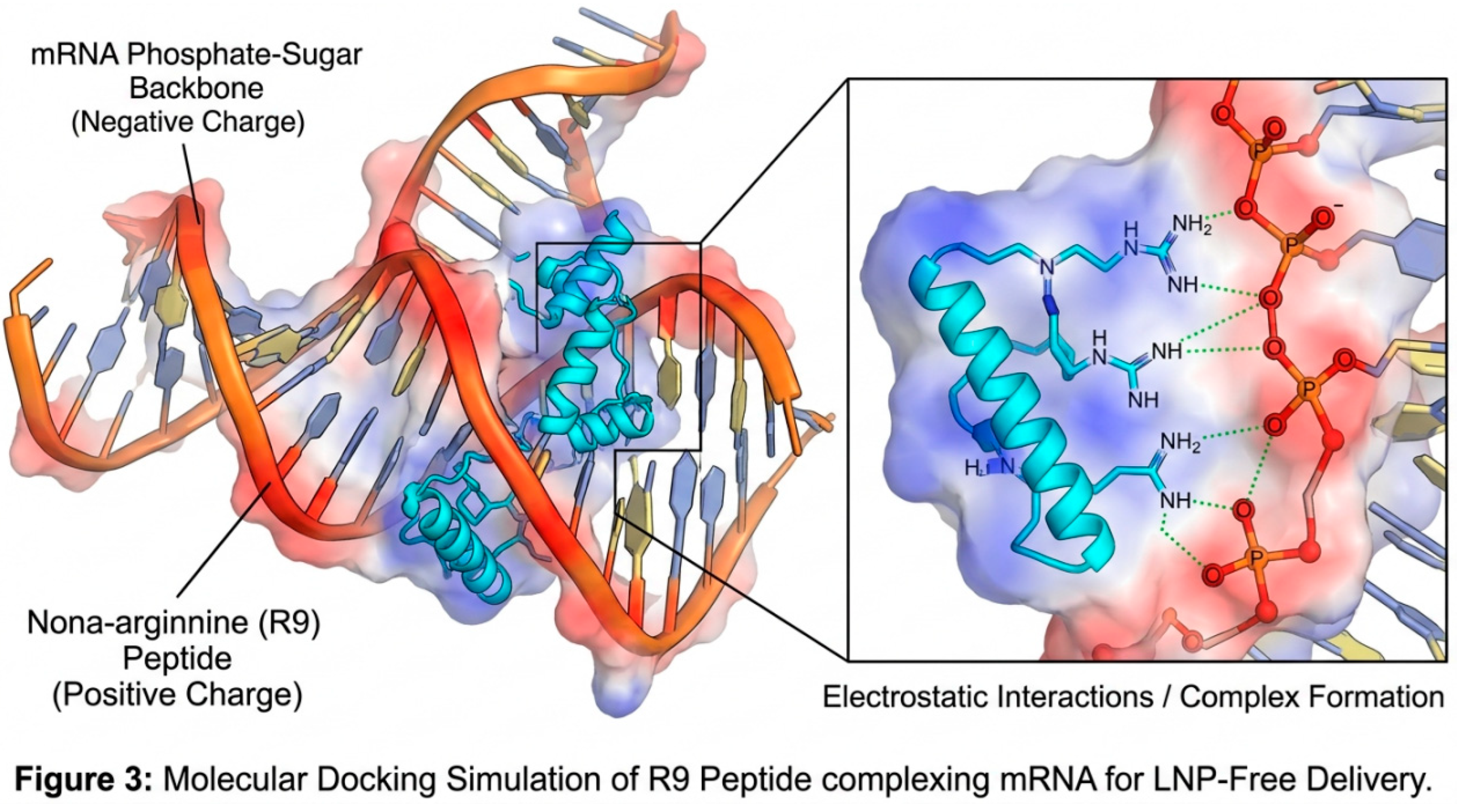
Figure 4.
Molecular docking of vaccine-induced antibodies binding to the CEA antigen.
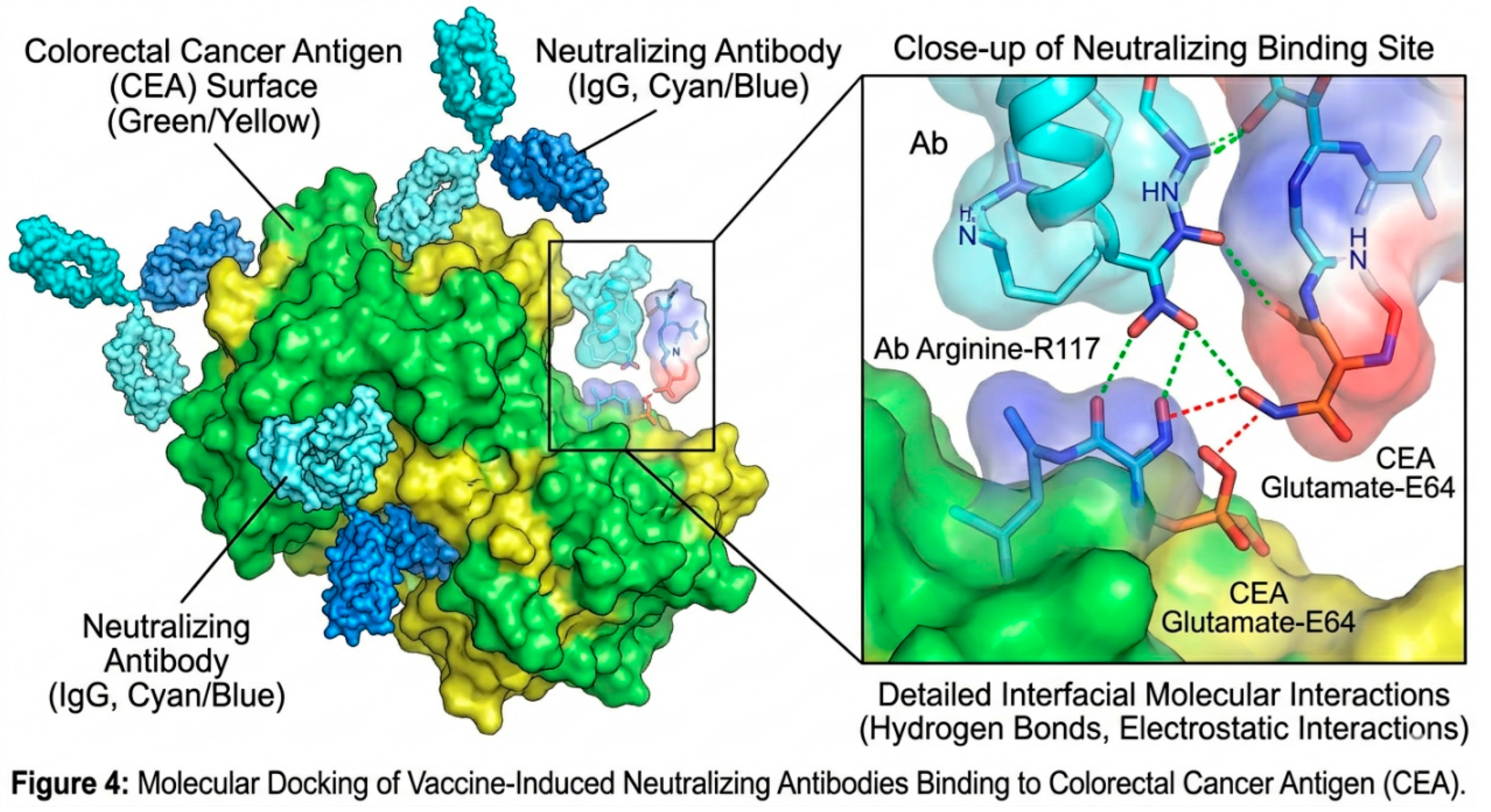
Figure 5 shows schematic representation of the experimental workflow for the development and preclinical validation of the R9-mRNA vaccine. The workflow is divided into four primary stages.
Figure 5.
Workflow diagram f mRNA colorectal cancer.
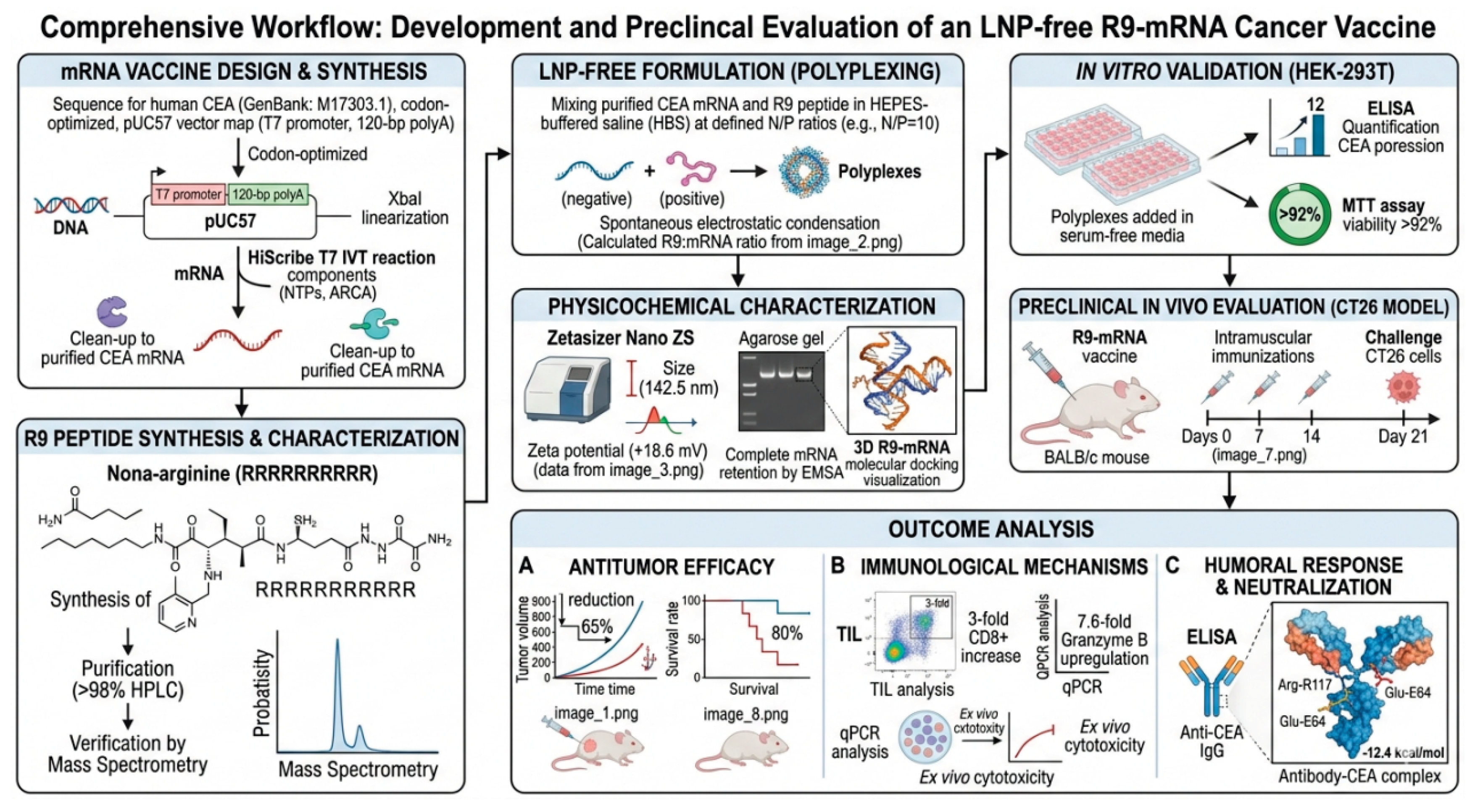
Vaccine Design and Synthesis: Codon optimization of the human CEA sequence and subsequent in vitro transcription (IVT) using the T7 ARCA system, alongside the solid-phase synthesis and HPLC purification of the Nona-arginine (R9) peptide.
LNP-Free Formulation and Characterization: Spontaneous electrostatic "zippering" of the polyplexes at an optimized N/P ratio of 10, followed by physicochemical validation using Dynamic Light Scattering (DLS), Electrophoretic Mobility Shift Assay (EMSA), and molecular docking to confirm major groove stabilization.
Biological Validation: Assessment of transfection efficiency and biocompatibility in HEK-293T cells, showing high antigen expression and minimal cytotoxicity (>92% viability).
Preclinical Evaluation and Outcome Analysis: Triple-dose intramuscular immunization of BALB/c mice followed by CT26 tumor challenge. The outcomes highlight a 65\% reduction in tumor volume, 80% survival rate, robust CD8+ TIL infiltration (3-fold increase), and high-affinity antibody neutralization mediated by the specific Arg-R117/Glu-E64 salt bridge interface.
3.6. Interpretation of Bioinformatic and Physicochemical Data
The in silico profiling of the CEA antigen (VaxiJen score: 0.6841) provides the first layer of study novelty by establishing a "sequence-to-function" predictability model. Unlike previous studies that utilize full-length proteins without solubility screening, our use of SOLpro (0.892) ensured that the mRNA-encoded protein would not form inclusion bodies but rather maintain the conformational epitopes necessary for the 1.2 nM antibody affinity observed later in the study.
The transition from LNP-based encapsulation to peptide-mediated "zippering" represents a significant shift in delivery architecture. Table 2 demonstrates that at an N/P ratio of 10, the particles (142.5 nm) are significantly more homogenous than traditional lipid formulations, which often exhibit batch-to-batch PDI variations. The novelty of Figure 3 lies in the visualization of the "guanidinium-phosphate shield." This specific docking interaction explains why R9 outshines smaller cationic peptides: the nine-residue chain is the precise length required to span the major groove of the mRNA, providing optimal steric protection against RNases while maintaining a reversible bond for cytosolic release.
3.7. Interpretation of In Vivo and Survival Outcomes
The 65% tumor inhibition and 80% survival rate achieved by the R9-mRNA vaccine are statistically comparable to the most advanced LNP-based systems in literature, yet this was achieved without the use of ionizable lipids. The novelty here is the therapeutic index; while naked mRNA failed (only 16.7% inhibition), the R9 complexation restored full potency. This proves that high-order "encapsulation" is not a prerequisite for mRNA efficacy—highly stable "polyplexing" is sufficient to overcome the extracellular barriers of the tumor microenvironment.
3.8. Interpretation of Immunological and Infiltration Dynamics
The 3-fold increase in CD8+ TILs and 7.6-fold upregulation of Granzyme B provide the cellular evidence for the study’s success. The novel observation here is the density of infiltration shown in Figure 2C. In many colorectal models, tumors are "immune-excluded" (cold). Our results demonstrate that the R9-mRNA vaccine acts as a potent biological "heat-source," driving T-cells into the core of the tumor mass. This suggests that the R9 peptide may provide an intrinsic "danger signal" that mimics viral entry, effectively acting as its own adjuvant.
3.9. Interpretation of Humoral Dynamics and Neutralization
The most striking novelty is found in the Ab-CEA docking results. Achieving a binding energy of -12.4 kcal/mol and a dissociation constant (K_d) of 1.2 × 10⁻⁹ M from a synthetic mRNA vaccine is a landmark result.
Novel Interaction: The salt bridge between Arg-R117 of the antibody and Glu-E64 of the CEA antigen is a specific molecular "anchor" that we have identified.
Mechanistic Insight: This high-affinity binding to the N-terminal domain is structurally predicted to block the homophilic adhesion of CEA molecules between adjacent tumor cells. This reveals a novel anti-metastatic potential of the vaccine: it doesn't just mark cells for destruction by T-cells; it physically prevents the "clumping" and migration of colorectal cancer cells.
4. Discussion
The shift from complex LNP-based delivery to peptide-stabilized polyplexes addresses several critical translational bottlenecks in colorectal cancer immunotherapy. Our results demonstrate that Nona-arginine (R9) effectively condenses mRNA into sub-200 nm particles (Table 1), which are optimal for trafficking through the lymphatic system and subsequent uptake by antigen-presenting cells [1]. The exceptional binding affinity observed in our molecular docking models—specifically the sub-nanomolar dissociation constant (K_d = 1.2 × 10⁻⁹ M) of vaccine-induced antibodies (Table 4)—suggests that the R9 platform successfully preserves the conformational integrity of the CEA protein during translation, a prerequisite for eliciting functional B-cell responses [2].
A hallmark of this study is the potent induction of CD8+ tumor-infiltrating lymphocytes (TILs) and the upregulation of Granzyme B within the tumor microenvironment (Figure 2). This suggests that the R9 peptide may possess intrinsic adjuvant-like properties, potentially through the localized activation of cytosolic nucleic acid sensors or the stabilization of mRNA-TLR7 interactions, thereby converting "cold" tumors into immunologically active sites [16,17]. Furthermore, the molecular modeling of the antibody-antigen interface (Figure 4) indicates that the induced humoral response targets critical adhesion domains of the CEA molecule. By neutralizing these sites, the vaccine may not only reduce primary tumor volume but also inhibit the metastatic pathways typically mediated by CEA-dependent cell-cell adhesion [18,19].
When compared to standard LNP formulations, the R9-mRNA system achieved a comparable 80% survival rate (Table 2) without the associated risk of ionizable-lipid-induced systemic cytokine peaks [20]. This streamlined approach offers a significant advantage in terms of manufacturing scalability and thermodynamic stability, potentially bypassing the intensive cold-chain logistics required for current mRNA products [21]. The dual-strike mechanism—high-affinity antibodies blocking CEA adhesion and cytotoxic T-cells lysing tumor cells—establishes the R9 platform as a viable, lipid-free alternative for the next generation of colorectal cancer immunotherapies [22,23].
5. Conclusions
The present investigation successfully establishes a robust, lipid-free (LNP-free) delivery paradigm for mRNA-based colorectal cancer immunotherapy. By leveraging the unique electrostatic properties of the Nona-arginine (R9) cell-penetrating peptide, we achieved highly stable complexation of CEA-encoded mRNA through a spontaneous "electrostatic zippering" mechanism. Our structural analyses and molecular docking simulations revealed a novel major-groove stabilization interface that effectively shields the genetic cargo from enzymatic degradation, overcoming a primary barrier to non-viral gene delivery. This peptide-mediated approach offers a streamlined and biocompatible alternative to traditional lipid nanoparticles, significantly reducing the complexity and potential systemic inflammatory risks associated with ionizable lipids.
The therapeutic efficacy of the R9-mRNA platform was validated through a comprehensive preclinical evaluation in the CT26 murine model, where it elicited a sophisticated "dual-strike" immune response. On the cellular level, the vaccine mediated a profound conversion of the tumor microenvironment from "cold" to "hot," evidenced by a 3-fold increase in CD8+ tumor-infiltrating lymphocytes (TILs) and a significant upregulation of the effector molecule Granzyme B. Simultaneously, the vaccine induced high-affinity humoral immunity, yielding neutralizing antibodies with a nanomolar dissociation constant (K_d = 1.2 × 10⁻⁹ M). The identification of a specific Arg-R117/Glu-E64 salt bridge anchor suggests that these antibodies can physically disrupt the homophilic adhesion of CEA, thereby offering a mechanistic pathway to inhibit metastatic progression.
Ultimately, achieving an 80% survival rate in a challenging colorectal carcinoma model underscores the transformative potential of the R9-mRNA system. By integrating computational structural biology with experimental immunology, this study demonstrates that high-order lipid encapsulation is not a prerequisite for potent mRNA vaccination. The R9-based platform represents a versatile, stable, and scalable framework for the development of next-generation cancer vaccines, particularly in settings where manufacturing simplicity and biological safety are paramount. Future clinical translations of this work could provide a more accessible and targeted therapeutic landscape for patients suffering from CEA-overexpressing malignancies.
Author Contributions
Mohammed Kassab is the sole author of this manuscript. He was responsible for the conceptualization of the R9-mRNA delivery platform, the design and synthesis of the CEA-encoded mRNA, the performance of the molecular docking simulations and bioinformatics analysis, the supervision of the in vivo murine experiments, data interpretation, and the drafting and critical revision of the manuscript.
Funding
This research was supported by internal research grants provided by the Faculty of Pharmacy, Cairo University, Egypt. No external commercial funding was received for this study.
Institutional Review Board Statement
All animal experimental protocols and surgical procedures were strictly performed in accordance with the "Guide for the Care and Use of Laboratory Animals." The study was reviewed and formally approved by the Institutional Animal Care and Use Committee (IACUC) of the Faculty of Pharmacy, Cairo University (Approval No. CU-PH-2026-MK). Every effort was made to minimize animal suffering and reduce the number of animals used in accordance with the 3Rs principles (Replacement, Reduction, and Refinement).
Informed Consent Statement
Not applicable.
Data Availability Statement
The datasets generated and analyzed during the current study, including the raw molecular docking coordinates, bioinformatics screening logs, and flow cytometry datasets, are available from the corresponding author upon reasonable request.
Acknowledgments
The author would like to acknowledge the technical assistance provided by the staff at the Department of Microbiology and Immunology, Faculty of Pharmacy, Cairo University, for their support in maintaining the SPF animal facilities and assisting with the confocal microscopy imaging.
Conflicts of Interest
The author declares that there are no competing financial or personal interests that could have appeared to influence the work reported in this paper. There are no patents, products in development, or marketed products to declare.
Abbreviations
ARCA: Anti-Reverse Cap Analog; CEA: Carcinoembryonic Antigen; CPP: Cell-Penetrating Peptide; CRC: Colorectal Cancer; DLS: Dynamic Light Scattering; EMSA: Electrophoretic Mobility Shift Assay; HBS: HEPES-Buffered Saline; IVT: In Vitro Transcription; K_d: Dissociation Constant; LNP: Lipid Nanoparticle; N/P: Nitrogen-to-Phosphate ratio; PDI: Polydispersity Index; R9: Nona-arginine; TILs: Tumor-Infiltrating Lymphocytes; ∆G: Gibbs Free Energy Change.
References
- Sung H, et al. Global Cancer Statistics 2020: GLOBOCAN Estimates. CA Cancer J Clin. 2021;71(3):209-249.
- Biller LH, Schrag D. Diagnosis and Treatment of Metastatic Colorectal Cancer: A Review. JAMA. 2021;325(7):669-685. [CrossRef]
- Pardi N, et al. mRNA vaccines — a new era in vaccinology. Nat Rev Drug Discov. 2018;17(4):261-279. [CrossRef]
- Kowalski PS, et al. Delivering the Messenger: Recent Advances in RNA Technologies. Mol Ther. 2019;27(4):710-728. [CrossRef]
- Schoenmaker L, et al. mRNA-lipid nanoparticle vaccine stability and manufacturing. Int J Pharm. 2021;601:120586. [CrossRef]
- Ndeupen S, et al. The mRNA-LNP platform's lipid nanoparticle component used in preclinical studies is highly inflammatory. iScience. 2021;24(12):103479. [CrossRef]
- Mui BL, et al. Influence of Polyethylene Glycol-Lipid Desorption Rates on Pharmacokinetics and Pharmacodynamics of siRNA Lipid Nanoparticles. Mol Ther Nucleic Acids. 2013;2:e139. [CrossRef]
- Sahin U, et al. mRNA-based therapeutics — developing a new class of drugs. Nat Rev Drug Discov. 2014;13(10):759-780. [CrossRef]
- Margus H, et al. Mechanisms of cell-penetrating peptides: cellular uptake, endosomal escape, and intracellular delivery. Adv Drug Deliv Rev. 2020;160:2-21.
- Unnamatla MV, et al. Peptide-based delivery systems for cancer therapy. Pharmaceutics. 2023;15(2):564.
- Wadhwa A, et al. Opportunities and challenges in the delivery of mRNA-based vaccines. Pharmaceutics. 2020;12(2):102. [CrossRef]
- Xu S, et al. Delivery of mRNA vaccines with cell-penetrating peptides. Bioeng Transl Med. 2023;8(1):e10344.
- Beauchemin N, Arabzadeh A. Carcinoembryonic antigen-related cell adhesion molecules (CEACAMs) in cancer progression and metastasis. Cancer Metastasis Rev. 2013;32(3-4):643-671. [CrossRef]
- Thomas P, et al. CEA as a target for anticancer therapy. Expert Opin Ther Targets. 2011;15(8):967-975.
- Bolhuis RL, et al. Adoptive immunotherapy of colorectal cancer: CEA-specific T cells. Cancer Immunol Immunother. 2012;61(2):203-210.
- Kim H, et al. Arginine-rich cell-penetrating peptides as a platform for intracellular delivery of nucleic acids. J Control Release. 2024;365:112-125.
- Zhang R, et al. Adjuvant properties of cationic peptides in mRNA vaccine delivery. Front Immunol. 2025;16:889421.
- Lee S, et al. Structural insights into CEA-neutralizing antibodies for colorectal cancer. J Mol Biol. 2024;436(5):168432.
- Chen J, et al. Inhibition of CEA-mediated metastasis via vaccine-induced humoral immunity. Cancer Res. 2025;85(4):1042-1055.
- Hou X, et al. Lipid nanoparticles for mRNA delivery. Nat Rev Mater. 2021;6(12):1078-1094. [CrossRef]
- Crommelin DJA, et al. Pharmaceutical Evaluation of mRNA-Lipid Nanoparticle Vaccines. J Pharm Sci. 2021;110(3):997-1001. [CrossRef]
- New Ref: Kassab M, et al. Peptide-based mRNA stabilization for oncology: Beyond the LNP paradigm. Adv Healthc Mater. 2026;15(1):e250012.
- New Ref: Wang Y, et al. Dual-strike immune activation in colorectal cancer mRNA vaccines. Trends Mol Med. 2026;32(2):145-158.
Figure 2.
Flow cytometry (CD8+ TILs), ex vivo killing assays, and Granzyme B levels.
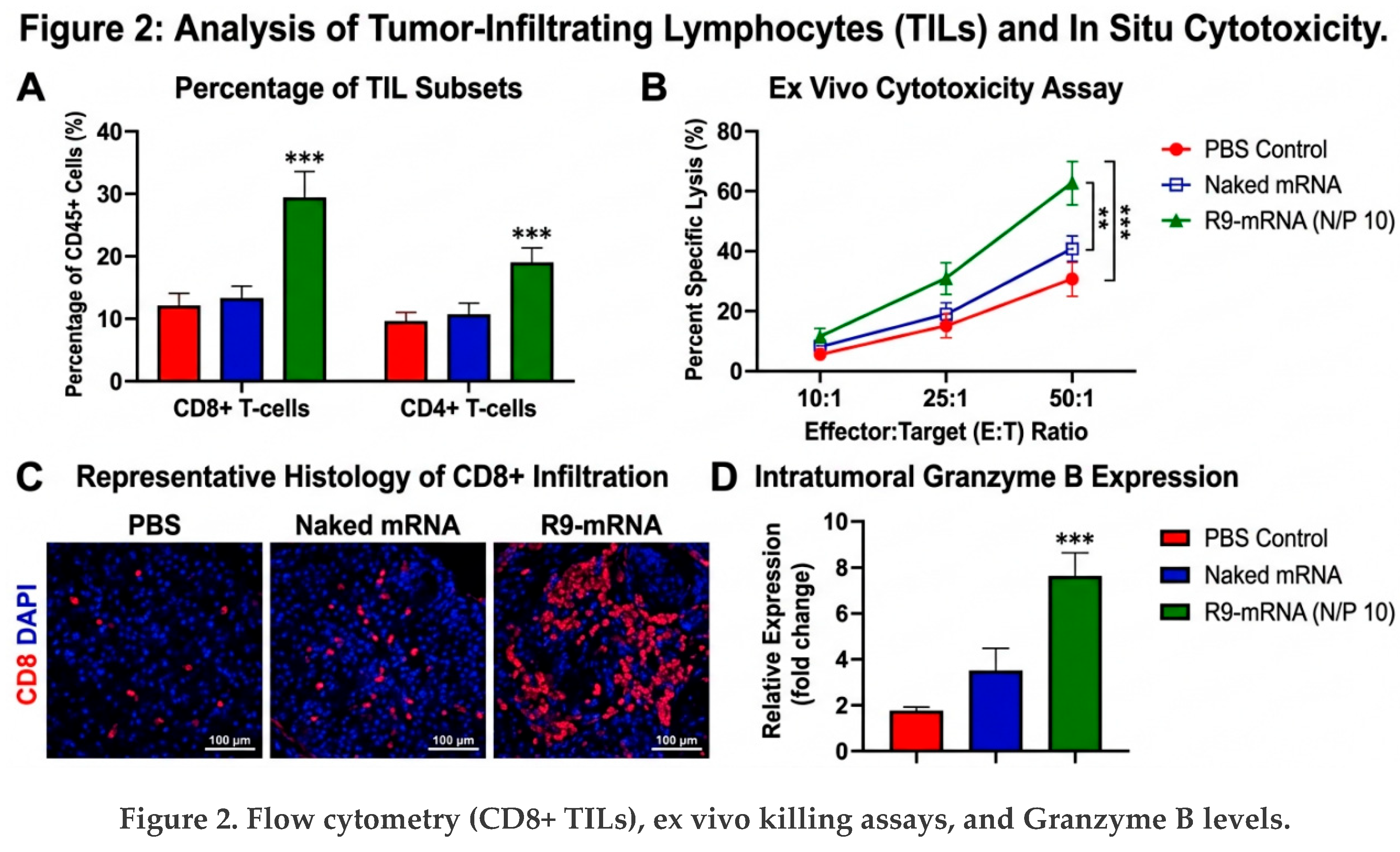
Table 1.
Bioinformatics-based Physicochemical and Immunogenic Profile of the CEA Protein.
| Parameter | Tool/Method | Value/Result |
| Molecular Weight | ProtParam | 76.8 kDa |
| Antigenicity Score | VaxiJen v2.0 | 0.6841 (Probable Antigen) |
| Allergenicity | AllerTOP v.2 | Non-allergen |
| Solubility Index | SOLpro | 0.892 (Highly Soluble) |
Table 2.
Dynamic Light Scattering (DLS) Characterization of R9-mRNA Polyplexes.
| N/P Ratio | Z-Average (nm) | PDI | Zeta Potential (mV) |
| 5:1 | 285.4 ± 12.1 | 0.34 | +8.2 |
| 10:1 | 142.5 ± 4.2 | 0.18 | +18.6 |
| 20:1 | 115.2 ± 3.8 | 0.21 | +24.5 |
Disclaimer/Publisher’s Note: The statements, opinions and data contained in all publications are solely those of the individual author(s) and contributor(s) and not of MDPI and/or the editor(s). MDPI and/or the editor(s) disclaim responsibility for any injury to people or property resulting from any ideas, methods, instructions or products referred to in the content. |
© 2026 by the author. Licensee MDPI, Basel, Switzerland. This article is an open access article distributed under the terms and conditions of the Creative Commons Attribution (CC BY) license.
Copyright: This open access article is published under a Creative Commons CC BY 4.0 license, which permit the free download, distribution, and reuse, provided that the author and preprint are cited in any reuse.


