

Submitted:
25 April 2026
Posted:
28 April 2026
You are already at the latest version
Abstract
This article deals with sixth-degree polynomial equations and, more specifically, describes the necessary conditions under which the solutions of these polynomials can be expressed in closed-form radicals. For this purpose, eight different cases of sixth-degree polynomial equations will be discussed in detail. It is concluded that if a specific relation exists between the constant term and the remaining coefficients of a sixth-degree polynomial equation, then its solutions can be obtained by formulas expressed as functions of the initial coefficients and ultimately represented in terms of radicals. Each case of the polynomial discussed in this article is presented in the “problem–proof” format.
Keywords:
sixth polynomial
; sextic polynomial
; sixth degree polynomial equation
; solvability
; galois theory
; radical solution
; radical roots
; radical expression
1. Introduction
It has been known since the 18th century that mathematicians such as N. Abel, P. Ruffini, and E. Galois contributed to the proof that general polynomial equations of degree five or higher cannot be solved by closed-form radicals. This means that the solutions of polynomial equations must be expressed in terms of relations and functions involving their coefficients, using only the standard operations (addition, multiplication, division, exponentiation, extraction of roots, etc.). For example, the formulas of G. Cardano, S. Ferro, and N. Tartaglia for cubic equations [1], as well as the L. Ferrari’s method for quartic equations [2], and the various formulas and methods for quadratic trinomials known to date [3,4,5], all above formulas produce roots expressible by closed-form solutions. However, certain polynomial equations of degree are solvable by radicals when specific conditions are satisfied, such as algebraic relations among their coefficients. Moreover, some quintic polynomial equations can be solved by radicals if an appropriate parameterization of their coefficients is found.
For example, the parameterized polynomial of G. P. Young [6], those studied by Spearman and Kenneth [7], as well as other more specialized quintic forms such as the Brioschi equation [8,9] are commonly mentioned. Similar conditions can be introduced for sixth-degree polynomial equations. In the present study, sixth-degree polynomial equations are divided into two categories, based on whether or not they can be solved by radicals. The solvability of an equation in terms of radical expressions depends on the Galois group to which the polynomial belongs. However, determining the Galois group for a sextic polynomial requires further investigation.
Let P(x) the general sextic polynomial equation:
With or and . Let S(x) be a second polynomial in which the coefficients are functions of the coefficients of P(x). In addition, set P(x) = 0. The table below presents the solvable and non-solvable by radicals, sixth-degree polynomials S(x).

Table 1.
Sixth-degree polynomial equations that are solvable by radicals and the methodology for solving them.
Table 1.
Sixth-degree polynomial equations that are solvable by radicals and the methodology for solving them.
| Coefficients of P(x) | Polynomial S(x) | Solution methodology (S(x) = 0) |
|---|---|---|
| S(x) can be transformed into a cubic equation by applying the substitution, . The resulting cubic polynomial can be solved using Cardano formula. | ||
| 1. S(x) can be transformed into a quadratic trinomial by applying the substitution, .2. Alternatively, S(x) can be transformed into a biquadratic (fourth-degree) trinomial using the transformation . The resulting equation can then be solved either by applying the further transformation or by using Ferrari’s formula, although the latter is a more complex methodology. | ||
| All coefficients are equal to zero except . | ||
| If S(x) can be transformed into the form , then it can be solved in terms of the hypergeometric function [10,11]. | ||
| The S(x) can be solved in terms of the H Fox hypergeometric function [12,13]. |
Table 2.
Sixth-degree polynomial equations that are solvable by radicals, only when certain conditions are satisfied for the constant term .
Table 2.
Sixth-degree polynomial equations that are solvable by radicals, only when certain conditions are satisfied for the constant term .
| Coefficients of P(x) | Polynomial S(x) | Conditions for S(x) |
|---|---|---|
| – | ||
The necessary conditions under which the polynomial S(x) is able to produce radical expressions for its roots are discussed in the following sections (Section 2-4). For completeness and clarity of presentation, formulas that calculate the roots of cubic and quartic polynomial equations are also included.
1.1. The Roots of Third Degree Polynomial Equations
Let the general cubic equation H(x) = with or and . If H(x) = 0 then the roots of H(x) can be calculated using Cardano’s formula as follows:
where A and B are coefficients expressed as functions of the original coefficients a, b, c of H(x), and , are the cubic roots of unity.
1.2. The Roots of Fourth Degree Polynomial Equations
Let the general quartic equation H(x) = with or and . If H(x) = 0 then the roots of H(x) can be calculated using Ferrari’s formula as follows:
where y is the root of the resolvent of H(x), which is a cubic equation.
where p and q are the coefficients expressed as functions of the resolvent coefficients.
where A, B and C are coefficients expressed as a function of the initial coefficients a, b, c, and d of H(x).
2. First Case – The General Sextic Polynomial Equation
Problem 1.
Let the polynomial P(x) = with and or . Prove that the roots of P(x) can be expressed by radicals; that is, () = , if the constant term of P(x) satisfies ,
Proof.
The polynomial P(x) can be transformed into a depressed sextic polynomial S(y) without the quintic term (i.e., with ) using the Tschirnhaus transformation x = y –/6.
where p, q, r, s, t are real or complex coefficients expressed as functions of the original coefficients of P(x); that is, (p, q, r, s, t) = f. More explicitly:
In the next step, consider G(y) as the product of two cubic trinomials without quadratic term:
where (m, n, u, v) or . Both trinomials as well as G(y) can be solved by Cardano formula. The result of the product G(y) is as follows:
□
It can be observed that ; that is, the two equations coincide and the corresponding terms of G(y) and S(y) are the same. Consequently, we obtain the following system of equations, consisting of five known and four unknown variables:
The above system provides four solutions for m, n, u, v and one equation. The solutions are as follows:
By substituting m, n, u, v into G(y), we obtain the two following cubic trinomials.
The solutions of the cubic trinomials are also roots of S(y). The last term t of S(y) is calculated using the following equation:
It can be seen that the last term t is expressed as a function of the coefficients of S(y); that is, t = f(p, q, r, s). Furthermore, it has already been shown that (p, q, r, s, t) = fand hencet = f. For the last term of P(x) we have:
If we set and as follows:
Finally we have:
Finally, we conclude that the general sextic polynomial P(x) has six roots that can be expressed by radicals, provided that the last term of P(x) can be expressed as a function of its coefficients. The roots of P(x) are given as follows:
where ... are the discriminants of P(x) and , are the cubic roots of unity. It is observed that (, ) = f(, ).
where (p, q, r, s, t) are coefficients calculated by . The basic conditions that must be satisfied to express the roots of both S(y) and P(x) polynomials as functions of their initial coefficients are as follows [14]:
3. Second Case – The Sextic Equation
Problem 2.
Let the polynomial P(x) = where and or . Prove that the roots of P(x) can be expressed by radicals, hence () = , provided that the constant term of P(x) satisfies ,
Proof.
We follow a technique similar to that used in the previous case. Using the Tschirnhaus transformation x = y – /6, we construct a new polynomial S(y). The above substitution eliminates the quintic term of P(x), and therefore the transformed polynomial S(y) takes the following form:
where p, q, r, s, t are real or complex coefficients expressed as functions of the initial coefficients of P(x). Hence (p, q, r, s) = f and t = f.The roots of S(y) can be calculated and expressed by radicals using a procedure similar to that of the previous case. It has already been proven that t = f.Therefore, the polynomial P(x) has the following roots:
where ... are the discriminants of the P(x) and , are the cubic roots of unity. It is observed that (, ) = f(, ).
The conditions that must be satisfied in order to express the roots of both of both S(y) and P(x) polynomials by radicals are the same as in the previous case:
More specifically, after substituting the coefficients p, q, r, s, t, we obtain:
□
4. Third Case – The Bring–Jerrard Sextic Equation
4.1. Problem 3, subcase 1: Let the polynomial P(x) = where and or . Prove that the roots of P(x) can be expressed by radicals, that is, () = , provided that the constant term of P(x) satisfies .
Proof.
he methodology used in the two previous cases cannot be applied in this particular case. If we consider in the general sextic polynomial P(x), then we obtain the sextic polynomial Bring–Jerrard S(y) = . However, S(y) cannot be solved using the previous formulas, since in this case the following limitations:
Therefore, an alternative technique is required to solve this particular polynomial. If we apply the substitution x = y + k with k to the Bring-Jerrard form of P(x), we obtain the following expression:
The k parameter is chosen so that the term is eliminated. Hence:
Equation S(y) obtains the following form without primary term:
We set (to make S(y) solvable by radicals. This requirement eliminates the constant coefficient of S(y). Consequently, S(y) obtains the following form:
The above form of S(y) can be solved by radicals as follows:
The remaining four roots of S(y) can be determined using Ferrari’s formula. The Bring-Jerrard sextic polynomial P(x) ultimately has one double root and four additional roots, which are as follows.
where, y is the root of the resolvent of S(y).
Where p and q are:
where A, B, and C are coefficients expressed as functions of the initial coefficients of S(y).
The condition that must be satisfied for the constant term in order to express the roots of both S(y) and P(x) polynomials by radicals is as follows:
□
4.2. Problem 3, subcase 2: Let the polynomial P(x) = where and or . Prove that the roots of P(x) can be expressed by radicals, hence () = , provided that the constant term of P(x) satisfies .
Proof.
The same methodology as in subcase 1 is followed. The difference in this subcase focused on the condition on the constant term of S(y). More specifically, the S(y) polynomial is given by:
We set ( to make S(y) solvable by radicals. This requirement eliminates both quintic and cubic term of S(y). Consequently, S(y) obtains the following form:
The above sixth-degree equation can be transformed into a cubic equation using the transformation which can then be solved by Cardano’s formula. Finally, in this particular subcase, the Bring-Jerrard polynomial P(x) has the following six roots, all of which can be expressed by radicals:
where A and B are coefficients expressed as functions of initial coefficients of S(y).
The condition that must be satisfied for the constant term in order to express the roots of both S(y) and P(x) polynomials by radicals is as follows:
where y is one of the six roots of S(y):
□
4.3. Problem 3, subcase 3: Let the polynomial P(x) = with and or . Prove that the roots of P(x) can be expressed by radicals–hence () = –if for the constant term of P(x) satisfies .
Proof.
The same methodology as in subcase 1 is followed. If we apply the substitution x = y + k with k to the Bring-Jerrard polynomial P(x), then we obtain the following expression:
The k parameter is chosen so that the term is eliminated. Hence:
With replacement of the k parameter, the equation S(y) obtains the following form:
Both S(y) and the initial polynomial P(x) can be solved by radicals depending on the relationship between the constant term , the coefficient , and the root of S(y). The various relations of as a function of are described in the following subcases. □
Subcase 4.3.1
I
The roots of S(y) can be calculated using Ferrari’s formula. The same method as in problem 3 – subcase 1 as well as problem 1, is followed. After numerous calculations, the roots y of S(y) are as follows:
where:
Subcase 4.3.2
If we set the constant term:
Then we obtain the polynomial:
The roots of S(y) can be calculated using Cardano’s formula, following the same method as in problem 3 – subcase 2 and problem 2.
The constant term has three different values:
The roots of P(x) in this case are:
Subcase 4.3.3
If we set the constant term:
Then we obtain the polynomial:
The S(y) is a quadratic trinomial. The roots of P(x) are:
The following is the relationship of the constant term based on the calculated root of S(y):
Subcase 4.3.4
If we set the constant term:
Then we obtain the polynomial:
The roots of P(x) are as follows:
The following is the simplified relationship of the constant term based on the calculated root of S(y):
5. Resume
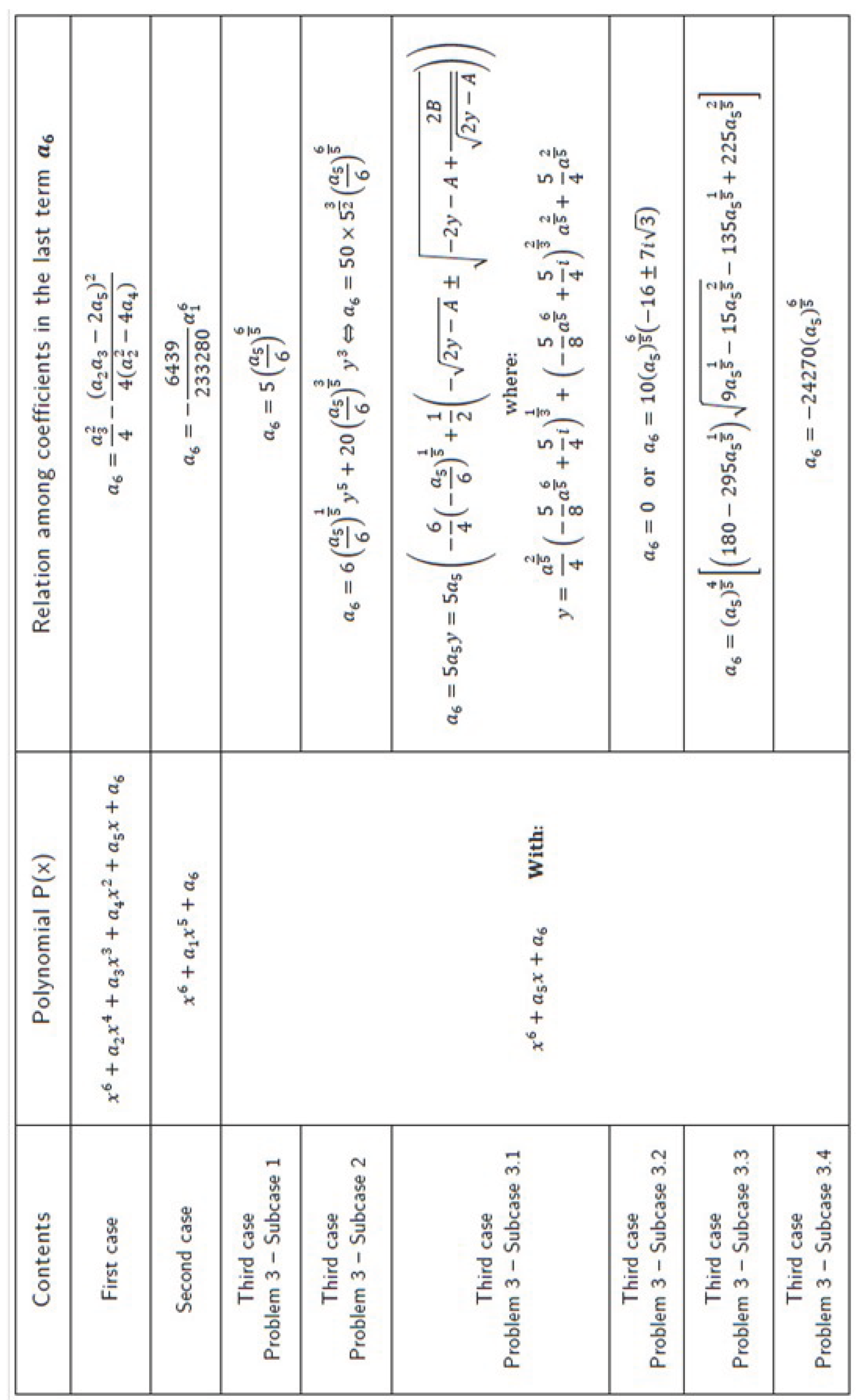
The previous table presents all cases of sixth-degree polynomial equations that can be solved in radicals under certain conditions. Specifically, each constant term must be a function of the other coefficients of the polynomial. In summary, eight different cases are finally mentioned.
References
- Contreras, J. N. An Episode of the Story of the Cubic Equation: Thedel Ferro-Tartaglia-Cardano’s Formulas. J. Math. Sci. Math. Educ. 2014, 9(2), 24–37. Available online: http://www.msme.us/2015-2-3.pdf.
- Saghe, A. Solving a quartic equation and certain equations with degree n. hal-01245821v3. 2015. Available online: https://hal.science/hal-01245821v3.
- Rogers, L.; Pope, S. A brief history of quadratic equations for mathematics educators. In Proceedings of the British Society for Research into Learning Mathematics (BSRLM); Adams, G., Ed.; 2015; Volume 35, 3, pp. 90–95. Available online: https://bsrlm.org.uk/wp-content/uploads/2016/02/BSRLM-IP-35-3-16.pdf.
- Pieronkiewics, B.; Tanton, J. Different ways of solving quadratic equations. Ann. Univ. Paedagog. Cracoviensis Stud. Ad. Didact. Math. Pertin. Accessed in. 2019, 11, 103–125. [Google Scholar] [CrossRef]
- Taub, D. A Brief History of Quadratic Equations. Department of Mathematics and Computer Science, Working Papers inMathematics Education, Karlstad University, NR 2022:2. 2022. Available online: https://www.diva-portal.org/smash/get/diva2:1721562/FULLTEXT01.pdf.
- Young, G. P. Solvable Quintic Equations with Commensurable Coefficients. Am. J. Math. 1888, 10(2), 99–130. Available online: https://www.jstor.org/stable/pdf/2369502.pdf. [CrossRef]
- Spearman, B. K.; Kenneth, S. W. Characterization of Solvable Quintics x∧5 + ax + b. Am. Math. Mon. Accessed in. 1994, 101(10), 986–992. [Google Scholar] [CrossRef]
- Garver, R. On the Brioschi Normal Quintic. Ann. Math. 1928, 30(1), 607–612. Available online: https://www.jstor.org/stable/pdf/1968308.pdf. [CrossRef]
- Piezas, T.; Weisstein, E. W. Brioschi Quintic Form. MathWorld - A Wolfram Resource. Available online: https://mathworld.wolfram.com/BrioschiQuinticForm.html.
- Piezas, T. Hilbert’s 13th Problem and series solutions for the reduced sextic, septic, and octic? 2024. Available online: https://mathoverflow.net/q/450112.
- Piezas, T. Is it possible to solve sextic equations using the Fox H function? 2024. Available online: https://mathoverflow.net/q/484428.
- Beenakker, C. Is it possible to solve sextic equations using the Fox H function? 2022. Available online: https://mathoverflow.net/q/422188.
- Belkić, D. All the trinomial roots, their powers and logarithms from the Lambert series, Bell polynomials and Fox–Wright function: illustration for genome multiplicity in survival of irradiated cells. J. Math. Chem. Accessed in. 2019, 59, 59–106. [Google Scholar] [CrossRef]
- Kouropoulos, G. P. A combined methodology for the approximate estimation of the roots of the general sextic polynomial equation. Research Square. Accessed in. 2021. [CrossRef]
Disclaimer/Publisher’s Note: The statements, opinions and data contained in all publications are solely those of the individual author(s) and contributor(s) and not of MDPI and/or the editor(s). MDPI and/or the editor(s) disclaim responsibility for any injury to people or property resulting from any ideas, methods, instructions or products referred to in the content. |
© 2026 by the authors. Licensee MDPI, Basel, Switzerland. This article is an open access article distributed under the terms and conditions of the Creative Commons Attribution (CC BY) license (http://creativecommons.org/licenses/by/4.0/).
Copyright: This open access article is published under a Creative Commons CC BY 4.0 license, which permit the free download, distribution, and reuse, provided that the author and preprint are cited in any reuse.


