
Submitted:
23 April 2026
Posted:
28 April 2026
You are already at the latest version
Abstract
Aquatic macroinvertebrates inhabit virtually all freshwater ecosystems, yet communities in extreme saline environments remain largely undescribed, particularly in the Tropical Andes. This study characterizes the taxonomic diversity of aquatic macroinvertebrates in a travertine-fed saline stream (salinity: 12.5 ± 0.2 g/L; 2520 m a.s.l., southern Ecuador) and compares it with an adjacent freshwater stream. Macroinvertebrates were sampled on four occasions (n = 4 events per stream) using a multi-habitat D-net technique; physicochemical variables were compared with Mann–Whitney U exact tests, and diversity metrics with exact permutation tests (C(8,4) = 70 permutations) supplemented with Cliff’s delta as effect-size estimator. Community composition was assessed with ANOSIM and non-metric multidimensional scaling (NMDS). A total of 919 individuals were collected. The freshwater stream harbored significantly greater richness (49 genera, 28 families), abundance, and Shannon diversity than the saline stream (14 genera, 8 families; all p = 0.029, Cliff’s δ = 1.00), while Pielou’s evenness did not differ between stream types. Community composition was fully separated (ANOSIM R = 1.00, p = 0.028), with salinity (R² = 0.95, p < 0.01) and water temperature (R² = 0.79, p = 0.03) as the primary environmental drivers. The saline stream was dominated by halotolerant Diptera (Ceratopogonidae, Stratiomyidae) and water mites (Hydrachnidae), with virtually no EPT (Ephemeroptera–Plecoptera–Trichoptera) representation. These findings establish the first macroinvertebrate diversity baseline for a travertine-associated saline stream in the Tropical Andes, highlighting salinity and temperature as key environmental filters of aquatic biodiversity in extreme Andean lotic ecosystems.
Keywords:
osmotic stress
; halotolerance
; community composition
; environmental filtering
; EPT richness
; high-altitude streams
; biomonitoring
; Ecuador
1. Introduction
Aquatic macroinvertebrates (invertebrates retained on a 500 µm mesh sieve) constitute the most taxonomically diverse component of benthic communities in lotic ecosystems, encompassing hundreds of species across phyla Arthropoda, Mollusca, Annelida, Nematoda, and Platyhelminthes, with insects representing the dominant taxon [1]. The ecological importance of macroinvertebrates extends beyond biodiversity metrics. As processors of organic matter, prey for higher trophic levels and bioindicators of water quality, they are integral to ecosystem functioning and health assessment [2,3].
Globally, macroinvertebrate diversity is well-characterized in freshwater systems, but communities inhabiting extreme aquatic environments remain poorly understood. Saline streams, defined as those with salinity > 0.5 g/L, represent one such extreme, where elevated ionic concentrations impose severe osmotic stress on aquatic organisms, constraining colonization to a limited number of halotolerant or halophilic taxa [4,5]. In Mediterranean and arid regions, research has demonstrated that macroinvertebrate richness and abundance decline sharply along salinity gradients, with community shifts toward salt-tolerant dipterans, water mites, and gastropods [4,6]. However, analogous studies in the Tropical Andes are virtually absent, representing a significant gap in our understanding of biodiversity patterns in this globally important mountain range.
Travertine-forming springs represent a geologically distinctive source of saline streams [7]. These systems arise when groundwater enriched with calcium carbonate, dissolving from limestone or dolomite substrates, emerges at the surface and deposits calcium carbonate precipitates in cascading terrace and pool formations [8,9]. In the Andes, such travertine systems can generate cold saline streams with ferrous odors and flavors, flowing alongside freshwater tributaries [10,11,12], offering a natural paired comparison at fine spatial scales (< 2 km). Despite their scientific interest and touristic value [13], their biodiversity remains undocumented.
The Tropical Andes constitute a global biodiversity hotspot [14,15], yet the extreme end of their aquatic spectrum, i.e. saline, geothermal, or travertine-associated streams, is essentially unknown from a macroinvertebrate perspective. Understanding which taxa tolerate or exploit these conditions, and which physicochemical variables govern community assembly, is critical for establishing conservation baselines and predicting responses to climate-driven changes in water chemistry.
The objective of this study was to characterize the taxonomic diversity and community composition of aquatic macroinvertebrates in a travertine-fed saline stream in the southern Andes of Ecuador, and to compare these with an adjacent freshwater stream. We hypothesized that (i) the saline stream would support lower richness, abundance, and diversity than the freshwater stream, owing to osmotic constraints; and (ii) salinity and associated physicochemical variables would be the primary drivers of community differentiation between stream types.
2. Materials and Methods
2.1. Study Site
The study was conducted in the El Salado sector (3°37’27”S, 79°10’42”W; 2,520 m a.s.l.), located approximately 1.7 km from Urdaneta Parish, Saraguro Canton, Loja Province, southern Ecuador (Figure 1). This site features an active travertine formation over which flows a cold saline stream with a distinctive ferrous odor and taste. The saline stream converges with an adjacent freshwater stream characteristic of Andean highland environments. During the dry season, the saline stream forms shallow pools on the travertine surface, and the site functions as a popular recreational destination.
2.2. Sampling Design and Macroinvertebrate Collection
Macroinvertebrates were sampled in both the saline and freshwater streams on four occasions: two during the rainy season (May–June 2023) and two during the dry season (July–August 2023), to account for seasonal hydrological variability characteristic of Andean streams [16,17]. At each sampling date, macroinvertebrates were collected using a D-frame kick-net (500 µm mesh) following a multi-habitat protocol that proportionally samples all available microhabitats (leaf packs, mineral substrate, macrophytes, submerged roots, and fine sediments) [1,18]. Collected individuals were preserved in 90% ethanol and identified to genus level in the laboratory using neotropical keys [19] and the digital reference collection of the Ecuadorian aquatic invertebrates of the UTPL Museum of Zoology.
2.3. Physicochemical Measurements
At each sampling event, the following physicochemical parameters were measured in situ in both streams using a YSI ProQuatro multiparameter sonde (Yellow Springs Instruments Inc., USA): water temperature (°C), pH, electrical conductivity (mS/cm), dissolved oxygen (mg/L and % saturation), total dissolved solids (g/L), and salinity (g/L).
2.4. Data Analysis
All analyses were performed in R environment [20]. Given the small number of independent sampling events (n = 4 per stream type), we used distribution-free methods throughout. Physicochemical variables were compared between stream types with two-sided Mann–Whitney U exact tests (package ‘coin’; [21]). Diversity metrics (genus richness, total abundance, Shannon diversity H’, Pielou’s evenness J’) were calculated with the package ‘vegan’ [22] and compared using exact permutation tests on the observed difference of means across all C(8,4) = 70 possible group assignments. Cliff’s delta (δ) was computed as a non-parametric effect-size estimator; values |δ| ≥ 0.638 indicate a large effect (package ‘effsize’; [23]). The minimum achievable p-value with n = 4 per group is 1/70 ≈ 0.014. Differences in community composition were assessed with ANOSIM (Bray-Curtis dissimilarity, 999 permutations; package ‘vegan’; [22]). Non-metric multidimensional scaling (NMDS) was used to ordinate community composition, and the environmental fit function (envfit) quantified the correlation of physicochemical variables with the ordination (p ≤ 0.05). Environmental variables were standardised prior to ordination, and multicollinearity was screened with the variance inflation factor (VIF threshold ≥ 7; package ‘usdm’; [24]).
3. Results
3.1. Physicochemical Characteristics
Mann–Whitney U exact tests showed that conductivity, total dissolved solids, salinity, and water temperature were all significantly higher in the saline stream (all U = 0, p = 0.0006 for ionic variables; U = 6, p = 0.026 for temperature; Table 1). pH did not differ significantly between streams (U = 23, p = 0.901). Dissolved oxygen and its percentage saturation also did not differ significantly (U = 26, p = 0.901 and U = 22, p = 0.805, respectively), a result influenced by high variance in the saline stream’s %OD measurements (90.7 ± 40.3%) that warrants verification against the original field records.
3.2. Macroinvertebrate Diversity
A total of 919 individuals were collected across both streams. The freshwater stream harbored substantially greater diversity, with 49 genera belonging to 28 families and 8 orders across 5 classes, totaling 823 individuals. The saline stream yielded 14 genera, 8 families, and 3 orders across 3 classes, totaling 96 individuals. Exact permutation tests confirmed that richness, total abundance, and Shannon diversity (H’) were all significantly lower in the saline stream (p = 0.029 for all three metrics; Figure 2), with maximum effect sizes (Cliff’s δ = 1.00; i.e. every freshwater sample exceeded every saline sample for all three metrics). Pielou’s evenness (J’) did not differ significantly (p = 0.686, Cliff’s δ = −0.25; Figure 2), indicating that, while the saline community was species-poor, the individuals present were relatively evenly distributed among taxa. With n = 4 per group, the minimum achievable p-value is 1/70 ≈ 0.014. The reported p = 0.029 is therefore the second-smallest achievable value and is supported by the maximum Cliff’s δ.
In the freshwater stream, the dominant orders were Ephemeroptera (Baetidae: Baetodes [220 ind.], Andesiops [84 ind.]; Leptohyphidae: Leptohyphes [53 ind.], Haplohyphes [52 ind.]), followed by Diptera (Chironomidae: Chironomus [49 ind.]) and Trichoptera (Hydroptilidae: Ochrotrichia [26 ind.]). In the saline stream, Diptera dominated: Ceratopogonidae (Stilobezzia, 29 ind.) and Stratiomyidae (Caloparyphus, 16 ind.) were the most abundant taxa, alongside water mites (Hydrachnidae mf 9, 15 ind.) and Gastropoda (Lymnaeidae: Pseudosuccinea, 5 ind.; Table 2). Community turnover between stream types was nearly complete: only 2 of 63 genera recorded (Gyraulus and Hydrachnidae mf 10) were shared between streams (3.2% of the total).
3.3. Community Composition and Environmental Drivers
ANOSIM revealed complete separation between macroinvertebrate communities of the saline and freshwater streams (R = 1.00, p = 0.028). All between-stream pairwise dissimilarities exceeded all within-stream dissimilarities. NMDS ordination (Figure 3) clearly visualised this separation, with salinity (R² = 0.95, p < 0.01) and water temperature (R² = 0.79, p = 0.03) as the physicochemical variables most strongly associated with community differentiation. pH was not a significant covariate (p > 0.05). The saline stream cluster was characterised by Diptera (Ceratopogonidae, Stratiomyidae) and Hydrachnidae, while the freshwater cluster was dominated by Ephemeroptera (especially Baetidae), Trichoptera, and Coleoptera (Elmidae). The 12 genera exclusive to the saline stream were dominated by Diptera (Stilobezzia, n = 29; Caloparyphus, n = 16; Tabanus, n = 11; Atherix, n = 4) and water mites (Hydrachnidae mf 9, n = 15), while the 47 freshwater-exclusive genera were dominated by Ephemeroptera (Baetodes, n = 220; Andesiops, n = 84; Haplohyphes, n = 52; Leptohyphes, n = 53).
4. Discussion
This study provides the first account of aquatic macroinvertebrate diversity in a travertine-associated saline stream in the Tropical Andes, filling a notable gap in the biogeography of extreme lotic ecosystems in this region. Our results corroborate the central hypothesis that salinity is a primary environmental filter that dramatically reduces macroinvertebrate richness, abundance, and diversity in the saline stream relative to the adjacent freshwater system.
The saline stream (12.5 g/L) supported only 14 genera across eight families, whichis roughly 28% of the taxonomic richness recorded in the freshwater stream. This is a pattern that is consistent with findings from Mediterranean saline rivers, where comparable salinity levels (> 10 g/L) are associated with a collapse in biodiversity towards a few halotolerant specialists [4,5,6]. High ionic concentrations disrupt osmoregulation in most freshwater invertebrates, which must expend increasing energetic resources to maintain ionic homeostasis or are simply excluded beyond their physiological tolerance thresholds [25]. The persistence of Pielou’s evenness across stream types suggests that, although few species tolerate saline conditions, those that do are distributed relatively equitably. This indicates a community structure that is functionally compressed but internally balanced, rather than a structure dominated by a single dominant opportunistic taxon.
The dominance of Diptera in the saline stream, particularly the families Ceratopogonidae (Stilobezzia) and Stratiomyidae (Caloparyphus and Nemotelus), reflects the well-documented salt tolerance of dipterans. Stratiomyid larvae are known for their ability to inhabit alkaline and saline environments owing to specialized integumental ion-transport mechanisms and resistance to desiccation [26]. Similarly, ceratopogonid larvae exhibit broad physiological tolerances and have been reported from brackish and hypersaline waters in South American lowlands [27]. The high abundance of water mites (Hydrachnidae) in the saline stream is noteworthy. These water mites are generally sensitive to pollution in freshwater systems [28], but certain taxa exhibit halotolerance and can reach high densities in the absence of competitive freshwater invertebrates [29].
The near-complete absence of the Ephemeroptera, Plecoptera, and Trichoptera (EPT) taxa in the saline stream, despite these orders constituting over 60% of the total macroinvertebrate abundance in the freshwater stream, highlights their sensitivity to ionic stress and supports their use as bioindicators of water quality [2]. EPT taxa lack robust osmoregulatory organs compared with dipteran larvae and are physiologically excluded at the salinity levels recorded here. The presence of pulmonated gastropods (Lymnaeidae, Planorbidae) in the saline stream is consistent with the relatively broad ionic tolerance of this group compared with other freshwater invertebrate orders [30]. Freshwater pulmonated are known to hyperregulate in dilute media but shift toward osmoconformity as ambient salinity increases [31].
NMDS ordination identified salinity and temperature as the dominant environmental axes separating communities. The slightly elevated water temperature of the saline stream (+3.8 °C on average) likely reflects the geothermal origin of the travertine-fed groundwater and may compound osmotic stress by accelerating metabolic rates and reducing oxygen solubility. Although dissolved oxygen levels were numerically lower in the saline stream (6.5 vs. 7.7 mg/L), this difference was not statistically significant under the non-parametric tests applied, partly due to high variance in the saline DO measurements that should be verified against the original field records. Regardless, the thermal-ionic co-gradient creates a multidimensional environmental filter that few taxa are adapted to bridge.
Our study has several limitations. First, the analysis relies on n = 4 independent sampling events per stream type, meaning that statistical tests operate at the boundary of their permutation space and results should be interpreted alongside effect sizes rather than p-values alone. The large Cliff’s delta values and the perfect ANOSIM separation provide biological confidence that the observed differences are real despite the small sample size. Second, the paired comparison involved only one freshwater and one saline stream, which limits the scope for generalization. Future studies should replicate the sampling across multiple travertine systems. Third, the physicochemical characterisation of the saline stream was limited to standard field parameters (temperature, pH, conductivity, DO, TDS, salinity). A full ionic analysis, including major cations (Na⁺, Ca²⁺, Mg²⁺, K⁺) and anions (Cl⁻, SO₄²⁻, HCO₃⁻), would provide a more complete understanding of the geochemical origin of the water and the specific ionic stressors experienced by the macroinvertebrate community. Such data would also allow comparison with other saline stream systems worldwide and better interpretation of the osmoregulatory mechanisms underlying the observed community patterns.
From a conservation perspective, travertine-fed saline streams represent micro-endemic extreme habitats, harboring a small but potentially specialized community not found in adjacent freshwater systems. The site’s popularity as a tourist destination (bathing in travertine pools) may pose disturbance risks to the macroinvertebrate community, and baseline data such as those presented here are essential for impact assessment and management.
5. Conclusions
This study demonstrates that a travertine-fed saline stream in the Tropical Andes harbors significantly lower macroinvertebrate richness, abundance, and Shannon diversity than an adjacent freshwater stream, with salinity and water temperature as the primary environmental filters structuring community composition. The saline macroinvertebrate fauna is dominated by halotolerant Diptera (Ceratopogonidae, Stratiomyidae) and water mites (Hydrachnidae), with virtually no EPT representation, in sharp contrast to the Ephemeroptera-dominated freshwater community. Pielou’s evenness did not differ between streams, indicating that the salt-tolerant community, though depauperate, maintains internal evenness. These findings establish the first biodiversity baseline for a travertine-associated saline lotic ecosystem in the Tropical Andes. Although the sampling design (n = 4 events per stream) limits statistical power, the maximum effect sizes and perfect community separation provide a robust empirical foundation for future biomonitoring and conservation planning in extreme Andean fluvial ecosystems.
Author Contributions
Conceptualization, C.I.A.; Methodology, S.C and C.I.A.; formal analysis, W.Z.S and C.I.A; writing—original draft preparation, S.C. and W.Z.S..; writing—review and editing, C.I.A. All authors have read and agreed to the published version of the manuscript.
Funding
This research was funded by the Universidad Técnica Particular de Loja.
Institutional Review Board Statement
The study was conducted in accordance with the Ministry of the Environment of Ecuador, which granted us access to the field sites and the necessary collecting permits (MAE-DNB-CM-2015-0016).
Acknowledgments
We would like to thank the Saraguro community for providing free access to the sampling site and for their help with logistics.
Conflicts of Interest
The authors declare no conflicts of interest. The funders had no role in the design of the study; in the collection, analyses, or interpretation of data; in the writing of the manuscript; or in the decision to publish the results.
References
- Hauer, F.R.; Resh, V.H. Macroinvertebrates. In Methods in Stream Ecology, Volume 1: Ecosystem Structure; Hauer, F.R., Lamberti, G.A., Eds.; Academic Press: London, 2017; pp. 297–319 ISBN 9780124165588.
- Buss, D.F.; Carlisle, D.M.; Chon, T.-S.; Culp, J.; Harding, J.S.; Keizer-Vlek, H.E.; Robinson, W.A.; Strachan, S.; Thirion, C.; Hughes, R.M. Stream Biomonitoring Using Macroinvertebrates around the Globe: A Comparison of Large-Scale Programs. Environ. Monit. Assess. 2015, 187, 4132. [CrossRef]
- Ramírez, A.; Gutiérrez-Fonseca, P.E. Functional Feeding Groups of Aquatic Insect Families in Latin America: A Critical Analysis and Review of Existing Literature. Rev. Biol. Trop. 2014, 62, 155–167.
- Millán, A.; Velasco, J.; Gutiérrez-Cánovas, C.; Arribas, P.; Picazo, F.; Sánchez-Fernández, D.; Abellán, P. Mediterranean Saline Streams in Southeast Spain: What Do We Know? J. Arid Environ. 2011, 75, 1352–1359. [CrossRef]
- Velasco, J.; Millán, A.; Hernández, J.; Gutiérrez, C.; Abellán, P.; Sánchez, D.; Ruiz, M. Response of Biotic Communities to Salinity Changes in a Mediterranean Hypersaline Stream. Saline Systems 2006, 2, 12. [CrossRef]
- Arribas, P.; Gutiérrez-Cánovas, C.; Abellán, P.; Sánchez-Fernández, D.; Picazo, F.; Velasco, J.; Millán, A. Tipificación de Los Ríos Salinos Ibéricos. Ecosistemas 2009, 18, 1–13.
- Gandin, A.; Capezzuoli, E. Travertine: Distinctive Depositional Fabrics of Carbonates from Thermal Spring Systems. Sedimentology 2014, 61, 264–290. [CrossRef]
- Pentecost, A. Travertine; Springer: Berlin, 2005; ISBN 1402035233.
- Minissale, A.; Kerrick, D.M.; Magro, G.; Murrell, M.T.; Paladini, M.; Rihs, S.; Sturchio, N.C.; Tassi, F.; Vaselli, O. Geochemistry of Quaternary Travertines in the Region North of Rome (Italy): Structural, Hydrologic and Paleoclimatic Implications. Earth Planet. Sci. Lett. 2002, 203, 709–728. [CrossRef]
- Leiva-Tafur, D.; Manco Perez, H.G.; Rascón, J.; Culqui, L.; Gamarra-Torres, O.A.; Oliva-Cruz, M. Hydrogeochemical Characterization of Mineral Springs in Peruvian Tropical Highlands. Water 2025, 17, 2539. [CrossRef]
- De Grys, A.; Vera, J.; Goossens, P. A Note on the Hot Springs of Ecuador. Geothermics 1970, 2, 1400–1404. [CrossRef]
- Quezada, P.; Fadel Cury, L.; Calderón, M.; Henríquez, C.; Mancini, L.; Micheletto, J.; Barbosa Athayde, G.; Bahniuk Rumbelsperger, A. Similar Sources but Distinct Δ13C Signatures in Adjacent Low-Temperature Travertines from Laguna Amarga (Southern Patagonian Andes). Sediment. Geol. 2024, 473, 106758. [CrossRef]
- Chrobak, A.; Ugolini, F.; Pearlmutter, D.; Raschi, A. Thermal Tourism and Geoheritage: Examining Visitor Motivations and Perceptions. Resources 2020, 9, 58. [CrossRef]
- Myers, N.; Mittermeier, R.A.; Mittermeier, C.G.; da Fonseca, G.A.; Kent, J. Biodiversity Hotspots for Conservation Priorities. Nature 2000, 403, 853–858. [CrossRef]
- Encalada, A.C.; Flecker, A.S.; Poff, N.L.R.; Suárez, E.; Herrera-R, G.A.; Ríos-Touma, B.; Jumani, S.; Larson, E.I.; Anderson, E.P. A Global Perspective on Tropical Montane Rivers. Science (80-. ). 2019, 365, 1124–1129.
- Jacobsen, D.; Schultz, R.; Encalada, A.C. Structure and Diversity of Stream Invertebrate Assemblages : The Influence of Temperature with Altitude and Latitud. Freshw. Biol. 1997, 38, 247–261.
- Ríos-Touma, B.; Encalada, A.C.; Prat Fornells, N. Macroinvertebrate Assemblages of an Andean High-Altitude Tropical Stream: The Importance of Season and Flow. Int. Rev. Hydrobiol. 2011, 96, 667–685. [CrossRef]
- Barbour, M.T.; Gerritsen, J.; Snyder, B.D.; Stribling, J.B. Rapid Bioassessment Protocols for Use in Streams and Wadeable Rivers: Periphyton, Benthic Macroinvertebrates, and Fish; Second.; US Environmental Protection Agency, Office of Water: Washington DC, 1999;
- Wantzen, K.M.; Rueda-Delgado, G. Técnicas de Muestreo de Macroinvertebrados Bentónicos. In Macroinvertebrados bentónicos sudamericanos. Sistemática y biología; Domínguez, E., Fernández, H.R., Eds.; Fundación Miguel Lillo: Tucumán, 2009; pp. 17–46.
- R Development Core Team R: A Language and Environment for Statistical Computing, Vienna, Austria 2025.
- Hothorn, T.; Horni, K.; van de Wiel, M.A.; Zeileis, A. Implementing a Class of Permutation Tests: The Coin Package. J. Stat. Softw. 2008, 28, 1–23, doi:doi:10.18637/jss.v028.i08.
- Oksanen, J.; Blanchet, F.G.; Kindt, R.; Legendre, P.; Minchin, P.R.; O’Hara, R.B.; Simpson, G.L.; Solymos, P.; Stevens, H.H.; Wagner, H. Vegan: Community Ecology Package. R Package Version 2.6-4 2022.
- Torchiano, M. Effsize: Efficient Effect Size Computation. R Package Version 0.8.1 2020.
- Naimi, B. Usdm: Uncertainty Analysis for Species Distribution Models. R Package Version 1.1-18 2015.
- Kefford, B.J.; Buchwalter, D.; Cañedo-Argüelles, M.; Davis, J.; Duncan, R.P.; Hoffmann, A.; Thompson, R. Salinized Rivers: Degraded Systems or New Habitats for Salt-Tolerant Faunas? Biol. Lett. 2016, 12, 20151072. [CrossRef]
- Washko, S.; Bogan, M. Ability of Aquatic Stratiomyidae (Diptera) Larvae to Survive Stream Drying Using Dormancy. Aquat. Insects 2024, 45, 402–415. [CrossRef]
- Golovatyuk, L. V.; Zinchenko, T.D.; Sushchik, N.N.; Kalachova, G.S.; Gladyshev, M.I. Biological Aspects of the Associations of Biting Midges (Diptera: Ceratopogonidae) in Two Saline Rivers of the Elton Lake Basin, Russia. Mar. Freshw. Res. 2018, 69, 906–916. [CrossRef]
- Goldschmidt, T. Water Mites (Acari, Hydrachnidia): Powerful but Widely Neglected Bioindicators – a Review. Neotrop. Biodivers. 2016, 2, 12–25. [CrossRef]
- Smith, I.M.; Cook, D.R.; Smith, B.P. Water Mites (Hydrachnidiae) and Other Arachnids. In Ecology and Classification of North American Freshwater Invertebrates; Thorp, J.H., Covich, A.P., Eds.; Academic Press: New York, 2010; pp. 485–586 ISBN 9780123748553.
- Costil, K.; Dussart, G.B.J.; Daguzan, J. Biodiversity of Aquatic Gastropods in the Mont St-Michel Basin (France) in Relation to Salinity and Drying of Habitats. Biodivers. Conserv. 2001, 10, 1–18. [CrossRef]
- Griffith, M.B. Toxicological Perspective on the Osmoregulation and Ionoregulation Physiology of Major Ions by Freshwater Animals: Teleost Fish, Crustacea, Aquatic Insects, and Mollusca. Environ. Toxicol. Chem. 2017, 36, 576–600. [CrossRef]
Figure 1.
Geographical location of the study site in the southern Andes of Ecuador. (A) Aerial view of the travertine formation showing the saline stream (blue line) originating from the active travertine deposit and converging with the adjacent freshwater stream (grey line). (B) Close-up view of the travertine terraces over which the saline stream flows; shallow pools formed during the dry season are visible on the deposit surface.
Figure 1.
Geographical location of the study site in the southern Andes of Ecuador. (A) Aerial view of the travertine formation showing the saline stream (blue line) originating from the active travertine deposit and converging with the adjacent freshwater stream (grey line). (B) Close-up view of the travertine terraces over which the saline stream flows; shallow pools formed during the dry season are visible on the deposit surface.
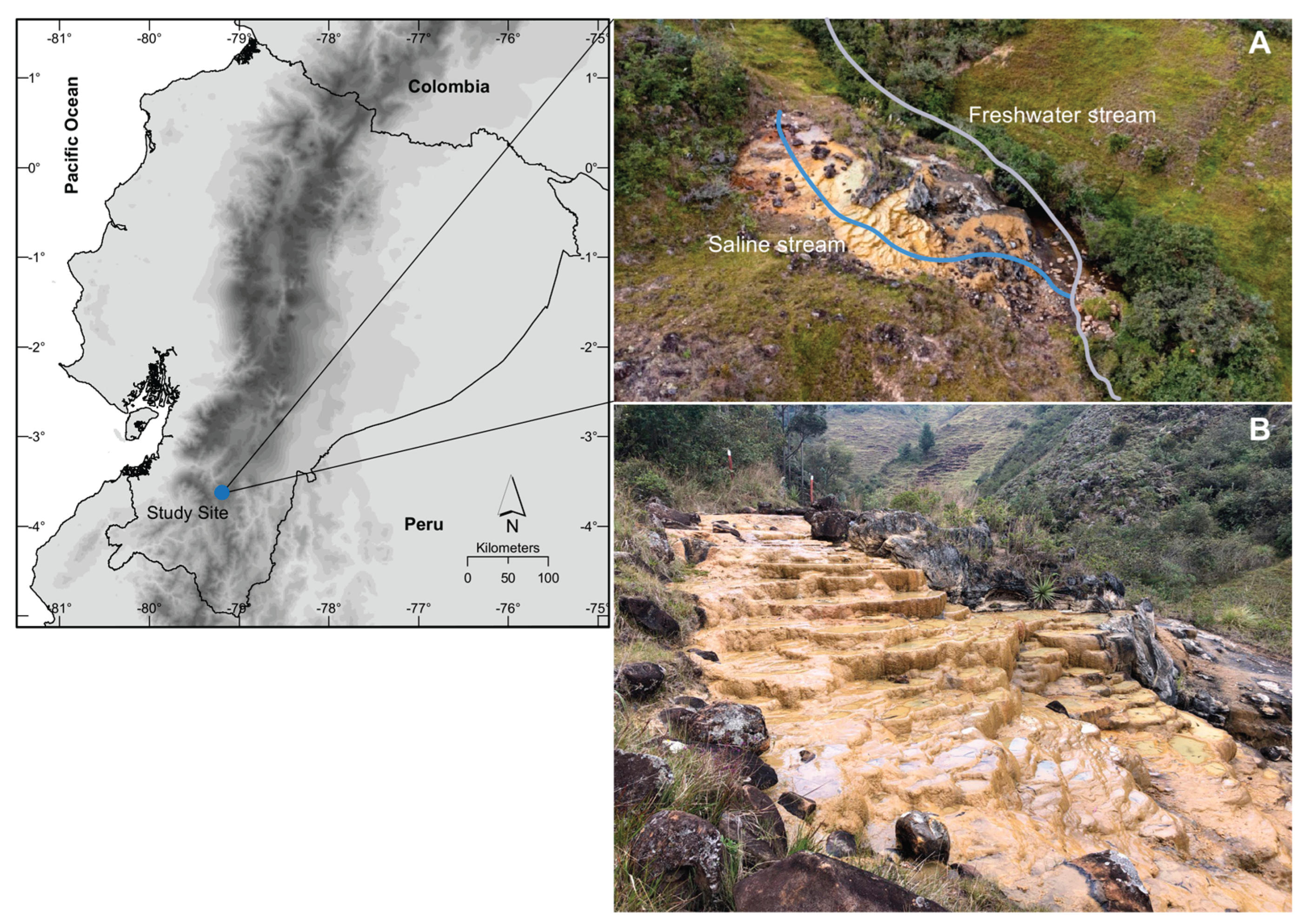
Figure 2.
Mean (± SE) alpha diversity metrics of aquatic macroinvertebrate communities sampled in the freshwater and saline streams in the southern Andes of Ecuador.
Figure 2.
Mean (± SE) alpha diversity metrics of aquatic macroinvertebrate communities sampled in the freshwater and saline streams in the southern Andes of Ecuador.
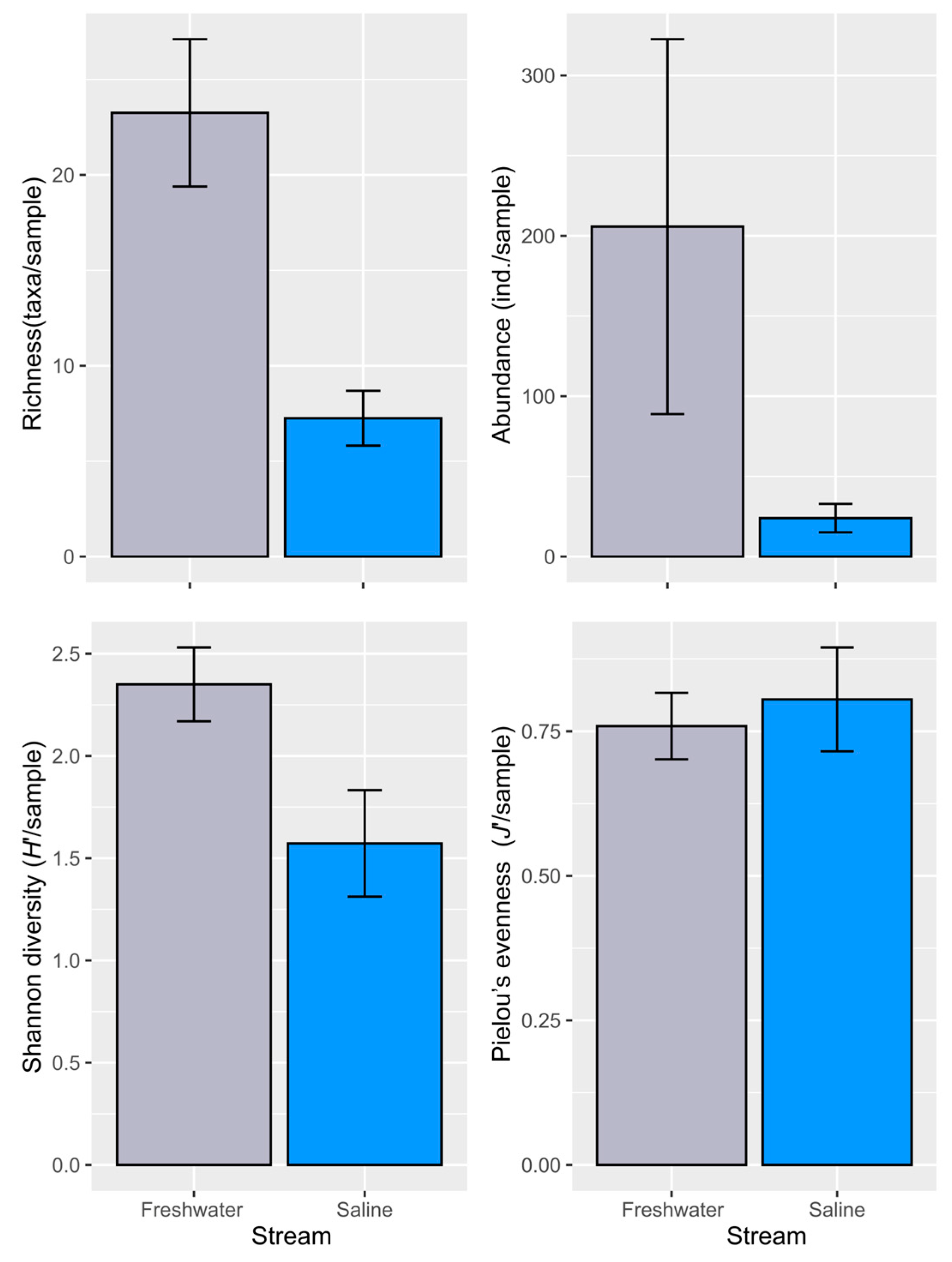
Figure 3.
Non-metric multidimensional scaling (NMDS) ordination of aquatic macroinvertebrate communities sampled in the freshwater and saline streams in the southern Andes of Ecuador. Each point represents a genus; shaded ellipses delimit the two stream types. Solid arrows indicate physicochemical variables significantly correlated with community composition (envfit; p ≤ 0.05): salinity (R² = 0.95, p < 0.01) and water temperature (R² = 0.79, p = 0.03). Dashed arrows indicate non-significant variables. Community composition differed significantly between stream types (ANOSIM R = 1.00, p = 0.028).
Figure 3.
Non-metric multidimensional scaling (NMDS) ordination of aquatic macroinvertebrate communities sampled in the freshwater and saline streams in the southern Andes of Ecuador. Each point represents a genus; shaded ellipses delimit the two stream types. Solid arrows indicate physicochemical variables significantly correlated with community composition (envfit; p ≤ 0.05): salinity (R² = 0.95, p < 0.01) and water temperature (R² = 0.79, p = 0.03). Dashed arrows indicate non-significant variables. Community composition differed significantly between stream types (ANOSIM R = 1.00, p = 0.028).
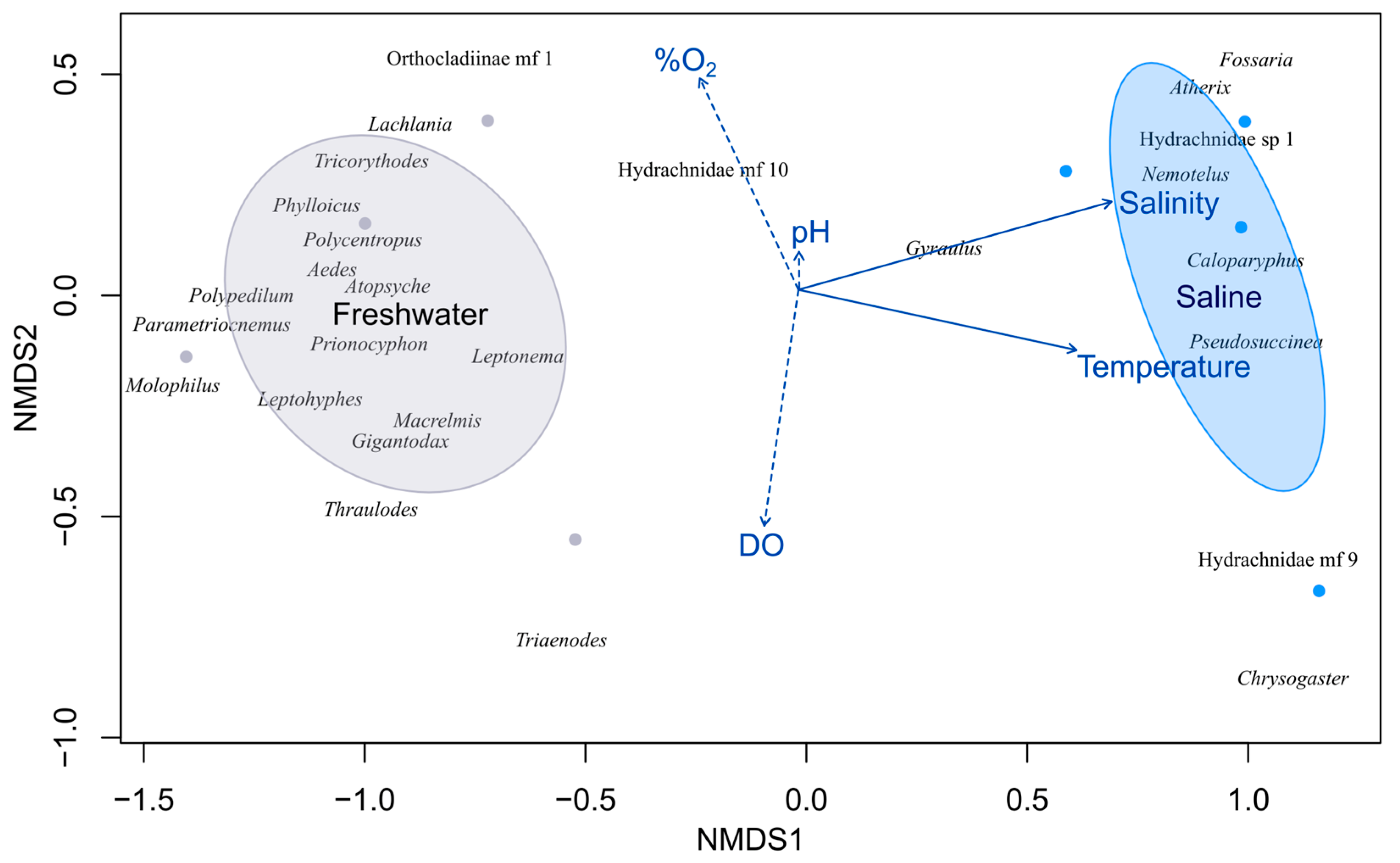

Table 1.
Mean values (± SD) of physicochemical parameters measured in a saline and a freshwater stream in the southern Andes of Ecuador (n = 7 measurements per stream across 2–3 independent sampling dates). Significant differences (Mann–Whitney U exact test; p ≤ 0.05) are shown in bold.
Table 1.
Mean values (± SD) of physicochemical parameters measured in a saline and a freshwater stream in the southern Andes of Ecuador (n = 7 measurements per stream across 2–3 independent sampling dates). Significant differences (Mann–Whitney U exact test; p ≤ 0.05) are shown in bold.
| Parameter | Unit | Freshwater stream | Saline stream | p-value |
|---|---|---|---|---|
| Temperature | °C | 13.7 ± 0.9 | 17.5 ± 3.3 | 0.028 |
| pH | 7.4 ± 0.7 | 7.4 ± 0.9 | 0.532 | |
| Conductivity | mS/cm | 0.1 ± 0.0 | 20.9 ± 0.4 | < 0.001 |
| Dissolved oxygen | Mg/L | 7.7 ± 0.4 | 6.5 ± 4.0 | 0.901 |
| O2 saturation | % | 102.2 ± 3.4 | 90.7 ± 37.5 | 0.805 |
| Total dissolved solids | g/L | 0.1 ± 0.0 | 21.0 ± 0.3 | < 0.001 |
| Salinity | g/L | 0.0 ± 0.0 | 12.5 ± 0.2 | < 0.001 |
Table 2.
Taxonomic list and abundance of aquatic macroinvertebrates collected in the freshwater and saline streams in the southern Ecuadorian Andes.
Table 2.
Taxonomic list and abundance of aquatic macroinvertebrates collected in the freshwater and saline streams in the southern Ecuadorian Andes.
| Stream | Class | Order | Family | Genus | Ind. |
|---|---|---|---|---|---|
| Freshwater | Malacostraca | Amphipoda | Hyalellidae | Hyallela | 17 |
| Oligochaeta | Arhynchobdellida | Cylicobdellidae | Cylicobdellidae mf 1 | 47 | |
| Insecta | Coleoptera | Elmidae | Austrolimnius | 1 | |
| Heterelmis | 25 | ||||
| Hexacylloepus | 1 | ||||
| Macrelmis | 4 | ||||
| Neoelmis | 8 | ||||
| Onychelmis | 1 | ||||
| Psephenidae | Pheneps | 1 | |||
| Scirtidae | Prionocyphon | 31 | |||
| Diptera | Blephariceridae | Paltostoma | 2 | ||
| Chironomidae | Aechnida | 3 | |||
| Chironomus | 49 | ||||
| Diamesa | 3 | ||||
| Larsia | 23 | ||||
| Metriocnemus | 4 | ||||
| Orthocladiinae mf 1 | 1 | ||||
| Parametriocnemus | 15 | ||||
| Polypedilum | 3 | ||||
| Culicidae | Aedes | 7 | |||
| Limoniidae | Molophilus | 1 | |||
| Polymera | 2 | ||||
| Simuliidae | Gigantodax | 38 | |||
| Tipulidae | Hexatoma | 1 | |||
| Ephemeroptera | Baetidae | Andesiops | 84 | ||
| Baetodes | 220 | ||||
| Hydrobiosidae | Atopsyche | 20 | |||
| Leptohyphidae | Haplohyphes | 52 | |||
| Leptohyphes | 53 | ||||
| Thraulodes | 8 | ||||
| Tricorythodes | 12 | ||||
| Oligoneuriidae | Lachlania | 6 | |||
| Trichoptera | Anomalopsyche | Contulma | 4 | ||
| Brachycentridae | Brachycentrus | 1 | |||
| Calamoceratidae | Heteropletron | 1 | |||
| Phylloicus | 1 | ||||
| Hydropsychidae | Leptonema | 12 | |||
| Macronema | 2 | ||||
| Hydroptilidae | Ochrotrichia | 26 | |||
| Leptoceridae | Triaenodes | 1 | |||
| Polycentropodidae | Polycentropus | 10 | |||
| Plecoptera | Perlidae | Anacroneuria | 13 | ||
| Gastropoda | Gastropoda | Gastropoda | Gastropoda mf 1 | 1 | |
| Malacostraca | Isopoda | Isopoda | Isopoda mf 1 | 1 | |
| Odanata | Aeshnidae | Allopetalia | 1 | ||
| Ironoquia | 1 | ||||
| Gastropoda | Pulmonata | Planorbidae | Gyraulus | 1 | |
| Arachnida | Trombidiformes | Hydrachnidae | Hydrachnidae mf 10 | 3 | |
| Hydrachnidae mf 14 | 1 | ||||
| Saline | Insecta | Diptera | Athericidae | Atherix | 4 |
| Ceratopogonidae | Stilobezzia | 29 | |||
| Tabanidae | Tabanus | 11 | |||
| Stratiomyidae | Caloparyphus | 16 | |||
| Nemotelus | 2 | ||||
| Syrphidae | Chrysogaster | 1 | |||
| Arachnida | Trombidiformes | Hydrachnidae | Hydrachnidae mf 10 | 2 | |
| Hydrachnidae mf 20 | 4 | ||||
| Hydrachnidae mf 22 | 1 | ||||
| Hydrachnidae mf 9 | 15 | ||||
| Hydrachnidae mf 1 | 4 | ||||
| Gastropoda | Pulmonata | Lymnaeidae | Fossaria | 1 | |
| Pseudosuccinea | 5 | ||||
| Planorbidae | Gyraulus | 1 |
Disclaimer/Publisher’s Note: The statements, opinions and data contained in all publications are solely those of the individual author(s) and contributor(s) and not of MDPI and/or the editor(s). MDPI and/or the editor(s) disclaim responsibility for any injury to people or property resulting from any ideas, methods, instructions or products referred to in the content. |
© 2026 by the authors. Licensee MDPI, Basel, Switzerland. This article is an open access article distributed under the terms and conditions of the Creative Commons Attribution (CC BY) license (http://creativecommons.org/licenses/by/4.0/).
Copyright: This open access article is published under a Creative Commons CC BY 4.0 license, which permit the free download, distribution, and reuse, provided that the author and preprint are cited in any reuse.


