
Submitted:
26 April 2026
Posted:
27 April 2026
You are already at the latest version
Abstract
This study presents a comprehensive PRISMA 2020-compliant systematic review of satellite remote sensing approaches used to monitor vegetation responses to climate change over the period 2000–2025. A total of 757 peer-reviewed studies were analysed to evaluate trends in sensor usage, spectral indices, machine learning (ML) and deep learning (DL) applications, geographic distribution, and methodological practices. Results indicate a rapid growth in research output, particularly after 2019, driven by the availability of high-resolution satellite data (e.g., Sentinel-2), cloud computing platforms, and advances in artificial intelligence. MODIS, Landsat, and Sentinel-2 emerged as dominant sensors, while NDVI remains the most widely used vegetation index despite known limitations. Random Forest and regression models continue to dominate analytical approaches, although DL methods such as CNNs and LSTMs are increasingly adopted. The review identifies significant geographic inequities, with over 80% of studies originating from Global North institutions, and highlights underrepresentation of critical ecosystems such as drylands, peatlands, and shrublands. Furthermore, inconsistent reporting of model performance metrics and limited adoption of open science practices constrain reproducibility and cross-study comparison. The study concludes by outlining key research gaps and providing strategic recommendations to advance the integration of multi-sensor data, improve methodological standardisation, and promote equitable and reproducible research in vegetation–climate remote sensing.
Keywords:
satellite remote sensing
; vegetation dynamics
; machine learning
; PRISMA systematic review
; biomass estimation
; earth observation
1. Introduction
1.1. Climate Change and the Imperative to Monitor Terrestrial Vegetation
The global climate system is undergoing its most rapid transformation in human history. 2024 marked the first calendar year in which global average surface temperature exceeded 1.5 °C above pre-industrial levels, recording an anomaly of approximately 1.55 °C (World Resources Institute, 2025). While this does not yet constitute a formal breach of the Paris Agreement — which defines the limit as a sustained multi-decadal average — recent research suggests that 2024 most probably signals Earth has already entered the 20-year period in which long-term warming will reach the 1.5 °C threshold (Bevacqua et al., 2025). UNEP's Emissions Gap Report 2025 warns that even if countries fulfil their current pledges, the world remains on course for 2.3–2.5 °C of warming by end of century (United Nations Environment Programme, 2025). These changes are not uniformly distributed: warming is amplified at high latitudes, the hydrological cycle is intensifying, and the frequency and severity of compound extreme events — heatwaves, droughts, and floods — are escalating across all inhabited regions (IPCC, 2021). The consequences for terrestrial ecosystems are profound.
Vegetation covers approximately 71% of the ice-free land surface and constitutes the principal interface between the atmosphere and the terrestrial biosphere. Through photosynthesis, transpiration, and surface energy partitioning, plant canopies regulate fluxes of carbon, water vapour, and energy that are critical to the functioning of the Earth system as a whole. The global terrestrial carbon sink, estimated at approximately 3.1 Pg C yr−1 over the 2011–2020 period (IPCC, 2021), is sustained largely by the photosynthetic activity of forests, grasslands, shrublands, and wetlands. Any systematic alteration of vegetation structure or function therefore has first-order consequences for atmospheric CO2 concentrations, regional climate feedbacks, freshwater availability, and biological diversity.
The sensitivity of vegetation to climate forcing has been established across multiple lines of evidence. Nemani et al. (2003) demonstrated, using 18 years of AVHRR satellite data and global climate observations, that net primary production (NPP) increased by approximately 6% globally between 1982 and 1999, attributable to climate-driven relaxation of thermal and moisture constraints on plant growth. Zhu et al. (2016) subsequently showed, using three independent satellite leaf area index (LAI) records and ten global ecosystem models, that 25–50% of the global vegetated area experienced significant greening between 1982 and 2009, with CO2 fertilisation accounting for approximately 70% of the observed trend. These foundational studies established the analytical framework — satellite-derived vegetation indices combined with climate forcing data and process-based models — that now underpins the broader research agenda this review synthesises.
However, vegetation responses to climate change are not uniformly positive. Drought-induced browning, phenological disruption, biome boundary migration, and wildfire-driven dieback represent equally significant dimensions of the vegetation–climate nexus. The tension between greening driven by CO2 fertilisation and warming at high latitudes on the one hand, and browning driven by drought, heat stress, and land cover change on the other, makes the net trajectory of global vegetation a question of central scientific and policy importance. Resolving this tension requires a comprehensive, multi-platform, multi-method synthesis of the observational and modelling literature — precisely the task this PRISMA 2020 systematic review undertakes.
1.2. Satellite Remote Sensing as the Observational Backbone of Vegetation–Climate Research
Satellite remote sensing has provided the only observational system capable of monitoring vegetation dynamics continuously, consistently, and globally over multi-decadal timescales. The history of this capability begins with Rouse et al. (1973), who first applied the spectral basis of the Normalised Difference Vegetation Index (NDVI) to satellite data from ERTS-1 (Landsat-1), with Tucker (1979) subsequently refining and operationalising the index for large-scale satellite vegetation monitoring. This foundational work transformed the theoretical relationship between canopy reflectance and photosynthetically active biomass into an operational tool for large-scale vegetation monitoring — a tool that has since accumulated over four decades of continuous satellite observation and generated hundreds of derivative spectral indices.
The launch of the first Landsat satellite in 1972, followed by the NOAA Advanced Very High Resolution Radiometer (AVHRR) in 1978, established the earliest multi-temporal global vegetation records. These were superseded in observational quality, spatial resolution, and spectral breadth by the Moderate Resolution Imaging Spectroradiometer (MODIS), aboard NASA's Terra and Aqua platforms from 2000 and 2002 respectively. MODIS introduced a suite of standardised vegetation products — including the NDVI and Enhanced Vegetation Index (EVI) composites, and the LAI and fraction of absorbed photosynthetically active radiation (FPAR) products (Myneni et al., 2002) — that provided the global scientific community with a freely available, radiometrically calibrated, and atmospherically corrected record extending from early 2000 to the present. The launch of the Sentinel-2A and -2B satellites in 2015 and 2017 by the European Space Agency marked a further step-change, providing 10–20 m multispectral imagery at a 5-day revisit frequency and making high-resolution vegetation monitoring accessible globally for the first time without commercial cost (Drusch et al., 2012; ESA, 2015).
The cumulative effect of these platform developments is an observational archive now spanning more than five decades, at spatial resolutions from 10 m to 1 km, with radiometric channels designed explicitly for vegetation characterisation. This archive has enabled the operational tracking of phenological shifts, productivity trends, drought stress responses, post-fire recovery dynamics, and biome-scale land cover transitions at time and space scales that are unattainable by any ground-based monitoring network. The challenge is no longer the availability of satellite observations; it is the systematic synthesis of what those observations have revealed about vegetation responses to climate change across sensors, indices, methods, and ecological domains.
The analytical utility of this spectral archive was demonstrated with particular clarity by Pettorelli et al. (2005), who reviewed evidence that satellite-derived NDVI time series could serve as a proxy for primary production, habitat quality, and trophic dynamics across a wide range of ecosystems. Their synthesis highlighted both the power of NDVI as an integrative ecological variable and the importance of understanding its sensitivity to sensor characteristics, atmospheric conditions, and land surface heterogeneity — methodological considerations that remain central to the quality appraisal framework applied in this review.
1.3. Machine Learning and Deep Learning as Analytical Accelerators
In parallel with advances in satellite sensor capability, the field of machine learning (ML) and deep learning (DL) has undergone a transformation that has fundamentally altered how remote sensing data are analysed. Reichstein et al. (2019) provided the most influential articulation of this paradigm shift, arguing in Nature that deep learning architectures — particularly those capable of exploiting spatial and temporal context — offered transformative potential for Earth system science by enabling the extraction of complex, nonlinear process signals from high-dimensional geospatial data streams. Their vision of hybrid modelling, coupling the mechanistic interpretability of physical process models with the pattern-recognition power of data-driven architectures, has since become the conceptual framework guiding the frontier of vegetation–climate RS research.
Prior to the deep learning era (roughly before 2015), the dominant analytical approaches in vegetation RS included multiple linear regression, ordinary least squares trend analysis, principal component analysis, and classical classifiers such as maximum likelihood and support vector machines (SVM). These methods provided statistically robust but structurally limited characterisations of the relationships between spectral indices and ecological or climatic variables. The introduction of ensemble tree methods — principally random forests (RF) and gradient boosting machines (GBM) — marked a first step towards nonlinear modelling at scale, offering improved predictive accuracy and inherent feature importance estimation without requiring the strong distributional assumptions of parametric regression.
The period from approximately 2015 onwards saw the rapid adoption of convolutional neural networks (CNNs) and long short-term memory (LSTM) networks for vegetation remote sensing tasks. CNNs, first demonstrated in computer vision contexts by LeCun et al. (2015), were adapted for multi-spectral image classification and time-series feature extraction, enabling end-to-end learning from raw reflectance data with minimal manual feature engineering. LSTM networks, designed to model sequential dependencies with arbitrary temporal lags, proved particularly well-suited to phenological modelling and drought response analysis, where the lagged effects of antecedent climate conditions on vegetation state are substantial. More recently, Vision Transformer (ViT) architectures and self-supervised pre-training strategies have extended the frontier further, enabling global-scale fine-tuning on limited labelled datasets. This methodological evolution is a central organising theme of the present review.
1.4. The Fragmented Literature and the Case for a PRISMA Systematic Review
Despite the convergence of unprecedented observational capability and analytical power described above, the literature on satellite RS of vegetation responses to climate change remains deeply fragmented. Studies are scattered across sensor platforms, spectral indices, ML architectures, ecological domains, geographic regions, and time periods. Several partial syntheses exist — bibliometric analyses of NDVI applications, narrative reviews of phenology remote sensing, and domain-specific meta-analyses of forest carbon flux studies — but none provides a comprehensive, PRISMA 2020-compliant systematic review spanning the full 25-year period from 2000 to 2025 across all sensors, all spectral indices, all ML/DL architectures, and all major vegetation response domains.
This absence of a unified synthesis creates specific practical problems. First, researchers and practitioners cannot readily identify which sensor–index combinations are most effective for which vegetation response domains in which biomes. Second, the performance of ML and DL architectures on vegetation–climate tasks cannot be compared across studies because metrics are reported inconsistently, with different units, validation strategies, and spatial contexts. Third, the geographic and biome distribution of research effort is unknown at a systematic level, making it impossible to identify where knowledge gaps are most acute. Fourth, the trajectory of open science adoption — code and data sharing, pre-registration, reproducibility — has not been audited across the corpus, leaving the field without a baseline against which future improvements can be measured.
The present review addresses all four of these gaps through a fully transparent, PRISMA 2020-compliant systematic search, screening, extraction, and synthesis pipeline. The review covers peer-reviewed journal articles published between January 2000 and December 2025, retrieved via the Scopus database using a structured Boolean query designed to capture the full intersection of satellite RS, vegetation dynamics, and climate change. Following multi-stage screening, 757 studies were included in the final synthesis — representing the most comprehensive evidence base assembled for this topic to date.
1.5. Scope, Objectives, and Structure of This Review
This systematic review pursues five primary objectives: (i) to quantify publication trends and geographic distribution of satellite RS vegetation–climate studies from 2000 to 2025; (ii) to classify and evaluate the taxonomy of satellite sensors and spectral indices employed across the 25-year period; (iii) to systematically map ML and DL architecture deployment across application domains and time periods; (iv) to appraise methodological quality, performance metrics consistency, and open science practices across the full corpus; and (v) to identify persistent research gaps — including underrepresented biomes, geographic equity deficits, and emerging frontiers such as physics-informed ML, multi-sensor fusion, and explainable AI — and to provide evidence-based recommendations for future research priorities.
The review is organised as follows. Section 2 describes the eligibility criteria, database search strategy, multi-stage screening pipeline, data extraction template, quality assessment framework, and synthesis approach. Section 3 presents the PRISMA 2020 flow diagram and describes the final corpus of 757 included studies, covering publication trends and geographic distribution, sensor platforms and spectral index usage, analytical methods, climate variables, vegetation research domains, biome coverage, open science practices, and model performance metrics. Section 4 presents the Discussion, interpreting the principal findings across publication growth, the sensor and spectral index landscape, the machine learning and deep learning transition, thematic and biome coverage patterns, open science practices, and the integrated synthesis of research gaps and priority directions. Section 5 provides the conclusions.
2. Methodology
This systematic review was conducted in strict accordance with the PRISMA 2020 guidelines (Page et al., 2021) and supplemented by the ROSES framework (Collaboration for Environmental Evidence, 2018), which provides additional reporting standards tailored to environmental evidence synthesis. The full review protocol encompasses five sequential phases: protocol, systematic database searching, multi-stage screening, structured data extraction, and quantitative and qualitative synthesis. Each phase is described in detail below.
2.1. Protocol
The review protocol was designed and documented prior to data collection in accordance with PRISMA 2020 reporting guidelines (Page et al., 2021) and supplemented by the ROSES reporting standards for environmental systematic reviews. Formal registration on a prospective registry (PROSPERO or OSF) was not completed. However, all protocol elements — including search strategy, eligibility criteria, screening procedure, and data extraction framework — were fully specified before the search was executed and are documented in the supplementary materials available from the corresponding author upon request. A single database, Scopus, was used as the sole source to maintain a reproducible and capped query volume consistent with Scopus export limits (≤5,000 records). The PRISMA 2020 flow diagram documenting all screening decisions and record counts is presented in Figure 1.
2.2. Eligibility Criteria
Eligibility criteria were defined a priori and operationalised across eight dimensions as detailed in Table 1. Briefly, eligible studies were peer-reviewed English-language journal articles (original research or review articles) published between January 2000 and December 2025 that used satellite remote sensing data to quantitatively investigate vegetation responses to climate change or climate variability at a spatial extent of at least 100 km². Studies relying exclusively on airborne or UAV sensors, ground-based spectroradiometers, or local plot-scale field measurements without satellite integration were excluded, as were conference papers, theses, preprints, and grey literature.
2.3. Search Strategy
A systematic electronic search was conducted on Scopus, selected as the primary database on account of its comprehensive coverage of environmental and remote sensing literature, structured metadata fields, and programmatic API access. The search query was formulated using a structured Boolean architecture comprising three thematic concept blocks (Table 2):
The full search was implemented as 13 compound Block-A × Block-B × Block-C pairs, each targeting a specific combination of sensor platform, vegetation index, and climate driver. Individual pairs were validated to ensure that no single pair returned more than 2,000 records, and the full unioned query was capped at 5,000 total results to remain within Scopus API constraints. The final query was applied to the TITLE-ABS-KEY field, retrieving records across all publication years from 2000 to 2025. No language or date restrictions were applied at the database query stage; all filtering was performed during the downstream screening process. The Scopus API query was executed programmatically using Python (requests library) with full pagination, retrieving bibliographic fields including title, abstract, publication year, DOI, first-author affiliation, journal name, document type, language, and cited-by count.
2.4. Screening and Selection
A multi-stage PRISMA 2020-compliant screening pipeline was implemented in Python, using the pandas, scikit-learn, langdetect, and fuzzywuzzy libraries. The pipeline comprised five sequential stages, with cumulative PRISMA counts tracked and logged at each transition.
Stage 1: Deduplication
Duplicate records were identified and removed using a two-step approach. In the first step, records with a valid DOI underwent exact-match deduplication using normalised DOI strings (lowercased, whitespace-stripped). In the second step, records lacking a valid DOI were subjected to fuzzy title-matching using the fuzzywuzzy Levenshtein distance algorithm at a similarity threshold of 95%. The two steps were applied independently to prevent no-DOI records from displacing records with valid DOIs. This procedure removed six duplicate records, yielding 4,788 unique records.
Stage 2: Language Verification
A four-layer language verification procedure was applied to all 4,788 deduplicated records. Layer 1 applied the langdetect library to abstract text to detect non-English records. Layer 2 cross-checked the Scopus API-provided language metadata field. Layer 3 scanned title strings for the presence of non-Latin Unicode character blocks, including CJK Unified Ideographs (U+4E00–U+9FFF), Arabic script (U+0600–U+06FF), Cyrillic (U+0400–U+04FF), and Hebrew (U+0590–U+05FF), to identify papers with non-English full text that had English-language abstracts only. Layer 4 applied a country and journal heuristic to flag bilingual publications from Chinese and Iranian outlets for manual review. Records confirmed as non-English were excluded.
Stage 3: Document Type and Temporal Filter
Only peer-reviewed journal articles and review articles were retained (Scopus document subtypes: "Article" and "Review"). Conference papers, editorials, letters, and other document types were excluded (n = 844 excluded at this stage). Records were also filtered to the study period of January 2000 to December 2025 using publication year metadata. Following document-type and temporal filtering, 3,944 records remained eligible for title and abstract screening.
Stage 4: Title and Abstract Screening
Title and abstract screening was conducted using a three-signal automated keyword classifier implemented in Python. To be automatically included, a record was required to exhibit all three of the following signals: (i) at least one specific satellite remote sensing term (e.g., MODIS, Landsat, Sentinel, NDVI, EVI, SAR); (ii) at least one specific vegetation term (e.g., phenology, biomass, forest, grassland, LAI); and (iii) at least one climate driver term (e.g., climate change, global warming, drought, temperature, precipitation). Records satisfying criteria (i) and (ii) but with an ambiguous or absent climate signal were designated as "borderline" and subjected to additional review. Records lacking either a remote sensing signal or a vegetation signal were automatically excluded. This stage excluded 2,462 records, yielding 1,482 records forwarded for full-text eligibility assessment.
Stage 5: Full-Text Eligibility Assessment
Full-text eligibility assessment was performed for all 1,482 records that passed title and abstract screening. Open-access PDFs were retrieved via the Unpaywall API (Priem et al., 2026) using the registered email address of the corresponding author. Retrieval was conducted in parallel using Python's ThreadPoolExecutor with up to ten concurrent workers. For records where the initial Unpaywall request failed, a cascade of supplementary recovery methods was attempted, including Semantic Scholar OpenAccess API, CORE API, PubMed Central, the Open Access Button, and direct publisher landing page parsing. Records for which no open-access PDF could be retrieved through any of these sources were excluded at this stage.
Full-text screening decisions were applied to extracted abstract and methods-section text from each PDF. Each study was evaluated against all eight eligibility criteria. Records with uncertain decisions were conservatively assigned EXCLUDE status. Full-text screening was conducted on papers for which PDFs were accessible via open-access sources. Papers for which no PDF could be retrieved (including some non-English publications) were excluded at this stage and are included within the full-text exclusion count (n = 725). Following full-text assessment, 757 studies were confirmed as meeting all eligibility criteria and were included in the final synthesis. The complete PRISMA 2020 record counts across all stages are summarised in Table 3 and displayed in the PRISMA flow diagram (Figure 1).
2.5. Data Extraction
Structured data extraction was performed for all 757 included studies to text extracted from each open-access PDF. Extraction targeted ten domains (Table 4). The extracted relevant entities and variable values from the methods, results, and discussion sections of each paper, returning structured JSON output that was subsequently parsed and consolidated into a master extraction spreadsheet (step4_extracted_data.xlsx).
Performance metrics (R², RMSE, MAE, overall accuracy, F1 score, and Cohen's Kappa) were extracted with explicit unit attribution and application-domain context to support the unit-normalisation and cross-domain benchmarking procedures described in Section 3.7. For spectral indices, a predefined vocabulary of 30 terms — ordered longest-first in the matching algorithm to prevent partial substring matches — was used to standardise index nomenclature across studies. Country affiliation was extracted from Scopus API metadata and mapped to geographic regions and Global North/South classifications using a validated country-to-region lookup table.
2.6. Quality Assessment
Methodological quality was assessed for all included studies using an adapted GRADE framework modified for observational remote sensing studies (Guyatt et al., 2011). Each study was scored across five dimensions: (i) sensor and data quality documentation (completeness of platform, resolution, and preprocessing description); (ii) validation approach rigour (independent test set, cross-validation, or leave-one-out strategy); (iii) spatial and temporal representativeness (geographic coverage relative to stated study domain); (iv) reproducibility (code and data availability via open repositories such as GitHub or Zenodo); and (v) statistical reporting completeness (provision of at least one quantitative performance metric with units). Domain scores were summed to produce a composite quality score (0–5) for each study, which informed sensitivity analyses and subgroup comparisons reported in the synthesis.
2.7. Synthesis and Analysis
Quantitative and qualitative synthesis was conducted across five complementary analytical streams:
- • Descriptive bibliometrics: Publication volume trends (2000–2025), geographic distribution of first-author affiliations, global equity analysis (Global North versus Global South representation), and journal-level concentration metrics were computed using Python (pandas, matplotlib, seaborn). Co-authorship and co-citation networks were visualised using VOSviewer.
- • Sensor and spectral index taxonomy: Platform prevalence was quantified by year, sensor generation, and application domain. Spectral index co-occurrence networks were constructed to identify dominant index combinations and their associations with specific biomes and climate zones.
- • ML and DL architecture analysis: Algorithm type frequencies were tabulated by application domain and time period. Cross-domain performance benchmarking was conducted on extracted R², RMSE, and MAE values, with unit normalisation applied where necessary. Algorithm evolution was characterised by comparing classical statistical approaches (pre-2015) against modern deep learning methods (post-2015), with particular attention to transformer-based architectures (post-2021).
- • Open science audit: Code and data availability rates were computed at the study level and stratified by year, journal, and geographic region to characterise the temporal trajectory of open science adoption across the corpus.
- • Research gap mapping: Systematic under-representation in the literature was identified by cross-tabulating biome type, application domain, and method class. This analysis directly informed the identification of priority research directions discussed in Section 4.7.
All Python scripts used in the screening, extraction, and synthesis pipeline are available upon request from the corresponding author to ensure full reproducibility of the review.
3. Results
3.1. Literature Search and Study Selection
The systematic search of Scopus retrieved 4,794 records using the defined title-abstract-keyword query combining remote sensing, vegetation, and climate-related terms, restricted to journal articles and reviews published in English between 2000 and 2025. After removal of six duplicate records, 4,788 unique records remained. Language verification confirmed all retained records were in English, and the time-window filter introduced no further exclusions. Document-type filtering removed 844 non-article records (conference papers, book chapters, editorials), yielding 3,944 candidate articles. Title and abstract screening using a keyword filter excluded a further 2,462 records deemed outside the scope of the review, resulting in 1,482 articles assessed for full-text eligibility. Following full-text assessment, 725 records were excluded due to insufficient methodological detail, absence of remote sensing data, or lack of explicit vegetation–climate linkage. The final corpus comprised 757 peer-reviewed studies published across 208 journals spanning 2000 to 2025. The complete selection process is illustrated in the PRISMA 2020 flow diagram (Figure 1).
3.2. Publication Trends
The annual distribution of included studies revealed a pronounced upward trajectory over the 25-year review period (Figure 2). Publication output remained low from 2000 to 2011, with fewer than 12 studies per year, reflecting the limited availability of freely accessible satellite data archives and the relative immaturity of machine learning applications in remote sensing during this period. A first inflection point is discernible around 2012–2015, reflecting a compound enabling effect: the opening of the Landsat archive to free public access in 2008, the launch of Google Earth Engine in 2010 (Gorelick et al., 2017), and the subsequent proliferation of cloud-based geospatial workflows — each of which required several years to translate into published research output at scale. A second and more pronounced acceleration began after 2019 (n = 47), with annual output reaching 62 studies in 2021, 87 in 2022, 74 in 2023, 120 in 2024, and 137 studies in 2025 — the highest annual count in the corpus. The period 2021–2025 accounts for 480 studies (63.4%) of the total corpus, underscoring the rapid growth of the field in the most recent five years. This surge corresponds temporally with the widespread adoption of Sentinel-2 imagery, the maturation of Google Earth Engine as a cloud-based analysis platform, and the increasing application of deep learning architectures to remote sensing problems.
3.3. Geographic Distribution and Research Equity
First-author institutional affiliation was used as a proxy for the geographic origin of research. East Asia produced the largest share of included studies (n = 244, 32.2%), followed by Europe (n = 208, 27.5%) and North America (n = 147, 19.4%). Together, these three regions account for nearly 80% of the total output, indicating a pronounced concentration of research capacity in high-income economies. South Asia contributed 31 studies (4.1%), the Middle East and North Africa 30 (4.0%), and Latin America 27 (3.6%), while Sub-Saharan Africa (n = 21, 2.8%) and Southeast Asia (n = 15, 2.0%) were markedly underrepresented relative to their land area and the ecological significance of their vegetation systems (Figure 3).
Classification of studies by the Global North/South framework further highlighted this disparity: 81.1% of studies originated from Global North institutions (n = 614), compared with only 16.4% from Global South institutions (n = 124), with 2.5% (n = 19) of unknown affiliation. Among study areas, China was the most frequently investigated country (n = 87), followed by the United States (n = 40), Canada (n = 19), India (n = 17), and Brazil (n = 16). The mismatch between where research is conducted and the geographic distribution of critical vegetation ecosystems — particularly tropical forests, savanna, and arid-land vegetation — represents a persistent equity gap in the literature.
3.4. Remote Sensing Sensors and Platforms
A total of 110 unique sensor tokens were identified after normalisation, reflecting the breadth of remote sensing instruments deployed across the corpus. The ten most frequently employed platforms are summarised in Table 5. MODIS was the most widely used sensor (n = 303, 40.0% of studies), attributable to its continuous daily global coverage since 2000 and its suite of pre-processed vegetation products (MOD13, MOD15, MOD17) that directly address the review's thematic focus. Landsat (n = 226, 29.9%) and Sentinel-2 (n = 213, 28.1%) ranked second and third respectively, together underpinning the majority of land-cover change, phenology, and biomass estimation studies. The rising prevalence of Sentinel-2 from 2017 onward reflects its 10 m spatial resolution and free data access policy. SAR-based sensors — including generic SAR platforms (n = 81), Sentinel-1 (n = 78), and PALSAR (n = 30) — collectively appeared in 189 studies (25%), indicating growing uptake of radar data for above-ground biomass and forest structure estimation. LiDAR was employed in 66 studies (8.7%), primarily for structural characterisation and biomass quantification at fine spatial scales. The legacy AVHRR sensor (n = 51) remained relevant owing to its uninterrupted record since 1981, enabling long-term trend analyses of vegetation greenness and browning.
3.5. Analytical Methods
Analytical approaches spanned a continuum from classical statistical methods to contemporary deep learning architectures. The frequency of machine learning and statistical methods across the corpus is presented in Table 6.
3.5.1. Machine Learning and Statistical Methods
Random Forest was the most commonly applied method (n = 160, 21.1%), consistent with its established robustness for high-dimensional remote sensing classification and regression tasks, its resistance to overfitting, and its ability to rank feature importance — a property particularly valued in vegetation–climate studies seeking to identify dominant drivers. Regression-based approaches (linear, multiple linear, and related variants) were the second most frequent category (n = 130, 17.2%), reflecting their interpretability and continued utility in establishing quantitative relationships between spectral predictors and biophysical variables. Support Vector Machines (n = 37, 4.9%) and Partial Least Squares regression (n = 17, 2.2%) maintained a consistent presence, particularly in hyperspectral and chemometric applications.
Deep learning methods showed a marked increase in prevalence from 2019 onward. Convolutional Neural Networks (CNN; n = 12) and U-Net architectures (n = 10) were predominantly applied to image segmentation and land-cover mapping tasks. LSTM networks (n = 6) were used for temporal modelling of vegetation time series. Gradient Boosting and XGBoost combined appeared in 21 studies (2.8%), reflecting their competitiveness in tabular prediction tasks. Google Earth Engine was cited as an analytical platform in 46 studies (6.1%), though it functions as a cloud computing infrastructure rather than an analytical method per se. The BFAST algorithm (n = 5) was specifically employed for structural break detection in vegetation time series.
3.6. Spectral Indices
Spectral indices were extracted or referenced in 460 studies (60.8% of the corpus). The Normalized Difference Vegetation Index (NDVI) dominated the literature (n = 346, 45.7%), reflecting its long-standing status as the standard proxy for vegetation greenness, photosynthetic activity, and canopy density. The Enhanced Vegetation Index (EVI; n = 100, 13.2%) ranked second, preferred in studies requiring reduced atmospheric sensitivity and improved performance in high-biomass tropical environments. Leaf Area Index (LAI; n = 56, 7.4%) was widely used as a biophysical variable linking remote sensing observations to process-based carbon and water-flux models. The Normalized Difference Water Index (NDWI; n = 16) and Solar-Induced Fluorescence (SIF; n = 16) appeared with equal frequency, with SIF notably emerging exclusively in post-2015 publications, tracking the availability of GOME-2, GOSAT, and OCO-2 data products. Drought-focused indices — including the Vegetation Condition Index (VCI; n = 14), Vegetation Health Index (VHI; n = 11), and Temperature Condition Index (TCI; n = 9) — collectively appeared in 34 studies, constituting a coherent methodological cluster within drought stress and vegetation response research.
3.7. Climate Variables
Climate variables were explicitly mentioned in 592 of 757 studies (78.2%). Temperature was the most frequently cited climate driver (n = 333, 44.0%), encompassing mean temperature, warming trends, heat stress, and related thermal parameters. Precipitation (n = 262, 34.6%) ranked second, including rainfall, snowfall, and snow cover variables. Carbon flux (n = 236, 31.2%) — encompassing CO2, carbon sequestration, and carbon cycle processes — reflected the prominence of carbon-focused research within the corpus. Drought (n = 209, 27.6%) was the fourth most common climate variable, consistent with the substantial sub-corpus focused on vegetation stress and drought monitoring. Phenological responses (n = 109) and growing season dynamics (n = 67) were also widely referenced. Greening and browning trends (n = 54) and evapotranspiration (n = 38) completed the major climate variable categories.
3.8. Vegetation Research Domains
Phenology constituted the largest single domain (n = 234, 30.9%), reflecting the sensitivity of plant phenological cycles to inter-annual climate variability and the availability of long-term NDVI and EVI time series. Multi-domain studies (n = 145, 19.2%) ranked second, indicating a trend towards more integrative research frameworks. Land cover change (n = 126, 16.6%) and biomass estimation (n = 124, 16.4%) were nearly equivalent in frequency, together comprising one-third of the corpus. Drought stress (n = 60, 7.9%), greening/browning trends (n = 40, 5.3%), carbon flux (n = 37, 4.9%), and wildfire recovery (n = 23, 3.0%) formed smaller but coherent sub-corpora. Species distribution modelling was rarely addressed (n = 3), suggesting a relative gap at the interface of remote sensing and biogeography.
3.9. Biome Coverage
Biome classification was inferable for 391 studies (51.6%). Among identifiable biomes, forests were the most studied ecosystem (n = 138, 18.2%), followed by mixed or multi-biome studies (n = 74, 9.8%), croplands (n = 54, 7.1%), and wetlands (n = 49, 6.5%). Tundra ecosystems (n = 33, 4.4%) were disproportionately well-represented given their geographic extent, reflecting heightened research attention on Arctic and sub-Arctic vegetation responses to rapid warming. Dryland and desert ecosystems (n = 17, 2.2%) and grasslands (n = 17, 2.2%) were underrepresented relative to their global extent. Peatlands (n = 3) and shrublands (n = 6) were scarcely represented, despite their disproportionate importance as carbon stores and their documented vulnerability to climate change.
3.10. Open Science Practices
The adoption of open science practices remained limited across the corpus. Of the 757 included studies, only 91 (12.0%) explicitly reported sharing analysis code, while 70 studies (9.2%) confirmed open data availability. Sixteen studies (2.1%) explicitly stated that code was not publicly available, and 37 studies (4.9%) stated data were not shared. The large majority of studies (n = 650, 85.9%) did not address code or data availability, consistent with the absence of mandatory data sharing policies in many journals during the early and mid-period of the review window. The overall low rate of code and data sharing constrains the reproducibility and replicability of findings across the corpus.
3.11. Model Performance Metrics
Quantitative model performance metrics were explicitly reported in a subset of studies. The coefficient of determination (R²) was reported in 78 studies (10.3%), with a mean R² of 0.72 (SD = 0.21, range: 0.006–1.0, median: 0.77). The interquartile range of 0.65–0.86 indicates that most models reporting R² achieved moderate to good predictive performance. Root Mean Square Error (RMSE) was reported in 64 studies (8.5%). The high variance in RMSE values (mean = 105.4, SD = 427.4) reflects the diversity of predicted variables and their units across studies, precluding direct cross-study comparison without normalisation. Mean Absolute Error (MAE) was reported in 11 studies (1.5%), and overall accuracy in classification tasks was recorded for 21 studies (2.8%). The low frequency of reported metrics underscores a recurring limitation of the literature: inconsistent and incomplete reporting of model validation statistics impedes meta-analytic synthesis and rigorous benchmarking across methodological approaches.
4. Discussion
This review synthesised 757 peer-reviewed studies published between 2000 and 2025 to provide the most comprehensive evidence base yet assembled for satellite remote sensing of vegetation responses to climate change. The findings reported in Section 3.1 through 3.11 reveal a field that has grown exponentially in output, become substantially more analytically sophisticated, and yet remains deeply constrained by geographic inequity, inconsistent performance reporting, and limited open science practice. The discussion that follows interprets the principal findings across five thematic dimensions: publication growth and its structural drivers; the sensor and spectral index landscape; the machine learning and deep learning transition; thematic and biome coverage patterns; and the open science deficit — before identifying the most critical knowledge gaps and priority research directions that emerge from the evidence.
4.1. Publication Growth and Its Structural Drivers
The annual publication trajectory documented in Section 3.2 reveals two distinct phases of acceleration. The period from 2000 to approximately 2011 yielded fewer than 12 studies per year, consistent with the operational constraints of that era: satellite data archives were costly or restricted in access, cloud computing infrastructure for large geospatial datasets did not exist at scale, and machine learning methods had not yet been widely adopted in remote sensing contexts. A first inflection point around 2012–2015 coincided with the opening of the Landsat archive in 2008, which made decades of multispectral data freely and programmatically accessible for the first time. The most pronounced acceleration began after 2019, culminating in 137 studies in 2025 alone — the highest annual count in the corpus. The period 2021–2025 alone accounts for 480 studies, representing 63.4% of all included publications.
This surge is temporally coherent with three independently documented developments. First, the Sentinel-2 constellation, which achieved its full 5-day global revisit capacity from 2017 onwards, provided 10-metre multispectral imagery at no cost, enabling vegetation monitoring at spatial scales that had previously required expensive commercial data. Second, Google Earth Engine — cited as an analytical platform in 46 studies (6.1% of the corpus) — lowered the computational barrier to processing planetary-scale time series, allowing researchers without dedicated high-performance computing infrastructure to conduct analyses that would previously have required institutional supercomputing resources. Third, the maturation of deep learning architectures, particularly convolutional neural networks and long short-term memory networks from 2015 onwards, provided new analytical tools for exploiting the temporal and spatial richness of these expanded data archives. The quantitative record of publication growth documented here thus reflects not simply increased scientific interest, but the convergence of three enabling technologies that together democratised large-scale vegetation remote sensing.
The rapid growth trajectory also introduces structural concerns. As Section 3.11 documents, only 78 studies (10.3%) reported the coefficient of determination (R²), and only 64 studies (8.5%) reported root mean square error (RMSE). The concentration of publications in the most recent five years, combined with persistently low rates of performance metric reporting, suggests that the field is expanding faster than its quality assurance mechanisms are consolidating. Journals, reviewers, and authors face a shared challenge: ensuring that the exponential increase in output does not outpace the development of methodological standards capable of benchmarking that output reliably.
4.2. Geographic Distribution and Research Equity
The geographic analysis presented in Section 3.3 reveals a pronounced concentration of research output in three regions: East Asia (32.2% of studies, n = 244), Europe (27.5%, n = 208), and North America (19.4%, n = 147). Together, these three regions account for nearly 80% of total output. By the Global North/South classification, 81.1% of studies originated from Global North institutions, compared with only 16.4% from Global South institutions. China was the single most studied country (n = 87), followed by the United States (n = 40), Canada (n = 19), India (n = 17), and Brazil (n = 16). A further 19 studies (2.5%) could not be classified by Global North/South designation due to ambiguous or multi-institutional authorship metadata; provisional inspection of author countries suggests the majority of these would also fall within the Global North, indicating the 81.1% figure is likely a conservative lower bound.
The mismatch between where research is conducted and where the world's most ecologically significant and climate-sensitive vegetation systems are located is stark. Sub-Saharan Africa contributed only 21 studies (2.8%) despite containing the Congo Basin, the world's second largest tropical forest and a carbon sink of global significance; the studies that do exist from this region demonstrate both the feasibility and the scientific value of remote sensing approaches applied under these conditions (e.g., Bojer et al., 2025; Ikuemonisan et al., 2025; Bihon et al., 2025). Southeast Asia contributed 15 studies (2.0%), despite hosting some of the highest rates of deforestation and some of the most biodiverse forest ecosystems on Earth (e.g., Laosuwan et al., 2025; Vetrita et al., 2025; Zhou et al., 2025). Latin America contributed 27 studies (3.6%), with Brazil accounting for the majority of these despite the Amazon’s outsized role in the global carbon and water cycles (e.g., Souza et al., 2025; Romero-Sánchez et al., 2025). Peatlands — which appear in only three studies (Habib et al., 2024; Zhou et al., 2023) — are almost entirely absent from the corpus despite constituting a disproportionate fraction of terrestrial carbon stocks and being acutely vulnerable to drainage and fire.
This equity deficit is not merely a matter of scientific representativeness; it has direct consequences for the quality of global carbon accounting, climate projections, and ecosystem management. Models of global terrestrial carbon flux are calibrated with the observational data available to them: a corpus that systematically underrepresents tropical forests, savannas, dryland ecosystems, and peatland systems will propagate those absences into the projections used to inform climate policy. The growing availability of free, globally consistent satellite data from Sentinel-2, MODIS, and Landsat removes the data access barrier that historically justified geographic concentration. The remaining barriers — institutional capacity, research funding, and the structural dynamics of international scientific publishing — require deliberate policy responses rather than passive reliance on technological democratisation.
4.3. Sensor Platforms and Spectral Index Dominance
Section 3.4 documents 110 unique sensor terms across the corpus, reflecting genuine methodological pluralism. However, the distribution is highly concentrated: MODIS was employed in 40.0% of studies (n = 303), Landsat in 29.9% (n = 226), and Sentinel-2 in 28.1% (n = 213). SAR-based sensors collectively appeared in 189 studies (25%), with Sentinel-1 (n = 78) and PALSAR (n = 30) being the most frequently used radar platforms. LiDAR was employed in 66 studies (8.7%), primarily for biomass estimation and forest structure characterisation.
The temporal progression of sensor use reflects broader developments in data availability. MODIS dominance across the full 25-year period reflects its uninterrupted daily global coverage since 2000 and the maturity of its pre-processed vegetation products (MOD13, MOD15, MOD17), which dramatically reduce the preprocessing burden for research groups. The rising prevalence of Sentinel-2 from 2017 onwards — it already represents the third most commonly used sensor across the full corpus — signals the beginning of a platform transition that is likely to become more pronounced in subsequent years as the Sentinel-2 archive deepens. AVHRR (n = 51) maintained relevance specifically for long-term trend studies requiring data extending before 2000, a functionality that no currently operational sensor can replace.
The spectral index landscape is equally concentrated. NDVI dominated at 45.7% of studies (n = 346), a proportion that reflects both its scientific utility and its status as the de facto standard for vegetation monitoring since Tucker (1979). EVI ranked second (13.2%, n = 100), preferred in high-biomass tropical environments where NDVI saturates. LAI appeared in 56 studies (7.4%), serving as the primary link between spectral observations and process-based carbon and water flux models. The emergence of Solar-Induced Fluorescence (SIF, n = 16) — exclusively in post-2015 publications — is particularly significant: unlike structural indices such as NDVI and EVI, SIF is directly coupled to photosynthetic electron transport and provides a more mechanistically grounded measure of actual carbon assimilation. Representative applications include SIF-based phenology monitoring (Marsh et al., 2025; Dutra et al., 2025; Meng et al., 2021), carbon flux estimation (Wenyu et al., 2025; Morais Filho et al., 2021), and drought stress detection (Wang et al., 2025; Zhang et al., 2024). Its growing uptake, enabled by the availability of products from GOME-2, GOSAT, and OCO-2, represents the most important spectral index innovation of the recent period and warrants substantially greater systematic synthesis than it has yet received.
The continued dominance of NDVI, despite well-documented limitations including atmospheric sensitivity, saturation in high-biomass environments, and susceptibility to soil background effects, reflects the path-dependency of an index that benefits from four decades of continuous satellite records. Newer indices — EVI2, NDWI, NDMI, and the drought-specific indices VCI, VHI, and TCI — address specific limitations of NDVI but have not accumulated the temporal depth or methodological validation record needed to supplant it for trend analysis. This creates a structural tension: the index best suited for long-term change detection is also the one with the most significant biophysical limitations for detecting subtle phenological and productivity changes in specific biome contexts.
4.4. The Machine Learning and Deep Learning Transition
The analytical method distribution documented in Section 3.5 reveals a field in methodological transition. Random Forest was the most commonly applied method (21.1%, n = 160), consistent with its established robustness for high-dimensional classification and regression tasks, its resistance to overfitting, and its intrinsic feature importance estimation capability — a property highly valued in vegetation-climate studies seeking to identify dominant drivers. Linear regression methods ranked second (17.2%, n = 130), reflecting their continued interpretability and utility for quantifying linear relationships between spectral indices and biophysical variables at scales where the linearity assumption holds.
Deep learning methods showed a marked increase in prevalence from 2019 onwards. CNNs (n = 12) and U-Net architectures (n = 10) were predominantly applied to image segmentation and land cover mapping tasks (e.g., Hanan et al., 2025; D’Amico et al., 2025; Abdelbaki et al., 2025). LSTM networks (n = 6) were specifically deployed for temporal modelling of vegetation time series, exploiting their capacity to capture long-range temporal dependencies of the kind that link antecedent climate conditions to lagged vegetation responses (e.g., Sun et al., 2025; Jeong et al., 2022). The GAN-CNN-LSTM model documented in one study on drought forecasting in Africa achieved the lowest RMSE, MAPE, and MAE values of any model in its comparison set, suggesting that hybrid architectures combining generative and sequential components may offer particular advantages for spatiotemporal prediction tasks.
The broader methodological literature — synthesised in the introduction of the review — anticipated exactly this evolution. Reichstein et al. (2019) argued in Nature that deep learning architectures, particularly those capable of exploiting spatial and temporal context simultaneously, offered transformative potential for Earth system science. The corpus analysed here provides empirical confirmation of that trajectory: deep learning methods now appear in the literature with sufficient frequency to be systematically trackable, though they remain a minority of the total analytical output. The continued dominance of Random Forest and linear regression reflects the reality that not all research questions require deep learning's complexity, and that simpler methods often offer superior interpretability at acceptable cost to predictive accuracy.
A persistent methodological limitation documented across the corpus is the inconsistency of performance metric reporting. The mean R² across the 78 studies that reported it was 0.72 (SD = 0.21, median 0.77, interquartile range 0.65–0.86), indicating moderate to good predictive performance on average. RMSE was reported in 64 studies, with a mean of 105.4 and SD of 427.4 — a variance so high that it reflects the diversity of predicted variables and their units rather than genuine performance heterogeneity. Only 11 studies reported MAE and 21 reported overall accuracy for classification tasks. This inconsistency makes cross-study benchmarking effectively impossible without unit normalisation and application-domain stratification. The field lacks the standardised reporting conventions that have been established in neighbouring disciplines such as computational biology and clinical prediction modelling, and the development of such conventions represents a priority task for the remote sensing community.
4.5. Application Domain and Biome Coverage
Phenology constituted the largest application domain in the corpus (30.9%, n = 234), reflecting the sensitivity of plant phenological cycles to inter-annual climate variability and the maturity of NDVI and EVI time series for detecting seasonal transitions. Land cover change (16.6%, n = 126) and biomass estimation (16.4%, n = 124) followed closely, together constituting one-third of the total corpus. Multi-domain studies (19.2%, n = 145) indicated a growing trend towards integrative research frameworks that link productivity, phenology, and carbon flux within unified analytical approaches. Drought stress (7.9%, n = 60) and greening/browning trends (5.3%, n = 40) formed coherent sub-corpora, while wildfire recovery (3.0%, n = 23) was notably small given the escalating global significance of fire as a vegetation disturbance agent.
The biome distribution documented in Section 3.9 reveals systematic under-representation of several ecosystem types. Forests were the most studied biome (18.2%, n = 138), consistent with their prominence in global carbon accounting and the availability of forest-specific remote sensing products. Tundra was disproportionately well-represented (4.4%, n = 33) relative to its global land area, reflecting heightened scientific attention to Arctic warming and the potential tipping point dynamics associated with permafrost degradation. By contrast, dryland and desert ecosystems (2.2%, n = 17), grasslands (2.2%, n = 17), peatlands (three studies), and shrublands (six studies) were all severely under-represented relative to their global extent and ecological importance.
The under-representation of drylands is particularly consequential. Drylands cover approximately 40% of the global land surface, and the vegetation dynamics of dryland ecosystems — dominated by the interplay of precipitation variability, vapour pressure deficit, and soil moisture — differ fundamentally from those of humid forest systems. The methodological arsenal developed for humid forest monitoring translates imperfectly to these environments, where vegetation cover is sparse and spectrally mixed, NDVI saturates at the low end rather than the high end, and phenological cycles are driven by episodic rainfall rather than photoperiod. The few studies that have addressed dryland systems demonstrate the feasibility of satellite-based monitoring in these challenging environments, including phenological tracking in desert biomes (e.g., Dutra et al., 2025; Qader et al., 2022), above-ground biomass estimation in arid shrublands (Hernández-Martínez et al., 2025), and greening/browning trend analysis across arid regions (Tang et al., 2025; Chen et al., 2025). The development of dryland-specific remote sensing methods, validated against the growing network of eddy covariance flux towers in these environments, represents a research priority of high ecological and carbon accounting significance.
Peatland under-representation is similarly acute. Peatlands store approximately 500–600 Pg of carbon in organic soils accumulated over millennia — a stock that dwarfs the carbon in above-ground forest biomass. Their vulnerability to drainage, fire, and the permafrost degradation associated with Arctic warming makes them a critical system for long-term carbon cycle monitoring. Yet only three studies in the 757-study corpus explicitly addressed peatland ecosystems: Habib et al. (2024) examined land cover change and carbon flux dynamics in tropical peatlands; and Zhou et al. (2023) quantified carbon stocks using multi-sensor fusion in boreal peat systems. Wetlands more broadly (6.5%, n = 49) were better represented, largely through studies of mangroves and salt marshes, but the peat-forming wetlands that constitute the largest terrestrial carbon store were essentially absent.
4.6. Open Science Practices and Reproducibility
The open science audit documented in Section 3.10 reveals a field in which reproducibility remains substantially constrained. Of the 757 included studies, only 91 (12.0%) explicitly reported sharing analysis code, and only 70 studies (9.2%) confirmed open data availability. Studies that did share both code and data provide replicable templates for the broader community — including, for example, Maurya and Mahajan (2025), Zhou et al. (2025), Kluczek and Zagajewski (2025), Chen et al. (2025), and Crişu et al. (2025), whose repositories are catalogued in Table A2. Sixteen studies explicitly stated that code was not publicly available, and 37 stated that data were not shared. The large majority (85.9%, n = 650) made no statement about code or data availability, a pattern consistent with the absence of mandatory data and code sharing policies in many journals across the study period.
These rates are low by the standards of neighbouring disciplines that have invested more systematically in reproducibility infrastructure. The consequences are concrete: when methods cannot be inspected, replicated, or applied to new study regions, the cumulative scientific value of individual studies is substantially reduced. Systematic reviews like the present one must rely on reported results rather than re-analysed data, making it impossible to normalise performance metrics, harmonise variable definitions, or verify the robustness of reported findings. The adoption of platforms such as GitHub, Zenodo, and the Open Science Framework for code and data deposition — now standard practice in fields such as ecology and computational biology — would substantially enhance the scientific return on the investment represented by each published study.
The temporal trajectory of open science adoption, while not separately presented here due to data limitations, is likely positive: mandatory data availability statements are increasingly required by high-impact journals, and the culture of pre-registration and open materials is diffusing from experimental psychology and ecology into the remote sensing community. The 12.0% code sharing rate documented across the full 2000–2025 period almost certainly underestimates the current (2023–2025) rate, given that open science norms were effectively absent in the remote sensing literature before approximately 2015. Future systematic reviews with a shorter time horizon will be better positioned to document this trajectory quantitatively.
4.7. Limitations of This Review
Protocol registration. This review was not prospectively registered on PROSPERO or the Open Science Framework (OSF) prior to data collection. Prospective registration is a core component of PRISMA-compliant systematic reviews, as it distinguishes a priori hypotheses and analytical decisions from post-hoc adaptations, and provides an auditable record against which deviations can be assessed (Page et al., 2021). The absence of registration does not invalidate the findings, but it means that decisions regarding eligibility criteria, search strategy, and synthesis approach cannot be independently verified as having been made before results were known. Future updates to this review should be prospectively registered to strengthen methodological transparency.
Database coverage. This review searched a single bibliographic database (Scopus). Web of Science, PubMed, CAB Abstracts, and grey literature sources — including technical reports, pre-prints, and institutional repositories — were not systematically searched. Single-database searches are known to introduce selection bias, as coverage varies substantially across disciplines, journals, and publication types (Bramer et al., 2017). Scopus provides broad coverage of peer-reviewed remote sensing literature, and the final corpus of 757 studies represents a substantial evidence base; however, it is likely that a proportion of relevant studies indexed exclusively in Web of Science or published as grey literature were not captured. The findings, particularly those relating to geographic distribution and thematic coverage, should be interpreted with this constraint in mind. The underrepresentation of Global South research identified in Section 3.3 may be partly attributable to database bias, since Scopus indexing is itself skewed toward journals from high-income countries.
4.8. Synthesis: Research Gaps and Priority Directions
The evidence base assembled across 757 studies and the systematic analysis of their geographic distribution, sensor use, analytical methods, application domains, and biome coverage converges on five priority research directions.
First, the geographic equity deficit demands targeted investment in research capacity in underrepresented regions, particularly Sub-Saharan Africa, Southeast Asia, and tropical Latin America. The barrier is no longer data access — Sentinel-2, Landsat, and MODIS are globally and freely available — but the institutional capacity to process and interpret those data in the context of local ecological knowledge. International collaboration programmes that pair Global North analytical capacity with Global South ecological expertise offer a partial solution, but must be structured to build sustainable local capacity rather than extracting intellectual value for external publication.
Second, the systematic under-representation of drylands, peatlands, and shrublands in the published literature requires deliberate community effort to develop and validate remote sensing methods appropriate for these ecosystems. This includes the development of dryland-specific spectral indices that perform robustly at low vegetation cover fractions, the extension of phenological monitoring frameworks to episodically vegetated systems driven by rainfall rather than photoperiod, and the integration of radar (SAR) and thermal infrared observations to penetrate the cloud cover that limits optical monitoring of tropical peatland systems.
Third, the performance metric inconsistency documented across the corpus — only 10.3% of studies reporting R² and 8.5% reporting RMSE — constitutes a barrier to cumulative scientific progress that requires a community-level response. The adoption of standardised reporting guidelines, analogous to the EQUATOR network's TRIPOD statement for clinical prediction models, would enable meaningful cross-study benchmarking and facilitate the meta-analytic synthesis that the volume of published studies now warrants.
Fourth, the under-utilisation of Solar-Induced Fluorescence as a vegetation monitoring tool — present in only 16 studies across the full corpus — represents a missed opportunity given SIF's mechanistic superiority to structural indices for capturing actual photosynthetic activity. As the OCO-3, TROPOMI, and future FLEX mission datasets accumulate, the systematic integration of SIF with structural indices such as NDVI and EVI in multi-index vegetation monitoring frameworks deserves substantially greater research investment than the current literature reflects.
Fifth, the open science deficit documented here — 12.0% code sharing and 9.2% data sharing across the corpus — must be addressed through a combination of journal policy, funder requirements, and community norm shifts. The scientific community has demonstrated, in fields from genomics to ecology, that open code and data sharing dramatically accelerate methodological progress and enable the type of cross-study synthesis on which evidence-based policy depends. The vegetation remote sensing community has the infrastructure — GitHub, Zenodo, the Google Earth Engine code sharing environment — to achieve substantially higher open science adoption rates than the current baseline reflects.
Taken together, the findings of this review affirm both the remarkable scientific productivity of the satellite remote sensing of vegetation responses to climate change over the 25-year study period and the structural constraints that limit the field's capacity to provide the globally consistent, biome-complete, methodologically reproducible evidence base that the urgency of climate change demands. Addressing these constraints — geographic, methodological, and institutional — represents the defining challenge for the field in the decade ahead.
5. Conclusion
This systematic review synthesised evidence from 757 studies to provide a comprehensive assessment of how satellite remote sensing has been used to monitor vegetation responses to climate change between 2000 and 2025. The findings demonstrate that the field has experienced rapid expansion, driven by technological advances in satellite observations, cloud computing, and artificial intelligence. Despite this progress, several structural challenges persist.
First, the dominance of a limited set of sensors (MODIS, Landsat, Sentinel-2) and indices (particularly NDVI) indicates both methodological maturity and path dependency, potentially limiting innovation in spectral analysis. Second, while machine learning techniques—especially Random Forest—remain widely used, the integration of deep learning approaches is still emerging and requires further validation and standardisation. Third, the strong geographic imbalance in research output highlights a critical need to strengthen scientific capacity in underrepresented regions, particularly in the Global South.
Additionally, the review identifies major gaps in biome coverage, with drylands, peatlands, and shrublands receiving disproportionately little attention despite their ecological and climatic importance. Methodological limitations, including inconsistent reporting of performance metrics and low levels of code and data sharing, further constrain the reproducibility and comparability of studies.
Future research should prioritise multi-sensor data fusion, the integration of advanced deep learning models, and the increased use of emerging indicators such as solar-induced fluorescence. Equally important is the adoption of standardised reporting frameworks and open science practices to enhance transparency and cumulative knowledge building. Addressing these challenges will be essential for developing a robust, globally representative, and policy-relevant understanding of vegetation–climate interactions in the face of ongoing environmental change.
Author Contributions
A.R. (Azad Rasul) solely conceived and designed the study, conducted the literature search and screening in accordance with PRISMA guidelines, performed data extraction and curation, carried out the formal analysis and interpretation, developed the methodology, prepared figures and visualizations, and wrote, reviewed, and edited the manuscript. A.R. also managed all aspects of the project administration and approved the final version of the manuscript.
Appendix A — Supporting Data Tables

Table A1.
Model Performance Benchmarks: Studies Reporting R² (n = 78). Studies ranked by descending R² value. Domain and biome classifications follow the standardised vocabulary applied during data extraction. Dashes (—) indicate fields not reported or not classifiable from available metadata.
Table A1.
Model Performance Benchmarks: Studies Reporting R² (n = 78). Studies ranked by descending R² value. Domain and biome classifications follow the standardised vocabulary applied during data extraction. Dashes (—) indicate fields not reported or not classifiable from available metadata.
| Citation | DOI | Application Domain | Biome | Primary Sensor(s) | ML Method | R² |
|---|---|---|---|---|---|---|
| Mngadi et al. (2021) | 10.3390/rs13214281 | Multiple | — | Sentinel-2 | Random Forest | 1.0 |
| Ghimire et al. (2024) | 10.1155/2024/9910094 | Biomass estimation | Forest | Sentinel-2 | Regression | 0.981 |
| Pastick et al. (2018) | 10.3390/rs10050791 | Multiple | — | MODIS; Landsat; Sentinel-2; Multisp… | Regression | 0.98 |
| Vetrita et al. (2025) | 10.1080/01431161.2025.2546154 | Multiple | — | Sentinel-2; Planet | — | 0.97 |
| Arslan et al. (2022) | 10.3390/agriculture12060800 | Phenology | Cropland | Sentinel-1; Sentinel-2; Planet; SAR… | — | 0.97 |
| Pang et al. (2020) | 10.3390/rs12244155 | Biomass estimation | Grassland | Sentinel-2; Hyperspectral; Multispe… | Regression; PLS | 0.95 |
| Huang et al. (2025) | 10.3390/agriengineering7120418 | Biomass estimation | Cropland | Hyperspectral | PLS; Random Forest; Regression | 0.93 |
| Jargalsaikhan et al. (2025) | 10.3390/rs17081428 | Biomass estimation | — | MODIS; Landsat; Sentinel-2; VIIRS; … | — | 0.92 |
| Al-Jabri et al. (2025) | 10.3390/su17010123 | Multiple | — | — | — | 0.906 |
| Pellicer-Valero et al. (2025) | 10.1029/2024ef005446 | Multiple | — | — | Deep Learning | 0.905 |
| Su et al. (2023) | 10.3390/f14050992 | Carbon flux | — | SPOT; LiDAR; Multispectral | Regression | 0.903 |
| Zhang et al. (2024) | 10.3390/rs16173341 | Phenology | Biomass estimation | Cropland | Hyperspectral | Regression; Random Forest | 0.901 |
| Ferreira et al. (2025) | 10.3390/land14071460 | Biomass estimation | Forest | LiDAR | Regression; Random Forest | 0.9 |
| Shi et al. (2024) | 10.3390/rs16214025 | Phenology | — | MODIS | — | 0.89 |
| Ali et al. (2025) | 10.3390/rs17040681 | Multiple | — | LiDAR | Regression; Random Forest | 0.88 |
| Jubanski et al. (2013) | 10.5194/bg-10-3917-2013 | Biomass estimation | — | Landsat; LiDAR; Multispectral | Regression | 0.88 |
| Vaglio et al. (2020) | 10.1016/j.jag.2020.102178 | Biomass estimation | Forest | LiDAR; Hyperspectral | Regression | 0.87 |
| Abdelbaki et al. (2025) | 10.3390/rs17142355 | Multiple | — | Hyperspectral | CNN; ANN | 0.86 |
| Qader et al. (2022) | 10.3390/rs14092136 | Phenology | Desert | Landsat | — | 0.86 |
| Jeong et al. (2022) | 10.1016/j.scitotenv.2021.149726 | Biomass estimation | Cropland | — | ANN; Deep Learning; Regression… | 0.86 |
| Suwanlee et al. (2024) | 10.3390/rs16050750 | Biomass estimation | Cropland | Sentinel-1; Sentinel-2 | Random Forest; Regression | 0.85 |
| Sánchez et al. (2023) | 10.3390/drones7060347 | Phenology | — | Multispectral | — | 0.85 |
| Novanda et al. (2025) | 10.3390/coasts5030033 | Carbon flux | — | Sentinel-2 | Regression | 0.847 |
| Chen et al. (2022) | 10.3390/rs14215456 | Biomass estimation | Forest | MODIS | Regression; Random Forest | 0.84 |
| Lyu et al. (2025) | 10.1080/15481603.2025.2555024 | Carbon flux | Forest | Landsat; PALSAR; GEDI; LiDAR | U-Net | 0.83 |
| Liu et al. (2025) | 10.1109/jstars.2025.3528429 | Biomass estimation | Forest | MODIS; Landsat; Sentinel-2 | Random Forest; GEE (platform) | 0.83 |
| Wang et al. (2022) | 10.3390/rs14041039 | Not stated | — | MODIS; SAR; PALSAR; LiDAR | Random Forest; Regression | 0.82 |
| Yang J. (2023) | 10.3390/rs15010114 | Phenology | — | — | ANN | 0.82 |
| Karahan H. (2024) | 10.3390/su16062481 | — | Other | MODIS; Landsat | ANN | 0.81 |
| Lo et al. (2024) | 10.1016/j.rama.2024.05.009 | Drought stress | Grassland | Sentinel-2 | SVM; Regression | 0.81 |
| Carlson et al. (2020) | 10.3390/rs12121959 | Phenology | Wetland | Sentinel-2 | Spectral unmixing | 0.8 |
| Meza et al. (2025) | 10.1007/s00271-023-00899-y | Drought stress | Carbon flux | — | Multispectral | — | 0.8 |
| Gomez et al. (2025) | 10.3390/rs17142336 | Phenology | Cropland | Sentinel-1; Sentinel-2; SAR; Multis… | — | 0.8 |
| Zhang et al. (2021) | 10.3390/rs13142711 | Phenology | — | MODIS; Landsat; Sentinel-1; Sentine… | — | 0.8 |
| Joshi et al. (2015) | 10.3390/rs70404442 | Multiple | — | SAR; PALSAR; LiDAR | — | 0.79 |
| Tsalyuk et al. (2017) | 10.1016/j.isprsjprs.2017.07.012 | Phenology | Mixed | MODIS; SPOT; AVHRR | Regression; PLS | 0.79 |
| Vatandaşlar et al. (2022) | 10.1007/s11676-021-01363-3 | Carbon flux | — | Sentinel-1; SAR; PALSAR | — | 0.78 |
| Badreldin et al. (2015) | 10.3390/rs70302832 | Biomass estimation | Forest | Landsat; LiDAR | — | 0.78 |
| Poudel et al. (2023) | 10.1155/2023/5553957 | Biomass estimation | Forest | Sentinel-2; Hyperspectral; Multispe… | Random Forest; Regression | 0.777 |
| Li et al. (2024) | 10.3390/f15060995 | Biomass estimation | Forest | MODIS; Landsat; Sentinel-2; Hypersp… | SVM; Regression; Random Forest | 0.77 |
| Khan et al. (2025) | 10.3390/rs17050934 | Biomass estimation | — | Sentinel-1; Sentinel-2; SAR | Regression; Random Forest | 0.766 |
| Wang et al. (2024) | 10.3390/f15111861 | Biomass estimation | Forest | Landsat; LiDAR; Hyperspectral; Mult… | PLS; Regression | 0.76 |
| Georgopoulos et al. (2022) | 10.3390/f13122157 | Biomass estimation | — | MODIS; Landsat; Sentinel-1; Sentine… | Random Forest; Regression | 0.74 |
| Liu et al. (2025) | 10.1038/s41598-025-18891-1 | Biomass estimation | Forest | Landsat; LiDAR | Gradient Boosting; Random Fore… | 0.74 |
| Ogunbadewa et al. (2013) | 10.3846/20296991.2013.807050 | Multiple | — | MODIS | Regression | 0.74 |
| Muhammad et al. (2024) | 10.3389/fenvs.2024.1448648 | Biomass estimation | Forest | Landsat; Sentinel-2; Multispectral | Random Forest; Regression | 0.74 |
| Ozdemir et al. (2025) | 10.3390/rs17061063 | Biomass estimation | Forest | Sentinel-2; SAR; PALSAR; LiDAR; Mul… | Regression; PLS | 0.74 |
| Gaspard et al. (2025) | 10.1111/jbi.15024 | Phenology | Multiple | — | — | — | 0.74 |
| Zhou et al. (2025) | 10.3390/f16101517 | Biomass estimation | Wetland | Landsat; Sentinel-1; Sentinel-2; Pl… | SVM; Regression; Random Forest… | 0.735 |
| Van et al. (2025) | 10.5194/bg-22-4291-2025 | Not stated | — | Sentinel-1; Sentinel-2; SAR; GEDI; … | — | 0.73 |
| Battaglia et al. (2025) | 10.3390/rs17213506 | Multiple | — | SAR | — | 0.71 |
| Liu et al. (2024) | 10.3390/f15040731 | Multiple | — | SAR; Multispectral | Random Forest; Regression | 0.71 |
| Putzenlechner et al. (2023) | 10.1016/j.scitotenv.2023.163114 | Drought stress | Forest | Sentinel-2 | — | 0.7 |
| Zhang et al. (2022) | 10.3390/rs14071608 | Biomass estimation | Forest | SAR | Random Forest | 0.7 |
| Pokhariyal et al. (2024) | 10.54386/jam.v26i4.2663 | Phenology | Cropland | Sentinel-2 | GEE (platform) | 0.68 |
| Forbes et al. (2022) | 10.3389/ffgc.2022.818713 | Multiple | — | Landsat; LiDAR; Multispectral | — | 0.67 |
| Avtar et al. (2013) | 10.1371/journal.pone.0074807 | Biomass estimation | Forest | SAR; PALSAR | — | 0.67 |
| Zhang et al. (2023) | 10.1109/jstars.2023.3281732 | Other | — | Sentinel-1; Sentinel-2 | Gradient Boosting; Random Fore… | 0.664 |
| Zhang et al. (2019) | 10.3390/f10111004 | Carbon flux | Forest | Landsat | Random Forest | 0.65 |
| Marsh et al. (2025) | 10.1016/j.jag.2024.104289 | Phenology | — | — | — | 0.64 |
| Avtar et al. (2014) | 10.1371/journal.pone.0086121 | Biomass estimation | Forest | PALSAR | Regression | 0.64 |
| Zeng et al. (2022) | 10.3390/f13030442 | Biomass estimation | Forest | SAR | Regression; Random Forest; SVM | 0.637 |
| Wang et al. (2024) | 10.3390/rs16071268 | Multiple | Forest | Sentinel-1; Sentinel-2; LiDAR | Random Forest | 0.63 |
| Zhang et al. (2019) | 10.3390/f10030276 | Biomass estimation | Forest | MODIS; Landsat; SAR; PALSAR | — | 0.612 |
| Ibrahim et al. (2018) | 10.1080/01431161.2018.1430914 | Phenology | Land cover change | Mixed | MODIS | — | 0.55 |
| Romero-Sanchez et al. (2025) | 10.3390/geomatics5030030 | Multiple | — | Landsat; PALSAR | Regression; Random Forest; XGB… | 0.54 |
| Pilia et al. (2025) | 10.3390/rs17091591 | Multiple | — | Sentinel-1; Sentinel-2; SAR; Hypers… | — | 0.51 |
| Hoffmann et al. (2022) | 10.3390/rs14071631 | Species distribution | Multiple | Forest | Landsat; Sentinel-1; Sentinel-2 | ANN; Deep Learning | 0.51 |
| Karlsen et al. (2021) | 10.3390/rs13153031 | Phenology | — | Sentinel-2 | — | 0.47 |
| Doughty et al. (2021) | 10.1002/rse2.198 | Biomass estimation | Wetland | Landsat | — | 0.4 |
| Ahmed et al. (2024) | 10.1186/s40068-024-00371-6 | Phenology | — | Landsat; Sentinel-2 | — | 0.36 |
| Ulsig et al. (2017) | 10.3390/rs9010049 | Phenology | — | MODIS | — | 0.36 |
| Monteiro et al. (2024) | 10.1016/j.ecolind.2024.112123 | Not stated | — | MODIS; Landsat; Sentinel-1; Sentine… | Regression | 0.33 |
| Tshabalala et al. (2021) | 10.3390/geographies1030011 | Biomass estimation | Wetland | Sentinel-2; Multispectral | PLS; Regression | 0.32 |
| Hussain et al. (2022) | 10.3390/land11050595 | Land cover change | — | Multispectral | Regression | 0.24 |
| Wijaya et al. (2025) | 10.36868/ijcs.2025.02.27 | Carbon flux | Wetland | Sentinel-2 | Random Forest; Regression | 0.21 |
| Park et al. (2021) | 10.3390/f12030286 | Phenology | Forest | MODIS; Landsat | — | 0.04 |
| Li et al. (2025) | 10.1038/s41598-025-02360-w | Multiple | — | Landsat | Regression | 0.006 |
Table A2.
Open Science Practices: Studies Sharing Analysis Code (n = 91). Studies that explicitly reported sharing analysis code via a public repository (GitHub, Zenodo, or equivalent). Data availability is indicated separately.
Table A2.
Open Science Practices: Studies Sharing Analysis Code (n = 91). Studies that explicitly reported sharing analysis code via a public repository (GitHub, Zenodo, or equivalent). Data availability is indicated separately.
| Citation | DOI | Application Domain | Biome | Primary Sensor(s) | Code Available | Data Available |
|---|---|---|---|---|---|---|
| Laosuwan et al. (2025) | 10.17707/agricultforest.71.4.02 | Carbon flux | Mixed | — | Yes | No |
| Maurya and Mahajan (2025) | 10.1007/s44274-025-00321-8 | Phenology | Biomass estimation | Wetland | Sentinel-2; AVIRIS; Planet; Hypersp… | Yes | Yes |
| Zhou et al. (2025) | 10.3390/f16101517 | Biomass estimation | Wetland | Landsat; Sentinel-1; Sentinel-2; Pl… | Yes | Yes |
| Borsah et al. (2025) | 10.1016/j.rsase.2025.101640 | Biomass estimation | Forest | Sentinel-1; Sentinel-2 | Yes | No |
| Yao et al. (2025) | 10.1007/s11707-025-1151-4 | Land cover change | Forest | — | Yes | No |
| Kluczek and Zagajewski (2025) | 10.1016/j.ecoinf.2025.103074 | Drought stress | Land cover change | Forest | Landsat; Sentinel-1; Sentinel-2 | Yes | Yes |
| Chen et al. (2025) | 10.1016/j.envres.2025.120959 | Greening/Browning trends | Land cover | Desert | Landsat | Yes | Yes |
| Crișu et al. (2025) | 10.3390/su17062618 | Drought stress | Cropland | Sentinel-2 | Yes | Yes |
| Wang et al. (2025) | 10.3390/fire8020047 | Wildfire recovery | Forest | MODIS; Sentinel-2 | Yes | No |
| Zhang et al. (2025) | 10.1109/jstars.2025.3587519 | Land cover change | Forest | Landsat; SAR; Multispectral | Yes | Yes |
| Xin et al. (2025) | 10.1080/01431161.2025.2549537 | Phenology | Mixed | MODIS | Yes | No |
| Bui-Quoc et al. (2025) | 10.3389/frsen.2025.1666123 | Multiple | — | Sentinel-1; Sentinel-2; SAR; GEDI; … | Yes | No |
| Zulkarnain et al. (2025) | 10.13057/asianjfor/r090202 | Biomass estimation | Wetland | Sentinel-1; Sentinel-2; SAR; GEDI; … | Yes | Yes |
| Pokhariyal et al. (2024) | 10.54386/jam.v26i4.2663 | Phenology | Cropland | Sentinel-2 | Yes | Yes |
| Xie et al. (2024) | 10.1007/s13131-024-2356-1 | Land cover change | Wetland | MODIS; Sentinel-2 | Yes | No |
| Wang et al. (2024) | 10.3390/rs16173238 | Land cover change | Wildfire recove… | Forest | MODIS; Landsat | Yes | Yes |
| Liu et al. (2024) | 10.3390/app14167050 | Land cover change | Mixed | — | Yes | No |
| Farzanmanesh et al. (2024) | 10.1016/j.foreco.2024.121920 | Biomass estimation | Wetland | Sentinel-2; PALSAR | Yes | Yes |
| Seo et al. (2024) | 10.3390/rs16071160 | Phenology | Greening/Browning trend… | Tundra | MODIS | Yes | Yes |
| Guo et al. (2024) | 10.1016/j.jenvman.2024.120542 | Phenology | Land cover change | Mixed | WorldView; Sentinel-2 | Yes | Yes |
| Xiong et al. (2024) | 10.1016/j.isprsjprs.2024.02.008 | Phenology | Biomass estimation | — | MODIS; Sentinel-2 | Yes | No |
| Song et al. (2024) | 10.1016/j.rse.2024.114027 | Phenology | Forest | Planet; Sentinel-2; Landsat | Yes | No |
| Zhao et al. (2024) | 10.1007/s11629-023-8299-8 | Land cover change | Cropland | MODIS; SPOT | Yes | Yes |
| Ghimire et al. (2024) | 10.1155/2024/9910094 | Biomass estimation | Forest | Sentinel-2 | Yes | No |
| Müller et al. (2024) | 10.1080/01431161.2024.2372076 | Drought stress | Land cover change | Forest | Sentinel-2 | Yes | Yes |
| Duong et al. (2024) | 10.15244/pjoes/173165 | Biomass estimation | Forest | — | Yes | No |
| Li et al. (2023) | 10.1016/j.jag.2023.103384 | Land cover change | Forest | Sentinel-1; Sentinel-2 | Yes | No |
| Putzenlechner et al. (2023) | 10.1016/j.scitotenv.2023.163114 | Drought stress | Forest | Sentinel-2 | Yes | No |
| Madson et al. (2023) | 10.1007/s00267-022-01749-x | Phenology | Greening/Browning trend… | Mixed | MODIS; Planet; AVHRR | Yes | Yes |
| Pech-May et al. (2023) | 10.13053/cys-27-2-4624 | Other | — | Sentinel-1; U-NET | Yes | No |
| Chen et al. (2022) | 10.3390/rs14215456 | Biomass estimation | Forest | MODIS | Yes | No |
| Ghorbanian et al. (2022) | 10.3390/rs14153683 | Greening/Browning trends | Mixed | MODIS | Yes | No |
| Crichton et al. (2022) | 10.1016/j.scitotenv.2022.156419 | Phenology | Tundra | Landsat | Yes | Yes |
| Dai et al. (2022) | 10.3390/rs14153748 | Phenology | Cropland | MODIS | Yes | Yes |
| Tamiminia et al. (2022) | 10.3390/rs14164097 | Biomass estimation | Forest | Landsat; SAR; LiDAR | Yes | Yes |
| Heim et al. (2022) | 10.1088/1748-9326/ac8066 | Phenology | Greening/Browning trend… | Tundra | MODIS | Yes | Yes |
| Asam et al. (2022) | 10.3390/rs14132981 | Phenology | Land cover change | Cropland | Landsat; Sentinel-1; Sentinel-2; SA… | Yes | No |
| Cavalli et al. (2022) | 10.3832/ifor4043-015 | Land cover change | Forest | Landsat | Yes | No |
| Vasilakos et al. (2022) | 10.3390/land11060923 | Phenology | Forest | MODIS | Yes | No |
| Qader et al. (2022) | 10.3390/rs14092136 | Phenology | Desert | Landsat | Yes | No |
| Zhang et al. (2022) | 10.3390/land11050605 | Greening/Browning trends | Mixed | MODIS | Yes | Yes |
| Kyparissis et al. (2022) | 10.3390/plants11050584 | Phenology | Forest | MODIS | Yes | Yes |
| Guo et al. (2022) | 10.3390/rs14041004 | Phenology | Cropland | MODIS | Yes | No |
| Singh C. (2022) | 10.1016/j.jenvman.2022.114639 | Biomass estimation | Forest | Sentinel-2 | Yes | Yes |
| Song et al. (2022) | 10.1016/j.rse.2021.112835 | Phenology | Mixed | MODIS; Landsat; VIIRS | Yes | Yes |
| Wang et al. (2021) | 10.1002/ecy.3518 | Phenology | Tundra | GIMMS; MODIS | Yes | No |
| Correa-Díaz et al. (2021) | 10.1016/j.foreco.2021.119402 | Greening/Browning trends | Mixed | MODIS | Yes | Yes |
| Chamberlain et al. (2021) | 10.3390/rs13153032 | Phenology | Land cover change | Wetland | Landsat | Yes | Yes |
| Noumonvi et al. (2021) | 10.3390/rs13153015 | Phenology | Forest | MODIS | Yes | Yes |
| Deng et al. (2021) | 10.5846/stxb202002140250 | Phenology | Land cover change | Mixed | MODIS | Yes | Yes |
| Meng et al. (2021) | 10.1080/20964471.2021.1920661 | Phenology | Tundra | MODIS | Yes | Yes |
| Brovelli et al. (2020) | 10.3390/ijgi9100580 | Land cover change | Forest | Landsat; Sentinel-2; Multispectral | Yes | Yes |
| Carlson et al. (2020) | 10.3390/rs12121959 | Phenology | Wetland | Sentinel-2 | Yes | Yes |
| Kern et al. (2020) | 10.1016/j.agrformet.2020.107969 | Phenology | Forest | MODIS; SPOT | Yes | Yes |
| Grabska et al. (2020) | 10.3390/rs12081298 | Land cover change | Forest | Sentinel-2 | Yes | Yes |
| Bolton et al. (2020) | 10.1016/j.rse.2020.111685 | Phenology | Mixed | MODIS; Landsat; Sentinel-2; SPOT; A… | Yes | Yes |
| Kato et al. (2020) | 10.1016/j.rse.2019.111525 | Wildfire recovery | Forest | Landsat | Yes | Yes |
| Cârlan et al. (2020) | 10.1016/j.ecoinf.2019.101032 | Drought stress | Land cover change | Mixed | Sentinel-2 | Yes | No |
| Chen Y. (2019) | 10.3390/rs11131517 | Phenology | Forest | MODIS; Landsat; Sentinel-2; VIIRS; SPOT | Yes | Yes |
| Ghosh et al. (2019) | 10.1007/s10661-019-7680-0 | Phenology | Forest | MODIS | Yes | Yes |
| Lv et al. (2019) | 10.3390/rs11232834 | Land cover change | Wetland | Landsat | Yes | No |
| Zhang et al. (2019) | 10.1007/s11676-018-0713-7 | Biomass estimation | Forest | Landsat | Yes | No |
| Guo et al. (2019) | 10.3390/rs11131593 | Phenology | Cropland | MODIS | Yes | Yes |
| Ataee et al. (2019) | 10.3390/f10080641 | Biomass estimation | Forest | Landsat; Sentinel-1; Sentinel-2; Ra… | Yes | No |
| Zhang et al. (2019) | 10.3390/f10030276 | Biomass estimation | Forest | MODIS; Landsat; SAR; PALSAR | Yes | Yes |
| Hou et al. (2018) | 10.1016/j.isprsjprs.2018.04.015 | Land cover change | Wetland | MODIS | Yes | Yes |
| Wang et al. (2018) | 10.1016/j.agrformet.2018.03.004 | Phenology | Tundra | MODIS | Yes | Yes |
| Rogers et al. (2018) | 10.1111/gcb.14107 | Drought stress | Forest | MODIS; Landsat | Yes | Yes |
| Park et al. (2016) | 10.1088/1748-9326/11/8/084001 | Phenology | Forest | MODIS | Yes | Yes |
| Bao et al. (2015) | 10.1002/joc.4286 | Biomass estimation | Land cover cha… | Grassland | GIMMS NDVI; MODIS | Yes | Yes |
| Mishra et al. (2015) | 10.1016/j.rse.2015.08.008 | Greening/Browning trends | Grassland | MODIS | Yes | Yes |
| Valle et al. (2015) | 10.1016/j.ecss.2015.07.034 | Land cover change | Wetland | Compact Airborne Spectrographic Ima… | Yes | No |
| Zhang et al. (2015) | 10.1659/mrd-journal-d-14-00110.1 | Phenology | Land cover change | Gre… | Grassland | MODIS | Yes | Yes |
| Pattison et al. (2015) | 10.1007/s10021-015-9858-9 | Phenology | Tundra | Landsat; AVHRR | Yes | Yes |
| Testa et al. (2014) | 10.5721/eujrs20144718 | Phenology | — | MODIS | Yes | No |
| Guay et al. (2014) | 10.1111/gcb.12647 | Biomass estimation | Greening/Brown… | Tundra | MODIS; SPOT; AVHRR | Yes | Yes |
| Avtar et al. (2014) | 10.1371/journal.pone.0086121 | Biomass estimation | Forest | PALSAR | Yes | No |
| Raynolds et al. (2013) | 10.1657/1938-4246-45.2.249 | Land cover change | Greening/Browni… | Tundra | Landsat; AVHRR | Yes | Yes |
| Gu et al. (2013) | 10.1016/j.ecolind.2012.05.024 | Biomass estimation | Grassland | MODIS | Yes | No |
| Avtar et al. (2013) | 10.1371/journal.pone.0074807 | Biomass estimation | Forest | SAR; PALSAR | Yes | Yes |
| Zeng et al. (2013) | 10.1088/1748-9326/8/3/035036 | Phenology | Tundra | AVHRR; MODIS; SPOT-VGT | Yes | Yes |
| Kim et al. (2012) | 10.1016/j.ecolmodel.2012.08.026 | Phenology | Forest | MODIS | Yes | No |
| Buyantuyev et al. (2012) | 10.1016/j.landurbplan.2011.12.013 | Phenology | Mixed | MODIS | Yes | Yes |
| Walker et al. (2012) | 10.1088/1748-9326/7/1/015504 | Greening/Browning trends | Tundra | AVHRR | Yes | Yes |
| Zeng et al. (2011) | 10.1088/1748-9326/6/4/045508 | Phenology | Tundra | MODIS; AVHRR; MERIS | Yes | Yes |
| Olthof et al. (2010) | 10.1016/j.rse.2009.11.017 | Land cover change | Forest | AVHRR; MODIS | Yes | Yes |
| De et al. (2010) | 10.5589/m10-021 | Phenology | Tundra | MODIS | Yes | Yes |
| Neigh et al. (2008) | 10.1016/j.rse.2007.08.018 | Phenology | Land cover change | Gre… | Mixed | NOAA; AVHRR | Yes | Yes |
| Gao et al. (2006) | 10.1007/s11442-006-0204-1 | Land cover change | Grassland | NOAA/AVHRR; SPOT/VGT; MODIS | Yes | Yes |
| Beck et al. (2006) | 10.1016/j.rse.2005.10.021 | Phenology | Greening/Browning trend… | Tundra | MODIS | Yes | Yes |
| Masek et al. (2001) | 10.1046/j.1365-2699.2001.00612.x | Phenology | Biomass estimation | Forest | Landsat | Yes | Yes |
References
- Drusch, M.; Del Bello, U.; Carlier, S.; Colin, O.; Fernandez, V.; Gascon, F.; Hoersch, B.; Isola, C.; Laberinti, P.; Martimort, P.; Meygret, A.; Spoto, F.; Sy, O.; Marchese, F.; Bargellini, P. Sentinel-2: ESA's optical high-resolution mission for GMES operational services. Remote Sens. Environ. 2012, 120, 25–36. [Google Scholar] [CrossRef]
- Collaboration for Environmental Evidence. Guidelines for systematic reviews in environmental management (Version 5.0). Collaboration for Environmental Evidence. 2018. Available online: https://www.environmentalevidence.org/information-for-authors.
- European Space Agency. Sentinel-2 user handbook (ESA Standard Document Issue 1, Rev. 2). 2015. Available online: https://sentinel.esa.int/documents/247904/685211/Sentinel-2_User_Handbook.
- Gorelick, N.; Hancher, M.; Dixon, M.; Ilyushchenko, S.; Thau, D.; Moore, R. Google Earth Engine: Planetary-scale geospatial analysis for everyone. Remote Sens. Environ. 2017, 202, 18–27. [Google Scholar] [CrossRef]
- Guyatt, G.; Oxman, A.D.; Akl, E.A.; Kunz, R.; Vist, G.; Brozek, J.; Norris, S.; Falck-Ytter, Y.; Glasziou, P.; DeBeer, H.; Jaeschke, R.; Rind, D.; Meerpohl, J.; Dahm, P.; Schünemann, H.J. GRADE guidelines: 1. Introduction—GRADE evidence profiles and summary of findings tables. J. Clin. Epidemiol. 2011, 64(4), 383–394. [Google Scholar] [CrossRef] [PubMed]
- IPCC. Climate Change 2021: The Physical Science Basis. Contribution of Working Group I to the Sixth Assessment Report of the Intergovernmental Panel on Climate Change; Masson-Delmotte, V., Zhai, P., Pirani, A., Connors, S.L., Péan, C., Berger, S., Caud, N., Chen, Y., Goldfarb, L., Gomis, M.I., Huang, M., Leitzell, K., Lonnoy, E., Matthews, J.B.R., Maycock, T.K., Waterfield, T., Yelekçi, O., Yu, R., Zhou, B., Eds.; Cambridge University Press, 2021. [Google Scholar] [CrossRef]
- LeCun, Y.; Bengio, Y.; Hinton, G. Deep learning. Nature 2015, 521(7553), 436–444. [Google Scholar] [CrossRef] [PubMed]
- Myneni, R.B.; Hoffman, S.; Knyazikhin, Y.; Privette, J.L.; Glassy, J.; Tian, Y.; Wang, Y.; Song, X.; Zhang, Y.; Smith, G.R.; Lotsch, A.; Friedl, M.; Morisette, J.T.; Votava, P.; Nemani, R.R.; Running, S.W. Global products of vegetation leaf area and fraction absorbed PAR from year one of MODIS data. Remote Sens. Environ. 2002, 83(1–2), 214–231. [Google Scholar] [CrossRef]
- Nemani, R.R.; Keeling, C.D.; Hashimoto, H.; Jolly, W.M.; Piper, S.C.; Tucker, C.J.; Myneni, R.B.; Running, S.W. Climate-driven increases in global terrestrial net primary production from 1982 to 1999. Science 2003, 300(5625), 1560–1563. [Google Scholar] [CrossRef]
- Pettorelli, N.; Vik, J.O.; Mysterud, A.; Gaillard, J.-M.; Tucker, C.J.; Stenseth, N.C. Using the satellite-derived NDVI to assess ecological responses to environmental change. Trends Ecol. Evol. 2005, 20(9), 503–510. [Google Scholar] [CrossRef]
- Page, M.J.; McKenzie, J.E.; Bossuyt, P.M.; Boutron, I.; Hoffmann, T.C.; Mulrow, C.D.; Shamseer, L.; Tetzlaff, J.M.; Akl, E.A.; Brennan, S.E.; Chou, R.; Glanville, J.; Grimshaw, J.M.; Hróbjartsson, A.; Lalu, M.M.; Li, T.; Loder, E.W.; Mayo-Wilson, E.; McDonald, S.; McGuinness, L.A.; Stewart, L.A.; Thomas, J.; Tricco, A.C.; Welch, V.A.; Whiting, P.; Moher, D. The PRISMA 2020 statement: An updated guideline for reporting systematic reviews. BMJ 2021, 372, n71. [Google Scholar] [CrossRef]
- Reichstein, M.; Camps-Valls, G.; Stevens, B.; Jung, M.; Denzler, J.; Carvalhais, N.; Prabhat. Deep learning and process understanding for data-driven Earth system science. Nature 2019, 566(7743), 195–204. [Google Scholar] [CrossRef]
- Priem, J.; Piwowar, H.; Orr, R. Unpaywall [Data set]. OurResearch. 2026. Available online: https://unpaywall.org/products/snapshot.
- Tucker, C.J. Red and photographic infrared linear combinations for monitoring vegetation. Remote Sens. Environ. 1979, 8(2), 127–150. [Google Scholar] [CrossRef]
- Zhu, Z.; Piao, S.; Myneni, R.B.; Huang, M.; Zeng, Z.; Canadell, J.G.; Ciais, P.; Sitch, S.; Friedlingstein, P.; Arneth, A.; Cao, C.; Cheng, L.; Kato, E.; Koven, C.; Li, Y.; Lian, X.; Liu, Y.; Liu, R.; Mao, J.; Pan, Y.; Peng, S.; Peñuelas, J.; Poulter, B.; Pugh, T.A.M.; Stocker, B.D.; Viovy, N.; Wang, X.; Wang, Y.; Xiao, Z.; Yang, H.; Zaehle, S.; Zeng, N. Greening of the Earth and its drivers. Nat. Clim. Change 2016, 6(8), 791–795. [Google Scholar] [CrossRef]
- Abdelbaki, A.; Milewski, R.; Saberioon, M.; Berger, K.; Demattê, J. A.; Chabrillat, S. Radiative Transfer Model-Integrated Approach for Hyperspectral Leaf Chlorophyll Estimation Using CNN and ANN. Remote Sens. 2025. [Google Scholar] [CrossRef]
- Bihon, Y. T.; Mohammed, A. K.; Ayele, E. G. Spatiotemporal analysis of land use and land cover using random forest and remote sensing in Sub-Saharan Africa. Environ. Chall. 2025. [Google Scholar] [CrossRef]
- Bojer, A. K.; Abshare, M. W.; Mesfin, F.; Al-Quraishi, A. M. F. Assessing climate and land use impacts on surface water yield using remote sensing in Sub-Saharan Africa. In Scientific Reports; 2025. [Google Scholar] [CrossRef]
- Chen, L.; Li, Z.; Zhang, C.; Fu, X.; Ma, J.; Zhou, M.; Peng, J. Spatiotemporal changes of vegetation in the northern foothills of Qinling Mountains based on kNDVI considering climate time-lag effects and human activities. Environ. Res. 2025, 270, 120959. [Google Scholar] [CrossRef] [PubMed]
- Crișu, L.; Zamfir, A. G.; Vlăduț, A.; Boengiu, S.; Simulescu, D.; Mititelu-Ionuș, O. Assessing Vegetation Response to Drought in the Central Part of Oltenia Plain (Romania) Using Vegetation and Drought Indices. Sustainability 2025. [Google Scholar] [CrossRef]
- d'Amico, G., Vangi, E., Schwartz, M., Giannetti, F., Francini, S., Corona, P., ... & Chirici, G. GEDI and Sentinel data integration for quantifying agroforestry carbon using U-Net segmentation. J. Environ. Manag. 2025. [CrossRef]
- Dutra, A. C.; Srivastava, A.; Ganem, K. A.; Arai, E.; Huete, A.; Shimabukuro, Y. E. Remote sensing-based phenology of dryland vegetation: Contributions and perspectives in the Southern Hemisphere. Remote Sens. 2025, 17(14), 2503. [Google Scholar] [CrossRef]
- Habib, W.; Ingle, R.; Saunders, M.; Connolly, J. Quantifying peatland land use and CO2 emissions in Irish raised bogs using satellite remote sensing. In Scientific Reports; 2024. [Google Scholar] [CrossRef]
- Hanan, A.; Khan, M.; Fernandez-Anez, N.; Arghandeh, R. DeepBioFusion: Multi-modal deep learning for above-ground biomass estimation from hyperspectral and LiDAR data. In Ecological Informatics; 2025. [Google Scholar] [CrossRef]
- Hernández-Martínez, L. A.; Dupuy-Rada, J. M.; Medel-Narváez, A.; Portillo-Quintero, C.; Hernández-Stefanoni, J. L. Improving aboveground biomass density mapping of arid and semi-arid shrublands using Sentinel-2. Sci. Remote Sens. 2025. [Google Scholar] [CrossRef]
- Ikuemonisan, F. E.; Kayode, Y. O.; Ogunjo, S. T.; Ikuomenisan, O. V. Geospatial assessment of heatwaves and the role of land cover dynamics based on remote sensing data in parts of Northeast Nigeria. Adv. Space Res. 2025. [Google Scholar] [CrossRef]
- Jeong, S.; Ko, J.; Yeom, J. M. Predicting rice yield at pixel scale through synthetic use of crop model and deep neural network. Sci. Total Environ. 2022. [Google Scholar] [CrossRef]
- Jeong, S., Ryu, Y., Gentine, P., Lian, X., Fang, J., Li, X., ... & Prentice, I. C. Persistent global greening over the last four decades using solar-induced chlorophyll fluorescence. Remote Sens. Environ. 2024. [CrossRef]
- Kluczek, M.; Zagajewski, B. Mapping spatiotemporal mortality patterns in spruce mountain forests using Sentinel-2 time series. Ecol. Inform. 2025. [Google Scholar] [CrossRef]
- Laosuwan, T.; Itsarawisut, J.; Uttaruk, Y.; Sangpradid, S.; Rotjanakusol, T.; Peebkhunthod, T. Urban tree carbon stock assessment based on remote sensing and allometric equations. Agric. For. 2025. [Google Scholar] [CrossRef]
- Bevacqua, E.; Schleussner, C. F.; Zscheischler, J. A year above 1.5 C signals that Earth is most probably within the 20-year period that will reach the Paris Agreement limit. Nat. Clim. Change 2025, 15(3), 262–265. [Google Scholar] [CrossRef]
- Marsh, H.; Jin, H.; Duan, Z.; Holst, J.; Eklundh, L.; Zhang, W. Plant Phenology Index leveraging over conventional vegetation indices to establish a new remote sensing benchmark of GPP for northern ecosystems. Int. J. Appl. Earth Obs. Geoinf. 2025, 136, 104289. [Google Scholar] [CrossRef]
- Maurya, K.; Mahajan, S. Mangrove forest health assessment using hyperspectral remote sensing and machine learning. In Discover Environment; 2025. [Google Scholar] [CrossRef]
- Meng, F.; Huang, L.; Chen, A.; Zhang, Y.; Piao, S. Spring and autumn phenology across the Tibetan Plateau inferred from solar-induced chlorophyll fluorescence. In Big Earth Data; 2021. [Google Scholar] [CrossRef]
- Morais Filho, L. F. F.; de Meneses, K. C.; de Araújo Santos, G. A.; da Silva Bicalho, E.; de Souza Rolim, G.; La Scala, N., Jr. xCO2 temporal variability above Brazilian agroecosystems derived from OCO-2 and MODIS SIF. J. Environ. Manag. 2021. [Google Scholar] [CrossRef]
- Qader, S. H.; Priyatikanto, R.; Khwarahm, N. R.; Tatem, A. J.; Dash, J. Characterising the land surface phenology of middle eastern countries using moderate resolution landsat data. Remote Sens. 2022, 14(9), 2136. [Google Scholar] [CrossRef]
- Romero-Sanchez, M. E.; Gonzalez-Hernandez, A.; Velasco-Bautista, E.; Correa-Diaz, A.; Ortiz-Reyes, A. D.; Perez-Miranda, R. Can combining machine learning techniques and remote sensing improve tropical forest biomass estimation? Geomatics 2025. [Google Scholar] [CrossRef]
- Rouse, J. W.; Haas, R. H.; Schell, J. A.; Deering, D. W. Monitoring vegetation systems in the Great Plains with ERTS. Proc. Third ERTS Symp. 1973, Vol. 1, 309–317. [Google Scholar]
- Souza Jr, C. M., Ferreira, B. G., Brandão, I. M., Rios, S., Aguilar-Brand, J., Schirmbeck, J., ... & Wiederhecker, H. C. Enhanced Amazon wetland map with multi-source remote sensing and machine learning. In Remote Sensing; 2025. [CrossRef]
- Sun, J.; Shen, J.; Li, H.; Wang, H.; Ren, A.; Zhou, X.; Yong, B. QCL-LNF: A spatiotemporal quantum CNN-LSTM model for long-term vegetation dynamics prediction. IEEE Trans. Geosci. Remote Sens. 2025. [Google Scholar] [CrossRef]
- Tang, Z.; Xuan, C.; Zhang, T.; Gao, X.; Liu, S.; Zhang, M. Assessment of plant diversity index in degraded desert grasslands using satellite remote sensing. In Scientific Reports; 2025. [Google Scholar] [CrossRef]
- United Nations Environment Programme. Emissions gap report 2025. UNEP. 2025, 42. Available online: https://www.unep.org/resources/emissions-gap-report-2025.
- Vetrita, Y., Diwyacitta, K., Sukarno, K. M., Albar, I., Usman, A. B., Ritonga, R. P., ... & Cochrane, M. A. Evaluating the capabilities of high-resolution PlanetScope and Sentinel-2 data for vegetation monitoring in Southeast Asia. Int. J. Remote Sens. 2025. [CrossRef]
- Wang, M., Wang, Y., Liu, X., Hou, W., Wang, J., Li, S., ... & Hu, Z. Vapor pressure deficit dominates vegetation productivity during compound drought and heatwave events in China's arid and semi-arid regions: Evidence from multiple vegetation parameters. Ecol. Inform. 2025, 88, 103144. [CrossRef]
- Wenyu, Y.; Qiang, B. Global-scale improvement of terrestrial gross primary production using solar-induced fluorescence. Ecol. Indic. 2025, 173, 113429. [Google Scholar] [CrossRef]
- World Resources Institute. The 1.5 degrees C temperature target: 8 things to know. 2025, 46. Available online: https://www.wri.org/insights/1-5-degrees-c-target-explained.
- Zhang, Y.; Bu, J.; Zuo, X.; Yu, K.; Wang, Q.; Huang, W. Vegetation water content retrieval from spaceborne GNSS-R and multi-source remote sensing data using ensemble machine learning methods. Remote Sens. 2024, 16(15), 2793. [Google Scholar] [CrossRef]
- Zhou, H., Shariff, A. R. M., Bejo, S. K., Jahari, M., Mohd Shafri, H. Z. B., Omar, H. B., ... & Takeuchi, W. Estimating mangrove aboveground biomass using Sentinel-2 and multi-sensor fusion in Southeast Asia. Forests 2025, 16(10), 1517. [CrossRef]
- Zhou, Y., Sachs, T., Li, Z., Pang, Y., Xu, J., Kalhori, A., ... & Wu, L. Long-term effects of rewetting and drought on GPP in a temperate peatland based on satellite remote sensing data. Sci. Total Environ. 2023, 882, 163395. [CrossRef]
Figure 1.
PRISMA 2020 flow diagram illustrating the systematic literature search and selection process (n = 757 included studies).
Figure 1.
PRISMA 2020 flow diagram illustrating the systematic literature search and selection process (n = 757 included studies).
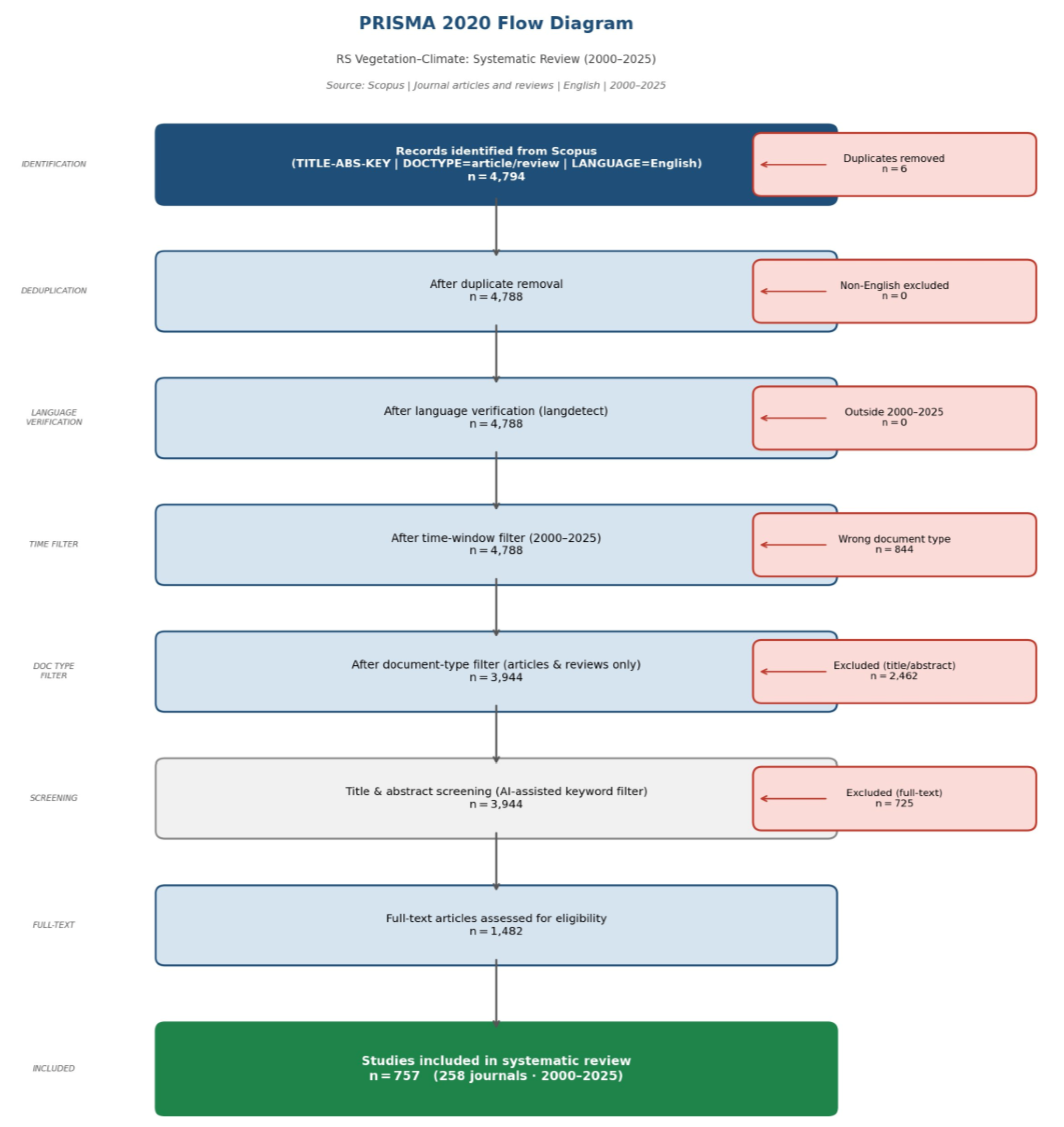
Figure 2.
Annual publication trend of included remote sensing vegetation–climate studies, 2000–2025 (n = 757).
Figure 2.
Annual publication trend of included remote sensing vegetation–climate studies, 2000–2025 (n = 757).
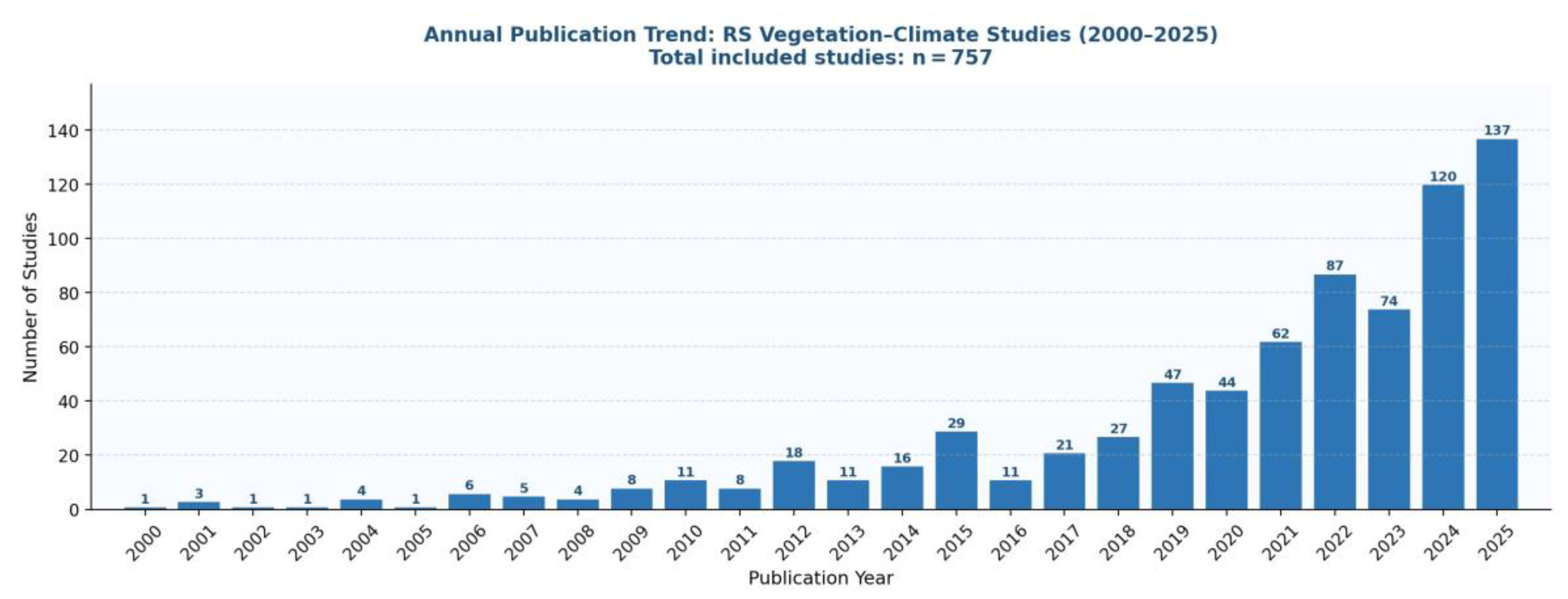
Figure 3.
Geographic distribution of included studies by first-author regional affiliation and Global North/South classification (2000–2025).
Figure 3.
Geographic distribution of included studies by first-author regional affiliation and Global North/South classification (2000–2025).
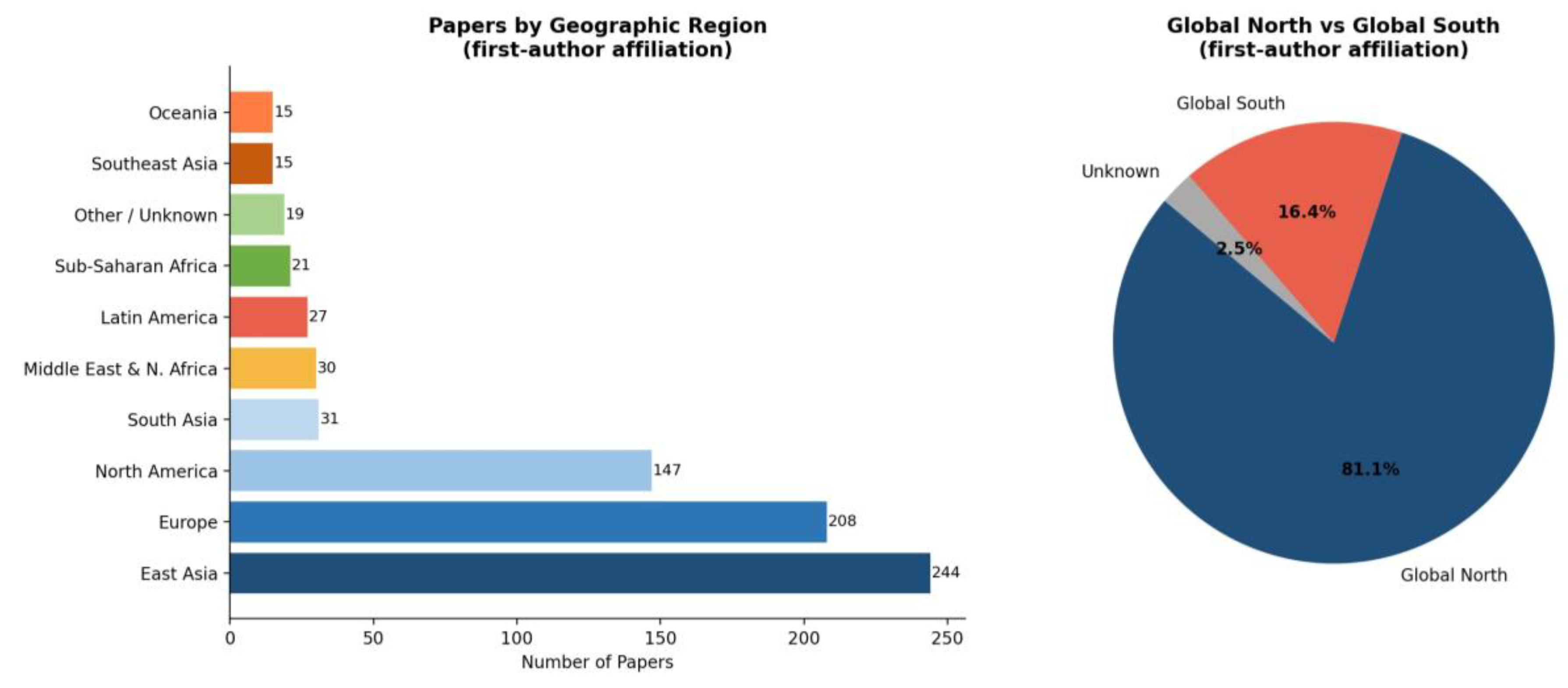
Table 1.
Eligibility criteria applied at all screening stages.
| Criterion | Inclusion | Exclusion |
|---|---|---|
| Publication type | Peer-reviewed journal articles (original research articles and review articles) | Conference papers, theses, dissertations, grey literature, preprints, book chapters |
| Language | English | Non-English publications |
| Time period | January 2000 – December 2025 | Published before 2000 or after December 2025 |
| Primary topic | Satellite RS used to study vegetation responses to climate change or climate variability | Airborne or UAV-only studies; non-climate vegetation studies; purely terrestrial field studies without RS integration |
| Spatial scale | Regional to global (minimum study extent ≥ 100 km²) | Local plot-scale studies without satellite RS integration |
| Methods | Any quantitative RS analysis combined with ML or statistical modelling | Purely qualitative, narrative, or opinion-based studies |
| Spectral data | Optical multispectral, hyperspectral, or SAR satellite data | Ground-based spectroradiometry or in situ sensor data only |
| Outcome | Quantitative vegetation or climate variable reported with performance metric | Studies without measurable outcome metrics |
Table 2.
Boolean search query structure (TITLE-ABS-KEY field, Scopus).
| Block | Terms |
|---|---|
| A — Remote Sensing | "satellite remote sensing" OR "multispectral" OR "hyperspectral" OR "MODIS" OR "Landsat" OR "Sentinel" OR "VIIRS" OR "SAR" |
| B — Vegetation | "vegetation" OR "NDVI" OR "EVI" OR "LAI" OR "phenology" OR "biomass" OR "land cover" OR "greening" OR "browning" OR "forest" OR "grassland" |
| C — Climate | "climate change" OR "global warming" OR "drought" OR "temperature" OR "precipitation" OR "heat stress" OR "carbon" OR "evapotranspiration" |
| Full query | (Block A) AND (Block B) AND (Block C) applied as TITLE-ABS-KEY across 13 compound Block-A × Block-B × Block-C pairs, combined via OR within a single query wrapper |
Table 3.
PRISMA 2020 record counts across all screening stages.
| Stage | Description | n |
|---|---|---|
| Identification | Records retrieved from Scopus (TITLE-ABS-KEY query, 13 compound pairs) | 4,794 |
| Deduplication | Duplicate records removed (DOI-exact and fuzzy title matching) | 6 |
| After dedup | Unique records after deduplication | 4,788 |
| Document type filter | Excluded — wrong document type (e.g., conference papers, editorials) | 844 |
| After doc-type filter | Records retained (articles and reviews only) | 3,944 |
| Title/abstract screening | Excluded at title/abstract stage (automated keyword classifier + Claude API for borderlines) | 2,462 |
| Full-text eligible | Records forwarded for full-text eligibility assessment | 1,482 |
| Full-text excluded | Excluded at full-text stage (including inaccessible PDFs and non-English publications; see Section 3.1) | 725 |
| Final included | Studies included in qualitative and quantitative synthesis | 757 |
Table 4.
Structured data extraction template domains and variables.
| Domain | Variables Extracted |
|---|---|
| Bibliographic | Authors, publication year, journal, country of corresponding author, DOI, open access status, citation count |
| Sensor platform | Satellite name, spatial resolution, spectral bands used, temporal resolution, multi-sensor fusion flag |
| Spectral indices | NDVI, EVI, EVI2, SAVI, MSAVI, NDWI, NDMI, LSWI, NBR, NDRE, SIF, LAI, fPAR, GPP, NPP, LST, ET, VCI, and all others as reported |
| ML/DL architecture | Algorithm type (RF, SVM, GBM, CNN, LSTM, ViT, etc.), training strategy, cross-validation approach, hyperparameter tuning method |
| Application domain | Phenology monitoring, biomass estimation, drought monitoring, land cover change, wildfire recovery, carbon flux, evapotranspiration |
| Climate variable | Temperature, precipitation, drought indices (PDSI, SPI, SPEI), CO₂ concentration, vapour pressure deficit |
| Geographic scope | Biome type, continent, country, spatial extent (km²), coordinate bounding box |
| Performance metrics | R², RMSE, MAE, overall accuracy, F1 score, Kappa — extracted with units and application-domain context |
| Open science | Code availability (GitHub/Zenodo), data availability, and pre-registration status |
Table 5.
Top ten remote sensing sensors and platforms by frequency of use in the reviewed corpus (n = 757).
Table 5.
Top ten remote sensing sensors and platforms by frequency of use in the reviewed corpus (n = 757).
| Sensor / Platform | n | % corpus | Primary application |
|---|---|---|---|
| MODIS | 303 | 40.0% | Vegetation monitoring; long time-series (2000–present) |
| Landsat | 226 | 29.9% | Land cover change; 30 m resolution; archive since 1972 |
| Sentinel-2 | 213 | 28.1% | High-resolution (10 m); free access; 2015–present |
| SAR (general) | 81 | 10.7% | All-weather; biomass and structure |
| Sentinel-1 | 78 | 10.3% | C-band SAR; free; 2014–present |
| Multispectral | 77 | 10.2% | General multispectral instruments |
| LiDAR | 66 | 8.7% | 3D structure; biomass estimation |
| AVHRR | 51 | 6.7% | Long NDVI archive (1981–present) |
| Hyperspectral | 37 | 4.9% | Species discrimination; stress detection |
| PALSAR | 30 | 4.0% | L-band SAR; forest structure |
Table 6.
Frequency of machine learning and statistical methods identified across the reviewed corpus.
Table 6.
Frequency of machine learning and statistical methods identified across the reviewed corpus.
| Method | n | % corpus | Category |
|---|---|---|---|
| Random Forest | 160 | 21.1% | Ensemble / Tree-based |
| Regression (linear/multiple) | 130 | 17.2% | Statistical |
| SVM | 37 | 4.9% | Kernel-based |
| ANN / Neural Networks | 32 | 4.2% | Deep Learning |
| Deep Learning (general) | 27 | 3.6% | Deep Learning |
| Change detection | 26 | 3.4% | Image analysis |
| Gradient Boosting / XGBoost | 21 | 2.8% | Ensemble / Tree-based |
| PLS | 17 | 2.2% | Statistical |
| CNN | 12 | 1.6% | Deep Learning |
| U-Net | 10 | 1.3% | Deep Learning |
| LSTM | 6 | 0.8% | Deep Learning |
| BFAST | 5 | 0.7% | Time-series |
Note: Percentage values are calculated relative to the total corpus of 757 studies unless otherwise stated. Sensor and method counts exceed 757 because individual studies frequently employed multiple sensors or analytical approaches.
Disclaimer/Publisher’s Note: The statements, opinions and data contained in all publications are solely those of the individual author(s) and contributor(s) and not of MDPI and/or the editor(s). MDPI and/or the editor(s) disclaim responsibility for any injury to people or property resulting from any ideas, methods, instructions or products referred to in the content. |
© 2026 by the author. Licensee MDPI, Basel, Switzerland. This article is an open access article distributed under the terms and conditions of the Creative Commons Attribution (CC BY) license.
Copyright: This open access article is published under a Creative Commons CC BY 4.0 license, which permit the free download, distribution, and reuse, provided that the author and preprint are cited in any reuse.


