
Submitted:
25 April 2026
Posted:
28 April 2026
You are already at the latest version
Abstract
Since tires from end-of-life vehicles are not entirely biodegradable and pose a serious environmental problem, their disposal has grown to be a significant global environmental concern. One technique to decrease these environmental issues is incorporating waste rubber to make sustainable green concrete. This study examined the usage of waste supplementary cementitious materials (SCMs) such as fly ash (FA), metakaolin (MK), marble powder (MP), slag (SL), and silica fume (SF) for surface precoating of crumb rubber (CR) to improve the mechanical properties of the produced crumb rubber concrete (CRC) by strengthening the bond between CR and cement paste in the Interfacial Transition Zone (ITZ). The CR replaced (0, 15%, and 25%) of sand by weight in the preparation of CRC mixtures. A total of eleven CRC mixes were cast to investigate the fresh properties, compressive strength, and splitting tensile strength. In addition, the compressive stress-strain curve was investigated, and peak stress, peak strain, energy absorption, toughness, and modulus of elasticity have been evaluated. The outcomes showed that pre-coating CR using FA, followed by MK, has the maximum effect in increasing the CRC compressive performance. The 25% substitution of sand with FA-treated CR increased compressive strength after 28 days, splitting tensile strength, peak stress, toughness, and modulus of elasticity by 34.7%, 23.7%, 34.8%, 26.1%, and 25.2%, respectively, in comparison to the same percentage of untreated CR. The proposed approach demonstrates a viable pathway for integrating waste materials and SCM-based technologies to develop high-performance, sustainable cementitious composites.
Keywords:
surface pre-coated crumb rubber
; supplementary cementitious materials (SCMs)
; mechanical properties
; stress-stain behavior
1. Introduction
In recent decades, as a result of fast expansion in the transportation industry, the issue of worn-out tires has emerged as a significant problem in several countries around the world. Based to the Rubber Manufacturers Association [1], the United States generates over 250 million worn-out tires annually. A tire is finally thrown out as waste once it reaches a point in its life cycle where it can no longer be used. Because of this, millions of waste tires are thrown away annually [2]. Rubber is not easily decomposed; therefore, it is either burned or disposed of in a landfill, which creates large storage areas and emissions of carbon dioxide (CO2), which cause several environmental issues [3,4]. One recyclable material that can be utilized in the concrete industry to partially or completely replace sand or coarse aggregate is crumb rubber (CR), which is derived from worn-out tires [5].
Concrete is the most widely used construction material worldwide, and its use is rising in proportion to the expansion of construction activity [6,7,8]. In 2017, China produced 5.51 billion tons of concrete which consumed 5.0 billion tons of natural aggregate (i.e., Sand, and Gravel) and emitted 0.83 billion tons of CO2, producing various environmental problems [7,9,10]. Therefore, replacing natural aggregates with CR from worn-out tires to produce CRC can decrease the usage of natural resources and protect the environment [11].
Recently, several investigations have been conducted regarding usage of CR in concrete mixes [11,12,13,14]. A novel building material called rubberized concrete has been demonstrated to be lightweight [15,16], improved capacity to insulate sound than normal concrete [17,18]. However, incorporating CR in the concrete can reduce the mechanical properties of CRC. Eldin and Senouci [19] demonstrated that employing rubber instead of sand and coarse aggregate weakens the binding between CR particles and cement paste at the ITZ, resulting in an 85% and 50% decrease in the compressive and tensile strengths of CRC, respectively. Thomas et al. [20] found that replacing fine aggregate with CR from 0% to 20% can reduce the mechanical characteristics, including compressive strength, elastic modulus, flexural strength, and tensile splitting strength. Guo et al. [21] proved that CRC with less than 30% CR has a greater flexural to compressive strength ratio than conventional concrete. Medina et al. [22] investigated that replacing sand and gravel with CR reduced the compressive strength of 100% CR by about 87%. Strukar et al. [23] investigated that CR size has a significant impact on fresh properties and water permeability, which improve with increasing CR content in concrete. Aslani and Khan [24] examined the relationship between CR size and compressive strength of produced CRC. They found that the compressive strength was reduced by 48% when coarse CR (5–10 mm) was substituted for 10% natural aggregate; however, this reduction was only 8.5% when fine CR (2–5 mm) was used in CRC. Increased rubber content leads to reduced strength is due to three basic reasons: (i) CR particles deform relative to the cement microstructure, leading to cracking initiation comparable to air voids in conventional concrete [25]. (ii) poor interfacial bonds between CR particles and cement matrix [26]. (iii) Concrete matrix density may decrease depending on aggregate size, density, and stiffness of the aggregate [27].
Various surface pre-treatment processes have been employed to increase the mechanical properties of CRC. Meddah et al. [28] studied the mechanical strengths of CR, including sand-glued, NaOH-pretreated, and untreated CR particles at a 25% by volume ratio. The results proved that the mixture including sand-glued CR aggregates had a higher compressive strength than the mix containing NaOH-pretreated CR aggregates, but it was still significantly less than the control sample. Azevedo et al. [29] tried binary mixtures of fly ash and metakaolin as well as single blends of fly ash to decrease the reduction of mechanical properties in CRC. They still noted notable drops in the compressive strength of produced rubberized concrete. Huang et al. [30] and Dong et al. [31] examined the influence of cement pre-coating on the surface modification of CR and how it affects the mechanical characteristics of produced CRC. They discovered that the mixes that included the surface-pretreated CR had much greater mechanical strengths than the mixes including the untreated CR as received; however, these pretreated CR mixes showed reduced mechanical strengths compared to the reference mix. Onuaguluchi [32] pre-coated the CR particles with limestone powder (LP), and a 10% volume of silica fume (SF) was added to the paste as supplementary cementitious materials (SCMs). Image analysis demonstrated a decrease in adhesion between CR and the cement paste at the ITZ, resulting in the filling of voids. Pelisser et al. [33] found compressive strength reduced in CRC. They observed that while the mixes’ compressive strength increased, it was still much less than that of the control mixture. In mixtures that contain 10% CR as a substitute for sand and limestone powder (LP) as a filler. Assaggaf et al. [34] examined the influence of several CR pre-coating procedures, such as NaOH, KMnO4, and cement surface treatment, on the mechanical characteristics of produced CRC. The findings demonstrated that, at low CR content ratios, the NaOH and KMnO4 treatments improved the rubberized concrete’s compressive and flexural strength compared to the untreated samples. However, by applying a cement coating, the agglomeration issue was resolved, improving the compressive and flexural strengths by 64% and 33%, respectively. Ghaleh et al. [35] studied a novel surface pre-coating technique using resin and microsilica. They found that using double-pre-coated rubber techniques increases the modulus of elasticity, flexural strength, and compressive strength of the modified CRC by 27%, 30%, and 60%, respectively, compared with untreated samples.
According to the literature, several chemical treatment procedures of CR, such as NaOH, KMnO4, and cement treatment, affect the physical and mechanical characteristics of rubberized concrete. The impact of surface pre-treatment of CR particles using supplementary cementitious materials on the compressive stress-strain curve has not been studied and still needs more investigations. Consequently, in this study, the CR was precoated by waste SCMs such as fly ash (FA), metakaolin (MK), marble powder (MP), slag (SL), and silica fume (SF). Three pre-coated CR sizes (1.36–1.18 mm), (1.18–0.6 mm), and (0.6–0.3 mm) were substituted for fine aggregates in varying weight ratios (15% and 25%) by weight. The mechanical properties and compressive stress-strain behavior of precoated CRC were compared with the untreated CRC.
2. Experimental Methodology
2.1. Materials Properties
2.1.1. Cement and SCMs
All the concrete mixes were prepared using ordinary Portland cement (OPC), having a nominal compressive strength of 42.5 MPa at 28 days, type II, according to ASTM C150 [36], with a specific gravity of 3.15 g/m3. The SCMs employed in precoated CR were FA, MK, MP, SF, and SL, with specific gravities of 2.2, 2.6, 2.50, 2.10, and 2.25, respectively. We created the MK by calcining kaolin for three hours at 850 °C [37]. FA classes F were used in this investigation. The MP is a waste product obtained from cutting and polishing local marble. Table 1 presents the physical parameters and chemical compositions of cement and SCMs.
2.1.2. Natural Coarse Aggregate, Fine Aggregate, and CR
Locally produced, well-graded coarse aggregate (CA) and sand were used in this study. Three CA sizes with a specific gravity of 2.65 and a maximum nominal size of 9.50 mm. With a fineness modulus of 2.6 and a specific gravity of 2.65, the desert sand was used as a fine aggregate. Both CA and fine aggregate had no content of clay, silt, and organic particles and were compatible with the Egyptian standards ECP 203 [38]. To partially replace sand in the CRC, three different sizes of untreated and treated CR (2.36–1.18, 1.18–0.6, and 0.6–0.3 mm), as shown in Figure 1, having a fineness modulus of 3.2 and a specific gravity of 1.15. Figure 2 shows the sieve analysis of the fine aggregate, CR, and NA.
2.1.3. Water, and Superplasticizer
2.2. Treatment Procedure
Five different surface pre-coatings of CR particles using SCMs (MK, FA, MP, SF, and SL) were utilized to determine their influence on the fresh and mechanical properties of CRC. To keep the same grade of CR between untreated and treated, the CR particles were sieved both after and before treatment. The FA treatment process involved coating the CR particles with an FA slurry at a water-to-FA ratio of 0.65, known as FATR. Several trials were done to identify the appropriate degree of dispersion. The ideal CR/FA ratios for 2.36–1.18, 1.18–0.6, and 0.6–0.3-mm size CR were 2.5, 2, and 1.25, respectively. We observed that the smallest fly ash slurry for treating all CR surfaces was found in the 2.36–1.18 mm size, due to its lower surface area in comparison with other CR particle sizes. The treatment process of FA consists of five steps, as presented in Figure 3. Initially, a homogeneous FA slurry was created by mixing the fly ash and water required to treat 1000 g of CR in a mixer for around four minutes. The second step involves progressively adding 1000 gm of untreated rubber to the mixer and mixing for 10 min to thoroughly cover the surface of untreated CR. Third, treated CR particles were dispersed in a layer with a thickness of 25 mm on a pan that had been heated in an oven, as seen in Figure 4a. To complete the drying process, keep the oven at 70 °C for 3 h, as illustrated in Figure 4b. The final step, the coated CR, was sieved mechanically for three minutes. After that, each size is placed in separate bags. The same FA procedure was used in the case of surface precoating of CR particles using MK, MP, SL, and SF, but the water to treatment material was changed. Treatment material and water/treatment material ratio are shown in Table 2. Furthermore, Figure 5 presented the CR particles before and after the treatment process using different SCMs.
2.3. Concrete Mixtures
CRC mixes are designed in accordance with ACI PRC-211.1-22 [40] and Egyptian standards ECP 203 [38]. This research focuses on the replacement of sand by untreated and treated CR particles using SCMs. The replacement ratio of CR is 15% and 25% (by weight). A total of 13 CRC mixes, including the control mix, were developed. For each mixture, we maintained a consistent water/cement ratio of 0.38. In order to get comparable mechanical characteristics for CRC mixes, the cement weight was 520 kg/m3. The control mixture (PC) was cast from plain concrete without either treated or untreated CR. The design parameters and proportions of the CRC mixes are listed in Table 3.
2.4. Mixing, Casting, and Curing
We created nine standard cylinders (100 mm diameter and 200 mm height) for every CRC mix to test its compressive strength at 7 and 28 days and split tensile strength at 28 days. In addition, for each concrete mix, to perform a compressive stress-strain curve at 56 days, three standard cylinders with dimensions of 150 mm in diameter and 300 mm in height were prepared.
A mechanical mixer was used for mixing the proportional material. The mixing procedure consists of three steps: first, coarse aggregate, fine aggregate, cement, and CR particles were added into the mixer and dry mixed for approximately 2 min. Subsequently, ninety percent of the water was then added to the mixer and allowed to mix for two more minutes. Finally, add superplasticizer and 10% water to the mixes and mix for 3 min to obtain a homogenous mixture. The mixing process was repeated. For all mixtures. For all mixtures. According to ECP 203 [38], all mixing processes were conducted at room temperature (20–25 °C). Concrete had been poured into the molds once the mixing procedure was finished and compacted mechanically using a vibrating table as well as a steel rod for ensuring complete compaction. Specimens were kept in their molds for 24 h after casting. Before being put to the test, the cylinders were put and allowed to be cured in pure tap water.
2.5. Testing Procedure
The experimental program consists of three stages. Firstly, investigating the fresh properties of CRC mixtures, according to ASTM C143/C143M-15 [41], as presented in Figure 6a. The second step includes studying the mechanical properties of casted CRC mixes. The compressive stress after 7 and 28 days was conducted based on ASTM C39/C39M−20 [42], as shown in Figure 6b. The tensile splitting strength test at 28 days was conducted according to ASTM C496 [43], as shown in Figure 6c. The last step examined the compressive stress-strain behavior of CRC specimens, which were drawn according to the accompanying deflection recorded by LVDTs and the load values acquired using a load cell (see Figure 6d).
3. Results and Discussion
3.1. Workability of CRC Mixes
The workability of freshly mixed concrete mixtures was evaluated by measuring their slump values, and the results are listed in Table 4. According to the experimental results, the control mixture had the highest slump value, and the slump value decreased as the replacement level of CR in the concrete mixture increased. For example, the slump value of mixes UTR 15 and UTR 25 was reduced by 18.20% and 27.30% in comparison to the control sample. The outcomes achieved are consistent with those documented in the literature [44,45,46]. The reduction of slump is due to (i) CR particles being flat and flaky, with an angular form and rougher cut parts. They require more water and cement paste to cover because of their larger surface area compared to sand. These properties can improve the concrete mix’s resistance to interparticle movement between CR and cement mortar particles. As a result, concrete could harden and need more energy to flow smoothly and overcome friction. (ii) Vehicle tires often include grooves and cavities on the outside surface, which can collect water and reduce flow. The combined impacts describe why fresh concrete containing CR slumps lower than the control mixture.
Figure 7a showed the impact of treatment material on the slump value of CRC in the case of 15% CR substitution of sand. Compared to the untreated CR mixture, the slump value of reduced for mixes FATR, MKTR, MPTR, SLTR, and SFTR were reduced by 11.1%, 5.6%, 33.3%, 22.2%, and 16.7%, respectively. A similar trend was shown when using 25% CR as a replacement for sand, as presented in Figure 7b. The increased adherence of CR particles to cement mortar may be the cause of the drop. Particle interlocking in the mix increases because of the CR particles’ rougher surface. Furthermore, surface treatment of CR leads to increasing water absorption from cement mortar, resulting in a decrease in the slump value. In addition, surface treatment of CR particles can affect cement hydration, plastic viscosity, and yield strength, leading to a reduction in slump.
3.2. Density of CRC Samples
It is critical for investigating the density of CRC mixes because a lower concrete density results in less dead load, the dimensions of the structural elements are reduced, and it requires less foundation reinforcement, possibly lowering overall building costs. Table 4 and Figure 8 show the hardened density of all mixtures. The density of mixes UTR 15 and UTR 25 reduced by 8.8% and 11.1%, respectively, compared to the reference mixture. This proves that the replacement of fine aggregate with UTR rubber increased the hardened density because the CR particles have a reduced specific gravity than sand. Additionally, the addition of CR to the concrete mix may have improved porosity, or air voids, and those air voids might have increased as the CR concentration grew [31,47]. CR’s hydrophobic surface repels water and attracts air bubbles, leading to increased air entrainment in concrete mixtures [48]. The larger void content of CRC may explain its lower density in comparison to PC.
The impact of CR treatment on the density of CRC mixtures is depicted in Figure 8a,b. The hardened density of FATR, MKTR, MPTR, SLTR, and SFTR increased by 0.5–3.5% at 15% CR and 1.0–4.10% at 25% CR instead of sand, in comparison to the UTR mix. The slight increase in density is because of the treatment material covering the outer surface of UTR rubber. The greatest density improvement occurs when FATR is included in the CRC mix. in contrast to SFTR, SLTR, MPTR, and MKTR. Additionally, the outcomes of this study are consistent with earlier investigations [34,49]. When FATR is utilized as a replacement of untreated CR, the density is considerably improved due to the air voids inside the CR material were filled with a solid substance after the FA treatment was completed. Because of that, the specific gravity of the CR particles was higher [50].
3.3. Mechanical Properties of CRC Samples
The findings and analysis of the mechanical characteristics of CRC samples, including their compressive strength (fcu) at 7 and 28 days and splitting tensile strength (fts) at 28 days, are presented in this section. Table 5 displays the outcomes of the mechanical properties testing.
3.3.1. Concrete Compressive Strength (fcu)
The 28-day compressive strength of normal concrete was recorded at 40.8 MPa, as observed in Table 5. The impact of surface treatment of CR on 7- and 28-day compressive strength is observed in Figure 9 and Figure 10. It is clearly evident that the compressive strength for CRC mixes decreases when the percentage level of CR increases. The 28-day fcu for mixes UTR15 and UTR25 reduced by 28.0 and 34.7%, respectively, compared with the reference mixture (PC). This confirms that including CR particles for CRC negatively affects the compressive strength. Various reasons for the decrease in concrete’s fcu and the rise in the percentage of CR, such as (i) the basic reason affecting the reduction of fcu of CRC mixes is the poor bonding between CR particles and cement mortar, which creates the weak Interfacial Transition Zone (ITZ) [44]. (ii) Owing to the hydrophobic properties of CR and the hydrophilic nature of cement mortar, it would be difficult for them to form a strong chemical bond, which would leave the cement paste surrounding the CR weaker than it would be around the control concrete containing sand. Because of the applied stresses’ uneven distribution, cracks surrounding the CR develop and spread more quickly [51]. (iii) Fine aggregate particles have a higher stiffness, density, and specific gravity than CR particles [2,52]. (iv) Incorporating CR in the mix can lead to increased air voids and permeability because air bubbles are trapped during mixing and have a water-repellent effect, increasing the porosity of ITZ between the cement paste and CR particles [31,47,53].
The impact of surface treatment of CR particles on the compressive strength at 28 days in the case of the replacement of sand by 15% CR and 25% CR is reported in Figure 10a,b. For all curing ages, the fcu of CRC mixes prepared with 15% CR and 25% CR treated by FA is significantly higher than the untreated sample by 26.40% and 20.0%, respectively. The same trend was observed for MPTR, MKTR, SLTR, and SFTR. Possible reasons for the increased fcu of mixtures including coated CR in comparison to the UTR rubber, such as surface precoated CR using SCMs, increase the surface roughness of CR particles, which leads to improved bonding between the CR particles and cement paste [44,54]. In addition, treatment of CR particles densifies the ITZ by decreasing the porosity, resulting in decreasing the voids between CR particles and the cement mortar.
Figure 11 depicts the influence of different treatment procedures on the 28-day compressive strength. In Figure 11a, the 28-day fcu is plotted against the 15% and 25% of untreated CR and FATR. It is noticed that the 28-day compressive strength of produced rubberized concrete with 15% untreated CR was 29.40 MPa, while the 28-day fcu with 15% FATR was 33.30 MPa (13.40% improvement). These results confirm that untreated CRC compressive strength was significantly lower than CRC cast with CR precoated with FA. This is attributed to the fact that, because of covering the rubber surface with fly ash, it increases the bond between the CR and the cement mortar [55]. A similar trend was shown in the case of using 25% CR as a substitution for fine aggregate. These results are consistent with Najim and Hall [56].
As observed in Figure 11b, precoating the untreated CR with MK increases the 28-day compressive strength. The fcu of specimen MKTR 15 (15% CR) and specimen MKTR 25 (25% CR) were 9.1% and 8.1% more than the mixes UTR 15 and UTR 25, respectively. This is mostly because untreated CR absorbs more water than treated CR using MK, and it also has a poorer interfacial zone and porosity.
The impact of applying MP treatment (MPTR) on the compressive strength fcu is presented in Figure 11c. The fcu of the mixes with 15% untreated CR was found to be 29.30 MPa; in contrast, the fcu of the mixes with 15% MPTR was found to be 30.10 MPa, indicating a 2.40% improvement in fcu after 28-day. The improvement in fcu was brought about by the pre-treatment processes method utilizing MP, which changed rubber’s hydrophobic properties to hydrophilic ones. Due to the controlled expansion of air pores during the mixing process and the removal of CR’s repellent qualities using MPTR, treated CRC mixes exhibit reduced porosity [57]. MPTR improved the bond between cement mortar and CR [50,58].
The effect of treating the CR using SL (SLTR) on the 28-day compressive strength is presented in Figure 11d. Where the 28-day fcu is plotted against the untreated CR and treated CR using SL. It is obvious from Figure 11d that the compressive strength of samples treated with SL with 15% CR and 25% CR (i.e., mixes SLTR15 and SLTR25) increased by 4.70% and 4.6%, respectively, in comparison with UTR specimens with the same percentage of CR (i.e., mixtures SLTR15 and SLTR25). This may be due to the same reason in the case of FATR, MKTR, and MPTR, that the bond between the coated CR and the cement mortar increased because of the treatment process [34].
Treating CR using SF increases the 28-day compressive strength slightly in comparison to the untreated mixes, as observed in Figure 11e. It is depicted from Figure 11e that the 28-day fcu of specimens cast from 15% and 25% treated CR using SF (SFTR 15 and SFTR%) was 29.90 MPa (1.8% improvement) and 27.0 MPa (1.6% improvement), respectively, in comparison with the UTR samples cast from the same percentage level of CR.
3.3.2. Splitting Tensile Strength (fts)
The tensile split strength (fts) of CRC is one of the most essential characteristics used to identify when concrete elements may crack. Additionally, Furthermore, it is crucial for structural component design as it aids in determining uncracked sections under certain loads. As shown in Table 5, the 28-day fts findings for the concrete cylinders showed notable differences across the various concrete mixes. The control mix (PC) reported a 4.40 MPa splitting tensile strength. As seen in Figure 12a,b, mixes UTR 15 and UTR 25, in contrast, had a decreased split tensile strength of 3.0 MPa and 2.8 MPa, respectively, which is a 13.8% and 23.7% drop in fts in comparison to PC, indicating that incorporating CR as a replacement of sand in the concrete mixes has a negative effect on fts. This reduction in fts corresponds with the results obtained from previous studies [14,59]. This decrease in split tensile strength is due to the same reason as in fcu: the CR particles are less stiff than the sand particles. Untreated CR has low intrinsic strength and poor bond performance, whereas CR particles are hydrophobic. Furthermore, microscopic cracks appear between the CR in the cement matrix.
On the other side, precoating the surface of CR using FA treatment increased the split tensile strength of CRC in comparison with untreated mixes. As demonstrated in Figure 12a,b, it is indicated that the fts in the case of treating 15% CR and 25% CR using FA (i.e., mixes FATR15 and FATR25) increased by 26.40% and 20.4%, respectively, compared to mixes UTR15 and UTR 25. A similar trend was shown in the case of treatment CR particles using MK, MP, SL, and SF. This increase in fts may be due to that treatment process leading to improving the adhesion between CR and cement. Also, treating the surface can make the connection between the CR particles and the cementitious matrix better, which increases the tensile strength.
3.3.3. Stress-Strain Behavior of Rubberized Concrete
According to load values obtained using the load cell and deflection measured using LVDTs, stress-strain curves were plotted for all CRC mixes after 56 days. Table 6 shows the outcomes of the stress-strain curves for the following parameters: peak stress, peak strain (εco), ultimate strain (εcu), toughness (T), and modulus of elasticity (Ec). The peak stress of the control sample is 51.20 MPa; this stress was measured at a strain value of 0.002590, as shown in Table 6. The control sample displayed brittle failure, with a sudden stress reduction occurring after failure. It is apparent that for the mixes including untreated CR, the peak stress decreased relative to the control sample, while the peak strain increased, but the sudden reduction in strength after the peak has been enhanced. Pre-coating of untreated CR increased peak and ultimate strain as compared to untreated CRC with the same proportion and reference mixture (PC).
The stress-strain relationship for concrete mixtures made with various percentages of CR at various surface treatments is displayed in Figure 13. Adding 15% rubber particles of fine aggregates causes variations in compressive strength and peak stress of CRC, as shown in Figure 13a. UTR15 specimens had a 28.9% lower peak stress than PC; their ultimate strain value slightly increased by 2% relative to the control mixture. Strength loss as a result of rubber addition is caused by several variables. In comparison to sand, rubber is less stiff. As a result, rubber’s compressive strength decreased despite its increased load-bearing capability. Rubber is naturally hydrophobic. Additionally, the mixes contain an air entry agent. Increases in rubber % cause more air to enter the mixture, which lowers the compressive strength [58]. Sand is heavier than rubber particles. The particles rise to the top when vibrated or tamped. Thus, internal stress concentration happens as a result of their unequal distribution. Strength was decreased because of the rubber particles’ expansion of the ITZ and weakening of the cement mortar-aggregate bond [60]. The loss in compressive strength is consistent with previous study results [2,44,46,61].
On the other side, compared to the untreated samples, treating the CR particles using SCMs improved the peak stress. The best peak stress showed at mix FATR 15 has a peak stress of 48.7 MPa (33.8% increase in peak stress), followed by sample MKTR 15 with peak stress of 47.10 MPa (29.4% increase), then MPTR 15 with peak stress of 45.2 MPa (16.5% increase), after that the mix SLTR 15 has peak stress of 42.50 MPa (16.8% increase), and finally the mix SFTR 15 has the lowest compressive strength of 40.0 MPa (9.9% increase). The FA treatment method is better than the MP, MK, SL, and SF treatment methods because it has the highest peak stress and peak strain [58]. This is because the FA on the surface of CR particles improves their adherence to the cement matrix, resulting in an improvement in peak stress [50].
The effect of surface coating on the stress-strain behavior of mixtures including 25% CR following 56 days of curing is shown in Figure 13b. Compared to the control mix (NC), the mix with 25% untreated CR showed a peak stress of 33.40 MPa, which corresponded to a 35.0% decrease in peak strength. Additionally, the peak strain was recorded at 0.002781, which indicates a 7.40% improvement relative to the control mix. In comparison to the mixtures with untreated CR, the FATR25, MKTR25, MPTR25, SLTR25, and SFTR25 displayed a significant increase in peak stress of 33.8%, 29.4%, 24.2%, 16.8%, and 9.9%, respectively. In that order, the peak strain increased by 1.08%, 1.02%, 1.01%, 0.96%, and 0.95%. The greatest peak stress for FATR25 was 44.3 MPa, whereas the peak stress for MKTR25 was somewhat lower at 41.1 MPa. On the other hand, at 35.4 MPa, the mixtures treated with SF had a lower peak stress value.
3.3.4. Energy Absorption
The toughness of the material may be calculated by the integral of the compressive stress-strain curve. The overall energy a material possesses prior to, during, and following the creation of a fracture is referred to as its toughness. The ability of a material to absorb energy until it reaches the yield point is known as pre-crack energy. The area under the curve from the beginning to the yield point is calculated to achieve this [50,57]. The integral of the stress-strain curve from the peak point to the ultimate point is used to determine the post-crack energy [50,57] Energy estimations indicate that the ultimate stress is equivalent to 80% of the peak stress. The total energy expended is determined through the integration of the stress-strain curve from beginning to the ultimate point. Additionally, it must be equal to the total energy absorbed throughout the pre-crack, crack, and post-crack stages of compression [50].
3.4. Pre-Crack Energy (P. E)
P.E is the amount of energy consumed in the specimen between the start and yield points. The area between the zero and yield points is used to calculate it [57]. Table 6 and Figure 14 compare the values of several samples in the case of 15% CR. The PEC gradually reduces as the amount of untreated rubber increases. The UTR15 specimen has the lowest P. E. value of 0.0188 due to its significant strength reduction as shown in Figure 14a. When treated rubber is added to the concrete mixture, P. E. values gradually increase. Out of all the treated samples, the FATR 15 specimen had the highest P. E. value (0.0282), and the obtained value was nearly identical to the control sample. A similar trend was shown in the case of using 25% of CR instead of sand, as shown in Figure 14b. However, it has been noted that by limiting the strength loss, rubber pretreatment enhanced the concrete’s pre-crack energy and toughness. The same results were obtained in the past investigation [57].
3.5. Crack Energy Absorbed in Compression (C. E)
The energy that concrete samples absorb from yield to peak is known as crack energy [57]. It is calculated by computing the area of the stress-strain curve from the yield point to the peak point. In concrete, it took a little instant to transition from yield to peak [57]. The specimen behavior for C.E. absorption is compared in the graph below. absorption. Increasing the percentage of rubber in concrete mix resulted in lower C.E. absorption capability, as indicated in Figure 15 and Table 6. The pretreated sample has a higher energy absorption capacity than the untreated sample. In comparison to the mixes with 15% untreated CR, the mixes FATR15, MKTR15, MPTR15, SLTR15, and SFTR15 displayed a significant increase in C.E. of 50.1%, 48.7%, 41.2%, 17.7%, and 7.1%, respectively, as presented in Figure 15a. A similar trend was shown when using 25% CR as presented in Figure 15b.
3.6. Post-Crack Energy Absorbed (PC. E)
The energy that the samples absorb between the peak point, and the final point is known as the post-crack energy [57]. When peak stress is reduced by 20%, the ultimate point occurs. Figure 16 depicts the energy absorption capacity of all specimens after reaching their peak stress. Due to the sudden reduction that followed peak stress brought on by the brittle nature of concrete, the PC. E of the control specimen PC was only 0.0429. The most important component of this investigation is describing post-peak response while utilizing rubber due to its ability to enhance post-peak behavior. The post-peak response of the untreated rubber specimen continuously improves [57]. The post-energy absorption capability of the CR samples rises as the rubber level increases in the concrete mix. Figure 16a and Table 6 demonstrated that the FATR 15 specimen absorbs the most energy, with a value of 0.050. The FATR 15 specimen absorbed 16.6% more energy than the control specimen PC. Treating CR using SCMs increases the PC. E than the same percentage of untreated CR as presented in Figure 16a,b.
3.6.1. Toughness
Toughness is the capacity of a material to absorb energy before cracking [57]. The toughness of a substance is determined by its strength and ductility. The toughness value is determined by computing the area under the stress-strain curve from zero to the ultimate point, which is 20% below the peak stress point [2,62]. Figure 17 displays the toughness of various CR specimens. The control mixture PC recorded a toughness value of 12.43 Nm/m3. Using untreated CR for mixes UTR15 and UTR25 decreases the toughness by 25.2% and 28.2% compared to the control specimen PC. Compared to the equivalent substation of untreated rubber (UTR10), when 10% of sand was replaced with coated CR by FA, MK, MP, SL, and SF (mixes: FATR10, MKTR 10, MPTR10, SLTR 10, and SFTR10), toughness increases by 46.2%, 45.6%, 38.9%, 17%, and 15.7, respectively. When 25% of the sand was substituted with CR particles, a similar pattern was seen.
3.6.2. Modulus of Elasticity
The stiffness of the structure affects its stability in addition to the strength of its components [2]. Therefore, another parameter for assessing rubberized concrete’s suitability for use as a structural material is its elastic modulus. The slope of the stress-strain curve can be utilized to assess it after CRC cylindrical samples have been loaded to one-third of their anticipated peak stresses [2]. In comparison to the NC mix, samples UTR10 and UTR20 had reduction values of 20.2% and 26.1%, respectively. These findings demonstrated that the modulus of elasticity reduced with a rise in CR ratio, which is consistent with earlier research [60,63]. It is shown that mixtures including treated CR behave better than mixes containing untreated CR at the CR ratio; for instance, the modulus of elasticity of the FATR10, MKTR 10, MPTR10, SLTR 10, and SFTR10 mixes was greater than those of the UTR10 mix by 17.1%, 12.1%, 10.7%, 7.3%, and 4.7, respectively, as shown in Figure 18. The samples with 25% CR exhibited the same behavior.
4. Conclusions
The study investigated the effects of using CR as a partial replacement of sand in the concrete mix and the various surface precoating of CR by waste SCMs such as FA, MK, MP, SL, and SF on fresh properties, mechanical strength, and the compressive stress-strain curve of CRC. The following conclusions can be derived according to the experimental results:
- As the untreated CR content increased, the workability and hardened density of CRC declined, reducing by 18.2–27.3% in slump and 8.8–11.1% in density in comparison to control concrete. The slump value reduced more with surface-treated CR using SCMs compared with untreated CR. However, the hardened density increased for treated CR compared to the UTR specimens with the same percentage level of CR.
- Generally, mechanical properties of CRC reduced as the replacement ratio of untreated CR increased. Incorporating 25% of untreated CR particles decreased 28-day compressive strength by 34.7% and splitting tensile strength by 23.7% in comparison with the control concrete.
- Significantly much greater enhanced characteristics are shown in concrete with CR treated with SCMs. At 28 days, compressive strength increased by 13.4–18.1% for FATR, 8.1–9.1% for MKTR, 2.4–3.2% for MPTR, 4.6–4.7% for SLTR, and 1.6–1.8% for SFTR, compared to the untreated CR.
- Compared to the control sample, the CRC specimens’ overall energy absorption capability is lower. Overall, the selected materials of treatment improved energy absorption of CRC mixes. Specifically, the best treatment material was fly ash.
- Toughness and modulus of elasticity of treated CR increased compared to the untreated CR. At 15% of CR, the toughness achieved a significant increase of 46.2%, 45.6%, 38.9%, 17.0%, and 15.7% for the mixes FATR 15, MKTR 15, MPTR 15, SLTR 15, and SFTR 15, respectively. While the modules of elasticity increased by 17.3%, 12.1%, 10.7%, 7.3%, and 4.7% in comparison with the untreated mix.
- The samples treated with MK showed a noticeable improvement in results; this kind of treatment may be trusted to enhance the properties of CRC and produce satisfactory results.
- In comparison to comparable equivalent mixes with untreated CR, the FA treatment of CR exhibits the optimum values of compressive strength, splitting tensile strength, energy absorption, toughness, and modulus of elasticity for all CR replacement ratios, followed by MK treatment, then MP treatment, after that SL treatment, and finally SF treatment.
- The 25% replacement of sand with FA-treated CR increased compressive strength after 28 days, splitting tensile strength, peak stress, modulus of elasticity, and toughness by 34.7%, 23.7%, 34.8%, 25.2%, and 26.1%, respectively, compared with a similar ratio of untreated rubber.
Author Contributions
Conceptualization, M.A., M.B. and A.E.; methodology, H.H. and S.E.; validation, M.B., S.E. and H.H.; formal analysis, A.E.; investigation, S.E.; resources, M.B.; data curation, H.H.; writing—original draft preparation, M.B.; writing—review and editing, M.A.; visualization, A.E.; funding acquisition, M.A. All authors have read and agreed to the published version of the manuscript.
Funding
The research was funded by KAU Endowment (WAQF) at king Abdulaziz University, Jeddah, Saudi Arabia. The authors, therefore, acknowledge with thanks WAQF and the Deanship of Scientific Research (DSR) for technical and financial support.
Data Availability Statement
The original contributions presented in this study are included in the article material. Further inquiries can be directed at the corresponding author.
Conflicts of Interest
The authors declare no conflicts of interest.
References
- Rubber Manufacturers Association (RMA). Recycled Rubber Products Catalogue. 2014. Available online: http://www.rma.org/recycled-rubber-products-catalog/ (accessed on 30 January 2014).
- Eisa, A.S.; Elshazli, M.T.; Nawar, M.T. Experimental investigation on the effect of using crumb rubber and steel fibers on the structural behavior of reinforced concrete beams. Constr. Build. Mater. 2020, 252, 119078. [Google Scholar] [CrossRef]
- Gheni, A.A.; Abdelkarim, O.I.; Abdulazeez, M.M.; ElGawady, M.A. Texture and design of green chip seal using recycled crumb rubber aggregate. J. Clean. Prod. 2017, 166, 1084–1101. [Google Scholar] [CrossRef]
- Elchalakani, M.; Aly, T.; Abu-Aisheh, E. Mechanical properties of rubberised concrete for roadside barriers. Aust. J. Civ. Eng. 2016, 14, 1–12. [Google Scholar] [CrossRef]
- Guo, Y.C.; Zhang, J.H.; Chen, G.M.; Xie, Z.H. Compressive behaviour of concrete structures incorporating recycled concrete aggregates, rubber crumb and reinforced with steel fibre, subjected to elevated temperatures. J. Clean. Prod. 2014, 72, 193–203. [Google Scholar] [CrossRef]
- Ahmed, S.; El-Zohairy, A.; Eisa, A.S.; Mohamed, M.A.E.-A.A.B.; Abdo, A. Experimental investigation of self-compacting concrete with recycled concrete aggregate. Buildings 2023, 13, 856. [Google Scholar] [CrossRef]
- Guo, Z.; Jiang, T.; Zhang, J.; Kong, X.; Chen, C.; Lehman, D.E. Mechanical and durability properties of sustainable self-compacting concrete with recycled concrete aggregate and fly ash, slag and silica fume. Constr. Build. Mater. 2020, 231, 117115. [Google Scholar] [CrossRef]
- Abdo, A.; El-Zohairy, A.; Alashker, Y.; Badran, M.A.E.A.; Ahmed, S. Effect of treated/untreated recycled aggregate concrete: Structural behavior of RC beams. Sustainability 2024, 16, 4039. [Google Scholar] [CrossRef]
- Hu, Y.Y. China gravel industry in transition—Talk on the future development trend of the industry. China Build. Mater. 2018, 7, 36–38. [Google Scholar]
- Hossain, F.M.Z.; Shahjalal, M.; Islam, K.; Tiznobaik, M.; Alam, M.S. Mechanical properties of recycled aggregate concrete containing crumb rubber and polypropylene fiber. Constr. Build. Mater. 2019, 225, 983–996. [Google Scholar] [CrossRef]
- Jokar, F.; Khorram, M.; Karimi, G.; Hataf, N. Experimental investigation of mechanical properties of crumbed rubber concrete containing natural zeolite. Constr. Build. Mater. 2019, 208, 651–658. [Google Scholar] [CrossRef]
- Medina, N.F.; Garcia, R.; Hajirasouliha, I.; Pilakoutas, K.; Guadagnini, M.; Raffoul, S. Composites with recycled rubber aggregates: Properties and opportunities in construction. Constr. Build. Mater. 2018, 188, 884–897. [Google Scholar] [CrossRef]
- Sharaky, I.A.; Mohamed, H.A.; Torres, L.; Emara, M. Flexural behavior of rubberized concrete beams strengthened in shear using welded wire mesh. Compos. Struct. 2020, 247, 112485. [Google Scholar] [CrossRef]
- Ali Ahmed, D.; Jumaa, G.B.; Khalighi, M. Mechanical properties and shear strength of rubberized fibrous reinforced concrete beams without stirrups. Constr. Build. Mater. 2022, 350, 128796. [Google Scholar] [CrossRef]
- Su, H.; Yang, J.; Ghataora, G.S.; Dirar, S. Surface modified used rubber tyre aggregates: Effect on recycled concrete performance. Mag. Concr. Res. 2015, 67, 680–691. [Google Scholar] [CrossRef]
- Su, H.; Yang, J.; Ling, T.C.; Ghataora, G.S.; Dirar, S. Properties of concrete prepared with waste tyre rubber particles of uniform and varying sizes. J. Clean. Prod. 2015, 91, 288–296. [Google Scholar] [CrossRef]
- Pacheco-Torgal, F.; Ding, Y.; Jalali, S. Properties and durability of concrete containing polymeric wastes (tyre rubber and polyethylene terephthalate bottles): An overview. Constr. Build. Mater. 2012, 30, 714–724. [Google Scholar] [CrossRef]
- Khaloo, A.R.; Dehestani, M.; Rahmatabadi, P. Mechanical properties of concrete containing a high volume of tire-rubber particles. Waste Manag. 2008, 28, 2472–2482. [Google Scholar] [CrossRef]
- Senouci, A.B.; Eldin, N. Rubber-tire particles as concrete aggregate. J. Mater. Civ. Eng. 1994, 5, 478–496. [Google Scholar]
- Thomas, B.S.; Gupta, R.C.; Panicker, V.J. Recycling of waste tire rubber as aggregate in concrete: Durability-related performance. J. Clean. Prod. 2016, 112, 504–513. [Google Scholar] [CrossRef]
- Guo, Q.; Zhang, R.; Luo, Q.; Wu, H.; Sun, H.; Ye, Y. Prediction on damage evolution of recycled crumb rubber concrete using quantitative cloud image correlation. Constr. Build. Mater. 2019, 209, 340–353. [Google Scholar] [CrossRef]
- Medina, N.F.; Medina, D.F.; Hernández-Olivares, F.; Navacerrada, M.A. Mechanical and thermal properties of concrete incorporating rubber and fibres from tyre recycling. Constr. Build. Mater. 2017, 144, 563–573. [Google Scholar] [CrossRef]
- Strukar, K.; Kalman Šipoš, T.; Miličević, I.; Bušić, R. Potential use of rubber as aggregate in structural reinforced concrete elements: A review. Eng. Struct. 2019, 188, 452–468. [Google Scholar] [CrossRef]
- Aslani, F.; Khan, M. Properties of high-performance self-compacting rubberized concrete exposed to high temperatures. J. Mater. Civ. Eng. 2019, 31, 04019040. [Google Scholar] [CrossRef]
- Khatib, Z.K.; Bayomy, F.M. Rubberized Portland cement concrete. J. Mater. Civ. Eng. 1999, 11, 206–213. [Google Scholar] [CrossRef]
- Chung, K.H.; Hong, Y.K. Introductory behavior of rubber concrete. J. Appl. Polym. Sci. 1999, 72, 35–40. [Google Scholar] [CrossRef]
- Ismail, M.K.; Hassan, A.A.A. Use of metakaolin on enhancing the mechanical properties of self-consolidating concrete containing high percentages of crumb rubber. J. Clean. Prod. 2016, 125, 282–295. [Google Scholar] [CrossRef]
- Meddah, A.; Beddar, M.; Bali, A. Use of shredded rubber tire aggregates for roller-compacted concrete pavement. J. Clean. Prod. 2014, 72, 187–192. [Google Scholar] [CrossRef]
- Azevedo, F.; Pacheco-Torgal, F.; Jesus, C.; Barroso De Aguiar, J.L.; Camões, A.F. Properties and durability of HPC with tyre rubber wastes. Constr. Build. Mater. 2012, 34, 186–191. [Google Scholar] [CrossRef]
- Huang, B.; Shu, X.; Cao, J. A two-staged surface treatment to improve properties of rubber modified cement composites. Constr. Build. Mater. 2013, 40, 270–274. [Google Scholar] [CrossRef]
- Dong, Q.; Huang, B.; Shu, X. Rubber modified concrete improved by chemically active coating and silane coupling agent. Constr. Build. Mater. 2013, 48, 116–123. [Google Scholar] [CrossRef]
- Onuaguluchi, O. Effects of surface pre-coating and silica fume on crumb rubber–cement matrix interface and cement mortar properties. J. Clean. Prod. 2015, 104, 339–345. [Google Scholar] [CrossRef]
- Pelisser, F.; Zavarise, N.; Longo, T.A.; Bernardin, A.M. Concrete made with recycled tire rubber: Effect of alkaline activation and silica fume addition. J. Clean. Prod. 2011, 19, 757–763. [Google Scholar] [CrossRef]
- Assaggaf, R.A.; Maslehuddin, M.; Al-Dulaijan, S.U.; Al-Osta, M.A.; Ali, M.R.; Shameem, M. Cost-effective treatment of crumb rubber to improve the properties of crumb-rubber concrete. Case Stud. Constr. Mater. 2022, 16, e00881. [Google Scholar] [CrossRef]
- Bakhtiari Ghaleh, M.; Asadi, P.; Eftekhar, M.R. Enhancing mechanical performance of waste tire concrete with surface double pre-coating by resin and micro-silica. J. Build. Eng. 2022, 50, 104084. [Google Scholar] [CrossRef]
- ASTM C150; Standard Specification for Portland Cement. ASTM International: West Conshohocken, PA, USA, 2001.
- Said-Mansour, M.; Kadri, E.H.; Kenai, S.; Ghrici, M.; Bennaceur, R. Influence of calcined kaolin on mortar properties. Constr. Build. Mater. 2011, 25, 2275–2282. [Google Scholar] [CrossRef]
- ECP 203; Egyptian Code of Practice for Design and Construction of Concrete Structures. Ministry of Housing, Utilities & Urban Communities: Cairo, Egypt, 2018.
- Sika Egypt. Available online: https://egy.sika.com/.
- ACI PRC-211.1-22; Selecting Proportions for Normal-Density and High-Density Concrete—Guide. American Concrete Institute: Farmington Hills, MI, USA, 2022.
- ASTM C143/C143M; Standard Test Method for Slump of Hydraulic-Cement Concrete. ASTM International: West Conshohocken, PA, USA, 2015.
- ASTM C39/C39M; Standard Test Method for Compressive Strength of Cylindrical Concrete Specimens. ASTM International: West Conshohocken, PA, USA, 2020.
- ASTM C496/C496M-17; Standard Test METHOD for Splitting Tensile Strength of Cylindrical Concrete Specimens. ASTM International: West Conshohocken, PA, USA, 2017.
- Khern, Y.C.; Paul, S.C.; Kong, S.Y.; Babafemi, A.J.; Anggraini, V.; Miah, M.J.; Šavija, B. Impact of chemically treated waste rubber tire aggregates on mechanical, durability and thermal properties of concrete. Front. Mater. 2020, 7, 90. [Google Scholar] [CrossRef]
- Li, Y.; Zhang, S.; Wang, R.; Dang, F. Potential use of waste tire rubber as aggregate in cement concrete: A comprehensive review. Constr. Build. Mater. 2019, 225, 1183–1201. [Google Scholar] [CrossRef]
- Miah, M.J.; Babafemi, A.J.; Paul, S.C.; Kong, S.Y.; Li, Y.; Jang, J.G. Eco-friendly concrete with chemically treated end-of-life tires. Constr. Build. Mater. 2022, 351, 128970. [Google Scholar] [CrossRef]
- Záleská, M.; Pavlík, Z.; Čítek, D.; Jankovský, O.; Pavlíková, M. Eco-friendly concrete with scrap-tyre-rubber-based aggregate. Constr. Build. Mater. 2019, 225, 709–722. [Google Scholar] [CrossRef]
- Si, R.; Guo, S.; Dai, Q. Durability performance of rubberized mortar and concrete with NaOH-solution treated rubber particles. Constr. Build. Mater. 2017, 153, 496–505. [Google Scholar] [CrossRef]
- Saloni; Parveen; Pham, T.M.; Lim, Y.Y.; Malekzadeh, M. Effect of pre-treatment methods of crumb rubber on strength, permeability and acid attack resistance of rubberised geopolymer concrete. J. Build. Eng. 2021, 41, 102448. [Google Scholar] [CrossRef]
- Abdo, A.; El-Sisi, A.; El Sayed, S.; Hassan, H.; Ahmed, S. Properties and stress-strain curve of rubberized concrete cast with uncoated or pre-coated rubber. Case Stud. Constr. Mater. 2024, 20, e03226. [Google Scholar] [CrossRef]
- Mohammed, B.S.; Adamu, M. Mechanical performance of roller compacted concrete pavement containing crumb rubber and nano silica. Constr. Build. Mater. 2018, 159, 234–251. [Google Scholar] [CrossRef]
- Fakhri, M.; Saberik, F. The effect of waste rubber particles and silica fume on the mechanical properties of roller compacted concrete pavement. J. Clean. Prod. 2016, 129, 521–530. [Google Scholar] [CrossRef]
- Miah, M.J.; Kallel, H.; Carré, H.; Pimienta, P.; La Borderie, C. The effect of compressive loading on the residual gas permeability of concrete. Constr. Build. Mater. 2019, 217, 12–19. [Google Scholar] [CrossRef]
- He, L.; Cai, H.; Huang, Y.; Ma, Y.; Van Den Bergh, W.; Gaspar, L.; Valentin, J.; Vasiliev, Y.E.; Kowalski, K.J.; Zhang, J. Research on the properties of rubber concrete containing surface-modified rubber powders. J. Build. Eng. 2021, 35, 101991. [Google Scholar] [CrossRef]
- Onuaguluchi, O.; Panesar, D.K. Hardened properties of concrete mixtures containing pre-coated crumb rubber and silica fume. J. Clean. Prod. 2014, 82, 125–131. [Google Scholar] [CrossRef]
- Najim, K.B.; Hall, M.R. Crumb rubber aggregate coatings/pre-treatments and their effects on interfacial bonding, air entrapment and fracture toughness. Mater. Struct. 2013, 46, 2029–2043. [Google Scholar] [CrossRef]
- Ul Aleem, M.A.; Siddique, M.S.; Farooq, S.H.; Usman, M.; Ahsan, M.H.; Hussain, M.; Hanif, A. Axial compressive behavior of concrete incorporating crumb rubber pretreated with waste quarry dust. J. Build. Eng. 2022, 59, 105086. [Google Scholar] [CrossRef]
- Polydorou, T.; Constantinides, G.; Neocleous, K.; Kyriakides, N.; Koutsokeras, L.; Chrysostomou, C.; Hadjimitsis, D. Effects of pre-treatment using waste quarry dust on the adherence of recycled tyre rubber particles. Constr. Build. Mater. 2020, 254, 119325. [Google Scholar] [CrossRef]
- Sofi, A. Effect of waste tyre rubber on mechanical and durability properties of concrete: A review. Ain Shams Eng. J. 2018, 9, 2691–2700. [Google Scholar] [CrossRef]
- Li, L.; Ruan, S.; Zeng, L. Mechanical properties and constitutive equations of concrete containing a low volume of tire rubber particles. Constr. Build. Mater. 2014, 70, 291–308. [Google Scholar] [CrossRef]
- Abdelmonem, A.; El-Feky, M.S.; Nasr, E.-S.A.R.; Kohail, M. Performance of high strength concrete containing recycled rubber. Int. J. Adv. Struct. Geotech. Eng. 2019, 3, 106–116. [Google Scholar] [CrossRef]
- Khan, M.; Cao, M.; Ali, M. Effect of basalt fibers on mechanical properties of calcium carbonate whisker–steel fiber reinforced concrete. Constr. Build. Mater. 2018, 192, 742–753. [Google Scholar] [CrossRef]
- Luo, T.; Zhang, Z.; Zhang, J.; Sun, C.; Ji, Y. Experimental study on uniaxial compressive strength of concrete incorporated with cigarette butts. IOP Conf. Ser. Earth Environ. Sci. 2019, 233, 052030. [Google Scholar] [CrossRef]
Figure 1.
The graduation of used CR.
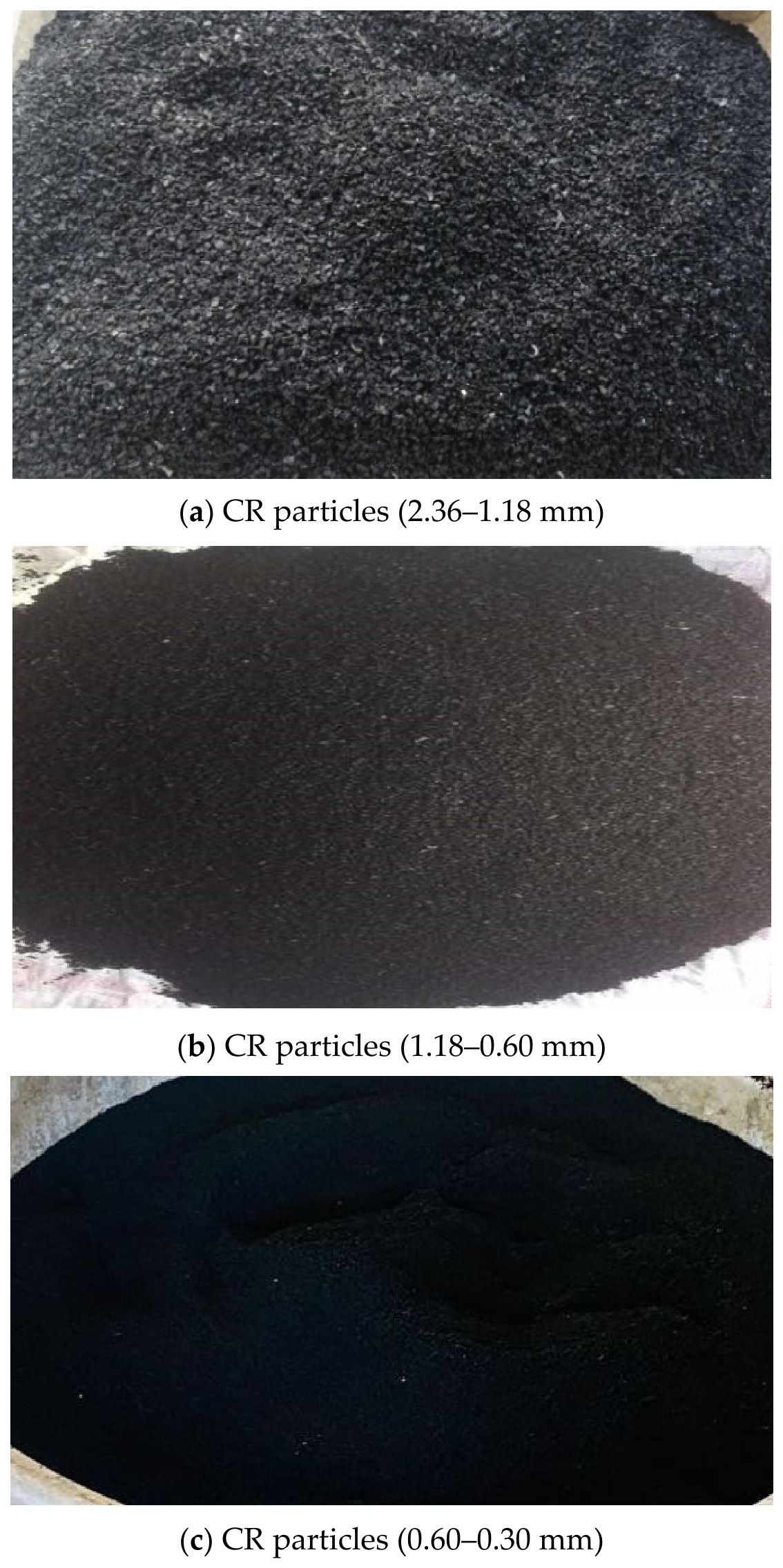
Figure 2.
Grain size distribution of CA, fine aggregate, CR, and mix.
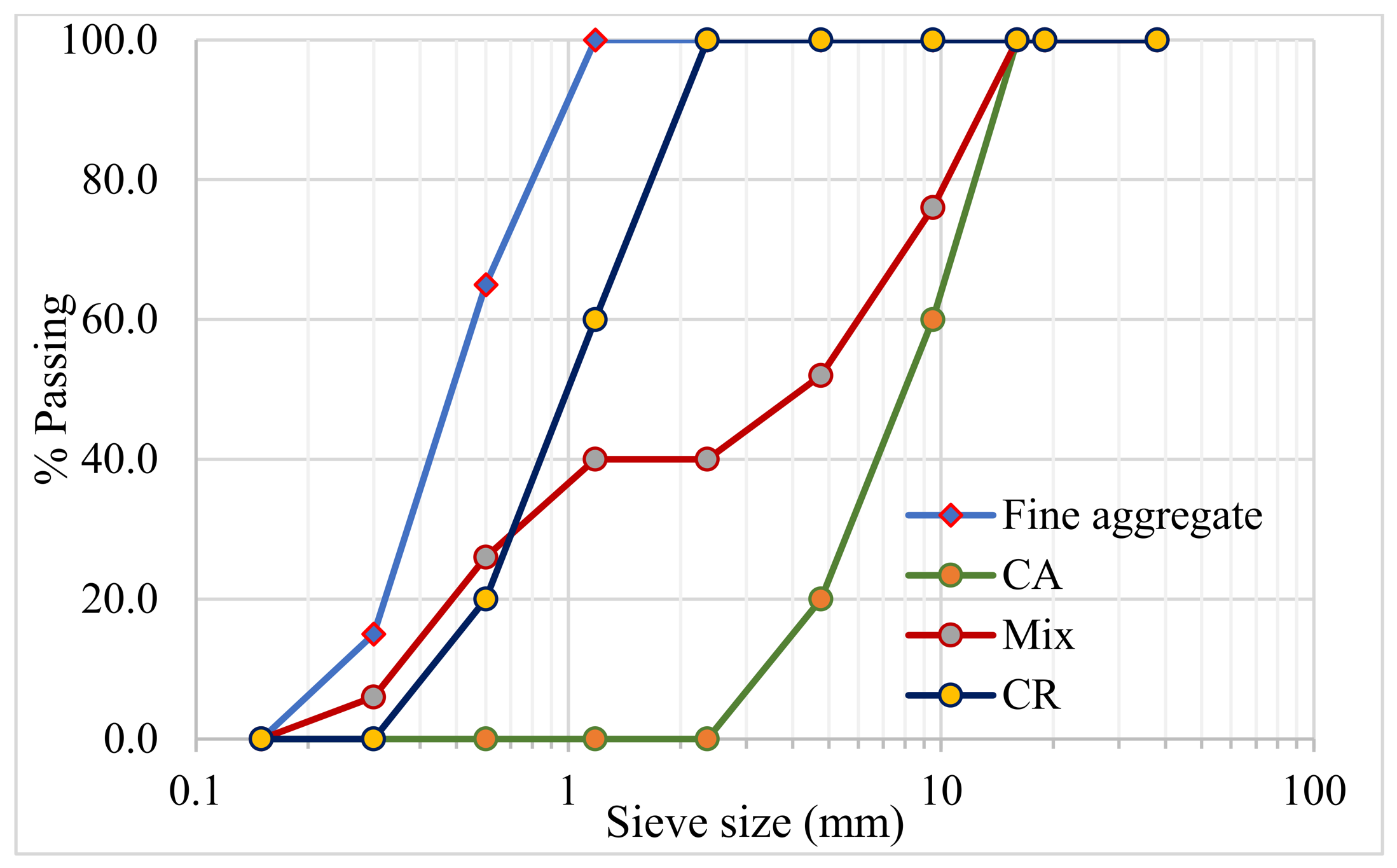
Figure 3.
Treatment procedure of untread CR.
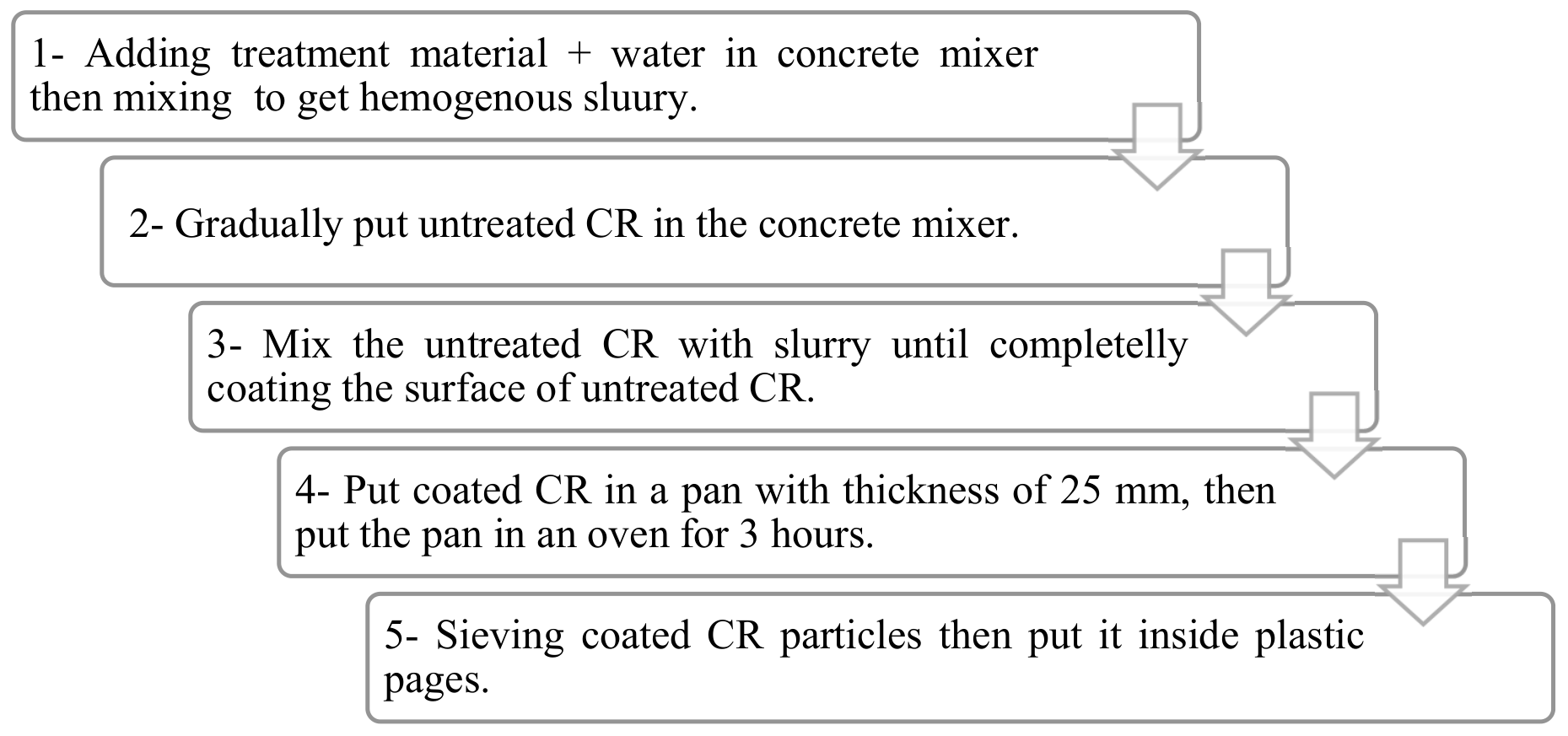
Figure 4.
Coating CR particles using FA.
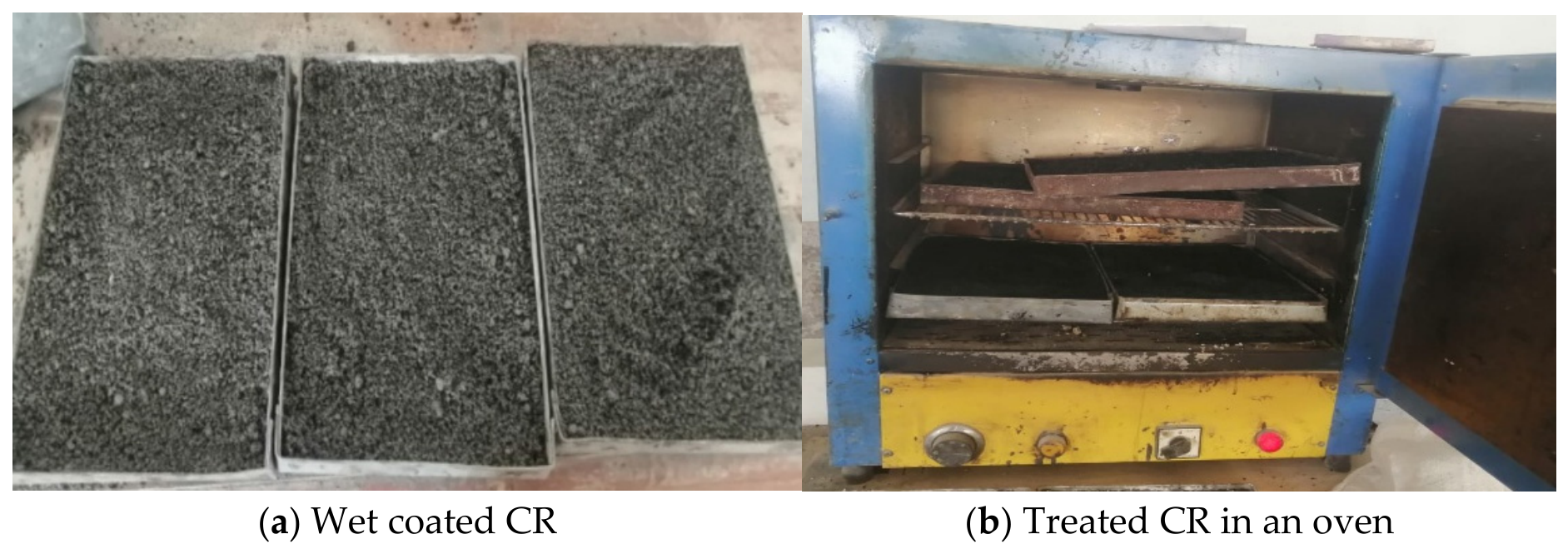
Figure 5.
Treatment of CR particles using SCMs.
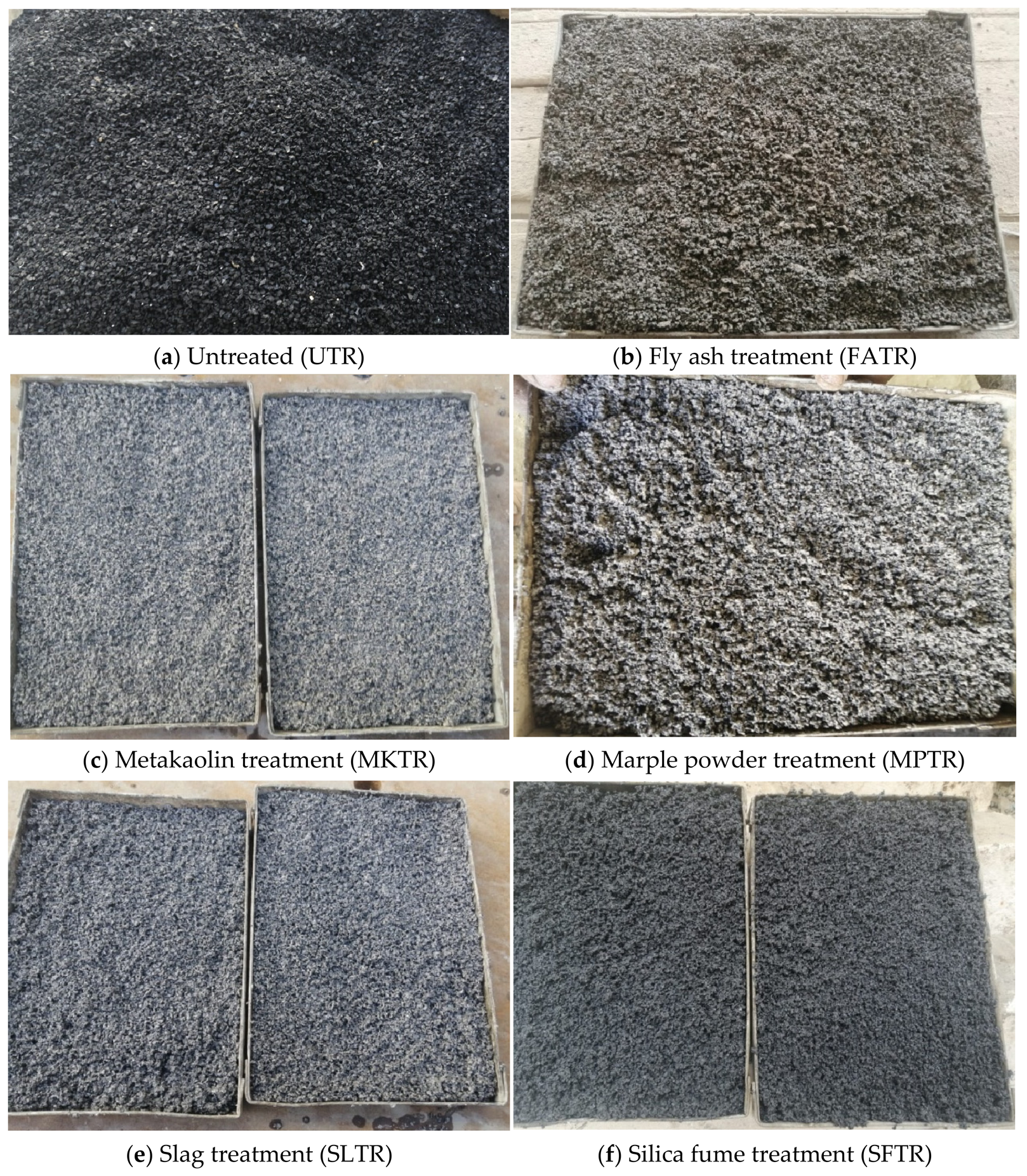
Figure 6.
CRC samples under testing.
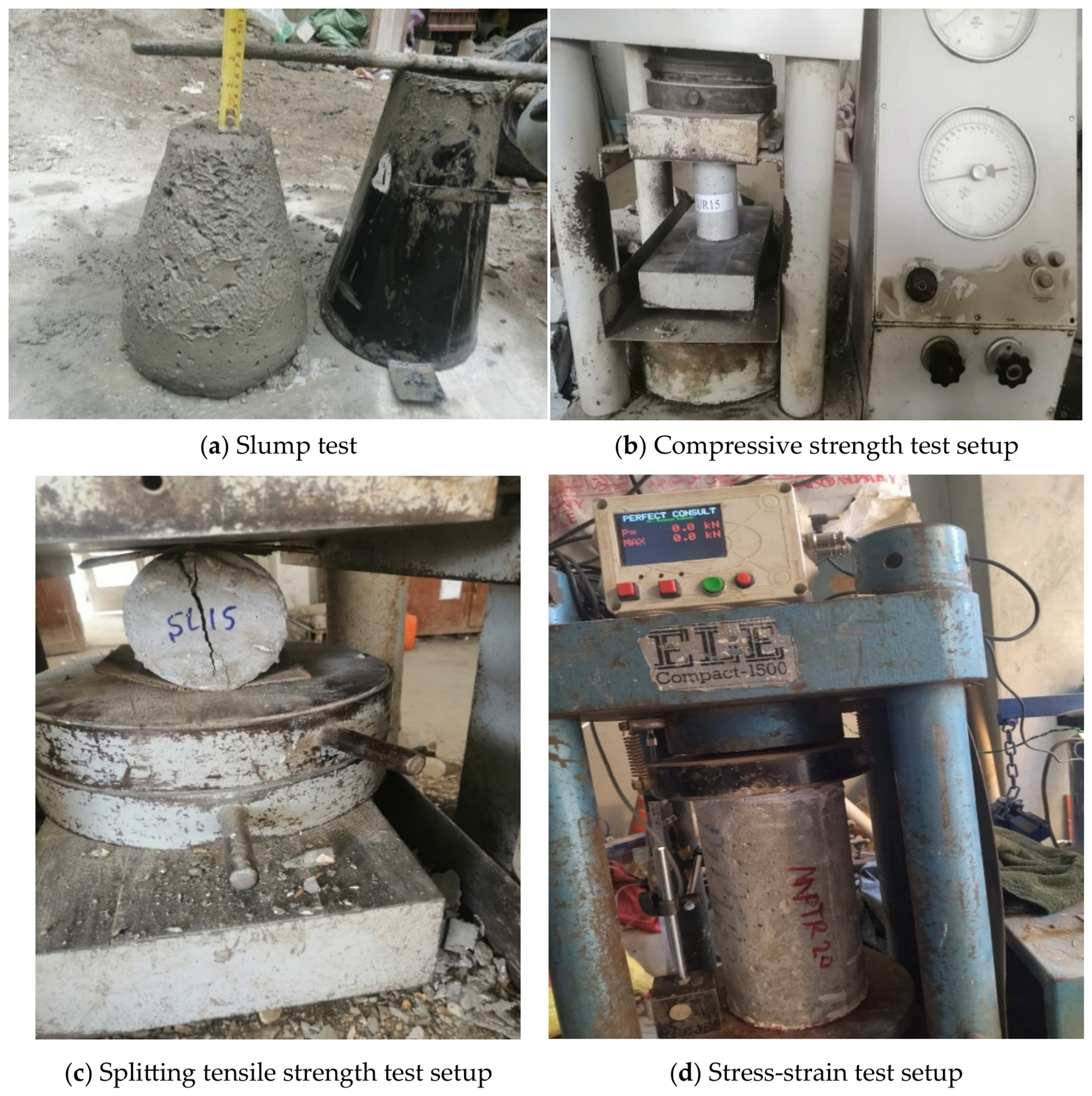
Figure 7.
Slump of CRC mixes.
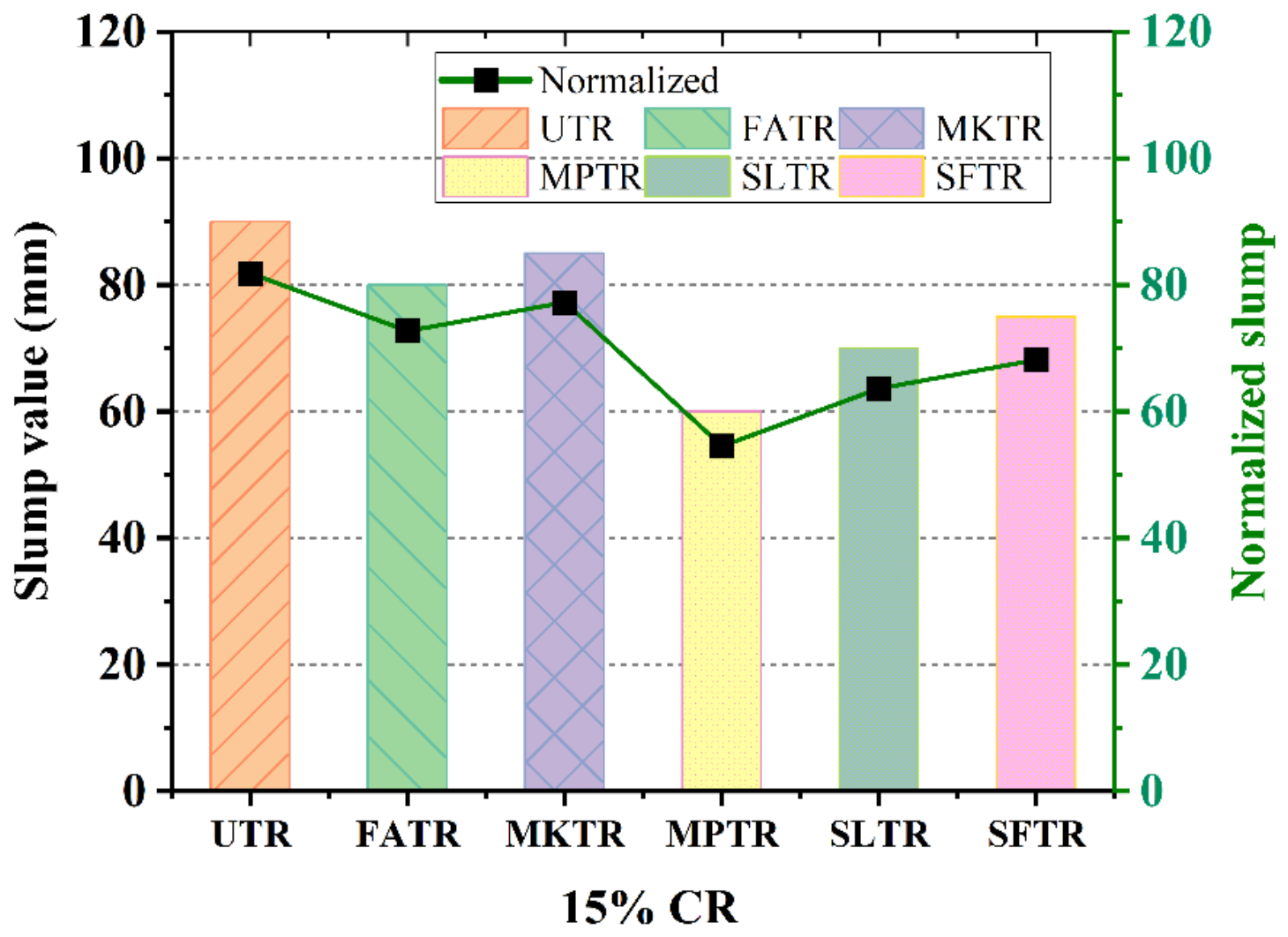
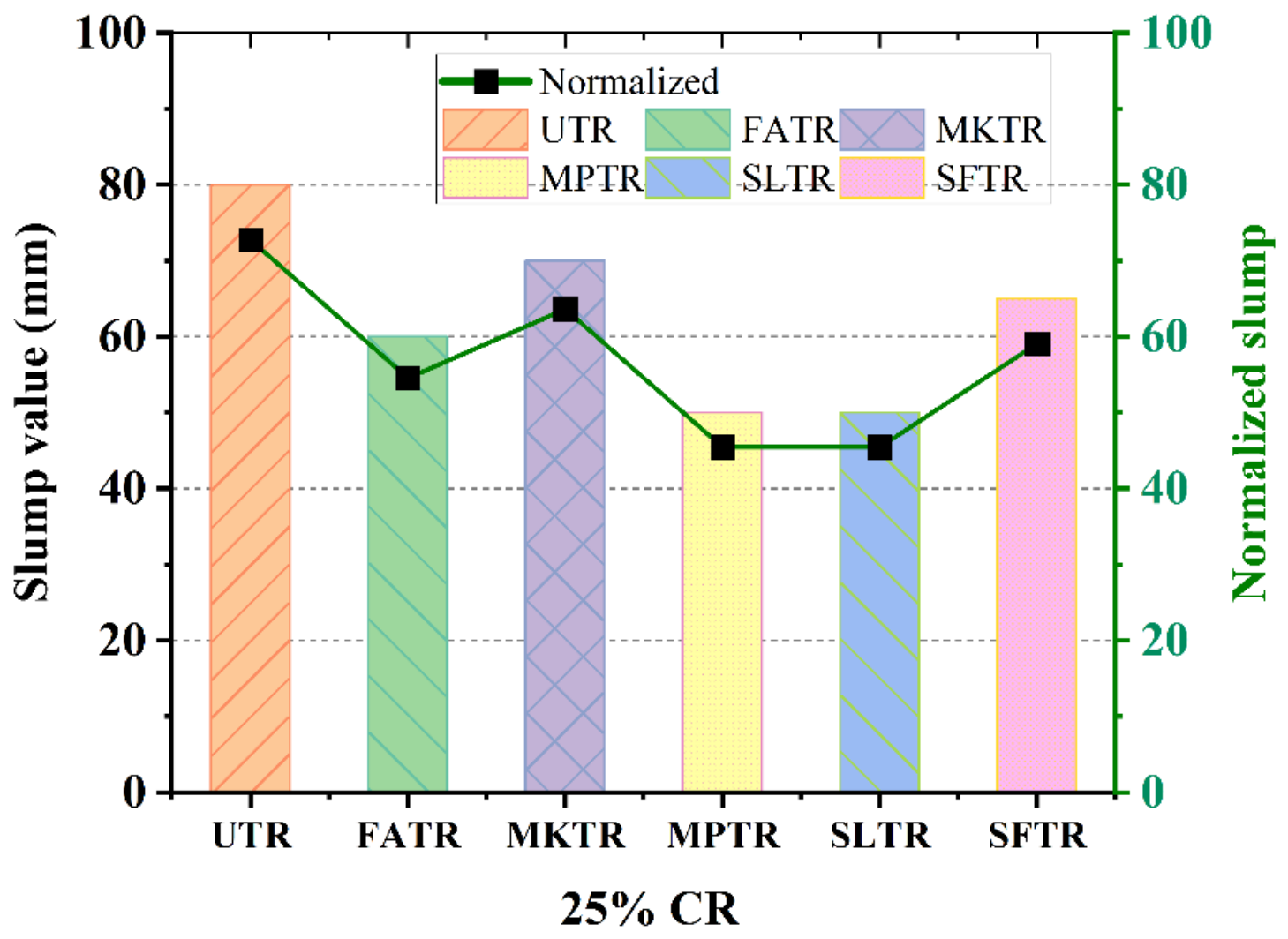
Figure 8.
Hardened density of CRC mixes.
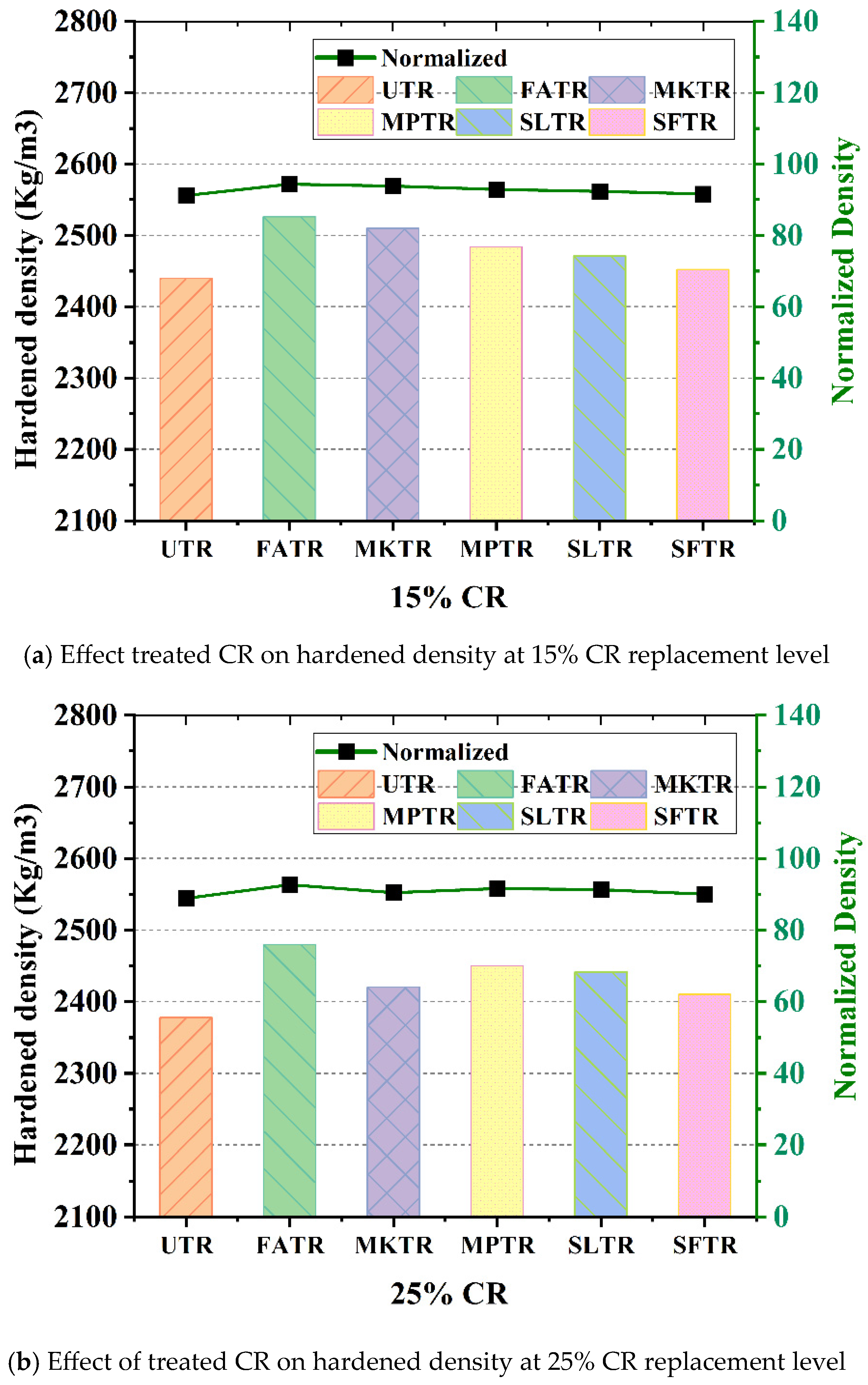
Figure 9.
fcu of CRC mixes at 7-day.
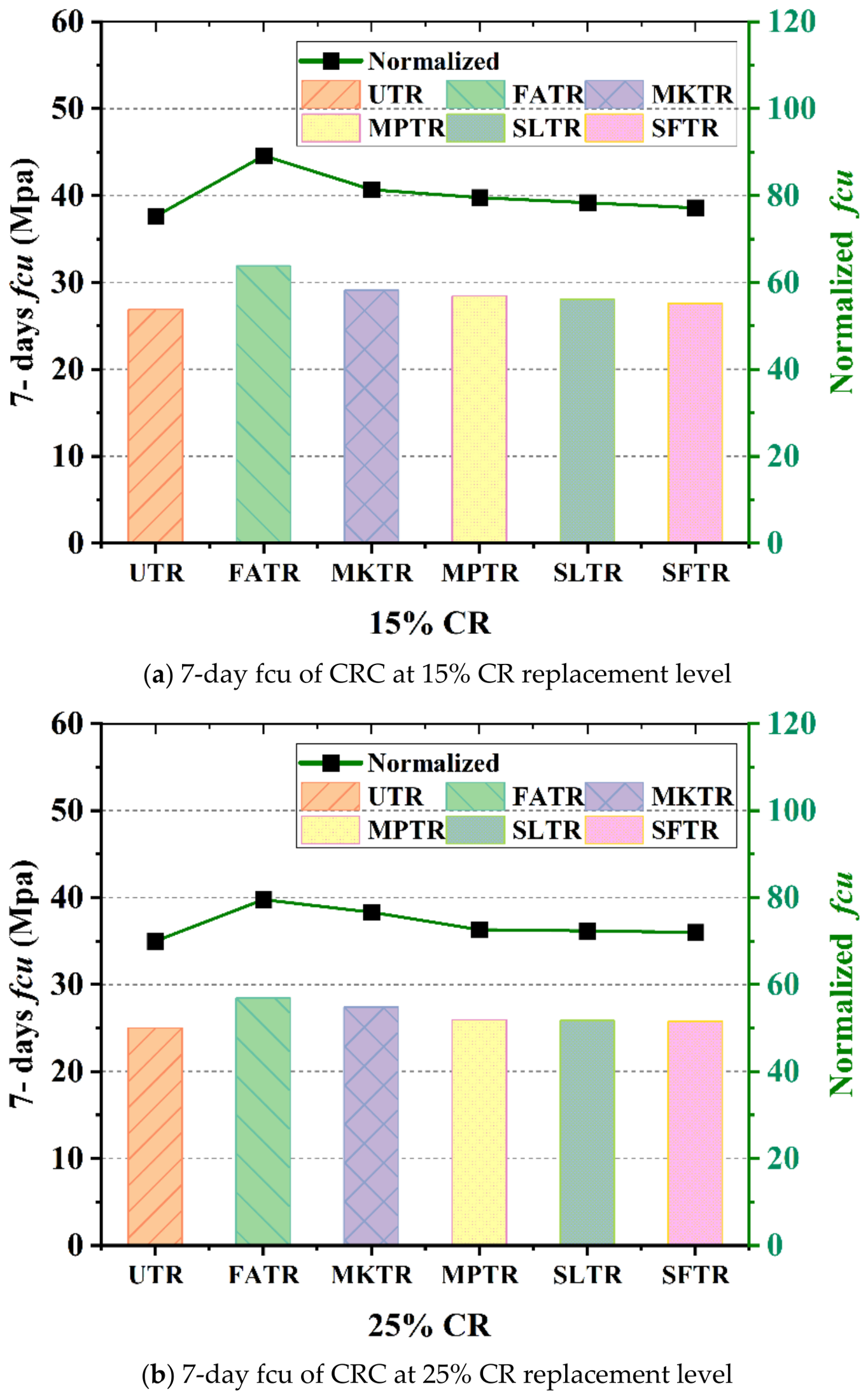
Figure 10.
fcu of CRC mixes at 28-day.
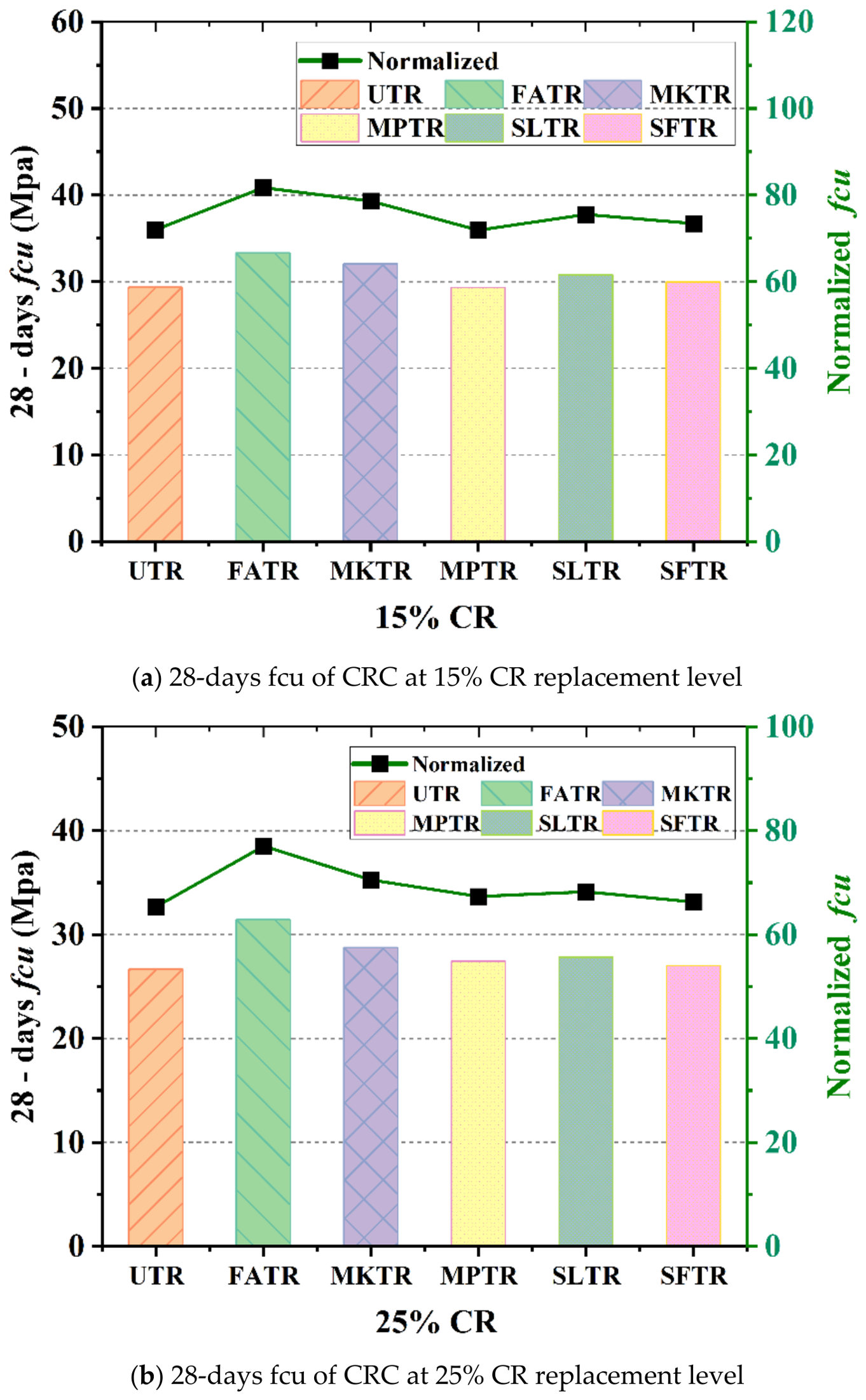
Figure 11.
Effect of precoated CR on 28-day fcu.
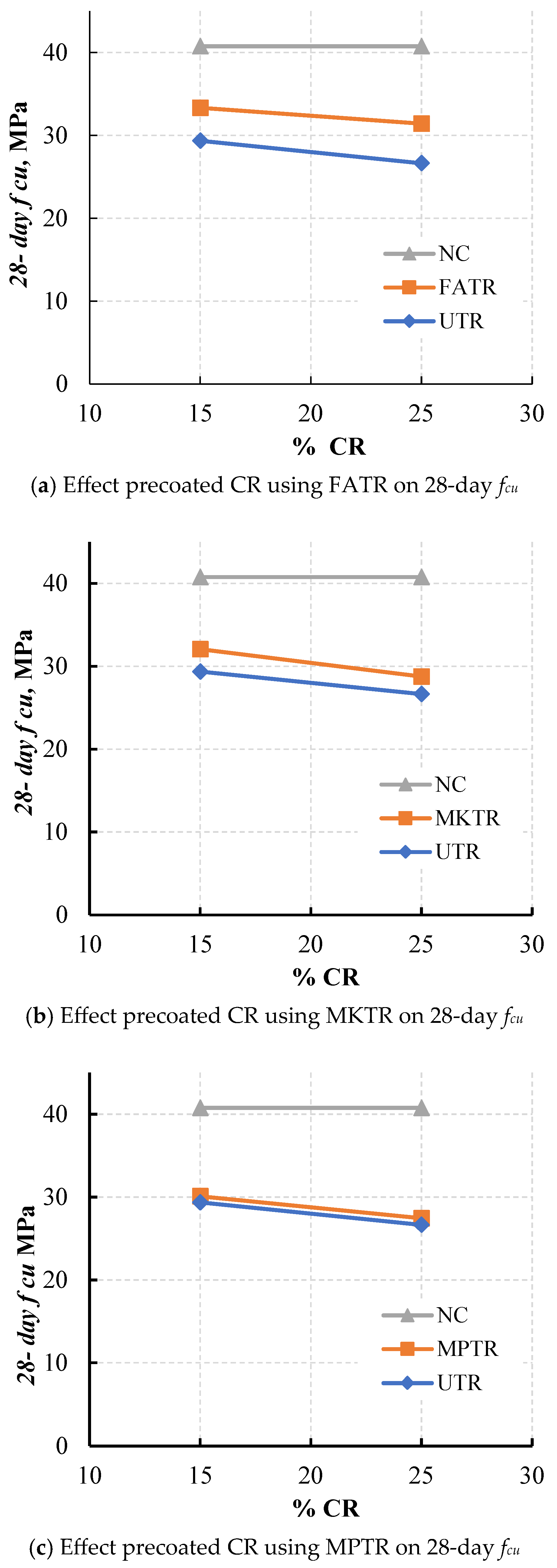
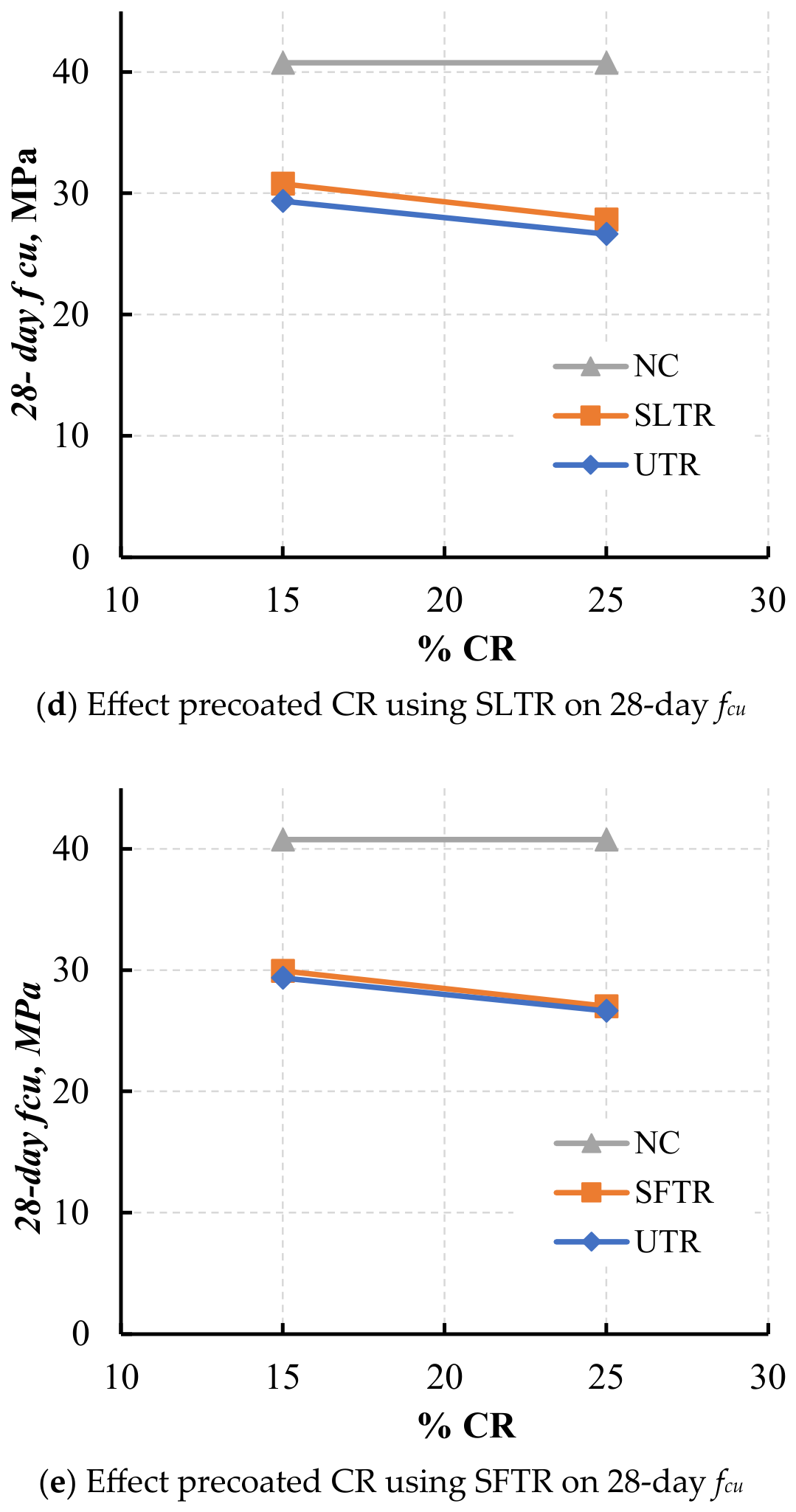
Figure 12.
Effect of precoated CR on 28-day fts.
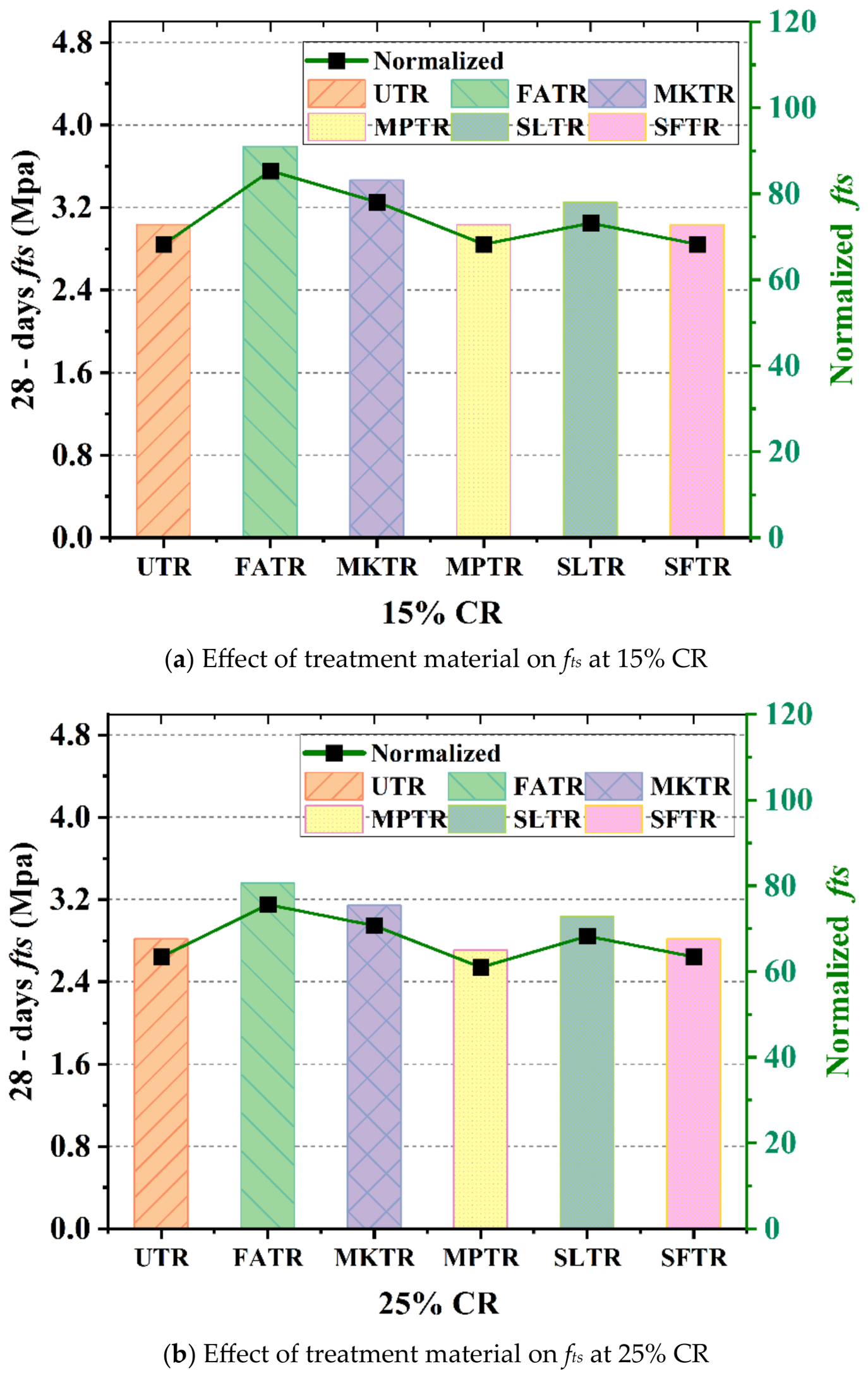
Figure 13.
Stress -strain behavior of CRC.
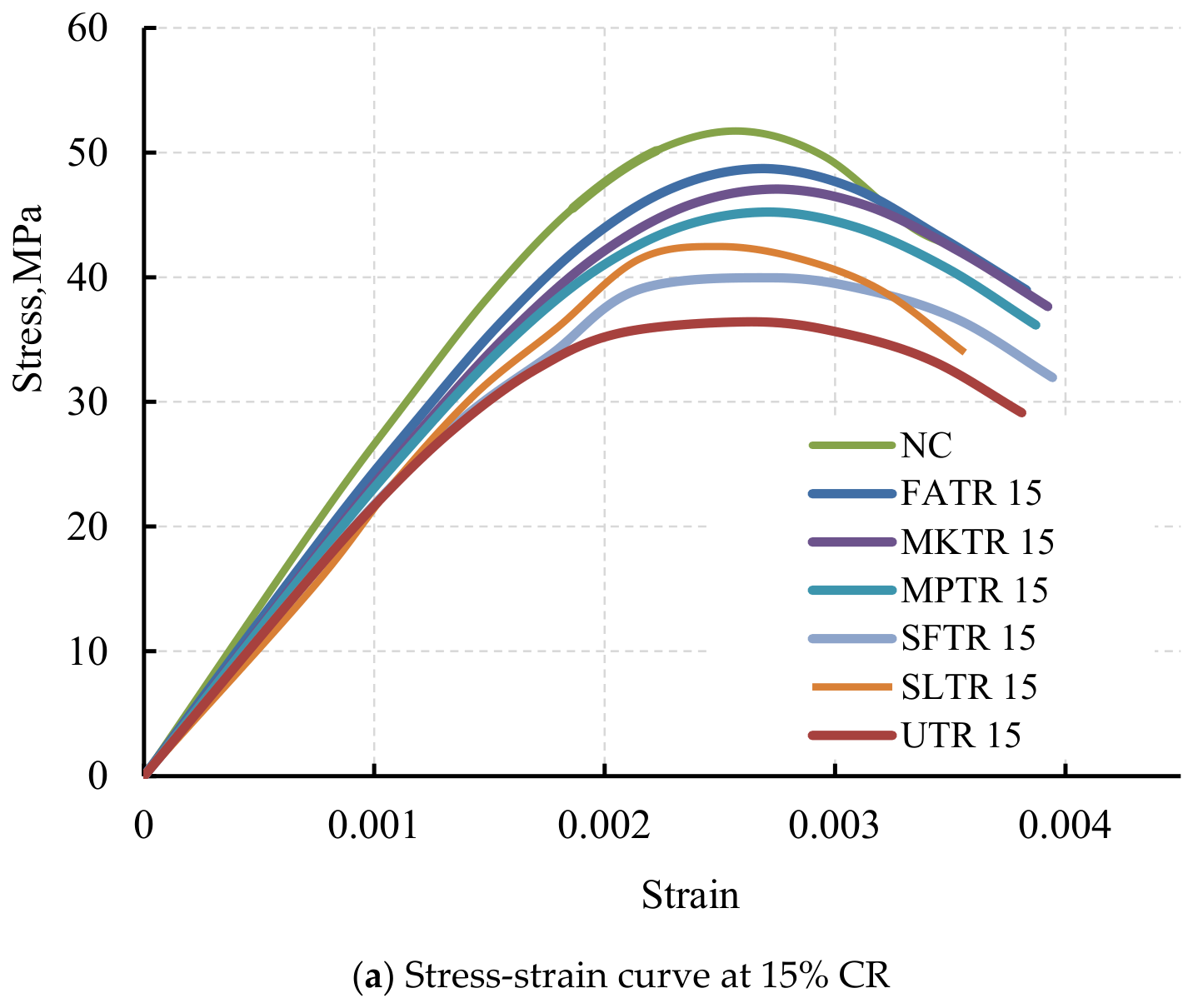
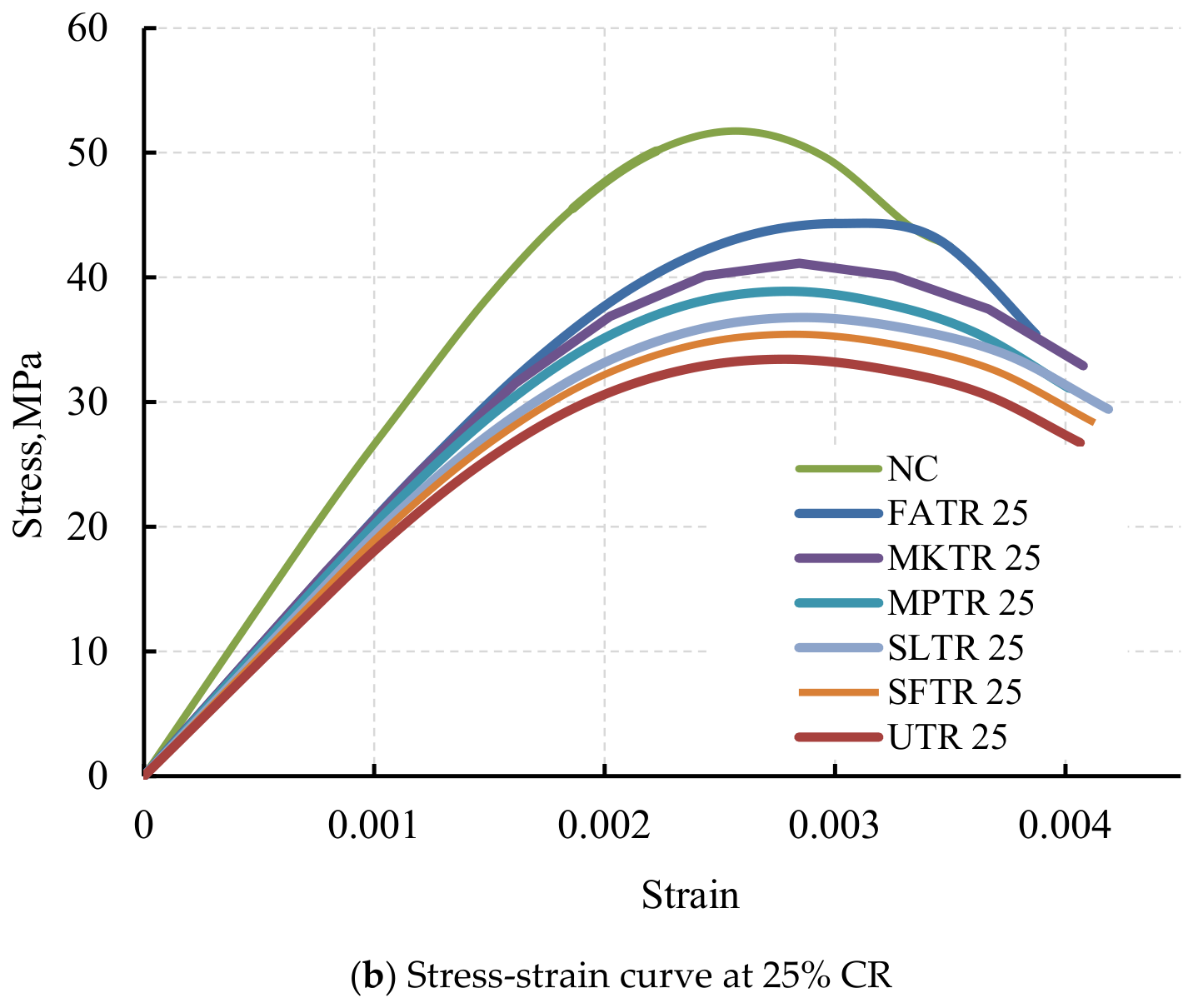
Figure 14.
Effect of precoated CR on P. E.
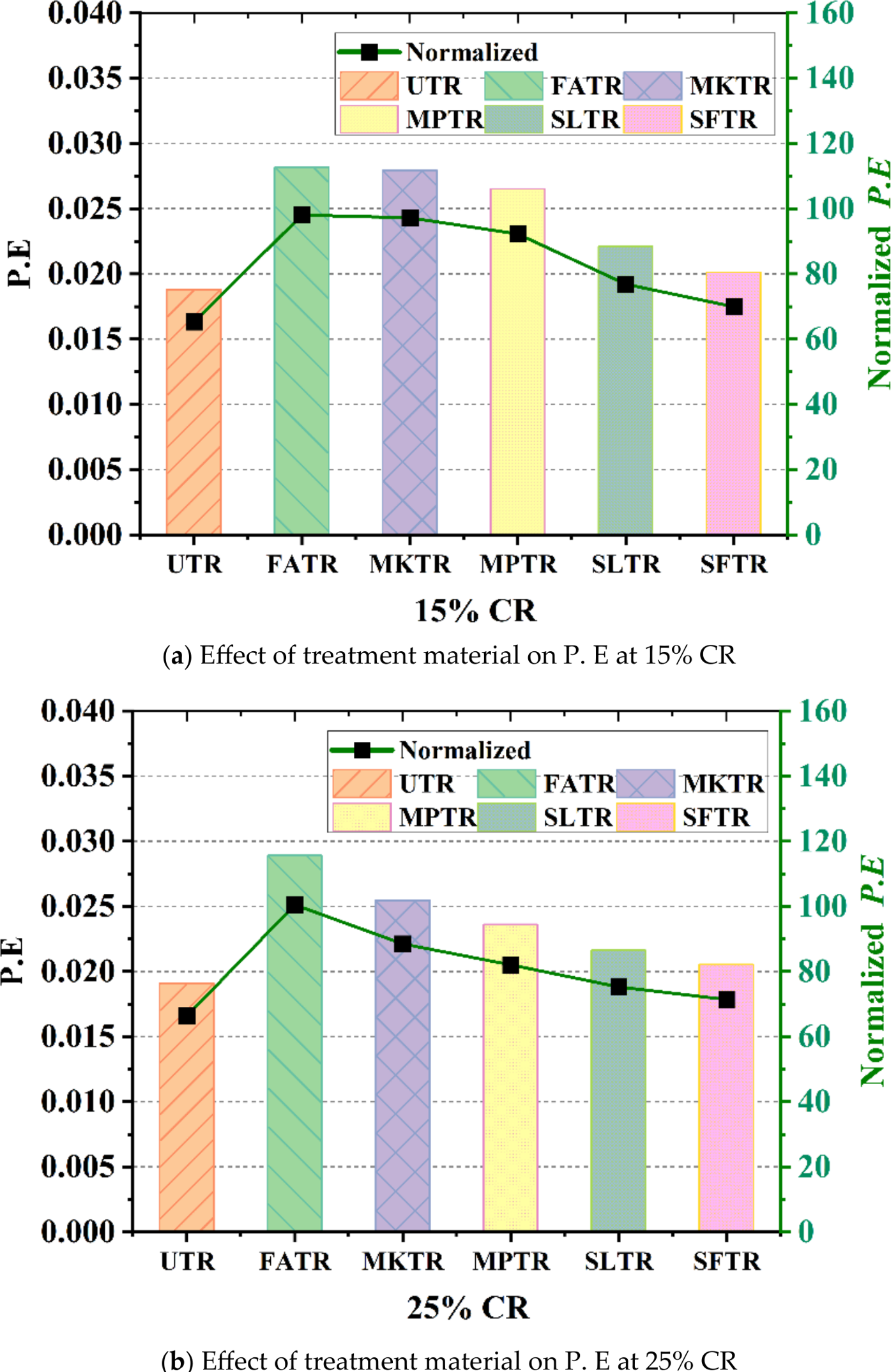
Figure 15.
Effect of precoated CR on C. E.
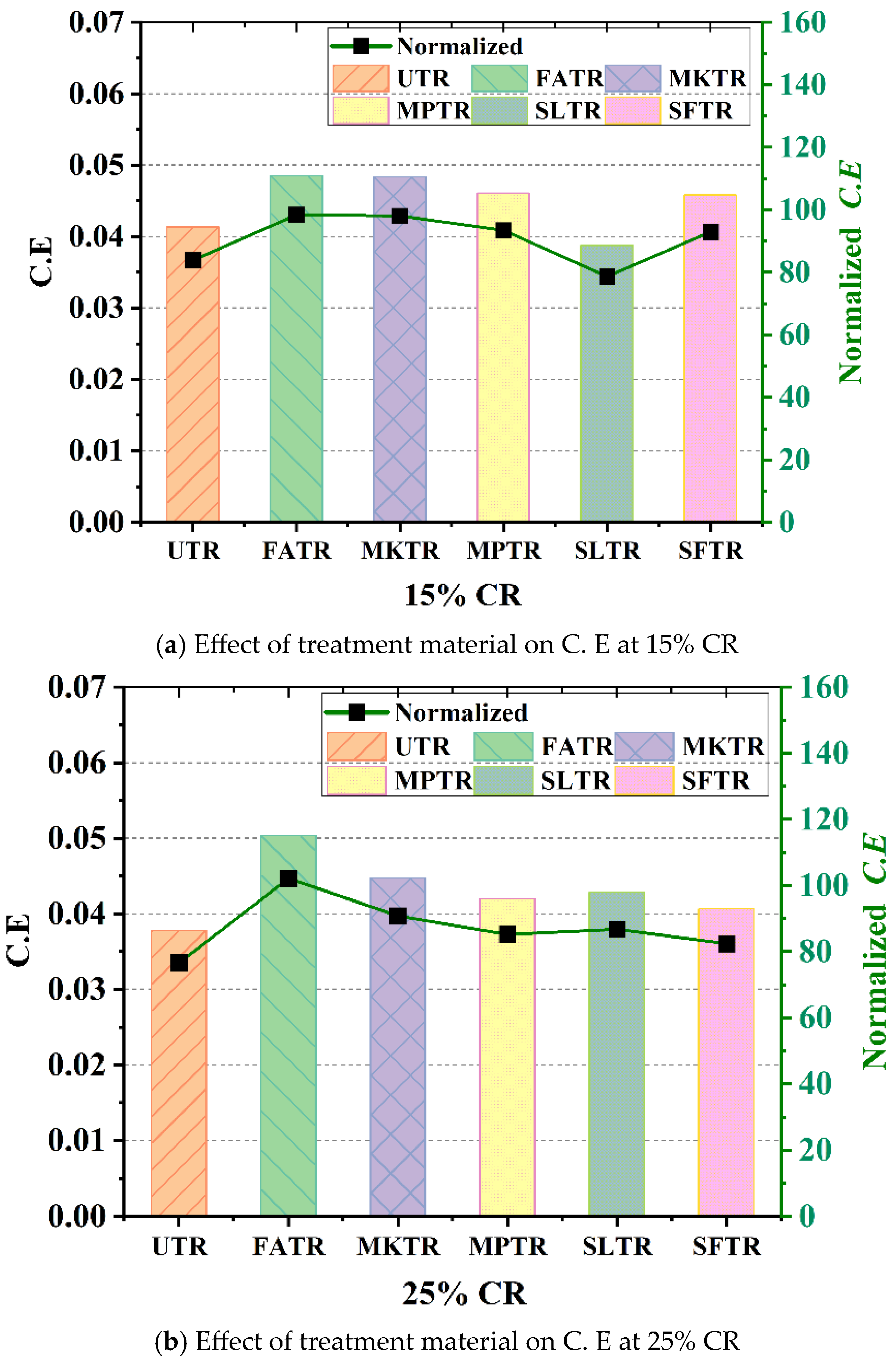
Figure 16.
Effect of precoated CR on PC. E.
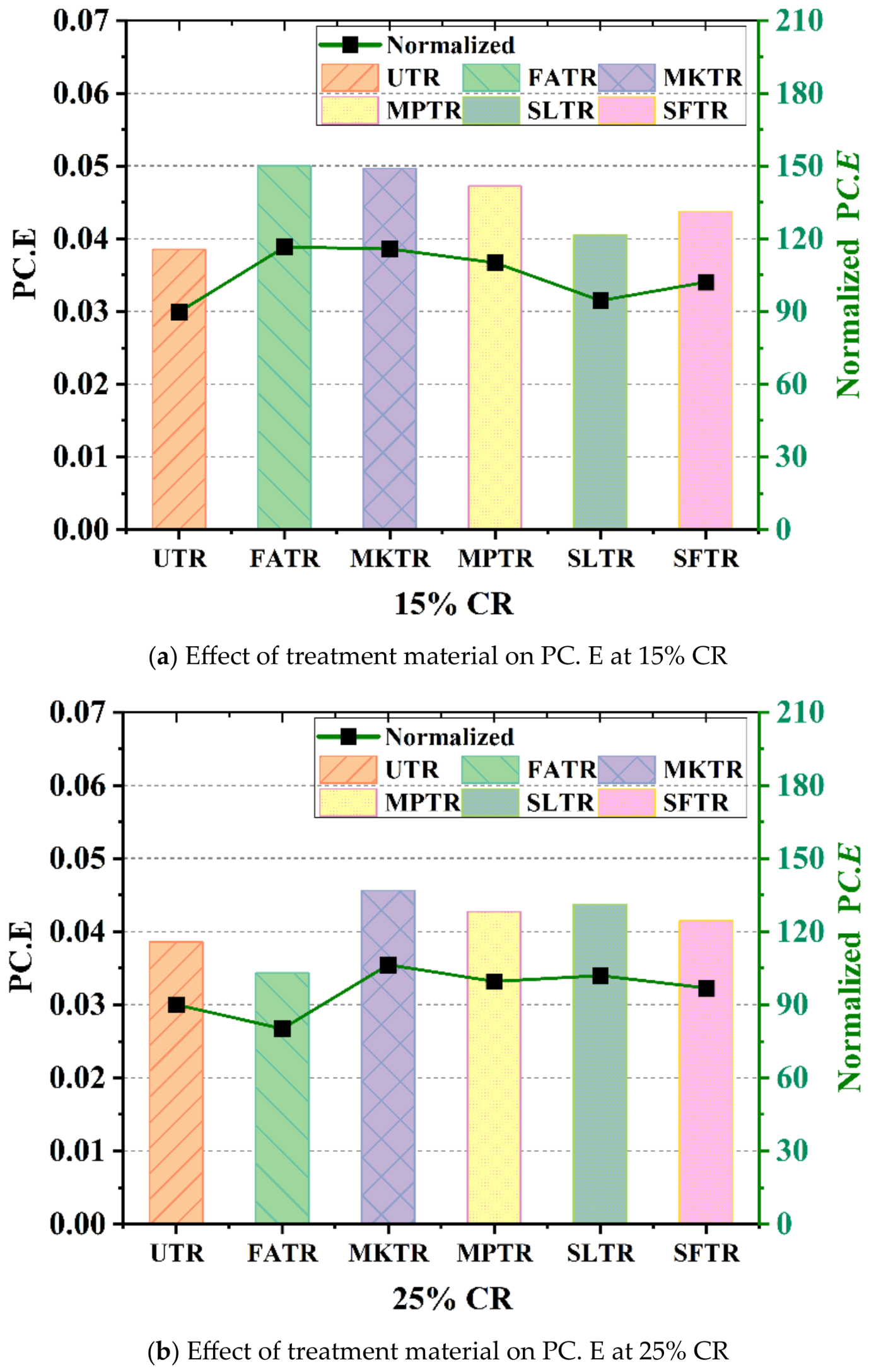
Figure 17.
Effect of precoated CR toughness.
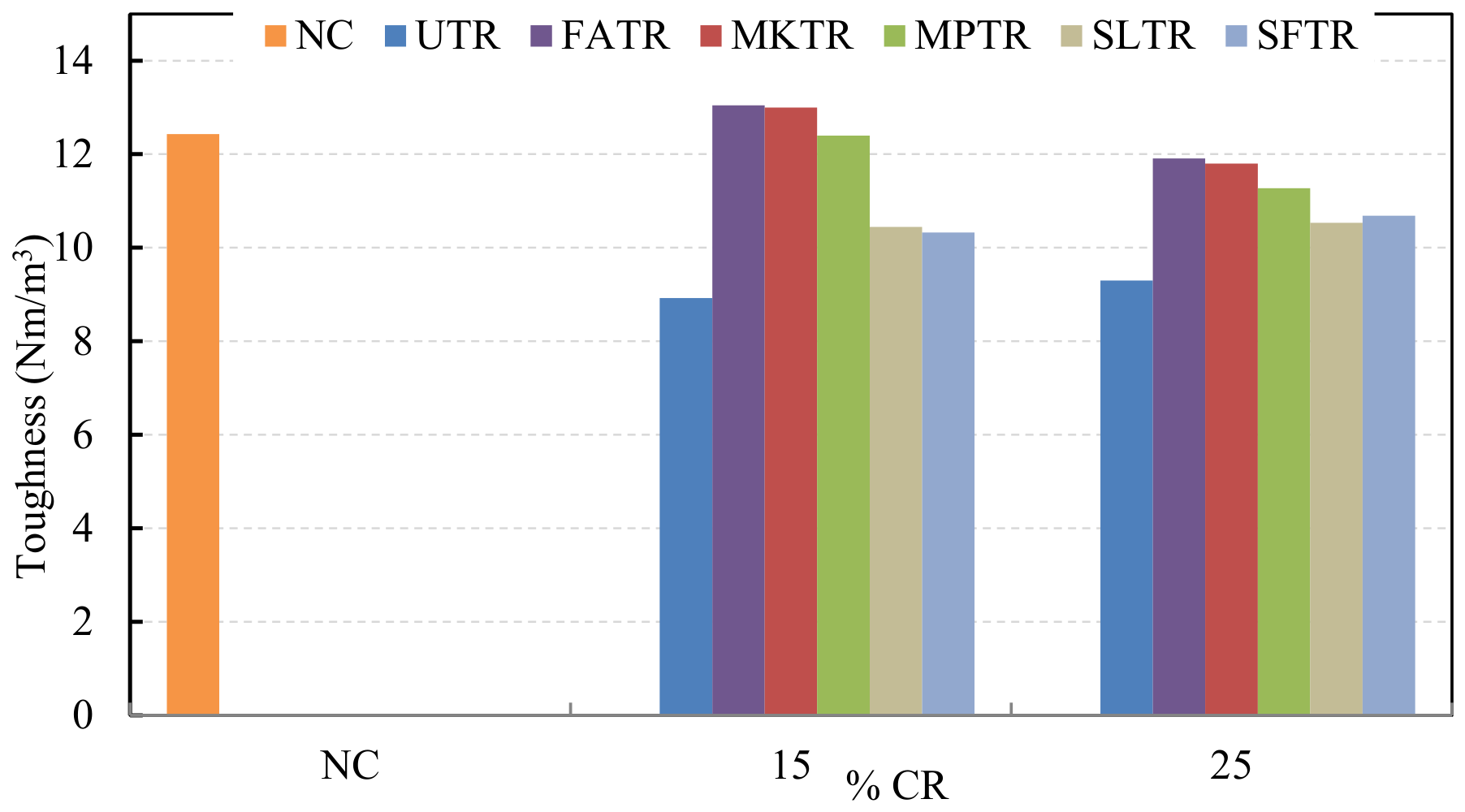
Figure 18.
Results of modulus of elasticity of CRC.
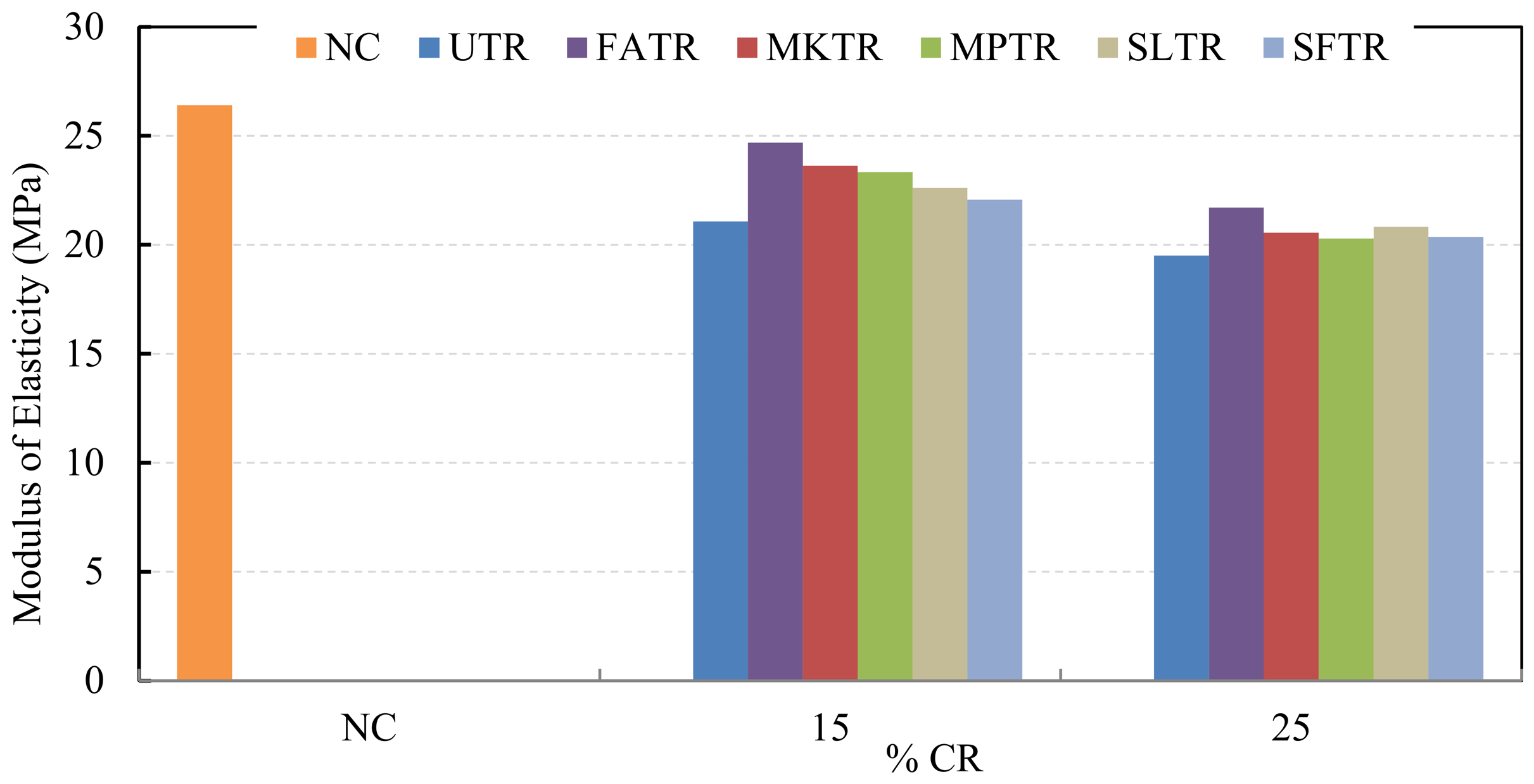

Table 1.
Physical and chemical characteristics of the used OPC and SCMs.
| Compounds | OPC | MK | FA | MP | SF | SL |
|---|---|---|---|---|---|---|
| SiO2 | 19.49 | 52.25 | 55.20 | 3.12 | 9.48 | 31.76 |
| Fe2O3 | 2.68 | 1.50 | 8.4 | 0.85 | 0.03 | 1.58 |
| Al2O3 | 7.36 | 41.25 | 21.9 | 0.73 | 0.40 | 14.72 |
| Cao | 62.51 | 1.20 | 5.23 | 83.22 | 0.44 | 44.01 |
| K2O | 0.70 | 0.65 | 1.2 | 0.09 | 0.25 | 0.39 |
| MgO | 3.70 | 0.15 | 1.53 | 1.52 | 0.40 | 5.53 |
| Na2O | 0.36 | 0.28 | 1.60 | 1.12 | 0.32 | 0.34 |
| LIO | 1.93 | 1.02 | 1.95 | 2.50 | 1.47 | 1.07 |
| Loss on ignition | 0.13 | 1.70 | 2.39 | 6.85 | 2.27 | 0.60 |
| Specific gravity (g/m3) | 3.14 | 2.60 | 2.2 | 2.50 | 2.10 | 2.25 |
Table 2.
Weights of constituents in crumb rubber treatment.
| Treatment Material | CR Size (mm) |
CR Weight (Kg) |
Treatment Material Weight (Kg) | Water (Kg) |
W/Treatment Material Ratio |
|---|---|---|---|---|---|
| FA | 2.36–1.18 | 2.0 | 0.8 | 0.52 | 0.65 |
| 1.18–0.6 | 2.0 | 1.0 | 0.65 | ||
| 0.6–0.3 | 2.0 | 1.6 | 1.04 | ||
| MK | 2.36–1.18 | 2.0 | 0.8 | 0.40 | 0.50 |
| 1.18–0.6 | 2.0 | 1.0 | 0.50 | ||
| 0.6–0.3 | 2.0 | 1.6 | 0.80 | ||
| MP | 2.36–1.18 | 2.0 | 0.8 | 0.32 | 0.40 |
| 1.18–0.6 | 2.0 | 1.0 | 0.40 | ||
| 0.6–0.3 | 2.0 | 1.6 | 0.64 | ||
| SF | 2.36–1.18 | 2.0 | 0.8 | 0.52 | 0.40 |
| 1.18–0.6 | 2.0 | 1.0 | 0.65 | ||
| 0.6–0.3 | 2.0 | 1.6 | 1.04 | ||
| SL | 2.36–1.18 | 2.0 | 0.8 | 0.24 | 0.30 |
| 1.18–0.6 | 2.0 | 1.0 | 0.30 | ||
| 0.6–0.3 | 2.0 | 1.6 | 0.48 |
FA: Fly ash; MK: Metakaolin; MP: Marple powder; SF: Silica fume; SL: Slag; W: Water.
Table 3.
Weights of constituents in CRC mixtures (Kg/m3).
| Mix ID | OPC | Water | CR % |
Coarse Aggregate | Fine Aggregate | CR | SP | ||||||
|---|---|---|---|---|---|---|---|---|---|---|---|---|---|
| 9.50 mm | 4.76 mm | 2.36 mm | 0.60 mm | 0.30 mm | 0.15 mm | 2.36–1.18 mm | 1.18–0.60 mm | 0.6–0.30 mm | |||||
| PC | 520 | 200 | 0 | 370.8 | 370.8 | 185.4 | 216.3 | 309.0 | 92.70 | 0 | 0 | 0 | 8.00 |
| UTR15 | 520 | 200 | 15 | 370.2 | 370.2 | 185.1 | 183.6 | 262.2 | 78.7 | 16.5 | 16.5 | 8.25 | 8.00 |
| UTR25 | 520 | 200 | 25 | 369.3 | 369.3 | 184.6 | 161.6 | 230.8 | 69.2 | 27.4 | 27.4 | 13.7 | 8.00 |
| FATR15 | 520 | 200 | 15 | 370.2 | 370.2 | 185.1 | 183.6 | 262.2 | 78.7 | 16.5 | 16.5 | 8.25 | 8.00 |
| FATR25 | 520 | 200 | 25 | 369.3 | 369.3 | 184.6 | 161.6 | 230.8 | 69.2 | 27.4 | 27.4 | 13.7 | 8.00 |
| MKTR15 | 520 | 200 | 15 | 370.2 | 370.2 | 185.1 | 183.6 | 262.2 | 78.7 | 16.5 | 16.5 | 8.25 | 8.00 |
| MKTR25 | 520 | 200 | 25 | 369.3 | 369.3 | 184.6 | 161.6 | 230.8 | 69.2 | 27.4 | 27.4 | 13.7 | 8.00 |
| MPTR15 | 520 | 200 | 15 | 370.2 | 370.2 | 185.1 | 183.6 | 262.2 | 78.7 | 16.5 | 16.5 | 8.25 | 8.00 |
| MPTR25 | 520 | 200 | 25 | 369.3 | 369.3 | 184.6 | 161.6 | 230.8 | 69.2 | 27.4 | 27.4 | 13.7 | 8.00 |
| SLTR15 | 520 | 200 | 15 | 370.2 | 370.2 | 185.1 | 183.6 | 262.2 | 78.7 | 16.5 | 16.5 | 8.25 | 8.00 |
| SLTR25 | 520 | 200 | 25 | 369.3 | 369.3 | 184.6 | 161.6 | 230.8 | 69.2 | 27.4 | 27.4 | 13.7 | 8.00 |
| SFTR15 | 520 | 200 | 15 | 370.2 | 370.2 | 185.1 | 183.6 | 262.2 | 78.7 | 16.5 | 16.5 | 8.25 | 8.00 |
| SFTR25 | 520 | 200 | 25 | 369.3 | 369.3 | 184.6 | 161.6 | 230.8 | 69.2 | 27.4 | 27.4 | 13.7 | 8.00 |
| PC: Plain concrete; UTR: Untreated rubber; FATR: Flay ash treatment; MKTR: Meta kaolin treatment; MPTR: Marble powder treatment; SLTR: Slag treatment; SFTR: Silica fume treatment; SP: superplasticizer; CR: Crumb rubber. | |||||||||||||
Table 4.
Slump values and density of CRC mixtures.
| Mix ID | Cylinder Weight (Kg) | Density (Kg/m3) | µ1 | µ2 | Slump (mm) | µ3 |
|---|---|---|---|---|---|---|
| PC | 4.2 | 2675 | - | - | 110.0 | - |
| UTR15 | 3.8 | 2440 | 91.21 | - | 90.0 | 81.8 |
| UTR25 | 3.7 | 2378 | 88.90 | - | 80.0 | 72.7 |
| FATR15 | 4.0 | 2527 | 94.5 | 103.5 | 80.0 | 72.7 |
| FATR25 | 3.9 | 2480 | 92.7 | 104.3 | 60.0 | 54.5 |
| MKTR15 | 3.9 | 2510 | 93.83 | 102.9 | 85.0 | 77.3 |
| MKTR25 | 3.8 | 2420 | 90.48 | 101.8 | 70.0 | 63.6 |
| MPTR15 | 3.9 | 2484 | 92.9 | 101.8 | 60.0 | 54.5 |
| MPTR25 | 3.8 | 2450 | 91.6 | 103.0 | 50.0 | 45.5 |
| SLTR15 | 3.9 | 2471 | 92.4 | 101.3 | 70.0 | 63.6 |
| SLTR25 | 3.8 | 2442 | 91.3 | 102.7 | 50.0 | 45.5 |
| SFTR15 | 3.9 | 2452 | 91.7 | 100.5 | 75.0 | 68.2 |
| SFTR25 | 3.8 | 2410 | 90.1 | 101.0 | 65.0 | 59.1 |
| The μ1 is the ratio of the density for mixes / density for PC, while μ2 is the ratio of the density for mixes / density of untreated mixes and μ3 is the ratio of slump value for mixes /slump value for PC. | ||||||
Table 5.
Mechanical properties of CRC mixtures.
| Mix ID | Compressive Strength | Splitting Tensile Strength at 28-Days |
|||||||
|---|---|---|---|---|---|---|---|---|---|
| 7- days | 28-Days | ||||||||
| fcu | µ1 | µ2 | fcu | µ3 | µ4 | ft | µ5 | µ6 | |
| PC | 35.8 | - | - | 40.8 | - | - | 4.4 | - | - |
| UTR15 | 26.9 | 75.2 | - | 29.4 | 72.0 | - | 3.0 | 69.0 | - |
| UTR25 | 25.0 | 69.9 | - | 26.6 | 65.3 | - | 2.8 | 64.0 | - |
| FATR15 | 31.9 | 89.1 | 118.6 | 33.3 | 81.7 | 113.4 | 3.8 | 86.2 | 126.4 |
| FATR25 | 28.5 | 79.5 | 113.8 | 31.4 | 77.0 | 118.1 | 3.4 | 76.3 | 120.0 |
| MKTR15 | 29.1 | 81.2 | 108.1 | 32.1 | 78.6 | 109.1 | 3.5 | 78.8 | 115.6 |
| MKTR25 | 27.4 | 76.5 | 109.6 | 28.8 | 70.5 | 108.1 | 3.1 | 71.4 | 112.2 |
| MPTR15 | 28.5 | 79.5 | 105.8 | 30.1 | 71.8 | 102.4 | 3.0 | 69.0 | 101.1 |
| MPTR25 | 26.0 | 72.5 | 103.8 | 27.4 | 67.3 | 103.2 | 2.7 | 61.6 | 96.8 |
| SLTR15 | 28.0 | 78.3 | 104.2 | 30.8 | 75.5 | 104.7 | 3.3 | 73.9 | 108.4 |
| SLTR25 | 25.9 | 72.3 | 103.5 | 27.8 | 68.2 | 104.6 | 3.0 | 69.0 | 108.4 |
| SFTR15 | 27.6 | 77.1 | 102.6 | 29.9 | 73.4 | 101.8 | 3.0 | 69.0 | 101.1 |
| SFTR25 | 25.8 | 71.9 | 103.0 | 27.0 | 66.2 | 101.6 | 2.8 | 64.0 | 100.6 |
The μ* is the ratio of strength for mixes/strength for PC.
Table 6.
Outcomes of stress-strain curves of CRC mixes.
| Mix ID | Peak Strain (εco) |
Ultimate Strain (εcu) |
Peak Stress (MP) | µ1 | µ2 | Energy Absorbed | Toughness (Nm/m3) |
Modulus of Elasticity (Ec) (MPa) | ||
|---|---|---|---|---|---|---|---|---|---|---|
| P. E | C. E | PC. E | ||||||||
| PC | 0.002590 | 0.003351 | 51.2 | -- | -- | 0.0288 | 0.0493 | 0.0429 | 12.43 | 26.40 |
| UTR15 | 0.002634 | 0.003810 | 36.4 | 71.1 | -- | 0.0188 | 0.0414 | 0.0385 | 8.92 | 21.07 |
| UTR25 | 0.002781 | 0.004064 | 33.4 | 65.2 | -- | 0.0191 | 0.0378 | 0.0386 | 9.30 | 19.50 |
| FATR15 | 0.002690 | 0.003831 | 48.7 | 95.1 | 133.8 | 0.0282 | 0.0485 | 0.0500 | 13.04 | 24.68 |
| FATR25 | 0.003011 | 0.003873 | 44.3 | 86.5 | 132.6 | 0.0289 | 0.0504 | 0.0344 | 11.91 | 21.70 |
| MKTR15 | 0.002751 | 0.003923 | 47.1 | 92.0 | 129.4 | 0.0279 | 0.0483 | 0.0497 | 13.00 | 23.63 |
| MKTR25 | 0.002846 | 0.004078 | 41.1 | 80.3 | 123.1 | 0.0254 | 0.0448 | 0.0456 | 12.02 | 20.55 |
| MPTR15 | 0.002710 | 0.003871 | 45.2 | 88.3 | 124.2 | 0.0265 | 0.0461 | 0.0472 | 12.39 | 23.33 |
| MPTR25 | 0.002796 | 0.004016 | 38.9 | 76.0 | 116.5 | 0.0236 | 0.0420 | 0.0427 | 11.27 | 20.28 |
| SLTR15 | 0.002502 | 0.003563 | 42.5 | 83.0 | 116.8 | 0.0221 | 0.0388 | 0.0405 | 10.44 | 22.61 |
| SLTR25 | 0.002674 | 0.003907 | 36.8 | 71.9 | 110.2 | 0.0216 | 0.0428 | 0.0437 | 10.53 | 20.82 |
| SFTR15 | 0.002519 | 0.003643 | 40.0 | 78.1 | 109.9 | 0.0201 | 0.0458 | 0.0438 | 10.32 | 22.07 |
| SFTR25 | 0.002635 | 0.003850 | 35.4 | 69.1 | 106.0 | 0.0205 | 0.0407 | 0.0415 | 10.00 | 20.36 |
| The μ1 is the ratio of peak stress for mixes/peak stress for PC, while μ2 is the ratio of peak stress for mixes / peak stress of untreated mixes, P.E: pre-cracking energy, C.E: Cracking energy, and PC. E post cracking energy. | ||||||||||
Disclaimer/Publisher’s Note: The statements, opinions and data contained in all publications are solely those of the individual author(s) and contributor(s) and not of MDPI and/or the editor(s). MDPI and/or the editor(s) disclaim responsibility for any injury to people or property resulting from any ideas, methods, instructions or products referred to in the content. |
© 2026 by the authors. Licensee MDPI, Basel, Switzerland. This article is an open access article distributed under the terms and conditions of the Creative Commons Attribution (CC BY) license (http://creativecommons.org/licenses/by/4.0/).
Copyright: This open access article is published under a Creative Commons CC BY 4.0 license, which permit the free download, distribution, and reuse, provided that the author and preprint are cited in any reuse.


