

Submitted:
24 April 2026
Posted:
27 April 2026
You are already at the latest version
Abstract
Light electric vehicles within the L category are expected to play a significant role in promoting sustainable urban transport, advantageous for both society and the environment. The batteries in these vehicles are well-suited for swapping, necessitating appropriate standards. This paper outlines the standardization framework relevant to this application, as studied by the ongoing European Stan4SWAP project.
Keywords:
standardization
; electric two- & three-wheelers
; LEV
; battery swapping
; charging business models
1. Introduction
In urban traffic, due to their beneficial effect on environment, electric vehicles are an important factor for improvement of traffic and more particularly for a healthier living environment. Light vehicles (L-category, as defined by by UNECE [2]) can have a contribution to cutting greenhouse gas emissions as set by the European Green Deal. Issues such as range anxiety remain however, but may be tackled with swappable battery systems (Figure 1). Battery swapping is an innovative system allowing owners of electric light vehicles to swap out their discharged batteries for fully recharged ones in a matter of seconds, eliminating long recharging stops and allowing flexible vehicle operation. This system has the potential to revolutionize electric mobility, facilitating the widespread adoption of electric vehicles. Standardizing battery designs and interfaces however presents obstacles, limiting interoperability between vehicle and battery makers.
The European Stan4SWAP project (stan4swap.standards.eu) (Figure 2) aims to speed up the market introduction of interchangeable battery systems for light vehicles. By creating a standardization roadmap, Stan4SWAP intends to guarantee interoperability and compatibility between vehicles and batteries from various manufacturers, thereby encouraging the uptake of battery-electric L-Cat vehicles. Alongside addressing the technical, market, and regulatory issues, as well as promoting education and awareness about the importance of standardization, one primary goal is to pinpoint the specific needs and challenges linked to swappable battery systems to aid their market launch and increase stakeholder involvement. The needs identified for swappable battery systems along with those for pre-normative research provide the foundation for spotting standardization gaps and tackling them in the standardization plan [4].
2. Regulatory Background [5]
Although standards and regulations are fundamentally different concepts, it is interesting to look at some European regulatory instruments, as these have an influence on the development of harmonized European standards through the standardization mandates issued by the European commission to CEN and CENELEC.
Recent relevant regulations include the new Battery Regulation (2023/1542) [6], which specifies mandatory requirements for all batteries placed on the EU market, covering aspects such as sustainability and safety, labelling, marking and information, due diligence, waste battery management and recycling, battery passport and green public procurement.
Of interest is also the Alternative Fuels Infrastructure Regulation AFIR (2023/1804) [7], which sets binding national targets for the development of EU alternative fuel infrastructure. Furthermore, it establishes common technical specifications and requirements regarding the information to vehicle users for the provision of data and payment requirements, as well as the low voltage directive LVD (2014/35/EU) [8] which ensures that electrical equipment provides a high level of protection for European citizens.
3. Relevant Standardization Work [5]
3.1. Introduction
To make a battery swapping system practical, it is crucial to have standardized specifications across various manufacturers and models. The varied European automotive industry, featuring a wide range of manufacturers and vehicle types, poses a notable challenge to standardization. Without unified standards for battery dimensions, shape, and connectivity, the system’s interoperability remains constrained.
The standardization work relevant to the subject is mainly done within IEC regarding the infrastructure issues, with specific vehicle-based aspects covered by ISO. Most work takes place at global level, with the resulting international standards being adopted as European ones by CEN and CENELEC.
The main IEC committee dealing with charging infrastructure standards is IEC TC69.
3.2. Battery Swapp Standards: IEC 62840
The subject of swappable batteries is covered by the IEC 62840 family of standards titled "Electric vehicle battery swap system". Its Part 1, "General and guidance" [3], was first published as Technical Specification in 2016, and made it to the International Standard level in 2025.
This first part gives a general overview of battery exchange systems for electrical road vehicle batteries, introducing system concepts and use cases. It marks the difference between "swappable" and "removable" battery systems, describing typical system components for both. The swappable battery system, where the batteries are moved by the charging station handling system, is foremostly aimed at larger vehicles (cars and heavy duty vehicles), whileas the removable system aims at lighter vehicles such as covered by the project. An example of removable battery system is given in Figure 1.
The second part on "Safety requirements", was published as international standard in 2016 [9], second edition 2025 [10]. It contains the general safety requirements for swappable or removable battery systems. The battery swap system shall be so designed and constructed that in normal use its performance is reliable and minimizes the risk of danger to the human individuals, equipment and surroundings. Specific additional aspects related to the application are covered including the operational safety of the vehicle lane system, the battery handling and storage systems, removable/swappable batteries and chargers. Special attention is given to electrical safety requirements.
The third part of IEC 62840, dealing with particular safety and interoperability requirements for battery swap systems operating with removable RESS/battery systems, has had a checkered history.
Initially, this document was intended to be part of the IEC 61851-3 series, aimed at the conductive charging of “light electric vehicles” (LEV). The exact definition of LEV proved however to be difficult, as it depended on varying national regulations taking into account factors like mass, number of wheels or maximum speed, which are hardly related to the electrical safety aspects of the charging process which were the real scope of the standard. For this reason, the documents of the 61851-3 series refer to ”DC EV supply equipment where protection relies on double or reinforced insulation” which is in fact the protection method most widely used for LEV. Such “Class II” equipment shall not be earthed. The various parts of IEC 61851-3 were eventually published as Technical Specification in 2023. However, the third part, 61851-3-3, dealing with removable battery systems, was taken out of the series and transferred to the 62840 project. It was decided to publish the document as a Publicly Available Specification based on the existing draft, as an intermediate document that meets specific market, which has been published prior to the development of a complete international standard. As such, IEC PAS 62840-3 was still heavily indebted to the 61851-3 series [11].
The new version however, which is now at Committee Draft level, will be fully integrated into the IEC 62840 series.
The new part 3 of 62840 provides specific requirements and test methods for battery swap systems operating with handheld swappable battery systems of totally or partly electrically propelled vehicles. It extends parts 1 and 2 with specific requirements for the give application.
3.3. Other Relevant Standards
The light electric vehicles with swappable batteries considered by the Stan4SWAP project cover various technology realms involving several other standardization committees, such as:
-
Accessories (IEC SC23H)Accessories to be used with the considered systems are covered by IEC SC23H, of which two documents are particularly interesting:
- –
- IEC/TS 62196-4 [12], covering the dimensional compatibility and interchangeability requirements for DC pin and contact-tube accessories for Class II or Class III applications. Class II and III refer to the measures taken to protect against electric shock, i.e., double or reinforced insulation for Class II and extra-low voltage for class III.
- –
-
IEC 63066, first published as Technical Specification in 2017 [13] and expected as International Standard in 2025, covers low-voltage docking connectors for removable energy storage units.IEC 63066 applies to docking connectors incorporated in or fixed to electrical equipment, intended to connect removable energy storage units to a dedicated electric power conversion unit, to an energy consuming unit or to another energy storage unit.Pluggable energy storage technology has a large demand and perspective in certain areas. With the advent of electric vehicles, energy storage units for renewable energy and other applications, guidance is needed to ensure safe and reliable operation, interoperability, environmental protection and energy efficiency. The industry needs such a standard to promote the technological development and popularization of pluggable energy storage technology.In comparison to other accessories, certain specific items are taken into account. The operator might not have tactile feedback during the mating process to correctly align the two parts of the connector. Additionally, a mechanical feed in the mating process might prevent proper alignment of the connector parts. To address these challenges, the accessory design may include movable components to compensate for mechanical feed and tolerances.Requirements are given for electrical and mechanical properties of the accessories; these requirements are largely based on IEC60309-1 – the general standard for industrial plugs and connectors – amended where necessary for the specific needs of docking connectors.The document defines three types of accessories in standard sheets, among them a docking connector rated 60V, 50A for battery swap systems under IEC/PAS 62840-3.
-
Battery safety (IEC TC21, IEC SC21A, CLC TC21X, ISO TC22 SC37, ISO TC22 SC38)As for standardization of batteries and their safety aspects, several committees are active each with their specific approach.When the battery is considered as a system in the vehicle, the main work comes from vehicle committees such as ISO TC22 SC37 with the general safety standard ISO 6469-1 [14] for EV batteries, or ISO TC22 SC38 where ISO 18243 [15] specifies the test procedures for lithium-ion battery packs and systems used in electrically propelled mopeds and motorcycles.A specific European development has been the EN 50604-1 ”Secondary lithium batteries for light electric vehicle” [16]. It specifies the test procedures and provides acceptable safety requirements for voltage class A and B (i.e., below or above 60V DC) removable lithium-ion battery packs and systems to be used as traction batteries for electrically propelled road vehicles.This standard is primarily system-oriented — excluding individual cells — and is to be considered in conjunction with the ISO standard 6469-1, supplementing or modifying the corresponding clauses in the ISO standard.The selected test items are designed to replicate scenarios that may happen during handling (such as removal or replacement) or during use, including normal operation, rough handling, and potential misuse or negligent handling.EN 50604-1 is now being elevated to the international level under the aegis of the IEC, as project IEC 63623-1 "Secondary lithium batteries for light EV (electric vehicle) applications - Part 1: General safety requirements and test methods". The NP for this standard has been approved. Its scope will include lithium-ion traction batteries of voltage class A (up to 60 V DC) for light mobility applications such as electrically power assisted cycles (EPACs), speed-EPACS (S-EPACs), carrier-cycles, personal light electric vehicles (PLEVs), personal mobility devices (PMDs) and e-transporters.For the safety aspects on cell level, these standards refer to the IEC 62660 series ”Secondary batteries for the propulsion of electric road vehicles”, where Parts 2 [17] and 3 [18] deal respectively with safety testing and safety requirements for battery cells and modules.Although these standards are primarily aimed towards larger vehicle batteries, cells covered by IEC 62660 are also likely to be used in LEV applications, albeit in smaller systems than for heavier vehicles.For portable secondary lithium cells and batteries, there is the IEC 62133-2 [19] standard drafted by IEC SC21A, which specifies requirements and tests for the safe operation, considering both intended use and reasonably foreseeable misuse. The latter is defined as use in a way which is not intended by the supplier, but which may result from readily predictable human behaviour.This standard covers a wide array of cell types and sizes, some of which may be applicable for LEV battery assemblies.
-
Battery chargers (IEC TC61)Battery chargers for light electric vehicles often are considered akin to household appliances and ruled by corresponding standards such as IEC 60335-2-29 [20] and IEC 60335-1 [21]. These documents also serve as basis for IEC/TS 61851-3-2 [22], which supplements or modifies the 60335 requirements and tests for mechanical and electrical safety.General standards on functional electrical safety such as IEC 61508 [23] may also be applicable. This standard provides a generic framework for all safety lifecycle activities involving systems composed of electrical, electronic, and/or programmable electronic (E/E/PE) elements that perform safety functions. This standardized methodology aims to establish a rational and consistent technical policy for all electrically-based safety-related systems. The standard introduces safety integrity levels for specifying the target level of safety integrity for the safety functions to be implemented. This document has a broad scope of application and is not specifically aimed at swappaple battery systems.
-
Protocol standards (IEC TC69)There is substantial standardization activity on communication protocols, the most famous example being the Open Charge Point Protocol (OCPP), a widely used consortium standard developed by the Open Charge Alliance (OCA), enshrined as IEC International Standard IEC 63584 [24] through the fast-track procedure in 2024. This document reflects OCPP 2.0.1 and does not refer to battery swapping.However, the latest version 2.1, implemented as IEC document 63584-210 [25] in 2025, features a new section that describes use cases for the control of a battery swap station. Battery swapping differs from conventional charging in that a battery swap action cannot be recorded by the usual OCPP messages. The action of swapping a battery is not considered a charging transaction; instead, it is a separate service. OCPP 2.1 introduces a new use case to record the swapping of batteries.A battery swap station has multiple slots to dock batteries. In OCPP, a battery swap station is treated as a charging station. Similar to charging stations, where one EVSE charges one EV, OCPP assumes that, in a battery swap station, conceptually one EVSE powers one battery slot. Different types of battery slots can be represented in the device model.
4. Stakeholders Involved
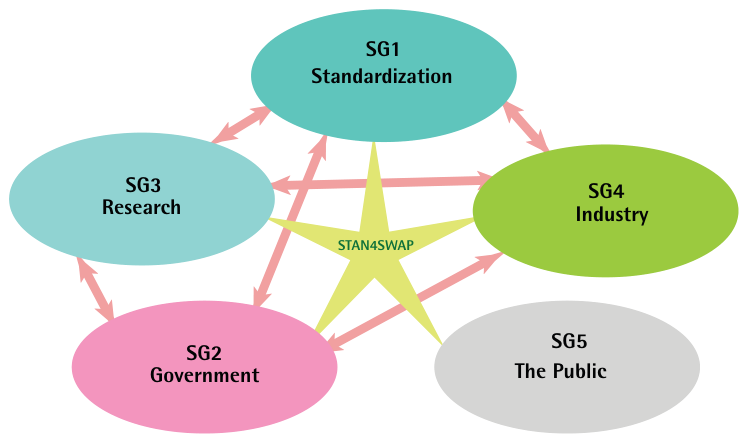
Considering the technical and societal impact of battery swapping technology standardization for light electric vehicles, one should realize that this exercise goes beyond single parties. A wide array of stakeholder groups are in fact involved (Figure 3), of which the mapping will allow a targeted approach for reaching the desired objectives and adding value to the project. The interaction between the various parties shall be optimized in order to obtain the optimal standardization framework addressing the needs of all concerned. Five main stakeholders are identified:
- 1.
-
Standardization committees and organizations.Several global and regional standards outline the criteria for safety, compatibility, and performance of replaceable battery systems. Much of the standardization in electrotechnology is performed by the IEC worldwide, while CENELEC both adopts international standards as European standards and drafts specific standards for Europe when necessary. Specifically for vehicles, standardization is performed by ISO and CEN respectively.
- 2.
-
Government services.Public authorities are responsible for defining the policy and regulatory framework needed for the deployment of environmentally friendly mobility and the related infrastructure. The authorities are established at different levels according to the subsidiarity principle: European, national and local, defining the regulatory framework and promoting specific developments:
- 3.
-
Research and academic interests.The influence of scientific research and development on innovation is paramount. Academic research is performed at universities where major research groups are focusing on electric mobility. A further channel is through fellow European research projects, funded by public authorities or by the industry. A key role is also foreseen for research-focused organizations providing funding or co-ordinating R&D activities.
- 4.
-
Commercial and industrial actors.The industrial sector regroups key actors in product development. The enterprises involved cover several domains such as the manufacturing industry (involving not only the vehicles proper, but also subsystems or ancillary infrastructures), the energy industry and the services industries .
- 5.
-
The general public.The end user of the technology is the general public, and its choices will measure the technology’s success.
5. Roadmap: Standardization Gaps and the Need for New Standards
5.1. Introduction
The design of a standardization roadmap [26] for swappable batteries was the main aim of Stan4SWAP project. A major point is the identification of the most relevant standardization gaps where additional measures have to be taken.
The roadmap is organized around three main goals:
- enabling interoperability among manufacturers and operators
- guaranteeing that batteries, vehicles, and charging infrastructure work seamlessly together
- creating strong communication standards across all layers of the ecosystem.
Safety and cybersecurity are addressed as overarching, cross-cutting, issues throughout.
Findings are organized across four system levels:
- Battery level
- Vehicle level
- Charging station/infrastructure level
- Interfaces and full system management
At each level, the document differentiates between topics that still need additional Pre-Normative Research (PNR) before standardization can move forward, and topics for which standardization gaps have already been identified and work can start. Every gap is evaluated in terms of its priority (T1 within 2 years, T2 within 4 years, T3 within 5 years), its regulatory context, the standardization committees involved, and the main stakeholders who should lead or take part.
5.2. Battery Level
At the battery level, the roadmap highlights safety-related specifications as the most critical and insufficiently addressed area. Key issues such as acceptable temperature ranges, strategies to reduce fire risk, and the control of thermal runaway and its propagation currently lack a fully coordinated and harmonized regulatory framework across the EU. This is the case even though existing standards, including EN 50604-1 [16] and IEC 62619 [27], only partially cover these aspects and leave important gaps. To mitigate these shortcomings, the document recommends exploring extensions to IEC 62840-3 [28], in particular to explicitly encompass indoor battery swapping applications and the specific risks associated with them, as well as the development of more efficient and unified certification procedures for Li-ion batteries. In addition, it identifies the formulation of insurance underwriting criteria and guidelines for battery pools operated by multiple entities as a closely related and still unmet requirement.
Battery management systems (BMS) constitute an additional domain of strategic importance. Although mature and reliable BMS technologies are already deployed, the sector currently lacks a standardized, cross-industry data model for representing State of Charge (SoC) and State of Health (SoH) parameters in a uniform way across original equipment manufacturers (OEM) and charging or storage station networks. To address this fragmentation, the roadmap proposes the development and formal adoption of a common data scheme — potentially by extending or refining the framework provided in IEC 62840-1 [3] that would facilitate harmonized data reporting, interoperable analytics, and seamless cross-network integration. The recommended implementation horizon for establishing and operationalizing this unified data structure is approximately two years.
End-of-life handling and pathways into secondary use are currently classified as issues of intermediate importance. However, existing recommendations for recycling, final disposal, and repurposing of batteries are still rudimentary and must be more closely aligned with the EU Batteries Regulation [6] and its overarching circular-economy ambitions.
In parallel, there is a clear need for standardized methodologies to evaluate battery lifetime and degradation behaviour. Test protocols should be harmonized and designed to reproduce realistic operating environments, including fluctuating temperatures, varying humidity levels, and diverse load and usage profiles over time. Although IEC 62660-1 [29] and ISO 12405-4 [30] offer an initial methodological framework, the absence of uniform performance metrics and reporting formats across manufacturers currently hampers meaningful cross-comparison of results and technologies.
Furthermore, standards for modular battery design — encompassing aspects such as the scalability, interchangeability, and adaptability of pack-level architectures to different applications and system sizes — are likewise assigned a medium level of priority. Nonetheless, they are regarded as pivotal for ensuring long-term compatibility, facilitating maintenance and upgrades, and thereby future-proofing the broader battery ecosystem.
The mechanical interface that connects the vehicle to the battery is classified as a top-priority issue. Current automotive connector standards and the corresponding solutions developed for permanently integrated traction batteries are not fully suited to the distinctive requirements of battery swapping. In swappable architectures, a single, interoperable interface must simultaneously accommodate high-power transfer, bidirectional data communication, and reliable mechanical latching and guidance, which imposes additional constraints beyond those considered for fixed installations. Ongoing standardization activities in ISO TC22/SC38, CEN TC301, and IEC SC23H (see IEC TS 63066 [13]) are anticipated to deliver relevant specifications within roughly two years; however, the roadmap explicitly indicates that substantial technical work and validation are still required to close existing gaps. In parallel, key physical characteristics of the battery pack — such as external dimensions (length, width, height), mass, ingress protection (IP) level, and human–machine interaction and ergonomic aspects — differ significantly between OEMs. These variations necessitate harmonization and formal standardization in order to realize truly cross-brand, interoperable battery swapping on a large scale.
A typical battery expected to be used in this application could have a voltage of 48 V, an energy content of 1.6 to 2 kWh, a peak charging power of 3 kW, and a peak output of 6 kW, all this packed in a unit of no more than 15 kg weight [31].
5.3. Vehicle Level
At the whole-vehicle level, numerous gaps identified at the battery level re-emerge, since the identical interface points must also be standardized from the standpoint of the vehicle as a system. This applies to the mechanical coupling and connector design, the allowable physical envelope and mounting constraints, the electrical interface parameters (including operating voltage range, usable capacity, permissible charging power, and permissible parallel/series configurations), as well as the data and control communication protocol governing interactions between the vehicle and the battery. Each of these aspects requires the development of dedicated, harmonized standards specifically defined at the vehicle–battery interface. Within the roadmap, these standardization needs are classified as high priority and are assigned a short-term implementation horizon (T1).
A characteristic regulatory challenge at the vehicle level concerns whole-vehicle type approval (WVTA). Under the current EU L-category Type Approval Regulation 168/2013 [32], a vehicle cannot obtain type approval unless its specific propulsion battery is included as part of the approval package. This requirement poses a fundamental obstacle for concepts based on standardized, interchangeable (swappable) traction batteries, since the vehicle is, by design, intended to operate with multiple compatible battery units rather than a single dedicated pack.
To address this, the roadmap proposes a targeted amendment of Regulation 168/2013 to explicitly acknowledge that the vehicle’s maximum performance characteristics are determined primarily by its inherent systems — such as the electric motor and power converter — and not by the particular battery installed at any given time. Such a clarification would enable type approval of vehicles designed for battery swapping without tying the approval to a specific battery model. The proposed change is classified as a measure of medium strategic importance, with an indicative implementation horizon of approximately four years (T2).
5.4. Charging Station and Infrastructure Level
At the station level, fire safety emerges as the primary and overriding concern. Although several piloted battery swapping stations with integrated fire-safety functionalities are already in operation, these solutions are fragmented and lack a coherent, EU-wide regulatory framework. The roadmap therefore proposes the development of harmonized fire protection criteria applicable to both indoor and outdoor station configurations. This includes the systematic expansion of the IEC 62840 standard series to more comprehensively address indoor battery swapping applications, as well as the establishment of uniform, science-based testing methodologies for assessing the performance of thermal runaway barriers in multi-battery rack systems. Given the potential consequences of battery-related fire incidents, this topic is classified as the top-priority action (T1) at the station level, with specialized fire safety organizations, including TÜV and DEKRA, identified as essential collaboration partners for standardization, testing, and certification.
Fundamental installation parameters — such as equipment footprint, air circulation and exhaust management, minimum clearances, and consistency with applicable construction regulations — are likewise classified as top-priority issues (T1). In the current regulatory landscape, the lack of harmonised, EU-level guidance compels station operators to comply with a fragmented set of national and municipal building regulations, land-use and zoning provisions, and fire-safety or fire-brigade approval procedures. Within this context, the roadmap proposes the development of a CEN/CLC Technical Specification or a fully fledged European Standard that would establish coherent, continent-wide design principles and implementation guidelines.
With respect to integration into the electricity grid, the roadmap highlights a medium-to-high prospective value in deploying swappable batteries as distributed grid resources. These resources could support load shifting and peak shaving, enable vehicle-to-grid (V2G) functionalities, and participate in aggregator-coordinated virtual power plants and other flexibility markets. Despite this promise, practical implementation is still largely confined to early-stage pilot projects with limited scale and scope.
Several critical gaps must be addressed before broader deployment is feasible. First, existing aggregator communication protocols need to be adapted or extended specifically for the characteristics of swappable battery nodes, including their mobility, intermittency of grid connection, and varying states of ownership and control. Second, clear ownership, liability, and regulatory frameworks are needed to govern the injection of energy from mobile battery systems back into the grid, including questions around asset responsibility, metering, billing, and dispute resolution. Third, robust and transparent economic models are required to define how swappable batteries can be compensated for grid services, and under what conditions distribution and transmission system operators are willing to accept such assets as part of their flexibility portfolios.
Within this context, the standards environment for V2G communication is particularly relevant. The IEC 62840 series [3], which addresses battery swap systems, the IEC 63119 series [33], which focuses on roaming information exchange for electric vehicle charging and related services, and ISO 15118-20 [34], which specifies advanced V2G communication capabilities, are all identified as key normative references that frame current and future developments in this domain.
Tax treatment and fiscal policy for battery swapping (energy supply versus service, cross-border scenarios) are noted as medium priority but important for market deployment, with a longer T2–T3 timeline. These are not strictly standardization topics but would benefit from harmonized data-reporting formats.
Insurance and risk governance for multi-operator battery installations are assigned a moderate level of strategic importance (T3). This prioritization arises predominantly from requirements and expectations articulated by the insurance and underwriting community, rather than from initiatives led by technical standards development organizations. The roadmap consequently advocates for the formulation of industry-led, practice-oriented guidelines that clarify appropriate insurance coverage, allocation of liabilities among multiple operators, and conditions for claims. In developing these guidelines, it is recommended to draw conceptually on established risk management frameworks, such as ISO 31000 [35], to ensure a systematic and transparent approach to identifying, assessing, and mitigating risks.
5.5. Interfaces and Full System Management
At the system architecture level, the roadmap underscores an acute requirement for a cyber-resilient backend infrastructure that can reliably handle data acquisition, data exchange, and financial settlement processes among batteries and charging infrastructures operated by multiple, potentially competing, Energy-as-a-Service (EaaS) providers. At present, no dedicated solution tailored to this specific use case is available on the market, although functionally similar platforms in the banking and telecommunications sectors serve as informative reference points for design and governance. The overarching regulatory framework is shaped by the Cyber Resilience Act (CRA) [36], the Data Act [37], and the General Data Protection Regulation (GDPR) [38]. In parallel, the standards environment is defined by IEC 63584-210 [25] (OCPP 2.1) which includes battery swapping scenarios, alongside other standards in the IEC 63110, IEC 63119, and ISO 15118 series. Within the European standardization bodies, authentication mechanisms and cybersecurity requirements are explicitly identified as high-priority thematic areas under the remit of CEN/CENELEC JTC 13, signaling the need for rapid and coordinated advancement in these domains.
Battery lifecycle management is identified as a medium-to-high priority area over approximately the next four years (T2). This encompasses the establishment of standardized procedures for quantifying energy throughput, the development of robust methodologies for predicting remaining battery life, and the adoption of a harmonized data-exchange format that is interoperable with, and compliant to, the EU Battery Passport framework. In contrast, the implementation of comprehensive conformance testing regimes and the achievement of consistent cross-border coverage are regarded as longer-term objectives (T3, around a five-year timeframe). These latter activities are expected to be primarily driven by independent certification and testing organizations, including entities such as TÜV and DEKRA, which will play a central role in defining, validating, and enforcing the corresponding standards and protocols.
5.6. Communication Standards
The roadmap assigns a central role to communication, defining it as an independent area of standardization. For the underlying communication protocol, it designates the CAN bus as the primary reference standard. It also specifies an extensive catalogue of data elements that must be exchanged in a uniform, interoperable manner. These include, among others, SoC, SoH, the operational status of the BMS, diagnostic and error codes, permissible charge and discharge limits, battery identifiers, effective usable capacity, self-discharge characteristics, projected service life, date of manufacture, cumulative energy and capacity throughput, records of harmful or abnormal events, and the number of completed charge–discharge cycles.
At the same time, the roadmap highlights a regulatory friction between conformity with Annex VII of the Battery Regulation and the obligations arising from the Cyber Resilience Act. The interaction between data-access requirements, cybersecurity safeguards, and integrity-check mechanisms in these CAN implementations is insufficiently resolved and therefore calls for explicit guidance and harmonized interpretation at the EU regulatory level.
Visual communication specifications are required for all labelling and marking tasks throughout the entire service life of the battery. These specifications must encompass, at a minimum: manufacturer identification, unique battery identification, chemical composition, the presence and type of hazardous substances, information on the carbon footprint, and safety-related notices supported by harmonized, standardized pictograms. In addition, they must include QR codes that provide access to the digital battery passport and the applicable CE conformity marking.
In parallel, written communication requirements cover standardized user and handling instructions, safety and hazard information, detailed technical documentation, declarations of conformity, disclosures on the share and origin of recycled content, and the reporting of electrochemical performance and durability metrics. All written documentation must be fully harmonized with, and explicitly compliant with, the provisions of the EU Battery Regulation.
Digital communication is primarily organized around the Battery Passport (as formally established in the EU Battery Regulation), complemented by digital information flows related to waste-battery collection, treatment, and recycling pathways. Every one of these communication dimensions — visual, written, and digital — is classified as a high-priority requirement, with an implementation and rollout horizon of approximately two years (T2).
5.7. Validation of Swap Actions at Charging Stations
Several parameters require validation during a battery swapping process. These parameters are systematically organized into three primary categories:
- 1.
- safety, encompassing protection against electric shock, prevention of short circuits, and mitigation of thermal runaway phenomena
- 2.
- integrity, which covers aspects such as compatibility with the electrical grid, acceptable power factor behavior, and accurate as well as reliable energy metering
- 3.
- interoperability, which includes the facilitation of energy and monetary transactions between different operators, the establishment of cybersecure channels for data communication, and the assurance that end-users are not technically or contractually locked into a single network provider.
The roadmap emphasizes that, in the absence of robust and standardized interoperability frameworks, the battery swapping ecosystem is likely to experience structural inefficiencies. These include:
- the emergence of fragmented markets characterized by isolated, non-communicating systems
- chronically underutilized swapping stations due to incompatible solutions
- increased cost per kilowatt-hour resulting from poor asset utilization and redundant investments
- reductions in user convenience and service accessibility
- the widespread rollout of parallel, overlapping infrastructures that duplicate functionality instead of leveraging shared, interoperable platforms
The detailed topics span physical station dimensions and compartment design, environmental specifications (IP rating, lightning protection, ventilation, heating), safety systems (flood detection, smoke detectors, fire extinguishers, emergency power suppression, anti-theft measures), electrical requirements (surge protection, certified energy meters, charging efficiency above 93%, grid compliance), and communication features (chemistry-independent charging protocols, display screens, audio feedback, customer identification via QR/NFC/Bluetooth, backup power for control circuits). The roadmap also recommends that future EU-funded projects support digital twin development at both city level (optimal station placement) and station level (capacity optimization, grid-service management).
6. Conclusion
The Stan4SWAP roadmap outlines a nascent yet rapidly consolidating ecosystem in which numerous technical components are already available, but remain only partially aligned and interoperable. In the near term, with a target implementation horizon of roughly two years (T1), the most critical tasks concern:
- ensuring robust fire safety for both batteries and swapping stations
- defining and standardizing the mechanical and communication interfaces that link battery, vehicle, and station
- establishing a cybersecure backend infrastructure capable of supporting data exchange and financial settlement among multiple operators
- completing a comprehensive set of communication protocol specifications alongside clear, harmonized labelling requirements
Over the medium term, with an indicative time frame of approximately four years (T2), the focus shifts to:
- grid integration of battery swapping systems
- development of lifecycle and end-of-life management frameworks
- design of appropriate insurance and risk-sharing schemes
- revision of type-approval processes to accommodate swappable batteries
- alignment of fiscal and taxation regimes relevant to these business models.
In the longer term, over a period of around five years (T3), the agenda emphasizes systematic conformance and interoperability testing as well as the achievement of regulatory and technical consistency across national borders, enabling truly cross-border deployment of swapping services.
Throughout all these phases, the EU Batteries Regulation [6] and the AFIR [7] constitute the principal regulatory reference points that shape and constrain technical and market developments. In parallel, the main standardization work is expected to be driven within the established international and European bodies, in particular IEC TC69 — especially WG13, responsible for the IEC 62840 series — and CEN TC301 — with its new working group WG19 on swappable battery systems for L-category vehicles —, which together form the key institutional arenas where the detailed technical standards for battery swapping will be developed, refined, and maintained.
This standardization work will institutionalize the industrial initiatives already taken in this field by the ”Big Four” motorcycle manufacturers in Japan — Honda, Kawasaki, Suzuki, and Yamaha — and by the international ”Swappable Battery Motorcycle Consortium” (SBMC), aiming to standardize swappable battery systems for L-category electric vehicles.
Reaching interoperability of batteries among various vehicles and swapping stations is an ambitious goal which will benefit users by removing range anxiety, reducing charging time and lowering end user costs. Furthermore, it will facilitate re-using and repurposing batteries for a second life application, aligning with a circular economy approach. To achieve these goals, it is essential to establish a thoroughly optimized standardization framework that can support all relevant technical, operational, and interoperability requirements.
Such standard batteries will allow interchangeability whilst meeting durability standards to withstand the demanding environment of frequent swapping and manipulation. The swapping procedure shall be user friendly and foolproof. They form part of an ecosystem consisting of the battery cells proper and the battery management system (BMS), interacting with the two biotopes of the swappable battery: on one hand the vehicle and on the other hand the charging station. The batteries shall of course comply with regulatory requirements set out in the Battery Regulation [6] concerning durability, health monitoring and recycling.
In this context, the standardization roadmap developed within the Stan4SWAP project constitutes a central strategic instrument, as it systematically identifies, organizes, and prioritizes the standards needed for the large-scale implementation of efficient and reliable battery swapping infrastructures for light electric vehicles. By providing this structured guidance, the roadmap significantly facilitates coordinated actions among industry stakeholders, policymakers, and standardization bodies, thereby accelerating the deployment and harmonization of effective battery swapping systems.
Funding
This research was funded by the European research project Stan4SWAP (Horizon Europe grant agreement No. 101135417.
Acknowledgments
The authors thank the International Electrotechnical Commission (IEC) for permission to reproduce Information from its International Standards. All such extracts are copyright of IEC, Geneva, Switzerland. All rights reserved. Further information on the IEC is available from www.iec.ch. IEC has no responsibility for the placement and context in which the extracts and contents are reproduced by the author, nor is IEC in any way responsible for the other content or accuracy therein. (This refers to Figure 1) During the preparation of this manuscript, the authors used Claude and Writefull for the purposes of textual optimisation. The authors have reviewed and edited the output and take full responsibility for the content of this publication.
Conflicts of Interest
The authors declare no conflicts of interest.
Abbreviations
The following abbreviations are used in this manuscript:
| AFIR | Alternative fuels infrastructure regulation |
| BMS | Battery management system |
| CAN | Controller area network |
| CEN | European committee for standardization |
| CENELEC | European electrotechnical committee for standardization |
| CRA | Cyber resiliency act |
| EaaS | Energy as a service |
| EPAC | Electric power assisted cycle |
| EVSE | Electric vehicle supply equipment |
| GDPR | General data protection regulation |
| IEC | International electrotechnical commission |
| ISO | International organisation for standardization |
| LEV | Light electric vehicle |
| OCA | Open charge alliance |
| OCPP | Open charge point protocol |
| OEM | Original equipment manufacturer |
| PAS | Publicly available specification |
| PLEV | Personal light electric vehicle |
| PMD | Personal mobility device |
| PNR | Pre-normative research |
| RESS | Rechargeable energy storage system |
| SBMC | Swappable batteries motorcycle consortium |
| SoC | State of charge |
| SoH | State of health |
| V2G | Vehicle to grid |
| WVTA | Whole-vehicle type approval |
References
- Van den Bossche, P.; Mentens, A.; Dotreppe, G.; Jacobs, V.A. Stan4SWAP: towards efficient standards for Light Electric Vehicles Battery Swap. In Proceedings of the EVS38 Proceedings, 2025. [Google Scholar]
- UNECE. Consolidated Resolution on the Construction of Vehicles. Number ECE/TRANS/WP.29/78/Rev.6, 2017; UNECE. [Google Scholar]
- IEC62840-1 Number 62840-1Electric vehicle battery swap system - Part 1: General and guidance, 1 ed.; IEC, 2025.
- Stan4SWAP. Stan4SWAP deliverable 2.1 – Technical and Market State of Art. Technical report. 2024. [Google Scholar]
- Stan4SWAP. Stan4SWAP deliverable 3.1 – Regulatory and Standardization State of the Art. Technical report. 2024. [Google Scholar]
- European Union. Regulation 2019/1020 Repealing Dir. 2006/66/EC 2023, OJ L191, 2023-07-28.
- European Union. Regulation (EU) 2023/1804 of the European Parliament and of the Council of 13 September 2023 on the deployment of alternative fuels infrastructure, and repealing Directive 2014/94/EU 2014, OJ L234, 2023-09-22.
- European Union. Directive 2014/35/EU of the European Parliament and of the Council of 26 February 2014 on the harmonisation of the laws of the Member States relating to the making available on the market of electrical equipment designed for use within certain voltage limits 2014, OJ L96, 2014-03-29.
- IEC62840-2 Number 62840-2; Electric vehicle battery swap system - Part 2: Safety requirements, 1.0 ed. IEC, 2016.
- IEC62840-2 Number 62840-2Electric vehicle battery swap system - Part 2: Safety requirements, 2 ed.; IEC, 2025.
- IEC/PAS62840-3 Number 62840-3Electric vehicle battery swap system - Part 2: Part 3: Particular safety and interoperability requirements for battery swap systems operating with removable RESS/battery systems, 1.0 ed.; IEC, 2021.
- IEC/TS62196-4 Number 62196-4; Plugs, socket-outlets, vehicle connectors and vehicles inlet – Conductive charging of electric vehicles – Part 4: Dimensional compatibility and interchangeability requirements for DC pin and contact-tube accessories for class II or class III applications. IEC, 2022.
- IEC/TS63066 Number 63066; Low-voltage docking connectors for removable energy storage units. IEC, 2017.
- ISO6469-1 Number 6469-1Electrically propelled road vehicles – Safety specifications – Part 1: Rechargeable energy storage system (RESS), 3 ed.; ISO, 2019.
- Electrically propelled mopeds and motorcycles — Test specifications and safety requirements for lithium-ion battery systems. ISO18243In Number, 1 ed.; ISO, 3 1824; p. 12017.
- EN50604-1 Number 50604-1Secondary lithium batteries for light EV (electric vehicle) applications — Part 1: General safety requirements and test methods, 1 ed.; CENELEC, 2016.
- IEC62660-2 Number 62660-2Secondary lithium-ion cells for the propulsion of electric road vehicles – Part 2: Reliability and abuse testing, 2 ed.; IEC, 2018.
- IEC62660-3 Number 62660-3Secondary lithium-ion cells for the propulsion of electric road vehicles - Part 3: Safety requirements of cells and modules, 2 ed.; IEC, 2022.
- IEC62133-2 Number 62133-2Secondary cells and batteries containing alkaline or other non-acid electrolytes - Safety requirements for portable sealed secondary cells, and for batteries made from them, for use in portable applications— Part 2: Lithium systems, 1 ed.; IEC, 2017.
- IEC60335-2-29:2016+AMD1:2019 Number 60335-2-29Household and similar electrical appliances – Safety – Part 2-29: Particular requirements for battery chargers, 5.1 ed.; IEC, 2019.
- IEC60335-1 Number 60335-1Household and similar electrical appliances – Safety – Part 1: General requirements, 60. ed.; IEC, 2020.
- IEC/TS61851-3-2Electric vehicle conductive charging system — Part 3-1: DC EV supply equipment where protection relies on double or reinforced insulation — Particular requirements for portable and mobile equipment, 1 ed.; IEC, 2023; Volume Number 61851-3-2.
- IEC61508-1 Number 61508-1Functional safety of electrical/electronic/programmable electronic safety-related systems — Part 1: General requirements, 2 ed.; IEC, 2010.
- IEC63854 Number 63584; Open Charge Point Protocol (OCPP), 1.0 ed. IEC, 2024.
- IEC63854-210 Number 63584-210; Open Charge Point Protocol (OCPP) 2.1, 1.0 ed. IEC, 2025.
- Stan4SWAP. Stan4SWAP deliverable 7.1 – Standardization Roadmap about Swappable Battery System for L-cat vehicles. Technical report. 2025. [Google Scholar]
- IEC62619 Number 62619Secondary cells and batteries containing alkaline or other non-acid electrolytes – Safety requirements for secondary lithium cells and batteries, for use in industrial applications, 2.0 ed.; IEC, 2022.
- IEC/TS62840-3/NP. Part 3: Specific requirements for battery swap systems operating with removable /battery systems; Number 69/965/NP, IEC TC69 WG13; 2024.
- IEC62660-1 Number 62660-1Secondary batteries for the propulsion of electric road vehicles – Part 1: Performance testing for lithium- ion cells, 2 ed.; IEC, 2018.
- ISO12405-4 Number 12405-4Electrically propelled road vehicles—Test specification for lithium-ion traction battery packs and systems – Part 4: Performance testing, 1 ed.; ISO, 2018.
- Stan4SWAP. Stan4SWAP deliverable 4.1 – Consolidated multidimensional list of needs towards market deployment. Technical report. 2025. [Google Scholar]
- European Union. REGULATION EU No 168/2013 OF THE EUROPEAN PARLIAMENT AND OF THE COUNCIL on the approval and market surveillance of two-or three-wheel vehicles and quadricycles 2013-03-02, 2013, Vol. 52, OJ L 60/52.
- IEC63119-1 Number 63119-1Information exchange for electric vehicle charging roaming service — Part 1: General, 1.0 ed.; IEC, 2019.
- ISO/IEC15118-20 Number 15118-20Road vehicles — Vehicle-to-Grid Communication Interface —Part 20: 2nd genera- tion network layer and application layer requirements, 1 ed.; ISO/IEC, 2022.
- ISO31000. Risk management — Guidelines. In Number 31000, 1 ed.; ISO, 2018. [Google Scholar]
- European Union. Regulation (EU) 2024/2847 of the European Parliament and of the Council of 23 October 2024 on horizontal cybersecurity requirements for products with digital elements and amending Regulations (EU) No 168/2013 and (EU) 2019/1020 and Directive (EU) 2020/1828 (Cyber Resilience Act); OJ L, 2024-11-24, 2024.
- European Union. Regulation (EU)) 2023/2854 of the European Parliament and of the Council of 13 December 2023 on harmonised rules on fair access to and use of data and amending Regulation ((EU) 2017/2394 and Directive (EU) 2020/1828 (Data Act); OJ L, 2023-12-22, 2023.
- European Union. Regulation (EU) 2016/679 of the European Parliament and of the Council of 27 April 2016 on the protection of natural persons with regard to the processing of personal data and on the free movement of such data, and repealing Directive 95/46/EC (General Data Protection Regulation); OJ L 119, 2016-05-04, 2016.
Figure 1.
Manual swapping station layout [3] © 2025 IEC
Figure 1.
Manual swapping station layout [3] © 2025 IEC
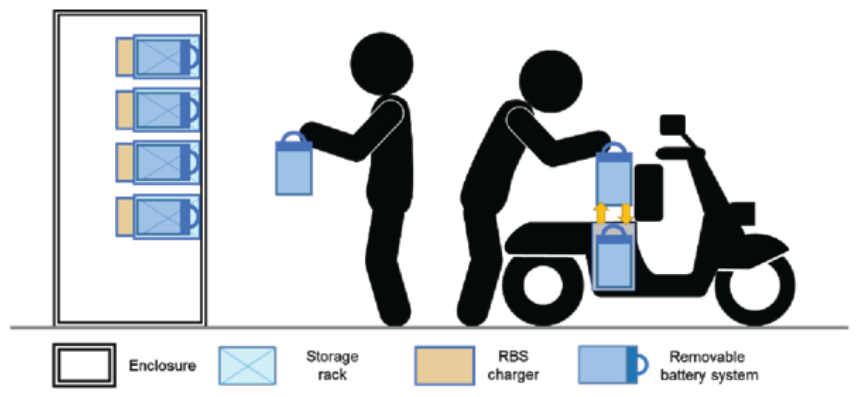
Figure 2.
Stan4SWAP project logo.
Figure 3.
Stakeholder groups
Disclaimer/Publisher’s Note: The statements, opinions and data contained in all publications are solely those of the individual author(s) and contributor(s) and not of MDPI and/or the editor(s). MDPI and/or the editor(s) disclaim responsibility for any injury to people or property resulting from any ideas, methods, instructions or products referred to in the content. |
© 2026 by the authors. Licensee MDPI, Basel, Switzerland. This article is an open access article distributed under the terms and conditions of the Creative Commons Attribution (CC BY) license (http://creativecommons.org/licenses/by/4.0/).
Copyright: This open access article is published under a Creative Commons CC BY 4.0 license, which permit the free download, distribution, and reuse, provided that the author and preprint are cited in any reuse.


