
Submitted:
24 April 2026
Posted:
27 April 2026
You are already at the latest version
Abstract
Rapid urbanization and intensifying climate risks are placing unprecedented pressure on cities to transition toward sustainable and resilient models. Achieving Sustainable Development Goals (SDGs) 11 (Sustainable Cities and Communities) and 13 (Climate Action) requires intelligent systems capable of interpreting complex urban dynamics and enabling proactive, adaptive decision-making. This paper presents a PRISMA-guided rapid review examining the role of Agentic Artificial Intelligence (AAI)–autonomous, goal-directed systems with multi-step reasoning, tool use, and multi-agent coordination–in advancing urban sustainability and climate resilience. Studies were required to exhibit at least two attributes: autonomous decision-making, multi-step planning, tool use or environmental interaction, and multi-agent coordination. From 920 records, 70 peer-reviewed studies were synthesized, covering smart mobility, infrastructure planning, waste management, emergency response, climate monitoring, emissions tracking, renewable energy forecasting, and multi-hazard early warning systems. Results show that despite rapid progress, AAI applications remain fragmented and domain-specific. To address this, a unified Agentic AI–Digital Twin framework is proposed, integrating real-time sensing, urban–climate co-simulation, multi-agent coordination, and adaptive decision intelligence. A Pareto-based optimization approach balances competing sustainability goals. Key challenges in interoperability, data governance, ethics, and scalability are identified, alongside a research roadmap for integrated intelligent urban ecosystems.
Keywords:
agentic AI
; multi-agent systems
; digital twins
; climate-resilient cities
; urban sustainability
; smart cities
; PRISMA review
; SDG 11
; SDG 13
1. Introduction
The rapid innovative developments in urban digitalization and artificial intelligence are transforming the way cities react to sustainability and climate-related issues. Nevertheless, current smart urban systems are still mostly scattered, responsive, and incapable of integrating across vital areas including mobility, infrastructure, energy, and environmental surveillance [1,2]. In this regard, a new paradigm, Agentic Artificial Intelligence (AAI), has been suggested that features autonomous decision-making, goal-oriented planning, multi-agent collaboration, and adaptive reasoning abilities [3]. In contrast to traditional AI systems, agentic systems are developed to be sustained continuously in dynamic environments, allowing proactive and context-sensitive reactions to the complex interactions between urban and climate. Modern agentic orchestration models based on large language models (LLM) (such as AutoGen-like multi-agent pipelines, agent graphs based on LangGraph, GPT-augmented urban planning agents) have operationalised these properties by additional means of structured agent communication protocols, tool-calling interfaces, and memory-augmented multi-step reasoning, pushing the practical frontier of AAI into urban practice [4,5].
Together with the digital twin technologies, which can integrate data in real-time, simulate, and predictive analytics, AAI makes a potent base to create closed-loop and smart urban ecosystems [6]. This kind of integration is especially essential to the progress of SDGs 11 (Sustainable Cities and Communities) and 13 (Climate Action), which demand a coordinated, data-driven, and adaptive intervention, across urban and environmental systems that are interconnected. This work therefore conceptualizes the notion of an integrated agentic AI ecosystem that mediates urban challenges, enabling technologies, and sustainability results as shown in Figure 1.
The suggested agentic AI ecosystem is an end-to-end framework that facilitates sustainable and climate-resilient cities by integrating several layers of technology and applications [7]. The framework, as demonstrated in Figure 1, starts with the challenges of urban and climate, such as traffic congestion, energy demand, infrastructure stress, flood risk, heatwaves, and carbon emissions, all of which characterize the problem space. Such challenges are tackled by enabling technologies like the Internet of Things (IoT), knowledge graphs, LLMs, and data pipelines of digital twins, helping to data acquisition, representation, and intelligent processing [8].
At the core of the architecture lies the agentic AI layer, which facilitates autonomous decision-making, goal-oriented planning, multi-agent coordination, reinforcement learning, explainable AI, and adaptive reasoning. The layer is closely connected with the digital twin layer, which allows to perform an urban simulation in real-time, modeling climate scenarios, observing infrastructures, predictive analytics, and experimenting with policies. The framework aligns these capabilities with the application domains that are aligned with SDG 11 and SDG 13, which ultimately leads to important outcomes of sustainability, such as resilient cities, fewer emissions, and efficient use of resources, climate adaptation, and sustainable urban planning. The ecosystem further outlines the most important directions of research in the future, including integration of AI across domains, ethical governance, scalable digital twins, human-AI collaboration, and policy-conscious AI systems [9].
1.1. Motivation and Problem Statement
The accelerated urbanization and the growing climate change are the two of the systemic challenges of the twenty-first century. Cities contribute over 70% of the total CO2 emissions and host over 50% of the global population, making urban environments the focal point of the environmental risk as well as sustainability changes. With the growth in size of metropolitan areas, they face more and more interconnected pressures, such as transportation congestion, inefficient use of resources, strain on infrastructure, and exposure to climate-related risks, such as floods, extreme heat, and severe storms [10].
Traditional urban management approaches tend to be reactive, piecemeal and reliant on human-centric decision processes that can hardly embrace the scale and speed of data produced by the new sensing infrastructures. This drawback highlights an increasing demand of smart systems that can be used to predictive analyze, responsive coordinate, and evidence-based intervention in various urban and environmental sectors at once.
The imperatives are explicitly covered by Sustainable Development Goals (SDGs) 11 and 13, which promote inclusive, resilient cities and climate urgency [11]. The realisation of these goals entails technological paradigms that are able to read intricate urban dynamics and facilitate proactive governance. There is a recent development of AAI, which is goal-oriented reasoning, autonomous decision making, use of tools, and multi-agent coordination, which is a promising paradigm to organize such capabilities [4]. Importantly, this review has a very specific working definition: a system can only be said to be agentic when it satisfies at least two out of four operationalized criteria that are presented in Section 3, which is what makes AAI different to traditional supervised or rule-based AI. Notably, the autonomy feature is defined as operational autonomy at the tasks level within specified limits; the suggested framework always provides the human control of safety-critical and high-level governance choices (see Section 7).
Despite accelerating innovation, the scholarly landscape remains fragmented. Current literature often looks at urban intelligence, climate analytics, and autonomous systems separately, constraining a comprehensive perspective on how agentic architectures can be used to promote sustainability results. This division inspires the necessity of an integrative synthesis that will be able to chart the existing developments and also define the ways to move towards harmonious intelligent urban ecosystems.
1.2. Aim and Scope of the Review
This paper is a PRISMA-guided rapid literature review [12] of current research examining genuinely agentic AI applications in support of SDG 11 (Sustainable Cities and Communities) and SDG 13 (Climate Action). Based on 70 peer-reviewed articles identified using a structured protocol (January 2018-March 2026), the review sums up the developments across autonomous urban operations, climate monitoring, adaptive early-warning infrastructures, and forecasting of renewable energy sources, and clearly separates agentic systems and the standard deployment of ML. In addition to listing the applications, this paper reviews the growing interface of Agentic AI with the Digital Twin spaces and multi-agent coordination systems, their possible role in modeling complex urban-climate interactions, and providing anticipatory decision support.
1.3. Contributions of This Paper
This review advances the literature through four primary contributions:
- 1.
- First operationalised synthesis of genuinely agentic AI for urban sustainability: The review is a synthesis of scattered studies based on explicit agentic screening criteria, which offer a coded landscape of systems demonstrating autonomy, goal-directed planning, use of tools, or multi-agent coordination, the first such taxonomy in this literature space.
- 2.
- Cross-domain optimisation formulation with calibration guidance: The paper formalises a joint SDG 11/SDG 13 reward goal (Eq. 1) and writes about Pareto-based and lexicographic methods of calibrating competing sustainability reward signals, which provides a principled mathematical foundation to future multi-objective Agentic AI system design.
- 3.
- Critical evaluation of technical and governance challenges: The study identifies structural barriers to large-scale adoption, including interoperability constraints, data heterogeneity, computational demands, and ethical considerations surrounding transparency, accountability, and algorithmic fairness.
- 4.
- Conceptual Agentic AI–Digital Twin architecture and research agenda: Based on the literature reviewed, the paper suggests a multi-layer model of integrating Agentic AI, Digital Twin technologies, and coordinated multi-agent systems, and indicates priority directions to develop explainable, trustworthy, and cross-domain AI systems.
1.4. Organization of the Paper
The remainder of this paper is structured as follows. Section 2 establishes foundational context by reviewing urbanization trends, climate risks, Digital Twin technologies, and the Agentic AI paradigm. Section 3 details the rapid review methodology, including operationalised agentic inclusion criteria. Section 4 and Section 5 synthesise AAI applications aligned with SDG 11 and SDG 13, respectively, followed by Section 6, which examines their intersection. Section 7 introduces the proposed Agentic AI–Digital Twin framework, while Section 8 discusses key findings and research implications. Finally, Section 9 concludes with strategic considerations for advancing intelligent, resilient, and sustainable urban futures.
2. Background
2.1. Sustainable Development Goals Overview
The United Nations Sustainable Development Goals (SDGs) offer a universalized platform of tackling multifaceted social, economic as well as environmental issues by 2030 [13]. SDG 11 aims at ensuring that cities become inclusive, safe, resilient, and sustainable by fostering urban planning policies that minimize environmental impact, livability and equitable access to necessary resources. SDG 13 focuses on climate action, as an urgent issue that needs to be mitigated through reduction of greenhouse gases, adaptation to climate-related risks, and mainstreaming climate in both urban and national planning [11]. Combined, these objectives create a map on how cities become resilient and environmentally stable systems.
2.2. Interdependence of SDG 11 and SDG 13
The climate change and urbanization are closely intertwined. The rapid urbanization can frequently result in an increase in energy use, waste, and emissions, which can add to the climate change. On the other hand, climate-related risks, such as extreme weather, temperature increase, and sea-level rise, are the direct threats during the urban infrastructure, safety, and economic activities [10]. To overcome these problems, comprehensive strategies that can maximize urban sustainability and climate resilience are needed. Figure 2 illustrates the conceptual interconnection between SDG 11 and SDG 13, highlighting the potential bridging role of Agentic AI.
2.3. Agentic AI: Formal Definition and Distinguishing Characteristics
AAI Autonomous and goal-oriented artificial intelligence systems that can perceive their surroundings, reason over time, use tools or APIs and act independently, frequently in coordination with other agents [3,4]. Importantly, AAI is not the same as traditional supervised learning or rule-based AI: a fixed model of solar irradiance prediction, such as that used in urban planning, is not agentic, even if it uses its outputs to make decisions, due to the absence of autonomy, planning horizon, and communication between agents that constitute agency [14]. Formally, an AAI agent may be characterized as a tuple , where denotes the state space perceived from the urban–climate environment, is the set of available actions (including tool invocations and inter-agent messages), represents the stochastic transition function mapping state-action pairs to distributions over successor states (reflecting the inherent uncertainty of real urban environments), is the reward signal aligned with sustainability objectives, and is the optimal policy maximizing cumulative expected reward. Four operationalised agentic characteristics are employed in this review as inclusion criteria (Section 3):
- Autonomy (A): Task-level independent decision execution at a designated level of operation, with closed-loop feedback, and under the greater-level human control.
- Goal-directed planning (G): Reasoning in multiple steps towards explicitly specified goals, e.g., maximizing traffic throughput or meeting emission targets.
- Tool use or environmental interaction (T): The agent is invoking external APIs, sensors, simulators or actuators as part of the agent action repertoire.
- Multi-agent coordination (M): Coordination and communication with other agents, which allows them to act as a system at higher levels than is possible individually.
Research papers incorporated in this review need to have at least two of the following four properties (A, G, T, or M) to be considered truly agentic. Section 3 describes how these criteria were used in the screening process. It is significant to distinguish between task-level autonomy (characteristic A) and the situation of full system-level autonomy and zero oversight: the AAI systems discussed in this paper are self-directed in their work and are restricted in the scope of their operation, whereas human participants have the power to make policy-level and safety-related decisions.
2.4. Related Technologies
2.4.1. Digital Twins
Digital Twins are virtualizations of the real world. They simulate urban infrastructure networks, traffic flow, energy grids and the environment. With AAI integration, one can make predictions, test scenarios, and assess interventions prior to their implementation in the real world [6,15,16]. Digital twins, therefore, provide a risk-free experimentation platform to the decision-maker that can be used to refine policies, through trial and error, without disrupting operations [17].
2.4.2. Multi-Agent Systems (MAS)
Multi-agent systems (MAS) are made up of a number of interacting agents with the ability to make decentralised decisions. The complex urban and climate applications that MAS frameworks facilitate include the distribution of tasks between specialized agents, which makes it possible to allocate resources efficiently, optimize traffic and mobility, and predictive climate modelling [18]. In MAS, the joint utility function across N agents may be expressed as , where are domain-specific weighting coefficients and denotes the local utility of agent i given state s and action . This formulation is directly related to the cross-domain optimisation objective in Eq. 1: for the two-domain case (), setting , , , , and introducing temporal discounting yields Eq. 1 as a special case of the MAS utility. Determining in practice requires stakeholder-driven elicitation or multi-objective optimisation methods; Pareto-based approaches [19] and constraint-based lexicographic ordering have been proposed in the cooperative MARL literature as principled alternatives to fixed weighting.
2.4.3. Internet of Things (IoT)
The IoT devices offer real-time data feeds at any given moment which are generated by sensors, smart meters, and environmental sensors. It is fed to Digital twins and agentic AI agents and helps in real-time analytics, anomaly detection and automated control, completing the loop between sensing, analytics and action [20].
2.5. Research Gaps and Opportunities
Although the pace of development is rapidly increasing, a number of structural and methodological loopholes are worth special consideration. One of the main issues is the imbalanced spread of sophisticated AI implementations across the globe. The current implementations are mostly confined to technologically advanced urban areas with the developing nations experiencing perennial challenges of infrastructure, data access, computational facilities, and skills [21]. The lack of standardized evaluation structures, methodologically, poses a huge challenge to the cumulative knowledge building. Often, studies have found improvements in performance on heterogeneous measures, which restricts the inter-study generalizability. Ethical and governance issues make large-scale adoption even harder: as more and more processes deemed safety-critical in cities are impacted by Agentic AI, it becomes urgent to implement responsible AI principles in systems design [4]. One SOTA gap in the existing literature is that the current literature has been less interested in operational AAI deployments based on contemporary LLM-based orchestration platforms (AutoGen, LangGraph, GPT-based urban agents) than a general-purpose foundation, which is a promising area of future review research. Cross-domain orchestration is another important opportunity that has been neglected in the literature; a significant portion of the current literature focuses on the management of urban areas, climate monitoring and optimization of energy consumption separately but without the systemic interdependencies.
3. Methodology
3.1. Rapid Review Design and Methodological Adaptations
An efficient review process was implemented as a PRISMA-informed rapid review methodology aiming to synthesize new evidence on the application of Agentic AI towards sustainable urban development and climate resilience [12]. Rapid reviews preserve the fundamental ideas of systematic reviews but simplify certain processes involved in order to provide timely, policy-relevant information to fast-changing areas [22]. Due to the interdisciplinary and fast-changing characteristics of agentic AI, the methodological changes were implemented to achieve the balance between rigor, feasibility, and timeliness.
In particular, the following modifications were made: (i) the search was limited to five major academic databases, which were further supplemented with targeted citation tracing, instead of comprehensive coverage of grey literature; (ii) title and abstract screening were done by a primary reviewer, and a second reviewer independently validated a stratified, two-out-of-five work sample to ensure consistency; (iii) backward reference scanning was selectively applied to high-impact and seminal studies to identify additional eligible works not captured in the primary database queries; and (iv) quantitative meta-analysis was not performed due to substantial heterogeneity in study designs, methodologies, and reported outcomes. These are adaptations that are in line with the guidance available on quick evidence synthesis [22,23].
A structured review protocol was established before the literature search to improve transparency and decrease the selection bias by stating the scope of the research, search strategy, eligibility criteria, and processes of synthesis. The review was implemented and reported according to PRISMA 2020 principles [12], which guarantees the methodological clarity and reproducibility [24].
3.2. Operationalisation of “Agentic AI” for Inclusion Screening and Eligibility Criteria
To respond to one of the main issues in the literature–the common confusion between the general applications of AI and truly agentic systems–this review defined four distinguishing features of Agentic AI as explicit inclusion criteria (see Section 2): Autonomy (A), Goal-directed planning (G), Tool use (T), and Multi-agent coordination (M). Only studies that reported at least two of these four characteristics based on architectural design, experimental validation or detail of implementation were included. Any systems where prediction is static (e.g., supervised learning, without decision-making loops), based on rules, or a data-processing pipeline but lacking adaptive or planning behavior were categorized as zero or one agentic and were not included.
The ≥ 2-of-4 threshold was set based on a calibration process of a 20-study random sample that was sampled before full-text screening. The threshold of A ≥1 was found to be too lenient towards passive ML pipelines, and a threshold of ≥3 was found to be too restrictive to exclude 23 otherwise substantive multi-step planning systems. The ≥2 threshold gave the most balanced cut-off between passive prediction systems and the truly agentic implementations, in line with the conceptual definition of agency as entailing at least coordinated planning or environmental interaction, rather than just autonomous execution. Regarding time, the search was restricted to a range of publications published between January 2018 and March 2026; this time frame was established in the review protocol before conducting the search and is aligned with the creation of modern deep reinforcement learning and the use of the LLM to augment agent architecture designs. Other eligibility criteria were that the studies had to: (i) introduce AI-driven strategies that can be applied to urban sustainability or climate resilience; (ii) exhibit agent-based, autonomous or multi-agent features in line with the agentic operationalization; and (ii) provide enough methodological description to enable scholarly assessment. Preprints and grey literature were excluded to preserve the peer-reviewed synthesis standard.
All the studies were included and systematically coded on the four agentic dimensions. Ambiguity In ambiguous cases, definitional rigor was upheld by a conservative exclusion decision.
3.3. Search Strategy
The extensive literature search involved the use of the largest academic databases, such as Scopus, Web of Science, IEEE Xplore, SpringerLink, and ScienceDirect. The last search was done in March 2026. The interdisciplinarity of agentic AI in urban and climate settings were taken into consideration by iteratively refining the combinations of the Boolean keywords to balance the recall and precision. Specifically, domain-specific terms (urban and climate) were used together to form their intersection without being too restrictive in terms of retrieval to explicit SDG-labelled studies. The entire search query that was used on databases (field-code modifications specific to each platform) was:
TITLE-ABS-KEY(
("agentic AI" OR "autonomous AI" OR "intelligent agent*"
OR "multi-agent system*" OR "multi-agent reinforcement learning"
OR "autonomous system*")
AND
("sustainable cit*" OR "smart cit*" OR "urban system*"
OR "urban plan*" OR "urban environment*")
AND
("climate action" OR "climate resilien*"
OR "carbon emission*" OR "climate adapt*"
OR "environmental monitor*")
AND
("digital twin*" OR "urban digital twin*"
OR "simulation" OR "urban model*"
OR "cyber-physical system*" OR "IoT")
)
Backward reference scanning was also used to ensure better coverage and minimize selection bias by ensuring that studies that were not identified by database queries were included. In the first search the total number of records found before deduplication was 920. The results of database coverage and retrieval are presented in Table 1.
3.4. Screening and PRISMA Flow
The screening procedure was in accordance with a PRISMA 2020-based workflow [12,24]. The initial number of records identified was 920 with 700 records remaining after deduplication. Title and abstract screenings were done using the predetermined eligibility criteria on these records. During the title and abstract step, 500 records were filtered: 260 were not on-topic or relevant to the city or climate domains, 150 were not agentic, and 90 were not in line with SDG 11 or SDG 13. This made it possible to advance 200 records to full-text evaluation. At full-text review, 130 studies were eliminated: 60 of them did not meet the ≥2 agentic threshold of methodological rigor, 30 did not sufficiently address the integrated urban-climate context, and 15 had a time frame outside of January 2018-March 2026. In the end, 70 studies that fulfilled all the eligibility criteria were incorporated in the final synthesis. Figure 3 presents the PRISMA 2020 flow diagram.
3.5. Data Extraction and Evidence Synthesis
The review of the chosen studies was systematized to extract data into a structured spreadsheet containing: bibliographic information; AI methodology (e.g., multi-agent reinforcement learning, LLM-augmented planning, digital twin integration); agentic characteristics exhibited (A, G, T, M); application domain; evaluation method and performance metrics reported; and alignment with SDG. This systematic extraction made it possible to compare cross-studies, allow thematic and descriptive quantitative synthesis, informed the development of the agentic coding table (Table 2).
3.6. Quality Assessment
Methodological quality was appraised using an adapted Joanna Briggs Institute (JBI) critical appraisal framework. The JBI framework was initially created to support clinical research, in this AI/ML-specific review, the framework was modified by replacing clinical population and intervention criteria with five dimensions that apply to computational systems research: (i) research objectives; (ii) methodological transparency (describing the algorithm and its implementation); (iii) validation strategy (simulation, real-world deployment, or comparative benchmark); (iv) data sufficiency (scale, diversity, and representativeness of training and evaluation data); and (v) limitations recognition. These are adaptations within a systematic review methodology of applied AI. Aggregate appraisal findings reveal that 37 studies (53%) reported high methodological quality in all five dimensions, 23 studies (33%) reported moderate quality, and 10 studies (14%) showed good quality with limitations. No studies were eliminated due to the quality; the results of the appraisals were utilized to interpret them and to assign the confidence to the results reported.
3.7. Inter-Rater Agreement
The first author screened the titles and abstracts, and a second reviewer independently screened a stratified 20% random sample (140 records). Agreement on inclusion and exclusion decisions was assessed using Cohen’s kappa, yielding (95% CI: [0.74, 0.88]), indicating substantial to near-perfect agreement [39]. Full-text eligibility assessment was similarly validated, with a 20% random sample (40 records) independently reviewed by the second assessor, yielding (95% CI: [0.68, 0.88]), indicating substantial agreement.
3.8. Agentic Coding of Included Studies
A representative subset of the 70 included studies was coded against the four agentic criteria (A = Autonomy, G = Goal-directed planning, T = Tool use, M = Multi-agent coordination) using a binary scheme ( = characteristic present; — = not evidenced). This coding is provided in Table 2 with 14 representative studies that were chosen to represent variety in the areas of application, SDG, and agentic configuration. All 70 studies have been coded in full and the results are available in the Supplementary Material to this submission.
3.9. Bibliometric Overview of the Corpus
The following subsection quantitatively describes the ultimate corpus of 70 studies, analyzing their time coverage, the landscape of publishers, and the type of documents. This is necessary to bibliometrically profile the trend, publication routes, and structural make-up of research on agentic AI in the realms of urban sustainability and climate resilience.
The temporal distribution of publications is shown in Table 3. The findings reveal that the trend of research activity will rise strongly in 2023 and the highest numbers will be observed in 2025 with 39 studies (which corresponds to about 55.7% of the corpus). Conversely, the latest studies are quite recent, with only 18.6% of the research published before 2023. This steep growth curve coincides with the accelerated development of large language model (LLM)-augmented agent systems, multi-agent coordination models, and their expanding utilization in cities and climate systems.
Table 4 is a summary of the distribution of publications according to the publisher category. The data indicate that there is a high concentration among large academic publishing platforms with Elsevier (22.9%), MDPI (20.0%), and Springer/Springer Nature (17.1%) constituting about 60% of the total corpus. This is indicative of the fact that agentic AI research in sustainable cities and climate action is primarily published in well-established and high-visibility conferences and journals. The reduced share of articles is found in technical reports of international institutions (e.g., UN frameworks) and independent or new journals, and represents the complementary contribution of policy-oriented and interdisciplinary sources.
Table 5 also divides the corpus by document type. Journal articles (91.4%), a small number of conference papers and technical reports (each 4.3%) are predominant in the dataset. This distribution shows a high level of focus on peer reviewed archival research, implying that the discipline has outgrown the stage of exploratory contribution at the level of conferences into more solid and rigorously verified research.
Overall, the bibliometric analysis reveals three key structural characteristics of the corpus: (i) a recent and rapid expansion of research activity, particularly post-2023; (ii) a concentration of publications within major academic publishers, indicating consolidation within established dissemination channels; and (iii) a dominant reliance on journal articles, reflecting the increasing maturity and rigor of the field. These tendencies are of significant importance to the thematic and technical synthesis further in the text.
3.10. Methodological Limitations
Even though it is a systematic review, there are some limitations that are characteristic of this PRISMA-guided rapid review and that should be brought out to the fore. First, the review was not pre-registered officially before the literature search (e.g., through PROSPERO). Although a predefined protocol was used a priori and adhered to, the lack of pre-registration is a transparency weakness; protocols to be reregistered should be prospectively registered in the future. Second, only one reviewer made decisions regarding title and abstract screening (which were not independently validated); the 81 reported only applies to the 140 validated records, and the reliability of the 560 invalidated decisions made by a single screener has not been determined (a structural limitation of single-screener rapid reviews that must be taken into account when interpreting synthesis results). Third, five major databases were searched that might have led to the exclusion of other studies that were not included in those databases. Fourth, grey literature was omitted to maintain quality of synthesis by peer-review. Fifth, operationalization of agentic AI features entails some amount of interpretive judgment in full-text coding, which is alleviated by the conservative rule of exclusion, but the overall reliability of coding of the entire 70-study table is constrained by the stated levels of inter-rater agreement.
4. Agentic AI for SDG 11: Sustainable Cities
4.1. Overview of Urban Applications
The use of agentic AI to improve the sustainability, safety, and efficiency of operations in urban areas has been on the rise. Figure 4 maps the six principal application clusters identified in the corpus: smart mobility, Digital Twin-based infrastructure planning, waste management automation, public safety and emergency response, urban energy and integrated governance, environmental monitoring, and environmental monitoring. Energy and Environmental Monitoring cluster (Section 4.6) is explicitly mentioned as a specific area of application as it has a substantive representation in eleven of the 70 studies reviewed.
4.2. Smart Mobility
The agentic AI can provide the high-level traffic control and autonomous vehicles coordination via the dynamic and real-time decision-making. MARL models have been used to co-optimize signal timing over intersections, and hierarchical MARL models have shown sustainability-beneficial outcomes in traffic signal control in high-density city situations [25]. Cooperative MARL models have also been implemented to autonomous vehicle lane-changing in mixed-traffic conditions to optimize mobility and decrease emissions [40]. Lee et al. [41] present a thorough survey of agentic AI architectures and methodologies that support these sustainability-friendly traffic optimization strategies. Optimization algorithms of the routes in the public and private transportation include both the live traffic telemetry and predictive demand models that allow the scheduling of the routes to use the emissions-aware scheduling [42]. Adaptive traffic management systems powered by IoT also contribute to the mobility of cities by dynamically addressing the congestion in real-time by coordinating multiple agents. Table 6 summarises representative case studies in smart mobility.
4.3. Digital Twin-Based Infrastructure Planning
Digital Twins + Agentic AI enables planners to simulate changes in infrastructure, analyse policies, and predict how they might be maintained, without making a capital investment commitment [26,32]. Scenario simulations Scenario simulations can be used to deal with urban expansion, energy planning, and disaster preparedness; predictive maintenance agents can observe structural health indicators in real-time to allow condition-based interventions. These reported enhancements in the use of assets differ significantly depending upon the deployment scenarios and depend upon sensor coverage, model fidelity, and institutional adoption capacity [44]. Multi-objective optimization criteria include environmental, social, and economic indicators, and the accuracy of the simulations is continually optimized with the help of the IoT sensor feedback.
4.4. Waste Management Automation
Autonomous AI improves the waste management process by using predictive analytics and optimizing routes. Smart bins monitored by IoT can report fill levels through wireless network, and Agentic AI optimizes collection routes in real time, with pilot projects indicating a decrease in unnecessary vehicle movements in managed urban environments [45,46]. Smart waste management AI-IoT systems also have graph-based predictive modelling and adaptive routing to enhance resilience in the system and lower the costs of operation [47]. Transformer-based MARL systems have also been used to incorporate waste classification, forecasting and adaptive routing showing quantifiable benefits in terms of emissions reduction and operational efficiency [48]. The size of the improvement depends on the density of the network, the accuracy of the bin sensors, and the size of the fleet; the outcomes of individual pilot trials must be considered context-dependent, and cannot be directly applied to other urban areas. Predictive models that are based on the historical patterns of generation can be used to allocate resources proactively and autonomous routing reduces the fuel consumption and related emissions.
4.5. Public Safety and Emergency Response
Urban safety is assisted by agentic AI in predictive risk modelling as well as multi-agent coordination. Geospatial risk models determine areas with high likelihoods of occurrence of accidents and infrastructure failures. Multi-agent pipelines enable fire, medical, and evacuation teams to coordinate their assets dynamically during emergencies as needed, based on changing incident conditions [49]. Meteorological feeds combined with early-warning systems give early warnings before floods and heatwaves and adverse weather conditions, which aid in pre-positioning emergency services.
4.6. Urban Energy and Environmental Monitoring
The AI agentic system helps in the attainment of sustainable energy management in cities and environmental monitoring by applying endless optimization cycles. Real-time agents optimize the electricity, water and district heating systems with the variable demand and renewable supply availability [50]. The architectures of multi-agent systems based on balancing energy demands in cities (where each person is allowed to optimize their comfort and predict power needs) and electricity forecasting and demand-response scheduling have proven to be practically viable in grid-scale applications [51]. Hierarchical MAS structures that are decentralized also make possible scalable smart grid energy management with high penetration of renewable energy at the same time, providing a balance between economic and environmental goals [52]. Multi-layer agentic systems combining forecasting, MARL, evolutionary optimization, and blockchain-enabled EV scheduling have achieved measurable reductions in carbon intensity and peak-load stress in urban microgrid settings [53,54]. Complementary decentralized load shifting and renewable integration mechanisms are offered in market-based MAS frameworks of coordinating district energy [55]. The sensor arrays placed around the area of air and noise pollution identify hotspots and activate local intervention measures (e.g., adaptive rerouting of traffic or changes in an HVAC), with the sensors being distributed across the area. This application cluster can be substantially illustrated in eleven out of 70 reviewed studies, which supports it as a fundamental area of deployment of Agentic AI in SDG 11.
5. Agentic AI for SDG 13: Climate Action
5.1. Overview of Climate Applications
Agentic AI is being used more and more to monitor weather, early warning systems, and to manage renewable energy. Figure 5 depicts the five principal application domains identified in the corpus: climate monitoring, early warning systems, renewable energy forecasting, carbon emission and air quality tracking, and disaster risk modelling and climate policy evaluation.
5.2. Climate Monitoring
The use of satellite data, sensor networks, and weather data is integrated into agentic AI which monitors any anomaly in the environment and keeps an eye on climate trends over time [56]. Multi-source observations are combined in agent-based systems to identify an urban heat island, deforestation front, and air pollution hotspots, providing situational awareness at previously unachievable time scales by manual analysis [57]. Simulation pipelines with reinforcement learning and LLM prediction allow predicting seasonal weather and the probability of extreme events, which can be used to generate adaptive strategies in urban management.
5.3. Early Warning Systems
The multi-agent AI pipelines complement the potential and rapidity of early warning systems of extreme events [33]. The agent real-time hazard prediction combines meteorological, hydrological, and geophysical data to make flood inundation, storm surge path, and wildfire propagation hazard estimates. The automated alert dissemination systems inform the authorities and citizens by multi-modal communication channels and the scenario simulation agents optimize evacuation routes and resource pre-positioning. Multi-agent simulation environments based on LLM have been suggested to realistically model population behaviour in the event of natural disasters to assist in pre-deployment stress testing of emergency response strategies [28]. The EW4All (Early Warnings for All) program is an example of how multi-agency AI coordination can reduce the data-to-decision cycle in climate hazards, although the operational lead times attained differ significantly depending on the hazard and geographic location as well as preparedness of infrastructure [58].
5.4. Renewable Energy Forecasting
In the context of grid stability, storage and demand-response, agentic AI predicts and optimizes renewable energy production [29,59]. Under good climatic conditions, deep learning forecasting models integrated into agentic pipelines can be competitive in terms of day-ahead solar irradiance forecast accuracy, but performance varies significantly across geographic regions and climatic variability profiles, and published accuracy results of individual studies cannot be extrapolated without mention of the conditions and datasets used to evaluate their performance [60]. Meteorological feature engineering can lead to similar accuracy in wind power prediction models, but the accuracy declines with forecast horizon. The agentic load-balancing systems dynamically manage battery storage, smart charging and dispatchable generation to keep grid frequency steady as the renewable penetration rises.
5.5. Carbon Emission and Air Quality Tracking
Real-time monitoring of emissions and pollution is made easy by AI systems, which aid in the enforcement of regulations and the creation of policies that are evidence-based [61]. City-scale CO2 and NOx emission tracking agents fuse transport, industrial, and building energy data to construct spatiotemporal emission inventories. Pollution hotspots are spotted, allowing specific actions to be taken, such as rerouting heavy traffic or turning on a low-emission area, and improvements in ambient air quality indicators have been shown in the experimental deployments. Integration with SDG 13 Target 13.2 encourages mainstreaming climate in urban policy processes.
5.6. Disaster Risk Modelling and Climate Policy Evaluation
Agentic AI enables simulation-based policy evaluation for climate resilience planning [30,31]. Multi-agent co-simulation environments simulate urban-climate interactions in response to extreme event scenarios projected into the future, enabling planners to stress-test adaptation strategies, such as green roofs and permeable pavement, and coastal barrier construction, prior to making an infrastructure investment. An urban development with a climate-responsive approach based on digital twins helps to integrate zero-energy building strategies into the framework of smart cities. Climate-resilient urban infrastructure design is enhanced by long-term planning tools that use ensemble climate projections to aid in the design.
6. Intersection of SDG 11 and SDG 13
6.1. Integrated Urban–Climate Architecture
The SDG 11 and SDG 13 intersection need the unity of the single system that will respond to the issues of urban efficiency and climate resilience. Figure 6 demonstrates the role of Agentic AI with Digital Twins in coordinating cross-domain urban-climate operations via four processes: integration of real-time data of IoT, weather, and city infrastructure; simulation of urban policies in different climate conditions; automated infrastructure and resource allocation; and integration of multiple urban systems to make climate-related decisions [50].
6.2. Urban–Climate Co-Simulation
Simulations of how urban policies influence the outcomes of climate, across interdependent layers of systems, can be coordinated using agentic AI [34,38]. Multi-agent co-simulations simulate the interactions between flows of traffic, energy use, greenhouse gas emissions and urban morphology, using climate variables (temperature patterns, precipitation patterns and storm frequency) to project city-scale scenarios. The second-order consequences of a policy can be predicted with the help of scenario-based evaluation, which enables policymakers to understand the implications of the policy prior to its implementation. Table 7 presents exemplary co-simulation scenarios and associated planning outcomes.
6.3. Digital Twin-Based Climate-Aware Planning
Digital Twins generate dynamic virtual models of cities and the environmental state, which allow repeating climate-conscious planning cycles [35]. Modelling of infrastructure stress on climatic extremes could be used to predict vulnerabilities to infrastructure before they are reflected in operation failure. Intervention simulation by agents yields performance estimates quantitatively, which are used to allocate capital. Digital twin paradigms for urban heat monitoring and policy integration provide concrete mechanisms for linking simulation outputs to actionable climate resilience strategies [62]. Visual dashboards are syntheses of multi-scenario results that enable transparent comparison of policy alternatives to decision-makers. Figure 7 shows the iterative cycle of interactions between agent-proposed interventions, Digital Twin simulation and city plan optimization.
7. Proposed Framework: Agentic AI–Digital Twin Architecture
Based on the insights gained by the literature review, this paper suggests an integrated conceptual framework that integrates Agentic AI and Digital Twin technologies to achieve sustainable urban development and climate-resilient development in line with SDG 11 and SDG 13. The architecture is created to integrate real time sensing, analysis of simulation, autonomous decision making, and multi-agent coordination into a single architectural paradigm. It is a reference architecture of future research, system design, and policy-oriented deployments and is not a full implementation of a system. The overall structure is shown in Figure 8.
7.1. Data Acquisition Layer
The data acquisition layer combines heterogeneous data streams of urban and environmental sources, such as the IoT sensor networks, satellite observations, open-data portals of municipalities, transportation networks, environmental monitoring stations, and citizen reporting networks [36,44]. Before downstream usage, data are subjected to preprocessing steps, that is, cleaning, normalization, extraction of features, and privacy-preserving transformation, to guarantee their reliability, interoperability, and respect to the ethics. In this layer, a constantly updating informational environment is facilitated that contributes to real-time analytics and high-fidelity Digital Twin synchronization.
7.2. Digital Twin Layer
The Digital Twin layer has a dynamic virtual model of the urban infrastructure and environmental conditions [32,63]. The urban model deals with the spatial patterns, mobility patterns, energy systems, and built systems, whereas the environmental model deals with the climatic variables such as temperature pattern, rain pattern, air quality index, and availability of renewable energy. The digital twins can be further synergistically integrated with AI-enabled IoT platforms to expand simulation capacity to include real-time building energy control and city-scale environmental surveillance [64]. Simulation engines help the decision-maker to test possible interventions prior to their implementation. Figure 9 presents the generalised Digital Twin workflow.
7.3. Agentic AI Layer and Optimisation Objective
The Agentic AI layer adds autonomous reasoning in order to respond adaptively and goal-oriented to the dynamics of urban-climate [5]. The agents are presented with the environmental states through the Digital Twin interface, analyze alternative strategies through reinforcement learning or through planning with sympathetic to the context LLM models, and respond by prescribing context-sensitive interventions. Every action of the agent is controlled by the human at the governance level; the system does not have an orientation to complete autonomy in decisions, but the decision-support one, which fits the definition of task-level autonomy in Section 2. The layer’s cross-domain optimisation objective is formalised as:
where is the optimal cross-domain policy, is the temporal discount factor, and are reward signals for urban sustainability and climate action outcomes respectively, and are weighting coefficients. As a special case of the MAS joint utility function (Section 2), Eq. 1 corresponds to agents with , , , , and an explicit temporal discounting structure. Prototype operationalisation of the reward signals is as follows: may be constructed as a weighted composite of traffic delay reduction (minutes saved per vehicle), energy demand compliance (percentage deviation from target load profile), waste collection trip reduction, and air quality improvement (AQI delta); may be constructed from CO2 emission reductions (tonnes per planning period), early warning lead time (hours ahead of event threshold), renewable energy penetration (percentage of grid supply), and adaptation plan coverage (population-weighted fraction covered by active climate adaptation measures). These exact composites constructions will be based on the availability of data and the priorities within institutions, in particular deployment settings.
Calibrating and is a non-trivial open problem: fixed scalar weights are vulnerable to differing magnitudes of rewards, and can not necessarily reflect trade-offs between stakeholders. The Pareto-optimal weighting approaches [19] determine a collection of non-dominated policies in the parameter space and leave the stakeholders to pick the operating point they desire without the need to specify a particular scalarization a priori. The approaches that lexicographically structure goals [65] put up a priority ordering (e.g., safety requirements of SDG 11 need to be met before attempting to achieve climate optimization of SDG 13) to ensure that more important objectives are not compromised to gain small benefits in less important ones. It will require the proper approach based on the institutional context, availability of data, and how closely SDG 11 and SDG 13 goals can be met in the environment of deployment.
7.4. Multi-Agent Coordination
The intrinsic nature of challenges in urban sustainability is the competing goals in the transportation, energy, environmental protection and safety of the population. The conceptualization is a multi-agent ecosystem with domains to coordinate with each other using structured communication protocols [66,67]. Coordination schemes involve common knowledge representations, negotiation schemes, consensus-building algorithms, e.g., distributed constraint optimization (DCOP) or auction-based resource allocation, to support balanced decision-making in the presence of resource constraints. Figure 10 shows a sequence of interaction between sensing and simulation, agent reasoning and decision support.
7.5. Framework Alignment with SDG Targets
Table 8 maps each architectural layer of the proposed framework to specific SDG 11 and SDG 13 targets and associated performance indicators.
7.6. Architectural Limitations and Failure Modes
While the framework provides a coherent reference architecture, several limitations and potential failure modes must be acknowledged. First, computational scalability: high-fidelity Digital Twin co-simulation of large metropolitan areas incurs large demands on computing resources, which edge cloud orchestration to some extent alleviates, at the cost of introducing latency trade-offs in time sensitive emergency response. Second, data heterogeneity and interoperability: Legacy urban infrastructure does not always have standardized APIs and data formats, federated data architectures and semantic interoperability layers are requirements that have to be in place before instantiating frameworks [68]. Third, security and adversarial vulnerability: multi-agent systems which run on networked sensor infrastructure are vulnerable to sensor spoofing, adversarial perturbations of policy inputs, as well as denial-of-service attacks with the potential to disrupt actuation decisions. Fourth, absence of empirical validation: the presented framework is conceptual; the purpose of performance claims is to depict the matter, but not to demonstrate it. Pilot implementations, longitudinal assessment, and comparison to the operational assessment of the existing smart city architectures have to be offered as the future work before the operational implementation can be suggested.
7.7. Implementation Considerations
The architecture supports popular AI development platforms, distributed computing architecture and interoperable data platforms. Latency-sensitive analytics and large-scale simulations, as well as standardized APIs to communicate sensing infrastructures, digital models, and intelligent agents, can be facilitated by edge-cloud orchestration [66]. Throughout the lifecycle of the system, security, privacy, and governance measures must be integrated to protect sensitive urban data and facilitate responsible AI implementation.
8. Key Findings and Discussion
The rapid review and accompanying conceptual framework provide a synthesized perspective on the evolving role of Agentic AI in advancing SDG 11 and SDG 13. All 70 studies analyzed show that there is a shift towards more integrated, autonomous and simulation-driven urban intelligence ecosystems, particularly in the narrow applications of AI. The representative studies are comparatively evaluated in Table 9.
8.1. Emerging Trends
The literature displays a definite direction towards distributed intelligence in city environment that is marked by a progressive use of multi-agent system that is able to coordinate various infrastructure activities. These systems can be used in conjunction with Digital Twin platforms to explore scenarios, stress test policies, and plan ahead. The bibliometric analysis (Table 3) shows a marked acceleration from 2023 onward, coinciding with the emergence of LLM-based agent frameworks. Traffic orchestration, energy load balancing, and emergency logistics are some of the common applications of reinforcement learning and adaptive optimization. The rising focus on explainability and ethical AI use is also an interesting trend: since the idea of algorithmic decision-making will be integrated into the mechanisms of civic processes, the concept of transparency is becoming a governance requirement. The unique functions of task agent autonomy and human-level governance oversight are being appreciated as being complementary and not conflicting design principles.
8.2. Observed Impacts
In the literature reviewed, Agentic AI has been shown to have remarkable potentials to improve operational efficiency, infrastructure responsiveness and climate preparedness [69]. Decision support with simulation allows planners to consider the effects of interventions prior to an actual implementation and decreases the uncertainties in high-stake environments. Measurement Agent-based coordination in mobility systems has been found to increase traffic flow and reduction of emissions in experimental research works [25,40]. In climate risk management, predictive analytics can be used to help identify hazards earlier and respond more effectively [28,58]. Renewable energy forecasting with AI not only enhances the stability of the grid but also ensures the supply in the grid is scheduled according to the changing demand trends [59]. The fact that multi-agent recommendation systems are also able to bridge the gap between urban theory and AI development also indicates that evidence-based sustainable city planning can be built based on the work of LLM-based agent architectures [70]. These effects are to be viewed as developing abilities as opposed to generally validated results; a great deal of implementation is still pilot-sized or simulation-based, which points to the necessity of longitudinal real-world appraisal.
8.3. Challenges and Structural Gaps
Even with such rapid advancement there are a number of structural impediments limiting large-scale implementation. The interoperability is an issue in the integration of the heterogeneous data streams through legacy urban infrastructures; lack of a universally accepted ontologies causes lack of seamless system integration [21,68]. High-frequency data environments pose significant computational challenges, whose scalability and energy efficiency is doubted. The ethical and social consequences of more autonomous decision systems, such as data privacy, algorithm bias, responsibility, and fair resource distribution also demand governance systems that go beyond purely technical protection. Geographical disparities complicate adoption trajectories, particularly in developing regions facing infrastructural and financial limitations. Research gaps and future opportunities are summarised in Table 10.
8.4. Comparison with Prior Reviews
This survey builds on and puts in perspective the existing studies on AI and smart city sustainability. Sharifi et al. [38] performed a systematic mapping of the smart city-SDG co-benefits and trade-offs but it was not limited to agentic systems and it did not investigate the Digital Twin integration and multi-agent coordination. SacotoCabrera et al. [34] discussed the integration of IoT, AI, and Digital Twin in smart cities without SDG-oriented framing and PRISMA approach. The incremental contributions of the current review are that, (i) the operationalization of the inclusion criteria on the term agentic is performed in a concrete manner; (ii) a joint optimization formulation is formulated with calibration information, and operationalization of the reward prototype; and (iii) a PRISMA-compliant selection procedure with reported inter-rater agreement and temporal scope definition.
8.5. Policy and Governance Implications
The results indicate that the transformative potential of Agentic AI can be achieved either by technological progress alone or together with institutional preparedness and regulatory clarity, as well as cross-sector cooperation [21]. Modes of hybrid governance, where adaptive AI qualities are combined with participatory urban energy management, are shown to point to future ways of institutional viable models of deployment. The use of AI-assisted simulations in urban planning can help policy makers involved in the planning process. This will be necessary to regulate the deployment of AI to ensure transparency and accountability, so that citizens could trust it. The development of capacity building is one of the strategic priorities: the provision of municipal authorities with skills to decipher the insights created by AI may contribute to the quality of decisions greatly. Legitimacy and contextual relevance can be enhanced by citizen sensing and community-informed datasets which are the components of participatory governance models.
8.6. Opportunities and Future Research Directions
Intelligent urban governance via the convergence of Agentic AI and Digital Twin ecosystems is a promising new frontier [64]. A notable new area of focus is emerging LLM-based agent orchestration platforms (AutoGen, LangGraph and GPT-based urban planning agents) which are a very promising direction; future reviews should explicitly consider whether these platforms meet the A/G/T/M agentic criteria and what their performance is in urban deployment settings compared to MARL-based architectures. Future research needs to focus more on: (i) cross-domain orchestration spanning multiple SDGs; (ii) empirical pilot validation of the proposed framework architecture; (iii) advances in decentralized agent coordination and explainable AI; (iv) longitudinal impact assessments measuring environmental performance, resilience, and societal equity; (v) a sensitivity analysis of the agentic inclusion threshold (≥2 vs. ≥1 or ≥3) to assess its effect on corpus composition and synthesis conclusions; and (vi) establishment of shared benchmarking protocols for comparative evaluation across studies.
9. Conclusions
This review has systematically examined the role of Agentic Artificial Intelligence in advancing SDG 11 and SDG 13 through a PRISMA-guided rapid review [12] of 70 peer-reviewed studies (January 2018–March 2026) selected using explicit agentic screening criteria (autonomy, goal-directed planning, tool use, and multi-agent coordination, requiring ≥2 of 4 criteria satisfied). The review synthesizes literature on urban and climate systems, and distinguishes clearly between truly agentic systems and typical ML deployments, which results in the conclusion that AAI, especially combined with multi-agent coordination and Digital Twin simulations, provides a substantial opportunity to increase urban performance, mitigate climate effects, and improve climate resilience. An optimization target across domains is defined (Equation 1), with a formal relationship to the MAS joint utility function, and Pareto and lexicographic methods of adapting its weighting parameters are suggested as principled substitutes to a scalar-weighting that is fixed. The operationalization of the reward signals presented as prototypes allow implementing them in the future empirically. The analysis identifies several technical, ethical, and policy issues related to mass utilization, such as computational scalability, data heterogeneity, adversarial vulnerability and equity of access. Proposed framework architectural constraints are clearly recognized, such as lack of empirical support and constraint of the single-screener of the rapid review methodology. The review establishes Agentic AI as a facilitating agent to fast track towards resilient, low-carbon, and future-ready cities, should the issues of methodological, governance and implementation outlined here be resolved by continuing to conduct interdisciplinary research.
Supplementary Materials
The following supporting information can be downloaded at the website of this paper posted on Preprints.org.
Author Contributions
Conceptualization, T.A.S. and A.A.; software, A.A.; formal analysis, A.A.; validation, M.T.N. and D.H.; investigation, M.T.N. and D.H.; resources, S.K. and A.F.; data curation, S.K. and A.F.; writing—original draft preparation, A.A.; writing—review and editing, T.A.S., A.A., M.T.N., D.H., S.K. and A.F.; visualization, A.A.; supervision, S.K. and A.F.; project administration, S.K. and A.F. All authors have read and agreed to the published version of the manuscript.
Funding
This research received no external funding.
Data Availability Statement
All data generated or analyzed during this study are publicly available in a Zenodo repository at: https://doi.org/10.5281/zenodo.19645690. The repository includes the curated study dataset (70 papers), detailed search strategies, PRISMA screening records, flow diagram, document classification statistics, and inter-rater reliability calculations. These materials ensure full transparency, reproducibility, and independent verification of the systematic review process and results.
Conflicts of Interest
The authors declare no conflicts of interest.
References
- Batty, M.; Axhausen, K.W.; Giannotti, F.; Pozdnoukhov, A.; Bazzani, A.; Wachowicz, M.; Ouzounis, G.; Portugali, Y. Smart cities of the future. Eur. Phys. J. Spec. Top. 2012, 214, 481–518. [Google Scholar] [CrossRef]
- Rolnick, D.; Donti, P.L.; Kaack, L.H.; Kochanski, K.; Lacoste, A.; Sankaran, K.; Ross, A.S.; Milojevic-Dupont, N.; Jaques, N.; Waldman-Brown, A.; et al. Tackling Climate Change with Machine Learning. ACM Comput. Surv. 2022, 55. [Google Scholar] [CrossRef]
- Tiwari, A. Conceptualising the emergence of agentic urban AI: From automation to agency. Urban Inform. 2025, 4, 13. [Google Scholar] [CrossRef]
- Liu, J.; Chu, C.; Zhao, Y.; Aoki, G.; Xiao, Z. Agentic AI for sustainable development: Leveraging large language model-enhanced agent-based modeling for complex policy strategies. Emerg. Mediu. 2025, 3, 401–413. [Google Scholar] [CrossRef]
- Liu, R.; Zhe, T.; Peng, Z.R.; Catbas, N.; Ye, X.; Wang, D.; Fu, Y. Urban planning in the age of agentic AI: emerging paradigms and prospects. ACM SIGKDD Explor. Newsl. 2025, 27, 35–42. [Google Scholar] [CrossRef]
- Choi, S.; Yoon, S. AI agent-based intelligent urban digital twin (I-UDT): Concept, methodology, and case studies. Smart Cities 2025, 8, 28. [Google Scholar] [CrossRef]
- Yigitcanlar, T.; Kamruzzaman, M.; Buys, L.; Ioppolo, G.; Sabatini-Marques, J.; da Costa, E.M.; Johnson, J.J. Can cities become smart without being sustainable? A systematic review of the literature. Sustain. Cities Soc. 2019, 45, 348–365. [Google Scholar] [CrossRef]
- Shahat, E.; Hyun, C.T.; Yeom, C. City digital twin potentials: A review and research agenda. Sustainability 2021, 13, 3386. [Google Scholar] [CrossRef]
- Tiwari, A. Beyond automation: the emergence of agentic urban AI. Automation 2025, 6, 29. [Google Scholar] [CrossRef]
- Hossain, I.; Haque, A.K.M.M.; Rana, M.S.; Al Masud, A. Assessing urban environmental sustainability using SDG aligned indices in major city corporations of Bangladesh. Discov. Cities 2026, 3, 13. [Google Scholar] [CrossRef]
- United Nations. Sustainable development goals: Goal 11 and Goal 13; Technical report; United Nations Department of Economic and Social Affairs, 2024. [Google Scholar]
- Page, M.J.; McKenzie, J.E.; Bossuyt, P.M.; Boutron, I.; Hoffmann, T.C.; Mulrow, C.D.; Shamseer, L.; Tetzlaff, J.M.; Akl, E.A.; Brennan, S.E.; et al. The PRISMA 2020 statement: an updated guideline for reporting systematic reviews. BMJ 2021, 372, n71. [Google Scholar] [CrossRef]
- United Nations. Transforming our world: The 2030 agenda for sustainable development; Technical report; United Nations, 2015. [Google Scholar]
- Vinuesa, R.; Azizpour, H.; Leite, I.; Balaam, M.; Dignum, V.; Domisch, S.; Felländer, A.; Langhans, S.D.; Tegmark, M.; Fuso Nerini, F. The role of artificial intelligence in achieving the Sustainable Development Goals. Nat. Commun. 2020, 11, 233. [Google Scholar] [CrossRef]
- Ali, Z.A.; Zain, M.; Hasan, R.; Pathan, M.S.; Al Salman, H.; Almisned, F.A. Digital twins: Cornerstone to circular economy and sustainability goals. In Environment, Development and Sustainability; 2025. [Google Scholar] [CrossRef]
- Ye, X.; Du, J.; Han, Y.; Newman, G.; Retchless, D.; Zou, L.; Ham, Y.; Cai, Z. Developing human-centered urban digital twins for community infrastructure resilience: A research agenda. J. Plan. Lit. 2023, 38, 187–199. [Google Scholar] [CrossRef]
- Riaz, K.; McAfee, M.; Gharbia, S.S. Management of climate resilience: Exploring the potential of digital twin technology, 3D city modelling, and early warning systems. Sensors 2023, 23, 2659. [Google Scholar] [CrossRef]
- Zhou, Y.; Han, Q.; Sarabi, S.; de Vries, B. Multi-agent systems in climate-resilient land-use planning: a review. Int. J. Digit. Earth 2025, 18, 2487051. [Google Scholar] [CrossRef]
- Kim, I.Y.; de Weck, O.L. Adaptive weighted-sum method for bi-objective optimization: Pareto front generation. Struct. Multidiscip. Optim. 2005, 29, 149–158. [Google Scholar] [CrossRef]
- Waqar, A.; Barakat, T.A.H.; Almujibah, H.R.; Alshehri, A.M.; Alyami, H.; Alajmi, M. Analytical approach to smart and sustainable city development with IoT. Sci. Rep. 2025, 15, 23617. [Google Scholar] [CrossRef]
- Alahi, M.E.E.; Sukkuea, A.; Tina, F.W.; Nag, A.; Kurdthongmee, W.; Suwannarat, K.; Mukhopadhyay, S.C. Integration of IoT-enabled technologies and artificial intelligence (AI) for smart city scenario: recent advancements and future trends. Sensors 2023, 23, 5206. [Google Scholar] [CrossRef]
- Devane, D.; Hamel, C.; Gartlehner, G.; Nussbaumer-Streit, B.; Griebler, U.; Affengruber, L.; Saif-Ur-Rahman, K.M.; Garritty, C. Key concepts in rapid reviews: an overview. J. Clin. Epidemiol. 2024, 175, 111518. [Google Scholar] [CrossRef]
- Gartlehner, G.; Nussbaumer-Streit, B.; Hamel, C.; Garritty, C.; Griebler, U.; King, V.J.; Devane, D.; Kamel, C. Responsible integration of artificial intelligence in rapid reviews: a position statement from the Cochrane Rapid Reviews Methods Group. Cochrane Evid. Synth. Methods 2025, 3, e70063. [Google Scholar] [CrossRef]
- Helms Andersen, T.; Marcussen, T.M.; Termannsen, A.D.; Lawaetz, T.W.H.; Nørgaard, O. Using artificial intelligence tools as second reviewers for data extraction in systematic reviews: a performance comparison of two AI tools against human reviewers. Cochrane Evid. Synth. Methods 2025, 3, e70036. [Google Scholar] [CrossRef]
- Cao, Q.; Li, J.; Trucco, P. Sustainability-oriented urban traffic system optimization through a hierarchical multi-agent deep reinforcement learning framework. Sustainability 2026, 18, 1606. [Google Scholar] [CrossRef]
- Yang, S.; Macatulad, E.G.; Biljecki, F.; Dane, G. Can urban digital twins support the realization of Sustainable Development Goal 11? Identifying key social and technical challenges. ISPRS Ann. Photogramm. Remote Sens. Spat. Inf. Sci. 2025, X-4/W7-2025, 129–136. [Google Scholar] [CrossRef]
- White, G.; Zink, A.; Codecá, L.; Clarke, S. A digital twin smart city for citizen feedback. Cities 2021, 110, 103064. [Google Scholar] [CrossRef]
- Tiggeloven, T.; Pfeiffer, S.; Matanó, A.; van den Homberg, M.; Thalheimer, L.; Reichstein, M.; Torresan, S. The role of artificial intelligence for early warning systems: Status, applicability, guardrails, and ways forward. iScience 2025, 28, 113689. [Google Scholar] [CrossRef]
- Algburi, S.; Al Kareem, S.S.A.; Sapaev, I.B.; Mukhitdinov, O.; Hassan, Q.; Khalaf, D.H.; Jabbar, F.I. The role of artificial intelligence in accelerating renewable energy adoption for global energy transformation. Unconv. Resour. 2025, 8, 100229. [Google Scholar] [CrossRef]
- Cho, H.; Ackom, E. Artificial intelligence (AI)-driven approach to climate action and sustainable development. Nat. Commun. 2025, 16, 1228. [Google Scholar] [CrossRef]
- Magazzino, C.; Zoundi, Z. Enhancing climate action evaluation using artificial neural networks: an analysis of SDG 13. Sustain. Futur. 2025, 9, 100439. [Google Scholar] [CrossRef]
- Villani, L.; Gugliermetti, L.; Barucco, M.A.; Cinquepalmi, F. A digital twin framework to improve urban sustainability and resiliency: The case study of Venice. Land 2025, 14, 83. [Google Scholar] [CrossRef]
- Ghaffarian, S.; Taghikhah, F.R.; Maier, H.R. Explainable artificial intelligence in disaster risk management: Achievements and prospective futures. Int. J. Disaster Risk Reduct. 2023, 98, 104123. [Google Scholar] [CrossRef]
- Sacoto-Cabrera, E.J.; Pérez-Torres, A.; Tello-Oquendo, L.; Cerrada, M. IoT, AI, and digital twins in smart cities: A systematic review for a thematic mapping and research agenda. Smart Cities 2025, 8, 175. [Google Scholar] [CrossRef]
- Korkmaz, M.; Akyildiz, Y.E.; Demirkesen, S.; Toprak, S.; Nowak, P.; Ciftci, B. A digital twin approach to sustainable disaster management: Case of Cayirova. Sustainability 2025, 17, 9626. [Google Scholar] [CrossRef]
- Vitanova, L.; Petrova-Antonova, D.; Shirinyan, E. Urban digital twin for assessing and understanding urban heat island impacts. Urban Clim. 2025, 62, 102530. [Google Scholar] [CrossRef]
- Burger, K. Towards equitable, smart, and sustainable urban mobility: Governance archetypes and their relations. Transp. Res. Part D. Transp. Environ. 2025, 145, 104797. [Google Scholar] [CrossRef]
- Sharifi, A.; Allam, Z.; Bibri, S.E.; Khavarian-Garmsir, A.R. Smart cities and sustainable development goals (SDGs): a systematic literature review of co-benefits and trade-offs. Cities 2024, 146, 104659. [Google Scholar] [CrossRef]
- Landis, J.R.; Koch, G.G. The measurement of observer agreement for categorical data. Biometrics 1977, 33, 159–174. [Google Scholar] [CrossRef] [PubMed]
- Louati, A.; Louati, H.; Kariri, E.; Neifar, W.; Hassan, M.K.; Khairi, M.H.H.; Farahat, M.A.; El-Hoseny, H.M. Sustainable smart cities through multi-agent reinforcement learning-based cooperative autonomous vehicles. Sustainability 2024, 16, 1779. [Google Scholar] [CrossRef]
- Lee, Y.; Park, E. Toward sustainable agentic AI systems: a survey of architectures and methodologies. Sustain. Dev. 2026. [Google Scholar] [CrossRef]
- Khamis, A. Smart mobility education and capacity building for sustainable development: A review and case study. Sustainability 2025, 17, 7999. [Google Scholar] [CrossRef]
- Chong, Y.W.; Villanueva-Libunao, K.; Chee, S.Y.; Alvarez, M.J.; Yau, K.L.A.; Keoh, S.L. Artificial intelligence policies to enhance urban mobility in Southeast Asia. Front. Sustain. Cities 2022, 4, 824391. [Google Scholar] [CrossRef]
- Zhu, M.; Jin, J. Data-driven urban digital twins and critical infrastructure under climate change: A review of frameworks and applications. Urban Plan. 2025, 10, 10109. [Google Scholar] [CrossRef]
- Fang, B.; Yu, J.; Chen, Z.; Osman, A.I.; Farghali, M.; Ihara, I.; Hamza, E.H.; Rooney, D.W.; Yap, P.S. Artificial intelligence for waste management in smart cities: A review. Environ. Chem. Lett. 2023, 21, 1959–1989. [Google Scholar] [CrossRef]
- Belyamani, I. Artificial intelligence in waste management systems: Applications, challenges, and prospects. Waste Manag. Bull. 2025, 3, 100269. [Google Scholar] [CrossRef]
- Anitha, R.; Parthiban, A. AI-IoT-graph synergy for smart waste management: a scalable framework for predictive, resilient, and sustainable urban systems. Front. Sustain. 2025, 6, 1675021. [Google Scholar] [CrossRef]
- Patel, R.; Kimsanovich, I.A.; Waiker, V.; Muniyandy, E.; Naidu, S.M.; Mahamatov, N.; Shahin, O.R. Transformer driven multi-agent reinforcement learning framework for integrated waste classification forecasting and adaptive routing. Int. J. Adv. Comput. Sci. Appl. 2025, 16. [Google Scholar] [CrossRef]
- Syed, T.A.; Muhammad, M.A.; AlShahrani, A.A.; Hammad, M.; Naqash, M.T. Smart water management with digital twins and multimodal transformers: A predictive approach to usage and leakage detection. Water 2024, 16, 3410. [Google Scholar] [CrossRef]
- Bibri, S.E.; Huang, J. AI and AI-powered digital twins for smart, green, and zero-energy buildings: a systematic review of leading-edge solutions for advancing environmental sustainability goals. Environ. Sci. Ecotechnology 2025, 28, 100628. [Google Scholar] [CrossRef] [PubMed]
- Malik, M.M.; Altamimi, A.; Kazmi, S.A.A.; Khan, Z.A.; Ansari, M.W.; Mujahid, K.; Gao, J. A full-fledged, multi-agent system representing the architecture of smart cities by balancing energy with optimal electricity forecasting, integrating individual comfort, and extracting financial gains. IEEE Access 2024, 12, 172280–172296. [Google Scholar] [CrossRef]
- Dragomir, O.E.; Dragomir, F. A decentralized hierarchical multi-agent framework for smart grid sustainable energy management. Sustainability 2025, 17, 5423. [Google Scholar] [CrossRef]
- Khanna, A.; Srivastava, D.; Sah, A.; Dangi, S.; Sharma, A.; Tiang, S.S.; Tiang, J.J.; Lim, W.H. AI-driven multi-agent energy management for sustainable microgrids: hybrid evolutionary optimization and blockchain-based EV scheduling. Computation 2025, 13, 256. [Google Scholar] [CrossRef]
- Jan, S.; Razzaqi, H.A.; Akarma, A.; Belgaum, M.R. A blockchain-monitored agentic AI architecture for trusted perception–reasoning–action pipelines. In Proceedings of the Proceedings of the 2025 IEEE International Conference on Computing and Applications (ICCA); IEEE, 2025. [Google Scholar] [CrossRef]
- Fritz, J.M.; Riebesel, L.; Xhonneux, A.; Müller, D. MASSIVE: A scalable framework for agent-based scheduling of micro-grids using market mechanisms. Energy Inform. 2025, 8, 101. [Google Scholar] [CrossRef]
- Causevic, A.; Causevic, S.; Fielding, M.; Barrott, J. Artificial intelligence for sustainability: Opportunities and risks of utilizing Earth observation technologies to protect forests. Discov. Conserv. 2024, 1, 2. [Google Scholar] [CrossRef]
- Shaamala, A.; Tilly, N.; Yigitcanlar, T. Leveraging urban AI for high-resolution urban heat mapping: Towards climate resilient cities. Environ. Plan. B Urban Anal. City Sci. 2025, 52, 2251–2266. [Google Scholar] [CrossRef]
- International Telecommunication Union (ITU); World Meteorological Organization (WMO). United Nations Office for Disaster Risk Reduction (UNDRR).; International Federation of Red Cross and Red Crescent Societies (IFRC). Global: AI-powered early-warning systems under the Early Warnings for All (EW4All) initiative; Technical report; United Nations Office for Disaster Risk Reduction (UNDRR), 2025. [Google Scholar]
- El-Shabrawy, M.; Gaber, K.S.; Eid, M.M.; Alhussan, A.A.; Khafaga, D.S.; El-Kenawy, S. Explainable AI for intelligent green energy forecasting: deep learning with iHow optimization algorithm (iHOW). Sci. Rep. 2025, 15, 41158. [Google Scholar] [CrossRef] [PubMed]
- Smart, E.E.; Olanrewaju, L.O.; Usman, J.; Otaru, K.; Muhammad, D.U.; Amalu, P.N.; Popoola, E.T. Artificial intelligence (AI) in renewable energy forecasting and optimization. World J. Adv. Eng. Technol. Sci. 2025, 15, 1100–1112. [Google Scholar] [CrossRef]
- Wang, Q.; Li, Y.; Pata, U.K.; Li, R. Artificial intelligence and global carbon inequality: addressing the challenges and opportunities for SDG 10, SDG 12, and SDG 13. Geosci. Front. 2025, 16, 102072. [Google Scholar] [CrossRef]
- Hossain, M.I.; Hossan, M.R.; Shaon, Z.H.; Ferdous, M.N. Linking digital twin paradigm for urban heat monitoring and policy integration to building smart city climate resilience. Discov. Cities 2026, 3, 1. [Google Scholar] [CrossRef]
- Huzzat, A.; Anpalagan, A.; Khwaja, A.S.; Woungang, I.; Alnoman, A.A.; Pillai, A.S. A comprehensive review of digital twin technologies in smart cities. Digit. Eng. 2025, 4, 100040. [Google Scholar] [CrossRef]
- Raihan, A. Synergistic Integration of Digital Twins and Artificial Intelligence for Sustainable Energy and Environmental Systems: A Comprehensive Review. Sustain. Cities Soc. Adv. 2026, 100024. [Google Scholar] [CrossRef]
- Xue, B.; Lin, X.; Zhang, X.; Zhang, Q. Multiple trade-offs: An improved approach for lexicographic linear bandits. Proc. Proc. AAAI Conf. Artif. Intell. 2025, Vol. 39, 21850–21858. [Google Scholar] [CrossRef]
- Clemen, T.; Ahmady-Moghaddam, N.; Lenfers, U.A.; Ocker, F.; Osterholz, D.; Ströbele, J.; Glake, D. Multi-agent systems and digital twins for smarter cities. In Proceedings of the Proceedings of the 2021 ACM SIGSIM Conference on Principles of Advanced Discrete Simulation. ACM, 2021; pp. 45–55. [Google Scholar] [CrossRef]
- Lu, Q.; Parlikad, A.K.; Woodall, P.; Ranasinghe, G.D.; Xie, X.; Liang, Z.; Konstantinou, E.; Heaton, J.; Schooling, J. Developing a digital twin at building and city levels: case study of West Cambridge campus. J. Manag. Eng. 2020, 36, 05020004. [Google Scholar] [CrossRef]
- Tan, Y.R.; Hofmeister, M.; Phua, S.Z.; Brownbridge, G.; Rustagi, K.; Akroyd, J.; Mosbach, S.; Bhave, A.; Kraft, M. Beyond connected digital twins—Can digital twins really deliver sustainable cities? Sustain. Cities Soc. 2025, 131, 106596. [Google Scholar] [CrossRef]
- Aleke, C.U.; Ovie, E.O.; Asere, J.B.; Oriakhi, E.A.; Igah, G.C.; Ajibade, O.E.; Egbuna, I.K. Digital twins for climate-resilient infrastructure: simulating environmental impact on buildings. Asian J. Geogr. Res. 2025, 8, 132–141. [Google Scholar] [CrossRef]
- Tong, J.; Wang, S.; Wang, G.; Wang, Y.; Moraros, J. Bridging urban theory and artificial intelligence: a multi-agent recommendation system for sustainable city development. Npj Urban Sustain. 2026. [Google Scholar] [CrossRef]
Figure 1.
Agentic AI ecosystem for sustainable and climate-resilient cities. The framework links urban–climate challenges with enabling technologies, an agentic AI core, and integrated digital twins to support SDG 11 and SDG 13 applications, leading to improved sustainability outcomes and future research directions.
Figure 1.
Agentic AI ecosystem for sustainable and climate-resilient cities. The framework links urban–climate challenges with enabling technologies, an agentic AI core, and integrated digital twins to support SDG 11 and SDG 13 applications, leading to improved sustainability outcomes and future research directions.
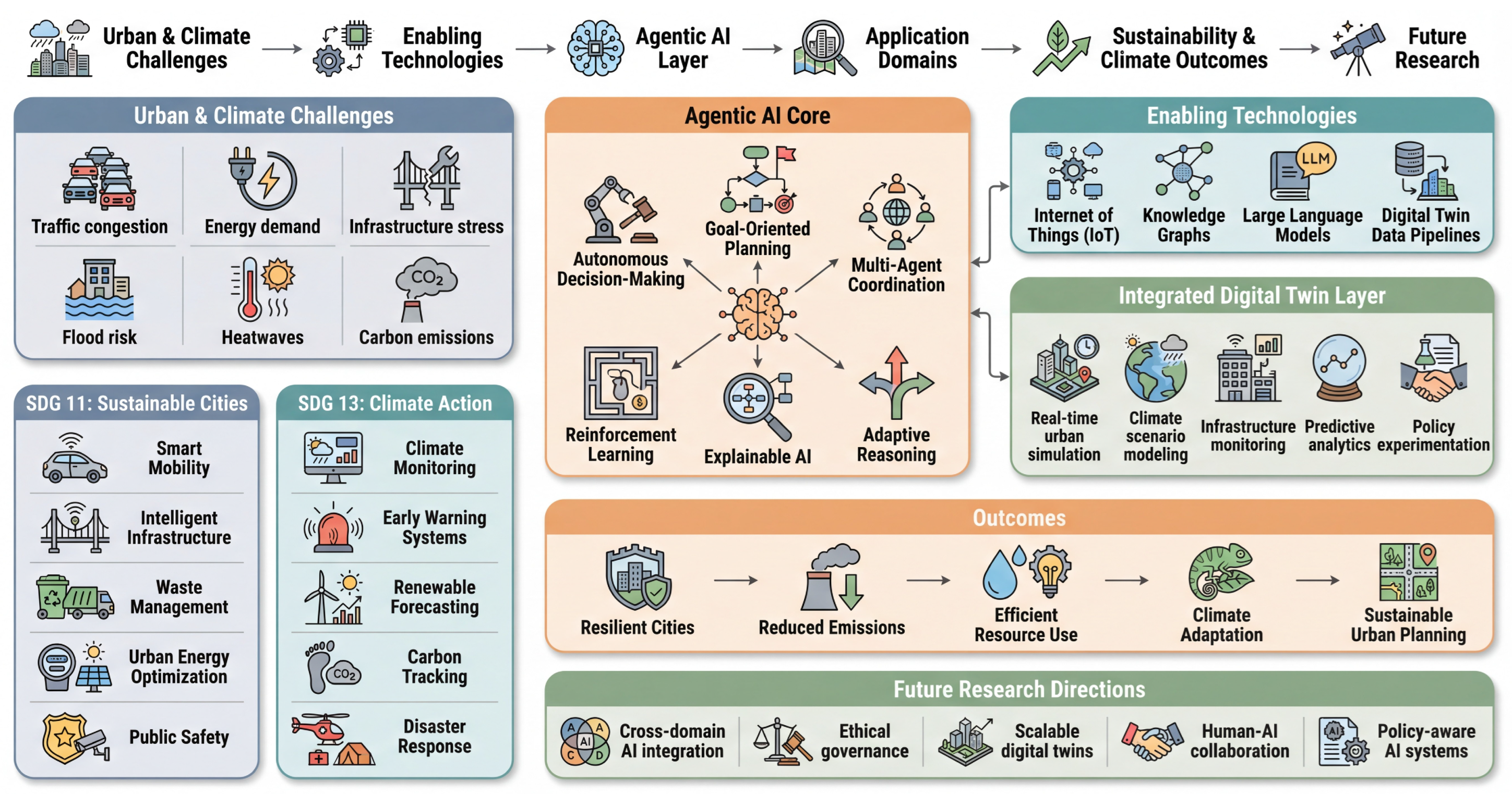
Figure 2.
Agentic AI-enabled digital twin framework for SDG 11 and SDG 13, integrating an orchestration layer with urban digital twins to model coupled urban–climate dynamics, address shared challenges (e.g., emissions, urban heat, disaster risk), and enable adaptive, feedback-driven decision-making.
Figure 2.
Agentic AI-enabled digital twin framework for SDG 11 and SDG 13, integrating an orchestration layer with urban digital twins to model coupled urban–climate dynamics, address shared challenges (e.g., emissions, urban heat, disaster risk), and enable adaptive, feedback-driven decision-making.
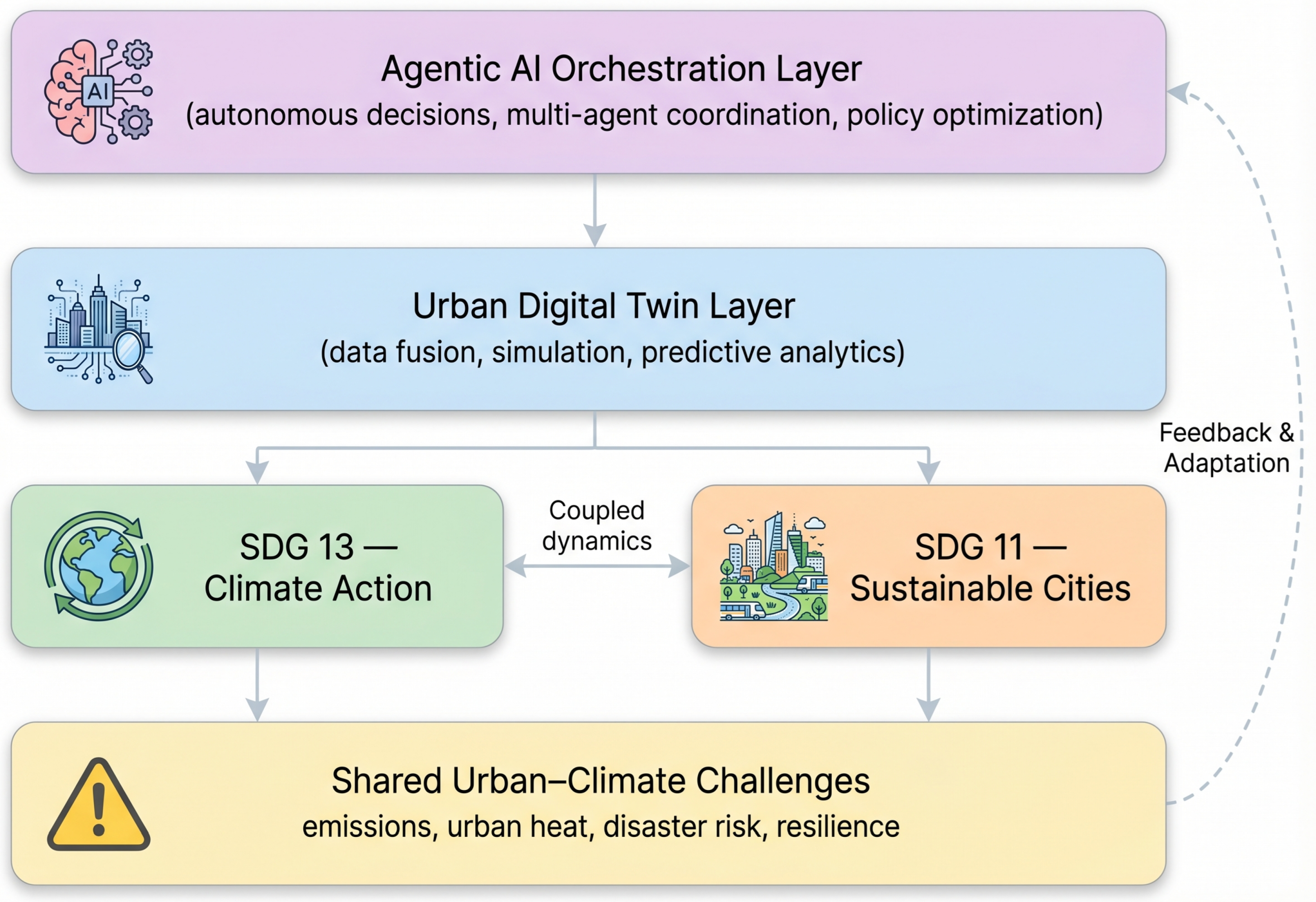
Figure 3.
PRISMA 2020 flow diagram illustrating the study selection process [12]. A total of 920 records were identified, with 700 remaining after deduplication. Following title and abstract screening, 500 records were excluded, leaving 200 studies for full-text assessment. Of these, 130 were excluded based on predefined eligibility criteria, resulting in 70 studies included in the final synthesis.
Figure 3.
PRISMA 2020 flow diagram illustrating the study selection process [12]. A total of 920 records were identified, with 700 remaining after deduplication. Following title and abstract screening, 500 records were excluded, leaving 200 studies for full-text assessment. Of these, 130 were excluded based on predefined eligibility criteria, resulting in 70 studies included in the final synthesis.
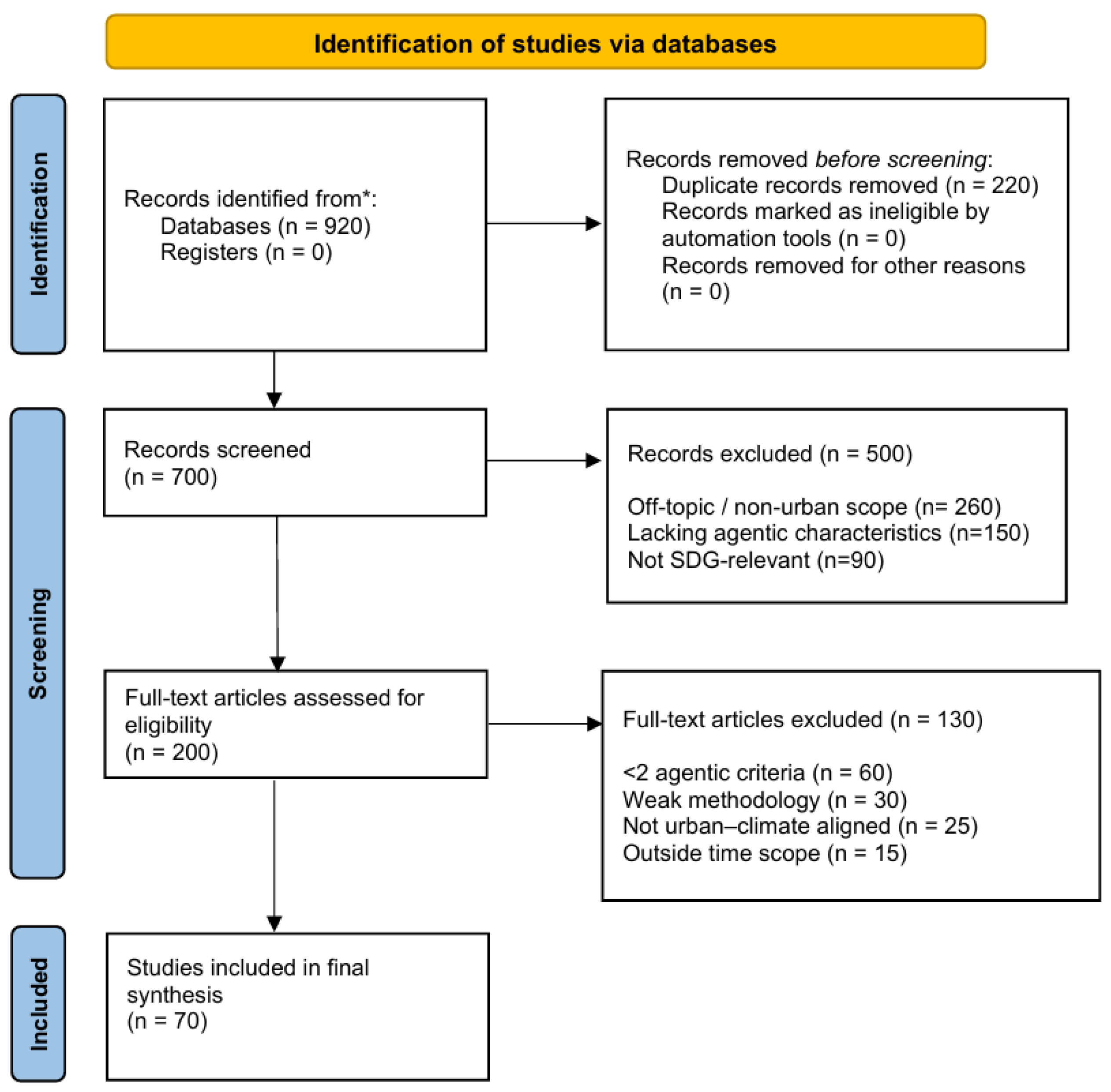
Figure 4.
Mapping of agentic AI application clusters for SDG 11, synthesized from 70 studies, highlighting six domains including energy and environmental monitoring (11 studies).
Figure 4.
Mapping of agentic AI application clusters for SDG 11, synthesized from 70 studies, highlighting six domains including energy and environmental monitoring (11 studies).
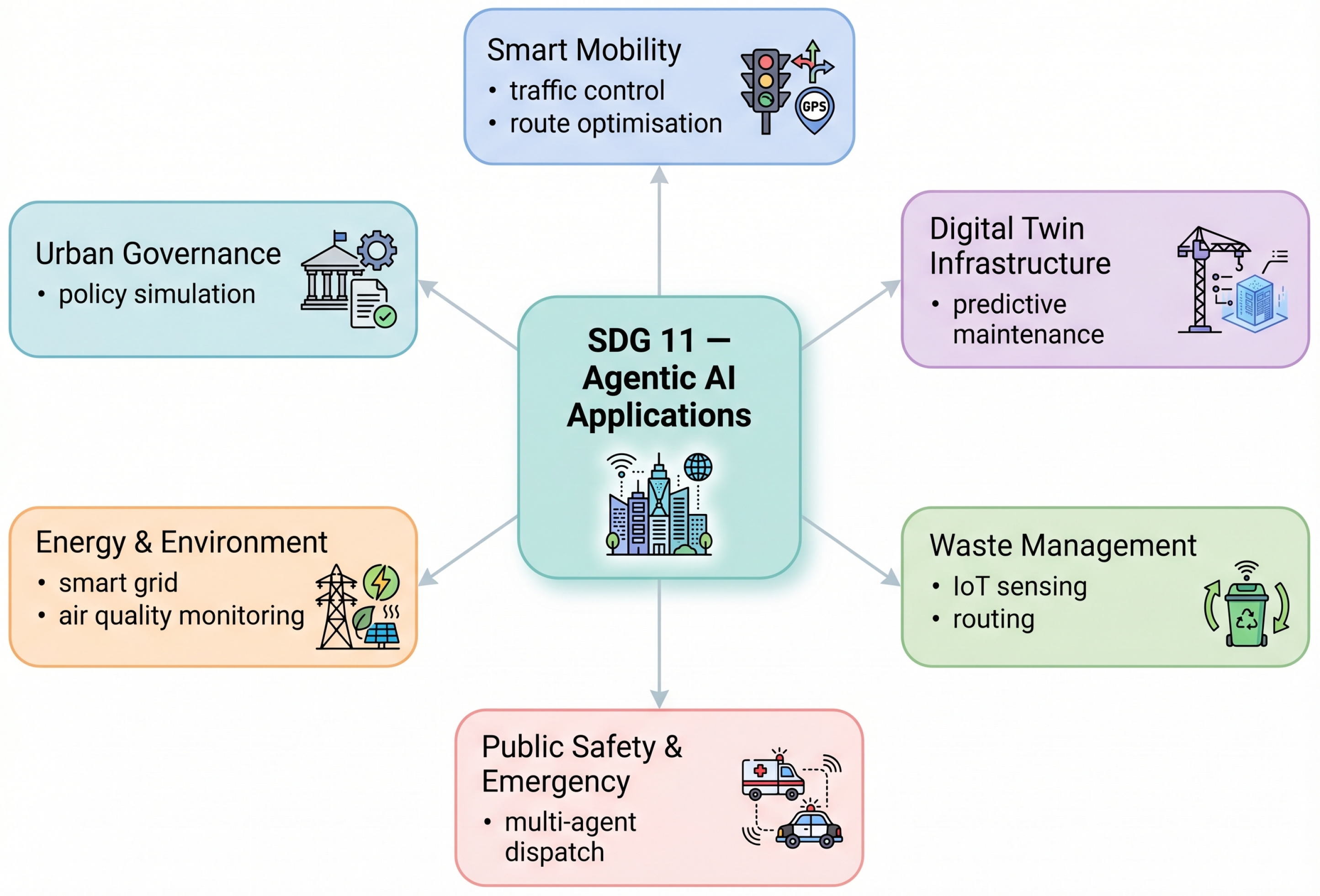
Figure 5.
High-level mapping of Agentic AI application clusters in support of SDG 13 (Climate Action), based on synthesis of the 70 included studies. Applications span sensing, forecasting, tracking, and policy evaluation dimensions.
Figure 5.
High-level mapping of Agentic AI application clusters in support of SDG 13 (Climate Action), based on synthesis of the 70 included studies. Applications span sensing, forecasting, tracking, and policy evaluation dimensions.
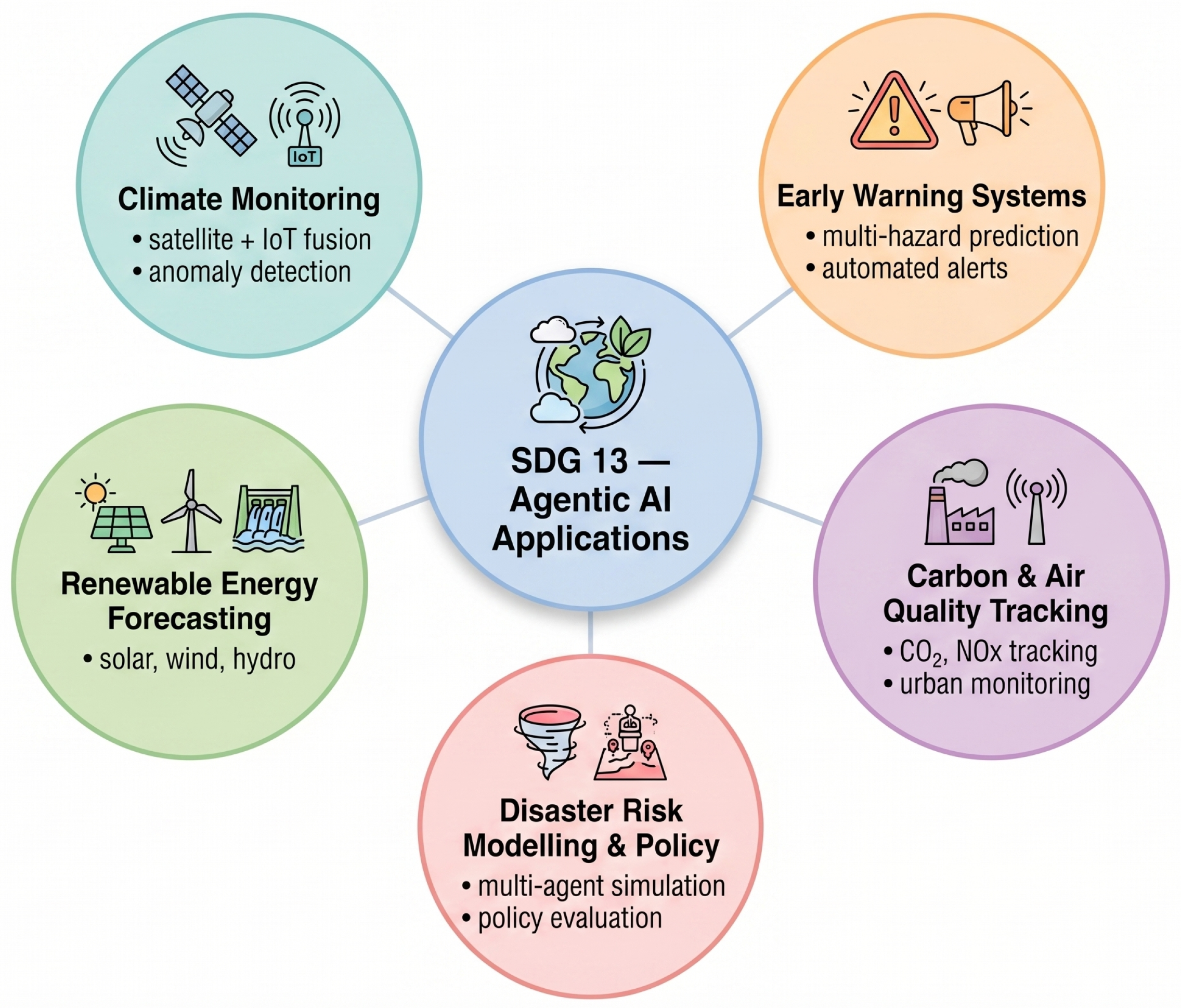
Figure 6.
Integrated architecture for urban sustainability (SDG 11) and climate resilience (SDG 13) through Agentic AI and Digital Twin coordination. The dashed arrow indicates the closed-loop feedback from actuation to agent learning, enabling continuous adaptation.
Figure 6.
Integrated architecture for urban sustainability (SDG 11) and climate resilience (SDG 13) through Agentic AI and Digital Twin coordination. The dashed arrow indicates the closed-loop feedback from actuation to agent learning, enabling continuous adaptation.
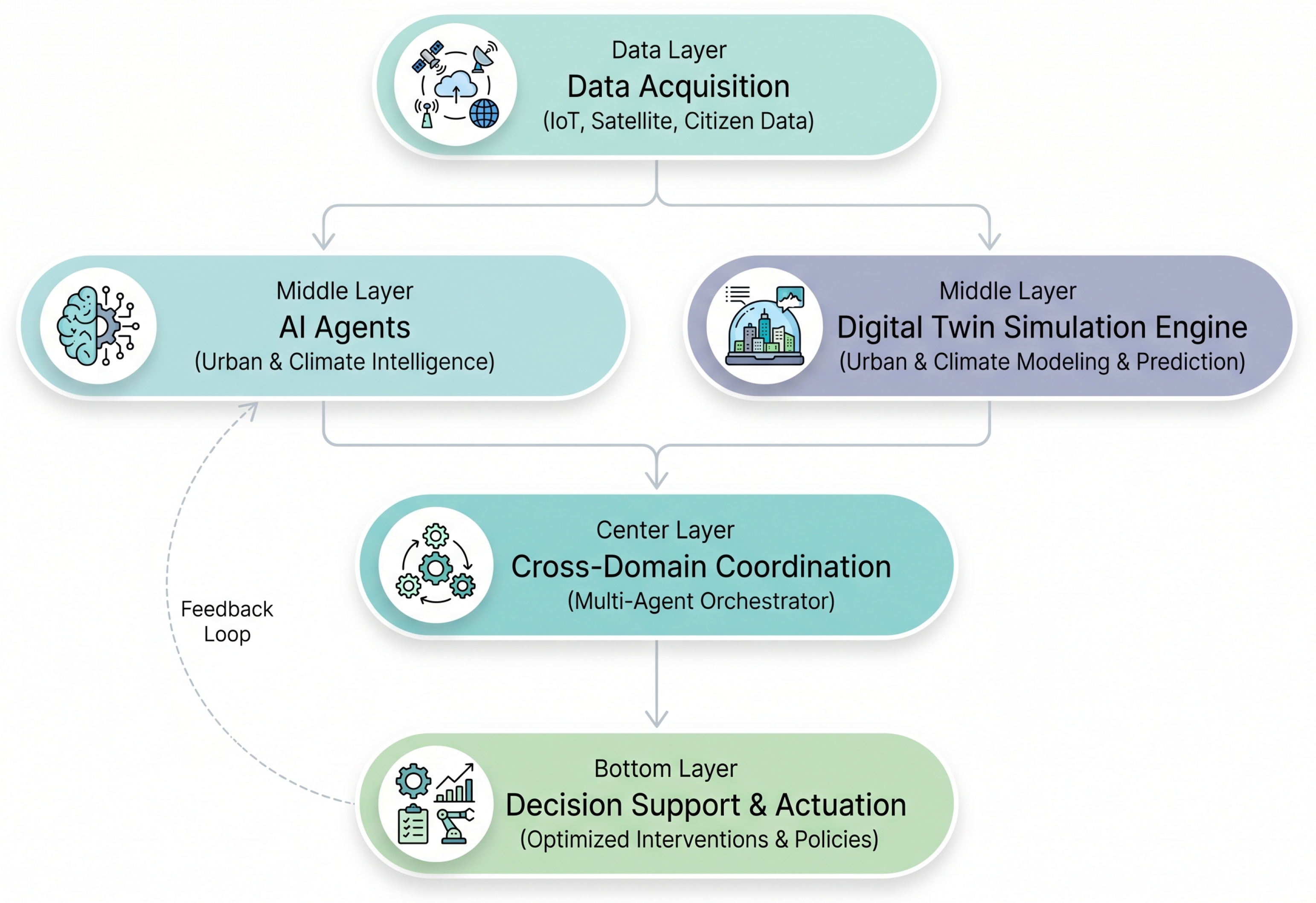
Figure 7.
Digital twin-based climate-aware planning workflow: real-time sensing updates the twin, simulation generates scenarios, agentic AI proposes interventions, decisions are supported via dashboards, and approved actions are deployed, with continuous feedback closing the loop.
Figure 7.
Digital twin-based climate-aware planning workflow: real-time sensing updates the twin, simulation generates scenarios, agentic AI proposes interventions, decisions are supported via dashboards, and approved actions are deployed, with continuous feedback closing the loop.
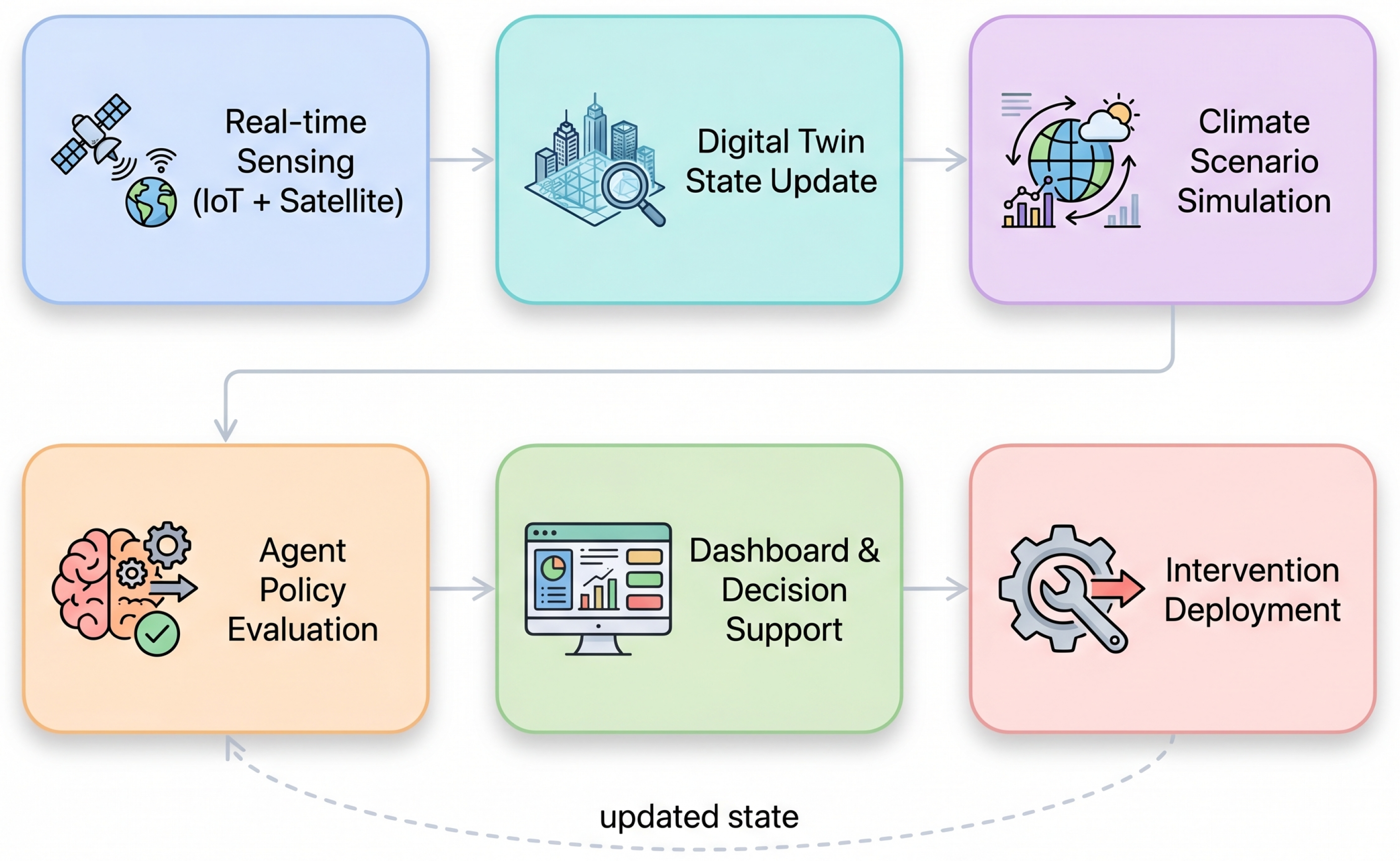
Figure 8.
Agentic AI ecosystem for sustainable and climate-resilient cities, integrating urban–climate challenges, enabling technologies, digital twin simulation, multi-agent orchestration, application domains, and sustainability outcomes, synthesized from 70 studies as a reference architecture.
Figure 8.
Agentic AI ecosystem for sustainable and climate-resilient cities, integrating urban–climate challenges, enabling technologies, digital twin simulation, multi-agent orchestration, application domains, and sustainability outcomes, synthesized from 70 studies as a reference architecture.
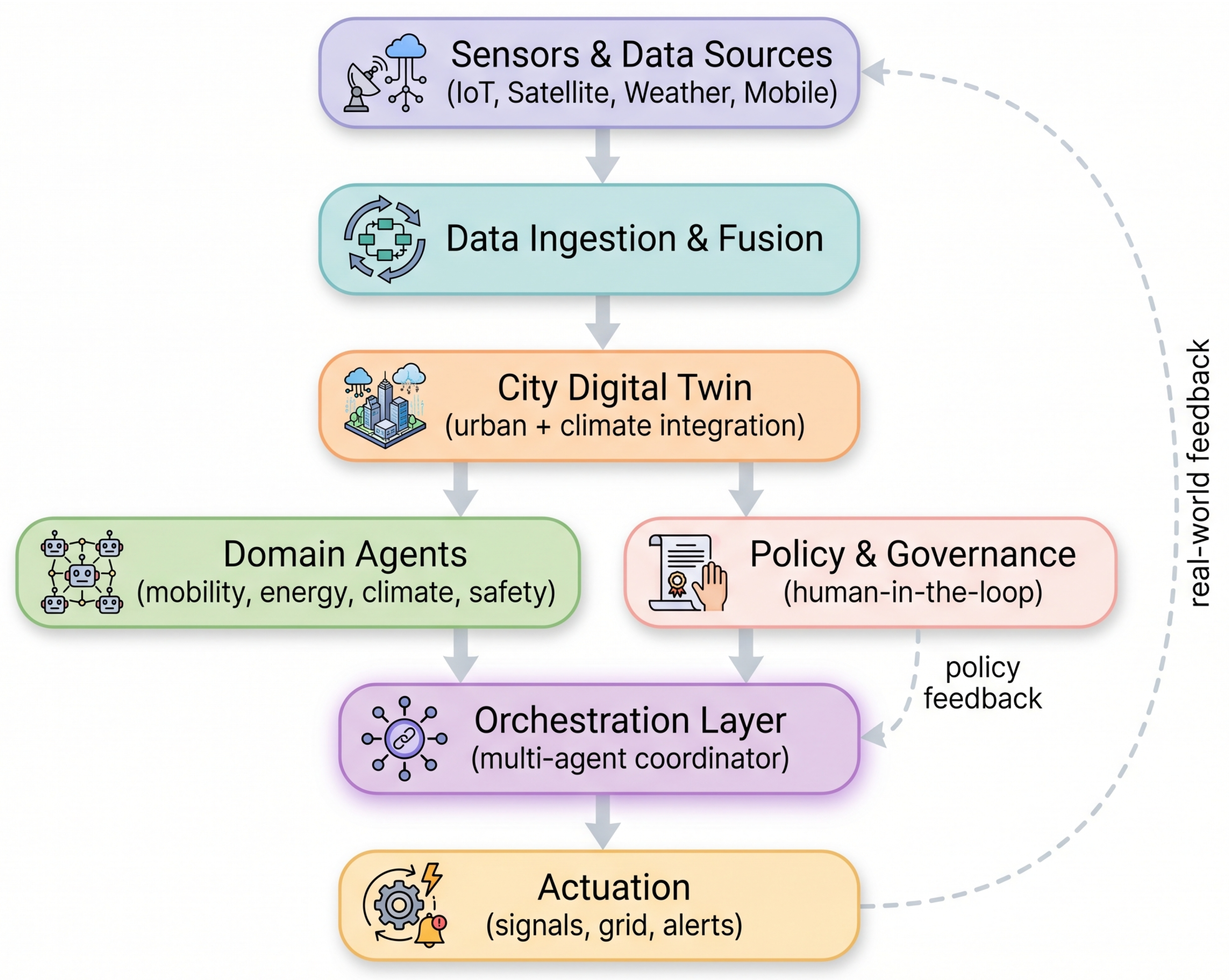
Figure 9.
Generalised digital twin workflow for simulation-driven urban decision-making, spanning data acquisition, storage, physics-based modelling, simulation and analytics, human-in-the-loop oversight, multi-agent orchestration, and actuation, with feedback closing the operational loop.
Figure 9.
Generalised digital twin workflow for simulation-driven urban decision-making, spanning data acquisition, storage, physics-based modelling, simulation and analytics, human-in-the-loop oversight, multi-agent orchestration, and actuation, with feedback closing the operational loop.
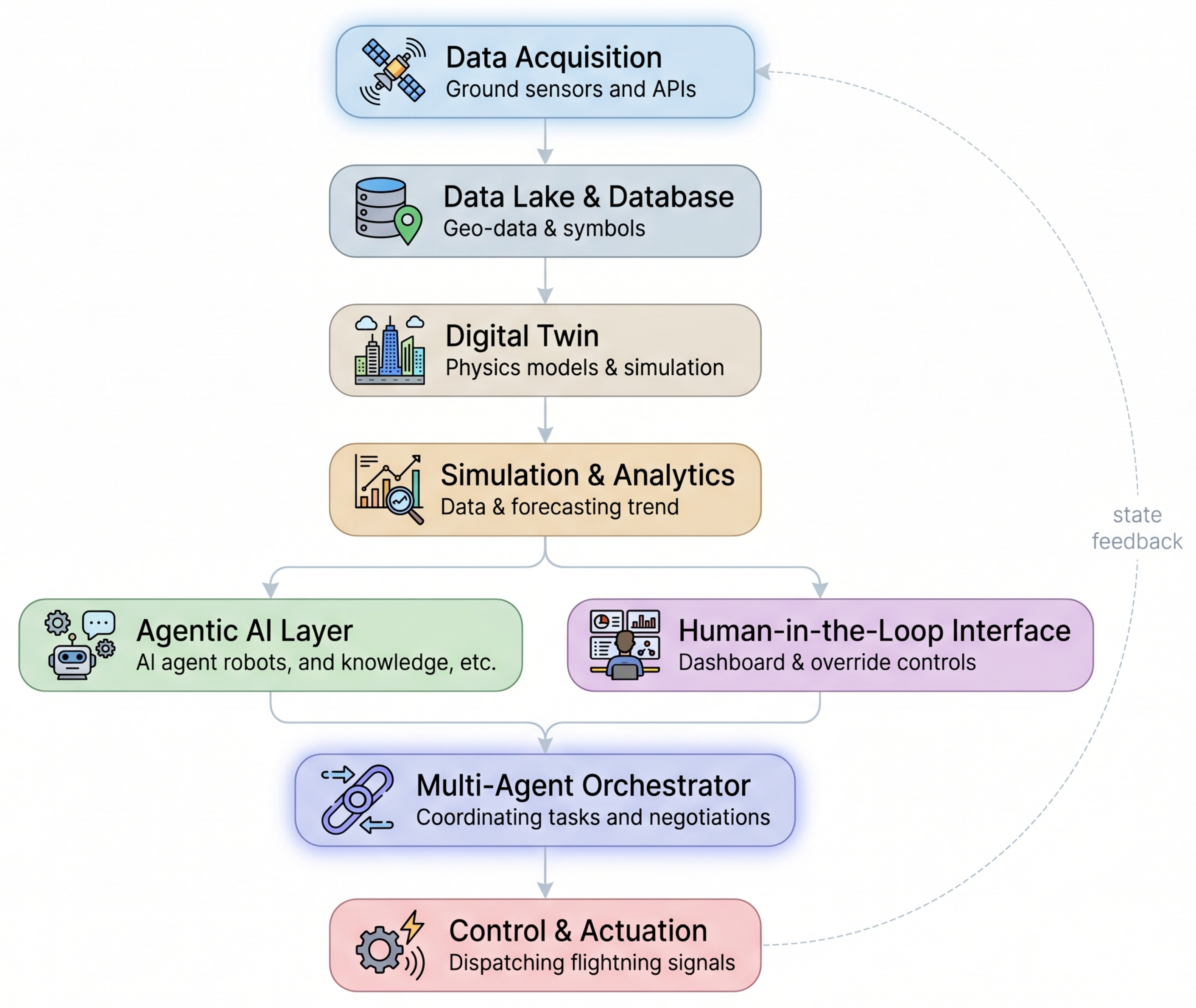
Figure 10.
Interaction sequence for agentic AI-driven urban management, linking IoT sensing, data ingestion, digital twin modelling, ML-based analysis, multi-scenario simulation, decision-making, and actuation in a closed-loop cycle.
Figure 10.
Interaction sequence for agentic AI-driven urban management, linking IoT sensing, data ingestion, digital twin modelling, ML-based analysis, multi-scenario simulation, decision-making, and actuation in a closed-loop cycle.
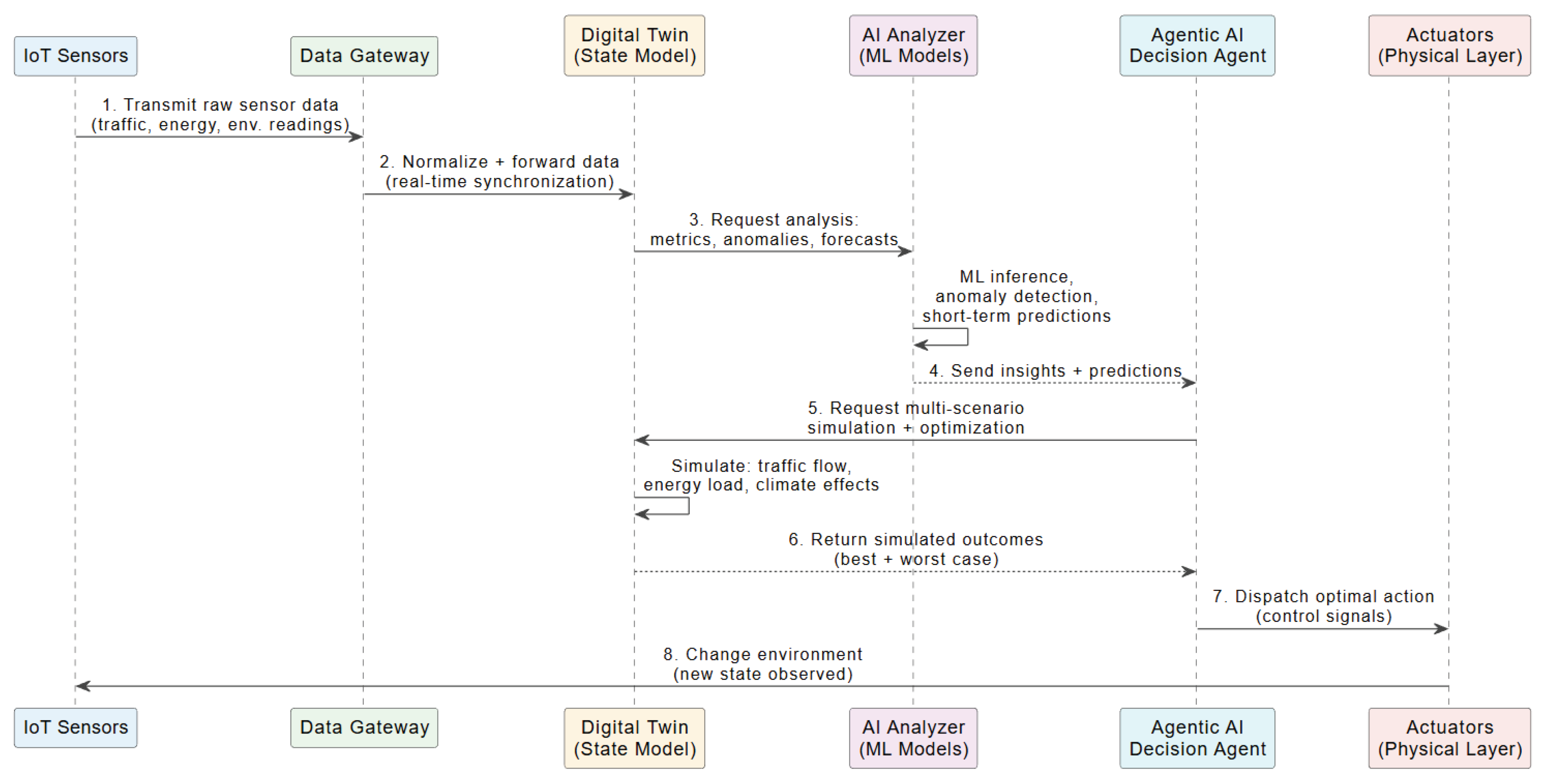

Table 1.
Database search strategy, field codes applied, and record retrieval outcomes. Boolean string fields: TS = Topic Search (Web of Science); TITLE-ABS-KEY (Scopus); Full Text & Metadata (IEEE Xplore); All Content (SpringerLink/ScienceDirect). Counts reflect pre-deduplication retrieval.
Table 1.
Database search strategy, field codes applied, and record retrieval outcomes. Boolean string fields: TS = Topic Search (Web of Science); TITLE-ABS-KEY (Scopus); Full Text & Metadata (IEEE Xplore); All Content (SpringerLink/ScienceDirect). Counts reflect pre-deduplication retrieval.
| Database | Field Code Applied | Records Retrieved |
|---|---|---|
| Scopus | TITLE-ABS-KEY | 320 |
| Web of Science | TS (Topic Search) | 240 |
| IEEE Xplore | Full Text & Metadata | 150 |
| SpringerLink | All Content | 110 |
| ScienceDirect | All Fields | 80 |
| Citation tracking | Backward reference scanning | 20 |
| Total | — | 920 |
Table 2.
Agentic characteristic coding for 14 representative included studies. A = Autonomy; G = Goal-directed planning; T = Tool use/interaction; M = Multi-agent coordination. = characteristic present; — = not evidenced. Studies are included if criteria are satisfied. Domain classifications reflect each paper’s primary empirical focus as described in the source publication.
Table 2.
Agentic characteristic coding for 14 representative included studies. A = Autonomy; G = Goal-directed planning; T = Tool use/interaction; M = Multi-agent coordination. = characteristic present; — = not evidenced. Studies are included if criteria are satisfied. Domain classifications reflect each paper’s primary empirical focus as described in the source publication.
| Study | Domain | A | G | T | M | Count |
|---|---|---|---|---|---|---|
| Cao et al. [25] | Traffic signal optimisation | 4 | ||||
| Yang et al. [26] | Infrastructure planning | — | 3 | |||
| White et al. [27] | Smart city citizen engagement | — | — | 2 | ||
| Tiggeloven et al. [28] | Climate early warning | — | 3 | |||
| Algburi et al. [29] | Renewable energy AI (review) | — | — | 2 | ||
| Cho et al. [30] | Climate policy evaluation | — | — | 2 | ||
| Magazzino et al. [31] | Climate action evaluation | — | — | 2 | ||
| Villani et al. [32] | Urban digital twin sustainability | — | 3 | |||
| Ghaffarian [33] | Disaster risk management | — | — | 2 | ||
| Sacoto-Cabrera et al. [34] | IoT–digital twin integration | — | 3 | |||
| Korkmaz [35] | Resilience digital twin | — | 3 | |||
| Vitanova et al. [36] | Urban climate modelling | — | 3 | |||
| Burger [37] | Mobility governance | — | 3 | |||
| Sharifi et al. [38] | Smart city–SDG synthesis | — | — | 2 |
Table 3.
Bibliometric overview of the 70 included studies by publication year. Studies prior to 2020 are aggregated. Cumulative percentages are computed as .
Table 3.
Bibliometric overview of the 70 included studies by publication year. Studies prior to 2020 are aggregated. Cumulative percentages are computed as .
| Year | Before 2020 | 2020 | 2021 | 2022 | 2023 | 2024 | 2025 | 2026 | Total |
|---|---|---|---|---|---|---|---|---|---|
| Studies | 5 | 2 | 4 | 2 | 5 | 7 | 39 | 6 | 70 |
| Cumul. % | 7 | 10 | 15 | 18 | 25 | 35 | 91 | 100 | — |
Table 4.
Distribution of publications by major publisher categories. Minor publishers are aggregated under “Others” for clarity.
Table 4.
Distribution of publications by major publisher categories. Minor publishers are aggregated under “Others” for clarity.
| Publisher Category | Count | Percentage | Example Venues |
|---|---|---|---|
| Elsevier | 16 | 22.9% | Cities, iScience, Sustainable Cities and Society |
| MDPI | 14 | 20.0% | Sustainability, Sensors, Smart Cities |
| Springer / Springer Nature | 12 | 17.1% | Nature Communications, npj Urban Sustainability |
| Other Academic Publishers | 22 | 31.4% | ACM, SAGE, IEEE, Frontiers, Wiley, etc. |
| Technical Reports (UN/Intl.) | 3 | 4.3% | UN SDGs, UNDRR EW4All |
| Independent / Misc. Journals | 3 | 4.3% | WJAETS, EJSMT, AJGR |
| Total | 70 | 100% |
Table 5.
Distribution of publications by document type.
| Document Type | BibTeX Type | Count | Percentage |
|---|---|---|---|
| Journal Articles | @article | 64 | 91.4% |
| Conference Papers | @inproceedings | 3 | 4.3% |
| Technical Reports | @techreport | 3 | 4.3% |
| Books / Book Chapters | @book / @incollection | 0 | 0% |
| Total | 70 | 100% |
Table 6.
Representative Agentic AI applications in smart mobility for SDG 11. Agentic criteria (A/G/T/M) are reported per Table 2. “Key Outcome” reflects stated findings in the cited peer-reviewed source.
Table 6.
Representative Agentic AI applications in smart mobility for SDG 11. Agentic criteria (A/G/T/M) are reported per Table 2. “Key Outcome” reflects stated findings in the cited peer-reviewed source.
| Study | AI Paradigm | Urban Context | Key Outcome | Limitation |
|---|---|---|---|---|
| Cao et al. [25] | Hierarchical MARL (A,G,T,M) | Urban traffic signal control | Sustainability-oriented traffic optimisation | Simulation-based; real-world validation needed |
| Khamis [42] | MaaS integration AI (G,T,M) | Smart transit planning | Improved modal shift equity | Limited rural applicability |
| Burger [37] | Agent-based governance (G,T,M) | Policy simulation | Equitable mobility archetypes | Normative framing required |
| Chong et al. [43] | AI policy analysis (G,T) | Southeast Asian cities | Enhanced policy alignment | Cross-context generalisability |
Table 7.
Examples of urban–climate co-simulation scenarios and planning outcomes supported by Agentic AI.
Table 7.
Examples of urban–climate co-simulation scenarios and planning outcomes supported by Agentic AI.
| Scenario | Simulation Focus | Planning Outcome |
|---|---|---|
| Urban Sprawl | Traffic + Emissions + Heatwaves | Identification of high-risk urban heat zones; targeted cooling intervention strategies |
| Renewable Integration | Energy Demand + Climate Variability | Optimal spatial allocation of storage assets and smart grid scheduling |
| Disaster Preparedness | Flood + Storm + Population Density | Emergency response prioritisation and pre-positioned resource allocation |
| Green Infrastructure | Land Cover + Urban Temperature + Runoff | Cost-benefit ranking of nature-based adaptation interventions |
Table 8.
Mapping of the proposed Agentic AI–Digital Twin framework layers to SDG 11 and SDG 13 targets and associated performance indicators.
Table 8.
Mapping of the proposed Agentic AI–Digital Twin framework layers to SDG 11 and SDG 13 targets and associated performance indicators.
| Framework Layer | Primary Function | SDG 11 Contribution | SDG 13 Contribution |
|---|---|---|---|
| Data Acquisition | Real-time sensing and multi-source integration | Infrastructure efficiency monitoring | City-scale climate monitoring |
| Digital Twin | Scenario simulation and stress testing | Urban planning and resilience | Risk prediction and adaptation |
| Agentic AI | Autonomous goal-directed coordination | Smart mobility optimisation | Disaster early warning |
| Multi-Agent Layer | Distributed resource allocation and negotiation | Public safety and equity | Emergency management |
Table 9.
Comparative analysis of representative studies on Agentic AI for sustainable and climate-resilient cities. Agentic criteria from Table 2. Reported outcomes reflect stated findings in original peer-reviewed sources; domain classifications reflect the primary focus of each source publication.
Table 9.
Comparative analysis of representative studies on Agentic AI for sustainable and climate-resilient cities. Agentic criteria from Table 2. Reported outcomes reflect stated findings in original peer-reviewed sources; domain classifications reflect the primary focus of each source publication.
| Study | AI Paradigm | Digital Twin | Domain | Strength | Limitation |
|---|---|---|---|---|---|
| Lee et al. [41] | Agentic AI survey | Partial | Sustainability architectures survey | Comprehensive architecture taxonomy | Survey paper; no experimental validation |
| Yang et al. [26] | Agent-based DT (A,G,T) | Yes | Infrastructure planning | SDG 11 target alignment | High infrastructure cost |
| Tiggeloven et al. [28] | Deep learning EWS (G,T) | No | Climate early warning | High forecast accuracy | Limited interpretability |
| White et al. [27] | DT citizen platform (G,T) | Yes | Smart city citizen engagement | Participatory DT governance | Limited autonomous decision-making |
| Algburi et al. [29] | Energy-AI review (G,T) | No | Renewable energy adoption (review) | Broad policy and technology coverage | Review paper; no empirical system |
| Cho et al. [30] | AI policy model (G,T) | Partial | Climate policy eval. | SDG interlinkage mapping | Causal inference limitations |
Table 10.
Research gaps and future opportunities in Agentic AI for urban sustainability and climate resilience.
Table 10.
Research gaps and future opportunities in Agentic AI for urban sustainability and climate resilience.
| Research Area | Identified Gap | Future Opportunity |
|---|---|---|
| Smart Mobility | Isolated domain optimisation models | Integrated multi-agent orchestration across transport modes |
| Climate Forecasting | Limited policy feedback linkage | AI-driven policy simulation with causal inference |
| Digital Twins | High infrastructure and data cost | Scalable federated cloud-based twin architectures |
| Urban Governance | Absence of ethical AI frameworks | Responsible AI governance with participatory design |
| Cross-domain AI | Fragmented single-domain deployments | Unified urban intelligence platforms spanning multiple SDGs |
| Equity and Access | AI concentrated in high-income cities | Lightweight architectures for developing regions |
Disclaimer/Publisher’s Note: The statements, opinions and data contained in all publications are solely those of the individual author(s) and contributor(s) and not of MDPI and/or the editor(s). MDPI and/or the editor(s) disclaim responsibility for any injury to people or property resulting from any ideas, methods, instructions or products referred to in the content. |
© 2026 by the authors. Licensee MDPI, Basel, Switzerland. This article is an open access article distributed under the terms and conditions of the Creative Commons Attribution (CC BY) license (http://creativecommons.org/licenses/by/4.0/).
Copyright: This open access article is published under a Creative Commons CC BY 4.0 license, which permit the free download, distribution, and reuse, provided that the author and preprint are cited in any reuse.


