
Submitted:
24 April 2026
Posted:
27 April 2026
You are already at the latest version
Abstract
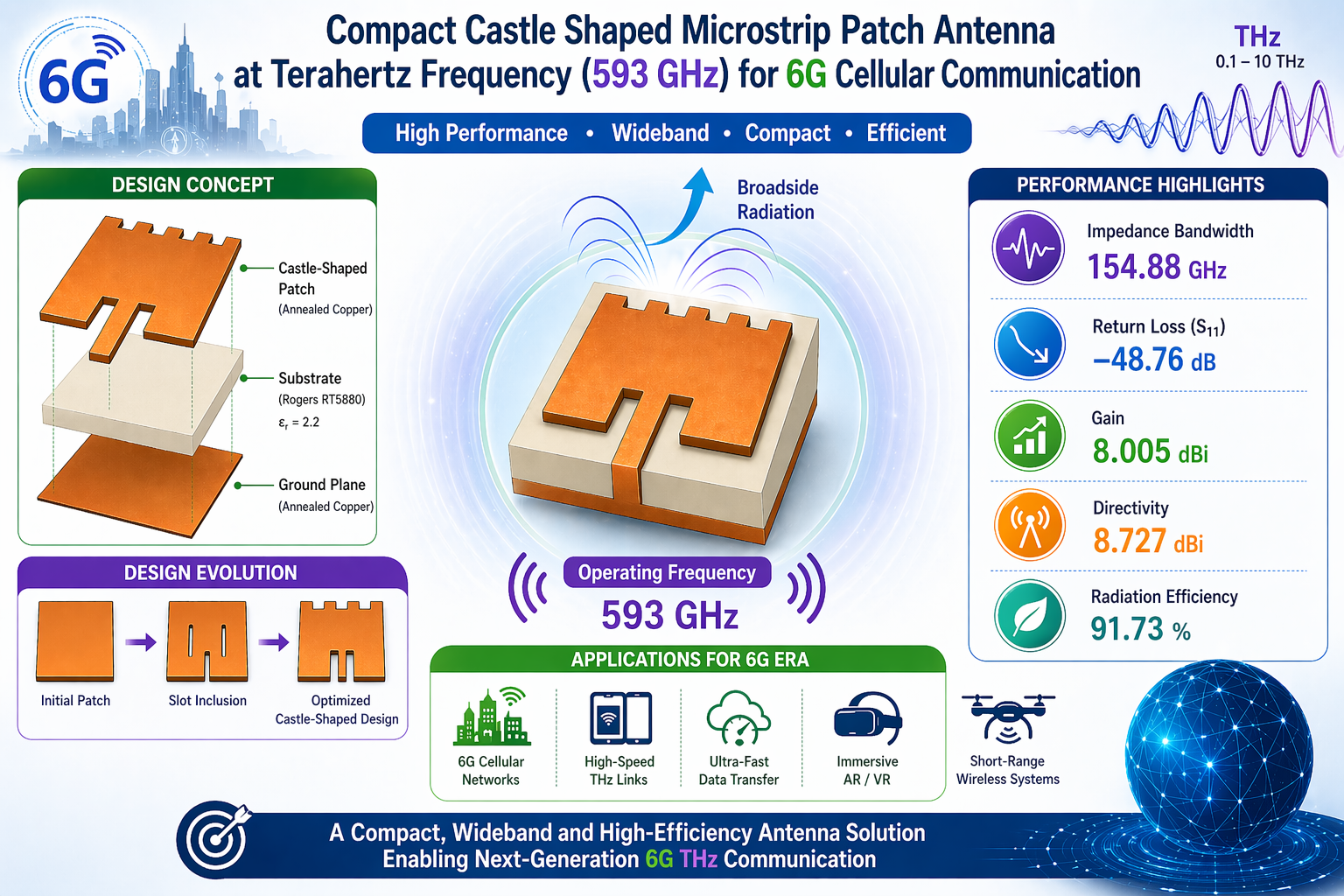
The fast growth of wireless communication systems and the growing need for very high data rates have been the driving force behind the creation of sixth-generation (6G) technologies that operate in the terahertz (THz) frequency region. This research represents the design and analysis of a small compact microstrip patch antenna that works in the terahertz (THz) frequency range for 6G cellular connectivity. The Rogers RT5880 substrate and annealed copper are used in the design of the suggested antenna, which aims for a 593 GHz resonance frequency. A progressive design technique that incorporates slotting and geometric optimization has been used to develop a castle shaped antenna which improve impedance matching and bandwidth to overcome the inherent constraints of traditional microstrip antennas. Excellent impedance matching is shown by the final design's near-ideal voltage standing wave ratio (VSWR) and return loss (S11) of –48.76 dB. It achieves a broad impedance bandwidth of 154.88 GHz, which far outperforms many current systems. The antenna exhibits consistent radiation characteristics in the broadside direction, a gain of 8.005 dBi, a directivity of 8.727 dBi, and an efficiency of around 91.73%. The proposed design performs very well in terms of bandwidth and efficiency, while also preserving compact dimensions and structural simplicity, as shown by a comparative comparison with most current literature. These results validate the suitability of the proposed antenna for high-speed, short-range THz communication systems in future 6G networks.
Keywords:
antenna design
; wireless communication
; sixth generation (6G)
; terahertz (THz)frequency band
; cellular communication
; microstrip patch antenna
; wide bandwidth
Copyright: This open access article is published under a Creative Commons CC BY 4.0 license, which permit the free download, distribution, and reuse, provided that the author and preprint are cited in any reuse.


