
Submitted:
23 April 2026
Posted:
27 April 2026
You are already at the latest version
Abstract
It is shown that one of the promising areas in the design GaAs of high-temperature operational amplifiers (Op-Amps) are circuit solutions based on an "folded" stage. 12 (Op-Amp) new circuits are considered, which are implemented on GaAs nJFET and GaAs bipolar p-n-p transistors. Due to the original circuit design solutions in the proposed Op-Amp, the systematic components of the zero offset voltage are minimized due to the influence of the GaAs p-n-p BJT base currents and the asymmetry of the gate-drain JFET transistors of the input differential pair. Mathematical constraints on the static mode of the Op-Amp have been obtained, in which the total zero offset voltage takes on minimal values. As an example, a computer simulation of one of the Op-Amp circuits of the class in question was performed in the LTspice environment. The proposed GaAs Op-Amp family is recommended for use in analog automation devices operating at elevated temperatures. (up to 250-300°C).
Keywords:
operational amplifier
; GaAs
; systematic component of the zero offset voltage
; LTspice simulation environment
; asymmetry of the static mode of input transistors
1. Introduction
Operational amplifiers (Op-Amps) remain key components in a wide range of modern analog and analog-to-digital computing systems today. However, for operation at elevated temperatures, special circuitry of the Op-Amp and circuits for establishing their static mode is required.
In recent years, there has been a growing interest in creating an Op-Amp based on gallium arsenide (GaAs), which is associated with the limitations of silicon technology when operating at high frequencies and under conditions of extreme external influences (radiation, elevated temperatures) [1,2,3].
One of the promising areas in the design of GaAs Op-Amp are circuit solutions with a single high-impedance node, providing average levels of voltage gain [4,5,6].
The relevance and novelty of the article lies in the development of recommendations for the design of original circuit solutions for Op-Amp with one high-impedance node based on gallium arsenide nJFET field-effect and GaAs p-n-p bipolar transistors, which are implemented within the framework of technologies mastered by a number of microelectronic companies [7,8,9,10,11,12,13,14,15,16]. The proposed circuit engineering methods can be used to create analog microcircuits designed to operate at elevated temperatures.
2. The Main Recommendations for Building a GaAs Op-Amp Based on an "Folded" Cascode
The structure of the operational amplifier considered below (Figure 1) is one of the most popular and is used in many serial microcircuits of leading microelectronic companies (154UD3, HA2520, HA5190, OP90, AD797, AD8631, AD8632, AD817, HA-2500, 140UD30, OPA42, etc.). Its feature is the presence of one high–impedance node Σ1, which allows you to get the average values of the voltage gain.
The total systematic component of the zero offset voltage of the Op-Amp in Figure 1 has three components
: (1)
where is determined by the difference between the reference current sources I1, I2, and I3 from the values shown in Figure 1;
depends on the non-identity of the gate-drain static voltages of the input transistors M1 and M2;
is determined by the current error in the high-impedance node.
Thescore. To obtain small it is necessary to ensure strict compliance with the requirements for reference current sources I1, I2, I3. Their significant difference from the set values generates the first component of the zero offset voltage (). In practice, I1, I2 and I3 are implemented on nJFET GaAs field effect transistors.
Thescore. If there is a difference in ΔVAB, then this generates a second component:
where μ=10-2-10-3 is the internal feedback coefficient of the transistors M1, M2 of the input differential stage in a circuit with a common gate.
If it is not possible to ensure equality VA = VB, then a cascoded input cascade must be used as the input differential stage (Figure 2).
Thescore. The third component of is related to the difference in static currents in the high - impedance node Σ1 when it is short - circuited to an equipotential voltage source:
where is the steepness of the gain of the differential stage DS1 from the inputs of the In.1, In.2 in a high-impedance node Σ1.
To reduce VOS.3 in the diagram in Figure 1, in the high-impedance node Σ1, it is necessary to ensure mutual compensation of all incoming and outgoing currents. For this purpose, it is sometimes possible to use a buffer amplifier control unit, the input current of which should be equal to Ibn, or use special circuits for generating compensating current on bipolar transistors.
Figure 3 shows a variant of the GaAs Op-Amp construction in Figure 1, which ensures the identity of the gate-drain static voltages of the M1, M2 transistors. For this purpose, an auxiliary transistor Q3 and an additional reference current source I4 are used.
In the Op-Amp circuit in Figure 4, two tasks are solved simultaneously - reducing due to the non-identical voltages VA and VB, as well as mutual compensation of incoming and outgoing currents in the high-impedance node Σ1, affecting .
The considered features of the basic Op-Amp in Figure 1 based on the "folded" cascade can be used in the construction of many other variants of GaAs control systems of this class.
In operational amplifiers, there are also other components of the zero offset voltage (except , , (1)), which are weakly dependent on the circuit solutions used and are determined by process errors, transistor topology, their design and technological features, the presence of a temperature gradient between the transistors of the input differential pair, etc. Currently, effective methods have been developed to reduce these "non-circuit" effects, the essence of which is considered in [17,18,19].
3. The First Practical Circuit of a GaAs Op-Amp is Shown in Figure 5
In this circuit design (Figure 5), the Q9 and VD1 elements ensure the symmetry of static modes in terms of gate-drain voltage of the transistors of the input differential cascade M1, M2.
At the same time, the base current of the Q9 transistor makes it possible to obtain the emitter current of the Q10 transistor equal to I0+Ibn. As a result, the collector current Q10 is equal to I0, which corresponds to the drain current of the transistor M11, which is determined by the resistance R7. In this scheme, JFET cascade activation is recommended as M3, M4, and M11.
4. The Second Practical Scheme of GaAs op-amp is Shown in Figure 6
In the Op-Amp circuit in Figure 6, which implements the previously considered circuit techniques for reducing VOS.Σ (1), all reference current sources are made on JFET transistors, and the resistances of the current-limiting resistors are the same R1=R2=R4=R5=R6, which increases the identity of the reference currents and reduces the component VOS.1 (1).
Here, using Q7 and Q9 transistors, the identity of the gate-drain static voltages of the input transistors M1, M2 is ensured. In addition, the base current of the Q9 transistor is "added" to the emitter circuit of the Q8 transistor. As a result, when the input current of the buffer amplifier is zero, mutual compensation of incoming and outgoing currents is provided in the high-impedance node Σ1:
Ic.8=Id.12=I0.
5. The Third Practical Scheme of GaAs Op-Amp is Shown in Figure 7
The symmetry of the static modes of the input transistors M1, M2 in the diagram in Figure 7 is provided by the introduction of a two-pole bias circuit V0, which can be implemented on p-n junctions, resistors or emitter repeaters.
The compensation of the incoming and outgoing currents in the high - impedance node Σ1 is provided by transistors Q8 and M11:
Ic.7= I0-Ibn=Id.11.
6. The Fourth Practical Scheme of GaAs op-amp is Shown in Figure 8
The M9 and M10 transistors in this circuit make it possible to obtain identical gate-drain voltages for M1, M2 transistors, which reduces VOS.2 (1).
At the same time, the Q12 and M11 transistors provide zero difference current in the high-impedance node Σ1, which reduces VOS.3 (1).
7. The Fifth Practical Scheme of GaAs Op-Amp is Shown in Figure 9
In this circuit, elements Q9 and Q10 minimize the second component of the zero offset voltage VOS.2 (1).
The base current of the Q12 transistor in the diagram in Figure 9 is "added" to the high-impedance node Σ1, which compensates for the current error. The Q13 transistor symmetrizes the static collector-base modes of Q9 and Q10 transistors. This increases the identity of the currents I0 generated by the M5-M8 transistors and reduces VOS.1 (1).
8. The Sixth Practical Scheme of GaAs Op-Amp is Shown in Figure 10
The symmetry of the static modes of the input transistors M1, M2 in the circuit in Figure 10 is provided by the p-n junctions VD1.
To obtain a zero difference current in the high-impedance node Σ1, an emitter repeater on a Q8 transistor is used, which adds the base current Ibn to node Σ1. As a consequence:
Ic.7 = I0 - Ibn + Ib8 = I0.
9. The Seventh Practical Scheme of GaAs is Shown in Figure 11
This circuit design uses nJFET cascoding in the input stage and reference current sources on M3 and M4 transistors.
The gate-drain voltage balancing circuit M1*, M2* in the form of a two-pole V0 may not be present in this circuit, since a cascade switch is used in the input stage. This reduces the systematic component of VOS.2 (1). The Q6 transistor measures the base current of the Q7 transistor (Ibn) and "adds" its value to the source of the M5 transistor. As a consequence, VOS.3 (1) decreases because
Ic.7 = I0 - Ibn = Id.5*.
10. The Eighth Practical Scheme of GaAs Op-Amp is Shown in Figure 12
A special feature of this circuit design is the use of the JFET cascade switch in the input DS1 and in the reference current sources on the M6, M8, M14 transistors.
At the same time, the reduction of the current error and VOS.3 (1) is provided by the Q9 transistor, which "adds" the base current Ibn to the high-impedance node Σ1:
I0-Ibn+Ib9 =Id13.
11. The Ninth Practical Scheme of GaAs Op-Amp is Shown in Figure 13
This circuit uses a JFET cascade in the input stage, as well as reference current sources on transistors M5, M8, and M13, M14.
The base current of the Q10 transistor is "added" to the high-impedance node Σ1, which allows for mutual compensation of incoming and outgoing currents in this node and reduces the third systematic component of the zero offset voltage VOS.3 (1).
12. The Tenth Practical Scheme of GaAs Op-Amp is Shown in Figure 14
A special feature of the circuit in Figure 14 is the use of the JFET cascade switch in the circuits of the reference current sources I0, which increases their identity.
The collector current of the transistor Q7 here is Ic7 =I0-Ibn.
To reduce the difference current in the high-impedance node Σ1, an emitter repeater on a Q12 transistor is introduced into the circuit, to the output of which a buffer amplifier (BA) is connected.
The identity of the static gate-drain voltages of the transistors of the input stage M1, M2 is provided by the p-n junction VD1.
13. The Eleventh Practical Scheme of GaAs Op-Amp Figure 15
To reduce the second component of the zero offset voltage (VOS.2) a matching two-pole V0 is introduced into the circuit in Figure 15, which can be made on p-n junctions, resistors or emitter repeaters.
To reduce the third component of the zero offset voltage, VOS.3 (1) in the diagram in Figure 15 using the Q8 transistor, the base current of the Q7 transistor is measured, which is then transmitted to the source circuit of the M11 transistor. As a result, when the input current of the control unit is zero, the collector current of the Q7 transistor and the drain current of the M11 transistor are mutually compensated in the high-impedance node Σ1.
14. The Twelfth Practical Scheme of GaAs Op-Amp is Shown in Figure 16
The peculiarity of this Op-Amp circuit is that the compensation of the current error in the high-impedance node Σ1 is provided here by transistors Q5 and M4. This reduces VOS.3 (1).
Due to the use of a JFET cascade switch in the input stage, as well as the use of a cascade-type current mirror, the asymmetry of static modes of DC transistors is minimized in this circuit design, which reduces VOS.2 (1).
15. An Example of a GaAs Op-Amp Computer Simulation Based on an "Folded" Cascade
Figure 17 shows a GaAs circuit of an operational amplifier with one high-impedance node Σ1, which uses an input stage on transistors M1 and M2. The current source on the M3 and M4 transistors provides stable current to the common DC source circuit and improves the common-mode signal suppression parameters.
The intermediate stage of the Op-Amp in Figure 17 includes transistors M5, M6, M7, M8 and Q9 with corresponding current-limiting resistors R3, R4, R5 and R6 and contains transistors Q10, M11.
The CC capacitor performs the function of a frequency correction circuit to ensure circuit stability.
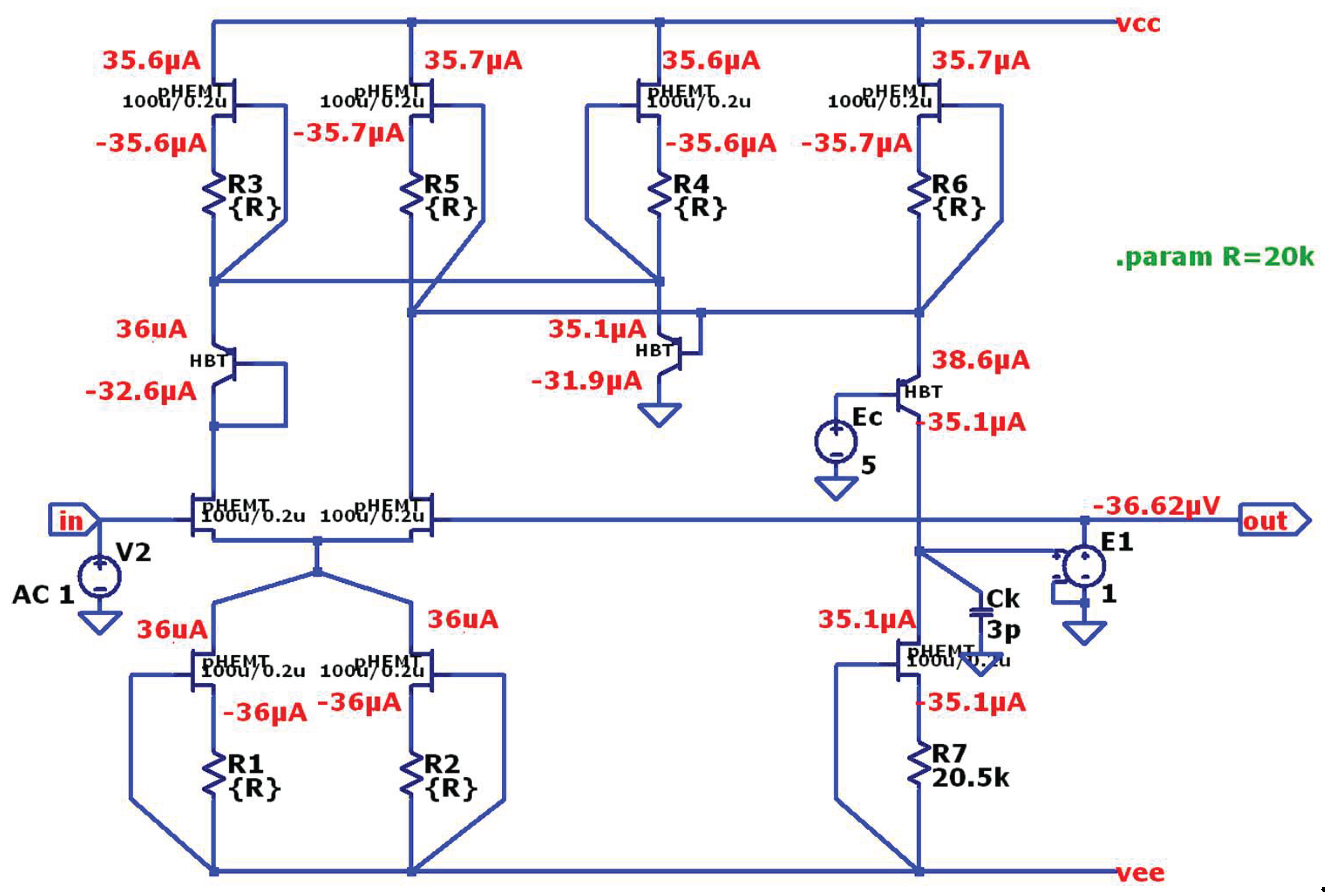
The static mode of the op-amp circuit in Figure 17 in the LTspice environment at R1÷R6 = 20 kOhm, R7 = 20.5 kOhm, Ck = 3 pF, Vc = 5 V, Vs = ±10V is shown in Figure 18.

Figure18. Static mode of transistors Op-Amp in Figure 17.
An analysis of the static mode of the Op-Amp in Figure 18 shows that the transistors of the proposed circuit operate at low currents, which ensures its energy efficiency.
Figure 19 shows the logarithmic amplitude-frequency response (AFR) of the voltage gain coefficient.
16. Conclusion
Recommendations have been developed for the design of a family of high-temperature gallium arsenide operational amplifiers based on an "folded" cascode with one high-impedance node, the circuits of which are based on GaAs nJFET and GaAs p-n-p bipolar transistors. It is shown that due to the rational construction of static mode control circuits, the Op-Amps under consideration can have relatively small values of the systematic component of the zero offset voltage. The proposed Op-Amp circuits are recommended for practical use in analog devices operating at elevated temperatures (up to 250 °C), which is ensured by the use of GaAs transistors.
The research has been carried out at the expense of the Grant of the Russian Science Foundation (project No. 23-79-10069), https://rscf.ru/en/project/23-79-10069/.
References
- Riazantsev, V.; et al. High-Speed Operational Amplifiers Based on GaAs Technology for RF Applications. IEEE Transactions on Microwave Theory and Techniques, 2023. [Google Scholar]
- Panda, S. K.; et al. Low-Noise GaAs-Based Operational Amplifier Design for Space Applications. J. Electron. Mater. 2023, vol. 52(no. 5). [Google Scholar]
- Alim, M. A.; et al. Performance Analysis of GaAs vs. Silicon in Operational Amplifier Design. Int. J. Electron. Commun. Eng. 2022, vol. 15(no. 2). [Google Scholar]
- Razavi. “Design of Analog CMOS Integrated Circuits,” in, 2nd ed.; McGraw-Hill, 2014. [Google Scholar]
- Soltani, et al. High-Speed Operational Amplifier for 5G RF Front-End Circuits. IEEE J. Solid-State Circuits 2020, vol. 55(no. 3), 789–798. [Google Scholar]
- Talegaonkar, M.; et al. Challenges in Designing High-Speed CMOS Op-Amps at Sub-90nm Nodes. In Proceedings of the IEEE International Symposium on Circuits and Systems (ISCAS), 2021; pp. 1–4. [Google Scholar]
- Fresina, M. Trends in GaAs HBTs for wireless and RF. 2011 IEEE Bipolar/BiCMOS Circuits and Technology Meeting - BCTM; LOCATION OF CONFERENCE, United StatesDATE OF CONFERENCE; pp. 150–153.
- Zampardi, P.J.; Sun, M.; Cismaru, C.; Li, J. Prospects for a BiCFET III-V HBT Process. 2012 IEEE Compound Semiconductor Integrated Circuit Symposium (CSICS); LOCATION OF CONFERENCE, USADATE OF CONFERENCE; pp. 1–3.
- Liu, W.; Hill, D.; Costa, D.; Harris, J. High-performance microwave AlGaAs-InGaAs Pnp HBT with high-DC current gain. IEEE Microw. Guid. Wave Lett. 1992, 2, 331–333. [Google Scholar] [CrossRef] [PubMed]
- Peatman, W.; et al. InGaP-Plus™: advanced GaAs BiFET technology and applications. CS MANTECH Conference, 2007; pp. 243–246. [Google Scholar]
- Dvornikov, O. V.; Pavlyuchik, A. A.; Prokopenko, N. N.; Chekhovsky, V. A. “Unified circuit design solutions for analog gallium arsenide chips,” in Izvestiya vuzov. Electronics (in Russian). 2022, Vol. 27(No. 4), 475–488. [Google Scholar] [CrossRef]
- Morris, F. J.; et al. Integrated circuit composed of group III-V compound field effect and bipolar semiconductors. US Patent 5068756, 26 Nov 1991. [Google Scholar]
- Chang, Mau-Chung F.; et al. Planar HBT-FET Device. US Patent 5250826, 5 Oct 1993. [Google Scholar]
- Yang, J.; Morris, F.; Plumton, D.; Jeffrey, E. GaAs BIJFET technology for linear circuits. 11th Annual Gallium Arsenide Integrated Circuit (GaAs IC) Symposium, LOCATION OF CONFERENCE, United StatesDATE OF CONFERENCE.
- Plumton, L.; et al. Method to integrate HBTs and FETs. US Patent 5077231, 31 Dec 1991. [Google Scholar]
- Dvornikov, O.; Pavluchik, A.; Prokopenko, N.; Tchekhovski, V.; Kunts, A.; Chumakov, V.; Mnipi. Probl. Adv. Micro-Nanoelectron. Syst. Dev. 2021. [CrossRef]
- Borkar; Shekhar, Y.; et al. Transistor group mismatch detection and reduction. in Patent US 6272666, 7 Aug 2001. [Google Scholar]
- Hart; Michael, L.; et al. Method and apparatus for compensating for process variations. in Patent US 7453311, 18 Nov 2008. [Google Scholar]
- Horowitz, P.; Hill, W. “The Art of Electronics,” in Third Edition; Cambridge University Press, 2015; p. 1225. [Google Scholar]
Figure 1.
Generalized GaAs operational amplifier circuit based on an "folded" cascode.
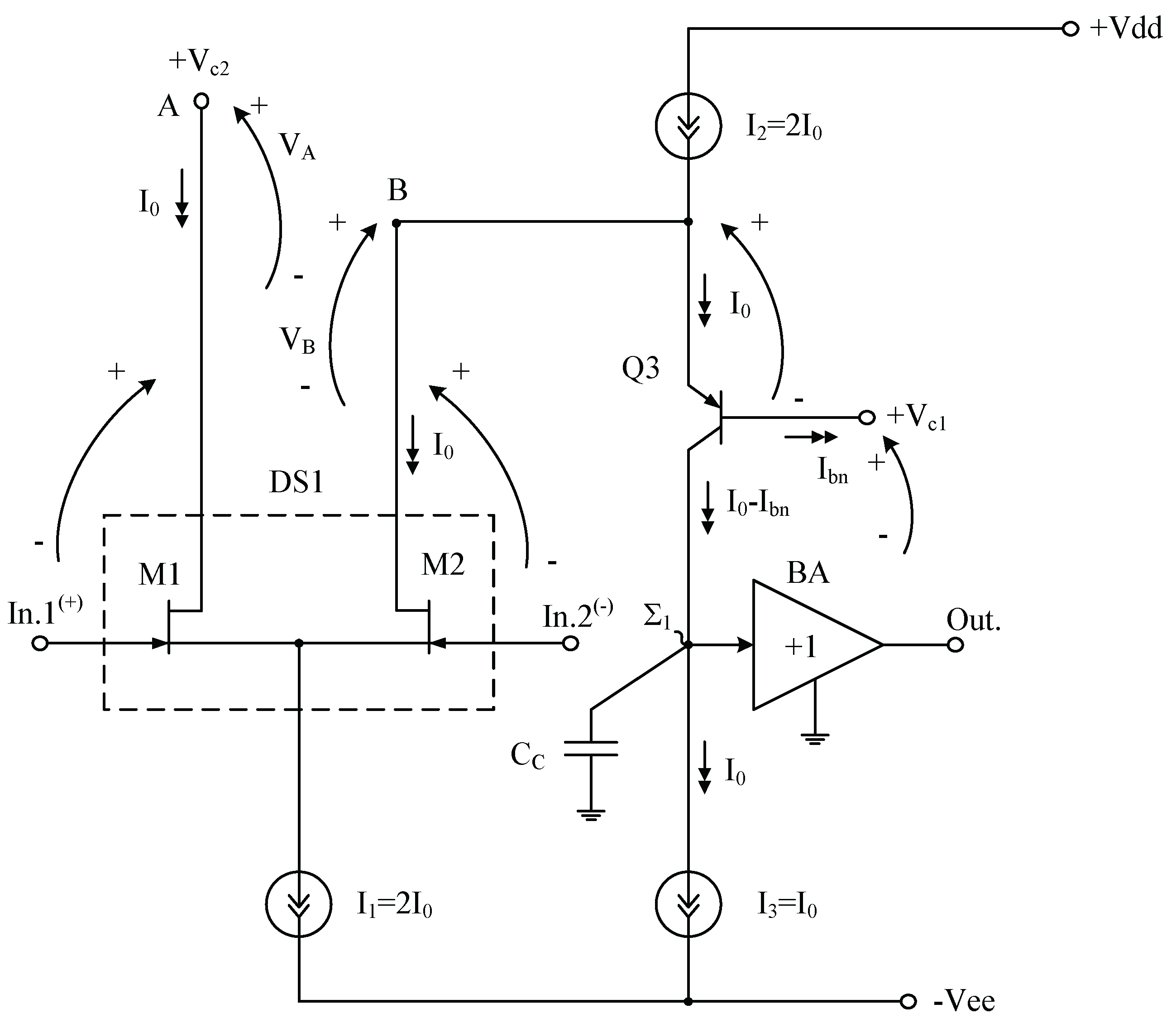
Figure 2.
GaAs operational amplifier with a cascoded differential stage that reduces the effect of internal feedback of transistors M1, M2 on
Figure 2.
GaAs operational amplifier with a cascoded differential stage that reduces the effect of internal feedback of transistors M1, M2 on
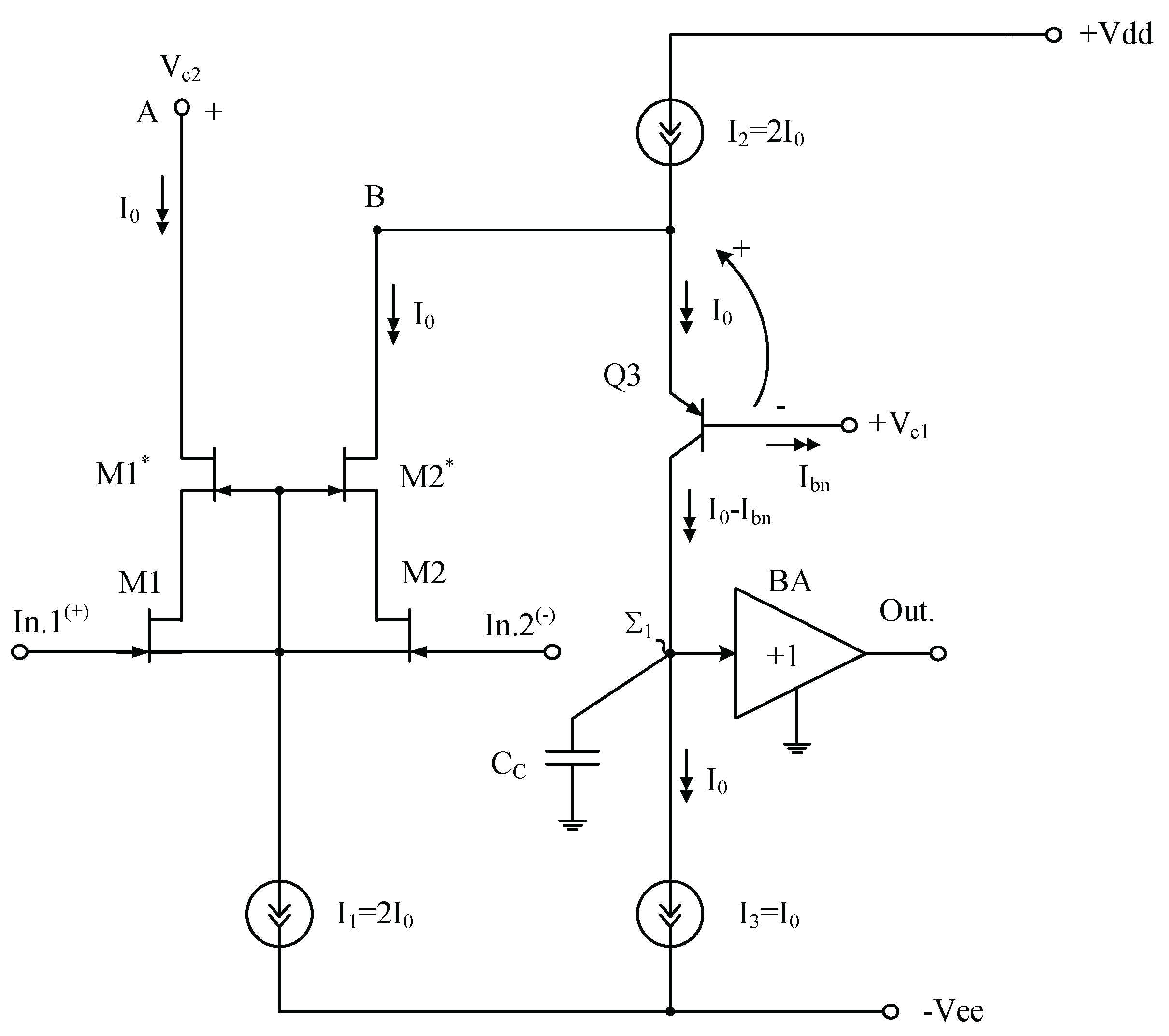
Figure 3.
GaAs operational amplifier with gate-drain static voltage balancing circuit M1, M2, made on Q3 and I4.
Figure 3.
GaAs operational amplifier with gate-drain static voltage balancing circuit M1, M2, made on Q3 and I4.
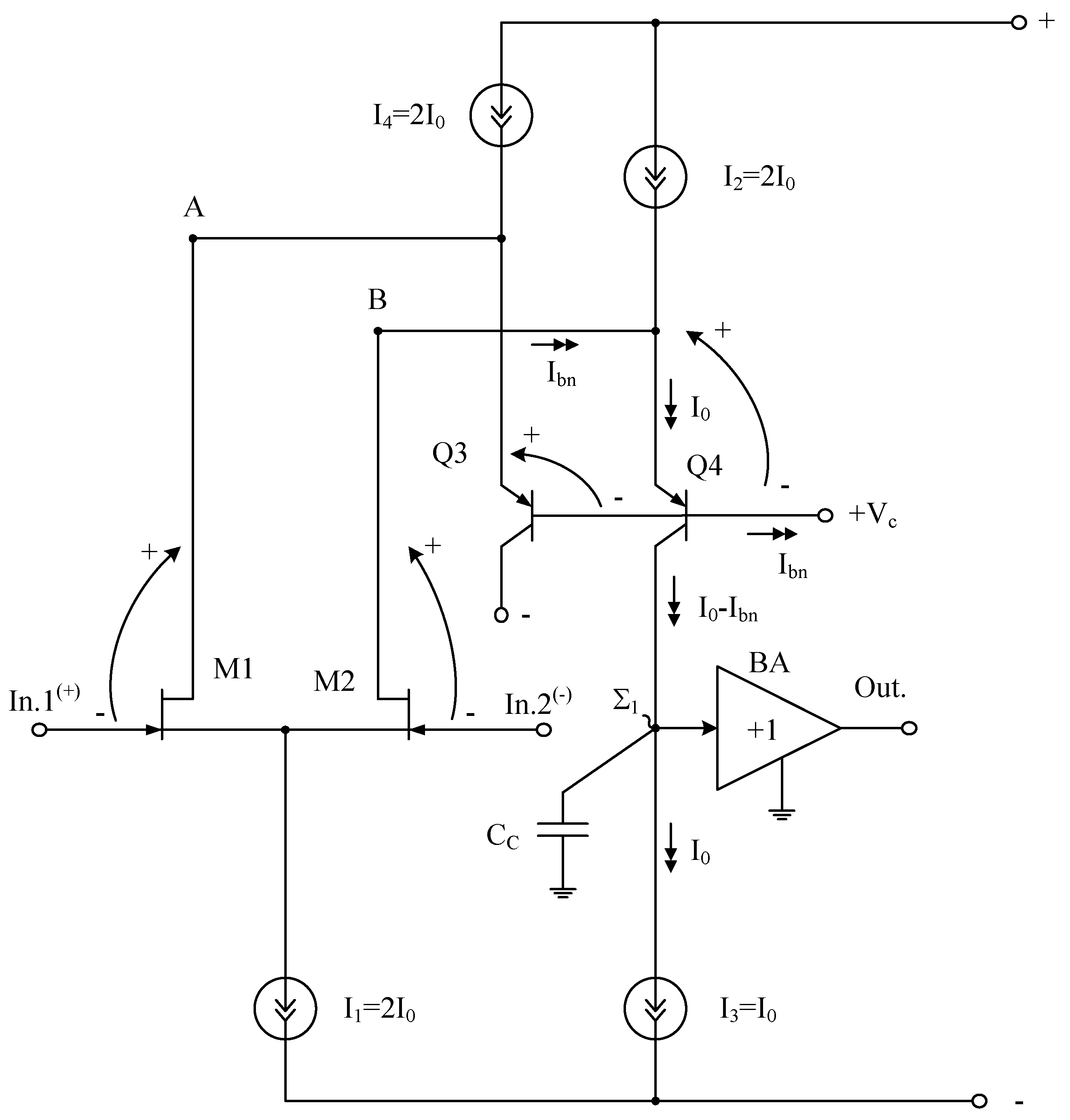
Figure 4.
GaAs operational amplifier with low and
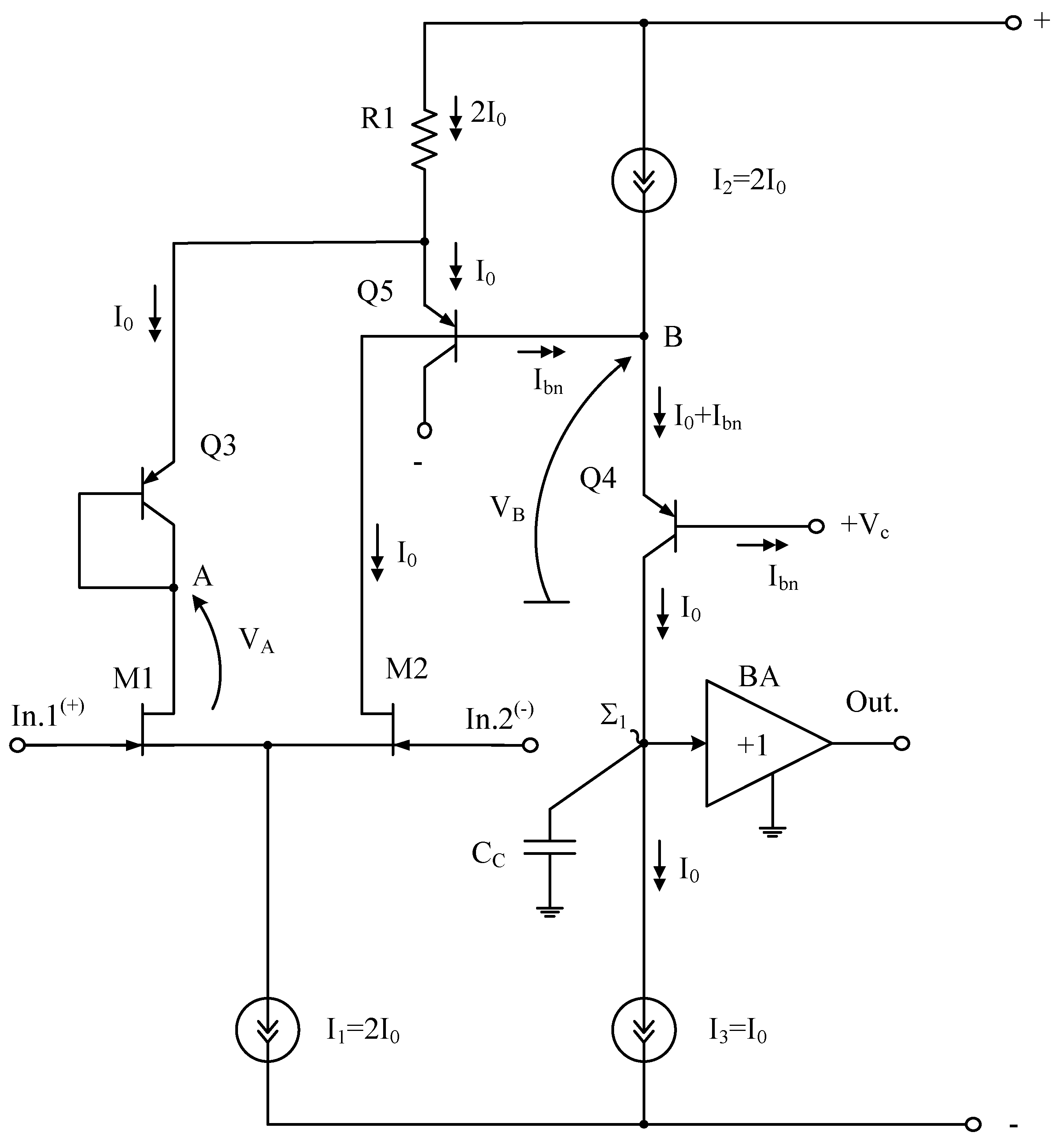
Figure 5.
GaAs operational amplifier.
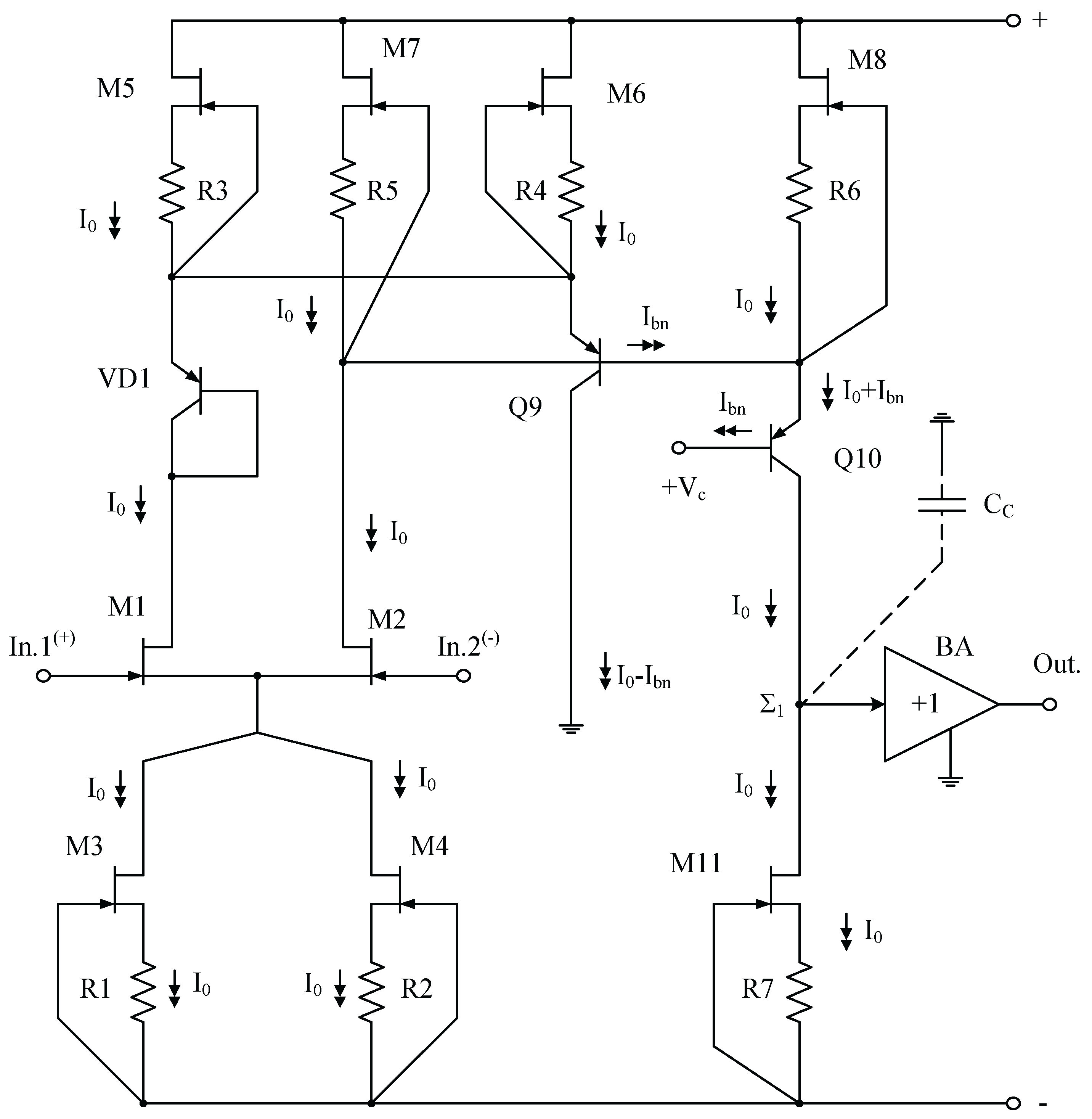
Figure 6.
Practical diagram of a GaAs operational amplifier with low VOS.∑ (1) and increased voltage gain.
Figure 6.
Practical diagram of a GaAs operational amplifier with low VOS.∑ (1) and increased voltage gain.
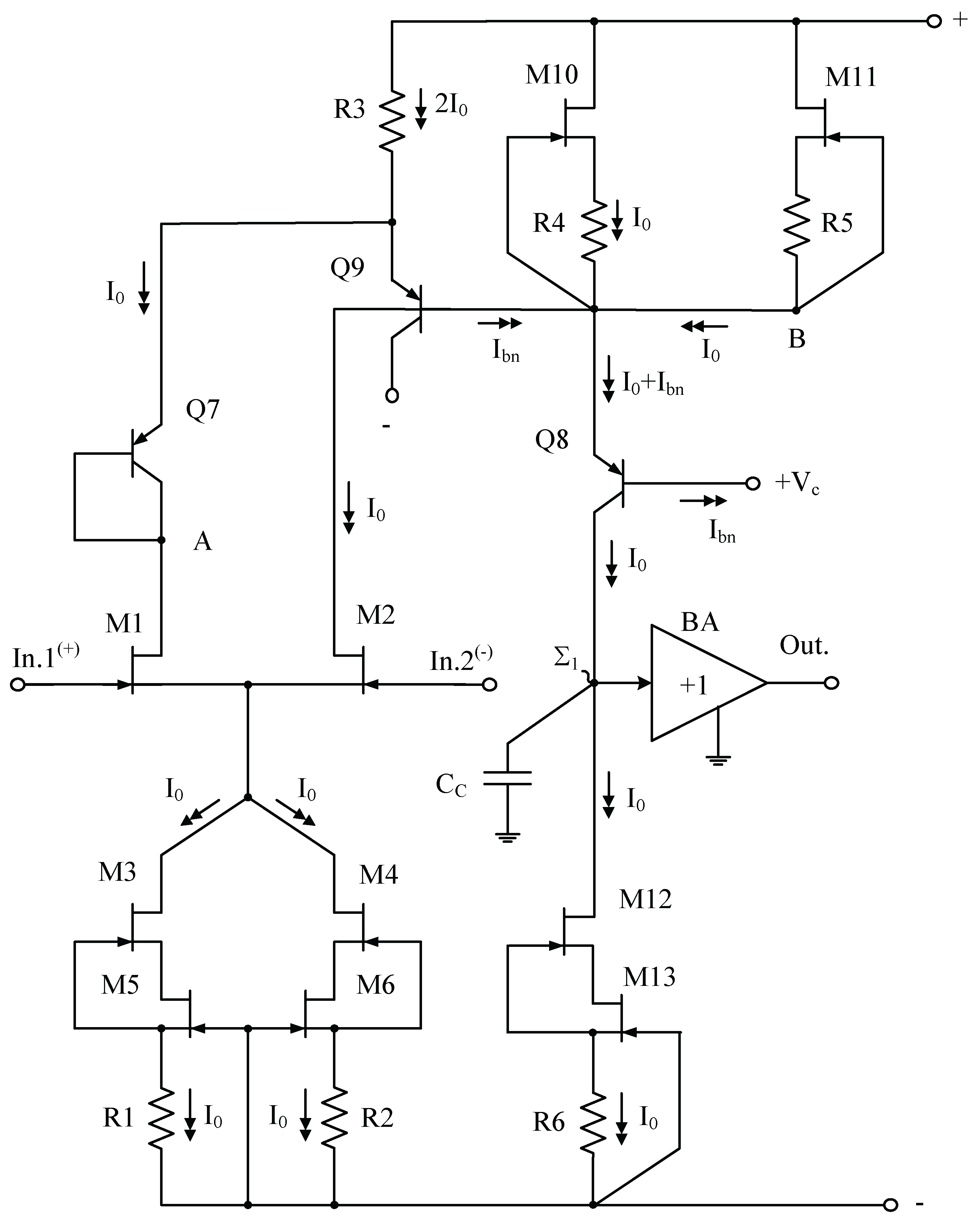
Figure 7.
GaAs operational amplifier.
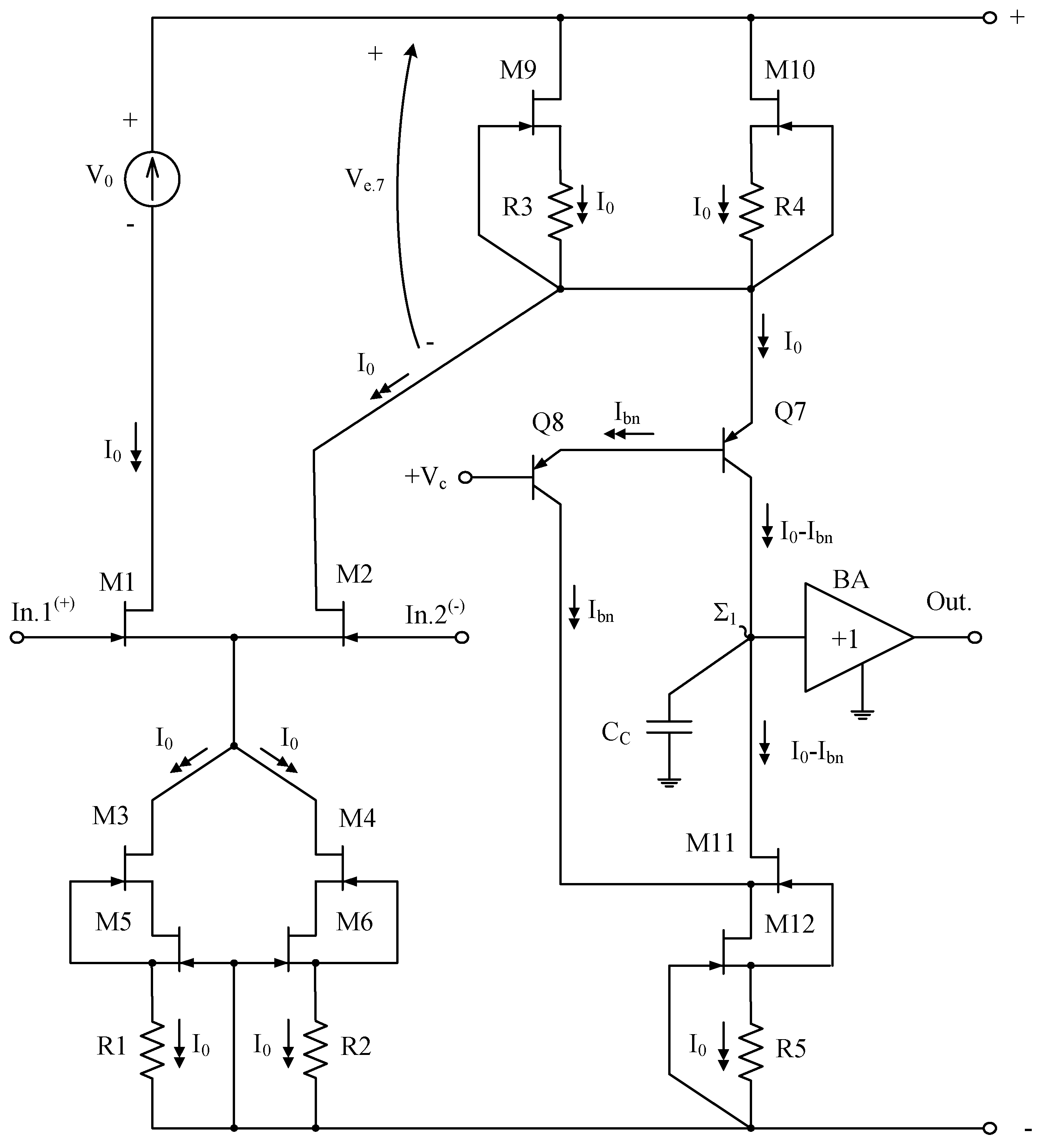
Figure 8.
GaAs operational amplifier.
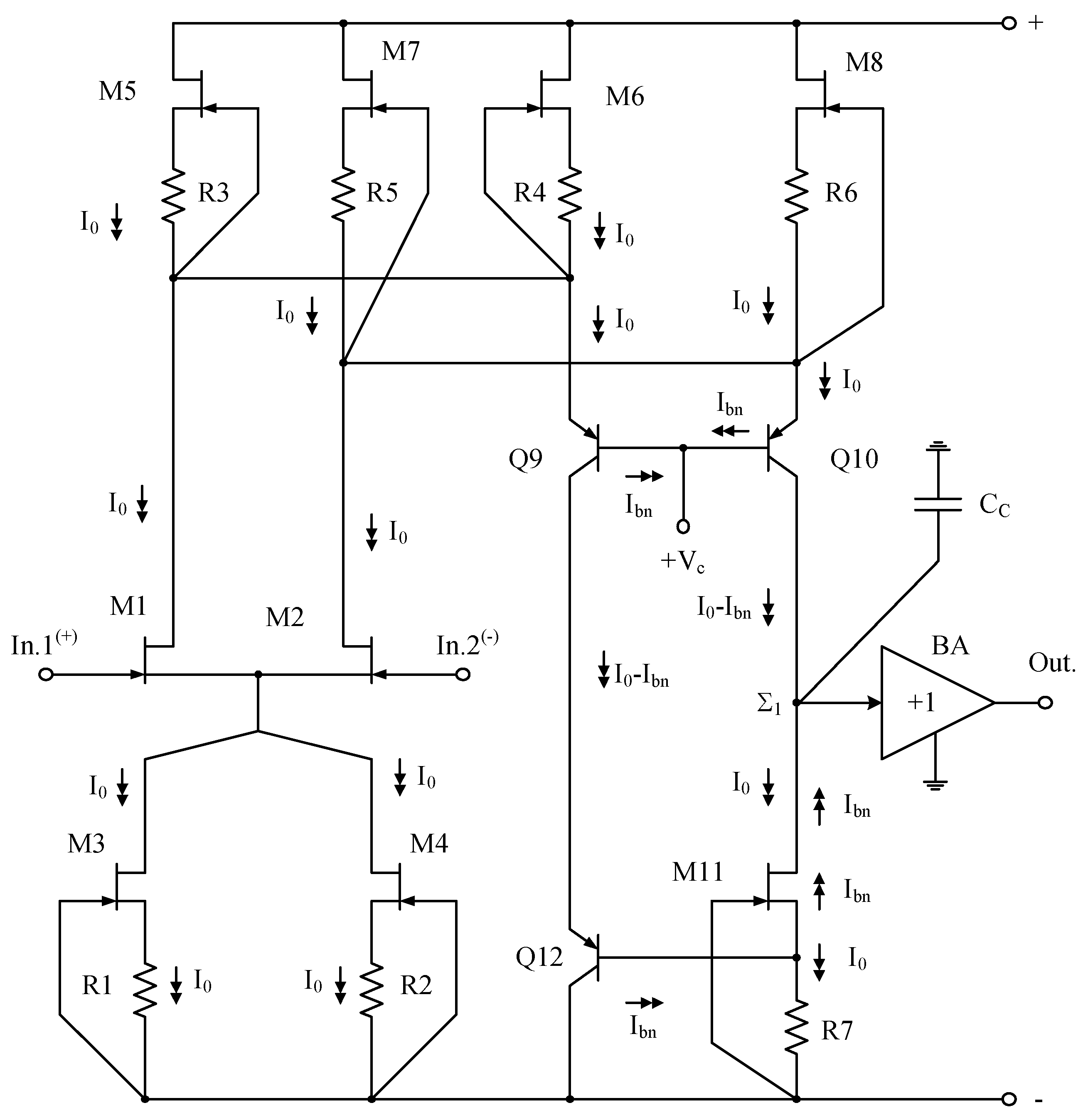
Figure 9.
GaAs operational amplifier.
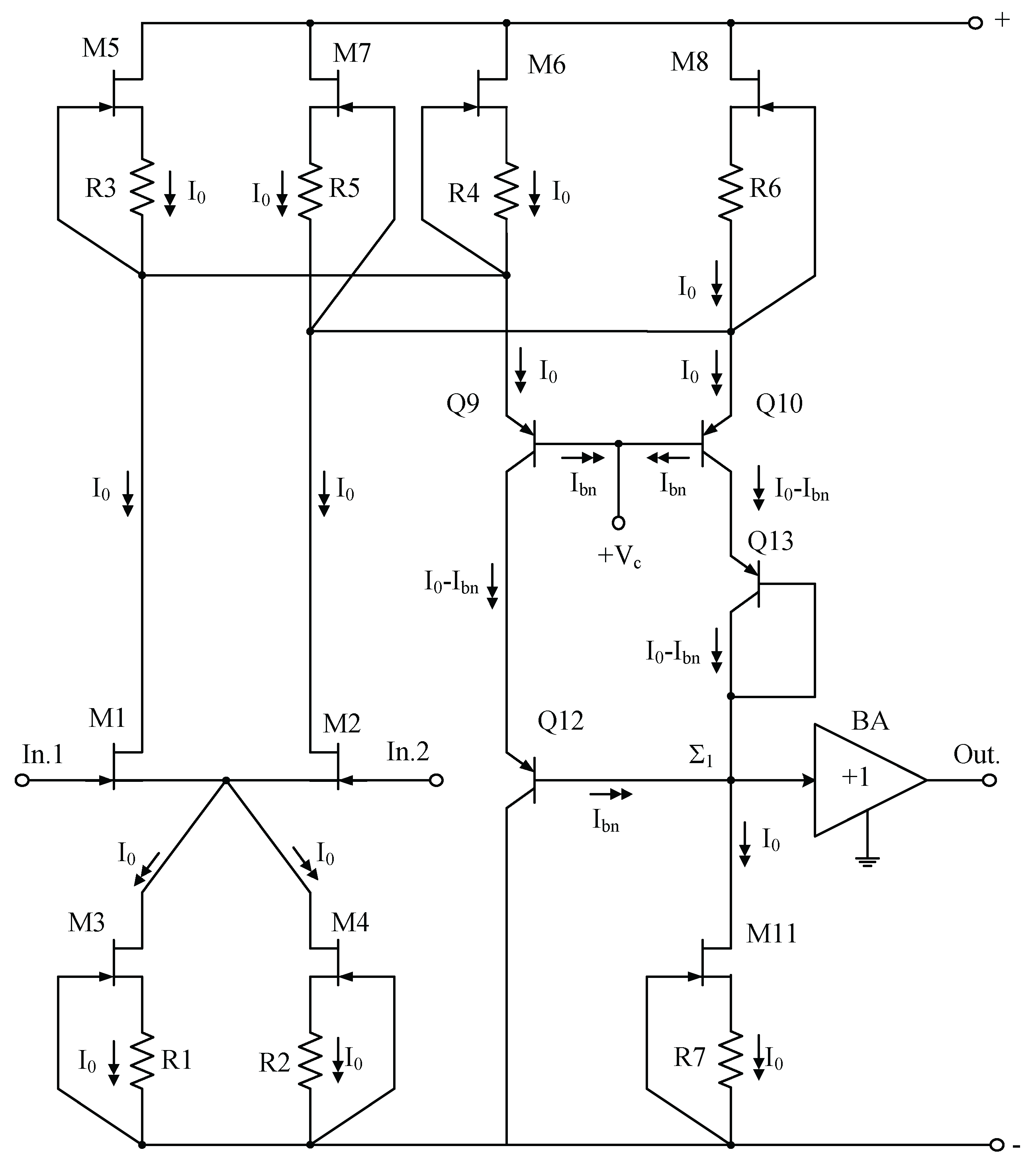
Figure 10.
GaAs Op-Amp based on an "folded" cascode and a Wilson current mirror.
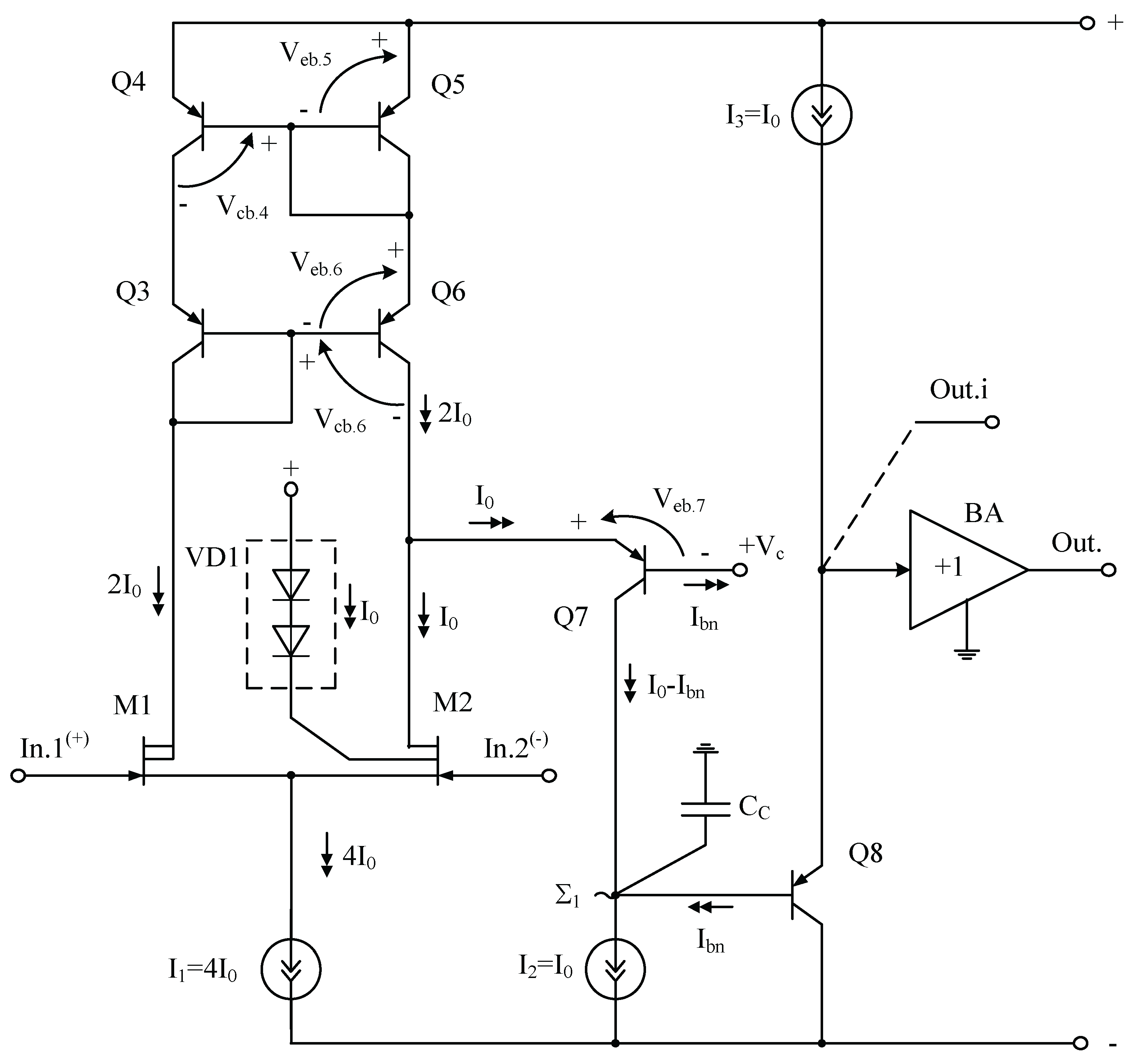
Figure 11.
GaAs Op-Amp c R1=R2=R3=R4=R5.
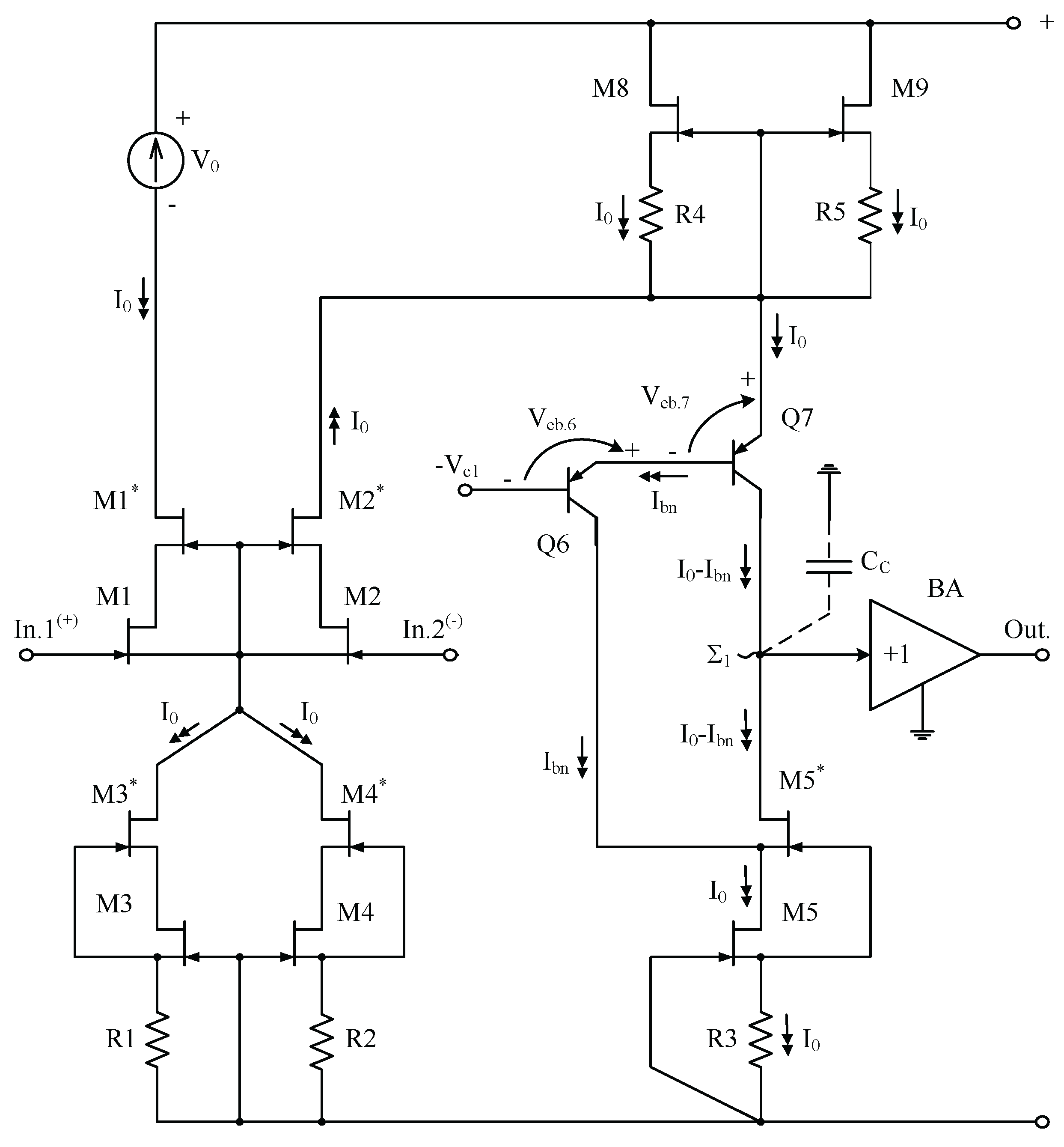
Figure 12.
GaAs operational amplifier with zero offset voltage compensation circuit VOS.3 (1).
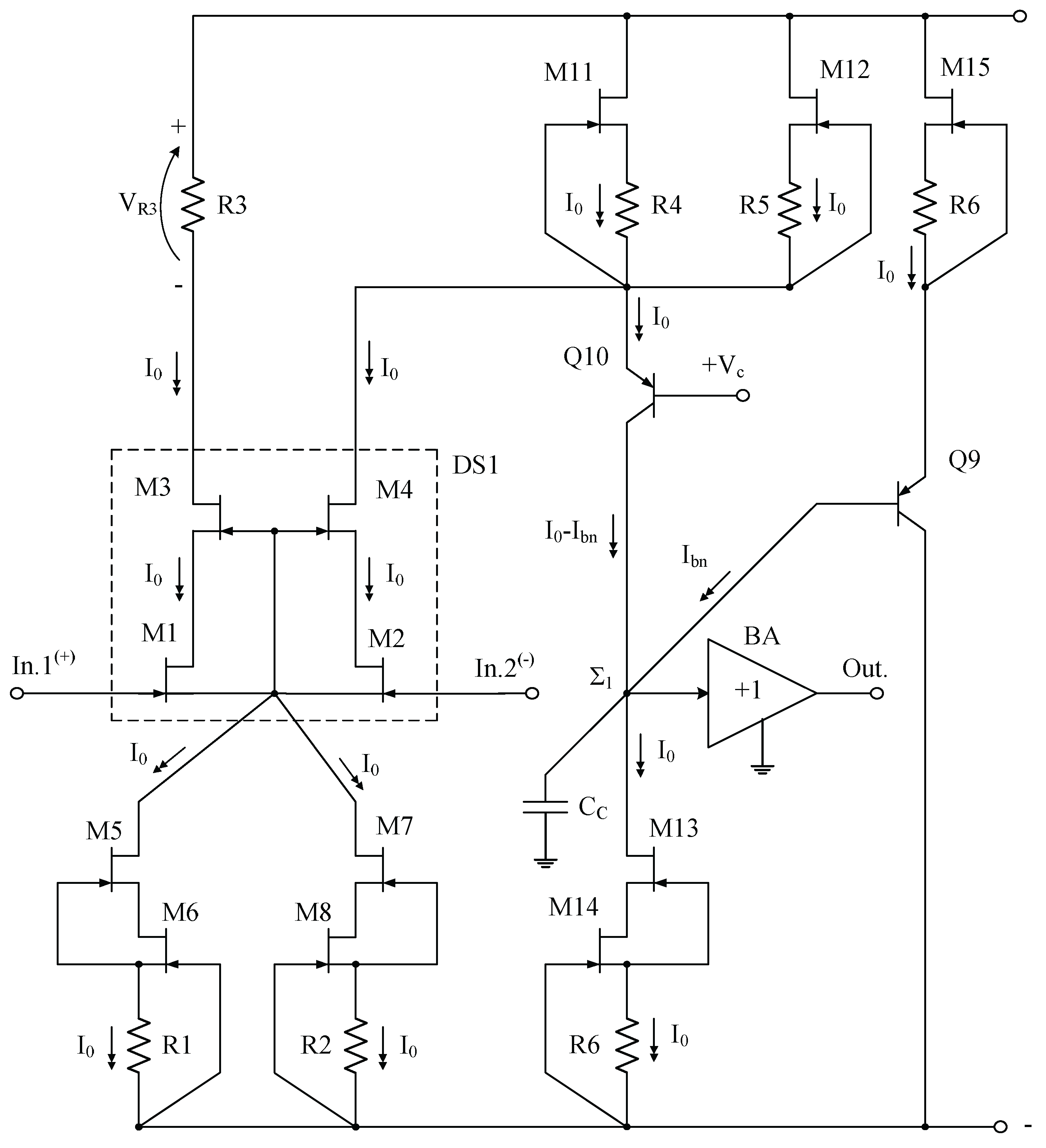
Figure 13.
GaAs operational amplifier with zero offset voltage compensation circuit VOS.3.
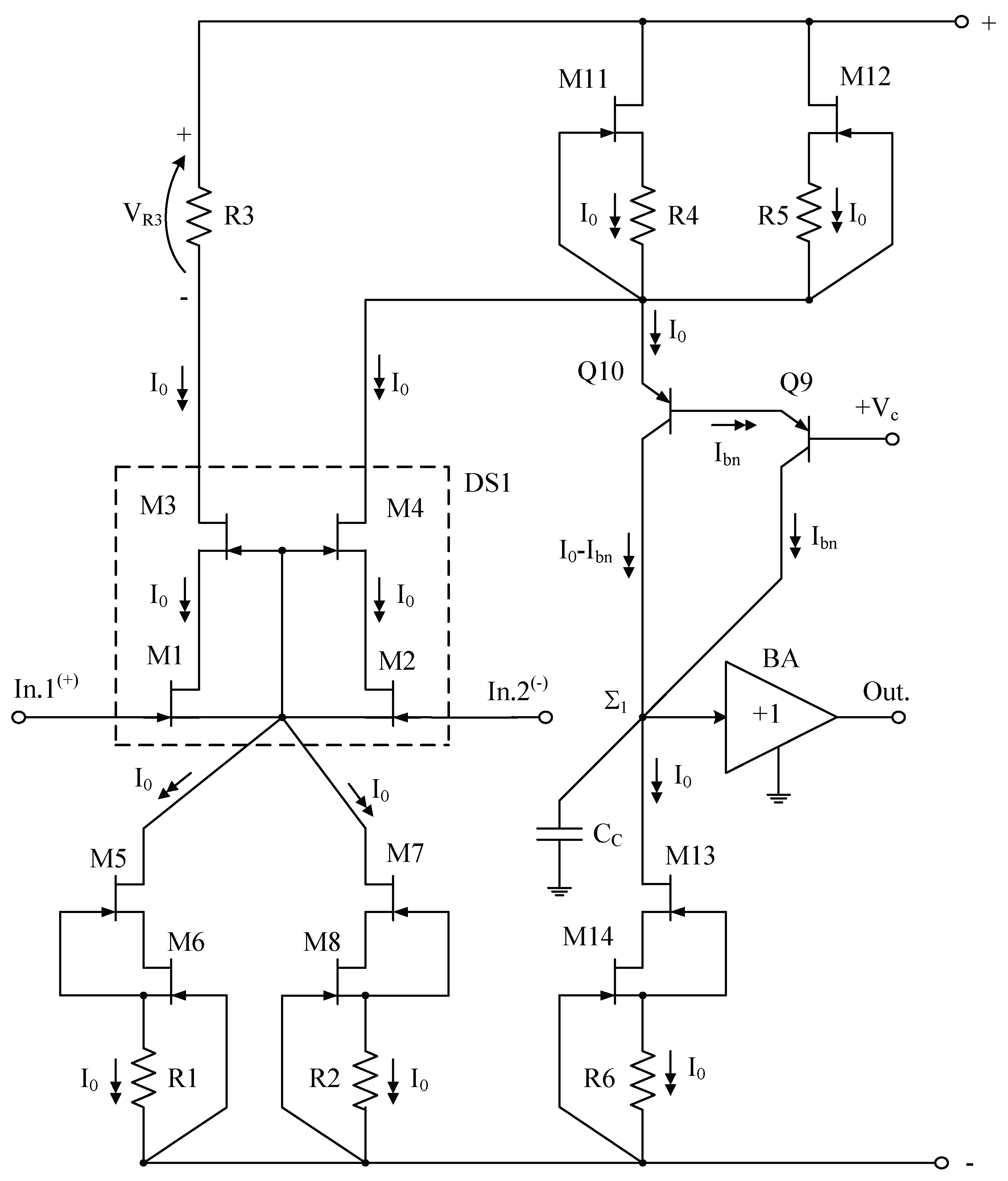
Figure 14.
GaAs operational amplifier.
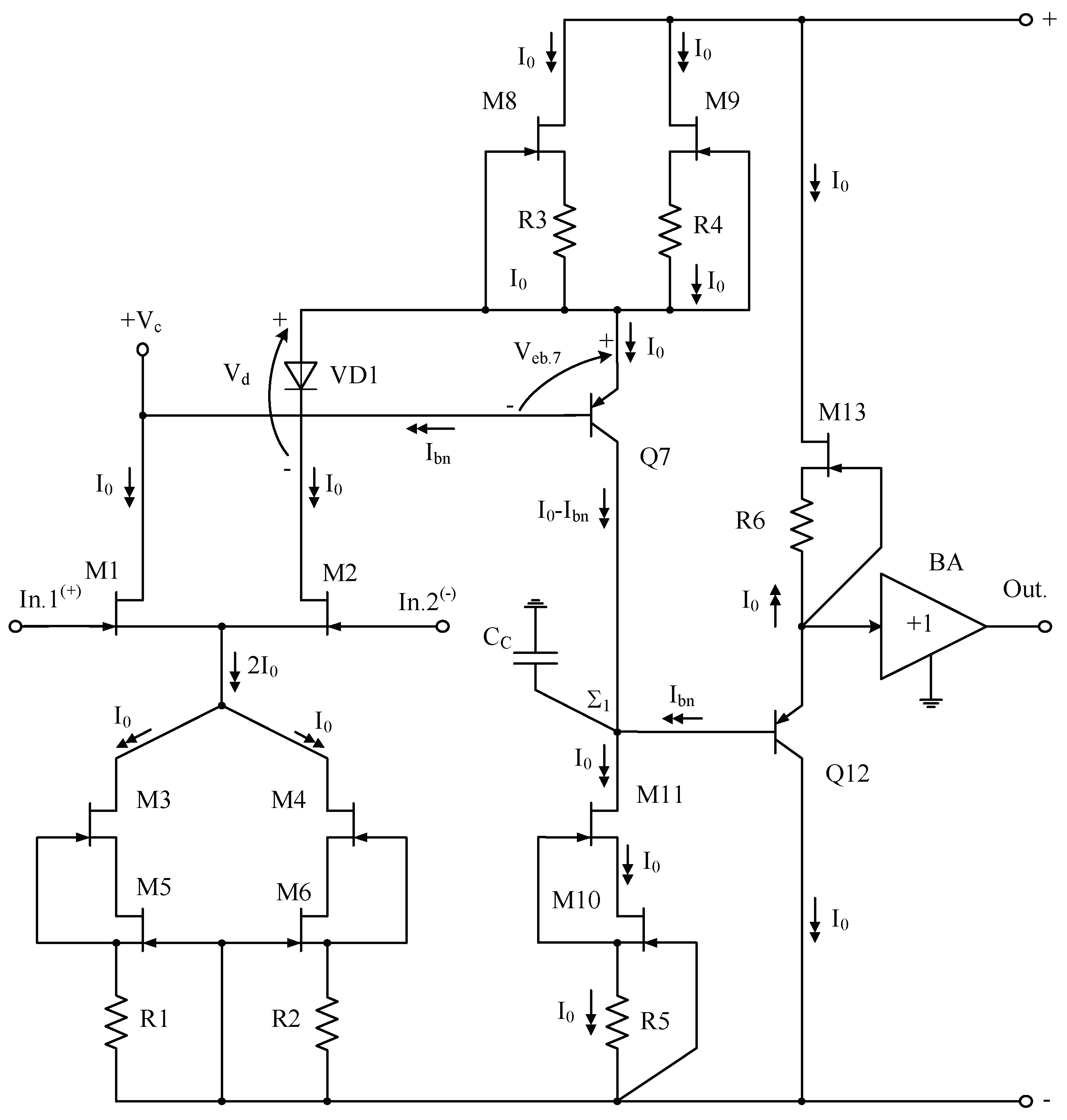
Figure 15.
GaAs operational amplifier.
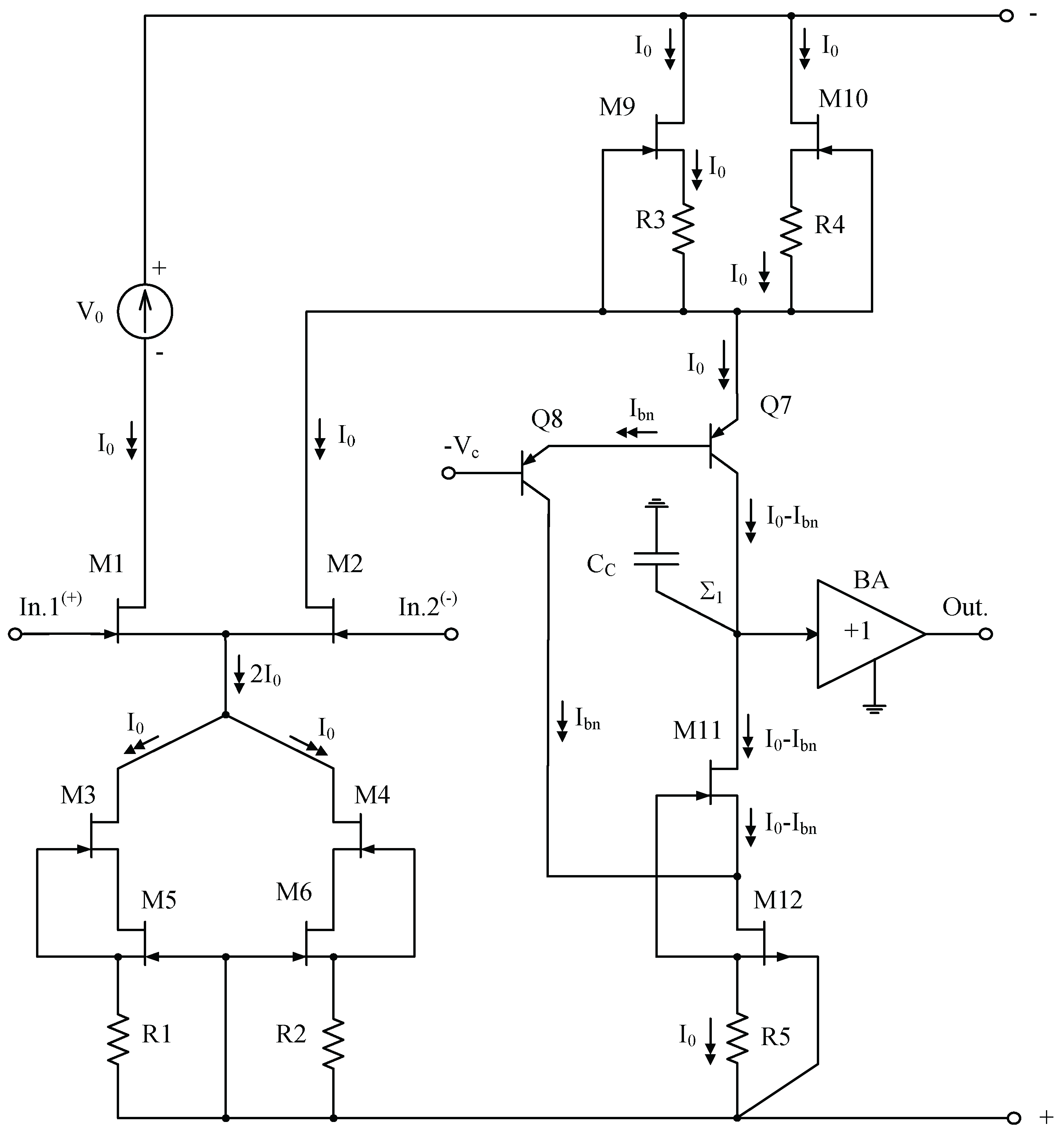
Figure 16.
GaAs operational amplifier with small VOS.
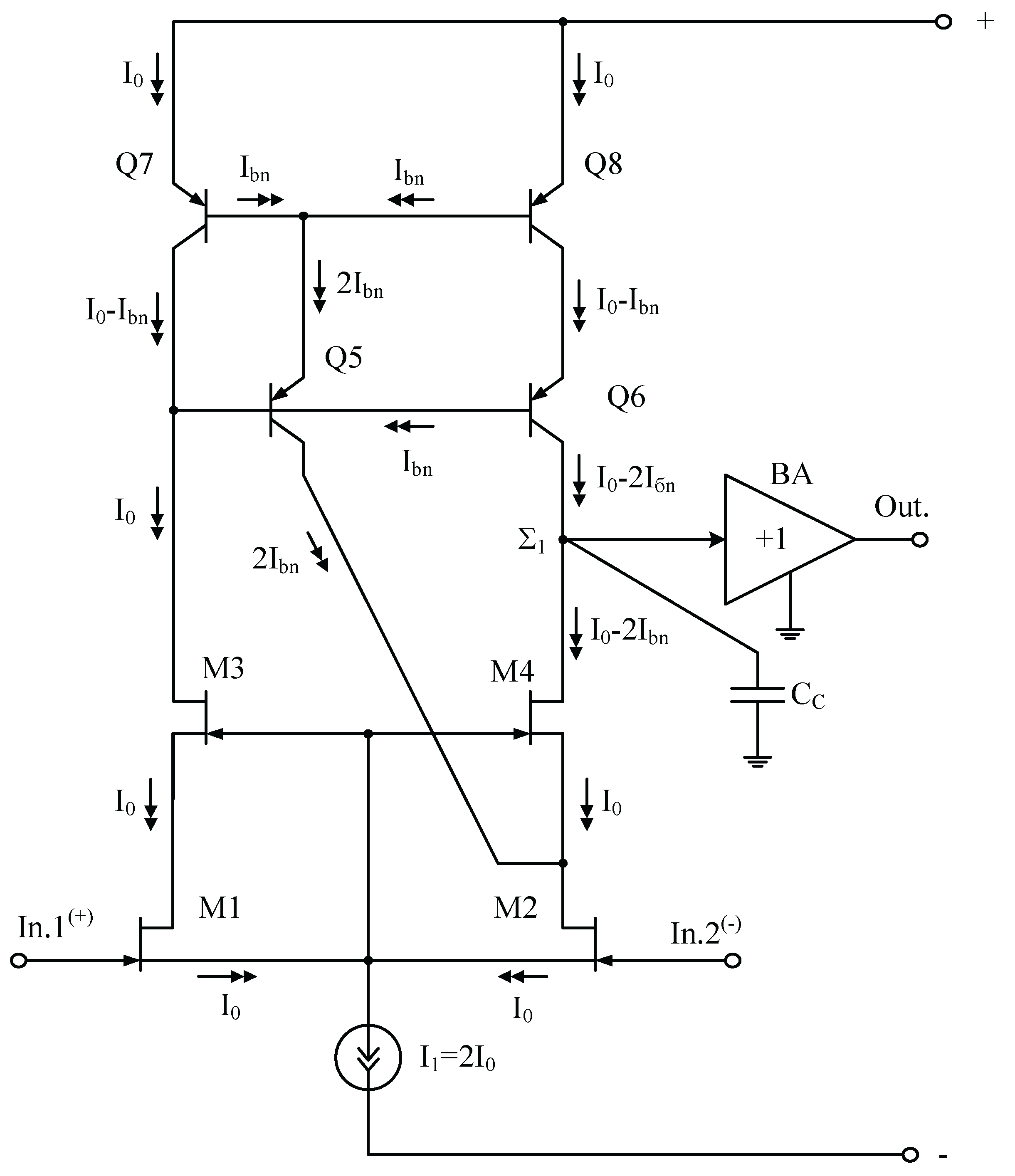
Figure 17.
GaAs operational amplifier.
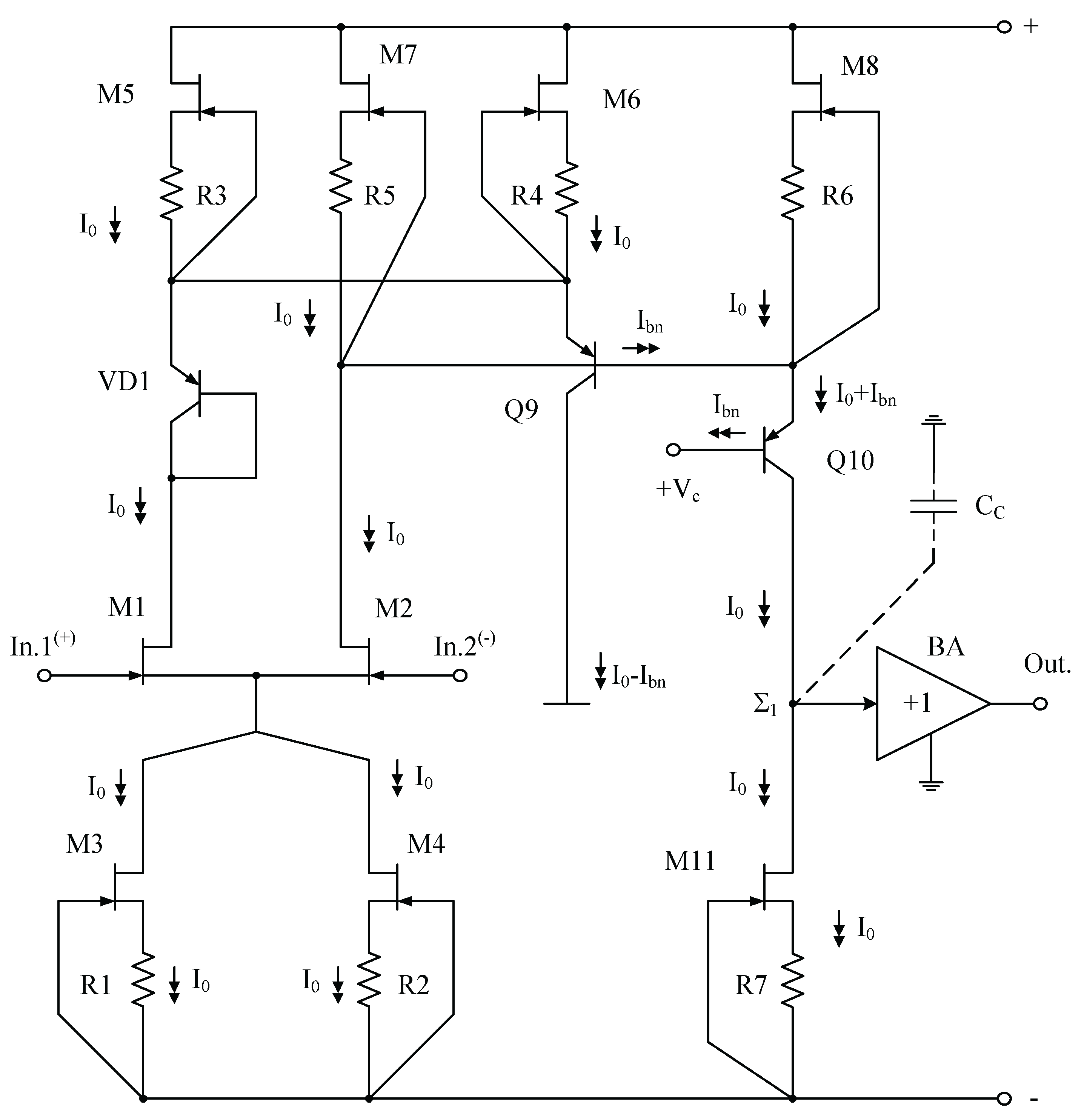
Figure 19.
Logarithmic amplitude-frequency response of the amplifier voltage gain in Figure 18.
Disclaimer/Publisher’s Note: The statements, opinions and data contained in all publications are solely those of the individual author(s) and contributor(s) and not of MDPI and/or the editor(s). MDPI and/or the editor(s) disclaim responsibility for any injury to people or property resulting from any ideas, methods, instructions or products referred to in the content. |
© 2026 by the authors. Licensee MDPI, Basel, Switzerland. This article is an open access article distributed under the terms and conditions of the Creative Commons Attribution (CC BY) license.
Copyright: This open access article is published under a Creative Commons CC BY 4.0 license, which permit the free download, distribution, and reuse, provided that the author and preprint are cited in any reuse.


