

Submitted:
23 April 2026
Posted:
24 April 2026
You are already at the latest version
Abstract
Salinity represents a critical agricultural threat that reduces the productivity of several crops. Tomato (Solanum lycopersicum), recognized as the world´s second most significant horticultural commodity globally, is salt-sensitive. This research evaluated seed priming treatments (hydro, halo, bacterio, and halo-bacterio) at different phenological stages under two salinity conditions (0 and 16 mM NaCl) as a biotechnological alternative to mitigate salt stress and increase production. Using physiological variables and multivariate statistical analyses, this research demonstrated that priming treatments modified the physiological, nutritional, and productive metabolism of tomato plants. Bacteriopriming, using an endophytic and halophytic bacterial consortium isolated from halophytes, enhanced germination variables and N, P, Ca and Zn absorption in seedlings. In the vegetative and reproductive stage and under stress, halo-bacteriopriming consistently enhanced concentrations of K, Mg, and Zn in leaves and fruits, but decreased Na absorption. This nutritional balance allowed not only a higher concentration of chlorophyll but also a significant increase in yield and beta-carotene concentration in tomato fruits. For the first time, this research demonstrated that the halo-bacteriopriming with this kind of bacteria is a biotechnological strategy to mitigate saline stress, optimizing not only tomato growth, but also its nutraceutical quality. It significantly outperformed the plant response in all stages of development compared to those from control, hydro, and halo-primed treatments.
Keywords:
bacteriopriming
; beta-carotene
; biofortification
; blossom-end rot
; functional food
; halophytes
; halopriming
; plant-growth promoting bacteria
; salt tolerance
; Solanum lycopersicum
1. Introduction
Currently, 70% of freshwater extracted from aquifers, streams, and lakes is used for irrigated agriculture [1], which supplies 60% of the food consumed globally [2]. Population growth demands more food, and agricultural production must increase [3,4]; however, climate change exacerbates freshwater scarcity due to aquifer overexploitation and salinization from seawater intrusion [5]. The use of poor-quality or high-salt content water for crop irrigation induces saline stress in plants and can reduce yields by 50%. Consequently, salinity and drought are the most damaging and widespread abiotic factors globally limiting agricultural production [6,7] and threaten food security and livelihoods [8].
Several strategies are analyzed to address the food security crisis and meet demand in foreseeable scenarios, such as a growing population (10 billion people by 2050) and global climate change, which induce salinity-plant stress [9,10]. Many agricultural species are glycophytes that tolerate low salt concentrations, but salinity can be modified through agronomic management practices and soil amendments such as biochar or gypsum [11,12]. Alternative genetic approaches may also create salinity-resistant plants and increase the productivity of glycophyte crops through traditional genetic breeding, genetic engineering (transgenesis), and molecular dissection (including gene editing, such as CRISPR/Cas9). However, all methods for enhancing salinity tolerance require different implementation times; for example, cross-breeding between 8 and 12 years, transgenic breeding of 6 - 10 years, and genome editing of 4 - 6 years [10,13,14,15,16,17]. Grafting, hybridization, and protoplast fusion using halophytes are also under development [18]. Halophytes can thrive in high salt concentrations, but they only comprise a small proportion (1% to 2%) of all terrestrial plants [18,19].
There are studies with other effective strategies to enhance plant salt tolerance. In general, priming of seeds or seedlings is a fast, practical, and economical strategy to enhance plant salt tolerance [20,21,22]. However, some options may be expensive, vary in efficacy in crop species, and have environmental impacts [15]. Zhou et al. [16] argued that seed priming is a sensitization of the plant to impending stress conditions, with specific signals occurring to enhance plant physiological and biochemical responses. Examples of primers (priming agents) include water, salts, phytohormones, reactive agents, osmoprotectants, physical and physico-chemical primers, nanoparticles, and even plant growth-promoting bacteria (PGPB), as summarized by some authors [20,21,23,24,25,26,27]. The combined study of several seed-priming agents to improve salt tolerance is scarce [26].
Microorganisms with plant growth-promoting traits are recognized as the second genome of plants. They enhance plant growth and fitness in normal conditions. Remarkably, with a multifaceted set of mechanisms, these beneficial microorganisms also mitigate the negative effects of salinity stress. Therefore, these soil microorganisms may be highly valuable for agriculture under salt-affected conditions and their concomitant impact on global food security [15]. In particular, PGPB are a promising, sustainable, and environmentally friendly approach for enhancing plant tolerance to salinity in glycophytes and even in halophytes [15,19,28,29,30]. The study of microorganisms isolated from the rhizosphere of several glycophytes has received much attention, and next, from the root endosphere. However, the cultivable root endophyte microorganisms inhabiting halophytes still are limited [19,30,31,32,33,34]. Biopriming with endophytic microorganisms, which edge into the rhizosphere, provides sufficient time for them to enter and colonize the seed [35]. This alternative may have broad application prospects in agriculture [19,29], where irrigation water is mixed with brackish water, or it is already saline. This practice occurs in many places due to insufficient rainfall/precipitation or limited water supplies [36]. Some authors have reported that halophytes' adaptation to harsh salt conditions is associated with highly specific salt-tolerant microorganisms colonizing their roots [31,37]. On one hand, Barajas-González et al. [31] and He et al. [19] isolated endophytic bacteria from the roots of dominant halophytes. These authors agreed that the use of these bacteria, particularly when applied as a consortium, holds promise for mitigating saline stress in glycophytes. Moreover, He et al. [19] evaluated their effects on germination and wheat seedlings growth under salt stress (50 and 100 mM for germination, and 100 and 200 mM NaCl, respectively). These authors observed that bacterial inoculation improved the rate and potential of seed germination. Moreover, alleviating salt stress in wheat seedlings by reducing several enzyme activities linked to reactive oxygen species.
On the other hand, tomato (Solanum lycopersicum) is the second most important horticultural crop worldwide [38]. Mexico is the world´s eighth-largest tomato producer and leads in its exportation [39]. Moreover, 70% tomato production is under protected agriculture (greenhouses, shade nets, macro-tunnels), which uses high-tech irrigation and is becoming the primary driver of production. However, this crop is a glycophyte, meaning it is moderately sensitive to salinity, which affects growth, physiology, yield, and even early plant death [40,41].
This research aimed to evaluate four priming treatments (hydro, halo, bacterio, and halo-bacteriopriming) on tomato seeds and to analyze their performance at different plant stages, including fruit production and quality under two salt conditions (0 and 16 mM NaCl). These conditions are similar to those in commercial-scale greenhouse production using irrigation water (16 mM NaCl) in different semiarid regions. Salinity is a key abiotic stressor that negatively affects plant physiology differently at seed germination, growth, development, yield, and fruit quality [10,15]. Deanda-Tovar et al. [39] observed that the response to salt stress varied in the tomato plant developmental stages. For this reason, this study analyzed salt-stress mitigation in tomato from germination through production to better understand seed priming treatments across different plant development stages. Although seed priming has tested various alternatives, little research has combined halo- and bacteriopriming, and there is limited use of bacterial consortia with complementary outstanding biochemical properties, such as PGPB. The use of endophytic bacteria isolated from halophytes, salt-tolerant (halophilic) with PGPB traits, has received less attention. In this research, bacteriopriming refers to the use of specific bacteria, whereas biopriming, a more generic term, may also involve fungi or other biological agents.
2. Materials and Methods
2.1. Seed priming and germination tests
Tomato seeds (Solanum lycopersicum var. Samantha) were used in this research. First, seeds were superficially disinfested with 70% ethyl alcohol for 5 min, followed by three washes with sterile distilled water. The excess of water was removed with sterile filter paper. Second, seeds received one of the five priming treatments: 1) none (control), 2) hydropriming, 3) halopriming, 4) bacteriopriming, and 5) halo-bacteriopriming. Hydropriming consisted of seed embedding in sterile distilled water. Halopriming involved seed imbibition in a sterile 80 mM NaCl aqueous solution. Bacteriopriming used a suspension of a selected bacterial consortium for imbibition, and halo-bacteriopriming combined halo and bacteriopriming.
The bacterial consortium consisted of five endophytic root bacteria that tolerated more than 2.5 M NaCl and had plant-growth-promoting traits. More information on the bacteria's origin and their outstanding properties can be reviewed [31]. The consortium was composed of Bacillus paralicheniformis, B. velezensis, Halobacillus sp., Billgrantia sp. (previously named Halomonas), and Bacillus sp.
Seeds were bacterioprimed with both bacteria was carried out according to what was described by Singh et al. [42]. The bacteriopriming suspension was prepared as follows: Each bacterium was separately grown for 48 h in LB broth at 28 °C and 120 rpm. Each bacterial culture was adjusted to 106 UFC (absorbance 0.5 at 600 nm). To obtain the consortium, 2 mL of each adjusted bacterial culture was vortexed and centrifuged (10,000 rpm for 10 min). The bacterial pellet was suspended in 10 mL of 10 mM phosphate buffer (pH=7). For the halo-bacteriopriming solution, instead of phosphate buffer, an 80 mM NaCl solution was used to suspend the bacterial pellet prepared as already mentioned.
For each of the priming treatments and for triplicate, 20 tomato superficially disinfested seeds were placed into 50 mL Falcon tubes and embedded separately for 30 min at 30 rpm. The excess solution in the seeds was removed with sterile filter paper, and the seeds were dried to constant weight and conserved until germination and growth tests.
Seeds were germinated on sterile, moist filter paper in a UV-sterile, transparent plastic box. Seedlings were watered every 3 d with sterile distilled water and incubated at 28 °C in the dark. Germination was evaluated daily for 6 d [43]. When the radicle reached at least 2 mm, germination was evaluated according to Kader, [44]. Moreover, average germination time (MGT), germination rate index (GRI), and germination uniformity coefficient (CUG) were also evaluated.
According to Ellis and Roberts [45], MGT was calculated using the following formula:
N = number of seeds germinated each day; d = number of days since the start of the test and N = total number of seeds germinated at the end of the experiment.
For GRI calculation ((% day-1), the following formula was used Esechie [46]:
G1 = germination percentage on the first day after sowing, G2 = germination percentage on the second day after sowing… Gn = germination percentage on the n day after sowing.
The CUG was determined according to Bewley and Black [47] using this formula:
Where GP is the germination percentage
2.2. Tomato Seedlings Evaluation
After seed germination (6 days after sown; das), the seedlings were transferred to 200-cavity trays containing sterile peat moss:vermiculite (3:1 v/v). The seedlings were kept to 16/8 h light/darkness photoperiod at 28 °C for 3 weeks. Every 3 days, the seedlings were watered with 50% Steiner nutrient solution (NO3)- = 6, (PO4)3- = 0.5, (SO4)2- = 3.5, K+ = 3.5, Ca2+ = 4.5, and Mg2+ =1 (meq L-1) and pH between 5.0 and 5.5 during the whole seedlings' growth. At 20 das, the vigor (V), fresh weight, root length, and foliar nutrient concentration were evaluated in four seedlings randomly taken from the trays.
V was calculated according to Vashisth and Nagarajan [48] by using the following formula:
V = Germination percentage x seedling length
(root + shoot)
Four seedlings (22 das) of each treatment were washed with running water to eliminate adhering substrate in the root system. Excess water was removed with a paper towel, and fresh weight (shoots and roots) and root length were measured. For the nutrient concentration, leaves were dried for 72 h at 60 °C, and then ground. 0.5 g was digested with a mixture of de HClO4 and H2SO4 (1:4) in an open system. Foliar concentrations of macro (N, P, K, Ca, Mg) and micronutrients (Zn, Cu, Mn and Fe) were quantified. Concentration of Ca, Mg, Zn, Cu, Mn, and Fe were analyzed in an absorption atomic spectrometer [49]. K was analyzed by flame photometry [50]. The concentration of P was determined using the ammonium molybdate blue method [51]. N was analyzed by Kjeldahl method [52].
2.3. Tomato Evaluation at Vegetative State
Two simultaneous experiments were performed to evaluate the effect of seed priming treatments in adult tomato plants (at vegetative and reproductive stages). These two experiments corresponded to the analysis of tomato plant behavior under normal (0 mEq NaCl) and salt-stress conditions (16 mM NaCl), respectively. The experiments were performed under similar commercial production conditions in a greenhouse with relative humidity (70% to 75%) and temperature between 30 °C and 35 °C [53].
Seedlings (28 das) from seeds treated with seed priming were used in these two experiments. Seedlings were selected by uniform shoot height (15 cm). Each plant was transplanted into a plastic bag (35 cm x 35 cm x 35 cm) containing 9 kg of a mixture of red tezontle sand (volcanic rock) with a grain size of 1 to 7 mm, and coconut fiber in 3:1 proportion [54].
In the experiment 1, tomato seedlings were irrigated with 100% Steiner nutrient solution modified [55], with the following composition (mEq L-1): 12 (NO3)-, 1 (H3PO4)-, 3.5 (SO4)-2, 7 (K)+, 4.5 (Ca)2+ y 2 (Mg)2+ y microelements (mg L-1): Fe2+ (1.5), Mn2+ (0.6), Zn2+ (0.2), B (0.5), Cu2+ (0.15) y Mo2+ (0.05), pH 6.1 and electrical conductivity (EC) 2.5 dS m-1. It is relevant to mention that this normal nutrient solution has an EC close to the threshold for yield reduction [56]. These authors emphasized that yield losses are expected even with a small salt addition in the nutrient solution. In experiment 2, plants were irrigated with the same nutrient solution but supplemented with 16 mEq NaCl (16 mM) and EC of 3.5 2.5 dS m-1. Both experiments were established under a completely randomized factorial design with eight replicates. All treatments received fertigation (150 mL of nutrient solution) eight times per day for 1.3 min each one.
50 days after transplanting (dat), the following variables were analyzed: height, stem diameter, internode length [57], photosynthetic pigments [58], proline [59], foliar nutrients (K, Na, Ca, Mg, P, Fe, Mn, Cu, and Zn), and emergence of the first flower bud [60]. All analyses were performed in the most recently mature leaves in each treatment [61].
For photosynthetic pigments analysis, five foliar discs (5 mm diameter) from each plant were randomly taken from fresh leaves, placed in amber-colored vials containing 5 mL of acetone (80%). Vials were refrigerated for 15 d until the leaf segments discolored. Chlorophyll a, b, and carotenoids concentration was calculated by scoring absorbance at 663.2 nm, 646.8 nm, and 470 nm, respectively [58], and using the following equations:
Chlorophyll a: 12.25A663.2 – 2.79A646
Chlorophyll b: 21.505A646 – 5.10A663
Total carotenoids: (1000A470 -1.82 Chlorophyll a – 85.02 Chlorophyll b) / 198
Photosynthetic pigment concentration was expressed in μg cm-2.
Proline concentration was quantified in 50 mg of fresh foliar tissue placed in glass tubes containing 2 mL of a mixture ethanol:distilled water (40:60). Tubes were kept at 4 °C during the night, then the tissue was macerated and centrifuged at 4000 rpm for 10 min. 10 µL of this extract was mixed with 1 mL of 1% ninhydrin diluted in 60% acetic acid. The mixture was vortexed and incubated in a water bath at 95 °C for 20 min. After cooling, the chromogen was extracted with 3 mL of toluene. After separating the two phases, the absorbance of the organic phase was read at 520 nm, and the concentration was quantified by interpolation using a calibration curve with known proline concentrations [59]. Foliar nutrient concentrations were quantified as referred to before.
2.4. Flowering and Fruit Production
The reproduction stage in tomato occurs when the first flower bunch opens, and flowers are receptive to pollination. Fruit maturation and harvest are included within the reproduction stage. At the 70 dat, the first flowering occurred, and the physiological traits evaluated in leaves were photosynthetic pigments and proline. The chemical analysis measured the foliar macronutrient concentration, such as P, Na, K, Ca and Mg, and micronutrients (Fe, Mn, Cu, and Zn). Physiological and chemical analyses were performed as mentioned before.
The harvest of the first cluster of fruits was made at 120 dat and lasted up to 190 dat. During this time, 10 fruit clusters were harvested. The number, percentage with blossom end rot, equatorial and polar diameter in fruits was quantified. In tomato fruits, total soluble solids (°Brix), nutrient concentration and beta-carotene were also analyzed. Total soluble solids were determined using a portable refractometer (Extech Instruments Corporation, Waltham, MA, EUA) with a precision of ± 2 °Brix. Fruit nutrient concentrations were quantified as mentioned before. Beta-carotene was extracted from tomato fruits. The samples were placed in amber glass flasks to minimize photo-oxidative degradation of beta-carotene. For this, 0.5 g of dehydrated tissue was lyophilized and macerated for 7 d with 5 mL 80% methanol grade HPLC. The samples were centrifuged at 8000 rpm for 10 min and the supernatant was filtered using a 0.22 µm acrodisc. Then, the samples were vortexed for 1 min and then sonicated for 15 min. The analysis was performed by HPLC using a C18 reversed-phase column (250 x 4.6 mm, 5 µm particle size). Phase separation was carried out using a mobile phase of acetonitrile:methanol:water (85:10:5 v/v/v). The flow was maintained at 1 mL min-1, with a column temperature of 25 °C [62]. Yield was calculated for each fruit cluster harvest, and the cumulative yield considered 10 harvests. All fruits in each cluster were harvested when they reached physiological maturity.
2.5. Statistical Analyses
Normality and variance homogeneity were confirmed using the Shapiro-Wilk and Bartlett tests for all variables (α=0.05). All variables had a normal distribution; therefore, no data transformation was performed. Data were analyzed by ANOVA using repeated measures and the Tukey test to compare means; both at p ≤ 0.05 (statistical software R version 4.0.5. To integral evaluation of seed priming treatments in tomato development stages, principal component analyses were performed in three phenological stages: germination (22 das), vegetative (70 dat), and reproductive stages (120 dat) under two salinity conditions (0 and 16 mM NaCl) with R Factoextra version 4.5.2 [63].
3. Results
3.1. Germination and Seedling Performance
MGT was lower in all seed priming treatments than in the control (Figure 1a). On the other hand, GRI and CUG were significantly higher in seeds treated with both bacteriopriming and halo-bacteriopriming than in control seeds or those with hydro or halopriming (Figure 1b, c).
Seedling vigor decreased in the following order: bacteriopriming = halo-bacteriopriming > hydropriming = halopriming > control (Figure 2). Priming increased the vigor of seedlings of all treatments. Seedlings from the treatments with the bacterial consortium, alone or in combination with halopriming, presented the highest vigor.
Similar to GRI, CUG, and vigor, all seedlings from priming treatments had higher fresh weight and root length than those of the control treatment (Table S1). These were in the decreasing order bacterio = halo-bacteriopriming > hydropriming = halopriming > control for these two variables.
A higher foliar concentration of N, P, Ca, and Zn was observed only in seedlings that came from seed treated with bacteriopriming and halo-bacteriopriming than those from the control treatment (Table S2). In seedlings, the foliar N content was between 0.2% and 1.8%. Seedlings from bacteriopriming and halo-bacteriopriming had three times more foliar N concentration than those from hydropriming, twice in comparison with those from halopriming, and eight to nine times with respect to the control ones. The range of foliar Ca concentration in tomato seedlings was between 8.6 and 20.4 g kg-1 DW. The foliar Ca concentration was 111% and 131% higher in seedlings from the bacterial seed priming treatments. Seedlings from halopriming had the highest Fe and Cu concentrations. The range of foliar Zn concentration in seedlings was from 15.5 to 23.1 g kg-1 DW, corresponding to the highest in seedlings from bacterio and halo-bacteriopriming. In contrast, no difference in the foliar concentration of K, Mg, and Mn was observed in seedlings that had the priming treatments.
3.2. Vegetative Tomato Plants' Behavior Due to Seed Priming
At 0 mM NaCl, the height was higher for plants treated with hydro-, bacterio-, and halo-bacteriopriming (64 to 67 cm) than for halopriming and control plants. Salinity conditions decreased plants' height. At 16 mM, plants from halo and halo-bacteriopriming had the highest height (48 and 50 cm) compared to those from hydro (40 cm) and bacteriopriming (43 cm), and the control, the smallest 32 cm (data not shown).
Stem diameter was higher in plants from halo-bacteriopriming (7.8 mm) than that from the other treatments (7.4 mm on average) at 0 mM NaCl. On the other hand, at 16 mM, the higher diameter (8.3 mm on average) was for plants from halo, bacterio, and their combination (data not shown).
Salinity conditions did not affect the emergence of the first flower bud; however, treatments influenced emergence (data not shown). In plants from control and hydropriming treatments, the first flower bud appeared between 35 and 37 d; those from halo and bacteriopriming appeared between 32 and 34 d, and 30 and 31 d, respectively. Plants from halo-bacteriopriming had the shortest emergence time, 28 and 30 d. On the other hand, no difference in internode length was observed among treatments or salinity conditions (data not shown).
Photosynthetic pigments are presented in Figure S1. At 0 mM NaCl, the highest chlorophyll a concentration was observed in plants from halo-bacteriopriming (15.6 µg cm-2) compared to the other treatments (6.6 to 8.3 µg cm-2). At 16 mM NaCl, the increasing concentration was: control = hydropriming = halopriming > bacteriopriming > halo-bacteriopriming. When comparing chlorophyll a concentration between NaCl conditions within the same treatment, no difference was observed (Figure S1a).
The highest chlorophyll b concentration was observed in plants from the halo-bacteriopriming treatment at 0 mM NaCl (11.7 µg cm-2) and at 16 mM (10.5 µg cm-2). Plants from control, hydro, and halopriming treatments had the lowest concentrations (1.9 to 3.4 µg cm-2) at both NaCl conditions (Figure S1b). Even plants from bacteriopriming had low chlorophyll b concentrations at both NaCl concentrations tested (4 µg cm-2).
At 0 mM NaCl, plants from bacteriopriming had the highest carotenoid concentration (4.6 µg cm-2) compared with those from the other priming treatments, which ranged from 1.6 to 3.8 µg cm-2 (Figure S1c). However, at 16 mM NaCl, no difference in carotenoid concentration among priming treatments was observed, but it was higher than in the absence of NaCl (6 to 7 µg cm-2).
Proline foliar concentration ranged from 141 to 164 µg g-1 DW in plants established in the absence of NaCl, while with NaCl it was from 147 to 187 µg g-1 DW (Figure S2a). At 16 mM NaCl, bacteriopriming had the highest proline concentration (187 µg g-1 DW) among the other treatments.
The foliar concentration of Na, K, Ca, and Mg is shown in Figure 3. The foliar Na concentration within the same treatment significantly differed between the two salt conditions (Figure 3a). At 0 mM NaCl, the foliar Na and K concentrations were similar among treatments (around 6 g kg-1 DW and 15 g kg-1 DW, respectively). In contrast, at 16 mM NaCl, the range was from 9.5 to 16.4 g Na kg-1 DW, and 9.1 to 13.9 g K kg-1 DW, respectively. Outstanding, halo-, bacterio-, and halo-bacteriopriming resulted in lower foliar Na concentration (Figure 3a), but higher K concentration than in plants from control and hydropriming treatment (Figure 3b). The foliar K concentration differed between control and hydropriming plants comparing the two NaCl conditions; in contrast, K concentrations were similar in the other priming treatments.
At 0 mM NaCl, all seed priming treatments significantly enhanced the foliar Ca concentration (between 9.7 and 15.5 g kg-1 DW) when compared to that of control plants (2.7 g kg-1 DW (Figure 3c). At 16 mM NaCl, hydropriming-treated plants had the lowest foliar Ca concentration (10.8 g kg-1 DW) compared to control plants (13.1 g kg-1 DW). Plants from bacterio and halo-bacteriopriming absorbed the highest foliar Ca concentrations (more than 16 g kg-1 DW). When comparing the two saline conditions, the Ca concentration was different only in plants from the control and bacteriopriming treatments.
The foliar Mg concentration was significantly different among treatments at 0 mM NaCl, but no difference was observed at 16 mM NaCl (Figure 3d). Plants from halo (25.6 g kg-1 DW) and bacteriopriming (25.9 g kg-1 DW) had the highest Mg concentration. Plants from hydro and halo-bacteriopriming had similar foliar Ca concentrations. Control plants had the lowest Ca concentration in leaves. When comparing Ca concentrations across different NaCl conditions within the same treatment, only those from the control and halopriming treatments differed.
The foliar P concentration in plants at 0 mM NaCl was between 0.14 and 0.58 g kg-1 DW, and at 16 mM NaCl was 0.38 and 0.69 g kg-1 (Table 1). The lowest concentration was found in control plants in both conditions. At 0 mM NaCl, plants from bacteriopriming had the highest foliar P concentration (0.58 g kg-1 DW). On the other hand, at 16 mM, it corresponded to plants from bacterio and halo-bacteriopriming (0.65 and 0.69 g kg-1 DW, respectively). When comparing salinity conditions, control plants had different P concentrations. In contrast, it was similar in the other seed priming treatments.
At 0 mM NaCl, the foliar Zn concentration was similar across treatments, except bacteriopriming (6% higher) and halopriming (10% lower), compared to control plants (Table 1). At 16 mM NaCl, all plants had similar Zn concentration. The foliar Cu concentrations were similar among plants and treatments (17 to 32 mg kg-1 DW), except that control plants grown at 16 mM had the lowest concentration (21 mg kg-1 DW).
Seed priming treatments with bacteria influenced Mn absorption in tomato plants (Table 1). Plants from halo-bacteriopriming had 1.5 times higher foliar concentration (129 mg kg-1 DW) than that of control plants (80 mg kg-1 DW) when grown at 0 mM NaCl. However, at 16 mM NaCl, plants from bacterio (119 mg kg-1 DW) and halo-bacteriopriming (123 mg kg-1 DW) had approx. 24% higher foliar Mn concentration than control plants (96 mg kg-1 DW).
The single and combined seed priming treatment positively influenced Fe absorption in tomato plants (Table 1). In both NaCl conditions, plants from halo-bacteriopriming had the highest foliar Fe concentration (23.4 g kg-1 DW at 0 mM and 30.6 g kg-1 DW at 16 mM NaCl), while control plants had the lowest values (5.7 and 7.7 mg kg-1 DW, respectively).
3.3. Responses in the Flowering and Fructification Stages of Tomato Plants to Seed Priming Treatments
3.3.1. Flowering Stage
At 0 mM NaCl, the highest chlorophyll a concentration (Figure S1d) corresponded to plants from halo-bacteriopriming (15.7 µg cm-2) while the lowest to those from hydropriming (5.4 µg cm-2). Plants from halo, bacteriopriming, and control treatments had similar concentrations (7.6-9.2 µg cm-2). At 16 mM NaCl, plants from halo-bacteropriming had the highest chlorophyll a concentration (14.0 µg cm-2), followed by those from bacteropriming (9.2 µg cm-2), and the lowest were those from halo, hydro, and control plants (7.7 to 8.7 µg cm-2).
On the other hand, plants subjected to halo-bacteriopriming had the highest chlorophyll b concentration at 0 and 16 mM NaCl (Figure S1e), at 12 µg cm-2 and 24 µg cm-2, respectively. The average chlorophyll b concentration for the other treatments was 2.8 µg cm-2 in both salinity conditions.
At 0 mM NaCl, the highest carotenoid concentration (3.8 µg cm-2) was observed in control plants (Figure S1f). In contrast, plants that came from hydro, halo, and bacteriopriming had similar concentrations (average 2.9 µg cm-2), and those from halo-bacteriopriming had the lowest (1.6 µg cm-2). On the other hand, at 16 mM, the highest carotenoid concentration was in plants from halopriming (3.7 µg cm-2) and the lowest was in those from halo-bacteriopriming (1.4 µg cm-2).
The range of foliar proline concentration was between 140 and 167 µg kg-1 DW, and from 147 to 180 µg kg-1 DW at 0 and 16 mM NaCl, respectively. In the first saline condition, proline concentration was not different among treatments. On the other hand, at 16 mM, plants from bacterio and halo-bacteriopriming had the highest proline concentration (average 179 µg cm-2) compared to the other treatments, which had similar values (Figure S2).
The foliar Na vigor (V concentration at 0 mM was similar among treatments (10 g kg-1 DW); however, at 16 mM, a higher Na concentration was quantified (Figure 4) in plants from control, hydro, and halopriming (on average 25.8 g kg-1 DW). In contrast, those from bacterio- and halo-bacteriopriming had less Na concentration (average 18.4 g kg-1 DW).
No difference was observed in the foliar K and Mg concentration among the seed priming treatments at 0 mM NaCl. It ranged from 22.3 to 28.9 g kg-1 DW for K, and 24.4 to 26.4 g kg-1 DW for Mg (Figure 4). At 0 mM, the foliar Ca concentration ranged from 14.6 to 18.1 g kg-1 DW for Ca, bacterio-, and halo-bacteriopriming were the best treatments. In contrast, at 16 mM NaCl, plants from bacterio- had the highest K concentration (32.9 g kg-1 DW), but those plants from hydropriming and control treatments had the lowest (7.2 g kg-1 DW).
Plants from bacterio- and halo-bacterio-priming had higher foliar concentration of Ca and Mg (13.8 and 25.1 kg-1 DW, respectively) compared to those from hydro, halopriming, and control treatments (11.1 and 14.2 g kg-1 DW, respectively).
The foliar P concentration at 0 mM NaCl was higher in plants from priming treatments (average of 1.2 g kg-1 DW) than in the control plants (0.47 g kg-1 DW). Salinity significantly decreased foliar P concentration in plants from the control, hydro, and halopriming treatments; however, it did not in those from bacterio- or halo-bacteriopriming (Table 2).
At 0 mM NaCl, foliar Zn concentration was similar among treatments. At 16 mM, plants from bacterio and halo-bacteriopriming treatments had the highest concentration (average 1045 g kg-1 DW). Foliar Cu concentration was similar among priming treatments at the two salinity conditions. Plants from bacterio- and halo-bacterio-priming treatments had the highest foliar Mn concentration at 0 mM NaCl; however, at 16 mM, no difference was observed. The foliar Fe concentration significantly enhanced in plants from halo-bacteriopriming treatment under both salt conditions. Fe concentration was three times higher in plants from this treatment than in control plants (Table 2).
3.3.2. Fruit Production
At 0 mM, priming treatments had fewer fruits per plant than the control (Table 3). Fruits from control and hydropriming treatments had a higher equatorial diameter; however, fruits from bacterio- and halo-bacteriopriming had the highest fruit polar diameter. Blossom-end rot did not occur in any of the tomato fruits.
At 16 mM NaCl, fruits from bacterio- and halo-bacteriopriming had the highest number of fruits, polar diameter, but the higher equatorial diameter was observed only in fruits from the bacteriopriming treatment. Blossom-end rot occurred only in fruits from the control and hydropriming treatments.
Figure 5 presents the tomato fruit yield across 10 harvests under two salt conditions. A significantly lower yield was observed at 16 mM than at 0 mM. Notably, plants from bacteriopriming exhibited the highest yield starting from the second cluster. The yield per cluster for the other seed priming treatments was similar; however, haloprimed plants produced the lowest yield beginning from the fourth cluster (Figure 5a). At 16 mM, all primed plants yielded more than the control treatment from the sixth cluster onwards, except of the hydropriming treatment (Figure 5b). Consistently, from the fifth cluster onward, the highest yield per cluster was observed in plants from bacteriopriming, while plants from the control and hydropriming treatments had the lowest yields.
Regardless of the treatments used, the average cumulative yield over ten harvests declined under salinity conditions (Figure 6). At 0 mM salinity, the average cumulative yield was 2,508 g per plant; however, it decreased to 2,007 g per plant at 16 mM. In the absence of salinity, the cumulative yield was ranked as follows: halo < hydro = control = halo-bacteriopriming < bacteriopriming, with yields ranging from 2,205 to 2,989 grams per plant. Outstandingly, bacteriopriming increased tomato yield in 16% compared to the control treatment. At 16 mM, the yield ranking changed to control = hydro < halo < bacterio = halo-bacteriopriming, with cumulative yields ranging from 1,570 to 2,481 grams per plant.
Figure 7 and Table 4 show the nutrient concentration in tomato fruits. At 0 mM NaCl, all tomato fruits, independently of treatment, had similar average Na and K concentrations (1.8 and 32.3 g kg-1 DW, respectively). However, at 16 mM, the fruit Na concentration ranged from 6 to 10 g kg-1 DW. Fruits from plants primed with bacteria and the combination halo-bacteriopriming (Figure 7a) absorbed less Na (6.4 g kg-1 DW) compared to those from the other priming treatments (average 9.7 g kg-1 DW). Fruits from bacteriopriming (Figure 7b) had the highest K concentration (36.3 g kg-1 DW) compared to those from the control and hydropriming (19.6 g kg-1 DW). At 0 mM NaCl, fruits from plants that came from control, hydro, and halopriming had similar Ca and Mg concentrations (in both cases, average 1.6 g kg-1 DW) that were lower than those observed in fruits from bacterio and halo-bacteriopriming with average concentration of 4.2 g kg-1 DW in both cases (Figure 7c, d).
When comparing the same treatment in both NaCl conditions, there were differences in fruit nutrient concentrations; except for Mg. All fruits had higher Na concentration at 16 mM than without salt-stress. Fruits from control and hydropriming treatments had higher K concentration at 0 mM than at 16 mM NaCl. For Ca, it only occurred in fruits form the control treatment.
At 0 mM NaCl, similar fruit concentrations of P, Zn, Cu, and Fe were observed in all treatments (Table 4). However, at 16 mM, fruits from bacterio and halo-bacteriopriming treatments had the highest P concentration (average 0.80 g kg-1 DW), Zn (average 59.1 g kg-1 DW), and Cu (average 15.0 g kg-1 DW) compared to 0.2, 48.2, 8.8 g kg-1 DW, respectively. The highest Fe concentration was observed in fruits from bacteriopriming treatment (292 g kg-1 DW) compared to the other treatments (221.9 g kg-1 DW).
At 0 mM, control and halopriming treatments (21.2 g kg-1 DW) had the lowest fruit Mn concentration (Table 4) compared with the other treatments (28.3 g kg-1 DW). There were significant differences in the nutrient fruit concentration, within the same treatment, except for Cu in both salt conditions. At 16 mM NaCl, Mn, and Fe concentrations were higher in fruits produced than at 0 mM. Zn concentration increased only in fruits from bacteriopriming under NaCl conditions, but not at 0 mM.
At both salt conditions, the lowest total soluble solids (°Brix) were observed in fruits from the control and hydropriming. In contrast, fruits from bacterio and halo-bacteriopriming had the highest value (Table 4). Salt conditions significantly decreased total soluble solids in the control and hydropriming treatments.
Concentration of beta-carotene in fruits, at 0 mM NaCl, varied among treatments (Figure 8), with halopriming as the best treatment (1.4 µg kg-1 DW), after bacteriopriming and halo-bacteriopriming (0.99 µg kg-1 DW), and finally with similar values hydropriming and control treatments (0.54 and 0.47 µg kg-1 DW, respectively). At 16 mM, fruits from bacteriopriming and halo-bacteriopriming had a higher concentration (2.6 µg kg-1 DW) than those from the other treatments (1.1 µg kg-1 DW).
3.4. Principal Component Analysis and Correlations at Different Tomato Growth Stages
Figures S3, 9, and 10 illustrate the ACPs at various stages of tomato growth. During the initial stages, germination and seedling growth, the first two components account for 59.2% of the total accumulated variance of the 15 variables analyzed (see Figure S3). Table S3 resumes the eigenvalues. PC1 alone explains 38.9% of the accumulated variance; moreover, it highlights GRI, CUG, vigor, fresh weight, root length, and foliar concentration of Ca, Zn, and N as the most significant variables reflecting the primary effects of seed priming. PC2 added variance (20.3%) and identifies MGT along with foliar concentrations of P, K, Mn, Cu, and Fe as key variables. A separation of seed priming effects is evident, with bacteriopriming primarily affecting GRI, CUG, vigor, and foliar concentrations of N and Ca in the seedlings. Notably, the control treatment impacted foliar concentrations of P, Mg, and Cu. It is noteworthy that seedling vigor demonstrates a strong correlation with foliar N content (r = 0.94) and with foliar Ca concentration (r = 0.82). Conversely, halo-bacteriopriming predominantly influenced fresh weight, root length, and foliar Zn concentration in the seedlings.
Figure 9 shows PCA analysis under the two salinity conditions in the vegetative stage of tomato plants from four seed priming treatments. The first two PC explained 75% of the variance at 0 mM (Figure 9a) and 80% at 16 mM NaCl (Figure 9b).
Of the 30 variables, 16 had high eigenvalues, demonstrating the strong influence of the priming treatments (Table S3). In both analyses, treatment responses clearly separate from each other, except that control and halopriming are closer together than the other treatments. At this plant stage, when salinity is not a stressing factor, several variables are grouped and relate to a specific treatment (Figure 9a). However, at 16 mM, many variables (morphological, physiological, and nutrimental) are bacteriopriming-related (Figure 9b).
In fruit production, PCAs at 0 mM NaCl (Figure 10a) and at 16 mM NaCl (Figure 10b) are shown. At 0 mM, the first two components explained 71.6% of the variance, while at 16 mM NaCl, they explained 92.3% of the variance from 23 variables. Table S3 resumes the eigenvalues in this tomato stage. Under the two saline conditions, there is a clear separation of seed priming effects. Bacterio and halo-bacteriopriming were the most influential treatments, especially at 16 mM NaCl.
4. Discussion
4.1. Bacterio and Halo-Bacteriopriming Improved Germination and Tomato Seedling Fitness
Tomato seeds treated with bacterio and halo-bacteriopriming exhibited a lower MGT, but higher GRI and CUG compared to the control (Figure 1). The findings showed the effectiveness of seed priming in reducing germination time, enhancing uniformity, and synchronizing emergence in tomato. Other authors observed similar results when using various priming agents [64], zinc application [65], or auxin-producing PGPB [66]. Additionally, both bacterio and halo-bacteriopriming improved seedling vigor, fresh weight, and root length (Figure 2), which agrees with observations of seedlings developing stronger rooting systems, higher biomass, and better structural development early on [65,67,68]. Furthermore, the nutritional status (N, P, Ca, and Zn) significantly improved in tomato seedlings (Table S1), particularly due to the bacterial treatments. The bacteria used in the present research showed several beneficial traits, including the production of indole-acetic acid (IAA), biological nitrogen fixation, and solubilization of P and Zn [31].
4.2. Halo-Bacteriopriming Increased Photosynthetic Pigments in Tomato Stages, Especially Under Salt Conditions
Chlorophyll a is the main pigment for photosynthesis. In both salt conditions, chlorophyll a concentrations were generally similar in seedlings and plants in the vegetative stage (Figure S1) across hydro, halopriming, and control treatments (between 5 and 7 µg cm-2). In contrast, a significantly higher concentration was observed for those from bacteriopriming (around 8 µg cm-2), but exceptionally higher than those from halo-bacteriopriming (approx. 18 µg cm-2). This early synthesis stimulation maximizes energy capture for plant development. During the flowering stage, in plants derived from halo-bacteriopriming, the concentration of chlorophyll a decreased at 16 mM (14 µg cm-2) compared to 0 mM (16 µg cm-2). Nevertheless, these values remained notably higher than those observed in the other treatments, which ranged from 6 to 9 µg cm-2).
PGPB improve photosynthesis by increasing chlorophyll a. Moreover, these bacteria stimulate auxin production, which retard leaves senescence and stimulates chloroplast division. Bacillus sp., a component of the consortia tested in this research, was the largest producer of IAA, a common auxin produced by PGPB [31]. The increment of chlorophyll a concentration is relevant under salt stress, as these halotolerant bacteria protect the photosynthetic apparatus of plants exposed to salt stress [69,70]. The result may be due to oxidative damage mitigation [71,72], alleviation of photorespiration [69], or expression of genes CHLH and POR, which are involved in chlorophyll biosynthesis [73]. This effect occurs when plants were alerted with previous osmotic stress, such as halopriming [73].
Chlorophyll b is an antenna pigment that expands the light absorption spectrum. Chlorophyll b had a notably lower concentration than chlorophyll a (Figure S1). The chlorophyll b concentration in the control, hydro, and halopriming treatments was from 2 to 4 µg cm-2 during the early and vegetative tomato stages under both salt conditions. However, in the halo-bacterio priming, it reached 10-12 µg cm-2. In the flowering stage, halo-bacteriopriming induced a significantly higher chlorophyll b concentration at 0 (12 µg cm-2) and 16 mM NaCl (24 µg cm-2) than in previous plant stages (10-12 µg cm-2). This maximum concentration of chlorophyll b suggests an expansion in light absorption to compensate for salinity stress and ensure energy for the fructification stage, which demands high energy. This is an adaptive response by tomato plants to maximize energy capture needed for the high metabolic cost of reproduction under salt stress [74].
Carotenoids have a photo-protective and light recycling function. In the present research, at early and vegetative stages (Figure S1), carotenoid concentration was almost constant, but it increased under salt conditions (2 µg cm-2 at 0 mM and 7 µg cm-2 at 16 mM NaCl). Contrary to chlorophyll pigments, carotenoid concentration decreased as plants maturate. At the flowering stage, carotenoid concentration was as low, from 1 to 4 µg cm-2. It is possible that during flowering, plants allocate resources, to flower development or protection, which are stable [75]. Halo-bacteriopriming showed the lowest carotenoid concentration; which may indicate little need for photo-protection due to high chlorophyll efficiency or possible redistribution of resources to reproductive organs.
4.3. Bacterio and Halo-Bacteriopriming Prevent Salt Stress by Osmoregulation Effect in Tomato at Different Growth Stages
Proline acts as an osmoprotector of cellular membranes and enzymes involved in oxidative stress. It helps mitigate the damaging effects of reactive oxygen species produced under salt stress [76]. In the present research, at the vegetative stage with 16 mM, plants from bacteriopriming had the highest proline concentration (187 µM g-1 DW), while bacteriopriming and halo-bacteriopriming had the highest proline concentration (179 µM g-1) at the flowering stage (Figure S2). This result agrees with several studies that showed that PGPB increase the proline production under salt stress [77]. The Na ions accumulated under salt conditions are balanced osmotically by proline and myoinositol, consequently protecting enzymes [56]. In this study, endophytic halophilic bacteria reinforced tomato metabolism on a critical growth stage related to plant productivity. The result is relevant, as proline maintains osmotic stability during flowering, positively influencing fruit production, the most sensitive stage in tomato under salt stress. During flowering and fruiting, tomato has the highest energy demand enzymes [56]. According to several authors, higher proline production protects cellular turgor, antioxidant enzyme activity, and the ultrastructure of leaves, which are factors negatively affected by salt stress [41,78]. Mitigation of salt stress has been observed with exogenous proline application in tomato and other crops when grown under salinity stress [78,79,80].
Higher production of osmoprotectants, such as proline, is facilitated by halophile PGPB that produce exopolysaccharides, another mechanism that helps plant cells under salt stress [29,34,77]. The consortia used in this study contained two bacteria that produce exopolysaccharides (Halobacillus sp. and Bacillus velezensis) as reported by Barajas-González et al. [31]. Although diverse in composition, bacterial exopolysaccharides have high sugar concentrations and functional chelating groups, such as phosphate, hydroxyl, and carboxyl, with affinity for Na+. It results in a reduction of free Na+ concentration and osmotic pressure on membranes, leading to increased water retention. Consequently, the osmotic gradient decreases, promoting proline production [34]. Additionally, Exopolysaccharides aid in nutrient uptake by forming biofilms that protect against drying [81,82].
Foliar Na concentration increased as plants mature (Figure 3a and Figure 4a). At 0 mM, the foliar Na concentration was approximately 6 g kg-1 DW at the vegetative stage and 10 g kg-1 DW at the flowering stage. No differences among treatments were not observed. At 16 mM, halo, bacterio, and halo-bacteriopriming in the vegetative stage, and bacterio, and halo-bacteriopriming in the reproductive stage significantly modulated foliar Na concentration (10 and 18 g kg-1 DW, respectively) compared to this in the other treatments 15 and 25 g kg-1 DW in vegetative and reproductive stages, respectively). These priming treatments activated efficient ionic transport mechanisms to remove Na from the xylem before it excessively translocated to leaves or flowers [83]. Upper inflorescences are highly sensitive to salt [56]. This observation agrees with the role of PGPB in helping plants to decrease Na uptake. They modulate the plant´s transport system to exclude excess Na at the root level, compartmentalize it within vacuoles, and regulate its transport to shoots. This process enhances the K+/Na+ ratio, which is crucial for maintaining cellular homeostasis, among other mechanisms [75,84,85].
The Na translocation control to reproductive organs is crucial because it induces osmotic stress. Figure 7a showed the Na concentration in fruits. Fruits from the control treatment had an average of 10 g kg-1 DW, whereas those from bacteriopriming and halo-bacteriopriming exhibited lower Na (on average 6 g kg-1 DW). It is well recognized that growing tomato under salt stress increases Na concentration while decreasing K, Ca, and Mg [56]. However, in the present research, bacterio and halo-bacteriopriming activated the physiological memory in tomatoes, decreasing Na uptake. This reduction was observed not only in foliar tissues but also in the fruits during salt stress. There was a significant increase in K and Ca concentrations of various tomato growth, as well as in fruits. At 16 mM, tomato seedlings from hydropriming and control treatment (Figure 3b) showed the lowest foliar K concentrations (approx. 9 g kg-1 DW), compared to those in bacterio and halo-bacteriopriming (average 14 g kg-1 DW). Similar results during the flowering and fruit production were also observed (Figure 4b and Figure 7b, respectively). Control plants had the lowest K concentration (< 7 g kg-1 DW). In contrast, plants treated with bacteriopriming had around 33 g kg-1 DW. The high foliar K concentration influenced by endophytic and halophilic bacterial inoculation is a significant finding. K plays a vital role in osmoregulation and is essential for stomata opening. It acts as the primary solute driving turgor-driven cell expansion. Under salt stress, K helps maintain homeostasis and regulates the osmotic balance within the plant [86,87].
In fruits (Figure 7b) from bacterio (35 g kg-1 DW) and halo-bacteriopriming (40 g kg-1 DW), an increment in K concentration was observed compared to that in fruits from control plants (20 g kg-1 DW). In the fructification stage, K is highly demanded by tomato plants for the transport of photosynthetates, influencing yield and fruit quality (diameter, weight, total soluble solids, dry matter, turgor, firmness, lycopene synthesis, taste, and shelf life among some variables) as referred by Woldemariam et al. [88]. The higher K concentration mitigated salt stress in tomato plants and fruits, especially when bacteria were involved in the seed priming treatments, which may give higher commercial value.
Bacterio and halo-bacteriopriming consistently improved Ca concentration across all growth stages compared with those from the control and other more conventional seed priming treatments. In the vegetative stage (Figure 3c), at 0 mM, control plants had the lowest foliar Ca concentration (2.7 g kg-1 DW) compared to those from bacterio and halo-bacteriopriming (15.5 g kg-1 DW). Under salinity, plants from these same priming treatments maintained the highest concentration (16.7 g kg-1 DW) while those from hydropriming had the lowest (10.8 g kg-1 DW). At the flowering stage, under both salt conditions, plants from bacterio and halo-bacteriopriming treatments consistently had higher Ca foliar concentrations (17.8 and 13.8 at 0 and 16 mM, respectively) compared to those from control, hydro, and halopriming (14.9 and 11.4 g kg-1 DW, respectively).
Fruits from bacterio and halo-bacteriopriming had higher Ca (average 4.1 g kg-1 DW) compared with those from control, hydro, and halopriming treatments (average 2.4 g kg-1 DW). Like in K, these results consistently showed that endophytic/halophilic PGPB improved Ca absorption in different tomato stages. These results are relevant as Ca is an essential plant nutrient and vital for cell wall and membrane structure [89]. It is also relevant because Ca deficiency induces blossom-end rot incidence [90]. The higher Ca in fruits, due to bacteria used in this research, is a relevant benefit that explains the absence of blossom-end rot in tomato fruits when used in seed priming treatments. There is scarce information showing that Ca has a beneficial effect due to PGPB and is less related to fruits. For example, high Ca concentration in roots and shoots of Cyperus esculentus L. var. sativus seedling was observed after multiple inoculations (every 5 days for a total of 5 times) with the endophytic halophilic Franconibacter sp. YSD YN2 [91]. Moreover, the expression of nutrient transporter and stress–responsive genes in tomato seedlings, inoculated with single or PGPB consortia was reported [92]. These genes were related to phosphate mobilization (PT1), improved nitrogen uptake (AMT1 and NRT2), and stress tolerance and reactive oxygen species scavenging (GR and DRE). Optimization of Ca translocation to the blossom-end pericarp and enhancing the ascorbic acid-glutathione antioxidant system may be key aspects to the reduction in incidence of this disorder [93]. Therefore, PGPB in this research may be influencing the crucial factors; however, this deserves deeper investigation.
Bacterio and halo-bacteriopriming generally improved Mg concentration in leaves (flowering) and fruits (Figure 4 and Figure 7, respectively). In the flowering stage, significant differences in Mg concentration were observed at 16 mM with these two priming treatments (25.1 g kg-1 DW) compared to other treatments (average 14.2 g kg-1 DW). No difference was observed at 0 mM. Similarly, in fruits from both priming treatments, higher Mg concentration was observed (4.2 g kg-1 DW) than in the other treatments (1.6 g kg-1 DW).
Salt stress greatly reduces foliar Ca and K concentrations. Plants with higher foliar K and Ca concentrations, under salt conditions, will have low Na/K and Na/Ca ratios and a nutrient equilibrium [56]. In the present research, both bacterio and halo-bacteriopriming lower Na/K ratio, suggesting reduced salt stress. This is in accordance with recent studies with Pseudomonas aeruginosa HG28-5, a rhizobacterium with PGP traits in tomato [94]. During the vegetative stage at a concentration of 16 mM, control plants had an Na/K ratio greater than 1.7. While plants from bacteriopriming showed a ratio of 0.35, representing nearly a fivefold reduction compared to the control treatment. During the flowering stage, high Na can compromise flower viability. In control plants, the Na/K ratio was 4, while in plants from bacteriopriming, it was 0.35. This reduced ratio suggests the protection of reproductive organs. Moreover, fruit quality is more closely associated with Na/K ratio than with Na plant concentration. The Na/K ratio was 0.5 in control plants, while with bacteriopriming, it was 0.15.
In all cases, low ratios observed in bacterio and halopriming treatments demonstrate the effective exclusion of Na, probably due to regulation of HKT transporters, and osmotic homeostasis. Na is toxic at high concentrations, while K is an essential nutrient for osmotic equilibrium and enzymatic activation. This ratio is also associated with higher soluble solids (Brix) due to bacterio and halo-bacteriopriming as mentioned later. Khawula et al. [95] argued that PGPB isolated from the rhizosphere regulate the K/Na ratio by increasing the expression of the high-affinity potassium transporter HKT1 gene. Then, keeps homeostasis in plants and reduces Na toxicity. The expression of this transporter was not identified by Barajas-Gonzalez et al. [31] in the endophyte and halophilic bacteria conforming the consortia tested in the present research; however, future studies should confirm this. Bacterial priming regulates the expression of transporters in root stela cells, effectively moving Na+ from xylem before it reaches leaves and subsequently to the fruits. When Na/K is low, compatible solutes and K regulate osmotic potential. This avoids energetic expenditure for vacuolar Na compartmentalization [83].
4.4. Priming Activated Tomato Physiological Memory at Different Development Stages, Allowing Better Nutrient Uptake Under Salt Stress
Seedlings from different priming treatments had different P foliar concentration (Table S2). In the vegetative tomato stage at 0 mM NaCl, P concentration increased 3.7 times in leaves of plants from bacterio and halo-bacteriopriming. These same treatments had higher P (1.8 times) than in control plants at 16 mM (Table 1). At the flowering state, when the plants are particularly vulnerable to salinity, the observed pattern was more pronounced. The bacterio and halo-bacteriopriming treatments increases the foliar P concentration (2.5 and 6.4 times, respectively) at 0 mM and 16 mM NaCl (Table 2). In the tomato fruit, there was no difference in P concentration among treatments at 0 mM. In contrast, at 16 mM, high P concentration (4-fold) was observed in bacterio and halo-bacteriopriming than in fruits from the rest of the treatments (Table 4). The results showed that priming with bacteria, especially when combined with halopriming, improves P uptake during critical tomato growth stages. Studies with halotolerant rhizobacteria, such as Arthrobacter and Bacillus strains, showed the ability to solubilize phosphate under salt stress conditions. These bacteria effectively mitigate the negative effects of salt by promoting plant growth and increasing P uptake, particularly under salinity conditions [96]. All members of bacterial consortia used in the present research demonstrated the capacity for P solubilization [31]. These are effective for nutrient management, particularly P and K, which are essential to sustaining tomato growth, yield, and the nutritional quality of the fruit [97].
Moreover, the foliar N and Zn concentrations in seedlings from bacterio and halo-bacteriopriming were higher compared to those of other treatments (Table S2). Control seedlings had the lowest N concentration (0.2%), while those of bacterio and halo-bacteriopriming had 8.5-fold higher concentrations. Foliar Zn concentration in the vegetative tomato stage was 6% higher than that of the control plants at 0 mM; however, there was no difference at 16 mM (Table 1). At the flowering stage, Zn concentration was similar among treatments at 0 mM; however, at 16 mM, bacterio and halo-bacteriopriming had approximately 1.3 times the Zn foliar concentration of control plants (Table 2). Similar behavior was observed in tomato fruits (Table 4). These two seed priming treatments had more Zn (1.2 times) than those from the control treatment. These results are relevant because Zn is a key nutrient for membrane integrity, a cofactor for more than 300 enzymes, and auxin synthesis. Adequate Zn concentration stabilizes membranes and reduces Na influx [98]. Na is an antagonist of Zn. The proportion of assimilates to the aerial part is lower under salinity than in normal conditions [56]. In the present research, the bacterial consortia tested influenced the small but significant increment in Zn concentration, which was also selected, among other outstanding traits, by their capacity to solubilize Zn [31]. Recent findings showed that high concentrations of Zn under salt conditions improved growth, yield, and nutritional tomato value, and reduced salt stress [99]. Similarly, the use of Zn as a priming agent mitigated the toxic effects of salts in sorghum plants, influencing nutrient homeostasis, chlorophyll synthesis, osmolytes accumulation, and maintaining leaf water status [98].
At 0 mM NaCl, the foliar Mn concentration was 1.5 times higher in plants in the vegetative stage from halopriming and halo-bacteriopriming, and 1.1 times higher in plants at the flowering stage from halo-bacteriopriming (Table 1). Bacteriopriming and halo-bacteriopriming also promoted greater Mn uptake during the vegetative stage, showing increases of 1.2 and 1.3-fold, respectively) than that in control plants at 16 mM. However, at the flowering stage at 16 mM, no differences in foliar Mn concentration were found among treatments, but at 0 mM, bacteriopriming and halo-bacteriopriming had 1.1 more Mn in leaves than in control plants (Table 2). During fructification at 0 mM, the highest Mn concentration was observed in fruits from hydro and bacteriopriming. At 16 mM, fruits from bacterio and halo-bacteriopriming had the highest Mn concentration. In both cases, compared to fruits from the control (Table 4). Several authors have suggested that microorganisms increase Mn bioavailability in plants through siderophores production, which, like Fe, also chelates Mn, making it more available to plants [100,101]. Moreover, PGPB solubilize Mn by reduction of pH and production of organic acids, under normal or salt conditions Barajas-González et al. [31]. These authors observed that 11 endophytes and halophilic bacteria isolated from halophytes solubilize Mn; Halobacillus sp. solubilized Mn at the highest concentration with 16 mM NaCl and 0 mM. This bacterium is a member of the consortia used in the present research.
At 0 mM NaCl during the vegetative tomato stage, control plants had a fourfold lower foliar Fe concentration than plants halo-bacterioprimed. Similarly, the control plants had a 3.9-fold lower Fe concentration compared to the plants from halo-bacteriopriming at 16 mM (Table 1). At the flowering tomato stage, plants from halo-bacteriopriming had 3.4 and 3.1-fold higher Fe concentrations, at 0 and 16 mM NaCl, respectively, compared to those in control plants (Table 2). Similar to Zn, bacteriopriming improved Fe uptake (36%) in tomato fruits compared with that of the control treatment at 16 mM of NaCl. However, there was no difference among treatments under 0 mM (Table 4). These results are crucial as salinity can limit Fe transport. Moreover, Fe is essential for enzymatic systems and chlorophyll synthesis. The endophyte and halophilic PGPB, used as consortia in the present research, also fortified plants and fruits with Fe. This result is a significant finding not only relevant to agricultural yield, but also a key public health tool to combat hidden malnutrition in cereals and major crops [102,103,104,105]. Some authors have suggested that rhizosphere bacteria can be a useful alternative Zn and Fe biofortification in edible parts of crop plants [104]. Moreover, seed priming and the use of Zn-solubilizer, along with siderophore-producing endophytic bacteria (as Arthrobacter sulfonivorans DS-68, Enterococcus hirae DS-163), are promising strategies for enhancing biofortification (endophytic biofortification) in various crops such as wheat [106,107]. This study indicates that PGPB enhances nutrient uptake by mediation of siderophores, which improve Fe absorption. Siderophores are compounds that chelate Fe, making it available for plants [95]. According to Barajas González et al. [31], eleven endophytic halophilic isolates from halophytes produced siderophores in normal and saline conditions. Notably, the most productive bacteria in the present study were among those in the tested consortium. The order of siderophore production, from highest to lowest, was Halomonas sp. (Billgrantia sp.) > Bacillus paranicheliformis > Halobacillus sp. > B. velezensis >> Bacillus sp.
4.5. Superior Yield of Tomato Fruits With Higher Nutraceutical Quality Produced Through Halo-Bacteriopriming
In relation to the number and fruit diameter (Table 3), the priming treatments expressed the best response at 16 mM than at 0 mM. Bacterio and halo-bacteriopriming had the highest number of fruits after 10 harvests (34), with a higher polar diameter (50 mm), while fruits from bacteriopriming had the highest equatorial diameter (42 mm). Cuartero and Fernández-Muñoz [56] discussed that under salt stress, tomato fruit size decreases during the first 4 weeks of harvest, but later, fruit number is also less. These authors also observed a smaller tomato fruit diameter in plants exposed to salt stress (35 mm) compared to normal conditions (55 mm). In the present research, the control treatment at 16 mM had 30 fruits, an equatorial diameter of 33 mm, and a polar diameter of 38 mm.
Control and hydropriming treatments produced fruits with blossom-end rot at 16 mM NaCl (Table 3). This damage in fruits is a century-old major functional disorder in tomato responsible for losses of up to 50% and less marketability [56,108]. As mentioned earlier, this tomato damage may be due to a localized Ca deficiency in the fruit [109]. Especially under salt stress, Ca moves with difficulty from the roots to the aerial parts and to the fruits [56]. Reactive oxygen species are also critical factors in this abnormal fruit development [108]. However, different factors (genetic, physiological, and environmental) may contribute to its occurrence [110].
The results of the present research showed that all seed priming treatments, except the hydropriming, mitigate this fruit disorder. Endophytic bacteria living within the plant tissue offer a targeted approach to managing this disorder by strengthening plant health and nutrient uptake. Several strategies have been studied [108], for example, spraying Ca directly onto young tomato fruits [107]; homeopathic medicines such as Lapis Albus 200C and Borax 200C [111], or eggshells or snail and seashell [112]. These outstanding bacterial priming treatments used in the present research may be part of innovative strategies for tomato and other plants production that suffer from this disorder under salinity conditions.
These previous results are in accordance with the yield decrement observed in fruits from the control in the present study (Figure 5 and Figure 6). Salinity may reduce tomato yield [56]. These authors mentioned that an increment of 1 dSm-1 may result in losses of around 10%. This value is higher than that observed with halo and halo-bacteriopriming in the present research. Yield decreased across all treatments by an average 20% under salt stress. Specifically, yield reductions were as follows: control plants had a 39% decrease, plants from hydropriming had a 33% reduction, plants from bacteriopriming had a 17% drop, and plants from halo and halo-bacteriopriming had the smallest decrease of 8%. Zhai et al. [113] reported that under commercial management, tomato yield decreased substantially with salinity after three consecutive years. The outstanding seed priming methods used in the present research may increase tomato plant fitness, productivity, and yield, as demonstrated at several growth stages. Future research should include the analysis of tomato production over a longer time.
Total soluble solids are a critical quality parameter in the industrialization of tomato paste, as they significantly influence the economic value of the raw material [56]. Several studies observed that salinity increases total soluble solids (measured in °Brix) in tomato, primarily due to small fruit size [114,115,116]. In the present research, this effect was not observed. At 16 mM NaCl, total soluble solids decreased in tomato fruits from seeds treated by control, hydroprimed, or halo-bacterioprimed seeds compared to those at 0 mM (Table 4). However, seeds primed with bacteria or the combination halo-bacterio produced fruits with the highest values in both salt conditions (3.7 to 4.3 °Brix). In accordance with observations of some authors, priming treatments influence the production of total soluble solids [117,118]. The results obtained in the present research are significant as a higher content of total soluble solids in tomato fruits positively influences their organoleptic quality [119]. Bacteria induce the production of sugars and organic acids, which account for total soluble solids. Extracts of seaweed Ascophyllum nodosum, with high concentrations of these compounds, used as biostimulants, also increased the total soluble solids under salt stress conditions [120].
Beta-carotene is a provitamin A with antioxidant properties [121] and is beneficial for general human health, also preventing illness [122]. It is known that salinity enhances carotenoid biosynthesis in tomato [119]. In the present research, 16 mM NaCl increased the beta-carotene concentration, except in fruits from halopriming, compared to 0 mM (Figure 8). Salt condition increased beta-carotene production: in the control treatment, it was 3 times; in hydropriming, it was 1.8; in the halo-bacteriopriming, it was 2.3, and in the bacteriopriming, it was 2.4 higher at 16 than at 0 mM. However, fruits from bacterio and halo-bacteriopriming had the highest beta-carotene concentrations (2.8 and 2.3 µg g-1 DW, respectively) compared with the control treatment (1.4 µg g-1 DW). This result is relevant because beta-carotene concentration improves the nutritional quality of tomato [119].
It is important to emphasize that there is extensive information on the effects of seed priming on germination, seedling and plant-growth, and biochemical and physiological plant parameters. In contrast, there are relatively few studies analyzing the nutraceutical quality of tomato fruits. Apparently, this is the first evaluation of the use of bacterio and halo-bacteriopriming and their influence on beta-carotene concentration in tomato fruits. This metabolite and other carotenoids, such as lycopene, are high-value commodities [123]. Other halopriming treatments (KNO3 and (NH4)2SO4) in tomato were effective to improve germination, plant height, chlorophyll pigments, and biochemical traits such as lycopene, total phenolic, and total flavonoid contents [118]. As bacterio and halo-bacteriopriming were the most effective treatments in the present research, future studies should incorporate metabolomics to analyze the influence of these seed priming treatments on a more complete tomato fruit profile. This information may increase our understanding of the stability and inherited transgenerational effects of these promising seed treatments.
4.6. Priming, with an Endophytic and Halophilic Bacterial Consortium, Modified the Physiological, Nutritional, Productive, and Nutraceutical Metabolism of Tomato Plants in All Development Stages
The present research demonstrated that endophytic and halophilic bacteria isolated from halophytes, with several plant growth-promoting properties, used as consortia in seed priming, represent a resource useful to increase salt tolerance at different growth stages in tomato (Figure 9 and Figure 10). Li et al. [124] observed that the inoculation with endophytes (Streptomyces olivaceus EGI P1B035 and Priestia filamentosa EGI P1B048) promoted the growth of tomato plants (45 days old) under salt stress. Inoculations were performed first in one-wee-old seedlings, and the second 30 days later. These authors observed that these bacteria influenced key enzymes and metabolites involved in flavonoid biosynthesis, as well as auxin, cytokinin, and brassinolide signaling pathways. In the present study, a single inoculation during the seed priming treatment produced several benefits for tomato plants.
Seed priming is a promising biotechnological alternative that not only helps seedlings survive immediate resilience in germination and early seedling growth but also influences physiological and biochemical attributes in tomato [117]. The current study demonstrated that seed priming with bacteria, in combination with halopriming, strengthens long-term salt tolerance in plants, persisting through fruit production and quality assessment.
At 0 mM NaCl, total accumulated variance for germination and seedlings was 59.2% (Figure S3), which increased and remained similar at vegetative and production stages (above 70%). Interestingly, at 16 mM NaCl, it increased at 80% and 92.3% in the last 2 tomato stages (Figure 9 and Figure 10). Hence, seed priming with endophytic and halophilic bacteria in a consortia improved tomato performance without salt stress. Under salt stress conditions, combining bacteriopriming with halopriming yielded even greater benefits. This study, for the first time, highlights a consistent response to salt stress in two priming treatments: bacteriopriming and halo-bacteriopriming. It examined a wide range of variables related to growth, physiological, and biochemical processes, yield, and fruit quality in tomato plants. In the PCA analysis, the seed priming treatments displayed significant importance for certain variables, particularly at 16 mM NaCl. The longer the arrow, the greater the significance and the closer the relationship with the treatment. Ultimately, this study examined the use of priming in tomato production to alleviate salt stress, a significant constraint in tomato production. However, further research should consider other emerging crops that are also affected by drought, salinity, and soil degradation [125].
5. Conclusions
Seed priming treatments using bacterio and halo-bacteriopriming have proven to be an effective biotechnological tool efficient for enhancing the resilience of tomato plants under salt stress. Both short and long-term benefits were observed from germination to fruit production. Overcoming the natural adaptive response of tomato plants, the endophyte and halophilic consortia, with outstanding properties as PGPB, have potential to be used in commercial production by seed priming as synergic bacterial inoculant in glycophyte crops, improving growth, fitness, as well as yield, and fruit quality (nutritional, organoleptic and nutraceutical) under salt stress.
Supplementary Materials
The following supporting information can be downloaded at the website of this paper posted on Preprints.org., Figure S1: Photosynthetic pigments in tomato plants under two salinity conditions (0 and 16 mM NaCl) in four seed priming treatments; Figure S2: Foliar proline concentration in two salinity conditions and two tomato growth stages; Figure S3: Principal component analysis of treatments on seedlings of tomato. Table S1: Fresh weight and root length of tomato seedlings with different seed priming treatments; Table S2: Foliar concentration of nutrients in tomato seedlings exposed to four seed priming treatments. Table S3: Eigen values of PCA in three tomato growth stages under different seed priming treatments.
Author Contributions
Conceptualization, MCGC and JABG; methodology, JABG, YSPV, RCG; validation, MCGC, RCG, JABG; formal analysis, JABC; investigation, JABC, MCGC; resources, MCGC, RCG; data curation, JABC; writing—original draft preparation, MCGC; writing—review and editing, MCGC, JABG, RCG; visualization, MCGC, JABG; supervision, MCGC; project administration, MCGC; funding acquisition, MCGC, RCG. All authors have read and agreed to the published version of the manuscript.
Funding
This research received no external funding.
Data Availability Statement
The original contributions presented in this study are included in the article/supplementary material. Further inquiries can be directed to the corresponding author(s)..
Acknowledgments
Help from MC Jesús Eulises Corona Sánchez for laboratory analysis is recognized.
Conflicts of Interest
The authors declare no conflicts of interest.
Abbreviations
The following abbreviations are used in this manuscript:
| CRISPR/Cas9 | Clustered regularly interspaced short palindromic repeats-associated protein 9 |
| PGPB | Plant growth-promoting bacteria |
| UFC | Units forming colonies |
| MGT | Average germination time |
| GRI | Germination rate index |
| CUG | Germination uniformity coefficient |
| GP | Germination percentage |
| V | Vigor of seedlings |
| IAA | Indole-acetic acid |
References
- Food and Agriculture Organization of the United Nations. Water for Sustainable Food and Agriculture: A Report Produced for the G20 Presidency of Germany; FAO: Rome, Italy, 2017. [Google Scholar]
- Mihailović, B.; Cvijanović, D.; Milojević, I.; Filipović, M. The role of irrigation in development of agriculture in Srem district [Serbia]. Екoнoмика пoљoпривреде/Economics of Agriculture 2014, 61(4), 1035–1047. [Google Scholar]
- Tilman, D.; Balzer, C.; Hill, J.; Befort, B. L. Global food demand and the sustainable intensification of agriculture. Proc. Natl. Acad. Sci. USA 2011, 108(50), 20260–20264. [Google Scholar] [CrossRef]
- Sun, S.; Zhang, C.; Li, X.; Zhou, T.; Wang, Y.; Wu, P.; Cai, H. Sensitivity of crop water productivity to the variation of agricultural and climatic factors: A study of Hetao irrigation district, China. J. Clean. Prod. 2017, 142, 2562–2569. [Google Scholar] [CrossRef]
- Soares, J. C.; Santos, C. S.; Carvalho, S. M.; Pintado, M. M.; Vasconcelos, M. W. Preserving the nutritional quality of crop plants under a changing climate: importance and strategies. Plant Soil. 2019, 443(1), 1–26. [Google Scholar] [CrossRef]
- Manzano Banda, J. I.; Rivera Ortiz, P.; Briones Encinia, F.; Zamora Tovar, C. Rehabilitación de suelos salino-sódicos: estudio de caso en el distrito de riego 086, Jiménez, Tamaulipas, México. Terra Latinoam. 2014, 32(3), 211–219. [Google Scholar]
- Kashyap, B.; Kumar, R. Sensing methodologies in agriculture for monitoring biotic stress in plants due to pathogens and pests. Inventions 2021, 6(2), 29. [Google Scholar] [CrossRef]
- Cheeseman, J.M. Food security in the face of salinity, drought, climate change, and population growth. In Halophytes for Food Security in Dry Lands; Grigore, M.-N., Ed.; Academic Press: London, UK, 2016; pp. 111–123. [Google Scholar]
- Ahmad, I.; Zhu, G.; Zhou, G.; Younas, M. U.; Suliman, M. S. E.; Liu, J.; Salih, E. G. I. Integrated approaches for increasing plant yield under salt stress. Front. Plant Sci. 2023, 14, 1215343. [Google Scholar] [CrossRef]
- Hualpa-Ramirez, E.; Carrasco-Lozano, E.C.; Madrid-Espinoza, J.; Tejos, R.; Ruiz-Lara, S.; Stange, C.; Norambuena, L. Stress salinity in plants: New strategies to cope with in the foreseeable scenario. Plant Physiol. Biochem. 2024, 208, 108507. [Google Scholar] [CrossRef]
- Majeed, A.; Siyyar, S. Salinity Stress Management in Field Crops: An Overview of the Agronomic Approaches. In Plant Eco-Physiology and Adaptation under Climate Change II: Mechanisms of Adaptation and Stress Amelioration; Hasanuzzaman, M., Ed.; Springer: Singapore, 2020; pp. 1–16. [Google Scholar]
- Bello, S.K.; Alayafi, A.H.; Al-Solaimani, S.G.; Abo-Elyousr, K.A. Mitigating soil salinity stress with gypsum and bio-organic amendments: A review. Agronomy 2021, 11, 1735. [Google Scholar] [CrossRef]
- Atta, K.; Mondal, S.; Gorai, S.; Singh, A.P.; Kumari, A.; Ghosh, T.; Jespersen, D. Impacts of salinity stress on crop plants: Improving salt tolerance through genetic and molecular dissection. Front. Plant Sci. 2023, 14, 1241736. [Google Scholar] [CrossRef] [PubMed]
- Mayak, S.; Tirosh, T.; Glick, B.R. Plant growth-promoting bacteria confer resistance in tomato plants to salt stress. Plant Physiol. Biochem. 2004, 42, 565–572. [Google Scholar] [CrossRef]
- Acharya, B.R.; Gill, S.P.; Kaundal, A.; Sandhu, D. Strategies for combating plant salinity stress: The potential of plant growth-promoting microorganisms. Front. Plant Sci. 2024, 15, 1406913. [Google Scholar] [CrossRef]
- Zhou, M.; Xie, Y. Advances in molecular plant sciences. Int. J. Mol. Sci. 2024, 25, 6408. [Google Scholar] [CrossRef]
- Chen, Z.; Zhang, P.; Wang, B.; Li, H.; Li, S.; Zhang, H.; Li, X. Harnessing the role of rhizo-bacteria to mitigate salinity stress in rice (Oryza sativa): Focus on antioxidant defense system, photosynthesis response, and rhizosphere microbial diversity. Rhizosphere 2025, 33, 101043. [Google Scholar] [CrossRef]
- Chen, J.; Wang, Y. Understanding the salinity resilience and productivity of halophytes in saline environments. Plant Sci. 2024, 346, 112171. [Google Scholar] [CrossRef]
- He, X.; Yuan, H.; Li, Y.; Yang, C. Endophytic plant growth-promoting bacteria from two halophytes improve wheat performance under salt stress. Front. Plant Sci. 2026, 17, 1658930. [Google Scholar] [CrossRef]
- Janah, I.; Elhasnaoui, A.; Ben Laouane, R.; Ait-El-Mokhtar, M.; Anli, M. Exploring seed priming as a strategy for enhancing abiotic stress tolerance in cereal crops. Stresses 2025, 5, 39. [Google Scholar] [CrossRef]
- Seth, R. Seed priming to improve tomato productivity in salinity-stressed environments: A review. Biosci. Biotechnol. Res. Asia 2023, 20, 817. [Google Scholar] [CrossRef]
- Khan, M.O.; Irfan, M.; Muhammad, A.; Ullah, I.; Nawaz, S.; Khalil, M.K.; Ahmad, M. A practical and economical strategy to mitigate salinity stress through seed priming. Front. Environ. Sci. 2022, 10, 991977. [Google Scholar] [CrossRef]
- Zulfiqar, F.; Ashraf, M. Nanoparticles potentially mediate salt stress tolerance in plants. Plant Physiol. Biochem. 2021, 160, 257–268. [Google Scholar] [CrossRef]
- Faizan, M.; Bhat, J.A.; Hessini, K.; Yu, F.; Ahmad, P. Zinc oxide nanoparticles alleviate the adverse effects of cadmium stress on Oryza sativa via modulation of the photosynthesis and antioxidant defense system. Ecotoxicol. Environ. Saf. 2021, 220, 112401. [Google Scholar] [CrossRef]
- Tolrà, R.; González-Cobo, C.; Corrales, I.; Padilla, R.; Llugany, M. Seed halopriming as an effective strategy to enhance salt tolerance in Cakile maritima: Activation of antioxidant and genetic responses. Antioxidants 2025, 14, 353. [Google Scholar] [CrossRef]
- Purwestri, Y.A.; Nurbaiti, S.; Putri, S.P.M.; Wahyuni, I.M.; Yulyani, S.R.; Sebastian, A.; Yamaguchi, N. Seed halopriming: a promising strategy to induce salt tolerance in Indonesian pigmented rice. Plants 2023, 12, 2879. [Google Scholar] [CrossRef]
- Biswas, S.; Seal, P.; Majumder, B.; Biswas, A.K. Efficacy of seed priming strategies for enhancing salinity tolerance in plants: An overview of the progress and achievements. Plant Stress. 2023, 9, 100186. [Google Scholar] [CrossRef]
- Bharti, N.; Barnawal, D. Amelioration of salinity stress by PGPR: ACC deaminase and ROS scavenging enzymes activity. In PGPR Amelioration in Sustainable Agriculture; Singh, D.P., Singh, H.B., Prabha, R., Eds.; Woodhead Publishing: Cambridge, UK, 2019; pp. 85–106. [Google Scholar]
- Etesami, H.; Glick, B.R. Halotolerant plant growth–promoting bacteria: Prospects for alleviating salinity stress in plants. Environ. Exp. Bot. 2020, 178, 104124. [Google Scholar] [CrossRef]
- Farooq, I.; Ahmad, N.; Porter, C.; Smith, R.; Scharf, T.; Cowley, A.; Nielsen, B.L. Characterization of halotolerant Kushneria isolates that stimulate growth of alfalfa in saline conditions. PLoS One 2025, 20, e0322979. [Google Scholar] [CrossRef] [PubMed]
- Barajas González, J.A.; de la Rosa, Y.E.K.; Carrillo-González, R.; González-Chávez, M.D.C.Á.; Hidalgo Lara, M.E.; Soto Hernández, R.M.; Herrera Cabrera, B.E. NaCl modifies biochemical traits in bacterial endophytes isolated from halophytes: towards salinity stress mitigation using consortia. Plants 2024, 13, 1626. [Google Scholar] [CrossRef]
- Cen, X.; Li, H.; Zhang, Y.; Huang, L.; Luo, Y. Isolation and plant growth promotion effect of endophytic siderophore-producing bacteria: a study on halophyte Sesuvium portulacastrum. Plants 2024, 13, 2703. [Google Scholar] [CrossRef] [PubMed]
- Guerrieri, A.; Racioppo, A.; Bevilacqua, A.; Conversa, G.; Giancaspro, A.; Speranza, B.; Corbo, M.R. Plant growth promoting bacteria in the endo- and rhizosphere of halophyte Cakile maritima Scop. Front. Plant Sci. 2025, 16, 1672435. [Google Scholar] [CrossRef] [PubMed]
- Goszcz, A.; Furtak, K.; Stasiuk, R.; Wójtowicz, J.; Musiałowski, M.; Schiavon, M.; Dębiec-Andrzejewska, K. Bacterial osmoprotectants—a way to survive in saline conditions and potential crop allies. FEMS Microbiol. Rev. 2025, 49, fuaf020. [Google Scholar] [CrossRef]
- Mahmood, A.; Kataoka, R. Application of endophytes through seed priming. In Priming and Pretreatment of Seeds and Seedlings: Implication in Plant Stress Tolerance and Enhancing Productivity in Crop Plants; Hasanuzzaman, M., Fotopoulos, V., Eds.; Springer: Singapore, 2019; pp. 509–521. [Google Scholar]
- Meinzer, M.; Ahmad, N.; Nielsen, B.L. Halophilic plant-associated bacteria with plant-growth-promoting potential. Microorganisms 2023, 11, 2910. [Google Scholar] [CrossRef] [PubMed]
- Wang, R.; Hu, J.; Li, J.; Chen, Z.; Ayala, B.; Liu, X.; Pan, Y. Halophyte-specific rhizosphere effects drive the differentiation of microbial community assembly in a desert-grassland salt marsh. Microorganisms 2026, 14, 635. [Google Scholar] [CrossRef] [PubMed]
- Ronga, D.; Zaccardelli, M.; Lovelli, S.; Perrone, D.; Francia, E.; Milc, J.; Pecchioni, N. Biomass production and dry matter partitioning of processing tomato under organic vs conventional cropping systems in a Mediterranean environment. Sci. Hortic. 2017, 224, 163–170. [Google Scholar] [CrossRef]
- Deanda-Tovar, A.A.; Rodríguez-Pérez, J.E.; Sahagún-Castellanos, J.; Colinas-y-León, M.T.B.; Pérez-Rodríguez, P.; Paredes-Cervantes, A.E. Tomato lines tolerant to sodium chloride at early growth stages. Horticulturae 2025, 11, 532. [Google Scholar] [CrossRef]
- Goykovic Cortés, V.; Saavedra del Real, G. Algunos efectos de la salinidad en el cultivo del tomate y prácticas agronómicas de su manejo. Idesia 2007, 25, 47–58. [Google Scholar] [CrossRef]
- Roșca, M.; Mihalache, G.; Stoleru, V. Tomato responses to salinity stress: From morphological traits to genetic changes. Front. Plant Sci. 2023, 14, 1118383. [Google Scholar] [CrossRef]
- Singh, S.; Singh, U.B.; Trivedi, M.; Sahu, P.K.; Paul, S.; Paul, D.; Saxena, A.K. Seed biopriming with salt-tolerant endophytic Pseudomonas geniculata-modulated biochemical responses provide ecological fitness in maize (Zea mays L.) grown in saline sodic soil. Int. J. Environ. Res. Public Health. 2020, 17, 253. [Google Scholar] [CrossRef]
- Nakaune, M.; Hanada, A.; Yin, Y.G.; Matsukura, C.; Yamaguchi, S.; Ezura, H. Molecular and physiological dissection of enhanced seed germination using short-term low-concentration salt seed priming in tomato. Plant Physiol. Biochem. 2012, 52, 28–37. [Google Scholar] [CrossRef]
- Kader, M.A.; Jutzi, S.C. Temperature, osmotic pressure and seed treatments influence imbibition rates in sorghum seeds. J. Agron. Crop Sci. 2002, 188, 286–290. [Google Scholar] [CrossRef]
- Ellis, R.H.; Roberts, E.H. The quantification of ageing and survival in orthodox seeds. Seed Sci. Technol. 1981, 9, 373–409. [Google Scholar]
- Esechie, H. Interaction of salinity and temperature on the germination of sorghum. J. Agron. and Crop Sci. 1994, 172, 194–199. [Google Scholar] [CrossRef]
- Bewley, J.D.; Black, M. Seeds: Physiology of Development and Germination; Springer: New York, NY, USA, 2013. [Google Scholar]
- Vashisth, A.; amp; Nagarajan, S. Effect on germination and early growth characteristics in sunflower (Helianthus annuus) seeds exposed to static magnetic field. J. plant physiol. 2023, 167(2), 149–156. [Google Scholar] [CrossRef]
- David, D.J. Determination of calcium in plant material by atomic-absorption spectrophotometry. Analyst 1959, 84, 536–545. [Google Scholar] [CrossRef]
- Havre, G.N. The flame photometric determination of sodium, potassium and calcium in plant extracts with special reference to interference effects. Anal. Chim. Acta 1961, 25, 557–566. [Google Scholar] [CrossRef]
- Kitson, R.E.; Mellon, M.G. Colorimetric determination of germanium as molybdigermanic acid. Ind. Eng. Chem. Anal. Ed. 1944, 16, 128–130. [Google Scholar] [CrossRef]
- Kendall, C. Tracing nitrogen sources and cycling in catchments. In Isotope Tracers in Catchment Hydrology; Kendall, C., McDonnell, J.J., Eds.; Elsevier: Amsterdam, The Netherlands, 1998; pp. 519–576. [Google Scholar]
- Šalagovič, J.; Vanhees, D.; Verboven, P.; Holsteens, K.; Verlinden, B.; Huysmans, M.; Nicolaï, B. Microclimate monitoring in commercial tomato (Solanum lycopersicum L.) greenhouse production and its effect on plant growth, yield and fruit quality. Front. Hortic. 2024, 3, 1425285. [Google Scholar] [CrossRef]
- San Martín-Hernández, C.; Ordaz-Chaparro, V. M.; Sánchez-García, P.; Colinas-León, M. T. B.; Borges-Gómez, L. Calidad de tomate (Solanum lycopersicum L.) producido en hidroponía con diferentes granulometrías de tezontle. Agrociencia 2012, 46, 243–254. [Google Scholar]
- Steiner, A. A. The influence of the chemical composition of a nutrient solution on the production of tomato plants. Plant Soil. 1966, 24, 454–466. [Google Scholar] [CrossRef]
- Cuartero, J.; Fernández-Muñoz, R. Tomato and salinity. Sci. Hortic. 1998, 78, 83–125. [Google Scholar] [CrossRef]
- Hanssens, J.; De Swaef, T.; Steppe, K.; Goen, K.; De Nayer, F.; Wittemans, L.; Desmedt, J. Effect of stem age on the response of stem diameter variations to plant water status in tomato. Acta Hortic. 2011, 952, 301–308. [Google Scholar] [CrossRef]
- Lichtenthaler, H. K. Chlorophyll fluorescence signatures of leaves during the autumnal chlorophyll breakdown. J. Plant Physiol. 1987, 131(1-2), 101–110. [Google Scholar] [CrossRef]
- Rosales, M. A.; Ocampo, E.; Rodríguez-Valentín, R.; Olvera-Carrillo, Y.; Acosta-Gallegos, J.; Covarrubias, A. A. Physiological analysis of common bean (Phaseolus vulgaris L.) cultivars uncovers characteristics related to terminal drought resistance. Plant Physiol. Biochem. 2012, 56, 24–34. [Google Scholar] [CrossRef]
- Contreras-Magaña, E.; Arroyo-Pozos, H.; Ayala-Arreola, J.; Sánchez-Del-Castillo, F.; Moreno-Pérez, E. D. C. Caracterización morfológica de la diferenciación floral en tomate (Solanum lycopersicum L.). Rev. Chapingo Ser. Hortic. 2013, 19, 59–70. [Google Scholar] [CrossRef]
- Sánchez-Rodríguez, E.; Rubio-Wilhelmi, M. del M.; Cervilla, L. M.; Blasco, B.; Ríos, J. J.; Leyva, R.; Ruiz, J. M. Study of the ionome and uptake fluxes in cherry tomato plants under moderate water stress conditions. Plant Soil 2010, 335, 339–347. [Google Scholar] [CrossRef]
- Perkins-Veazie, P.; Collins, J. K.; Pair, S. D.; Roberts, W. Lycopene content differs among red-fleshed watermelon cultivars. J. Sci. Food Agric. 2001, 81, 983–987. [Google Scholar] [CrossRef]
- Kassambara, A.; Mundt, F.; Package ‘factoextra’. Extract and Visualize the Results of Multivariate Data Analyses. 2017. Available online: http://www.sthda.com/english/rpkgs/factoextra</b> (accessed on 23 February 2026).
- Hasanović, M.; Durmić-Pašić, A.; Karalija, E. Seed priming beyond stress adaptation: Broadening the agronomic horizon. Agronomy 2025, 15, 1829. [Google Scholar] [CrossRef]
- Sarker, P.; Mahamud, M. A.; Paul, N. C.; Harine, I. J.; Sumi, M. J.; Chakrobortty, J.; Imran, S. Zinc application through seed priming and foliar spray enhanced germination, seedling growth, photosynthetic pigments, and reduced lead toxicity in tomato (Solanum lycopersicum L.). BMC Plant Biol. 2025, 25, 1678. [Google Scholar] [CrossRef]
- Pappalettere, L.; Bartolini, S.; Toffanin, A. Enhancement of tomato seed germination and growth parameters through seed priming with auxin-producing plant growth promoting bacteria strains. Seeds 2024, 3, 479–492. [Google Scholar] [CrossRef]
- Maity, P.; Roy, D.; Chowdhury, B.; Chakraborty, B.; Anand, N.; Roy, B.; Choudhury, A.; Biswas, N.; Karmakar, K. Biopriming with EPS-producing bacteria of sub-Himalayan-soil origin recovers the cold-induced vigor loss in seedlings. Indian J. Microbiol. 2024, 65, 1838–1849. [Google Scholar] [CrossRef] [PubMed]
- Reed, R. C.; Bradford, K. J.; Khanday, I. Seed germination and vigor: ensuring crop sustainability in a changing climate. Heredity 2022, 128, 450–459. [Google Scholar] [CrossRef]
- Taj, Z.; Challabathula, D. Protection of photosynthesis by halotolerant Staphylococcus sciuri ET101 in tomato (Lycopersicon esculentum) and rice (Oryza sativa) plants during salinity stress: possible interplay between carboxylation and oxygenation in stress mitigation. Front. Microbiol. 2021, 11, 547750. [Google Scholar] [CrossRef]
- Irshad, K.; Siddiqui, Z. S.; Chen, J.; Rao, Y.; Ansari, H. H.; Wajid, D.; Wei, X. Bio-priming with salt tolerant endophytes improved crop tolerance to salt stress via modulating photosystem II and antioxidant activities in a sub-optimal environment. Front. Plant Sci. 2023, 14, 1082480. [Google Scholar] [CrossRef]
- Rossi, M.; Borromeo, I.; Capo, C.; Glick, B. R.; Del Gallo, M.; Pietrini, F.; Forni, C. PGPB improve photosynthetic activity and tolerance to oxidative stress in Brassica napus grown on salinized soils. Appl. Sci. 2021, 11, 11442. [Google Scholar] [CrossRef]
- Karagüzel, Ü. Ö. Integrative osmotic–antioxidant mechanisms in salinity-stressed Gerbera jamesonii treated with proline–IAA and PGPR. Front. Plant Sci. 2025, 16, 1733697. [Google Scholar] [CrossRef]
- Hossain, M. S. Seed priming with PGPR and salicylic acid mediates salt stress tolerance in Solanum lycopersicum L. by modulating photosynthetic pigments and antioxidant defense systems. J. Plant Growth Regul. 2022, 41, 2415–2432. [Google Scholar] [CrossRef]
- Moradi, F.; Ismail, A. M. Responses of photosynthesis, chlorophyll fluorescence and ROS-scavenging systems to salt stress during seedling and reproductive stages in rice. Ann. Bot. 2007, 99, 1161–1173. [Google Scholar] [CrossRef]
- Ashraf, M. H. P. J. C.; Harris, P. J. C. Photosynthesis under stressful environments: An overview. Photosynthetica 2013, 51, 163–190. [Google Scholar] [CrossRef]
- Umar, J. A.; Aliyu, A.; Shehu, K.; Abubakar, L. Influence of salt stress on proline and glycine betaine accumulation in tomato (Solanum lycopersicum L.). J. Hortic. Plant Res. 2018, 1, 19–25. [Google Scholar] [CrossRef]
- Farooq, I.; Ahmad, N.; Porter, C.; Smith, R.; Scharf, T.; Cowley, A.; Nielsen, B. L. Characterization of halotolerant Kushneria isolates that stimulate growth of alfalfa in saline conditions. PLoS One 2025, 20, e0322979. [Google Scholar] [CrossRef] [PubMed]
- El-Banna, M. F.; Mosa, A. Exogenous application of proline mitigates deteriorative effects of salinity stress in NFT closed-loop system: an ultrastructural and physio-biochemical investigation on hydroponically grown tomato (Solanum lycopersicum L.). Sci. Hortic. 2024, 330, 113061. [Google Scholar] [CrossRef]
- El Moukhtari, A.; Cabassa, C.; Durand, N.; Farissi, M.; Savouré, A. Exogenous proline supply improves growth, antioxidant defense system, and nutrient homeostasis in salt-stressed alfalfa (Medicago sativa L.). J. Soil Sci. Plant Nutr. 2025, 25, 3603–3614. [Google Scholar] [CrossRef]
- Naz, T.; Iqbal, M. M.; Ahmad, I.; Sohail, M. A.; Iqbal, S.; Jamal, A.; Pompelli, M. F. Foliar application of proline mitigates salinity stress in two maize (Zea mays L.) genotypes: a comparative study of growth, physiology, chlorophyll fluorescence, and ionic composition. J. Plant Growth Regul. 2025, 44, 5431–5448. [Google Scholar] [CrossRef]
- Arora, N. K.; Fatima, T.; Mishra, J.; Mishra, I.; Verma, S.; Verma, R.; Bharti, C. Halo-tolerant plant growth promoting rhizobacteria for improving productivity and remediation of saline soils. J. Adv. Res. 2020, 26, 69–82. [Google Scholar] [CrossRef]
- Yang, A.; Akhtar, S. S.; Iqbal, S.; Amjad, M.; Naveed, M.; Zahir, Z. A.; Jacobsen, S. E. Enhancing salt tolerance in quinoa by halotolerant bacterial inoculation. Funct. Plant Biol. 2016, 43, 632–642. [Google Scholar] [CrossRef]
- Munns, R.; Tester, M. Mechanisms of salinity tolerance. Annu. Rev. Plant Biol. 2008, 59, 651–681. [Google Scholar] [CrossRef]
- Mishra, P.; Mishra, J.; Arora, N. K. Plant growth promoting bacteria for combating salinity stress in plants – recent developments and prospects: a review. Microbiol. Res. 2021, 252, 126861. [Google Scholar] [CrossRef] [PubMed]
- Yue, Z.; Ni, M.; Wang, N.; Miao, J.; Han, Z.; Hou, C.; Ma, K. Deciphering the salt tolerance mechanisms of the endophytic plant growth-promoting bacterium Pantoea sp. EEL5: integration of genomic, transcriptomic, and biochemical analyses. Biology 2025, 15, 45. [Google Scholar] [CrossRef] [PubMed]
- Cochrane, T. T.; Cochrane, T. A. The vital role of potassium in the osmotic mechanism of stomata aperture modulation and its link with potassium deficiency. Plant Signal. Behav. 2009, 4, 240–243. [Google Scholar] [CrossRef]
- Hasanuzzaman, M.; Bhuyan, M. B.; Nahar, K.; Hossain, M. S.; Mahmud, J. A.; Hossen, M. S.; Fujita, M. Potassium: a vital regulator of plant responses and tolerance to abiotic stresses. Agronomy 2018, 8, 31. [Google Scholar] [CrossRef]
- Woldemariam, S. H.; Lal, S.; Zelelew, D. Z.; Solomon, M. T. Effect of potassium levels on productivity and fruit quality of tomato (Lycopersicon esculentum L.). J. Agric. Stud. 2018, 6, 104–117. [Google Scholar] [CrossRef]
- White, P. J.; Broadley, M. R. Calcium in plants. Ann. Bot. 2003, 92, 487–511. [Google Scholar] [CrossRef]
- Zhai, Y.; Yang, Q.; Hou, M. The effects of saline water drip irrigation on tomato yield, quality, and blossom-end rot incidence a case study in the south of China. PLoS One 2015, 10, e0142204. [Google Scholar] [CrossRef]
- Wang, S.; Huang, Y.; Tang, X. The role of endophytic salt-tolerant Franconibacter sp. YSD YN2 in Cyperus esculentus L. var. sativus: impacts on plant growth and mechanisms of salt tolerance. BMC Plant Biol. 2025, 25, 553. [Google Scholar] [CrossRef]
- Rangasamy, K.; Saleh, A. M. Bacterial consortia enhance nutrient uptake and molecular response in tomato seedlings under alkaline soil stress: a comparative study. Front. Microbiol. 2026, 17, 1738650. [Google Scholar] [CrossRef]
- Reitz, N. F. Biological and chemical processes associated with blossom-end rot development in tomato. Ph.D. Dissertation, University of California, Davis, USA, 2021. [Google Scholar]
- Dong, H.; Wang, Y.; Di, Y.; Qiu, Y.; Ji, Z.; Zhou, T.; Li, Y. Plant growth-promoting rhizobacteria Pseudomonas aeruginosa HG28-5 improves salt tolerance by regulating Na⁺/K⁺ homeostasis and ABA signaling pathway in tomato. Microbiol. Res. 2024, 283, 127707. [Google Scholar] [CrossRef] [PubMed]
- Khawula, S.; Daniel, A. I.; Nyawo, N.; Ndlazi, K.; Sibiya, S.; Ntshalintshali, S.; Nkomo, M. Optimizing plant resilience with growth-promoting rhizobacteria under abiotic and biotic stress conditions. Plant Stress. 2025, 9, 100949. [Google Scholar] [CrossRef]
- Tchakounté, G. V. T.; Berger, B.; Patz, S.; Becker, M.; Fankem, H.; Taffouo, V. D.; Ruppel, S. Selected rhizosphere bacteria help tomato plants cope with combined phosphorus and salt stresses. Microorganisms. 2020, 8, 1844. [Google Scholar] [CrossRef]
- Akinoğlu, G. Macronutrient deficiencies in tomato plants: impacts on symptomatology, growth, physiology, fruit yield, and quality. Not. Bot. Horti Agrobot. Cluj-Napoca 2025, 53, 14523. [Google Scholar] [CrossRef]
- Hassan, U.; Chattha, M. U.; Khan, I.; Khan, T. A.; Nawaz, M.; Tang, H.; Guoqin, H. Zinc seed priming alleviates salinity stress and enhances sorghum growth by regulating antioxidant activities, nutrient homeostasis, and osmolyte synthesis. Agronomy 2024, 14, 1815. [Google Scholar] [CrossRef]
- Rabbi, R. H. M.; Aktar, N.; Mahamud, M. A.; Paul, N. C.; Halder, D.; Imran, S. Impact of different zinc concentrations on growth, yield, fruit quality, and nutrient acquisition traits of tomato (Lycopersicon esculentum L.) grown under salinity stress. Arch. Biol. Sci. 2024, 76, 71–82. [Google Scholar] [CrossRef]
- Khoshru, B.; Mitra, D.; Nosratabad, A.F.; Reyhanitabar, A.; Mandal, L.; Farda, B.; Mohapatra, P.K.D. Enhancing manganese availability for plants through microbial potential: A sustainable approach for improving soil health and food security. Bacteria 2023, 2, 129–141. [Google Scholar] [CrossRef]
- Tang, Y.; Kang, H.; Qin, Z.; Zhang, K.; Zhong, Y.; Li, H.; Mo, L. Significance of manganese resistant Bacillus cereus strain WSE01 as a bioinoculant for promotion of plant growth and manganese accumulation in Myriophyllum verticillatum. Sci. Total Environ. 2020, 707, 135867. [Google Scholar] [CrossRef] [PubMed]
- Perane, S. E.; Patel, V. P. Biofortification: A weapon against hidden hunger. Biomed. Res. 2022, 33, 143–148. [Google Scholar]
- Sakhong, R.; Kehokhunu; Kacho, N.F.; Pande, K.K.; Solanki, P.; Kumar, S. Agronomic bio-fortification of cereals with zinc to overcome malnutrition in the Indian population. Agric. Arch. Int. J. 2024, 3, 30–34. [Google Scholar] [CrossRef]
- Stangoulis, J. C.; Knez, M. Biofortification of major crop plants with iron and zinc achievements and future directions. Plant Soil. 2022, 474, 57–76. [Google Scholar] [CrossRef]
- Yilmaz, H.; Yilmaz, A. Hidden hunger in the age of abundance: the nutritional pitfalls of modern staple crops. Food Sci. Nutr. 2025, 13, e4610. [Google Scholar] [CrossRef]
- Singh, D.; Rajawat, M. V. S.; Kaushik, R.; Prasanna, R.; Saxena, A. K. Beneficial role of endophytes in biofortification of Zn in wheat genotypes varying in nutrient use efficiency grown in soils sufficient and deficient in Zn. Plant Soil. 2017, 416, 107–116. [Google Scholar] [CrossRef]
- Dhaliwal, S. S.; Sharma, V.; Shukla, A. K.; Verma, V.; Kaur, M.; Shivay, Y. S.; Hossain, A. Biofortification—A frontier novel approach to enrich micronutrients in field crops to encounter nutritional security. Molecules 2022, 27, 1340. [Google Scholar] [CrossRef] [PubMed]
- Topcu, Y.; Nambeesan, S. U.; van der Knaap, E. Blossom-end rot: a century-old problem in tomato (Solanum lycopersicum L.) and other vegetables. Mol. Hortic. 2022, 2, 1. [Google Scholar] [CrossRef]
- Ho, L. C.; White, P. J. A cellular hypothesis for the induction of blossom-end rot in tomato fruit. Ann. Bot. 2005, 95, 571–581. [Google Scholar] [CrossRef]
- Hagassou, D.; Francia, E.; Ronga, D.; Buti, M. Blossom end-rot in tomato (Solanum lycopersicum L.): a multi-disciplinary overview of inducing factors and control strategies. Sci. Hortic. 2019, 249, 49–58. [Google Scholar] [CrossRef]
- Vidhya, M.; Lathifa, J. F.; Kumaran, G. S. Sustainable management of blossom end rot in tomatoes using Lapis Albus 200C and Borax 200C. J. Integr. Stand. Homoeopath. 2024, 7, 137. [Google Scholar] [CrossRef]
- Coulibaly, A. S.; Kouakou, K. L.; Dao, J. P.; Kouakou, C.; Dedi, J. K.; Bi, I. A. Z. Enhancing tomato (Solanum lycopersicum L.) fruit yield and quality and blossom-end rot control using different biological calcium sources. J. Agric. Chem. Environ. 2023, 12, 263–274. [Google Scholar] [CrossRef]
- Zhai, Y.; Yang, Q.; Hou, M. The effects of saline water drip irrigation on tomato yield, quality, and blossom-end rot incidence: a case study in southern China. PLoS One 2015, 10, e0142204. [Google Scholar] [CrossRef]
- Saito, T.; Matsukura, C. Effect of salt stress on the growth and fruit quality of tomato plants. In Abiotic Stress Biology in Horticultural Plants; Ahmad, P., Prasad, M.N.V., Eds.; Springer: Tokyo, Japan, 2014; pp. 3–16. [Google Scholar] [CrossRef]
- Alghamdi, A. G.; Alshami, A. K.; El-Shafei, A.; Al-Omran, A. M.; Alkhasha, A.; Aly, A. A.; Alharbi, A. R. Evaluating tomato performance: a novel approach of combining full and deficit irrigation with saline water. Agronomy 2024, 14, 559. [Google Scholar] [CrossRef]
- Ikuyinminu, E.; Goñi, O.; O’Connell, S. Enhancing irrigation salinity stress tolerance and increasing yield in tomato using a precision engineered protein hydrolysate and Ascophyllum nodosum-derived biostimulant. Agronomy 2022, 12, 809. [Google Scholar] [CrossRef]
- Habibi, N.; Aryan, S.; Amin, M. W.; Sanada, A.; Terada, N.; Koshio, K. Potential benefits of seed priming under salt stress conditions on physiological and biochemical attributes of micro-tom tomato plants. Plants 2023, 12, 2187. [Google Scholar] [CrossRef] [PubMed]
- ul Sahar, N.; Khatoon, N.; Mangrio, A. M.; Rind, N. A.; Rafiq, M. The halopriming of seeds improves germination, growth, physiological and phytochemical attributes of tomato under saline conditions. Emir. J. Food Agric. 2023, 35, 48–58. [Google Scholar] [CrossRef]
- Leiva-Ampuero, A.; Agurto, M.; Matus, J. T.; Hoppe, G.; Huidobro, C.; Inostroza-Blancheteau, C.; Vega, A. Salinity impairs photosynthetic capacity and enhances carotenoid-related gene expression and biosynthesis in tomato (Solanum lycopersicum L. cv. Micro-Tom). PeerJ. 2020, 8, e9742. [Google Scholar] [CrossRef]
- Di Mola, I.; Ottaiano, L.; Cozzolino, E.; El-Nakhel, C.; Fiorentino, N.; Pelosi, M.E.; et al. Impact of salinity and biostimulants on cherry tomato yield and quality. Horticulturae 2024, 10, 1239. [Google Scholar] [CrossRef]
- Garande, V.K.; Patil, R.S. Orange fruited tomato cultivars: rich source of beta carotene. J. Hortic. 2014, 1, 1000108. [Google Scholar]
- Tufail, T.; Bader Ul Ain, H.; Noreen, S.; Ikram, A.; Arshad, M.T.; Abdullahi, M.A. Nutritional benefits of lycopene and Beta-carotene: A Comprehensive Overview. Food Sci. Nutr. 2024, 12, 8715–8741. [Google Scholar] [CrossRef]
- Lo, C.; Manurung, R.; Esyanti, R.R. Enhancement of lycopene and β-carotene production in cherry tomato fruits (Solanum lycopersicum L. var. cerasiforme) by using red and blue light treatment. Int. J. Tech. Res. Appl. 2014, 2, 7–10. [Google Scholar]
- Li, L.; Yuan, Y.; Huang, Y.; Muhammad, M.; Wang, L.; Ma, J.; et al. Salt-tolerant endophytic bacteria from Suaeda aralocaspica enhance tomato growth under salinity stress. Ind. Crops Prod. 2026, 241, 122786. [Google Scholar] [CrossRef]
- Pérez-Montaño, F.; Aparicio, N.; Arenas, F.; Arjona, J.M.; Camacho, M.; Fernández-García, N.; et al. Emerging crops and plant growth-promoting bacteria (PGPB): A synergistic approach to climate-resilient agriculture. Microbiome 2025, 13, 228. [Google Scholar] [CrossRef] [PubMed]
Figure 1.
Germination of tomato seed under four seed priming treatments. a) mean germination time (MGT), b) germination rate index (GRI), and c) germination uniformity coefficient (CUG). Values correspond to average ± standard deviation, n=80. Different letters show a statistical difference between treatments (Tukey, α=0.05).
Figure 1.
Germination of tomato seed under four seed priming treatments. a) mean germination time (MGT), b) germination rate index (GRI), and c) germination uniformity coefficient (CUG). Values correspond to average ± standard deviation, n=80. Different letters show a statistical difference between treatments (Tukey, α=0.05).
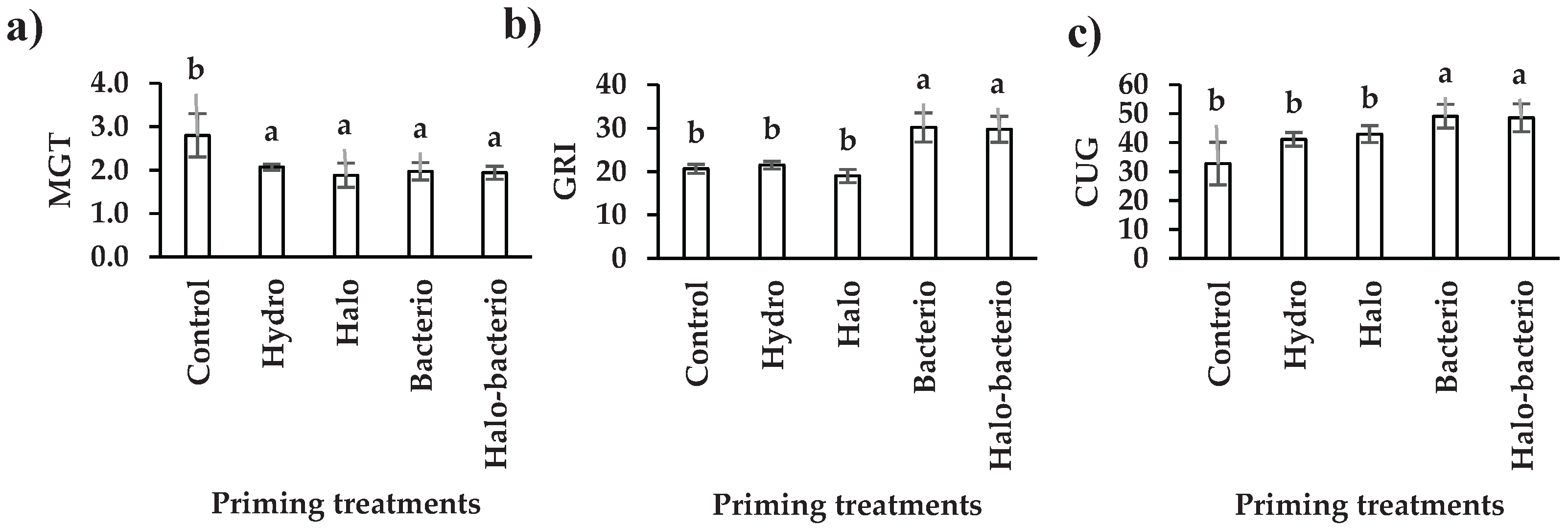
Figure 2.
Vigor of tomato seedlings influenced by four seed priming treatments. Values correspond to average ± standard deviation, n=4. Statistical differences between treatments are observed with different letters (Tukey, α=0.05).
Figure 2.
Vigor of tomato seedlings influenced by four seed priming treatments. Values correspond to average ± standard deviation, n=4. Statistical differences between treatments are observed with different letters (Tukey, α=0.05).
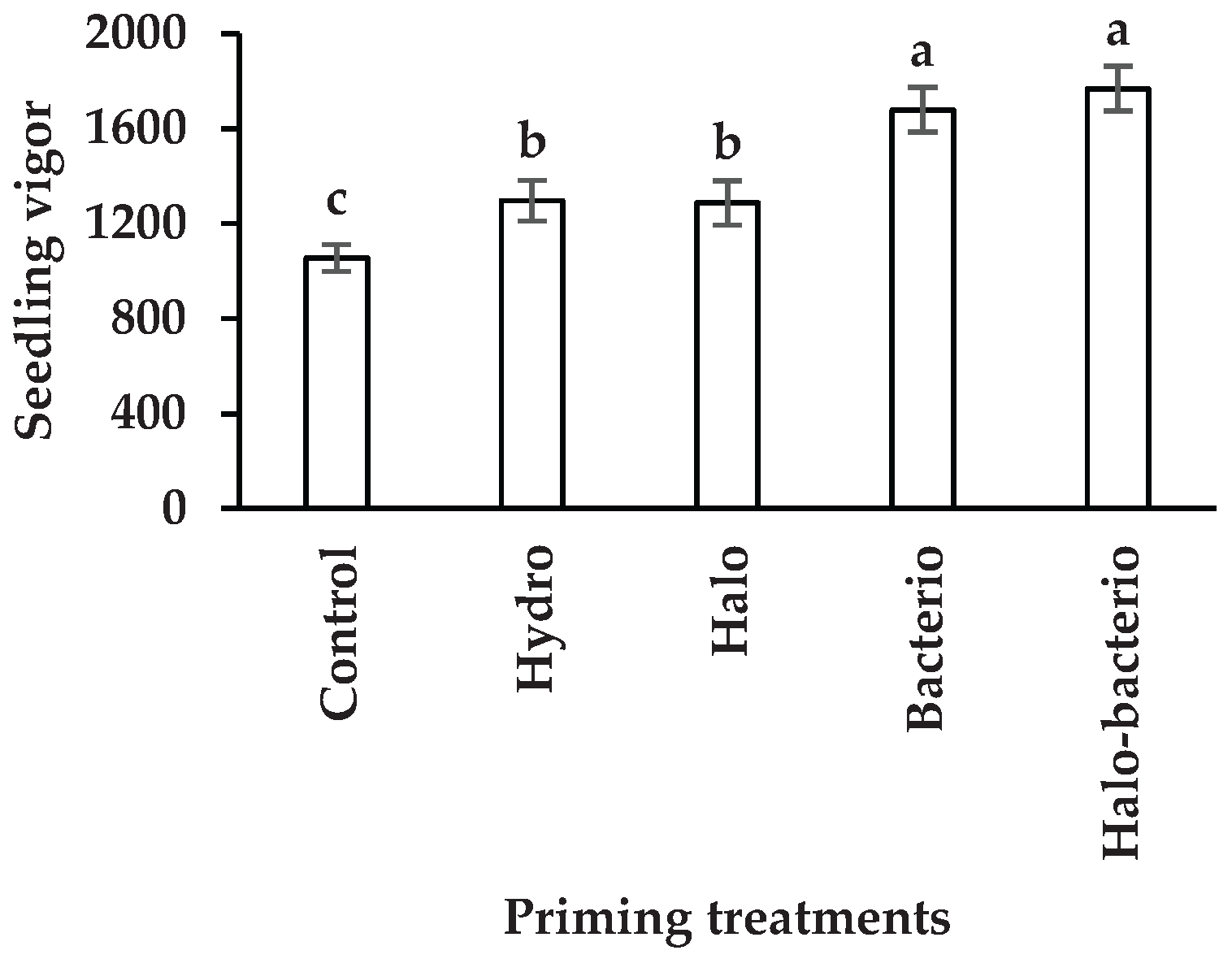
Figure 3.
Foliar concentration of Na and osmoprotective elements in tomato plants at the vegetative stage under two salinity conditions (0 and 16 mM NaCl) in four seed priming treatments. a) Na, b) K, c) Ca, and d) Mg. Means and standard deviation, n=8. Identical lowercase letters do not show a statistically significant difference in nutrient concentration at 0 mM NaCl. Identical uppercase letters do not show a statistically significant difference at 16 mM NaCl. Asterisk shows a difference when comparing the same treatment under the two saline conditions. In all cases with Tukey (α=0.05).
Figure 3.
Foliar concentration of Na and osmoprotective elements in tomato plants at the vegetative stage under two salinity conditions (0 and 16 mM NaCl) in four seed priming treatments. a) Na, b) K, c) Ca, and d) Mg. Means and standard deviation, n=8. Identical lowercase letters do not show a statistically significant difference in nutrient concentration at 0 mM NaCl. Identical uppercase letters do not show a statistically significant difference at 16 mM NaCl. Asterisk shows a difference when comparing the same treatment under the two saline conditions. In all cases with Tukey (α=0.05).
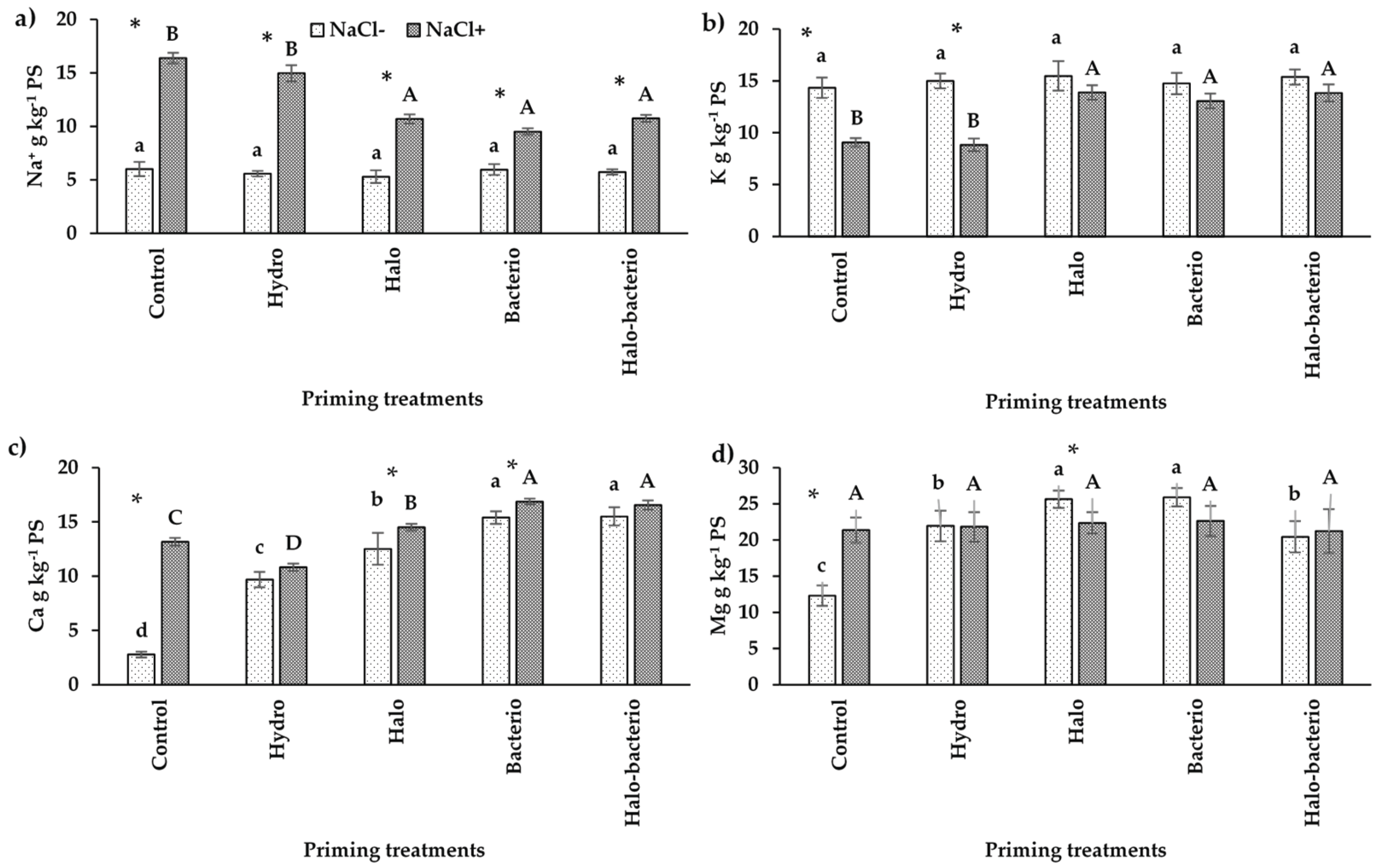
Figure 4.
Foliar concentration of Na and osmoprotective elements in tomato plants at flowering stage under two salinity conditions (0 and 16 mM NaCl) in four seedpriming treatments. a) Na, b) K, c) Ca, and d) Mg. Means and standard deviation, n=8. Identical lowercase letters do not show a statistically significant difference in nutrient concentration at 0 mM NaCl. Identical uppercase letters do not show a statistically significant difference at 16 mM NaCl. Asterisk shows a difference when comparing the same treatment under the two saline conditions. In all cases with Tukey (α=0.05).
Figure 4.
Foliar concentration of Na and osmoprotective elements in tomato plants at flowering stage under two salinity conditions (0 and 16 mM NaCl) in four seedpriming treatments. a) Na, b) K, c) Ca, and d) Mg. Means and standard deviation, n=8. Identical lowercase letters do not show a statistically significant difference in nutrient concentration at 0 mM NaCl. Identical uppercase letters do not show a statistically significant difference at 16 mM NaCl. Asterisk shows a difference when comparing the same treatment under the two saline conditions. In all cases with Tukey (α=0.05).
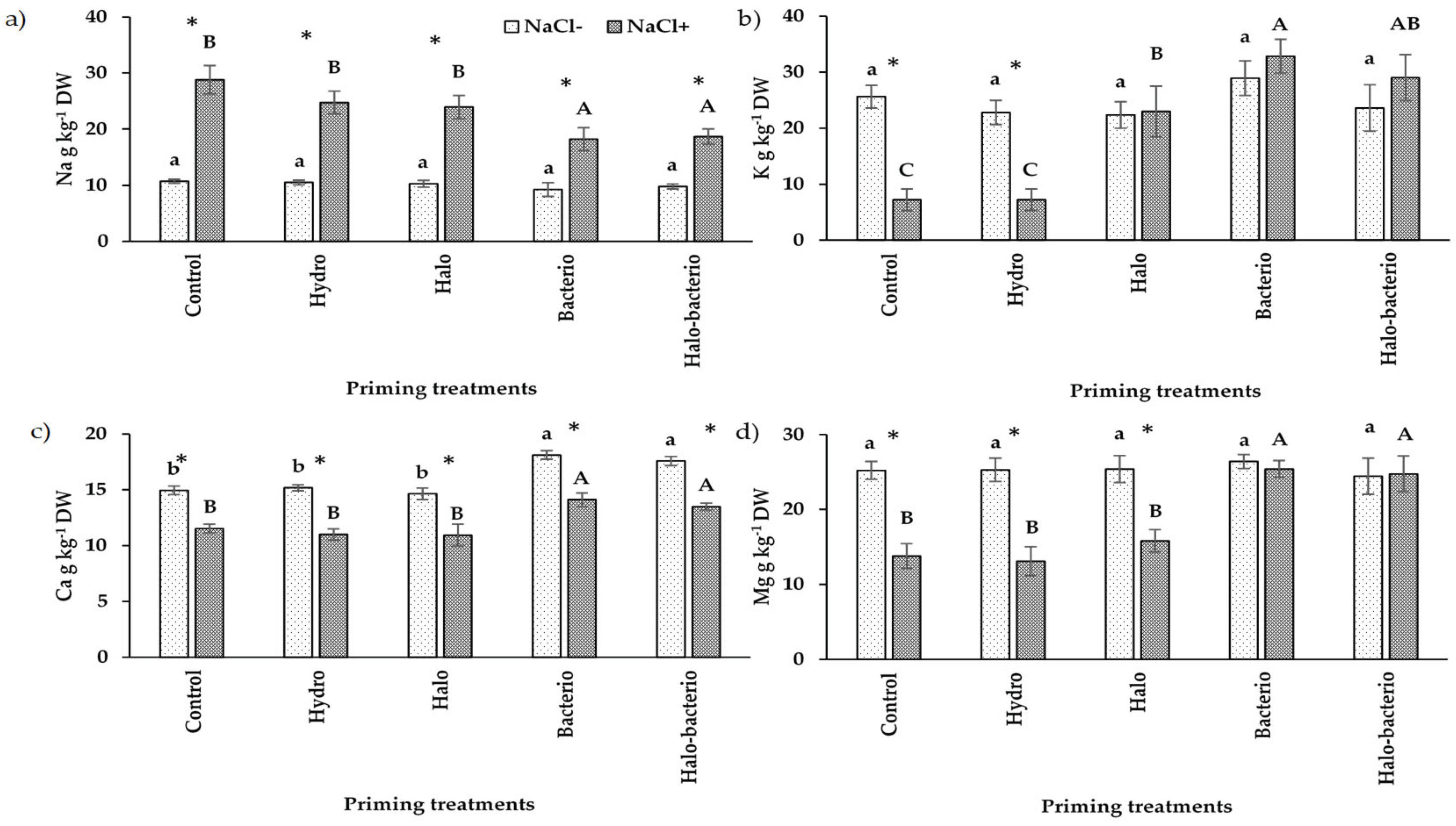
Figure 5.
Tomato yield per cluster harvest from plants that received seed priming. a) 0 mM NaCl, b) 16 mM NaCl. Means and standard deviation, n=8. Identical lowercase letters do not show a statistically significant difference in the tomato yield at 0 mM NaCl. Identical uppercase letters do not show a statistically significant difference at 16 mM NaCl. In all cases with Tukey (α=0.05).
Figure 5.
Tomato yield per cluster harvest from plants that received seed priming. a) 0 mM NaCl, b) 16 mM NaCl. Means and standard deviation, n=8. Identical lowercase letters do not show a statistically significant difference in the tomato yield at 0 mM NaCl. Identical uppercase letters do not show a statistically significant difference at 16 mM NaCl. In all cases with Tukey (α=0.05).
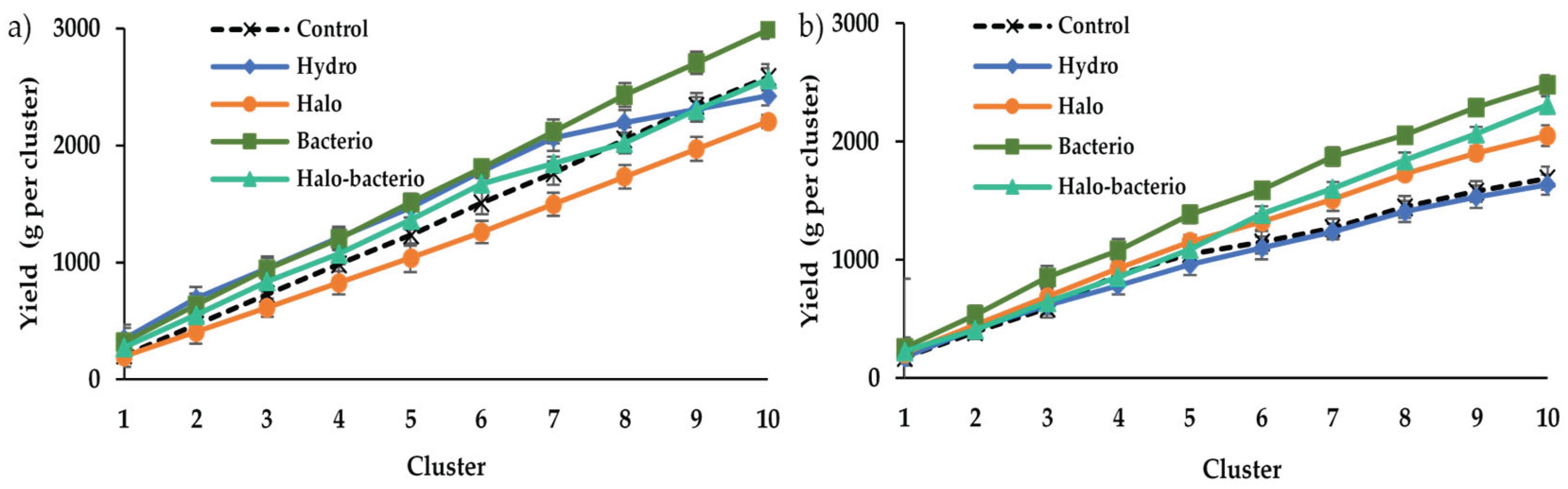
Figure 6.
Tomato cumulative yield (10 harvests) in plants from seed priming treatments under the influence of two salinity conditions. Means and standard deviation, n=8. Identical lowercase or uppercase letters do not show a statistically significant difference at 0 mM and 16 mM NaCl, respectively. Asterisk shows a difference when comparing the same treatment at the two saline conditions. In all cases with Tukey (α=0.05). .
Figure 6.
Tomato cumulative yield (10 harvests) in plants from seed priming treatments under the influence of two salinity conditions. Means and standard deviation, n=8. Identical lowercase or uppercase letters do not show a statistically significant difference at 0 mM and 16 mM NaCl, respectively. Asterisk shows a difference when comparing the same treatment at the two saline conditions. In all cases with Tukey (α=0.05). .
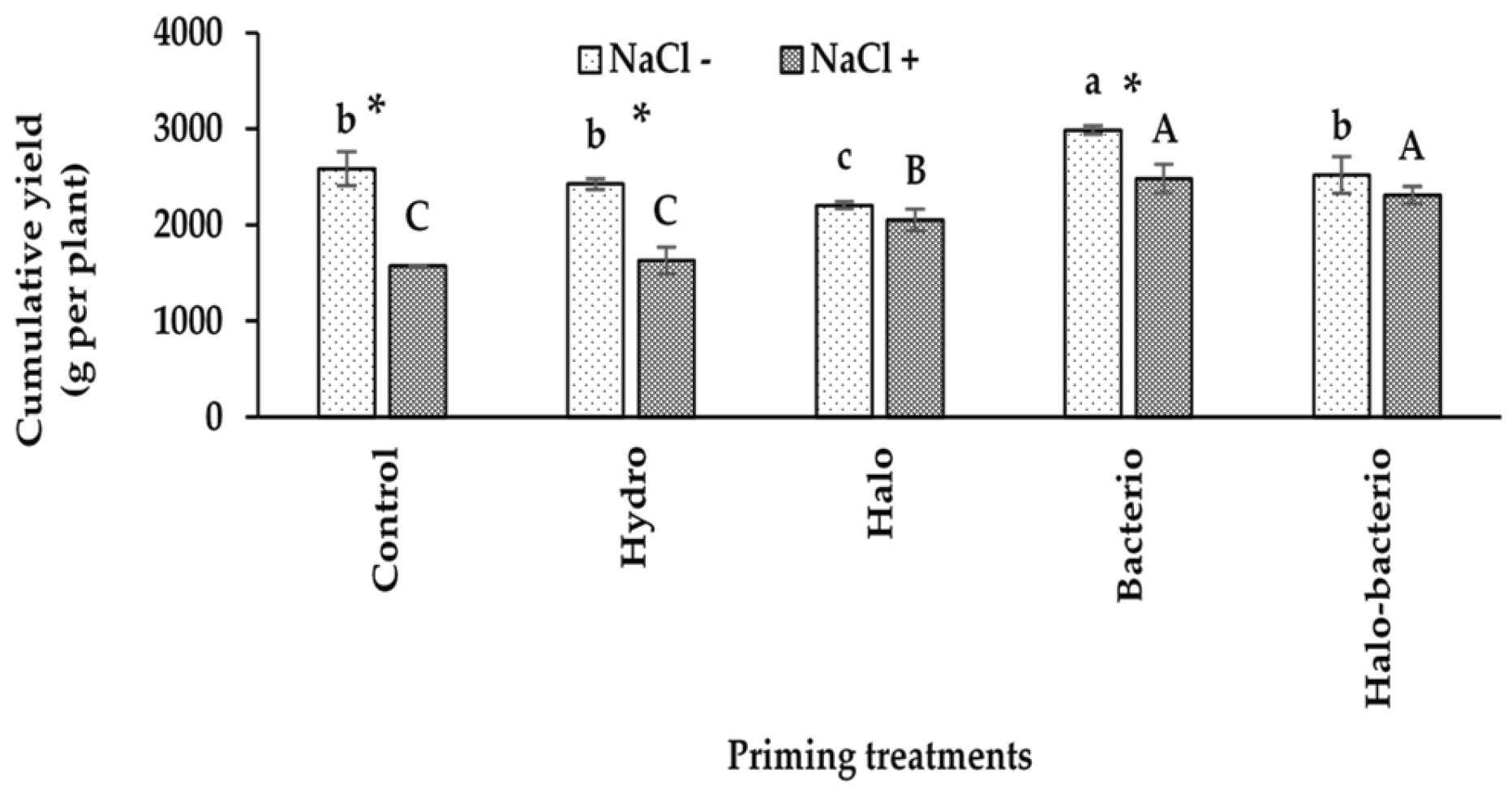
Figure 7.
Nutrient concentration in tomato fruits under two salinity conditions (0 and 16 mM NaCl) influenced by seed priming treatments. a) Na, b) K, c) Ca, and d) Mg. Means and standard deviation, n=8. Identical lowercase letters do not show a statistically significant difference in nutrient concentration at 0 mM NaCl. Identical uppercase letters do not show a statistically significant difference at 16 mM NaCl. Asterisk shows a significant difference when comparing the same treatment in the two saline conditions. In all cases with Tukey (α=0.05).
Figure 7.
Nutrient concentration in tomato fruits under two salinity conditions (0 and 16 mM NaCl) influenced by seed priming treatments. a) Na, b) K, c) Ca, and d) Mg. Means and standard deviation, n=8. Identical lowercase letters do not show a statistically significant difference in nutrient concentration at 0 mM NaCl. Identical uppercase letters do not show a statistically significant difference at 16 mM NaCl. Asterisk shows a significant difference when comparing the same treatment in the two saline conditions. In all cases with Tukey (α=0.05).
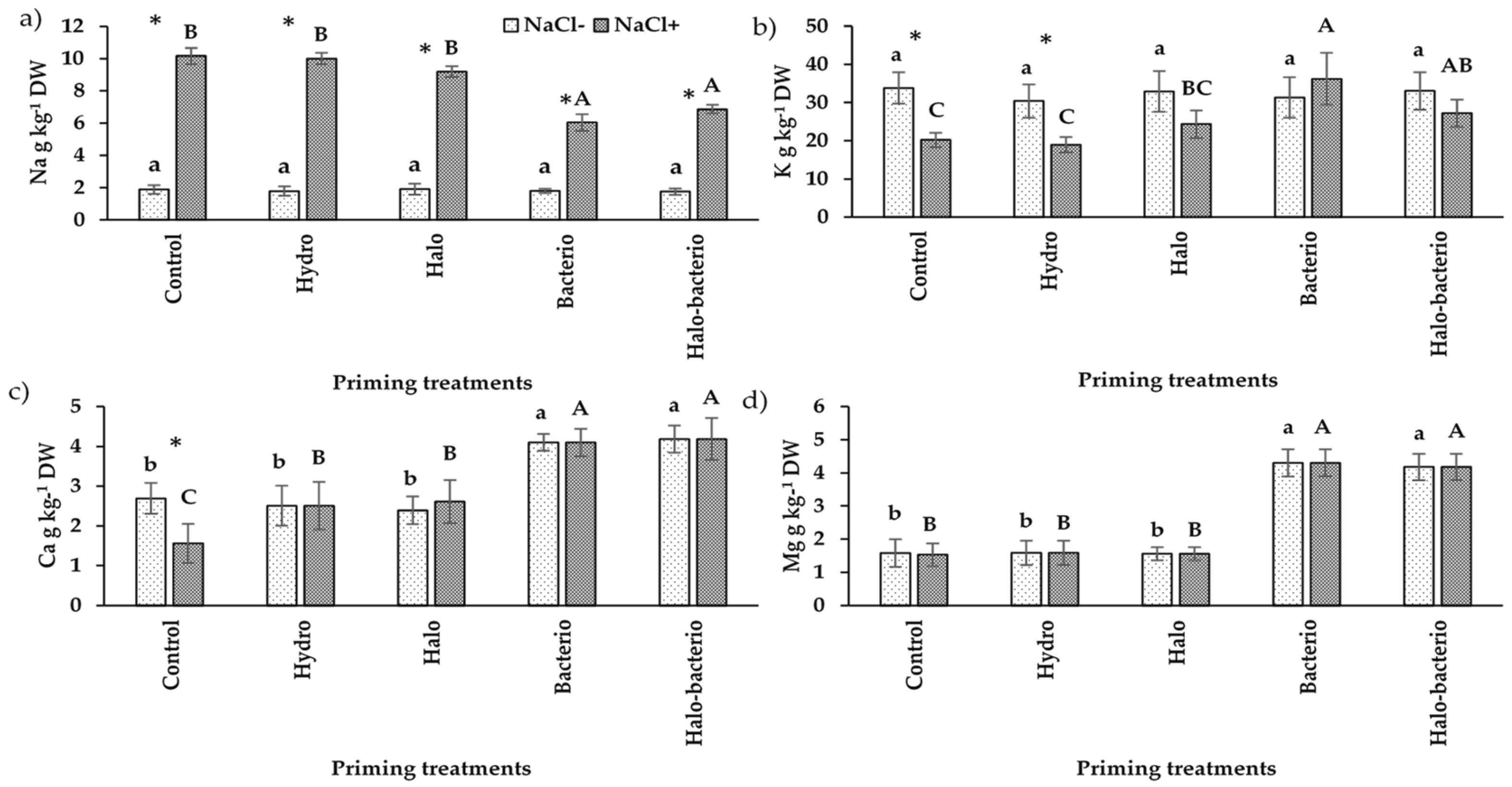
Figure 8.
Beta-carotene concentration in fruits of plants established at two salinity conditions that received several seed priming treatments. Means and standard deviation, n=8. Identical lowercase letters do not show a statistically significant difference in nutrient concentration at 0 mM NaCl. Identical uppercase letters do not show a statistically significant difference at 16 mM NaCl. Asterisk shows a difference when comparing the same treatment at the two saline conditions. In all cases with Tukey (α=0.05).
Figure 8.
Beta-carotene concentration in fruits of plants established at two salinity conditions that received several seed priming treatments. Means and standard deviation, n=8. Identical lowercase letters do not show a statistically significant difference in nutrient concentration at 0 mM NaCl. Identical uppercase letters do not show a statistically significant difference at 16 mM NaCl. Asterisk shows a difference when comparing the same treatment at the two saline conditions. In all cases with Tukey (α=0.05).
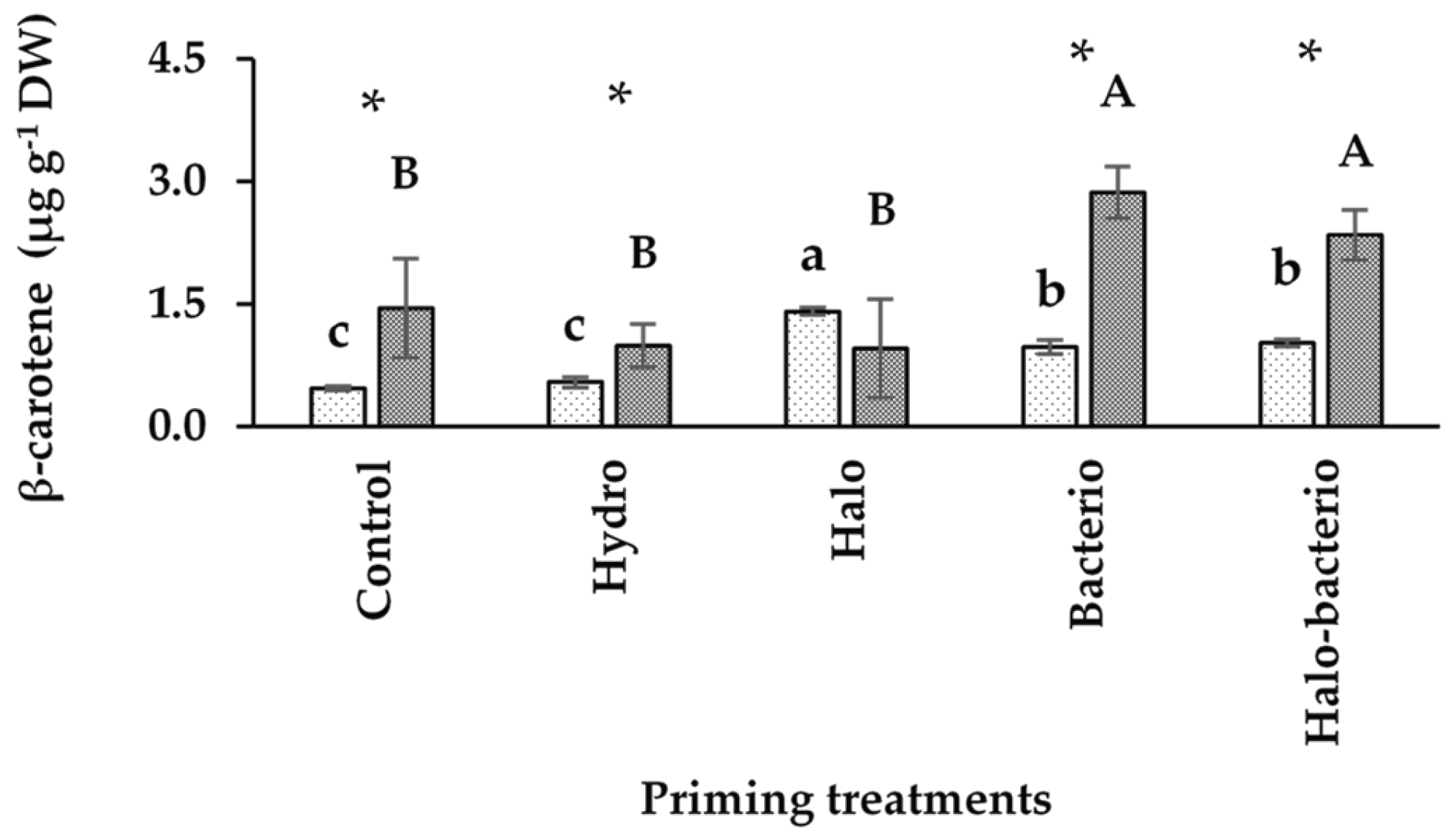
Figure 9.
Principal component analysis of treatments on the vegetative stage of tomato seedlings. Blue arrows variables related to photosynthetic pigments; yellow arrows: variables related to foliar nutrients concentration; black arrows related to foliar proline concentration; green arrows variables related to physiological traits, black arrows related to foliar proline concentration. Nutrients concentration=chemical symbols with foliar.
Figure 9.
Principal component analysis of treatments on the vegetative stage of tomato seedlings. Blue arrows variables related to photosynthetic pigments; yellow arrows: variables related to foliar nutrients concentration; black arrows related to foliar proline concentration; green arrows variables related to physiological traits, black arrows related to foliar proline concentration. Nutrients concentration=chemical symbols with foliar.
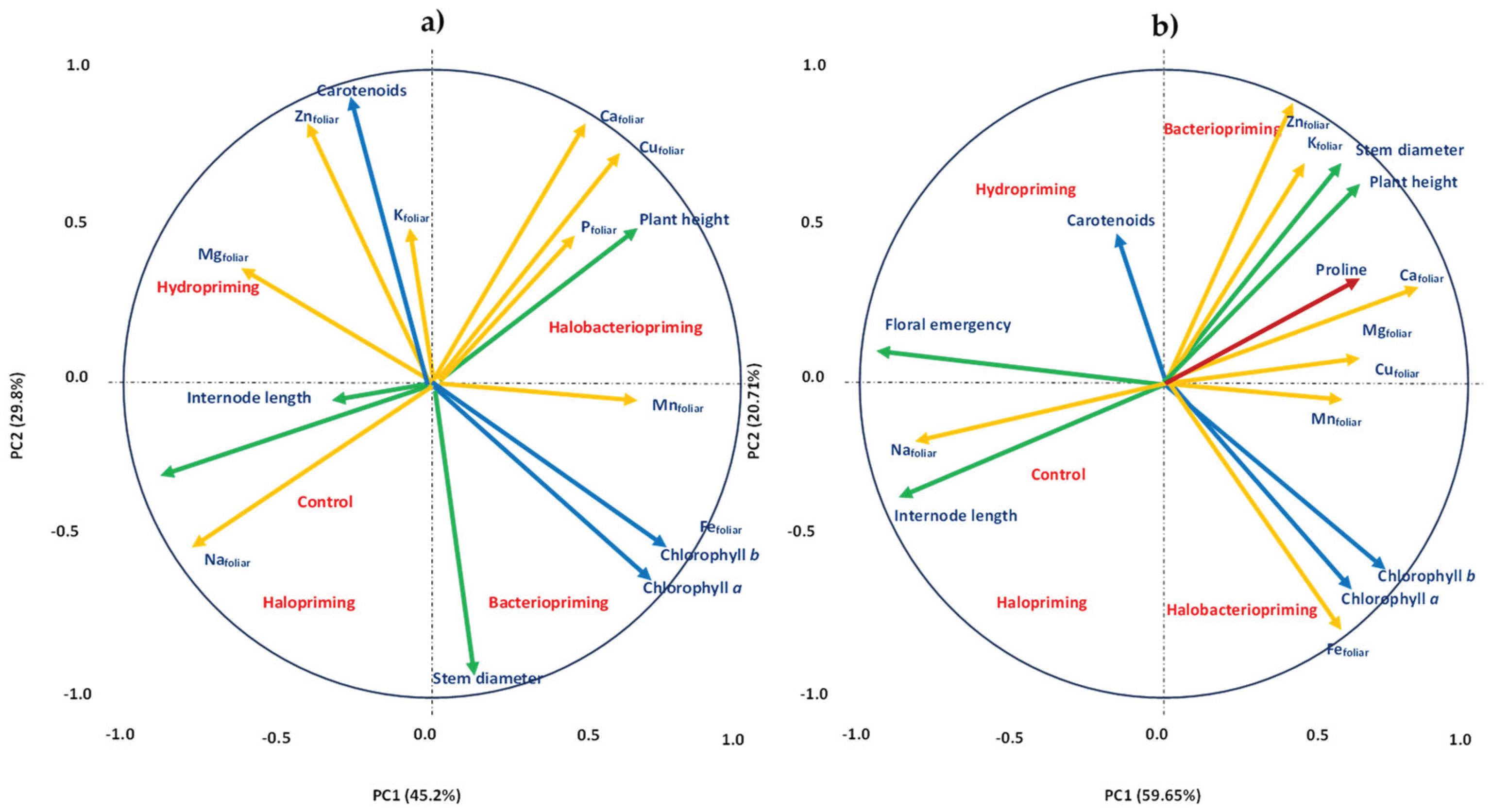
Figure 10.
Principal component analysis of seed priming treatments on tomato plants at the reproduction stage in two salinity conditions. a) 0 mM and b) 16 mM NaCl. Blue arrows: variables related to photosynthetic pigments; yellow arrows: variables related to foliar nutrient concentration; black arrows: variables related to foliar proline concentration; green arrows: variables related to nutrients in tomato fruits; orange arrows: variables related to accumulative tomato yield; red arrows: variables related to beta-carotene concentration in tomato fruits. Foliar and fruit nutrients concentration=chemical symbols with foliar or fruit, respectively.
Figure 10.
Principal component analysis of seed priming treatments on tomato plants at the reproduction stage in two salinity conditions. a) 0 mM and b) 16 mM NaCl. Blue arrows: variables related to photosynthetic pigments; yellow arrows: variables related to foliar nutrient concentration; black arrows: variables related to foliar proline concentration; green arrows: variables related to nutrients in tomato fruits; orange arrows: variables related to accumulative tomato yield; red arrows: variables related to beta-carotene concentration in tomato fruits. Foliar and fruit nutrients concentration=chemical symbols with foliar or fruit, respectively.
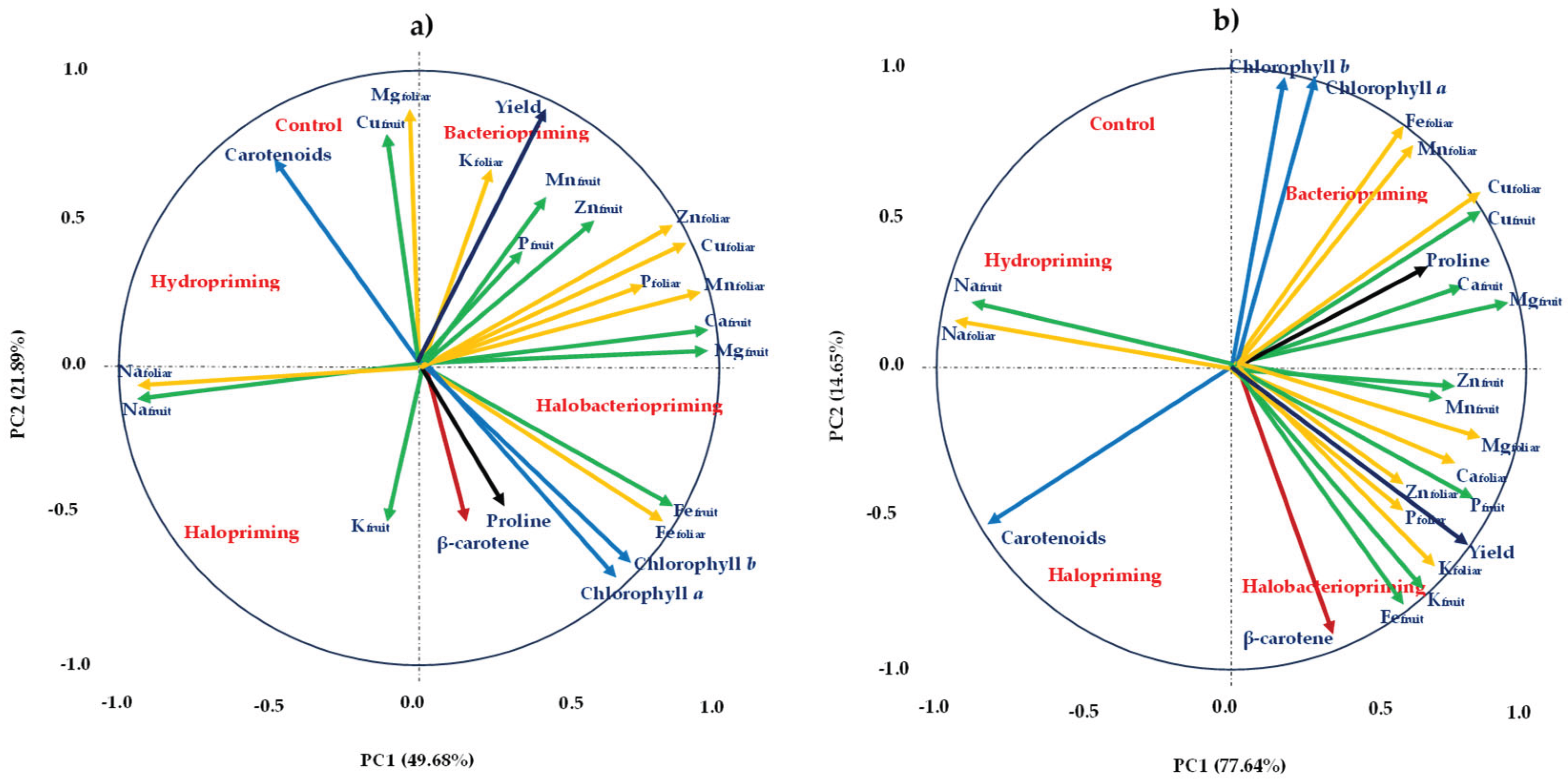

Table 1.
Foliar nutrient concentration of tomato plants at the vegetative stage under two salinity conditions (0 and 16 mM NaCl) that came from seed priming treatments.
Table 1.
Foliar nutrient concentration of tomato plants at the vegetative stage under two salinity conditions (0 and 16 mM NaCl) that came from seed priming treatments.
| 0 meq NaCl | |||||||||||
|---|---|---|---|---|---|---|---|---|---|---|---|
| Seed priming treatment |
P (g kg-1 DW) |
Zn | Cu | Mn | Fe | ||||||
| (mg kg-1 DW) | |||||||||||
| Control | 0.48 ± 0.12a* | 46 ± 5a | 12 ± 2a | 22 ± 3b | 140 ± 25a | ||||||
| Hydro | 0.60 ± 0.16a* | 51 ± 7a | 9 ± 2a | 30 ± 4a | 143 ± 15a | ||||||
| Halo | 0.38 ± 0.10a | 46 ± 2a | 10 ± 2a | 21 ± 3b | 148 ± 15a | ||||||
| Bacterio | 0.51 ± 0.11a | 50 ± 2a | 13 ± 2a | 28 ± 3a | 144 ± 19a | ||||||
| Halo-bacterio | 0.54 ± 0.11a | 51 ± 7a | 11 ± 2a | 27 ± 4ab | 161 ± 17a | ||||||
| 16 meq NaCl | |||||||||||
|
P (g kg-1 DW) |
Zn | Cu | Mn | Fe | |||||||
| (mg kg-1 DW) | |||||||||||
| Control | 0.17 ± 0.05B | 48 ± 5B | 8 ± 1B | 35 ± 3B* | 215 ± 4B* | ||||||
| Hydro | 0.19 ± 0.04B | 46 ± 2B | 9 ± 1B | 40 ± 4AB* | 220 ± 16B* | ||||||
| Halo | 0.24 ± 0.06B | 51 ± 2B | 9 ± 1B | 33 ± 4B* | 219 ± 12B* | ||||||
| Bacterio | 0.84 ± 0.06A* | 59 ± 2A* | 14 ± 3A | 43 ± 2A* | 292 ± 25A* | ||||||
| Halo-bacterio | 0.75 ± 0.09A* | 59 ± 4A | 16 ± 2A | 42 ± 2A* | 234 ± 6A* | ||||||
Means and standard deviation, n=8. Identical lowercase letters do not a statistically significant difference in nutrient concentration at 0 mM NaCl. Identical uppercase letters do not show a statistically significant difference at 16 mM NaCl. An asterisk indicates a difference between the same treatment under the two saline conditions. All cases with Tukey (α=0.05).
Table 2.
Foliar nutrient concentration of tomato plants at the flowering stage under two salinity conditions (0 and 16 mM NaCl) that came from seed priming treatments.
Table 2.
Foliar nutrient concentration of tomato plants at the flowering stage under two salinity conditions (0 and 16 mM NaCl) that came from seed priming treatments.
| 0 meq NaCl | |||||||
|---|---|---|---|---|---|---|---|
| Seed priming treatment |
P (g kg-1 DW) |
Zn | Cu | Mn | Fe | ||
| (mg kg-1 DW) | |||||||
| Control | 0.47 ± 0.11b* | 981 ± 152a | 32 ± 3a | 209 ± 3b | 887 ± 61b* | ||
| Hydro | 1.28 ± 0.10a* | 988 ± 40a | 32 ± 3a | 207 ± 3b | 1004 ± 43b* | ||
| Halo | 1.00 ±0.15a* | 957 ± 42a | 31 ± 2a | 204 ± 3b | 1034 ± 23b* | ||
| Bacterio | 1.29 ± 0.15a | 1060 ± 35a | 35 ± 2a | 242 ± 8a* | 1030 ± 33b | ||
| Halo-bacterio | 1.24 ± 0.12a | 1030 ± 593a | 33 ± 4a | 240 ± 8a* | 3098 ± 67a* | ||
| 16 meq NaCl | |||||||
|
P (g kg-1 DW) |
Zn | Cu | Mn | Fe | |||
| (mg kg-1 DW) | |||||||
| Control | 0.20 ± 0.07C | 800 ± 134B | 30 ± 3A | 216 ± 3A | 663 ± 53C | ||
| Hydro | 0.52 ± 0.18B | 910 ± 39B | 32 ± 2A | 215 ± 4A | 659 ± 39C | ||
| Halo | 0.56 ± 0.14B | 924 ± 139AB | 33 ± 2A | 214 ± 7A | 677 ± 40C | ||
| Bacterio | 1.42 ± 0.12A | 1071 ± 140A | 35 ± 3A | 214 ± 2A | 1116 ± 25B | ||
| Halo-bacterio | 1.12 ± 0.10A | 1030 ± 26A | 36 ± 4A | 218 ± 4A | 2099 ± 68A | ||
Means and standard deviation, n=8. Identical lowercase letters do not show a statistically significant difference in nutrient concentration at 0 mM NaCl. Identical uppercase letters do not show a statistically significant difference at 16 mM NaCl. Asterisk shows a difference when comparing the same treatment at the two saline conditions. All cases with Tukey (α=0.05).
Table 3.
Fruit traits influenced by priming treatments in two salt conditions.
| 0 meq NaCl | |||||
|---|---|---|---|---|---|
| Seed priming treatment |
Number of fruits harvested | % Fruits with blossom end rot | Equatorial diameter (mm) | Polar diameter (mm) | |
| Control | 47 ± 1a* | 0 | 47 ± 3ab* | 47 ± 2b* | |
| Hydro | 36 ± 2bc | 0 | 47 ± 0.46a* | 46 ± 2b* | |
| Halo | 32 ± 2c | 0 | 40 ± 0.8c | 41 ± 0.6c | |
| Bacterio | 37 ± 0.8b | 0 | 45 ± 0.4b | 54 ± 0.5a | |
| Halo-bacterio | 37 ± 3b* | 0 | 42 ± 2bc* | 51 ± 0.5a | |
| 16 meq NaCl | |||||
| Number of fruits harvested | % Fruits with blossom end rot | Equatorial diameter (mm) | Polar diameter (mm) | ||
| Control | 30 ± 2b | 15 ± 4a | 33 ± 0.8c | 38 ± 0.9b | |
| Hydro | 30 ± 2b | 8 ± 4b | 35 ± 0.5b | 39 ± 0.6b | |
| Halo | 31 ± 2b | 0 | 36 ± 0.3b* | 39 ± 1.0b | |
| Bacterio | 34 ± 1a | 0 | 42 ± 1.0a* | 51 ± 0.6a | |
| Halo-bacterio | 34 ± 1a | 0 | 33 ± 0.9c | 50 ± 0.6a | |
Means and standard deviation, n=8. Identical lowercase letters do not show a statistically significant difference in fruits traits at 0 mM NaCl. Identical uppercase letters do not show a statistically significant difference at 16 mM NaCl. Asterisk shows a difference when comparing the same treatment at the two saline conditions. All cases with Tukey (α=0.05).
Table 4.
Fruit nutrient concentration of tomato plants under two salinity conditions that received seed priming treatments.
Table 4.
Fruit nutrient concentration of tomato plants under two salinity conditions that received seed priming treatments.
| 0 meq NaCl | ||||||||
|---|---|---|---|---|---|---|---|---|
| Seed priming treatment |
P (g kg-1 DW) |
Zn | Cu | Mn | Fe | °Brix | ||
| (mg kg-1 DW) | ||||||||
| Control | 0.48 ± 0.12a* | 46 ± 5a | 12 ± 2a | 22 ± 3b | 140 ± 24a | 1.9 ± 0.1c* | ||
| Hydro | 0.60 ± 0.16a* | 51 ± 7a | 8 ± 2a | 30 ± 3a | 143 ± 15a | 2.2 ± 0.1c* | ||
| Halo | 0.38 ± 0.10a | 46 ± 2a | 9 ± 2a | 21 ± 3b | 148 ± 15a | 2.6 ± 0.2b | ||
| Bacterio | 0.51 ± 0.11a | 50 ± 2a | 13 ± 2a | 28 ± 2a | 144 ±19a | 3.8 ± 0.1a | ||
| Halo-bacterio | 0.54 ± 0.11a | 51 ± 7a | 11 ± 2a | 27 ± 4ab | 161 ± 16a | 4.3 ± 0.3a* | ||
| 16 meq NaCl | ||||||||
|
P (g kg-1 DW) |
Zn | Cu | Mn | Fe | °Brix | |||
| (mg kg-1 DW) | ||||||||
| Control | 0.17 ± 0.05B | 48 ± 5B | 8 ± 1B | 35 ± 3B* | 215 ± 4B* | 1.0 ± 0.1c | ||
| Hydro | 0.19 ± 0.04B | 46 ± 2B | 9 ± 1B | 40 ±4AB* | 219 ± 16B* | 1.7 ± 0.2c | ||
| Halo | 0.24 ± 0.06B | 51 ± 2B | 9 ± 1B | 33 ± 4B* | 219 ± 12B* | 2.9 ± 0.3b | ||
| Bacterio | 0.84 ± 0.06A* | 59 ± 2A* | 14 ± 2A | 43 ± 2A* | 292 ± 25A* | 3.7 ± 0.2a | ||
| Halo-bacterio | 0.75 ± 0.09A* | 59 ± 4A | 16 ± 2A | 42 ± 2A* | 234 ± 6A* | 3.8 ± 0.3a | ||
Means and standard deviation, n=8. Identical lowercase letters do not show a statistically significant difference in nutrient concentration at 0 mM NaCl. Identical uppercase letters do not show a statistically significant difference at 16 mM NaCl. Asterisk shows a difference when comparing the same treatment on the two saline conditions. In all cases with Tukey (α=0.05).
Disclaimer/Publisher’s Note: The statements, opinions and data contained in all publications are solely those of the individual author(s) and contributor(s) and not of MDPI and/or the editor(s). MDPI and/or the editor(s) disclaim responsibility for any injury to people or property resulting from any ideas, methods, instructions or products referred to in the content. |
© 2026 by the authors. Licensee MDPI, Basel, Switzerland. This article is an open access article distributed under the terms and conditions of the Creative Commons Attribution (CC BY) license (http://creativecommons.org/licenses/by/4.0/).
Copyright: This open access article is published under a Creative Commons CC BY 4.0 license, which permit the free download, distribution, and reuse, provided that the author and preprint are cited in any reuse.


