
Submitted:
23 April 2026
Posted:
24 April 2026
You are already at the latest version
Abstract
Understanding the extent to which anthropogenic activity shapes vegetation dynamics is a central challenge in palaeoecology. In the Eastern Mediterranean, pollen-based studies have traditionally identified human impact through qualitative interpretations of anthropogenic indicators, particularly within the framework of the Beyşehir Occupation Phase (BOP) . However, quantitative comparison of anthropogenic signals across multiple sites remains limited. This study compiles pollen datasets from multiple lacustrine records across Anatolia (Türkiye) to construct a regional multi-site dataset and evaluates anthropogenic influence using a quantitative BOP period anthropogenic taxa integrated with Principal Component Analysis (PCA). Anthropogenic impact was quantified using a composite pollen index based on Olea, Juglans, Plantago lanceolata-type, Cerealia and Rumex acetosa-type taxa. The results reveal substantial spatial variability in anthropogenic signals, with combined pollen percentages ranging from less than 1% to 16% among lakes. PCA results show clear inter-site differentiation, with the first two components explaining 42.94% and 21.95% of the total variance, respectively. In particular Olea emerges as the most influential indicator, strongly contributing to the primary ecological gradient. These findings provide a quantitative extension of the traditionally qualitative BOP concept and demonstrate that anthropogenic influence is a fundamental and spatially heterogeneous component of vegetation dynamics across Anatolia. By integrating a composite anthropogenic index with multivariate analysis, this study offers a robust and transferable framework for comparing human–environment interactions across different regions and ecological settings.
Keywords:
pollen data
; anthropogenic indicators
; multivariate analysis
; PCA
; Anatolia
; Late Holocene
1. Introduction
Understanding the timing, intensity, and spatial variability of anthropogenic impacts on vegetation is a central objective in palaeoecology and environmental archaeology. Pollen based reconstructions provide one of the most robust tools for tracing past human environment interactions, as they directly record vegetation responses to both climatic and anthropogenic drivers [1,2,3]. In the Mediterranean and Near Eastern regions, particular attention has been given to anthropogenic pollen indicators, including cultivated taxa and disturbance related species, which reflect agricultural expansion, arboriculture, and land-use intensification.
Within this framework, the BOP has emerged as a key concept for identifying periods of intensified human activity in Anatolia. First recognized in lacustrine pollen records from southwestern Türkiye [4,5], and further developed through integrated palaeoecological and archaeological studies [6,7,8], the BOP is characterized by increases in cultivated taxa such as Cerealia-type, Olea and Juglans, together with disturbance indicators including Plantago lanceolata-type and Rumex acetosa-type. These pollen assemblages are widely interpreted as reflecting agricultural intensification, arboriculture, and broader socio-economic transformations during the Late Holocene.
Regional studies from Türkiye further highlight the importance of local environmental and cultural contexts in modulating anthropogenic signals. Palynological investigations from central and western Anatolia have demonstrated significant variability in vegetation response to human activity during the Late Holocene [9,10,11,12]. These studies emphasize that anthropogenic indicators are strongly influenced by regional ecological settings and cannot be interpreted uniformly across different landscapes.
Comparable anthropogenic signals have also been documented across Europe, particularly in Mediterranean and temperate regions [2,13,14]. These records often show synchronous increases in cultivated taxa and secondary anthropogenic indicators during key historical periods such as the Roman era, the Medieval Climate Anomaly, and later phases of intensified land use. However, the expression of these signals varies across regions due to differences in ecological settings, land-use strategies, and cultural trajectories.
Despite these advances, direct comparison of anthropogenic signals across regions remains challenging. Pollen records are inherently influenced by local environmental conditions, including basin characteristics, sedimentation processes, and vegetation composition, which may obscure regional-scale patterns. Furthermore, the BOP concept has traditionally been applied qualitatively, based on visual interpretation of pollen diagrams, limiting its comparability across multiple datasets.
To overcome these limitations, recent studies have increasingly adopted multivariate statistical approaches, particularly PCA, to identify dominant gradients in pollen datasets and to disentangle anthropogenic signals from natural variability [15]. However, few studies have explicitly tested whether BOP type signals are embedded within the dominant structure of multivariate variability or whether they remain dependent on site specific interpretations.
This study evaluates the anthropogenic impact signal across several lake records in Anatolia by defining a combined quantitative measure based on anthropogenic pollen indicators. Through standardization of pollen variables from selected taxa, both the relative level and compositional pattern of anthropogenic impact across lake systems are examined comparatively. In this context, the study offers a quantitative extension of the anthropogenic pollen signal, traditionally largely reliant on qualitative interpretations, and provides a robust analytical framework for comparing human-environment interactions in different ecological and geographical contexts.
2. Materials and Methods
Pollen datasets from İznik, Abant, Sapanca, Beyşehir, Hoyran, Gölhisar, Köyceğiz, Söğüt, Ova, and Van (VAN1 and VAN2) lakes across Anatolia were compiled from the Neotoma Paleoecology Database to create a regional multi-site dataset; site locations are shown in Figure 1. Such synthesis approaches are increasingly used to investigate large scale vegetation dynamics and human environment interactions. [14,16].
The analysis relied on five taxa that could directly and indirectly represent human impact: Olea, Juglans, Plantago lanceolata-type, Cerealia and Rumex acetosa-type. These taxa were considered suitable indicators for assessing traces of anthropogenic signals in pollen records, as they could be associated with agricultural activity, cultivated trees, open field use, weed environments, and grazing pressure [2,4,6,17]. Only directly related pollen names were considered in taxon matching; for Olea, broader family-level records such as Oleaceae were not included in the analysis. Similarly, the Rumex variant was limited to only Rumex acetosa and Rumex acetosa-type records, not to the general genus level. In the first stage, rows corresponding to selected anthropogenic indicator taxa from 1300-3500 cal BP were identified in each lake record, and pollen counts of these taxa were collected to calculate a composite anthropogenic indicator value. This value was divided by the total pollen count during the BOP period to obtain a composite anthropogenic pollen percentage representing the relative share of the five selected taxa within the total pollen. Anthropogenic influence was quantified using a combined anthropogenic pollen percentage derived from five selected indicator taxa. In this study, Olea, Juglans, Plantago lanceolata-type, Cerealia and Rumex acetosa-type were aggregated and expressed as a percentage of total pollen. These taxa represent agricultural activity, grazing pressure, and arboriculture, and are widely used as indicators of human impact in Mediterranean pollen records [17,18].
In the second stage, the minimum, maximum, arithmetic mean, and standard deviation of the combined anthropogenic pollen percentage were calculated for each lake in the 1300-3500 cal BP range. Thus, not only the overall lake-based representation of the five selected taxa but also the variability they exhibited throughout the 1300-3500 cal BP period was evaluated.
The five selected anthropogenic indicator taxa were converted into percentage values for each lake separately; thus, a lake and taxon ratio matrix was created where the percentages of the lakes were in the rows, and the percentages of the taxa were in the columns. This matrix was used to evaluate which taxon combinations originated from the combined anthropogenic pollen signal and to provide the basic data structure for multivariate analyses such as heatmap and PCA. To reduce the effects of differing variances among taxa and to standardize the dataset prior to multivariate analysis, all variables were transformed using z-score normalization (z = (x − μ)/σ), where x represents the pollen percentage, μ is the mean, and σ is the standard deviation of each variable [19]. In the final stage, PCA was applied to standardized taxon percentages. In the analysis, observations represent the lakes, and variables represent the standardized percentages of five selected taxa. The aim of PCA is to summarize the similarities and differences between the lakes using a smaller number of components and to reveal the compositional patterns of anthropogenic indicators.
PCA was applied to the standardized dataset to identify the main gradients in pollen assemblages and to explore relationships between vegetation dynamics and anthropogenic indicators. PCA was performed on the covariance matrix of z-score standardized variables, including all selected terrestrial pollen taxa. This method is widely used in palaeoecology to reduce dimensionality and identify dominant ecological gradients [19,20]. The first two principal components (PC1 and PC2), explaining the largest proportion of variance, were retained for interpretation.
3. Results
When five anthropogenic indicator taxa selected in the 1300-3500 cal BP time interval were evaluated together, significant differences were found between the lakes in terms of both total signal level and taxonomic composition. The combined anthropogenic pollen percentage calculated on a lake-by-lake basis reveals the share of these five taxa in the total pollen during the relevant time interval and allows for a comparative evaluation between different records. In this respect, the highest combined value was found in İznik (16.72%), and the lowest value in Hoyran (0.94%). İznik Lake is followed by Ova (7.93%), Van 2 (5.51%), Van 1 (4.47%), Söğüt (4.21%) and Gölhisar (3.90%). Beyşehir (3.01%), Sapanca (1.34%), Abant (1.68%) and Köyceğiz (1.29%) have lower combined anthropogenic pollen percentages. This distribution clearly shows that the selected anthropogenic indicators are not represented with the same intensity in all lakes, and therefore the reflection of human influence in pollen records varies on a regional scale (Table 1).
The mean of the combined percentages throughout the BOP period also supports this pattern. In terms of mean value, İznik (16.62%) ranks first, followed by Van 2 (5.66%), Ova (4.65%), Van 1 (4.45%), Söğüt (4.17%), Gölhisar (3.61%) and Beyşehir (2.78%). Lakes with lower mean values are Abant (2.04%), Sapanca (1.49%), Köyceğiz (1.22%) and Hoyran (0.87%). These results show that the lakes can be evaluated at three different intensity levels in general. İznik, Van 2, Ova, Van 1 and Söğüt stand out as records with mean combined pollen percentages of approximately 4% and above, where the selected indicators are more strongly represented. Abant, Sapanca, Köyceğiz and Hoyran, with mean values below approximately 2%, emerged as lakes with weaker anthropogenic indicators. Gölhisar and Beyşehir are in the middle group, between these two groups (Table 1).
Maximum values are important for understanding the extent to which the selected indicators are concentrated. The fact that the maximum value in Iznik reaches 36.94% indicates the presence of very strong anthropogenic signals in this record during the BOP period. The maximum value of 25.42% in Ova is similarly noteworthy. Maximum values are 13.86% in Söğüt, 8.95% in Van 2, 6.95% in Van 1, 6.95% in Beyşehir, 8.62% in Gölhisar, 8.13% in Abant, 4.82% in Sapanca, 2,86% in Köyceğiz, and 2.53% in Hoyran (Table 1). The fact that Iznik and Ova stand out compared to other records in terms of both total percentage and maximum value suggests that human influence produced a stronger or more visible pollen signal in these lakes.
The temporal variability of total pollen percentage also differs among the lakes, and the standard deviation calculated from the total percentage series reveals how much this signal fluctuates over time. The standard deviation is 10.30 in İznik, 7.54 in Ova, 3.31 in Söğüt, 2.76 in Abant, 2.36 in Gölhisar, 1.62 in Van 2, 2.19 in Beyşehir, 1.38 in Van 1, 1.27 in Sapanca, 0.74 in Köyceğiz and 0.65 in Hoyran (Table 1). This distribution shows that İznik and Ova not only have high total percentages but also exhibit highly variable records over time. In contrast, lakes such as Hoyran and Köyceğiz have both low overall anthropogenic pollen levels and exhibit more limited fluctuations over time. A high standard deviation indicates that the selected indicators exhibit a more variable pattern, strengthening and weakening over specific periods, while a low standard deviation suggests a weaker but relatively stable human influence (Figure 2).
The heatmap showing the percentage distribution of selected anthropogenic indicator taxa at the lake level reveals that the combined pollen signal differs not only quantitatively but also in terms of taxonomic composition (Figure 3). İznik stands out particularly with its high values for Olea and Cerealia; Juglans and Plantago lanceolata-type also contribute secondarily to this lake. Olea is largely dominant in the plain, while Cerealia and Juglans are less represented. In the Van 1 and Van 2 records, the anthropogenic signal shows a more Cerealia dominant distribution. In Söğüt, the closer values of Plantago lanceolata-type, Cerealia, Olea and Juglans indicate a more balanced composition where multiple indicators contribute together. In Gölhisar, Olea and Cerealia are dominant. In contrast, the Plantago lanceolata-type has become relatively more dominant in Beyşehir, Abant and partly in Sapanca, suggesting that the anthropogenic signal in these lakes may be more closely related to open land use and ruderal environmental indicators. In Köyceğiz and Hoyran, both the total signal is low and none of the selected taxa show significant dominance. Therefore, the heatmap clearly shows that the differences between the lakes are due not only to the total intensity of the selected anthropogenic indicators but also to which combinations of taxa generate this signal.
PCA, performed after z-score standardization, shows that the selected anthropogenic indicator taxa differ between lakes not only in terms of total density but also in terms of pattern (Figure 4). The first two components explain approximately 64.89% of the total variance; 42.94% is represented by the first component and 21.95% by the second. The first component stands out as an axis particularly associated with Olea, Juglans and to a lesser extent Cerealia, while the second component appears to be more associated with Plantago lanceolata-type and Rumex acetosa-type. This suggests that PC1 more strongly reflects the anthropogenic signal associated with cultivated trees and agricultural activity, while PC2 more strongly reflects the impact associated with open field use, ruderal environments, and potential grazing pressure. The PCA results show three distinct clusters among the lakes. First, İznik stands apart from all other records, positioned alone on the positive side of PC1. This indicates that the selected anthropogenic signal is particularly strong in the Olea and Juglans axis in İznik, suggesting that indicators related to cultivated trees and agricultural activities are more dominant in this record. Second, Ova, Gölhisar, Sapanca, Köyceğiz and Hoyran cluster more towards the negative PC2 side; the structure of the selected taxa in these lakes deviates from the Plantago lanceolata-type and Rumex acetosa-type dominant pattern on the upper axis. Third, Abant, Beyşehir, Söğüt, and Van 1 are more located towards the positive PC2 side, exhibiting a distribution closer to the Plantago lanceolata-type and Rumex acetosa-type orientation. Van 2, however, presents a more variable character due to its location near the intersection of the axes.
In conclusion, the selected anthropogenic indicators do not show a uniform effect in the lake records of Anatolia. Accordingly, in some lakes, the anthropogenic effect is represented more by indicators related to cultivated trees and grain production, while in others it is represented by indicators related to open land use, ruderal environments, and grazing pressure (Figure 4).
4. Discussion
The results of this study demonstrate that anthropogenic signals are systematically embedded within the dominant gradients of pollen variability across Anatolia. This finding aligns with a growing body of evidence indicating that Late Holocene vegetation dynamics in the Eastern Mediterranean cannot be explained by climatic forcing alone but are strongly shaped by human activities [3,13,14] (Roberts et al., 2011; Woodbridge et al., 2019; Fyfe et al., 2015). Regional syntheses have shown that agricultural expansion, the development of arboriculture, and increasing land-use intensity produced persistent and spatially structured anthropogenic signals in pollen records. In particular, the co-occurrence of tree-crop indicators (e.g., Olea, Juglans) with disturbance taxa is widely regarded as a robust proxy for human induced landscape transformation [21].
The separation of lake records along the PCA axes reflects both regional environmental differences and varying degrees of anthropogenic influence. The strong differentiation of İznik along PC1, coupled with its high and highly variable BOP period values, suggests that this record captures pronounced and dynamic human environment interactions. In contrast, the low and stable BOP period values observed in Hoyran indicate relatively weak or more stable anthropogenic influence. This spatial heterogeneity highlights the importance of local ecological and socio-economic contexts in modulating human impact. Similar patterns have been documented in Mediterranean and European pollen records, where anthropogenic indicators show regionally variable expressions depending on land-use intensity, settlement dynamics, and environmental constraints [13,14]. This supports the interpretation that the distribution of Late Holocene vegetation in Anatolia was shaped by a combination of climate and human-induced processes, and that human influence acted as a strong and local variable controlling the environment.
The combined anthropogenic pollen index applied in this study represents a significant methodological advancement over traditional qualitative approaches. By integrating multiple indicators Olea, Juglans, Plantago lanceolata-type, Cerealia and Rumex acetosa-type into a single quantitative framework, the method captures multiple dimensions of land use, including cultivation, grazing, and disturbance. This reduces reliance on individual taxa and increases the robustness of anthropogenic signal detection. Moreover, the standardized structure of the index enables direct comparison across sites, facilitating regional synthesis. Its integration with multivariate analyses such as PCA allows anthropogenic signals to be evaluated within the broader structure of ecological variability, providing a more rigorous assessment of their relative importance. Within this framework, Olea europaea emerges as the most diagnostically robust proxy of anthropogenic land use. In the Lake İznik record, elevated Olea values coincide with reduced forest taxa, indicating large-scale vegetation clearance and the expansion of olive-based agroecosystems [22]. The magnitude and persistence of these increases exceed natural expectations, pointing to deliberate cultivation rather than climatic expansion. Importantly, Olea occurs in association with other anthropogenic indicators, reflecting integrated land-use systems rather than isolated taxonomic fluctuations. At a regional scale, olive pollen is consistently linked to long-term landscape transformation and the intensification of tree-crop economies [3,21]. This role is directly reflected in the PCA results. The alignment of Olea rich assemblages with PC1 indicates that arboriculture-driven land use constitutes a primary driver of the dominant ecological gradient. This confirms that anthropogenic processes are embedded within the core structure of vegetation variability and supports the interpretation of PC1 as a human-driven gradient consistent with BOP dynamics.
Although the human impact signal associated with BOP appears more limited in the study by Eastwood et al. [6] at Lake Ova, it is likely that this difference is largely due to chronological placement. Indeed, a later revised age-depth model by Giesecke et al. [23] shows that the increase in Olea in the Lake Ova record corresponds to approximately 3177 cal BP, thus presenting a signal more consistent with BOP. The results obtained in this study also reveal that anthropogenic impact is felt at Lake Ova, and this signal is primarily represented through Olea. However, the fact that most of the other selected taxa remain below 1% suggests that the anthropogenic pattern in this record is largely Olea dominant. Despite its proximity to the Mediterranean coast, Lake Köyceğiz does not reveal strong traces of agricultural activities, such as olive cultivation, which would be expected to correspond to the Hellenistic–Roman period in pollen records [4,6]. The fact that the total percentage of the five anthropogenic indicators selected in this study is 1.29%, one of the lowest levels among the lakes, suggests that this weak representation cannot be explained solely by chronological discrepancies, as in Lake Ova. Therefore, it can be said that the anthropogenic signal associated with BOP in the Köyceğiz record is either quite weak or expressed in a limited way when compared to other regional records. Similarly, the fact that the total proportion of the five selected anthropogenic indicator taxa in Lake Hoyran remains at a very low level of 0.94% is consistent with Eastwood et al. [6] assessment that this record does not reflect a clear BOP signal.
Comparison with European records reveals both broad consistencies and important regional contrasts in the expression of anthropogenic signals. While increases in anthropogenic indicators are widely associated with land-use intensification and landscape opening across Europe, the stronger variability observed in Anatolia likely reflects its pronounced ecological heterogeneity and its position at the interface of Mediterranean and continental climatic systems [13]. This transitional setting enhances the sensitivity of vegetation to both climatic fluctuations and human pressure, resulting in more spatially heterogeneous and site-specific expressions of anthropogenic impact. Consequently, Anatolian pollen records do not simply replicate broader European trends but instead highlight the context dependent nature of human environment interactions, where local environmental constraints and socio-economic trajectories play a decisive role.
5. Conclusions
This study demonstrates that anthropogenic signals constitute a fundamental component of pollen-derived vegetation variability across Anatolia, rather than representing secondary disturbances superimposed on climate-driven patterns. The strong correspondence between the anthropogenic indicator taxa and the primary PCA axis indicates that human-induced landscape transformation is embedded within the dominant ecological gradients shaping vegetation dynamics.
The results further reveal marked spatial variability in anthropogenic signals, with some lake records (e.g., İznik and Ova) showing high and dynamic values, while others (e.g., Hoyran and Köyceğiz) exhibit consistently weak signals. This heterogeneity highlights that human impact is not uniformly expressed, but instead reflects locally specific land-use strategies, ecological constraints, and socio-economic conditions. The application of a composite anthropogenic pollen index, integrating multiple indicators into a standardized quantitative framework, represents a significant methodological advancement over traditional qualitative approaches. This framework enables direct comparison across sites and facilitates the identification of regionally differentiated patterns of human impact. The results also emphasize the dominant role of Olea europaea as a key proxy of anthropogenic land use, particularly in relation to arboriculture and long-term landscape management. Its strong contribution to the primary PCA axis confirms that tree-crop economies played a central role in structuring vegetation patterns during the Late Holocene. Overall, this study provides a robust and transferable analytical framework for disentangling anthropogenic and climatic drivers in pollen records. It contributes to advancing quantitative palaeoecological research and offers new insights into the spatial complexity and long-term dynamics of human-environment interactions in Anatolia.
Author Contributions
Conceptualization, H.C.; methodology, H.C.; investigation, H.C.; data curation, H.C.; writing-original draft preparation, H.C. and G.G.; writing-review and editing, H.C. and G.G. All authors have read and agreed to the published version of the manuscript.
Funding
This research received no external funding.
Data Availability Statement
The original data presented in this study are openly available in the Neotoma Paleoecology Database, accessible at neotomadb.org.
Acknowledgments
The authors would like to sincerely thank Nurgül Karlıoğlu Kılıç and Rüya Yılmaz Dağdeviren for their valuable support and contributions to this study.
Conflicts of Interest
The authors declare no conflicts of interest.
Abbreviations
The following abbreviations are used in this manuscript:
| BOP | Beyşehir Occupation Phase |
| PCA | Principal Component Analysis |
References
- van Zeist, W.; Bottema, S. Late Quaternary Vegetation of the Near East; Dr Ludwig Reichert Verlag: Wiesbaden, Germany, 1991. [Google Scholar]
- Behre, K.-E. The interpretation of anthropogenic indicators in pollen diagrams. Pollen Spores 1981, 23, 225–245. [Google Scholar]
- Roberts, N.; Eastwood, W. J.; Kuzucuoğlu, C.; Fiorentino, G.; Caracuta, V. Climatic, vegetation and cultural change in the eastern Mediterranean during the mid-Holocene environmental transition. The Holocene 2011, 21(1), 147–162. [Google Scholar] [CrossRef]
- van Zeist, W.; Woldring, H.; Stapert, D. Late Quaternary vegetation and climate of southwestern Turkey. Palaeohistoria 1975, 53–143. Available online: https://ugp.rug.nl/Palaeohistoria/article/view/24805.
- Bottema, S.; Woldring, H. Late Quaternary vegetation and climate of southwestern Turkey. Part II. Palaeohistoria 1984, 123–149. Available online: https://ugp.rug.nl/Palaeohistoria/article/view/24854.
- Eastwood, W. J.; Roberts, N.; Lamb, H. F. Palaeoecological and Archaeological Evidence for Human Occupance in Southwest Turkey: The Beyşehir Occupation Phase. Anatolian Studies 1998, 48, 69–86. [Google Scholar] [CrossRef]
- Eastwood, W. J.; Roberts, N.; Lamb, H. F.; Tibby, J. C. Holocene environmental change in southwest Turkey: a palaeoecological record of lake and catchment-related changes. Quaternary Science Reviews 1999, 18(4-5), 671–695. [Google Scholar] [CrossRef]
- Eastwood, W. J.; Leng, M. J.; Roberts, N.; Davis, B. Holocene climate change in the eastern Mediterranean region: a comparison of stable isotope and pollen data from Lake Gölhisar, southwest Turkey. J. Quaternary Sci. 2007, 22, 327–341. [Google Scholar] [CrossRef]
- Şenkul, Ç.; Ören, A.; Doğan, U.; Eastwood, W. J. Late Holocene environmental changes in the vicinity of Kültepe (Kayseri), central Anatolia, Turkey. Quaternary International 2018, 486, 107–115. [Google Scholar] [CrossRef]
- Şenkul, Ç.; Memiş, T.; Eastwood, W. J.; Doğan, U. Mid-to late-holocene paleovegetation change in vicinity of lake Tuzla (Kayseri), central Anatolia, Turkey. Quaternary International 2018, 486, 98–106. [Google Scholar] [CrossRef]
- Ören, A. Fosil polen analizlerinde kullanılan antropojenik göstergelerin değerlendirilmesi ve arazi kullanım şekilleri. Türk Coğrafya Dergisi 2020, 75, 163–172. [Google Scholar] [CrossRef]
- Ören, A. Anadolu’da Beyşehir İskân Dönemi’nin sonlanmasında etkili olan faktörlerin analizi. Uluslararası Sosyal Bilimler ve Eğitim Dergisi 2023, 5(9), 695–724. Available online: https://izlik.org/JA68XX54ES.
- Fyfe, R.M.; Woodbridge, J.; Roberts, N. From forest to farmland: pollen-inferred land cover change across Europe using the pseudobiomization approach. Glob Change Biol 2015, 21, 1197–1212. [Google Scholar] [CrossRef] [PubMed]
- Woodbridge, J.; Roberts, C. N.; Palmisano, A.; Bevan, A.; Shennan, S.; Fyfe, R.; Eastwood, W. J.; Izdebski, A.; Çakırlar, C.; Woldring, H.; Broothaerts, N.; Kaniewski, D.; Finné, M.; Labuhn, I. Pollen-inferred regional vegetation patterns and demographic change in Southern Anatolia through the Holocene. The Holocene 2019, 29(5), 728–741. [Google Scholar] [CrossRef]
- Birks, H.J. D.G.; Frey; Deevey, E.S. Review 1: Numerical tools in palaeolimnology – Progress, potentialities, and problems. Journal of Paleolimnology 1998, 20, 307–332. [Google Scholar] [CrossRef]
- Williams, J. W.; Grimm, E. C.; Blois, J. L.; Charles, D. F.; Davis, E. B.; Goring, S. J.; Graham, R. W.; Smith, A. J.; Anderson, M.; Arroyo-Cabrales, J. The Neotoma Paleoecology Database, a multiproxy, international, community-curated data resource. Quaternary Research 2018, 89(1), 156–177. [Google Scholar] [CrossRef]
- Bottema, S.; Woldring, H.; Aytug, B. Palynological investigations on the relation between prehistoric man and vegetation in Turkey: The Beyşehir Occupation Phase. In Proceedings of the 5th OPTIMA Meeting, Istanbul; Demiriz, H., Özhatay, N., Eds.; University of Istanbul, 1986; pp. 315–328. [Google Scholar]
- Roberts, N.; Fyfe, R.M.; Woodbridge, J.; Gaillard, M. J.; Davis, B. A.; Kaplan, J. O.; Marquer, L.; Mazier, F.; Nielsen, A. B.; Sugita, S.; Trondman, A.-K.; Leydet, M. Europe’s lost forests: a pollen-based synthesis for the last 11,000 years. Sci Rep 2018, 8, 716. [Google Scholar] [CrossRef] [PubMed]
- Legendre, P.; Legendre, L. Numerical Ecology, 3rd ed.; Elsevier: Amsterdam, 2012. [Google Scholar]
- Birks, H. J. B.; Lotter, A. F.; Juggins, S.; Smol, J. P. Tracking Environmental Change Using Lake Sediments: Data Handling and Numerical Techniques; Springer Dordrecht: UK, 2012. [Google Scholar] [CrossRef]
- Langgut, D.; Cheddadi, R.; Carrión, J. S.; Cavanagh, M.; Colombaroli, D.; Eastwood, W. J.; Greenberg, R.; Litt, T.; Mercuri, A. M.; Miebach, A.; Roberts, C. N.; Woldring, H.; Woodbridge, J. The origin and spread of olive cultivation in the Mediterranean Basin: The fossil pollen evidence. The Holocene 2019, 29(5), 902–922. [Google Scholar] [CrossRef]
- Miebach, A.; Niestrath, P.; Roeser, P.; Litt, T. Impacts of climate and humans on the vegetation in northwestern Turkey: palynological insights from Lake Iznik since the Last Glacial. Clim. Past 2016, 12, 575–593. [Google Scholar] [CrossRef]
- Giesecke, T.; Davis, B.; Brewer, S.; et al. Towards mapping the late Quaternary vegetation change of Europe. Veget Hist Archaeobot 2014, 23, 75–86. [Google Scholar] [CrossRef]
Figure 1.
Location of the studied lacustrine records across Anatolia (Türkiye), including İznik, Abant, Sapanca, Söğüt, Beyşehir, Hoyran, Gölhisar, Köyceğiz, Ova and Lake Van (VAN1 and VAN2). The sites cover different climatic and ecological regions, providing a spatial framework for evaluating vegetation dynamics and anthropogenic signals.
Figure 1.
Location of the studied lacustrine records across Anatolia (Türkiye), including İznik, Abant, Sapanca, Söğüt, Beyşehir, Hoyran, Gölhisar, Köyceğiz, Ova and Lake Van (VAN1 and VAN2). The sites cover different climatic and ecological regions, providing a spatial framework for evaluating vegetation dynamics and anthropogenic signals.
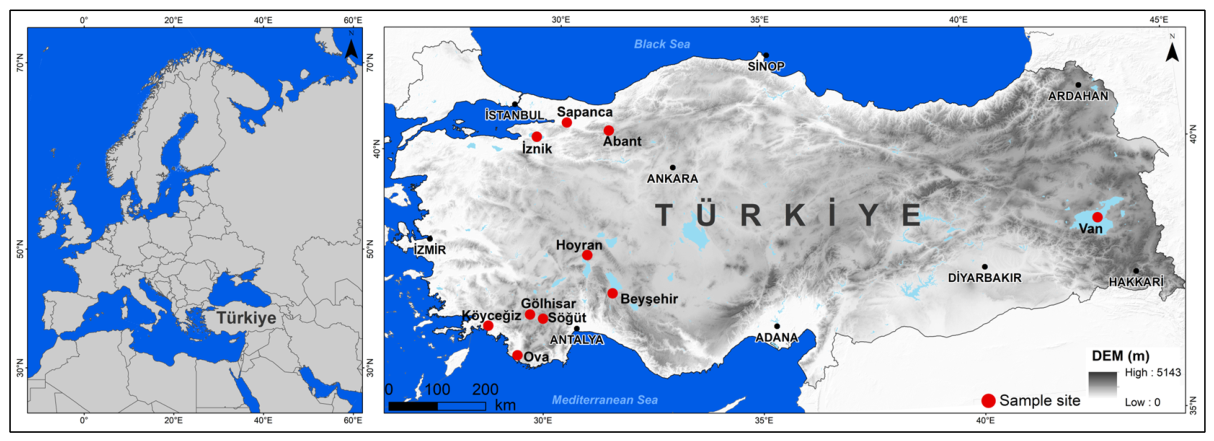
Figure 2.
Lake-based average values and standard deviations of combined pollen percentage for selected anthropogenic indicator taxa in the 1300-3500 cal BP range. Lakes are ranked according to average combined pollen percentage, and error bars indicate the standard deviation.
Figure 2.
Lake-based average values and standard deviations of combined pollen percentage for selected anthropogenic indicator taxa in the 1300-3500 cal BP range. Lakes are ranked according to average combined pollen percentage, and error bars indicate the standard deviation.
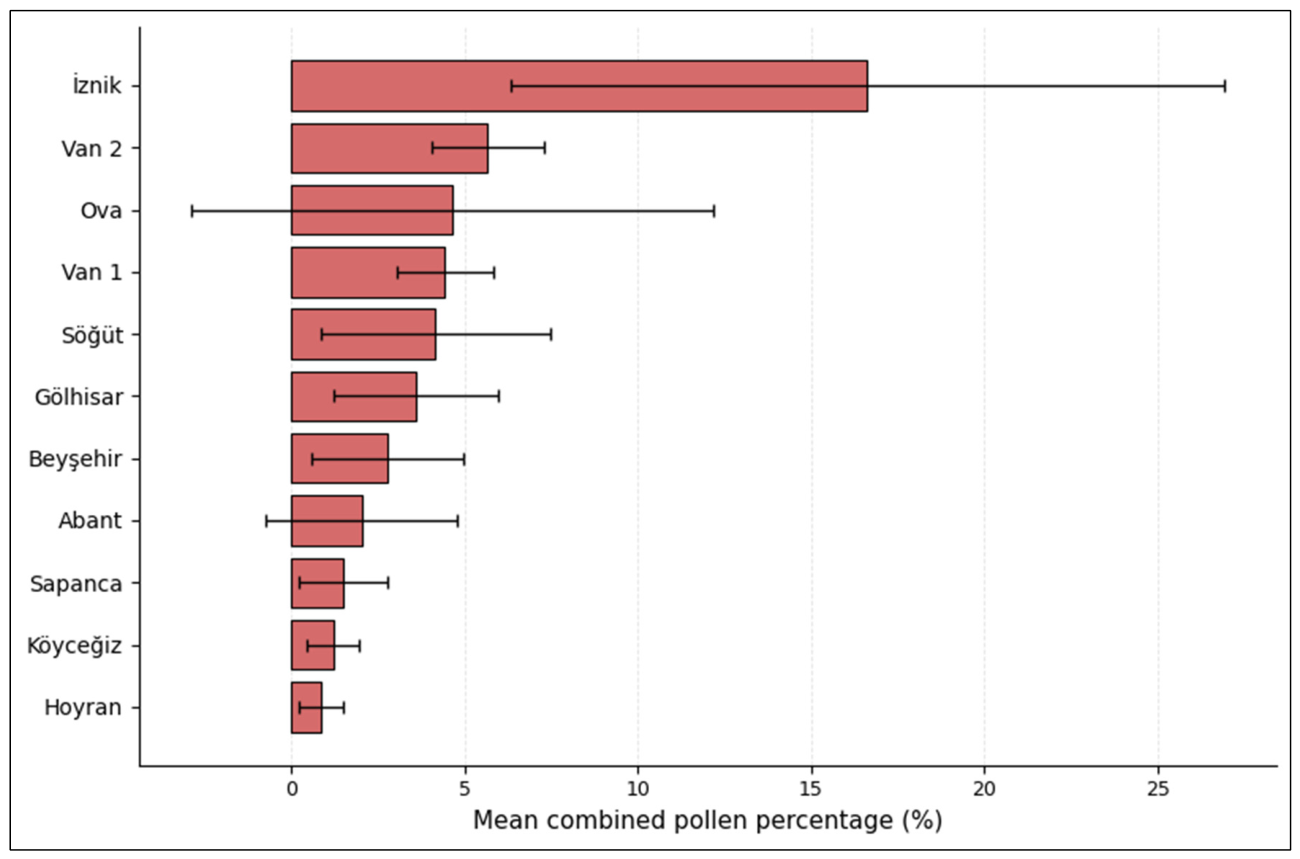
Figure 3.
Heatmap showing the percentage distribution of selected anthropogenic indicator taxa in lakes, spanning the period 1300-3500 cal BP.
Figure 3.
Heatmap showing the percentage distribution of selected anthropogenic indicator taxa in lakes, spanning the period 1300-3500 cal BP.
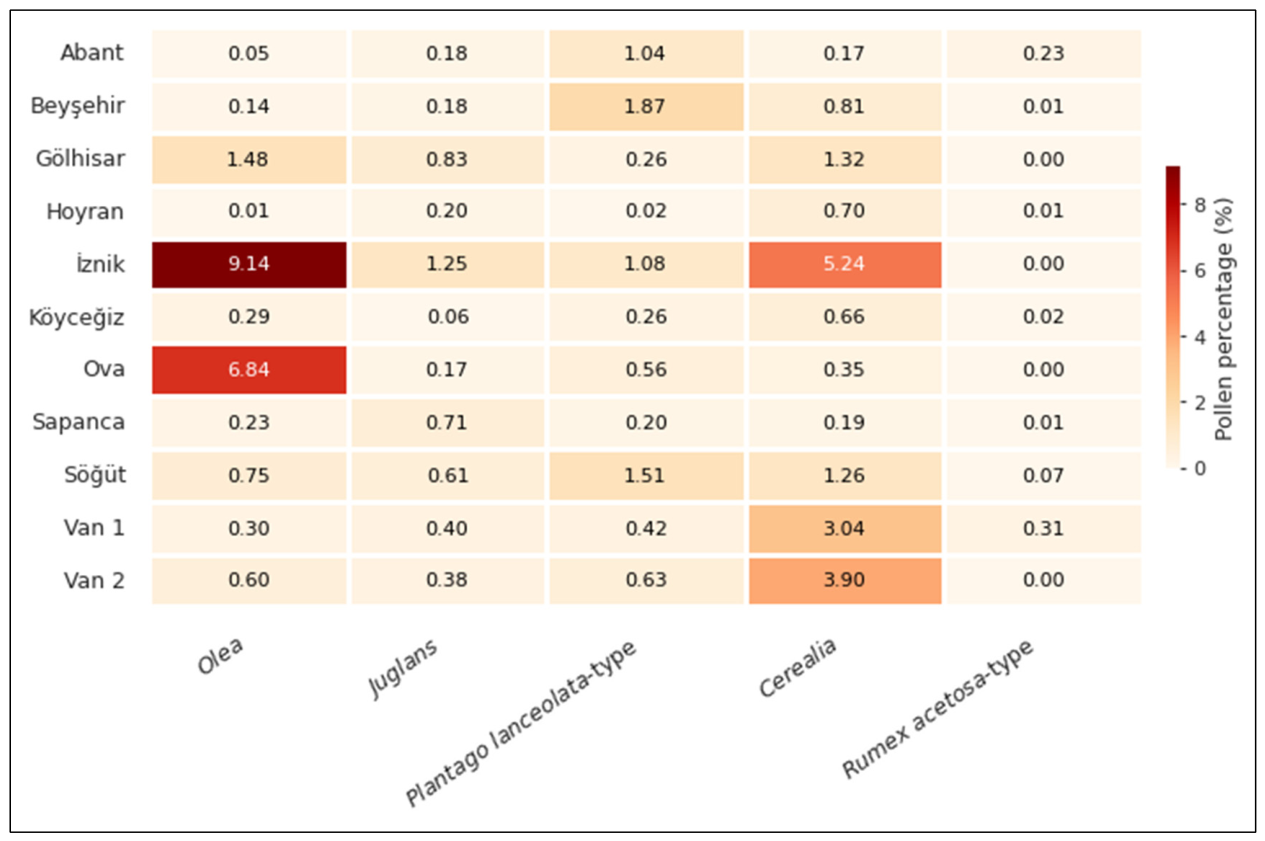
Figure 4.
Lake based PCA results of selected anthropogenic indicator taxa.
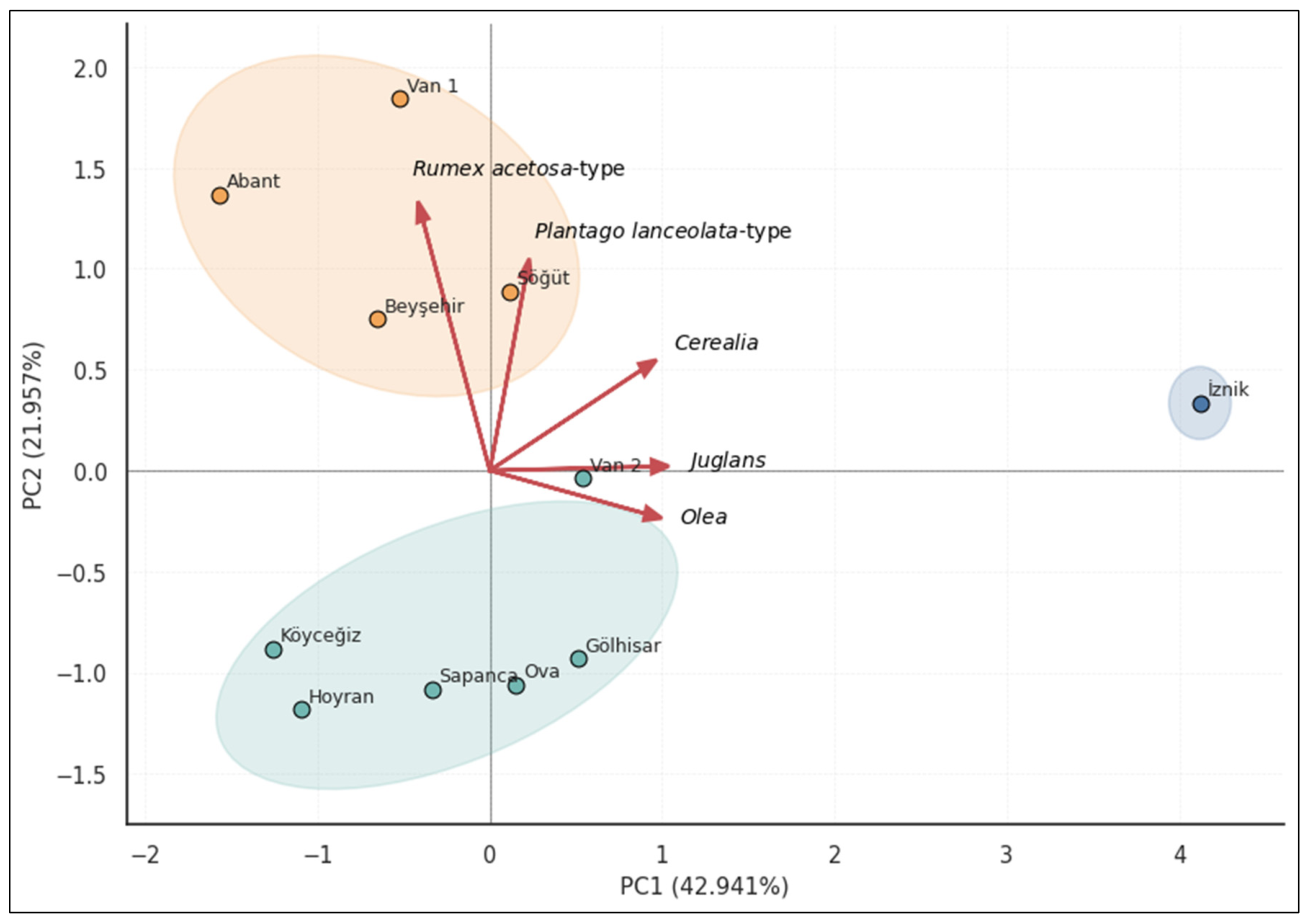

Table 1.
Lake-based summary statistics on the combined pollen percentage of selected anthropogenic indicator taxa in the 1300-3500 cal BP range.
Table 1.
Lake-based summary statistics on the combined pollen percentage of selected anthropogenic indicator taxa in the 1300-3500 cal BP range.
| Lakes | Min (%) | Max (%) | Mean (%) | SD (%) | Total (%) |
|---|---|---|---|---|---|
| Abant | 0.21 | 8.13 | 2.04 | 2.76 | 1.68 |
| Beyşehir | 0.18 | 6.95 | 2.78 | 2.19 | 3.01 |
| Gölhisar | 0.00 | 8.62 | 3.61 | 2.36 | 3.90 |
| Hoyran | 0.31 | 2.53 | 0.87 | 0.65 | 0.94 |
| İznik | 2.11 | 36.94 | 16.62 | 10.30 | 16.72 |
| Köyceğiz | 0.24 | 2.86 | 1.22 | 0.74 | 1.29 |
| Ova | 0.00 | 25.42 | 4.65 | 7.54 | 7.93 |
| Sapanca | 0.00 | 4.82 | 1.49 | 1.27 | 1.34 |
| Söğüt | 0.68 | 13.86 | 4.17 | 3.31 | 4.21 |
| Van 1 | 2.61 | 6.95 | 4.45 | 1.38 | 4.47 |
| Van 2 | 2.52 | 8.95 | 5.66 | 1.62 | 5.51 |
Disclaimer/Publisher’s Note: The statements, opinions and data contained in all publications are solely those of the individual author(s) and contributor(s) and not of MDPI and/or the editor(s). MDPI and/or the editor(s) disclaim responsibility for any injury to people or property resulting from any ideas, methods, instructions or products referred to in the content. |
© 2026 by the authors. Licensee MDPI, Basel, Switzerland. This article is an open access article distributed under the terms and conditions of the Creative Commons Attribution (CC BY) license (http://creativecommons.org/licenses/by/4.0/).
Copyright: This open access article is published under a Creative Commons CC BY 4.0 license, which permit the free download, distribution, and reuse, provided that the author and preprint are cited in any reuse.


