
Submitted:
22 April 2026
Posted:
23 April 2026
You are already at the latest version
Abstract
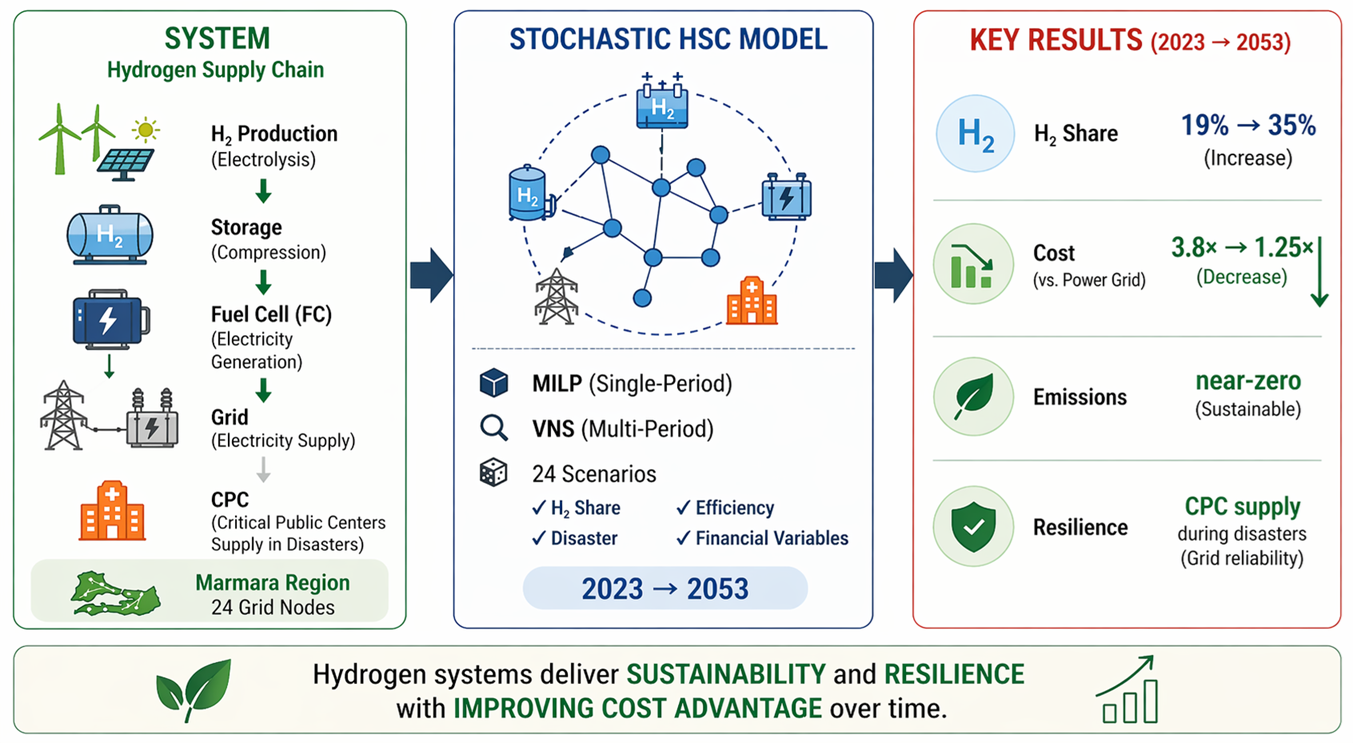
Hydrogen (H2) is regarded as a promising option for sustainable energy systems; however, its large-scale use in electricity supply remains limited. This study develops a stochastic network optimization model to examine the applicability of H2-based electricity generation. The proposed Hydrogen Supply Chain (HSC) model evaluates cost and emission performance under uncertainty by considering disaster conditions, transmission losses, depreciation, and the time value of money. The Marmara Region of Türkiye is divided into 24 grid nodes, and a single-period model for 2023 is solved using Mixed-Integer Linear Programming (MILP). The HSC is allowed to meet 10–40% of electricity demand and to replace collapsed grid lines by supplying critical public centers (CPCs) during disasters. The results show that the HSC can meet about 25% of demand, although at costs higher than power grid (PG) electricity, while keeping emissions near zero. The model is then extended to a multi-period structure (2023–2053) and solved by Variable Neighborhood Search (VNS). Over time, H2 costs decline, and its share rises from 19% to 35%. These findings suggest that H2 can support long-term sustainability, resilience, and energy security.
Keywords:
hydrogen supply chain
; stochastic optimization
; energy transition
; disaster resilience
; multi-period planning
; variable neighborhood search
Copyright: This open access article is published under a Creative Commons CC BY 4.0 license, which permit the free download, distribution, and reuse, provided that the author and preprint are cited in any reuse.


