
Submitted:
22 April 2026
Posted:
23 April 2026
You are already at the latest version
Abstract
Mars climatology is a growing interest domain for planetary research and for operational missions. In the last three decades, Martian General Circulation Models have been developed to support the interpretation of spacecraft and telescopic observations and for the advancement of theoretical understanding of the climate. They have been designed to represent key processes, such as dust cycle, seasonal CO2 condensation and interaction between boundary layer and surface. At the same time, new observations from orbiters and landers have enhanced the diagnostics, but several uncertainties in the parameterization, especially in dust representation and turbulent mixing, require further improvements. This review represents a synthesis of the state of the art of existing global and regional models, comparing numerical and physical approaches, identifying the main challenges for the next years, with particular attention to the needs of operational missions and machine learning techniques.
Keywords:
Martian atmosphere
; climate modeling
; GCM
; state of the art
1. Introduction
In the XXI century, Mars explorations moved from pure geological recognition to the systematic characterization of climate and atmosphere. Mariner 4 (1964) and Viking 1,2 (1975) missions marked the first successes in the exploration of Mars, providing the first images and analyses of the soil. After the space missions of the 1970s, the general circulation of Mars has become the best known after the terrestrial one. In fact, on both planets a large part of the solar radiation reaches the surface, and the thermal radiation heats the atmosphere [1]. In 1996, the NASA Mars Pathfinder was the first mission to carry a rover (Sojourner) to the planet. The lander operated as a weather station, while the rover analyzed the soil and rocks at the landing site and performed various experiments on the surface. The Mars Science Laboratory (MSL) is a NASA exploration mission, mainly made up of the Curiosity Rover activities, launched on 26 November 2011, landed on 6 August 2012, and currently ongoing.
Operational requirements related to rovers, landers and future assets require reliable weather forecasting and a deep understanding of climate processes that regulate the seasonal and interannual variability of the planet. General Circulation Models (GCMs) developed for Mars (LMD, NASA/Ames, MarsWRF) are useful tools to support missions and research activities, however, they often do not converge on specific topics, due to uncertainties on dust lifting parameterizations, dust optical properties and on planetary boundary layer representation. This review aims to provide an updated overview of modeling architecture, available observations and critical areas that need rapid developments, with the aim of providing the community with shared research planning.
The modeling of the Martian atmosphere started in 1969 with Leovy and Mintz [2], who adapted the Mintz-Arakawa two-level model for planetary atmospheres to Martian conditions. The most important variations were the removal of the oceans and mountains and the change in composition of the atmosphere. They performed two experiments, simulating respectively orbital conditions at the southern summer solstice and at the southern autumnal equinox. Successively, this model was updated at the NASA AMES Research Center [3], incorporating the radiative effects of atmospheric dust on solar and thermal radiation, and used for the simulation of the general circulation of the Martian atmosphere. Several numerical experiments were conducted for alternative choices of seasonal date and dust optical depth.
In 1989, the LMD terrestrial climate model was adapted to Mars with the introduction of a new radiative transfer module and a parameterization of CO2 condensation and sublimation [4]. This model was validated against pressure measurements provided by Viking and temperature fields provided by Mariner-9. In the 90s, a spectral solver in conjunction with a simplified set of parameterizations was implemented at the Universities of Reading and Oxford [5], while an advanced version of LMD model was developed thanks to a joint effort of the Laboratoire of Meteorologie Dynamique (LMD, France) and the Department of Atmospheric, Oceanic and Planetary Physics of Oxford University (AOPP, United Kingdom) [6].
On Mars, deterministic forecasts can be made only for 3-5 Martian days (Sol), due to the limited availability of observations from rovers and sensors, and consequent limited assimilation. Nowadays, Martian weather forecasts are useful to plan rover activities (Perseverance, Curiosity, Opportunity, Spirit), avoid dust storms that could damage solar panels, estimate visibility and energy production, wind and turbulence forecast for drones (e.g., Ingenuity). Before landing, local weather is simulated around landing area by evaluating density, wind, temperature and turbulence. The main centers providing weather forecasts are NASA (USA) supporting Perseverance and Curiosity, LMD (France) providing forecasts for lander, orbiter and future missions and ESA (Europe) providing information to support European missions.
An exhaustive review about existing Martian climate models was presented in 2003 by Lewis [7], providing a comprehensive assessment of the theoretical framework, numerical methods and physical parameterizations available at that time. In the last two decades, the field has undergone substantial transformation, since advances in computational power have enabled higher spatial resolution, multi-scale nesting approaches and more complex representations of radiative transfer and aerosol–dynamics coupling. At the same time, a large amount of observational data from missions such as Mars Global Surveyor (MGS), Mars Reconnaissance Orbiter (MRO), Mars Express, MAVEN and multiple landed platforms have profoundly reshaped our understanding of Martian atmospheric structure and variability. The present work aims to provide an updated perspective, building upon the foundations laid two decades ago and reflecting the substantial progress achieved since.
2. Martian Atmospheric Features
Mars is significantly smaller than Earth, its diameter being about half of the terrestrial one (6787 km vs. 12742 km) and its mass about 1/10 of the Earth. Martian atmosphere is composed almost totally of carbon dioxide, specifically CO2 95%, N2 2.7%, Argon 1.6% with traces of oxygen and water vapor [8]. Weather features have been analyzed through data provided by space probes, orbiters, rovers and through results of numerical simulations. Mars climate is variable in time and space, due to diurnal and seasonal cycles, combined with variable topography. Despite low density, Mars is characterized by strong winds (in the order of tens of km/h) and ice clouds, along with CO2 snow. The surface pressure is very low (about 7 mb), meaning less gas than on the Earth is available to absorb radiation and heat transfer. Since the mass content is low, due to the scarce thermal inertia, the soil warms up mainly during the daytime and quickly cools down at nighttime. Moreover, for the same reason, dust represents the main element for radiative balance control. In fact, during global dust storms, almost all the solar radiation is absorbed in the atmosphere and the soil remains cool. CO2 creates a greenhouse effect only at nighttime, for its capacity to absorb infrared radiation from soil, while the radiative effects of ozone layer are generally negligible [9]. The average surface temperature is about -60°C. Due to the low thermal capacity of the atmosphere, diurnal and seasonal variations of temperature are higher with respect to Earth, being about 60° C in Mars and 30° C on Earth, with peaks of 90° C in the Martian polar regions, whilst the highest excursions recorded on Earth are of about 50° C in north-east Siberia [1]. In clear atmosphere, heating from surface generates convection extending until a scale height (H) equal to 1. Referring to the pressure, H is equal to about 7.5 km for Earth and about 10 km for Mars (the scale height represents a length on which a physical variable reduces its value by a factor e). In this convective boundary layer, temperature decreases by about 4.3° C per km. At higher altitudes, temperature decreases more gradually, reaching the CO2 condensation values (-143° to -123° C) at about 40 km. General circulation is driven by horizontal temperature values associated with pressure variations.
GCMs are mainly used for generating climatology over many years. A year on Mars is equivalent to 687 Earth days [10]. A Martian day (sol) is only slightly longer than an Earth Day: 24 hours and 39 minutes. Instead of months, solar longitude (from 0 to 360°) is used, which is the position of Mars along its orbit around the Sun. The Martian calendar began much more recently than that on Earth: years are counted from the spring equinox in the planet's northern hemisphere, which occurred on 11 April 1955, marking the beginning of Martian year 1. In 2026, the current year on Mars is 38.
3. An Overview of Existing Operating GCMs
In the last three decades, several GCMs have been developed for the simulation of the Martian atmosphere, generally obtained starting from numerical cores designed for the representation of Earth climate. Climate models incorporate orographic information obtained from mission datasets. A map of Mars and its related orography, with major regions labeled, is shown in Figure 1.
3.1. General Information about Martian GCMs
The governing equations of a Martian GCM are the same as for a terrestrial model, but the physical terms inside equations are different, due to the distinct features of Martian atmosphere. Specifically, the values of gas constant R, of the gravity acceleration, of density and of specific heats are different. Moreover, an additional term is present in the continuity equation, since CO2 condensates directly, and a specific transport equation is included for the dust. The main differences between Earth and Mars GCMs lie in the physical parameterizations, since physical processes are different:
• Turbulence, due to the different Planetary Boundary Layer (PBL) heights (1-2 km on Earth, 10 km on Mars for the strong diurnal thermal gradients that enhance convection).
• Convection, which is moist on Earth and dry on Mars.
• Radiative transfer, due to the different atmospheric composition.
• Clouds, related to water and ice on Earth, and to CO2 ice on Mars.
• Different surface heat exchange: oceans and vegetation on Earth, dry soil on Mars.
3.2. LMD Mars GCM
The LMD Mars GCM [6] was developed at Laboratoire de Meteorologie Dinamique (LMD, France) with the support of the Department of Atmospheric, Oceanic and Planetary Physics (AOPP) of Oxford University and is widely used especially for the development of the Mars Climate Database (MCD). It is employed for climate simulations covering many Martian years, for the execution of sensitivity studies and for the development of climatological datasets (i.e., MCD). The model has been recently renamed as “Mars Planetary Climate Model” [11] and is freely distributed and available to the community through the website http://www-planets.lmd.jussieu.fr/ (accessed 09/03/2026).
The model includes a hydrodynamical part for the resolution of the general equations of atmospheric circulation and a physical part specific for this planet. The hydrodynamical code is based on the spatial and temporal integration of the equations of fluid dynamics on a three-dimensional grid, starting from an initial state. It adopts a finite difference discretization of the governing equations on a longitude-latitude grid and a vertical discretization based on a terrain-following coordinate system. The horizontal resolution typically ranges from 5° to 1°, but it is possible to increase the number of grid points to zoom on a given part of the globe, for example at the spacecraft landing sites. The top layer is positioned at a height of about 100 km. Typical computational grids are characterized by 64x48x25 or 64x48x32 or 32x42x25 grid points. Being the Martian radius about 3400 km, the grid 64x48 corresponds to cells of 330x220 km at the equator. Vertical levels are distributed in a non-uniform way, to have the largest accuracy near the soil. The calculations are performed by means of horizontal exchanges among cells. The physical part can be seen as a juxtaposition of several columns of atmosphere.
The radiative transfer parameterization computes atmospheric heating and cooling rates and the surface radiative fluxes by accounting for the absorption and scattering of solar (shortwave) and thermal (longwave) radiation. The radiative processes are treated using a correlated-k method, which provides an efficient representation of spectrally resolved gas absorption in a CO₂ dominated atmosphere. Thermal infrared emission and near-infrared solar absorption by CO₂ are explicitly considered. In the thermal infrared, the strong 15 μm CO₂ band is treated using a wide-band approach, which captures the main features of absorption and emission. The model includes Doppler broadening effects that become important at high altitudes (above ~50 km), while non-local thermodynamic equilibrium effects are not considered. The absorption of solar radiation in the near-infrared CO₂ bands is represented through a simplified parameterization. Although this process is negligible in the lower atmosphere, it becomes more important above 50 km and contributes significantly to atmospheric heating.
Atmospheric dust plays a key radiative role by absorbing and scattering parts of solar radiation, heating the layers where it has a larger concentration and reducing the flux that reaches the soil. Moreover, dust emits infrared radiation, influencing nighttime temperature. These processes are modeled with the numerical scheme of Fouquart and Bonel [12], originally developed for terrestrial GCM, while the scattering of thermal infrared radiation initially was not considered, according to most Earth studies. However, in [6] it was found that for many wavelengths the infrared radiation scattered by the atmospheric dust back to the surface cannot be neglected, as it causes a change in surface and atmospheric temperature. For this reason, a scheme that accounts for multiple scattering by dust particles outside the 15 µm CO2 band was included. The evolution of surface temperature is described as a balance between incoming fluxes and soil thermal conduction, using an 11-layer soil model.
The PBL is represented with a turbulence closure based on the prognostic turbulent kinetic energy, to allow the simulation of extremely deep PBL (8–10 km) and shallow nocturnal stable layers, typical of Mars. Finally, a standard energy conserving convective adjustment scheme is used, which mixes heat and momentum in convectively unstable layers.
In the LMD Mars GCM, data assimilation relies on a nudging scheme to incorporate observations, e.g., temperature profiles from Mars Climate Sounder (MCS), dust optical depth from Thermal Emission Spectrometer (TES) and surface pressure from landers, constraining the simulated Martian atmosphere.
The model has been employed for the realization of the MCD [13], developed to provide a realistic modelization of the Martian climate system. The MCD provides average values and statistics of the main meteorological variables (temperature, density, pressure, wind) and atmospheric composition (dust, water vapor, ice content) at resolution 5.675°×3.75°. It can be used in the context of specific studies requiring an accurate description of the state of the Martian atmosphere. Since the main factor influencing Martian climate is the dust load, the MCD provides a series of climatologies for different dust scenarios: standard year, cold (low dust), hot (high dust), dust storm. Moreover, the database provides additional “add-on” scenarios focusing on individual Martian years (24 to 31), which are useful to reproduce specific historical conditions or for comparison with missions/experiments performed in a selected year. The fields are saved 12 times a day, approximately every 2 Martian hours, to describe the diurnal cycle appropriately. The latest version of the database (6.1) is freely distributed through the website https://www-mars.lmd.jussieu.fr/ (accessed 09/03/2026). The MCD has been validated against observational data from many available sources (e.g., Viking landers). An example of temperature distribution over the Martian surface, extracted from the MCD [14], is shown in Figure 2.
The model was also used to explore the possible climate on Mars in the past, when obliquity was different [11], and also used for providing environmental predictions aimed at preparing space missions, e.g.:
- Mars Express: space exploration by ESA of the planet and its moons since 2003. It includes the Mars Express Orbiter and Beagle 2, a lander designed to perform exobiology and geochemistry research (https://www.esa.int/Science_Exploration/Space_Science/Mars_Express, accessed 09/03/2026);
- ExoMars Rover (named now as Rosalind Franklin), designed for the ExoMars mission by ESA and Roscosmos, expected to launch in 2028 (https://www.esa.int/Science_Exploration/Human_and_Robotic_Exploration/Exploration/ExoMars/ExoMars_rover, accessed 09/03/2026).
3.2 NASA AMES Mars M-GCM
The M-GCM was developed by the Mars Climate Modeling Center (MCMC) at the National Aeronautics and Space Administration (NASA, USA) to support operational missions in the 2000s and is continuously updated. It is also used for multimodel intercomparison, studies of interannual variability and density forecasting. The model has played a central role for the interpretation of spacecraft observations and for the advancements of the theoretical understanding of Martian climate dynamics since the Viking era. Its development started with early global circulation experiments described by Haberle [15], which established the basics of modern Mars climate modelling.
The M-GCM solves the hydrostatic dynamical equations on a rotating sphere using finite-difference techniques and a terrain-following coordinate in the vertical direction. The horizontal resolutions ranges from 5°× 6° to 1°× 1°, with 30–50 vertical levels extending up to 80–100 km altitude, depending on the application.
The physical parameterization packages include a CO₂ radiative transfer, surface–atmosphere exchange and aerosol processes, allowing the reproduction of the strong seasonal and diurnal variability characteristic of Mars. The radiative forcing is treated using schemes that account for infrared cooling by CO2 and heating by airborne dust. Dust lifting, transport and sedimentation are represented in interactive way or using prescribed scenarios. In this way the M-GCM can simulate both climatological dust cycles and episodic global dust storms. Surface processes are simulated through parameterizations of thermal inertia, albedo and topographic forcing, including high-resolution datasets derived from spacecraft measurements. The representation of polar CO₂ condensation and sublimation allows a realistic simulation of seasonal mass exchange between atmosphere and surface, which is a feature of Martian climate.
The M-GCM is characterized by a data assimilation system able to incorporate data from the Mars Color Imager (MARCI), TES, MCS, land pressure and temperature measurements, allowing the short-range forecasts (2-5 sol) to support rover operations and entry descent landing studies.
The model is currently used for practical applications, thanks to the effort provided at MCMC [16], aimed at updating NASA missions and operating support. Specifically, the model provides forecasts for Entry, Descent and Landing (EDL) of landers such as:
- Phoenix (2008): wind and density at 68°N during Martian summer.
- InSight (2018): density profiles and shear winds at Elysium Planitia.
- Mars 2020/Perseverance (2021): evaluation of Terrain-Relative Navigation and parachute deployment, integrated with data MCS for dust storms [17].
- Future ones (e.g., Mars Sample Return).
It is also employed in near-real-time aerobraking operations for missions such as MGS, Odyssey, and MRO to provide forecasts of atmospheric density along the braking corridors.
Data are distributed through the NASA Ames web interface (https://data.nas.nasa.gov/mcmc/portals/web-interface/, accessed 10/03/2026). Moreover, the MCMC made available the Community Analysis Pipeline (CAP) [18], an open-source Python-based command line tool for analyzing and visualizing M-GCM output. An example of temperature distribution over the Martian surface generated with this model is shown in Figure 3.
The model has also been employed for scientific research. Batterson et al. [19] reproduced the recurring southern polar “B” regional dust storm observed by TES on MGS and by MCS on MRO. Their simulations showed that during years without global dust storms, the B storm over the retreating south polar CO₂ cap is driven by repeated dust plumes poleward of 70°S. Hinson and Wilson [20] analyzed seven years of temperature profiles from the MCS to characterize atmospheric waves generated by boundary-layer winds over steep topography. A complementary simulation with the M-GCM was then used to interpret the observations and better understand the generation and structure of waves in the Martian atmosphere. The Mars year 34 global dust storm (June 2018) was monitored by several spacecraft in orbit and was modeled with M-GCM in [21], to understand its evolution and assess sources and sinks of dust.
3.3. MarsWRF
The MarsWRF (Mars Weather Research and Forecasting model) [22] is a Mars specific implementation of the planetWRF model [23], which was adopted from the terrestrial WRF model. It is used to simulate the mesoscale circulation, regional dust storms, characterization of landing sites and study of boundary layer processes. Maintained through a collaboration between NASA Ames, the Spanish Research Council (CSIC) and others, it enables meso-scale to micro-scale modeling of Martian weather, bridging the gap between GCMs like NASA Ames M-GCM and local observations from landers and rovers.
It is characterized by a fully compressible, non-hydrostatic dynamical core, supporting nested grids, regional domains with spatial resolution less than 10 km, allowing the study of regional phenomena not completely solved by GCMs (see Section 4). The parameterization schemes of the terrestrial model have been modified to adapt to the Martian conditions, in particular the dry convection, PBL schemes and interactive dust transport (via moment method), while the fast accurate radiative transfer model was developed in 2012 [24]. The CO2 scheme allows a portion of the atmosphere to freeze out onto the surface if any point in the vertical column becomes supersaturated and allows CO2 to sublime back into the atmosphere if the atmosphere over CO2 ice becomes sub-saturated [25]. The model supports fully coupled dust cycles, predicting lifting, transport, and sedimentation with sub-grid variability. Additional key physics include water ice microphysics, regolith heat diffusion and boundary layer schemes tuned for Mars' thin atmosphere (about 1% Earth density). An interesting feature is that MarsWRF can be coupled to Large Eddy Simulations (LES) configurations for explicit simulation of turbulence and convective structures, as described in [26].
The model assimilates data for initialization from missions like MGS, using the Data Assimilation Research Testbed (DART) [27], a rigorous framework that allows various observation types to be combined using a common interface to an Ensemble Kalman Filter. Data from other missions, e.g. MRO, Phoenix, Curiosity and InSight can be also assimilated.
In [22], the sensitivity of the model to the horizontal resolution was investigated considering grids from 7.5° × 9° to 0.5° × 0.5°, encompassing a wide range from standard Mars GCMs to global mesoscale modeling. It was found that while most of the gross-scale circulation features are insensitive to horizontal resolution, several major features are sensitive, e.g., the northern winter polar circulation. A high number of Rover Environmental Monitoring Station (REMS) wind measurements were collected in three science investigations during MSL’s Bagnold Dunes Campaign and compared with numerical modeling with MarsWRF [25], considering over 80 sols around southern winter solstice (Ls ∼90°). Zohu et al. [28] also investigated the impact of model horizontal resolution of the model by increasing the commonly used value 5° x 5° to the higher value 3° x 3°, applying an interactive dust scheme to parameterize the dust-lifting process. They found that increasing the horizontal resolution with interactive dust produces only limited changes in the simulated climate. Relevant differences emerged only in regions characterized by complex topography, such as Olympus Mons, the Hellas Basin and the southern cap-edge areas. Figure 4 shows the vertical cross-section of five-sol-averaged zonal-mean temperature (K) around Ls = 0° in the standard resolution (5°x 5°) and high resolution (3°x 3°) simulations. The analysis of results suggests that higher horizontal resolution is particularly important for the investigation of regions with complex terrain. Conversely, in flat areas, e.g., the Tianwen-1 landing site in Utopia Planitia, simulations performed at standard resolution tend to provide comparable results while requiring substantially lower computational resources.
In [29], the model was run in a five-nest configuration, down to a spatial resolution of about 1.46 km, centered on the landing sites of six past missions. It was found that the model reproduces accurately the EDL vertical profiles in terms of density, temperature, pressure and horizontal wind in the lowest 30 km, where the most critical phase of the EDL takes place.
3.4. UK Met Office Mars Unified Model
The UK Met Office has recently adopted the Unified Model (UM) to deal with Martian applications [30]. This effort is notable because the UM underpins both operational weather forecasting and climate simulations on Earth, offering a unified approach across scales. Even if it is less mature than LMD or MarsWRF, the UM-Mars model highlights the feasibility of transferring state-of-the-art Earth system modeling infrastructure to planetary atmospheres. A highly sophisticated model was created by adapting established climate schemes used for the study of Earth to the specific features of Mars (e.g., atmospheric dust, wind, atmospheric composition.) [31].
The Global Atmosphere 7.0 science configuration of the UM was adopted to Martian conditions. The computational core is based on a non-hydrostatic fully compressible flow solver, which uses a semi-implicit timestep and semi-Lagrangian advection scheme. The model incorporates a dynamic dust scheme that explicitly reproduces saltation processes, allowing for a more realistic simulation of dust lifting and transport. Surface properties are treated through a roughness length derived from [32], ensuring consistency with observed Martian terrain features. The Martian orography is described including a smoothing of extreme elevations, with maximum and minimum surface heights ranging between +8.2 and −8.2 km, respectively, to maintain numerical stability. An average surface pressure of about 610 Pa is assumed, representing typical Martian conditions, and adopting a simplified atmospheric composition of 95% CO₂ and 5% N₂, neglecting the contribution of argon. An idealized CO₂ ice scheme is included to account for seasonal condensation and sublimation processes, which dynamically modify surface pressure through mass exchange between the atmosphere and polar caps. Additionally, the model represents Martian moisture quantities, enabling the simulation of water-related processes. The data assimilation scheme is based on techniques designed to interface with models of different complexity, capable of analyzing any randomly distributed dataset [33].
In [30], a resolution of 2° in latitude and 2.5° in longitude (grid size of 118 x 147.5 km at the equator) was used, along with 50 hybrid-height atmospheric levels up to a model top of 80 km above the areoid level. Model output was validated against in-situ data from the Viking landers and output from the LMD Mars GCM. As an example, Figure 5 shows the surface pressure at Viking Lander 1 and Viking Lander 2 sites over a Martian year, provided by observational data [34] and model output. It is shown that the cold season pressure drop present in observations is not represented by the model, since UM does not currently have a CO2 ice cycle.
Overall, UK Met Office model demonstrated good capabilities in reproducing the main features of the large-scale Martian circulation but lacks two important physical processes: i.e. water and CO2 cycle.
As a summary of this section, which provided an overview of the main GCMs, Table 1 presents a comparison of the main features of the different models.
4. Limited Area Models and High-Resolution Studies
GCMs have some limitations in simulating local climate, since they are characterized by resolutions around or coarser than 100 km, while important phenomena occur at spatial scales less than 10 km. Moreover, GCMs do not adequately account for complex topography, which is an important aspect of the physical response governing the regional/local atmospheric features. Thus, downscaling techniques and Regional Climate Models (RCMs) were developed in the early 1990s for terrestrial applications [35] and have since developed rapidly and significantly. They take the large-scale predictions provided by GCMs and extract the implied information at more regional/local scales. In the last years, limited area models (meso- and micro-scale) have been applied not only to Earth applications, but also to the Martian atmosphere to support the interpretation of in situ measurements from landed spacecraft and to investigate meteorological processes occurring at sub-global scales. The spatial resolutions employed, down to hundreds of meters, allow LES approaches where boundary-layer dynamics can be explicitly resolved [36]. The lateral boundary conditions for such limited-area models must either be provided by output from GCM archives or, in the case of idealized experiments, specified as periodic.
Early regional simulations were performed employing the Mars Regional Atmospheric Modeling System (MRAMS) model [37], which descended from the regional atmospheric modeling system (RAMS), in large use in the terrestrial community in the late 1990s. RAMS is a non-hydrostatic and not fully compressible model, based upon the grid-volume Reynolds-averaged primitive equations. The pressure signal modeled using the baseline RAMS dynamical core, in the absence of full compressional heating, is unable to properly reproduce the strong diurnal pressure cycles of Mars. For this reason, a correction was done by adding the compressional term (i.e., a term proportional to the time rate of change in potential temperature) to the dynamical core, substantially improving the simulation of Mars’ diurnal pressure cycles. An additional buoyancy term was also added. The height coordinate system is based on a terrain influenced geometric approach. As regards physical parameterizations, the model uses foreground dust and background dust fields individually (or in combination) to simulate a wide variety of scenarios. The cloud microphysics scheme employed is the Community Aerosol and Radiation Model for Atmospheres (CARMA) model adapted for Mars H2O ice and CO2 ice clouds. In [37], MRAMS simulations covering the Mars Pathfinder landing site were performed, using a grid with 55 x 55 points horizontally (grid spacing of 60 km) and 47 points in the vertical direction. Initial and boundary conditions (updated every six hours) were obtained from the NASA Ames M-GCM. The simulation started before sunrise (0530 local time) at Ls =142°, covering approximately 3 sols. Model evaluation, conducted against Pathfinder data, revealed good capabilities of the model, even if maximum temperatures were slightly underpredicted, as well as wind speeds. Interestingly, the model revealed that the Martian atmosphere is about two-three times more turbulent than the terrestrial atmosphere in the afternoon, but with fluxes that are an order of magnitude smaller, due to the lower density. Successively, the model was updated and the current version (v2.9_r39) was presented in detail in [38]. Apart from technical updates to modern Fortran standards, the full compressibility was included in the model core, along with a complete linearization of the buoyancy term, to guarantee a proper representation of the strong irrotational flows associated with the atmospheric tide. Overall, this version can represent the main key physical processes and can be applied to any geographical area, from pole to equator, differently from the original model that was only capable of simulating the very basic mesoscale and microscale circulations. Figure 6 shows the Olympus Mons cloud particle distribution at several locations to the lee of the volcano, simulated with MRAMS as an example of the modeled microphysical details of the afternoon clouds.
Since the introduction of MRAMS, other mesoscale models have been developed. The LMD Martian Mesoscale Model [39] is the limited area version, developed in 2009, of the LMD Mars GCM. It was designed with the aim of combining the improvements achieved in the mesoscale dynamical solver ARW-WRF for terrestrial applications (in terms of stability, accuracy and ergonomy) with the entire set of Martian parameterizations developed for nearly two decades in the corresponding LMD GCM, including CO2 cycle, dust cycle and photochemical cycles. The usage of the same parameterization in an RCM and in the corresponding driving GCM ensures a high level of downscaling consistency. The simulations presented in [39] were performed using GCM driving data obtained at resolution 5. 625° x 3.75°, every Martian hour. Several domains were considered, centered over selected locations (e.g., Chrysie Planitia, Valles Marineris, Gusev), employing horizontal resolutions varying from 20 km to 5 km. Numerical results revealed that near-surface daily cycles of temperature, pressure and horizontal winds are in good agreement with data from Viking and Pathfinder. Three-dimensional LES were performed over Gusev crater at horizontal resolution of 100 m, aimed to resolve a part of turbulence spectrum responsible for most of the energy transport within the PBL.
The MarsWRF model was used also in regional/mesoscale mode, even if not as pure LAM, rather as nested into a global domain. In [40], the model was used in a very high-resolution configuration (about 490 m) centered over Bagnold Dunes area in Gale crater. Even if starting from a global structure of the model, the study used a nested domain to explicitly represent the local processes, such as circulation around Aeolis Mons. In this way, it was possible to reproduce phenomena that are not solved at global scale, such as diurnal cycle and turbulence in the Namib dune. The model showed a good capability in capturing the temporal structure of the circulation, even with biases in wind speed and direction. In [41], back trajectory analyses were performed for the methane spikes detected by the MSL at Gale crater. Since high-quality wind observations on Mars were lacking, MarsWRF was used to simulate the wind fields necessary for inverse Lagrangian modeling at increasing horizontal resolutions around Gale crater. Four nested domains were employed, each increasing in spatial and temporal resolution by a factor of three relative to its parent. The innermost domain covered an area of 8.89° × 8.89°, with a horizontal resolution of 0.074° (4.4 km) and a timestep of 2.22 s.
5. Open Challenges
In the last years, there has been growing research interest in exploring the Martian atmosphere. Numerical simulations have considerably supported spacecraft and telescopic observations. Despite the significant progress made, there remain numerous issues and representations of phenomena that require further improvement. A relevant part of the computational effort needed by a GCM lies in the parameterization schemes, in particular radiation, dust and cloud microphysics. Radiative transfer is one of the main forcing mechanisms and must be modeled accurately. In the Martian atmosphere, it differs from terrestrial conditions for the very low atmospheric mass, a different composition (CO2 dominated) and for the presence of mineral dust. Despite the significant progress achieved, the representation of radiative processes and dust is still affected by important uncertainties. In particular, the physical representation of size, shape and optical characteristics of dust is still challenging, influencing the simulated temperature structure of the atmosphere [11]. In addition, the dust lifting from the surface occurs at scale much smaller than those resolved by global models and must therefore be parameterized. A proper radiative transfer and dust representation is essential not only for climate simulations but also for short-term meteorological forecasts. Errors in dust vertical distribution can lead to large biases also in density estimates relevant to aerobraking and near-surface winds impacting rover operations. Progresses in this area will likely depend on a combination of better observational constraints, improved parameterizations of small-scale processes, and the continued development of models capable of linking global circulation with mesoscale and local dynamics. Improving the representation of dust and its interaction with radiation may also benefit from emerging machine learning (ML) techniques, which can be used to develop data-driven parameterizations of subgrid processes and to better constrain dust distributions from observations. ML represents one of the leading tools of technological advancement: in fact, while high-resolution climate models remain challenging due to the computational costs, the use of ML algorithms yields satisfactory results in terms of operational efficiency and resource consumption. For terrestrial applications, recent advances have produced ML-based models with less forecast error than single physical-based simulations [42]. On the other hand, the usage of these new techniques for Martian applications is still limited. In [43], Priyadarshini and Puri used data from the Kaggle repository (https:// www.kaggle. com/ imkrkannan/ mars-weather-data, accessed 01/04/2026) representing the weather conditions on Mars from sol 1 (7 August 2012, on Earth) to sol 1895 (27 February 2018, on Earth) and applied different ML models (e.g., CNN, GRU, LSTM) evaluating their performances. The sensitivity of optimization solvers in LSTM algorithm for temperature forecast over Mars was performed in [44], while a review of ML techniques for the analysis of Mars weather data is presented in [45]. These previous works give us hope that the combination of the power of artificial intelligence with the large amount of data obtained from space missions will play a crucial role in deciphering the complexities of Mars weather patterns, but it will be essential to select relevant features and transform data appropriately, to enhance the accuracy and interpretability of ML models.
The implementation of a CO2 condensation scheme and its interaction with dust is another critical issue. As stated in [30], the implementation of this process will allow the simulations of specific Martian years or investigate diurnal tides. Near-surface conditions must be effectively described, to obtain an accurate prediction of surface drags, dust lifting and tracer transport. Moreover, due to its very shallow and stratified structure, the parameterization of nocturnal boundary layer is challenging.
It is well known that grid resolutions typically employed even in mesoscale models are not sufficient for the explicit representation of the turbulent processes within the PBL. For this reason, a transition of turbulence schemes, from 1D to more complex schemes (e.g., LES), is necessary to tackle the challenges of the turbulent grey zone [36]. Encouraging results were obtained by Temel et al. [46], who performed LES computations within MarsWRF showing a good agreement between prediction of convective boundary layer height and the observational data acquired by radio occultations of Mars Express.
Data assimilation in Martian modeling is more challenging than on Earth [47], the Martian atmosphere being less chaotic and exhibiting more global features. Currently, it is still characterized by several weaknesses, since observations from instruments such as MCS, MARCI and TES are sparse in space and time, leading to large gaps, especially near the surface and in polar regions. Lander data provide in situ measurements, but only for fixed positions and not well integrated with orbital datasets. The quality of data is also degraded by instrument biases and inter-calibration inconsistencies. Improvements could be achieved with the development of better error covariance models for Martian dynamics, including methods such as ensemble-based assimilation. The consistency could be increased with enhanced bias correction schemes and cross calibration between instruments. Observations from Emirates Mars Mission (EMM) were assimilated in 2022 into the LMD GCM using the Local Ensemble Transform Kalman Filter (LETKF) [48], demonstrating relevant improvements in the numerical representation of several phenomena, describing also how winds change during the day and night by making use of EMM's temperature observations.
Of course, many other aspects of Martian modeling need specific attention, but a detailed analysis of all of them is beyond the purpose of the present work. For example, it is worth noting that, as shown in recent video material from NASA’s Mars vehicles, dust devils (particle-loaded vertical convective vortices) are very common on Mars. Since they represent a dust-lifting mechanism and possible triggers for global dust storms on Mars [49], a proper representation is needed. A first attempt was performed in [50] using the Computational Fluid Dynamics software package provided by ANSYS, to investigate the flow characteristics of dust devil and to lay the foundation for performing more detailed and in-depth analyses.
Funding
This research received no external funding.
Data Availability Statement
No new data were created or analyzed in this study. Data sharing is not applicable to this article.
Acknowledgments
During the preparation of this manuscript, the author used ChatGPT-5.3 to improve the quality of Figure 1. The author has reviewed and edited the output and takes full responsibility for the content of this publication.
Conflicts of Interest
The author declares no conflicts of interest. The funders had no role in the design of the study; in the collection, analyses, or interpretation of data; in the writing of the manuscript; or in the decision to publish the results.
Abbreviations
The following abbreviations are used in this manuscript:
| AOPP | Atmospheric, Oceanic and Planetary Physics |
| CAP | Community Analysis Pipeline |
| CARMA | Community Aerosol Radiation Model for Atmosphere |
| CSIC | Spanish National Research Council |
| DART | Data Assimilation Research Testbed |
| EDL | Entry, Descent, Landing |
| EMM | Emirates Mars Mission |
| ESA | European Space Agency |
| GCM | General Circulation Model |
| GSFC | Goddard Space Flight Center |
| LES | Large Eddy Simulation |
| LMD | Laboratoire de Meteorologie Dinamique |
| MARCI | Mars Color Imager |
| MCD | Mars Climate Database |
| MCMC | Mars Climate Modeling Center |
| MCS | Mars Climate Sounder |
| MGS | Mars Global Surveyor |
| ML | Machine Learning |
| MOLA | Mars Orbiter Laser Altimeter |
| MRO | Mars Reconnaissance Orbiter |
| MSL | Mars Science Laboratory |
| NASA | National Aeronautics and Space Administration |
| PBL | Planetary Boundary Layer |
| REMS | Rover Environmental Monitoring Station |
| TES | Thermal Emission Spectrometer |
References
- Leovy, C. Weather and climate on Mars. Nature 2001, 412, 245–249. [Google Scholar] [CrossRef]
- Leovy, C.; Mintz, Y. Numerical simulation of the atmospheric circulation and climate of Mars. J. Atmos. Sci. 1969, 26, 1166–1190. [Google Scholar] [CrossRef]
- Pollack, J. B.; Haberle, R. M.; Schaeffer, J.; Lee, H. Simulations of the general circulation of the Martian atmosphere 1, Polar processes, 1990. J. Geophys. Res. 95, 1447–1473. [CrossRef]
- Hourdin, F.; Le Van, Phu; Forget, F.; Talagrand, O. Meteorological variability and the annual surface pressure cycle on Mars. J. Atmos. Sci. 1993, 50, 3625–3640. [Google Scholar] [CrossRef]
- Collins, M.; James, I. N. A simplified global circulation model of the Martian atmosphere, 1995. J. Geophys. Res.: Planets 100(E7), 14421–14432. [CrossRef]
- Forget, F.; Hourdin, F.; Fournier, R.; Hourdin, C.; Talagrand, O.; Collins, M.; Lewis, S.R.; Read, P.L.; Huot, J.P. Improved general circulation models of the Martian atmosphere from the surface to above 80 km, 1999. J. Geophys. Res. 104:24, 155–176.
- Lewis S.R., Modelling the martian atmosphere. Astronomy & Geophysics 2003, 44(4), 4.6–4.14.
- Giuranna, M.; Tellmann, S.; Montmessin, F. Vertical Structure of the Martian Atmosphere: The View from Mars Express. Space Sci. Rev. 2025, 221, 36. [Google Scholar] [CrossRef]
- Lindner, B. L. The Martian polar cap: Radiative effects of ozone, clouds, and airborne dust, 1990. J. Geophys. Res. 95, 1367–1379. [CrossRef]
- Suran J., A calendar for Mars, 1997. Planetary and Space Science 45(6), 705–708.
- Forget F., Millour E., Bierjon A., Delavois A., Fan S., et al. Challenges in Mars Climate Modelling with the LMD Mars Global Climate Model, Now Called the Mars “Planetary Climate Model” (PCM). Seventh international workshop on the Mars atmosphere: Modelling and observations, June 2022, Paris, France. pp.id.1102. insu-03690056.
- Fouquart, Y.; Bonnel, B. Computations of solar heating of the Earth's atmosphere: A new parametrization. Contrib. Atmos. Phys. 1980, 53, 35–62. [Google Scholar]
- Millour E., et al. The Mars Climate Database (MCD version 5.2), EPSC Abstracts Vol. 10, EPSC2015-438, 2015 European Planetary Science Congress 2015.
- Mars Climate Database – Laboratoire de Météorologie Dynamique (LMD). Mars Climate Database Portal. Available online: https://www-mars.lmd.jussieu.fr/ (accessed on 16/03/2026).
- Haberle R., Early Mars Climate Models, 1998. J. Geophys. Res. 103(E12, 28), 467–28,479.
- Kahre, M.A. The Mars Climate Modeling center at NASA AMES Research Center: overview of recent science, model development, and progress making tools publicly available and accessible. Proc. The Tenth International Conference on Mars, California Institute of Technology (Caltech) Pasadena (USA), July 22–25, 2024; 2024. [Google Scholar]
- Bertrand, T.; Wilson, R. J.; Kahre, M. A.; Urata, R.; Kling, A. Simulation of the 2018 global dust storm on Mars using the NASA Ames Mars GCM: A multitracer approach, 2020. J. Geophys. Res.: Planets 125, e2019JE006122. [CrossRef]
- Batterson, C. M. L.; Kling, A. L. M.; Hartwick, V. L.; Urata, R. A.; Kahre, M. A.; Wilson, R. J.; Steakley, K. E.; Brecht, A. S.; Harman, C. E. Increasing Access to Mars Global Climate Model (MGCM) Data with The Community Analysis Pipeline (CAP), 2023 Presented at the AGU Fall Meeting 2023. San Francisco (USA). Available online: https://agu.confex.com/agu/fm23/meetingapp.cgi/Paper/1441150 (accessed on 10/03/2026).
- Batterson, C.M.L.; Kahre, M.A.; Bridger, A.F.C.; Wilson, R.J.; Urata, R.A.; Bertrand, T. Modeling the “B” regional dust storm on Mars: Dust lofting mechanisms predicted by the new NASA Ames Mars GCM, 2023. Icarus 400, 115542. [CrossRef]
- Hinson, D.; Wilson, R. J. Diurnal waves forced by horizontal convergence of near-surface winds on Mars, 2023. Icarus 394, 115420. [CrossRef]
- Bertrand, T.; Wilson, R. J.; Kahre, M. A.; Urata, R.; Kling, A. Simulation of the 2018 global dust storm on Mars using the NASA Ames Mars GCM: A multitracer approach, 2020. J. Geophys. Res.: Planets 125, e2019JE006122. [CrossRef]
- Toigo, A.D.; Lee, C.; Newman, C.E.; Richardson, M.I. The impact of resolution on the dynamics of the martian global atmosphere: Varying resolution studies with the MarsWRF GCM, 2012. Icarus 221, 1.
- Richardson, M.I.; Toigo, A.D.; Newman, C.E. Planet WRF: a general purpose, local to global numerical model for planetary atmospheric and climate dynamics. J. Geophys. Res. (Planets) 2007, 112, E09001. [Google Scholar] [CrossRef]
- Mischna, M.A.; Lee, C.; Richardson, M.I. Development of a fast, accurate radiative transfer model for the Martian atmosphere, past and present, 2012. J. Geophys. Res. 117, E10009.
- Newman, C.E.; Gomez-Elvira, J.; Marin, M.; Navarro, S.; Torres, J.; Richardson, M. I.; Battalio, J.M.; Guzewich, S.D.; Sullivan, R.; de la Torre, M.; Vasavada, A.R.; Bridges, N.T. Winds measured by the Rover Environmental Monitoring Station (REMS) during the Mars Science Laboratory (MSL) rover’s Bagnold Dunes Campaign and comparison with numerical modeling using MarsWRF, 2017. Icarus 203–231.
- Wu, Z.; Richardson, M. I.; Zhang, X.; Cui, J.; Heavens, N. G.; Lee, C.; et al. Large eddy simulations of the dusty Martian convective boundary layer with MarsWRF, 2021. J. Geophys. Res. (Planets) 126, e2020JE006752. [CrossRef]
- Lee, C.; Lawson, W.G.; Richardson, M.I.; Anderson, J.L.; Collins, N.; Hoar, T.; Mischna, M. Demonstration of ensemble data assimilation for Mars using DART, MarsWRF, and radiance observations from MGS TES, 2011. J. Geophys. Res. 116, E11011. [CrossRef]
- Zhou, Y.-W.; Chow, K.-C.; Xiao, J. The Effect of Model Resolution on the Vertical and Temporal Variation in the Simulated Martian Climate, 2022. Atmosphere 13, 1736.
- Fonseca, R. M.; Zorzano, M.-P.; Martín-Torres, J. MARSWRF prediction of entry descent landing profiles: Applications to Mars exploration, 2019. Earth and Space Science 6, 1440–1459. [CrossRef]
- McCulloch, D.; Sergeev, D. E.; Mayne, N.; Bate, M.; Manners, J.; Boutle, I.; Drummond, B.; Kohary, K. A modern-day Mars climate in the Met Office Unified Model: dry simulations, 2023. Geosci. Model Dev. 16, 621–657. [CrossRef]
- McCulloch D., Mayne N., Bate M., Sergeev D., Modelling an idealised Martian climate with the Unified Model: The next “giant leap” for Mars GCMs, Europlanet Science Congress 2021, online, 13–24 Sep 2021, EPSC2021-232. [CrossRef]
- Hébrard, E.; Listowski, C. An aerodynamic roughness length map derived from extended Martian rock abundance data, 2012. J. Geophys. Res. E: Planets 117(4), 4008.
- Lewis, S.R.; Read, P.L. An operational data assimilation scheme for the martian atmosphere. Advances in Space Research 1995, 16(6), 9–13. [Google Scholar] [CrossRef]
- Tillman, J. E. VL1/VL2-M-MET-4-DAILY-AVG-PRESSUREV1.0, NASA [data set]. 1989). Available online: https://atmos.nmsu.edu/data_and_services/atmospheres_data/MARS/viking/sol_avg_sur_press_data.html (accessed on 17/03/2026).
- Giorgi, F.; Mearns, L. Approaches to the simulation of regional climate change: a review, 1991. Rev. Geophys. 29(2), 191–216. [CrossRef]
- Cinquegrana, D.; Bucchignani, E.; Montesarchio, M.; Zollo, A.L. The impact of grid resolution, turbulence schemes and soil initialization over performances of ICON model with TERRA-URB at hectometric scale, 2026. Met. Atm. Physics 138:3.
- Rafkin, S.C.R.; Haberle, R.M.; Michaels, T.I. The Mars Regional Atmospheric Modeling System: Model Description and Selected Simulations, 2001. Icarus 151(2), 228–256. [CrossRef]
- Rafkin, S.C.R.; Michaels, T.I. The Mars Regional Atmospheric Modeling System (MRAMS): Current Status and Future Directions, 2019. Atmosphere 10, 747.
- Spiga, A.; Forget, F. A new model to simulate the Martian mesoscale and microscale atmospheric circulation: Validation and first results, 2009. J. Geophys. Res. 114.
- Newman, C.E.; Gómez-Elvira, J.; Marin, M.; Navarro, S.; Torres, J.; Richardson, M.I.; Battalio, J.M.; Guzewich, S.D.; Sullivan, R.; de la Torre, M.; Vasavada, A.R.; Bridges, N.T. Winds measured by the Rover Environmental Monitoring Station (REMS) during the Mars Science Laboratory (MSL) rover's Bagnold Dunes Campaign and comparison with numerical modeling using MarsWRF, 2017. Icarus 291, 203–231. [CrossRef] [PubMed]
- Luo, Y.; Mischna, M. A.; Lin, J. C.; Fasoli, B.; Cai, X.; Yung, Y. L. Mars methane sources in northwestern Gale crater inferred from back trajectory modeling, 2021. Earth and Space Science 8, e2021EA001915. [CrossRef]
- Price, I.; Sanchez-Gonzalez, A.; Alet, F.; et al. Probabilistic weather forecasting with machine learning, 2025. Nature 637, 84–90. [CrossRef]
- Priyadarshini, I.; Puri, V. Mars weather data analysis using machine learning techniques. In Earth Science Informatics; 2021. [Google Scholar] [CrossRef]
- Eltahan, M.; Moharm, K.; Daoud, N. Sensitivity of different optimization solvers in LSTM algorithm for temperature forecast over Mars at Jezero Crater landing site, 2020. 21st International Arab Conference on Information Technology (ACIT), Giza, Egypt; 2020, pp. 1–5. [CrossRef]
- Pant, P.; et al. Machine Learning Techniques for Analysis of Mars Weather Data, 2023. 15th International Conference on Electronics, Computers and Artificial Intelligence (ECAI), Bucharest, Romania; 2023, pp. 1–7. [CrossRef]
- Temel, O.; Senel, C.M.; Porchetta, S.; Muñoz-Esparza, D.; Mischna, M.A.; Van Hoolst, T.; van Beeck, J.; Karatekin, O. Large eddy simulations of the Martian convective boundary layer: Towards developing a new planetary boundary layer scheme, 2021. Atmosph. Res. 250, 105381. [CrossRef]
- Navarro, T.; Forget, F.; Millour, E.; Greybush, S.J.; Kalnay, E.; Miyoshi, T. The Challenge of Atmospheric Data Assimilation on Mars, 2017. Earth and Space Science 4(12), 690–722. [CrossRef]
- Young, R.M.B.; Millour, E.; Forget, F.; Smith, M.D.; Aljaberi, M.; Edwards, C.S.; et al. First assimilation of atmospheric temperatures from the Emirates Mars InfraRed Spectrometer, 2022. Geophys. Res. Lett. 49, e2022GL099656. [CrossRef]
- Balme, M.; Greeley, R. Dust devils on Earth and Mars. Reviews of Geophysics 2006, 44(3), 2005RG000188. [Google Scholar] [CrossRef]
- Philippou, A.N.; Isaac, K.M. An introductory investigation of dust devils on Mars: computational fluid dynamics modeling, 2023, NASA-Missouri Space Grant Consortium. 34. Available online: https://scholarsmine.mst.edu/nmsgc/2023/full-schedule/34 (accessed on 08/04/2026).
Figure 1.
Global topographic map of Mars based on Mars Orbiter Laser Altimeter (MOLA) data. The locations of Viking Lander 1 (VL1) and Viking Lander 2 (VL2) are indicated. Image credit: NASA Goddard Space Flight Center (GSFC), available at https://attic.gsfc.nasa.gov/mola/images/topo_labeled.jpg, accessed 17/03/2026).
Figure 1.
Global topographic map of Mars based on Mars Orbiter Laser Altimeter (MOLA) data. The locations of Viking Lander 1 (VL1) and Viking Lander 2 (VL2) are indicated. Image credit: NASA Goddard Space Flight Center (GSFC), available at https://attic.gsfc.nasa.gov/mola/images/topo_labeled.jpg, accessed 17/03/2026).
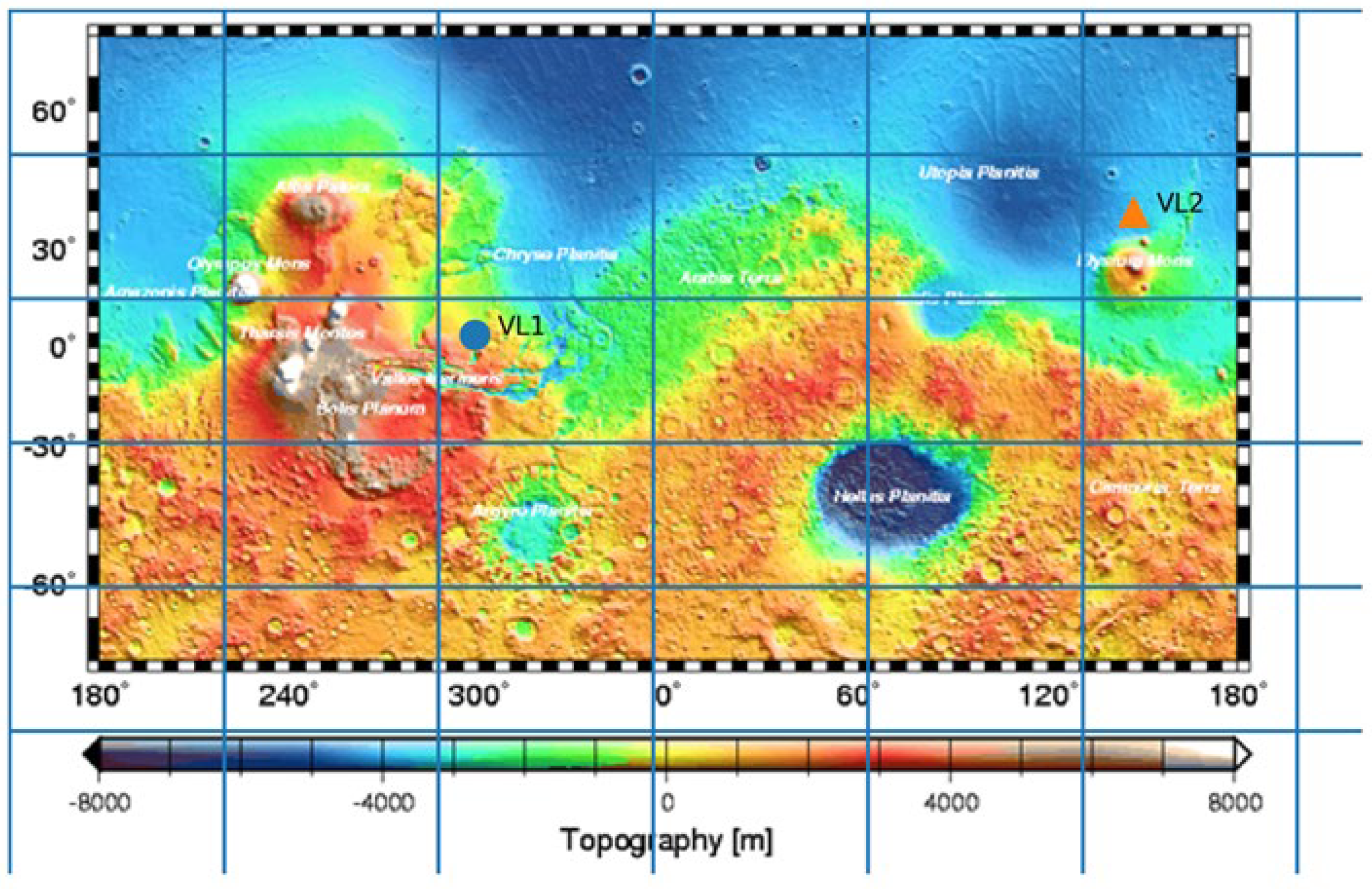
Figure 2.
An example of temperature distribution over the Martian surface, extracted from the Mars Climate Database (Laboratoire de Météorologie Dynamique, LMD, https://www-mars.lmd.jussieu.fr/, accessed on 16/03/2026) [14].
Figure 2.
An example of temperature distribution over the Martian surface, extracted from the Mars Climate Database (Laboratoire de Météorologie Dynamique, LMD, https://www-mars.lmd.jussieu.fr/, accessed on 16/03/2026) [14].
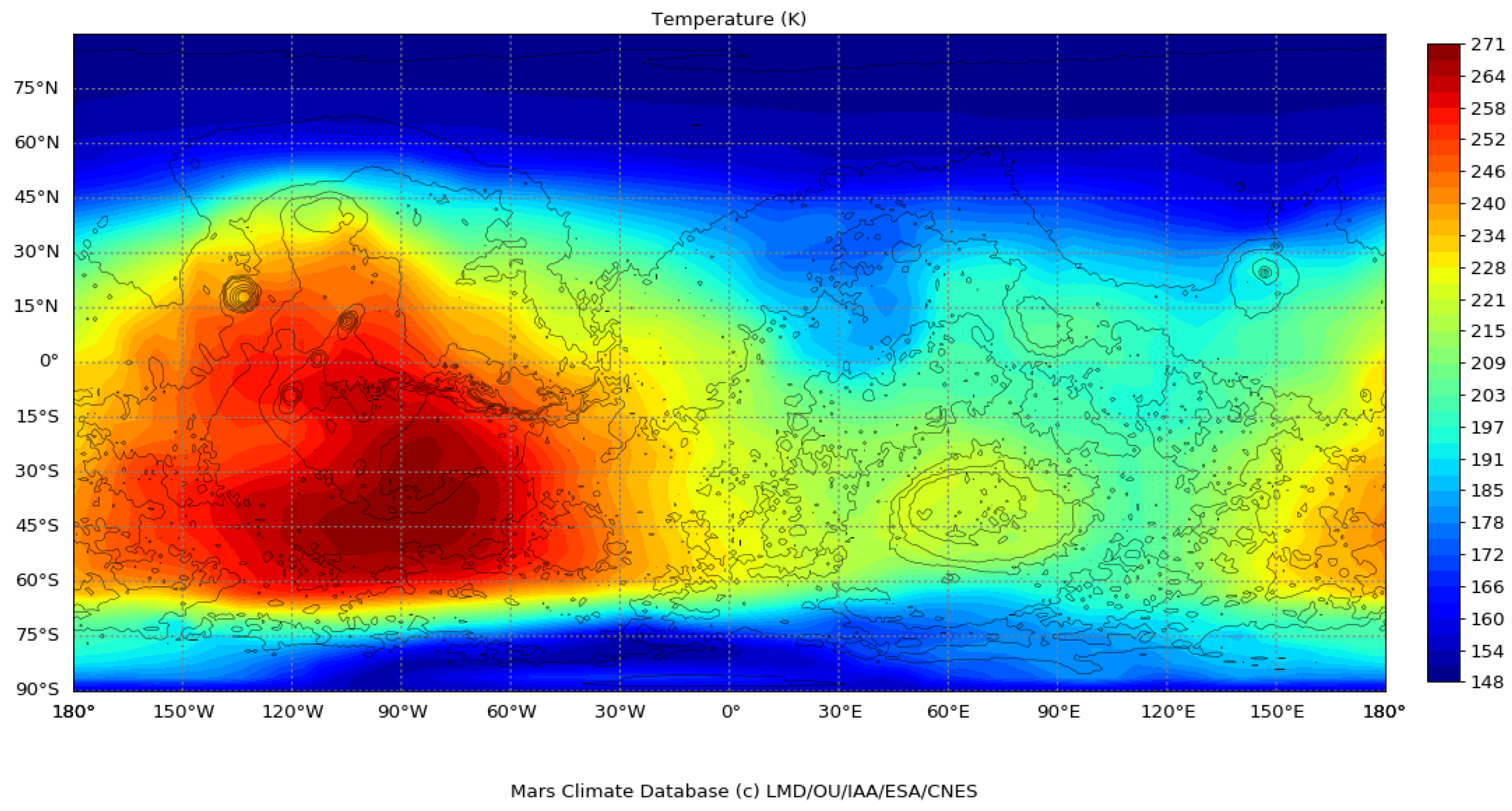
Figure 3.
Diurnally averaged air temperature at 1 km altitude (Ls ≈ 180°). Plot generated using the NASA NAS Data Portal (MCMC interface). NASA data are in the public domain. (https://data.nas.nasa.gov/mcmc/portals/web-interface/ accessed on 19/03/2026).
Figure 3.
Diurnally averaged air temperature at 1 km altitude (Ls ≈ 180°). Plot generated using the NASA NAS Data Portal (MCMC interface). NASA data are in the public domain. (https://data.nas.nasa.gov/mcmc/portals/web-interface/ accessed on 19/03/2026).
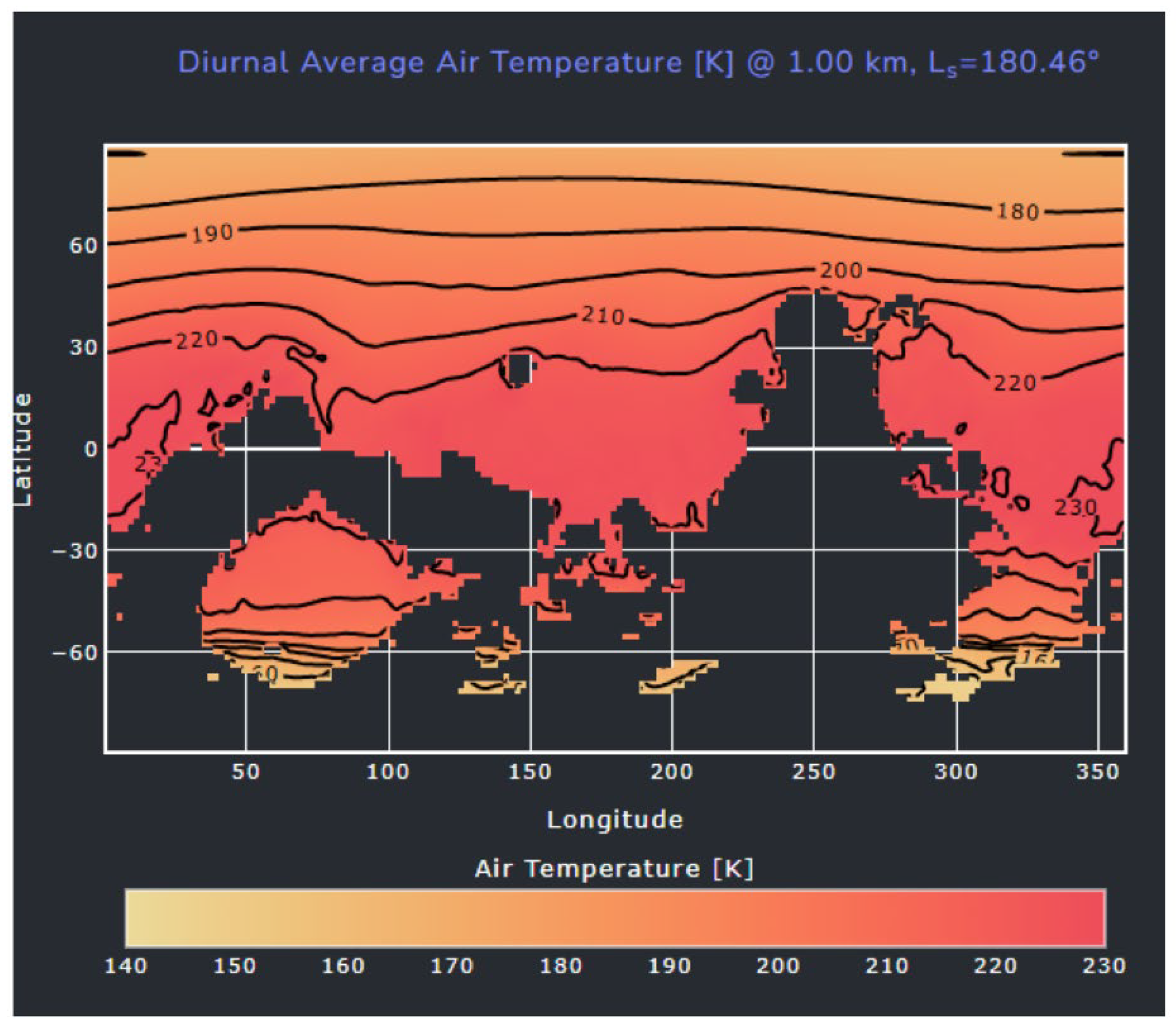
Figure 4.
Vertical cross-section of five-sol-averaged zonal-mean temperature (K) around Ls = 0° in (a) the standard resolution (5°x 5°) and (b) high resolution (3°x 3°) simulations. Reproduced from Zohu et al. (2022) [28], under the terms of the Creative Commons Attribution (CC BY 4.0) license.
Figure 4.
Vertical cross-section of five-sol-averaged zonal-mean temperature (K) around Ls = 0° in (a) the standard resolution (5°x 5°) and (b) high resolution (3°x 3°) simulations. Reproduced from Zohu et al. (2022) [28], under the terms of the Creative Commons Attribution (CC BY 4.0) license.
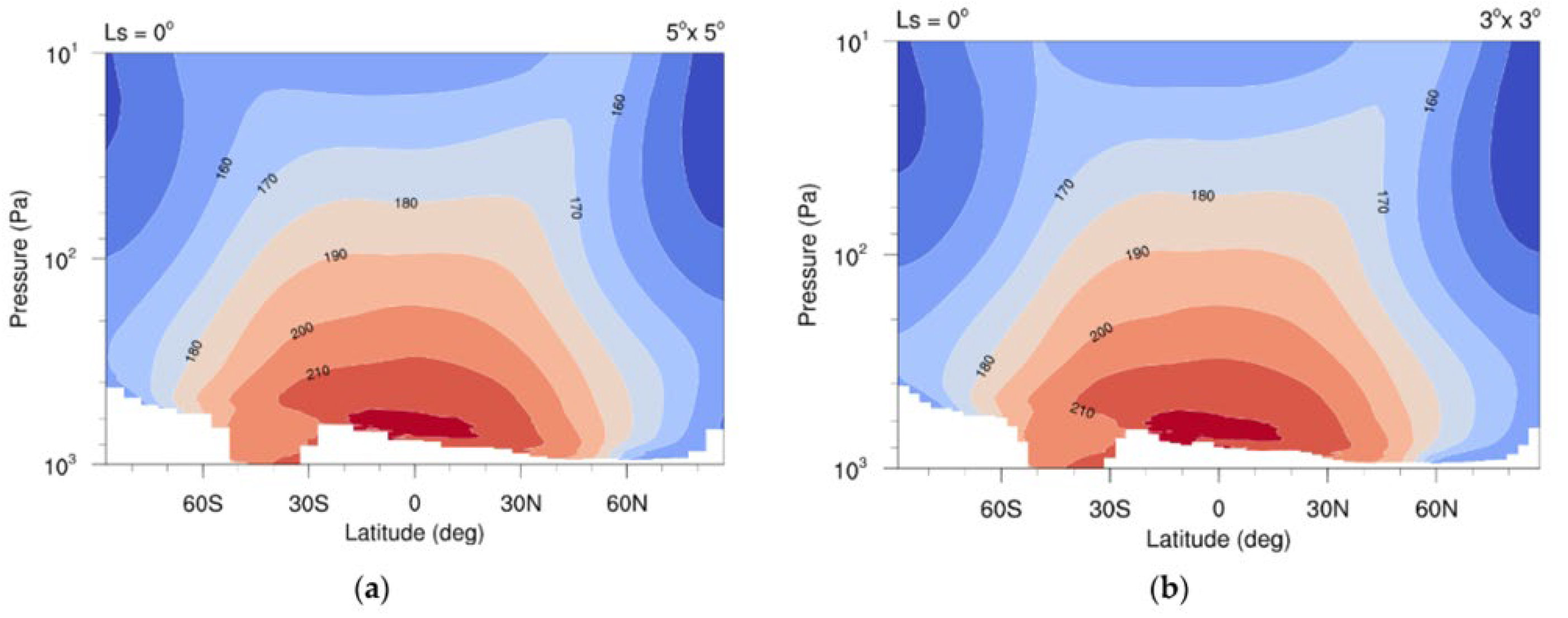
Figure 5.
Surface pressure at approximate Viking Lander 1 and Viking Lander 2 sites over a Martian year. Reproduced from McCulloch et al. (2023) [30] under the Creative Commons Attribution 4.0 License. Viking lander observational data from Tillman (1989) [34].
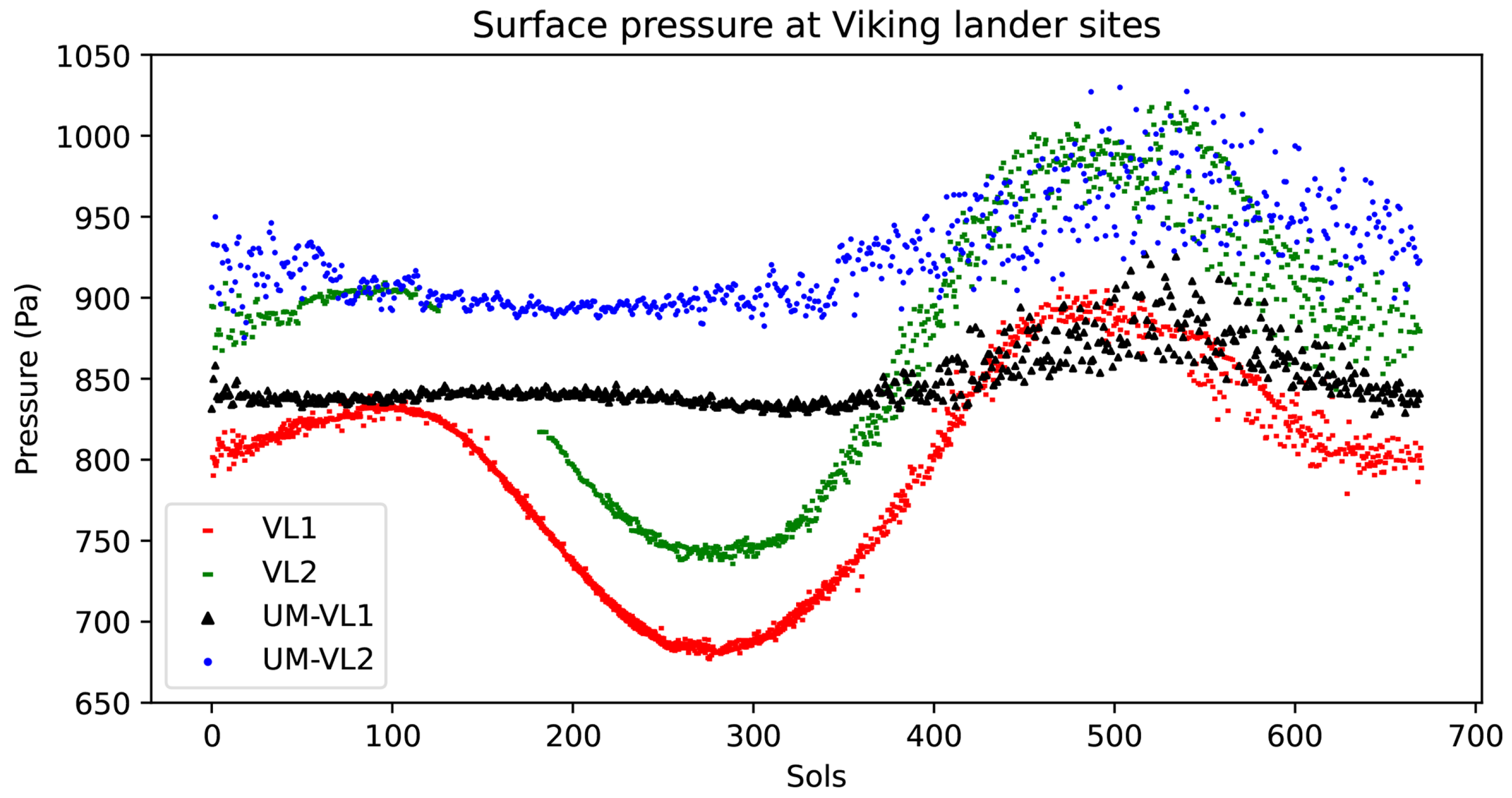
Figure 6.
The Olympus Mons cloud particle distribution at several locations to the lee of the volcano, simulated with MRAMS (1300 local mean solar time, Ls = 100°). Reproduced from Rafkin and Michaels (2019) [38] under the Creative Commons Attribution 4.0 License.
Figure 6.
The Olympus Mons cloud particle distribution at several locations to the lee of the volcano, simulated with MRAMS (1300 local mean solar time, Ls = 100°). Reproduced from Rafkin and Michaels (2019) [38] under the Creative Commons Attribution 4.0 License.
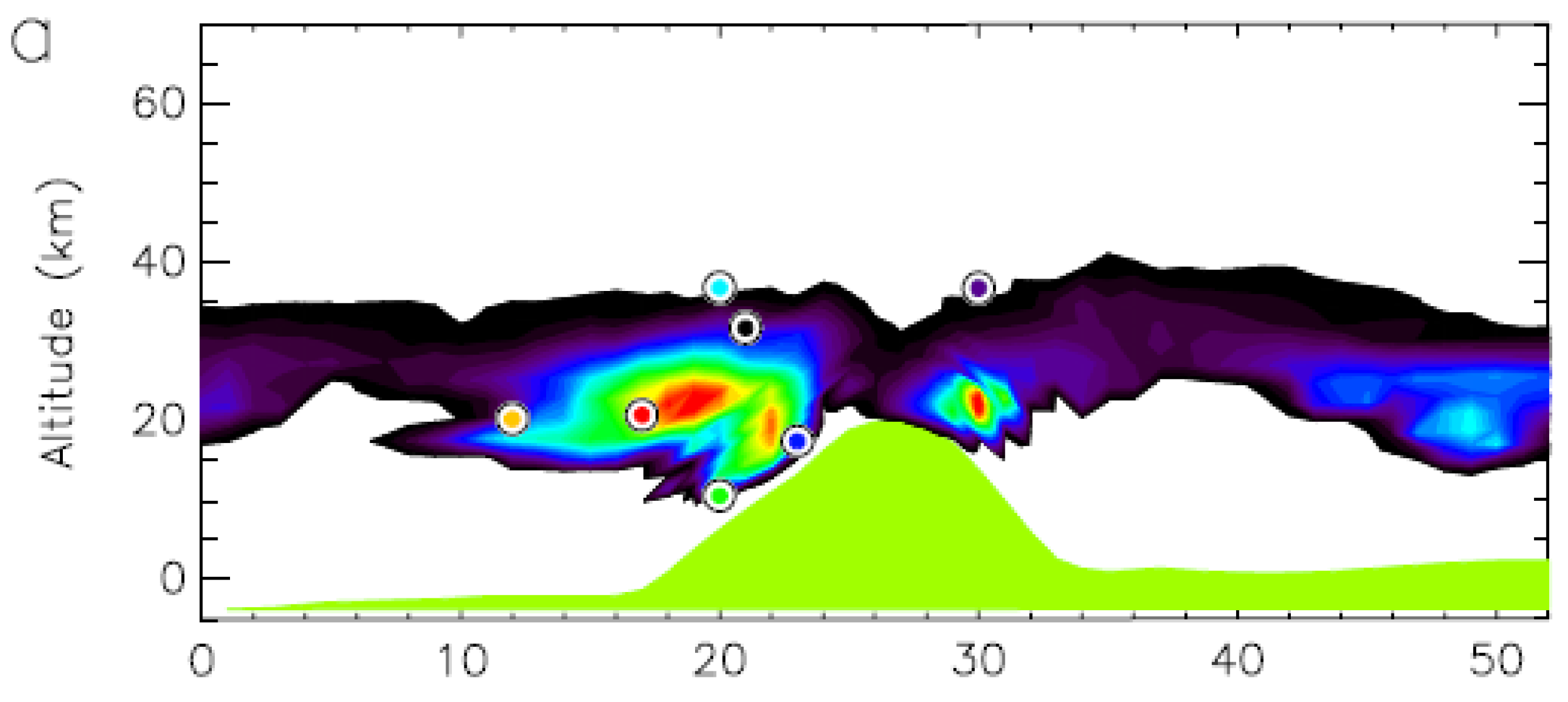

Table 1.
Main features of different Mars Climate models.
| LMD GCM | Nasa M-GCM | MarsWRF | Met Office UM | |
| Institute | LMD (France) | MCMC (USA) | NASA AMES (USA), CSIC (Spain) | UK Met Office |
| Main Focus | Mars Climate Database | Support for operations missions | Mesoscale / Microscale modeling | Research |
| Dynamical core | Hydrostatic | Hydrostatic | Non-Hydrostatic | Non-Hydrostatic |
| Discretization | Finite difference on a 3D grid | Finite difference on a rotating sphere | Finite difference on Arakawa C-grid | Finite difference on Arakawa C-grid |
| Data assimilation | Nudging scheme. Data from MCS, TES, landers | Ensemble Kalman filter. Data from MARCI, TES, MCS | Data Assimilation Research Testbed | Three-Dimensional Variational Assimilation |
Disclaimer/Publisher’s Note: The statements, opinions and data contained in all publications are solely those of the individual author(s) and contributor(s) and not of MDPI and/or the editor(s). MDPI and/or the editor(s) disclaim responsibility for any injury to people or property resulting from any ideas, methods, instructions or products referred to in the content. |
© 2026 by the authors. Licensee MDPI, Basel, Switzerland. This article is an open access article distributed under the terms and conditions of the Creative Commons Attribution (CC BY) license (http://creativecommons.org/licenses/by/4.0/).
Copyright: This open access article is published under a Creative Commons CC BY 4.0 license, which permit the free download, distribution, and reuse, provided that the author and preprint are cited in any reuse.


