

Submitted:
22 April 2026
Posted:
23 April 2026
You are already at the latest version
Abstract
The formation of side products is often unavoidable in organic synthesis; however, analyzing these secondary species provides practical insights into reaction pathways, mechanisms, and competing processes. This understanding is essential for optimizing reaction conditions, increasing product yields, and improving overall safety and efficiency. Additionally, side products can sometimes reveal unexpected molecular structures with valuable properties. In this study, we present the characterization of a compound that formed as a side product in a modified Pictet-Spengler reaction. The molecular structure of 2,2′-(methylenebis(3,4-dimethoxy-6,1-phenylene))diacetic acid was elucidated using a combination of NMR, FTIR, UV–Vis, and HRMS spectroscopic techniques.
Keywords:
side products
; organic synthesis
; oxa-Pictet-Spengler reaction
; 3
; 4-dimethoxyphenylacetic acid
; dimerization
1. Introduction
Side products in chemical synthesis are substances formed alongside the target products of the reaction [1]. Their formation is often unavoidable, necessitating the development of strategies to remove them from the reaction mixture and reduce impurities in the final product. In many cases, however, side products prove to be valuable species with diverse applications or serve as precursors and raw materials for further transformations [2]. The study of side products is therefore of considerable importance. It not only contributes to the optimization of synthetic processes and improves the yield and purity of target compounds, but also enables the identification of previously unknown structures with potential applications across manufacturing, pharmaceutical, cosmetic, and other industrial sectors.
Homophthalic anhydride and its substituted derivatives are important precursors in the synthesis of a wide range of compounds [3,4,5,6,7,8,9,10,11,12,13]. One common approach to their preparation involves a four-step synthetic procedure starting from appropriately substituted phenylacetic acids [14,15]. The initial step in this pathway is an oxa-Pictet–Spengler reaction — a variation of the classical Pictet-Spengler reaction — which yields the corresponding isochroman-3-one as the principal product.
Although the reaction has been known in the literature for a long time, the main side product obtained – 2,2'-(methylenebis(3,4-dimethoxy-6,1-phenylene))diacetic acid – has not been studied in detail to date, which set the goal of the studies described below.
2. Results and Discussion
The Oxa-Pictet-Spengler reaction is a variant of the Pictet-Spengler reaction where an oxygen atom acts as the nucleophile instead of nitrogen. Using phenylacetic acid and its aryl-substituted analogs facilitates the formation of isochroman-3-one structures, as shown in Scheme 1. This transformation is widely used not only to create the isochromane backbone but also as a crucial step in synthesizing substituted homophthalic anhydrides, which are important intermediates in the production of various compounds [7,12,13].
This well-documented reaction is usually carried out in the presence of an acid. Under standard conditions, TLC analysis of the reaction mixture revealed, in addition to the target isochroman-3-one, a secondary product. Workup revealed that this side product was acidic in nature, as it was selectively extracted with a 5% aqueous NaHCO3. Acidifying the aqueous layer and extracting with ethyl acetate yielded the desired compound, which was then purified by recrystallization. The isolated product was characterized by 1H, 13C and DEPT-135 NMR, FTIR, UV-Vis and HRMS analyses, as detailed below.
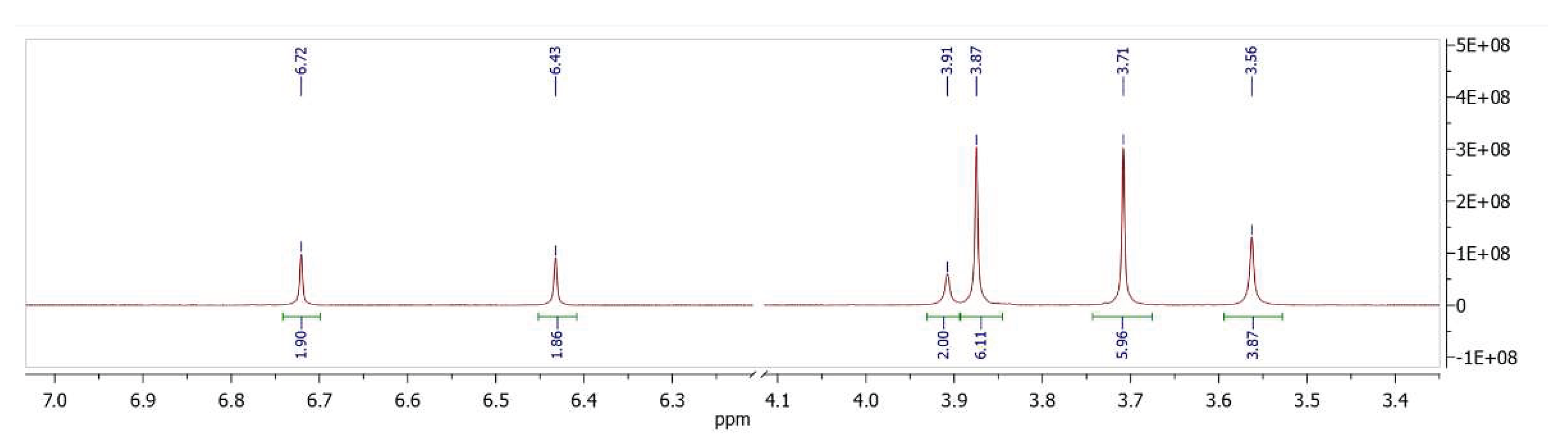
The recorded NMR spectra clearly indicate the presence of an aromatic system in the structure, as well as a strongly negative heteroatom. Overall, the spectra closely resemble those reported in the literature for the starting acid [16]. In the 1H-NMR spectrum, two singlets at 3.87 and 3.71 ppm are observed, corresponding to methoxy groups. Additionally, two singlets at 6.72 and 6.43 ppm are assigned to aromatic protons, while the singlet at 3.56 ppm is attributed to a methylene group - in this case, does adjacent to the carboxylic group. A key distinction between the isolated product and the starting phenylacetic acid derivative is the absence of one aromatic proton, accompanied by the appearance of a new singlet signal at 3.91 ppm (Figure 1). This signal, according to the area ratio and chemical shift, can be attributed to the methylene group linking the two aromatic rings. This assignment aligns with the literature on diphenylmethane derivatives, which reports the methylene protons to appear as a singlet at 4.11 ppm in 1H-NMR spectrum [17].
The 13C-NMR spectrum, together with DEPT-135 analysis, confirms the presence of a carboxyl group, evidenced by a signal at 179 ppm. In addition, six distinct aromatic carbon signals are observed, comprising two tertiary and four quaternary carbons. The spectra also reveal two methylene groups, with an approximate intensity ratio of 1:2. The 1H, 13C and DEPT-135 NMR spectra are presented in Figures S1, S2 and S3 in the Supplementary Materials, respectively.
The FTIR spectrum of the compound exhibits several characteristic absorption bands. Broad signals around 3000 cm⁻¹ (stretching vibrations, υO-H) and a strong band near 1700 cm⁻¹ (stretching vibrations, υC=O) are consistent with the presence of a carboxyl group. Absorptions at 1610 and 1510 cm⁻¹ correspond to C=C stretching vibrations of the aromatic ring. Additionally, strong bands at 1270, 1230, and 1030 cm⁻¹ are attributed to C-O stretching vibrations of the methoxy groups, as well as the C-O-H functionality of the carboxylic acid. The FTIR spectrum of the compound is presented in Figure S4 in the Supplementary Materials.
The structural resemblance between the studied compound and 3,4-dimethoxyphenylacetic acid suggests similar UV-VIS spectral features. The methylene group between the aromatic ring and the carboxyl group precludes conjugation, so the spectrum is dictated solely by the benzene ring and its two methoxy substituents. The positive mesomeric effect (+M) of the methoxy groups outweighs their negative inductive effect (-I), causing a bathochromic shift of the benzene absorption bands. Accordingly, two maxima are observed — at 232 nm and a lower-intensity band at 286 nm. Measurements were performed at a concentration of 25 μM in ethanol. The corresponding UV-VIS spectrum is presented in Figure S5 in the Supplementary Materials.
Due to the presence of a carboxyl group in the compound, accurate mass determination was performed in negative ion scan mode. The mass spectrum exhibited a peak at m/z 403.13838, which corresponds to the deprotonated molecular ion ([M-H]-) of the studied compound. The HRMS spectrum of the compound is presented in Figure S6 in the Supplementary Materials.
The results of these studies confirm that the structure of the reaction’s side product is consistent with those proposed in Scheme 1, resembling a dimer of the 3,4-dimethoxysubstituted phenylacetic acid bridged with an methylene group.
3. Materials and Methods
3.1. General
All chemicals used were purchased from Sigma-Aldrich (FOT, Sofia, Bulgaria ) and used without further purification. TLC was performed on silica gel coated aluminum sheets (Alugram® SIL G/UV254, Macherey-Nagel, Merck, Darmstadt, Germany). NMR spectra were recorded on a Bruker Avance III HD (500 MHz and 126 MHz for 1H and 13C, respectively) using TMS as an internal standard and CDCl3 as a solvent. The chemical shifts (δ) are given in ppm and J values are reported in Hz. FTIR spectra were recorded in solid state on a Nicolet iS5 FT-IR Spectrometer equipped with iD5 ATR Accessory (Thermo Scientific, ACM 2, Sofia, Bulgaria). UV-Vis spectra were recorded on Evolution 60S UV-Visible Spectrophotometer (Thermo Scientific, ACM 2, Sofia, Bulgaria) using quartz cuvette. High-Resolution Mass Spectra (HRMS) were obtained on a Shimadzu LCMS-9050 (Shimadzu Handels GmbH., Korneuburg, Austria).
3.2. Procedure
In a round-bottom flask 3,4-dimethoxyphenylacetic acid (8.9 g, 0.045 mol) and glacial acetic acid — AcOH, (25 mL, 0.437 mol) were heated under reflux with continuous stirring until reaching 80 °C. At this temperature, conc. hydrochloric acid — HCl, (15 mL 0.485 mol) and 37% aqueous formaldehyde solution — HCHO (15 mL, 0.20 mol) were added, after which the temperature was raised to 90 °C and maintained for an hour with continuous stirring under reflux. After cooling, 50 mL of water was added to the reaction mixture and extracted with chloroform. The organic layer was washed sequentially with 5% NaHCO3 until the presence of the studied compound was no longer detected in the organic layer (TLC). The aqueous extracts were combined, acidified with HCl to pH = 3 and extracted with EtOAc. The organic layer was washed with water until pH = 7 and dried with sodium sulfate — Na2SO4. After evaporation to dryness, the resulting solid was recrystallized from EtOAc to give 2,2'-(methylenebis(3,4-dimethoxy-6,1-phenylene))diacetic acid as white crystals (1.03 g), m.p. = 185-186 °C . Rf = 0.31 (acetone: heptane = 1:4); UV-Vis (ethanol): λmax = 232 nm (ε = 27840 L mol−1 cm−1); 286 nm (ε = 10080 L mol−1 cm−1); FTIR (solid) cm−1: ν = 2938 (w, O=H), 1697 (s, C=O), 1607 (w, C=C), 1513 (s, C=C), 1275 (s, C-O), 1231 (s, C-O), 1033 (m, C-O); 1H-NMR (500 MHz, CDCl3): δ = 6.72 (2H, s, Ar-H), 6.43 (2H, s, Ar-H), 3.91 (2H, s, CH2), 3.87 (6H, s, OCH3), 3.71 (6H, s, OCH3), 3.56 (4H, s, CH2). 13C-NMR (126 MHz, CDCl3): δ = 179.05 (C, COOH), 148.53 (C), 147.58 (C), 131.24 (C), 124.41 (C), 114.26 (CH), 113.05 (CH), 56.07 (CH3, OCH3), 56.01 (CH3, OCH3), 38.07 (CH2), 35.80 (CH2). HRMS (ESI): m/z calculated for [M-H]- C21H23O8-: 403.13984; found: [M-H]- 403.13838.
Supplementary Materials
The following supporting information can be downloaded at the website of this paper posted on Preprints.org, Figure S1, S2, S3, S4 and S5: 1H, 13C, DEPT-135 NMR, FTIR and UV-VIS Spectrum of 2,2'-(methylenebis(3,4-dimethoxy-6,1-phenylene))diacetic acid, respectively.
Author Contributions
S.S. and M.G.B. contributed equally to this article. All authors have read and agreed to the published version of the manuscript.
Funding
This research received no external funding.
Data Availability Statement
The original contributions presented in this study are included in the article/supplementary material. Further inquiries can be directed to the corresponding author(s).
Conflicts of Interest
The authors declare no conflicts of interest.
References
- Massol-Frieh, C.; Vantourout, J. Synthesis Side Stories: Capitalizing the Unintended Side-Product. Helv. Chim. Acta 2026, e00001. [Google Scholar] [CrossRef]
- R. van Bommel, M.; de Keijzer, M. Mauveine: The First Synthetic Dye. In Bright Colours from the Past, 1st ed.; Springer: Cham, Switzerland, 2025; pp. 133–143. [Google Scholar]
- Obaida, S.N.B.; Harrity, J.P.A. Base-Mediated Annulation Strategy to Naphthol Boronic Ester Derivatives. J. Org. Chem. 2025, 90(44), 15867–15870. [Google Scholar] [CrossRef] [PubMed]
- Spock, M.; Fettinger, J.C.; Ando, K.; Shaw, J.T. Stereodivergent Synthesis of Complex N-Sulfonimidoyl Lactams via the Castagnoli–Cushman Reaction. Org. Lett. 2025, 27, 1147–1152. [Google Scholar] [CrossRef] [PubMed]
- Saddiqa, A.; Andac, C.A.; Çakmak, O.; Babar, I.; Akhtar, F. Design, synthesis, and structural investigations of novel (S)-amide derivatives as promising ACE inhibitors. Kuwait J. Sci. 2025, 52, 100313. [Google Scholar] [CrossRef]
- Kirad, S.; Deepa, P.R.; Sankaranarayanan, M. Greener alternatives for synthesis of isoquinoline and its derivatives: a comparative review of eco-compatible synthetic routes. RSC Adv. 2025, 15, 30231–30275. [Google Scholar] [CrossRef] [PubMed]
- Stoyanova, S.; Bogdanov, M.G. Rational Design, Synthesis and In Vitro Activity of Diastereomeric Cis-/Trans-3-Substituted-3,4-Dihydroisocoumarin-4-Carboxylic Acids as Potential Carnitine Acetyltransferase Inhibitors. Molecules 2025, 30, 3159. [Google Scholar] [CrossRef] [PubMed]
- Angelov, V.; Stoyanova, S.; Bogdanov, M.G. trans-11-(3,4-Dimethoxyphenyl)-2,3,8,9-tetramethoxy-6-oxo-11,12-dihydro-6H-dibenzo[c,h]chromene-12-carboxylic Acid. Molbank 2024, 2024(4), M1920. [Google Scholar] [CrossRef]
- Liu, S.-J.; Chen, Z.-H.; Chen, J.-Y.; Ni, S.-F.; Zhang, Y.-C.; Shi, F. Rational Design of Axially Chiral Styrene-Based Organocatalysts and Their Application in Catalytic Asymmetric (2+4) Cyclizations. Angew. Chem. Int. Ed. Angew. Chem. 2022, 134, e202112226.. 2022, 61, e202112226. [Google Scholar] [CrossRef] [PubMed]
- Kazantsev, A.; Bakulina, O.; Dar’in, D.; Kantin, G.; Bunev, A.; Krasavin, M. Unexpected Ring Contraction of Homophthalic Anhydrides under Diazo Transfer Conditions. Org. Lett. 2022, 24, 4762–4765. [Google Scholar] [CrossRef] [PubMed]
- Bayles, T.; Guillou, C. Trifluoroethanol Promoted Castagnoli–Cushman Cycloadditions of Imines with Homophthalic Anhydride. Molecules 2022, 27, 844. [Google Scholar] [CrossRef] [PubMed]
- Miliovsky, M.; Svinyarov, I.; Prokopova, E.; Batovska, D.; Stoyanov, S.; Bogdanov, M.G. Synthesis and Antioxidant Activity of Polyhydroxylated trans-Restricted 2-Arylcinnamic Acids. Molecules 2015, 20, 2555–2575. [Google Scholar] [CrossRef] [PubMed]
- Svinyarov, I.; Bogdanov, M.G. One-pot synthesis and radical scavenging activity of novel polyhydroxylated 3-arylcoumarins. Eur. J. Med. Chem. 2014, 78, 198–206. [Google Scholar] [CrossRef] [PubMed]
- Weimar, C.; Angerer, S.; Wiegrebe, W. Methoxy- and acetoxy-8-oxoberbines - synthesis, antitumor activity, and interaction with DNA. Arch. Pharm. Pharm. Med. Chem. 1991, 324, 509–518. [Google Scholar] [CrossRef] [PubMed]
- Saeed, A. Oxa-Pictet–Spengler reaction in water. Synthesis of some (±)-1-aryl-6,7-dimethoxyisochromans. Chin. Chem. Lett. 2010, 21, 261–264. [Google Scholar] [CrossRef]
- Krohn, K.; Cludius-Brandt, S. 2-(Trimethylsilyl)-1,3-dithiane 1-Oxide as a Convenient Reagent for the Transformation of Aldehydes and Ketones into Homologous Carboxylic Acids. Synth. 2010, 15, 2616–2620. [Google Scholar] [CrossRef]
- Wang, H.; Li, L.; Bai, X.-F.; Shang, J.-Y.; Yang, K.-F.; Xu, L.-W. Efficient Palladium-Catalyzed C-O Hydrogenolysis of Benzylic Alcohols and Aromatic Ketones with Polymethylhydrosiloxane. Adv. Synth. Catal. 2013, 355, 341–347. [Google Scholar] [CrossRef]
Scheme 1.
Synthesis of the dimeric side product via oxa-Pictet-Spengler reaction.

Figure 1.
Representative 1H-NMR spectra in CDCl3 of the studied compound.
Disclaimer/Publisher’s Note: The statements, opinions and data contained in all publications are solely those of the individual author(s) and contributor(s) and not of MDPI and/or the editor(s). MDPI and/or the editor(s) disclaim responsibility for any injury to people or property resulting from any ideas, methods, instructions or products referred to in the content. |
© 2026 by the authors. Licensee MDPI, Basel, Switzerland. This article is an open access article distributed under the terms and conditions of the Creative Commons Attribution (CC BY) license (http://creativecommons.org/licenses/by/4.0/).
Copyright: This open access article is published under a Creative Commons CC BY 4.0 license, which permit the free download, distribution, and reuse, provided that the author and preprint are cited in any reuse.


