

Submitted:
22 April 2026
Posted:
23 April 2026
You are already at the latest version
Abstract
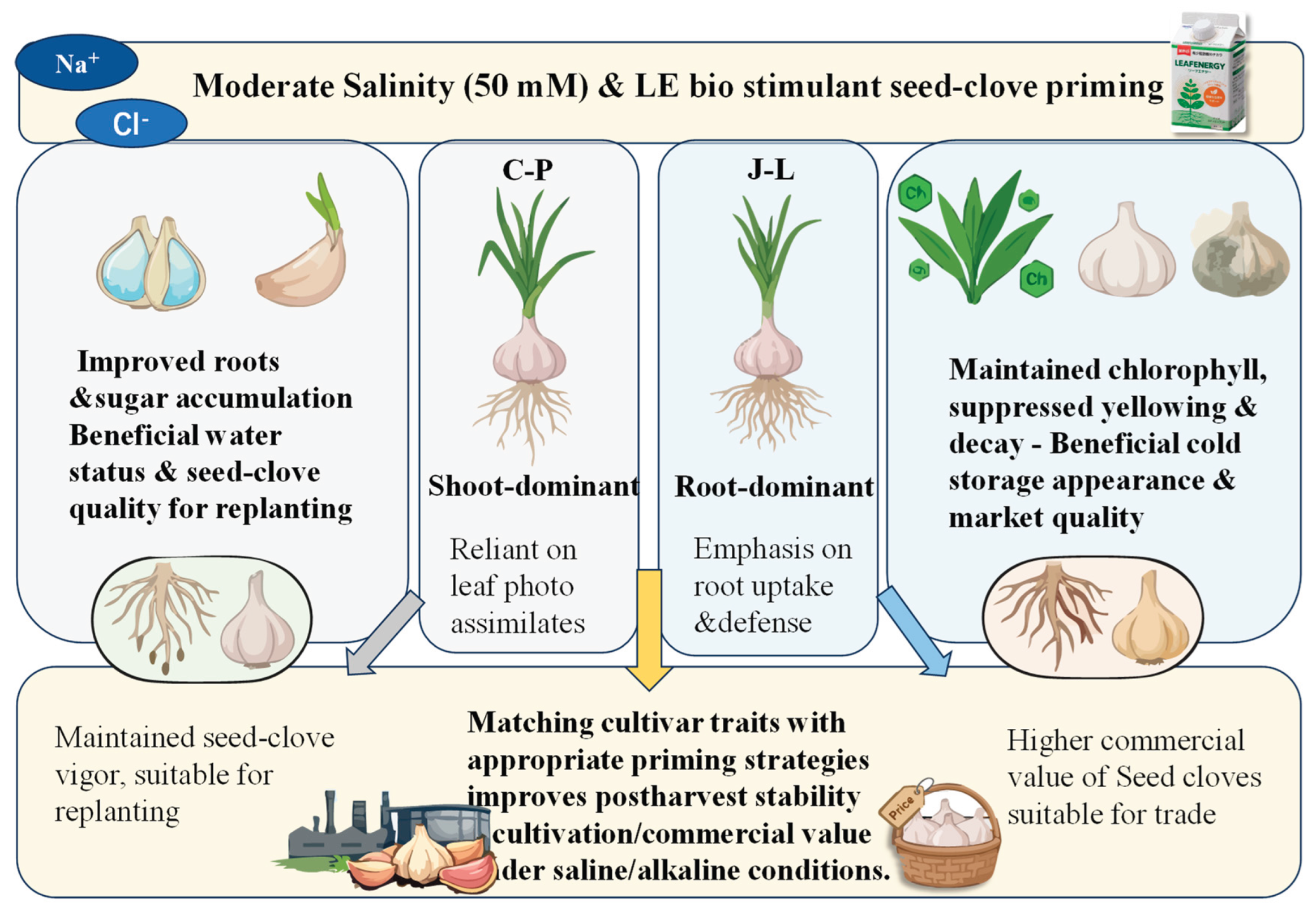
Soil salinization severely limits the stable production of garlic (Allium sativum L.) and compromises the postharvest storability of seed cloves as industrial planting materials. This study evaluated the morpho-physiological, photosynthetic (JIP-test), and postharvest responses of a shoot-dominant ('C-P') and a root-dominant ('J-L') garlic cultivar to graded salinity (0, 50, 200 mM NaCl) in a hydroponic system, with or without seed-clove priming using a novel commercial biostimulant. Results showed 50 mM NaCl significantly inhibited shoot growth, while 200 mM nearly arrested growth and induced clove decay. Under moderate salinity, LE priming exhibited cultivar-dependent mitigation. In 'C-P', it promoted root branching, enhanced soluble sugar accumulation, and improved postharvest tissue hydration. In 'J-L', biostimulant elevated leaf SPAD values, fully reversed stress-induced clove yellowing, and significantly suppressed postharvest fungal decay during cold storage. In conclusion, garlic's response to salinity is fundamentally dictated by intrinsic resource allocation strategies. Rather than merely promoting growth, biostimulant priming optimizes photosynthetic energy fluxes and reshapes metabolism. This tailored approach effectively preserves the visual marketability of susceptible cultivars while enhancing Osmo protectant accumulation and hydration in vigorous morphotypes, providing a sustainable strategy to safeguard industrial raw materials in salinized controlled cultivation systems.
Keywords:
Allium sativum L.
; salt stress
; seed-clove priming
; biostimulants
; OJIP
1. Introduction
Garlic (Allium sativum L.) is a high-value industrial and medicinal crop extensively utilized as a fresh vegetable, processing raw material, and a primary source of bioactive ingredients, such as organosulfur compounds, phenolics, and antioxidants, for pharmaceutical and functional-food applications [1,2,3,4,5,6]. However, the sustainable production of garlic as an industrial crop is increasingly constrained by soil salinization in arid and irrigated regions, which depresses bulb yield and modifies quality-defining metabolites that determine its technological and health value [7,8,9,10,11]. Salinity disturbs ion and water homeostasis, triggers oxidative damage, and impairs photosynthetic machinery, thereby limiting biomass accumulation and the efficient conversion of primary production into marketable industrial products [12,13,14,15].
Within this context, cultivar-specific resource allocation strategies have emerged as a critical component of salt tolerance, as genotypes often differ markedly in biomass partitioning patterns between above- and below-ground organs [16,17,18,19]. In our previous screening, 'C-P' was identified as a shoot-dominant cultivar with high biomass productivity, whereas 'J-L' exhibited a root-dominant phenotype with enhanced root mass. Yet, the integrated response of these contrasting morphotypes to salinity, specifically regarding morphological plasticity, JIP-test-derived photosynthetic energy fluxes, and antioxidant defense systems, remains largely unresolved at the whole-plant level. Moreover, the storability of seed cloves during refrigerated storage is a decisive bottleneck for industrial garlic chains, as it affects planting material vigor, sprouting behavior, and downstream yield and quality [20,21,22,23,24]. This critical postharvest phase has rarely been examined in combination with maternal salinity exposure and genotype-dependent responses.
Plant biostimulants are increasingly recognized as a promising agronomic tool to improve the performance of industrial crops under abiotic stress by enhancing resource use efficiency, modulating redox homeostasis, and fine-tuning primary and secondary metabolism [14,25,26,27,28,29]. Among various categories, novel commercial biostimulant formulations, such as LEAFENERGY® (LE), have garnered interest for their capacity to enhance membrane stability and stress signaling, traits tightly linked to photosynthetic efficiency and osmotic adjustment under salinity. While such biostimulants are known to stimulate general plant vigor, their specific role in redirecting photosynthetic energy allocation and carbon partitioning toward protective solutes, such as soluble sugars, under salt stress remains poorly understood.
Therefore, to optimize the sustainable production and postharvest quality of garlic in saline environments, this study aimed to dissect the morpho-physiological and photosynthetic responses of shoot-dominant ('C-P') and root-dominant ('J-L') garlic genotypes to salinity. Furthermore, we evaluated the effects of LE-based seed clove priming on photosynthetic energy fluxes, antioxidant capacity, and carbon allocation under salt stress. By integrating these evaluations, we sought to assess how such physiological responses translate into the storability and visual quality of seed cloves during cold storage. We hypothesized that LE-priming would differentially optimize resource allocation and enhance industrially relevant quality traits in a cultivar-specific manner under moderate salt stress.
2. Materials and Methods
2.1. Plant Materials and Priming Treatments
Two garlic (Allium sativum L.) cultivars with contrasting morphological and genetic backgrounds, 'C-P' and 'J-L', were used in this study. Seed cloves were selected to be free of visible diseases, pests, and mechanical damage, and to be uniform in size, with a mean single clove weight of 4.35 g for 'C-P' (100 cloves) and 6.66 g for 'J-L'. Before sowing, all cloves were carefully peeled, surface-sterilized in 5% (v/v) sodium hypochlorite (NaClO) solution for 5 min, rinsed three times with deionized water, and air-dried at room temperature in a ventilated area. A priming treatment with a commercial monounsaturated fatty acid biostimulant was then applied. For the LE-treated group (+LE), cloves were fully immersed in a 1% (v/v) LEAFENERGY® solution (single monounsaturated fatty acid formulation, IBIDEN Co., Ltd., Japan) for 30 min. For the control group (-LE), cloves were immersed in an equal volume of deionized water for 30 min. During priming, solutions were gently agitated to ensure complete contact between clove surfaces and the solution. After treatment, surface moisture was removed with tissue paper and cloves were immediately transplanted.
2.2. Experimental Design and Growth Conditions
The experiment was arranged as a completely randomized design with three fixed factors: (1) cultivar (two levels: 'C-P' and 'J-L'), (2) salinity (three NaCl levels: 0 mM as control, 50 mM, and 200 mM), and (3) priming treatment (two levels: 0% and 1% LE). In total, 12 treatment combinations were established. For each treatment, 24 seedlings were grown in standard hydroponic trays (19 × 13 × 4 cm) using an alternate planting pattern to minimize mutual shading and root entanglement. All trays were placed on multi-layer racks in an artificial climate chamber. To reduce positional effects caused by light heterogeneity and vertical temperature gradients, the positions of all trays were randomly rotated among and within racks at each nutrient solution renewal. Growth conditions were set to 23 ± 1 °C, 60–70% relative humidity, a 14 h light / 10 h dark photoperiod, and a photosynthetic photon flux density (PPFD) of 150 ± 50 μmol m⁻² s⁻¹. Plants were supplied with a hydroponic nutrient solution based on the OAT Agrio (Otsuka) formulation, with electrical conductivity maintained at 0.5 dS m⁻¹ and pH adjusted to 7.4. During the first week after transplanting, the nutrient solution was renewed every 2 days to facilitate seedling establishment. From the second week onward, it was replaced every 7 days. Salinity treatments were imposed from the day of transplanting by adding NaCl to the nutrient solution to the designated concentrations.
2.3. Developmental Stage-Based Sampling
Because 'C-P' and 'J-L' exhibit markedly different intrinsic growth rates, a developmental stage synchronization strategy was adopted for sampling instead of a fixed calendar time. For the fast-growing cultivar 'C-P', plants were sampled at 19 days after transplanting (DAT), when plant height approached the critical distance to the light source and early morphological development was completed. For the slower-growing cultivar 'J-L', sampling was conducted at 30 DAT, corresponding to a developmental stage comparable to that of 'C-P' at 19 DAT. This approach ensured that physiological and metabolic parameters were compared at similar developmental stages between cultivars.
2.4. Morphological Growth Measurements
For each treatment, 15 representative plants were randomly selected for morphological measurements. Plant height, pseudostem diameter, number of leaves, number of root tips, and maximum root length were recorded. Plants were then separated into roots, bulbs (seed cloves), and leaves, and the fresh weight (FW) of each organ was determined. Samples were oven-dried at 105 ℃ for 30 min and then at 75 °C to constant weight to obtain dry weight (DW). Color parameters (L*, a*, b*) of roots and bulbs were measured using a portable colorimeter (CR-20, Konica Minolta, Japan). Based on the measured color parameters, the Browning Index (BI) was calculated to quantify the degree of root browning and salt damage[30]. An intermediate variable x was first determined as follows:
x = (a* + 1.75L*) / (5.645L* + a* - 3.012b*)
Subsequently, the BI was calculated using the following equation:
BI = 100(x - 0.31) / 0.17
Additionally, the Yellowness Index (YI) of the bulbs was calculated to evaluate their whiteness and freshness based on the ASTM E313 standard[31]:
YI = (142.86 × b) / L
2.5. Photosynthetic and Chlorophyll Fluorescence Measurements
Relative chlorophyll content (SPAD value) was measured on the middle portion of fully expanded functional leaves using a SPAD-502 Plus chlorophyll meter (Konica Minolta, Japan). Chlorophyll fluorescence parameters were determined with a portable fluorometer FluorPen FP 110 (Photon Systems Instruments, Czech Republic). After 30 min of dark adaptation, OJIP transients were recorded, and additional fluorescence parameters (e.g., quantum yield) were measured after 1 h of light adaptation according to the manufacturer’s protocol.
2.6. Biochemical Assays
For biochemical analyses, 1.0 g of fresh tissue (roots, leaves, or bulbs) was homogenized in 4 mL of 80% (v/v) methanol on ice. Homogenates were centrifuged at 10,000 rpm for 30 min at 4 °C, and the supernatant was collected and brought to a final volume of 6 mL with 80% methanol. Extracts were stored at −20 °C until analysis of DPPH radical scavenging activity and total phenolic content (TPC)[32]. Additionally, soluble sugar and soluble protein contents were determined. Soluble sugars were extracted with distilled water in a boiling water bath and quantified using the anthrone colorimetric method, with the absorbance measured at 620 nm [33]. Soluble proteins were extracted using a phosphate buffer (pH 7.0) and measured using the Coomassie brilliant blue G-250 method (Bradford assay) at a wavelength of 595 nm [34].
2.7. Statistical Analysis
All raw data were organized and preprocessed using Microsoft Excel (Microsoft Corp., USA). Statistical analyses and graphing were performed with GraphPad Prism version 10.4 (GraphPad Software, San Diego, CA, USA). For each response variable, a three-factor structure (cultivar, salinity level, and LE treatment) was initially considered in the experimental design, but data were analyzed using two-way analysis of variance (two-way ANOVA) focusing on the interaction between salinity and LE treatment within each cultivar, followed by Dunnett’s multiple comparisons test to compare each stress or LE treatment with its corresponding control. Normality and homoscedasticity assumptions were checked before ANOVA, and differences were considered statistically significant at p < 0.05.
3. Results
Figure 1B further details these morphological variations. Regarding shoot growth, 'C-P' demonstrated significantly higher leaf fresh weight (FW) and leaf length compared to the other three cultivars, along with a stem diameter significantly larger than those of 'C-W' and 'J-S' (P < 0.01). This indicates stronger mechanical support and a distinct advantage in shoot biomass accumulation for 'C-P'. Conversely, 'J-S' exhibited the lowest values across most indices, including leaf FW, leaf length, and stem diameter, representing the weakest overall growth vigor. In terms of root development, 'J-L' showed significantly higher root FW than 'C-W' (P < 0.01). Although root length did not differ significantly among the four cultivars, the root biomass accumulation in 'J-L' highlighted a clear advantage, reflecting a typical "root-dominant" resource allocation strategy.
The radar chart and Z-score heatmap (Figure 1C and 1D) substantiate this trait divergence. 'C-P' displayed a strong positive deviation in indices such as leaf dry matter content, dry leaf weight, and fresh leaf weight, indicating a tendency to prioritize resource investment into the shoots. In contrast, 'J-L' excelled in dry root weight, fresh root weight, and root dry matter content, showing a preference for root system establishment and water acquisition. Furthermore, 'C-W' was characterized as a "high SPAD–low biomass" type, whereas 'J-S' exhibited negative deviations across most indices, reflecting weak comprehensive growth capabilities. Based on these distinct trait divergences, 'C-P' was selected as the representative cultivar for "high shoot biomass/strong growth vigor," and 'J-L' was chosen to represent "strong root development/root mass accumulation" for subsequent stress and mitigation experiments.
Figure 1E illustrates significant differences in the storability of the seed cloves among the cultivars and treatments following 45 days of storage at 4 °C in the dark. The 'J-L' control group (-LE) was highly susceptible to fungal infection in the low-temperature, high-humidity environment, developing noticeable rot and mildew patches on the surface. However, 'J-L' cloves treated with LE exhibited a significant reduction in mildew severity and maintained a more intact appearance. This suggests that the monounsaturated fatty acid biostimulant helps mitigate microbial infection and tissue decay during cold storage. In comparison, the 'C-P' cultivar inherently possesses strong storability; neither the control nor the LE-treated group showed obvious mildew or rot, and the cloves maintained a normal appearance and sprouting status.
Physiochemically, Figure 1F demonstrates that the LE treatment significantly increased the water content on a dry weight basis in 'C-P' cloves (from 236.9% to 254.7%, P < 0.05). This indicates that LE application facilitates the maintenance of tissue hydration in seed cloves during cold storage, thereby providing a more stable physiological foundation for subsequent germination and regeneration. The vigorous shoot development observed in this cultivar during cold storage aligns with its previously noted morphological phenotype, further supporting the potential application value of LE in enhancing clove storability during practical production stages such as cold storage and transportation.
As illustrated in Figure 2A, the morphological response of the 'C-P' cultivar to salinity stress exhibited a clear concentration-dependent pattern. Under the 0 mM NaCl (non-saline) condition, the plants displayed optimal growth vigor, characterized by elongated, dark green leaves and a well-developed, dense white root system, with no discernible morphological differences between the control (-LE) and LE-treated groups. At 50 mM NaCl (moderate salinity stress), overall plant growth was significantly stunted, manifesting as reduced plant height, shorter and narrower leaves, and decreased root length and density across both groups. Under the 200 mM NaCl (severe salinity stress) treatment, shoot growth was almost entirely arrested, highlighting the profound physiological inhibition induced by severe salt stress.
Figure 2B reveals that under 200 mM NaCl stress, the control cloves suffered from severe rot and browning, accompanied by a noticeable off-odor. In contrast, the LE treatment noticeably reduced the area of decay and the degree of color deterioration; the cloves remained whiter and structurally firmer. This suggests that LE provides a buffering effect, mitigating tissue necrosis and quality degradation induced by severe salinity.
Figure 2C systematically evaluates the impacts of the treatments on biomass accumulation and tissue water status. Regarding biomass, moderate salinity stress significantly diminished leaf fresh weight (FW). Compared to the non-saline control (CP-CK-0), the leaf FW in CP-CK-50 and CP-LE-50 decreased significantly by 2.428 g (P = 0.0001) and 2.481 g (P < 0.0001), respectively. For the fresh-to-dry weight (FW/DW) ratio, which reflects tissue water retention, both CP-CK-50 and CP-LE-50 significantly reduced the bulb FW/DW ratio (decreases of 1.509, P = 0.0240; and 1.677, P = 0.0103, respectively). However, these treatments highly significantly increased the root FW/DW ratio (increases of 2.827, P < 0.0001; and 1.432, P = 0.0344, respectively). This indicates a strategic phenotypic adjustment in 'C-P' under moderate salt stress, shifting water and biomass allocation toward the root system.
Morphological indices (Figure 2D) further confirmed these stress responses. Compared to CP-CK-0, the CP-CK-50 and CP-LE-50 treatments severely inhibited longitudinal growth, reducing plant height by 13.44 cm and 12.70 cm, and shortening leaf length by 12.62 cm and 12.56 cm, respectively (all P < 0.0001). Notably, regarding root traits, the CP-LE-50 treatment significantly promoted the formation of root tips, increasing the number of root tips by 6.00 compared to the control (P = 0.0393). This suggests that under moderate salinity, LE application enhances root branching and nutrient acquisition capabilities.
Furthermore, the varying treatments exerted significant, tissue-specific effects on the biochemical antioxidant system of the 'C-P' cultivar (Figure 2E, 2F). In the roots, CP-CK-50 and CP-LE-50 significantly enhanced the DPPH radical scavenging activity (increases of 0.179 and 0.192 μmol TE/g FW, respectively, P < 0.001) and total phenolic content (increases of 0.530 and 0.539 mg GAE/g FW, respectively, P < 0.01) compared to the non-saline control. In the leaves, although these two treatments did not significantly alter the DPPH scavenging activity (P > 0.05), both significantly elevated the total phenolic content (increases of 0.426 mg GAE/g FW, P = 0.0163; and 0.469 mg GAE/g FW, P = 0.0080, respectively).
As shown in Figure 3A, the chlorophyll a fluorescence induction curves across all groups exhibited the typical O–J–I–P polyphasic rise. The initial fluorescence (O phase, ~0.02 ms) was relatively consistent among treatments, but distinct divergences appeared during the J, I, and peak P phases (~300–400 ms). Compared to the control (CP-CK-0), both CP-LE-0 and CP-CK-50 significantly increased the transient fluorescence intensity, reaching the highest levels at the maximal fluorescence yield (P phase). The fluorescence intensity of CP-LE-50 was also higher than the control but slightly lower than the former two treatments. This phenomenon indicates that the treatment conditions profoundly impacted the electron transport rate on the acceptor side of Photosystem II (PSII) and the reduction state of the plastoquinone (PQ) pool.
Further analysis of the core JIP-test parameters (Figure 3B) revealed that Fv/Fm, which reflects the maximum photochemical quantum yield of PSII, remained highly stable across all treatments (relative values ranging between 1.00 and 1.01). This suggests that the applied stress did not cause irreversible structural photoinhibition. However, the performance index on an absorption basis (PIABS), a sensitive indicator of overall photosynthetic vitality, showed significant differences: CP-CK-50 and CP-LE-50 increased by 17.67% and 9.77%, respectively, compared to the control, whereas CP-LE-0 experienced a slight decrease (~1.98%). The specific energy fluxes per reaction center (RC) elucidate the energetic basis of these changes: compared to CP-CK-0, CP-CK-50 and CP-LE-50 generally downregulated the absorbed light energy (ABS/RC), trapped energy (TR0/RC), and thermal dissipation (DI0/RC) per RC. Notably, CP-CK-50 exhibited the most significant reduction in energy dissipation, with DI₀/RC dropping by approximately 8.0%. Collectively, CP-CK-50 and CP-LE-50 significantly enhanced overall photosynthetic performance by actively reducing ineffective heat dissipation and optimizing energy absorption and allocation strategies.
Regarding photosynthetic parameters (Figure 3C), the leaf SPAD values in the moderate salt stress groups (CP-CK-50 and CP-LE-50) were highly significantly elevated compared to the control, increasing by 3.82 and 4.08, respectively (P < 0.0001). This indicates that moderate salt treatment somewhat favors leaf pigment accumulation in this cultivar. Conversely, the differences in QY values among the treatments were not significant (P > 0.05), demonstrating that the primary photochemical efficiency of PSII remained broadly stable.
To further evaluate the impact of salt stress and LE treatment on nutritional quality and osmolyte accumulation, we quantified the protein and soluble sugar contents in the garlic cloves (Figure 3D). Quantitative analysis showed that protein content remained highly stable across all conditions. Compared to CP-CK-0, neither the singular LE treatment (CP-LE-0), moderate salt stress (CP-CK-50), nor their combined application (CP-LE-50) induced any significant changes in protein content (P > 0.05). This suggests that protein metabolism in garlic is not significantly disrupted or remodeled under the current stress concentrations.
In contrast to the stability of proteins, soluble sugar content exhibited high responsiveness to exogenous LE application. Data showed that 50 mM salt stress alone (CP-CK-50) did not significantly alter soluble sugar levels (P = 0.5492). However, the application of LE highly significantly promoted soluble sugar accumulation: under non-saline conditions, the soluble sugar content in the CP-LE-0 group increased by 0.967 g/100g FW compared to the control (P < 0.0001). More importantly, under 50 mM salt stress, this promotive effect remained robust, with the CP-LE-50 group showing a substantial increase of 1.140 g/100g FW over the control (P < 0.0001).
In terms of appearance quality (Figure 3E), the clove yellowness index was insensitive to all tested concentrations (P > 0.05). The root browning index also showed no significant changes under low-to-moderate concentrations; interestingly, it significantly decreased under extreme 200 mM salt stress. Specifically, CP-CK-200 and CP-LE-200 dropped by 17.35 (P < 0.0001) and 14.24 (P = 0.0012) compared to the control, respectively, indicating that high salt concentrations significantly inhibit the visual onset of root browning.
As shown in Figure 4A, the 'J-L' cultivar exhibited a strictly concentration-dependent morphological response to salt stress. Under non-saline conditions (0 mM NaCl), the plants developed healthy shoots and leaves alongside a robust root system. Under 50 mM moderate salt stress, growth was noticeably suppressed, primarily manifesting as stunted plant height and shortened leaves. When the salt concentration reached the extreme level of 200 mM, germination and shoot elongation were completely halted, leaving only the original clove morphology. Visual observation (Figure 4B) further revealed that under the extreme 200 mM stress, the basal region (root-generating area) of the cloves in both the CK and LE-treated groups suffered from severe salt-stress-induced browning and rot.
Biomass statistics (Figure 4C) confirmed the significant inhibition of 'J-L' shoot growth by moderate salt stress: compared to JL-CK-0, the fresh leaf weights of JL-CK-50 and JL-LE-50 decreased highly significantly by 2.070 g (P = 0.0057) and 2.739 g (P = 0.0002), respectively. However, there were no significant differences in leaf dry weight among the treatments (P > 0.05). This indicates that salt stress primarily restricted the turgor pressure (water content) of the leaves rather than dry matter accumulation. As a root-dominant cultivar, the subterranean parts of 'J-L' demonstrated exceptional biomass stability. Under the individual LE treatment (JL-LE-0), moderate salt stress, and combined treatment (JL-LE-50), neither the fresh nor dry weights of the roots showed significant fluctuations (P > 0.05). Similarly, the fresh weight, dry weight, and fresh-to-dry weight ratio of the cloves remained stable across all treatments (P > 0.05).
Measurements of growth indices (Figure 4D) revealed that the JL-CK-50 treatment led to highly significant decreases in plant height and leaf length by 11.08 cm (P = 0.0009) and 10.18 cm (P = 0.0025), respectively. The subsequent application of exogenous LE (JL-LE-50) did not reverse this inhibition of longitudinal growth (all P < 0.0001). Notably, under 50 mM NaCl stress (JL-CK-50), the number of root tips was not suppressed; instead, it increased highly significantly by 12.20 compared to the non-saline control (P = 0.0002), exhibiting a strong compensatory root growth response. However, when combined with LE treatment (JL-LE-50), the number of root tips reverted to a steady-state level that did not differ significantly from the control group (P = 0.7113).
Biochemical analyses demonstrated that the treatments did not significantly affect the DPPH radical scavenging capacity in any organ of the 'J-L' cultivar (P > 0.05) (Figure 4E). However, total phenolic metabolism exhibited highly tissue-specific remodeling (Figure 4F). Under moderate salt stress (JL-CK-50), the total phenolic content in the roots significantly increased (by 0.437 mg GAE/g FW, P = 0.0056), whereas the total phenolic content in the cloves significantly decreased (by 0.387 mg GAE/g FW, P = 0.0144). The application of LE under salt stress (JL-LE-50) failed to restore the total phenolic levels in the bulbs (P = 0.0111), while simultaneously causing the root total phenolic content to return to a level not significantly different from the control (P > 0.05). The total phenolic content in the leaves remained unaltered across all treatments.
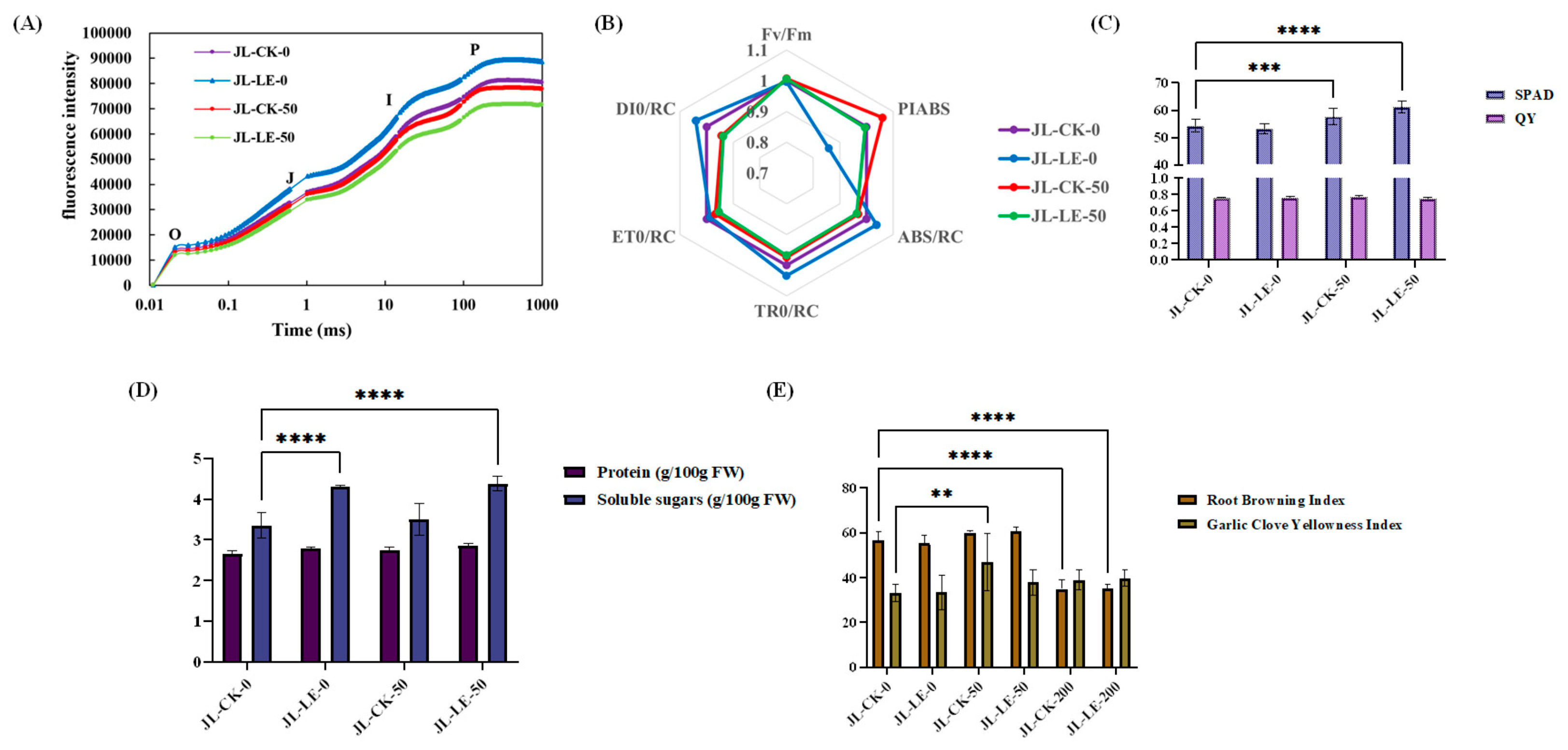
As shown in Figure 5A, the chlorophyll a fluorescence induction curves of the 'J-L' cultivar across all treatments retained the complete O–J–I–P polyphasic rise characteristic; however, the trends in transient fluorescence intensity differed markedly from those of the 'C-P' cultivar. Compared to the control (JL-CK-0), the JL-LE-0 treatment significantly increased transient fluorescence intensity throughout the induction phase, reaching the highest peak at maximal fluorescence yield. Conversely, the overall fluorescence intensities of JL-CK-50 and JL-LE-50 were lower than the control, with JL-LE-50 exhibiting the lowest fluorescence yield. Typically, an abnormal surge in fluorescence yield (as seen in JL-LE-0) suggests blocked electron transport on the acceptor side of Photosystem II (PSII), leading to over-reduction, whereas a decrease in fluorescence yield implies a relatively smoother operation of the electron transport chain.
Further analysis of the core JIP-test parameters (Figure 5B) revealed that Fv/Fm, which reflects the maximum photochemical quantum yield of PSII, remained highly stable across all treatments (relative values ranging between 0.997 and 1.007). This suggests that the applied stress did not cause irreversible structural photoinhibition. However, the performance index on an absorption basis (PIABS), a sensitive indicator of overall photosynthetic vitality, showed significant divergence: JL-CK-50 increased by approximately 5.98%, and JL-LE-50 maintained a steady state (a marginal decrease of 0.48%) compared to the control, whereas JL-LE-0 caused a substantial decline in PIABS by 14.13%. The specific energy fluxes per reaction center (RC) elucidate the energetic basis of these changes: under the JL-LE-0 treatment, light energy absorption (ABS/RC) and trapping (TR0/RC) per RC increased by approximately 3.76% and 3.47%, respectively, but electron transport efficiency (ET0/RC) decreased by 1.36%, causing excess energy to be lost as heat dissipation (DI0/RC increased by 4.02%). In contrast, the JL-CK-50 and JL-LE-50 treatments actively synergized to downregulate energy absorption and trapping at the reaction centers, thereby greatly suppressing useless thermal dissipation, with their DI0/RC values significantly decreasing by 5.64% and 6.20%, respectively. Collectively, this active energy allocation optimization strategy effectively alleviated the excitation pressure on the reaction centers.
Regarding photosynthetic parameters (Figure 5C), the leaves of the 'J-L' cultivar exhibited a significant pigment accumulation response to moderate salt stress. The SPAD value of the JL-CK-50 group was highly significantly elevated compared to the control, increasing by 3.317 (P = 0.0004); the addition of exogenous LE (JL-LE-50) further amplified this effect, highly significantly increasing the SPAD value by 6.817 (P < 0.0001). Conversely, the differences in QY values among the treatments were not significant (P > 0.05), demonstrating that the primary photochemical efficiency of PSII remained broadly stable.
To further evaluate the interactive effects of treatment conditions and substance types on nutritional quality, we quantified the protein and soluble sugar contents in the garlic cloves and conducted a two-way analysis of variance (Figure 5D). The ANOVA results indicated that substance type was the largest source of variation, explaining up to 70.33% of the total variance (F (1, 16) = 205.1, P < 0.0001). This is primarily attributed to the overall baseline accumulation of soluble sugars in the 'J-L' cultivar (mean 3.891 g/100g FW) being significantly higher than that of proteins (mean 2.765 g/100g FW). Concurrently, the different treatment conditions also exerted a highly significant main effect on the quality indices (F (3, 16) = 14.81, P < 0.0001), explaining 15.24% of the data variance, demonstrating that salt stress and LE application significantly altered the overall nutritional accumulation levels.
Crucially, there was a highly significant interaction between treatment conditions and substance types (F (3, 16) = 8.692, P = 0.0012), which contributed 8.943% of the variance. This significant interaction implies that the response patterns of proteins and soluble sugars within the 'J-L' cultivar to different treatments are not synchronous or parallel, but rather exhibit specific, dynamic variations.
In terms of appearance quality (Figure 5E), the response exhibited clear concentration-threshold characteristics. The 50 mM salt stress (JL-CK-50) caused significant yellowing of the garlic cloves, with the yellowness index rising sharply by 13.65 (P = 0.0011). However, the combined LE treatment (JL-LE-50) successfully reversed this trend, restoring the yellowness index to a state not significantly different from the non-saline control (P = 0.5419). Regarding the root browning index, there were no significant changes under low-to-moderate concentrations; interestingly, under the extreme 200 mM salt stress, the browning index experienced a precipitous drop. Specifically, JL-CK-200 and JL-LE-200 dropped by 21.85 and 21.65 (P < 0.0001) compared to the control, respectively, reconfirming the strong inhibitory effect of severe salt toxicity on the visual onset of root browning.
4. Discussion
4.1. Cultivar-Specific Resource Allocation Under Salinity
The present study demonstrates that garlic morphotypes with contrasting resource-allocation strategies—shoot-dominant ‘C-P’ and root-dominant ‘J-L’—exhibit divergent physiological and postharvest responses to salinity and seed-clove priming. Morphological plasticity and biomass partitioning are critical determinants of salt tolerance in Allium crops [35,36,37,38,39,40,41]. As NaCl concentrations increased, both cultivars experienced growth inhibition, a typical response driven by osmotic stress and impaired carbon assimilation.
In the shoot-dominant ‘C-P’, moderate salinity (50 mM) induced a sharp decline in shoot biomass, leaf length, and leaf number, with growth nearly arrested at 200 mM . This sensitivity aligns with the premise that rapidly growing, shoot-oriented phenotypes often face severe hydraulic and photosynthetic constraints under saline conditions. Interestingly, the root system of ‘C-P’ maintained structural integrity at moderate salinity, indicating that the plant strategically restricts canopy expansion to reduce transportational water loss, temporarily safeguarding root hydraulic status at the expense of overall biomass accumulation[42,43,44,45,46,47]. Conversely, the root-dominant ‘J-L’ displayed a more conservative strategy, maintaining stable below-ground architecture while actively adjusting foliar pigment accumulation and carbohydrate metabolism. The significant variance in soluble sugars compared to proteins underscores the reliance of ‘J-L’ on low-molecular-weight carbohydrates for osmotic adjustment and the maintenance of cell turgor during stress [48,49,50,51,52].
4.2. Biostimulant-Mediated Mitigation of Photosynthetic and Visual Degradation
Seed-clove priming with the LE formulation provided consistent mitigation against salt-induced degradation, both during the vegetative stage and postharvest. While LE priming did not fully reverse the growth inhibition imposed by salinity, it significantly improved visual clove quality and modulated pigment dynamics. In ‘J-L’, LE application under 50 mM NaCl further elevated SPAD values relative to the non-primed counterpart without altering the quantum yield of PSII. This suggests that the biostimulant primarily enhances chlorophyll biosynthesis or delays its degradation, thereby preserving light-harvesting capacity and providing photoprotection under sub-lethal stress [53,54,55,56,57].
Furthermore, LE priming effectively reversed the salt-induced yellowing of ‘J-L’ cloves, restoring the yellowness index to control levels. This visual recovery indicates a reduction in pigment oxidation and phenolic browning, which are common symptoms of ROS-mediated tissue damage [58,59,60,61,62,63]. Interestingly, under extreme salinity (200 mM), the root browning index of ‘J-L’ dropped sharply. This non-linear response likely reflects a threshold effect where severe tissue necrosis and the cessation of metabolic activity arrest the enzymatic browning pathways. Consequently, color-based injury indices should be interpreted with caution under extreme stress, necessitating the future integration of biochemical markers for cell death [64,65,66,67].
4.3. Postharvest Storability and Agronomic Perspectives
The divergent postharvest behavior of the two cultivars highlights the extended benefits of pre-planting biostimulant applications [68,69,70,71,72,73,74,75]. The ‘J-L’ control cloves were highly susceptible to fungal rot during cold storage. However, maternal LE priming markedly suppressed mildew severity and preserved structural integrity, suggesting that improved membrane stability and osmotic balance established during the vegetative phase translate into robust postharvest resistance against microbial decay. In contrast, while ‘C-P’ cloves possessed inherently strong storability, LE priming further increased their dry-weight-based water content and supported vigorous sprouting.
Collectively, these findings emphasize that biostimulant efficacy is heavily modulated by the intrinsic resource-allocation patterns of the target genotype. Shoot-dominant morphotypes may primarily benefit from improved tissue hydration, whereas root-dominant morphotypes exhibit comprehensive enhancements in appearance, pigment stability, and rot resistance. Although these hydroponic results offer precise physiological insights, future field-scale validations across heterogeneous saline soils and diverse rhizosphere microbiomes are essential to confirm the agronomic robustness of this priming strategy in sustainable garlic production.
5. Conclusions
In conclusion, this study demonstrates that garlic genotypes with contrasting resource-allocation strategies exhibit distinctly different adaptive responses to salinity, which fundamentally dictate their overall productivity and postharvest storability as industrial raw materials. Under moderate salt stress, the shoot-dominant cultivar 'C-P' prioritized above-ground biomass and photosynthetic maintenance, whereas the root-dominant 'J-L' invested heavily in root biomass stability and tissue-specific phenolic accumulation. This highlights genotype-specific biomass partitioning as a critical determinant of salt tolerance and subsequent raw material quality.
Under salt stress, pre-planting seed-clove priming with the monounsaturated fatty acid-based biostimulant (LE) selectively modulated photosynthetic energy fluxes, carbohydrate and phenolic metabolism, and visual quality traits. In 'C-P', LE priming optimized the balance between light energy utilization and thermal dissipation at PSII, preserved critical clove hydration, and mitigated tissue browning and decay during cold storage, thereby enhancing its sprouting potential. In 'J-L', the biostimulant reshaped phenolic partitioning between roots and cloves and re-tuned JIP-test parameters. This indicates that under moderate stress, LE acts primarily as an energy and metabolic modulator to safeguard postharvest industrial processing value, rather than merely a simple growth promoter.
From an agronomic and postharvest industrial perspective, these findings underscore the necessity of matching specific garlic morphotypes with tailored biostimulant strategies to bolster the resilience of controlled cultivation systems under salt stress. By jointly targeting vegetative physiological health and postharvest cold-chain vigor, this approach offers a sustainable pathway for quality maintenance within the garlic industrial supply chain. Future research should extend this framework to longer storage periods and diverse controlled environments, and further elucidate the molecular crosstalk between lipid-based priming, secondary metabolism, and photosynthetic energy allocation.
Author Contributions
Conceptualization, M.L. and N.L.; Methodology, M.L., N.L. and M.T.; Investigation, M.L. and D.N.; Formal Analysis, M.L. and S.G.; Writing—Original Draft Preparation, M.L. and K.X.; Writing—Review and Editing, M.L. and K.X. All authors have read and agreed to the published version of the manuscript.
Data Availability Statement
The original contributions presented in the study are included in the article/Supplementary Material, further inquiries can be directed to the corresponding author.
Acknowledgments
We are grateful to IBIDEN Co., Ltd. for providing the LEAFENERGY biostimulant samples used in this study.
Conflicts of Interest
The authors declare that the research was conducted in the absence of any commercial or financial relationships that could be construed as a potential conflict of interest. While IBIDEN Co., Ltd. provided the biostimulant materials, the company had no role in the study design, data collection, analysis, decision to publish, or preparation of the manuscript.
References
- Tavares, L.; Santos, L.; Noreña, C.P.Z. Bioactive compounds of garlic: A comprehensive review of encapsulation technologies, characterization of the encapsulated garlic compounds and their industrial applicability. Trends Food Sci. Technol. 2021, 114, 232–244. [Google Scholar] [CrossRef]
- Agarwal, K.C. Therapeutic actions of garlic constituents. Med. Res. Rev. 1996, 16(1), 111–124. [Google Scholar] [CrossRef]
- Lanzotti, V. The analysis of onion and garlic. J. Chromatogr. A 2006, 1112(1-2), 3–22. [Google Scholar] [CrossRef]
- Milner, J.A. Garlic: its anticarcinogenic and antiumorigenic properties. Nutr. Rev. 1996, 54(11), S82. [Google Scholar] [CrossRef]
- Londhe, V. Role of garlic (Allium sativum) in various diseases: An overview. Angiogenesis 2011, 12(13), 129–134. [Google Scholar]
- Tattelman, E. Health effects of garlic. Am. Fam. Physician 2005, 72(01), 103–106. [Google Scholar] [PubMed]
- Astaneh, R.K. The effects of selenium on some physiological traits and K, Na concentration of garlic (Allium sativum L.) under NaCl stress. Inf. Process. Agric. 2018, 5(1), 156–161. [Google Scholar] [CrossRef]
- Francois, L.E. Yield and quality response of salt-stressed garlic. HortScience 1994, 29(11), 1314–1317. [Google Scholar] [CrossRef]
- Wang, G. Selection of reliable reference genes for quantitative RT-PCR in garlic under salt stress. PeerJ 2019, e7319. [Google Scholar] [CrossRef]
- Astaneh, R.K. Effects of selenium on enzymatic changes and productivity of garlic under salinity stress. South Afr. J. Bot. 2019, 121, 447–455. [Google Scholar] [CrossRef]
- Kong, Q. Comparative transcriptome profiling reveals that brassinosteroid-mediated lignification plays an important role in garlic adaption to salt stress. Plant Physiol. Biochem. 2021, 158, 34–42. [Google Scholar] [CrossRef]
- Shao, T. Salt stress affects the biomass of industrial crop Jerusalem artichoke by affecting sugar transport and metabolism. Heliyon 2023, 9(3). [Google Scholar] [CrossRef]
- Said-Al Ahl, H.; Omer, E. Medicinal and aromatic plants production under salt stress. A review. Herba Pol. 2011, 57(2). [Google Scholar]
- Nephali, L. Biostimulants for plant growth and mitigation of abiotic stresses: A metabolomics perspective. Metabolites 2020, 10(12), 505. [Google Scholar] [CrossRef]
- Taarit, M.B. Plant growth, essential oil yield and composition of sage (Salvia officinalis L.) fruits cultivated under salt stress conditions. Ind. Crop. Prod. 2009, 30(3), 333–337. [Google Scholar] [CrossRef]
- Singh, R. From QTL to variety-harnessing the benefits of QTLs for drought, flood and salt tolerance in mega rice varieties of India through a multi-institutional network. Plant Sci. 2016, 242, 278–287. [Google Scholar] [CrossRef]
- Akbar, M.; Yabuno, T.; Nakao, S. Breeding for saline-resistant varieties of rice: I. Variability for salt tolerance among some rice varietles. Jpn. J. Breed. 1972, 22(5), 277–284. [Google Scholar]
- Ashraf, M.; McNeilly, T. Variability in salt tolerance of nine spring wheat cultivars. J. Agron. Crop Sci. 1988, 160(1), 14–21. [Google Scholar] [CrossRef]
- Kausar, A. Evaluation of sorghum varieties/lines for salt tolerance using physiological indices as screening tool. Pak. J. Bot. 2012, 44(1), 47–52. [Google Scholar]
- Nurmalia, et al. Effect of low temperature and period of storage on the quality of Garlic Seeds (Allium sativum L). In IOP Conference Series: Materials Science and Engineering; IOP Publishing, 2019. [Google Scholar]
- Madhu, B.; Mudgal, V.D.; Champawat, P.S. Storage of garlic bulbs (Allium sativum L.): A review. J. Food Process Eng. 2019, 42(6), e13177. [Google Scholar] [CrossRef]
- Sasmitaloka, K.; et al. The dormancy breaking of garlic seeds through thermal shock storage methods and soaking in gibberellin acid. IOP Conference Series: Earth and Environmental Science, 2021; IOP Publishing. [Google Scholar]
- Rahim, M.; Fordham, R. Effect of storage temperature on the initiation and development of garlic cloves (Allium sativum L.). Sci. Hortic. 1988, 37(1-2), 25–38. [Google Scholar] [CrossRef]
- Ichikawa, M.; Ide, N.; Ono, K. Changes in organosulfur compounds in garlic cloves during storage. J. Agric. Food Chem. 2006, 54(13), 4849–4854. [Google Scholar] [CrossRef]
- Calvo, P.; Nelson, L.; Kloepper, J.W. Agricultural uses of plant biostimulants. Plant Soil. 2014, 383(1), 3–41. [Google Scholar] [CrossRef]
- Drobek, M.; Frąc, M.; Cybulska, J. Plant biostimulants: Importance of the quality and yield of horticultural crops and the improvement of plant tolerance to abiotic stress—A review. Agronomy 2019, 9(6), 335. [Google Scholar] [CrossRef]
- Du Jardin, P. Plant biostimulants: Definition, concept, main categories and regulation. Sci. Hortic. 2015, 196, 3–14. [Google Scholar] [CrossRef]
- Van Oosten, M.J. The role of biostimulants and bioeffectors as alleviators of abiotic stress in crop plants. Chem. Biol. Technol. Agric. 2017, 4(1), 5. [Google Scholar] [CrossRef]
- Bulgari, R.; Franzoni, G.; Ferrante, A. Biostimulants application in horticultural crops under abiotic stress conditions. Agronomy 2019, 9(6), 306. [Google Scholar] [CrossRef]
- Zambrano-Zaragoza, M. The effect of nano-coatings with α-tocopherol and xanthan gum on shelf-life and browning index of fresh-cut “Red Delicious” apples. Innov. Food Sci. Emerg. Technol. 2014, 22, 188–196. [Google Scholar] [CrossRef]
- Adams, M.L.; Philpot, W.D.; Norvell, W.A. Yellowness index: an application of spectral second derivatives to estimate chlorosis of leaves in stressed vegetation. Int. J. Remote Sens. 1999, 20(18), 3663–3675. [Google Scholar] [CrossRef]
- Velioglu, Y. Antioxidant activity and total phenolics in selected fruits, vegetables, and grain products. J. Agric. Food Chem. 1998, 46(10), 4113–4117. [Google Scholar] [CrossRef]
- Yemm, E.; Willis, A. The estimation of carbohydrates in plant extracts by anthrone. Biochem. J. 1954, 57(3), 508. [Google Scholar] [CrossRef] [PubMed]
- Bradford, M.M. A rapid and sensitive method for the quantitation of microgram quantities of protein utilizing the principle of protein-dye binding. Anal. Biochem. 1976, 72(1-2), 248–254. [Google Scholar] [CrossRef]
- Hussain, M.I.; Al-Dakheel, A.J. Effect of salinity stress on phenotypic plasticity, yield stability, and signature of stable isotopes of carbon and nitrogen in safflower. Environ. Sci. Pollut. Res. 2018, 25(24), 23685–23694. [Google Scholar] [CrossRef]
- Huang, Y. Morphological and structural plasticity of grassland species in response to a gradient in saline-sodic soils. Plant Biol. 2015, 17(6), 1187–1195. [Google Scholar] [CrossRef]
- Høgh-Jensen, H.; Pedersen, M.B. Morphological plasticity by crop plants and their potassium use efficiency. J. Plant Nutr. 2003, 26(5), 969–984. [Google Scholar] [CrossRef]
- Shelden, M.C.; Munns, R. Crop root system plasticity for improved yields in saline soils. Front. Plant Sci. 2023, 14, 1120583. [Google Scholar] [CrossRef] [PubMed]
- Rewald, B. Adaptive plasticity of salt-stressed root systems. In Ecophysiology and responses of plants under salt stress; 2012; pp. 169–201. [Google Scholar]
- Abbruzzese, G. Leaf morphological plasticity and stomatal conductance in three Populus alba L. genotypes subjected to salt stress. Environ. Exp. Bot. 2009, 66(3), 381–388. [Google Scholar] [CrossRef]
- Arif, M.R.; Islam, M.T.; Robin, A.H.K. Salinity stress alters root morphology and root hair traits in Brassica napus. Plants 2019, 8(7), 192. [Google Scholar] [CrossRef]
- Xu, Q. Osmotic stress-and salt stress-inhibition and gibberellin-mitigation of leaf elongation associated with up-regulation of genes controlling cell expansion. Environ. Exp. Bot. 2016, 131, 101–109. [Google Scholar] [CrossRef]
- Tian, F. Salinity stress effects on transpiration and plant growth under different salinity soil levels based on thermal infrared remote (TIR) technique. Geoderma 2020, 357, 113961. [Google Scholar] [CrossRef]
- Neumann, P.M.; Van Volkenburgh, E.; Cleland, R.E. Salinity stress inhibits bean leaf expansion by reducing turgor, not wall extensibility. Plant Physiol. 1988, 88(1), 233–237. [Google Scholar] [CrossRef]
- Plaut, Z.; Meinzer, F.C.; Federman, E. Leaf development, transpiration and ion uptake and distribution in sugarcane cultivars grown under salinity. Plant Soil. 2000, 218(1), 59–69. [Google Scholar] [CrossRef]
- Acosta-Motos, J.R. Plant responses to salt stress: adaptive mechanisms. Agronomy 2017, 7(1), 18. [Google Scholar] [CrossRef]
- Liao, Q. Mild water and salt stress improve water use efficiency by decreasing stomatal conductance via osmotic adjustment in field maize. Sci. Total Environ. 2022, 805, 150364. [Google Scholar] [CrossRef]
- Kirst, G.O.; Bisson, M.A. Regulation of turgor pressure in marine algae: ions and low-molecular-weight organic compounds. Aust. J. Plant Physiol. 1979, 6(4), 539–556. [Google Scholar] [CrossRef]
- Gorham, J.; Hughes, L.; Jones, R. Wyn. Low-molecular-weight carbohydrates in some salt-stressed plants. Physiol. Plant. 1981, 53(1), 27–33. [Google Scholar] [CrossRef]
- Zhou, G. Comparative Proteomic Insights into Low Molecular Weight Chitosan-Induced Drought Tolerance in Sugarcane. Sugar Tech. 2026, 1–15. [Google Scholar] [CrossRef]
- Subbarao, G.V. Osmotic adjustment, water relations and carbohydrate remobilization in pigeonpea under water deficits. J. Plant Physiol. 2000, 157(6), 651–659. [Google Scholar] [CrossRef]
- Piper, F.I.; Moreno-Meynard, P.; Fajardo, A. Nonstructural carbohydrates predict survival in saplings of temperate trees under carbon stress. Funct. Ecol. 2022, 36(11), 2806–2818. [Google Scholar] [CrossRef]
- Simkin, A.J. The role of photosynthesis related pigments in light harvesting, photoprotection and enhancement of photosynthetic yield in planta. Photosynth. Res. 2022, 152(1), 23–42. [Google Scholar] [CrossRef]
- Nguyen, A.T.; Tran, L.H.; Jung, S. Salt stress-induced modulation of porphyrin biosynthesis, photoprotection, and antioxidant properties in rice plants (Oryza sativa). Antioxidants 2023, 12(8), 1618. [Google Scholar] [CrossRef]
- Yan, D. Melatonin-mediated enhancement of photosynthetic capacity and photoprotection improves salt tolerance in wheat. Plants 2023, 12(23), 3984. [Google Scholar] [CrossRef]
- Horton, P. Optimization of light harvesting and photoprotection: molecular mechanisms and physiological consequences. Philos. Trans. R. Soc. B Biol. Sci. 2012, 367(1608), 3455–3465. [Google Scholar] [CrossRef]
- Chen, L. Genome-wide analysis and identification of light-harvesting chlorophyll a/b binding (LHC) gene family and BSMV-VIGS silencing TaLHC86 reduced salt tolerance in wheat. Int. J. Biol. Macromol. 2023, 242, 124930. [Google Scholar] [CrossRef]
- Essa, H.A. Chemical characteristics, mineral contents and color evaluation of fresh garlic cloves and dried garlic sheet. Egypt. J. Chem. 2023, 66(3), 323–331. [Google Scholar] [CrossRef]
- Hossain, M.N. Influence of salinity stress on color parameters, leaf pigmentation, polyphenol and flavonoid contents, and antioxidant activity of Amaranthus lividus leafy vegetables. Molecules 2022, 27(6), 1821. [Google Scholar] [CrossRef] [PubMed]
- Montanaro, G. Image-based sensing of salt stress in grapevine. Oeno One 2024, 58(1). [Google Scholar] [CrossRef]
- Guo, P. Mechanisms for leaf color changes in Osmanthus fragrans ‘Ziyan Gongzhu’using physiology, transcriptomics and metabolomics. BMC Plant Biol. 2023, 23(1), 453. [Google Scholar] [CrossRef]
- Roosta, H.R. Supplemental red and blue LED light ameliorate the adverse effect of salinity and alkalinity stress in lettuce plants. Sci. Rep. 2025, 15(1), 36449. [Google Scholar] [CrossRef]
- Kibar, B.; Kibar, H. Alleviation of salt stress in pea: biochemical, germination and seedling responses depending on putrescine and salicylic acid. Russ. J. Plant Physiol. 2025, 72(1), 26. [Google Scholar] [CrossRef]
- Zhang, X. Effects of salt stress on root morphology, carbon and nitrogen metabolism, and yield of Tartary buckwheat. Sci. Rep. 2023, 13(1), 12483. [Google Scholar] [CrossRef]
- Mozafarian, M.; Hawrylak-Nowak, B.; Kappel, N. Effect of different rootstocks on the salt stress tolerance and fruit quality of grafted eggplants (Solanum melongena L.). Plants 2023, 12(20), 3631. [Google Scholar] [CrossRef]
- Mahmoud, L.M.; Killiny, N.; Dutt, M. Melatonin supplementation enhances browning suppression and improves transformation efficiency and regeneration of transgenic rough lemon plants (Citrus× jambhiri). PLoS ONE 2024, 19(3), e0294318. [Google Scholar] [CrossRef] [PubMed]
- Dawood, M.F. Role of acetic acid and nitric oxide against salinity and lithium stress in Canola (Brassica napus L.). Plants 2023, 13(1), 51. [Google Scholar] [CrossRef]
- Capo, L. Agronomic strategies to enhance the early vigor and yield of maize part II: the role of seed applied biostimulant, hybrid, and starter fertilization on crop performance. Front. Plant Sci. 2023, 14, 1240313. [Google Scholar] [CrossRef]
- Cardarelli, M. Seed treatments with microorganisms can have a biostimulant effect by influencing germination and seedling growth of crops. Plants 2022, 11(3), 259. [Google Scholar] [CrossRef]
- Akdağ, N.; Avcı, S. The impact of sowing time and biostimulant application on seed production in Italian ryegrass. Turk. J. Agric.-Food Sci. Technol. 2023, 11(8), 1260–1264. [Google Scholar] [CrossRef]
- Sivarathri, B.S. Influence of seed-applied biostimulants on soybean germination and early seedling growth under low and high temperature stress. Plant Physiol. Rep. 2025, 30(1), 32–44. [Google Scholar] [CrossRef]
- Gawęda, D. The effect of herbicides and biostimulant application on the seed yield and seed quality of soybean (Glycine max (L.) Merr.). Agronomy 2024, 14(9), 2174. [Google Scholar] [CrossRef]
- Qiu, Y. Biostimulant seed coating treatments to improve cover crop germination and seedling growth. Agronomy 2020, 10(2), 154. [Google Scholar] [CrossRef]
- Pereira, L.C. Addition of biostimulant to the industrial treatment of soybean seeds: physiological quality and yield after storage. J. Seed Sci. 2018, 40, 442–449. [Google Scholar] [CrossRef]
- Klimek-Kopyra, A. Application of biostimulants influences shoot and root characteristics of seedlings of winter pea (Pisum sativum L.). Acta Agrobot. 2019, 72(2). [Google Scholar] [CrossRef]
Figure 1.
Morpho-physiological characteristics and post-harvest storability of four garlic cultivars. (A) Plant morphology at 38 days under hydroponic conditions (C-W/C-P: Chinese white/purple; J-L/J-S: Japanese large/small). (B) Primary growth indices (one-way ANOVA, Tukey's test, n = 10). (C, D) Radar chart (C) and Z-score heatmap (D) of 12 normalized morpho-physiological traits, detailing growth dominance and resource allocation. (E, F) Clove morphology (E) and water content of the C-P cultivar (F) after 45 days of dark storage at 4 °C (p < 0.05).
Figure 1.
Morpho-physiological characteristics and post-harvest storability of four garlic cultivars. (A) Plant morphology at 38 days under hydroponic conditions (C-W/C-P: Chinese white/purple; J-L/J-S: Japanese large/small). (B) Primary growth indices (one-way ANOVA, Tukey's test, n = 10). (C, D) Radar chart (C) and Z-score heatmap (D) of 12 normalized morpho-physiological traits, detailing growth dominance and resource allocation. (E, F) Clove morphology (E) and water content of the C-P cultivar (F) after 45 days of dark storage at 4 °C (p < 0.05).
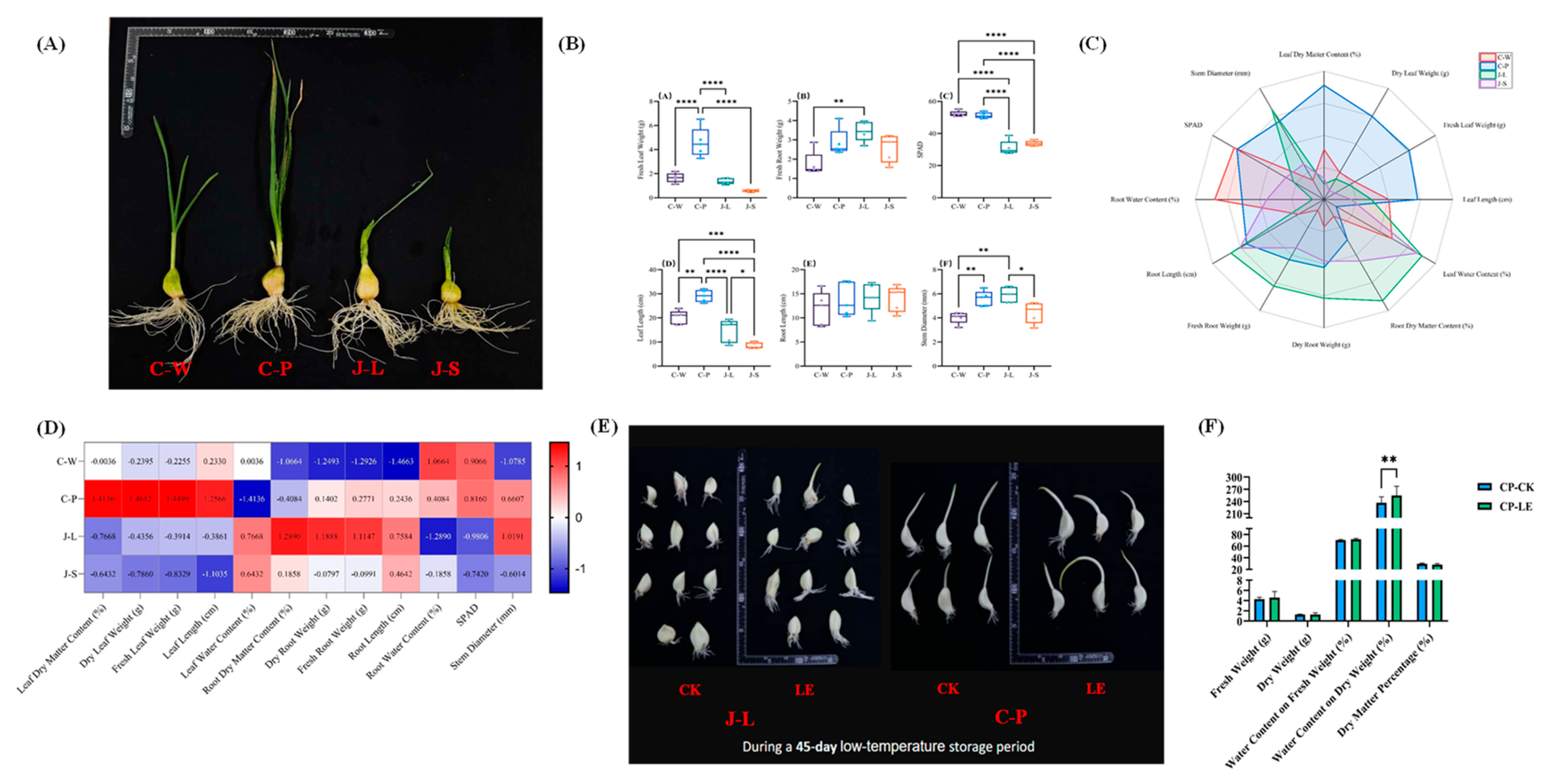
Figure 2.
Growth morphology and basic physiological indices of the 'C-P' garlic cultivar under varying salt concentrations and LE treatment. (A) Plant morphology under 0, 50, and 200 mM NaCl (Left: control [-LE]; Right: +LE). (B) External clove morphology under 200 mM NaCl. (C, D) Shoot and root biomass (fresh/dry weights) and morphological parameters (plant height, leaf dimensions/number, stem diameter, and root tip number). (E, F) DPPH radical scavenging activity (E) and total phenolic content (F) in roots, cloves, and leaves (p < 0.05).
Figure 2.
Growth morphology and basic physiological indices of the 'C-P' garlic cultivar under varying salt concentrations and LE treatment. (A) Plant morphology under 0, 50, and 200 mM NaCl (Left: control [-LE]; Right: +LE). (B) External clove morphology under 200 mM NaCl. (C, D) Shoot and root biomass (fresh/dry weights) and morphological parameters (plant height, leaf dimensions/number, stem diameter, and root tip number). (E, F) DPPH radical scavenging activity (E) and total phenolic content (F) in roots, cloves, and leaves (p < 0.05).
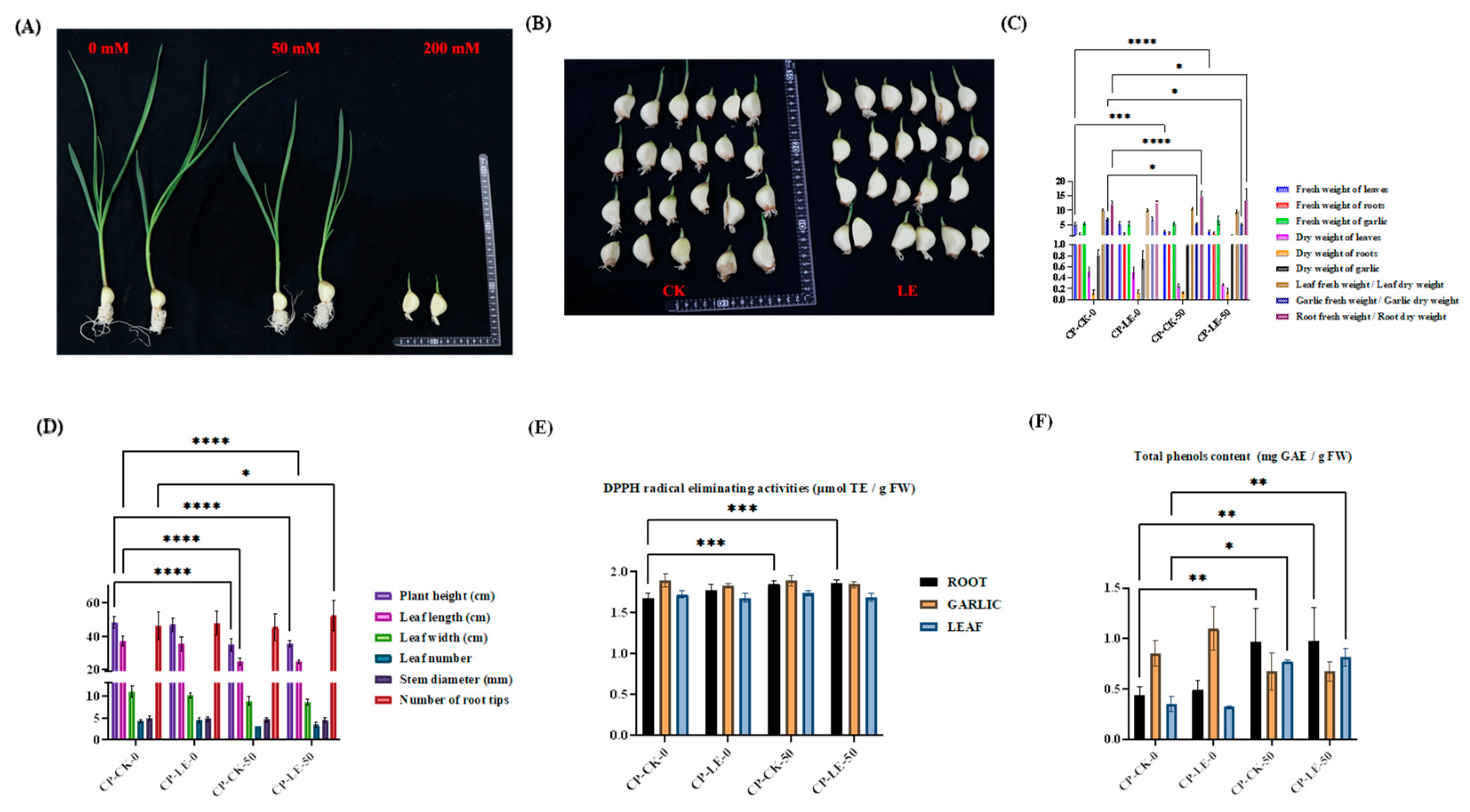
Figure 3.
Photosynthetic and biochemical responses of the 'C-P' garlic cultivar under varying treatments. (A) Chlorophyll a fluorescence (OJIP) transient curve. (B) Radar chart of JIP-test parameters (specific energy fluxes and performance indices: Fv/Fm, PIABS, ABS/RC, TR0/RC, ET0/RC, and DI0/RC) relative to the CP-CK-0 control. (C) Leaf SPAD value and Photosystem II quantum yield (QY). (D) Clove protein and soluble sugar contents. (E) Root browning and clove yellowness indices (p < 0.05).
Figure 3.
Photosynthetic and biochemical responses of the 'C-P' garlic cultivar under varying treatments. (A) Chlorophyll a fluorescence (OJIP) transient curve. (B) Radar chart of JIP-test parameters (specific energy fluxes and performance indices: Fv/Fm, PIABS, ABS/RC, TR0/RC, ET0/RC, and DI0/RC) relative to the CP-CK-0 control. (C) Leaf SPAD value and Photosystem II quantum yield (QY). (D) Clove protein and soluble sugar contents. (E) Root browning and clove yellowness indices (p < 0.05).
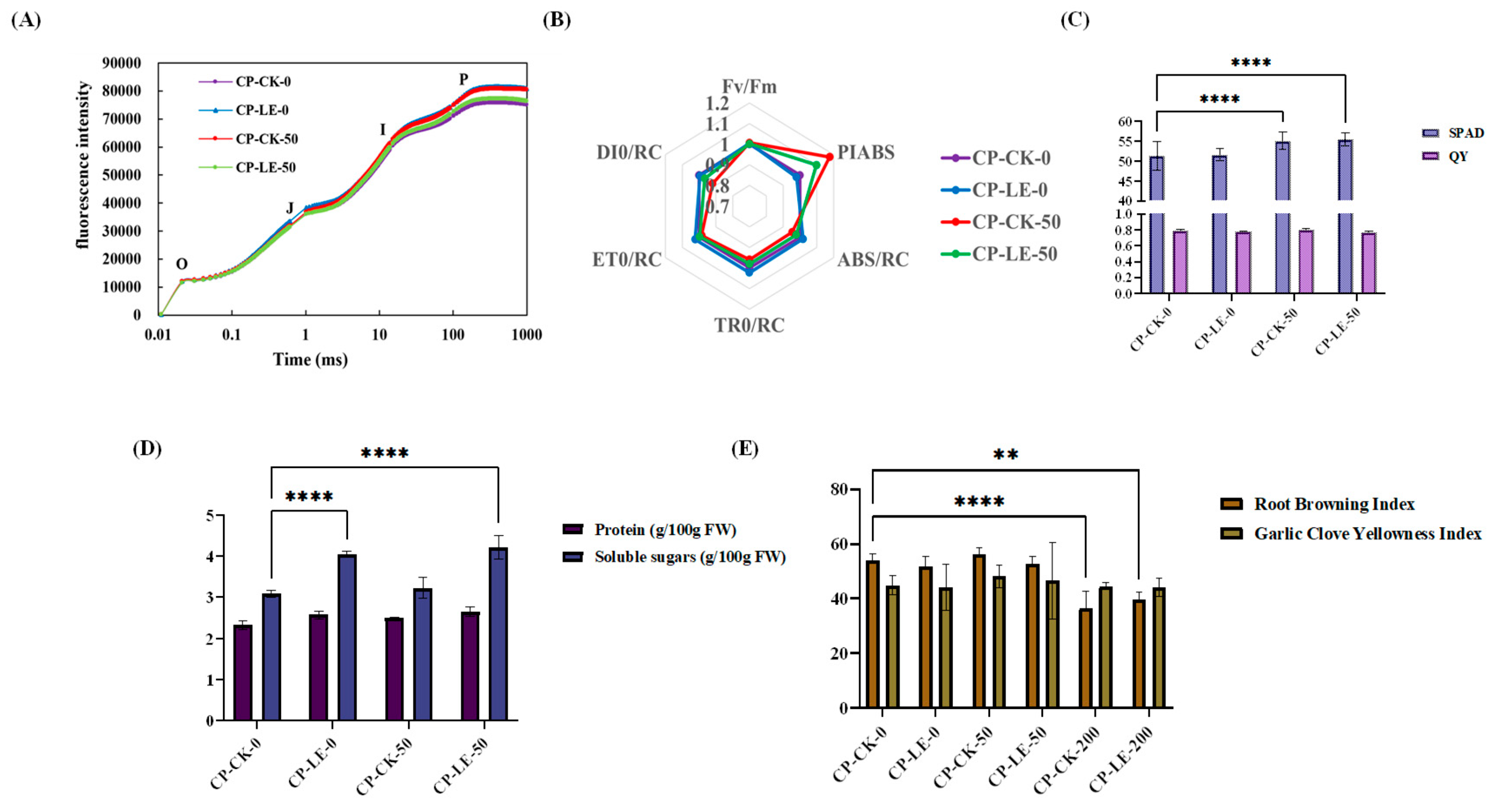
Figure 4.
Growth morphology and basic physiological indices of the root-dominant 'J-L' garlic cultivar under varying salt concentrations and LE treatment. (A) Plant morphology under 0, 50, and 200 mM NaCl (Left: CK; Right: LE). (B) External clove morphology under 200 mM NaCl. (C, D) Shoot and root biomass (fresh/dry weights) and morphological parameters (plant height, leaf dimensions/number, stem diameter, and root tip number). (E, F) DPPH radical scavenging activity (E) and total phenolic content (F) in roots, cloves, and leaves (p < 0.05).
Figure 4.
Growth morphology and basic physiological indices of the root-dominant 'J-L' garlic cultivar under varying salt concentrations and LE treatment. (A) Plant morphology under 0, 50, and 200 mM NaCl (Left: CK; Right: LE). (B) External clove morphology under 200 mM NaCl. (C, D) Shoot and root biomass (fresh/dry weights) and morphological parameters (plant height, leaf dimensions/number, stem diameter, and root tip number). (E, F) DPPH radical scavenging activity (E) and total phenolic content (F) in roots, cloves, and leaves (p < 0.05).
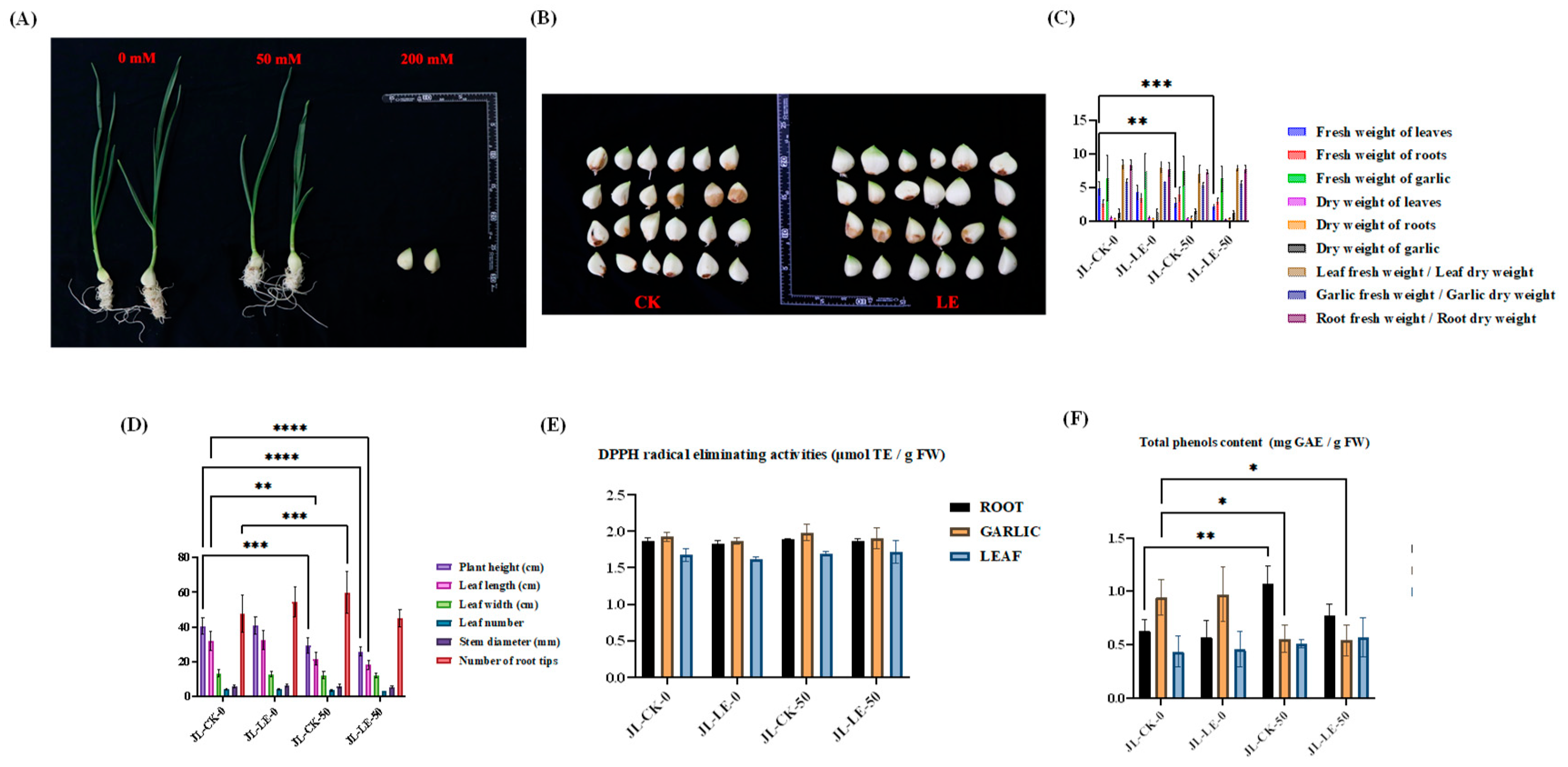
Figure 5.
Photosynthetic and biochemical responses of the 'J-L' garlic cultivar under varying treatments. (A) Chlorophyll a fluorescence (OJIP) transient curve. (B) Radar chart of JIP-test parameters (specific energy fluxes and performance indices: Fv/Fm, PIABS, ABS/RC, TR0/RC, ET0/RC, and DI0/RC) relative to the JL-CK-0 control. (C) Leaf SPAD value and Photosystem II quantum yield (QY). (D) Clove protein and soluble sugar contents. (E) Root browning and clove yellowness indices (p < 0.05).
Figure 5.
Photosynthetic and biochemical responses of the 'J-L' garlic cultivar under varying treatments. (A) Chlorophyll a fluorescence (OJIP) transient curve. (B) Radar chart of JIP-test parameters (specific energy fluxes and performance indices: Fv/Fm, PIABS, ABS/RC, TR0/RC, ET0/RC, and DI0/RC) relative to the JL-CK-0 control. (C) Leaf SPAD value and Photosystem II quantum yield (QY). (D) Clove protein and soluble sugar contents. (E) Root browning and clove yellowness indices (p < 0.05).
Disclaimer/Publisher’s Note: The statements, opinions and data contained in all publications are solely those of the individual author(s) and contributor(s) and not of MDPI and/or the editor(s). MDPI and/or the editor(s) disclaim responsibility for any injury to people or property resulting from any ideas, methods, instructions or products referred to in the content. |
© 2026 by the authors. Licensee MDPI, Basel, Switzerland. This article is an open access article distributed under the terms and conditions of the Creative Commons Attribution (CC BY) license (http://creativecommons.org/licenses/by/4.0/).
Copyright: This open access article is published under a Creative Commons CC BY 4.0 license, which permit the free download, distribution, and reuse, provided that the author and preprint are cited in any reuse.


