
Submitted:
21 April 2026
Posted:
23 April 2026
You are already at the latest version
Abstract
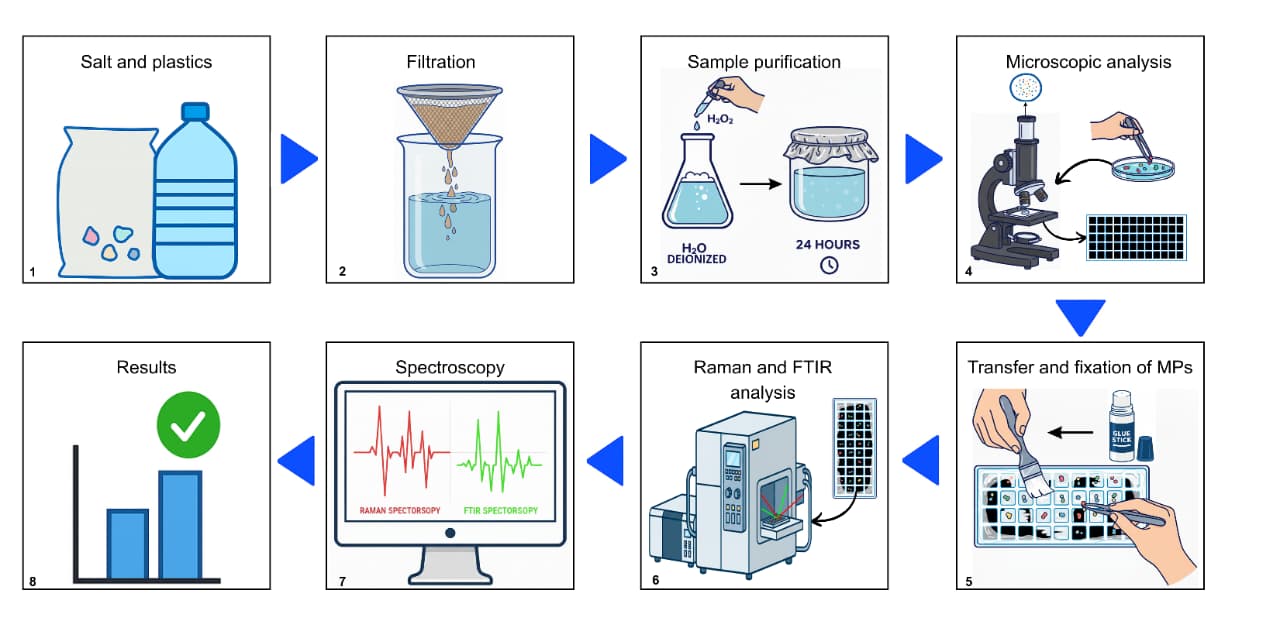
Microplastics are particles derived from polymer degradation, and their occurrence and abundance have been assessed across various environments and compartments. The method commonly used for their evaluation and quantification in sediments involves a marine salt solution for decantation. However, due to the high incidence of plastics in marine environments, this salt may already contain a considerable concentration of microplastics and must be carefully filtered to minimize interference during laboratory processing. To assess the importance of this procedure, sediment samples from an estuarine environment, in which the salt used for laboratory sorting was not filtered, were compared with samples from semiarid reservoirs, in which the salt underwent filtration before decantation. All other procedures were identical, performed by the same team under controlled airborne contamination conditions. The Mann–Whitney test applied to samples with and without NaCl filtration revealed a significantly lower incidence of microplastics in samples whose salt had been filtered. Based on these findings, a filtration protocol for NaCl used in sediment decantation was developed, emphasizing an accessible, low-cost product widely applied in natural environmental quality assessments. Only through the standardization of methodologies and sampling units will it be possible to compare environments in terms of actual anthropogenic impact, generating outcomes that provide scientific support for conservation actions and impact mitigation.
Keywords:
environmental impact
; microplastic filtration
; screening protocol
; NaCl
Copyright: This open access article is published under a Creative Commons CC BY 4.0 license, which permit the free download, distribution, and reuse, provided that the author and preprint are cited in any reuse.


