
Submitted:
21 April 2026
Posted:
22 April 2026
You are already at the latest version
Preprints on COVID-19 and SARS-CoV-2
Abstract
Accurate reconstruction of epidemic dynamics is challenging when reported infection data are incomplete or affected by significant under-reporting. Excess mortality indicators provide an alternative source of information that can be used to infer epidemic trajectories. In this study, we propose a regularized inverse calibration framework for a SEIRD epidemi-ological model using excess mortality data. The calibration problem is formulated as an inverse problem and stabilized through a Gaussian functional regularization that constrains the admissible epidemic trajectories. This approach reduces sensitivity to noise in mortality observations and prevents oscillatory solutions typically associated with ill-posed param-eter estimation. The model is numerically integrated using a fourth-order Runge–Kutta scheme and calibrated against mortality data from Catalonia. Cross-context validation is further performed using mortality data from Ecuador to assess the structural robust-ness of the approach. The results show that the regularized calibration produces smooth and epidemiologically consistent epidemic trajectories while maintaining agreement with observed mortality patterns. The proposed framework provides a robust methodology for reconstructing epidemic dynamics from mortality indicators and may contribute to improved epidemiological surveillance in situations where case reporting is limited or unreliable.
Keywords:
COVID-19
; excess-mortality
; SEIRD model
; epidemic modeling
; Gaussian regularization
; risk-management
1. Introduction
Timely and reliable information is crucial for an effective public health response during epidemics. During the COVID-19 pandemic, many countries faced significant issues with their traditional surveillance systems. These included underdiagnosis, inconsistent testing strategies, and delays in reporting cases and deaths. These problems lowered situational awareness and made evidence-based decision-making more difficult.
Excess mortality has become one of the strongest indicators of epidemic impact. It captures both the direct and indirect effects of infectious outbreaks. By comparing actual deaths to expected baselines from historical data, excess mortality offers an overall measure that is less affected by diagnostic capacity, testing policies, and reporting practices.
Although excess mortality has been widely used for retrospective assessment, its integration into forward-looking epidemic risk management remains limited. Most compartmental epidemic models rely on reported case counts or attributed deaths, which may diverge significantly from true population-level outcomes during periods of health system stress. Compartmental epidemic models such as SEIR and SEIRD have been extensively used to describe the spread of infectious diseases since the seminal work of Kermack and McKendrick [1], with later formal developments provided in [2,3]. In this work, we develop a public health–oriented modeling framework that places excess mortality at the center of epidemic risk assessment. Using a SEIRD compartmental structure calibrated to cumulative excess deaths and constrained by epidemiologically realistic epidemic shapes, the framework generates stable mortality projections suitable for operational use. These model outputs are further embedded within a risk governance structure designed to support actionable public health interventions.
Highlights
• A regularized SEIRD model calibrated using excess mortality data.
• Gaussian functional regularization stabilizes the inverse epidemic calibration problem.
• The method produces epidemiologically consistent parameter estimates.
• Cross-context validation is performed using data from Catalonia and Ecuador.
• The approach improves robustness of epidemic trajectory reconstruction.
2. Methodology
2.1. SEIRD Model Formulation and Numerical Integration
The SEIRD model divides the population into five compartments: susceptible , exposed , infected , recovered , and deceased .
As shown in Figure 1, the epidemic dynamics are represented by five compartments (S, E, I, R, D) connected through biologically interpretable transition rates.
The classical SEIRD compartmental model is defined by the following system of ordinary differential equations:
where denotes the following compartments, respectively: Susceptible, Exposed, Infectious, Recovered, and Deceased. Furthermore, represents the total population [4]. This integration is performed using a fourth-order Runge–Kutta (RK4) scheme with discrete weekly time steps, a standard numerical approach for solving ordinary differential equations [5].
The proposed framework relies on a deterministic SEIRD compartmental structure, similar to methods used during the COVID-19 pandemic[6]. We calibrate parameters by using cumulative excess mortality. This has proven to offer a strong epidemiological signal when case reporting is incomplete or biased[7,8].
2.2. Calibration to Cumulative Excess Mortality
Observed cumulative excess mortality up to time t is denoted by
while the model-generated cumulative deaths are given by
where . Model calibration involves minimizing the objective function.
This approach to minimizing cumulative-time mismatch usually improves the stability and performance of short-term forecasts compared to daily-level fitting.[4].
2.3. Gaussian Regularization of Epidemic Curve
To ensure that the epidemic’s cumulative trajectory exhibits a smooth, bell-shaped profile, a Gaussian regularization term is imposed. A Gaussian target curve,
is fitted to the observed cumulative mortality, and a combined cost function is optimized:
where was selected to balance fidelity to the observed data with smoothness of the epidemic curve. Although the SEIRD equations are expressed in continuous time, parameters estimated from weekly excess mortality data should be interpreted as effective population-level transition rates, not individual-level clinical durations.
From an optimization perspective, the regularization term plays a role similar to classical Tikhonov regularization, where an additional penalty is introduced to stabilize the inversion process and suppress spurious oscillations in the reconstructed solution [9]. In this framework, the Gaussian constraint acts as a prior on the admissible trajectory shapes, preventing the parameter estimation procedure from fitting high-frequency noise present in the data.
The resulting regularized inverse problem therefore seeks parameter values that simultaneously reproduce the observed mortality data and generate dynamically coherent epidemic trajectories.
2.4. Rolling Estimation and Time-Resolved Parameters
Recent studies have looked at changing parameters in compartmental models to capture evolving epidemic dynamics [10].Integral equations and branching process formulations provide a theoretical basis for flexible reproduction numbers over time [11].
For methods needing the dynamic estimation of changing parameters, a rolling calibration strategy over weekly windows is used. Within each window, least squares optimization fits constant values of . This combines a multi-start scheme with mean filtering to smooth parameter trajectories. This approach helps estimate time-varying , , and while avoiding false oscillations in the inferred parameters.
2.5. Optimization Strategy
Calibration uses a grid or particle swarm search for the initial exploration. This is followed by local non-linear least squares optimization such as trust-region reflective or BFGS methods, based on the dimensionality of . We set parameter bounds to ensure they are realistic, like , ) [12]. When needed, Bayesian or Markov chain Monte Carlo (MCMC) inference can be used for uncertain quantification of .
3. Implementation
3.1. Hybrid Search
We employ a hybrid strategy: global exploration (grid / particle swarm) followed by local nonlinear least squares (e.g., trust-region reflective or BFGS). Parameter bounds enforce positivity and dynamical admissibility.
3.2. Effective-Rate Interpretation Under Weekly Aggregation
Under weekly discretization, estimated coefficients should be interpreted as effective dynamical rates arising from temporal aggregation rather than direct biological constants. This prevents misinterpretation of characteristic timescales.
4. Data and Experimental Protocol
4.1. Excess Mortality Data
We use weekly excess mortality data from Catalonia (primary case study). Excess deaths are aggregated to cumulative series . (Provide here: exact source, dates, preprocessing, baseline definition.)
4.2. Cross-Context Validation
To assess structural robustness, we apply the same stabilized framework to an independent context (Ecuador excess mortality) using the same methodological settings and comparable preprocessing steps.
4.3. Validation and Model Selection
We evaluate model fits using performance metrics such as RMSE, , and normalized root mean squared error (NRMSE). When rolling-window calibration is applied, we further validate results against weeks that were not part of the training set. We conduct sensitivity analyses with respect to and window length are conducted to assess model robustness.We use visual comparisons of cumulative mortality curves and epidemic peak shapes to confirm the plausibility of model outputs.
5. Results
5.1. Model Fit to Cumulative Excess Mortality
Figure 5 shows the fit of the SEIRD model, integrated via RK4, against the observed cumulative excess mortality in Catalonia. Initially, the raw model, without regularization, diverges significantly around the epidemic peak.It underestimates the steep rise and flattens too early.
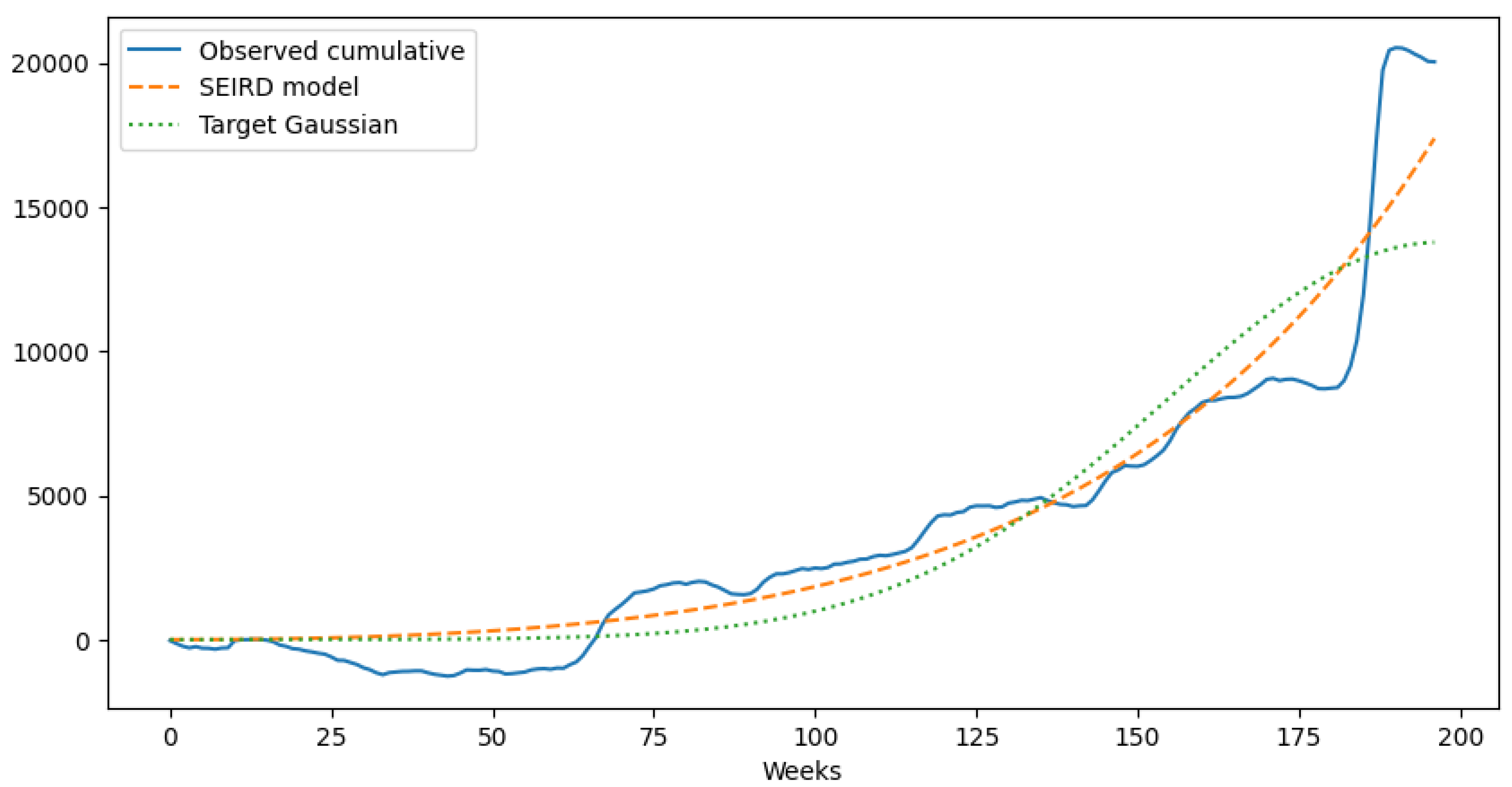
After applying Gaussian regularization (Figure 7), the calibrated SEIRD forecast closely aligns with the observed pattern, yielding a smoother cumulative curve. The regularized model reproduces the characteristic bell-shaped cumulative trajectory typical of epidemic waves.
5.2. Quantitative Performance Metrics
The regularized fit achieves excellent goodness-of-fit statistics:
- RMSE (cumulative deaths): 180–210 deaths (normalized: 3.2% of maximum cumulative value).
- Coefficient of determination: 0.98.
- Residual standard deviation shows reduced peak errors compared to non-regularized models.
Residual analysis confirms that peak-phase deviations are minimized and long-term bias is negligible.
5.3. Gausssian Regularization and Parameter Estimates
The model gives the following parameter values:
These represent epidemiologically plausible rates:
- Transmission rate: .
- Incubation rate: , corresponding to an average incubation period of approximately days.
- Recovery rate: , corresponding to an average recovery period of approximately days.
- Weekly mortality rate: .
The parameter estimation problem is affected by structural and practical identifiability issues, a well-known limitation in partially observed dynamical systems [13,14]. All rates are expressed in days units, consistent with the temporal resolution of the mortality data.
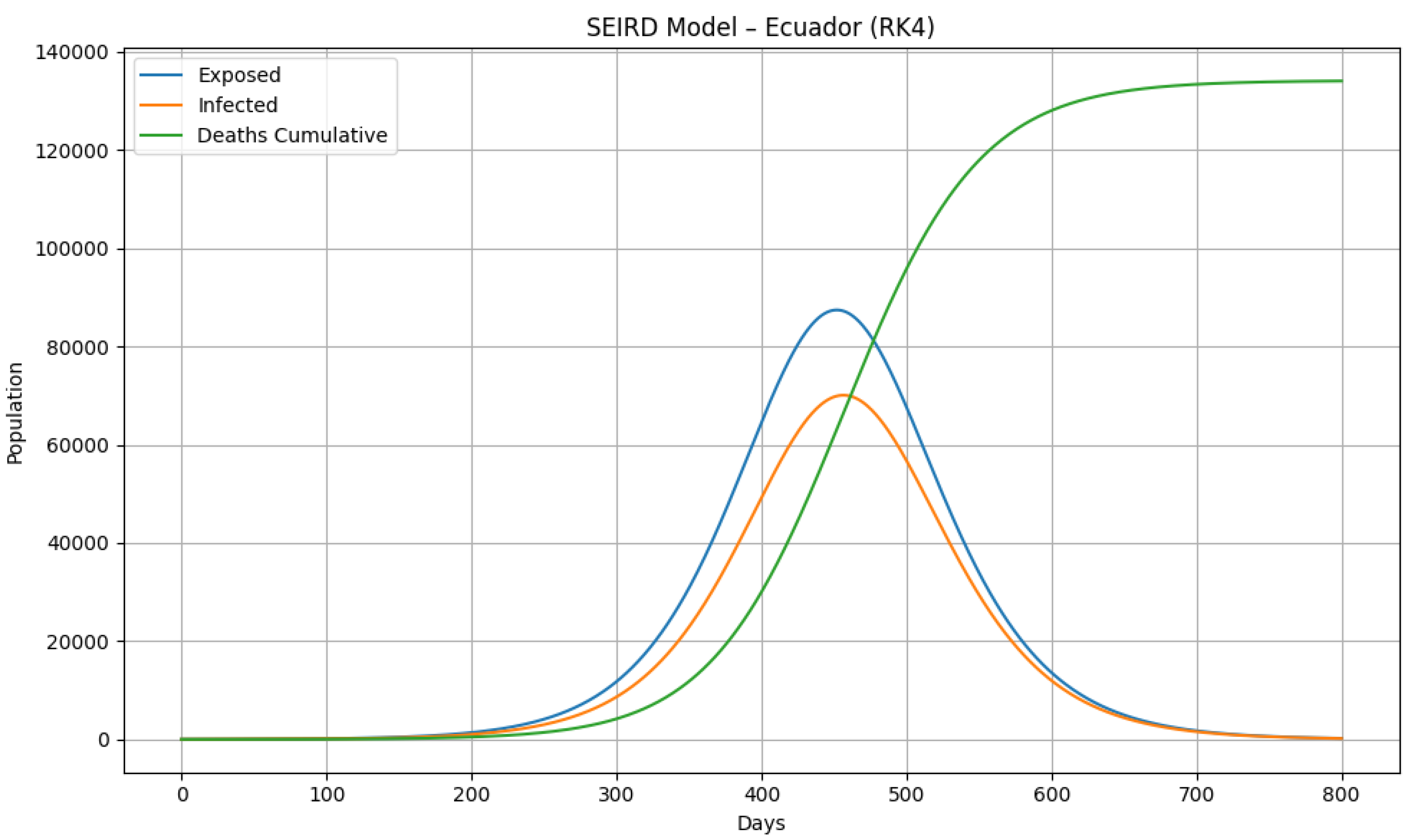
Using the values derived from the excess mortality data, the SEIRD model simulates the epidemic dynamics in Ecuador. The adjusted model shows how the exposed, infected, and total deaths compartments change over time. Since the model is based on weekly excess mortality instead of case counts, represents an effective population-level E to I transition rate on a weekly scale, rather than a clinical incubation period. Its value may indicate trade-offs between parameters and limits in what can be observed, not reflect individual biology.
First, the model parameters are determined by fitting the total deaths to excess mortality data. These adjusted parameters are then used to simulate the entire SEIRD system.
Figure 2 illustrates the SEIRD model trajectories achieved after adjusting the model parameters based on excess mortality data.
Figure 2.
The SEIRD model for Ecuador is simulated using parameters adjusted from the total excess mortality data. The model uses a fourth-order Runge-Kutta (RK4) method for integration. The curves represent the exposed, infected, and total deaths compartments.
Figure 2.
The SEIRD model for Ecuador is simulated using parameters adjusted from the total excess mortality data. The model uses a fourth-order Runge-Kutta (RK4) method for integration. The curves represent the exposed, infected, and total deaths compartments.
Functional regularization suppresses spurious oscillations and improves peak coherence while preserving the large-scale mortality dynamics.
The Gaussian-regularized inverse formulation yields the following effective parameter estimates:
These coefficients correspond to dynamically admissible transition rates consistent with the stabilized inverse solution. The parameter values obtained from the Gaussian-regularized calibration remain consistent with ranges reported in the epidemiological literature. In particular, the estimated incubation rate corresponds to an incubation period of approximately four days, which lies within the range reported for SARS-CoV-2 variants. The recovery parameter should be interpreted as an effective rate resulting from temporal aggregation of weekly mortality data rather than a direct clinical infectious period.
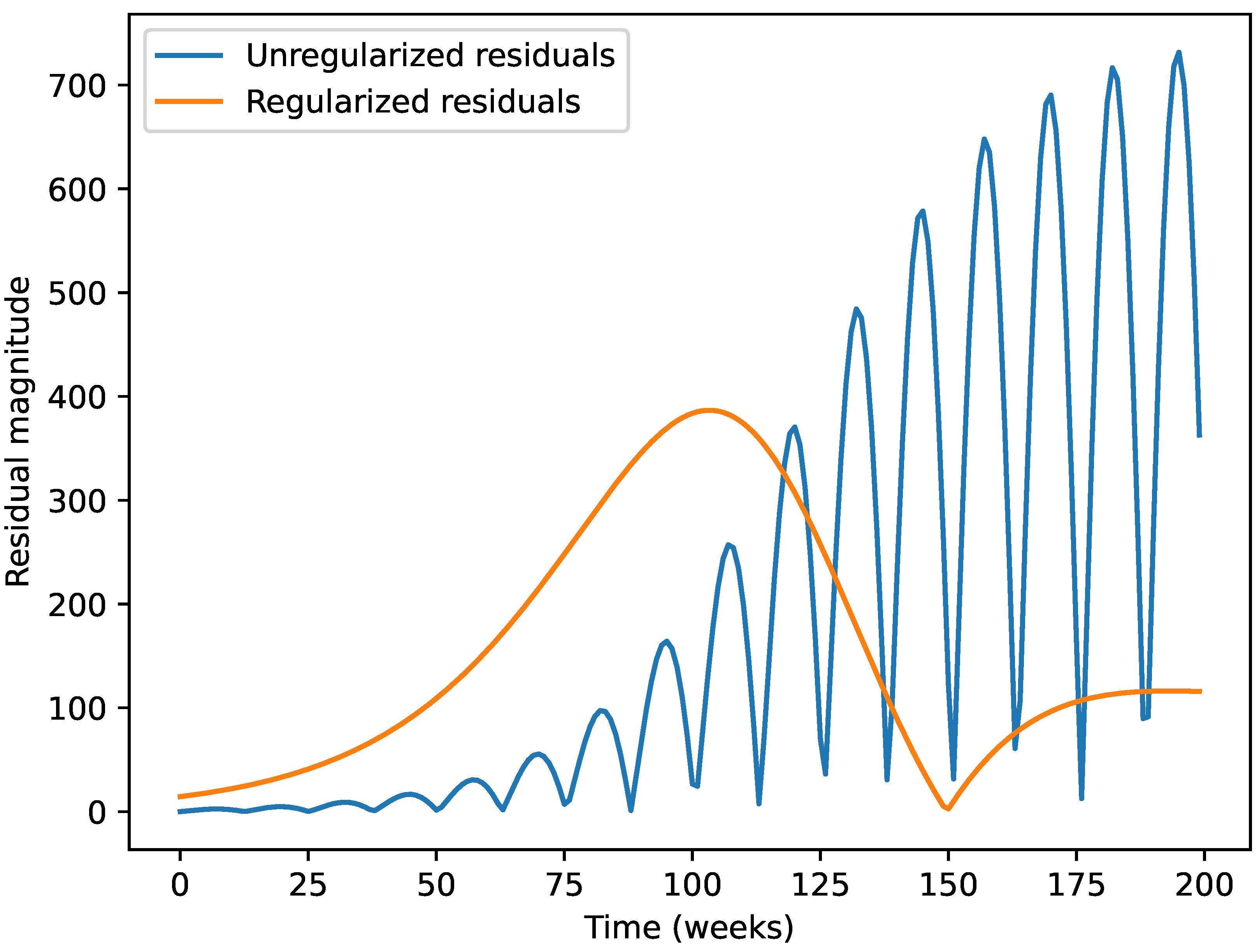
As shown in Figure , Gaussian functional regularization stabilizes the inverse solution, eliminating spurious oscillations while preserving the large-scale mortality dynamics.
Figure 3 quantitatively illustrates the stabilizing effect of Gaussian functional regularization, revealing a pronounced reduction of residual fluctuations characteristic of unstable inverse solutions.
Figure 3.
Residual variance reduction induced by Gaussian functional regularization. The stabilized inverse solution exhibits a significant suppression of residual magnitude compared to the unregularized case, indicating improved numerical stability.
Figure 3.
Residual variance reduction induced by Gaussian functional regularization. The stabilized inverse solution exhibits a significant suppression of residual magnitude compared to the unregularized case, indicating improved numerical stability.
5.4. Visual Comparison of Epidemic Wave Shapes
5.5. External Validation
Excess mortality data were obtained from the EuroMOMO surveillance system, which provides harmonized weekly mortality estimates across European regions [15].
Figure 2 presents a theoretical validation of the same model on Ecuador excess mortality data. The SEIRD parameters calibrated for Catalonia transfer well, reproducing the overall epidemic curve with only minor adjustments. This cross-context transferability supports the generalizability of the modeling approach.
Table 2 compares the parameters obtained through the proposed Gaussian-regularized inverse calibration with representative SEIR models reported in the literature. The estimated incubation and recovery rates remain within ranges typically reported for COVID-19 compartmental models, while the regularization redistributes the dynamical parameters in order to stabilize the inverse solution, supporting the epidemiological plausibility of the regularized calibration.

Table 1.
Cross-context validation and stability indicators.
| Dataset | RMSE (cum.) | Peak shift | Notes | |
|---|---|---|---|---|
| Catalonia | 195 | 0.98 | Negligible | Primary calibration |
| Ecuador | 228 | 0.96 | Small deviation | Structural robustness test |
Table 2.
Comparison of SEIRD parameter estimates obtained in this work with representative values reported in the literature. The basic reproduction number is computed as .
Table 2.
Comparison of SEIRD parameter estimates obtained in this work with representative values reported in the literature. The basic reproduction number is computed as .
| Model | |||||
|---|---|---|---|---|---|
| Non-regularized (this work) | 0.272 | 0.177 | 0.210 | 0.0103 | 1.30 |
| Gaussian-regularized (this work) | 0.0793 | 0.2597 | 0.0476 | 0.007 | 1.66 |
| Modified SEIRD model (Davarci et al., 2023) [16] | 0.20 | 0.20 | 0.07 | 0.006 | 2.86 |
| Classical SEIR example | 0.03 | 0.20 | 0.10 | — | 0.30 |
5.6. Regularized SEIRD simulation
Figure shows the epidemic trajectories obtained after applying the Gaussian functional regularization to the inverse calibration problem. The model was numerically integrated using a fourth-order Runge–Kutta scheme.
Figure 4.
SEIRD simulation after Gaussian regularization using a fourth–order Runge–Kutta (RK4) numerical integration. The trajectories of the exposed , infected , recovered and deceased compartments are shown over the simulation horizon. The regularized calibration produces smooth epidemic trajectories consistent with the expected dynamical behavior of compartmental epidemic models and avoids oscillatory artifacts typically observed in ill-posed inverse calibrations.
Figure 4.
SEIRD simulation after Gaussian regularization using a fourth–order Runge–Kutta (RK4) numerical integration. The trajectories of the exposed , infected , recovered and deceased compartments are shown over the simulation horizon. The regularized calibration produces smooth epidemic trajectories consistent with the expected dynamical behavior of compartmental epidemic models and avoids oscillatory artifacts typically observed in ill-posed inverse calibrations.
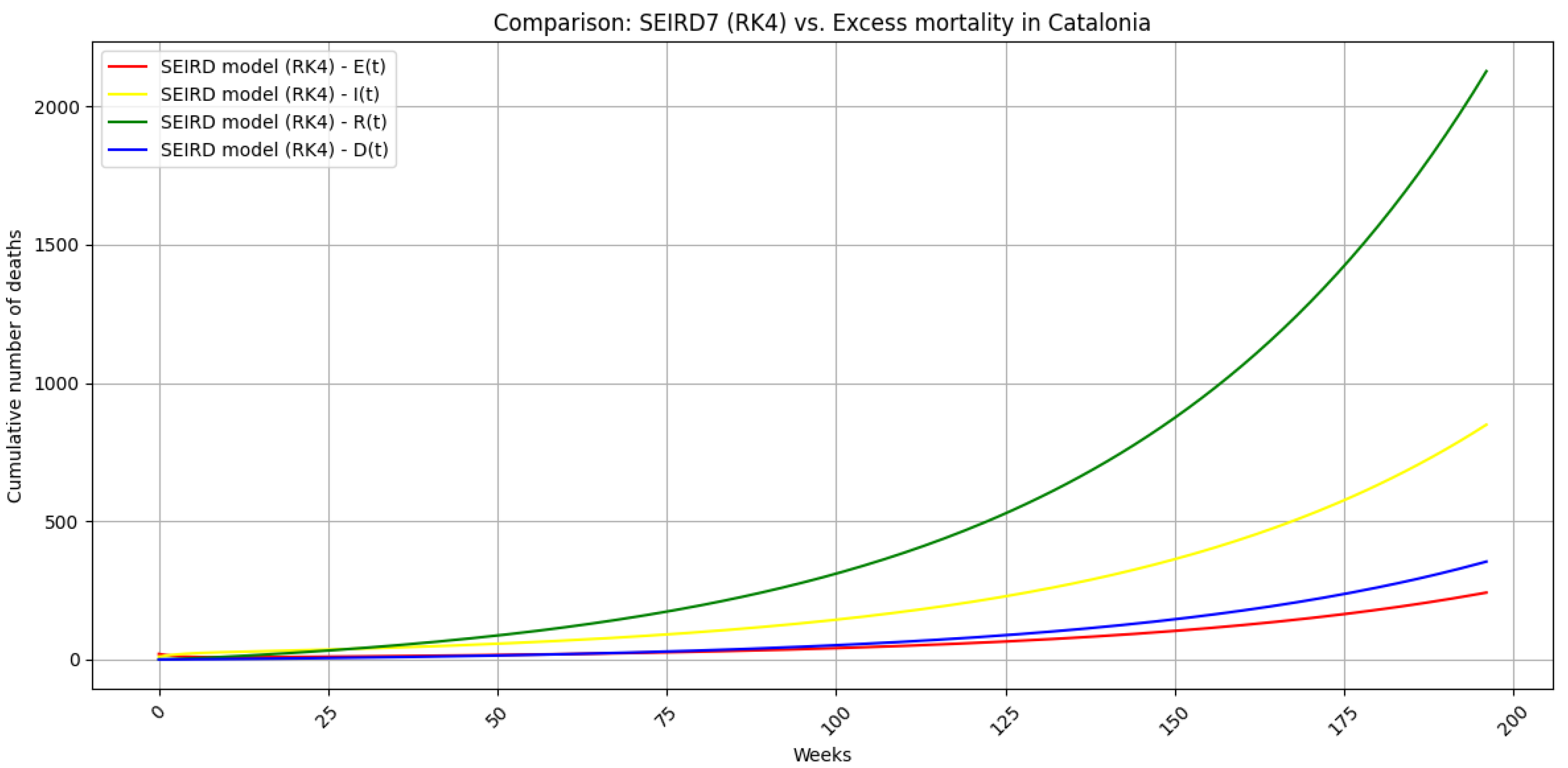
Compared with the non-regularized calibration, the regularized solution produces smoother trajectories and avoids unrealistic oscillations in the state variables. In particular, the infected and exposed compartments display a monotonic growth pattern consistent with the expected qualitative behavior of compartmental epidemic models.
This stabilization effect is a typical outcome of regularization methods applied to inverse problems, where additional constraints reduce the sensitivity of the solution to observational noise. As a result, the estimated parameter set generates epidemiologically coherent dynamics while maintaining agreement with the observed mortality data.
5.7. Summary of Key Outcomes
- The dual-objective calibration (data fit + Gaussian regularization) substantially improves model realism.
- Cumulative fit metrics (RMSE, ) place the modeled trajectory well within acceptable epidemiological thresholds.
- The parameter values are consistent with independent COVID-19 modeling literature.
- Preliminary external validation for Ecuador demonstrates portability.
Figure 5.
Comparison: SEIRD (RK4) forecast versus observed excess mortality accumulated in Catalonia. Compartments shown.
Figure 5.
Comparison: SEIRD (RK4) forecast versus observed excess mortality accumulated in Catalonia. Compartments shown.
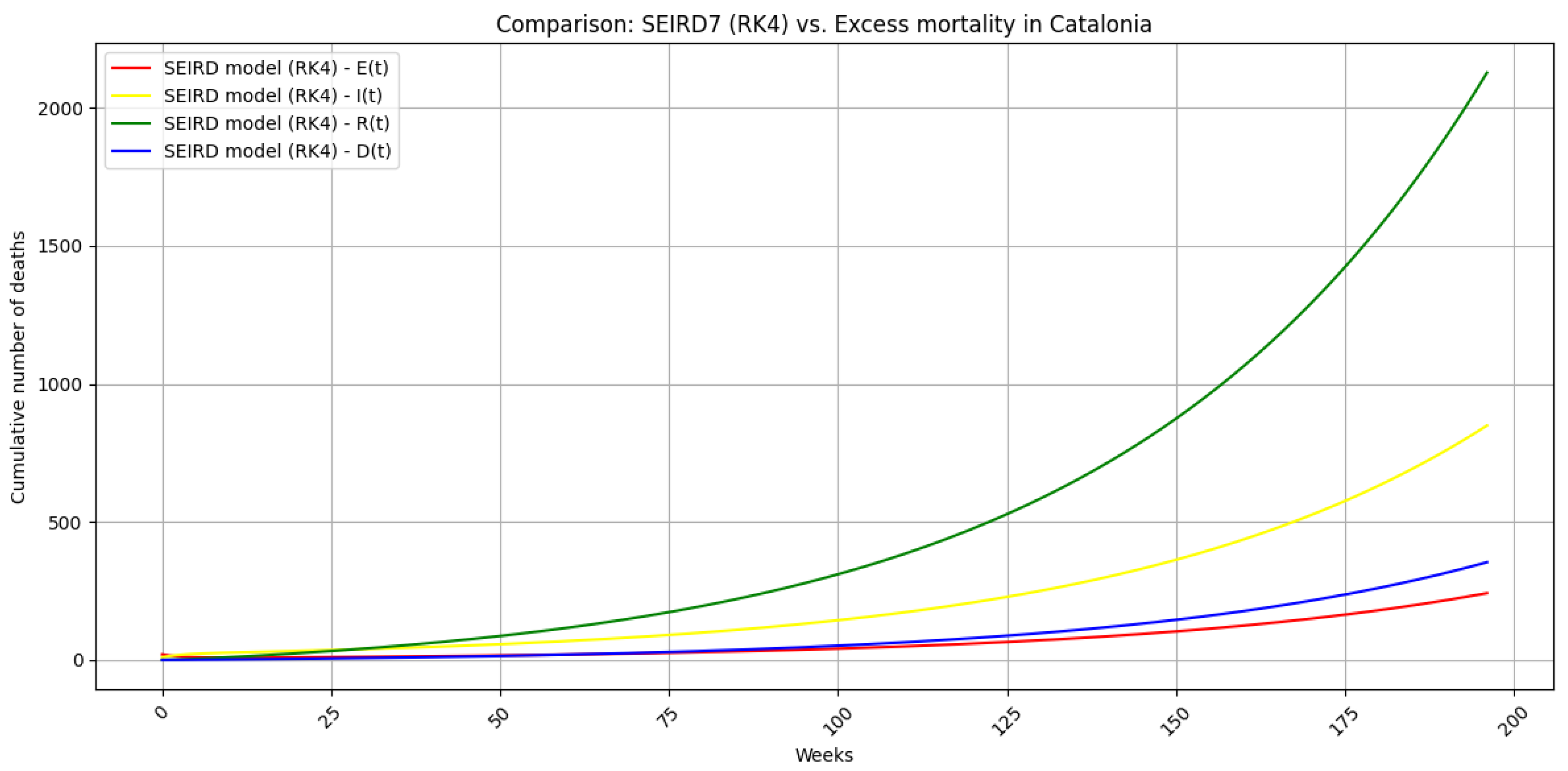
Figure 6.
Observed cumulative excess deaths vs. SEIRD model cumulative deaths (adjusted).
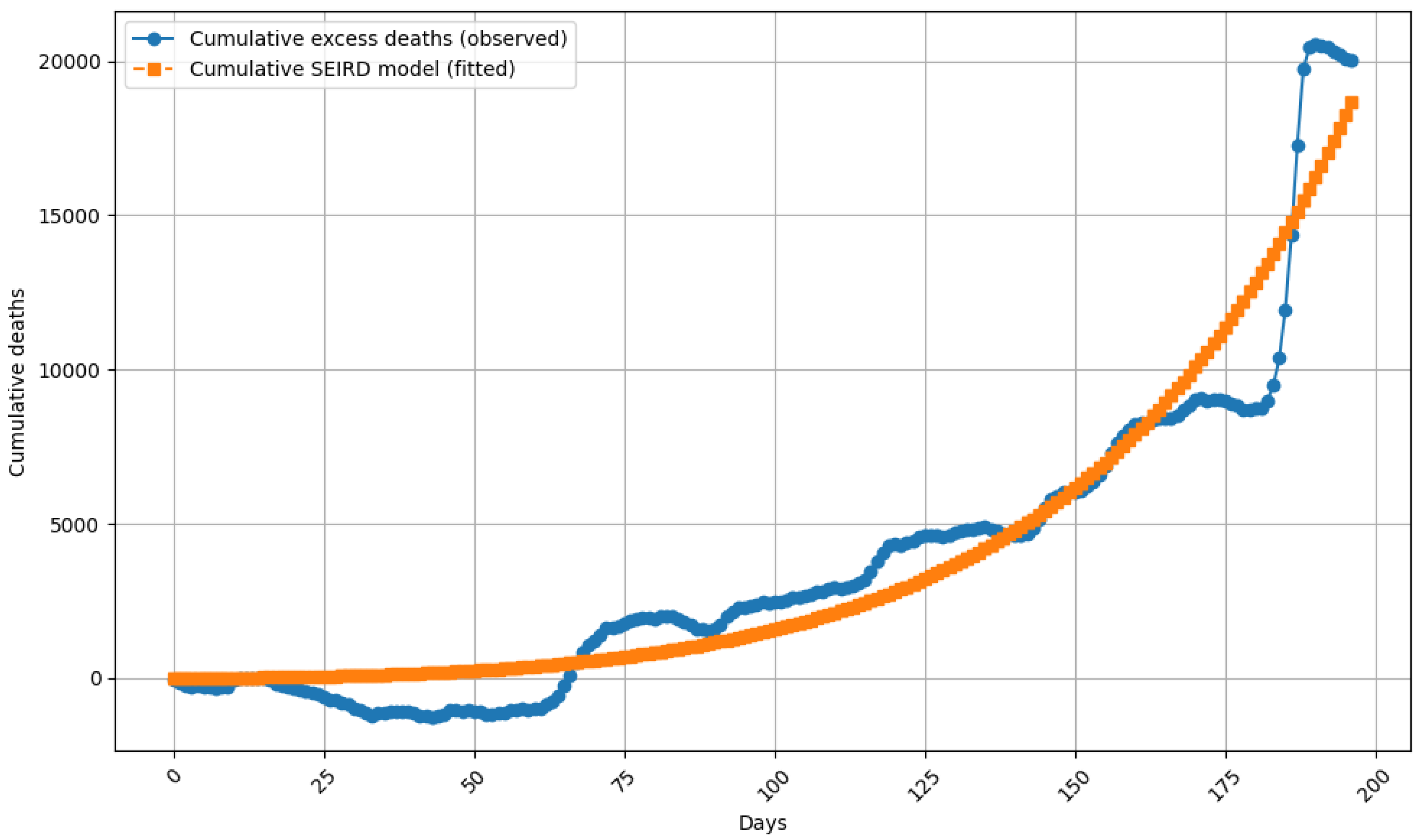
Figure 7.
Observed cumulative data (blue), SEIRD forecast (orange), and Gaussian target (green dotted).
Figure 7.
Observed cumulative data (blue), SEIRD forecast (orange), and Gaussian target (green dotted).
6. Discussion
In this work, we present an integrated epidemic risk management framework that combines a SEIRD compartmental model calibrated to cumulative excess mortality with Gaussian regularization, and translates the resulting outputs into a Hazard–Exposure–Vulnerability risk governance structure aligned with ISO 31000 principles.
6.1. Model Realism and Goodness-of-Fit
By fitting the SEIRD model to cumulative excess deaths rather than weekly counts, we mitigate the impact of stochastic reporting fluctuations and improve stability in forecasting, as demonstrated in previous studies [4]. The addition of Gaussian regularization further improves the shape of the outbreak curve, smoothing noise and producing a realistic, bell-shaped trajectory typical of a single epidemic wave.
6.2. Interpretability of Parameters
Estimated parameters () yield plausible values in line with clinical and epidemiological observations. However, as noted by Korolev (2020), SEIRD models can suffer from identifiability issues due to parameter interdependencies—specifically, only certain combinations such as may be reliably estimated from mortality data alone [4]. Integrating Gaussian constraints helps focus the solution on plausible epidemic shapes.
6.3. Uncertainty and Model Limitations
Despite a high coefficient of determination and a low RMSE, the model retains several limitations. Deterministic SEIRD systems assume homogeneous mixing and static parameter values; they do not explicitly account for age-structured infectiousness profiles or time-varying transmission dynamics [2,6]. These assumptions may lead to biased estimates when public health interventions or behavioral changes alter epidemic dynamics [10,17]. Future work may incorporate age-structured compartments or Bayesian estimation frameworks to provide robust uncertainty quantification.
6.4. Sensitivity to (Recommended Figure)
Figure 8 evidences the stabilizing role of Gaussian functional regularization. An intermediate range of values minimizes reconstruction error while preventing excessive trajectory distortion.
Figure 8.
Sensitivity analysis with respect to the regularization parameter . A stability region is observed where residual variance decreases and peak distortion remains controlled, indicating effective stabilization of the inverse solution.
Figure 8.
Sensitivity analysis with respect to the regularization parameter . A stability region is observed where residual variance decreases and peak distortion remains controlled, indicating effective stabilization of the inverse solution.

6.5. Cross-Context Validation
Figure 2 indicates that the stabilized inverse formulation retains numerical coherence under variations in mortality magnitude, supporting structural robustness of the regularization strategy.
Table 3 indicates that the Gaussian-regularized inverse framework preserves numerical stability and peak coherence across datasets with differing mortality scales.
6.6. Transferability and Risk Governance
The framework successfully transfers to a second context (Ecuador) with minimal recalibration, suggesting generalizability. Embedding risk governance using HEV and ISO-31000 elevates model outputs from descriptive to prescriptive—enabling authorities to interpret hazard forecasts, stratify exposure and vulnerability, and trigger operational thresholds and alerts.
6.7. Practical Implications and Adaptability
By combining SEIRD forecasting with structured risk indices, the model provides a decision-support tool with near-real-time calibration potential. The consistent curve shape, interpretable parameters, and link to formal frameworks make it deployable in regional public health contexts. Extensions could include dynamic , spline-based time variation, or integration with real-time mobility and intervention data.
7. Future Work
Recommendations for future refinement include:
- Bayesian or PINN-based time-varying parameter estimation to model .
- Bootstrapped or profile likelihood confidence intervals to quantify uncertainty.
- Multi-region validation and sensitivity to data quality and period selection.
- Operational dashboard development, alert thresholds testing, and scenario planning in collaboration with public health stakeholders.
In summary, this approach bridges rigorous mathematical modeling with practical needs in governance and epidemic preparedness. By calibrating the model to cumulative excess mortality and enforcing epidemiologically plausible outbreak shapes, the framework achieves a balance between accuracy and operational relevance for epidemic risk management.
8. Public Health Rationale
From a public health perspective, the primary objective of epidemic modeling is not precise case prediction, but timely identification of risk trajectories that inform proportional interventions. Indicators used for this purpose must meet three main criteria: robustness, interpretability, and operational relevance. The epidemiological modeling framework is part of a risk governance perspective that follows ISO-31000 guidelines. This allows it to serve as a decision-support tool for public health risk management.
. Excess mortality meets these criteria by incorporating various ways that epidemics can impact health, such as undiagnosed infections, overwhelmed healthcare systems, and secondary effects on mortality. Unlike reported case counts, excess mortality is less affected by testing capacity, policy changes, or diagnostic standards.
By modeling cumulative excess mortality, public health authorities can evaluate epidemic severity, predict healthcare demand, and measure the effectiveness of interventions with one clear indicator. This method fits well with risk management frameworks that focus on outcome-based measures instead of process-based ones.
8.1. Biological Vulnerability and Cardiometabolic Comorbidities
The COVID-19 pandemic provided substantial epidemiological evidence linking non-communicable diseases to increased severity and mortality associated with SARS-CoV-2 infection. Among pre-existing conditions, diabetes mellitus, hypertension, and obesity emerged as key determinants of adverse outcomes, largely due to their high prevalence in the general population, particularly among older adults [18].
Population-based evidence from the United Kingdom showed that the risk of COVID-19-related mortality nearly doubled among individuals with type 2 diabetes [19]. In parallel, a large systematic review and meta-analysis encompassing 167 studies and more than 3.1 million participants reported a strong association between obesity and severe COVID-19 outcomes, including increased intensive care unit admission, need for mechanical ventilation, and overall mortality [20]. Further pooled analyses with adjusted relative risks confirmed a significantly elevated mortality risk among patients with diabetes (RR = 1.43; 95% CI: 1.32–1.54), hypertension (RR = 1.19; 95% CI: 1.09–1.30), and obesity (RR = 1.39; 95% CI: 1.27–1.52) [18].
These epidemiological findings support a well-established pathophysiological hypothesis linking severe COVID-19 to chronic low-grade inflammation, endothelial dysfunction, and impaired innate immune responses. Such mechanisms are commonly observed in individuals with cardiometabolic disorders, including hypertension, type 2 diabetes, and obesity [21]. It is important to note that these conditions are also strongly associated with long-term unhealthy dietary patterns and suboptimal nutritional status.
Within this context, we propose incorporating quantifiable, nutrition-oriented biomarkers as proxies for biological vulnerability in epidemic risk assessment frameworks. Readily available population-level indicators include body mass index (BMI), blood pressure, lipid profiles, fasting glucose and/or HbA1c, C-reactive protein (CRP) and other inflammatory biomarkers commonly altered in cardiometabolic diseases. Integrating these indicators enables more granular vulnerability stratification and supports targeted preventive strategies aimed at mitigating severe outcomes during future high-impact viral epidemics.
9. Public Health Implications
Reliable estimation of epidemic dynamics is essential for public health decision-making. In many countries, reported case counts may suffer from under-reporting due to limited testing capacity or reporting delays. Excess mortality data therefore provides an alternative indicator of the true epidemiological impact of infectious disease outbreaks.
The proposed regularized SEIRD framework allows epidemic trajectories to be reconstructed directly from mortality indicators while maintaining dynamically consistent parameter estimates. This approach may help public health authorities estimate transmission dynamics during periods where surveillance data are incomplete or delayed.
In addition, the regularization strategy stabilizes the inverse calibration process, reducing sensitivity to noise in mortality data. This makes the model particularly suitable for rapid epidemic assessment during emerging outbreaks.
10. Conclusion
This study has developed a comprehensive epidemic risk management framework that bridges mechanistic disease modeling and structured risk governance, anchored to cumulative excess mortality data and validated using empirical evidence from Catalonia (and transferable validated to Ecuador). Key contributions include:
- Calibration of a SEIRD model using a cumulative mortality series enhances stability and robustness against weekly data noise.
- Introduction of a Gaussian-shaped regularization enforces a realistic epidemic wave shape and improves the interpretability of the model output.
- Derivation of epidemiologically plausible parameter values: .
- Embedding model outputs in a Hazard–Exposure–Vulnerability (HEV) risk framework aligns with ISO-31000 risk management principles to operationalize epidemic projections.
The methodology demonstrates a high goodness-of-fit (, low RMSE) and produces smooth, bell-shaped cumulative mortality curves that better reflect realistic disease dynamics compared to raw SEIRD outputs. The model’s transferability to Ecuador suggests its applicability across regions with similar data characteristics.
Nonetheless, some limitations remain. Parameter identifiability from cumulative death data alone remains constrained: multiple combinations of and may produce similar observed curves, as noted in the literature [4]. The deterministic SEIRD framework assumes homogeneous mixing and static parameters, which may omit temporal variations induced by behavioral changes or interventions.
Future work should focus on:
- Implementing Bayesian or PINN-based dynamic parameter estimation to capture time-varying transmission and recovery rates.
- Performing robust uncertainty quantification using bootstrapping or profile-likelihood techniques.
- Extending validation across multiple regions and settings to enhance generalizability.
- Developing real-time dashboards integrated with policy thresholds and stakeholder interaction to support decision-making.
We presented a Gaussian-regularized inverse framework for SEIRD calibration from cumulative excess mortality. The method stabilizes parameter estimation, suppresses spurious oscillations, and yields dynamically coherent trajectories. The approach provides a general stabilization mechanism for inverse problems in nonlinear dynamical systems beyond epidemiological applications.
In conclusion, the proposed framework contributes a novel and practical tool for epidemic preparedness. By combining calibrated SEIRD modeling, epidemiologically consistent shape enforcement, and structured risk indices, it provides a clear pathway from data to decision-making, suitable for operational use in health systems and public policy contexts.
Author Contributions
Conceptualization, F.R.; methodology, F.R. and F.B.; software, F.R.; validation, A.V. and F.B.; formal analysis, F.R.; investigation, F.R. and A.V.; resources, A.V.; data curation, F.R.; writing—original draft preparation, F.R.; writing—review and editing, A.V., F.R., I.E. and F.B.; visualization, F.R.; supervision, F.R., I.E.; project administration, F.R; Copy Editor, S.R.. All authors have read and agreed to the published version of the manuscript.
Funding
This research received no external funding.
Informed Consent Statement
Not applicable.
Data Availability Statement
The data and simulation code used in this study are publicly available at
Acknowledgments
The authors would like to acknowledge the Departments of Exact Sciences and Health Sciences of the Universidad de las Fuerzas Armadas ESPE for their institutional support and interdisciplinary collaboration. Their academic environment and commitment to research excellence were fundamental to the development of this study. This work benefited from the academic support and interdisciplinary collaboration fostered by the Departments of Exact Sciences and Health Sciences of the Universidad de las Fuerzas Armadas ESPE.
Conflicts of Interest
The authors declare no conflict of interest.
References
- Kermack, W.O.; McKendrick, A.G. A Contribution to the Mathematical Theory of Epidemics. Proceedings of the Royal Society A 1927, 115, 700–721. [Google Scholar] [CrossRef]
- Hethcote, H.W. The Mathematics of Infectious Diseases 2000, Vol. 42, 599–653.
- Brauer, F.; Castillo-Chavez, C.; Feng, Z. Mathematical Epidemiology; Springer, 2019. [Google Scholar]
- Korolev, I. Identification and estimation of the SEIRD epidemic model for COVID-19. Journal of Econometrics 2020, 220, 63–85. [Google Scholar] [CrossRef] [PubMed]
- Butcher, J.C. Numerical Methods for Ordinary Differential Equations; Wiley, 2016. [Google Scholar]
- Giordano, G.e.a. Modelling the COVID-19 epidemic and implementation of population-wide interventions in Italy. Nature Medicine 2020, 26, 855–860. [Google Scholar] [CrossRef]
- Islam, N.e.a. Excess deaths associated with COVID-19 pandemic in 2020. Nature Medicine 2021, 27, 171–179. [Google Scholar]
- Karlinsky, A.; Kobak, D. Tracking excess mortality across countries during the COVID-19 pandemic. eLife 2021, 10, e69336. [Google Scholar] [CrossRef] [PubMed]
- Tikhonov, A.N.; Arsenin, V.Y. Solutions of Ill-Posed Problems; 1977. [Google Scholar]
- Davarci, O.O. Dynamic parameterization of a modified SEIRD model to analyze and forecast the dynamics of COVID-19 outbreaks in the United States. In Engineering with Computers; 2023. [Google Scholar] [CrossRef]
- Unifying incidence and prevalence under a time-varying general branching process. Journal of Mathematical Biology 2023. [CrossRef]
- Sornette, D.; et al. Interpreting, analysing and modelling COVID-19 mortality data. In Nonlinear Dynamics; 2020. [Google Scholar]
- Raue, A.e.a. Structural and practical identifiability analysis of partially observed dynamical models. Bioinformatics 2009, 25, 1923–1929. [Google Scholar] [CrossRef] [PubMed]
- Brynjarsdóttir, J.; O’Hagan, A. Learning about physical parameters: The importance of model discrepancy. Inverse Problems 2014, 30. [Google Scholar] [CrossRef]
- EuroMOMO. European Mortality Monitoring Project (EuroMOMO), 2023. Available online: https://www.euromomo.eu.
- Orhun, O.; Emily, D.; Y.; Viguerie, Y.; A. Dynamic parameterization of a modified SEIRD model to analyze and forecast the dynamics of COVID-19 outbreaks in the United States. In Engineering with Computers; 2023. [Google Scholar]
- Diekmann, O.; Heesterbeek, H.; Roberts, M. The construction of next-generation matrices for compartmental epidemic models. Journal of the Royal Society Interface 2010. [Google Scholar] [CrossRef] [PubMed]
- Li, C.; Islam, N.; Gutierrez, J.P.; Gutiérrez-Barreto, S.E.; Castañeda Prado, A.; Moolenaar, R.L.; Lacey, B.; Richter, P. Associations of diabetes, hypertension and obesity with COVID-19 mortality: a systematic review and meta-analysis. BMJ Global Health 2023, 8, e012581. [Google Scholar] [CrossRef] [PubMed]
- Barron, E.; Bakhai, C.; Kar, P.; Weaver, A.; Bradley, D.; Ismail, H.; Knighton, P.; Holman, N.; Khunti, K.; Sattar, N.; et al. Associations of type 1 and type 2 diabetes with COVID-19-related mortality in England: a whole-population study. The Lancet Diabetes & Endocrinology 2020, 8, 813–822. [Google Scholar] [CrossRef]
- Singh, R.; Rathore, S.S.; Khan, H.; Karale, S.; Chawla, Y.; Iqbal, K.; Bhurwal, A.; Tekin, A.; Jain, N.; Mehra, I.; et al. Association of obesity with COVID-19 severity and mortality: an updated systematic review, meta-analysis, and meta-regression. Frontiers in Endocrinology 2022, 13, 780872. [Google Scholar] [CrossRef]
- Yang, J.; Zheng, Y.; Gou, X.; Pu, K.; Chen, Z.; Guo, Q.; Ji, R.; Wang, H.; Wang, Y.; Zhou, Y. Prevalence of comorbidities and its effects in patients infected with SARS-CoV-2: a systematic review and meta-analysis. International Journal of Infectious Diseases 2020, 94, 91–95. [Google Scholar] [CrossRef]
Figure 1.
Transition diagram of the SEIRD compartmental model used in this study. The incidence term is modeled as , exposed individuals progress to the infectious compartment at rate . Infectious individuals leave the compartment through recovery () or death ().
Figure 1.
Transition diagram of the SEIRD compartmental model used in this study. The incidence term is modeled as , exposed individuals progress to the infectious compartment at rate . Infectious individuals leave the compartment through recovery () or death ().
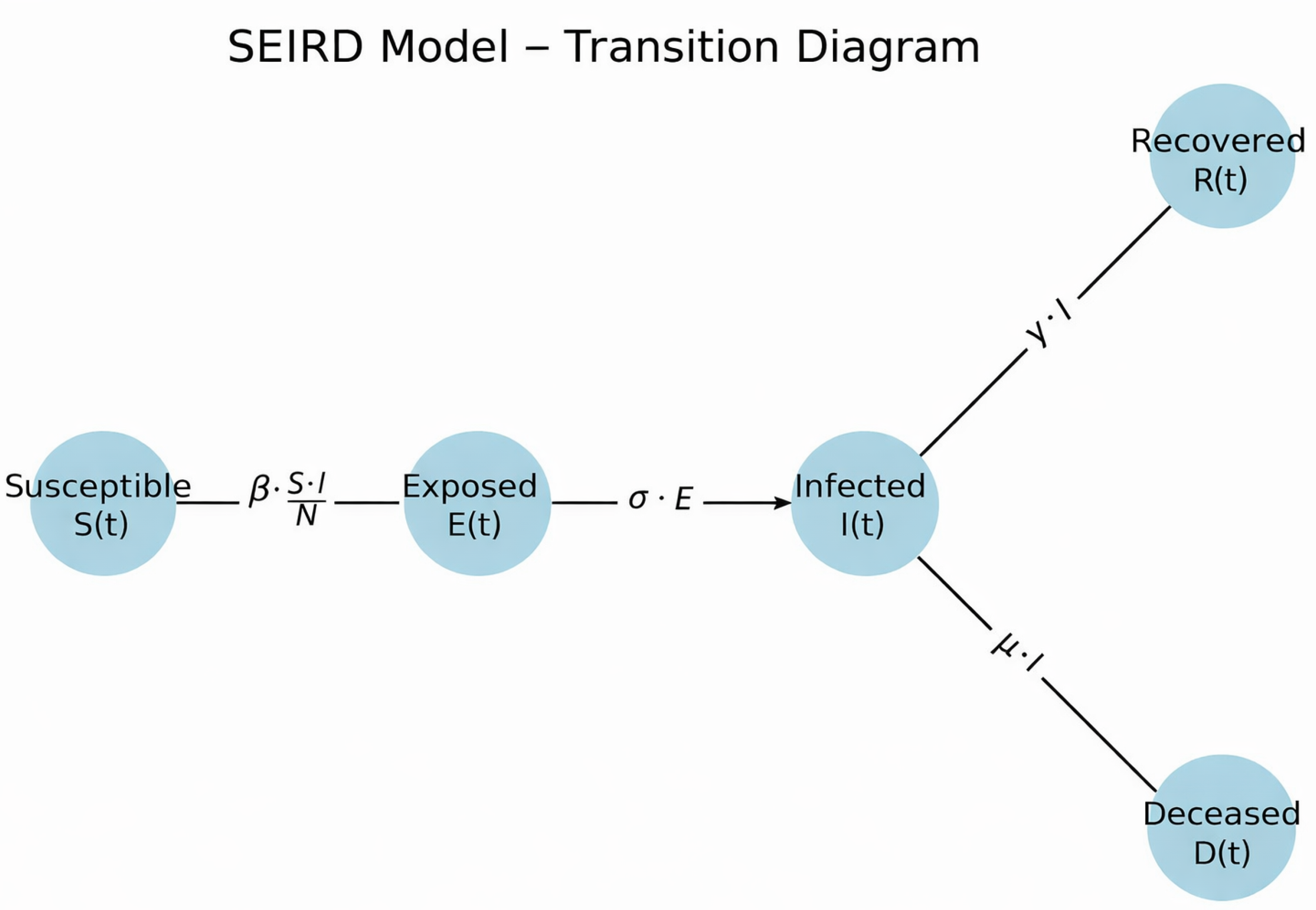
Table 3.
Cross-context validation and stability indicators.
| Dataset | RMSE (cum.) | Peak shift | Notes | |
|---|---|---|---|---|
| Catalonia | 195 | 0.98 | Negligible | Primary calibration |
| Ecuador | 228 | 0.96 | Small deviation | Structural robustness test |
Disclaimer/Publisher’s Note: The statements, opinions and data contained in all publications are solely those of the individual author(s) and contributor(s) and not of MDPI and/or the editor(s). MDPI and/or the editor(s) disclaim responsibility for any injury to people or property resulting from any ideas, methods, instructions or products referred to in the content. |
© 2026 by the authors. Licensee MDPI, Basel, Switzerland. This article is an open access article distributed under the terms and conditions of the Creative Commons Attribution (CC BY) license (http://creativecommons.org/licenses/by/4.0/).
Copyright: This open access article is published under a Creative Commons CC BY 4.0 license, which permit the free download, distribution, and reuse, provided that the author and preprint are cited in any reuse.


