

Submitted:
21 April 2026
Posted:
22 April 2026
You are already at the latest version
Abstract
Poly(l-lactic acid) or poly(l-lactide) (PLLA) is an optically active polymer derived from renewable sources and fully biodegradable. It is known that PLLA assumes a left-handed helix in the solid state and also in solution it still keeps a certain degree of helical structure. Here we examine the Optical Rotatory Dispersion (ORD) behavior of two grades of PLLA (medium molecular weight and hexadecyl-terminated or a high molecular weight for 3D printing) in 13 different solvents and through the Moffitt-Yang equation of the ORD data. Furthermore, the ORD data of PLLA in additional 6 solvents were taken from literature and analyzed with the Moffitt-Yang approach. The results suggest that also in solution PLLA maintain the left-handed helix and the most structurizing and helicogenic solvents for PLLA are ethyl acetate, acetonitrile, and certain chlorinated solvents. The equilibrium association constant (K) and other thermodynamic parameters (ΔG°, ΔH° and ΔS°) between PLLA and polyphenylacetylene (PPA another helical polymer in the solid state and in solution) were determined in trichloromethane, dichloromethane and tetrahydrofuran. The K values found suggest a strong helix-helix interaction between the two polymers. The ORD analysis of the PLLA-PPA solutions show evidences of the extrinsic Cotton effect and confirming the chiral helicity induction between the two polymers with 1:1 complex formation.
Keywords:
Poly(l-lactic acid) or PLLA
; optical rotatory dispersion
; Moffitt-Yang analysis
; helicogenic solvents
; polyphenylacetylene or PPA
; PLLA-PPA 1:1 complex
; extrinsic cotton effect
; helix-helix interaction
1. Introduction
Poly(l-lactic acid) (PLLA) or poly(lactide) is a quite unique biodegradable polymer produced from renewable raw materials on large industrial scale [1,2,3]. Actually, PLLA founds many uses from packaging, automotive and technical components, 3D printing to medical devices, drug delivery and cosmetics applications. PLLA is an intrinsically isotactic and stereoregular polymer with helical structure in the solid state (see Figure 1) [1,2]. More in detail, PLLA exists in different crystal modifications. The most common consists of two different left-handed helix geometries having three units in one turn (31) in the β-form or ten units in three turns (103) in the most common α-form [1,2]. Stereocomplexes with remarkably higher melting temperature than the homopolymers and considerably improved mechanical properties are obtained by intimate blending of PLLA and poly(d-lactic acid) (PDLA) [1,2,4]. The improved properties are explained by the presence of a dense network of weak CH…O=C hydrogen bonds [1,2,4].
In this paper our interest is addressed toward the PLLA behavior in solution in different solvents. Since 1965 there are hints about the helical structure of PLLA in solution of certain solvents as suggested by the exploratory works from Schultz and Schwaab using optical rotatory dispersion (ORD) spectroscopy [5]. With some uncertainty [6], such hints about the PLLA helical structure in solution were confirmed few years later [7]. Recently, such finding was reached in a firm and conclusive way, through the breakthrough of vibrational circular dichroism (VCD) spectroscopy [8,9,10,11]. Indeed, PLLA assumes helical conformation in certain halogenated solvents as well as in certain polar solvents [8,9,10,11], confirming previous preliminary results obtained with optical rotatory dispersion (ORD) spectroscopy [5,6,7]. The macromolecular dynamics of PDLA and PLLA in dilute solutions was also studied by a number of different physical techniques including small angle X-ray scattering and static light scattering in a medium polar solvent like tetrahydrofuran revealing fine details of helical conformation [12,13]. Such exciting PLLA behavior in solution has led us to study with ORD its complex formation with iodine [14], C60 and C70 fullerenes [15,16], with certain dyes [17] and during high energy irradiation [18].
There is great interest in different types of PLLA complexes: with solvent molecules [19], in host-guest interactions for example with amylose [20,21], with different types of molecules like cyclodextrin, sorbitol, nanocellulose, humic substances and biological molecules either for composite production or for drug delivery purposes [22,23]. Furthermore, PLLA/gelatin and PLLA/collagen were developed for skin tissue engineering [24,25] and PLLA/chitosan composite for tissue regeneration [26]. Without any intent to be comprehensive, it is also worth mentioning the PLLA complexes and composites with poly(vinylacetate) [27,28], with poly(methyl methacrylate) [29,30,31] and with alginate [32].
The present work is first dedicated to a systematic study for the determination of PLLA helical content in 13 different solvents, analyzing the ORD results data through the Moffitt-Yang equation [33,34]. Furthermore, our attention will be focused on helix-helix interaction in solution between PLLA and polyphenylacetylene (PPA) with the determination of the equilibrium constant and other chemical thermodynamics parameters in selected solvents. More in detail, the PLLA-PPA interaction in solution will be studied by ORD with the detection of the extrinsic Cotton effect as a proof of the chiral PLLA helices interaction and handedness induction on the PPA racemic helices [35,36,37,38]. In fact, it is known that phenylacetylene (and related monomers) undergoes a stereospecific polymerization over Rh(I) catalyst yielding PPA (and other polyacetylenes) with helical structures in the solid state [39,40,41,42,43,44,45]. The PPA helical structure is also preserved in solution [43] and, depending from the solvent treatment, the heat or pressure treatment of PPA it is possible to cause the cis-transoid to cis-cisoid helical structure transition (see Figure 2) [43,44,45]. The polyacetylenes (PAs) and polyphenylacetylenes (PPAs) synthesis, properties and quite unique chiral properties have been reviewed numerous times [46,47,48]. Particularly interesting is the possibility to cause chiral induction in PPAs through non-covalent chiral interactions, including the interaction with solvents [49,50], and the switching of the handedness of the PPAs helices [51,52]. Regarding the PLLA-PPA interaction, little can be found in literature. In one case PPAs with chiral and racemic polylactide pendant groups were studied [53] while in another case the helical chirality of racemic PAs was regulated by chiral polylactide in solid state films to produce circularly polarized luminescence [54].
2. Materials and Methods
2.1. Materials and Equipment
All solvents used in the present work were the best analytical grades purchased from Aldrich-Merck (USA-Germany). Two PLLA grades were used in present work. A PLLA-3D, designed for 3D printing was from Ingeo Biopolymers 2003D, it was characterized by a molecular weight Mw = 182000 Da and Mw/Mn ≈ 2 with DSC glass transition at +60°C and by a DSC melting point peak at 157°C with a melting enthalpy of 45.4 J/g [16,55]. A lower molecular weight PLLA with Mn ≈ 40000 Da and hexadecyl-terminated was obtained from Aldrich-Merck (USA-Germany) and labelled PLLA-40kDa throughout this work. Further details about the properties of PLLA-40kDa can be found in literature [56,57].
Phenylacetylene, the complex bicyclo[2.2.1]hepta-2,5-diene-rhodium(I) chloride dimer, i.e. [Rh(NBD)Cl]2 and triethylamine (C2H5)3N were purchased from Aldrich-Merck (USA-Germany).
Spectrophotometric studies were performed on a Shimadzu UV-2450 spectrophotometer equipped with thermostated cells through the cell temperature controller TCC-240A. The optical rotatory dispersion (ORD) spectra were recorded on a Jasco (Japan) model P-2000 polarimeter equipped with a digital monochromator from Optometrics (USA), model DMC1-03, which transforms the polarimeter into a spectropolarimeter. A cell of 0.5 dm path length was used.
2.2. Preparation of the PLLA-3D or PLLA-40kDa Solutions
In Table 1 are summarized the PLLA-3D and PLLA-40kDa concentrations in the selected solvents used in the present study. In general, the PLLA concentration was kept at 0.5% (w/vol) with some exceptions. In a typical procedure, the PLLA was stirred at room temperature until its complete dissolution in the given solvent. Warming in a water bath was needed for the PLLA dissolution in ethyl acetate (AcOEt), acetone, toluene, chlorobenzene (Cl-Bz) and o-dichlorobenzene (o-DCBz). As also summarized in Table 1, some gel was noticed at the bottom or the flask of the cooled PLLA solution in the case of AcOEt, acetone and toluene. In the case of o-DCBz, cooling causes the separation of the PLLA-3D from the solvent and only warming above 50°C ensures the complete dissolution. Thus, only for the o-DCBz solution the ORD measurement was made at 50°C, while in all the other cases the ORD measurement were made at ambient temperature.
2.3. Synthesis of Polyphenylacetylene (PPA)
Stereoregular PPA was synthesized using as Rh(I) catalyst the dimer complex with norbonadiene complex [Rh(NBD)Cl]2 [39,40,41]. In detail, phenylacetylene (2.5 ml) was dissolved in 20 ml of toluene and [Rh(NBD)Cl]2 (0.7 mg) was added under stirring at room temperature. The reaction is initiated by the addition of few drops of triethylamine to the stirred homogeneous solution. An immediate darkening of the solution was observed as well as an increase in the viscosity. The mixture was left stirring overnight at ambient temperature and then it was treated with a large excess of methanol. PPA precipitated as an orange mass which was collected by filtration, washed repeatedly with methanol and dried in air and in a desiccator to constant weight. The dried PPA was collected as an orange powder in nearly quantitative yield.
2.4. Determination of the Equilibrium Constant Between PLLA-40kDa and PPA
The equilibrium constant in the PLLA-PPA interaction in solution was determined with the same general procedure used in the previous works [14,15,16,58,59]. A stock solution of PPA (1.70 mg) in 100 ml of tetrahydrofuran (THF), dichloromethane (CH2Cl2) or chloroform (CHCl3) was prepared. The electronic absorption spectrum of the solution was recorded at a selected temperature using the thermostated cell holder of the spectrophotometer. Then PLLA-40kDa was added step-by-step in weighted amounts to the stock solution. After each PLLA-40kDa addition and dissolution, the resulting electronic spectrum was recorded. PLLA-40kDa was selected for its prompt solubility in the selected solvents. The spectrophotometric experimental data were then treated according to the Scott’s equation [60] for the determination of Keq at a given temperature. Through the Van’t Hoff approach it was then possible to derive other themodynamics parameters regarding the PLLA-PPA interaction in solution.
3. Results and Discussion
3.1. Analysis of the ORD Data with the Moffitt-Yang Equation
3.1.1. ORD Measurement of PLLA in Selected Solvents
In this study, the ordinary PLLA commonly used was a version designed for 3D printing and hence referred hereinafter PLLA-3D or simply 3D it is characterized by high molecular weight and high strength (see Materials and Methods section) [55]. In some specific cases also a low molecular weight PLLA referred as PLLA-40kDa or simply 40kDa was used. The latter polymer was also characterized by chain termination with a long hexadecyl aliphatic chain ensuring a quick and complete solubility in certain solvents like chloroform, dichloromethane and tetrahydrofuran (for further details regarding PLLA-40kDa see Materials and Methods section) [56,57].
The ORD measurement consists in the measurement of the degree of rotation of the plane of polarized light α crossing a solution of concentration c (in g/ml) kept in a cell with l (in dm) path length by sweeping the wavelength λ, so that the specific optical rotation [α]λ is determined [34,35]:
[α]λ = α l-1 c-1
(1)
Figure 3 shows the ORD of the two PLLA grades, selected for this work, dissolved in chloroform, dichloromethane and N-methyl-2-pyrrolidone (NMP). In all these three solvents PLLA-40kDa shows a significantly more pronounced specific optical rotation than the higher molecular weight PLLA-3D. Thus, the lower molecular weight PLLA-40kDa with the hexadecyl end group appears to offer more structured solutions than the high molecular weight type. These results will be discussed more deeply after the analysis of the ORD data according to the Moffitt-Yang equation, in the next section.
In addition to the ORD comparison of PLLA-40kDa versus PLLA-3D in three selected solvents (Figure 3), the latter polymer was studied in 13 different solvents as shown in Figure 4. In Figure 4a are reported the ORD curves of PLLA-3D in a series of chlorinated solvents (chloroform, 1,1’,2,2’-tetrachloroethane, dichloromethane and chlorobenzene) and two ethers (tetrahydrofuran and 1,4-dioxane). All the measurements were made at ambient temperature. Additionally, also PLLA-3D in o-dichlorobenzene was studied with ORD (not shown in Figure 4a for clarity), but the ORD curve, only in this case, was collected at 50°C because at lower temperature the PLLA-3D precipitates from the solution. Anyway, the ORD of PLLA-3D in o-dichlorobenzene resembles too much that in chlorobenzene as will be discussed in the next section.
Figure 4b shows the ORD curves of PLLA-3D in polar aprotic solvents like acetonitrile, ethyl acetate, acetone, N,N’-dimethylformamide and N-methyl-2-pyrrolidone. Furthermore, also the PLLA-3D ORD curve in the apolar toluene is reported.
Figure At first glance, it is immediately evident from Figure 4a that at approximate same concentration and temperature conditions PLLA-3D is giving significantly more negative optical rotation in chlorobenzene than in 1,1’,2,2’-tetrachlorobenzene. Similarly, in Figure 4b it is immediately evident that PLLA-3D is showing much higher negative rotatory power in ethyl acetate and in acetonitrile than in acetone or in N-methyl-2-pyrrolidone. Thus, higher rotatory power implies necessary that the PLLA-3D is assuming a helical structure in certain solvents in a way more pronounced than in other solvents. In other words, there are solvents which favor the formation and retention of the helical structure of PLLA-3D it has in the solid state, i.e. left-handed helix geometries having three units in one turn (31) or ten units in three turns (103) [1,2], while other solvents are denaturing the helical structure promoting at least in part the emergence of a statistical coil. The solvent favoring the helical structure are known also as helicogenic solvents.
To analyze in a deeper way the solvent effect on the PLLA conformation in different solvents, the ORD data were analyzed according to the Moffitt model through the Moffitt-Yang equation.
3.1.2. The Moffitt Model and the Moffitt-Yang Equation
In 1956 Moffitt has proposed a model to describe mathematically the optical activity of helical polymers in solution [61]. The model is based on the interaction of transition dipoles within and helical array. More in detail, Moffitt proposed that the electronic transition occurring in each monomeric unit (the ketone or ester group of each lactic acid residue in in PLLA) should be split into two components one parallel and one perpendicular to the helix axis. This approach is known as exciton splitting and the model assumes an infinitely long and uniform helix. With our modern view of polymer chains in solution, it is immediately evident that the Moffitt model involves a considerable oversimplification of the actual physical situation [62,63]. Nevertheless, the Moffitt-Yang equation [34,35,63] remains a powerful phenomenological equation for the analysis of the ORD data and for the estimation of the helical content of the optically active polymers.
The Moffitt-Yang equation, reports the specific optical rotation [α] in terms of mean residue rotation [m’]λ [34,35]:
[m’]λ = {3(n2 -2)-1}{(Mm
[α])/100} (2)
The first term of Equation (1) i.e. {3(n2 -2)-1} is the Lorentz refractive index correction for the selected solvent with n the refractive index of solvent in the spectral window considered for the ORD measurement (in practice it is used the nD of the solvent), Mm is the molecular weight of the monomeric unit of the polymer. In the case of PLLA the lactic acid residue has a Mm = 72.06 Da. The specific optical rotation [α]λ was already defined by Equation (1).
[m’]λ = a0 [λ02/(λ2-λ02)] + b0 [λ04/(λ2-λ02)2]
(3)
with
a0 a parameter related to the intrinsic optical rotation of the monomeric units and random coil together with the solvent effect;
b0 the parameter directly related to the helical content in the given solvent;
λ0 a constant that linearizes the plot and taken in correspondence of the electronic transition of the optically active chromophore [34,35]. In the case of polypeptides λ0 is taken at 212 nm in correspondence to the amide electronic transition [34,35], while was taken at 201 nm for PLLA [5]. Our recent study on PLLA thin solid film, has shown that the electronic transition due to the ester group occurs at 209.5 nm [16]. Thus, instead of adopting a λ0 from literature, for our analysis of the ORD data on PLLA in various solvents, λ0 = 209.5 nm has been our choice. After all, the n → π* transition of the C=O group in simple esters dissolved in hydrocarbons is found just at 210-211 nm [64].
To determine a0 and b0 parameters the preferred plottable version of Equation (3) is under the form of [34,35]:
[m’]λ [(λ2-λ02)/ λ02] = a0 + b0 [λ02/(λ2-λ02)] (4)
So that b0 is determined from the slope and a0 from the intercept. The physical dimensions of both a0 and b0 are the same as the residue rotation [m’] expressed in (deg cm2)/( dmol).
A couple of examples of the analysis of the ORD data with Equation 4 is provided in Figure 5. The ORD data of PLLA-3D in CH3CN and in CHCl3 were plotted according to Equation (4). From the slope b0 = 349.0 in CH3CN and 307.1 in CHCl3. From the intercept a0 = -698.1 and -542.3 respectively. A similar treatment (according to Equation (4)) was reserved to all the ORD data in 13 different solvents and 2 PLLA grades. The results are collected in Table 1 where all solvents are listed according to decreasing values of b0. The solvents with high b0 values favor the helical conformation of PLLA in solution and this is the case for instance of ethyl acetate, acetonitrile, o-dichlorobenzene and chlorobenzene. The worst solvents in terms of helical content appear to be 1,1’,2,2’-tetrachloroethane and acetone, characterized by the lowest b0 values.
Another important aspect reported in Table 1 regards the positive values of b0 in all solvents studied. This is in line with earlier results and confirms that PLLA assumes a left-handed helix also in solution [5,6,7]. In Figure 6 it is shown the expected linear correlation of the Specific Optical Rotation [α]λ with b0 and a0 Moffitt-Yang parameters using the data of Table 1. The specific optical rotation of PLLA in any solvent measured for example at 380 nm is linerly correlated with the b0 parameter: [α]380 = -1.0582 b0, as shown in Figure 6a. Indeed, higher degree of helical conformation in solution gives an extra optical rotatory power. The linear correlation is very good also with the a0 parameter, e.g. [α]380 = 0.5850 a0 ; in this case a0 is linked first of all to the intrinsic optical activity of the monomeric units, but it is also expressing the solvent interaction with the polymer chains [34,35]. In other words, there are two contributions to a0, the monomer effect, i.e. the intrinsic chirality of the l-lactide units and the solvent effect which is a result of the PLLA interaction with solvent dipoles and polarizability. All the a0 values in Table 1 are negative values, it confirms that the l-configuration of the l-lactide units is dominating the non-helical part of the ORD signal. Of course, there is also a linear correlation between the b0 and a0 values of Table 1.
The anomaly in Table 1 is represented by the solvent N-methyl-pyrrolidone (NMP) which shows a considerably high b0 value suggesting a high helical content, but this is not corroborated by the specific optical rotation values which are unusually low, comparable to that found in solvents like TCE and acetone which disfavour the helix conformation of PLLA in solution.
For this reason, the Moffitt-Yang parameters in NMP solvent are shown separately in Table 1 and were not included in the correlation graphs of Figure 6. It is necessary clarify that the ORD data in NMP solutions were collected in a restricted spectral range of 600-390 nm instead of the usual spectral range of 620-350 nm adopted for all other PLLA solutions. However, in our view, the anomalous behavior of NMP should be attributed mainly to a strong polymer-solvent interaction, since NMP is the solvent with the highest dipole moment (4.09 Debye) among all solvents studied in Table 1 [65]. The anomaly of the NMP solvent can be explained in terms of PLLA-NMP complex formation, a phenomenon already observed with highly polar aprotic solvents [19].
In this context, to complete the discussion, it is necessary to recall that for the PLLA helix to exist, the torsion angles along the polymer backbone must fall into specific pattern: the gt (gauche-trans) conformation, which refers to the rotational state of the -(O=C)-O-Cα-(C=O)- and -O-Cα-(C=O)-O- sequences in a crystalline ordered phase. In solution, of course, the bonds are free to rotate producing various conformers (e.g. gg, gt, tg, tt). "Helical fraction" of PLLA in solution should not be viewed as long, rigid rods (this is the limitation of the Moffitt model).
Instead, should be conceived as the statistical probability that segments of the chain are currently assuming the gt arrangement. Thus, it is correct to talk about a population of gt conformers to express the helical fraction of a polymer in solution. The solvent chemical nature and polarity is able to affect greatly such a population of gt conformers. In PLLA solutions, solvent polarity acts as a "fine tuning knob" for the population of gt conformers. Because the PLLA 103 helix relies on specific dipole alignments and steric packing, the solvent can either stabilize these building blocks or disrupt them into a random coil. The PLLA helix has a net dipole moment directed along its axis. In a less polar solvent, the polymer chain "collapses" into an ordered helical structure to internally satisfy its own dipole-dipole interactions. In polar solvents (like DMF or NMP) can interact directly with the PLLA ester groups. This competitive interaction often "pulls" the bonds away from the gt state and into a disordered random coil (e.g gg and tt conformers) because the solvent molecules are more prone in solvating individual monomeric units than letting the chain wrap around itself. Interestingly, some specific polar solvents don't just disrupt the helix—they participate in it. Solvents like THF or DMF can form "complex crystals" (ε-form) with PLLA at low temperatures [19]. In these cases, the solvent molecules nestle into the helical voids, actually stabilizing the gt conformers into a unique 103 helix that wouldn't be as stable in a purely inert environment.
While no simple correlations were found between the b0 and a0 values with the dielectric permittivity of the solvents or the dipole moment (reportedπ in Table 1) it was instead found that solvent polarizability (or Onsager function of the refractive index):
(n2-1)/(2n2+1) (5)
shows a quite good correlation with both b0 and a0 Moffitt-Yang parameters as shown in Figure 7. This correlation suggests that it is not only a matter of dipole-dipole interaction since also solvent polarizability acts as a stabilizer for the helical architecture in solution. This linear correlation with the Onsager function [F(n2)] is strong evidence that the helix formation is driven also by dispersion-driven solvation rather than just simple dielectric effects. As the solvent becomes more polarizable (higher F(n2)), the dispersion forces and induced-dipole interactions between the solvent and the PLLA backbone strengthen. These interactions favor the gt conformer. The solvent essentially stabilizes the specific geometry of the 103 helix, leading to a higher population of helical segments. In PLLA’s specific optical configuration, this manifests as an increase in the positive b0 value.
The a0 parameter reflects the "intrinsic" optical activity of the monomer units and the non-helical contributions. The fact that a0 becomes more negative as polarizability F(n2) increases suggests a strong electronic effect of the solvent on the ester chromophores. As the solvent’s electron cloud becomes more "distortable" (higher F(n2) values), it interacts more intensely with the n → π* electronic transitions of the lactic acid units. This shift in the local electronic environment of the monomer pushes the a0 value further into the negative, likely due to a change in the local solvation shell as the chain transitions from a coil to a more ordered helical state.
In Figure 3 and in Table 1 it is also evidenced the behavior of the two PLLA grades studied in the same solvents and at the same concentration and temperature. The b0 value of PLLA-40kDa is systematically higher than that of the conventional PLLA-3D. In CHCl3, b0 is 328.9 vs 307.1 respectively, in CH2Cl2 325.5 vs 300.7 and even in NMP b0 =407.0 vs 363.2. Because its lower molecular weight and long hexadecyl chain end group, PLLA-40kDa shows a ready solubility in various solvents like the mentioned CHCl3 and CH2Cl2 but also THF and a higher trend to produce a population of gt conformers leading to a higher helical fraction with respect to PLLA-3D in solution. The lower molecular weight PLLA-40kDa is characterized by higher chain mobility in solution allowing the chains to rearrange into helical "pre-ordered" structures more rapidly. On the other hand, in the case of the higher PLLA-3D, the high degree of entanglement acts as a physical barrier that can "trap" chains in a disordered state, making it harder for long-range helical order to develop quickly.
The long alkyl chain end group it is believed to act as a lubricant in the PLLA-40kDa acting like a plasticizer and reduces the glass transition temperature of the polymer by increasing the free volume between the polymer chains [56,57]. PLLA-40kDa will show a high concentration of individual, solvated helices. The hexadecyl tail acts as a spacer, further reducing the chance of these helices aggregating compared to an acid-terminated chain. The differences between PLLA-3D and PLLA-40kDa can be summarized on the fact that the former relies on chain entanglement for its properties, whereas the 40kDa ester-terminated version relies on end-group chemistry [56,57].
3.2.1. The Moffitt-Yang Equation Applied to Previous ORD Data: A Comparison with the Current Data
In Table 1 are reported the ORD data of PLLA (two grades) solutions in 13 different solvents analyzed with the Moffitt-Yang equation. In the scientific literature are available also the ORD data of PLLA dissolved in 9 solvents [5,6], 6 solvents of which are not reported in Table 1. These data were analyzed according to the Equation (4) and the results are shown in Table 2. Before commenting the results in Table 2, it is necessary to clarify that the PLLA from literature are different from the two grades studied in the present work, in terms of molecular weight and end groups. Furthermore, the spectral range of the ORD data it is also different. In our current work, the spectral range of the ORD data is comprised between 350 and 620 nm with λ0 selected at 209.5 nm which is the absorption maximum of the PLLA-3D thin solid film [16]. The spectral range of the ORD data of the PLLA solutions in ref. [5] is instead restricted in the 367-578 nm range. In order to not alter the original b0 and a0 values found by these authors [5], the λ0 = 201 nm chosen by them for the Moffitt-Yang analysis of these older ORD data was maintained. In the case of ref. [6] the ORD spectra range considered is shifted to shorter wavelengths, i.e. 200-400 nm. However, the Moffitt-Yang analysis of the ORD data requires to consider only the values far away from the electronic transition of the chromophore [34,35]. Consequently, in our Moffitt-Yang analysis of the old ORD data of ref. [6] we have used only the 280-400 nm spectral range and for λ0 we have adopted 209.5 nm, i.e. the same value used for the analysis of the solvents listed in Table 1 and due to the PLLA electronic transition in the solid state as thin solid film [16].
Because of the just mentioned limitations, it is immediately evident from Table 2 that the PLLA-3D in CH3CN yields b0 = 349.0 in the present work, a value significantly higher than b0 = 277.3 derived from older data [6]. Relatively little is known about the PLLA used by the authors of ref. [6] and even its concentration in solution was not specified. Furthermore, also the difference in the spectral range (see Table 2) may have led to such important differences. Regarding the CHCl3 solvent, in Table 2 we have available 4 different PLLA grades and, as expected, the largest b0 value is offered again by PLLA-40kDa, with a value not far from that shown by the PLLA of ref. [5]. Also the PLLA-3D offers an b0 value reasonably close to the previous two values. Completely offset results the b0 value the PLLA used in ref. [6], in the same solvent. Here it is necessary to apply the same explanations given for the b0 value differences in CH3CN. Exactly the same b0 sequence found in chloroform can be found in CH2Cl2 solvent in Table 2: PLLA-40kDa >PLLA[5] >PLLA-3D. This is not a surprise, considering the similar chemical nature of the two chlorinated solvents and confirms the consistency of the results.
Table 2 shows also the Moffitt-Yang parameters of additional 6 solvents not considered in the present work (Table 1) but taken from literature ORD data [5,6]. Five of these solvents are acid and highly polar solvents and in general give b0 < 300 which suggest a trend of moderate to lower and lower PLLA helical structure induction in these solvents on passing from m-cresol to sulfuric acid, following the sequence reported in Table 2. Regarding the fluorinated solvents in Table 2, it is worth reminding that trifluoroethanol is considered a helix-inducting solvent in protein chemistry [35], and also in Table 2 with PLLA its b0 ≈ 300 suggests a similar behavior. Instead, trifluoroacetic acid is definitely considered a denaturing solvent in protein chemistry [35], and indeed also with PLLA its b0 value is relatively low at about 274. Among the solvent commented above, there is only one chlorinated solvent: 1,1’,2-trichlorethane whose a0 is anyway in the range of other chlorinated solvents like for instance CH2Cl2.
4.1. On the Interaction Between PLLA-40kDa and PPA in Solution
4.1.1. Expected PLLA-40kDa and PPA Interaction in Solution
In the previous sections we have shown that PLLA-40kDa is characterized by a ready solubility in solvents like THF, CHCl3 and CH2Cl2. Furthermore, the helical fraction in any solvent studied is higher with PLLA-40kDa solutions with respect to PLLA-3D. For these reasons, in the following study on the interaction of PLLA with polyphenylacetylene (PPA) the PLLA of exclusive choice was PLLA-40kDa.
The complementarity between PLLA and PPA in terms of helical structures, is represented from one side by the relative rigidity of the polyester chain in contrast with a highly dynamic PPA helix in solution [43,44]. Furthermore, PPA is characterized by a low helix-inversion barrier[42,43,44], meaning that its chains fluctuate rapidly between left- and right-handed states in a racemic solution unless dictated otherwise by a template. The template in this study is represented by the helical and intrinsically chiral PLLA-40kDa in solution.
4.1.2. Determination of the Equilibrium Association Constant in the PLLA-40kDa and PPA Interaction in CHCl3 Solution
For the determination of the equilibrium association constant of the reaction:
[PLLA] + [PPA] → [PLLA-PPA]complex (6)
the Scott plot (a variation of the Benesi-Hildebrand equation was used in the condition of [PLLA] >> [PPA] [14,60]:
{[PLLA][PPA]}/Aλ = [PLLA]/Eλ + [1/(K•Eλ)] (7)
Since in the graph, the slope = 1/Eλ while the intercept = 1/(K•Eλ), the ratio slope/intercept gives the association constant K.
With Lambert-Beer law:
Aλ = [Complex] L•Eλ (8)
The Aλ the absorbance at a selected wavelength, L the path length of the UV-VIS cuvette (1 cm) and Eλ is the molar extinction coefficient again at the selected wavelength. The PLLA absorption peak occurs at 209.5 nm [16], hence the selection of the wavelength for the study of the complex formation was made at wavelengths far away from the PLLA electronic transition, where the absorbance of the latter is negligible. Furthermore, if an increase in the base line of the spectra was detected, then a baseline correction was introduced accordingly in the calculations.
Figure 8a shows the electronic absorption spectra of PPA in CH2Cl2. The stepwise addition of PLLA-40kDa causes an evident hyperchromic effect (evidenced by an arrow) in the spectral window comprised between 230 and 265 nm. For the determination of the equilibrium constant the absorbance was selected at 250 nm and plotted according to Equation (7) in Figure 9, where it is possible to observe the perfect linearity which is a confirmation of 1:1 stoichiometry of the PLLA-PPA complex. From the ratio slope/intercept, the equilibrium association constant for the PLLA+PPA complex was derived: K = 1103 M-1 in CH2Cl2 at 16°C. A similar procedure was adopted for the determination of the equilibrium association constant of the PLLA-PPA complex in THF. Figure 5b shows the electronic absorption spectra recorded after the stepwise addition of PLLA-4kDa to a solution of PPA in THF at 18°C. Also in this case the hyperchromic effect was evident and suggested by the direction of the arrow. The light increase in the base line was of course subtracted to the absorbances used for the determination of K in THF. As summarized in Table 3, for the determination of the association equilibrium constant of the PLLA-PPA complex in THF, the absorbance at three different wavelengths (λ = 247, 315, 400 nm) were used in the Scott plot yielding similar K values which were then averaged. Thus, in THF at 18°C K = 1539 M-1, at 25°C K=831 M-1 and at 35°C K = 560 M-1 (see Table 3). The association equilibrium constants of the PPA-PLLA complex were also determined in chloroform at three different temperatures and using two wavelengths: 240 and 250 nm. The results are all collected in Table 3, including also the K value of dichloromethane which was measured only at 16°C because the low boiling point of this solvent.
To complete the thermodynamic analysis of the reaction (6) the K values determined at different temperatures either in THF or in CHCl3 were plotted according to the Van’t Hoff equation:
Ln K = (-ΔH/R)(1/T) + (ΔS/R) (9)
In Figure 10 the Van’t Hoff plot can be observed. From the slope ΔH° was determined, while from the intercept ΔS°. The results of this analysis are collected in Table 4 with ΔG° calculated according to:
ΔG° = ΔH° - TΔS° (10)
The free energy of formation of the PLLA-PPA complex is negative and essentially the same (ΔG° ≈ -17 kJ/mol) in any solvent considered. This confirms that the complex formation is a spontaneous reaction. Table 4 permits also a breakdown of the PLLA-PPA complex formation in terms of enthalpy and entropy. In CHCl3 (and presumably in CH2Cl2) the complex formation is an exothermal reaction ΔH° = -16.9 kJ/mol without any entropic change ΔS° ≈ 0 J mol-1 K-1. This means that the reaction (6) in chloroform (and most probably also in CH2Cl2) is essentially an enthalpy driven process. The situation is more complex in THF, where the exothermicity of reaction (6) is ΔH° = -43.6 kJ/mol about 2.6 times that in chloroform. Such large and negative enthalpy suggests a very strong and specific interaction occurring between PLLA and PPA in THF and it is accompanied by a significant reduction of enthalpy ΔS° = -89.17 J mol-1 K-1, not seen in chlorinated solvents.
The K values relative to PLLA-PPA complex formation (Table 3) and the relative thermodynamic parameters (Table 4) suggest that in solution a specific lock and key fit occur between the helices of these polymers and the phenomenon appears more facilitated in THF, although it occurs as well in chlorinated solvents.
A further insight regarding the PLLA-PPA interaction may be derived from the hyperchromic effect observed in the spectra of Figure 8. It occurs in any solvent in the 230-260 nm range, corresponding to the π → π* electronic transitions of the PPA phenyl rings.
This suggests that environment of the PPA phenyl groups is altered because for instance is straightened or tightened by the PLLA interaction. This is consistent with a conformation change induced by binding. Furthermore, the hyperchromic effect is extended to longer wavelengths in THF solvent (see Figure 5b). In fact, the equilibrium constant for the PLLA-PPA complex is derivable also from the absorbances at 315 and 400 nm (see Table 3) and this means that only in THF the conformation change of PPA is much more intensive affecting also the π → π* electronic transitions of the polyenic backbone of the polymer and not only the pending phenyl rings (see Figure 2). This is fully consistent with the thermodynamic analysis and supports a chiral templating mechanism leading to a helical supramolecular PLLA-PPA adduct.
It is worth mentioning here that similar equilibrium association constants (K values) as those determined here for PLLA-PPA complex were measured in the helical complexes of PLLA-C60 (K ≈ 955 M-1) [15] or in the other fullerene helical complex PLLA-C70 (K ≈ 1084 M-1) [16]. With smaller molecules like iodine, the equilibrium constants result smaller, e.g. PLLA-I2 (K ≈ 25 M-1), poly(methylmethacrylate)-I2 (K ≈ 40 M-1) and poly(vinylpyrrolidone)-I2 (K ≈ 600 M-1) [14].
Other host-guest complexes to be compared with the ΔG° ≈ -17 kJ/mol (Table 4), cyclodextrine-naphthenic acids show ΔG° between -16 to -28 kJ/mol [67], triphenylene-2,6,10-tricarboxamide (TTA) based supramolecular homopolymers show ΔG° ≈ -35 kJ/mol with large enthalpic effect ΔH° ≈ -50 kJ/mol but also large and negative entropy values ΔS° ≈ -50 J mol-1 K-1 [68]. The thermodynamic parameters of the latter system are extraordinarily similar to our values on PLLA-PPA complex in THF (Table 4), supporting our interpretation of the helical supramolecular adduct. In helical, hydrogen-bonded supramolecular self-assembled polymers it is also possible to reach ΔG° values of -40 kJ/mol [69].
4.1.3. Determination of the Induced Cotton Effect in PLLA-PPA Complex
In Figure 8 it is possible to observe the broad band between approximately 300 and 400 nm, with a peak at about 360 nm due to the π → π* transition of the polyenic backbone of PPA either in CHCl3 or in THF. As already discussed in the previous sections (see Figure 3 and Figure 4), the ORD of pure PLLA is plain negative, since the Cotton effect due to electronic transition of the ester groups chromophore occurs much below 250 nm [6,16]. Thus, also in Figure 11 the blue dots show simply the plain negative curve of PLLA-40kDa in CHCl3. However, the presence of PPA in the solution causes an induced Cotton effect as shown by the orange dots in Figure 11, a clear indication and confirmation of the strong interaction occurring between the PLLA helices and the PPA helices in solution.
The induced Cotton effect shown in Figure 11 is due just by the PLLA interaction with PPA influencing the π → π* transition of the polyenic backbone of the latter polymer. Unfortunately, in Figure 11 it is possible to see only part of the induced Cotton effect because of the limited spectral range covered by our spectropolarimeter. Anyway, it represents a further confirmation of the chiral templating mechanism leading to a helical supramolecular PLLA-PPA adduct. Such kind of interaction between optically active polymers with guest molecules or guest polymers detectable by ORD are known since long in literature [35,36,37,38]. Furthermore, the induced Cotton effect was successfully detected also in our previous studies on PLLA chiral interaction with iodine [14], C60 and C70 fullerenes [15,17] and with certain dyes [16]. In the latter case a multiple induced Cotton effect was detected in the solid state on a thin solid film of PLLA loaded with two dyes [16].
4. Conclusions
For long time it was disputed if PLLA is able to keep a helical conformation in solution [5,6,7]. Recently, it was confirmed through vibrational circular dichroism that PLLA assumes a certain degree of helical conformation in solution [8,9,10]. In this work, we have examined the ORD behavior of PLLA in 13 different solvents plus other 6 solvents from ORD literature data in order to find the most helicogenic solvents, i.e. the solvents which are able to favor the highest degree of helical conformation of PLLA in solution. Thus, ORD data were analyzed through the Moffitt model and the Moffitt-Yang equation (3 and 4) and Table 1 shows the solvents ordered according the b0 Moffitt-Yang parameter which gives the level of helical conformation in solution. The most structuring solvents which promote a high degree of helical conformation of PLLA are ethyl acetate, acetonitrile, chlorobenzene, chloroform and dichloromethane. At an intermediate level can be classified the cyclic ethers 1,4-dioxane and tetrahydrofuran together with toluene and N,N’-dimethylformamide, m-cresol and trifluoroethanol. Acetone, trifluoroacetic acid and sulfuric acid are the less helicogenic or even denaturing solvents. An anomalous and unique behavior was observed in the case of N-methyl-2-pyrrolidone. Although it is a good PLLA solvent, it gives and anomalous low specific optical rotation at any wavelength suggesting that it is not helicogenic at all. However, the Moffitt-Yang parameter b0 results extremely high but it is not at all corroborated by the [α]380 value, and hence was excluded from the correlations between the b0 and a0 Moffitt-Yang parameters reported in Figure 6 and the general discussion.
Two PLLA grades were used in the present study, a high molecular weight PLLA-3D, designed for 3D printing and a medium molecular weight PLLA-40kDa hexadecyl-terminated. It turned out that PLLA-40kDa is readily soluble in the solvents where it was studied and it gives a systematically higher helical content in solution with respect to PLLA-3D in the same solvents.
Thus, PLLA-40kDa was then used as chiral template in complex formation with poly(phenylacetylene) or PPA in solution of CH2Cl2, CHCl3 and THF. In fact, also PPA maintain a helical conformation in solution but it is racemic. In presence of the PLLA-40kDa chiral helices, a chiral helicity induction occurs as confirmed by the extrinsic Cotton effect observed in the ORD of PLLA-PPA solutions (Figure 11). This is certainly the most definitive proof of complex formation between the two helical polymers in solution, because the extrinsic Cotton effect implies that the chiral PLLA chains with helical conformation are forcing the PPA chains into a preferred helical handedness. This can only occur by helical-helical interaction by the two polymers. Indeed, important equilibrium association constant (Table 3) for the formation of PLLA-PPA complex were determined in three solvents further supported by a series of highly favorable thermodynamic parameters (Table 4).
Funding
This research received no external funding.
Data Availability Statement
This work will be available in the Researchgate website at the author’s page.
Conflicts of Interest
The author declares no conflict of interest.
References
- Synthesis, Structure and Properties of Poly (lactic acid); Di Lorenzo, M. L., Androsch, R., Eds.; Springer International Publishing: Cham, Switzerland, 2018; Adv. Polym. Sci.2018; Volume 279, pp. 1–343. [Google Scholar]
- Industrial Applications of Poly (lactic acid); Di Lorenzo, M. L., Androsch, R., Eds.; Springer International Publishing: Cham: Switzerland, Adv. Polym. Sci.; 2018; Volume 282, pp. 1–221. [Google Scholar]
- Rosli, N. A.; Karamanlioglu, M.; Kargarzadeh, H.; Ahmad, I. Comprehensive exploration of natural degradation of poly (lactic acid) blends in various degradation media: A review. Internat. J. Biol. Macromol. 2021, 187, 732–741. [Google Scholar] [CrossRef] [PubMed]
- Tashiro, K.; Wang, H.; Kouno, N.; Koshobu, J.; Watanabe, K. Confirmation of the X-ray-analyzed heterogeneous distribution of the PDLA and PLLA chain stems in the crystal lattice of poly (lactic acid) stereocomplex on the basis of the vibrational circular dichroism IR spectral measurement. Macromol. 2017, 50, 8066–8071. [Google Scholar] [CrossRef]
- Schultz, R.C.; Schwaab, J. Rotationdispersion bei monomeren und polymerem L-(-)-lactid. Macromol. Chem. Phys. 1965, 87, 90–102. [Google Scholar] [CrossRef]
- Goodman, M.; D'Alagni, M. Investigations of poly-S-lactic acid structure in solution. J. Polym. Sci. Part B: Polym. Lett. 1967, 5, 515–521. [Google Scholar] [CrossRef]
- Matsuo, S.; Iwakura, Y. Analysis of optical rotatory dispersion of poly-and oligo (l-lactate) by two-term Drude equation. Macromol. Chem. Phys. 1972, 152, 203–215. [Google Scholar] [CrossRef]
- Hongen, T.; Taniguchi, T.; Nomura, S.; Kadokawa, J. I.; Monde, K. In depth study on solution-state structure of poly (lactic acid) by vibrational circular dichroism. Macromol. 2014, 47, 5313–5319. [Google Scholar] [CrossRef]
- Taniguchi, T.; Hongen, T.; Monde, K. Studying the stereostructures of biomolecules and their analogs by vibrational circular dichroism. Polym. J. 2016, 48, 925–931. [Google Scholar] [CrossRef]
- Taniguchi, T. Analysis of molecular configuration and conformation by (electronic and) vibrational circular dichroism: Theoretical calculation and exciton chirality method. Bull. Chem. Soc. Japan 2017, 90, 1005–1016. [Google Scholar] [CrossRef]
- Wen, T.; Wang, H. F.; Li, M. C.; Ho, R. M. Homochiral evolution in self-assembled chiral polymers and block copolymers. Acc. Chem. Res. 2017, 50, 1011–1021. [Google Scholar] [CrossRef]
- Suzuki, Y.; Watanabe, T.; Kosugi, H.; Ueda, K.; Kikuchi, M.; Narumi, A.; Kawaguchi, S. Dilute solution properties of poly (d, l-lactide) by static light scattering, SAXS, and intrinsic viscosity. Polym. J. 2020, 52, 387–396. [Google Scholar] [CrossRef]
- Suzuki, Y.; Watanabe, T.; Kosugi, H.; Ueda, K.; Kikuchi, M.; Narumi, A.; Kawaguchi, S. Chain conformation of poly(D-lactide) in tetrahydrofuran by static light scattering, small-angle X-ray scattering, and intrinsic viscosity. Macromol. 2020, 53, 1604–1612. [Google Scholar] [CrossRef]
- Cataldo, F. Formation and decomposition of Poly (l-lactic acid) charge-transfer complex with iodine: A new molecular switch. Polym. Degradat.Stabil. 2020, 176, 109155. [Google Scholar] [CrossRef]
- Cataldo, F. On the interaction of C60 fullerene with poly (L-lactic acid) or poly (lactide). Fullerenes Nanot.Carbon Nanostruct. 2020, 28, 621–626. [Google Scholar] [CrossRef]
- Cataldo, F. On the optical activity of poly (l-lactic acid)(PLLA) oligomers and polymer: Detection of multiple cotton effect on thin PLLA solid film loaded with two dyes. Internat. J. Mol. Sci. 2020, 22, 8. [Google Scholar] [CrossRef] [PubMed]
- Cataldo, F. Some aspects concerning the interaction of C70 fullerene with poly (L-lactic acid)(PLLA). Fullerenes Nanot. Carbon Nanostruct. 2021, 29, 608–614. [Google Scholar] [CrossRef]
- Cataldo, F.; Barzaga, R.; García-Hernández, D. A.; Manchado, A.; Di Sarcina, I.; Cemmi, A. High energy radiation induced degradation of poly (lactic acid)(PLLA) film: radiation chemical yield, kinetics, mechanism and radioracemization evidences. J. Radioanal. Nucl. Chem. 2025, 334, 2875–2885. [Google Scholar] [CrossRef]
- Marubayashi, H.; Asai, S.; Sumita, M. Complex crystal formation of poly (l-lactide) with solvent molecules. Macromol. 2012, 45, 1384–1397. [Google Scholar] [CrossRef]
- Tanaka, T.; Tsutsui, A.; Tanaka, K.; Yamamoto, K.; Kadokawa, J. I. Evaluation of stability of amylose inclusion complexes depending on guest polymers and their application to supramolecular polymeric materials. Biomolecules 2017, 7, 28. [Google Scholar] [CrossRef]
- Orio, S.; Yamamoto, K.; Kadokawa, J. I. Preparation and material application of amylose-polymer inclusion complexes by enzymatic polymerization approach. Polymers 2017, 9, 729. [Google Scholar] [CrossRef] [PubMed]
- Kowalewska, A.; Nowacka, M. Supramolecular interactions in hybrid polylactide blends—the structures, mechanisms and properties. Molecules 2020, 25, 3351. [Google Scholar] [CrossRef] [PubMed]
- Świerczyńska, M.; Kudzin, M. H.; Chruściel, J. J. Poly (lactide)-based materials modified with biomolecules: a review. Materials 2024, 17, 5184. [Google Scholar] [CrossRef]
- Jang, Y.; Jang, J.; Kim, B. Y.; Song, Y. S.; Lee, D. Y. Effect of gelatin content on degradation behavior of PLLA/gelatin hybrid membranes. Tissue Engin. Regenerat. Medicine 2024, 21, 557–569. [Google Scholar] [CrossRef]
- Lu, H.; Oh, H. H.; Kawazoe, N.; Yamagishi, K.; Chen, G. PLLA–collagen and PLLA–gelatin hybrid scaffolds with funnel-like porous structure for skin tissue engineering. Sci. Technol. Adv. Mater. 2012, 13, 064210. [Google Scholar] [CrossRef]
- Chen, S.; Hao, Y.; Cui, W.; Chang, J.; Zhou, Y. Biodegradable electrospun PLLA/chitosan membrane as guided tissue regeneration membrane for treating periodontitis. J. Mater. Sci. 2013, 48, 6567–6577. [Google Scholar] [CrossRef]
- Li, Y.; Zhao, L.; Han, C.; Xiao, L.; Yu, Y.; Zhou, G.; Xu, M. Effect of the molecular weight of poly (vinyl acetate) on the polymorphism and thermomechanical properties of poly (L-lactic acid)/poly (D-lactic acid) blends. J. Therm. Anal. Calorim. 2022, 147, 3171–3184. [Google Scholar] [CrossRef]
- Li, Y.; Liu, L.; Shi, Y.; Xiang, F.; Huang, T.; Wang, Y.; Zhou, Z. Morphology, rheological, crystallization behavior, and mechanical properties of poly (l-lactide)/ethylene-co-vinyl acetate blends with different VA contents. J. Appl. Polym. Sci. 2011, 121, 2688–2698. [Google Scholar] [CrossRef]
- Le, K. P.; Lehman, R.; Remmert, J.; Vanness, K.; Ward, P. M. L.; Idol, J. D. Multiphase blends from poly (L-lactide) and poly(methyl mathacrylate). J. Biomater. Sci. Polym. Ed. 2006, 17, 121–137. [Google Scholar] [CrossRef] [PubMed]
- Samuel, C.; Cayuela, J.; Barakat, I.; Müller, A. J.; Raquez, J. M.; Dubois, P. Stereocomplexation of polylactide enhanced by poly(methyl methacrylate): improved processability and thermomechanical properties of stereocomplexable polylactide-based materials. ACS Appl. Mater. Interf. 2013, 5, 11797–11807. [Google Scholar] [CrossRef] [PubMed]
- Samuel, C.; Raquez, J. M.; Dubois, P. PLLA/PMMA blends: A shear-induced miscibility with tunable morphologies and properties? Polymer 2013, 54, 3931–3939. [Google Scholar] [CrossRef]
- Lim, M. P. A.; Lee, W. L.; Widjaja, E.; Loo, S. C. J. One-step fabrication of core–shell structured alginate–PLGA/PLLA microparticles as a novel drug delivery system for water soluble drugs. Biomater. Sci. 2013, 1, 486–493. [Google Scholar] [CrossRef]
- Liang, J.; Deng, J. Chiral particles consisting of helical polylactide and helical substituted polyacetylene: preparation and synergistic effects in enantio-differentiating release. Macromol. 2018, 51, 4003–4011. [Google Scholar] [CrossRef]
- Djerassi, C. Optical Rotatory Dispersion. Applications to Organic Chemistry; McGraw-Hill Book Co. Inc.: New York, 1960; Volume Chapter 17. [Google Scholar]
- Jirgensons, B. Optical Activity of Proteins and Other Macromolecules, 2nd Ed. ed; Chapman & Hall Ltd.: London, UK, 1973; pp. 16–17. [Google Scholar]
- Schultz, R. Addition compounds and complexes with polymers and models. Pure Appl. Chem. 1974, 38, 227–247. [Google Scholar] [CrossRef]
- Schultz, R. Modification of chiral properties due to the interaction of polymers and small molecules or ions. In Optically Active Polymers; Selegny, E., Ed.; Reidel: Dordrecht, The Netherlands, 1979; pp. 267–290. [Google Scholar]
- Hatano, M. Induced circular dichroism in biopolymer-dye systems. Adv. Polym. Sci. 1986, 77, 1–136. [Google Scholar]
- Furlani, A.; Napoletano, C.; Russo, M. V.; Feast, W. J. Stereoregular polyphenylacetylene. Polym. Bull. 1986, 16, 311–317. [Google Scholar] [CrossRef]
- Furlani, A.; Napoletano, C.; Russo, M. V.; Camus, A.; Marsich, N. The influence of the ligands on the catalytic activity of a series of Rh(I) complexes in reactions with phenylacetylene: Synthesis of stereoregular poly(phenyl)acetylene. J. Polym. Sci.Part A: Polym. Chem. 1989, 27, 75–86. [Google Scholar] [CrossRef]
- Cataldo, F. A spectroscopic study of polyacetylene prepared by using Rh (I) catalysts. Polymer 1994, 35, 5235–5240. [Google Scholar] [CrossRef]
- Yoshida, Y.; Mawatari, Y.; Motoshige, A.; Motodshige, R.; Hiraoki, T.; Tabata, M. Helix oscillation of polyacetylene esters detected by dynamic 1H NMR, IR, and UV-vis methods in solution. Polym. Chem. 2013, 4, 2982–2988. [Google Scholar] [CrossRef]
- Motoshige, R.; Mawatari, Y.; Motoshige, A.; Yoshida, Y.; Sasaki, T.; Yoshimizu, H.; Suzuki, T.; Tsujita, Y.; Tabata, M. Mutual conversion between stretched and contracted helices accompanied by a drastic change in color and spatial structure of poly (phenylacetylene) prepared with a [Rh(nbd)Cl]2-amine catalyst. J. Polym. Sci. Part A Polym. Chem. 2014, 52, 752–759. [Google Scholar] [CrossRef]
- Tabata, M.; Mawatari, Y. Emerging π-conjugated stretched and contracted helices and their mutual conversions of substituted polyacetylenes prepared using an organo-rhodium catalyst. Polym. Rev. 2017, 57, 65–88. [Google Scholar] [CrossRef]
- Akagi, K.; Mori, T. Helical polyacetylene—origins and synthesis. Chem. Record 2008, 8, 395–406. [Google Scholar] [CrossRef] [PubMed]
- Yashima, E.; Maeda, K.; Iida, H.; Furusho, Y.; Nagai, K. Helical polymers: synthesis, structures, and functions. Chem. Rev. 2009, 109, 6102–6211. [Google Scholar] [CrossRef]
- Masuda, T. Substituted polyacetylenes: Synthesis, properties, and functions. Polymer Reviews 2017, 57, 1–14. [Google Scholar] [CrossRef]
- Pisetsky, W.; Müller, T. J. Recent advances in the synthesis of substituted polyacetylenes. Catalysts 2025, 15, 50. [Google Scholar] [CrossRef]
- Maeda, K.; Yashima, E. Helical polyacetylenes induced via noncovalent chiral interactions and their applications as chiral materials. Top. Curr. Chem. 2017, 375, 72. [Google Scholar] [CrossRef]
- Cataldo, F.; Ursini, O.; Angelini, G. Synthesis and study of the thermal and chiro-optical properties of polyacetylenes with bulky side groups: Poly (1-ethynyl-4-biphenyl), Poly (1-ethynyl-4-phenoxybenzene) and Poly (1-ethynyl-4-pentylbenzene). J. Macromol. Sci. Part A: Pure Appl. Chem. 2009, 46, 860–869. [Google Scholar] [CrossRef]
- Wang, Y.; Zhang, X.; Huang, C. B.; Hu, L.; Wang, X. Q.; Wang, W.; Yang, H. B. Inducing and switching the handedness of polyacetylenes with topologically chiral [2] catenane pendants. Angew. Chemie Int. Ed. 2024, 63, e202408271. [Google Scholar] [CrossRef]
- Ikai, T.; Okuda, S.; Tsuzuki, A.; Suzuki, N.; Yashima, E. Switchable and self-learning enantioseparation based on ultrafast helix induction and memory of a helical polyacetylene. J. Amer. Chem. Soc. 2026. [Google Scholar] [CrossRef]
- Zhang, C.; Wang, H.; Su, G.; Li, R.; Shen, X.; Zhang, S.; Geng, Q.; Liu, F.; Otsuka, I.; Satoh, T.; Kakuchi, T. Synthesis and conformation effects of poly (phenylacetylene) s having chiral and racemic polylactide pendants. Polym. Internat. 2012, 61, 1158–1162. [Google Scholar] [CrossRef]
- Gao, X.; Wang, J.; Yang, K.; Zhao, B.; Deng, J. Regulating the helical chirality of racemic polyacetylene by chiral polylactide for realizing full-color and white circularly polarized luminescence. Chem. Mater. 2022, 34, 6116–6128. [Google Scholar] [CrossRef]
- Orellana Barrasa, J.; Ferrández-Montero, A.; Ferrari, B.; Pastor, J. Y. Characterisation and modelling of PLA filaments and evolution with time. Polymers 2021, 13, 2899. [Google Scholar] [CrossRef] [PubMed]
- Báez, J. E.; Marcos-Fernández, Á; Galindo-Iranzo, P. Exploring the effect of alkyl end group on poly (L-lactide) oligo-esters. Synthesis and characterization. J. Polym. Res. 2011, 18, 1137–1146. [Google Scholar] [CrossRef]
- Tsuji, H.; Sugimoto, S. Long terminal linear alkyl group as internal crystallization accelerating moiety of poly (l-lactide). Polymer 2014, 55, 4786–4798. [Google Scholar] [CrossRef]
- Garcia-Hernandez, D. A.; Cataldo, F.; Manchado, A. Charge-transfer interaction between C60 fullerene and alkylnaphthalenes. Fullerenes Nanot.Carbon Nanostruct. 2017, 25, 223–229. [Google Scholar] [CrossRef]
- García-Hernández, D. A.; Cataldo, F.; Manchado, A. C70 Fullerene charge-transfer interaction with alkylnaphthalenes, pinenes, and a diene. Fullerenes Nanot.Carbon Nanostruct 2017, 25, 505–511. [Google Scholar] [CrossRef]
- Scott, R. L. Some comments on the Benesi-Hildebrand equation. Recueil Trav. Chim. Pays-Bas 1956, 75, 787–789. [Google Scholar] [CrossRef]
- Moffitt, W. Optical rotatory dispersion of helical polymers. J. Chem. Phys. 1956, 25, 467–478. [Google Scholar] [CrossRef]
- Moffitt, W.; Fitts, D. D.; Kirkwood, J. G. Critique of the theory of optical activity of helical polymers. Proc. Nation. Acad. Sci. 1957, 43, 723–730. [Google Scholar] [CrossRef]
- McLachlan, A. D. Macromolecules Optical rotation in helical polymers. Proc. Royal Soc. London Ser. A. Mathem. Phys. Sci. 1967, 297, 141–149. [Google Scholar] [CrossRef]
- Stern, E.S.; Timmons, C. Gillam and Stern’s Introduction to Electronic Absorption Spectroscopy in Organic Chemistry, 3rd Ed. ed; Edward Arnold Publishers Ltd: London, UK, 1970; p. 54. [Google Scholar]
- McClellan, A.L. Tables of Experimental Dipole Moments; Freeman Co.: San Francisco, USA, 1963. [Google Scholar]
- Maryott, A.; Smith, E.R. Tables of Dielectric Constants. US Dept. of Commerce; National Bureau of Standards, 10 August 1951; Volume Circular 514. [Google Scholar]
- Mohamed, M. H.; Wilson, L. D.; Headley, J. V.; Peru, K. M. Thermodynamic properties of inclusion complexes between β-cyclodextrin and naphthenic acid fraction components. Energy & Fuels 2015, 29, 3591–3600. [Google Scholar] [CrossRef]
- Preuss, M. D.; Jansen, S. A.; Vantomme, G.; Meijer, E. W. Chirality and Supramolecular Copolymerizations–The Elusive Role of Subtle Solvation Effects. Israel J. Chem. 2021, 61, 622–628. [Google Scholar] [CrossRef]
- Aparicio, F.; Sánchez, L. Thermodynamics of the helical, supramolecular polymerization of linear self-asembling molecules: influence of hydrogen bonds and π stacking. Chem. Eur. J. 2013, 19(32). [Google Scholar] [CrossRef] [PubMed]
Figure 1.
Schematic structure of PLLA showing its isotacticity and the position of the asymmetric carbon atoms (with asterisk).
Figure 1.
Schematic structure of PLLA showing its isotacticity and the position of the asymmetric carbon atoms (with asterisk).
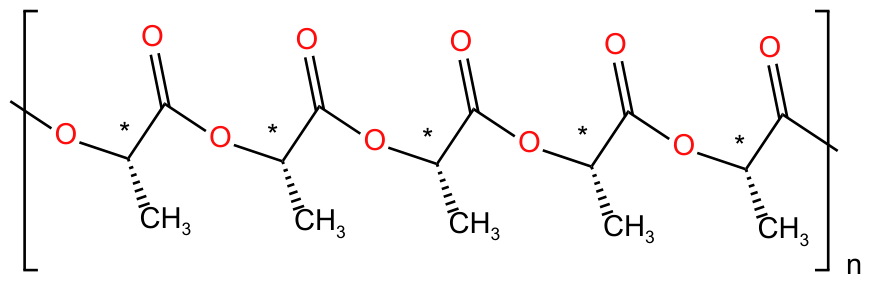
Figure 2.
Stereoisomers of poly(phenylacetylene) (PPA).
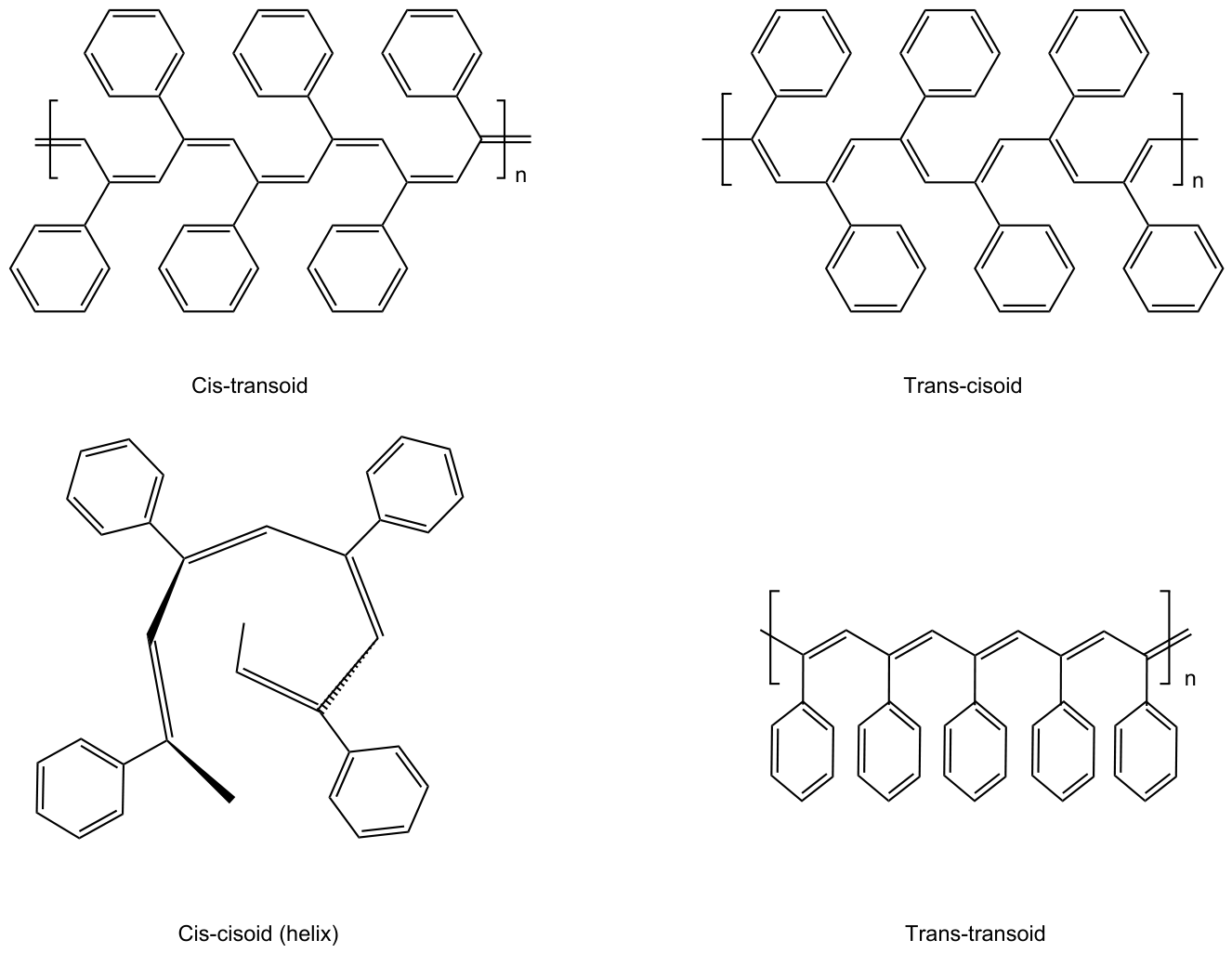
Figure 3.
ORD of PLLA-3D (circles) and PLLA-40kDa (triangles) at ambient temperature in three different solvents: N-methyl-2-pyrrolidone (NMP, green traces); dichloromethane (blue traces) and chloroform (red traces)
Figure 3.
ORD of PLLA-3D (circles) and PLLA-40kDa (triangles) at ambient temperature in three different solvents: N-methyl-2-pyrrolidone (NMP, green traces); dichloromethane (blue traces) and chloroform (red traces)
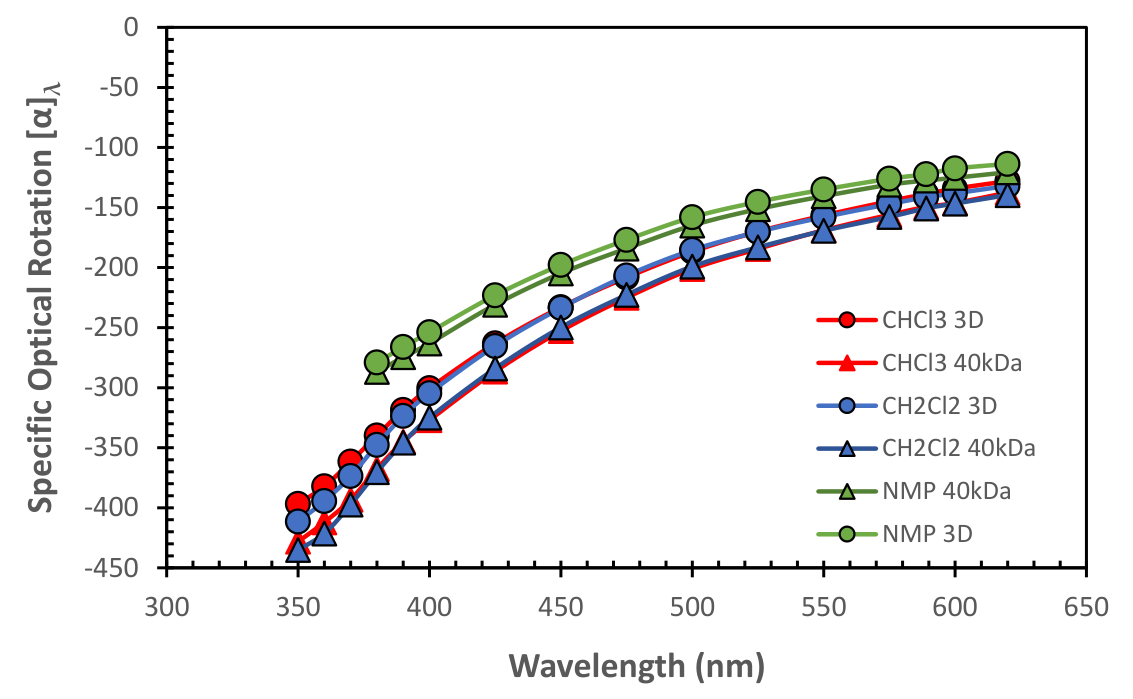
Figure 4.
ORD of PLLA-3D at the ambient temperature (a) in chlorinated solvents and in ethers: CHCl3 (blue), Cl2CH-CHCl2 (TCE, orange); tetrahydrofuran (THF, grey), 1,4-dioxane (red), CH2Cl2 (green), chlorobenzene (black) (b) in various other solvents: CH3CN (violet), ethyl acetate (AcOEt, red), acetone (orange), N,N’-dimethylformamide (DMF, black), toluene (blue), N-methyl-2-pyrrolidone (NMP, green).
Figure 4.
ORD of PLLA-3D at the ambient temperature (a) in chlorinated solvents and in ethers: CHCl3 (blue), Cl2CH-CHCl2 (TCE, orange); tetrahydrofuran (THF, grey), 1,4-dioxane (red), CH2Cl2 (green), chlorobenzene (black) (b) in various other solvents: CH3CN (violet), ethyl acetate (AcOEt, red), acetone (orange), N,N’-dimethylformamide (DMF, black), toluene (blue), N-methyl-2-pyrrolidone (NMP, green).
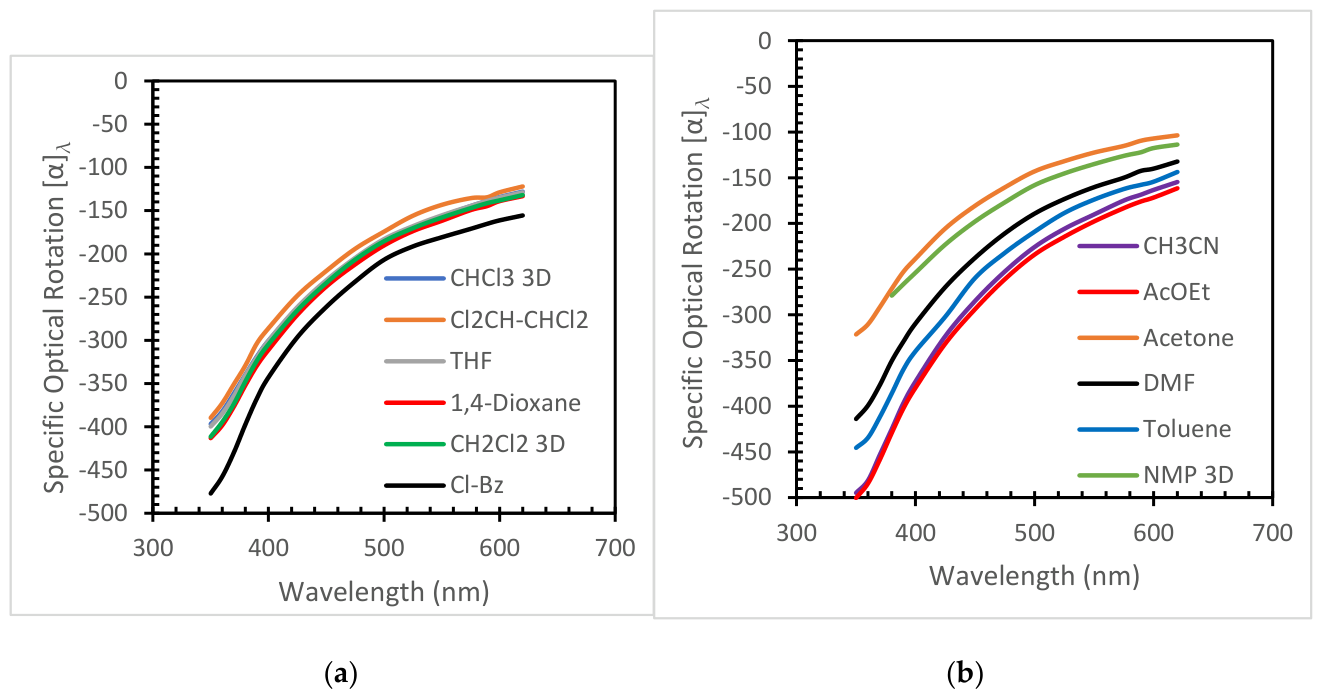
Figure 5.
Moffitt-Yang plot according to Equation (4) of the ORD data of PLLA-3D in CH3CN (orange dots) and in CHCl3 (blue dots). In CH3CN b0 = 349.0 from the slope and a0 = -698.1 from the intercept while in CHCl3 b0 = 307.1 and a0 = -542.3 respectively.
Figure 5.
Moffitt-Yang plot according to Equation (4) of the ORD data of PLLA-3D in CH3CN (orange dots) and in CHCl3 (blue dots). In CH3CN b0 = 349.0 from the slope and a0 = -698.1 from the intercept while in CHCl3 b0 = 307.1 and a0 = -542.3 respectively.
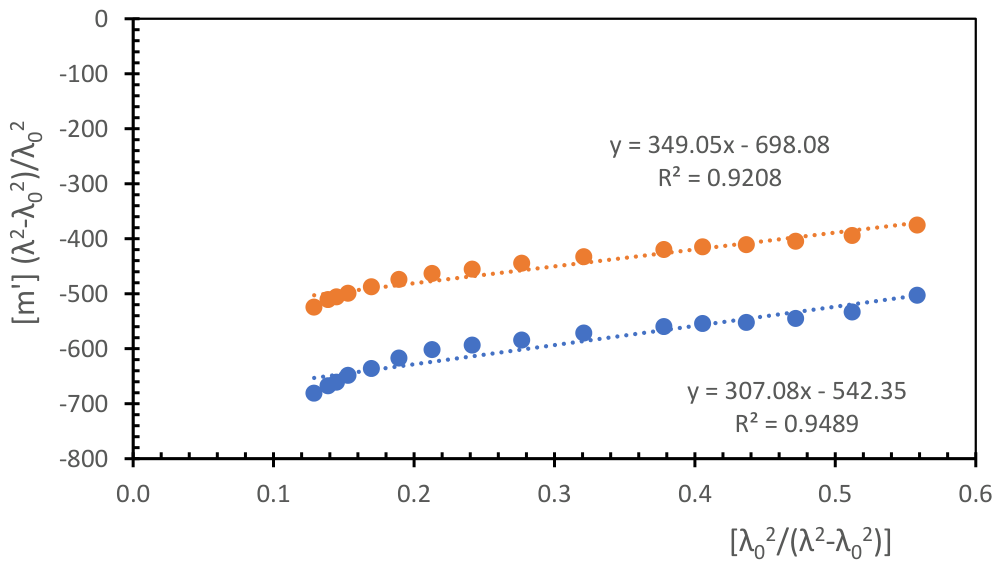
Figure 6.
Correlation of the specific optical rotation [α]589 and [α]380 with the Moffitt-Yang b0 and a0 parameters; (a) [α]589 = -0.4644 b0 (blue dots) and [α]380 = -1.0582 b0 (orange dots) (b) [α]589 = 0.2565 a0 (blue dots) and [α]380 = 0.5850 a0 (orange dots).
Figure 6.
Correlation of the specific optical rotation [α]589 and [α]380 with the Moffitt-Yang b0 and a0 parameters; (a) [α]589 = -0.4644 b0 (blue dots) and [α]380 = -1.0582 b0 (orange dots) (b) [α]589 = 0.2565 a0 (blue dots) and [α]380 = 0.5850 a0 (orange dots).
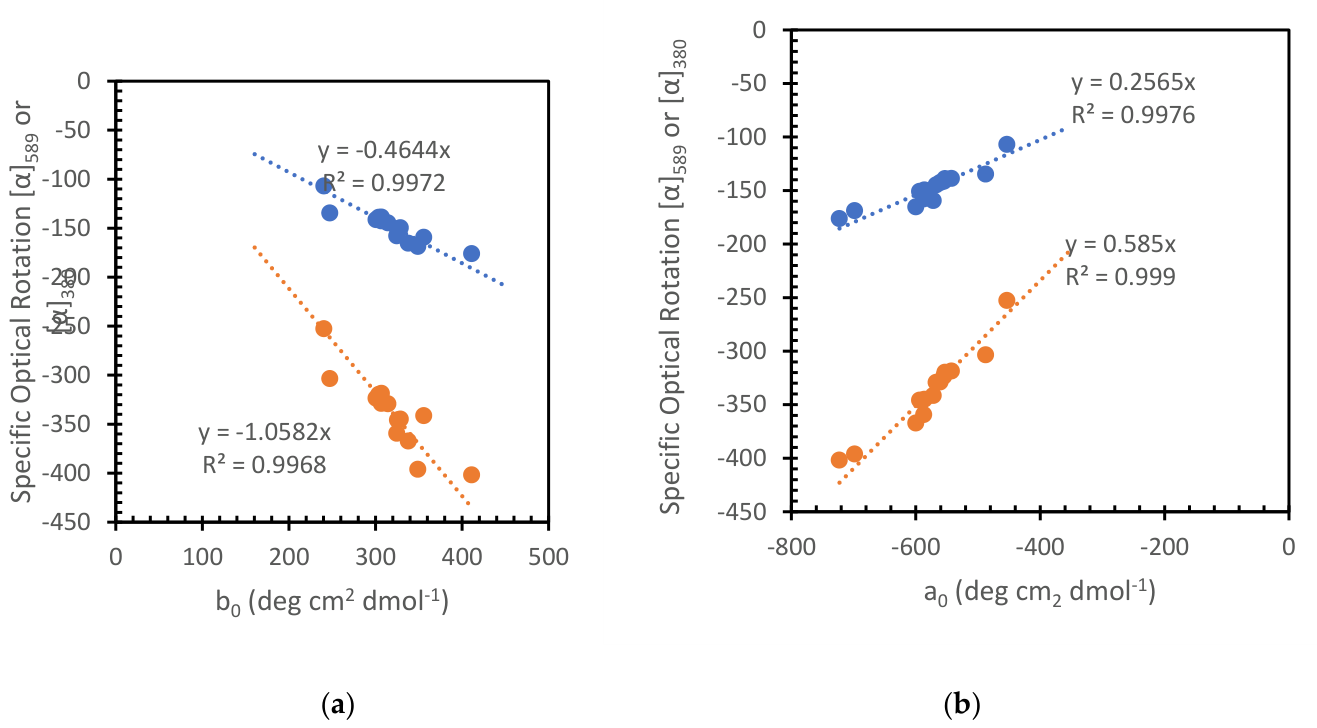
Figure 7.
Correlation of the Moffitt-Yang parametes b0 and a0 with the Onsager function of the solvent polarizability.
Figure 7.
Correlation of the Moffitt-Yang parametes b0 and a0 with the Onsager function of the solvent polarizability.
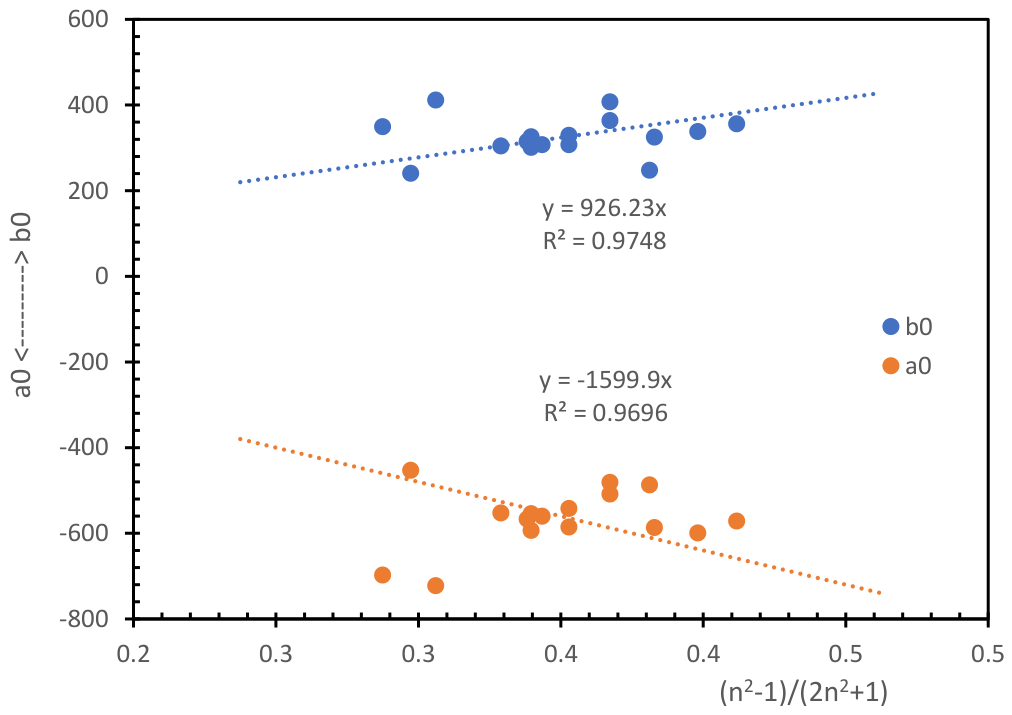
Figure 8.
Hyperchromic effect due to the stepwise addition of PLLA-40kDa to a solution of PPA (a) of 2.0 mg in 100 ml of CH2Cl2 at 16°C or (b) 2.6 mg in 100 ml THF at 18°C, in both cases in thermostated UV cuvettes.
Figure 8.
Hyperchromic effect due to the stepwise addition of PLLA-40kDa to a solution of PPA (a) of 2.0 mg in 100 ml of CH2Cl2 at 16°C or (b) 2.6 mg in 100 ml THF at 18°C, in both cases in thermostated UV cuvettes.
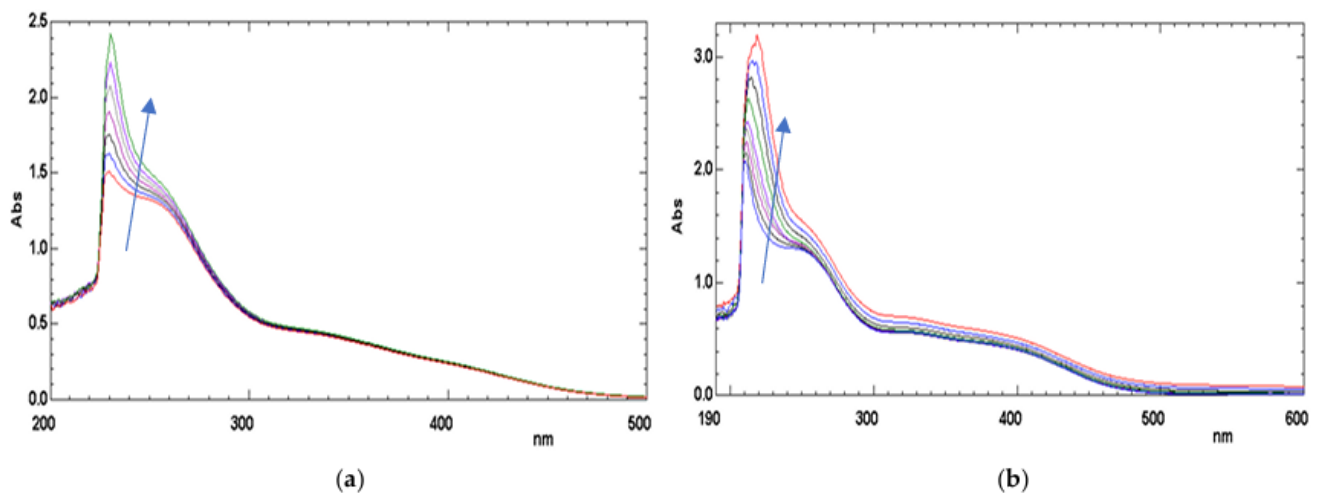
Figure 9.
Example of the Scott plot according to Equation (7) due to the stepwise addition of PLLA-40kDa to a solution of PPA 2.0 mg in 100 ml CH2Cl2 at 16°C. The absorbance was read at 250 nm and the excellent linearity confirms 1:1 complex stoichiometry. Since both abscissa and ordinate were multiplied by 106 factor, the slope is 1.71 x 10⁻⁴ and the intercept 1.55 x 10⁻⁷, hence Keq = 1103 M-1.
Figure 9.
Example of the Scott plot according to Equation (7) due to the stepwise addition of PLLA-40kDa to a solution of PPA 2.0 mg in 100 ml CH2Cl2 at 16°C. The absorbance was read at 250 nm and the excellent linearity confirms 1:1 complex stoichiometry. Since both abscissa and ordinate were multiplied by 106 factor, the slope is 1.71 x 10⁻⁴ and the intercept 1.55 x 10⁻⁷, hence Keq = 1103 M-1.
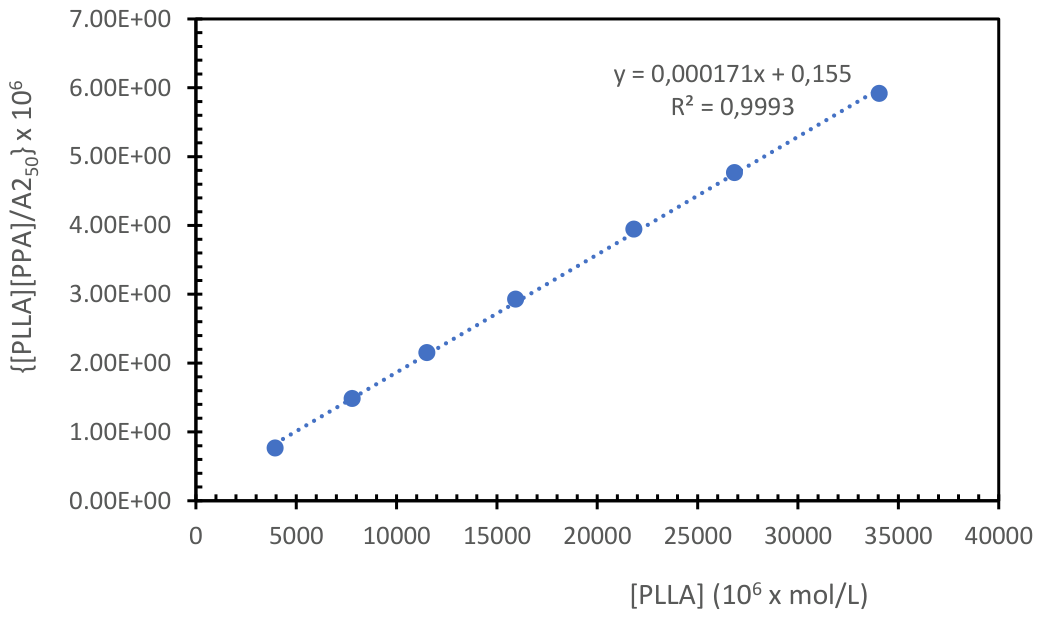
Figure 10.
Van’t Hoff plot of the equilibrium constants (Ln K) for the PLLA-PPA complex against the reciprocal absolute temperature. From this graph the enthalpy and entropy of formation in two different solvents were determined and summarized in Table 4.
Figure 10.
Van’t Hoff plot of the equilibrium constants (Ln K) for the PLLA-PPA complex against the reciprocal absolute temperature. From this graph the enthalpy and entropy of formation in two different solvents were determined and summarized in Table 4.
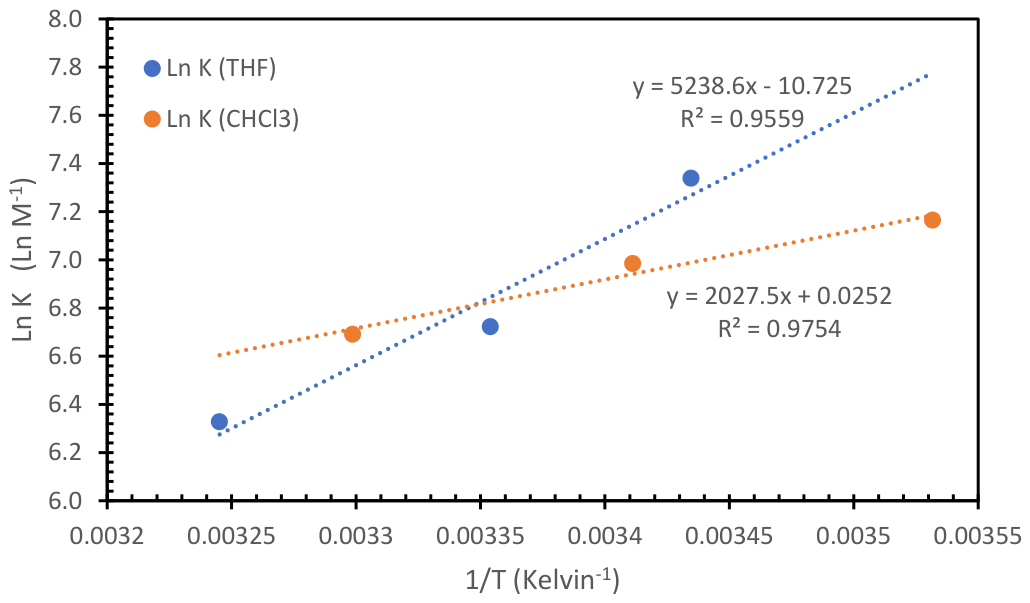
Figure 11.
ORD in CHCl3: PLLA-40kDa 423 mg/100 ml (blue dots); PLLA-40kDa 423 mg/100 ml +1.8 mg PPA (orange dots). Note the induced Cotton effect starting with a trough at about 360 nm.
Figure 11.
ORD in CHCl3: PLLA-40kDa 423 mg/100 ml (blue dots); PLLA-40kDa 423 mg/100 ml +1.8 mg PPA (orange dots). Note the induced Cotton effect starting with a trough at about 360 nm.
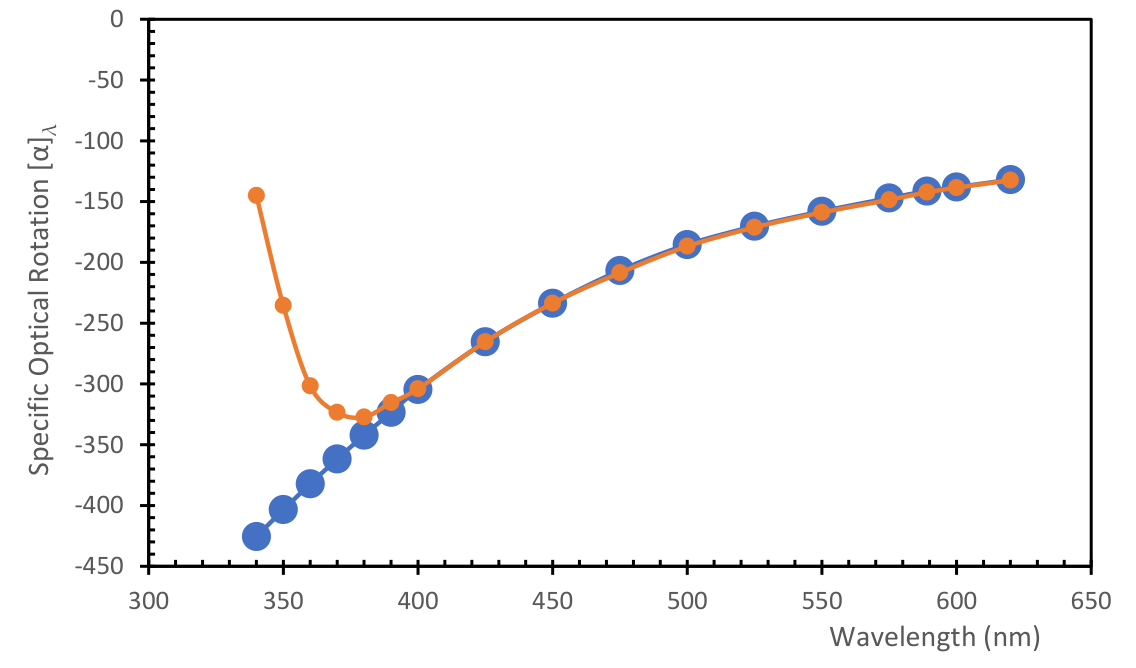

Table 1.
Moffitt-Yang b0 and a0 parameters, specific optical rotations and concentration of PLLA in selected solvents at ambient temperature. Polarity and polarizability of solvents.
Table 1.
Moffitt-Yang b0 and a0 parameters, specific optical rotations and concentration of PLLA in selected solvents at ambient temperature. Polarity and polarizability of solvents.
| SOLVENT and SOLUTE |
SOLVENT POLARITY (ε)/(μ) (*) |
Polarizability (**) |
b0 (Equation (4)) |
a0 (Equation (4)) |
[a]589 | [a]380 | % (w/V) (***) |
| Ethyl Acetate (****) [PLLA-3D] | 6.02 / 2.05 | 0.3061 | 411.1 | -722.7 | -176.1 | -401.8 | 0.135 |
| Acetonitrile [PLLA-3D] | 37.5 /3.39 | 0.2875 | 349.0 | -698.1 | -168.7 | -396.1 | 0.484 |
| o-Dichlorobenzene (†) [PLLA-3D] | 9.93/2.56 | 0.4118 | 345.8 | -571.7 | -159.3 | -341.4 | 0.246 |
| Chlorobenzene [PLLA-3D] | 5.71/1.75 | 0.3981 | 337.9 | -599.8 | -165.3 | -367.2 | 0.246 |
| Chloroform [PLLA-40kDa] | 4.81/1.10 | 0.3529 | 328.9 | -585.8 | -149.5 | -344.9 | 0.670 |
| Dichloromethane [PLLA-40kDa] | 9.08/1.85 | 0.3396 | 325.5 | -593.6 | -150.7 | -345.8 | 0.450 |
| Toluene (****)[PLLA-3D] | 2.38/0.36 | 0.3929 | 324.7 | -587.0 | -157.9 | -359.3 | 0.450 |
| Dioxane [PLLA-3D] | 2.21/0.0 | 0.3382 | 314.6 | -567.1 | -144.7 | -329.2 | 0.484 |
| Chloroform [PLLA-3D] | 4.81/1.1 | 0.3529 | 307.1 | -542.3 | -138.7 | -318.6 | 0.670 |
| N,N'-dimethylformamide [PLLA-3D] | 36.7/3.85 | 0.3435 | 306.9 | -560.7 | -142.6 | -328.8 | 0.463 |
| Tetrahydrofuran [PLLA-3D) | 8.20/1.63 | 0.3290 | 303.9 | -552.8 | -138.9 | -319.7 | 0.495 |
| Dichloromethane [PLLA-3D] | 9.08/1.85 | 0.3396 | 300.7 | -554.6 | -141.4 | -323.5 | 0.423 |
| 1,1',2,2'-Tetrachloroethane [PLLA-3D] | 8.2/1.85 | 0.3812 | 247.4 | -487.5 | -134.6 | -303.5 | 0.413 |
| Acetone (****) [PLLA-3D] | 20.7/2.86 | 0.2973 | 240.4 | -453.4 | -106.9 | -252.6 | 0.467 |
| N-Methyl-pyrrolidone (‡) [PLLA-40kDa] | 32.3/4.09 | 0.3673 | 407.0 | -508.8 | -127.9 | -274.7 | 0.261 |
| N-Methyl-pyrrolidone (‡) [PLLA-3D] | 32.3/4.09 | 0.3673 | 363.2 | -481.3 | -122.2 | -266.2 | 0.468 |
(*) ε = dielectric permittivity [66]; μ = dipole moment in Debye [65]; (**) Onsager solvent polarizability (n2-1)/(2n2+1); (***) concentration g /100 ml; (****) some gel present; (†) ORD taken at T ≈ 50°C; (‡)ORD in a restricted spectral range of 600-380 nm instead of the usual 620-350 nm for all the other solvents.
Table 2.
Moffitt-Yang b0 and a0 parameters, recalculated from ref. [5,6] and compared with the current work.
| SOLVENT (‡) |
b0 (Equation (4)) |
a0 (Equation (4)) |
λ0 (nm) (*) | Spectral Range (nm) (**) | % (w/V) (***) | Reference |
| Acetonitrile PLLA-3D | 349.0 | -698.1 | 209.5 | 350-620 | 0.484 | This Work |
| Acetonitrile | 277.3 | -572.9 | 209.5 | 280-400 | n.r. (#) | [6] |
| Chloroform PLLA-40kDa | 328.9 | -585.8 | 209.5 | 350-620 | 0.67 | This Work |
| Chloroform | 317.3 | -634.4 | 201.0 | 365-578 | 0.72 | [5] |
| Chloroform PLLA-3D | 307.1 | -542.3 | 209.5 | 350-620 | 0.67 | This Work |
| Chloroform | 280.9 | -713.2 | 209.5 | 280-400 | n.r. (#) | [6] |
| Dichloromethane PLLA-40kDa | 325.5 | -593.6 | 209.5 | 350-620 | 0.45 | This Work |
| Dichloromethane | 309.9 | -654.8 | 201.0 | 365-578 | 0.72 | [5] |
| Dichloromethane PLLA-3D | 300.7 | -554.6 | 209.5 | 350-620 | 0.42 | This Work |
| m-Cresol | 305.7 | -984.6 | 201.0 | 365-578 | 0.72 | [5] |
| Trifluoroethanol | 298.8 | -899.9 | 209.5 | 280-400 | n.r. (#) | [6] |
| 1,1,2-Trichloroethane | 297.3 | -574.3 | 201.0 | 365-578 | 0.72 | [5] |
| Dichloroacetic acid | 279.7 | -680.9 | 201.0 | 365-578 | 0.72 | [5] |
| Trifluoroacetic acid | 273.9 | -901.8 | 209.5 | 260-400 | n.r. (#) | [6] |
| Sulfuric acid | 199.6 | -585.3 | 201.0 | 365-578 | 0.72 | [5] |
(*) λ0 used in the Equation (4); spectral range covered in the ORD measurements; (***) concentration g /100 ml; (‡) The PLLA grade is reported only in the measurements of the present work; (#) n.r. = not reported.
Table 3.
Association constants K for PLLA-PPA complex formation at different temperatures.
| Solvent | T(°C) | Λ (nm) | K (M-1) |
| Tetrahydrofuran | 18°C | 247/315/400 | 1539 |
| Tetrahydrofuran | 25°C | 247/315/400 | 831 |
| Tetrahydrofuran | 35°C | 247/315/400 | 560 |
| Chlorofom | 10°C | 240/250 | 1293 |
| Chlorofom | 20°C | 240/250 | 1080 |
| Chlorofom | 30°C | 240/250 | 805 |
| Dichloromethane | 16°C | 250 | 1103 |
Table 4.
Thermodynamic parameters for PLLA-PPA complex formation in different solvents.
| Solvent | ΔH°(kJ/mol) | ΔS°(J mol-1 K-1) | ΔG°(kJ/mol) |
| Tetrahydrofuran | -43.6 | -89.17 | -17.0 |
| Chloroform | -16.9 | +0.210 | -16.8 |
| Dichloromethane | n.d | n.d. | -16.8 |
Disclaimer/Publisher’s Note: The statements, opinions and data contained in all publications are solely those of the individual author(s) and contributor(s) and not of MDPI and/or the editor(s). MDPI and/or the editor(s) disclaim responsibility for any injury to people or property resulting from any ideas, methods, instructions or products referred to in the content. |
© 2026 by the authors. Licensee MDPI, Basel, Switzerland. This article is an open access article distributed under the terms and conditions of the Creative Commons Attribution (CC BY) license (http://creativecommons.org/licenses/by/4.0/).
Copyright: This open access article is published under a Creative Commons CC BY 4.0 license, which permit the free download, distribution, and reuse, provided that the author and preprint are cited in any reuse.


