

Submitted:
22 April 2026
Posted:
24 April 2026
You are already at the latest version
Abstract
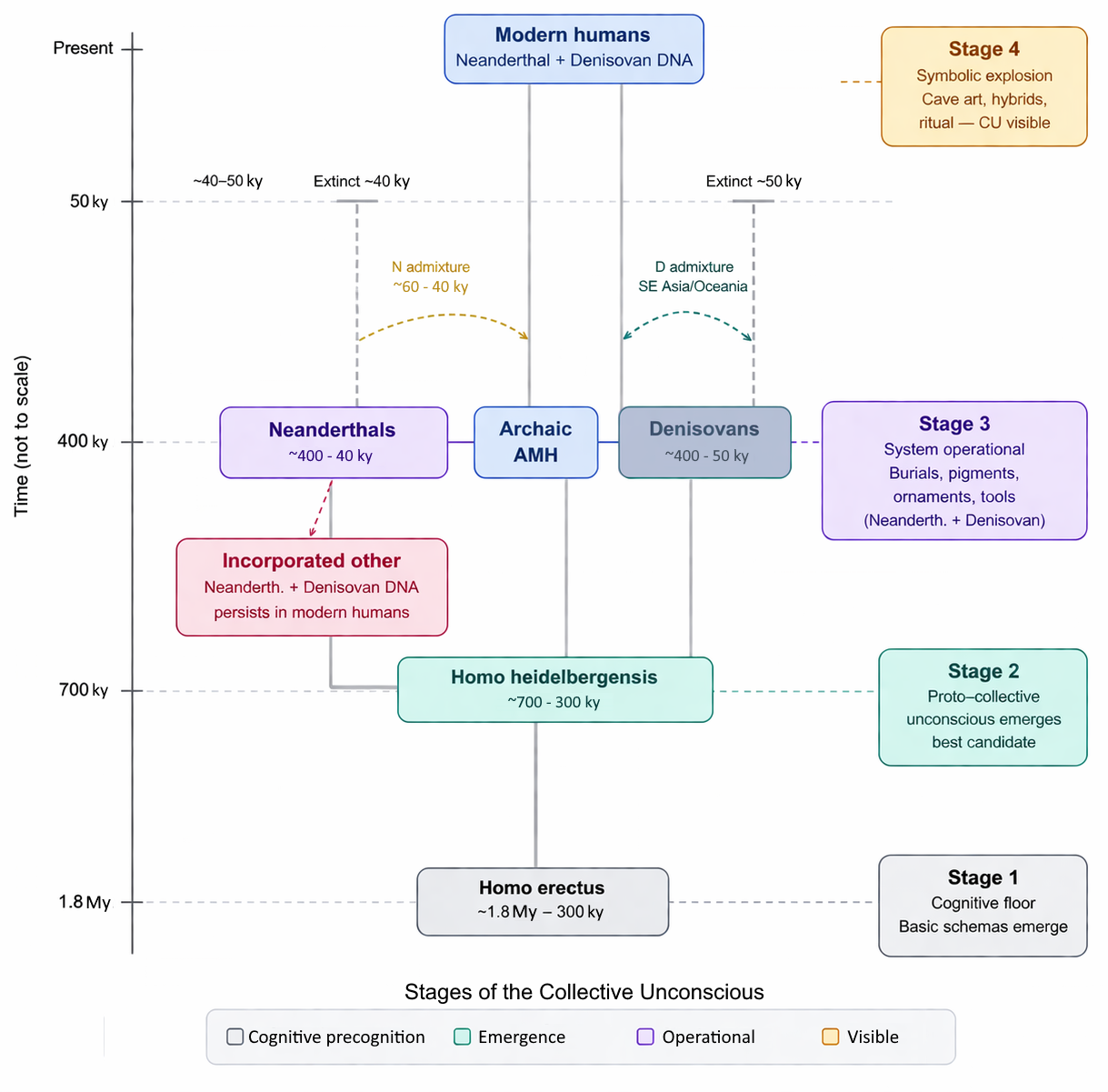
Why does research on Neanderthals attract public attention far beyond its immediate scientific relevance? Such fascination reflects not merely intellectual curiosity but the activation of deep symbolic structures, what Carl Gustav Jung termed the collective unconscious. Neanderthals occupy a psychologically distinctive position as an "incorporated other": an extinct human lineage that remains genetically present in the genomes of non-African modern humans, collapsing intuitive boundaries between self and other, past and present, familiarity and extinction. This symbolic ambiguity is intensified by ancient pathogen evidence and the largely genomic but morphologically invisible presence of Denisovans. Integrating perspectives from evolutionary biology, ancient genomics, paleoanthropology, and analytical psychology, I address a question Jung did not explicitly pose: when, along the human evolutionary lineage, did the collective unconscious originate? I argue that this structure did not emerge suddenly. Homo erectus established the cognitive floor, providing basic universal schemas of fear, group cohesion, and hierarchy, without strong evidence of symbolic elaboration. Homo heidelbergensis, the common ancestor of both Neanderthals and Homo sapiens, is the strongest candidate for the emergence of proto-archetypal structures, given its enlarged brain, complex social behavior, and early funerary practice. The symbolic system was operational in Neanderthals and archaic Homo sapiens and became fully and unambiguously visible only with the Upper Paleolithic explosion approximately 40,000 to 50,000 years ago. Neanderthals are therefore not merely objects of curiosity; they are co-inheritors of the same deep symbolic architecture still operating in every modern mind that encounters them.
Keywords:
Neanderthals
; collective unconscious
; archetypes
; human evolution
; symbolic cognition
; Homo heidelbergensis
; Upper Paleolithic
; science communication
; evolutionary psychology
; ancient genomics
Copyright: This open access article is published under a Creative Commons CC BY 4.0 license, which permit the free download, distribution, and reuse, provided that the author and preprint are cited in any reuse.


