

Submitted:
21 April 2026
Posted:
22 April 2026
You are already at the latest version
Abstract
Caño Barro is a secondary tributary of the Ayapel wetland complex (Ramsar site), Córdoba, Colombia. Despite its role connecting the Cauca River to the wetland, no previous study has assessed its environmental condition. This work presents an integrated geo-environmental evaluation combining morphometric analysis, in-situ water quality measurements, and total mercury (Hg-T) analysis across ten stations. The watershed (632.78 km2, Kc = 2.09) has a very low channel slope (0.017%), limiting sediment transport. Dissolved oxygen fell below 4.0 mg/L at three stations (P1 = 3.55, P3 = 2.58, P6 = 3.27 mg/L), indicating localized oxygen depletion. Hg-T exceeded the US EPA chronic criterion (CCC = 0.77 µg/L) at six of seven quantifiable stations (range: 0.54–2.01 µg/L), with one outlier of 97.46 µg/L requiring confirmation. The Conesa impact assessment classified mercury ecotoxicity as severe (I = −66), ranking it as the highest management priority. Conservation proposals include riparian restoration, erosion control, and mercury monitoring. These results provide the first environmental baseline for this Ramsar tributary and underscore the impacts of illegal gold mining on protected wetland systems.
Keywords:
geo-environmental assessment
; integrated water resources management
; heavy metal contamination
; geomorphological degradation
; morphometric analysis
; Ramsar Wetland
; gold mining
1. Introduction
Wetlands associated with tropical floodplains provide essential services such as flood regulation, water storage, nutrient cycling, and support for artisanal fisheries [1,2]. In Colombia, the Momposina Depression contains some of the most productive and biodiverse wetland systems in the Caribbean region, including the Ayapel wetland complex, which was designated as a Ramsar site in 2022 [3]. Within this system, secondary channels known as "caños" connect the main wetland with surrounding rivers and floodplain areas. These channels regulate water flow between wet and dry seasons and serve as ecological corridors for fish migration and nutrient transport [4].
However, these ecosystems face growing pressures from deforestation, cattle ranching expansion, agricultural runoff, and especially illegal gold mining [5]. Artisanal and small-scale gold mining in the San Jorge River basin relies on mercury amalgamation to extract gold from alluvial sediments. The mercury released during this process reaches downstream water bodies through runoff and contaminated sediments, where it can be converted into methylmercury (MeHg), a highly toxic organic form that accumulates through the food chain [6,7]. Previous research by Marrugo-Negrete and colleagues at the University of Córdoba has documented mercury contamination in fish [8], sediments [9], and soils [10] of the Ayapel wetland, as well as elevated mercury levels in the hair of local fishing communities [11]. More recently, mercury-related soil degradation was reported within the Ayapel wetland management district, raising concerns about food safety due to metal uptake by crops [12].
Despite this body of work on the main wetland, no study has specifically assessed the environmental condition of Caño Barro, a tributary that connects the Cauca river with the Ayapel wetland and serves as an entry point for water, sediments, and potentially contaminants from upstream mining areas. When the Cauca River overflows its levees, which occurs approximately every 15 to 18 years, Caño Barro acts as a major route for water and sediment transfer into the wetland [13]. The absence of baseline data for this channel limits the ability of environmental authorities and local communities to make informed management decisions.
At the global level, approaches to water quality assessment have shifted from simple parameter measurements toward integrated diagnostics that combine hydrochemistry, remote sensing, geographic information systems (GIS), and multivariate analysis [14,15]. In Latin America, studies have combined physicochemical variables with biological indices to evaluate river quality under agricultural and urban pressures [16], while in the Momposina Depression, the regional environmental authority (CVS) has identified sedimentation, wastewater discharge, and agrochemical use as the main threats to the Ayapel wetland and its tributaries [5].
The aim of this study was to carry out the first integrated geo-environmental assessment of the Caño Barro watershed by (1) characterizing its morphometric and hydrological properties using GIS tools, (2) evaluating in-situ physicochemical water quality parameters and total mercury concentrations in water, and (3) determining potential environmental impacts and risks using the Conesa methodology to support the formulation of conservation and rehabilitation proposals.
2. Materials and Methods
2.1. Study Area
Caño Barro is located in the municipality of Ayapel, department of Córdoba, Colombia, within the Momposina Depression wetland system. The channel is a secondary tributary of the Ayapel wetland and functions as a hydrological connector between the Cauca River and the main wetland body (Figure 1). The area falls within the tropical humid forest life zone (bh-T), with mean temperatures above 27 °C and annual precipitation ranging from 2500 to 3000 mm, concentrated in a single rainy season from April to November. The mean annual precipitation measured in the Caño Barro sub-basin is 2934.75 mm/year, which is higher than the 2200–2500 mm/year reported for the central wetland area [3,13].
The geological setting corresponds to the San Jacinto fold belt, dominated by the Betulia Formation (Pleistocene lacustrine deposits of sandy clays, plastic clays, silts, and gravels) and overlying Quaternary alluvial and fluvio-lacustrine deposits composed of organic-rich clays [13]. Land use is dominated by extensive cattle ranching (over 83% of the watershed area), with minor areas of subsistence agriculture (rice, corn, cassava) and remnant riparian forest. Illegal mechanized gold mining operates upstream in the San Jorge River basin and constitutes the main source of mercury contamination in the region [5,11].
2.2. Morphometric Analysis
The watershed was delineated using a Digital Elevation Model (DEM) from ALOS PALSAR, processed with the hydrology module of ArcGIS Pro. Flow direction and flow accumulation grids were generated to extract the drainage network and define the watershed boundary. The following morphometric parameters were calculated: watershed area, perimeter, length, mean width, total relief, mean elevation, main channel length, total stream length, and maximum stream order using the Strahler classification [17]. Shape indices included the Gravelius compactness coefficient (Kc), Horton form factor (Kf), Miller circularity index (Kci), and Schumm elongation ratio (Re) [17,18]. Drainage network parameters included drainage density (Dd), stream frequency (Fc), mean bifurcation ratio (Rb), storage coefficient, drainage texture, overland flow length, and infiltration number. Slope analysis followed the FAO classification [19] and the USDA flow energy categories [20]. Concentration times were estimated using ten empirical methods. Hypsometric analysis was conducted to assess the geomorphological maturity of the watershed.
2.3. Water Sampling and Physicochemical Analysis
Ten sampling stations were established along the Caño Barro channel, covering the upper, middle, and lower reaches as well as areas with agricultural influence and potential contamination sources. In-situ physicochemical measurements were taken during a field campaign in June 2025 using a multiparameter probe. The parameters recorded at each station were: pH, water temperature (°C), electrical conductivity (µS/cm), total dissolved solids (TDS, mg/L), salinity (ppt), oxidation-reduction potential (ORP, mV), and dissolved oxygen (DO, mg/L). Results were compared against Colombian environmental regulations (Decree 1076 of 2015: pH 4.5–9.0, DO ≥ 4.0 mg/L for flora and fauna preservation) and the US EPA National Recommended Water Quality Criteria for freshwater aquatic life (pH 6.5–9.0, DO ≥ 5.0 mg/L) [21,22].
2.4. Total Mercury Analysis
Water samples for total mercury (Hg-T) analysis were collected at the same ten stations during a second field campaign in August 2025. Samples were analyzed at the Toxicology and Environmental Management Laboratory of the University of Córdoba using cold vapor atomic absorption spectroscopy (method PLTX-045). The method detection limit (MDL) was 0.11 µg/L and the method quantification limit (MQL) was 0.32 µg/L. Results reported as below the MQL (<0.32 µg/L) were treated as non-quantifiable and were not assigned numerical values in the analysis. Quantifiable results were compared against the US EPA chronic criterion for aquatic life in freshwater (CCC = 0.77 µg/L) [21] and the Canadian Council of Ministers of the Environment long-term guideline (CCME = 0.026 µg/L) [23].
2.5. Environmental Impact and Risk Assessment
The Conesa methodology [24] was applied to translate the physicochemical and toxicological results into a structured assessment of potential environmental impacts. Five impacts were defined based on the observed data, covering water quality deterioration, reduced habitat suitability, mercury ecotoxicity, bioaccumulation risk, and the site-specific mercury hotspot. Each impact was scored across ten criteria: nature (N), intensity (IN), extent (EX), timing (MO), persistence (PE), reversibility (RV), synergy (SI), accumulation (AC), effect (EF), periodicity (PR), and recoverability (MC). The overall Importance (I) was calculated as I = N × (3·IN + 2·EX + MO + PE + RV + SI + AC + EF + PR + MC), and impacts were classified as irrelevant (−13 to −24), moderate (−25 to −49), severe (−50 to −75), or critical (−76 to −100).
To improve prioritization, the Importance classification was used to assign a Consequence value (C = 1 to 4), which was then combined with a Probability score (P = 1 to 3) based on the spatial pattern of the finding (isolated vs. widespread) and its likelihood of recurrence. Risk was calculated as R = P × C and classified as Low (R ≤ 3), Medium (R = 4–6), or High (R ≥ 9).
3. Results
3.1. Watershed Morphometry
The Caño Barro watershed covers an area of 632.78 km² with a perimeter of 186.30 km, classifying it as a medium-sized basin. The maximum stream order reached 6 on the Strahler scale, confirming a well-developed drainage network. The total stream length across all orders was 1259.58 km. Key morphometric parameters are presented in Table 1.
The four shape indices consistently indicate an elongated watershed with low tendency to produce simultaneous peak flows. The drainage density of 1.99 km/km² shows a moderately well-developed network capable of transporting water and sediments. However, the main channel slope of only 0.017% is the most important finding for understanding the system. This very low gradient means the channel has limited energy to move sediments, especially in the middle and lower reaches. Under natural conditions, this balance between sediment input and transport is maintained. When illegal mechanized gold mining adds large volumes of disturbed sediment to the system, this balance is broken. The channel receives more sediment than it can carry, leading to progressive filling of the channel bed, reduced cross-section, and loss of hydraulic capacity [5,13].
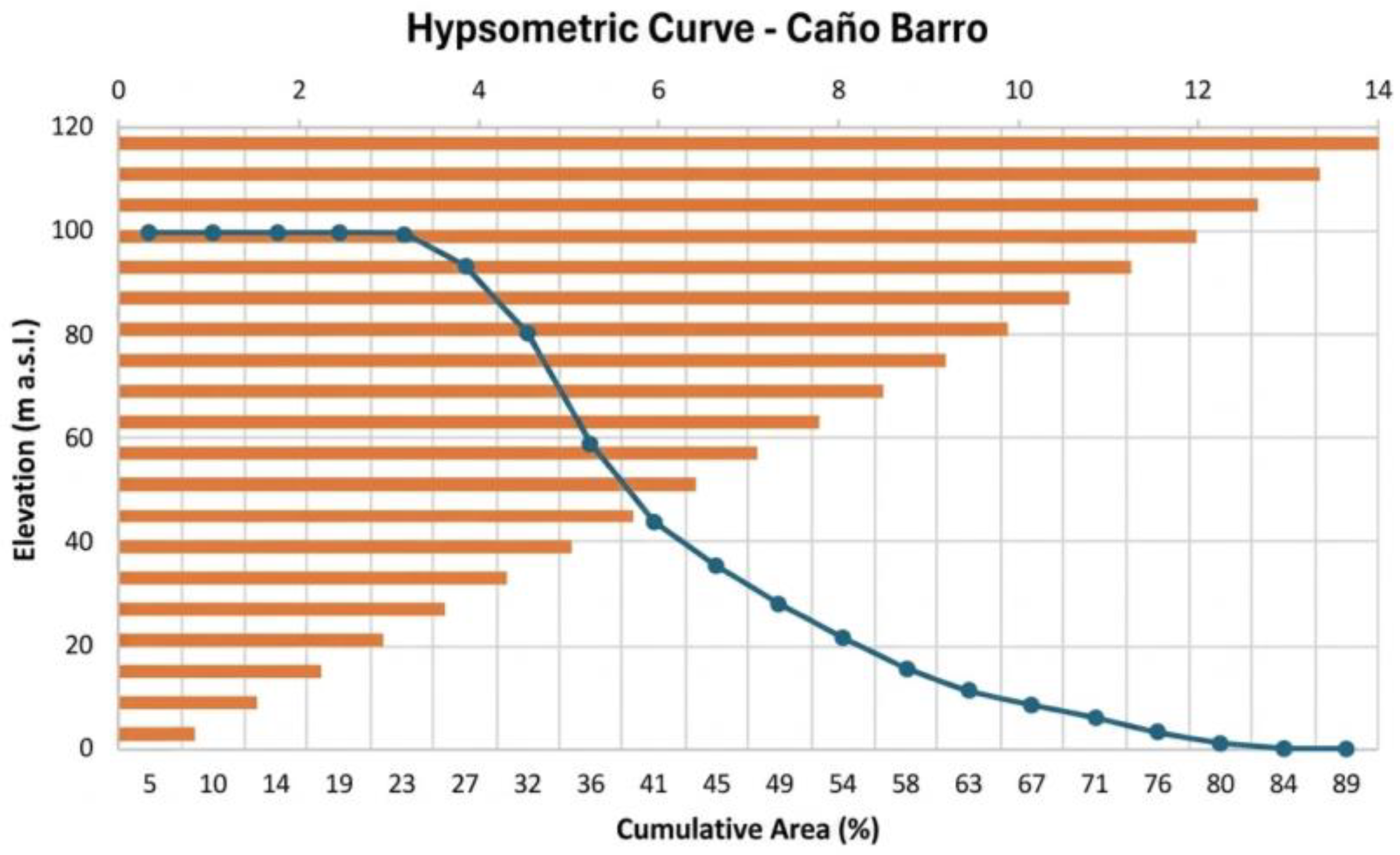
Slope analysis confirmed that most of the watershed (classes 0–4% slope) has low to moderate energy, with localized areas of higher slopes (10–30%) concentrated in the southern sector. These steeper areas generate faster runoff and serve as sediment source zones, while the flat middle and lower reaches function as sediment accumulation zones. The hypsometric curve showed a slightly concave shape, consistent with a geomorphologically mature watershed in dynamic equilibrium between erosion and deposition. The dominant elevation range was 80–110 m a.s.l. Concentration times estimated by the most applicable methods (Kirpich: 12.40 h, Giandotti: 6.07 h, Ventura-Heras: 13.80 h) indicate a gradual hydrological response, consistent with the elongated shape and gentle slopes.
Figure 2.
Slope gradient map of the Caño Barro watershed classified according to FAO (2009).
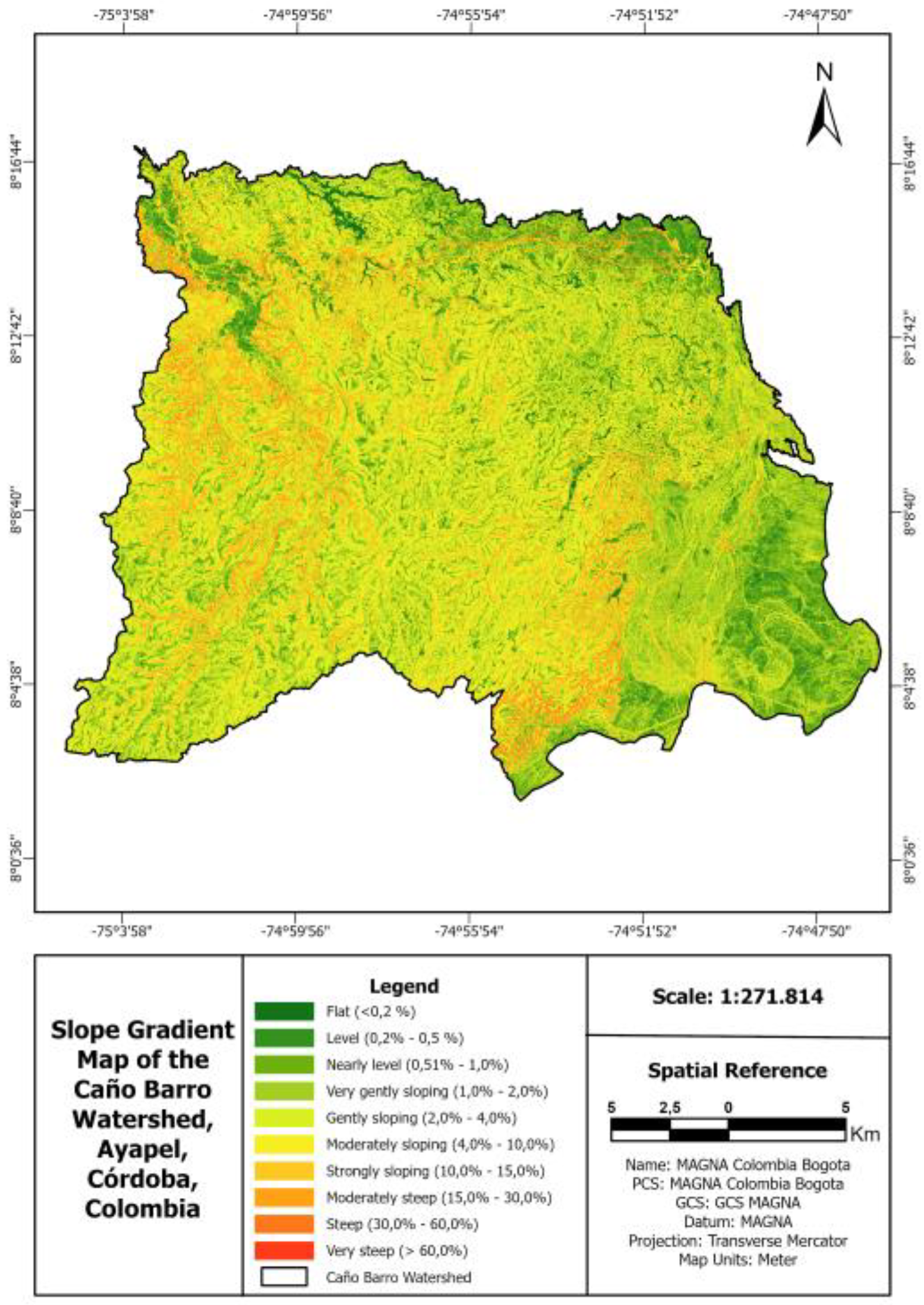
Figure 3.
Hypsometric curve and altimetric frequency histogram of the Caño Barro watershed.
3.2. Physicochemical Water Quality
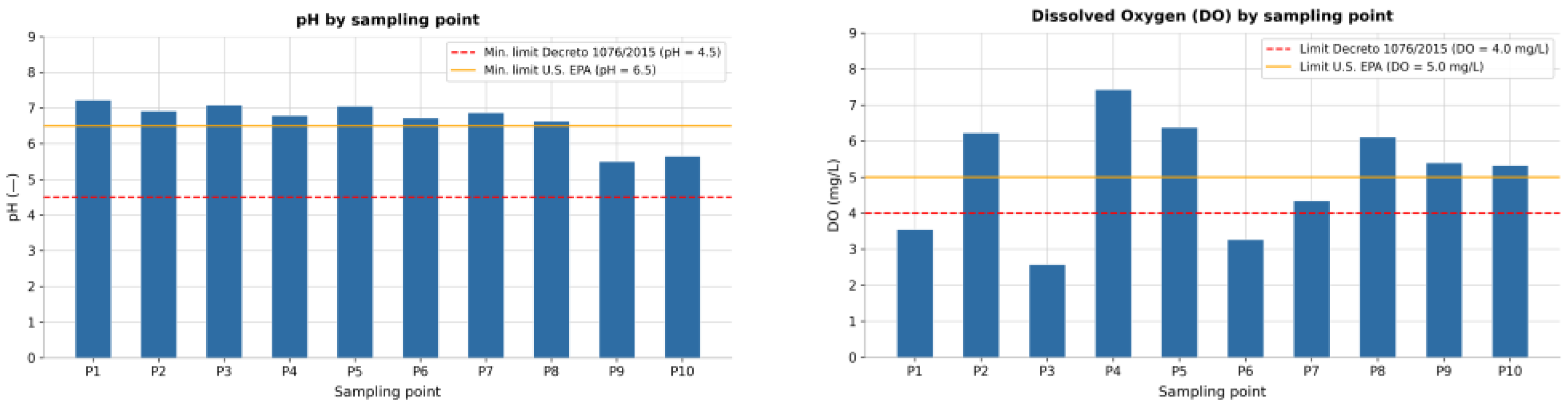
Results from the ten sampling stations (June 2025) showed spatial variability across all parameters (Table 2). pH ranged from 5.50 (P9) to 7.23 (P1), with most stations near neutral values. Two stations in the lower reach (P9 = 5.50, P10 = 5.65) fell below the EPA freshwater reference of 6.5, though they remained within the Colombian regulatory range (4.5–9.0). These lower pH values likely reflect greater influence of decomposing organic matter and reducing conditions in the lower floodplain sectors.
Regulatory references: Colombian Decree 1076/2015 for flora/fauna preservation: pH 4.5–9.0, DO ≥ 4.0 mg/L. US EPA freshwater aquatic life: pH 6.5–9.0, DO ≥ 5.0 mg/L.
Dissolved oxygen was the most critical parameter. Three stations recorded DO below 4.0 mg/L: P3 (2.58 mg/L), P6 (3.27 mg/L), and P1 (3.55 mg/L). These values fall below the Colombian threshold for flora and fauna preservation and indicate localized conditions where aquatic organisms may experience physiological stress [22]. The low DO at these stations is consistent with areas of slower water flow, greater water residence time, and higher organic matter decomposition, as supported by the morphometric analysis showing very low channel gradients in these reaches.
Conductivity ranged from 17 to 127 µS/cm and TDS from 8 to 63 mg/L, indicating a low-mineralization system overall. The highest conductivity values were recorded in the upper and middle sections (P1, P3), while the lowest were found in the lower reaches (P9, P10), suggesting different water sources or mixing patterns along the channel.
Figure 4.
a. Dissolved oxygen (mg/L). b.pH at the ten sampling stations.
3.3. Total Mercury in Water
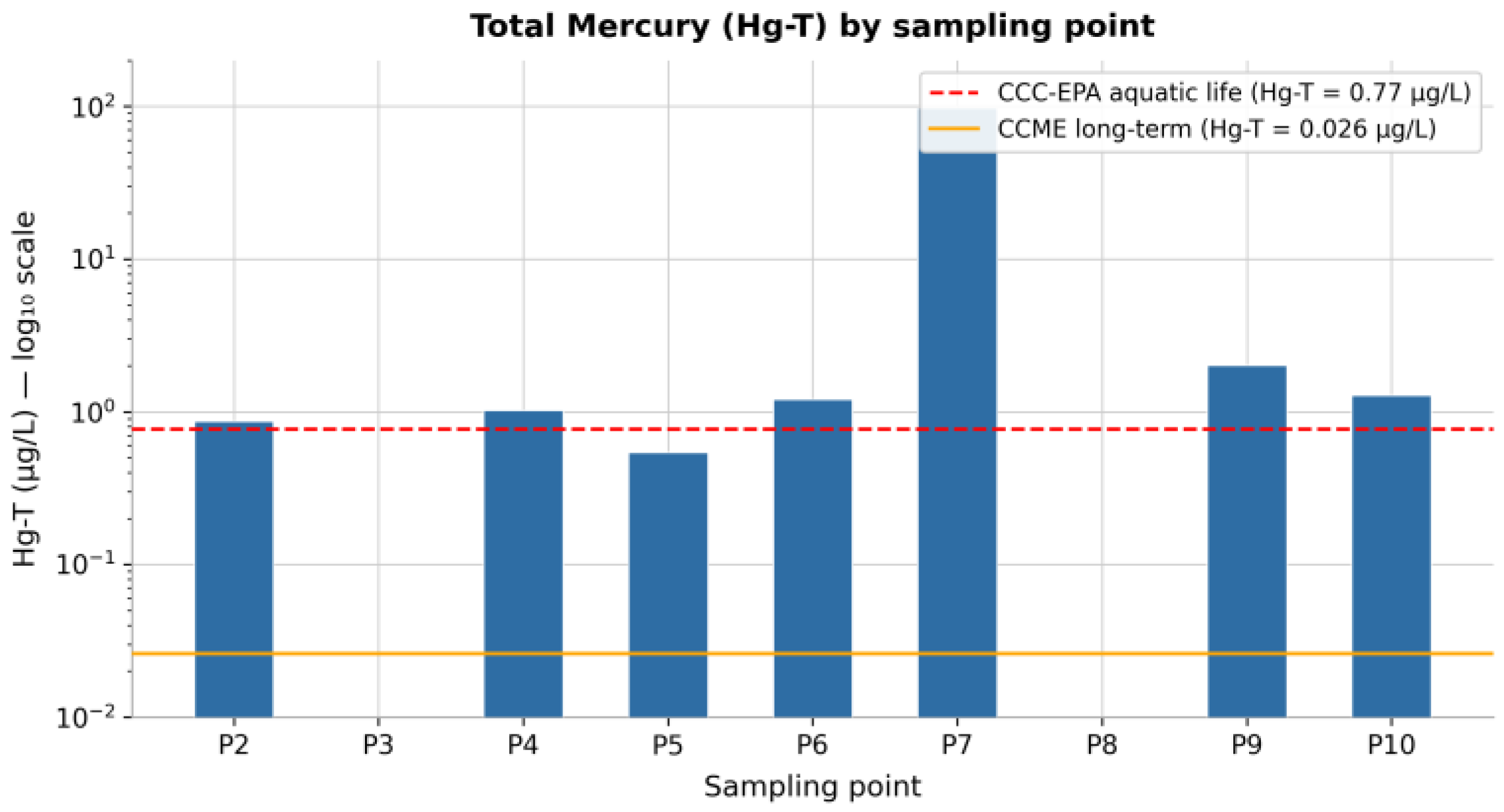
Of the ten stations sampled in August 2025, seven returned quantifiable Hg-T concentrations, while three (P1, P3, P8) were below the method quantification limit (<0.32 µg/L) (Table 3). Among the quantifiable results, concentrations ranged from 0.54 µg/L (P5) to 97.46 µg/L (P7), with the remaining stations between 0.87 and 2.01 µg/L.
Excluding the outlier at P7, six of the seven quantifiable stations exceeded the EPA chronic criterion (CCC = 0.77 µg/L), and all seven exceeded the CCME guideline (0.026 µg/L). The concentration at P7 (97.46 µg/L) was approximately 127 times the CCC-EPA value and nearly 5 times the Colombian regulatory limit (20 µg/L). This value stands out sharply from the rest of the dataset and may reflect a localized contamination source, a sampling or analytical issue, or an actual extreme concentration at that point. The chain of custody and analytical traceability of this sample should be reviewed, and a confirmation sampling campaign at P7 and surrounding control points is recommended before drawing definitive conclusions from this single measurement.
Figure 5.
Total mercury concentrations by station (log10 scale). Stations below MQL are not plotted.
Figure 5.
Total mercury concentrations by station (log10 scale). Stations below MQL are not plotted.
3.4. Environmental Impact and Risk Assessment
The Conesa impact assessment identified five potential impacts on the aquatic environment, with Importance (I) values ranging from −36 to −66. The mercury ecotoxicological impact received the highest severity rating (I = −66, classified as severe), driven by the widespread presence of quantifiable Hg-T across the majority of stations and the consistent exceedance of international protection criteria. The risk analysis (R = P × C) ranked mercury ecotoxicity as High risk (R = 9), the only impact reaching this level. Results are summarized in Table 4.
This section may be divided by subheadings. It should provide a concise and precise description of the experimental results, their interpretation, as well as the experimental conclusions that can be drawn.
4. Discussion
4.1. Morphometric Controls on Environmental Vulnerability
The morphometric analysis reveals that Caño Barro is a low-energy fluvial system where sediment accumulation in the middle and lower reaches is the dominant process. The main channel slope of 0.017% places severe limits on sediment transport capacity. This finding is relevant for two reasons. First, it explains why the lower sections of the channel are prone to filling with fine sediments, which in turn creates areas of slow-moving or stagnant water where dissolved oxygen can drop and organic matter can accumulate. The low-DO stations (P1, P3, P6) are located in precisely these low-gradient reaches, confirming the link between channel morphology and water quality. Second, this low transport capacity means that any additional sediment input from mining or land-use change will not be flushed out naturally but will instead accumulate, gradually reducing the channel cross-section and its ability to carry floodwaters. Since Caño Barro serves as a major route for water transfer from the Cauca River to the Ayapel wetland during extreme flood events [13], the loss of hydraulic capacity in this channel has implications beyond the local scale, potentially increasing flood risk for downstream communities and reducing the buffering function of the wetland system.
4.2. Water Quality and Mercury Contamination in Context
The dissolved oxygen results show that 30% of the sampling stations fall below the Colombian regulatory threshold for fauna preservation, indicating localized but repeated oxygen depletion within the system. While the overall pH range and conductivity values suggest a relatively undisturbed system in terms of general water chemistry, the DO patterns point to specific reaches where aquatic organisms face challenging conditions. These low-oxygen zones coincide with the morphometric characteristics of the lower floodplain (flat terrain, slow flow, organic-rich sediments), a pattern that has been described in similar tropical floodplain systems in South America [2,16].
The mercury results are the most significant finding of this study. The fact that Hg-T exceeded the EPA chronic criterion at six of seven quantifiable stations indicates that mercury contamination in Caño Barro is not limited to isolated hotspots but is distributed across most of the evaluated channel. This pattern is consistent with the known upstream sources of mercury from gold mining in the San Jorge basin [5,8] and with the transport of contaminated sediments through the drainage network into downstream water bodies. The concentrations measured (0.54–2.01 µg/L, excluding the outlier) are comparable to those reported in other mercury-affected floodplain systems in Colombia and the Amazon basin [7,8].
The outlier at P7 (97.46 µg/L) deserves careful treatment. While the measurement was performed following standard laboratory protocols, a value approximately 50 to 100 times higher than the other stations raises questions that cannot be resolved without a follow-up sampling campaign. Possible explanations include proximity to a previously unidentified contamination source, recent disturbance of mercury-rich sediments, cross-contamination during sampling, or an analytical issue. We recommend treating this value as a priority finding for verification rather than as a confirmed measurement.
From an ecotoxicological perspective, the combination of quantifiable mercury in water and low dissolved oxygen at several stations creates conditions that are particularly concerning for aquatic life. Reducing environments with fine sediments and organic matter favor the bacterial conversion of inorganic mercury to methylmercury [6], the form that accumulates through the food chain. While this study did not measure mercury in sediments or biota, previous work in the Ayapel wetland has demonstrated active bioaccumulation and biomagnification of mercury in fish consumed by local communities [8,11]. The presence of mercury in the water column of Caño Barro, a direct tributary to the wetland, strengthens the case that mercury enters the Ayapel system through multiple pathways and that monitoring efforts should extend to tributary channels and not only the main wetland body.
4.3. Conservation and Rehabilitation Proposals
Based on the integrated diagnosis, three groups of management measures are proposed, organized by implementation timeframe. In the short term, the priority is to verify the P7 mercury outlier through targeted re-sampling with full chain-of-custody documentation, accompanied by rapid field inspections at critical points to identify visible contamination sources. Complementary actions include cleanup of accessible channel sections, basic signage at waste disposal points, and removal of anthropogenic obstructions at low-DO stations to improve local flow conditions.
In the medium term, rehabilitation efforts should focus on two fronts. In the headwater areas (stream orders 1–2), where slopes are steeper and erosion is more active, measures such as infiltration trenches, vegetative barriers, and soil cover management can reduce sediment input to the drainage network. In the middle and lower reaches (stream orders 4–6), where the low gradient favors sediment accumulation, riparian buffer restoration with native species, bank stabilization, and nature-based solutions for erosion control should be implemented. Riparian vegetation serves multiple functions: it stabilizes banks, filters runoff, improves the microclimate over the water surface, and provides habitat for terrestrial and aquatic species.
For long-term sustainability, a monitoring program with at least two campaigns per year (dry and wet seasons) should be established, maintaining the current sampling network for comparability over time. Minimum indicators include dissolved oxygen and pH at sensitive stations, visual erosion and sedimentation assessments, and Hg-T analysis at priority points. Coordination with the CVS, municipal authorities, and community organizations such as CorpoAyapel and the local fishers' association (AGROYA) is essential to sustain these efforts and integrate the management of Caño Barro into the broader conservation framework of the Ayapel Ramsar site.
4.4. Limitations
This study has several limitations that should be considered when interpreting the results. First, the physicochemical and mercury data come from a limited number of sampling campaigns (June and August 2025), and seasonal variation could not be fully captured. However, these represent the first measurements ever recorded for this watercourse and provide an essential starting point for future monitoring. Second, mercury was measured only in the water column; analysis of sediments and biological tissue would provide a more complete picture of contamination pathways and bioaccumulation risks. Third, the morphometric analysis relies on a regional DEM, and finer-scale channel geometry (cross-sections, depth profiles) would improve the interpretation of sediment transport dynamics. Finally, the Conesa methodology depends on expert judgment for criteria scoring, introducing a degree of subjectivity; however, the use of explicit criteria tables and traceable scoring supports the reproducibility of the assessment
5. Conclusions
This study provides the first integrated geo-environmental baseline for Caño Barro, a key tributary of the Ayapel Ramsar wetland in Colombia. The watershed operates as a low-energy fluvial system (main channel slope 0.017%) where sediment accumulation in the middle and lower reaches is the dominant geomorphic process, making the channel highly vulnerable to additional sediment input from upstream gold mining. Water quality assessment revealed dissolved oxygen below the ecological threshold at 30% of stations, while total mercury exceeded the US EPA chronic criterion for aquatic life at most quantifiable stations, confirming widespread contamination likely linked to illegal gold mining in the San Jorge River basin. The Conesa impact assessment and risk analysis ranked mercury ecotoxicity as the highest management priority (R = 9, High). Conservation proposals include short-term verification of critical findings, medium-term riparian restoration and erosion control, and long-term monitoring integrated into the Ramsar site management framework. These results demonstrate that environmental monitoring of wetland tributary channels, and not only the main water body, is necessary to understand the full extent of contamination and to guide effective management of internationally protected ecosystems.
Supplementary Materials
The following supporting information can be downloaded at: Preprints.org. Figure S1: title; Table S1: title; Video S1: title.
Author Contributions
Conceptualization, M.R.P. and R.P.U.; methodology, J.C.M.V. and M.R.P.; formal analysis, J.C.M.V.; investigation, J.C.M.V. and R.P.U.; data curation, J.C.M.V.; writing—original draft preparation, J.C.M.V.; writing—review and editing, M.R.P.; supervision, M.R.P. and R.P.U. All authors have read and agreed to the published version of the manuscript.
Funding
This research received no external funding
Data Availability Statement
The data presented in this study are available on request from the corresponding author due to institutional data management policies at the University of Córdoba.
Acknowledgments
The authors thank the Toxicology and Environmental Management Laboratory of the University of Córdoba for the analytical support. J.C.M.V. acknowledges the academic exchange with the Federal University of São Carlos (UFSCar), Brazil, which contributed to the methodological design of this study.
Conflicts of Interest
The authors declare no conflict of interest.
Abbreviations
The following abbreviations are used in this manuscript:
| DEM | Digital Elevation Model (DEM) |
| UFSCar | Federal University of São Carlos |
| ALOS PALSAR | Advanced Land Observing Satellite – Phased Array type L-band Synthetic Aperture Radar |
| CCME | Canadian Council of Ministers of the Environment |
| CCC | Chronic Criterion Concentration |
| CVS | Regional Autonomous Corporation of the Sinú and San Jorge Valleys |
| DO | Dissolved Oxygen |
| EC | Electrical Conductivity |
| EPA | Environmental Protection Agency (USA) |
| FAO | Food and Agriculture Organization of the United Nations |
| GIS | Geographic Information System |
| Hg-T | Total Mercury |
| Kc | Gravelius Compactness Coefficient |
| Kci | Circularity Index |
| Kf | Form Factor |
| MDL | Method Detection Limit |
| MeHg | Methylmercury |
| MQL | Method Quantification Limit |
| ORP | Oxidation–Reduction Potential |
| Re | Elongation Ratio |
| TDS | Total Dissolved Solids |
| USDA | United States Department of Agriculture |
References
- Pineda, J.; Palomino, M.; Hernández, C. Caños as ecological corridors and regulators of the flood pulse in the Momposina Depression: A hydroenvironmental perspective. Rev. Colomb. Geogr. 2017, 26, 35–52. [Google Scholar]
- Gómez, D.; Roldán, G. Geo-Environmental Assessment of River Basins: An Integrated Approach for Diagnosis and Management of Aquatic Systems; Editorial Universidad de Antioquia: Medellín, Colombia, 2019. [Google Scholar]
- Ramsar Sites Information Service. Environmental Management Plan of the Ayapel Wetland Complex, Department of Córdoba (CO2499_mgt220405); Ramsar Convention: Gland, Switzerland, 2022. [Google Scholar]
- Ríos-Pulgarín, M.I.; Jiménez-Segura, L.F.; Palacio, J.A.; Ramírez-Restrepo, J.J. Fish community in the Ayapel wetland, Magdalena River (Córdoba), Colombia: Spatiotemporal changes. Actual. Biol. 2008, 30, 25–40. [Google Scholar]
- Corporación Autónoma Regional de los Valles del Sinú y del San Jorge (CVS). Environmental Status Report of the Ayapel Wetland and Its Tributaries; CVS: Montería, Colombia, 2021. [Google Scholar]
- Hong, Y.S. Mercury contamination in aquatic ecosystems: Sources, transformation and bioaccumulation processes. Environ. Rev. 2012, 20, 1–20. [Google Scholar]
- Marrugo-Negrete, J.L.; Pinedo-Hernández, J.; Díez, S. Assessment of heavy metal pollution, spatial distribution and origin in agricultural soils along the Sinú River Basin, Colombia. Environ. Res. 2017, 154, 380–388. [Google Scholar] [CrossRef] [PubMed]
- Marrugo-Negrete, J.L.; Lans, E.; Benítez, L. Mercury presence in fish of the Ayapel wetland. Rev. MVZ Córdoba 2007, 12, 985–993. [Google Scholar]
- Marrugo-Negrete, J.L.; Verbel, J.O.; Ceballos, E.L.; Benitez, L.N. Total mercury and methylmercury concentrations in fish from the Mojana region, Colombia. Environ. Geochem. Health 2008, 30, 21–30. [Google Scholar] [CrossRef] [PubMed]
- Marrugo-Negrete, J.L.; Benítez, L.N.; Olivero-Verbel, J. Distribution of mercury in several environmental compartments in an aquatic ecosystem of northern Colombia. Arch. Environ. Contam. Toxicol. 2010, 58, 1–8. [Google Scholar]
- Gracia, C.A.; Marrugo, J.L.; Alvis, E. Mercury contamination in humans and fish in the municipality of Ayapel, Córdoba, Colombia. Biomédica 2009, 30, 180–185. [Google Scholar]
- Marrugo-Negrete, J.L.; Pinedo-Hernández, J.; Fernández-Maestre, R.; Díez, S. Soil mercury degradation in the Integrated Management District of the Ayapel Wetland Complex. Chemosphere 2025, 371, 144932. [Google Scholar]
- Aguilera-Díaz, M.M. Ayapel Wetland: Biodiversity and Water Resources (Working Paper No. 112); Banco de la República: Cartagena, Colombia, 2009. [Google Scholar]
- Sapkota, R.P.; et al. Hydrogeochemical assessment of Ramsar wetlands in Nepal: Water quality implications for sustainable development goals. J. Hydrol. 2025, 642, 131877. [Google Scholar]
- Baković, M.; et al. Multi-criteria optimization of monitoring networks in a coastal lake using fuzzy AHP and Monte Carlo simulation. Water 2021, 13, 1209. [Google Scholar]
- Gudiño-Sosa, M.A.; et al. Physicochemical and biological assessment of the Cupatitzio River, Mexico: Effects of agricultural and urban pressures. Water 2022, 14, 2765. [Google Scholar]
- Strahler, A.N. Quantitative analysis of watershed geomorphology. Trans. Am. Geophys. Union 1957, 38, 913–920. [Google Scholar] [CrossRef]
- Horton, R.E. Erosional development of streams and their drainage basins: Hydrophysical approach to quantitative morphology. Geol. Soc. Am. Bull. 1945, 56, 275–370. [Google Scholar] [CrossRef]
- Food and Agriculture Organization of the United Nations (FAO). Guidelines for Soil Description, 4th ed.; FAO: Rome, Italy, 2006. [Google Scholar]
- United States Department of Agriculture (USDA). Stream Visual Assessment Protocol; NRCS Technical Note 99-1; USDA: Washington, DC, USA, 2008. [Google Scholar]
- U.S. Environmental Protection Agency (EPA). National Recommended Water Quality Criteria: Aquatic Life Criteria Table; EPA: Washington, DC, USA; Available online: https://www.epa.gov/wqc (accessed on 1 October 2025).
- República de Colombia. Decree 1076 of 2015: Single Regulatory Decree for the Environment and Sustainable Development Sector; Diario Oficial No. 49,523; Government of Colombia: Bogotá, Colombia, 2015. [Google Scholar]
- Canadian Council of Ministers of the Environment (CCME). Mercury (Inorganic Mercury and Methylmercury): Canadian Water Quality Guidelines for the Protection of Aquatic Life; CCME: Winnipeg, Canada, 2003. [Google Scholar]
- Conesa Fernández-Vítora, V. Methodological Guide for Environmental Impact Assessment, 4th ed.; Mundi-Prensa: Madrid, Spain, 2010. [Google Scholar]
Figure 1.
Map of the study area showing Caño Barro watershed, Córdoba, Colombia.
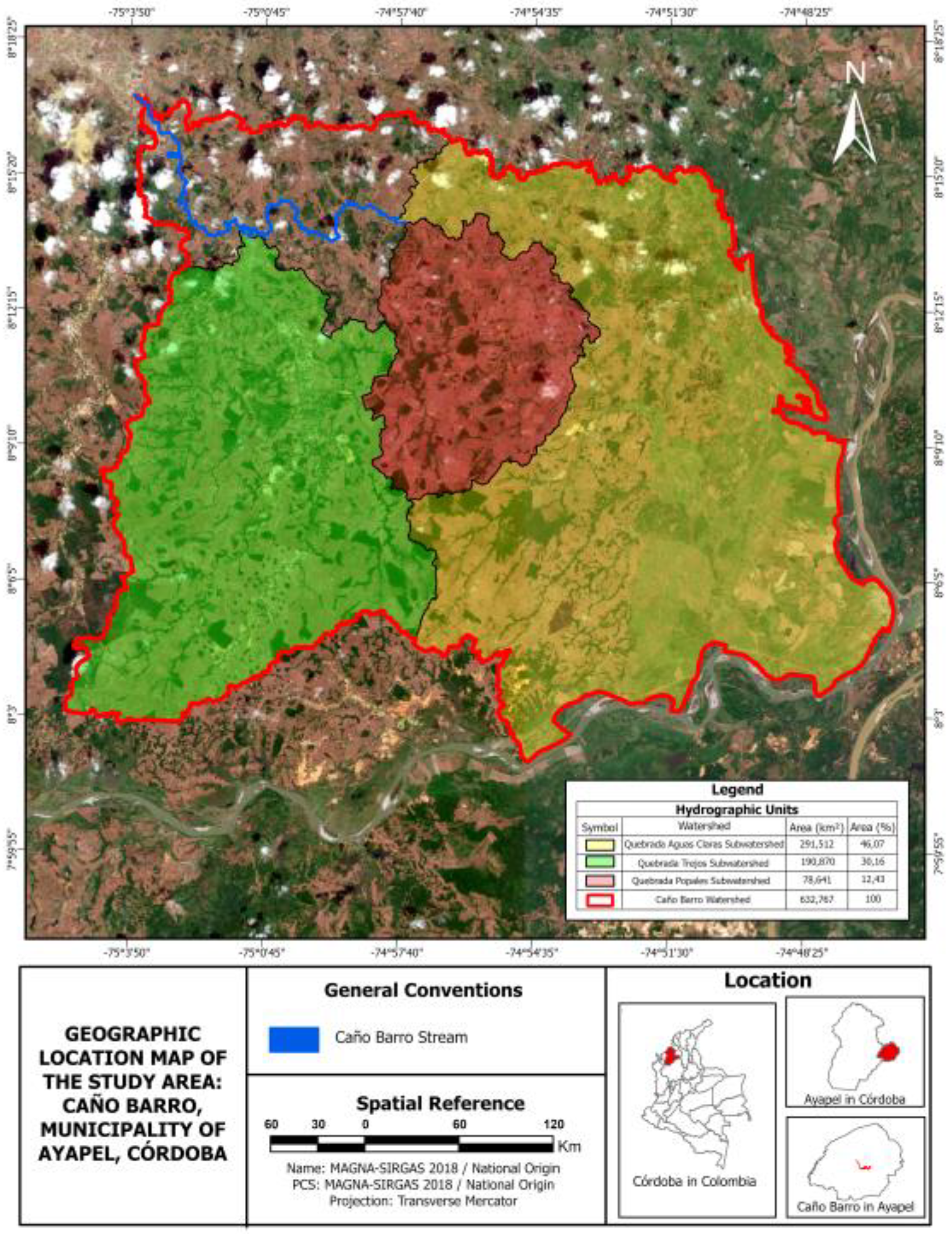

Table 1.
Main morphometric parameters of the Caño Barro watershed.
| Parameter | Value | Unit | Interpretation |
|---|---|---|---|
| Area (A) | 632.78 | km² | Medium-sized basin |
| Perimeter (P) | 186.30 | km | — |
| Basin length (Lb) | 38.74 | km | — |
| Total relief (H) | 87.92 | m | Low relief |
| Main channel length | 11.60 | km | — |
| Total stream length | 1259.58 | km | Well-developed network |
| Stream order (Strahler) | 6 | — | Complex branching |
| Compactness coeff. (Kc) | 2.09 | — | Elongated shape |
| Form factor (Kf) | 0.42 | — | Elongated |
| Circularity index (Kci) | 0.23 | — | Far from circular |
| Elongation ratio (Re) | 0.73 | — | Oval to elongated |
| Drainage density (Dd) | 1.99 | km/km² | Moderate to high |
| Stream frequency (Fc) | 2.21 | streams/km² | Moderate |
| Mean slope | 5.00% | (2.86°) | Gently inclined |
| Main channel slope | 0.017% | — | Very low gradient |
Table 2.
In-situ physicochemical parameters measured at ten sampling stations, Caño Barro, Ayapel (June 2025).
Table 2.
In-situ physicochemical parameters measured at ten sampling stations, Caño Barro, Ayapel (June 2025).
| Station | pH | Temp (°C) | DO (mg/L) | EC (µS/cm) | TDS (mg/L) | Sal. (ppt) | ORP (mV) | Coordinates |
|---|---|---|---|---|---|---|---|---|
| P1 | 7.23 | 28.6 | 3.55 | 123 | 61 | 0.06 | 215 | 8.36°N 75.03°W |
| P2 | 6.92 | 31.4 | 6.23 | 111 | 56 | 0.05 | 210 | 8.31°N 75.10°W |
| P3 | 7.08 | 29.6 | 2.58 | 127 | 63 | 0.06 | 194 | 8.34°N 75.05°W |
| P4 | 6.79 | 30.1 | 7.43 | 39 | 20 | 0.02 | 198 | 8.29°N 75.08°W |
| P5 | 7.05 | 30.2 | 6.38 | 27 | 14 | 0.01 | 212 | 8.25°N 75.08°W |
| P6 | 6.72 | 30.7 | 3.27 | 79 | 39 | 0.04 | 202 | 8.26°N 75.05°W |
| P7 | 6.87 | 28.5 | 4.35 | 66 | 33 | 0.03 | 220 | 8.23°N 74.99°W |
| P8 | 6.63 | 27.7 | 6.12 | 89 | 45 | 0.04 | 263 | 8.25°N 74.91°W |
| P9 | 5.50 | 27.9 | 5.40 | 17 | 8 | 0.01 | 289 | 8.23°N 74.95°W |
| P10 | 5.65 | 29.2 | 5.33 | 19 | 10 | 0.01 | 244 | 8.23°N 74.94°W |
Table 3.
Total mercury (Hg-T) concentrations in water samples, Caño Barro, August 2025. MDL = 0.11 µg/L; MQL = 0.32 µg/L.
Table 3.
Total mercury (Hg-T) concentrations in water samples, Caño Barro, August 2025. MDL = 0.11 µg/L; MQL = 0.32 µg/L.
| Station | Hg-T (µg/L) | Status | Note |
|---|---|---|---|
| P1 | <0.32 | Below MQL | — |
| P2 | 0.87 | Quantifiable | Exceeds CCC-EPA |
| P3 | <0.32 | Below MQL | — |
| P4 | 1.02 | Quantifiable | Exceeds CCC-EPA |
| P5 | 0.54 | Quantifiable | Below CCC-EPA |
| P6 | 1.21 | Quantifiable | Exceeds CCC-EPA |
| P7 | 97.46 | Quantifiable — Outlier | ~127× CCC-EPA; requires verification |
| P8 | <0.32 | Below MQL | — |
| P9 | 2.01 | Quantifiable | Exceeds CCC-EPA |
| P10 | 1.28 | Quantifiable | Exceeds CCC-EPA |
Reference values: US EPA CCC freshwater = 0.77 µg/L; CCME long-term = 0.026 µg/L; Colombian Decree 1076/2015 = 20 µg/L.
Table 4.
Summary of environmental impact assessment and risk analysis for Caño Barro.
| Impact | I | Classification | P | C | R=P×C | Risk Level |
|---|---|---|---|---|---|---|
| Water quality deterioration | −36 | Moderate | 2 | 2 | 4 | Medium |
| Reduced habitat suitability (DO) | −41 | Moderate | 3 | 2 | 6 | Medium |
| Hg-T ecotoxicity for aquatic life | −66 | Severe | 3 | 3 | 9 | High |
| Bioaccumulation/biomagnification risk | −47 | Moderate | 2 | 3 | 6 | Medium |
| Site-specific Hg-T hotspot (P7) | −63 | Severe | 1 | 3 | 3 | Low * |
I = Importance (Conesa); P = Probability (1–3); C = Consequence (1–4); * Low due to single unverified point; requires priority verification.
Disclaimer/Publisher’s Note: The statements, opinions and data contained in all publications are solely those of the individual author(s) and contributor(s) and not of MDPI and/or the editor(s). MDPI and/or the editor(s) disclaim responsibility for any injury to people or property resulting from any ideas, methods, instructions or products referred to in the content. |
© 2026 by the authors. Licensee MDPI, Basel, Switzerland. This article is an open access article distributed under the terms and conditions of the Creative Commons Attribution (CC BY) license (http://creativecommons.org/licenses/by/4.0/).
Copyright: This open access article is published under a Creative Commons CC BY 4.0 license, which permit the free download, distribution, and reuse, provided that the author and preprint are cited in any reuse.


