

Submitted:
20 April 2026
Posted:
22 April 2026
You are already at the latest version
Abstract
Cement manufacturing is one of the major sources of carbon dioxide (CO2) emissions globally. Cement replacement materials are increasingly used to minimize the environ-mental impact of concrete production. In the present study, the mechanical and envi-ronmental performance of concrete mixtures containing fly ash and recycled glass powder as partial cement replacements at levels of 10%, 20%, and 30% were investigated. Workability, unit weight, compressive strength, and water permeability tests were con-ducted to evaluate the effect of replacements on the behavior of concrete. Carbon emissions and performance-normalized indicators were applied to evaluate environmental performance. It was observed that as the replacement level increased, the carbon emis-sions decreased. The highest reduction was observed at the 30% replacement level, as 28.9%. Compressive strength varied between 21.9 and 27 MPa. This indicates that all mixtures met the targeted strength range. The mixture with 30% fly ash demonstrated the highest environmental efficiency, with a carbon intensity of 10.84 kg CO₂/MPa. This in-dicates a 19.2% reduction compared to the control mixture. The sensitivity analysis re-vealed that changes in emission factors did not alter the order of the mixture.
Keywords:
cement replacement
; fly ash
; glass powder
; compressive strength
; water permeability
; life cycle assessment
; carbon intensity
1. Introduction
The construction industry is a major contributor to global energy use, natural resource consumption, and carbon emissions. Concrete is the most commonly used construction material worldwide. However, its main binder, Portland cement generates significant carbon emissions. Cement manufacture is one of the most carbon-intensive industrial processes, contributing around 7% of the world’s anthropogenic CO2 emissions [33]. Due to increasing environmental regulations and climate change concerns, research on sustainable construction materials has been increasing day by day. To reduce cement consumption and environmental damage, partial substitution of Portland cement with recycled materials and industrial by- products has become a widely adopted strategy. Fly ash (FA) and glass powder (GP) are among the most researched recycled materials in sustainable concrete. For decades, fly ash, which is a by-product of coal power plants, has been used as a supplementary material in cement production. However, most studies consider mechanical and environmental performance independently, resulting in a major research gap.
The intersection between mechanical performance and environmental impact has not received enough attention. Only a limited number of researches report performance-based indicators such as carbon emissions per unit of compressive strength (kg CO₂/MPa). Selecting appropriate replacement levels is challenging without these metrics. The relationship between carbon reduction and structural performance is uncertain. This study aims to address this gap.
During cement hydration pozzolanic characteristics of fly ash enable it to interact with calcium hydroxide and produce supplementary calcium-silicate-hydrate (C-S-H) gel and improve long-term strength and durability [1,2]. Moderate fly ash replacement levels improve pore structure and reduce water infiltration, but elevated replacement levels may adversely affect early-age strength [3,4,5,6]. Fly ash is also a fundamental element in alkali-activated and geopolymer systems, where it contributes to low shrinkage, reduced creep, and strong sulfate resistance [7].
Globally, millions of tons of waste glass are generated annually, and when not recycled, a significant portion is disposed of in landfills. The use of powdered waste glass as a partial cement replacement is one way to utilize this waste. [8,9,10,11,12,13]. The utilization of waste glass in the cement industry is beneficial not only for reducing cement demand but also for eliminating melting energy, thereby cutting down CO₂ emissions [14]. By grinding glass powder to fine sizes, glass powder develops pozzolanic activity. Due to its fine nature, it enhances particle packing within the cement matrix and also reacts with calcium hydroxide to produce additional C-S-H gel [15,16,17,18]. Previous studies indicate that 10–20% levels of replacement result in an increase in compressive strength and a decrease in permeability. However, above these levels workability decreases while the rate of gain in strength becomes constant. [19,20,21,22,23]. Fineness is a key factor since higher degrees improve the reactivity and also keep strength high even at elevated replacement rates [21,22]. Like fly ash, glass powder has also been tested in alkali-activated systems. However, it appears more sensitive to mixture adjustments. [23]. A comparison of the these materials indicates a complex relationship. Glass powder shows a noticeable strength advantage at early curing stages. But this difference tends to diminish as curing time increases. [24,25,26]. In recent years, researchers have studied beyond binary systems. Glass powder was combined with other industrial by-products and these are used in more advanced binder systems [27,28,29,30,31,32]. In summary, these observations emphasize that performance depends on a combination of material type, particle size, and replacement level, rather than any single factor alone.
Concrete specimens were prepared using fly ash and glass powder at replacement levels of 10%, 20%, and 30%. Fresh concrete properties like slump, Vebe time, and air content were measured according to standard procedures. The specimens were cured for 28 days. After curing Schmidt hammer readings, compressive strength tests and water permeability tests were conducted on the specimens.
To evaluate environmental performance, embodied carbon was calculated within a cradle-to-gate system boundary. Based on these values, the carbon intensity (kgCO₂/MPa of compressive strength) was determined. This parameter enables the relationship between environmental efficiency and structural performance to be assessed. Present research presents three major contributions to the body of knowledge. Firstly, the study combines mechanical properties with environmental effects through performance-normalized indices. In other words, it facilitates the ability to compare environmental effectiveness with compressive strength. Secondly, it studies the behavior of FA and GP substitutes in mixtures with high water-to-cement ratios without chemical admixtures. Thirdly, it proposes substitution levels for both FA and GP that combine mechanical efficiency, durability, and carbon reduction.
2. Materials and Methods
In this study, the effects of recycled fly ash and glass powder on the fresh and hardened properties of concrete were compared. Concrete mixtures were prepared without using chemical admixtures in order to better understand the intrinsic role of fly ash and glass powder. This simplified setup reveals the behavior of fly ash (FA) and glass powder (GP) more directly. In this setup, the factors arising from chemical interactions are eliminated. In particular, the study described here is limited to concrete mixtures with a relatively high water-to-cement ratio (w/c = 0.60). When used in practice, such mixtures are usually developed as low-strength concretes for field applications. The selected water-cement ratio of 0.60 signifies low-to-medium strength concrete that is often used for nonstructural purposes, such as pavements, mass concrete, and leveling layers. In addition, this ratio allows enough water content to ensure that pozzolanic reactions continue at early curing ages, since replacement cementitious materials such as fly ash and glass powder need adequate moisture for secondary hydration products to develop. Although lowering the water-cement ratio would increase the baseline strength, it would be harder to identify the contribution of SCMs because the strength range would be compressed, making differentiation between mixtures more difficult. This study does not target a specific strength class. Rather, the emphasis is placed on the effect of these supplementary materials on important properties such as workability, unit weight, and compressive strength under representative conditions.
The aim is to evaluate the mechanical performance, durability, and environmental impact of concrete mixtures with FA and GP. Many previous studies have examined these aspects separately. By contrast, the present work combines structural performance with environmental efficiency.
The present work offers three distinct contributions to the field. Firstly, it merges mechanical performance with environmental impact through performance-normalized indicators. This allows for a direct comparison of environmental efficiency and compressive strength. Secondly, it analyzes the levels of FA and GP replacements under conditions of high water-to-cement ratios without the use of chemical admixtures. These conditions represent real-world construction scenarios. They also utilize simplified mixture designs. Lastly, the proposed framework provides replacement levels that strike a balance between mechanical performance, durability attributes, and carbon reduction potential. It thus provides practical mixture selection recommendations based on integrated engineering and environmental criteria.
To ensure a reliable basis for comparison, a mixture composed solely of Portland cement was utilized as the control group. Using this control as a reference, the effects of FA and GP were examined more clearly.
2.1. Design of Experiments
Tests began with a concrete mixture called Control, containing 100% cement, to serve as a reference in the study. Subsequently, mixtures were prepared with fly ash or glass powder as replacements for 10%, 20%, and 30% of the cement. As a result, there were seven mixture types in total. Cubic test specimens were cast for each type of mixture. The performed tests were related to fresh and hardened properties of concrete. In this regard, fly ash or glass powder was used to replace 10%, 20% or 30% of the cement content in the mixtures. Such methodology provided information regarding the concrete mixtures that are relevant, comparable, and representative. In all concrete mixtures, the water to cement ratio was kept constant (around 0.60). The maximum aggregate size selected was less than 20 mm. The effect of mineral admixtures on concrete properties was investigated directly; therefore, no chemical additives were used. Concrete mixtures of proportions and materials are shown in Table 1.
The replacement type and level were accounted for while assigning the names of concrete mixtures under investigation. “Control” represents the reference mixture, made of pure cement without any replacement. The abbreviations “FA” and “GP” stand for fly ash and glass powder, respectively. Mixture names contained numbers equal to 10%, 20%, or 30% depending on the cement replacement level. Thus, “GP-20” indicated that cement replaced with 20% of glass powder. The name “FA-10” indicated that the cement content was replaced with 10% of fly ash. Such a naming convention helps to make comparative evaluation of influence of different types and levels of replacement on concrete properties both at fresh and hardened states.
2.2. Sample Preparation and Curing Conditions
The experiments were conducted in the Construction Department Laboratory, Vocational School, Kyrgyzstan Turkey Manas University. The concrete mixtures were cast in 150×150×150 mm cube molds. Casting was carried out according to the TS EN 12390-2. The inner surfaces of the molds were oiled. To prevent segregation, concrete was placed in three layers. Each layer was compacted using a mechanical vibrator. After casting, the molds were covered with a damp cloth and plastic sheeting to prevent moisture loss during setting. Specimens were removed from the molds after approximately 24 hours and then cured in a water tank at 20 ± 2 °C for 28 days.
2.3. Test Methods
The following standard test methods were used to evaluate both fresh and hardened concrete properties. Fresh concrete tests focused on key workability characteristics like workability, ease of placement, and homogeneity. Hardened concrete tests were carried out to quantitatively assess the influence of additive materials on mechanical strength, durability, and water permeability.
2.3.1. Fresh Concrete Tests
Unit weight was measured to assess fresh concrete density and placement quality. The slump test (TS EN 12350-2) was carried out to obtain a practical sense of consistency and workability. Air content (TS EN 12350-7) was determined using a Type A pressure air meter to measure the amount of air in the fresh mix. The workability test applied was the Vebe test (TS EN 12350-3), using a standard Vebe apparatus. It consisted of measuring, in seconds, the time it took until the concrete became fluid under vibration.
2.3.2. Hardened Concrete Tests
For the compressive strength test (TS EN 12390-3), 150 mm × 150 mm cube specimens were tested after 28 days of curing at a loading rate of 0.6 ± 0.2 MPa/s. The Schmidt hammer test (TS EN 12504-2) was applied to indirectly determine compressive strength by measuring surface hardness and to check uniformity. An N-type hammer was used to obtain ten readings from each specimen, and the average rebound value (R) was noted. To evaluate permeability, which is a key indicator of durability, a water permeability test was conducted according to TS EN 12390-8. Specimens were subjected to 5 bar (0.5 MPa) of water pressure for 72 hours. After splitting them open, the average depth of water permeability (in mm) was measured.
3. Results and Discussion
3.1. Fresh Concrete Properties
3.1.1. Unit Weight, Slump, and Vebe Time
The unit weight of concretes with fly ash and glass powder was investigated. All mixtures had a high water-to-cement ratio (w/c = 0.60) and were prepared without chemical additives. To better understand the results, we considered not only the average unit weight but also the standard deviation and coefficient of variation (COV). Unit weights of prepared mixtures are given in Figure 1. Statistical analysis, shown in Table 2, was also conducted to evaluate the variability and reliability of the results. For all mixtures, the COV values were below 1%. This indicates that the results are statistically reliable and reproducible. It also shows that the mixtures were produced in a controlled way, even without chemical admixtures. The variability in the measurements stayed within acceptable limits. The control concrete, which contained 100% cement, had a unit weight of 2364.67 kg/m³. Its standard deviation was 17.03 kg/m³, and its COV was 0.72%.
The unit weight of the control concrete was relatively high. The standard deviation and COV values of control concrete were within acceptable ranges. This indicates that control concrete with a high water/cement ratio exhibits adequate homogeneity in the absence of chemical admixtures. This makes the control mixture a reference point for variability in the evaluation of admixtures. In concrete mixtures containing fly ash, a gradual and limited decrease in unit weight was observed with increasing additive ratio. Unit weights were measured as 2361.00 kg/m³, 2354.71 kg/m³, and 2348.98 kg/m³ in mixtures containing 10%, 20%, and 30% fly ash, respectively. For FA-20, the decrease in standard deviation to 15.31 kg/m³ and COV value to 0.65% indicates that this mixture has a more uniform internal structure compared to the control concrete.
Due to the spherical particle shape and filling effect of fly ash, the void distribution between the concrete paste and the aggregate becomes more balanced. This causes a reduction in the variability between measurements. In FA-30, the standart deviation was 18.79 kg/m³ with a COV of 0.80%. This indicates that limitations related to processability and water distribution may arise at high substitution rates, but are not excessive. A greater decrease in unit weight was observed in GP mixtures compared to FA mixtures.
For the GP-10 mixture the unit weight, standard deviation, and COV values were determined as 2326.18 kg/m³, 15.35 kg/m³, and 0.66%, respectively. This indicates that in mixtures with a high water/cement ratio, glass powder functions as a microfiller in the concrete and increases the stability of the pore structure at low replacement levels.
In the GP-20 and GP-30 mixtures, the unit weight decreased to 2311.05 kg/m³ and 2288.72 kg/m³, respectively. The standard deviation of GP-20 was 18.72 kg/m³ with a COV of 0.81%, while those for the GP-30 mixture were 15.79 and 0.69%, respectively. This suggests that, in the absence of chemical additives, an increase in the proportion of glass powder increases the water demand and can negatively affect the internal homogeneity of the concrete to a limited extent. The control concrete had the highest unit weight, followed by mixtures containing fly ash, while mixtures containing glass powder showed the lowest values. When standard deviation and COV values are evaluated together, it was observed that especially FA-20 and GP-10 offer a more stable, homogeneous, and predictable structure. These findings demonstrate that waste-based mineral admixtures affect not only the physical properties of concrete but also its production stability and internal structure homogeneity.
Slump and Vebe tests were conducted to quantitatively evaluate the effect of observed changes in unit weight and homogeneity on the properties of fresh concrete. These tests showed that admixtures play a decisive role in the workability of concrete. The workability properties of concrete mixtures produced with different admixtures were evaluated, and the results are given in Table 3.
The effects of mineral admixtures (FA and GP) on fresh concrete properties were evaluated in mixtures produced without chemical admixtures and with a high water/cement ratio (w/c = 0.60), using slump and Vebe tests. In this context, the effects of different mineral admixtures on workability were investigated, and the slump values of the mixtures were determined using the slump test, and the results are presented. The slump of control concrete was 123.5 mm with a Vebe time of 6 seconds. These results show that the concrete is flexible and workable. It was observed that although the high water/cement ratio was used, the lack of chemical additives limited fluidity; however, workability remained.
The control concrete’s high unit weight indicates a stable fresh concrete behavior and a compact internal structure. It has been observed that as the substitution ratio increases, the slump values of concrete mixtures containing fly ash increase while the Vebe times decrease regularly. In the FA-10 mixture, the slump value increased to 142.8 mm. Consequently, the Vebe time decreased to 4.5 seconds, and the concrete exhibited plastic-fluid behavior. In the FA-20 and FA-30 mixtures, the slump values were measured as 174.1 mm and 207.9 mm, respectively, and the Vebe times decreased to 2.8 seconds and 1.5 seconds. This indicates that the spherical grain structure and ball-bearing effect of fly ash reduce internal friction, thereby increasing the fluidity of the concrete mixture. Especially the FA-30 mixture exhibits behavior close to self-compacting concrete (SCC) with its high slump and very low Vebe time.
Unlike fly ash, in mixtures containing glass powder, the workability decreases as the substitution ratio increases. In the GP-10 mixture, the slump value was 114.6 mm and the Vebe time was 5.6 seconds, indicating plastic-medium consistency behavior. In the GP-20 mixture, the slump value decreased to 76.8 mm, and the Vebe time increased to 7.9 seconds. In the GP-30 mixture, the slump value was measured as 48.9 mm and the Vebe time as 12 seconds, and the concrete showed a hard consistency structure. This behavior can be attributed to the properties of glass powder. Due to its angular grain structure and high specific surface area, it increases the water requirement. As a result, in the absence of chemical additives, the flow of the concrete paste is restricted.
When unit weight and workability results are evaluated together, a strong relationship is observed between fresh concrete behavior and internal structure density. Figure 2 shows the relationship between slump and unit weight for FA and GP mixtures. As seen in the figure, fly ash mixtures maintained relatively high unit weight while slump increased significantly. In contrast, glass powder mixtures showed a steady decline in both unit weight and slump as the replacement ratio increased. This confirms that the spherical shape of fly ash particles improves particle packing and flowability simultaneously, while the angular shape of glass powder restricts both density and workability.
The control and fly ash-containing mixtures exhibited a more compact and fluid structure with high unit weight and low Vebe time. In contrast, unit weight decreased in glass powder-containing mixtures, and workability decreased significantly. Figure 3 presents the relationship between slump and Vebe time for FA and GP mixtures. It is evident from the graph that there exists an inverse relationship between slump and Vebe time. The fly ash mixtures exhibit a steeper negative slope, implying that even minor changes in slump result in substantial decreases in Vebe time. On the other hand, the glass powder mixtures display a less pronounced trend with higher Vebe times despite having similar slump values due to their lower fluidity. The fact that all COVs are below 1% suggests that the data are statistically sound.
It can be concluded that fly ash had a highly significant effect on the increase of workability in concrete mixtures, while glass powder gradually decreased workability. The results indicate that it is important to consider the relationship between slump and Vebe, as well as average values, when evaluating the effect of waste-based mineral admixtures on fresh concrete properties.
3.1.2. Air Content
Air content plays a vital role in the performance of concrete since it affects the strength and workability directly. In this study, a compressed air measurement test was conducted to determine the air content of fresh concrete. The results are presented in Figure 4. The air content of the control concrete was approximately 2.0%. In the FA mixtures, the air content decreased gradually depending on the replacement level. It was determined as 1.9%, 1.8%, and 1.7% for FA-10, FA-20, and FA-30, respectively. These represent an overall absolute decrease of approximately 0.3% in air content up to 30% fly ash replacement. GP mixtures exhibited different behavior. The air content of the GP-10 mixture was approximately 2.0%, similar to the control concrete. However, for the GP-20 and GP-30 mixtures, the air content increased to approximately 2.1% and 2.5%, respectively.
It has been observed that replacement type and level have a significant effect on the air content. Despite the high water-to-cement ratio, fly ash caused a gradual decrease in air content. This may be due to better self-compaction and tighter particle packing. In contrast, glass powder caused an increase in air content at higher replacement levels. This may be due to its increased ability to trap more air and the angular shape of the particles. These findings demonstrate that the physical characteristics of the additives significantly influence the behavior of fresh concrete.
3.2. Properties of Hardened Concrete
3.2.1. Compressive Strength
The 28-day compressive strength test was conducted as shown in Figure 5.
Compressive strength results presented in Figure 6 illustrate the effect of replacement materials on concrete strength. The compressive strength of the control mixture was 27.0 MPa. This value is used as a reference for the analysis. In FA mixtures, compressive strength gradually decreased at higher replacement levels. The behavior of FA-10 was quite similar to the control concrete, with a value of 26.8 MPa. For FA-20 and FA-30, the compressive strength was 25.6 MPa and 24.5 MPa, respectively. These results show a significant decrease compared to the control concrete.
Reduction in compressive strength of mixtures containing glass powder was more evident. The GP-10 mixture exhibited a slight decrease compared to the control unit, with a strength of 26.2 MPa. As the glass powder substitution level increased to 20% and 30%, the compressive strength declined to 23.4 MPa and 21.9 MPa, respectively. Especially, the GP-30 mixture showed an approximate strength loss of 19% relative to the control.
Overall, it was observed that the 28-day compressive strength values decrease with increasing substitution ratio. The 28-day compressive strength values obtained for all mixtures range from 21.9 to 27.0 MPa, which is within the expected performance range for concretes with a w/c ratio of 0.60.
Figure 7 presents the relationship between air content and 28-day compressive strength for all mixtures. Overall, the graph shows that an increase in air content is associated with a reduction in compressive strength.
Mixtures containing fly ash with lower air content (1.7–1.9%) generally exhibited higher compressive strength, while mixtures incorporating glass powder with higher air content (2.1–2.5%) tended to show lower strength values. Specifically, the GP-30 mixture emerged as the case with both the highest air content and the lowest compressive strength.
In the graph, the symbol size represents the replacement level. It increases as the replacement level increases. The figure shows that as the replacement level increases, the air content tends to increase as well. This pattern is more noticable in glass powder mixtures. Therefore, it can be said that air content plays a significant role in the fresh concrete structure.
In conclusion, the findings show that both the replacement level and the associated air content affect compressive strength. The strength reduction was less significant with fly ash, whereas a more pronounced decrease in strength was observed in glass powder mixtures as air content increased.
These findings imply that concrete performance is significantly influenced by the type of replacement material used. The results show that at moderate substitution levels, fly ash can maintain strength performance within a relatively constant range. In contrast, glass powder requires more careful evaluation, especially at greater replacement levels.
3.2.2. Statistical Evaluation of Compressive Strength
A two-way analysis of variance (ANOVA) was conducted to investigate the effects of replacement type and replacement level on 28-day compressive strength. The results are presented in Table 4. Five samples were prepared for each group, and a total of 40 experiments were conducted. Statistical analysis confirmed that this number was sufficient as shown in Table 5.
The conducted statistical analysis revealed that both the replacement level and the type contributed significantly to compressive strength at p < 0.001. With an effect size of η²p = 0.912, the replacement ratio was found to be the dominant factor. With an effect size of η²p = 0.685, the replacement type was statistically significant. This means that FA and GP mixtures followed different strength performance trends.
A post-hoc power analysis was conducted for the two-way ANOVA using a non-central F distribution (α = 0.05). The calculated partial eta squared (η²p) was used to calculate Cohen’s f values. These values ranged from 1.115 to 3.219. This represents very large effect sizes according to standard criteria [37] and five samples per group (n = 5) were used. The statistical power for all main effects and the interaction term was greater than 0.98. This is much higher than the conventional threshold of 0.80. The minimum sample size needed for 80% power was estimated to be n = 2–4. Thus, n = 5 offered a sufficient safety margin.
A statistically significant interaction effect was also detected between additive type and replacement ratio (p < 0.001, η²p = 0.554). This result implies that the effect of the replacement ratio is different for both materials. In practice, FA and GP mixtures show different patterns of strength reduction instead of a steady decline. To ascertain which particular groups exhibited significant differences, Tukey’s Honestly Significant Difference (HSD) test was conducted (α = 0.05). Table 6 only shows statistically significant comparisons for clarity. Comparisons that are not statistically significant (p > 0.05) are not shown.
FA and GP mixtures performed similarly at the 10% replacement level. There was no statistically significant difference between CONTROL and FA-10 or GP-10 (p > 0.05). The strength performance of GP mixtures was significantly lower than that of FA mixtures at replacement levels of 20% and 30%. There were significant differences between CONTROL and FA-20 (p = 0.028), CONTROL and FA-30 (p < 0.001), CONTROL and GP-20 (p < 0.001), and CONTROL and GP-30 (p < 0.001). This variation suggests a significant interaction between replacement type and replacement level. Thus, the replacement ratio is the main factor influencing 28-day compressive strength. The rate at which strength declines as the substitution level rises is also influenced by the type of replacement material. Therefore, the effect of replacement is not the same for FA and GP systems. While fly ash mixtures remain more stable with increasing replacement levels, glass powder mixtures lose their strength more quickly.
3.3. Durability-Related Performance
3.3.1. Schmidt Test
Schmidt hammer rebound test was conducted to confirm the results of compressive strength. For both replacement materials, a good relationship between rebound number and compressive strength was observed, as shown in Figure 8 and Figure 9. This confirms the reliability of non-destructive measurements.
For FA-replaced mixtures, the relationship was obtained as (fc = 0.65R + 2.6, R² ≈ 0.97). It is obseved that rebound number and compressive strength decreased gradually for inreasing fly ash level. This proves that the Schmidt test accurately captures the strength reduction.
For GP-replaced concretes, the relationship was (fc = 0.92R − 6.3, R² ≈ 0.93). The slope of GP mixtures is higher than that of FA mixtures. This suggests that surface hardness is more sensitive to strength changes in GP mixtures. Rebound numbers decreased with an increasing replacement ratio. This behavior was consistent with the compressive strength results. Such changes in rebound number are due to the decrease in the number of hydration products and the density of the matrix, which arise due to the decrease in cement content.
The higher slope value in the GP mixture indicates a greater influence of strength changes on the rebound value, which may be related to differences in particle structure and adhesion properties. Glass particles form a heterogeneous internal structure.
To summarize, the Schmidt test is a helpful field instrument for tracking changes in strength in combinations made of recycled materials. However, its results must always be evaluated alongside conventional compressive strength tests.
3.3.2. Water Permeability
One of the most important factors affecting the durability of concrete is its water permeability. Concrete is naturally a porous material. These pores enable the penetration of water, harmful ions such as chloride, and sulfate into the concrete. This may cause corrosion of reinforcement and reduce the service life. Therefore, evaluating the permeability of concrete that contains different replacement materials is extremely important. Permeability test results presented in Table 7 demonstrated that both replacement type and level have a significant effect on the internal structure of concrete. The permeability of the control concrete was found to be 27.6 mm. This value was consistent with the tested concrete mixture. Moreover, the low values of standard deviation (1.66) and COV (6.01%) indicate stable test results.
Figure 10 illustrates the permeability values of tested mixtures. It was observed that fly ash generally reduced the permeability of the concrete. The lowest permeability value was obtained in the FA-20 mixture at 18.4. This could be due to micro structural refinement. Fine particles fill voids between cement grains. Pozzolanic reactions produce additional hydration products. These reactions reduce pore continuity. The inner structure becomes more compact.
A slight improvement in the FA-30 mixture permeability level is noticeable. This is due to the limited positive influence of the substitution process. With greater substitution levels, there is not enough reactive binder. In such conditions, the diluting effect starts playing its role. As a result, an increase in permeability takes place. The COV in the FA mixtures ranges between 6-7%.
There was a marked increase in permeability when more glass powder (GP) was used. Although the GP-10 mix had nearly the same value for permeability compared to that of the control concrete mix, the permeability in the GP-20 and GP-30 mixtures was 35.3 and 44.6 respectively. The significant increase in permeability values of GP-20 and GP-30 can be attributed to three reasons. Firstly, high water demand caused by an elevated specific surface area has adversely affected workability and dispersibility. Secondly, the low pozzolanic activity of the material compared to fly ash has led to a less developed pore structure at 28 days. Thirdly, micro-cracking may occur due to angular particles during mixing and hardening.
These findings indicate that replacement level must be carefully controlled for glass powder mixtures. Lower replacement levels may be suitable for general applications. Higher levels require additional design considerations. COV values in the GP series are in the range of 6.5–10.5%. This indicates that the results are acceptable.
Overall, the results show that durability of a unit depends on both material type and replacement ratio. This effect is more visible because of the absence of chemical admixtures in the mixtures. Under these simplifications, the true behavior of each material can be observed more clearly.
Figure 11 shows the relationship between the 28-day compressive strength and water permeability of the mixtures studied. In general, it was observed that as compressive strength increases, permeability decreases; in other words, these parameters are inversely proportional.
In the control concrete, the compressive strength was approximately 27 MPa, and the water permeability depth was 27.6 mm. It should be underlined that as the strength of FA replacement mixtures decreases, their permeability increases. In particular, the FA-20 mixture gave the lowest permeability value of 18.4 mm with a strength of 25.6 MPa. This is due to fly ash’s pozzolanic reactions, which thin the pore structure and reduce capillary continuity. In the FA-30 mixture, a decrease in strength and an increase in permeability (22.1 mm) were observed. This finding showed that the binder effectiveness decreased at high substitution levels.
The relationship between strength and permeability is more pronounced in GP-replacement mixtures. While GP-10 performed close to the control concrete, the decrease in strength and increase in permeability were more evident in GP-20 and GP-30. The GP-30 mixture gave the lowest compressive strength at 21.9 MPa and the highest water permeability at 44.6 mm. This is due to the high percentage of glass powder substitution increasing air voids and irregular microstructures.
The difference between the two materials can be explained by their reaction mechanisms. Fly ash participates in pozzolanic reactions over time. Such reactions enhance the bond strength of the matrix. The function of glass powder in the initial phase of curing is mainly a physical one rather than a chemical one. The glass powder contributes to the physical filling stage of the concrete.
The above results show that compressive strength alone cannot be used to measure the performance of the concrete. Factors like permeability should be considered to predict future performance.
3.4. Environmental Performance
This study also examined the environmental performance of concrete mixtures from a life-cycle approach. This included the manufacturing, transportation, construction, and demolition processes within the scope. This approach provides a more realistic representation of environmental impact.
The goal is to evaluate the environmental benefits of partial cement replacement with supplementary materials. A controlled methodological approach is used to determine the maximum possible reduction in carbon emissions.
Emission factors were based on widely reported international average datasets. Region-specific industrial data were not considered. International average datasets are commonly used to compare the environmental performance of construction materials.
Performance-normalized indicators ensured that environmental improvements do not compromise structural performance. A sensitivity analysis was also conducted to evaluate key parameters and to improve transparency in the environmental assessment framework.
The results showed that increasing cement replacement consistently reduced embodied carbon. The highest reduction was achieved at the 30% replacement level. This reduction is primarily related to the lower cement content in the mixture. Cement production is the main source of carbon emissions in concrete systems. The sensitivity analysis confirmed that changes in emission factors affected absolute values but did not change the ranking of mixtures. This shows that the environmental findings are reliable.
3.4.1. Carbon Emissions
For each mixture the total embodied carbon (EC) was calculated using the following equation:
where EC represents the total embodied carbon (kg CO₂/m³), mi represents the mass of material i (kg/m³), and EFi represents the emission factor of material i (kg CO₂/kg). The equation is applied seperately for each replacement type as shown below.
where mcem, mFA , mGP , and magg represent the mass of cement, fly ash, glass powder, and total aggregate, respectively. The emission factors used in the base case are given in Table 8. These values are averages from international environmental databases. They are commonly used in concrete material assessments. The emission factors for cement, fly ash, and aggregate are provided from the Inventory of Carbon and Energy (ICE) database [34]. The emission factor for recycled glass powder (0.10 kg CO₂/kg) was determined using the Tier 1 default emission factor method suggested in the IPCC guidelines [35]. This approach agrees with the energy-based estimation principle proposed by Meyer et al. [36]. In this study, recycled glass was regarded as a secondary material. Consequently, the emission factor reflects only the energy related to the collection and grinding processes. This means that emissions from primary production are excluded from the system boundary. This approach is consistent with the recycled-content approach in life cycle assessment research.
To assess uncertainty associated with cement production emissions, the cement emission factor was varied by ±10% (0.81 and 0.99 kg CO₂/kg). The sensitivity analysis confirmed that absolute EC values change proportionally with variations in the cement EF. However, the relative ranking of the mixtures remained unchanged. Cement content is therefore validated as the primary parameter governing carbon mitigation within the investigated system boundary.
3.4.2. Carbon Reduction Potential
To accurately evaluate the environmental benefit of cement replacement, the percentage reduction in embodied carbon relative to the control mixture was calculated using:
Table 9 presents the embodied carbon and CO₂ reduction percentages for all mixtures at the cradle-to-gate boundary. In conclusion, it was observed that increasing cement substitution in both material types reduced embodied carbon. FA-30 exhibited the greatest reduction (28.9%), followed by GP-30 (26.1%).
3.4.3. Transportation, Construction, and End-of-Life Parameters
The life cycle was completed by adding construction and demolition processes to the cradle-to-gate boundary. In this context, the parameters presented in Table 10 were considered for stages other than material production.
Based on the values shown in Table 10, the calculations for additional emissions for each stage per unit volume of concrete can be determined as follows. The contribution of transportation is 23.53 kg CO₂/m³ (2.353 ton/m³ × 100 km × 0.10 kg CO₂/ton-km). The construction energy gives a contribution of 2.50 kg CO₂/m³ (5 kWh/m³ × 0.50 kg CO₂/kWh). For the demolition energy, the conversion from MJ to kWh was first done by dividing the value of MJ by the ratio 1 kWh = 3.6 MJ, giving a value of 13.08 kWh/m³ (20 MJ/ton ÷ 3.6 × 2.353 ton/m³), equivalent to a gross emission of 6.54 kg CO₂/m³. With the recycling rate of 70%, the contribution of demolition is 1.96 kg CO₂/m³. Thus, the sum of stages yields 23.53 + 2.50 + 1.96 = 28.0 kg CO₂/m³.
3.4.4. Embodied Carbon Results
Table 11 represents the total values of embodied carbon for all mixtures when the transportation, construction, and disposal emissions (28 kg CO₂/m³) were added to cradle-to-gate embodied carbon. The control mix had the largest total value of embodied carbon (334 kg CO₂/m³) while the FA-30 mix had the smallest total value (237.7 kg CO₂/m³), indicating a decrease of 26.7%. Among glass powder mixtures, GP-30 achieved a 24.0% reduction compared to the control. Transportation, construction, and disposal emissions added approximately 8% of total embodied carbon for all mixtures.
3.4.5. Carbon–Strength Efficiency Assessment
Although embodied carbon per cubic meter provides a direct environmental indicator, concrete is fundamentally a structural material. Therefore, environmental efficiency must be evaluated relative to mechanical performance. The functional unit in this analysis is 1 m³ of concrete with 28-day compressive strength. Carbon intensity (kg CO₂/MPa) is calculated by dividing embodied carbon (kg CO₂/m³) by compressive strength (MPa).
The carbon intensity (CI) is obtained using the above formula:
where:
CI = carbon intensity (kg CO₂/MPa),
EC = embodied carbon (kg CO₂/m³),
fc = 28-day compressive strength (MPa).
This value normalizes the environmental impact according to mechanical capacity per unit volume. It is compatible with studies used in the field of sustainability. While other definitions exist, such as normalizing the value against strength and volume (e.g., EC / (fc× volume)), the current one was chosen since all samples used in this study had the same geometric configuration and loading conditions, making it possible to compare only their mechanical capabilities.
Lower CI values indicate greater environmental efficiency per unit structural capacity. Table 12 presents the performance-based carbon intensity results for all mixtures at the cradle-to-gate + construction + demolition stage. The control mixture exhibited the highest CI (13.42 kg CO₂/MPa), while FA-30 achieved the lowest value (10.84 kg CO₂/MPa).
Environmental and structural performance should be evaluated together. Concrete is often loaded under external forces; therefore, environmental indicators must be analyzed together with strength. In this regard, carbon intensity helped to establish the connection between environmental efficiency and mechanical capacity. A lower carbon intensity shows better environmental efficiency per unit of strength.
The carbon intensity of concrete reduced with increasing replacement proportion in the fly ash group. FA-30 produced the best results compared to other mixtures in terms of carbon intensity, proving the environmental efficiency of a high proportion of replacement material.
On the other hand, the GP series had a very tight range of carbon intensity values of 12.73, 13.01, and 12.57 kg CO₂/MPa for GP-10, GP-20, and GP-30, respectively. Consequently, there was a seemingly steady trend for the GP series when compared to the FA series. This could be attributed to two opposing effects. As the glass powder ratio increased, both embodied carbon and compressive strength decreased. The environmental gain from lower cement content was offset by strength loss. As a result, carbon intensity values remained relatively consistent across the GP series. In particular, GP-30 achieved the lowest embodied carbon level. However, its carbon intensity did not become too low due to strength loss.
However, the choice of optimal mixture cannot be made only on the basis of its environmental efficiency. The stability of mechanical performance should also be taken into consideration. Thus, the mixture with lower emissions is not necessarily characterized by high structural reliability. Intermediate levels of replacement might be an appropriate choice.
3.4.6. Interpretation of Life Cycle Results
As depicted in Table 11 and Table 12, the control mixture exhibited the highest carbon intensity among all analyzed mixtures across all scenarios. Among the fly ash mixtures, carbon intensity decreased consistently as the replacement ratio increased. Thus, FA-30 achieved the lowest carbon intensity, corresponding to a 19.2% improvement compared to the control mixture.
In the glass powder mixtures, embodied carbon also decreased with increasing cement replacement. However, the reduction in compressive strength limited the carbon efficiency of these mixtures. This pattern persisted even under the sensitivity scenarios, indicating that strength loss is the primary factor constraining environmental efficiency in the glass powder series.
Considering absolute emission reduction, carbon efficiency, and overall life cycle environmental impact, FA-30 clearly emerges as the most environmentally optimal mixture within the defined system boundary.
However, in actual applications, structural safety requirements or strength design considerations determine the type of material used in mixtures. In such cases, FA-20 may serve as a technically balanced option. Even though FA-20 fails to maximize carbon reduction, it maintains a conservative strength behavior while still ensuring significant environmental benefits.
In summary, it can be concluded that the environmental positive aspect of increasing fly ash content is clearly demonstrated through structural stability and analysis techniques. The cement substitution ratio remains the main factor in carbon emissions reduction, with fly ash proving to have better performance than glass powder.
3.5. Limitations
Despite the detailed experimental and environmental analysis conducted in this study, there were some limitations that should be considered. The mechanical and durability properties of the specimens were analyzed at only one curing age (28 days), and this may not fully capture the material’s long-term performance. A relatively high w/c ratio (0.60) and the lack of chemical additives were purposely selected to ensure the simplicity of the mixture design. However, variations in the mixture design can affect the results obtained. The emission factor employed in the calculation of environmental impact was based on international averages. No region-specific industrial data was employed. This was an intentional choice. However, due to the lack of local data, this might affect the accuracy of embodied carbon. Nevertheless, the sensitivity analysis confirmed that this does not alter the relative ranking of the mixtures. Finally, conclusions regarding mixture properties were based on macroscopic tests since micromechanics tests were not performed.
4. Conclusions
In this research, FA and GP were considered as partial replacements of cement. Replacement rates were 10%, 20%, and 30%. The concrete mixtures were manufactured without any chemical admixtures and with a relatively high w/c ratio (0.60). It was observed that the effect of partial cement replacement on concrete behavior depends on several factors, including the physical properties of the replacement material.
First, the workability of the concrete was positively affected by the use of FA. The slump value increased and the Vebe time decreased with an increasing rate of FA replacement. The spherical shape of the FA particles led to a reduction in internal friction within the fresh concrete mixture. Workability, however, decreased with an increasing rate of glass powder replacement.
Similar reductions in 28-day compressive strength were observed in concretes prepared with either FA or GP as a replacement. The reduction in strength with FA was steadier than that with glass powder replacement, where considerable reductions in strength were observed at both 20% and especially at 30% replacement levels. At 10% replacement levels, however, the strengths of concretes with FA or glass powder were similar to those of control concretes containing no replacement materials.
In relation to durability, FA replacement was found to improve the impermeability of concretes up to an optimal level of 20%. Concrete samples containing 20% FA replacement had the lowest value for water permeability. High percentages of glass powder, however, increased the permeability of the concretes.
From an environmental perspective, using fly ash and glass powder to partially replace cement in concrete formulations led to a reduction in the embodied carbon of the resultant concretes.
Considering the cradle-to-gate, construction, and demolition phases of the concretes, the control mixture contained the highest total embodied carbon value of 362.47 kg CO₂/m³. The concretes with 30% replacement of cement by either FA or GP exhibited the lowest embodied carbon values of 265.66 and 275.32 kg CO₂/m³, respectively.
While the embodied carbon per unit volume of the concretes was reduced with the use of fly ash and glass powder, the environmental efficiency of those concretes can be more reliably evaluated based on the embodied carbon relative to the compressive strength. The use of carbon intensity (CI) ratios indicates that the more fly ash incorporated into the concrete, was associated with lower carbon intensity. Thus, FA-30 concrete exhibited the lowest carbon intensity of 10.84 kg CO₂/MPa, representing a 19.2% reduction relative to the control mixture (13.42 kg CO₂/MPa).
In contrast, the carbon intensity values of the GP concretes remained relatively stable between 12.57 and 13.01 kg CO₂/MPa for each level of replacement. This is because the embodied carbon and compressive strength decreased at similar rates as the percentage of glass powder increases.
Based on these findings, the use of FA is more efficient than GP, especially at higher replacement levels. However, these calculations are based on the concretes’ 28-day strength. Therefore, further investigation is needed to assess the impact of these byproducts on long-term strength and embodied carbon.
Overall, the use of industrial byproducts as additives to Portland cement significantly affected the performance of the resultant concretes and provided a potential guidance for construction practices seeking to minimize embodied carbon.
Author Contributions
”Conceptualization, E.D. and G.K.; methodology, E.D., G.A, G.K.; validation, E.D., M.K.; formal analysis, E.D.; investigation, E.D., G.A.,M.K., and G.K.; resources, G.A.,M.K., and G.K ; data curation, G.A., G.K.; writing—original draft preparation, E.D., G.K; writing—review and editing, E.D., G.A. and G.K.; visualization, E.D.,G.A., M.K.; supervision,E.D. All authors have read and agreed to the published version of the manuscript.
Funding
This research was funded by Kyrgyz Turkish Manas University Department of Scientific Research Council; grant number KTMU-BAP-2024.FB.27.
Data Availability Statement
The data presented in this study are available upon request form the corresponding author.
Acknowledgments
The authors thank Medcem Global for providing the fly ash used in this study free of charge. The authors have reviewed and edited the output and take full responsibility for the content of this publication.
Conflicts of Interest
The authors declare no conflicts of interest.
References
- Nayak, D.K.; Abhilash, P.P.; Singh, R.; Kumar, R.; Kumar, V. Fly ash for sustainable construction: A review of fly ash concrete and its beneficial use case studies. Clean. Mater. 2022, 6, 100143. [Google Scholar] [CrossRef]
- Fraay, A.L.A.; Bijen, J.M.; de Haan, Y.M. The reaction of fly ash in concrete a critical examination. Cem. Concr. Res. 1989, 19, 235–246. [Google Scholar] [CrossRef]
- Marceau, M.L.; Gajda, J.; VanGeem, M.G. Use of Fly Ash in Concrete: Normal and High-Volume Ranges; PCA R&D Serial No. 2604; Portland Cement Association: Skokie, IL, USA, 2002. [Google Scholar]
- da Silva, S.R.; Andrade, J.J.D.O. A Review on the Effect of Mechanical Properties and Durability of Concrete with Construction and Demolition Waste (CDW) and Fly Ash in the Production of New Cement Concrete. Sustainability 2022, 14, 6740. [Google Scholar] [CrossRef]
- Yazıcı, H.; Arel, H.S. Effects of fly ash fineness on the mechanical properties of concrete. Sadhana. 2012, 30, 389–403. [Google Scholar] [CrossRef]
- Zabihi-Samani, M.; Mokhtari, S.P.; Raji, F. Effects of fly ash on mechanical properties of concrete. J. Appl. Eng. Sci. 2018, 12, 35–40. [Google Scholar] [CrossRef]
- Hardjito, D.; Wallah, S.E.; Sumajouw, D.M.J.; Rangan, B.V. On the development of fly ash-based geopolymer concrete. ACI Mater. J. 2004, 101, 467–472. [Google Scholar] [CrossRef] [PubMed]
- Mohajerani, A.; Vajna, J.; Cheung, T.H.H.; Kurmus, H.; Arulrajah, A.; Horpibulsuk, S. Practical recycling applications of crushed waste glass in construction materials: A review. Constr. Build. Mater. 2017, 15, 443–467. [Google Scholar] [CrossRef]
- Jiang, Y.; Ling, T.C.; Mo, K.H.; Shi, C. A critical review of waste glass powder—Multiple roles of utilization in cement-based materials and construction products. J. Environ. Manag. 2019, 242, 440–449. [Google Scholar] [CrossRef]
- Dong, W.; Li, W.; Tao, Z. A comprehensive review on performance of cementitious and geopolymer concretes with recycled waste glass as powder, sand or cullet. Resour. Conserv. Recycl. 2021, 172, 105664. [Google Scholar] [CrossRef]
- Kumari, S.; Agarwal, S.; Khan, S. Micro/nano glass pollution as an emerging pollutant in near future. J. Hazard. Mater. Adv. 2022, 6, 100063. [Google Scholar] [CrossRef]
- Barret, J.; Cooper, T.; Hammond, G.P.; Pidgeon, N. Industrial energy, materials and products: UK decarbonisation challenges and opportunities. Appl. Therm. Eng. 2018, 136, 643–656. [Google Scholar] [CrossRef]
- Del Rio, D.D.F.; Sovacool, B.K.; Foley, A.M.; Griffiths, S.; Bazilian, M.; Kim, J.; Rooney, D. Decarbonizing the glass industry: A critical and systematic review of developments. Renew. Sustain. Energy Rev. 2021, 155, 111885. [Google Scholar] [CrossRef]
- Amin, M.; Agwa, I.S.; Mashaan, N.; Mahmood, S.; Abd-Elrahman, M.H. Investigation of the physical mechanical properties and durability of sustainable ultra-high performance concrete with recycled waste glass. Sustainability 2023, 15, 3085. [Google Scholar] [CrossRef]
- Kamali, M.; Ghahremaninezhad, A. Effect of glass powders on the mechanical and durability properties of cementitious materials. Constr. Build. Mater. 2015, 98, 407–416. [Google Scholar] [CrossRef]
- Aliabdo, A.A.; Abd Elmoaty, A.E.M.; Aboshama, A.Y. Utilization of waste glass powder in the production of cement and concrete. Constr. Build. Mater. 2016, 124, 866–877. [Google Scholar] [CrossRef]
- Mirzahosseini, M.; Riding, K.A. Influence of different particle sizes on reactivity of finely ground glass as supplementary cementitious material (SCM). Cem. Concr. Compos. 2015, 56, 95–105. [Google Scholar] [CrossRef]
- Xu, J.; Zhan, P.; Zhou, W.; Zuo, J.; Shah, S.P.; He, Z. Design and assessment of eco-friendly ultra-high performance concrete with steel slag powder and recycled glass powder. Powder Technol. 2023, 419, 118356. [Google Scholar] [CrossRef]
- Kim, J.; Yi, C.; Zi, G. Waste glass sludge as a partial cement replacement in mortar. Constr. Build. Mater. 2015, 75, 242–246. [Google Scholar] [CrossRef]
- Islam, G.S.; Rahman, M.; Kazi, N. Waste glass powder as partial replacement of cement for sustainable concrete practice. Int. J. Sustain. Built Environ. 2017, 6, 37–44. [Google Scholar] [CrossRef]
- Du, H.; Tan, K.H. Properties of high volume glass powder concrete. Cem. Concr. Compos. 2017, 52, 22–29. [Google Scholar] [CrossRef]
- Vijayakumar, G.; Vishaliny, H.; Govindarajulu, D. Studies on glass powder as partial replacement of cement in concrete production. Int. J. Emerg. Technol. Adv. Eng. 2013, 3, 153–157. [Google Scholar]
- Celik, A.I.; Tunc, U.; Bahrami, A.; Karalar, M.; Othuman Mydin, M.A.; Alomayri, T.; Ozkılıç, Y.O. Use of waste glass powder toward more sustainable geopolymer concrete. J. Mater. Res. Technol. 2023, 24, 8533–8546. [Google Scholar] [CrossRef]
- Schwarz, N.; Neithalath, N. Influence of a fine glass powder on cement hydration: Comparison to fly ash and modeling the degree of hydration. Cem. Concr. Res. 2008, 38, 429–436. [Google Scholar] [CrossRef]
- Schwarz, N.; Cam, H.; Neithalath, N. Influence of a fine glass powder on the durability characteristics of concrete and its comparison to fly ash. Cem. Concr. Compos. 2008, 30, 486–496. [Google Scholar] [CrossRef]
- Wattanapornprom, R.; Stitmannaithum, B. Comparison of properties of fresh and hardened concrete containing finely ground glass powder, fly ash, or silica fume. Eng. J. 2015, 19, 35–47. [Google Scholar] [CrossRef]
- Rashidian-Dezfouli, H.; Rangaraju, P.R. Comparison of strength and durability characteristics of a geopolymer produced from fly ash, ground glass fiber and glass powder. Mater. Construcc. 2017, 67, e136. [Google Scholar] [CrossRef]
- Sironiya, S.; Jamle, S.; Verma, M.P. Experimental investigation on fly ash & glass powder as partial replacement of cement for M-25 grade concrete. Int. j. sci. adv. res. technol. 2017, 3, 322–324. [Google Scholar]
- Ibrahim, K.I.M. Recycled waste glass powder as a partial replacement of cement in concrete containing silica fume and fly ash. Case Stud. Constr. Mater. 2021, 15, e00630. [Google Scholar] [CrossRef]
- Siad, H.; Lachemi, M.; Sahmaran, M.; Mesbah, H.A.; Hossain, K.M.A. Use of recycled glass powder to improve the performance properties of high volume fly ash-engineered cementitious composites. Constr. Build. Mater. 2018, 163, 53–62. [Google Scholar] [CrossRef]
- Singh, R.P.; Mohanty, B. Effect of waste glass powder on the durability and microstructural properties of fly ash-GGBS based alkali activated concrete containing 100% recycled concrete aggregate. Constr. Build. Mater. 2024, 7, 138024. [Google Scholar] [CrossRef]
- Baikerikar, A.; Mudalgi, S.; Ram, V.V. Utilization of waste glass powder and waste glass sand in the production of eco-friendly concrete. Constr. Build. Mater. 2023, 377, 131078. [Google Scholar] [CrossRef]
- Strunge, T.; Küng, L.; Sunny, N.; Shah, N.; Renforth, P.; Van der Spek, M. Finding least-cost net-zero CO₂ strategies for the European cement industry using geospatial techno-economic modelling. RSC Sustain. 2024, 10, 3054–3076. [Google Scholar] [CrossRef]
- Hammond, G.; Jones, C. The Inventory of Carbon and Energy (ICE); University of Bath: Bath, UK, 2011. [Google Scholar]
- Intergovernmental Panel on Climate Change (IPCC). 2006 IPCC Guidelines for National Greenhouse Gas Inventories; Institute for Global Environmental Strategies (IGES): Hayama, Japan, 2006. [Google Scholar]
- Meyer, C.; Egosi, N.; Andela, C. Concrete with waste glass as aggregate. In Recycling and Reuse of Glass Cullet; Thomas Telford Publishing: London, UK, 2001; pp. 179–188. [Google Scholar]
- Cohen, J. Statistical Power Analysis for the Behavioral Sciences, 2nd ed.; Lawrence Erlbaum Associates: Hillsdale, NJ, USA, 1988. [Google Scholar]
Figure 1.
Unit weight of mixtures.
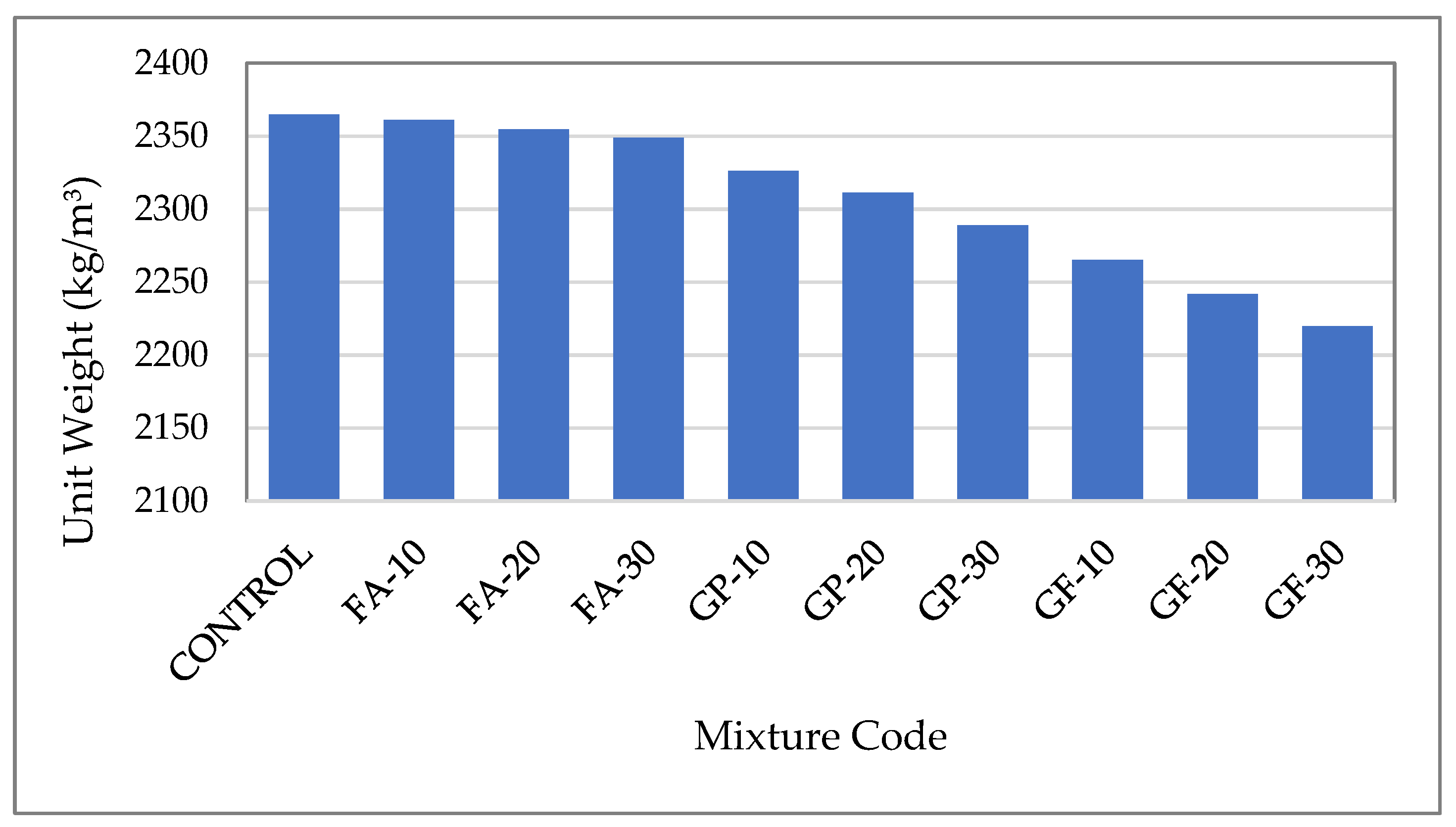
Figure 2.
Slump versus unit weight for mixtures (symbol size indicates the replacement level).
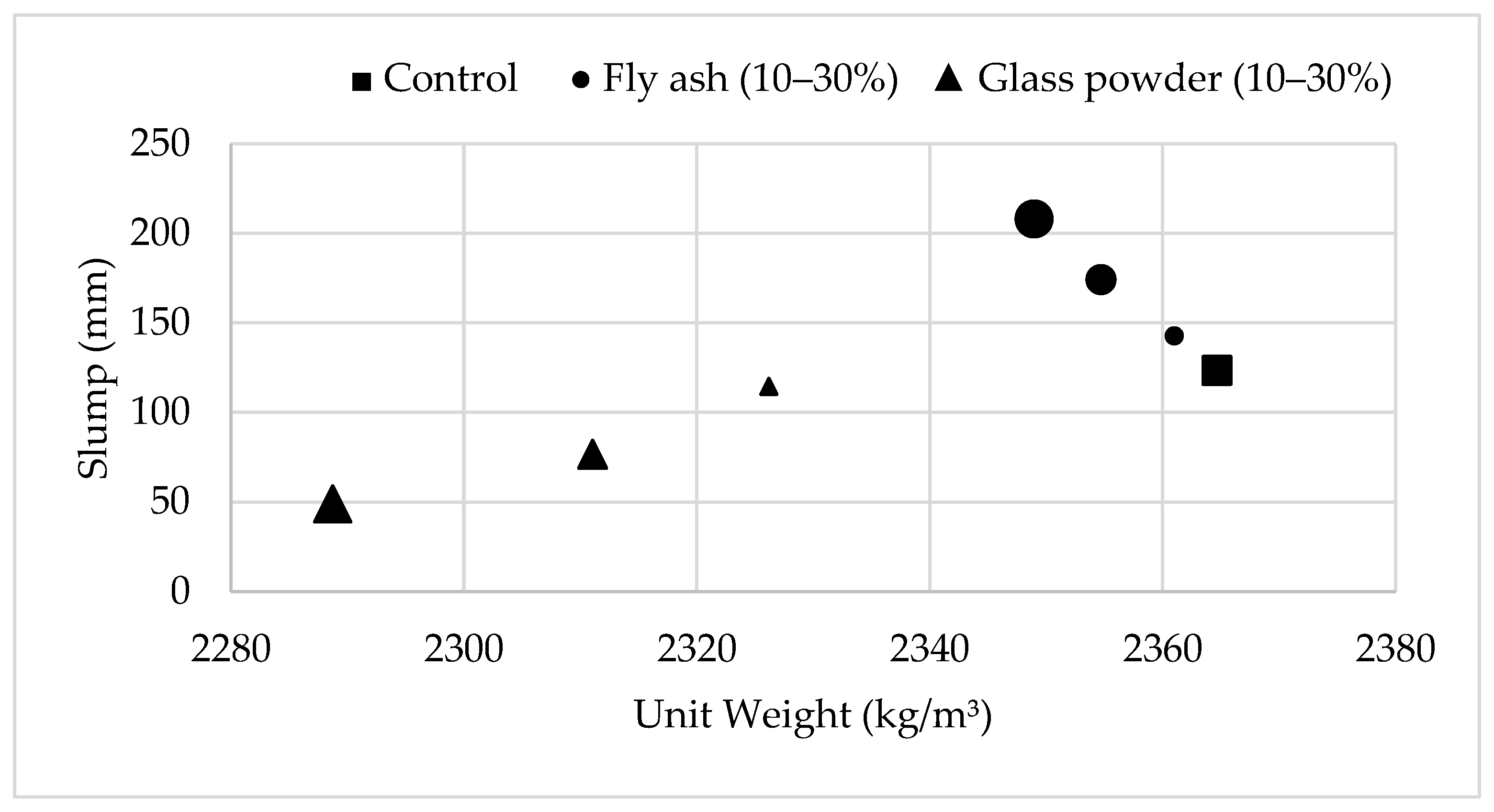
Figure 3.
Slump versus vebe time for mixtures (symbol size indicates replacement level).
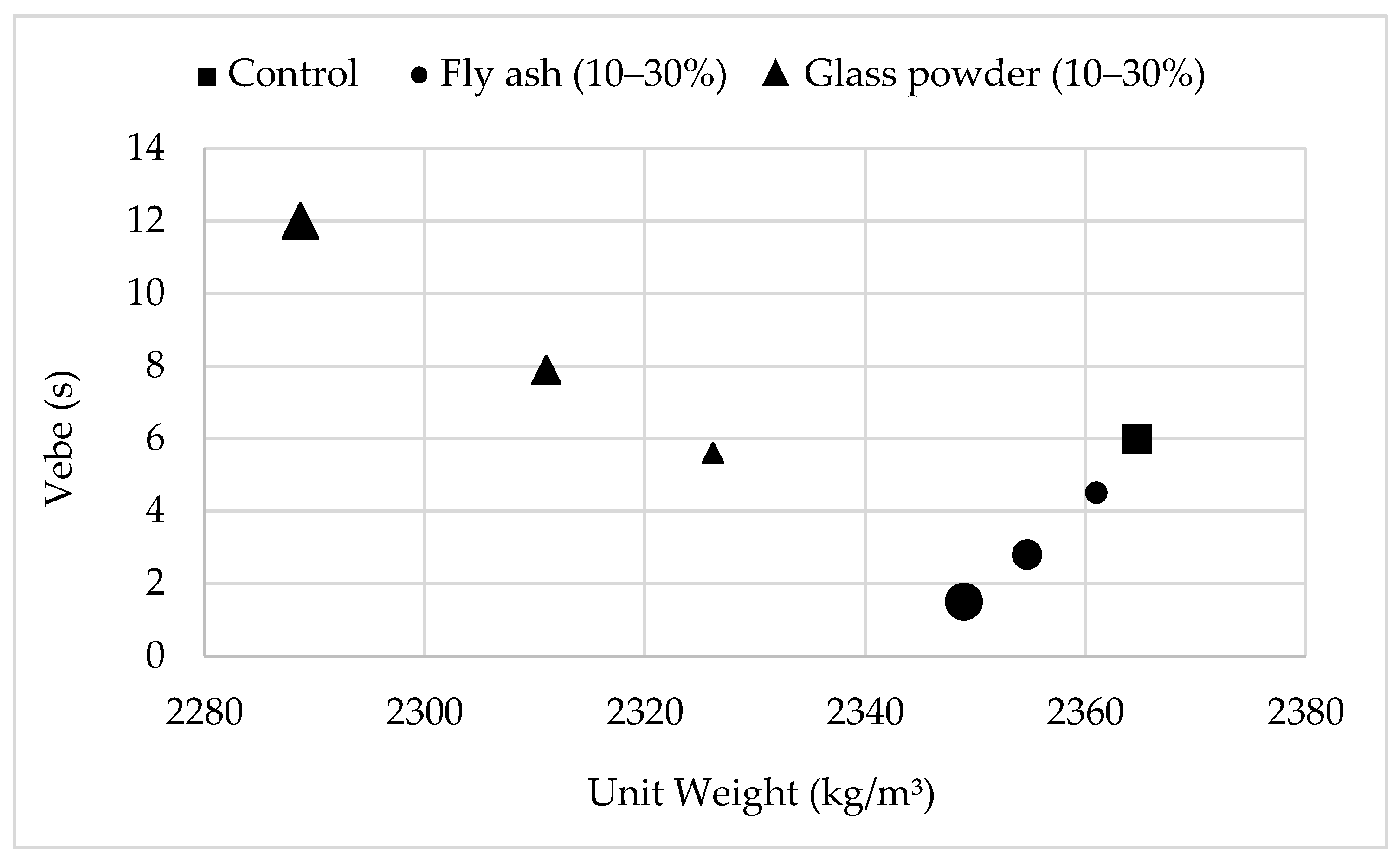
Figure 4.
Comparison of air contents.
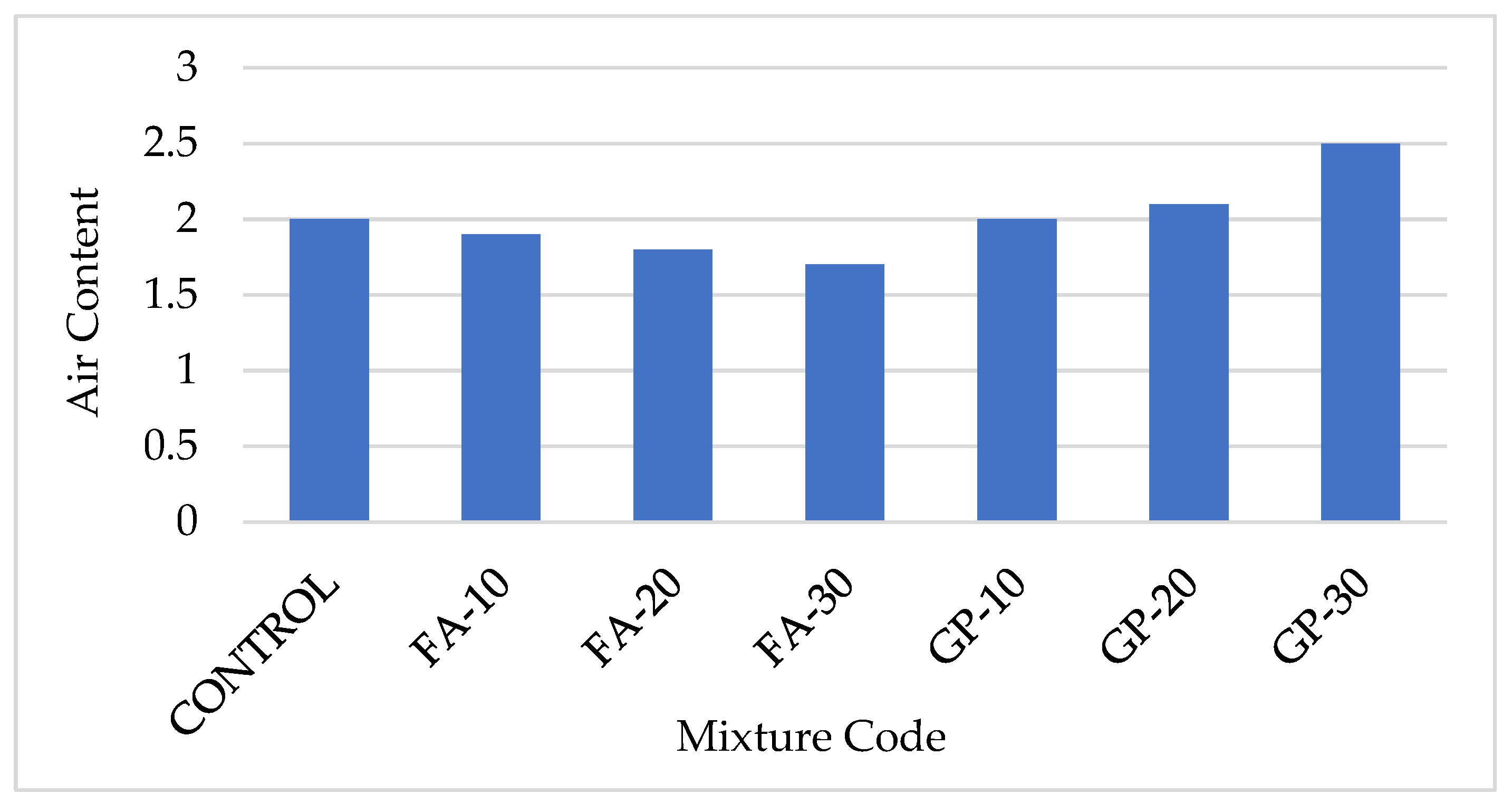
Figure 5.
Experimental setup.
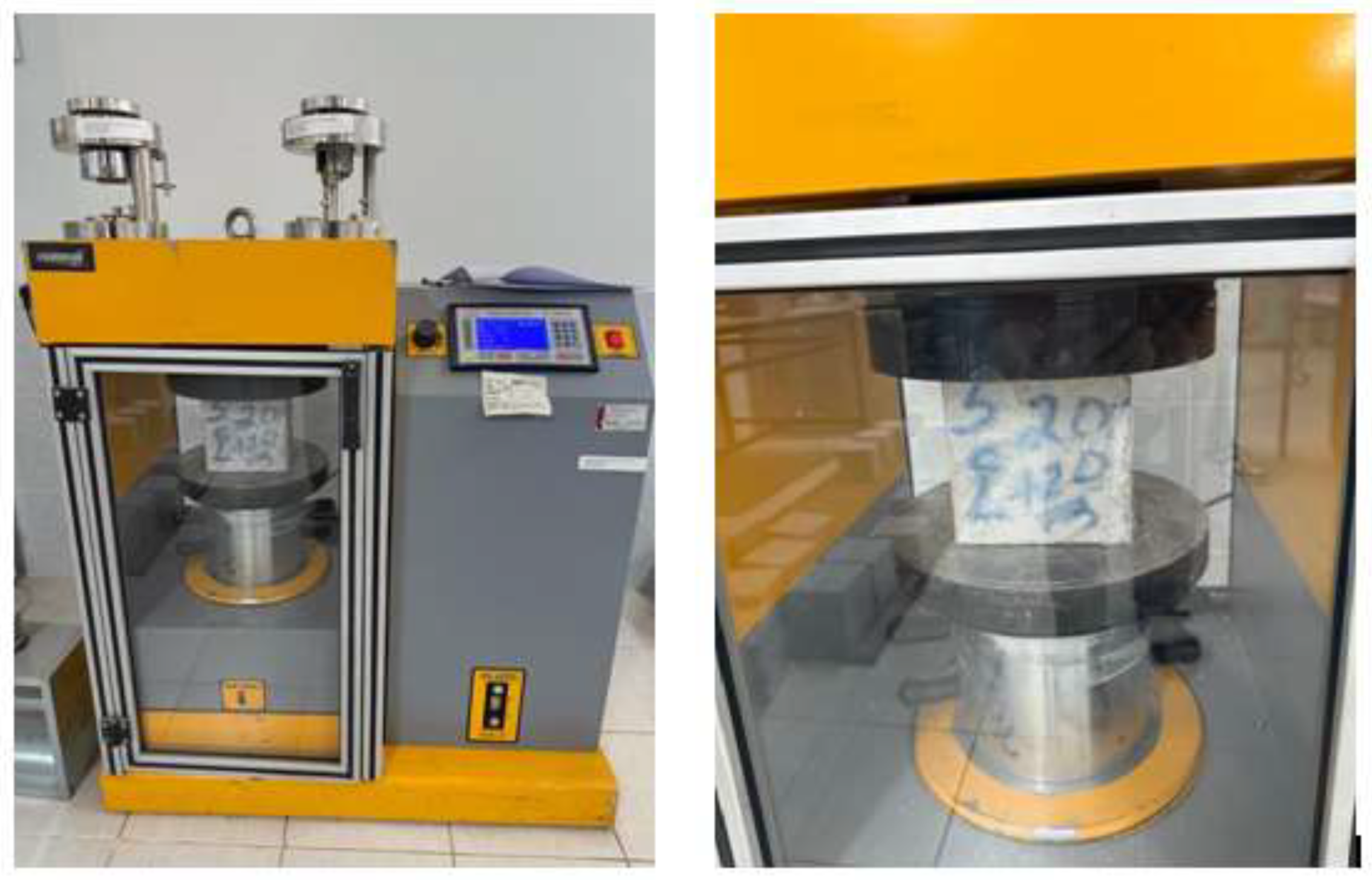
Figure 6.
28-day compressive strength results of all mixtures.
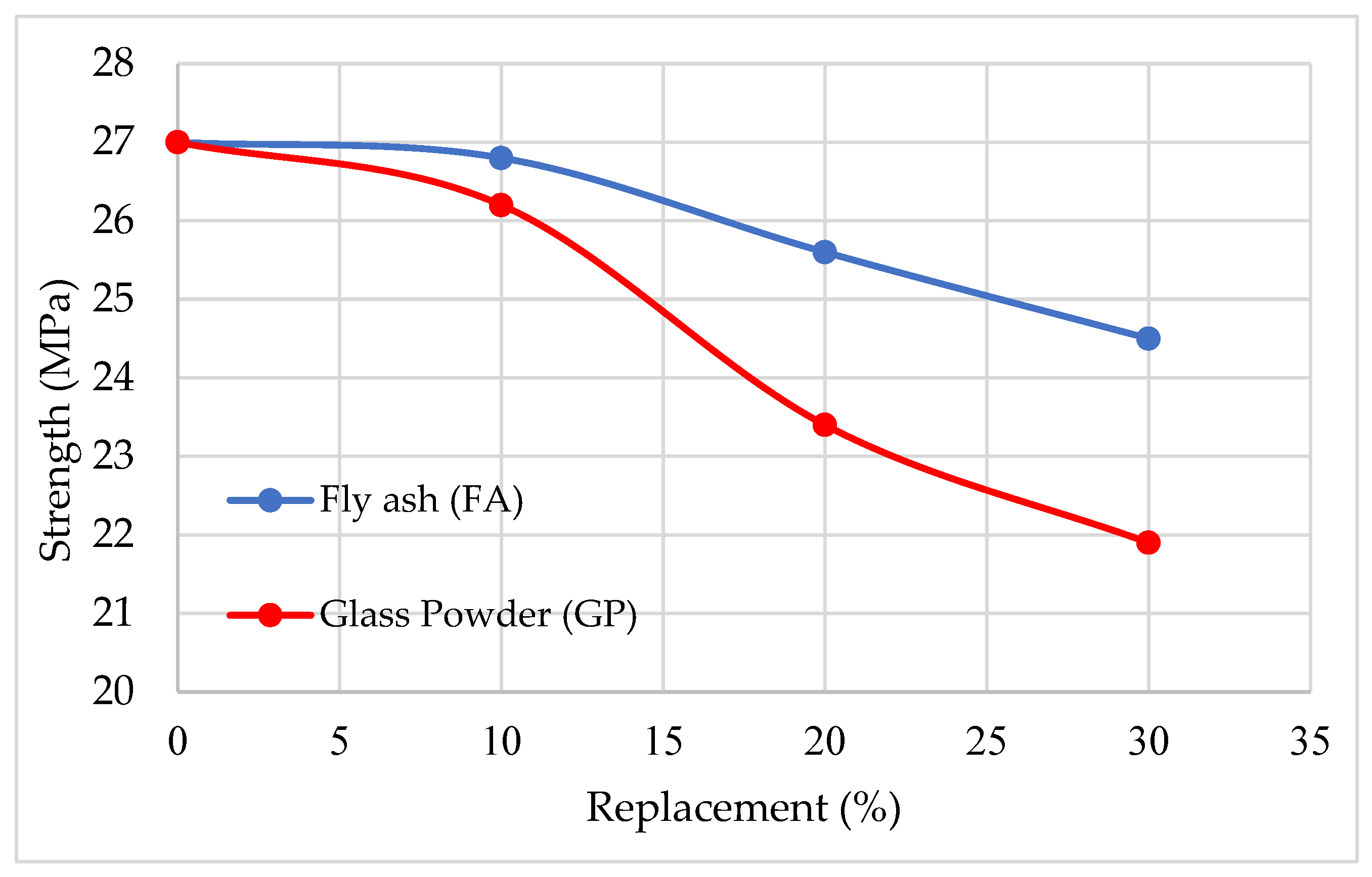
Figure 7.
Compressive strength versus air content.
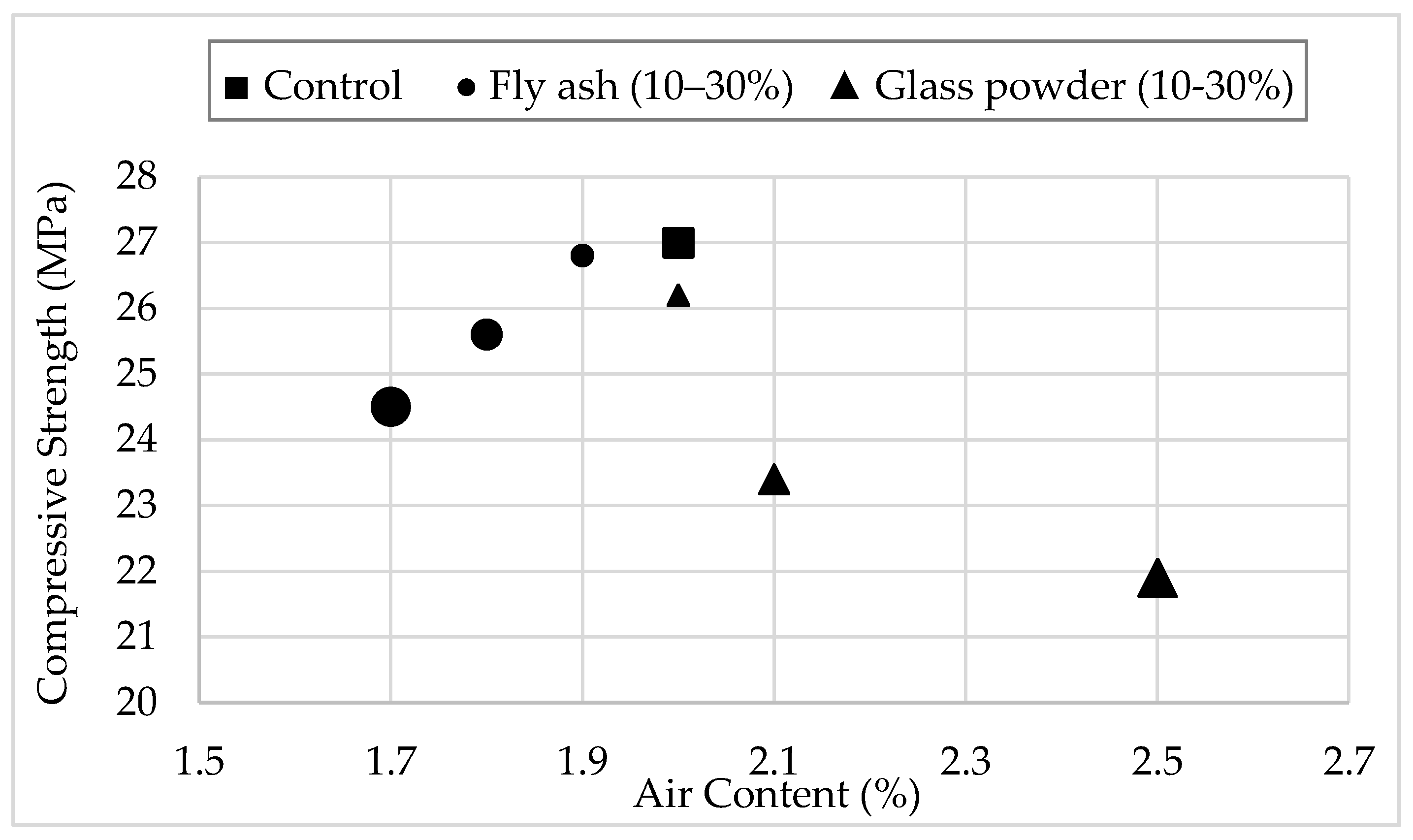
Figure 8.
Correlation between rebound number and compressive strength for FA mixtures.
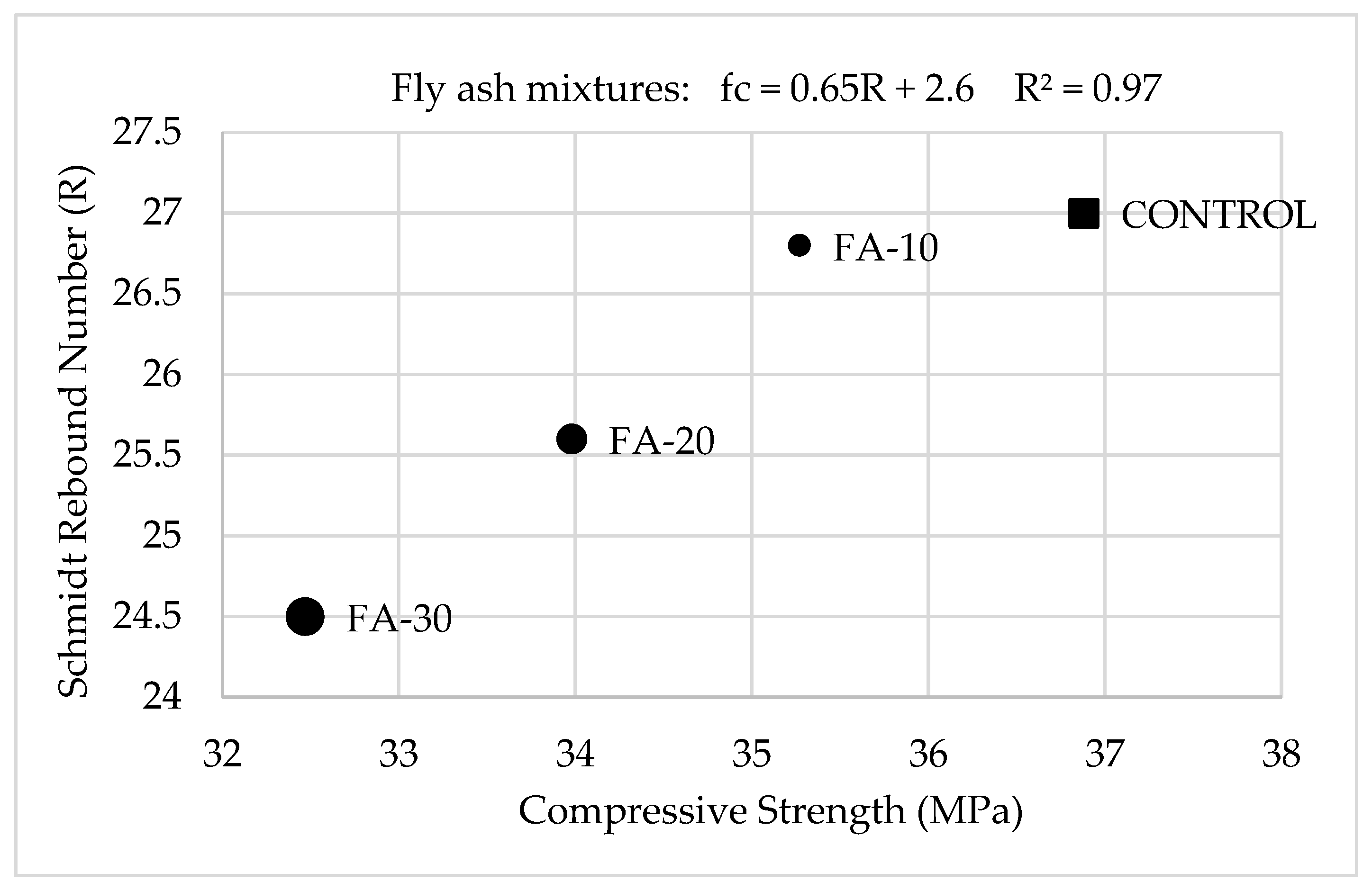
Figure 9.
Correlation between rebound number and compressive strength for GP mixtures.
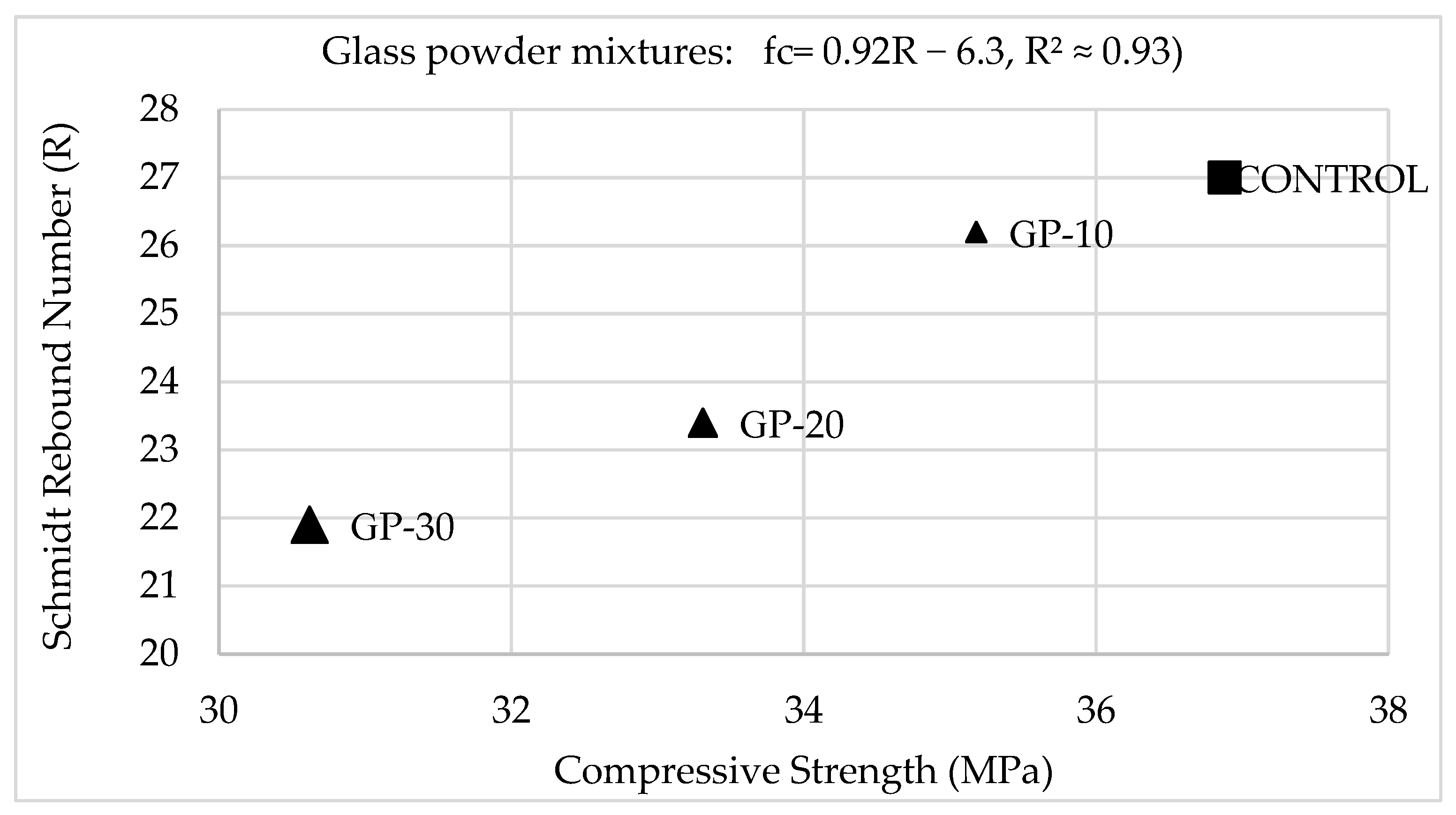
Figure 10.
Permeability results of all mixtures.
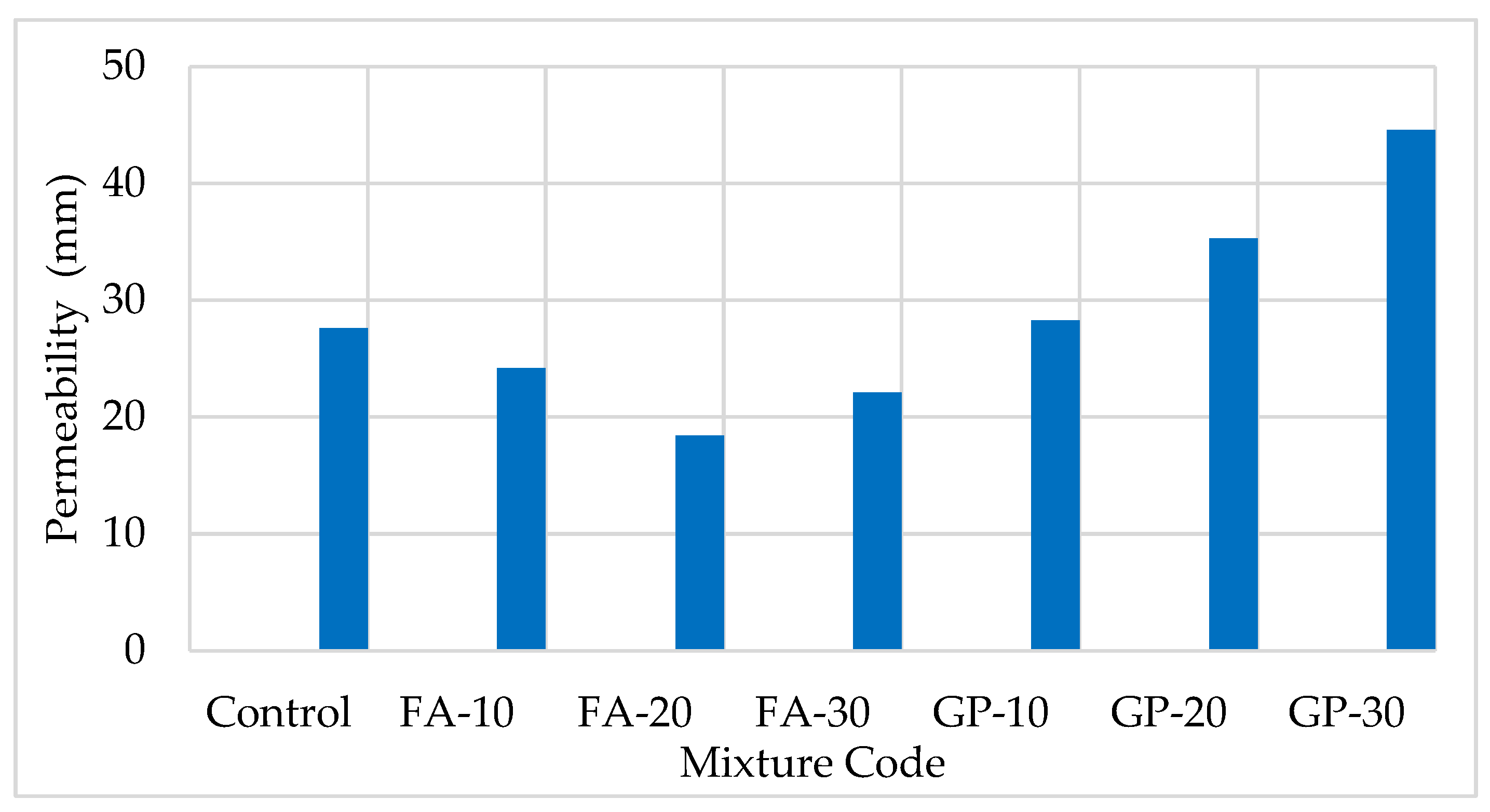
Figure 11.
Compressive Strength vs. Water Permeability.
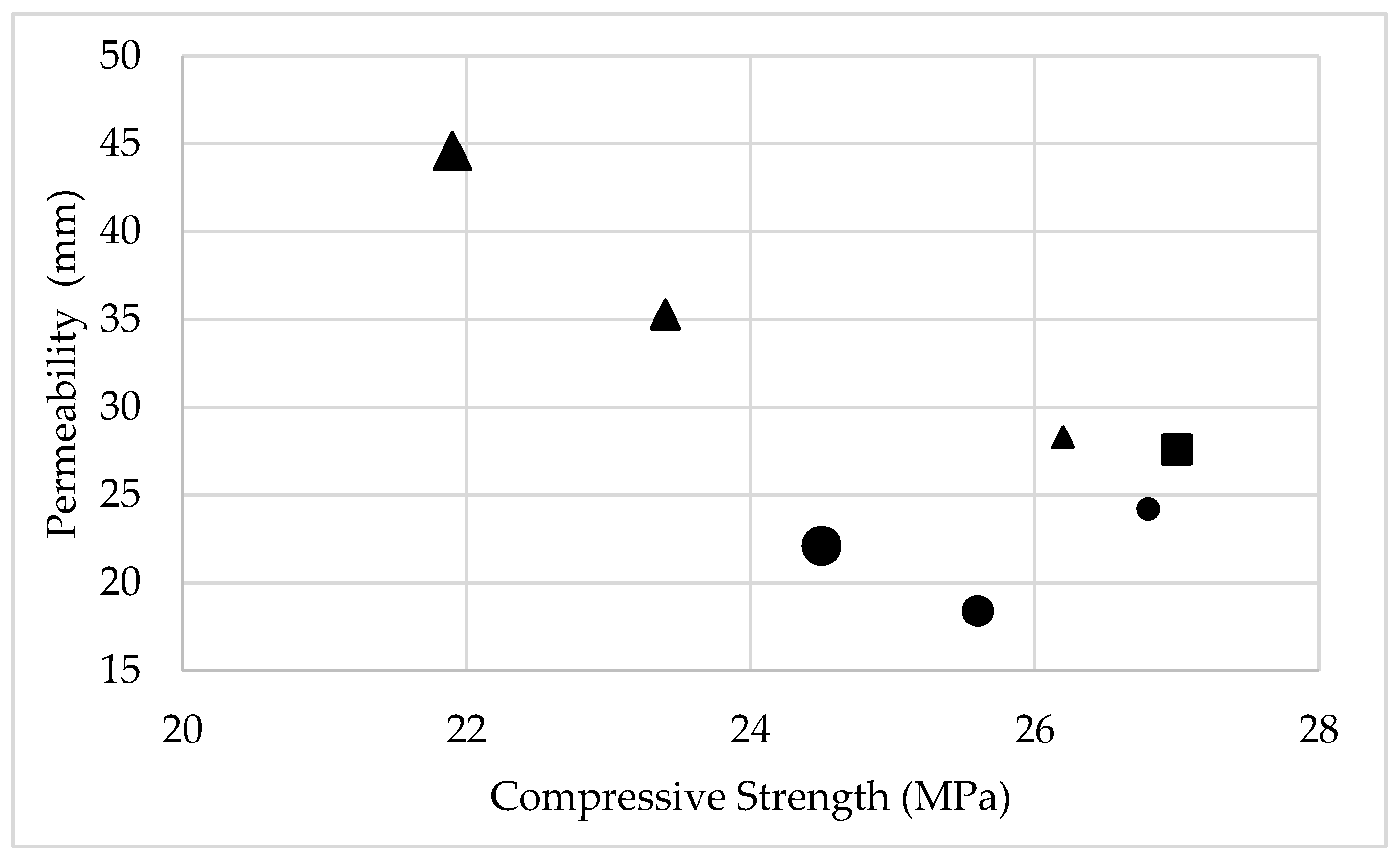

Table 1.
Concrete mixture ingredients.
| Mix Code | Cement (kg) | Additive | Additive Amount (kg) | Water (L) | Sand (kg) | Aggregate (kg) | Total (kg) |
|---|---|---|---|---|---|---|---|
| CONTROL | 350 | - | 0 | 210 | 708 | 1085 | 2353 |
| FA-10 | 315 | Fly ash | 35 | 210 | 708 | 1085 | 2353 |
| FA-20 | 280 | Fly ash | 70 | 210 | 708 | 1085 | 2353 |
| FA-30 | 245 | Fly ash | 105 | 210 | 708 | 1085 | 2353 |
| GP-10 | 315 | Glass powder | 35 | 210 | 708 | 1085 | 2353 |
| GP-20 | 280 | Glass powder | 70 | 210 | 708 | 1085 | 2353 |
| GP-30 | 245 | Glass powder | 105 | 210 | 708 | 1085 | 2353 |
Table 2.
Concrete unit weight.
| Mixture Code | Unit Weight (kg/m³) | Standard Deviation (kg/m³) | COV (%) |
|---|---|---|---|
| CONTROL | 2364.67 | 17.03 | 0.72 |
| FA-10 | 2361 | 21.83 | 0.92 |
| FA-20 | 2354.71 | 15.31 | 0.65 |
| FA-30 | 2348.98 | 18.79 | 0.8 |
| GP-10 | 2326.18 | 15.35 | 0.66 |
| GP-20 | 2311.05 | 18.72 | 0.81 |
| GP-30 | 2288.72 | 15.79 | 0.69 |
Table 3.
Slump, Vebe time of mixtures.
| Mix Code | Unit Weight (kg/m³) | Slump (mm) | Vebe (sec) |
|---|---|---|---|
| CONTROL | 2364.67 | 123.5 | 6 |
| FA-10 | 2361 | 142.8 | 4.5 |
| FA-20 | 2354.71 | 174.1 | 2.8 |
| FA-30 | 2348.98 | 207.9 | 1.5 |
| GP-10 | 2326.18 | 114.6 | 5.6 |
| GP-20 | 2311.05 | 76.8 | 7.9 |
| GP-30 | 2288.72 | 48.9 | 12 |
Table 4.
Results of Two-Way ANOVA for compressive strength.
| Source | SS | df | MS | F | p-value | η²p |
|---|---|---|---|---|---|---|
| Additive Type (A) | 16.27 | 1 | 16.27 | 69.53 | <0.001 | 0.685 |
| Replacement Ratio (B) | 82.49 | 3 | 27.5 | 117.46 | <0.001 | 0.912 |
| A × B Interaction | 9.27 | 3 | 3.09 | 13.2 | <0.001 | 0.554 |
| Error | 7.49 | 32 | 0.23 | |||
| Total | 115.52 | 39 |
Table 5.
Post-hoc statistical power analysis for two-way ANOVA factors.
| Factor | η²p | Cohen’s f | df₁ | df₂ | λ (ncp) | Achieved power |
|---|---|---|---|---|---|---|
| Replacement ratio | 0.912 | 3.219 | 3 | 16 | 207.27 | >0.999 |
| Additive type | 0.685 | 1.475 | 1 | 8 | 21.75 | 0.982 |
| Interaction | 0.554 | 1.115 | 7 | 32 | 49.69 | 0.999 |
Table 6.
Tukey HSD post-hoc test.
| Comparison | Mean Difference (MPa) | 95% Confidence Interval (MPa) | p-value |
|---|---|---|---|
| CONTROL – FA-20 | +1.40 | [0.11, 2.69] | 0.028 |
| CONTROL – FA-30 | +2.50 | [1.21, 3.79] | <0.001 |
| CONTROL – GP-20 | +3.60 | [2.31, 4.89] | <0.001 |
| CONTROL – GP-30 | +5.10 | [3.81, 6.39] | <0.001 |
| FA-10 – FA-30 | +2.30 | [1.01, 3.59] | <0.001 |
| FA-20 – GP-20 | +2.20 | [0.91, 3.49] | <0.001 |
| FA-30 – GP-30 | +2.60 | [1.31, 3.89] | <0.001 |
| GP-10 – GP-20 | +2.80 | [1.51, 4.09] | <0.001 |
| GP-10 – GP-30 | +4.30 | [3.01, 5.59] | <0.001 |
| GP-20 – GP-30 | +1.50 | [0.21, 2.79] | 0.015 |
Table 7.
Water permeability test results.
| Group | Permeability | standard deviation | COV (%) |
|---|---|---|---|
| Control | 27.6 | 1.66 | 6.01 |
| FA-10 | 24.2 | 1.48 | 6.12 |
| FA-20 | 18.4 | 1.12 | 6.09 |
| FA-30 | 22.1 | 1.58 | 7.15 |
| GP-10 | 28.3 | 1.85 | 6.54 |
| GP-20 | 35.3 | 3.71 | 10.51 |
| GP-30 | 44.6 | 3.66 | 8.21 |
Table 8.
Emission factors adopted in the base scenario.
| Material | Emission Factor (kg CO₂/kg) | |
|---|---|---|
| Cement (EFcem) | 0.93 | |
| Fly Ash (EFFA) | 0.008 | |
| Glass Powder (EFGP) | 0.10 | |
| Aggregate (EFagg) | 0.005 |
Table 9.
Embodied carbon (EC) and CO₂ reduction percentages of mixtures.
| Mix Code | EC (kg CO₂/m³) | CO₂ Reduction (%) |
|---|---|---|
| CONTROL | 334.47 | — |
| FA-10 | 302.20 | 9.6 |
| FA-20 | 269.93 | 19.3 |
| FA-30 | 237.66 | 28.9 |
| GP-10 | 305.42 | 8.7 |
| GP-20 | 276.37 | 17.4 |
| GP-30 | 247.32 | 26.1 |
Table 10.
Assumed Parameters for Life Cycle Stages.
| Parameter | Value | Unit |
|---|---|---|
| Transport distance | 100 | km |
| Transport emission factor | 0.10 | kg CO₂/ton-km |
| Construction energy | 5 | kWh/m³ |
| Electricity emission factor | 0.50 | kg CO₂/kWh |
| Demolition energy | 20 | MJ/ton |
| Recycling rate | 70 | % |
| Concrete density | 2353 | kg/m³ |
Table 11.
Embodied carbon and CO₂ reduction percentages.
| Mix Code | Cradle-to-Gate EC (kgCO₂/m³) |
Additional Emissions (kgCO₂/m³) |
Cradle-to-gate + construction + demolition EC (kg CO₂/m³) |
CO₂ Reduction (%) |
|---|---|---|---|---|
| CONTROL | 334.47 | 28.0 | 362.47 | — |
| FA-10 | 302.20 | 28.0 | 330.20 | 8.9 |
| FA-20 | 269.93 | 28.0 | 297.93 | 17.8 |
| FA-30 | 237.66 | 28.0 | 265.66 | 26.7 |
| GP-10 | 305.42 | 28.0 | 333.42 | 8.0 |
| GP-20 | 276.37 | 28.0 | 304.37 | 16.0 |
| GP-30 | 247.32 | 28.0 | 275.32 | 24.0 |
Table 12.
Carbon intensity values normalized by compressive strength.
| Mix Code | EC (kg CO₂/m³) |
Strength (MPa) | CI (kg CO₂/MPa) |
|---|---|---|---|
| CONTROL | 362.47 | 27.0 | 13.42 |
| FA-10 | 330.20 | 26.8 | 12.32 |
| FA-20 | 297.93 | 25.6 | 11.64 |
| FA-30 | 265.66 | 24.5 | 10.84 |
| GP-10 | 333.42 | 26.2 | 12.73 |
| GP-20 | 304.37 | 23.4 | 13.01 |
| GP-30 | 275.32 | 21.9 | 12.57 |
Disclaimer/Publisher’s Note: The statements, opinions and data contained in all publications are solely those of the individual author(s) and contributor(s) and not of MDPI and/or the editor(s). MDPI and/or the editor(s) disclaim responsibility for any injury to people or property resulting from any ideas, methods, instructions or products referred to in the content. |
© 2026 by the authors. Licensee MDPI, Basel, Switzerland. This article is an open access article distributed under the terms and conditions of the Creative Commons Attribution (CC BY) license (http://creativecommons.org/licenses/by/4.0/).
Copyright: This open access article is published under a Creative Commons CC BY 4.0 license, which permit the free download, distribution, and reuse, provided that the author and preprint are cited in any reuse.


