

Submitted:
20 April 2026
Posted:
21 April 2026
You are already at the latest version
Abstract
Background/Objectives: The incidence of gastroesophageal reflux disease (GERD) is increasing worldwide; however, the contribution of gastroduodenal microbiota to GERD phenotypes and symptom severity remains incompletely understood. This study profiled mucosa-associated microbiota from the gastric antrum and duodenum across GERD phenotypes and examined site-specific associations with symptom severity. Methods: Forty individuals with erosive reflux disease (ERD), non-erosive reflux disease (NERD), or an endoscopically normal comparator group underwent 16S rRNA gene sequencing of the V3–V4 region. Community differences were assessed using Bray–Curtis dissimilarity, differential taxa were explored by linear discriminant analysis effect size (LEfSe), and correlations with validated symptom questionnaires (GERD-Q and FSSG) were evaluated. Results: Microbial community structure differed significantly between the antrum and duodenum, with Proteobacteria and Firmicutes predominating at both sites. LEfSe suggested enrichment of Streptococcus, Haemophilus, and Enterobacter in the duodenum, whereas Sphingobium, Acinetobacter, and Aquabacterium were more abundant in the antrum. The genus Helicobacter was relatively enriched in the antrum of ERD samples, whereas Streptococcus-dominant signatures were more prominent in the duodenum. Symptom severity showed stronger associations with duodenal taxa, including Prevotella with epigastric pain, throat clearing, and postnasal drip; Veillonella with early satiety; Neisseria with dyspnea; and Helicobacter with hoarseness, whereas gastric associations were fewer. Conclusions: Overall, gastroduodenal microbiota exhibited site-specific differences across GERD phenotypes. These findings highlight the importance of anatomical context in host–microbe interactions and identify site-specific microbial patterns that warrant validation in larger, phenotypically well-characterized cohorts.
Keywords:
gastroesophageal reflux disease
; gastric antrum
; duodenum
; mucosa-associated microbiome
; symptom severity
; 16S rRNA sequencing
1. Introduction
Gastroesophageal reflux disease (GERD) is a common chronic disorder of the upper gastrointestinal tract, defined by the reflux of gastric contents into the esophagus [1]. Recent meta-analyses estimate that the global prevalence of GERD symptoms is approximately 14.8% [2]. In North America and Europe, GERD affects roughly 10–20% of the population, and symptom-based prevalence has also increased across Asia over the past two decades [3]. In Indonesia, the burden of GERD has likewise increased, consistent with trends reported in other Asian and Western populations [3,4]. A survey of Indonesian adults reported a high prevalence of symptom-based GERD, underscoring its substantial public health impact and its burden on patients’ quality of life [4,5].
GERD has traditionally been explained by mechanical and chemical factors, including lower esophageal sphincter dysfunction, impaired esophageal clearance, hiatal hernia, and excessive gastric acid exposure [6]. However, previous findings suggest that GERD symptom severity is not always directly associated with either pH-monitored reflux burden or endoscopically detected mucosal erosions [7]. Despite being a longstanding and effective treatment for GERD, proton pump inhibitors (PPIs) also fail to deliver an adequate response in about 30% of patients [8,9]. These observations indicate that additional factors may contribute to symptom generation and disease heterogeneity.
In this context, interest in the gastrointestinal microbiome has expanded considerably. Emerging evidence suggests that microbial communities in the upper gastrointestinal tract may influence GERD pathogenesis through modulation of mucosal immunity, inflammation, and sensory signaling [10,11]. The upper gastrointestinal tract, particularly the stomach and duodenum, harbors site-specific microbial ecosystems [12,13,14]. These microbial communities may affect upper gut physiology, including motility, gastric acid exposure, and symptom manifestation [15,16]. Alterations in gastric and duodenal microbiota have also been linked to small intestinal bacterial overgrowth (SIBO) [13,17], increased intraluminal gas production, and disrupted bile acid metabolism, mechanisms that could plausibly exacerbate reflux-related symptoms [18].
Despite growing interest in microbiome–host interactions, the gastroduodenal microbiota in GERD remains insufficiently characterized. In particular, it is unclear whether microbial patterns differ between anatomical locations and how these differences relate to clinical phenotypes such as erosive reflux disease (ERD) and non-erosive reflux disease (NERD). Therefore, this study aimed to profile mucosa-associated microbiota in the gastric antrum and duodenum across GERD phenotypes and to evaluate associations between site-specific microbial features and symptom severity using validated questionnaires (GERD-Q and FSSG).
2. Materials and Methods
2.1. Study Population and Sample Collection
This cross-sectional study enrolled adults aged ≥18 years from the gastroenterology clinics of RSUD Dr. Soetomo Hospital, Surabaya, Indonesia, who were scheduled to undergo upper gastrointestinal endoscopy. Symptomatic participants reported typical reflux symptoms, defined as heartburn and/or regurgitation occurring at least twice weekly for a minimum of three months. An endoscopically normal comparator group was also included. Phenotypic classification based on endoscopic findings and GERD-Q scores is described in Section 2.2.
All enrolled participants underwent gastroscopy to evaluate the esophagus, stomach, and duodenum. Mucosal biopsies for microbiome analysis were obtained from the lesser curvature of the gastric antrum, approximately 3 cm proximal to the pyloric ring, and from the descending duodenum. Biopsy specimens were placed in transport medium containing 10% glycerol. For DNA extraction, samples were suspended in 500 μL phosphate-buffered saline and stored at −80°C until processing.
Clinical H. pylori status was assessed by culture and rapid urease testing, and all included participants were negative by these assessments. Because 16S rRNA gene sequencing provides taxonomic classification primarily at the genus level, any Helicobacter reads identified in the sequencing data were not interpreted as evidence of clinical H. pylori infection.
Participants who had received H. pylori eradication therapy or antibiotics, or had used proton pump inhibitors (PPIs) or other medications likely to affect the upper gastrointestinal microbiota within two weeks before endoscopy, were excluded. Additional exclusion criteria included a history of autoimmune disease, cirrhosis, malignancy, pregnancy, active infection, or major endoscopic abnormalities unrelated to the study groups. The study was approved by the Ethics Committee of RSUD Dr. Soetomo, Surabaya (0124/KPEK/1/2021), and by the Ethics Committee of Oita University Faculty of Medicine (#1660, 2021). Written informed consent was obtained from all participants.
2.2. Clinical Data Collection and Symptom Questionnaires
Demographic and clinical data, including age and sex, were collected from all participants. Upper endoscopy was performed by experienced gastroenterologists with at least five years of clinical practice. The severity of erosive esophagitis was graded according to the Los Angeles (LA) classification system. Briefly, LA grade A is defined as one or more mucosal breaks measuring 5 mm or less that do not extend between the tops of adjacent mucosal folds; LA grade B as one or more mucosal breaks longer than 5 mm that likewise do not extend between the tops of adjacent folds; LA grade C as mucosal breaks continuous between the tops of two or more mucosal folds but involving less than 75% of the esophageal circumference; and LA grade D as mucosal breaks involving at least 75% of the esophageal circumference [19].
In accordance with the 2018 Lyon Consensus, LA grade B–D esophagitis was considered objective endoscopic evidence of GERD-related erosive disease, whereas LA grade A findings were considered inconclusive for a definitive diagnosis of GERD [7]. Accordingly, participants with LA grade B–D esophagitis were classified as having erosive reflux disease (ERD), regardless of GERD-Q score. Participants with negative endoscopic findings, defined as normal mucosa or LA grade A esophagitis, and a GERD-Q score ≥8 were classified as having non-erosive reflux disease (NERD). Participants with negative endoscopic findings and a GERD-Q score <8 were classified as the endoscopically normal comparator group.
All participants completed the GERD Questionnaire (GERD-Q) and the Frequency Scale for the Symptoms of GERD (FSSG) to assess symptom burden (Table S1). Both questionnaires had previously been translated into and validated in Bahasa Indonesia [20,21]. A summary of endoscopic findings, GERD-Q scores, final phenotypic classification, and biopsy availability is provided in Table S2.
2.3. Microbiome Analysis
2.3.1. DNA Extraction and 16S rRNA Sequencing
Genomic DNA was extracted using the DNeasy Blood & Tissue Kit (QIAGEN, Santa Clarita, CA, USA) and further concentrated using the DNA Clean & Concentrator kit (Zymo Research, Irvine, CA, USA), according to the manufacturers’ instructions. DNA concentration was measured using the Quantus™ Fluorometer (Promega, Madison, WI, USA). The V3–V4 region of the bacterial 16S rRNA gene was amplified using the universal primers 341F (5′-CCTACGGGNGGCWGCAG-3′) and 805R (5′-GACTACHVGGGTATCTAATCC-3′) [22].
Amplicons were purified using Agencourt AMPure XP magnetic beads (Beckman Coulter, Tokyo, Japan), and short non-target fragments (<500 bp) were removed. Library quality was assessed using the Agilent 2100 Bioanalyzer (Agilent Technologies, Palo Alto, CA, USA) with a DNA 7500 chip. Dual indices and sequencing adapters were added using the Nextera XT Index Kit (Illumina Inc., San Diego, CA, USA). The pooled libraries were further validated using the Agilent TapeStation 4150. Libraries (5 pM) were denatured with 0.2 N NaOH and spiked with 10–15% PhiX Control v3 (Illumina Inc.) to increase sequence diversity. Sequencing was performed on the Illumina MiSeq platform using 2 × 300 bp paired-end reads with the MiSeq Reagent Kit v3, according to the manufacturer’s instructions.
2.3.2. Bioinformatics
Demultiplexed paired-end reads were imported into QIIME 2 (version 2023.9) and processed using the DADA2 plugin to generate amplicon sequence variants (ASVs) [23]. Primer and adapter sequences were removed using cutadapt, followed by quality filtering. DADA2 was used to trim low-quality regions, model error rates, dereplicate reads, infer ASVs, and remove chimeras. Taxonomy was assigned using a Naïve Bayes classifier trained on the target region against the SILVA database (version 138; 99% sequence identity) [24]. Multiple sequence alignment was performed using MAFFT, and a phylogenetic tree was constructed using FastTree [25,26].
The feature table, taxonomy, phylogenetic tree, and sample metadata were imported into R (version 4.5.1) using the phyloseq package [27]. For diversity analyses, samples were rarefied to a uniform sequencing depth of 1,000 reads per sample. Alpha diversity was assessed using ACE, Chao1, Observed richness, Pielou’s evenness, Shannon, and Simpson indices. Comparisons between anatomical sites (antrum vs. duodenum) were performed using paired non-parametric tests when both samples were available from the same individual (Wilcoxon signed-rank test). For site-specific analyses including participants with only one biopsy site, unpaired comparisons were performed using the Wilcoxon rank-sum test. Comparisons across GERD phenotypes within each anatomical site were similarly performed using the Kruskal–Wallis test.
Beta diversity was evaluated using Bray–Curtis dissimilarity and visualized by principal coordinate analysis (PCoA) [28,29]. Differences in community composition were tested using permutational multivariate analysis of variance (PERMANOVA) with the adonis2 function in the vegan package [30]. Differentially abundant taxa were explored using linear discriminant analysis effect size (LEfSe); taxa with p < 0.05 and an LDA score > 2.0 were considered discriminant. Associations between genus-level relative abundance and symptom questionnaire scores were evaluated using Spearman’s rank correlation. Visualizations were generated using ggplot2.
2.4. Statistical Analysis
Baseline characteristics are presented using descriptive statistics. Continuous variables are presented as mean ± SD, and categorical variables as counts and percentages. Group comparisons for continuous variables were performed using one-way ANOVA for normally distributed data or the Kruskal–Wallis test, as appropriate. Categorical variables were compared using the Chi-square test or Fisher’s exact test, as appropriate.
For microbiome analyses, alpha-diversity comparisons between paired antral and duodenal samples were performed using the Wilcoxon signed-rank test, whereas unpaired comparisons were performed using the Wilcoxon rank-sum test. Beta-diversity differences were assessed using PERMANOVA based on Bray–Curtis dissimilarity. Differentially abundant taxa were identified using LEfSe with a significance threshold of p < 0.05 and an LDA score > 2.0.
Associations between genus-level relative abundance and symptom severity scores were assessed using Spearman’s rank correlation. Because a large number of correlations were tested, these analyses were considered exploratory, and the reported p-values are nominal (unadjusted). All tests were two-sided, and p < 0.05 was considered statistically significant unless otherwise specified. Clinical statistical analyses were performed using SPSS version 26.0 (SPSS Inc., Chicago, IL, USA), and microbiome analyses and visualization were conducted in R as described above.
3. Results
3.1. Participants Overview
A total of 40 participants were enrolled, including 25 with erosive reflux disease (ERD), 11 with non-erosive reflux disease (NERD), and 4 endoscopically normal comparator subjects. Participant classification and biopsy availability are summarized in Table S2, and baseline characteristics are shown in Table S3. Paired mucosal biopsies from the gastric antrum and duodenum were collected during upper endoscopy. During sequencing library preparation, samples that did not meet the minimum DNA concentration threshold required for library normalization were excluded to ensure the reliability of downstream microbiome analysis. As a result, 25 participants contributed complete paired samples for the final paired analysis, whereas participants with only one biopsy site passing quality control were retained for site-specific analyses.
Overall, 35 antral biopsies (25 paired and 10 antrum-only) and 30 duodenal biopsies (25 paired and 5 duodenum-only) were included, yielding 65 mucosal biopsy samples in total. All retained samples passed quality filtering (≥500 reads) and were included in the analysis. The antral dataset comprised 35 biopsies (comparator, n=4; ERD, n=21; NERD, n=10), whereas the duodenal dataset comprised 30 biopsies (comparator, n=3; ERD, n=20; NERD, n=7).
The overall cohort included 27 women (67.5%) and 13 men (32.5%), with a mean age of 42.92 ± 13.87 years. No significant differences in baseline demographic or clinical characteristics were observed across GERD phenotypes (Table S3).
3.2. Site-Specific Variation in Gastric and Duodenal Microbial Communities
Across all retained samples, a total of 7,192 taxa were detected after taxonomic assignment. For downstream diversity analyses, samples were rarefied to a uniform sequencing depth of 1,000 reads per sample. Taxonomic profiling identified 248 genera belonging to 18 phyla and 153 families in the gastric antrum, and 180 genera belonging to 15 phyla and 115 families in the duodenum. The dominant phyla at both sites were Proteobacteria, Firmicutes, Campylobacterota, and Bacteroidota. Phylum-level relative abundance profiles for the antrum and duodenum are shown in Figure S1, and the top 20 genera across the two anatomical sites are presented in Figure 1.
At the genus level, the antrum and duodenum shared several dominant taxa, although their relative abundances differed between sites. In the antrum, the seven most abundant genera were Streptococcus (24.3%), Pseudomonas (14.6%), Helicobacter (9.75%), Sphingobium (5.15%), Prevotella (4.35%), Veillonella (4.07%), and Haemophilus (3.14%). In contrast, the duodenum was dominated by Streptococcus (29.2%) and Helicobacter (13.2%), followed by Pseudomonas (9.30%), Haemophilus (8.18%), Gemella (3.62%), Prevotella (3.52%), and Veillonella (3.33%). These results indicate that, although several core genera were present at both gastroduodenal sites, their relative dominance was site-specific.
To evaluate gastroduodenal mucosa-associated microbial diversity, alpha diversity was assessed using ACE, Chao1, Observed richness, Pielou’s evenness, Shannon, and Simpson indices. No significant differences in alpha diversity were observed between the antrum and duodenum in the overall analysis (Figure S2). Beta diversity was assessed using Bray–Curtis dissimilarity. Principal coordinate analysis (PCoA) showed significant separation by anatomical site, indicating differences in overall community composition between the antrum and duodenum (PERMANOVA, p = 0.018; Figure 2). A more detailed within-subject paired analysis of site-specific microbiome differences is presented in Section 3.5.
3.3. Microbial Differences across GERD Phenotypes
3.3.1. Microbial Composition across GERD Phenotypes in the Antrum and Duodenum
Relative abundance profiles suggested phenotype-associated shifts in dominant taxa across GERD groups. At the phylum level, Proteobacteria and Firmicutes were the two predominant phyla across all three disease groups and both anatomical sites. In the endoscopically normal comparator group, Proteobacteria was the most abundant phylum in the antrum (54.4%), followed by Firmicutes (32.3%), while in the duodenum Firmicutes was more abundant (47.0%) than Proteobacteria (36.8%). In NERD, a similar pattern was observed, with Proteobacteria being dominant in the antrum (49.8%) and Firmicutes in the duodenum (39.3%). In ERD, Proteobacteria showed markedly higher relative abundance compared to the other groups, accounting for 69.6% in the antrum and 62.3% in the duodenum, while Firmicutes was relatively lower at 14.1% and 20.7%, respectively (Figure S3).
In the endoscopically normal comparator group, Streptococcus and Pseudomonas showed relatively high abundance at both anatomical sites. In NERD, the most abundant genera in the antrum were Veillonella (5.68%) and Pseudomonas (8.37%), whereas the duodenum was dominated by Streptococcus (37.3%) and Haemophilus (11.3%). In ERD, the antrum showed higher relative abundance of Sphingobium (6.50%), Acinetobacter (3.44%), and Aquabacterium (1.54%) than the duodenum. In contrast, the duodenum showed higher relative abundance of Streptococcus (25.3%), Haemophilus (7.69%), and Enterobacter (3.02%) than the antrum (Figure 3).
3.3.2. Alpha and Beta Diversity Differences across GERD Phenotypes by Anatomical Site
We compared microbial diversity across GERD phenotypes (ERD, NERD, and the endoscopically normal comparator group) separately for antral and duodenal mucosal samples. In the antrum, alpha diversity did not differ significantly among phenotypes based on ACE, Chao1, Observed richness, Pielou’s evenness, Shannon, and Simpson indices (Figure S4A). Similarly, no significant between-group differences in alpha diversity were observed in duodenal samples (Figure S4B).
For beta diversity, microbial community composition in antral samples did not differ significantly among phenotypes (PERMANOVA, p = 0.078; Figure S5A), and principal coordinate analysis (PCoA) showed no clear separation by phenotype. In contrast, duodenal samples demonstrated significant differences in beta diversity among phenotypes (PERMANOVA, p = 0.003; Figure S5B), with PCoA indicating modest separation of microbial communities across ERD, NERD, and the endoscopically normal comparator group.
3.3.3. Associations between Microbial Profiles and Symptom Severity Scores
We assessed associations between symptom severity and microbial relative abundance at the genus level. In the primary analysis focusing on the top 20 genera, several significant correlations were observed (Table S4). All reported p-values for symptom–taxon correlations are nominal (unadjusted). Given the large number of tests performed, these analyses are exploratory and should be interpreted with caution.
In the gastric antrum, several dominant genera were significantly associated with reflux-related symptoms. Pseudomonas was associated with throat clearing (p = 0.013), Veillonella with bloating (p = 0.014), and Streptococcus with postnasal drip (p = 0.018) and nausea (p = 0.034). Actinobacillus in the antrum was associated with multiple symptoms, including regurgitation (p = 0.005), belching (p = 0.009), and early satiety (p = 0.024).
In the duodenum, several dominant genera were also associated with symptom severity. Prevotella was associated with epigastric pain (p = 0.016), throat clearing (p = 0.039), and postnasal drip (p = 0.035). Additional associations included Veillonella with early satiety (p = 0.018), Neisseria with dyspnea (p = 0.023), and Helicobacter with hoarseness (p = 0.025). Notably, Fusobacterium in the duodenum was associated with multiple symptoms, including odynophagia (p < 0.001), early satiety (p = 0.001), heartburn (p = 0.007), and globus sensation (p = 0.005).
3.4. Differential Taxa and Biomarker Identification
LEfSe analysis comparing bacterial taxa between anatomical sites (antrum vs. duodenum) identified multiple taxa with significantly different relative abundances (Figure S6A). Taxa with an LDA score > 2.0 and p < 0.05 were considered discriminant. At the genus level, Streptococcus, Haemophilus, and Enterobacter were enriched in the duodenum, whereas Sphingobium, Acinetobacter, and Aquabacterium were enriched in the antrum (Figure S6B). These findings were consistent with the site-specific relative abundance patterns observed in the descriptive analysis.
To explore phenotype-specific microbial signatures across GERD phenotypes, LEfSe analysis was performed separately for antral and duodenal samples at the genus level. Taxa were considered significant at p < 0.05 with an LDA score > 2.0 (Figure 4). In the antrum, Helicobacter appeared relatively enriched in ERD compared with NERD and the endoscopically normal comparator group, although substantial inter-individual variability was observed. Several low-abundance genera, including Lachnoanaerobaculum, P5D1-392, Selenomonas, Solobacterium, and Stomatobaculum, were detected across groups without clear phenotype-specific enrichment.
In the duodenum, Streptococcus was the most abundant genus overall and appeared relatively enriched in ERD and NERD compared with the endoscopically normal comparator group. Other genera, including Parvimonas, Lachnoanaerobaculum, Johnsonella, and Fusobacterium, were detected at lower relative abundances. Among these, Fusobacterium showed greater variability across GERD phenotypes.
3.5. Paired Analysis of Gastric and Duodenal Microbiota
Alpha-diversity analysis of paired antrum and duodenum samples showed that species richness was significantly higher in the antrum than in the duodenum, as indicated by the Observed richness index (p = 0.047). Although the ACE and Chao1 indices also trended toward higher richness in the antrum, these differences did not reach statistical significance (p = 0.074 and p = 0.057, respectively). No significant differences were observed in diversity or evenness indices, including Shannon (p = 0.24), Pielou’s evenness (p = 0.66), and Simpson (p = 0.94). These findings suggest that, although species richness differed modestly between sites, overall microbial diversity and evenness were comparable in paired samples (Figure 5).
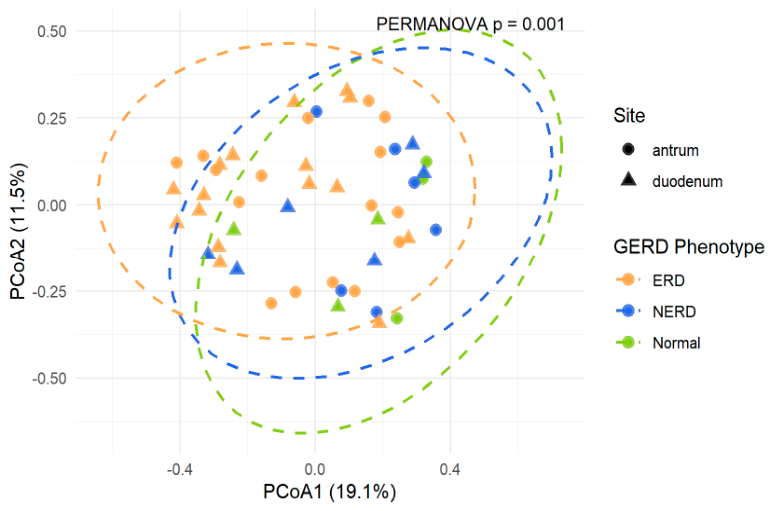
Beta-diversity analysis revealed a statistically significant difference in microbial community composition between paired antral and duodenal samples (PERMANOVA, p = 0.001). Principal coordinate analysis (PCoA) based on Bray–Curtis dissimilarity showed that the first two principal coordinates explained 19.1% (PCoA1) and 11.5% (PCoA2), respectively, with clear separation by anatomical site (Figure 6). When samples were further stratified by GERD phenotype (ERD, NERD, and the endoscopically normal comparator group), substantial overlap was observed across groups in the ordination space, indicating that anatomical location was a stronger determinant of microbial community composition than GERD phenotype.
The genus-level microbial community composition was broadly similar between paired antral and duodenal samples across all three GERD phenotypes (the endoscopically normal comparator group, NERD, and ERD). In the endoscopically normal comparator group, Streptococcus was the most dominant genus at both anatomical sites, accounting for 40.1% in the antrum and 41.8% in the duodenum, followed by Pseudomonas (14.3% in the antrum and 8.59% in the duodenum). In NERD, Streptococcus remained the most abundant genus at both sites (43.4% in the antrum and 39.8% in the duodenum), with Veillonella (7.83%) and Gemella (6.26%) being the next most abundant genera in the antrum, while Haemophilus (11.9%) and Helicobacter (7.08%) were prominent in the duodenum. In ERD, Streptococcus was also the most abundant genus at both sites (18.8% in the antrum and 26.8% in the duodenum), with Pseudomonas (18.6%) and Helicobacter (12.8%) being co-dominant in the antrum, while Helicobacter (19.2%) and Pseudomonas (8.57%) were the next most abundant genera in the duodenum (Figure S7).
LEfSe analysis identified distinct discriminant taxa across GERD phenotypes at both anatomical sites in the paired-sample analysis (LDA score > 2.0, p < 0.05) (Figure S8). In the antrum, all discriminant genera were enriched in the NERD group, including P5D1-392, Oribacterium, Solobacterium, and Lachnoanaerobaculum. In the duodenum, Streptococcus was the genus with the largest effect size and was enriched in the endoscopically normal comparator group, whereas Lachnoanaerobaculum, Solobacterium, Parvimonas, [Eubacterium]_brachy_group, and Johnsonella were enriched in the NERD group. Notably, no significantly discriminant taxa were identified in the ERD group at either site. These findings suggest site-specific microbial signatures across GERD phenotypes, particularly in the NERD group.
4. Discussion
GERD is a multifactorial disorder influenced by mechanical, chemical, dietary, and lifestyle-related factors [31,32]. In recent years, the gastrointestinal microbiome has emerged as an additional factor that may contribute to disease heterogeneity and symptom burden [33,34]. In this study, we characterized mucosa-associated microbiota in the gastric antrum and duodenum across GERD phenotypes and examined their associations with symptom severity. The principal finding was that microbial community structure differed more clearly by anatomical site than by GERD phenotype, indicating that the gastric antrum and duodenum represent distinct microbial niches within the upper gastrointestinal tract [35,36].
This site-specific pattern was supported by both all-sample and paired-sample analyses. Although the dominant phyla were broadly similar at both sites, beta-diversity analysis showed significant separation between antral and duodenal communities, and paired analysis further strengthened this observation by reducing inter-individual variability. The paired analysis also showed that richness was modestly higher in the antrum, whereas overall diversity and evenness remained comparable between sites. Together, these findings suggest that anatomical location has a substantial influence on upper gastrointestinal mucosal microbiota and should be considered explicitly in studies of GERD-related dysbiosis.
Phenotype-associated microbial differences appeared more evident in the duodenum than in the gastric antrum. In particular, duodenal beta diversity differed significantly across GERD phenotypes, whereas antral beta diversity did not. LEfSe analysis also suggested that several discriminant taxa were enriched in NERD, especially in paired analyses, indicating that within-subject comparisons may be particularly useful for detecting subtle phenotype-related microbial signals. These findings support the possibility that NERD is associated with a distinct upper gastrointestinal microbial profile [37,38], although this interpretation remains tentative because the present study lacked objective reflux monitoring and the non-erosive group may have included patients with esophageal hypersensitivity or functional heartburn [39].
The relative enrichment of Helicobacter in antral ERD samples should be interpreted cautiously. All participants in this study were clinically negative for H. pylori by culture and rapid urease testing, and 16S rRNA gene sequencing does not reliably resolve species-level taxonomy. Therefore, this result should be interpreted as enrichment of the genus Helicobacter rather than H. pylori specifically. This distinction is important because the reported relationship between H. pylori and GERD is complex and sometimes paradoxical [22]. In the present study, the genus-level signal may reflect non-pylori Helicobacter taxa and/or the inherent taxonomic limitations of 16S-based profiling rather than active H. pylori infection.
The phenotype-associated enrichment of anaerobic genera in NERD, particularly in the duodenum, is also noteworthy. Taxa such as Fusobacterium, Solobacterium, Lachnoanaerobaculum, and Parvimonas were more prominent in NERD, whereas Streptococcus was enriched in the endoscopically normal comparator group in the paired duodenal analysis. These findings are broadly consistent with observations from the esophageal microbiome, where healthy mucosa is often associated with Streptococcus-dominant communities, whereas reflux-related conditions show relative enrichment of Gram-negative or anaerobic taxa [40,41,42]. However, this comparison should be interpreted cautiously, as the present study did not include esophageal samples and therefore cannot directly establish coordinated microbiome shifts across the entire upper gastrointestinal tract.
An additional important observation was that symptom severity showed stronger and more consistent associations with duodenal taxa than with antral taxa. Several duodenal genera were associated with specific symptoms, including Prevotella with epigastric pain, throat clearing, and postnasal drip; Veillonella with early satiety; Neisseria with dyspnea; and Helicobacter with hoarseness. In contrast, fewer symptom–taxon associations were observed in the gastric antrum. Although these findings remain exploratory, they raise the possibility that duodenal microbial communities may be more closely linked to symptom-related mechanisms than antral communities. This is biologically plausible because the duodenum functions as an important interface for luminal sensing, neuroenteric signaling, motility regulation, and exposure to bile and gastric outflow [43,44]. Nonetheless, the cross-sectional design does not allow causal inference, and the observed associations may reflect secondary changes related to altered gastrointestinal physiology rather than direct drivers of symptom generation.
Several limitations should be considered when interpreting these findings. First, the sample size was modest, and the endoscopically normal comparator group was particularly small. Second, although biopsies were collected from both sites during endoscopy, not all samples passed library normalization, which reduced the number of complete paired datasets and may have limited statistical power. Third, objective reflux monitoring, such as ambulatory pHmetry or pH-impedance testing, was not performed, which limited the accuracy of GERD phenotyping, especially in the non-erosive group. Fourth, dietary intake and some medication-related factors were not systematically assessed, and residual confounding cannot be excluded. Fifth, because biopsies were obtained through a standard endoscope channel, contamination from oral or luminal microbiota is a potential methodological concern. Finally, the use of 16S rRNA gene sequencing limited taxonomic resolution and functional interpretation, and no metabolomic or pathway-based analyses were performed to directly link microbial activity with symptom generation.
5. Conclusions
These findings indicate that the gastric antrum and duodenum harbor distinct mucosa-associated microbial communities and that these site-specific communities differ across GERD phenotypes. The data further suggest that duodenal microbial patterns may be more closely related to symptom-associated variation than antral profiles and that paired multi-site sampling improves sensitivity for detecting subtle differences. While these findings should be regarded as exploratory, they support the value of anatomical context in upper gastrointestinal microbiome studies and provide a rationale for future work incorporating larger cohorts, objective reflux phenotyping, esophageal sampling, and multi-omics approaches.
Supplementary Materials
The following supporting information can be downloaded at: https://www.mdpi.com/article/doi/s1, Table S1. Symptom distribution based on GERD-Q and FSSG scores; Table S2. Summary of endoscopic findings and GERD-Q scores; Table S3. Baseline characteristics of study participants; Table S4. Significant correlations between the top 20 bacterial genera and symptom severity in the gastric antrum and duodenum; Figure S1. Stacked bar plot showing phylum-level relative abundances in the gastric antrum and duodenum; Figure S2. Comparison of α-diversity indices in all samples between antrum and duodenum; Figure S3. Relative abundance of dominant bacterial phyla across GERD phenotypes in the gastric antrum and duodenum; Figure S4. Comparison of microbial α-diversity across GERD phenotypes in (A) antral and (B) duodenal samples; Figure S5. Principal coordinates analysis (PCoA) based on Bray-Curtis distances in antrum and duodenum; Figure S6. Taxonomic biomarkers identified by LEfSe analysis between the gastric antrum and duodenum. (A) Relative abundances of discriminative taxa; Figure S7. Genus-level microbial composition in paired gastric antrum and duodenal samples across GERD phenotypes; Figure S8. LEfSe analysis of paired samples across GERD phenotypes.
Author Contributions
Conceptualization, S.R.D., M.M.; data curation, S.R.D.; formal analysis, S.R.D., T.M., T.S.; methodology, S.R.D., T.M.; visualization, S.R.D.; resources, T.M., Y.Y.; validation, T.M., Y.Y., investigation, T.S.; writing-original draft, S.R.D.; writing-review and editing, S.R.D., T.M., M.M., Y.Y.; supervision, M.M., Y.Y.; project administration, T.S.; funding acquisition, M.M., Y.Y. All authors have read and agreed to the published version of the manuscript.
Funding
This report is based on work supported in part by Grants-in-Aid for Scientific Research from the Ministry of Education, Culture, Sports, Science, and Technology (MEXT) of Japan (23K24133) and the Japan Agency for Medical Research and Development (AMED) [Adopting Sustainable Partnerships for Innovative Research Ecosystem (ASPIRE); 23836904, Science and Technology Research Partnership for Sustainable Development (SATREPS); 21357105]. This work was also supported by the Indonesian Endowment Fund for Education (LPDP) on behalf of the Indonesian Ministry of Higher Education, Science and Technology and managed under the EQUITY Program (Contract No. 4300/B3/DT/03.08/2025; No. 297/UN3/HK.07.00/2025) and International Research Collaboration by Subject Scheme No. 5425/B/UN3.LPPM/PT.01.03/2025.
Institutional Review Board Statement
The study was approved by the Ethics Committee of RSUD Dr. Soetomo Hospital, Surabaya (0124/KPEK/1/2021) and Oita University Faculty of Medicine (IRB Approval No. 1660; 28 Dec 2021).
Informed Consent Statement
Written informed consent was obtained from all participants prior to participation in the study.
Data Availability Statement
All data supporting the findings of this study are included in the article and in the supplementary file. The datasets generated during and/or analyzed during the current study are available from the corresponding author upon reasonable request. .
Acknowledgments
In this section, you can acknowledge any support given which is not covered by the author contribution or funding sections.
Conflicts of Interest
The authors declare no conflicts of interest.
Abbreviations
Gastroesophageal reflux disease (GERD); Non-erosive reflux disease (NERD); Erosive reflux disease (ERD); GERD questionnaire (GERD-Q); Frequency scale for the symptoms of GERD (FSSG); Body mass index (BMI); Los Angeles classification (LA); Multiple alignment using fast Fourier transform (MAFFT); Amplicon sequence variants (ASVs); Linear discriminant analysis (LDA); Linear discriminant analysis effect size (LEfSe); Principal coordinate analysis (PCoA); 16S ribosomal RNA gene (16S rRNA).
References
- Deshpande, N.P.; Riordan, S.M.; Castaño-Rodríguez, N.; Wilkins, M.R.; Kaakoush, N.O. Signatures within the Esophageal Microbiome Are Associated with Host Genetics, Age, and Disease. Microbiome 2018, 6. [Google Scholar] [CrossRef]
- Eusebi, L.H.; Ratnakumaran, R.; Yuan, Y.; Solaymani-Dodaran, M.; Bazzoli, F.; Ford, A.C. Global Prevalence of, and Risk Factors for, Gastro-Oesophageal Reflux Symptoms: A Meta-Analysis. Gut 2018, 67, 430–440. [Google Scholar] [CrossRef]
- Jung, H.-K. Epidemiology of Gastroesophageal Reflux Disease in Asia: A Systematic Review. J. Neurogastroenterol. Motil. 2011, 17, 14–27. [Google Scholar] [CrossRef]
- Vakil, N.; Van Zanten, S.V.; Kahrilas, P.; Dent, J.; Jones, R. the Global Consensus Group The Montreal Definition and Classification of Gastroesophageal Reflux Disease: A Global Evidence-Based Consensus. Am. J. Gastroenterol. 2006, 101, 1900–1920. [Google Scholar] [CrossRef]
- Syam, A.F.; Sobur, C.S.; Hapsari, F.C.P.; Abdullah, M.; Makmun, D. Prevalence and Risk Factors of GERD in Indonesian Population—An Internet-Based Study. Adv. Sci. Lett. 2017, 23, 6734–6738. [Google Scholar] [CrossRef]
- Argüero, J.; Sifrim, D. Pathophysiology of Gastro-Oesophageal Reflux Disease: Implications for Diagnosis and Management. Nat. Rev. Gastroenterol. Hepatol. 2024, 21, 282–293. [Google Scholar] [CrossRef]
- Gyawali, C.P.; Kahrilas, P.J.; Savarino, E.; Zerbib, F.; Mion, F.; Smout, A.J.P.M.; Vaezi, M.; Sifrim, D.; Fox, M.R.; Vela, M.F.; et al. Modern Diagnosis of GERD: The Lyon Consensus. Gut 2018, 67, 1351–1362. [Google Scholar] [CrossRef] [PubMed]
- Davis, T.A.; Gyawali, C.P. Refractory Gastroesophageal Reflux Disease: Diagnosis and Management. J. Neurogastroenterol. Motil. 2024, 30, 17–28. [Google Scholar] [CrossRef] [PubMed]
- Labenz, J.; Labenz, G.; Stephan, D.; Willeke, F.; 9. LOPA-Studiengruppe. Unzureichende Symptomkontrolle unter Langzeittherapie mit PPI bei GERD — Fakt oder Fiktion? MMW—Fortschritte Med. 2016, 158, 7–11. [Google Scholar] [CrossRef]
- Bonazzi, E.; Lorenzon, G.; Maniero, D.; De Barba, C.; Bertin, L.; Barberio, B.; Salvador, R.; Valmasoni, M.; Zingone, F.; Ghisa, M.; et al. The Esophageal Microbiota in Esophageal Health and Disease. Gastroenterol. Insights 2024, 15, 998–1013. [Google Scholar] [CrossRef]
- Guan, Y.; Cheng, H.; Zhang, N.; Cai, Y.; Zhang, Q.; Jiang, X.; Wang, A.; Zeng, H.; Jia, B. The Role of the Esophageal and Intestinal Microbiome in Gastroesophageal Reflux Disease: Past, Present, and Future. Front. Immunol. 2025, 16. [Google Scholar] [CrossRef]
- Nakae, H.; Tsuda, A.; Matsuoka, T.; Mine, T.; Koga, Y. Gastric Microbiota in the Functional Dyspepsia Patients Treated with Probiotic Yogurt. BMJ Open Gastroenterol. 2016, 3, e000109. [Google Scholar] [CrossRef]
- Wang, Z.-T.; Tan, W.-T.; Huang, J.-L.; Zhang, P.-F.; Li, Q.; Wang, M.-M.; Meng, M.-M.; Su, H.; Guo, C.-M.; Liu, H. Correlation Between Gastroesophageal Reflux Disease and Small Intestinal Bacterial Overgrowth: Analysis of Intestinal Microbiome and Metabolic Characteristics. J. Inflamm. Res. 2025, Volume 18, 33–51. [Google Scholar] [CrossRef]
- Bik, E.M.; Eckburg, P.B.; Gill, S.R.; Nelson, K.E.; Purdom, E.A.; Francois, F.; Perez-Perez, G.; Blaser, M.J.; Relman, D.A. Molecular Analysis of the Bacterial Microbiota in the Human Stomach. Proc. Natl. Acad. Sci. 2006, 103, 732–737. [Google Scholar] [CrossRef]
- Igarashi, M.; Nakae, H.; Matsuoka, T.; Takahashi, S.; Hisada, T.; Tomita, J.; Koga, Y. Alteration in the Gastric Microbiota and Its Restoration by Probiotics in Patients with Functional Dyspepsia. BMJ Open Gastroenterol. 2017, 4, e000144. [Google Scholar] [CrossRef]
- Zhang, X.; Li, Q.; Xia, S.; He, Y.; Liu, Y.; Yang, J.; Xiao, X. Proton Pump Inhibitors and Oral–Gut Microbiota: From Mechanism to Clinical Significance. Biomedicines 2024, 16 12, 2271. [Google Scholar] [CrossRef]
- Revaiah, P.C.; Kochhar, R.; Rana, S.V.; Berry, N.; Ashat, M.; Dhaka, N.; Rami Reddy, Y.; Sinha, S.K. Risk of Small Intestinal Bacterial Overgrowth in Patients Receiving Proton Pump Inhibitors versus Proton Pump Inhibitors plus Prokinetics. JGH Open 2018, 2, 47–53. [Google Scholar] [CrossRef]
- Wei, L.; Singh, R.; Ro, S.; Ghoshal, U.C. Gut Microbiota Dysbiosis in Functional Gastrointestinal Disorders: Underpinning the Symptoms and Pathophysiology. JGH Open 2021, 5, 976–987. [Google Scholar] [CrossRef] [PubMed]
- Lundell, L.R.; Dent, J.; Bennett, J.R.; Blum, A.L.; Armstrong, D.; Galmiche, J.P.; Johnson, F.; Hongo, M.; Richter, J.E.; Spechler, S.J.; et al. Endoscopic Assessment of Oesophagitis: Clinical and Functional Correlates and Further Validation of the Los Angeles Classification. Gut 1999, 45, 172–180. [Google Scholar] [CrossRef] [PubMed]
- Saragih, R.H.; Rey, I. FSSG Scale System in Comparison with GERD Questionnaires in Predicting Endoscopic. Indones. J. Gastroenterol. Hepatol. Dig. Endosc. 2012, 14, 136. [Google Scholar]
- Simadibrata, M.; Rani, A.; Adi, P.; Djumhana, A.; Abdullah, M. The Gastro-Esophageal Reflux Disease Questionnaire Using Indonesian Language: A Language Validation Survey. Med. J. Indones. 2011, 125. [Google Scholar] [CrossRef]
- Sugihartono, T.; Fauzia, K.A.; Miftahussurur, M.; Waskito, L.A.; Rejeki, P.S.; I’tishom, R.; Alfaray, R.I.; Doohan, D.; Amalia, R.; Savitri, C.M.A.; et al. Analysis of Gastric Microbiota and Helicobacter Pylori Infection in Gastroesophageal Reflux Disease. Gut Pathog. 2022, 22 14. [Google Scholar] [CrossRef]
- Bolyen, E.; Rideout, J.R.; Dillon, M.R.; Bokulich, N.A.; Abnet, C.C.; Al-Ghalith, G.A.; Alexander, H.; Alm, E.J.; Arumugam, M.; Asnicar, F.; et al. Reproducible, Interactive, Scalable and Extensible Microbiome Data Science Using QIIME 2. Nat. Biotechnol. 2019, 37, 852–857. [Google Scholar] [CrossRef]
- Robeson, M.S.; O’Rourke, D.R.; Kaehler, B.D.; Ziemski, M.; Dillon, M.R.; Foster, J.T.; Bokulich, N.A. RESCRIPt: Reproducible Sequence Taxonomy Reference Database Management. PLOS Comput. Biol. 2021, 24 17, e1009581. [Google Scholar] [CrossRef]
- Price, M.N.; Dehal, P.S.; Arkin, A.P. FastTree 2—Approximately Maximum-Likelihood Trees for Large Alignments. PLoS ONE 2010, 5, e9490. [Google Scholar] [CrossRef] [PubMed]
- Katoh, K. MAFFT Version 5: Improvement in Accuracy of Multiple Sequence Alignment. Nucleic Acids Res. 2005, 33, 511–518. [Google Scholar] [CrossRef]
- McMurdie, P.J.; Holmes, S. Phyloseq: An R Package for Reproducible Interactive Analysis and Graphics of Microbiome Census Data. PLoS ONE 2013, 8, e61217. [Google Scholar] [CrossRef]
- Pavoine, S.; Dufour, A.-B.; Chessel, D. From Dissimilarities among Species to Dissimilarities among Communities: A Double Principal Coordinate Analysis. J. Theor. Biol. 2004, 228, 523–537. [Google Scholar] [CrossRef] [PubMed]
- Ramette, A. Multivariate Analyses in Microbial Ecology. FEMS Microbiol. Ecol. 2007, 62, 142–160. [Google Scholar] [CrossRef]
- Kelly, B.J.; Gross, R.; Bittinger, K.; Sherrill-Mix, S.; Lewis, J.D.; Collman, R.G.; Bushman, F.D.; Li, H. Power and Sample-Size Estimation for Microbiome Studies Using Pairwise Distances and PERMANOVA. Bioinformatics 2015, 31, 2461–2468. [Google Scholar] [CrossRef]
- Yuan, L.-Z.; Yi, P.; Wang, G.-S.; Tan, S.-Y.; Huang, G.-M.; Qi, L.-Z.; Jia, Y.; Wang, F. Lifestyle Intervention for Gastroesophageal Reflux Disease: A National Multicenter Survey of Lifestyle Factor Effects on Gastroesophageal Reflux Disease in China. Ther. Adv. Gastroenterol. 2019, 12. [Google Scholar] [CrossRef] [PubMed]
- Katzka, D.A.; Kahrilas, P.J. Advances in the Diagnosis and Management of Gastroesophageal Reflux Disease. BMJ 2020, m3786. [Google Scholar] [CrossRef] [PubMed]
- Ye, X.; Yu, F.; Zhou, J.; Zhao, C.; Wu, J.; Ni, X. Analysis of the Gut Microbiota in Children with Gastroesophageal Reflux Disease Using Metagenomics and Metabolomics. Front. Cell. Infect. Microbiol. 2023, 13. [Google Scholar] [CrossRef]
- Vikram Singh, A.; Sharma, P.; Das, K.; Bhaskar, Y.; Goel, I.; Singh, H.; Das, R. Alteration in the Gastric Microbiota of Erosive Reflux Disease and Non-Erosive Reflux Disease Patients: An Indicator for Disease Progression. Biomedicine 2024, 34 44, 79–88. [Google Scholar] [CrossRef]
- Martinez-Guryn, K.; Leone, V.; Chang, E.B. Regional Diversity of the Gastrointestinal Microbiome. Cell Host Microbe 2019, 26, 314–324. [Google Scholar] [CrossRef]
- Han, H.S.; Lee, S.-Y.; Oh, S.Y.; Moon, H.W.; Cho, H.; Kim, J.-H. Correlations of the Gastric and Duodenal Microbiota with Histological, Endoscopic, and Symptomatic Gastritis. J. Clin. Med. 2019, 8, 312. [Google Scholar] [CrossRef]
- Zhou, J.; Shrestha, P.; Qiu, Z.; Harman, D.G.; Teoh, W.-C.; Al-Sohaily, S.; Liem, H.; Turner, I.; Ho, V. Distinct Microbiota Dysbiosis in Patients with Non-Erosive Reflux Disease and Esophageal Adenocarcinoma. J. Clin. Med. 2020, 9, 2162. [Google Scholar] [CrossRef]
- Wang, K.; Wang, S.; Chen, Y.; Lu, X.; Wang, D.; Zhang, Y.; Pan, W.; Zhou, C.; Zou, D. Causal Relationship between Gut Microbiota and Risk of Gastroesophageal Reflux Disease: A Genetic Correlation and Bidirectional Mendelian Randomization Study. Front. Immunol. 2024, 15. [Google Scholar] [CrossRef]
- Park, C.H.; Seo, S.I.; Kim, J.S.; Kang, S.H.; Kim, B.J.; Choi, Y.J.; Byun, H.J.; Yoon, J.-H.; Lee, S.K. Treatment of Non-Erosive Reflux Disease and Dynamics of the Esophageal Microbiome: A Prospective Multicenter Study. Sci. Rep. 2020, 10, 15154. [Google Scholar] [CrossRef] [PubMed]
- Park, C.H.; Lee, S.K. Exploring Esophageal Microbiomes in Esophageal Diseases: A Systematic Review. J. Neurogastroenterol. Motil. 2020, 26, 171–179. [Google Scholar] [CrossRef]
- Chen, S.; Jiang, D.; Zhuang, Q.; Hou, X.; Jia, X.; Chen, J.; Lin, H.; Zhang, M.; Tan, N.; Xiao, Y. Esophageal Microbial Dysbiosis Impairs Mucosal Barrier Integrity via Toll-like Receptor 2 Pathway in Patients with Gastroesophageal Reflux Symptoms. J. Transl. Med. 2024, 22, 1145. [Google Scholar] [CrossRef] [PubMed]
- Corning, B.; Copland, A.P.; Frye, J.W. The Esophageal Microbiome in Health and Disease. Curr. Gastroenterol. Rep. 2018, 20, 39. [Google Scholar] [CrossRef] [PubMed]
- Zhang, X.; Chen, L.; Zhang, T.; Gabo, R.; Wang, Q.; Zhong, Z.; Yao, M.; Wei, W.; Su, X. Duodenal Microbiota Dysbiosis in Functional Dyspepsia and Its Potential Role of the Duodenal Microbiota in Gut–Brain Axis Interaction: A Systematic Review. Front. Microbiol. 2024, 15, 1409280. [Google Scholar] [CrossRef]
- Oshima, T. Functional Dyspepsia: Current Understanding and Future Perspective. Digestion 2024, 105, 26–33. [Google Scholar] [CrossRef] [PubMed]
Figure 1.
Relative abundance of the top 20 bacterial genera in the gastric antrum and duodenum.
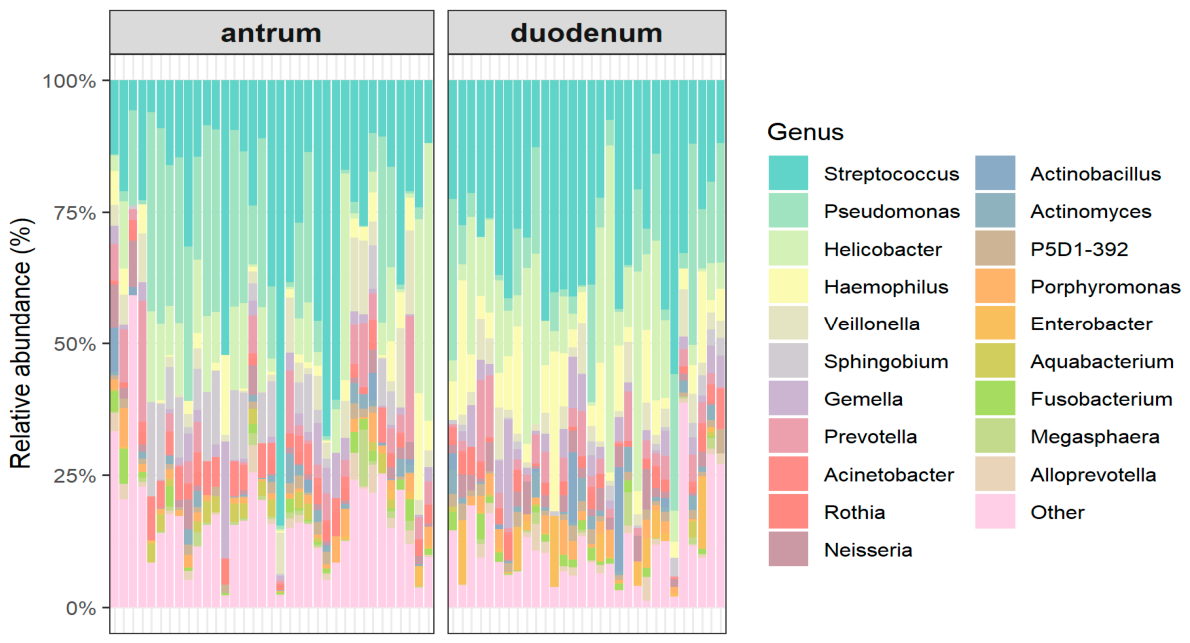
Figure 2.
Principal coordinates analysis (PCoA) based on Bray–Curtis distances showing separation of microbial communities between gastric antrum and duodenal samples (PERMANOVA, p = 0.018). Antrum samples are shown in green, and duodenal samples are shown in pink.
Figure 2.
Principal coordinates analysis (PCoA) based on Bray–Curtis distances showing separation of microbial communities between gastric antrum and duodenal samples (PERMANOVA, p = 0.018). Antrum samples are shown in green, and duodenal samples are shown in pink.
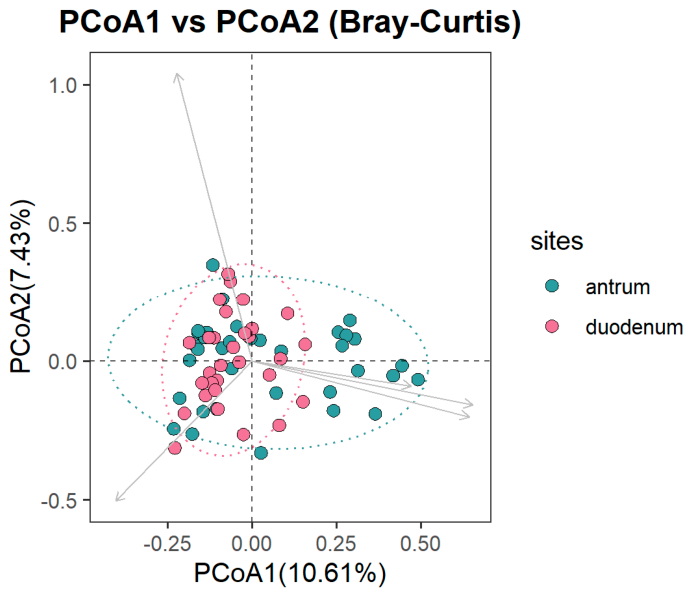
Figure 3.
Genus-level microbial composition across GERD phenotypes in the gastric antrum and duodenum.
Figure 3.
Genus-level microbial composition across GERD phenotypes in the gastric antrum and duodenum.
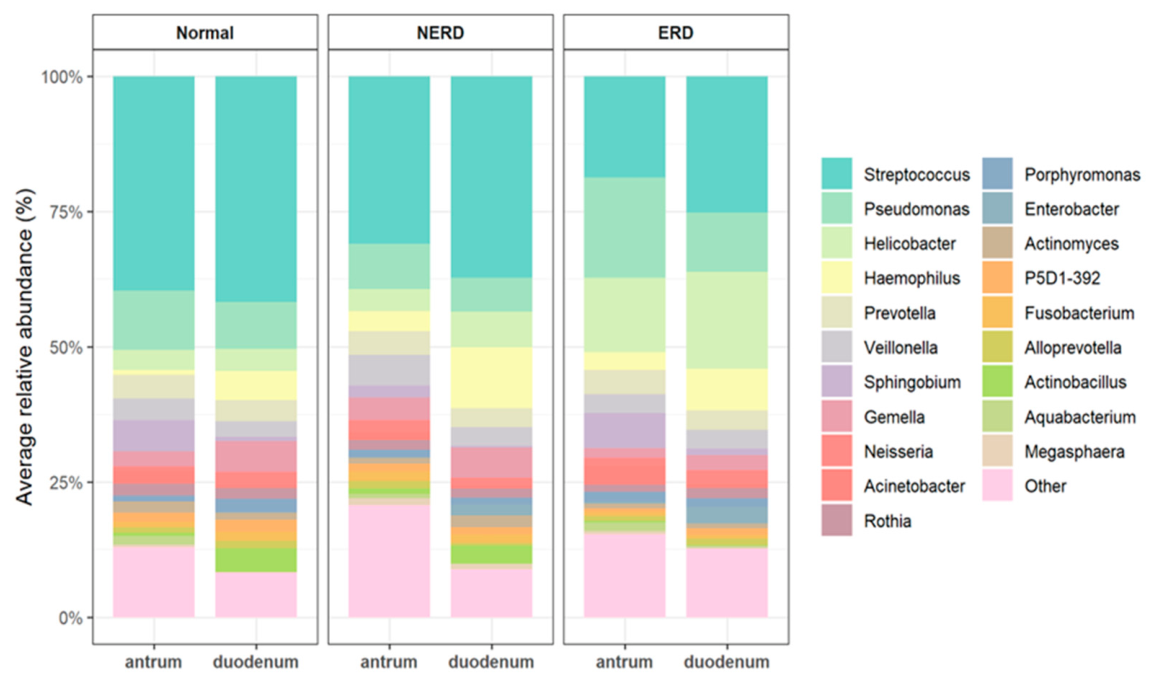
Figure 4.
LEfSe analysis showing significantly discriminant bacterial genera across GERD phenotypes within each anatomical site. Relative abundance plots are shown for the gastric antrum (A) and duodenum (B), and linear discriminant analysis (LDA) score bar plots showing effect sizes are shown for the gastric antrum (C) and duodenum (D). Taxa with an LDA score > 2.0 and p < 0.05 were considered discriminant.
Figure 4.
LEfSe analysis showing significantly discriminant bacterial genera across GERD phenotypes within each anatomical site. Relative abundance plots are shown for the gastric antrum (A) and duodenum (B), and linear discriminant analysis (LDA) score bar plots showing effect sizes are shown for the gastric antrum (C) and duodenum (D). Taxa with an LDA score > 2.0 and p < 0.05 were considered discriminant.
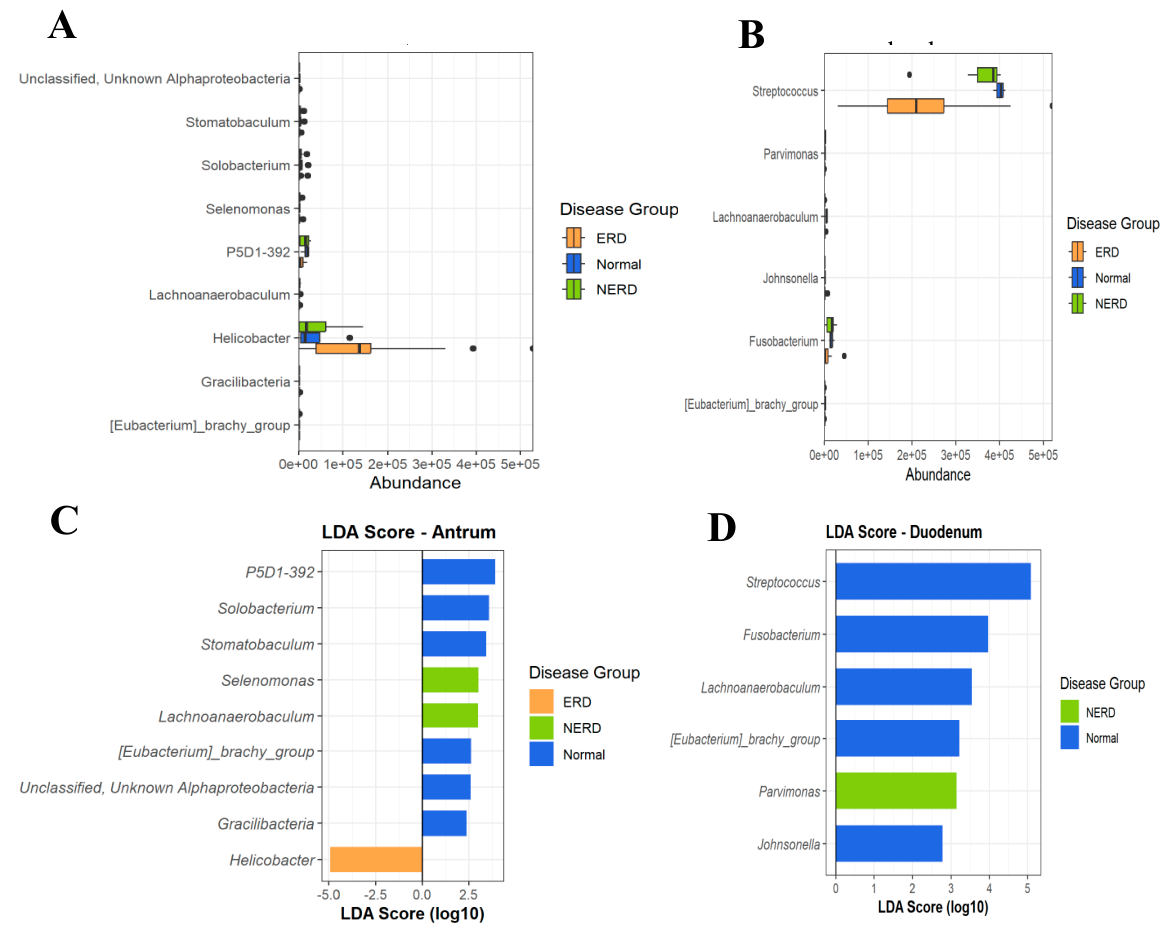
Figure 5.
Comparison of α-diversity indices in paired gastric antrum and duodenal samples (n = 25).
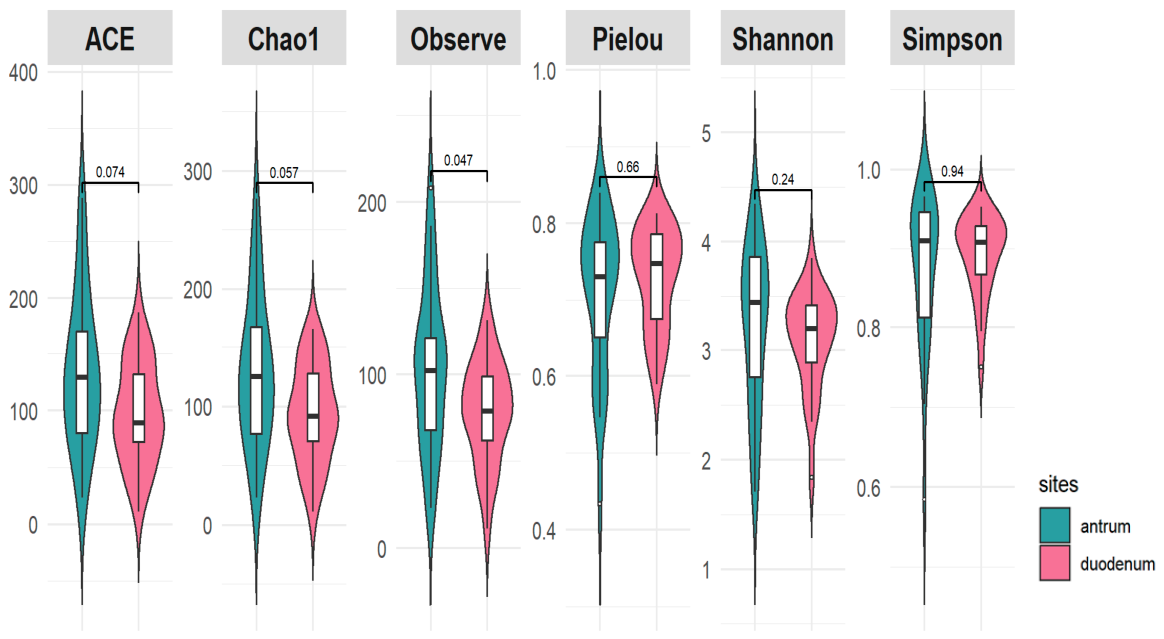
Figure 6.
Principal coordinates analysis (PCoA) based on Bray–Curtis distances showing differences in microbial community composition between paired gastric antrum and duodenal samples (n = 25).
Figure 6.
Principal coordinates analysis (PCoA) based on Bray–Curtis distances showing differences in microbial community composition between paired gastric antrum and duodenal samples (n = 25).
Disclaimer/Publisher’s Note: The statements, opinions and data contained in all publications are solely those of the individual author(s) and contributor(s) and not of MDPI and/or the editor(s). MDPI and/or the editor(s) disclaim responsibility for any injury to people or property resulting from any ideas, methods, instructions or products referred to in the content. |
© 2026 by the authors. Licensee MDPI, Basel, Switzerland. This article is an open access article distributed under the terms and conditions of the Creative Commons Attribution (CC BY) license (http://creativecommons.org/licenses/by/4.0/).
Copyright: This open access article is published under a Creative Commons CC BY 4.0 license, which permit the free download, distribution, and reuse, provided that the author and preprint are cited in any reuse.


