

Submitted:
20 April 2026
Posted:
21 April 2026
You are already at the latest version
Abstract
Balancing of macronutrient intake assumes that animals change their food preferences to increase consumption of the deficient nutrients and/or decrease consumption of nu-trients in excess. Harvestmen are generalist predators that consume mostly soft-bodied insects, but they supplement this with plant-derived food such as berries (omnivory). In spite of this, they are often carbohydrate limited in their natural habitats. As aphids have higher sugar content than most other insect prey, they are a potential source of sugar. We hypothesized that sugar-deficient harvestmen have increased preference for aphids relative to other insect prey (fruit flies) and consume more aphids than sug-ar-satiated harvestmen. Likewise, we hypothesized that protein-deficient harvestmen would show increased consumption of aphids relative to a pure sugar source (dried grape pulp). The former hypothesis was confirmed but the latter was not. Carbohy-drate-deprived harvestmen (Leiobunum gracile) consumed more aphids than nutritionally balanced ones. Consumption of dried grape was increased in carbohydrate-deficient harvestmen, while protein-deficiency did not increase consumption of aphids. These results indicate that aphids may be used as a carbohydrate source if no better alternative is available, but they are unable to relieve a protein deficiency. We suggest that carbohydrate deprivation in predators may enhance aphid control.
Keywords:
nutritional balance
; Opiliones
; omnivory
; predation
; prey preference
1. Introduction
Balancing of macronutrient intake by means of behavioural and physiological adaptations is a central aspect of foraging in generalist herbivores [1] as well as predators and omnivores [2,3]. By self-selecting among available foods, the animals seek to obtain a nutrient composition of the diet (the Intake Target [3]) that maximizes their fitness. For herbivores, the intake target can be reached by selecting among plant species or parts of plants with different nutrient composition. For predators, it can be reached by selecting between different prey species or by preferentially eating certain parts of the prey. The need for and the ability of predators to obtain a balanced diet has been documented repeatedly in laboratory studies [2,4,5] using either semi-artificial foods or fruit flies whose nutrient composition was manipulated through enrichment of the growth medium [6,7]. In spite of the ability to balance their diet, other studies have shown that predators in the field are often in an imbalanced state [8], indicating that available prey are nutritionally biased. Predators and predatory omnivores are most often lipid limited in nature [8,9]. However, several species of harvestmen (Opiliones) have been found to be mainly carbohydrate limited [7,10]. This raises the question: what types of food can harvestmen search for that may alleviate their carbohydrate deficiency?
Most harvestmen are generalist predatory omnivores and scavengers, i.e. they consume mostly small soft-bodied insects and other invertebrates, but they supplement the diet with plant-derived food [11]. The carbohydrate fraction of the self-selected diet of phalangiid and sclerosomatid harvestmen make up 15-22% of macronutrient energy intake, while protein and lipid account for 46-50% and 24-38%, respectively [7,10]. Plant matter mainly consists of the soft parts of berries, i.e. the pulp [7,11,12]. Thus, simple sugars are the main plant-derived nutrients [13].
Sugars may also be gained through the harvestmen’s predatory activities, as insects like aphids and other phloem-sap sucking Hemiptera contain sugar in amounts that are higher than found in other types of insects [14,15,16,17,18]. We hypothesized an increased preference for aphids and thus an increased aphid consumption in sugar-deficient harvestmen compared to nutritionally balanced harvestmen.
Aphids also have a substantial amount of protein in their bodies (35-60% of dry mass [17,18]) and thus might be able to relieve a potential protein deficiency of harvestmen, though such a deficiency has not yet been demonstrated to occur in the field. We therefore hypothesized that a similar relationship might exist for protein, i.e. harvestmen might accept an increased consumption of aphids when they are protein deficient.
By means of semi-artificial foods we fed harvestmen into deficiency of carbohydrate, protein or both, and measured in two separate experimental series their response in terms of amounts consumed of aphids and fruit flies (a “control prey”), and aphids and dried pulverized grape pulp (a nearly pure sugar source), respectively. For the first experiment, we hypothesized that sugar-deprived harvestmen would increase their consumption of aphids but not fruit flies compared to nutritionally balanced animals. For the second experiment, we hypothesized that sugar deprived harvestmen would increase consumption of dried grape pulp and aphids compared to non-deprived, and that protein deprived harvestmen would increase consumption of aphids relative to non-deprived animals.
2. Materials and Methods
2.1. Experimental Animals and Foods
Our experimental animals were adult females of the harvestman Leiobunum gracile (Thorell, 1876) (Sclerosomatidae). The species inhabits forests, whether deciduous or coniferous, shadowed by dense canopy, where they can be found on the tree trunks. For the present study, they were collected from the walls of a below-ground cellar built within a dense plantation of sitka spruce (Picea sitchensis) situated at Sårup in Thy, Denmark (57°08′97"N, 08°62′95"E). They were collected during two periods of the autumn 2024 (27-28 September (70 specimens) and 16-19 October (30 specimens)), i.e. experiments were run during the reproductive period of the species, and at a season where berries and aphids would be abundant. The animals were kept individually in plastic vials (diameter 3.5 cm, height 8.2 cm) with a humid bottom of plaster and stored in darkness in a cooler box during transport and in a fridge (c. 5°C) at the laboratory until start of the experiments.
Aphids (Rhopalosiphum padi) were raised on organic wheat seedlings, from which they were harvested by gently brushing them off into a tray, then transferred to a vial and frozen. Subsequently, they were dried in a vacuum oven (VacuTherm VT6060M; Thermo Scientific, Langenselbold, Germany) at 50°C. Macronutrient ratio (Protein:Lipid:Carbohydrate) for Aphididae (average of several species) is reported as 55.3%P:28.1%L:16.6%C [18].
Fruit flies (Drosophila melanogaster) were raised on Carolina Instant Drosophila Medium Formula 4–24 mixed 1:1 by weight with crushed dogfood, which makes the fruit flies of high food quality for arachnids [6]. They were freeze-killed and oven-dried at 50 °C. Macronutrient ratio for Diptera (average of several species) is reported as 62.8%P:31.4%L:5.8%C [18]. Notice that the carbohydrate content of aphids is approximately three times higher than that of flies.
Organic grapes (Vitis sp.) were store-bought, rinsed and skinned. The fruit pulp was cut into minor blocks and dried in the oven at 50°C. Finally, the dried blocks were blended in a coffee blender, so that they could be served as tiny pieces. Grapes contain 82.2% water, 0.6% protein, c. 0.0% lipid, and 16.8% carbohydrate of which 15.9% are low-molecular sugars (https://frida.fooddata.dk/food/508). Peeled and dried pulp thus contains more than 89% available sugar.
The semi-synthetic foods used as dietary treatments were made based on previously used recipes [19,20]. The foods were prepared by mixing dry pulverized locust with casein (protein), lard (lipid) and sucrose (carbohydrate), respectively, according to the experimental design (see below). The ingredients were finely powdered and thoroughly mixed so that selection of specific constituents was unlikely. All foods were free of water and kept in a box with silica gel until served. We used dry, pulverized foods for the treatments as well as for the tests to avoid the many confounding factors associated with choice of live prey (e.g. mechanical and behavioural defences) and as far as possible isolate food quality (as determined by content of nutrients and possible chemical defence substances) as the basis for food selection in the harvestmen.
2.2. Procedures
During the whole experiment, the harvestmen were kept individually in plastic containers (9x9 cm, height 5 cm) with holes for airflow, and a wetted block of rubber foam to provide adequate humidity and drinking water ad libitum. During the first 24-48 hours they were acclimated to the laboratory conditions (temperature c. 21 °C, day length uncontrolled) and provided fruit flies ad libitum to standardize their nutritional condition. This period was considered sufficient as harvestmen have a throughput time for food of 16-20 hours [21]. Subsequently they went through experimental feeding treatments for 7 days, during which fresh food and water were supplied every 2-3 days. The treatments differed between the two experimental series.
2.2.1. Experiment 1. Does Aphid Consumption Increase in Carbohydrate Deficient Harvestmen?
Two groups of 20 harvestmen were randomly selected from the pool of animals available from the first collection round. One group (control (C), final n = 19) was served semi-synthetic food with macronutrient composition similar to the self-selected optimal intake target previously determined [7]. The carbohydrate-deficient group (CD, final n = 18) was served a similar food except that no sucrose was added (Table 1).
Following this 7-day treatment period, we performed a 24 hour self-selection experiment in which the animals of both treatments could choose between two prey types: dried aphids and dried fruit flies. Approximately 5 mg of each prey were weighed (Sartorius MC 5.1 g, ISO 9001 Sartorius AG, Göttingen, Germany; accuracy 0.001 mg) and presented on separate glass dishes placed at opposite corners of the container. At the end of the test period, remaining prey was dried in the vacuum oven at 50 °C and weighed. The amounts consumed were calculated by subtracting the mass of remaining prey from the mass of prey served.
2.2.2. Experiment 2. Does Aphid Consumption Increase in Protein Deficient Harvestmen?
The experiment was performed during two periods (blocks) following the two collection rounds. For each period, we established three randomly selected groups of harvestmen that received different feeding treatments. Compared to the self-selected (target) macronutrient composition, they were offered a carbohydrate deficient food (CD), a protein deficient food (PD), or a food that was deficient in both carbohydrate and protein (CPD) (Table 1). With this design we had one non-deficiency and two deficiency treatments of each macronutrient (protein and carbohydrate). Final total sample sizes for the three treatments were CD n = 14, PD n = 14, and CPD n = 13. The treatment period was followed by a 24 hour self-selection test in which the animals of all groups could choose between dried aphids and dried pulverized grape pulp. Weighed amounts of the test foods were presented on separate glass dishes placed at opposite corners of the container. At the end of the test period, remaining food was dried in the vacuum oven at 50 °C and weighed. The amounts consumed were calculated by subtracting the mass of remaining food from the mass of food served.
Control samples without a harvestman (n = 15) were run along with the test samples in order to test possible loss of food during the experimental procedure not due to feeding by harvestmen. Aphids and grape pulp lost some weight (3.95% and 4.14%, respectively) whereas loss of fruit fly mass was negligible (0.06%). Therefore, the amounts of aphids and grape pulp served were corrected for these losses before the remains were subtracted. The animals were released at the site of collection after termination of the experiments.
2.3. Statistical Analysis
Statistical analyses were made in RStudio [22] and R 4.4.2 [23]. Because consumption of the two offered foods (exp.1: aphids and fruit flies; exp. 2: aphids and grape pulp) were non-independent, we used MANOVA with the two consumption values as the multiple response variables and treatment as factor. Multivariate assumptions (multivariate normality (Henze-Zirkler test), equal variance (Box’s M test), outlier test (Mahalanobis distance)) were checked; in both experiments, they were fulfilled by untransformed data. As Experiment 2 was performed in two periods (blocks) and further had to use animals with up to three legs missing (especially in the second period), the initial MANOVA model included the factors Block and No. of legs (harvestmen are robust to loss of a few legs [24], but we wanted to check for a potentially negative effect). However, after sequential deletion of non-significant factors, both were absent from the final model. After checks of univariate assumptions (normal distribution of residuals (Shapiro-Wilk test, QQ-plots), variance homogeneity (Levene test)), the MANOVAs were followed by ANOVAs comparing consumption of each food type over the treatments. Tukey’s HSD test was used for post-hoc comparisons between treatments in experiment 2. Finally, we used paired t-tests or Wilcoxon’s signed-rank test (when assumptions of paired t-tests were not fulfilled) to compare consumption of the two foods in relation to treatments in both experiments.
3. Results
3.1. Experiment 1
The harvestmen consumed aphids and fruit flies differently following the two treatments (MANOVA, Pillai’s trace = 0.332, F = 8.19, df = 1,34, p = 0.0013; Figure 1). Consumption of fruit flies was independent of treatments (ANOVA, F = 2.14, p = 0.15), while aphid consumption was increased in the carbohydrate-deficient treatment (F = 15,46, p = 0.0004). Consumption of aphids was higher than that of fruit flies in the carbohydrate-deficient treatment (CD) but not in the control (C) (paired t-tests, C: t18 = 0.43, p = 0.67; CD: t16 = -3.62, p = 0.0023).
3.2. Experiment 2
The harvestmen consumed aphids and grape pulp differently following the three treatments (MANOVA, Pillai’s trace = 0.632, F = 8.77, df = 2,38, p < 0.0001; Figure 2). Consumption of aphids was independent of treatments (ANOVA, F2,38 = 1.32, p = 0.28), while consumption of grape pulp was increased in the +CD-treatment compared to the other treatments (ANOVA, F2,38 = 28.08, p < 0.0001). Grape pulp was consumed more than aphids in all three treatments (paired t-tests; PD: t13 = 2.31, p = 0.0377; CD: t13 = 11.42, p < 0.0001; Wilcoxon signed-rank test PCD: S13 = 37.50, p = 0.0061).
4. Discussion
The results reveal that harvestmen increased their acceptance of aphids when deprived of carbohydrate (Figure 1) and thus support the hypothesis that harvestmen may use carbohydrate-rich prey such as aphids in an attempt to mend a carbohydrate deficit. They also show that no similar increase in aphid consumption occurred when a food with a very high sugar content (grape pulp) was also available (Figure 2). Thus, harvestmen may eat aphid prey to relieve a carbohydrate deficiency if no better carbohydrate source is available. In contrast, against our prediction we found no evidence that the harvestmen would use aphids to relieve a protein deficiency, even if only low-protein alternative food was available (Figure 2).
Consumption of unbalanced food is generally lower than consumption of balanced food [3]; thus, the carbohydrate-deficient animals were probably hungrier than control animals after the treatment period. This may explain why, in experiment 1, total consumption was higher in the carbohydrate-deficient than in the control group. In spite of this, it was only consumption of aphids that was increased, not that of fruit flies. This indicates that it was carbohydrate deficiency rather than hunger that was driving the increased acceptance of aphids.
The harvestmen increased grape pulp consumption if carbohydrate-deficient, but not if deficient in both carbohydrate and protein (Figure 2). The reason why carbohydrate deficiency increased grape pulp consumption in one situation and not the other can probably be understood from consideration of the overall nutritional balance of the animals. In the former situation, sugar intake from grape pulp consumption could potentially restore the animals’ nutritional balance completely; in the latter situation, grape pulp consumption would relieve the carbohydrate deficiency, but at the same time deepen the protein deficiency further.
The reason why aphids may be used in an attempt to relieve a carbohydrate but not a protein deficiency is unknown. Extending the argument above, aphid consumption by protein-but-not-carbohydrate deficient animals would lead to an excessive carbohydrate intake. We also speculate that the ability to regulate carbohydrate has evolved because the species (as well as several other harvestmen) is often carbohydrate limited in nature [7]. In contrast, there is no evidence for protein limitation of harvestmen in the field; thus, behavioural mechanisms for dealing with this situation may not have evolved.
Harvestman species of forest habitats are known for their extensive vertical migrations along tree trunks during their nightly activity in search of food and mates. In Charles Elton’s words: “… after dark these trunks become important highways up and down between the canopy and the ground and support a massive traffic of … harvestmen …” [25] (p. 60). Up-trunk movement in particular must be extremely energy demanding and may thus explain the need for and frequent deficiency of sugar, which is unusual for mainly carnivorous animals.
In the present study we found indications of active sugar balancing by consumption of either prey (aphids) or plant food (grape pulp) in the same animal species. These findings support the hypothesis that dietary mixing (including both predatory polyphagy and omnivory) serves a role in maintaining nutritional balance in generalist predators and predatory omnivores [26,27,28]. That two such different food types can serve the same physiological function support the idea that generalist feeders forage for nutrients rather than for specific foods [29]. The benefits of omnivory for the harvestmen are illustrated by the double possibilities it gives for redressing a nutritional deficit: it can be done through predation by utilization of sugar-rich prey, or through frugivory. Depending on what types of food are available, both ways of feeding may be the optimal solution.
Clearly, aphids differ in value as food depending on the nutritional status of the predator. They may be a valuable addition to a mixed diet for predators with a specific deficit, and a neutral or even negative addition to balanced predators. This combination of context-dependent food value was shown in a linyphiid spider where aphids were a negative addition to a mixed diet that included a high-quality prey, but a positive addition to a diet that included a low-quality prey [30].
5. Implications
It is tempting to speculate whether carbohydrate limitation in the field gives harvestmen a special potential in the natural control of aphids in agricultural crops. Though little studied, harvestmen may be common inhabitants of agricultural fields and thus may contribute to the combined control potential of the generalist predator community [31]. Some authors have expressed the opinion that harvestmen have been underrated as predators of crop pests [11,32]. In microcosm studies, the harvestman Oligolophus tridens was the most effective among six tested generalist predators (others were spiders and carabid beetles), reducing aphid numbers by more than 90% as compared to predator-free controls [33]. Future studies should investigate what role the demand for low-molecular sugars may play for the effectiveness of generalist predators in aphid control, and if sugar deficiency may enhance control efficiency.
Author Contributions
Conceptualization, S.T.; methodology, all authors; formal analysis, all authors; resources, S.T.; writing—original draft preparation, M.R.S., L.B.-W., L.C.G.; writing—review and editing, S.T.; supervision, S.T. All authors have read and agreed to the published version of the manuscript.
Funding
This research received no external funding.
Data Availability Statement
The data presented in this study are available on request from the corresponding author.
Acknowledgments
The experiments were completed as part of a student course in Experimental Evolutionary Biology. Johanne Hejselbak Weber-Hansen contributed to the completion of the experiments. We are grateful to Tove Hedegaard Jørgensen and Jesper Givskov Sørensen for guidance and comments on preliminary reports, and to Marie Rosenstand Hansen for practical help in the laboratory. We are also thankful to Lars Stubsgaard (Borregaard Bioplant ApS) for procuring the aphids we used for propagation during our experiments.
Conflicts of Interest
The authors declare no conflicts of interest.
References
- Behmer, S.T. Insect herbivore nutrient regulation. Ann. Rev. Entomol. 2009, 54, 165–187. [Google Scholar] [CrossRef]
- Mayntz, D.; Raubenheimer, D.; Salomon, M.; Toft, S.; Simpson, S.J. Nutrient-specific foraging in invertebrate predators. Science 2005, 307(5706), 111–113. [Google Scholar] [CrossRef] [PubMed]
- Simpson, S.J.; Raubenheimer, D. The nature of nutrition: a unifying framework; Princeton University Press: Princeton, N.J, 2012. [Google Scholar]
- Wilder, S.M. Spider nutrition: an integrative perspective. Adv. Insect Physiol. 2011, 40, 87–136. [Google Scholar] [CrossRef]
- Toft, S. Nutritional aspects of spider feeding. In Spider Ecophysiology; Nentwig, W., Ed.; Springer Verlag: Berlin, 2013; pp. 373–384. [Google Scholar] [CrossRef]
- Mayntz, D.; Toft, S. Nutrient composition of the prey’s diet affects fitness of a generalist predator. Oecologia 2001, 127, 207–213. [Google Scholar] [CrossRef] [PubMed]
- Nielsen, S.M.B.; Bilde, T.; Toft, S. Macronutrient niches and field limitation in a woodland assemblage of harvestmen. J. Anim. Ecol. 2022, 91, 593–603. [Google Scholar] [CrossRef]
- Toft, S.; Cuende, E.; Olesen, A.L.; Mathiesen, A.; Larsen, M.M.; Jensen, K. Food and specific macronutrient limitation in an assemblage of predatory beetles. Oikos 2019, 128, 1467–1477. [Google Scholar] [CrossRef]
- Toft, S.; Pavón-Peláez, C.; Martinez-Villar, M.; Rengifo, L.; Arroyave, A.; Pompozzi, G.; Franco, V.; Albo, M.J. Contrasting patterns of food and macronutrient limitation in the field among co-existing omnivorous carnivores. Ecol. Entomol. 2021, 46, 898–909. [Google Scholar] [CrossRef]
- Christensen, J.; Nielsen, S.M.B.; Toft, S. The three-dimensional macronutrient niche of an invasive generalist predator. Ecol. Entomol. 2020, 45, 644–651. [Google Scholar] [CrossRef]
- Acosta, L.E.; Machado, G. Diet and foraging. In Harvestmen: the biology of Opiliones; Pinto-da-Rocha, R., Machado, G., Giribet, G., Eds.; Harvard University Press: Cambridge, 2007; pp. 309–338. [Google Scholar]
- Nyffeler, M.; Machado, G.; Hartmann, A.; Keiser, C.N. Fungus and fruit consumption by harvestmen and spiders (Opiliones, Araneae): The vegetarian side of two predominantly predaceous arachnid groups. J. Arachnol. 2023, 51, 1–18. [Google Scholar] [CrossRef]
- Jordano, P. Fruits and frugivory. In The ecology of regeneration in plant communities, 3rd ed.; Gallagher, R.S., Ed.; CABI: Wallingford, UK, 2014; pp. 18–61. [Google Scholar]
- Srivastava, P.N. Nutritional physiology. In Aphids, their biology, natural enemies and control; Minks, A.K., Harrewijn, P., Eds.; Elsevier: Amsterdam, 1987; Volume A, pp. 99–121. [Google Scholar]
- Lv, N.; Wang, L.; Sang, W.; Liu, C.-Z.; Qiu, B.-L. Effects of endosymbiont disruption on the nutritional dynamics of the pea aphid Acyrthosiphon pisum. Insects 2018, 9, 161. [Google Scholar] [CrossRef]
- Liu, H.-P.; Yang, Q.-Y.; Liu, J.-X.; Haq, I.U.; Li, Y.; Zhang, Q.-Y.; Attia, K.A.; Abushady, A.M.; Liu, C.-Z.; Lv, N. Host plant mediated effects on Buchnera symbiont: implications for biological characteristics and nutritional metabolism of pea aphids (Acyrthosiphon pisum). Front. Plant Sci. 2023, 14, 1288997. [Google Scholar] [CrossRef]
- Cuff, J.P.; Tercel, M.P.T.G.; Vaughan, I.P.; Drake, L.E.; Wilder, S.M.; Bell, J.R.; Müller, C.T.; Orozco-terWengel, P.; Symondson, W.O.C. Prey nutrient content is associated with the trophic interactions of spiders and their prey selection under field conditions. Oikos 2024a, e10712. [Google Scholar] [CrossRef]
- Cuff, J.P.; Tercel, M.P.T.G.; Vaughan, I.P.; Drake, L.E.; Wilder, S.M.; Bell, J.R.; Müller, C.T.; Orozco-terWengel, P.; Symondson, W.O.C. Prey nutrient content is associated with the trophic interactions of spiders and their prey selection under field conditions [Dataset]. Zenodo 2024b. [Google Scholar] [CrossRef]
- Jensen, K.; Mayntz, D.; Toft, S.; Clissold, F.; Raubenheimer, D.; Simpson, S.J. Optimal foraging for specific nutrients in predatory beetles. Proc. R. Soc. B 2012, 279, 2212–2218. [Google Scholar] [CrossRef]
- Noreika, N.; Madsen, N.E.L.; Jensen, K.; Toft, S. Balancing of lipid, protein, and carbohydrate intake in a predatory beetle following hibernation, and consequences for lipid restoration. J. Insect Physiol. 2016, 88, 1–9. [Google Scholar] [CrossRef]
- Phillipson, J. A contribution to the feeding biology of Mitopus morio (F.) (Phalangida). J. Anim. Ecol. 1960, 29, 35–43. [Google Scholar] [CrossRef] [PubMed]
- Posit team. RStudio: Integrated Development Environment for R. Posit Software, PBC, Boston, MA. 2024. Available online: http://www.posit.co/.
- R Core Team. R: A language and environment for statistical computing; R Foundation for Statistical Computing: Vienna, Austria, 2024; Available online: https://www.R-project.org/.
- Escalante, I.; O’Brien, S.L. Robustness to leg loss in Opiliones: a review and framework considerations for future research. Integr. Comp. Biol. 2024, 64, 1338–1353. [Google Scholar] [CrossRef]
- Elton, C.S. The pattern of animal communities; Methuen & Co, London: London, 1966. [Google Scholar]
- Coll, M.; Guershon, M. Omnivory in terrestrial arthropods: mixing plant and prey diets. Ann. Rev. Entomol. 2002, 47, 267–297. [Google Scholar] [CrossRef]
- Lefchek, J.S.; Whalen, M.A.; Davenport, T.M.; Stone, J.P.; Duffy, J.E. Physiological effects of diet mixing on consumer fitness: a meta-analysis. Ecology 2013, 94, 565–572. [Google Scholar] [CrossRef]
- Marques, R.V.; Sarmento; Lemos, F.; Pedro-Neto, M.; Sabelis, M.W.; Venzon, M.; Pallini, A.; Janssen, A. Active prey mixing as an explanation for polyphagy in predatory arthropods: synergistic dietary effects on egg production despite a behavioural cost. Funct. Ecol. 2015, 29, 1317–1324. [Google Scholar] [CrossRef]
- Kohl, K.D.; Coogan, S.C.P.; Raubenheimer, D. Do wild carnivores forage for prey or for nutrients?: Evidence for nutrient-specific foraging in vertebrate predators. BioEssays 2015, 37, 701–709. [Google Scholar] [CrossRef] [PubMed]
- Bilde, T.; Toft, S. Evaluation of prey for the spider Dicymbium brevisetosum Locket (Araneae: Linyphiidae) in single-species and mixed-species diets. Ekológia (Bratislava) 2000, 19, 9–18. Available online: https://www.european-arachnology.org/esa/wp-content/uploads/2015/08/009-018_Bilde.pdf.
- Symondson, W.O.C.; Sunderland, K.D.; Greenstone, M.H. Can generalist predators be effective biocontrol agents? Ann. Rev. Entomol. 2002, 47, 561–594. [Google Scholar] [CrossRef]
- Dixon, P.L.; Mckinlay, R.G. Aphid predation by harvestmen in potato fields in Scotland. J. Arachnol. 1989, 17, 253–255. Available online: http://www.jstor.org/stable/3705637.
- Madsen, M.; Terkildsen, S.; Toft, S. Microcosm studies on control of aphids by generalist arthropod predators: effects of alternative prey. BioControl 2004, 49, 483–504. [Google Scholar] [CrossRef]
Figure 1.
Consumption of dried aphids (Rhopalosiphum padi) (grey) and dried fruit flies (Drosophila melanogaster) (white) in nutritionally balanced (Control) and carbohydrate deficient females of the harvestman Leiobunum gracile. Same letter indicates no significant difference between groups based on ANOVAs and paired t-tests. Horizontal line within box = median; box = 25th/75th pecentiles; whiskers = 5th/95th percentiles; dots = outliers.
Figure 1.
Consumption of dried aphids (Rhopalosiphum padi) (grey) and dried fruit flies (Drosophila melanogaster) (white) in nutritionally balanced (Control) and carbohydrate deficient females of the harvestman Leiobunum gracile. Same letter indicates no significant difference between groups based on ANOVAs and paired t-tests. Horizontal line within box = median; box = 25th/75th pecentiles; whiskers = 5th/95th percentiles; dots = outliers.
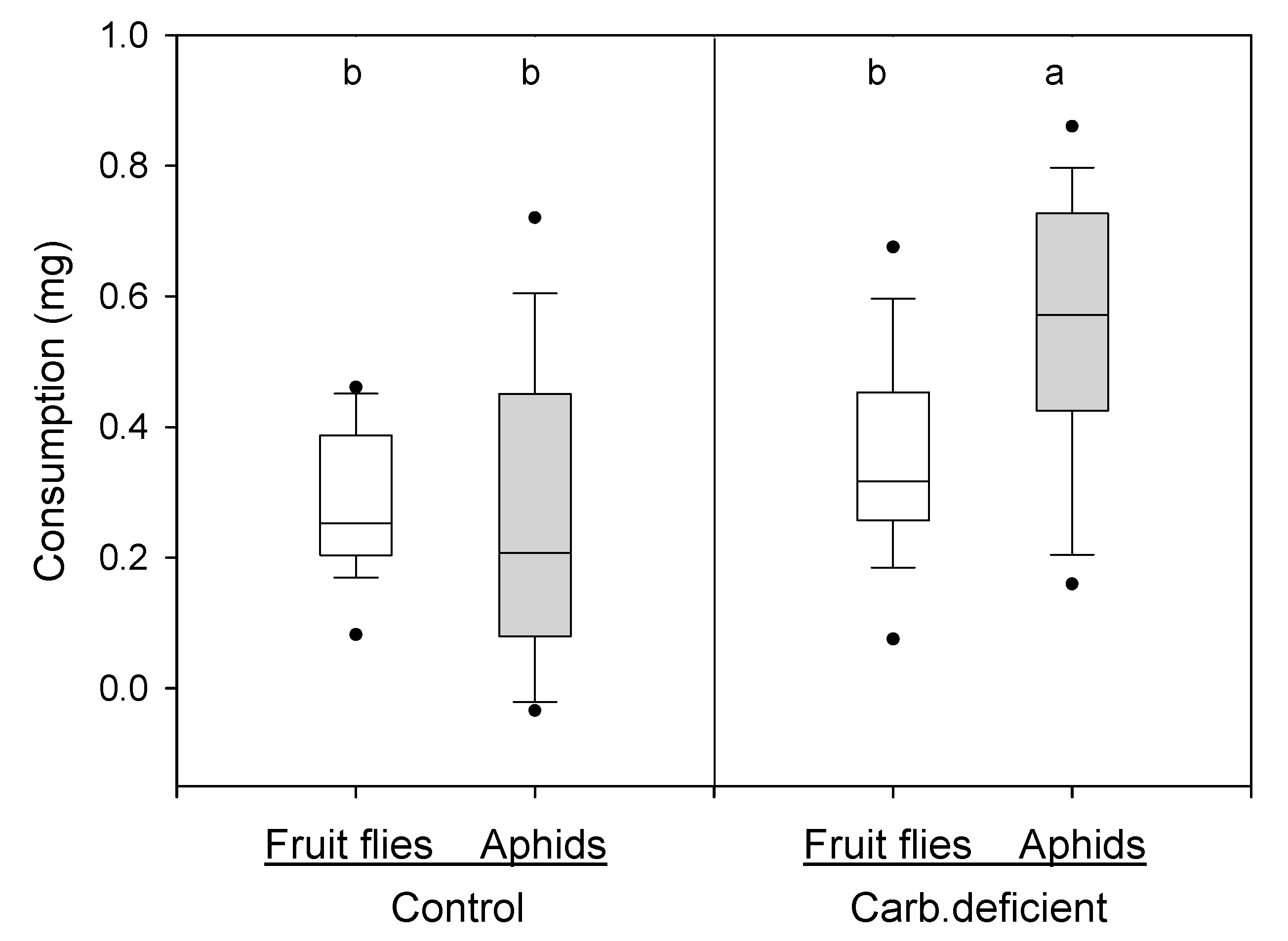
Figure 2.
Consumption of dried aphids (Rhopalosiphum padi) (grey) and dried grape pulp (white) by protein deficient, protein and carbohydrate deficient, and carbohydrate deficient females of the harvestman Leiobunum gracile. Same letter indicates no significant difference between groups based on Tukey HSD tests (same food between treatments) and paired t-tests/Wilcoxon signed-rank tests (different foods within treatments). Horizontal line within box = median; box = 25th/75th percentiles; whiskers = 5th/95th percentiles; dots = outliers.
Figure 2.
Consumption of dried aphids (Rhopalosiphum padi) (grey) and dried grape pulp (white) by protein deficient, protein and carbohydrate deficient, and carbohydrate deficient females of the harvestman Leiobunum gracile. Same letter indicates no significant difference between groups based on Tukey HSD tests (same food between treatments) and paired t-tests/Wilcoxon signed-rank tests (different foods within treatments). Horizontal line within box = median; box = 25th/75th percentiles; whiskers = 5th/95th percentiles; dots = outliers.
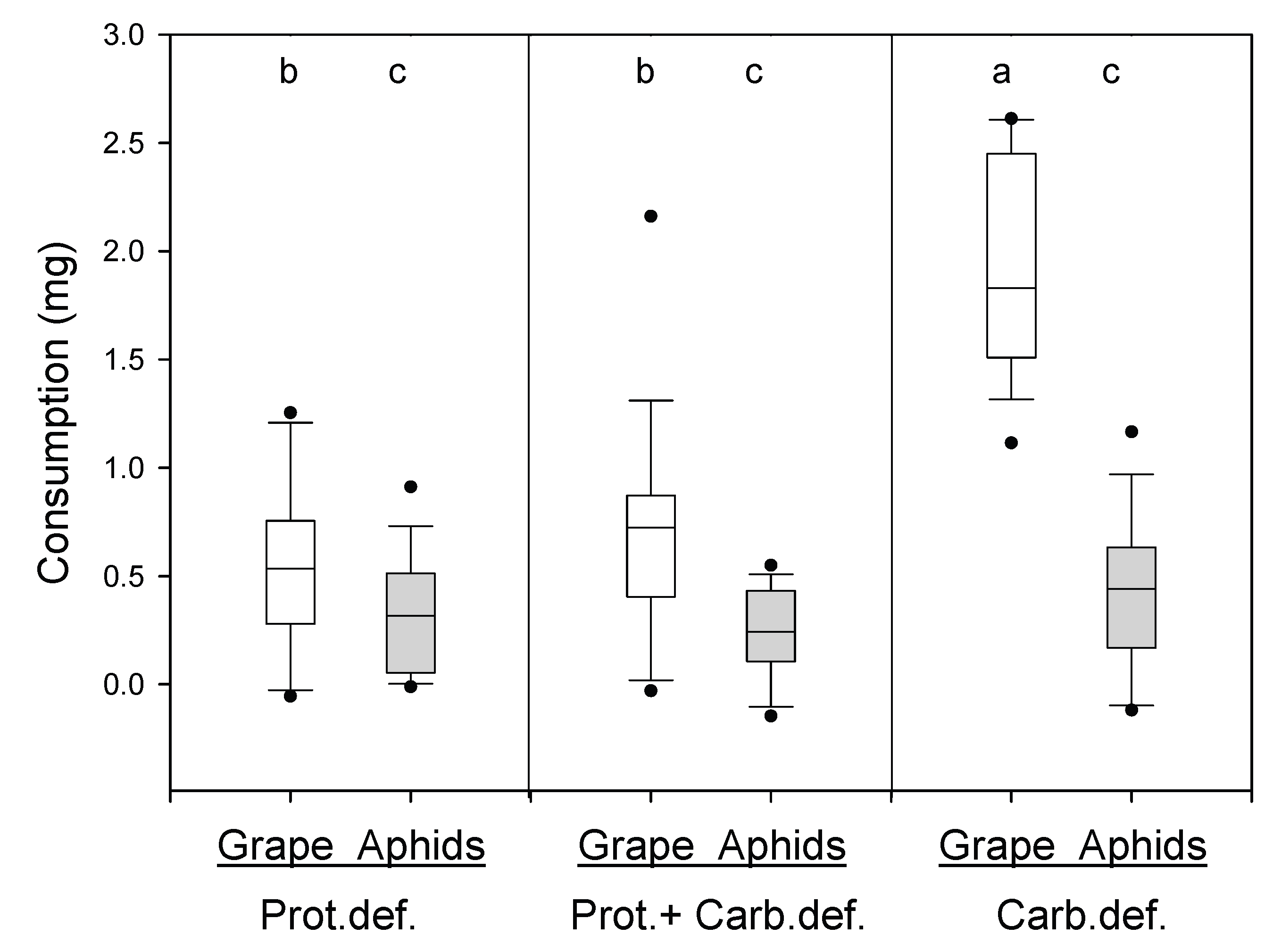

Table 1.
Ingredients and macronutrient composition of semi-synthetic foods used for treatment of the harvestmen. C (control): balanced food (~ intake target); CD: carbohydrate deficient food; PD: protein deficient food; PCD: protein and carbohydrate deficient food.
Table 1.
Ingredients and macronutrient composition of semi-synthetic foods used for treatment of the harvestmen. C (control): balanced food (~ intake target); CD: carbohydrate deficient food; PD: protein deficient food; PCD: protein and carbohydrate deficient food.
| Ingredients by weight | Macronutrient content by energy |
||||||
| %grasshopper | %casein | %lard | %sucrose | %protein | %lipid | %carb. | |
| Exp. 1 | |||||||
| C | 40.0 | 28.0 | 12.0 | 20.0 | 47.2 | 35.7 | 17.2 |
| CD | 50.0 | 35.0 | 15.0 | 0.0 | 74.0 | 24.5 | 1.5 |
| Exp. 2 | |||||||
| PD | 44.4 | 0.0 | 22.2 | 35.5 | 24.4 | 48.4 | 27.2 |
| CD | 51.2 | 35.8 | 15.4 | 0.0 | 57.4 | 41.3 | 1.2 |
| PCD | 57.7 | 0.0 | 30.2 | 12.1 | 30.4 | 60.2 | 9.4 |
Disclaimer/Publisher’s Note: The statements, opinions and data contained in all publications are solely those of the individual author(s) and contributor(s) and not of MDPI and/or the editor(s). MDPI and/or the editor(s) disclaim responsibility for any injury to people or property resulting from any ideas, methods, instructions or products referred to in the content. |
© 2026 by the authors. Licensee MDPI, Basel, Switzerland. This article is an open access article distributed under the terms and conditions of the Creative Commons Attribution (CC BY) license.
Copyright: This open access article is published under a Creative Commons CC BY 4.0 license, which permit the free download, distribution, and reuse, provided that the author and preprint are cited in any reuse.


