

Submitted:
20 April 2026
Posted:
21 April 2026
You are already at the latest version
Abstract
Background: Motor precision is a highly innate trait, while ambidexterity in high-precision tasks remains rare and biologically regulated. Few sports necessitate bilateral precision; however, the indigenous sport of picigin uniquely requires symmetrical palm-striking proficiency. Methods: This study investigated bilateral precision and ball velocity in 22 experienced players, divided into competitive (n=11) and recreational (n=11) groups. A specialized bilateral palm-precision test was developed to measure performance across both dominant and non-dominant hands. Key metrics included the asymmetry index for speed and accuracy, and the speed-accuracy trade-off (SAT). Results: Results indicate that competitors significantly outperform recreational players in both precision and velocity. Notably, the SAT analysis suggests that the dominant hand of recreational players performs at a level comparable to the non-dominant hand of competitors. While recreational players exhibited slightly lower asymmetry indices, the inter-manual gap remained stable despite years of experience. Conclusions: Findings suggest that bilateral training induces linear improvements on both sides, maintaining a constant asymmetry ratio rather than diminishing it through long-term practice.
Keywords:
motor precision
; bilateral performance
; asymmetry index
1. Introduction
Precision in ball sports is often interpreted not as a standalone motor ability, but as the emergent result of accurate motor performance [1]. It comprises two distinct components: accuracy (the ability to reach the target) and consistency (the ability to replicate successful movements). Developing precision is particularly challenging due to its substantial innate component [2]. This biological constraint is often explained by the “neural noise” theory, which posits that individuals possess inherent levels of signal interference within the central nervous system that remain largely resistant to training [3,4]. Furthermore, research on ballistic movements, such as tennis serves, indicates that the underlying programs for high-velocity, high-precision tasks are highly heritable, determined primarily by the velocity of impulse conduction [1,5].
When integrated with Fitts’ Law [6]—which establishes an inverse relationship between movement speed and accuracy (Fitts, 1992)—precision can be viewed as a “hard” genetic factor; elite performers maintain signal stability even at high velocities [2]. While most precision-based sports are unilateral, requiring athletes to rely on their dominant side under pressure, the phenomenon of ambidexterity introduces further complexity. Natural ambidexterity is exceptionally rare, occurring in only approximately 1% of the population, and is under strict genetic regulation [7,8]. Even in sports where bilateral play is encouraged, such as basketball, elite athletes predominantly rely on their dominant hand for high-precision actions [9]. Despite the rarity of natural ambidexterity, certain sports like picigin—a Croatian cultural asset and dynamic ball game—demand high-velocity, bilateral precision. Unlike basketball or tennis, picigin requires players to execute accurate palm strikes with both hands, as the game’s mechanics largely preclude backhand strokes. This unique motor demand allows for an empirical investigation into whether decades of specialized training can override innate neural lateralization.
The aim of this study is to determine the differences in precision, ball velocity, and inter-manual asymmetry between elite competitors and experienced recreational players. Based on the ‘performance ceiling’ theory and the robust nature of genetic motor programs, we test the following hypotheses: Elite competitors will significantly outperform recreational players in both accuracy and velocity, demonstrating superior control of ‘neural noise. Long-term bilateral training will elevate the performance of both hands but will not eliminate the inherent inter-manual asymmetry.
2. Materials and Methods
2.1. Sample of Respondents
The sample comprised 22 active picigin players, categorized into two groups: the competitive group (CG; n=11), consisting of players with tournament experience, and the recreational group (RG; n=11), including long-term year-round players without competitive history. All participants possessed over 10 years of experience in this sport, which requires exceptional bilateral precision. This elite profile allows for the detection of specific motor adaptations absent in the general population. The study was conducted in accordance with the Declaration of Helsinki and approved by the Ethics Committee of the Faculty of Kinesiology, University of Split (Class: 643-02/21-13/006). GenAI: During the preparation of this manuscript, the authors used ChatGPT version [4o] for the purposes of generating Python code used for data visualization and the creation of graphs within the Google Colab environment. The authors have reviewed, executed, and edited the code and its output, and take full responsibility for the content and accuracy of the resulting figures. The authors also acknowledge the use of EndNote for reference management.
2.2. Variables and Asymmetry Index
Primary variables included accuracy and ball velocity for both the dominant (D) and non-dominant (ND) hands. Inter-manual asymmetry was quantified using the Asymmetry Index (AI): AI=[(D-ND)/(D+ND]×100. Values range from +100 (absolute D dominance) to -100 (absolute ND dominance), with zero representing perfect ambidexterity. Speed-Accuracy Trade-off (SAT). To evaluate the relationship between execution velocity and precision, a Speed-Accuracy Trade-off (SAT) index was calculated, consistent with Fitts’ Law [6]. The SAT index was defined as the product of total accuracy (sum of 5 trials, 0–25 points) and mean ball velocity (km/h):
2.3. Bilateral Palm Precision Test (BPPT) and Procedure
The BPPT was designed to isolate the fundamental motor skill of palm-striking from a controlled, stationary position. Participants stood 6 meters from a concentric target (1m diameter) consisting of five scoring zones (1–5 points). Hits outside the zones were recorded as zero. The protocol was standardized as follows:
Acclimatization: Three initial warm-up trials to stabilize the motor pattern.
Experimental Phase: Five consecutive trials with the dominant hand (DH), followed by five trials with the non-dominant hand (NDH). The task required a self-toss and a palm strike aiming for maximum accuracy and velocity. Data Acquisition: Ball velocity was measured using a Stalker ATS II radar (accuracy ±0.041 m/s) positioned 1 meter behind the participant. All trials were recorded with a high-definition mobile device for blinded post-hoc video analysis to ensure precise scoring. All participants used the same traditional picigin ball (22–25g).
2.4. Data Processing Methods
Data were analyzed using descriptive statistics (means and standard deviations). Normality was assessed via the Shapiro-Wilk test. Internal consistency of the BPPT was calculated using Cronbach’s alpha and average inter-item correlations. Differences between groups (CG vs. RG) were analyzed using independent samples t-tests or Mann-Whitney U tests for non-normal distributions. Effect sizes were quantified using Cohen’s d. Statistical significance was set at p < 0.05, using Statistica v.14.0.1.25.
3. Results
Reliability and Instrument Validity
The Bilateral Palm Precision Test (BPPT) protocol demonstrated exceptional internal consistency for ball velocity, with a Cronbach’s alpha of 0.98 and an average inter-item correlation of 0.87. These values indicate a high degree of measurement stability for the ballistic component of the task across all trials.
In contrast, the reliability coefficients for motor precision were lower, yielding a Cronbach’s alpha of 0.62 and an average inter-item correlation of 0.15. While lower than the velocity metrics, these values remain acceptable for a novel diagnostic instrument assessing inherently variable motor tasks. This discrepancy is consistent with the “neural noise” theory [3], which posits that high-precision motor performance is subject to inherent signal interference within the central nervous system, leading to natural trial-to-trial fluctuations.
Furthermore, as precision is an emergent property of complex motor coordination rather than a fixed physiological trait, the stability of these coefficients is particularly sensitive to the sample size. In a specialized group of athletes, individual performance fluctuations can exert a disproportionate effect on total variance. Despite this, the BPPT successfully differentiated between skill levels, confirming its discriminative validity for assessing bilateral palm-striking proficiency.
Sample analysis (Table 1) revealed that both groups are demographically similar, with a mean age over 40 years. However, a significant difference was observed in training experience (p = 0.05), with competitors averaging 19.55 years compared to 12.27 years for recreational players. This confirms that the competitive group represents a “highly expert” population.
Comparative analysis (Figure 1) showed that competitors significantly outperformed recreational players in dominant hand accuracy (p<0.01, d=1.51), non-dominant hand accuracy (p<0.03, d=1.00), and dominant hand ball velocity (p<0.03, d=1.51). Although the difference in non-dominant hand velocity did not reach statistical significance (p=0.10), the moderate-to-high effect size (d=0.74) suggests a substantial practical difference.
Interestingly, the Asymmetry Index (AI) remained stable across both groups (Table 2). Precision asymmetry was notably higher (~22-27%) than velocity asymmetry (~7-9%), indicating that while bilateral power is more easily equalized, precision remains more resistant to training-induced symmetry. The Speed-Accuracy Trade-off (SAT) for the dominant hand showed a strong trend toward superiority in competitors (p=0.066, d=0.83), reinforcing the hypothesis that elite performers maintain higher precision at greater velocities.
4. Discussion
The results of this study confirm that competitors achieve nearly double the precision scores of recreational players, aligning with the ‘Expert-Novice’ paradigm [10]. This suggests that high levels of motor automation allow elite performers to maintain accuracy even at increased velocities. While competitors exhibited significantly higher ball speeds with their dominant hand, their superior motor skill was most evident in their ability to maintain precision despite this increased speed—a hallmark of advanced motor control. Although the difference in non-dominant hand velocity was not statistically significant (p=0.10), the medium-to-large effect size (d=0.74) suggests that practical differences exist and would likely be confirmed with a larger cohort. A compelling finding of this study is the stability of motor asymmetry. Despite years of specialized bilateral training, the asymmetry index did not decrease; rather, it remained stable or slightly favored the dominant side in competitors (27% vs. 22% in accuracy). This supports the view that lateralization is a robust, stable trait [11]. Improvements appear to follow a linear trajectory where bilateral practice elevates the performance of both extremities simultaneously, preserving the inherent inter-manual gap [12].
Furthermore, the data revealed that asymmetry in accuracy is three times greater than asymmetry in ball velocity. This is consistent with the findings of Provins and Magliaro (1993), who demonstrated that skill-based asymmetry (fine motor control) is significantly more pronounced than strength-based asymmetry (gross motor skills) [13]. While velocity is largely a function of muscular power, precision relies on the long-term refinement of neural pathways.
The Speed-Accuracy Trade-off (SAT) analysis further underscores the elite status of competitors (0.031 ± 0.016) for the dominant hand. Most notably, the SAT of the competitors’ non-dominant hand was found to be at the same level as the recreational players’ dominant hand. This reflects a “bilateral efficiency” where the non-dominant side of an expert benefits from the advanced motor programs developed on the dominant side, a phenomenon supported by bilateral transfer theories [14,15]. In picigin, this bilateral engagement does not eliminate asymmetry but rather raises the “performance floor” of the entire motor system, allowing the weaker hand to function at a level typically reserved for the dominant hand of less experienced players.
Long-term training in picigin enhances bilateral speed and accuracy, but it does not eliminate, and may slightly increase, the inherent inter-manual asymmetry between hands [2,6]. While bilateral training allows the non-dominant hand of athletes to match the performance of a recreational player’s dominant hand, the asymmetry remains stable due to natural neural lateralization [2,7]. For more information, please refer to the studies by Starosta, Teixeira, and Cuellar-Partida.
Despite the insights gained, several limitations should be acknowledged. The primary limitations of this study are the small sample size (n=22) and gender homogeneity (exclusively male), which may limit the statistical power and generalizability of the findings regarding the ‘performance ceiling’ in female players. Although a medium-to-large effect size (d=0.74) was observed for non-dominant hand velocity, the small cohort likely prevented it from reaching statistical significance. Furthermore, picigin is a sport relatively unknown outside of Croatia, which could potentially hinder a full understanding of its specific context. However, as this study focuses on the elementary motor skill of precision, a deep knowledge of the game’s rules is not essential for interpreting the results. Readers seeking further information or additional materials may contact the corresponding author.
To address these limitations, future research should include larger, diverse samples and transition from stationary testing to dynamic conditions, such as striking during locomotion or jumping. Additionally, using electromyography (EMG) or longitudinal tracking of junior players would clarify the ‘neural noise’ patterns and the exact developmental stage at which the inter-manual gap becomes fixed.
5. Conclusion
This study investigated precision, inter-manual asymmetry, and the speed-accuracy trade-off (SAT) in picigin players—a unique population required to perform high-velocity, high-precision actions bilaterally. Our findings demonstrate that long-term specialized training leads to a significant linear improvement in both accuracy and ball velocity across both extremities. However, this bilateral progression does not diminish the inherent motor asymmetry; instead, the inter-manual gap remains remarkably stable even after decades of practice. The asymmetry index for precision was found to be three times higher than that for velocity, reinforcing the theory that fine motor regulation is more deeply lateralized and resistant to symmetry-oriented training than gross motor power. Notably, the competitive advantage of elite players is best illustrated by the fact that their non-dominant hand performs at a functional level equivalent to the dominant hand of experienced recreational players. These results suggest that while bilateral training cannot override the biological foundations of brain lateralization, it significantly elevates the “performance ceiling” of the entire motor system, enabling superior functional competence in the non-dominant limb.
Author Contributions
Conceptualization, X.X. and Y.Y.; methodology, X.X.; software, X.X.; validation, X.X., Y.Y. and Z.Z.; formal analysis, X.X.; investigation, X.X.; resources, X.X.; data curation, X.X.; writing—original draft preparation, X.X.; writing—review and editing, X.X.; visualization, X.X.; supervision, X.X.; All authors have read and agreed to the published version of the manuscript.
Funding
This research received no external funding.
Data Availability Statement
The data presented in this study are openly available in: https://doi.org/10.5281/zenodo.19480950.
Acknowledgments
During the preparation of this manuscript, the authors used ChatGPT (version [4o]) for the purposes of generating Python code used for data visualization and the creation of graphs within the Google Colab environment. The authors have reviewed, executed, and edited the code and its output, and take full responsibility for the content and accuracy of the resulting figures. The authors also acknowledge the use of EndNote for reference management and InstaText for language editing and grammatical refinement.
Conflicts of Interest
The authors declare no conflicts of interest.
Abbreviations
The following abbreviations are used in this manuscript:
| BPPT | The Bilateral Palm Precision Test |
| SAT | Speed-Accuracy Trade-off |
| AI | Asymmetry index |
| DH | Dominant hand |
| NDH | Non-dominant hand |
References
- Schmidt, R.A.; Lee, T.D.; Winstein, C.; Wulf, G.; Zelaznik, H.N. Motor control and learning: A behavioral emphasis; Human kinetics, 2018. [Google Scholar]
- Missitzi, J.; Gentner, R.; Misitzi, A.; Geladas, N.; Politis, P.; Klissouras, V.; Classen, J. Heritability of motor control and motor learning. Physiol. Rep. 2013, 1, 10. [Google Scholar] [CrossRef] [PubMed]
- Faisal, A.A.; Selen, L.P.J.; Wolpert, D.M. Noise in the nervous system. Nat. Rev. Neurosci. 2008, 9, 292–303. [Google Scholar] [CrossRef] [PubMed]
- Harris, C.M.; Wolpert, D.M. Signal-dependent noise determines motor planning. Nature 1998, 394, 780–784. [Google Scholar] [CrossRef] [PubMed]
- Desmurget, M.; Grafton, S. Forward modeling allows feedback control for fast reaching movements. Trends Cogn. Sci. 2000, 4, 423–431. [Google Scholar] [CrossRef] [PubMed]
- Fitts, P.M. The Information Capacity of the Human Motor System in Controlling the Amplitude of Movement (reprinted from Journal Experimental-Psychology, VOL 47, PG 381-391, 1954). J. Exp. Psychol.-Gen. 1992, 121, 262–269. [Google Scholar] [CrossRef] [PubMed]
- Cuellar-Partida, G.; Tung, J.Y.Y.; Eriksson, N.; Albrecht, E.; Aliev, F.; Andreassen, O.A.; Barroso, I.; Beckmann, J.S.; Boks, M.P.; Boomsma, D.I.; et al. Genome-wide association study identifies 48 common genetic variants associated with handedness. Nat. Hum. Behav. 2021, 5, 14. [Google Scholar] [CrossRef] [PubMed]
- de Kovel, C.G.F.; Carrión-Castillo, A.; Francks, C. A large-scale population study of early life factors influencing left-handedness. Sci Rep 2019, 9, 11. [Google Scholar] [CrossRef] [PubMed]
- Stöckel, T.; Weigelt, M. Plasticity of human handedness: Decreased one-hand bias and inter-manual performance asymmetry in expert basketball players. Journal of sports sciences 2012, 30, 1037–1045. [Google Scholar] [CrossRef] [PubMed]
- Beilock, S.L.; Carr, T.H. On the fragility of skilled performance: What governs choking under pressure? Journal of experimental psychology: General 2001, 130, 701. [Google Scholar] [CrossRef] [PubMed]
- Teixeira, L.A. Categories of manual asymmetry and their variation with advancing age. Cortex 2008, 44, 707–716. [Google Scholar] [CrossRef] [PubMed]
- Starosta, W. Movement symmetrization-a new concept of motor learning in sport. Journal of Human Kinetics-Antropomotoryka 1999, 1. [Google Scholar]
- Provins, K.; Magliaro, J. The measurement of handedness by preference and performance tests. Brain and cognition 1993, 22, 171–181. [Google Scholar] [CrossRef] [PubMed]
- Starosta, W. Symetria i asymetria w szkoleniu sportowym [Symmetry and asymmetry of movement in sport training]; 1990. [Google Scholar]
- Haaland, E.; Hoff, J. Non-dominant leg training improves the bilateral motor performance of soccer players. Scandinavian journal of medicine & science in sports 2003, 13, 179–184. [Google Scholar]
Figure 1.
Comparative analysis. ** Statistically significant difference at the p < 0.001 level; * statistically significant difference at the p < 0.05 level.
Figure 1.
Comparative analysis. ** Statistically significant difference at the p < 0.001 level; * statistically significant difference at the p < 0.05 level.
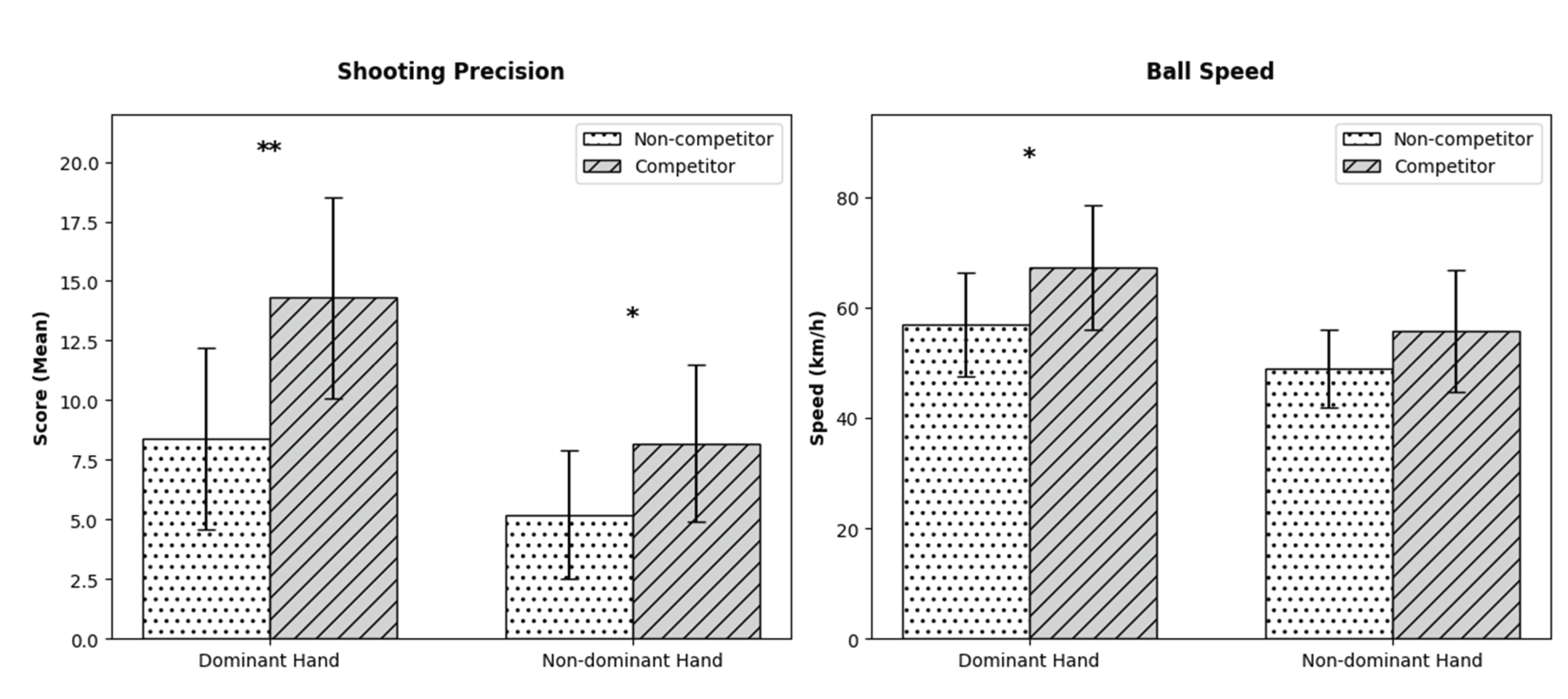

Table 1.
Variables that describe the sample.
| Variables | Non-competitors (n=11) | Competitors (n=11) |
| Mean ± SD (Min – Max) | Mean ± SD (Min – Max) | |
| Age (years) | 46.82 ± 8.54 (32.00 – 62.00) | 41.00 ± 9.06 (26.00 – 54.00) |
| Training experience (years) | 12.27 ± 7.04* (3.00 – 28.00) | 19.55 ± 8.82* (4.00 – 40.00) |
| Training per week | 3.73 ± 1.42 (1.00 – 6.00) | 3.18 ± 1.25 (1.00 – 5.00) |
| Body height (cm) | 181.18 ± 8.84 (169.00 – 196.00) | 183.27 ± 8.06 (173.00 – 198.00) |
| Body mass (kg) | 84.27 ± 14.45 (68.00 – 116.00) | 84.73 ± 7.20 (72.00 – 93.00) |
| BMI (kg/m2) | 25.57 ± 3.00 (19.66 – 30.20) | 25.28 ± 2.31 (21.68 – 28.70) |
*statisticaly significant difference in experience t=-2.14, p=0.05.
Table 2.
Comparison of Performance, Asymmetry index, and Speed-Accuracy Trade-off between Groups (n=22).
Table 2.
Comparison of Performance, Asymmetry index, and Speed-Accuracy Trade-off between Groups (n=22).
| Variables | Non-competitors (M ± SD) | Competitors (M ± SD) | t | p | Cohen’s d |
| Asymmetry Index AI | |||||
| Precision AI | 22.69 ± 27.55 | 27.20 ± 20.10 | -0.44 | .666 | 0.18 |
| Ball speed AI | 7.34 ± 3.65 | 9.62 ± 5.69 | -1.11 | .278 | 0.47 |
| Speed-Accuracy Trade-off | |||||
| SAT Dominant hand | 0.031 ± 0.016 | 0.044 ± 0.017 | -1.95 | .066 | 0.83 |
| SAT Non-dominant hand | 0.022 ± 0.013 | 0.030 ± 0.012 | -1.52 | .145 | 0.65 |
Disclaimer/Publisher’s Note: The statements, opinions and data contained in all publications are solely those of the individual author(s) and contributor(s) and not of MDPI and/or the editor(s). MDPI and/or the editor(s) disclaim responsibility for any injury to people or property resulting from any ideas, methods, instructions or products referred to in the content. |
© 2026 by the authors. Licensee MDPI, Basel, Switzerland. This article is an open access article distributed under the terms and conditions of the Creative Commons Attribution (CC BY) license.
Copyright: This open access article is published under a Creative Commons CC BY 4.0 license, which permit the free download, distribution, and reuse, provided that the author and preprint are cited in any reuse.


