
Submitted:
19 April 2026
Posted:
21 April 2026
You are already at the latest version
Abstract
Institutional Review Boards (IRBs) exercise veto power on most empirical research in the social and behavioural sciences. Although widely regarded as essential safeguards in behavioural research, their overall impact on knowledge production has been seldom scrutinized, much less systematically examined. Rather than evaluating IRBs in terms of their stated aims, this article considers them as institutions based on process characteristics: that is, as decision making units facing bureaucratic incentives to impose costs on others. From this political economic perspective, ethics review functions not as a neutral guardrail, but as an active agent influencing the selection pressures within the scientific ecosystems they regulate. This article examines the following key mechanisms through which IRBs affect knowledge production: (1) cost inflation and quality dilution that reduces both the supply of and demand for the knowledge produced by research; (2) selection effects operating on researcher characteristics and on the bureaucratization of decision-making processes in a direction detrimental to the quality and integrity of research production; and (3) non-random distortions of methods, topics, and rates of independent replication are all expected to contribute to a reduction in the practical significance and societal benefit of affected academic institutions. These impacts escalate because of asymmetric accountability and motivated mission expansion in a system where overreach more often self-reinforces than becomes restrained by corrective feedback. This points to empirical predictions and highlights the need to quantify the real costs of unchecked IRB expansion.
Keywords:
Institutional Review Board
; Human Research Ethics Committee
; replication crisis
; nomological network
; public choice
; political economy
Introduction
The dose of a thing makes it a poison. Even substances as essential for life as water can be lethal in large enough quantities. Although this principle of diminishing and eventually negative returns to increasing inputs is familiar in many contexts, it is lost sight of when it comes to the role of Institutional Review Boards (IRBs) overseeing scientific research and is especially true in the case of Human Research Ethics Committees (HRECs). Instead, discussions of HREC input into research proceed as if it is beneficial at any level (e.g., Grady, 2015; Mieteu, 2024; NHMRC, 2018). Such a categorical mindset may explain why concerns raised by researchers about the friction their mandates impose reflect mere misunderstandings, ignorance, or insufficient ethical sensitivity on the part of the researchers, effectively deflecting scrutiny from the underlying institutional problem. A more rational and optimal method of trade-offs requires acknowledging that increases in ethical oversight, like any sort of oversight or intervention, impose incremental costs that must be weighed against its incremental benefits.
Often referred to as “Ethics Creep” (Haggerty, 2004), this pervasive tendency for ethical review boards to increase in scope and scale of activities is felt as a familiar thorn in the side of many researchers. These problems become clearer when IRBs are analysed in economic instead of purely rhetorical terms (Zywicki, 2007). This means treating them as monopolistic decision-making units, subject to regulatory capture in a variety of ways, and their activities can powerfully shape the incentive structure in which researchers operate. Ethics Creep has proceeded for decades in ignorance of the scale and nature of the costs they affect and difficulty ascertaining to what degree imposing these costs achieves their ostensible goals. IRBs themselves face no cost proportional to the burdens they impose, which are instead borne by the researchers and others who depend on their approval authority for their careers to progress and projects to survive. This feature forms part of a larger problem in that IRBs are insulated from effective feedback. There have been few attempts to demonstrate their effectiveness at achieving their goals, much less to measure their overall impact on the quantity and quality of research under their auspices. Crucially, there is no clear mechanism linking the negative effects of IRB decisions on the knowledge produced by the fields they regulate forcing them to adjust their decision-making processes. In lieu of systematic evidence, confidence in the net benefits of IRBs rests more on presumption than demonstration.
The limited data available already raises red flags, revealing substantial delays that are likely to impact research feasibility. For example, despite the consensus panel recommendation for reviews to be completed within 60 days, the actual review times usually exceed this target (Varley et al., 2016). Measuring time from initial submission to final approval, Hall et al (2015) report median times of 131 days for full reviews and 85 days for “expedited” reviews (as high as 631 days). Even studies with protocols considered “exempt” from the need for full review frequently exceeded the 60-day recommendation, ranging from 16 to 437 days (Hall et al., 2015)1.
Time delays are only the most easily measured and obvious costs. Time lost is not only money but opportunity: administrative delays affect project costs, staff retention, and the ability to meet sponsor deadlines. As grants expire and early-career researchers miss dissertation deadlines or weakened publication timelines, IRB decisions can have ramifications that the committee members never see. While prior work has catalogued these and other grievances (e.g., Schrag, 2011), the present analysis shifts focus from complaints to the institutional mechanisms that would predict such outcomes. In the few instances where the potential costs of IRBs are considered, they are likewise only narrowly thought about such as in terms of obvious and direct time delays, financial operating costs, or morale lost by researchers because of compliance with IRB bureaucratic procedures and demands. As important and severe as these may be, such estimates cannot tell the whole story, which must extend beyond rising costs. For example, as we will see, if costlier research implies less or altered research, that likely means lower rates of replication, which may then affect the decisions scientists make and in turn the sorts of research conducted. If such cost increases are not random with respect to the types of studies IRBs control, this then necessarily alters the type of findings that research produces and encourages substitutions that are likely to reduce the quality of knowledge that is produced. The growing influence of IRBs and the disparate impacts of the decisions may also create unforeseen damage through their influence on selection processes acting on both researchers and the people who populate IRB panels in ways that accelerate rather than dampen the most adverse of these effects and their sequelae.
The purpose of this article is to clarify these issues, along with suggesting strategies for how we can move from this diagnosis to a more constructive prognosis aimed at minimizing these impacts. To do this, we draw on familiar economic principles to model research as a process that transforms inputs into knowledge. Each input — time, money, attention — carries a ‘shadow price’2 shaped by IRB decisions. Following Sowell (1980), we focus not on declared aims but on the actual incentives and constraints shaping IRB behaviour. We also extend Stigler’s (1975) insights on regulatory capture to show how ethical review processes can be co-opted as instruments of professional competition. Like any regulatory mechanism, ethical oversight operates along a continuum where sober and judicious oversight can shade into zealous overreach where beyond a certain dose, intended cures become toxic.
2. A Political Economic Perspective
This section outlines a conceptual framework for understanding IRBs as decision-making institutions operating under asymmetric incentives and feedback; dynamics that have been suggested to drive persistence and suboptimal patterns in decision making and belief formation in a variety of contexts elsewhere (e.g., Roy, 2017; Sowell, 1980). The purpose is to derive qualitative empirical predictions that could then inform remedial practice and policy.
2.2. Supply-Side Costs and Demand-Side Trust
To understand the influence of IRBs on the creation of knowledge, let us first think of the process of scientific research through the concept of a production function. For example, the output of a research lab (discoveries, papers, data) requires the skilled coordination of various inputs including specialized labour, capital equipment, time, knowledge, and, increasingly, institutional authorization including IRB approvals. In other words, IRBs do not simply execute “oversight” add on to research but provide an obligatory ingredient in its manufacture. Researchers must pay a shadow price for this input in terms of things like the time and effort required to comply with IRB directions. The scarce resources that are absorbed by such administrative requirements can be thought of as a sort of “Ethics tax” which must be paid for out of limited research budgets at the expense of other research inputs (whether measured in terms of time, attention, effort, etc.). As this burden increases, the cost per unit of knowledge produced necessarily rises. Rising costs on a particular field of study must reduce either the quantity, the quality, or both, all other things being equal (this is a general economic principle but we will consider further what this deterioration in “quality” might mean in more tangible terms).
This idea is embodied in Figure 1. This shows an upward sloping, convex marginal cost curve: low quality knowledge production is cheap while higher quality knowledge is increasingly costly to make (e.g., requires more replication, rigor, randomized control designs, sample sizes, etc.). The concave indifference curve represents the preferences of consumers of research (e.g., funders, institutions, broader scientific community), making trade-offs between quality and price. The curve is drawn in a way suggesting they prefer higher quality but at increasing marginal cost. The point of tangency between these curves represents the optimal quality level at a given price. This is the region that can be expected to represent equilibrium if we make additional assumptions about the “market” for research resembling a competitive free market. Presuming, for now, that the imposition of an Ethics tax affects all levels of quality production equally, this will necessarily shift the cost function upward (Figure 1a). What this illustrates is the point that even if friction with IRB compliance raises the costs of doing research generally, an immediate implication is that the new equilibrium will correspond to lower research quality. As would ordinarily be expected of any product whose quality has deteriorated, this in turn should reduce demand for research.
Reasons for expecting subtle effects like this to occur arise from the nature of the costs IRBs impose. For instance, the burden of gaining approval and complying with IRB oversight tends to resemble “fixed” costs rather than “variable” costs in that, once the cost of IRB compliance is paid by a particular project, it is cheaper to scale it up compared to beginning another project. And once a laboratory or research institute has paid the fixed costs of being able to comply with IRBs (e.g., by setting up its own shadow bureaucracy to cope with the paperwork requirements), it is relatively cheap for it to continue to do research compared to another laboratory that does not yet have such a capacity or where the cost of getting over this hurdle would be prohibitive from ever getting started3. In both cases, the tax acts as a barrier to entry for new research groups and new types of research while the established research groups have both an advantage in (and the incentive to) spread that cost by carrying out as much of the same research as is profitable4.
Crucially, such barriers to entry and reductions in overall research activity imply fewer independent attempts to replicate findings of the research that does get done, a process that plays a central role in evaluating and refining scientific claims. Changes in the expected rate of replication can, in turn, influence researcher behaviour in at least two ways. Firstly, replication functions as a deterrent. When researchers expect that their findings are likelier to be independently tested, the anticipated costs of reporting fragile or spurious results increase. Conversely, when the probability of replication is low, this deterrent effect is weakened. Secondly, replication provides a positive incentive by rewarding researchers whose findings prove robust, for example through increased citation and uptake. A reduction in replication therefore diminishes both the perceived penalties for unreliability and the rewards for producing durable findings with transparent methods, with potential consequences for the overall quality of research. In other words, this establishes a feedback loop: higher costs discourage replication, which lowers reliability of visible research findings, thereby attracting fewer resources, thus sustaining less research.
These considerations suggest that the effects of IRB-induced cost increases may extend beyond the immediate supply of research to influence its demand. To the extent that higher costs reduce opportunities for replication, they may contribute to a decline in the reliability of published findings. If so, downstream consumers of research — including funding bodies, industry partners, and other researchers — may place less weight on academic outputs or even view particular fields as dubious when allocating resources or forming collaborations. A reduction in the value of research findings would thus tend to reduce the resources devoted to its production. In this way, initial increases in the cost of conducting research may generate secondary effects through demand, reinforcing reductions in overall research activity. Summarized in Figure 2, this feedback dynamic will be developed further in subsequent sections.
In sum, IRBs impose non-trivial costs on research. Higher costs imply lower equilibrium quantity. More importantly, if the Ethics tax was some constant amount across the board, it might be bad but manageable, representing mostly a simple reduction in scientific traffic. But because the tax may be small for some types of study and larger for others, this warps the research process. Barriers to entry are just one among many pathways through which IRBs can distort the structure of knowledge production, and thus a reduction, in quality can be expected.
2.3. Distortions and Dilution
Cost differentials theoretically should alter the composition of research output. Because IRBs do not weigh the cost of the knowledge lost against the perceived risks of the knowledge gained, they create a selective pressure that systematically favours "path-of-least-resistance" science. Therefore, research activity can be expected to shift toward designs, topics, and populations that are more easily approved and less administratively burdensome. Just as noted above in the case of reduced replication rates, beyond simply reducing quantity of research, this can lower overall quality in a field, which dampens demand needed to pay for this research (and so ultimately reduces quantity through this additional mechanism).
2.31. The Shrinking Set of the Mutually Agreeable
One way to conceptualise this is to consider the set of studies involving human participants that would be undertaken in the absence of ethical review as those that are mutually acceptable to researchers and participants. At its most basic level, research is a voluntary transaction between a researcher seeking insight and a participant willing to provide it. In the absence of HRECs, any study mutually agreeable to both parties would proceed. But the introduction of HREC oversight imposes an additional constraint, reducing this set to those studies that are also acceptable to review committees and their own idiosyncratic interests. As the scope and stringency of review increase, this feasible set may shrink further (Figure 3).
Note that this contraction is not a uniform scaling down but a distortion. Questions that are easier to justify, populations that are easier to recruit under approved conditions, and methodologies that are less likely to trigger extensive review may be disproportionately represented. Over time, this can lead to a systematic narrowing of inquiry, with potential consequences for the breadth and relevance of scientific knowledge. It may also be expected that researchers would increasingly twist their research questions away from what would be ideal from the traditional hypothetico deductive method into forms that would instead be answerable by the shrinking subset of study designs. Put differently, scientific curiosity is satisfied less per unit of effort because researchers are forced to increasingly forego "optimal" study designs for the shrinking subset of "approvable" ones.
2.32. Methodological Substitution
The potentially insidious nature of how IRBs like HRECs can affect knowledge production can be further seen by considering the ways they alter the relative efficiencies with which different types of research translate the limited resources of researchers into knowledge. To illustrate, consider the choice between a rigorous randomized controlled trial (experimental) and a survey-based study (correlational). If an IRB imposes say, a several-month delay and exhaustive reporting requirements on the experiment but not the survey, they have effectively subsidized the latter at the expense of the former. Using a budget line model (Figure 4), we can see that researchers with a natural preference for experimental rigor find their "purchasing power" for discovery drastically reduced. Meanwhile, those more comfortable with correlational designs find their relative influence in the field growing. Even if no individual researcher changes their personal bias, the field leans toward correlational data because it is cheaper to produce under the IRB regime. Of course, both controlled experiments and correlational observations play important roles, but if we accept that the former tend to produce higher quality knowledge about, say, questions of causation, then an increased replacement of experimental with correlational implies a diminished level of quality for the field overall to the extent that field is concerned with the causes of important phenomena. Note that this does not require any individual researchers change their behaviour or choices: leaving preferences constant, some simply contribute relatively less to the research field, changing the ultimate composition of the knowledge that consumers can then use (which includes other researchers using knowledge gained by previous studies as important inputs into the production of their own research).
We can complicate this simple model further by supposing researchers do notice changes in incentives and constraints shaped by IRBs and respond rationally by switching from experimental to correlational studies to optimize their research output, and the nature of the research questions that they ask. For example, researchers might turn to easier and less interesting research questions because they are less likely to cause friction with HRECs. Alternatively, researchers who do persist with important topics may have to resort to lower quality sources of evidence in lieu of the sorts of studies IRB inhibit. For example, many research questions that might have been most directly answered using human participants in the past must now make do using alternatives such as animal models, computer simulations, or exhumations of older data sets. The point is not that these types of study are inherently flawed, but that they are nevertheless imperfect substitutes and, therefore, reliance on them more than what would have been in the absence of HRECs implies a degradation of quality. Other obvious substitutes for the hardest-to-approve studies include data from less relevant populations, various lower quality sources, or even outright fabrication. Most IRBs are concentrated in academia, so sources collected outside (such as those reported by activists or other special interest groups) become incrementally more preferrable since they can sidestep Ethics Creep while continuing to pursue important and interesting questions.
Some fields may trend towards increasingly relying on systematic reviews, meta-analyses, and other ways of recycling existing studies relative to the design and execution of new, decisive experiments. Whatever the other merits or demerits of these methods, it is important to note that an increased dependence on systematic reviews and studies based on secondary data can be expected to compound biases introduced to the scientific literature by IRB interference to the extent those studies which form the sample of such systematic reviews have been distorted. For example, suppose that IRBs decide it is unethical to reimburse participants for their time while, in reality, the lack of reimbursement biases the participant population in some crucial way that is difficult to screen for or does not occur to researchers a priori. Consequently, participants who turn up for the study respond to an experimental manipulation in a particular way that is different to how most other individuals might have reacted but did not volunteer to participate. The only studies that are allowed, then, are likely to wrongly conclude that the experimental manipulation has the effect they observe generally. Each subsequent review of these same types of studies would increasingly reinforce the interpretation and thus further embeds this artefact of the IRB involvement. The error could not be remedied by more reviews but requires allowing some research to proceed without the same IRB imposition.
In short, fields may switch away from ideal studies towards less relevant research to avoid friction with IRBs. This effect may be understated because this process does not require individual researchers to consciously alter their behaviour for the overall change to be profound. As these substitutes become incrementally preferrable and new and relevant research becomes increasingly prohibitive, the underlying signal to noise ratio of the literature in an affected field can be expected to become degraded. Importantly, this increased bias in primary studies is probably only echoed by aggregation and further restriction, not corrected.
2.4. Process Characteristics
To understand the effects of IRB’s we next examine how decisions are made, and the incentives and constraints under which they operate. From this perspective, several features of IRB decision-making suggest the potential for systematic distortions.
2.42. Absence of Feedback
Foremost among these are the absence of effective and corrective feedback. In more practical endeavours, decisions are often constrained by costs. A researcher must balance the desire for a perfect data set against the need to recruit flesh and blood participants who have finite time and patience. If a researcher makes a study too boring, too long, or too intrusive, they fail to collect data. By contrast, IRBs are tasked with reducing potential harms by imposing constraints on research. The IRB pays no such direct cost for forcing on participants longer and more tedious tasks (such as complex consent forms, limitations on the type of feedback participants can receive, and the sanitization of experimental provocations). More usually, the costs of these constraints (delays, administrative burdens, and foregone studies) are borne by the broader scientific community. When a study fails or is not undertaken because the "ethics-approved" version is too tedious to attract a sufficient sample, the IRB does not lose status or its mandate. As a result, IRBs face limited incentives to minimise such costs.
At the same time, the actual benefits of IRB decisions, in the form of harms avoided, are difficult to observe or verify. Indeed, the absence of harms following the imposition of even superfluous or redundant risk-minimization steps can be interpreted as justification. This combination of imposing costs borne by others justified based on notional, counterfactual benefits limits the extent to which IRB decision-making can be calibrated by feedback. If anything, IRBs are by design risk-averse, as the only clear sign of their failure are “embarrassing” cases where harm has been done by researchers under their watch. This means they are motivated to tighten rules in response to perceived potential crises but are rarely, if ever, motivated to loosen them, lacking a feedback mechanism to detect when their measures are overkill or ineffective.
Another way of making the same point is to consider any practical situations where it is easy to see that too many safety devices present its own dangers. One parachute is prudent; two are safer still. But no skydiver wears five. Beyond a point, each new parachute worn adds friction and risk of entanglement The armchair nature of IRBs is quite different. When the bureaucratic hurdles added are objected to, their defenders can respond by pointing out how each individual safety requirement might be useful or desirable in isolation (can you not understand that this parachute could save your life?). Again, this reasoning reveals the deeper problem in that IRBs do not have to consider the net impact when all the individual requirements add up, while the benefits they are supposed to achieve need only exist in the imaginations of IRB committees to justify their inclusion. Even when each of these measures may be clearly justified in isolation, their cumulative effect may influence the willingness of individuals to participate, the types of participants who do so, overall efficiency of the study, and, crucially, the validity of the findings. This logic leaves no logical ceiling to the amount of red tape that can be accumulated over time.
2.42. Mission Creep Incentives
While the absence of restraints explains why IRBs can escalate costs, the incentives they face explains why they are positively motivated to do so. As genuine and unarguable evils in research become rarer, the rational response for an IRB is not to downsize, but to redefine “harm”. This "Ethics Creep" by semantic expansion allows the board to maintain its activity levels and social importance by focusing on increasingly trivial or idiosyncratic concerns. When "harm" is expanded to include things like temporary boredom or mild emotional provocation, the IRB ensures a perpetual caseload. In extremis, they block research attempting to understand and thus prevent serial or mass murder out of fear that researchers may pose uncomfortable questions to individuals convicted of attempting those crimes (Schrag, 2011) – a sentiment that would strike most observers as disproportionate to the net societal risk involved (not only by anyone familiar with the nature of the sorts of participants involved but, we suspect, most of the general public and potential funders of such research). Note again that this is not necessarily a conscious conspiracy but an endogenous consequence of an institution whose activities (which includes imagining harms) are more easily measured than their overall results (i.e., actual harms prevented).
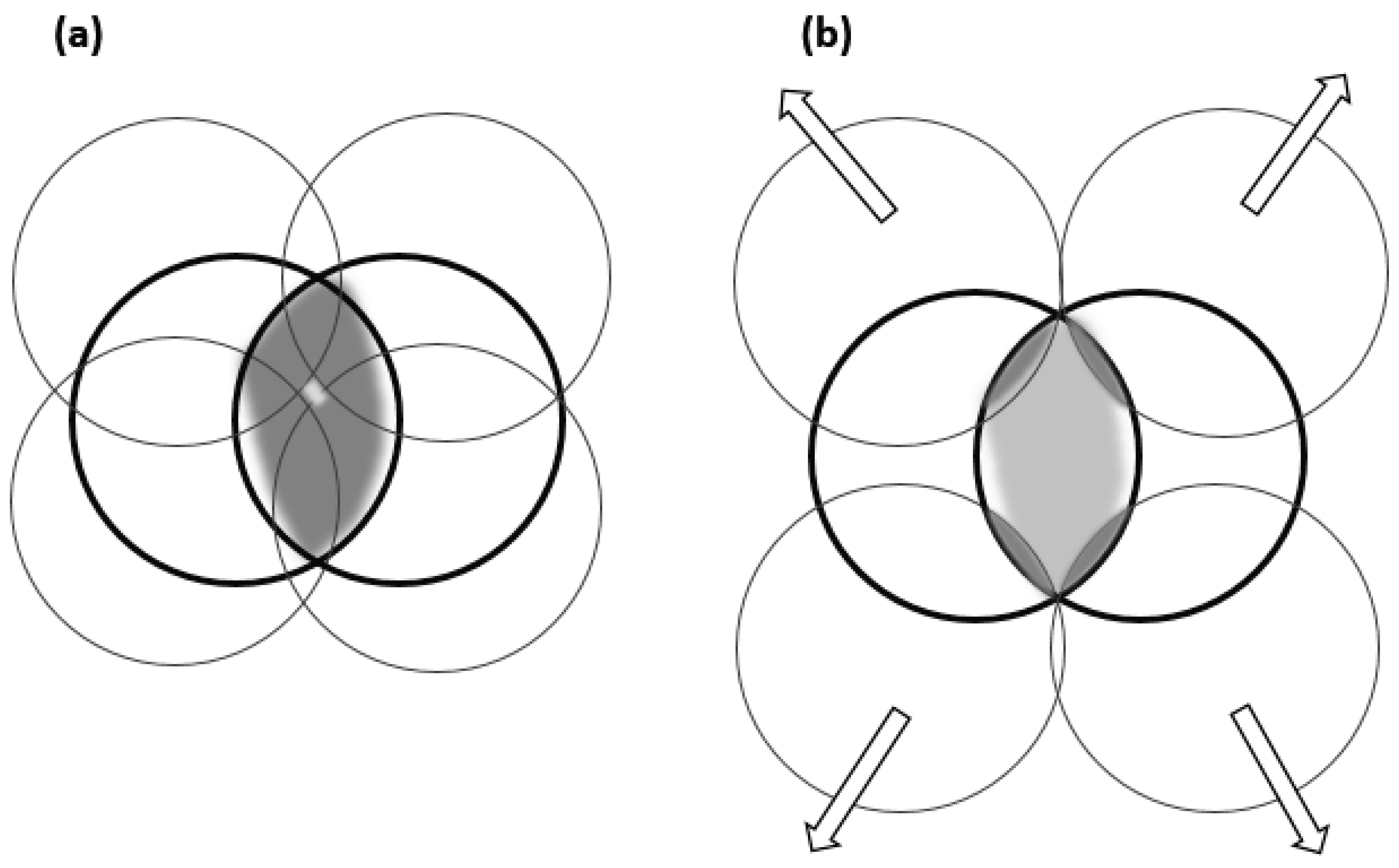
This problem of mission creep raises another important point. Because IRBs are largely insulated from effective external scrutiny such as legal and market pressures, they are free to develop idiosyncratic contrivances that would never survive in the courtroom or the town square. By departing from established legal standards of "informed consent" or "minimal risk", for example, and replacing them with their own bureaucratic precedents, they create a sort of parallel legal system. Once these precedents are set, they become the "selective pressure" that dictates which research is allowed to survive, regardless of whether this invented jurisprudence is moored by either common law or common sense. To the extent that this drift (or ratchet) is directionally unique to each institution, this again hinders the capacity for researchers to replicate studies beyond simply reducing the total number of studies that are undertaken (Figure 5). This is because what was ethically approved at a given time in institution A becomes less likely to be approved at another time by institution B because A and B are diverging in what procedures they think are acceptable and what costs are needed as part of their implementation. Thus, as argued for other reasons above (§2.2), even if Ethics Creep does not directly distort the quality of any individual study, its influence on the perceived likelihood of attempts at independent replication may be an important and underappreciated consequence. As with the other mechanisms mentioned above, the true cost of IRBs is not the increased difficulty of research carried out, but research that is not done.
2.5. Selection and Sorting Effects
Given the environment described above of increasing risk-aversion and dislocation from costs-to-benefit calibration, the next natural question to ask is who thrives in such a habitat. We can sketch the contours of the selective landscape as shaped by IRB-related constraints and trends to see how this may be expected to influence the characteristics of both those actors entering and remaining in these environments. Most fundamentally, increasing costs will tend to favour individuals whose preferences and skills are better aligned with those constraints. Just as we saw how changes in relative costs can shift the mix of research methods produced (§2.32), they may also shift the composition of researchers within a field as, for example, by becoming less attractive to individuals with a strong preference for exploratory or unconstrained inquiry and a low tolerance for bureaucratic processes. Conversely, such environments may be more compatible with individuals who are comparatively more willing or able to navigate institutional requirements. Over time, this could lead to a gradual reweighting of the research population, with potential consequences for the types of questions asked and the approaches taken. Put plainly, individuals high on traits normally predictive of high scientific productivity but low in bureaucratic patience and conformity should be naturally culled from research environments as Ethics Creep progresses.
An obvious substitute for honest and transparent research is dishonest research. Perhaps the most tragically predictable effect of extreme compliance requirements is that it raises the relative costs of the former relative to the latter. When IRB mandates become so detached from common sense and compliance is seen as a performative ritual or a bureaucratic hurdle to be evaded, rather than a legitimate ethical check, researchers are increasingly tempted to practice dishonesty. Cutting corners, fudging details, and otherwise gaming the application process to ensure approval, become increasingly rational responses. Much like the “broken windows” theory of moral decay in another context, the increasingly visible practice of trivial dishonesty in ethics applications and compliance may then lower the psychological barrier to more substantial scientific misconduct. If a researcher perceives that dishonesty is endemic, steps toward faking data appear shorter and cheaper. In such an environment, a form of Gresham’s Law may take hold, where dishonest research begins to drive out honest research. Put differently, just as telling little lies can be practice for telling larger ones, this is one way that Ethics Creep could inadvertently but predictably cultivate the development of skills and habits conducive to the degradation in quality of knowledge produced by research field.
Another layer of adaptation arises through investment in compliance-related skills and knowledge. As ethical review processes become more complex, researchers must devote increasing time and effort to learning how to navigate them effectively. It may be prudent for labs and research groups to create “shadow bureaucracies” within them to cope with the administrative demand. Such competencies (understanding application procedures, anticipating reviewer concerns, and structuring studies to meet approval criteria) constitute a form of human capital that can be financially valuable within the existing system. Note that, beyond the issue of this investment coming at the cost of other research inputs, once established, they may represent a significant investment in maintaining the IRB status quo. To roll back IRB demands would be to devalue their specific skill set.
What about within the IRB boards themselves? As noted above, while the prevalence of clear and serious harms declines, the nature of the decisions faced by IRBs may shift toward more ambiguous or marginal cases. This may favour individuals who are particularly sensitive to low-probability risks, or who place greater weight on precautionary considerations relative to competing values such as other types of harm, scientific progress, or researcher/participant autonomy. Put bluntly, the role of an IRB board member may then increasingly come to attract those who find psychological rewards or careerist advantages in the exercise of effective veto power over others, or for the opportunity to inflict costs on researchers and fields they have personal issues with, and less often those prepared to analyse the trade-offs of active scientific discovery in a more appropriately rational way. In short, like any institution with the power to inflict costs, once established, it can be open to abuse. Importantly, how susceptible they are to misuse depends not on the stated objectives, but on the incentive structure it operates within. The absence of effective feedback on the decision-making processes makes IRBs valuable instruments for those seeking to exercise this sort of judicial activism and may lead to a growing subset of researchers within affected fields motivated to aggravate rather than restrain Ethics Creep.
The vested interest issue is further exacerbated by the growing trend of “Ethics training” programs, including the delivery of these as part of undergraduate courses and professional staff training at universities. In addition to these also representing a significant investment of time and attention in developing skills specific to dealing with IRB, the intended effects of these are to socialise researchers into seeing IRBs as imperative. In short, Ethics training and internal compliance expertise, while ostensibly protective, also represent sunk investments that bind researchers to the existing system. Each hour spent mastering bureaucracy increases the constituency for its continuance. And each student indoctrinated by the most proactive supporters of the mindset underlying Ethic Creep promotes future demand for its own expansion.
3. Discussion
We have argued that IRBs resemble other regulatory bodies that can generate unintended consequences when the costs they impose are borne by others, and when the benefits of their interventions are difficult to observe or verify directly. This echoes prior work has examined IRBs through the lens of public choice and bureaucratic behaviour, most notably Zywicki (2007). Building on this perspective, we consider how these costs propagate through the research ecosystem to shape the kinds of knowledge that are ultimately produced. We argue that compliance costs directly reduce research activity, uneven burdens distort the composition of research, and self-reinforcing institutional dynamics extend IRBs’ reach and entrench their influence. This affects how findings are produced, the methodologies that produce them, and which actors are best positioned to participate in the system. Most importantly, IRBs shape not only what research is conducted, but also what research never happens.
All this implies that the consequences of IRB expansion cannot be adequately assessed by focusing solely on whether identifiable (or imagined) harms were prevented in particular cases. The real question is not simply whether IRBs prevent harm, but how they alter the balance between the risks of conducting research and the risks of not conducting it. To answer this question, research is needed. A review of 52 studies on IRBs concluded that, although there is evidence that IRBs can impede research, current data of this is insufficient to quantify for the purposes of IRB policy reform (Silberman & Kahn, 2011). The following sections outline a set of empirical predictions that follow from this framework and consider potential strategies for mitigating these costs as they become clearer.
3.2. Evidence and Implications
One potential problem with the decisions of HRECs is that the criterion they ultimately rest on is what seems plausible to the IRB panellists in domains where harms are counterfactual and feedback is structurally weak. But perfectly plausible beliefs about complex processes can be wrong because such things can be equally compatible with many plausible beliefs until more facts are known. Like the presumptions of IRBs, our focus on process characteristics may likewise seem plausible, and its utility must hinge on the degree to which it describes reality. Distinct patterns are predicted related to the effects of costs, distortions, decisions, and selection effects described by our framework.
For example, if IRB oversight increases the cost of conducting research, then fields subject to greater regulatory intensity should exhibit lower knowledge output. This could be measured in terms of research quantity and quality, such as fewer replications, and longer time to completion, publications and citation rates. These effects should be observable using variation in IRB intensity across time, institutions, and domains. Quasi-experimental designs such as difference-in-differences could compare trends in output between areas that experienced substantial increases in oversight and those that did not. These effects may be particularly evident in domains where independent replication is already resource-intensive, amplifying the impact of additional compliance costs.
The decline in perceived quality of academic research has become apparent in the trends of increasing decoupling between industry with academia. For instance, Springer Nature (2017) reported that pharmaceutical firms have halved their average scientific publication output (from 29 to 12 papers per firm annually) while reducing basic research funding shares from 26% to 22% of total R&D (1980–2006), increasingly outsourcing discovery to selective academic collaborations rather than broad support. UK industry-academia links surveys reveal a 33% drop in industrial placements alongside shifts toward targeted postdoctoral work, reflecting pharma's pivot from early-stage academic partnerships. Such trends amplify IRB-induced cost inflation by eroding external demand for academic outputs, further contracting research ecosystems. Anecdotally, a major reason for this boils down to declines in perceived replicability of findings in academic research. Surveys of traditional research industry partners could be combined with thematic analysis to help determine if the reasons for this sort of decline in demand for university-led research are connected to the mechanisms adumbrated above.
Within scholarly fields we predict distortions in the composition of research as a function of growing IRB intensiveness in the production of knowledge. The limited data at hand again heightens our concerns. Vazirani et al. (2024), for example, found that among surgical studies, randomized controlled trials and studies undergoing full board review took substantially longer to obtain IRB approval than less complex designs. A review also found that papers with more controversial protocols attracted relatively more revisions and longer waiting times from IRBs (Silberman & Kahn, 2011). More generally, we expect that designs that are costlier to get approved — such as experimental or intervention-based studies, and those pioneering more novel methodologies — to become relatively less common than lower-friction alternatives. This can be tested by comparing the prevalence of experimental versus correlational studies, or of harder-to-approve versus easier-to-approve samples, across fields with differing levels of IRB burden.
For instance, just as we predict Ethics Creep to lead to an increase in substitution of correlational for experimental designs, we would also predict (along with Rice, 2011) researchers to increasingly switch to the use of animal models instead of human participants. This is because HRECs are often separate to IRBs overseeing studies using animal research, and so differences in their efficiencies may mean it is easier to get approval from the latter. Comparisons between vertebrate and invertebrate research also offers a potentially informative case, as the degree of oversight differs markedly across these types of research. All types of substitution should be most pronounced where oversight regimes are administratively simpler or more predictable, rather than simply being less stringent. If observed shifts reflect general scientific progress, similar trends should appear across both; if they reflect regulatory cost pressures, they should be more pronounced where oversight burdens are greater.
Another testable implication concerns the statistical properties of published findings, particularly those associated with the replication crisis. If increased compliance costs reduce the likelihood of independent replication while simultaneously raising the stakes associated with producing publishable results, then fields subject to greater IRB burden should exhibit stronger or earlier signatures of selective reporting and result inflation. These may include increased evidence of publication bias (e.g., funnel plot asymmetry), excess significance relative to statistical power, or patterns consistent with “p-hacking”. Importantly, this prediction is again comparative: such indicators should increase more sharply in domains where ethical oversight has expanded most, relative to those where constraints have remained comparatively stable. By linking institutional features of research governance to well-established metrics of research reliability, this approach provides a further avenue for evaluating whether IRBs influence not only the volume and composition of research, but also its credibility. This would be consistent with a reduction in the disciplining role of replication and an increased reliance on statistical thresholds as proxies for evidentiary strength.
The kinds of inconsistency and apparent arbitrariness reported anecdotally by Schrag (2011) are also precisely what would be expected of a review system insulated from feedback and operating under locally evolving precedent. The picture painted of a mosaic landscape in which IRB practices become increasingly “rudderless and inefficient” (Zywicki, 2012) implies that we should observe low consistency and increasing divergence in review outcomes. If IRBs operate under limited feedback and locally evolving precedents, identical protocols should receive materially different decisions across institutions. This prediction could be tested by presenting the same proposals to different review panels. A further implication is that this variation should be smaller among people no longer embedded in active IRB structures, providing a way to separate institutional from individual sources of judgment.
Current evidence hints that this prediction will be borne out. Hirshon et al. (2002) examined a single, low-risk emergency medicine protocol submitted to multiple IRBs. They found marked variability in risk classification, review requirements, and demanded modifications across institutions. Because the protocol itself was held constant, this dispersion cannot plausibly be attributed to differences in study design or participant population. Instead, it is consistent with a decision-making environment characterized by weak feedback, locally evolving precedent, and limited mechanisms for cross-institutional calibration. Similarly, Gonsalus et al (2007) compared the time taken by three different IRBs within the same city to review studies with the same, identical low-risk protocols and found decision time varied from 10 and 77 days. Another study compared decisions by IRBs as to whether studies should be considered exempt from the need for review and found only 75 per cent agreement across IRBs (with 16.7 per cent of studies that were considered by some to be fully exempt forced into full review) (Tsan & Van Hook, 2022). While in theory consistency may be maintained by oversight by additional layers of bureaucracy aimed at establishing best practice, in reality this is unlikely given the scale of increase in IRB operations: In the United States the less than one per cent of IRBs under the auspices of the Department of Health and Human Services are inspected annually (U.S. Government Accountability Office [GAO], 2023). Based on the current political-economic perspective, such variability is not merely an administrative inconvenience, but an almost inevitable outcome. This contrasts with what might be expected in a well-functioning regulatory system, where best scientific practice with regards to “safety” should be universal rather than reflecting local aesthetic.
As with other political economic analyses of how regulatory bodies can diminish competition (e.g., Sowell, 1980; Stigler, 1975), the framework predicts selection and concentration effects within the research ecosystem. Higher fixed compliance costs should favour larger and more established research groups while discouraging entry by smaller or newer teams. These dynamics should be observable in patterns of authorship, funding allocation, and collaboration networks, particularly where new partnerships introduce approval risk or administrative delay. Over time, such effects should increase concentration and reduce the diversity of research approaches. One aspect of this relates to the predicted consequences on the researcher characteristics. We expect Ethics Creep to have added to increasing bureaucratic burdens generally and suspected to have caused disproportionate number of high-talent early career researchers to exit academia by diverting their research time towards compliance, hindering innovation and favouring those most tolerant of administrative loads than creative talent (as has been argued by Eysenck, 1995).
The systemic effects considered above may also have psychological ramifications that can also be tested for. Measures of constructs like creativity, intellectual independence, and fluid intelligence of researchers exiting different fields of research could be compared to those who remain to see if our narrative about self-sorting holds up. It could be interesting to see if the timing of indices of Ethics Creep within a field could predict traits like these of individuals being on the margin. Such traits are predicted to be both positively correlated with outstanding scientific achievement and negatively correlated with conformist rule following (Eysenck, 1995; 1997). More surreptitious research designs may be required to explore our other corollaries, such as the prediction that interactions with IRBs can encourages the cultivation of dishonest tendencies. We note there is already some evidence for this (e.g., Kieth-Spiegel & Koocher, 2005) suggesting that these dynamics deserve to be better understood. Similarly, anecdotes (e.g., Foster, 2015a; 2015b) suggest that our hypothesis that the power of HREC presents panellists with temptations to abuse their power is one worthy of serious study.
Finally, our framework implies that the effects of IRBs may be identified more directly through exogenous changes in regulatory intensity and through behavioural experiments that simulate review environments. Manipulations of administrative burden or review stringency could be used to examine how researchers adjust their design choices, collaboration strategies, and willingness to pursue particular topics under different constraint regimes. In other words, while much of the above predictions measure the impacts of IRBs on decision making ex post, these experiments we may get an idea of the extent they shape decisions ex ante, such as through researchers altering their designs as a function of experience because they internalize their local IRB board’s risk aversion.
Taken together, these predictions provide multiple avenues for assessing whether IRBs influence not only the conduct of individual studies, but also the structure and direction of scientific knowledge production. This is critical because many of the impacts we predict will not be obvious to individual researchers and so underlines the need for steps taken to mitigate the impacts of Ethics Creep to be calibrated on evidence rather than perceptions. If we can identify the ways in which IRBs distort research, we replace ignorance with uncertainty that is at least tractable. Even a malfunctioning compass can be useful if we know how it is wrong while a compass whose error pattern is unknown is much less helpful. In the same way, understanding how IRBs affect different fields can improve both the interpretation of existing findings and the design of future research.
3.4. Mitigation
Having established testable implications of this framework, we now consider practical measures for mitigating these distortions. An implication of Ethics Creep that we should not always rely on a single institution or a single route through an IRB system for tackling important topics. For example, if IRBs vary in arbitrary ways across institutions, then replication across institutions may be more informative than repeated work within the same institutional environment. Having multiple faulty compasses (where each is warped differently) can sometimes yield a better estimate of true north than any one compass alone. By analogy, if each IRB imposes different distortions, then comparing findings across sites may help recover a more balanced picture of the underlying phenomenon. Some mitigation measures are proposed here as hypotheses about approaches that may make research more resilient to the dynamics identified above.
3.42. Nomological Nets
A type of research program that is likely more resilient to IRB distortion is one that explicitly attempts to enjoin multiple types of research in answering the same overarching research question. Just as when compasses are less reliable (e.g., as people approach the poles), their use can be combined with landmarks, stars, and other methods can be used to adjust for the increasing different between magnetic and geographic North, similar solutions might be suggested for making allowance for the capacity of IRBs to distort and dampen the “signals” detectable by various types of research. Reality might therefore be better grasped when theory is empirically anchored to multiple types of investigation, as in “nomological network” types of theory (Cronbach, 1957). Mutually supporting observations could enable greater confidence in a theory than one whose empirical foundation depends solely on one type of study (Eysenck, 1997). In short, nomological networks can be useful in shifting emphasis away from single, high-stakes IRB-intensive studies and towards multiple, lower-cost, converging lines of evidence.
Put differently, if Ethics approval is a costly input into the production of knowledge, we might be able to minimize the epistemological impact by deliberately adjusting the ways it is combined it with other ingredients. In addition to integrating otherwise disparate observations in a common framework by a nomological network theory, conflict between findings from different approaches could indicate the influence of possible biases in a way that would not be possible for theories limited in application to a narrow field or type of evidence. This is in effect the opposite of the substitution effect predicted above: instead of using different types of research that might otherwise be used as substitutes for answering a given research question (as mentioned above), skilful analysis and theorizing could make them usable as complements. Another upshot is that it is conceivable that a shift towards this type of research program might also reduce the incentive of individuals to strategically or ideologically use IRB discretionary power: if they sense there are multiple avenues by which the truth will be revealed, the potential of using any particular IRB as a choke point is diminished.
3.43. Ethical Competition
A more structural change is to introduce elements of contestability and review into the ethics approval process. Most IRBs operate as local monopolies, with binding authority over researchers within a given institution and limited scope for appeal. This arrangement reduces the extent to which decision-making is disciplined by comparison or feedback. One way to address this is to decouple ethical approval from institutional affiliation, allowing funders or regulators to recognise approvals granted by any accredited IRB rather than requiring approval from a researcher’s home institution. Such an arrangement would introduce a degree of regulated competition, creating incentives for boards to develop clearer standards, reduce unnecessary delays, and avoid idiosyncratic requirements while still maintaining core protections. The idea here is that increased competition could reduce delay, while comparisons between IRBs could enable their decision-making to become linked to clearer feedback.
Appeal mechanisms could also help. An independent oversight body or ombudsman could offer researchers a route for challenging decisions that are inconsistent or excessive. Over time, such mechanisms would also produce comparative information about how different boards operate, making IRB performance more visible and more open to evaluation. We are aware that a concern with such an approach is that any additional layer of oversight may itself become subject to the same dynamics of accumulation, capture, and mission creep that we have explored above. For that reason, institutional design matters. Short, non-renewable terms, random selection from a qualified pool, and a narrowly defined mandate could help limit entrenched interests and reduce the accumulation of precedent. The aim is not necessarily to abolish ethical oversight, but to prevent it from becoming yet another unaccountable source of constraint. Such arrangements would resemble jury systems in legal contexts, where rotation and randomness are used to limit systematic bias and institutional drift. While no design can eliminate these risks entirely, incorporating turnover and reducing the scope for entrenched interests may help ensure that oversight mechanisms remain responsive to the trade-offs that are involved.
3.44. Awareness
Although some awareness of potential issues with IRBs may be growing, the rhetorical effect of their stated aims and categorical thinking about “harms” means that other bureaucracies with veto power over research institutions may have facilitated Ethics Creep more than they would have should they have been more aware of the risks and impacts. For example, whatever the merits of pre-registered studies, this can magnify issues related to ethics cost by introducing an additional layer of administrative headaches. For example, where preregistering a protocol that is acceptable at one time then, by the time it goes through the process of ethics approval, is required to change in unforeseen ways by Ethics Creep.
Another is accreditation agencies. Accreditation agencies and training programs, intended to supposedly improve integrity, may unintentionally amplify Ethics Creep by embedding IRB assumptions into curricula and institutional norms. By quantifying these effects, policymakers could perhaps better calibrate educational standards to preserve scientific substance without deepening habits borne out of bureaucratic build up and a what increasingly looks like a burgeoning ideology.
4. Conclusion
This article has argued that IRBs must be understood not merely in terms of their stated aims, however noble these may sound, but in terms of the relevant incentives, constraints, and selection pressures. By raising the costs of research in uneven and often non-random ways, IRBs do not simply protect participants; they shape which questions are asked and how. As research becomes more costly, inquiry may be displaced toward less direct substitutes, replication becomes rarer, and incentives shift in ways that favour compliance over originality. Like leeches bleeding a medieval patient, IRBs may sometimes do good, but even remedies can become counterproductive when too much is applied. Our argument is not that ethics review is categorically bad, but that its effects remain unmeasured. Without quantifying how far is too far, science risks mistaking ritual for responsibility. The most ethical course for the research community is not acquiescence, but inquiry. Science should apply the same empirical discipline to its regulation that it demands of its own practices. Then we may be surer that ethical oversight serves knowledge rather than impede it.
Acknowledgments
Ideas in this essay were initially stimulated following conversations with Rich Ryan, Anthony Dillon, Gigi Foster, and Joe Forgas.
Conflicts of Interest and Funding Declaration
I have no funding or conflict of interest to declare. No new data was generated in the creation of this manuscript
References
- Cronbach, L. (1957). The two disciplines of scientific psychology. American Psychologist, 12, 671-684. [CrossRef]
- Eysenck, H.J., 1995. Genius: The Natural History of Creativity. Cambridge University.
- Press, Cambridge.
- Eysenck, H. J. (1997). Personality and experimental psychology: The unification of psychology and the possibility of a paradigm. Journal of Personality and Social Psychology, 73, 1224-1237. [CrossRef]
- Foster, G. (2015a). Universities are misguided to evade controversy with “ethics”. The Conversation.
- Foster, G. (2015b). A new model for research ethics reviews. The Conversation.
- Grady, C. (2015). Institutional review boards: Purpose and challenges. Chest, 148(5), 1148-1155. [CrossRef]
- Gunsalus, C. K., Bruner, E. M., Burbules, N. C., Dash, L., Finkin, M., Goldberg, J. P.,... & Aronson, D. (2007). The Illinois white paper: Improving the system for protecting human subjects: Counteracting IRB “mission creep”. Qualitative Inquiry, 13(5), 617-649. [CrossRef]
- Haggerty, K. D. (2004). Ethics Creep: Governing social science research in the name of ethics. Qualitative sociology, 27(4), 391-414. [CrossRef]
- Hall, D. E., Hanusa, B. H., Stone, R. A., Ling, B. S., & Arnold, R. M. (2015). Time required for institutional review board review at one Veterans Affairs medical center. JAMA surgery, 150(2), 103-109. [CrossRef]
- Hirshon, J. M., Krugman, S. D., Witting, M. D., Furuno, J. P., Limcangco, M. R., Perisse, A. R., & Rasch, E. K. (2002). Variability in institutional review board assessment of minimal-risk research. Academic Emergency Medicine, 9, 1417-1420. [CrossRef]
- Keith-Spiegel, P., & Koocher, G. P. (2005). The IRB paradox: could the protectors also encourage deceit?. Ethics & Behavior, 15, 339-349. [CrossRef]
- Miteu, G. D. (2024). Ethics in scientific research: a lens into its importance, history, and future. Annals of Medicine and Surgery, 86(5), 2395-2398. [CrossRef]
- Jaffe, S., Minton, R., Mulligan, C. B., & Murphy, K. M. (2019). Chicago Price Theory. Princeton University Press.
- National Health and Medical Research Council. (2018). National statement on ethical conduct in human research (2007) – Updated 2018. https://www.nhmrc.gov.au/about-us/publications/national-statement-ethical-conduct-human-research-2007-updated-2018.
- Rice, M. J. (2011). The institutional review board is an impediment to human research: the result is more animal-based research. Philosophy, Ethics, and Humanities in Medicine, 6(1), 12. [CrossRef]
- Roy, D. J. (2017). A conditioning model of delusion. Neuroscience & Biobehavioral Reviews, 80, 223-239. [CrossRef]
- Schrag, Z. M. (2011). The case against ethics review in the social sciences. Research Ethics, 7(4), 120-131. [CrossRef]
- Silberman, G., & Kahn, K. L. (2011). Burdens on research imposed by institutional review boards: the state of the evidence and its implications for regulatory reform. The Milbank Quarterly, 89(4), 599-627. [CrossRef]
- Sowell, T. (1980). Knowledge and decisions (Vol. 10). New York: Basic Books.
- Springer Nature. (2017, November 6). Collaboration surges as businesses outsource discovery to academia [Press release]. Nature Index. https://group.springernature.com/gp/group/media/press-releases/nature-index-science-inc/15285830.
- Stigler, G. J. (1975). The citizen and the state: Essays on regulation. University of Chicago Press.
- Tsan, M. F., & Van Hook, H. (2022). Assessing the quality and performance of institutional review boards. Journal of Empirical Research on Human Research Ethics: An International Journal, 17(4), 525-532. [CrossRef]
- U.S. Government Accountability Office. (2023). Institutional review boards: Actions needed to improve federal oversight and examine effectiveness (GAO-23-104721). https://www.gao.gov/assets/gao-23-104721.pdf.
- Varley, P. R., Feske, U., Gao, S., Stone, R. A., Zhang, S., Monte, R.,... & Hall, D. E. (2016). Time required to review research protocols at 10 Veterans Affairs Institutional Review Boards. Journal of Surgical Research, 204(2), 481-489. [CrossRef]
- Vazirani, A., Castagne-Charlotin, M., Akpoviroro, O., & Malikova, M. A. (2024). Impact of institutional review board stipulations on turnaround time for approvals of surgical studies. World Journal of Surgery, 48(2), 271-277. [CrossRef]
- Zywicki, T. J. (2007). Institutional review boards as academic bureaucracies: An economic and experiential analysis. Nw. UL Rev., 101, 861.
| 1 | Interestingly, the authors interpret delays occurring during investigator response periods as not being attributable to the IRB, implicitly assuming that the volume and complexity of IRB-mandated revisions are not the issue. This is another example of how even research on IRB function is immune to corrective feedback, as no amount of additional costs on researcher time in complying with IRB edits would count as suggesting need for reform. |
| 2 | A “shadow price” is an implicit cost in time or effort rather than one represented or measured directly in monetary terms. |
| 3 | Ethics review imposes fixed compliance costs that are easier to absorb for large, established research groups than for smaller or newer ones. This creates an incumbency advantage: established groups can spread the cost of IRB compliance across many projects and maintain internal compliance infrastructure, while newer groups must incur those costs from scratch. As a result, collaboration becomes more selective. Large groups may avoid partnerships that introduce uncertainty, delay, or approval risk, especially when working with institutions or teams lacking established IRB workflows. The consequence is not only reduced collaboration but also a systematic bias toward consolidation, with research becoming more centralized and less open to new entrants. |
| 4 | By “profitable” we mean in the sense of what is rational given the marginal benefit to them, which must in some way be influenced by how others value the knowledge that their research produces and so are willing to fund. |
Figure 1.
Ethics Tax on Quality of Knowledge Produced. (a) Shows the effect of a uniform increase in the cost of producing knowledge (e.g., through ethics related compliance costs) on the quality of knowledge produced. The upward shift in the cost curve reduces the equilibrium level of quality from to , even when the cost applies equally across all levels of quality. (b) Shows the effect when compliance costs increase with the level of research quality makes the cost curve steeper. This shifts the equilibrium towards a potentially still lower quality, , corresponding to less expenditure on the research. Note that “price” is the dollar value or funding per unit of knowledge.That said, a recurring theme in this paper is that such cost inflation is unlikely to affect all types of research and researchers evenly. Figure 1b shows, under otherwise the same assumptions, what would happen if the Ethics Tax was especially burdensome for research necessary to produce higher quality knowledge. This not only results in a lower equilibrium level of quality but may also correspond to a lower price (i.e., less funding made available per unit of knowledge). The hallmark of this would thus not necessarily be higher amounts of funds spent but manifest in the field producing cheaper and lower quality knowledge.
Figure 1.
Ethics Tax on Quality of Knowledge Produced. (a) Shows the effect of a uniform increase in the cost of producing knowledge (e.g., through ethics related compliance costs) on the quality of knowledge produced. The upward shift in the cost curve reduces the equilibrium level of quality from to , even when the cost applies equally across all levels of quality. (b) Shows the effect when compliance costs increase with the level of research quality makes the cost curve steeper. This shifts the equilibrium towards a potentially still lower quality, , corresponding to less expenditure on the research. Note that “price” is the dollar value or funding per unit of knowledge.That said, a recurring theme in this paper is that such cost inflation is unlikely to affect all types of research and researchers evenly. Figure 1b shows, under otherwise the same assumptions, what would happen if the Ethics Tax was especially burdensome for research necessary to produce higher quality knowledge. This not only results in a lower equilibrium level of quality but may also correspond to a lower price (i.e., less funding made available per unit of knowledge). The hallmark of this would thus not necessarily be higher amounts of funds spent but manifest in the field producing cheaper and lower quality knowledge.
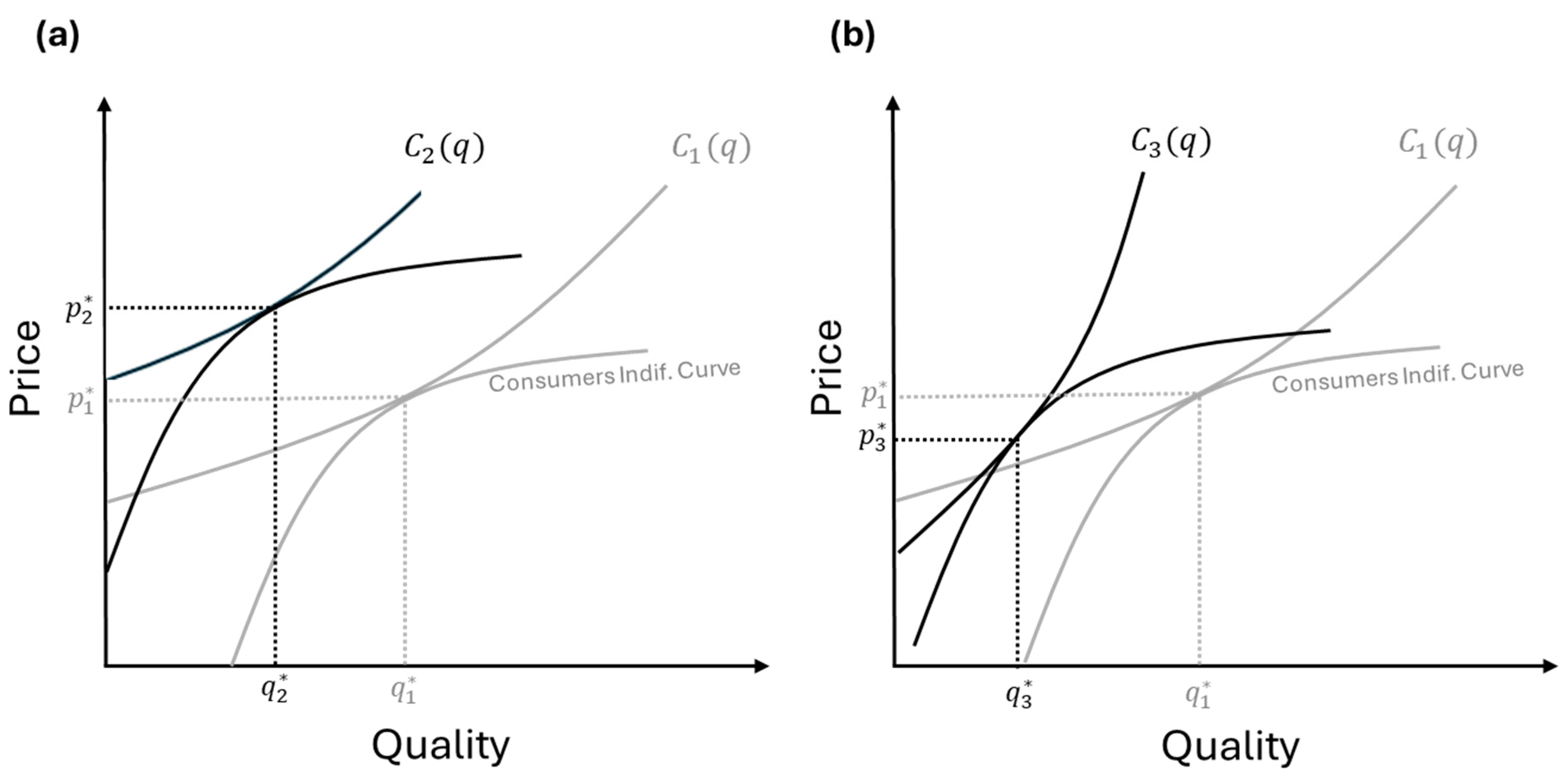
Figure 2.
Effect of Ethics Creep on Knowledge Quality. Arrows represent causal effects, with + and - indicating an augmenting and reducing influence respectively. Research Demand is expressed as funding for research, with more funding enabling more research activity. Research at larger scales enables more quality knowledge to be produced, with independent replication being key mechanism. Greater knowledge quality leads to more research demand. Ethics Creep discourages replication indirectly by increasing costs of research activity generally and indirectly by making replications relatively costlier to produce than other types of study (such as by IRBs at different institutions drifting in different directions).
Figure 2.
Effect of Ethics Creep on Knowledge Quality. Arrows represent causal effects, with + and - indicating an augmenting and reducing influence respectively. Research Demand is expressed as funding for research, with more funding enabling more research activity. Research at larger scales enables more quality knowledge to be produced, with independent replication being key mechanism. Greater knowledge quality leads to more research demand. Ethics Creep discourages replication indirectly by increasing costs of research activity generally and indirectly by making replications relatively costlier to produce than other types of study (such as by IRBs at different institutions drifting in different directions).
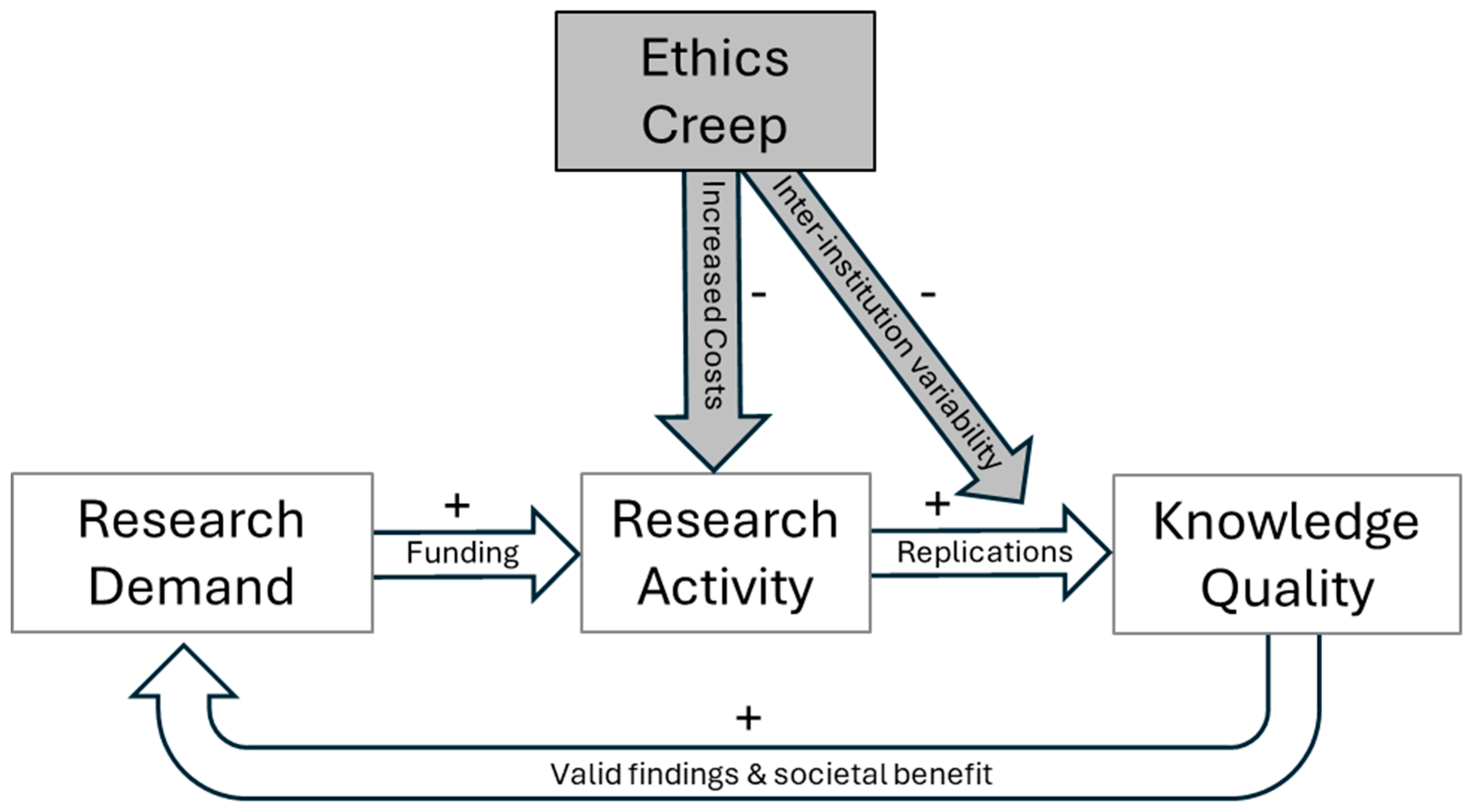
Figure 3.
Venn depiction of the set of acceptable studies. (a) shaded region represents the set of studies that would be carried out in the absence of IRBs because both researchers and participants find them mutually agreeable. (b) the set that is actually allowed to exist shrinks when it must also be acceptable to HRECs. This narrower range of studies, represented by darker shading, further shrinks in a non-random way with further “Ethics Creep”, this trend represented by a further departure from what researchers and participants would want (c).
Figure 3.
Venn depiction of the set of acceptable studies. (a) shaded region represents the set of studies that would be carried out in the absence of IRBs because both researchers and participants find them mutually agreeable. (b) the set that is actually allowed to exist shrinks when it must also be acceptable to HRECs. This narrower range of studies, represented by darker shading, further shrinks in a non-random way with further “Ethics Creep”, this trend represented by a further departure from what researchers and participants would want (c).
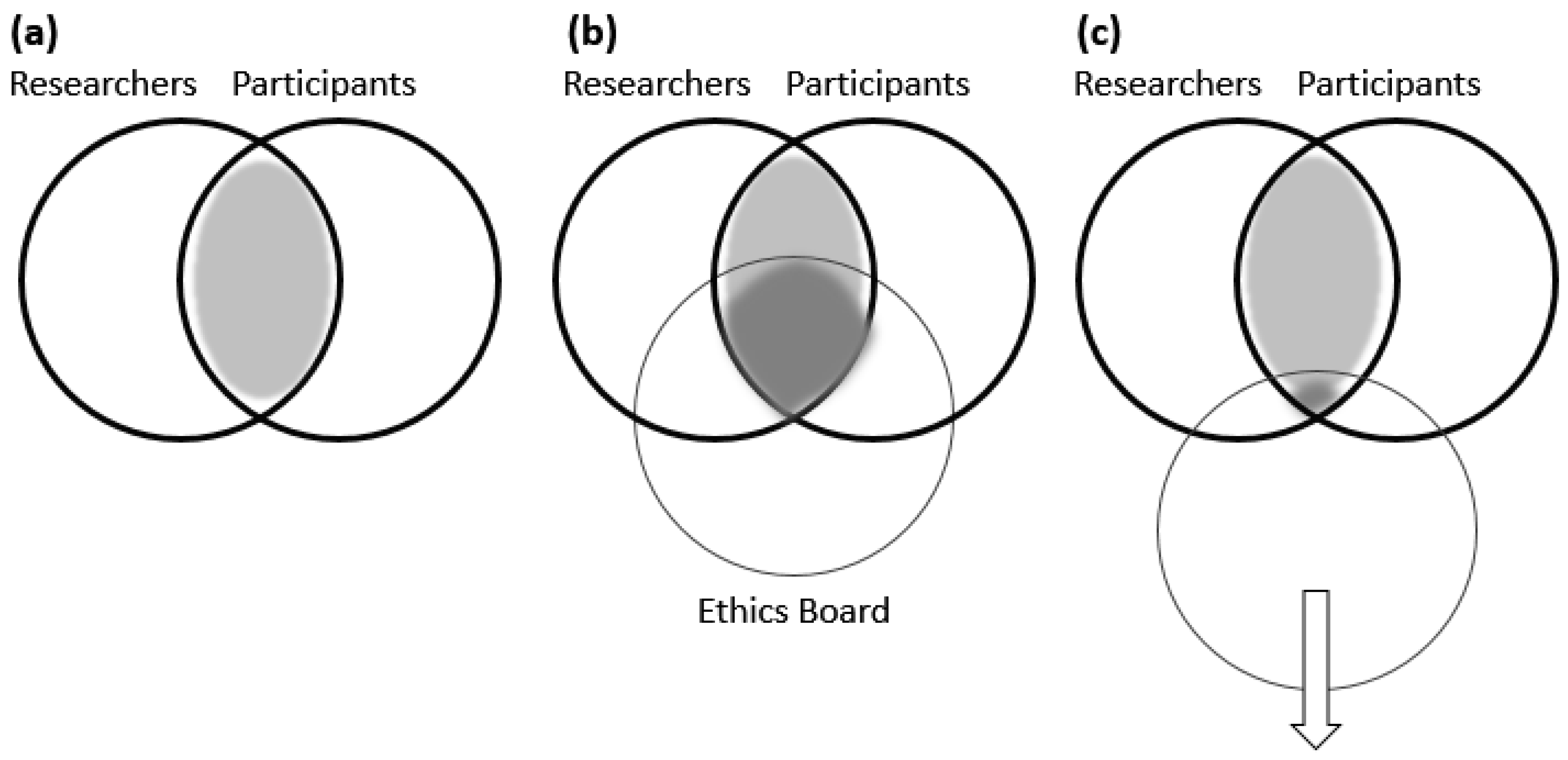
Figure 4.
Hypothetical description of quantity and type of studies produced by researchers. Lines represent the ‘budget line’ or limited resources researchers have when they are totally spent on either experiment (person A), correlational (person E), or some mix of both types of study (persons B-D). (a) researchers vary in terms of their ideal mix of experimental to correlational studies and simply spent all their resources on both according to this proportion. (b) a change in the relative price of one type of study for the other leads to a shift in the budget line that tends to favour those with a preference for more of the research type with a falling price. In this hypothetical case, persons D and E can do more of both types of research, person C is indifferent, and persons A and B can only perform less total research, while the field as a whole has shifted further towards correlational studies (based on description in Jaffe et al., 2019).
Figure 4.
Hypothetical description of quantity and type of studies produced by researchers. Lines represent the ‘budget line’ or limited resources researchers have when they are totally spent on either experiment (person A), correlational (person E), or some mix of both types of study (persons B-D). (a) researchers vary in terms of their ideal mix of experimental to correlational studies and simply spent all their resources on both according to this proportion. (b) a change in the relative price of one type of study for the other leads to a shift in the budget line that tends to favour those with a preference for more of the research type with a falling price. In this hypothetical case, persons D and E can do more of both types of research, person C is indifferent, and persons A and B can only perform less total research, while the field as a whole has shifted further towards correlational studies (based on description in Jaffe et al., 2019).
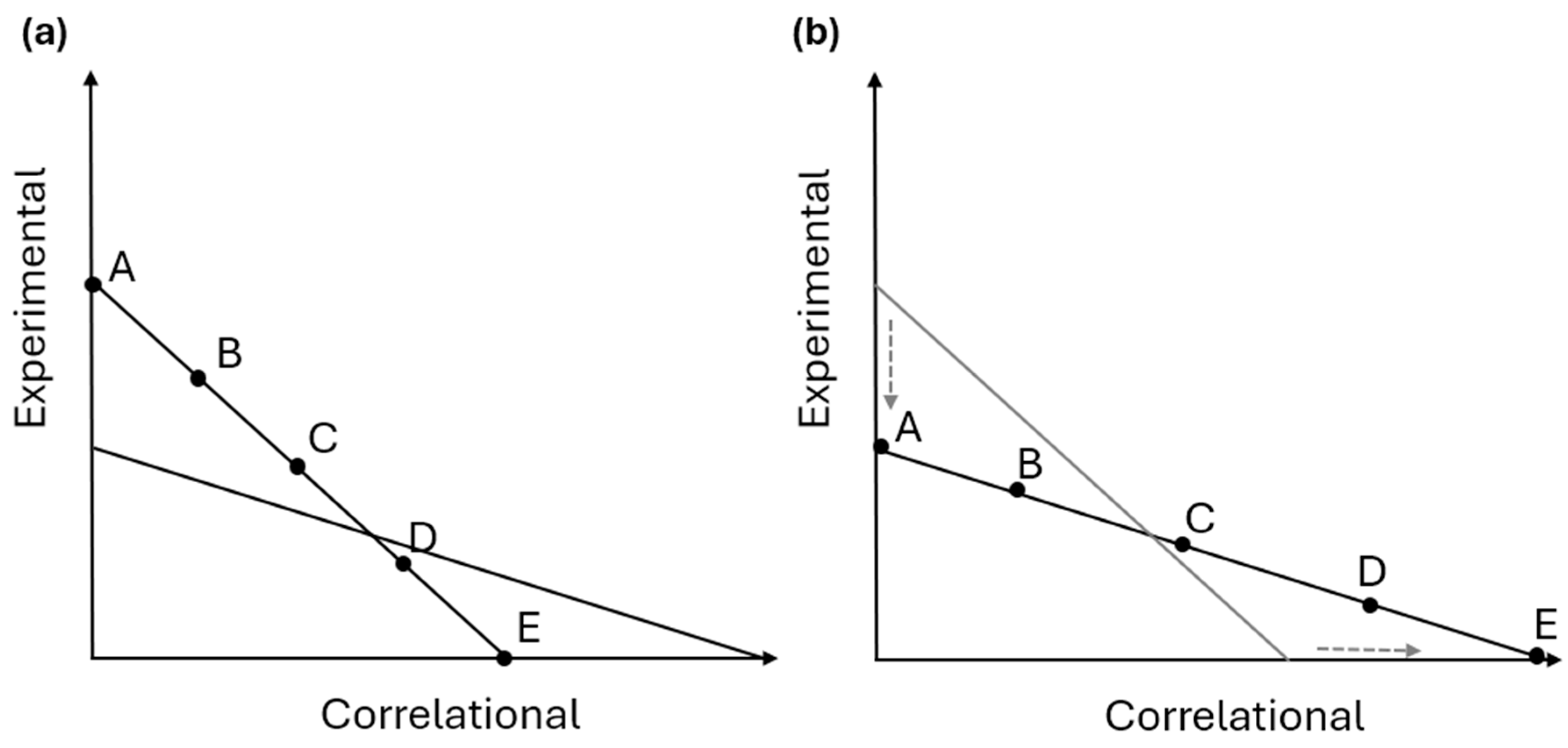
Figure 5.
Mosaic Effects of Ethics Creep. (a) Types of research are agreeable to both researcher and participant are shown as the overlapping region of two bold circles. The need for HRECs approval restricts this subset further to what is acceptable to the Ethics panel. Across a research field, research undertaken at different research institutions musts satisfy local HRECs, meaning that the research that can be replicated independently (i.e., by different researchers working in different institutions must simultaneously agree with a number of HRECs to the proportion of how many attempts at replication are made. (b) When these ethics boards drift off in different directions, the scope for replication shrinks.
Figure 5.
Mosaic Effects of Ethics Creep. (a) Types of research are agreeable to both researcher and participant are shown as the overlapping region of two bold circles. The need for HRECs approval restricts this subset further to what is acceptable to the Ethics panel. Across a research field, research undertaken at different research institutions musts satisfy local HRECs, meaning that the research that can be replicated independently (i.e., by different researchers working in different institutions must simultaneously agree with a number of HRECs to the proportion of how many attempts at replication are made. (b) When these ethics boards drift off in different directions, the scope for replication shrinks.
Disclaimer/Publisher’s Note: The statements, opinions and data contained in all publications are solely those of the individual author(s) and contributor(s) and not of MDPI and/or the editor(s). MDPI and/or the editor(s) disclaim responsibility for any injury to people or property resulting from any ideas, methods, instructions or products referred to in the content. |
© 2026 by the authors. Licensee MDPI, Basel, Switzerland. This article is an open access article distributed under the terms and conditions of the Creative Commons Attribution (CC BY) license (http://creativecommons.org/licenses/by/4.0/).
Copyright: This open access article is published under a Creative Commons CC BY 4.0 license, which permit the free download, distribution, and reuse, provided that the author and preprint are cited in any reuse.


