
Submitted:
18 April 2026
Posted:
21 April 2026
You are already at the latest version
Abstract
Abstract
Ganzhou City in Jiangxi Province is a core production area for navel oranges in China and represents a typical selenium-rich specialty agricultural region. However, the selenium-rich red soils in southern Jiangxi are strongly acidic with high iron-manganese oxide content, which strongly immobilizes soil selenium, severely restricting the development of the local selenium-enriched navel orange industry. Low-molecular-weight organic acids (LMWOAs), as root exudates and microbial metabolites, can activate soil selenium and synergistically promote plant growth. However, the regulatory mechanisms of LMWOAs on soil selenium speciation remain unclear. This study investigated how low-molecular-weight organic acids (LMWOAs) affect selenium transformation and availability in selenium-enriched red soils. Six LMWOAs at concentrations of 0.1–100 mmol kg⁻¹ were tested to examine their influence on selenium speciation and dissolved organic matter (DOM) composition. Soil selenium speciation and DOM fluorescent components were analyzed following LMWOAs application to assess the relationship between DOM changes and selenium transformation. LMWOAs significantly increased soluble selenium (SOL-Se) content, especially under 100 mmol kg⁻¹ citric acid (CA). Low-concentration treatments (≤10 mmol kg⁻¹) promoted the release of exchangeable (EXC-Se) and Fe-Mn oxide-bound (FMO-Se) selenium, while high-concentration treatments (100 mmol kg⁻¹) of CA, acetic acid (AA), and n-butyric acid (N-BA) inhibited their release. Only oxalic acid (OA) increased organically bound selenium (OM-Se). DOM components were negatively correlated with bioavailable selenium under CA treatment, but positively correlated with bound selenium under 10 mmol kg⁻¹ OA. LMWOAs notably alter soil selenium speciation. Short-term application enhances selenium bioavailability, promoting plant uptake. Prolonged use may increase humification, immobilizing selenium and reducing its availability. In contaminated areas, long-term LMWOAs application can mitigate selenium toxicity through immobilization. As natural rhizosphere exudates, LMWOAs are biodegradable and environmentally safe, posing minimal risk to soil ecosystems.
Keywords:
selenium
; low-molecular-weight organic acids
; EEM
; PARAFAC
; selenium speciation transformation
1. Introduction
Selenium (Se) is a vital trace element, and both excessive and inadequate intake can be detrimental to human health [1]. In soils, Se is the primary source for plant uptake, and its content and speciation directly determine plant absorption and utilization efficiency [2]. Common soil Se fractions include soluble Se (SeO₄²⁻ SeO₃²⁻), exchangeable Se (SeO₄²⁻ SeO₃²⁻), iron–manganese oxide-bound Se(SeO₃²⁻) , organically bound Se(Se²⁻、HSe⁻), and residual Se (RES-Se)(Se²⁻、HSe⁻、Se0), with SOL-Se and EXC-Se being the bioavailable forms readily absorbed by plants. The transformation and bioavailability of Se in soils are influenced by various factors, including pH, organic and inorganic complexation, redox potential, and dissolution–precipitation processes [3,4]. These factors lead to Se existing in multiple forms and undergoing continuous migration and transformation.
Organic acids (OAs), key components of rhizosphere soils, play a significant role in regulating Se bioavailability [5]. They are generally classified into low-molecular-weight organic acids (LMWOAs) and high-molecular-weight organic acids (HMWOAs) [6]. HMWOAs primarily originate from the decomposition of organic matter [7]. In contrast, LMWOAs arise from root exudates, microbial metabolites, and the decomposition of organic matter [8]. Plant root exudates serve as the primary source of OAs in the rhizosphere, with the majority being LMWOAs, such as formic, acetic, citric, oxalic, malic, tartaric, malonic, fumaric, and succinic acids [9]. Increasing evidence indicates that OAs modify soil properties and solid-phase interactions, thereby affecting Se bioavailability [10]. Selenium is tightly immobilized in acidic and reducing soils, which limits its mobility [11]. LMWOAs can alter soil physicochemical properties and Se bioavailability [4]. Rich in functional groups like –COOH, –OH, phenolic –OH, and –SH, they engage in adsorption–desorption, dissolution–precipitation, and redox reactions, thereby directly or indirectly affecting Se adsorption, speciation, and mobility [12].
The impact of OAs on the desorption of Se from adsorption sites is significant. LMWOAs, in particular, are able to dissolve metal cations that are bound in organic matter–mineral complexes. This process results in the release of soil organic matter (SOM) into the solution phase [13]. This process temporarily raises dissolved organic matter (DOM) levels, which microorganisms quickly decompose, facilitating mineralization and the release of immobilized Se. Changes in SOM composition are key to Se speciation and bioavailability. For example, fulvic acid (FA) and humic acid (HA) can form binary or ternary complexes with Se, altering its immobilization and speciation [14].
Despite these findings, knowledge gaps remain: (1) most studies examine only a single OA, lacking systematic comparisons among structurally different OAs, particularly LMWOAs; (2) the ternary interaction mechanisms among LMWOAs, Se, and DOM components remain unclear; and (3) the effects of concentration gradients within field-relevant ranges (0.1–10 mmol kg⁻¹) and high experimental concentrations (>10 mmol kg⁻¹) have not been systematically studied. To fill these gaps, this study applied six representative LMWOAs at concentrations between 0.1 and 100 mmol kg⁻¹ to systematically evaluate their effects on Se speciation in Se-rich red soils. Fluorescence excitation–emission matrix (EEM) spectroscopy was employed to analyze changes in DOM composition, aiming to clarify the relationship between OA functional groups and the efficiency of Se speciation transformation. The results offer ideas for how to control how much of the Se is available in acidic soils and for choosing and controlling how much OA is used when making Se-rich agricultural products.
2. Materials and Methods
2.1. Soils Material
Soil samples were obtained from uncontaminated quaternary red soil (Soil was collected from a navel orange planting area located 20 kilometers from the urban district.) in Ganzhou City, Jiangxi Province, China (114°52′59.88″ N, 25°47′43.80″ E). Using the five-point sampling method, surface soil (0–20 cm) was obtained, with plant and animal residues and gravel removed. The samples were air-dried and sieved through a 20-mesh filter. The sieved red soil was thoroughly mixed with a sodium selenite (Na₂SeO₃) solution and aged to simulate selenium-rich red soil. The initial total selenium concentration of the soil collected was 0.6051 mg kg⁻¹, while the final total selenium content of the experimental soil reached 22.72 mg kg⁻¹.
2.2. Experimental Design
The pre-selenized and aged red soil, used as the test substrate, had a pH of 4.8, organic matter content of 3.90 g kg⁻¹, available nitrogen of 30.32 mg kg⁻¹, available phosphorus of 4.03 mg kg⁻¹, and available potassium of 69.97 mg kg⁻¹. A 100 g portion of soil, sieved through a 20-mesh filter, was placed into culture containers. Six representative LMWOAs were selected: OA, CA, FA, AA, N-BA, and PA. The concentration of organic acids in the rhizosphere soil solution varies depending on plant species and stress conditions. Total rhizosphere organic acid concentrations reported in the literature typically range from 10 μM to 5 mM. The concentrations of LMWOAs applied in this study (0.1–100 mmol kg⁻¹ soil) cover and greatly exceed this physiological range, aiming to explore their potential mechanisms of influence. Four concentration levels were set for each organic acid, applied exogenously while maintaining 70% of the field water-holding capacity. A control group without LMWOAs addition (0 mmol kg⁻¹, CK) was included, with three replicates for each treatment. The samples were incubated in a constant-temperature incubator at 25°C for 180 days. This 180-day period is sufficient to observe the medium- to long-term, stable effects of LMWOAs on the transformation of soil selenium species, rather than short-term chemical impacts. This duration is essential for evaluating the potential of "long-term organic acid application" in agricultural practices or pollution remediation. At days 1, 7, 15, 30, 65, 90, 120, and 180, cultivated Incubated soils samples were collected through replicated sampling. After removing residues, the samples were air-dried, finely ground, and sieved through a 100-mesh sieve for selenium speciation analysis. The remaining soil was used to extract dissolved organic matter (DOM) solutions for excitation-emission matrix (EEM) fluorescence analysis.
2.3. Measurement Indicators and Methods
2.3.1. Selenium Speciation Determination in Soil
Selenium fractionation and extraction were conducted following the method of Wang et al. (2012) [15] . A 2 g soil sample, passed through a 100-mesh sieve, was placed in a 50 mL centrifuge tube, and extractions were performed using different solutions at a solid–liquid ratio of 1:10 for each step. This method classifies soil selenium into four fractions: soluble selenium (SOL-Se), exchangeable selenium (EXC-Se), iron–manganese oxide-bound selenium (FMO-Se), and organically bound selenium (OM-Se). The selenium concentration in each extract was determined using an atomic fluorescence spectrometer (HG-AFS 9120, Beijing Jitian, China).
2.3.2. DOM Extraction and EEM Analysis
DOM was extracted following the method of Hong et al. (2021) with slight modifications [16] . A 2 g soil sample was mixed with deionized water at a soil–water ratio of 1:10 (w/v), shaken at 200 rpm for 1 h, and centrifuged at 5000 rpm for 8 min. The supernatant was filtered through a 0.45 μm membrane to obtain the DOM filtrate. Excitation–emission matrices (EEMs) of DOM were measured using a fluorescence spectrophotometer (F-7000, Hitachi, Japan). Component validation and identification were conducted using the DOMFluor toolbox in MATLAB and the OpenFluor database (http://www.openfluor.org) [17]. EEM–PARAFAC modeling was applied to resolve the fluorescent components of DOM in selenium-rich soils after organic acid treatments.
2.4. Data Analysis
All experimental data were analyzed using IBM SPSS Statistics 27 (IBM Corp., Chicago, IL, USA). Significant differences (p < 0.05) were assessed via one-way analysis of variance (ANOVA) followed by Duncan’s multiple range test. Differences in organic acids across different incubation times were compared using one-way ANOVA and Duncan's multiple range test (p < 0.05). The relationships between organic matter components and selenium speciation were visualized using scatter plots, and linear least squares (OLS) regression was applied for fitting. The strength of correlation was evaluated using Pearson's correlation coefficient (r), and the corresponding P-value was calculated through hypothesis testing (t-test) to determine statistical significance, with the significance level set at α = 0.05. Origin 2021 (Origin Lab Corp., Northampton, MA, USA) was used for data visualization. All data are expressed as the mean ± standard error.
3. Results
3.1. Soluble Se in Soil After LMWOAs Treatment
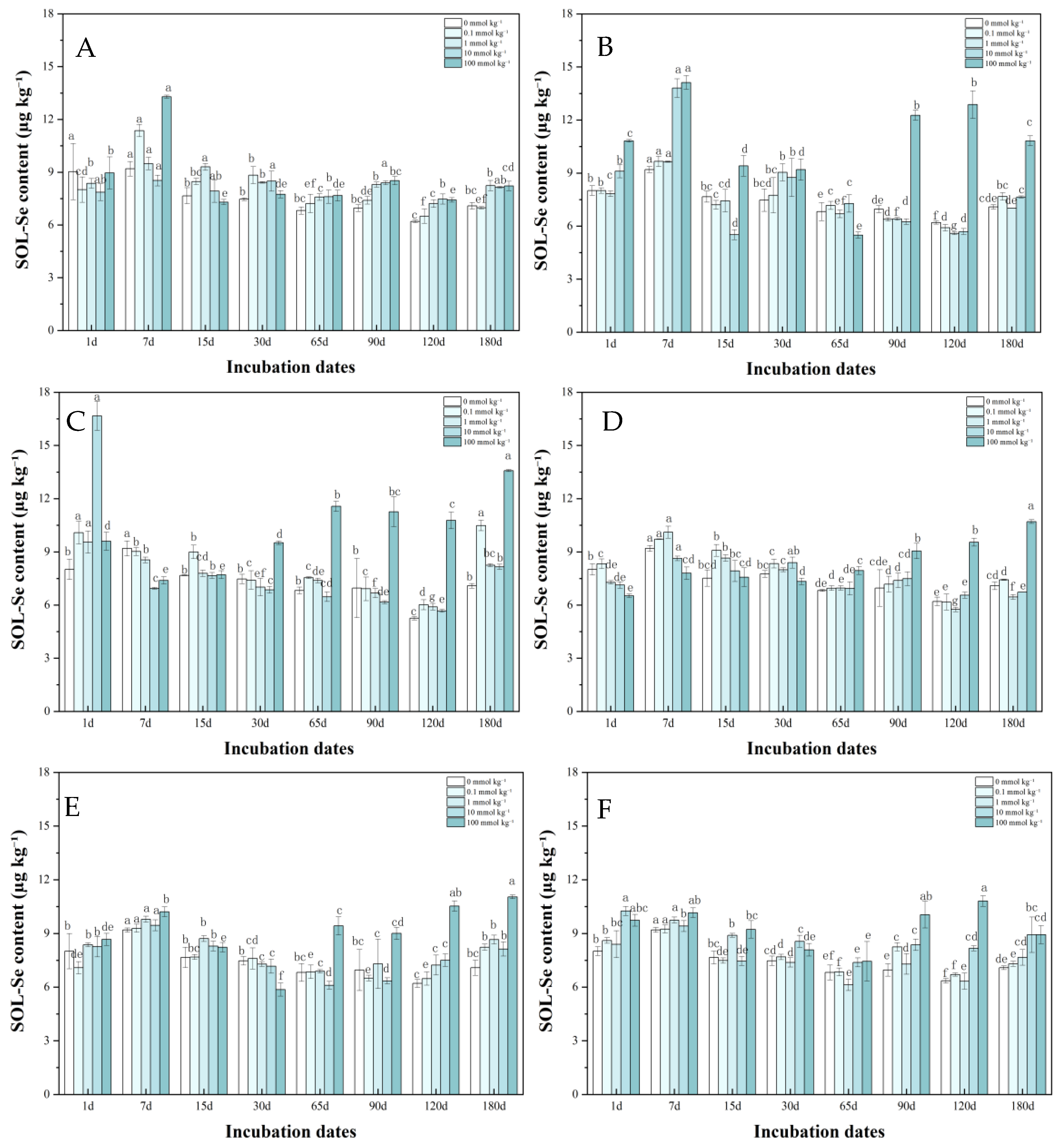
Exogenous addition of LMWOAs significantly increased the content of soluble selenium (SOL-Se) in selenium-enriched red soil, and this enhancement effect generally strengthened with increasing treatment concentration. The dynamic changes in SOL-Se content under different treatments during the incubation period could be categorized into two types (Fig 1). The first type exhibited a pattern of initial promotion, followed by inhibition, and then re-promotion, with CA, OA, and PA treatments being the most notable. For instance, under CA treatment, SOL-Se content peaked on day 7 (14.12 µg kg⁻¹), then gradually decreased, reaching its lowest level on day 65 (5.48 µg kg⁻¹), after which it slowly rebounded until reaching equilibrium (12.2 µg kg⁻¹). Under PA treatment, SOL-Se content began to decrease on day 7, reached its minimum value (5.85 µg kg⁻¹) on day 30, and then started to increase. The second type showed a continuous increase in SOL-Se content throughout the incubation period without an obvious decline phase, with FA treatment being the most representative. Comprehensive comparison showed that at 180 days of incubation, the 100 mmol kg⁻¹ LMWOAs treatment exhibited the most prominent activation effect on SOL-Se. Among them, FA treatment increased SOL-Se content by 51.19% compared with the control, while OA and CA treatments increased it by 44.55% and 43.12%, respectively, all reaching statistically significant levels (p <0.05). Acetic acid and butyric acid treatments also exerted certain promoting effects on SOL-Se, but their effects were weaker than those of OA, CA, and FA, with the overall trend similar to that of PA treatment.
Figure 1.
Content of Soluble Se in selenium-rich red soil treated with different concentrations of low-molecular-weight organic acids over 180 days. Figure A (OA (oxalic acid)), B (CA (citric acid)), C (FA (fumaric acid)), D (AA (acetic acid)), E (PA (propionic acid)), F (N-BA (n-butyric acid)). Each treatment was replicated three times (n=3), and different lowercase letters indicate significant differences among treatments (p < 0.05).
Figure 1.
Content of Soluble Se in selenium-rich red soil treated with different concentrations of low-molecular-weight organic acids over 180 days. Figure A (OA (oxalic acid)), B (CA (citric acid)), C (FA (fumaric acid)), D (AA (acetic acid)), E (PA (propionic acid)), F (N-BA (n-butyric acid)). Each treatment was replicated three times (n=3), and different lowercase letters indicate significant differences among treatments (p < 0.05).
3.1.1. Exchangeable Se in Soil After LMWOAs Treatment
The regulation of soil exchangeable selenium (EXC-Se) by LMWOAs exhibited obvious concentration dependence and type specificity (Fig.2). During the incubation period, LMWOAs treatments at concentrations ≤10 mmol kg⁻¹ promoted the release of EXC-Se from the soil, but the overall promoting effect did not reach a highly significant level. In contrast, CA, AA, and N-BA treatments at 100 mmol kg⁻¹ gradually showed an inhibitory effect on EXC-Se release as incubation time progressed. Compared with CK, the EXC-Se content under 100 mmol kg⁻¹ CA treatment reached its maximum on day 1, significantly increasing by 56.15% (p <0.05) relative to the control. However, as incubation time increased, EXC-Se release began to decrease and tended to stabilize after day 30 (2.02 mg kg⁻¹). By day 180 of incubation, the EXC-Se content under this treatment decreased by 3.79%–5.58% compared with the control. Meanwhile, AA and N-BA treatments at 100 mmol kg⁻¹ exhibited inhibitory trends consistent with CA. PA treatment promoted EXC-Se release at all concentrations, with the promoting effect strengthening as concentration increased. OA and FA treatments had no significant effect on soil EXC-Se content, showing no significant differences from the control at any concentration or time point (p >0.05).
Figure 2.
Content of Exchangeable Se in selenium-rich red soil treated with different concentrations of low-molecular-weight organic acids over 180 days. Figure A (OA (oxalic acid)), B (CA (citric acid)), C (FA (fumaric acid)), D (AA (acetic acid)), E (PA (propionic acid)), F (N-BA (n-butyric acid)). Each treatment was replicated three times (n=3), and different lowercase letters indicate significant differences among treatments (p < 0.05).
Figure 2.
Content of Exchangeable Se in selenium-rich red soil treated with different concentrations of low-molecular-weight organic acids over 180 days. Figure A (OA (oxalic acid)), B (CA (citric acid)), C (FA (fumaric acid)), D (AA (acetic acid)), E (PA (propionic acid)), F (N-BA (n-butyric acid)). Each treatment was replicated three times (n=3), and different lowercase letters indicate significant differences among treatments (p < 0.05).

3.1.2. Iron-Manganese Oxide-Bound Se in Soil After LMWOAs Treatment
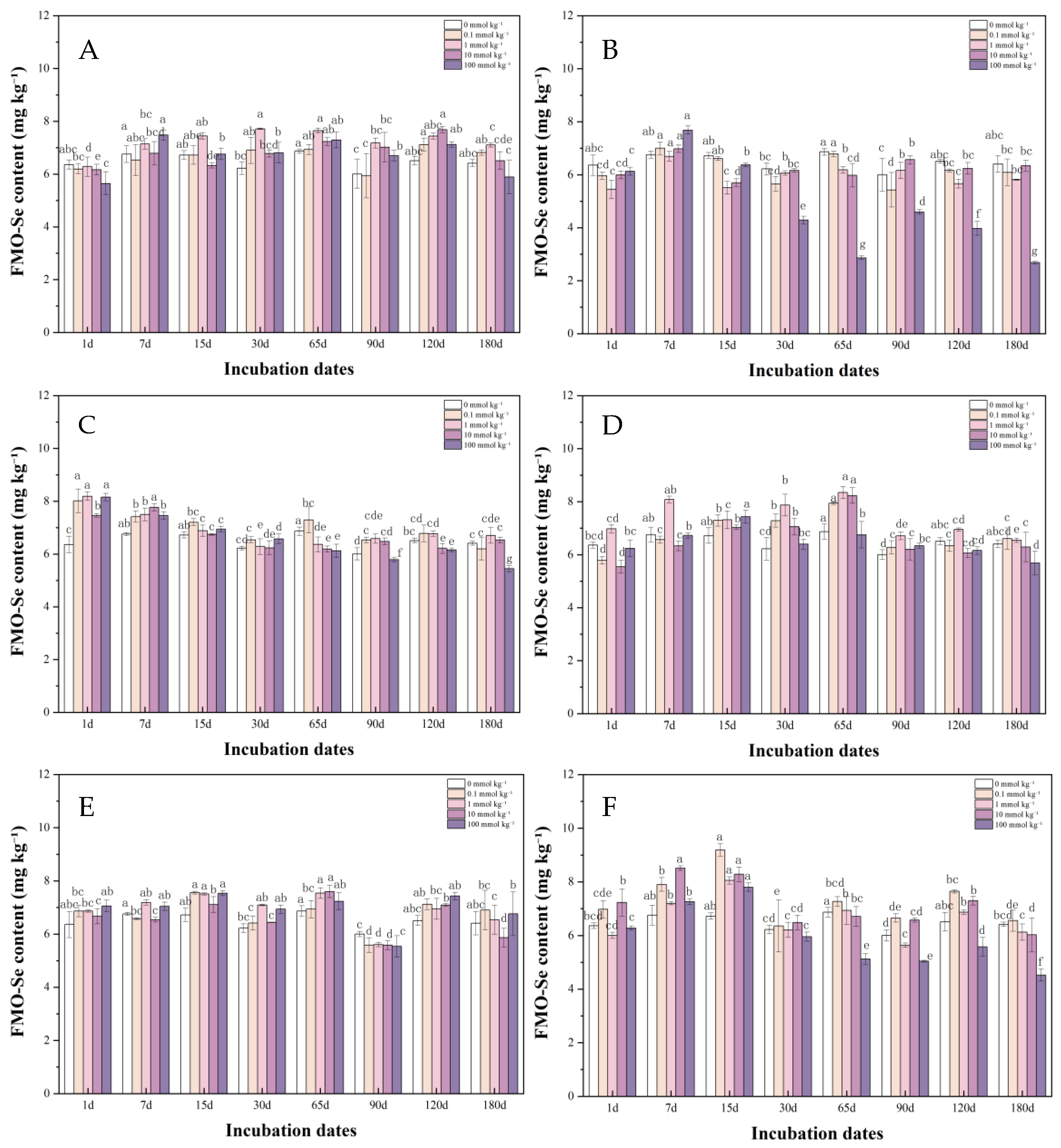
The regulation of FMO-Se by LMWOAs exhibited obvious concentration effects and type differences, generally presenting a dual characteristic of "no significant effect at low concentrations, significant inhibition at high concentrations"( Fig 3). During the incubation period, the three low-to-medium concentration organic acid treatments (0.1, 1, and 10 mmol kg⁻¹) promoted FMO-Se content but exerted no significant regulatory effect, with no significant differences observed at any time point compared with the control (p > 0.05). However, among the high-concentration treatments at 100 mmol kg⁻¹, CA, AA, and N-BA exhibited extremely significant inhibitory effects on FMO-Se. By day 180 of incubation, the 100 mmol kg⁻¹ CA treatment reduced FMO-Se content by 58.31% compared with CK, while AA and N-BA treatments reduced it by 52.17% and 49.83%, respectively, all reaching extremely significant differences (p <0.01). Under the 100 mmol kg⁻¹ CA treatment, soil FMO-Se content showed an initial increase followed by a decrease, peaking on day 7 (7.68 mg kg⁻¹) and then continuously declining to its lowest value on day 65 (2.86 mg kg⁻¹). Under OA treatment, FMO-Se content was promoted during the period from day 7 to day 120, with the 1 mmol kg⁻¹ treatment showing the most significant effect, reaching its maximum FMO-Se content on day 30 (7.71 mg kg⁻¹), an increase of 24.04% compared with CK. Under FA treatment, the 1 mmol kg⁻¹ concentration exhibited a significant promoting effect on soil FMO-Se content throughout the 180-day period compared with other concentrations, reaching its maximum on day 65, an increase of 21.56% compared with CK. Under AA treatment at concentrations ≤10 mmol kg⁻¹, FMO-Se concentration continuously decreased with increasing incubation time. Notably, PA treatment promoted mild FMO-Se release at all concentrations. By day 90 of incubation, the 1 mmol kg⁻¹ OA treatment reduced FMO-Se content by 8.72% compared with the control, and although this did not reach a significant level, the overall trend was stable. FA treatment exhibited a weak promoting effect only at the 1 mmol kg⁻¹ concentration, with no obvious regulatory effect at other concentrations, forming a distinct contrast with OA treatment.
Figure 3.
Content of Iron–manganese oxide-bound Se in selenium-rich red soil treated with different concentrations of low-molecular-weight organic acids over 180 days. Figure A (OA (oxalic acid)), B (CA (citric acid)), C (FA (fumaric acid)), D (AA (acetic acid)), E (PA (propionic acid)), F (N-BA (n-butyric acid)). Each treatment was replicated three times (n=3), and different lowercase letters indicate significant differences among treatments (p < 0.05).
Figure 3.
Content of Iron–manganese oxide-bound Se in selenium-rich red soil treated with different concentrations of low-molecular-weight organic acids over 180 days. Figure A (OA (oxalic acid)), B (CA (citric acid)), C (FA (fumaric acid)), D (AA (acetic acid)), E (PA (propionic acid)), F (N-BA (n-butyric acid)). Each treatment was replicated three times (n=3), and different lowercase letters indicate significant differences among treatments (p < 0.05).
3.1.3. Organically Bound Se in Soil After LMWOAs Treatment
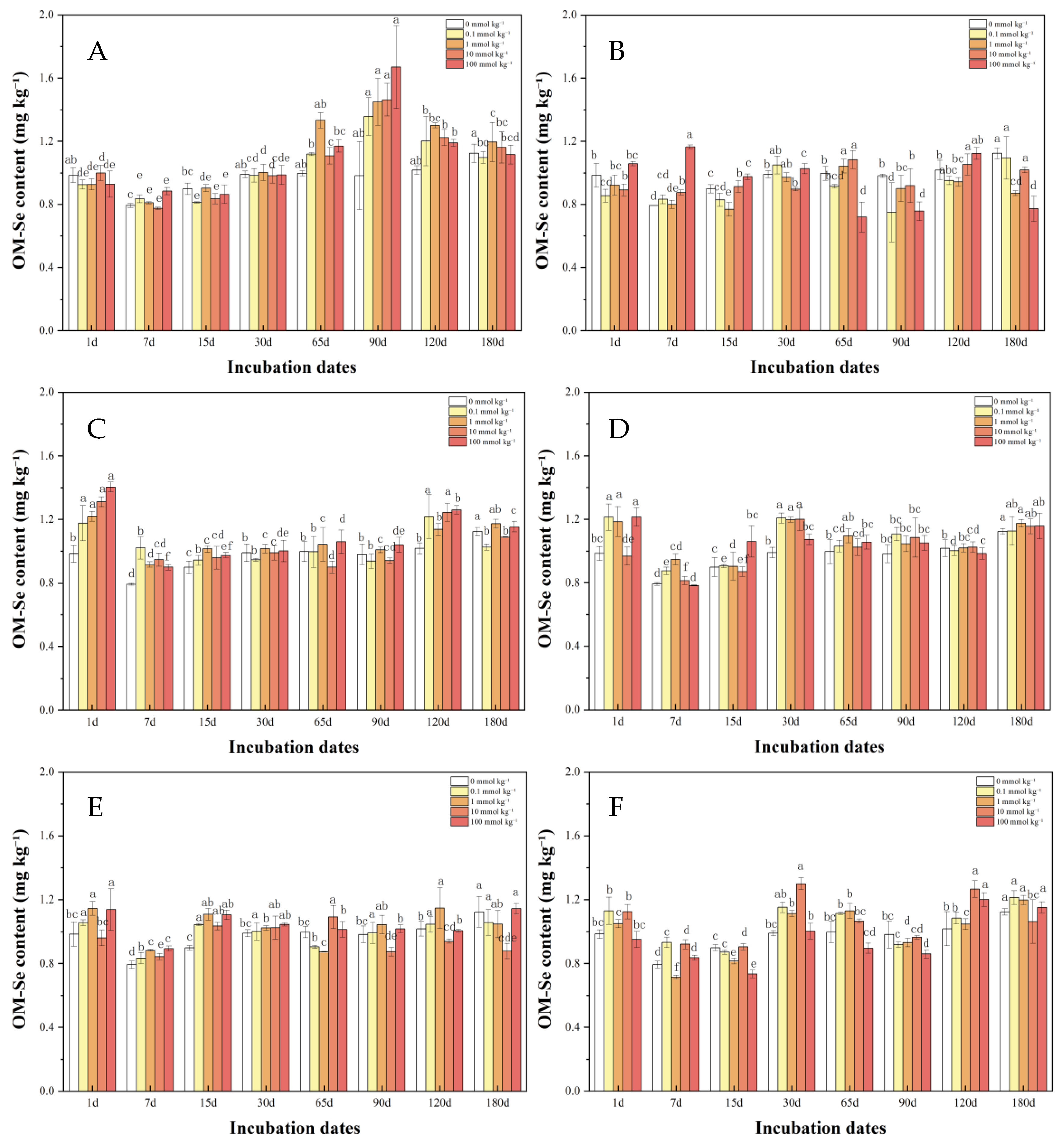
Different LMWOAs exhibited significantly distinct regulatory effects on soil organic matter-bound selenium (OM-Se). Only OA treatment showed a consistent enhancing effect, whereas other organic acids displayed no clear patterns, with some high-concentration treatments even showing inhibitory effects.
Under OA treatment, OM-Se content followed an initial increase followed by stabilization over time(Fig.4 A,). All OA concentrations increased OM-Se content between days 30 and 90, peaking on day 90 (1.38 mg kg⁻¹), then declining and stabilizing at approximately 1.10 mg kg⁻¹. On day 90, compared with the control, the 100 mmol kg⁻¹ OA treatment increased OM-Se content by 70.02% (p <0.01); the 10 mmol kg⁻¹ treatment increased it by 48.35%; and the 0.1 and 1 mmol kg⁻¹ treatments increased it by 19.27% and 31.54%, respectively (p <0.05). The enhancing effect increased with OA concentration. CA treatment exhibited a pattern of "no effect at low concentrations, inhibition at high concentration" (Fig.4 B). Under 100 mmol kg⁻¹ CA treatment, OM-Se content peaked on day 7 (46.89% higher than CK), followed by significant inhibition, with decreases of 27.84%, 22.89%, and 31.27% on days 65, 90, and 180, respectively, compared with CK. No significant differences were observed between the 0.1, 1, 10 mmol kg⁻¹ treatments and the control (p >0.05). FA, AA, BA, and N-BA treatments showed no significant regulatory effects on OM-Se content at any concentration, with no significant differences from the control at any time point (p > 0.05), and no clear concentration-dependent or temporal patterns. Specifically: Under FA treatment, the 0.1 and 1 mmol kg⁻¹ concentrations reached their maximum values on days 1 and 30, while the 10 mmol kg⁻¹ concentration peaked on day 30; Under AA treatment, OM-Se release increased with concentration on day 1, followed by an initial decrease and subsequent increase; Under N-BA treatment, low concentrations promoted OM-Se content during the first 90 days while high concentrations inhibited it; however, all concentrations promoted OM-Se content from day 120 to day 180. From a temporal perspective, OA treatment showed a continuous increase in OM-Se content with increasing treatment time and concentration, peaking on day 90. In contrast, CA treatment showed the opposite pattern: high concentration promoted OM-Se release before day 30 but inhibited it after day 30.
Figure 4.
Content of Organically bound Se in selenium-rich red soil treated with different concentrations of low-molecular-weight organic acids over 180 days. Figure A (OA (oxalic acid)), B (CA (citric acid)), C (FA (fumaric acid)), D (AA (acetic acid)), E (PA (propionic acid)), F (N-BA (n-butyric acid)). Each treatment was replicated three times (n=3), and different lowercase letters indicate significant differences among treatments (p < 0.05).
Figure 4.
Content of Organically bound Se in selenium-rich red soil treated with different concentrations of low-molecular-weight organic acids over 180 days. Figure A (OA (oxalic acid)), B (CA (citric acid)), C (FA (fumaric acid)), D (AA (acetic acid)), E (PA (propionic acid)), F (N-BA (n-butyric acid)). Each treatment was replicated three times (n=3), and different lowercase letters indicate significant differences among treatments (p < 0.05).
3.2. Correlation Analysis of Soil DOM Components and Se Morphology
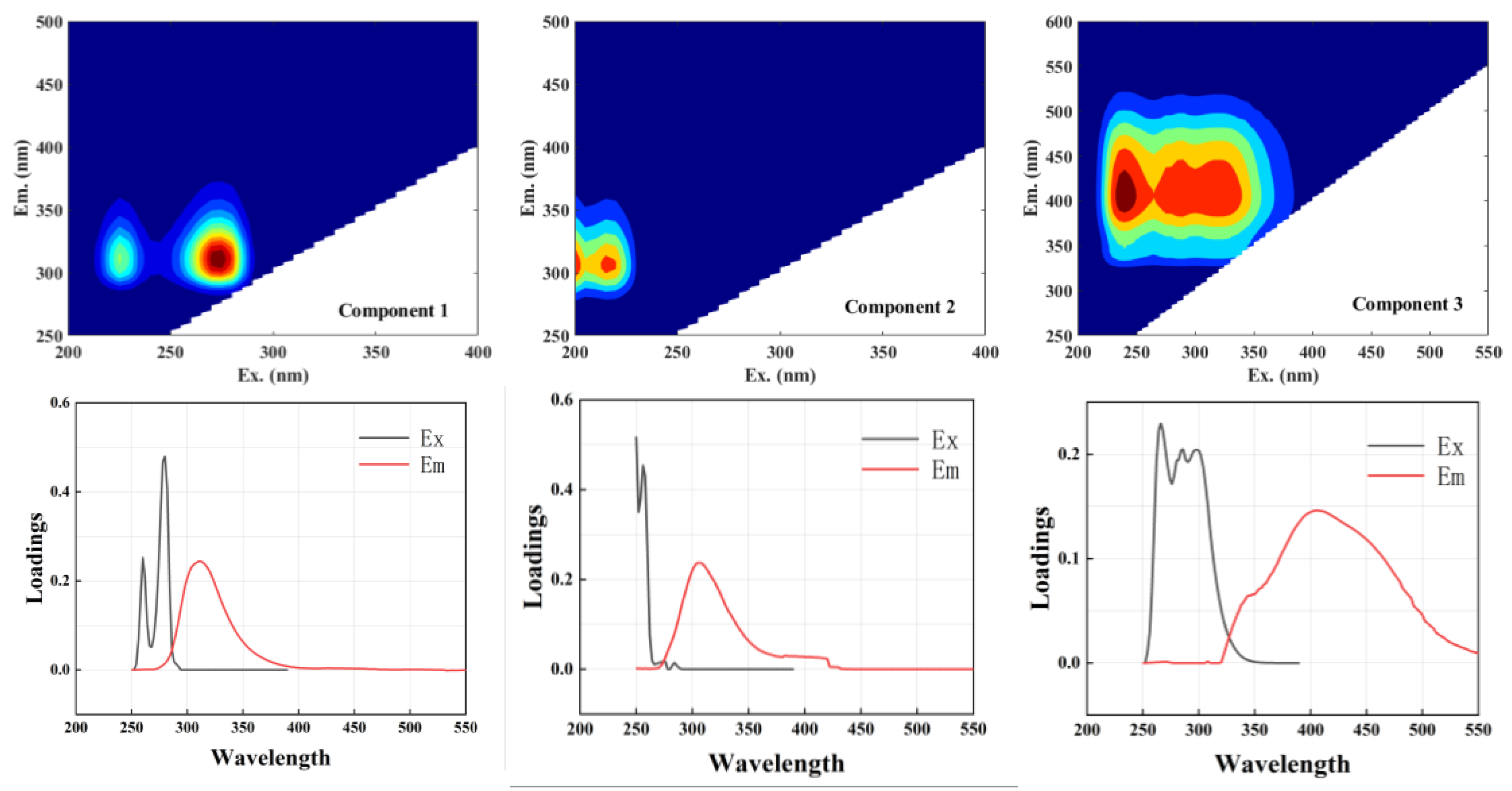
Through literature comparison, the information of organic matter components was determined. C1 was identified as low-molecular-weight and low-aromaticity tyrosine-like substances [18,19,20], component C2 as tyrosine-like substances [21,22], and component C3 as humic-like substances [16,23,24]. Correlation analysis showed that the relationships between DOM fluorescent components and soil selenium fractions (SOL-Se, EXC-Se, FMO-Se, OM-Se) exhibited obvious organic acid type and concentration dependence. Under 100 mmol kg⁻¹ OA treatment, the C1, C2, and C3 fluorescent components all showed significant or extremely significant positive correlations with organic matter-bound selenium (OM-Se) (R = 0.782-0.895, p <0.05). Under 1 mmol kg⁻¹ CA treatment, C1 and C2 were significantly negatively correlated with exchangeable selenium (EXC-Se) (R = -0.713, -0.735, p <0.05), and C3 was significantly negatively correlated with iron-manganese oxide-bound selenium (FMO-Se) (R = -0.698, p <0.05). C1 showed a significant positive correlation with EXC-Se under 10 mmol kg⁻¹ OA treatment (R = 0.7959, p <0.05). Both C1 and C3 showed significant positive correlations with OM-Se under 100 mmol kg⁻¹ treatment (R = 0.7975, p <0.05; R = 0.8077, p <0.05), and C2 showed an extremely significant positive correlation (R = 0.9740, p <0.01) (Table 1). For the other organic acids at various concentrations, the correlations between DOM fluorescent components and soil selenium fractions did not reach significant levels (p >0.05), showing no clear association patterns.
Further results from OA and CA treatments (Table 2) revealed that the C1 component was negatively correlated with FMO-Se and EXC-Se under 0.1 mmol kg⁻¹ treatment (R = -0.7224, p < 0.05; R = -0.8193, p <0.05), and with SOL-Se under 10 mmol kg⁻¹ treatment (R = -0.6890, p <0.05). Moreover, C1, C2, and C3 were all negatively correlated with EXC-Se under 1 mmol kg⁻¹ treatment (R = -0.8545, p <0.05; R = -0.8037, p <0.05; R = -0.7725, p <0.05).
Under PA treatment (Table 3), only the C2 component showed a negative correlation with OM-Se under 100 mmol kg⁻¹ treatment (R = -0.7435, p <0.05).
Under AA treatment (Table 5), only the C2 and C3 components showed negative correlations with EXC-Se under 10 mmol kg⁻¹ treatment (R = -0.8989, p <0.05; R = -0.7317, p <0.05).
Under N-BA treatment (Table 6), the C1 component showed a positive correlation with SOL-Se under 100 mmol kg⁻¹ treatment (R = 0.8384, p <0.05); the C2 component showed a negative correlation with EXC-Se under 100 mmol kg⁻¹ treatment (R = -0.7587, p <0.05); and the C3 component showed a positive correlation with FMO-Se under 0.1 mmol kg⁻¹ treatment (R = 0.8103, p <0.05).
Figure 5.
The DOM components and their loading diagrams obtained by PARAFAC analysis. Each treatment was replicated three times (n=3).
Figure 5.
The DOM components and their loading diagrams obtained by PARAFAC analysis. Each treatment was replicated three times (n=3).
4. Discussion
4.1. Mechanisms and Regional Specificity of Low-Molecular-Weight Organic Acids in Regulating Soil SOL-Se and FMO-Se
In selenium-enriched red soils of southern Jiangxi, iron-manganese oxide-bound selenium (FMO-Se) is the dominant selenium fraction, accounting for approximately 30% of total soil selenium, and serves as the core limiting factor for soil selenium bioavailability. Soluble selenium (SOL-Se) is the available form that can be directly absorbed and utilized by plants [25], and its content changes primarily originate from the activation and release of FMO-Se. These two fractions exhibit a clear source-sink relationship and transformation interdependence, regulated by low-molecular-weight organic acids (LMWOAs). The results of this study showed that treatments with 100 mmol kg⁻¹ citric acid (CA), oxalic acid (OA), and fumaric acid (FA) significantly increased soil SOL-Se content by 43.12%, 44.55%, and 51.19%, respectively, compared with the control, while significantly decreasing FMO-Se content. Notably, the 100 mmol kg⁻¹ CA treatment reduced FMO-Se content by 58.31% compared with the control, both reaching extremely significant differences (p < 0.01). In contrast, low-to-medium concentration (0.1, 1, 10 mmol kg⁻¹) LMWOAs treatments showed no significant regulatory effects on either fraction, with no significant differences from the control (p > 0.05). These results are closely related to the regional characteristics of southern Jiangxi selenium-enriched red soils, including strong acidity (pH 4.5–5.5) and high iron oxide content (total Fe 25–35 g kg⁻¹). The abundant iron-manganese oxides in red soils possess numerous adsorption sites that strongly adsorb selenium ions, forming stable FMO-Se, resulting in extremely low SOL-Se content that is difficult for navel orange roots to absorb and utilize [26].
The regulation of SOL-Se and FMO-Se by LMWOAs operates through two synergistic pathways: (1) Acidification effect: LMWOAs dissociate and release H⁺, further promoting the dissolution of iron-manganese oxides, destroying their surface adsorption structures, and releasing SeO₃²⁻ adsorbed on their surfaces, thereby increasing SOL-Se content and decreasing FMO-Se content [27,28]. (2) Competitive adsorption effect: The carboxyl groups (-COOH) in LMWOA molecules compete with SeO₃²⁻ for adsorption sites on iron-manganese oxide surfaces, promoting the desorption of FMO-Se and release of SOL-Se. This also explains the differences in regulatory effects among different LMWOA structures observed in this study: tricarboxylic acid (CA) and dicarboxylic acids (OA, FA), possessing more carboxyl groups, exhibited significantly better activation effects on SOL-Se and inhibitory effects on FMO-Se than monocarboxylic acids (acetic acid, propionic acid, butyric acid) containing only one carboxyl group, which showed no significant regulatory effects on either fraction. The phenomenon of SOL-Se concentration surge followed by decline observed in this study—reaching up to 16.66 µg kg⁻¹ and then dropping to as low as 5.48 µg kg⁻¹—occurred under 10 mmol kg⁻¹ AA treatment and 100 mmol kg⁻¹ CA, AA, and OA treatments during the early incubation period. This is primarily because the competitive adsorption between LMWOAs and selenium mainly occurs in the early reaction stage. Some LMWOAs, such as CA and AA, possess multiple -COOH groups that can bind with ligand groups of weakly adsorbed Se(VI) shortly after organic acid treatment [29]. At this stage, LMWOA adsorption has not yet reached equilibrium, and the increase in free selenium in the soil over a short period may lead to elevated soil selenium content, explaining the early selenium release peak observed in CA, AA, and OA treatments. As time progresses and LMWOA adsorption reaches equilibrium, selenium is re-adsorbed, resulting in a transient decline. The complexation between LMWOAs and metal ions in the soil also affects the mechanisms of precipitation and dissolution reactions. This complexation, dependent on the number and position of functional groups (-COOH, -OH, or -SH), releases certain metal cations originally adsorbed onto soil components, allowing selenium oxyanions to exchange with ligands on metal (hydr)oxides, thereby increasing Se(VI) release. This also explains the subsequent increase in selenium content .
Fang et al. (2015) conducted research in neutral soil (pH 6.5–7.0) and demonstrated that citric acid exhibited the optimal selenium activation effect [30,31,32]. However, the results of the present study differ: in southern Jiangxi selenium-enriched red soil, AA showed better SOL-Se activation than CA, with a maximum extraction efficiency 17.98% higher than that of CA treatment. This is primarily attributable to the regional specificity of the strongly acidic red soils in southern Jiangxi. In neutral soils, citric acid exhibits higher carboxyl group dissociation and stronger capacity for Fe³⁺ complexation and competitive adsorption at binding sites. In contrast, under the strongly acidic conditions of southern Jiangxi red soils, acetic acid has a higher carboxyl group dissociation degree than citric acid, making it more prone to form stable complexes with Fe³⁺ in the soil, thereby releasing more SOL-Se. This finding fills a research gap regarding LMWOA-mediated selenium activation in acidic red soils. Similar results have been reported in related studies. Saha et al. (2007) observed that citric acid significantly enhanced the desorption kinetics of pre-adsorbed selenium on adsorption site surfaces [33]. Similarly, El-Said et al. (2007) reported that selenium desorption reached 10.67% in the presence of acetic acid, compared with only 3.5% in the absence of acetic acid [34]. Furthermore, in this study, oxalic acid treatment at all concentrations exhibited mild promoting effects on FMO-Se release, with a maximum release of 10.72% compared with CK. Although this did not reach a significant level, the overall trend was relatively stable. This is primarily because oxalic acid can form soluble complexes with Fe³⁺, which exhibit higher stability under the strongly acidic soil conditions of southern Jiangxi, slowly dissolving iron-manganese oxides.
In summary, LMWOAs promote SOL-Se release and inhibit FMO-Se release, exhibiting obvious concentration effects, type specificity, and regional specificity. High concentrations of polycarboxylic acids (CA, OA, FA) represent the optimal choice for enhancing selenium bioavailability and breaking the selenium fixation bottleneck in southern Jiangxi selenium-enriched red soils, with regulatory mechanisms closely related to the characteristics of strong acidity and high iron oxide content in red soils.
4.2. Dual effects of Exchangeable Se in Selenium-Rich Red Soils
This study found that LMWOAs treatments at concentrations ≤10 mmol kg⁻¹ promoted soil EXC-Se content compared with CK, but the effect was not significant. CA treatment on day 1 and AA treatment during the first 30 days at high concentrations both increased soil EXC-Se content. The faster response of CA treatment compared with AA treatment may be attributed to the number of carboxyl groups; tricarboxylic and dicarboxylic OAs can more effectively mobilize minerals [35]. Therefore, CA and AA treatments exhibited intense reactions in the early stage, while other organic acids showed weaker effects. However, over time, CA, AA, and N-BA treatments at 100 mmol kg⁻¹ gradually exhibited inhibitory trends. Continuous addition of LMWOAs decreases soil pH. Under low pH conditions, the positive charge carried by the soil solid phase increases, which in turn promotes selenium fixation, thereby driving the transformation of Se from SOL-Se and EXC-Se into less bioavailable forms [25], resulting in decreased EXC-Se content. On the other hand, Se in acidic soils is dominated by Se(IV), which readily binds to soil components. Under strongly acidic reducing conditions, selenate is easily abiotically reduced by iron and aluminum hydroxides, and the reduced Se(IV) is more readily adsorbed and fixed [36]. This is consistent with the findings of Fang et al. (2019), which also explains, in part, the continuous decline in EXC-Se content observed in this experiment under CA, AA, and N-BA treatments at 100 mmol kg⁻¹ as treatment time increased. Research by Wang et al. (2019) also showed that the extractable proportion of EXC-Se decreased after LMWOAs addition [37], which is consistent with the results of this study. In addition, the decrease in soil EXC-Se content may also be related to the formation of multi-component complexes involving LMWOAs, Se, and other soil components, such as binary complexes like LMWOAs-Se(IV). Wang et al. (2019) further demonstrated this result, as reduced Se(0), Se(-II), or ferric selenite precipitates cannot be extracted by phosphate [37], which is one reason for the rapid decrease in EXC-Se content.
4.3. Differential Regulation and Specific Mechanisms of Low-Molecular-Weight Organic Acids on Soil OM-Se
The effects of LMWOAs on OM-Se in selenium-enriched soils are highly complex, involving not only simple ion exchange and pH-mediated dissolution-precipitation equilibria but also the influence of various multi-component complexes and polymers. In this study, the most significant changes in OM-Se were observed under OA treatment. Fang et al. (2019) demonstrated that OA promotes Se immobilization and reduction, but no further investigation was conducted [30]. As treatment time increased, OM-Se concentration continuously rose, which may be attributed to the formation of multi-component complexes and polymers, such as Se-Fe-HA and LMWOA-Fe(III)-Se(IV) ternary complex precipitates, leading to further transformation of soil Se into Se(-II) and Se(0), thereby increasing OM-Se content in the soil [27,38].
Under AA, FA, PA, and N-BA treatments, OM-Se content increased significantly on day 1 of incubation, and this increase intensified with higher treatment concentrations. This may be related to soil pH and soil texture. The southern Jiangxi region features red clay soils, where Se exists as oxyanions that adsorb onto clay minerals through electrostatic interactions, forming mineral surface complexes. Additionally, lower pH values result in higher mobility and availability of cations, while the opposite is true for anions [39]. The interaction between Se and clay is strongly influenced by pH, with Se adsorption increasing as soil pH decreases [26], leading to a significant short-term increase in OM-Se content.
Under CA treatment at 100 mmol kg⁻¹, soil OM-Se content showed an increasing trend during the early incubation period. As CA was continuously added, the decreased pH facilitated the transformation of Se into OM-Se and RES-Se, resulting in increased OM-Se content. Research by Vermeiren et al. (2025) also indicated that pH reduction leads to the immobilization of selenate and selenite [38,40]. However, as treatment time increased, OM-Se content exhibited a decreasing trend. This phenomenon may be attributed to the released Se being captured by CA itself or other soil substances, forming insoluble precipitates and thereby reducing OM-Se content.
The above discussion is based on selenium fractionation results, and other reasons may exist. However, this experiment only measured OM-Se without determining organic matter-bound selenium, which represents one of the limitations of this study.
4.4. Correlation Between Fluorescent Components and Soil Se
To investigate the relationship between organic matter components (x) and selenium fractions (y), scatter plots were used to visualize data distribution, and linear least squares (OLS) regression was applied for fitting. The results showed that under LMWOAs treatments, soil organic matter components were negatively correlated with available selenium in soil and positively correlated with bound selenium. This outcome may be attributed to the properties of both. The addition of LMWOAs leads to a decrease in soil pH, increasing the dissolution of soil metal cations and promoting the formation of organic matter-metal cation complexes [41]. Enhanced soil humification promotes the production of organic matter-metal complexes, which can indirectly complex with Se, leading to Se immobilization and transformation toward bound forms [42], thereby increasing the content of bound selenium in soil. On the other hand, organic matter forms complexes with metals and indirectly complexes with Se, forming ternary complex-like species, resulting in decreased Se content. Both C1 and C2 components are protein-like substances that can react with soil Se, enhancing Se fixation. With the addition of LMWOAs, soil humification is intensified, and soil metal cations originally fixed in the soil are dissolved [35], causing free Se(VI) to be adsorbed and complexed by organic acids and humic substances [40], which may be one of the reasons for the decrease in available Se content. Additionally, the C3 component (humic acid) in soil may undergo complexation reactions with Se, leading to precipitation. Studies have found that OAs, HA, and Se exist in the form of ternary complexes [27,43]. Furthermore, positively charged metals promote the formation of Se-OAs-HS ternary complexes [44]. Early studies have also indicated that Se can be adsorbed by Fe-HS complexes, and research on cation bridge-mediated interactions between two anions, particularly Fe(III), further confirms that HSs combine with Se oxyanions to form ternary complexes
In summary, these results suggest that long-term application of organic acids may lead to increased humification, thereby converting plant-available selenium into unavailable bound forms, which is unfavorable for plant selenium uptake and utilization. However, on the other hand, this phenomenon can be applied to environmental remediation in selenium-contaminated areas by accelerating selenium immobilization to reduce its toxic effects on plants. Therefore, this outcome has dual implications.
5. Conclusion
With the development of modern industry, substantial industrial waste emissions have been generated, causing serious harm to the environment. LMWOAs are one of the main components of plant root exudates. By binding with mineral metal elements in soil, they can alter the chemical forms of these elements. Additionally, LMWOAs are readily decomposable and pose a low risk of secondary pollution to the environment.
The results showed that, except for OA, all LMWOAs treatments at 100 mmol kg⁻¹ significantly increased soil SOL-Se content, while CA, AA, and N-BA at the same concentration inhibited the contents of EXC-Se and FMO-Se. Analysis of the relationships between soil Se speciation and DOM fluorescence components under different LMWOAs treatments indicated that changes in DOM composition had complex effects on Se transformation. Specifically, the C1 component of DOM—comprising low-molecular-weight, low-aromaticity, tyrosine-like substances—was positively correlated with various Se species, the C3 component—humic-like substances—was negatively correlated, and the C2 component—tyrosine-like substances—showed no significant correlation. Overall, the exogenous addition of LMWOAs markedly influenced Se speciation transformation: short-term application enhanced soil bioavailable Se, whereas long-term application accelerated Se fixation.
Therefore, the short-term and intermittent application of low-concentration LMWOAs is conducive to plant uptake and utilization of selenium from the soil. For areas severely contaminated with selenium, long-term application of LMWOAs can accelerate selenium immobilization, thereby mitigating soil selenium pollution and reducing its toxicity to plants. Additionally, as one of the primary components of root exudates, LMWOAs are readily degradable and non-polluting to the soil, posing minimal risk of environmental harm.
Supplementary Materials
The supporting information can be downloaded at Preprints.org.
Funding
This research was funded by the Natural Science Foundation of China (42207042), Natural Science Foundation of Jiangxi Province, China (20224BAB215027, 20232BAB215042), Jiangxi Province’s Key Research and Development Project ‘Leading the Charge with Open Competition’ (20223BBF61008), Ganzhou Science and Technology Plan Project (2023CYZ27841, GZ2024QNR001).
Data Availability Statement
The authors confirm that all data presented in this manuscript are original to their research. Supplementary data related to the experiment have been included in the manuscript. Additional data can be provided upon request by contacting the corresponding author.
Declarations
Consent for Publication All authors have approved the manuscript and agree with its submission to this publication. Competing interest On behalf of all authors, the corresponding author states that there is no conflict of interest.
References
- Zhai, H.; Kleawsampanjai, P.; Wang, R.; Zhou, F.; Xie, J.; Hao, X.; Liu, Y.; Yao, D.; Xiao, H.; Liang, D. Effect of alternating wetting and drying cycles on selenium aging in three soils amended with selenate/selenite. Journal of Soils and Sediments 2025, 25(5), 1532–1543. [Google Scholar] [CrossRef]
- Li, Z.; Man, N.; Wang, S.; Liang, D.; Liu, J. Selenite adsorption and desorption in main Chinese soils with their characteristics and physicochemical properties. Journal of Soils and Sediments 2015, 15(5), 1150–1158. [Google Scholar] [CrossRef]
- Alfthan, G.; Eurola, M.; Ekholm, P.; Venäläinen, E.-R.; Root, T.; Korkalainen, K.; Hartikainen, H.; Salminen, P.; Hietaniemi, V.; Aspila, P.; Aro, A. Effects of nationwide addition of selenium to fertilizers on foods, and animal and human health in finland: From deficiency to optimal selenium status of the population. Journal of Trace Elements in Medicine and Biology 2015, 31, 142–147. [Google Scholar] [CrossRef]
- Natasha; Shahid, M.; Niazi, N.K.; Khalid, S.; Murtaza, B.; Bibi, I.; Rashid, M.I. A critical review of selenium biogeochemical behavior in soil-plant system with an inference to human health. Environmental Pollution 2018, 234, 915–934. [Google Scholar] [CrossRef]
- Panchal, P.; Miller, A.J.; Giri, J. Organic acids: Versatile stress-response roles in plants. Journal of Experimental Botany 2021, 72(11), 4038–4052. [Google Scholar] [CrossRef] [PubMed]
- Adeleke, R.; Nwangburuka, C.; Oboirien, B. Origins, roles and fate of organic acids in soils: A review. South African Journal of Botany 2017, 108, 393–406. [Google Scholar] [CrossRef]
- Potysz, A.; Grybos, M.; Kierczak, J.; Guibaud, G.; Fondaneche, P.; Lens, P.N.L.; Van Hullebusch, E.D. Metal mobilization from metallurgical wastes by soil organic acids. Chemosphere 2017, 178, 197–211. [Google Scholar] [CrossRef] [PubMed]
- Favorito, J.E.; Eick, M.J.; Grossl, P.R. Adsorption of selenite and selenate on ferrihydrite in the presence and absence of dissolved organic carbon. Journal of Environmental Quality 2018, 47(1), 147–155. [Google Scholar] [CrossRef]
- Chen, Z.C.; Liao, H. Organic acid anions: An effective defensive weapon for plants against aluminum toxicity and phosphorus deficiency in acidic soils. Journal of Genetics and Genomics 2016, 43(11), 631–638. [Google Scholar] [CrossRef]
- Zhang, Hongyu.; Xie, S.; Bao, Z.; Tian, H.; Carranza, E.J.M.; Xiang, W.; Yao, L.; Zhang, Hai. Underlying dynamics and effects of humic acid on selenium and cadmium uptake in rice seedlings. Journal of Soils and Sediments 2020, 20(1), 109–121. [Google Scholar] [CrossRef]
- Fernández-Martínez, A.; Charlet, L. Selenium environmental cycling and bioavailability: A structural chemist point of view. Reviews in Environmental Science and Bio/Technology 2009, 8(1), 81–110. [Google Scholar] [CrossRef]
- Wang, Y.; Chen, X.; Whalen, J.K.; Cao, Y.; Quan, Z.; Lu, C.; Shi, Y. Kinetics of inorganic and organic phosphorus release influenced by low molecular weight organic acids in calcareous, neutral and acidic soils. Journal of Plant Nutrition and Soil Science 2015, 178(4), 555–566. [Google Scholar] [CrossRef]
- Agnello, A.C.; Huguenot, D.; Van Hullebusch, E.D.; Esposito, G. Enhanced phytoremediation: A review of low molecular weight organic acids and surfactants used as amendments. Critical Reviews in Environmental Science and Technology 2014, 44(22), 2531–2576. [Google Scholar] [CrossRef]
- Bolan, N.; Kunhikrishnan, A.; Thangarajan, R.; Kumpiene, J.; Park, J.; Makino, T.; Kirkham, M.B.; Scheckel, K. Remediation of heavy metal(loid)s contaminated soils – to mobilize or to immobilize? Journal of Hazardous Materials 2014, 266, 141–166. [Google Scholar] [CrossRef] [PubMed]
- Wang, S.; Liang, D.; Wang, D.; Wei, W.; Fu, D.; Lin, Z. Selenium fractionation and speciation in agriculture soils and accumulation in corn (zea mays L.) under field conditions in shaanxi province, China. Science of The Total Environment 2012, 427-428, 159–164. [Google Scholar] [CrossRef]
- Hong, H.; Wu, S.; Wang, Q.; Dai, M.; Qian, L.; Zhu, H.; Li, Junwei.; Zhang, J.; Liu, J.; Li, Jian.; Lu, H.; Yan, C. Fluorescent dissolved organic matter facilitates the phytoavailability of copper in the coastal wetlands influenced by artificial topography. Science of the Total Environment 2021, 790, 147855. [Google Scholar] [CrossRef]
- Murphy, K.R.; Stedmon, C.A.; Graeber, D.; Bro, R. Fluorescence spectroscopy and multi-way techniques. PARAFAC. Analytical Methods 2013, 5(23), 6557. [Google Scholar] [CrossRef]
- D’Andrilli, J.; Junker, J.R.; Smith, H.J.; Scholl, E.A.; Foreman, C.M. DOM composition alters ecosystem function during microbial processing of isolated sources. Biogeochemistry 2019, 142(2), 281–298. [Google Scholar] [CrossRef]
- Painter, S.C.; Lapworth, D.J.; Woodward, E.M.S.; Kroeger, S.; Evans, C.D.; Mayor, D.J.; Sanders, R.J. Terrestrial dissolved organic matter distribution in the north sea. Science of the Total Environment 2018, 630, 630–647. [Google Scholar] [CrossRef]
- Yamashita, Y.; Boyer, J.N.; Jaffé, R. Evaluating the distribution of terrestrial dissolved organic matter in a complex coastal ecosystem using fluorescence spectroscopy. Continental Shelf Research 2013, 66, 136–144. [Google Scholar] [CrossRef]
- Derrien, M.; Choi, H.; Jardé, E.; Shin, K.-H.; Hur, J. Do early diagenetic processes affect the applicability of commonly-used organic matter source tracking tools? An assessment through controlled degradation end-member mixing experiments. Water Research 2020, 173, 115588. [Google Scholar] [CrossRef]
- Derrien, M.; Shin, K.-H.; Hur, J. Biodegradation-induced signatures in sediment pore water dissolved organic matter: Implications from artificial sediments composed of two contrasting sources. Science of the Total Environment 2019, 694, 133714. [Google Scholar] [CrossRef]
- Chen, M.; Jung, J.; Lee, Y.K.; Hur, J. Surface accumulation of low molecular weight dissolved organic matter in surface waters and horizontal off-shelf spreading of nutrients and humic-like fluorescence in the chukchi sea of the arctic ocean. Science of the Total Environment 2018, 639, 624–632. [Google Scholar] [CrossRef]
- Sharma, P.; Laor, Y.; Raviv, M.; Medina, S.; Saadi, I.; Krasnovsky, A.; Vager, M.; Levy, G.J.; Bar-Tal, A.; Borisover, M. Compositional characteristics of organic matter and its water-extractable components across a profile of organically managed soil. Geoderma 2017, 286, 73–82. [Google Scholar] [CrossRef]
- Li, J.; Peng, Q.; Liang, D.; Liang, S.; Chen, J.; Sun, H.; Li, S.; Lei, P. Effects of aging on the fraction distribution and bioavailability of selenium in three different soils. Chemosphere 2016, 144, 2351–2359. [Google Scholar] [CrossRef] [PubMed]
- Antoniadis, V.; Levizou, E.; Shaheen, S.M.; Ok, Y.S.; Sebastian, A.; Baum, C.; Prasad, M.N.V.; Wenzel, W.W.; Rinklebe, J. Trace elements in the soil-plant interface: Phytoavailability, translocation, and phytoremediation–a review. Earth-science Reviews 2017, 171, 621–645. [Google Scholar] [CrossRef]
- Martin, D.P.; Seiter, J.M.; Lafferty, B.J.; Bednar, A.J. Exploring the ability of cations to facilitate binding between inorganic oxyanions and humic acid. Chemosphere 2017, 166, 192–196. [Google Scholar] [CrossRef]
- Peel, H.R.; Martin, D.P.; Bednar, A.J. Extraction and characterization of ternary complexes between natural organic matter, cations, and oxyanions from a natural soil. Chemosphere 2017, 176, 125–130. [Google Scholar] [CrossRef]
- Nakamaru, Y.M.; Sekine, K. Sorption behavior of selenium and antimony in soils as a function of phosphate ion concentration. Soil Science & Plant Nutrition 2008, 54(3), 332–341. [Google Scholar] [CrossRef]
- Fang, D.; Wei, S.; Xu, Y.; Xiong, J.; Tan, W. Impact of low-molecular weight organic acids on selenite immobilization by goethite: Understanding a competitive-synergistic coupling effect and speciation transformation. Science of The Total Environment 2019, 684, 694–704. [Google Scholar] [CrossRef]
- Fordyce, F.M. Selenium deficiency and toxicity in the environment[M]//Selinus O. In Essentials of Medical Geology; Springer Netherlands: Dordrecht, 2013; pp. 375–416. [Google Scholar] [CrossRef]
- Guo, Q.; Ye, J.; Zeng, J.; Chen, L.; Korpelainen, H.; Li, C. Selenium species transforming along soil–plant continuum and their beneficial roles for horticultural crops. Horticulture Research 2023, 10(2), uhac270. [Google Scholar] [CrossRef]
- Saha, U.K.; Kozak, L.M.; Huang, P.M. Kinetics of citrate-induced selenite desorption from montmorillonite as affected by complexation with hydroxyaluminum and hydroxyaluminosilicate ions. Clays and Clay Minerals 2007, 55(1), 71–88. [Google Scholar] [CrossRef]
- El-Said, A.G.; Badawy, N.A.; Abdel-Aal, A.Y.; Garamon, S.E. Optimization parameters for adsorption and desorption of Zn(II) and Se(IV) using rice husk ash: kinetics and equilibrium. Ionics 2011, 17(3), 263–270. [Google Scholar] [CrossRef]
- Adeleke, R.; Nwangburuka, C.; Oboirien, B. Origins, roles and fate of organic acids in soils: A review. South African Journal of Botany 2017, 108, 393–406. [Google Scholar] [CrossRef]
- He, J.; Shi, Y.; Yang, X.; Zhou, W.; Li, Y.; Liu, C. Influence of fe(II) on the se(IV) sorption under oxic/anoxic conditions using bentonite. Environmental Research 2018, 164, 288–301. [Google Scholar] [CrossRef] [PubMed]
- Wang, D.; Xue, M.; Wang, Y.; Zhou, D.; Tang, L.; Cao, S.; Wei, Y.; Yang, C.; Liang, D.-L. Effects of straw amendment on selenium aging in soils: Mechanism and influential factors. Science of The Total Environment 2019, 657, 871–881. [Google Scholar] [CrossRef] [PubMed]
- Vermeiren, C.; Ceulemans, J.; Thiry, Y.; Smolders, E. Increased soil pH and enhanced microbial activity stimulate the gradual immobilisation of selenate added to soils. Soil Biology & Biochemistry 2025, 202, 109688. [Google Scholar] [CrossRef]
- Kader, M.; Lamb, D.T.; Megharaj, M.; Naidu, R. Sorption parameters as a predictor of arsenic phytotoxicity in australian soils. Geoderma 2016, 265, 103–110. [Google Scholar] [CrossRef]
- He, J.; Shi, Y.; Yang, X.; Zhou, W.; Li, Y.; Liu, C. Influence of fe(II) on the se(IV) sorption under oxic/anoxic conditions using bentonite. Chemosphere 2018, 193, 376–384. [Google Scholar] [CrossRef]
- Bruggeman, C.; Maes, A.; Vancluysen, J. The interaction of dissolved boom clay and gorleben humic substances with selenium oxyanions (selenite and selenate). Applied Geochemistry 2007, 22(7), 1371–1379. [Google Scholar] [CrossRef]
- Jordan, N.; Marmier, N.; Lomenech, C.; Giffaut, E.; Ehrhardt, J.-J. Competition between selenium (IV) and silicic acid on the hematite surface. Chemosphere 2009, 75(1), 129–134. [Google Scholar] [CrossRef] [PubMed]
- Tolu, J.; Thiry, Y.; Bueno, M.; Jolivet, C.; Potin-Gautier, M.; Le Hécho, I. Distribution and speciation of ambient selenium in contrasted soils, from mineral to organic rich. Science of The Total Environment 2014, 479-480, 93–101. [Google Scholar] [CrossRef] [PubMed]
- Dinh, Q.T.; Li, Z.; Tran, T.A.T.; Wang, D.; Liang, D. Role of organic acids on the bioavailability of selenium in soil: A review. Chemosphere 2017, 184, 618–635. [Google Scholar] [CrossRef] [PubMed]

Table 1.
The correlation between three-dimensional fluorescence components and selenium species in soil under OA treatment, different lowercase letters indicate significant differences among treatments (p < 0.05).
Table 1.
The correlation between three-dimensional fluorescence components and selenium species in soil under OA treatment, different lowercase letters indicate significant differences among treatments (p < 0.05).
| Se Speciation | OA Treatment | DOM Components | |||||||
| C1(%) | C2(%) | C3(%) | |||||||
| R | P | R | P | R | P | ||||
| SOL-Se | 0 mmol kg⁻¹ | -0.3631 | >0.05 | 0.2587 | >0.05 | 0.3618 | >0.05 | ||
| 0.1 mmol kg⁻¹ | 0.6371 | >0.05 | 0.1619 | >0.05 | -0.1531 | >0.05 | |||
| 1 mmol kg⁻¹ | 0.4918 | >0.05 | -0.1257 | >0.05 | -0.5218 | >0.05 | |||
| 10 mmol kg⁻¹ | 0.6419 | >0.05 | 0.1241 | >0.05 | -0.4377 | >0.05 | |||
| 100 mmol kg⁻¹ | -0.0295 | >0.05 | -0.1931 | >0.05 | -0.0296 | >0.05 | |||
| EXC-Se | 0 mmol kg⁻¹ | -0.2015 | >0.05 | 0.1243 | >0.05 | 0.1917 | >0.05 | ||
| 0.1 mmol kg⁻¹ | 0.4645 | >0.05 | 0.2527 | >0.05 | -0.2485 | >0.05 | |||
| 1 mmol kg⁻¹ | 0.0015 | >0.05 | -0.3963 | >0.05 | -0.068 | >0.05 | |||
| 10 mmol kg⁻¹ | 0.7959 | <0.05 | 0.437 | >0.05 | 0.0106 | >0.05 | |||
| 100 mmol kg⁻¹ | -0.2208 | >0.05 | 0.2413 | >0.05 | 0.0912 | >0.05 | |||
| FMO-Se | 0 mmol kg⁻¹ | 0.2145 | >0.05 | 0.0402 | >0.05 | -0.3563 | >0.05 | ||
| 0.1 mmol kg⁻¹ | -0.2486 | >0.05 | -0.033 | >0.05 | -0.3703 | >0.05 | |||
| 1 mmol kg⁻¹ | -0.6041 | >0.05 | -0.4662 | >0.05 | 0.1517 | >0.05 | |||
| 10 mmol kg⁻¹ | -0.0523 | >0.05 | -0.3753 | >0.05 | -0.1683 | >0.05 | |||
| 100 mmol kg⁻¹ | -0.1571 | >0.05 | 0.1462 | >0.05 | 0.2137 | >0.05 | |||
| OM-Se | 0 mmol kg⁻¹ | 0.5184 | >0.05 | 0.3105 | >0.05 | -0.1523 | >0.05 | ||
| 0.1 mmol kg⁻¹ | -0.2911 | >0.05 | 0.1255 | >0.05 | 0.5144 | >0.05 | |||
| 1 mmol kg⁻¹ | -0.3614 | >0.05 | 0.2478 | >0.05 | 0.2926 | >0.05 | |||
| 10 mmol kg⁻¹ | 0.0621 | >0.05 | -0.1704 | >0.05 | 0.1566 | >0.05 | |||
| 100 mmol kg⁻¹ | 0.7975 | < 0.05 | 0.974 | <0.001 | 0.8077 | <0.05 | |||
Table 2.
The correlation between three-dimensional fluorescence components and selenium species in soil under CA treatment, different lowercase letters indicate significant differences among treatments (p < 0.05).
Table 2.
The correlation between three-dimensional fluorescence components and selenium species in soil under CA treatment, different lowercase letters indicate significant differences among treatments (p < 0.05).
| Se Speciation | CA Treatment | DOM Components | |||||||
| C1(%) | C2(%) | C3(%) | |||||||
| R | P | R | P | R | P | ||||
| SOL-Se | 0 mmol kg⁻¹ | -0.2657 | >0.05 | -0.0108 | >0.05 | 0.1975 | >0.05 | ||
| 0.1 mmol kg⁻¹ | -0.1585 | >0.05 | -0.8235 | <0.05 | 0.6572 | >0.05 | |||
| 1 mmol kg⁻¹ | -0.1668 | >0.05 | -0.6180 | >0.05 | -0.5315 | >0.05 | |||
| 10 mmol kg⁻¹ | -0.6890 | <0.05 | -0.0016 | >0.05 | -0.4679 | >0.05 | |||
| 100 mmol kg⁻¹ | 0.7618 | >0.05 | -0.0779 | >0.05 | -0.5374 | >0.05 | |||
| EXC-Se | 0 mmol kg⁻¹ | -0.2014 | >0.05 | 0.1242 | >0.05 | 0.1916 | >0.05 | ||
| 0.1 mmol kg⁻¹ | -0.8193 | <0.05 | -0.4823 | >0.05 | 0.1814 | >0.05 | |||
| 1 mmol kg⁻¹ | -0.8545 | <0.05 | -0.8037 | <0.05 | -0.7725 | <0.05 | |||
| 10 mmol kg⁻¹ | -0.7226 | <0.05 | -0.3598 | >0.05 | -0.2583 | >0.05 | |||
| 100 mmol kg⁻¹ | 0.4152 | >0.05 | -0.0418 | >0.05 | -0.4253 | >0.05 | |||
| FMO-Se | 0 mmol kg⁻¹ | 0.2147 | >0.05 | 0.0401 | >0.05 | -0.3569 | >0.05 | ||
| 0.1 mmol kg⁻¹ | -0.7224 | <0.05 | -0.1457 | >0.05 | 0.5389 | >0.05 | |||
| 1 mmol kg⁻¹ | -0.2318 | >0.05 | -0.3251 | >0.05 | -0.1405 | >0.05 | |||
| 10 mmol kg⁻¹ | 0.3931 | >0.05 | 0.2427 | >0.05 | -0.4687 | >0.05 | |||
| 100 mmol kg⁻¹ | 0.2871 | >0.05 | -0.0443 | >0.05 | -0.5129 | >0.05 | |||
| OM-Se | 0 mmol kg⁻¹ | 0.5184 | >0.05 | 0.3106 | >0.05 | -0.5234 | >0.05 | ||
| 0.1 mmol kg⁻¹ | 0.0663 | >0.05 | -0.0994 | >0.05 | -0.5616 | >0.05 | |||
| 1 mmol kg⁻¹ | -0.1070 | >0.05 | 0.1048 | >0.05 | -0.1523 | >0.05 | |||
| 10 mmol kg⁻¹ | -0.1994 | >0.05 | -0.5234 | >0.05 | -0.2795 | >0.05 | |||
| 100 mmol kg⁻¹ | 0.4025 | >0.05 | -0.5616 | >0.05 | -0.0251 | >0.05 | |||
Disclaimer/Publisher’s Note: The statements, opinions and data contained in all publications are solely those of the individual author(s) and contributor(s) and not of MDPI and/or the editor(s). MDPI and/or the editor(s) disclaim responsibility for any injury to people or property resulting from any ideas, methods, instructions or products referred to in the content. |
© 2026 by the authors. Licensee MDPI, Basel, Switzerland. This article is an open access article distributed under the terms and conditions of the Creative Commons Attribution (CC BY) license (http://creativecommons.org/licenses/by/4.0/).
Copyright: This open access article is published under a Creative Commons CC BY 4.0 license, which permit the free download, distribution, and reuse, provided that the author and preprint are cited in any reuse.


