

Submitted:
16 April 2026
Posted:
21 April 2026
You are already at the latest version
Abstract
This paper integrates a theorem-bearing dual-time core with an explicit reconstruction of Lorentzian geometry from stabilized event statistics. Starting from a dual-time architecture --- generative inner time, completed outer time, and a completion/projection interface between them --- the manuscript develops admissible-history monads, completion and observation functors, Hilbert-fiber realizations, quadratic carrier algebras, compact phase symmetry, a stabilization interface from completed histories to candidate event structures, and a factorized geometry map from stabilized measures to weighted discrete or continuum Lorentzian geometry. The central representation-theoretic result is retained and sharpened in context: a strongly continuous action of \textit{S}\textsuperscript{1} on a real Hilbert space induces, on each nontrivial irreducible sector, a canonical orthogonal complex structure, unique up to conjugation. A further rigidity statement remains decisive: every symmetric bilinear form invariant under the compact phase action on such a sector is a scalar multiple of the Euclidean one. Hence no nondegenerate split form can be preserved on the same compact phase sector. This gives a concrete mathematical reason that phase and causal readout must be carried by different algebraic branches. The new synthesis supplied here is that completed observable histories can feed a stabilization stage whose output is a probability measure on candidate event structures, and that this measure in turn determines effective causal and metric observables. Around this bridge the paper proves local continuity of the reconstruction data, threshold recovery of a sharp effective order, consistency of volume-based and chain-based proper-time estimators, a continuum recovery theorem showing that reconstructed order together with reconstructed volume determines a Lorentzian metric up to diffeomorphism and coarse graining in a manifoldlike regime, and an exact light-cone-strip benchmark converging to flat $(1+1)$-dimensional Minkowski geometry. The resulting contribution is structural and constraint-based rather than elemental. Familiar ingredients are placed in one controlled emergence chain: compact recurrence yields complex Hilbert phase sectors, completion and projection yield observable irreversibility, stabilization yields persistent event statistics, and reconstructed order plus volume yield Lorentzian geometry. The paper does not derive gravitational dynamics. It does show that complex phase structure and spacetime geometry can arise in one framework at different levels, with a mathematically forced separation between their invariant quadratic carriers.
Keywords:
dual time
; admissible histories
; stabilized event statistics
; quadratic algebras
; real algebraic geometry
; causal reconstruction
; Lorentzian geometry
; causal sets
; complex Hilbert space
MSC: 14L15; 14P99; 18C15; 46C05; 81P10; 83A05
1. Introduction
This paper addresses a structural question rather than a purely technical one: to what extent can complex Hilbert-space structure, observer-level irreversibility, and Lorentzian geometry be linked within one controlled organization of time, completion, and event formation? In standard mathematical physics these ingredients are usually introduced independently. Complex scalars are built into Hilbert space, causal order is imposed geometrically, and irreversible semigroups appear only after reduction, environment, or coarse-graining. The present work explores a different explanatory order.
The starting point is a dual-time framework with three basic ingredients: a generative inner time, a completed outer time, and a completion/projection interface linking them. The first half of the paper develops the theorem-bearing core attached to that architecture: admissible-history monads, completion and observation functors, Hilbert-fiber realizations, quadratic carrier algebras, compact inner-time symmetry, and a minimal split-quadratic causal readout. The second half adds the geometry stage that the original core only pointed toward: a stabilization interface from completed histories to candidate event structures, and from stabilized event statistics to weighted discrete or continuum Lorentzian geometry. The structural organization of this framework is summarized in Figure 1.
One reason to pursue such a framework is that foundational physics repeatedly treats the following three structures as separate primitives:
- (1)
- complex Hilbert structure, central to quantum theory;
- (2)
- Lorentzian or causal structure, central to relativity;
- (3)
- irreversible observable dynamics, central to statistical and open-systems descriptions.
The present paper argues that these can be linked without collapsing them into one undifferentiated formalism. Complex structure arises from compact inner-time symmetry, irreversible observable evolution arises from quotient merging under completion/projection, and Lorentzian geometry is reconstructed from stabilized event statistics by means of effective causal order and volume data. The resulting claim is not that the whole of physics has been reconstructed, but that these features can be organized within one controlled chain of definitions and theorems.
The strongest inherited theorem is representation-theoretic: a strongly continuous S1-action on a real Hilbert space forces a canonical orthogonal complex structure on each nontrivial irreducible frequency sector, unique up to conjugation. A second inherited consequence is sharper than a mere reinterpretation: every symmetric bilinear form invariant under the compact phase action on such a sector is a scalar multiple of the Euclidean one. Hence no invariant split quadratic form can live on the same compact phase sector. This is a concrete mathematical reason that the circular branch and the hyperbolic branch must do different jobs. The circular branch governs recurrence and phase; the hyperbolic branch governs causal readout and the seed of Lorentzian geometry.
The new step taken here is explicit and constructive. The paper introduces a stabilization interface that turns completed observable histories into a stabilized probability measure on candidate event structures. From that measure it reconstructs persistent labels, precedence and link kernels, interval volumes, overlap-based slice geometry, manifoldlikeness diagnostics, and, in a globally hyperbolic manifoldlike regime, a continuum Lorentzian metric determined by reconstructed order and reconstructed volume, in the sense of the causal-geometry results of Hawking–King–McCarthy and Malament together with causal-set volume reconstruction [27,28,29,37].
A further aim is to make the algebraic-geometric side explicit rather than incidental. The carrier algebras are finite real algebras and therefore affine schemes ; their norm-one loci are affine conics; and the circular and hyperbolic branches correspond to the anisotropic and split real forms of a one-dimensional torus [14,15,16]. The carrier level of the framework already lives in real algebraic geometry before one reaches operator theory, stabilization, or spacetime interpretation.
The manuscript is deliberately organized so that the theorem-bearing core can be read independently of the wider interpretation. Readers interested mainly in the compact-symmetry core may begin with Section 5, Section 6, Section 7, Section 8, Section 9, Section 10 and Section 11. Readers interested in the geometry stage may then move to Section 12, Section 13, Section 14 and Section 15, where stabilized event statistics are used to reconstruct effective Lorentzian geometry. The later Section 16, Section 17, Section 18, Section 19 and Section 20 summarize what is established, what the merged framework contributes, and what remains open.
1.1. The Structural Problem Addressed Here
A recurring difficulty in foundational physics is that phase, causality, and irreversibility are often imported from different formalisms and only compared after the fact. The present paper asks whether a minimal two-level organization of time can explain why these structures are related but not identical.
More concretely, the paper tests three claims.
- (i)
- Compact recurrence should force phase structure rather than merely coexist with it.
- (ii)
- Completion and projection should explain why exact underlying composition can descend to irreversible observer-level dynamics.
- (iii)
- The split form used for causal readout should be incompatible with the compact phase representation on the same nontrivial irreducible sector.
The first two claims organize familiar mathematics in a new way. The third yields a concrete constraint: the framework does not merely say that phase and causal readout are different; it proves that they cannot be represented by the same invariant quadratic geometry on a nontrivial compact irreducible phase sector.
1.2. What This Paper is Trying to Accomplish
The paper has seven closely related goals.
- (i)
- To isolate a theorem-bearing mathematical core for SMM/DTT that can be assessed without prior commitment to the broader metaphysical programme.
- (ii)
- To provide a disciplined translation from minimal structural assumptions to formal constructions: admissible histories, completion, observation, operator realization, compact inner-time symmetry, stabilized event statistics, and coarse-grained observable geometry.
- (iii)
- To show that the carrier classification naturally separates the circular, nilpotent, and hyperbolic regimes, and that only the first and third serve as nondegenerate branches of the theory.
- (iv)
- To prove directly the strongest compatibility statements required to make the framework mathematically legible, including sectorwise emergence of complex structure, invariant-form rigidity, semigroup descent, and local continuity of reconstructed event statistics.
- (v)
- To construct an explicit bridge from completed histories to effective spacetime geometry by introducing a stabilization interface and a factorized geometry reconstruction map.
- (vi)
- To prove an integrated emergence theorem showing that the same dual-time framework can support compact Hilbert phase structure at the generative level and Lorentzian geometry at the observer level, while keeping those structures mathematically separated.
- (vii)
- To mark a sharp boundary between what is established here and what remains programmatic, so that scope is not confused with overclaim.
The result is meant to be broad but disciplined. It does not ask the reader to accept a total cosmology all at once. It asks whether a specific explanatory order can be formulated precisely, whether its internal theorem chain is coherent, and whether that chain yields nontrivial constraints that standard frameworks usually leave implicit.
This paper is intended as a foundational reference for a staged programme. Its aim is not to present a complete physical theory, but to isolate and prove a minimal theorem-bearing core: admissible-history composition, completion/projection descent, compact-symmetry-induced complex structure, invariant-form rigidity on phase sectors, and a stabilization-to-geometry bridge. The wider physical branches are included only insofar as the core makes them mathematically intelligible.
1.3. What Is New Here, and What Is Not
Several ingredients used in this paper are classical when viewed separately: the classification of two-dimensional real quadratic algebras, the power-series derivation of circular and hyperbolic Euler identities, the real Fourier decomposition of , the Stone and Hille–Yosida theorems, and the scheme-theoretic description of norm-one conics and real tori. The manuscript does not claim novelty for those facts in isolation.
The novelty lies in how those ingredients are made to interact. Four points matter most.
- (1)
- A fixed explanatory chain. The paper links admissible histories, completion, quadratic carriers, compact symmetry, and observable geometry in one explicit order.
- (2)
- A mathematically forced division of labour. The circular branch carries recurrence and phase; the hyperbolic branch carries causal readout. This is not only interpretive. Proposition 10 and Corollary 1 show that a nondegenerate split form cannot be invariant on the same nontrivial compact irreducible phase sector.
- (3)
- Derived rather than assumed structures. Complex Hilbert structure is derived from symmetry, and observer-level irreversibility is derived from quotient structure.
- (4)
- Strict logical status. The theorem-bearing core is proved directly, while broader physical branches are marked as conjectural or programmatic.
The contribution is therefore structural and constraint-based rather than elemental. The paper does not offer new algebraic atoms. It identifies a minimal package of assumptions under which familiar structures stop being independent choices and start constraining one another.
1.4. Main Theorems Proved in This Paper
The paper proves a theorem chain in two coupled stages. The first stage develops the dual-time core; the second stage turns stabilized event statistics into effective Lorentzian geometry. The most important results are the following.
- (1)
- Carrier classification (Theorem 5): every two-dimensional commutative associative unital real quadratic carrier generated by one non-scalar element is isomorphic to exactly one of the three normal forms , , or .
- (2)
- Affine-scheme and torus avatar (Proposition 2): these carriers define real affine schemes of degree two over , while their norm-one loci are affine conics; the circular and hyperbolic branches are, respectively, anisotropic and split real one-dimensional tori.
- (3)
- Unified Euler laws (Theorem 6): the ordinary Euler identity, the nilpotent tangent law, and the hyperbolic Euler law are all instances of a single exponential theorem for quadratic carriers.
- (4)
- Observable semigroup descent (Theorem 7): under completion compatibility, complete histories descend to a well-defined observable semigroup, with observer-level irreversibility arising precisely by quotient merging.
- (5)
- Canonical complex structure from compact inner time (Theorem 9, with uniqueness in Theorem 10): a strongly continuous translation action of S1 on a real Hilbert space canonically induces, on every nontrivial irreducible sector, a compatible complex structure that is unique up to conjugation.
- (6)
- Invariant-form rigidity on compact phase sectors (Proposition 10): every symmetric bilinear form invariant under the compact inner-time action on a nontrivial irreducible phase sector is a scalar multiple of the Euclidean one; in particular, no invariant split quadratic form exists on the same sector.
- (7)
- Observable causal inequality (Theorem 11): bounded local propagation together with a completion-delay law yields an observable cone inequality, which is the first split-quadratic datum from which Lorentzian structure can grow.
- (8)
- Local continuity of reconstruction data (Proposition 14): the local kernels extracted from stabilized event statistics vary Lipschitz-continuously in a local total-variation seminorm.
- (9)
- Threshold recovery of sharp effective order (Theorem 12): near-deterministic stabilized precedence data recover a genuine partial order by thresholding at .
- (10)
- Consistency of proper-time estimators (Proposition 15): interval-volume and longest-chain proper-time estimators agree asymptotically in a manifoldlike regime.
- (11)
- Lorentzian recovery from reconstructed order and volume (Theorem 13): in a globally hyperbolic manifoldlike regime, reconstructed causal order together with reconstructed volume determines a coarse-grained Lorentzian metric up to diffeomorphism and coarse graining.
- (12)
- Integrated dual-time emergence theorem (Theorem 14): under a stabilization interface and manifoldlike concentration, the same dual-time framework yields canonical complex Hilbert phase sectors at the inner level and effective Lorentzian geometry at the observer level, with a mathematically forced separation between their invariant quadratic carriers.
- (13)
- Exact discrete strip benchmark (Proposition 18): the overlap-based reconstruction on a discrete light-cone strip yields the exact Euclidean slice metric and converges to flat -dimensional Minkowski geometry, as illustrated in Figure 3..
The strongest inherited theorem is still the compact-inner-time theorem. Its importance is not merely that Fourier modes exist — that part is classical — but that symmetry alone forces a compatible complex structure sectorwise. The strongest new synthesis theorem is that this phase structure can coexist with emergent Lorentzian geometry only by appearing at a different level of description. Compact recurrence yields complex phase geometry; stabilized order plus volume yield spacetime geometry; and the same invariant-form rigidity that produces the phase/readout separation prevents those two from collapsing into one compact sector.
Main theorem (informal). If a real Hilbert space carries a strongly continuous compact inner-time translation symmetry by S1, then every nontrivial irreducible frequency sector carries a canonical orthogonal complex structure J, unique up to conjugation, and the symmetry acts on that sector by Euler phases . If, in addition, completion and observation feed a stabilization stage whose output is manifoldlike in the precise sense of Section 12, Section 13, Section 14 and Section 15, then the corresponding stabilized event statistics reconstruct an effective Lorentzian geometry from order and volume. Moreover, the only symmetric quadratic forms invariant on a nontrivial compact phase sector are scalar multiples of the Euclidean one, so the Lorentzian geometry cannot live there as invariant compact phase geometry. It appears only after completion, stabilization, and observer-level reconstruction.
This theorem is the main bridge between the recurrence side of SMM/DTT, the complex Hilbert-space formalism used in quantum theory, and the reconstructed Lorentzian geometry ordinarily taken as primitive in relativity.
1.5. Claim-Status Discipline
Because the framework spans ontology, pure algebra, representation theory, operator theory, relativity, and quantum foundations, the paper adopts an explicit claim-status discipline. This is essential: a broad foundational paper is useful only if the reader can tell, at every stage, which statements are definitions, which are proved results, and which remain directions for future work.
This discipline matters because the paper is intentionally asymmetric: the theorem-bearing core is proved directly, whereas several wider applications are deliberately presented only as branches that the core makes mathematically intelligible.
| Label | Meaning in this paper |
| Principle / Postulate | Structural commitments that fix the direction of explanation. |
| Definition | Formal mathematical notions introduced and used in the theorem chain. |
| Theorem / Proposition / Corollary | Results proved directly in the present manuscript. |
| Remark / Discussion | Explanatory or interpretive comments that are not themselves theorem claims. |
| Conjecture / Research Question | Directions that are mathematically meaningful but not yet closed. |
1.6. Why the Paper Has an Algebraic-Geometric Side
The present paper is not an algebraic-geometry paper in the narrow sense of moduli, birational classification, or sheaf cohomology. Its contact with algebraic geometry is more elementary and more structural. The dual-time carriers that support the circular and hyperbolic branches are quadratic -algebras; as such they define affine schemes, carry natural involutions, and possess norm-one loci cut out by quadratic equations. These loci are conics, and in the nondegenerate cases they realize the two basic real forms of a one-dimensional torus: the anisotropic form and the split form [14,15,16]. The carrier level of the framework is therefore already algebraic-geometric before one reaches Hilbert spaces or coarse-grained physics.
A second algebraic-geometric point concerns character lattices and real forms. The compact recurrence branch is expressed analytically through the circle group S1, but algebraically it is governed by the same integer character lattice that governs one-dimensional tori. The split-complex readout branch, by contrast, is governed by a split quadratic form whose null locus is a real quadric cone. The language of conics, quadrics, and tori is therefore not decorative packaging. It is the natural algebraic summary of the carrier-level geometry already present in the theory.
Representation-theoretic viewpoint.
The framework developed here may also be read as a hierarchy of representations. Admissible histories act on generative states as a monoid representation; after Hilbert-fiber realization, they become operator representations on local Hilbert spaces. Compact inner time is represented by a strongly continuous orthogonal action of S1 on a real Hilbert space, whose irreducible sectors carry canonical complex structures and Euclidean invariant forms. Completion and projection descend the generative action to observable semigroup dynamics, while the hyperbolic branch provides a split-form-preserving representation adapted to causal readout. In this sense the paper links symmetry, algebra, and observable geometry through a single representation-theoretic scaffold.
1.7. Relation to Existing Frameworks and Mathematical Models
The framework developed in this paper sits at the intersection of several well-established mathematical and physical traditions. It is therefore important to clarify both its points of contact and its points of departure in concrete rather than merely rhetorical terms.
Complex numbers and phase-based time.
In standard quantum theory and harmonic analysis, time evolution and internal symmetry are expressed through complex phases acting on complex Hilbert spaces [4,5]. In that setting the complex structure is usually taken as primitive. Here the logical order is reversed: one begins with a real Hilbert space carrying a compact -symmetry, and the compatible complex structure is derived sectorwise from that symmetry. Proposition 10 strengthens the distinction: a compact phase sector carries only definite invariant quadratic data, so the Lorentzian split form needed for causal readout cannot be invariant there.
Hyperbolic and split-complex geometry.
Alongside the circular complex branch , the split-complex algebra plays a familiar role in Lorentzian geometry and relativistic kinematics [6,7]. In many treatments the circular and hyperbolic algebras enter for unrelated reasons. Here they appear together because the classification of real quadratic carriers leaves exactly these two nondegenerate signs, together with a nilpotent boundary case. The circular branch is used for compact recurrence and phase; the hyperbolic branch is used for completion-compatible causal readout.
Algebraic-geometric models.
Each carrier defines an affine scheme , and its norm-one locus defines a real conic corresponding to an anisotropic or split real form of a one-dimensional torus [14,15,16]. The present paper uses this language not for moduli theory or field configurations, but because it is the most economical way to describe the carrier-level geometry already inherent in the framework.
Two-time and multi-time theories.
Various physical theories introduce additional time parameters, either as extra spacetime coordinates or as independent evolution parameters [11]. The duality of time considered here differs conceptually: inner and outer time are not two coordinates of the same type but two levels of organization. Inner time governs generative composition and recurrence, while outer time orders completed observable states. The distinction is therefore categorical and operational before it is geometric. Their relationship and roles are schematically illustrated in Figure 1.
Categorical and process-based approaches.
The formulation of admissible histories as a monad and their observable descent as a semigroup places the framework near categorical approaches to physics and operational reconstruction [12,13]. The difference is that the present construction ties those categorical structures explicitly to a dual-time architecture, to Hilbert-fiber operator realizations, and to a carrier-level separation between phase and causal readout.
Relativistic structure.
The causal theorem proved here is intentionally weaker than a full spacetime theory. It does not produce the full Lorentz group, geodesic structure, or Einstein dynamics. What it does provide is a split-quadratic cone inequality from bounded propagation and completion delay. The result is therefore best understood as a metric-free seed from which a sharper relativistic branch would have to grow.
Taken together, these comparisons show that the SMM/DTT framework is not offered as a replacement for standard mathematics. Its claim is that several familiar structures — complex phase, split-complex boosts, monadic composition, operator dynamics, and cone geometry — can be reorganized into one hierarchy with a fixed explanatory order and at least one genuine separation principle.
1.8. How to Read the Paper
Different readers may wish to enter the paper at different points.
- (i)
- Skeptical mathematical route. Read Section 5, Section 6, Section 7, Section 8, Section 9, Section 10 and Section 11 first, then Section 12, Section 13, Section 14 and Section 15, and only afterward Section 16, Section 17, Section 18, Section 19 and Section 20. This route displays the theorem-bearing core and the stabilized-geometry stage with minimal exposure to interpretive language.
- (ii)
- (iii)
- Geometry-first route. After reading Section 9, Section 10 and Section 11 for the phase/readout separation principle, move directly to Section 12, Section 13, Section 14 and Section 15 for the reconstruction of Lorentzian geometry from stabilized event statistics.
- (iv)
- Programmatic route. After Section 5, Section 6, Section 7, Section 8, Section 9, Section 10, Section 11, Section 12, Section 13, Section 14 and Section 15, move to Section 16, Section 17, Section 18, Section 19 and Section 20 for the wider research map, but keep Section 17 in view to distinguish established results from open branches.
1.9. Main synthesis thesis
The main synthesis thesis may be expressed schematically as follows:
In compressed form, the framework may be read as a pipeline:
Each arrow corresponds either to a proved construction or to a precisely delimited reconstruction step.
What is distinctive here is not that every arrow has already been closed in one monolithic proof. It is that the arrows are explicit enough, logically differentiated enough, and in two places rigid enough — compact-phase rigidity and Lorentzian recovery from order plus volume — to organize a coherent mathematical research programme.
2. Minimal Structural Commitments
The present section states the smallest interpretive input used later in the paper. These statements are not theorems; their function is to fix the direction of explanation. Later sections translate them into explicit algebraic, categorical, and operator-theoretic structures. Readers interested only in the mathematics may treat this section as background and return to it after Section 5, Section 6, Section 7, Section 8, Section 9, Section 10 and Section 11.
2.1. From Oneness to Multiplicity
Theorem 1
(Ontological singularity). There exists a unique primitive source, called the Monad, which is prior to spatial extension, measurable duration, and the plurality of observable physical objects.
In the present paper this principle is used only in a restricted way: it motivates a source-level rather than constituent-level description. The Monad is not treated as a new particle or field variable. It serves only to justify why the formalism begins from generative histories rather than from a fixed plurality of already completed objects.
2.2. Continuous Re-Creation
Theorem 2
(Perpetual re-creation). Observable multiplicity is generated by ongoing re-creation of the Monad’s projection rather than by the autonomous persistence of pre-given spatial objects.
The mathematical role of this postulate is to motivate composition at the generative level. Later, this becomes admissible-history composition in a monoid or monad. The postulate is not itself a theorem about matter or fields.
2.3. Duality of Time
Theorem 3
(Dual time). Time has two irreducible levels:
- (a)
- inner time, which orders generative or re-creative succession;
- (b)
- outer time, which orders completed observable states after projection.
Inner time is prior in the direction of explanation. Outer time is derivative in the sense that it orders completed outcomes rather than the underlying generative composition. This distinction is the conceptual seed of the phase/readout split developed later.
2.4. Projection, Completion, and Observability
Theorem 4
(Completion and projection). Multiplicity becomes empirical only after a process of completion and projection. Completion marks when a generative history is eligible to register as an event; projection forgets part of the underlying chronology and retains only observer-level content.
This principle motivates two later mathematical constructions: quotient-induced irreversibility and completion-delay laws relating generative succession to observable registration.
2.5. Compactness, Recurrence, and Internal Phase
A repeated mathematical motif in the theorem-bearing core is the appearance of compact internal symmetry, especially S1. At the structural level, compactness models recurrence. If inner time is not merely sequential but cycle-like, then compact phase symmetry becomes a natural mathematical presentation of one aspect of the generative order. It is precisely this route through compactness that later yields Fourier sectors, canonical complex structure, and the rigidity of invariant quadratic data on irreducible phase sectors.
3. Core Structural Roles in SMM/DTT
The role of the present section is organizational rather than theorem-bearing. It identifies the roles later played by histories, completion, recurrence, and readout. Formal definitions begin only in Section 5, Section 6, Section 7, Section 8, Section 9, Section 10 and Section 11.
3.1. The Monad as Source Rather Than Constituent
The first clarification is that the Monad is not a constituent among constituents. It is a source principle. In different presentations of SMM/DTT it has been related to a minimal monopole-like source, to a zero-dimensional ontological origin, or to a hidden source of gauge and polarization structures. What remains invariant across these readings is that the Monad is invoked only to explain why apparently distinct physical structures may share a common generative root.
3.2. Inner and Outer Time as Complementary Orders
Inner and outer time are not two coordinates of equal status. Their roles differ.
- Inner time governs generation, recurrence, compact or discrete succession, and in suitable branches phase.
- Outer time governs completion, persistence, observable duration, and the ordering of records or realized frames.
In this sense DTT is not two-time physics in the ordinary sense of adding an extra timelike spacetime coordinate. It is a theory of two temporal levels in the organization of becoming.
Figure 1 will serve as a guide to the passage from generative histories to observable events used throughout the paper.
3.3. Hierarchical Projection and Spatial Formation
A recurring SMM/DTT idea is that space is not primitive but projected. One structural version of this idea treats successive inner-time cycles as generating increasing spatial extension: one-dimensional structures at an earliest projection stage, two-dimensional planes at the next, and extended three-dimensional space after a larger coherence cycle. Within the present paper this hierarchy is used only as a motivating structural hypothesis. It is not claimed as an isolated theorem independent of the later constructions.
3.4. Discreteness and Continuity as Complementary Descriptions
Within SMM/DTT, discreteness and continuity belong to different descriptive levels. The generative layer is discrete or compact in the sense of recurrence and finite-cycle succession; the observable layer appears continuous after projection, completion, and coarse-graining. This becomes mathematically concrete in several later branches:
- (i)
- compact S1 symmetry yields discrete Fourier sectors and a canonical complex structure;
- (ii)
- split-complex observable readout yields Lorentzian signature and hyperbolic kinematics;
- (iii)
- quotient or hidden-mode elimination yields memory kernels and dissipative effective equations in projected dynamics;
- (iv)
- stabilized recordhood yields a possible route from effect-space structure to the Born rule.
3.5. A Translation Dictionary from Structural Language to Mathematics
Because SMM/DTT begins from structural commitments rather than from a pre-chosen physical state space, a stand-alone mathematical paper needs an explicit translation dictionary.
Except where later sections make an entry precise by definition, these correspondences should be read as role-translations rather than as literal identifications. This is deliberate: the paper uses the structural language to motivate the mathematics, not to replace it.
| Structural notion | Exact or heuristic mathematical role used in this paper |
| Monad | Source principle; not modeled as a constituent, but used to motivate source-level generative description. |
| Re-creation | Exact when formalized: ordered composition of admissible histories in a monoid or writer monad. |
| Inner time | Generative order parameter; represented by compact phase, discrete cycle index, or algebraic carrier coordinate, depending on the branch. |
| Outer time | Completion parameter or observable registration coordinate. |
| Completion | Exact when formalized: idempotent completion monad or completion-delay law. |
| Projection / observation | Exact when formalized: quotient or functorial forgetting of hidden chronology. |
| Observable event | Exact when formalized: equivalence class or image of a complete history under the completion-observation map. |
| Recurrence / phase | Exact in the core theorem chain: compact internal symmetry by S1. |
| Causal readout | Exact in the readout branch: split quadratic form and hyperbolic carrier on observable increments. |
4. From Structural Commitments to Formal Questions
The present paper treats the mathematical side of SMM/DTT as a multi-branch framework rather than as a single formalism forced to do every job at once. There are now four principal theorem-bearing questions.
- Branch A: histories, completion, and observation.
How can exact generative composition descend to irreversible observable dynamics? In the answer developed below, admissible histories form a writer monad, completed histories descend under projection to observable semigroups, and quotient merging explains irreversibility without requiring a failure of underlying composition.
- Branch B: compact recurrence and complex structure.
What does compact inner-time symmetry force? The answer is sharper than a mere Fourier decomposition. Compact recurrence yields integer sectors, canonical complex structures on nontrivial irreducible planes, and rigidity of invariant quadratic data on those phase sectors.
- Branch C: readout and cone geometry.
How can causal order appear before a spacetime metric is assumed? The answer developed in Section 10 and Section 11 uses split-complex carrier geometry together with bounded propagation and completion delay to produce cone data for observable increments.
- Branch D: stabilization and Lorentzian reconstruction.
How can the causal seed sharpen into effective spacetime geometry? The answer developed in Section 12, Section 13, Section 14 and Section 15 introduces a stabilization interface from completed histories to candidate event structures and reconstructs weighted causal kernels, effective order, interval volume, spatial overlap geometry, manifoldlikeness diagnostics, and, when justified, a continuum Lorentzian metric from reconstructed order and volume.
The rest of the paper is organized so that these branches are unified conceptually while remaining logically distinguishable. No later theorem depends on the structural vocabulary except through the explicit definitions, assumptions, and realizations introduced in the theorem-bearing sections.
These branches should not be read as competing formalisms but as layers in a single explanatory hierarchy, with the stabilization–reconstruction branch completing the transition from generative structure to observable geometry.
5. Algebraic Foundations of Dual Time
One of the main aims of the present rewrite is to expand the algebraic foundations of the framework and to state their algebraic-geometric meaning explicitly. The guiding idea is simple: once dual time is represented by a two-component real carrier, one must ask which two-dimensional real algebras can serve as effective carriers, what quadratic forms they support, which exponential laws they induce, and what geometric objects are cut out by their norm equations. This section answers that question at a level detailed enough for a stand-alone mathematical paper.
5.1. Quadratic Carriers and Their Normal Forms
Consider a real two-dimensional commutative associative unital algebra A generated by one non-scalar element. Such an algebra may be presented as with multiplication determined by a quadratic relation
The next theorem gives the standard normal forms.
Theorem 5
(Classification of two-dimensional real quadratic carriers). Let A be a two-dimensional commutative associative unital real algebra generated by one element . Then A is isomorphic to exactly one of the following algebras:
Equivalently, after a change of generator and rescaling, every such algebra admits a distinguished generator u satisfying
Proof.
Write and complete the square. If
then
Thus A is generated by subject to the single relation . Equivalently,
The sign of the discriminant-like scalar is the only invariant that remains after rescaling the generator by a nonzero real scalar. If , set ; then and
If , take ; then and
If , set ; then and
In each case the quotient map is generated by sending the class of u to the chosen generator in A; because both source and target are two-dimensional over , the map is automatically an isomorphism. No fourth case can occur, since every quadratic relation over has exactly one of the three signs , , or after square completion. A coordinate-only restatement appears in Appendix B. □
The three cases are illustrated geometrically in Figure 2.
Theorem 5 is elementary, but it is foundationally useful. It shows that once one insists on a two-dimensional real quadratic carrier, there are only three basic possibilities: circular, nilpotent, and hyperbolic.
5.2. Standard Conjugation, Multiplicative Norm, and Matrix Models
Each of the three normal forms admits a standard involution.
Definition 1
(Standard conjugation). Let with . Define
The corresponding quadratic norm is
Proposition 1
(Multiplicativity of the quadratic norm). For every , the quadratic form is multiplicative:
Proof.
Since conjugation is an algebra involution,
using commutativity. □
Remark 1
(Matrix models for the three carrier algebras). The quadratic carriers admit faithful real matrix realizations:
Their determinants are, respectively,
Thus the norms on the circular, nilpotent, and hyperbolic carriers may equally be read as determinants in these matrix models. In particular, Proposition 1 is parallel to the multiplicativity of determinants.
The sign of determines the geometry carried by :
- : is positive definite and its unit locus is a circle.
- : is degenerate.
- : is split and its unit locus is a hyperbola.
These geometries correspond to the circular, degenerate, and hyperbolic loci shown in Figure 2.
The nilpotent case therefore appears as a boundary or degeneration. It is mathematically important, but it does not support either nondegenerate Euclidean phase geometry or nondegenerate Lorentzian readout. The circular and hyperbolic cases are the two branches that matter most for SMM/DTT.
5.3. Affine Schemes, Conics, and Real Tori
The previous algebraic classification has a direct algebraic-geometric reading.
Proposition 2
(Scheme-theoretic avatar of the quadratic carriers). Let with and let
Then:
- (i)
- is finite and flat of degree 2.
- (ii)
- is the spectrum of the quadratic field extension , is nonreduced, and is split étale.
- (iii)
-
The norm-one lociare affine conics. For , over . For , is an anisotropic real form of , becoming isomorphic to after base change to .
Proof.
Each algebra is free of rank 2 as an -module with basis , hence the structure morphism is finite and flat of degree 2. The three cases are immediate from the quotient presentations:
Thus is a quadratic field extension, is nonreduced, and is split étale.
For the norm-one loci, the defining equations cut out affine conics in , with projective closures
If , set
Then , so the coordinate ring becomes , proving . If , then after base change to and writing
we again obtain , so . Over it does not split; its real locus is the circle , which is the standard anisotropic real form of a one-dimensional torus. □
Remark 2
(Conics, quadrics, and degeneration). The projective closures and are the circular and split conics underlying the two nondegenerate branches. The nilpotent boundary case does not define a smooth torus-like object; it is best viewed as a singular degeneration that records the tangent boundary between the circular and hyperbolic geometries.
5.4. Why the Circular and Hyperbolic Branches Both Appear
Within a purely algebraic classification, the ordinary complex numbers and the split-complex numbers appear as siblings. Within SMM/DTT, they serve different structural tasks. The visual distinction between these branches is summarized in Figure 2.
Remark 3
(Two effective “complex-time” branches). The dual-time framework should not be read as forcing a single hypercomplex carrier for all purposes. Instead, different branches of the theory single out different two-dimensional real algebras:
- (i)
- the circular branch with is the natural carrier for compact recurrence, phase, Fourier decomposition, and interference-like structure;
- (ii)
- the hyperbolic branch with is the natural carrier for split sign structure, causal readout, and Lorentzian observable geometry;
- (iii)
- the nilpotent branch with appears as a useful degeneration or tangent limit, but not as a full causal or phase carrier.
This distinction is mathematically clean and conceptually useful. It allows one to say that the same re-creation framework has both a phase-like shadow and a causal shadow without pretending that these must be represented by one and the same algebra in all contexts.
5.5. The Euclidean Complex Branch
Set and consider the algebra
The norm
is positive definite. The unit locus
is the unit circle , and multiplication by rotates the plane. This is the canonical algebraic carrier for compact internal recurrence. In a DTT reading, it is the mathematical shadow of an internal order that returns upon itself and is therefore naturally described by phase.
5.6. The Split-Complex Branch
Set and consider the algebra
The norm
is split. The unit locus is the hyperbola
and multiplication by preserves it. This is the natural algebraic carrier for a two-level readout with Lorentzian sign structure. In a DTT reading, it is the mathematical shadow of completion-compatible observable geometry.
5.7. A Comparison Table
| Carrier | Algebraic relation | Quadratic form | Structural role in SMM/DTT |
| Ordinary complex | Compact recurrence, phase, internal rotations, Fourier sectors, canonical complex structure; algebraically, an anisotropic quadratic extension and norm-one conic. | ||
| Dual numbers | Degenerate or tangent limit; useful boundary case but not a full nondegenerate phase or causal carrier. | ||
| Split-complex | Observable readout, causal sign classes, Lorentzian geometry, hyperbolic boosts; algebraically, the split degree-two algebra and its split torus. |
6. Euler Identities and Dual-Time Exponentials
The request to expand the Euler equation aspect of the theory should be understood, in the present mathematical setting, as a request to make the exponential laws of the circular and hyperbolic carriers explicit. These identities are not decorative. They are the algebraic bridge between re-creation, symmetry, and geometry.
6.1. A Unified Exponential Theorem
The ordinary Euler formula and its hyperbolic analogue can be written in one theorem.
Theorem 6
(Unified Euler laws for quadratic carriers). Let u be a generator satisfying with . Then for every real parameter λ,
where
Explicitly,
Proof.
Expand the exponential in a power series. Since and ,
If , the even and odd sums become and . If , all powers beyond first order vanish and . If , the even and odd sums become and . □
Theorem 6 compresses a large amount of intuition into one algebraic statement. The circular branch gives oscillation and compact phase. The hyperbolic branch gives noncompact boost-like evolution. The nilpotent branch gives a first-order tangent or infinitesimal limit.
6.2. Euler Phase Law as a Recurrence Law
In the circular branch, multiplication by preserves the positive-definite norm and acts by plane rotation. Its orbit is periodic. This is the algebraic reason that compact inner time is naturally represented by and ordinary Euler phases..
Proposition 3
(Circular phase orbits). Let with . Then
for all ϕ, and the orbit of a unit vector is the unit circle. In particular the phase action is periodic with period .
Proof.
By multiplicativity of the norm and Theorem 6,
Hence . □
Within SMM/DTT, this proposition should be read structurally: phase is not postulated first and interpreted later; rather, a recurrent inner-time organization is what makes the circular exponential law natural.
6.3. Hyperbolic Euler Law as a Completion Law
The hyperbolic branch is equally important. Here the orbits are noncompact and the preserved form is split.
Proposition 4
(Hyperbolic phase or boost orbits). Let with . Then
for all η, and the orbit of a unit vector lies on a branch of the unit hyperbola.
Proof.
Again by multiplicativity,
Hence . □
In the DTT reading, this branch is not about internal recurrence but about observable separation between generative and completed directions. The sign difference in the norm is what will later support causal classification.
6.4. Operator-Valued Euler Laws
The algebraic Euler laws admit operator versions that are central for the later Hilbert-space theory.
Proposition 5
(Operator Euler identity). Let J be a bounded real-linear operator on a real Banach or Hilbert space such that . Then
If K satisfies , then
Proof.
Apply the same power-series argument as in Theorem 6, replacing u by J or K. □
This observation is the bridge between the abstract Euler laws of the previous subsections and the canonical complex-structure theorem proved later. On a nontrivial compact Fourier sector, the relevant operator J is generated by the inner-time rotation itself.
7. Admissible Histories, Completion, and Observation
This section translates the ontological language of re-creation, completion, and projection into explicit categorical structure. The framework used here is intentionally minimal. It is not meant to exhaust category theory, only to supply the smallest theorem-bearing formal language in which the SMM/DTT claims can be stated precisely [17,18].
7.1. Generative States and Admissible Histories
Definition 2
(Support category and admissible-history monad). Let be a cartesian category of generative state objects. Let be the free monoid generated by a set Σ of elementary recurrence acts, and let be a chosen submonoid of admissible histories. The associated admissible-history endofunctor is
Equipped with the standard writer-monad unit and multiplication, is the admissible-history monad.
Definition 3
(Eilenberg–Moore algebra for admissible histories). A -algebra on an object is a morphism
For each admissible history , define the induced endomorphism
Proposition 6
(Explicit algebra laws). A map is a -algebra if and only if the family satisfies
where ε is the empty history.
Proof.
For the writer monad, the unit law yields , hence . The multiplication law evaluated on gives
which is exactly . Conversely, these identities reconstruct the Eilenberg–Moore laws. □
This proposition may look small, but it does important conceptual work. It says that once admissible histories are specified, their action on generative states is an ordinary algebraic structure rather than a metaphor.
7.2. Completion and Observation
Definition 4
(Completion data). A completion sector consists of categories and , adjoint functors
and the induced idempotent completion monad
An observation functor is a functor
Heuristically, Q sends a generative state to its completed form, while P forgets hidden chronology and retains only observer-level content.
Definition 5
(History-completion realization). A history-completion realization consists of the data
where is a -algebra and is a distinguished submonoid of complete histories.
7.3. Observable Descent
Let for and write for the completion–observation map. The key question is whether completed histories descend to well-defined observable maps.
Assumption 1
(Completion compatibility with observation). For each complete history , the map is constant on fibers of π; equivalently,
Theorem 7
(Observable semigroup descent). Under completion compatibility, every induces a unique observable endomorphism
such that
Moreover,
Hence complete histories descend to a semigroup action on observable states.
Proof.
Because is constant on fibers of , it factors uniquely through the quotient determined by , producing . For ,
Uniqueness of factorization yields . The identity law follows from . □
Proposition 7
(Observer-level irreversibility by quotient merging). If there exist and such that
then is not injective and therefore not invertible.
Proof.
Immediate from
□
This proposition captures one of the central SMM/DTT intuitions in a precise form: irreversibility need not originate from a breakdown of underlying composition. It may arise because completion and projection merge histories that remain distinct before observation.
7.4. A Worked Toy Model of Completion-Induced Irreversibility
Example 1
(A minimal linear model). Let State be the category of real vector spaces, take , and let under addition. Define
Because , we have for all . Thus A is a -algebra in the sense of Proposition 6. Let and define the observation map
Then for every one has , so the completion-compatibility hypothesis holds. Theorem 7 therefore yields descended observable maps
Hence any nontrivial complete history sends every observable state to the same record 0. Distinct generative states with different visible coordinates therefore become observationally indistinguishable after completion. This example is intentionally small, but it makes the logic of quotient-induced irreversibility entirely explicit.
Nothing essential in the example depends on the particular projector P. One may insert richer reversible or unitary pre-dynamics before the completion step without changing the descent mechanism itself. The point here is simply that the categorical construction can be followed by hand in a concrete finite-dimensional model.
8. Hilbert-Fiber Realization and Operator Dynamics
The categorical layer is not meant to replace operator theory. It determines when operator theory becomes relevant.
8.1. Local Hilbert Fibers
Definition 6
(Hilbert-fiber realization). A Hilbert-fiber realization is a symmetric monoidal functor
from a category of finite local supports to finite-dimensional Hilbert spaces, compatible with finite disjoint unions.
In the operator branch of the programme, this structure is used to turn admissible histories into bounded operators on local Hilbert fibers, to isolate physically relevant submonoids, and to define completed-cycle semigroups and Hamiltonians.
Proposition 8
(Local generator representation). Let be a dynamic generator alphabet for a fixed local support, and assign a bounded operator to each . For a word , define
Then is a representation of the admissible-history monoid. If each is unitary, then each is unitary.
Proof.
The identity is immediate. If and , then
The unitarity claim follows because products of unitaries are unitary. □
8.2. Completed Cycles and Generators
The next step is continuous calibration.
Assumption 2
(Cycle calibration). There exists a family such that
- (a)
- ;
- (b)
- for all ;
- (c)
- is norm-continuous for every ;
- (d)
- the family is obtained from calibrated completed-cycle evolution of the underlying history monoid.
Proposition 9
(Semigroup and Hamiltonian generation). If each is contractive, then there exists a closed densely defined generator G such that in the semigroup sense. If the family extends to a strongly continuous unitary group on , then there exists a unique self-adjoint Hamiltonian H such that
Proof.
Taken together, the categorical and operator layers yield a minimal but nontrivial framework: admissible histories compose exactly at the generative level; completion and observation descend them to observer-level semigroup evolution; Hilbert-fiber realization supplies the operator content from which local quantum, gauge, and continuum limits may later be built.
9. Compact Inner Time and the Emergence of Complex Hilbert Structure
This section is the mathematical hinge of the paper. The classical ingredient is Fourier theory on S1; the nonstandard claim concerns logical status. Complex Hilbert structure is not assumed at the outset. It is forced sectorwise by compact inner-time symmetry. A second consequence, proved below, is rigid: the same compact irreducible phase sectors admit only definite invariant quadratic forms. This is the point at which the paper moves beyond reinterpretation and obtains a concrete separation principle.
9.1. Real-First Dual-Time Kinematics
Let
For each , define
Because Haar measure on S1 is translation invariant, is orthogonal on and the map is strongly continuous.
The methodological choice to begin over is deliberate. It prevents complex structure from entering by convention and forces it to appear, if at all, as a consequence of the representation.
9.2. Fourier Sectors
In the internal variable alone, the real Fourier decomposition reads
Tensoring with yields
Theorem 8
(Integer sectors from compactness). The strongly continuous translation representation of S1 on decomposes orthogonally into invariant sectors indexed by integers (equivalently by in the real sine/cosine presentation). On with , the restriction of is rotation by angle .
Proof.
Orthogonality and completeness of the real Fourier system give the decomposition. The trigonometric addition formulas imply
so in the ordered basis , the operator is represented by the rotation matrix
□
9.3. Canonical Complex Structure and Euler Phase Law
Definition 7
(Sectorwise complex structure). For each , define by
Then extend to by
Theorem 9
(Canonical complex structure from compact inner time). For each nontrivial frequency sector with :
- (i)
- is orthogonal and satisfies ;
- (ii)
- the inner-time translation action satisfies
- (iii)
- after identifying with multiplication by i, the action becomes multiplication by .
Proof.
On , the operator is the standard rotation, hence orthogonal with . The formula for from the previous theorem is exactly
Tensoring with the identity on yields the result on . The exponential form follows from the operator Euler identity. □
The theorem is central for the programme because it gives a mathematically precise sense in which complex Hilbert structure emerges from compact phase symmetry rather than being postulated first.
Theorem 10
(Uniqueness up to conjugation). Let be an orthogonal operator such that
Then
Thus the compatible complex structure on each nontrivial irreducible sector is unique up to conjugation.
Proof.
On the real two-plane , the commuting algebra of the rotation representation consists of matrices of the form . If commutes with all rotations and satisfies , then on each irreducible two-plane it must have the form with
Hence and . The case is impossible over , so and . Therefore . Tensoring with gives the result on . □
9.4. Invariant Forms on Compact Phase Sectors
The previous theorem shows that compact symmetry forces complex structure. The next result supplies the paper’s sharpest constraint: the same nontrivial compact irreducible sectors admit only definite invariant quadratic data.
Proposition 10
(Invariant-form rigidity on irreducible compact sectors). Let W be a nontrivial irreducible real two-dimensional S1-sector for the compact inner-time representation. If B is a symmetric bilinear form on W satisfying
then there exists such that
In particular, every nonzero invariant quadratic form on W is definite, and no nondegenerate split quadratic form is preserved on the same compact phase sector.
Proof.
Choose an orthonormal basis of W in which the representation is the standard rotation representation. Let S be the symmetric matrix representing B in this basis. The invariance condition is
where is the rotation matrix. Equivalently, S commutes with every . The commutant of the rotation representation consists of matrices of the form . Since S is symmetric while J is skew-symmetric, one must have . Hence , so with . If , the quadratic form is definite. Therefore no nondegenerate split form can be invariant under the full compact phase action on W. □
Corollary 1
(Phase-readout separation on irreducible sectors). The split quadratic data required for hyperbolic causal readout cannot be realized as an invariant quadratic form on a nontrivial irreducible compact inner-time sector. Hence phase and causal readout require different carriers, or equivalently different structural levels, within the dual-time framework.
Proof.
Immediate from Proposition 10. □
Example 2
(Why a rotation does not preserve a Lorentzian form). On
let
Then
This equals S only for discrete angles, not for the full compact action. By contrast, for all φ. The calculation makes concrete why a nontrivial compact phase sector preserves Euclidean but not Lorentzian quadratic data.
Remark 4
(What is and is not unique). The uniqueness statement does not say that all quantum descriptions must globally use one canonical complex Hilbert space. It says something narrower and precise: given compact inner-time symmetry by S1, each nontrivial irreducible real sector carries a symmetry-compatible complex structure, and that structure is unique up to conjugation. Proposition 10 adds that the invariant quadratic geometry on such a sector is likewise rigid up to scale.
Example 3
(The first nontrivial Fourier sector). On
the translation action is the ordinary rotation representation
in the basis . The operator
satisfies , and one has
Thus the first nontrivial real sector is already a two-plane carrying the ordinary complex rotation law. After identifying with multiplication by i, or equivalently choosing one of the two conjugate orientations permitted by Theorem 10, the same real rotation becomes the standard phase action . The substantive point is that the complex scalar enters only after the real symmetry has already fixed the structure.
9.5. Why Euler’s Formula is Structurally Important Here
The significance of Theorem 9 is not merely that it recovers the usual phase factor . It reverses the explanatory order. In ordinary quantum mechanics one begins with complex phase and writes rotations using Euler’s formula. In the present framework one begins with recurrence and compact symmetry on a real Hilbert space; Euler’s formula then appears as the compressed algebraic expression of that real rotation structure. Proposition 10 sharpens the point: once the compact sector is fixed, the invariant quadratic geometry is fixed up to scale as well. In that sense the ordinary Euler identity is not external decoration but an emergent bookkeeping law for inner-time recurrence.
10. Split-Complex Readout and Lorentzian Observable Geometry
The circular phase branch is not the whole story. Corollary 1 shows that the split form needed for causal readout cannot be preserved on the same nontrivial compact irreducible phase sector. The hyperbolic branch therefore enters not as a rival complex structure, but as a distinct readout geometry adapted to completed observable increments.
10.1. A Split-Complex Dual-Time Carrier
Let
Write a dual-time carrier variable as
where, in the present stand-alone discussion, denotes the generative coordinate and t the completed observable coordinate. The split norm is
The sign classes , , and already divide the carrier into timelike, null, and spacelike sectors in the algebraic sense.
Proposition 11
(Hyperbolic rotations). For every rapidity parameter , multiplication by
preserves the split norm and acts on by
Proof.
Multiply directly:
Norm preservation follows from . □
10.2. Observable Calibration and Minkowskian Readout
To compare the split-complex carrier with ordinary relativistic coordinates, choose a calibration constant and identify
Then
so
This is the one-dimensional Minkowski interval. The split-complex norm therefore yields Lorentzian signature after a simple calibration.
Proposition 12
(One-dimensional Lorentz boost formulas). Under the calibration , the hyperbolic carrier transformation induced by multiplication by becomes
where
Proof.
Using the previous proposition with the passive sign convention gives
Multiplying the first by c yields
Now set and , so . Then
□
Remark 5
(Hyperbolic angle as rapidity). The previous proposition identifies the hyperbolic carrier angle with relativistic rapidity on the observable branch. This is an exact representation statement, not merely a qualitative analogy.
10.3. Why the Lorentzian Branch Must be Separate from the Phase Branch
The circular and hyperbolic carriers should not be conflated. The first is compact and periodic; the second is noncompact and preserves a split form. The difference is not merely verbal. Proposition 10 rules out an invariant split quadratic form on a nontrivial compact irreducible phase sector. Therefore the Lorentzian readout branch cannot be obtained by simply “relabeling” the compact phase geometry. It requires a distinct carrier or a distinct structural level.
This is the paper’s clearest answer to the apparent two-carrier tension in earlier formulations. The circular branch is not abandoned when the hyperbolic branch appears, and the hyperbolic branch is not a second version of phase. The two branches are mathematically complementary because the compact phase representation and the split readout geometry obey different invariance requirements.
11. Completion Delay, Propagation Bounds, and Observable Causal Structure
A second mathematically controlled branch of the framework derives causal order from completion and bounded propagation rather than postulating a spacetime metric in advance. This section states the minimal theorem chain in a self-contained way.
11.1. Metricized Support Sector
Let be a concrete -algebra and suppose A carries a pseudometric
measuring observable displacement of a tracked localized excitation between two generative states. Let
be a generator-weight function extended to a monoid homomorphism
Assumption 3
(Microlocal propagation bound). There exists a fundamental recreated length such that for every elementary generator and every ,
Proposition 13
(Global propagation from local generation). Under the microlocal propagation bound, every admissible history satisfies
Proof.
Induct on the word length of u. The empty word is immediate. If , then by the triangle inequality,
□
11.2. Completion-Delay Law and Vacuum Calibration
Definition 8
(Completion-delay law). A completion-delay law is a map
assigning to each complete history the outer delay required for it to become observable.
Definition 9
(Vacuum calibration). A vacuum completion cycle is a distinguished element with
The associated calibrated speed is
Assumption 4
(Delay compatibility). Every complete history satisfies
Theorem 11
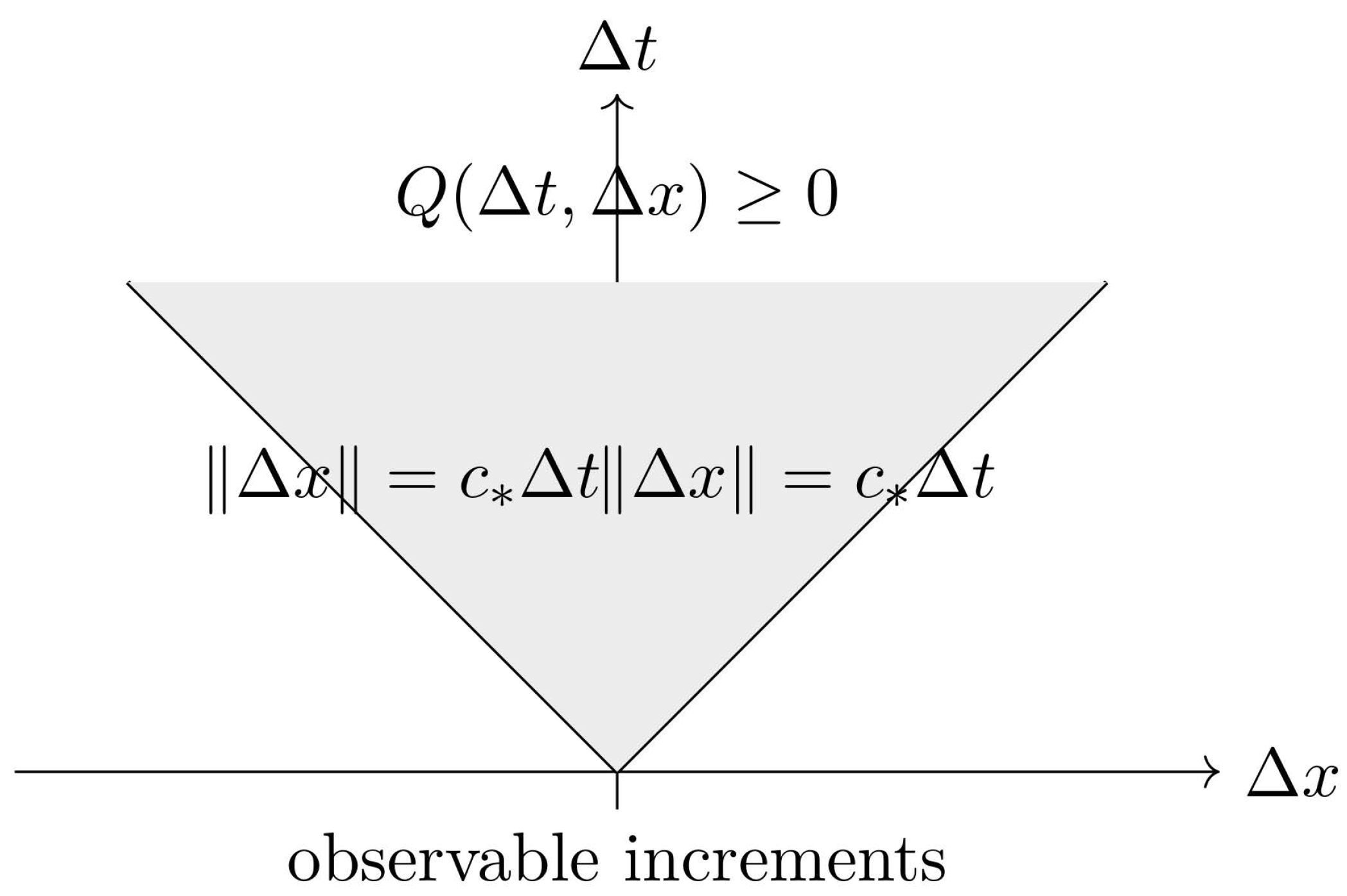
(Observable causal inequality). Under the propagation bound, vacuum calibration, and delay compatibility assumptions, every complete history satisfies
Consequently, if a projected event is assigned observable increment with and , then
Hence the observable increments lie in the future cone of the split quadratic form
Proof.
By global propagation,
Delay compatibility gives
Combining them yields
Rearranging gives . □
Remark 6
(The causal inequality as the seed of Lorentzian structure). Theorem 11 does not yet produce full Minkowski space or exact Lorentz symmetry. What it does produce is the first split-quadratic datum from which a Lorentzian geometry can grow: a nontrivial inequality , its null quadric , and the associated future cone. In this precise sense the causal inequality is the seed of a Lorentzian structure. A natural next step is to determine additional admissibility or calibration hypotheses under which this seed sharpens into exact observable Minkowskian kinematics.
This theorem is intentionally minimal, but it already captures the causal logic of the framework: completion delay plus bounded propagation defines an observable cone before any background Minkowski metric is assumed.
Figure 3.
Observable causal cone obtained from bounded propagation and completion delay. The inequality defines the future cone of the split quadratic form .
Figure 3.
Observable causal cone obtained from bounded propagation and completion delay. The inequality defines the future cone of the split quadratic form .
11.3. Further relativistic sharpening
The cone theorem is intentionally minimal. A natural strengthening would identify conditions under which the completed observable branch carries the full invariant structure of special relativity, including an exact Minkowski interval, Lorentz transformations, and inertial worldlines. The present paper does not assume or prove that sharpening. Its role in the current framework is therefore methodological: the split-complex carrier and the causal inequality specify the algebraic and geometric seed from which such a relativistic branch would have to grow.
12. Stabilized Event Statistics and Reconstruction Strategy
Section 5, Section 6, Section 7, Section 8, Section 9, Section 10 and Section 11 identify the theorem-bearing dual-time core and prove the separation principle between compact phase and split causal readout. Those sections deliberately stopped short of reconstructing full spacetime geometry. The present section and the next three close that gap by adding an explicit stabilization stage and a factorized geometry map.
12.1. Why the Dual-Time Core Still Needs a Geometry Stage
The constructions of Section 5, Section 6, Section 7, Section 8, Section 9, Section 10 and Section 11 yield algebraic, operator, and causal seed structures. What they do not yet supply is a mechanism by which these structures stabilize into persistent observable records. The present section introduces that additional layer.
The observable cone theorem of Section 11 yields the first split-quadratic datum from which Lorentzian geometry can grow, but it does not yet produce a metric, curvature observables, or a continuum manifold. To obtain those one needs a level of structure that remembers not just whether observable increments satisfy a cone inequality, but how candidate events co-occur, which labels persist, how frequently one event precedes another, what interval volumes are seen after stabilization, and how causal futures and pasts overlap on reconstructed slices. These are not phase-sector observables. They are observer-level statistics of completed and stabilized events.
12.2. Candidate Event Structures and Stabilized Measures
Definition 10
(Candidate event structure). A candidate event structure in context Γ is a tuple
where is a finite or countable set of event-nodes, is a label assignment, is a candidate partial order, and stores record data relevant to admissibility and stabilization.
Definition 11
(Stabilization interface). A stabilization interface for a dual-time realization in context Γ consists of:
- (i)
- a measurable space of candidate event structures;
- (ii)
-
a measurable mapfrom completed observable histories to candidate event structures;
- (iii)
-
a family of empirical or repeated-cycle laws on such that the pushforwardsconverge weakly to a stabilized probability measureon a stabilized sector .
This definition is intentionally abstract. In repeated-interaction models the stabilized measure may live on ordered record strings; in redundancy-bearing environment models it may live on fragment record patterns. The present manuscript assumes only that such a stabilization stage exists.
12.3. Persistent Labels and the Factorized Reconstruction Map
Let denote the union of all labels that occur with nonzero stabilized probability,
Fix a persistence threshold and define the persistent-label sector
Definition 12
(Factorized geometry map). The stabilized geometry map is defined in stages by
with the following roles.
- (1)
- extracts persistent labels and local statistics from .
- (2)
- reconstructs a weighted causal kernel and, when justified, a sharp effective order.
- (3)
- calibrates scale from interval statistics, density, and chain data.
- (4)
- tests whether a continuum lift is warranted.
- (5)
- returns either a weighted discrete causal geometry or a continuum Lorentzian geometry.
The factorization is methodological rather than decorative. It isolates which parts of the reconstruction are always available and which require additional manifoldlike structure.
12.4. Why Coarse Outcomes are Too Weak
The input to is intentionally stronger than a push-forward to a coarse outcome space. A coarse map may retain only the final label of a record while discarding multiplicity, internal ordering, interval structure, and overlap data. The reconstruction below depends precisely on those discarded data. This is the sense in which emergent geometry here is tied to stabilized event structure rather than to coarse outcomes alone.
13. Local Reconstruction Data and Lorentzian Recovery
13.1. Co-Occurrence, Precedence, and Interval Kernels
For , define the co-occurrence frequency
Whenever , define the conditional precedence and link kernels
where the interval between two labelled events in a candidate structure is
The corresponding conditional interval cardinality is
whenever the conditioning event has positive probability.
For continuity estimates it is useful to introduce the affine, unconditioned versions
These kernels are already geometric in embryo: they measure how often labels coexist, how often one precedes another, how often they are linked, and how large their intervening intervals are.
13.2. Local Continuity
Let be finite, and let denote the cylinder -algebra generated by restricting candidate structures to labels in S. For stabilized measures and , define the local total-variation seminorm
Proposition 14
(Local Lipschitz bounds for stabilized reconstruction data).
-
For ,and likewise for .
-
If on the support of both measures, thenfor any S containing all labels that can occur in intervals between α and β.
-
If , thenand likewise for .
Proof.
The events and are cylinder events, giving part (i). Part (ii) follows by expanding the bounded expectation over interval-cardinality events and using the maximal interval size on support. Part (iii) follows from the quotient identity
and the elementary bound for . □
The importance of this proposition is structural: the raw data entering geometry reconstruction are already local and continuous at the level of stabilized measures. Any later discontinuity comes only from thresholding or branch decisions.
13.3. Weighted Causal Kernel and Sharp-Order Regime
The generic output of stabilized statistics is not a deterministic order but a weighted causal kernel,
Because each candidate structure carries a partial order, one always has
The remaining weight
represents stabilized incomparability.
Definition 13
(-sharp stabilized sector). A stabilized measure is-sharp around a reference poset if and, for all distinct ,
- (i)
- if , then
- (ii)
- if α and β are incomparable in , then
Theorem 12
(Threshold recovery of sharp order). Suppose is ε-sharp around a reference poset with . Define the threshold relation
Then coincides with and is therefore a partial order.
Proof.
If , then , so . If and are incomparable in , both directional probabilities are at most , so neither threshold inequality holds. Thus the threshold relation agrees pairwise with . □
13.4. Scale Reconstruction and Manifoldlikeness Diagnostics
To reconstruct scale one also needs a volume element. The minimal choice is the counting measure on persistent labels, calibrated by a density parameter :
For comparable labels , the empirical interval volume is
where absorbs endpoint conventions.
For a finite reconstructed interval
with , let denote the number of related pairs in the interval. The ordering fraction is
In manifoldlike causal sets approximating flat Lorentzian intervals, the expectation of is a monotone function of the continuum dimension [30,31,32,37]. Whenever lies in the range of that family, define the local dimension estimate
A context-level estimate is then obtained by averaging or taking the median over a mesoscale family of intervals.
Let denote the volume of a unit Alexandrov interval in d-dimensional Minkowski spacetime. In a manifoldlike regime one expects
for scales large compared with discreteness and small compared with curvature radii. This motivates the volume-based estimator
For comparable labels define the longest-chain observable
In manifoldlike causal sets one expects
with dimension-dependent constant [33,37]. This motivates the chain-based estimator
Proposition 15
(Consistency of proper-time estimators). Suppose that for a family of reconstructed comparable pairs one has
with and . Then
Proof.
Both statements are immediate from the definitions and continuity of the functions and division by the asymptotically correct calibration constants. □
The mismatch
is itself a manifoldlikeness diagnostic: small mismatch supports continuum behaviour, while large mismatch indicates that the discrete branch should be retained.
13.5. Spatial Geometry on Reconstructed Antichains
Assume for the moment that a sharp effective order has been reconstructed. Let be the set of minimal elements or, more generally, a context-selected initial antichain. Define the layer function
where is the length of the longest chain from m to and is taken to be zero if no such chain exists. The canonical layer antichains are then
Choose a truncation depth and define
For , define the causal-overlap dissimilarity
where ▵ denotes symmetric difference. Let be strictly increasing with , and define provisional edge lengths
Retaining nearest neighbours per node and symmetrizing defines a graph . The corresponding path metric is
13.6. Manifoldlike Concentration and Continuum Lorentzian Recovery
Definition 14
(-manifoldlike concentration). A stabilized measure is-manifoldlike with respect to a globally hyperbolic spacetime if there exist measurable embeddings
and a density such that for all mesoscale pairs above the cutoff :
- (i)
- the candidate order agrees with the spacetime causal order with probability at least ;
- (ii)
- the reconstructed interval volume satisfies
- (iii)
- the local dimension estimate obeys
This definition is operational rather than metaphysical. It does not require exact faithful embedding at arbitrarily small scales; it requires only that stabilized intervals above a cutoff behave like those of a globally hyperbolic spacetime to controlled accuracy.
Theorem 13
(Lorentzian recovery from reconstructed order and volume). Let be -manifoldlike with respect to a globally hyperbolic, past-and-future distinguishing spacetime . Suppose in addition that the ambiguity diagnostic remains below on the mesoscale window, so that a sharp effective order is reconstructed. Then:
- (1)
- the reconstructed order determines the conformal class of the continuum metric on scales above , up to diffeomorphism and errors;
- (2)
- the reconstructed counting measure , equivalently the interval-volume functional , fixes the conformal factor on those scales;
- (3)
- therefore there exists a coarse-grained Lorentzian metric on M, unique up to diffeomorphism and coarse-graining ambiguities of order , such that is statistically close to .
Proof.
Because the stabilized sector is manifoldlike, the reconstructed order agrees with the continuum causal order on mesoscale pairs up to error. The Hawking–King–McCarthy and Malament theorems then imply that the causal order determines the conformal spacetime geometry of a past-and-future distinguishing spacetime [27,28]. The interval-volume functional fixes the missing conformal factor because a Lorentzian metric in a fixed conformal class is determined by its volume measure. Finite density and residual stabilization noise introduce controlled errors of order and . □
Proposition 16
(Curvature access in the manifoldlike branch). Suppose the hypotheses of Theorem 13 hold, and let denote the Benincasa–Dowker operator built from the reconstructed causal set at dimension . Then for slowly varying scalar fields φ,
In particular,
serves as an effective scalar-curvature observable up to the usual coarse-graining errors.
14. Integrated Dual-Time-to-Geometry Synthesis
14.1. The Integrated Context
The first half of the paper provides admissible histories, completion and observation, compact phase sectors, and a minimal causal seed. Section 12 and Section 13 provide stabilized event measures and Lorentzian reconstruction from reconstructed order and volume. The present section composes them into one statement.
Definition 15
(Integrated emergent-geometry context). A dual-time realization in context Γ is an integrated emergent-geometry context if:
- (i)
- the local real Hilbert realization carries a strongly continuous compact inner-time action of S1;
- (ii)
- admissible and complete histories satisfy completion compatibility in the sense of Theorem 7;
- (iii)
- a stabilization interface exists and yields a stabilized measure on candidate event structures;
- (iv)
- the stabilized sector is ε-sharp and -manifoldlike, with .
Theorem 14
(Integrated dual-time emergence theorem). Let Γ be an integrated emergent-geometry context. Then:
- (1)
- every nontrivial irreducible compact frequency sector carries a canonical orthogonal complex structure, unique up to conjugation;
- (2)
- complete histories descend to an observable semigroup, and observer-level irreversibility occurs whenever quotient merging identifies distinct generative histories;
- (3)
- the stabilized measure determines a weighted discrete causal geometry;
- (4)
- thresholding reconstructs a sharp effective order ;
- (5)
- on scales above , reconstructed order together with reconstructed volume determines a coarse-grained Lorentzian metric up to diffeomorphism and ambiguities;
- (6)
- because no invariant split quadratic form exists on any nontrivial compact phase sector, the Lorentzian metric cannot arise there as invariant compact phase geometry. It appears only after completion, projection, stabilization, and geometric reconstruction.
Proof.
Item (1) is Theorems 9 and 10. Item (2) is Theorem 7 together with the quotient-merging mechanism of Proposition 7. Item (3) follows from the factorized reconstruction map and the local kernels extracted from . Item (4) is Theorem 12. Item (5) is Theorem 13. Item (6) is Proposition 10: on a nontrivial compact phase sector every invariant symmetric bilinear form is Euclidean up to scale, so a split Lorentzian form cannot live there as invariant compact geometry. □
Corollary 2
(Phase and spacetime are outputs at different levels). In an integrated emergent-geometry context, complex Hilbert structure and Lorentzian spacetime are not two primitive choices inserted by hand. The former is forced by compact inner-time symmetry on generative sectors; the latter is reconstructed from stabilized event statistics after completion and observation.
Proposition 17
(Coarse outcomes do not fix geometry). Let be a measurable coarse-graining and let satisfy . Suppose, however, that on some persistent-label subset S at least one local precedence, link, interval, or overlap kernel differs between μ and ν. Then there exists a bounded local geometric observable of the reconstruction data such that
Proof.
Choose to read out the differing local kernel directly, or a derived local observable such as a link weight or slice edge length built from it. Since is constructed from these kernels before coarse-graining to , the observable distinguishes the two reconstructions. □
This proposition is physically important. It shows that the geometry reconstructed here is sensitive to stabilized event structure that is invisible to coarse outcome statistics. The reconstruction procedure may be visualized directly on the configuration shown in Figure 3.
15. Exact Benchmark: Discrete Causal Strip
Consider the persistent-label set
with effective order
This is the causal order of an infinite discrete light-cone strip. Assume the stabilized measure is sharply concentrated on this order so that thresholding recovers it exactly. The minimal elements are those at layer , and the layer function is simply . Hence the canonical antichains are
Fix a slice and a truncation depth . For and with , the truncated futures satisfy
At each future layer , the two spatial intervals have equal size and relative shift r, so their symmetric difference has cardinality . Summing over gives
The same computation holds for the truncated pasts, so with unit counting measure,
Choose
where is a lattice spacing. Then
Restricting to nearest-neighbour edges therefore yields
The discrete configuration used in this benchmark is depicted in Figure 3.
Proposition 18
(Exact slice reconstruction on the strip). For the discrete causal strip above, the overlap-based reconstruction yields the exact Euclidean slice metric on every canonical antichain.
Proof.
The symmetric-difference computation is exact, and the induced path metric on the nearest-neighbour graph reproduces the lattice distance exactly. □
Assign temporal spacing and map . Then the order relation becomes
Choosing the relativistic calibration makes the causal-cone speed unity. In the joint limit with macroscopic coordinates fixed, the reconstructed geometry converges to
The benchmark is intentionally elementary, but it demonstrates two key points: the reconstruction can be exact in a discrete setting, and its continuum interpretation does not require an additional ad hoc embedding rule.
16. Research Branches Opened by the Core Results
The following directions are not established results of the present paper. They are mathematically meaningful extensions suggested by the proven core, and are listed to indicate scope without implying completion.
The preceding sections define the theorem-bearing core and prove its strongest internal stand-alone results. The purpose of the present section is not to turn unproved directions into conclusions by rhetoric. It is to state, as precisely as possible, the mathematical continuation problems that the core results make intelligible.
16.1. Non-Equilibrium Dynamics and Temporal Asymmetry
A first continuation problem concerns irreversible dynamics, memory kernels, non-Markovianity, and temporal asymmetry. The mathematical question is whether a dual-time organization can produce effective irreversible equations by eliminating hidden generative variables while retaining a controlled relation to the underlying exact dynamics. A related geometric route, developed from a complementary topological perspective, appears in [3]. The present paper contributes the algebraic and categorical side of that story: completion and projection already provide the minimal mechanism by which exact composition can descend to irreversible observer-level evolution.
16.2. Quantum Probability and the Born Rule
A second continuation problem concerns record-based probability. The compact-inner-time theorem proved above yields canonical complex structure on nontrivial phase sectors, but it does not by itself derive the Born rule. A plausible next step would distinguish possibility-side evolution from stabilized record formation, reconstruct an effect-space description for those records, and then apply Gleason- or Busch-type theorems once that effect space admits Hilbert realization [21,22]. In that branch the Born rule would not be postulated at the level of records; it would appear as the unique probability representation compatible with the recovered effect structure.
16.3. Projection-Induced Memory, Dissipation, and Entropy
A third continuation problem studies how hidden-sector elimination can generate memory, dissipation, and entropy production. In this perspective, removing inaccessible dual-time variables yields reduced equations with memory kernels; under suitable scaling regimes the reduced dynamics may become local but no longer reversible. The conceptual point for the present paper is straightforward: the same framework that explains why completion and projection can produce semigroup dynamics also supplies a natural mechanism by which observable dynamics can lose recoverability.
16.4. Lorentzian Geometry and Einstein Universality
The geometric branch of the programme aims to go beyond cone data. One natural problem is to specify a universality class of microscopic dual-time realization models — with locally finite configurations, bounded microscopic updates, appropriate cylinder-history measures, and mixing hypotheses — and then ask whether the coarse-grained quotient produces Lorentzian conformal causal structure, infrared Lorentz covariance, and, under additional locality and effective-field-theory hypotheses, Einstein-Hilbert dynamics as the leading infrared term. These developments are not proved here. They are included because the core formalism now makes such a derivation programme mathematically formulable rather than merely rhetorical.
16.5. Noncommutative Geometry and Dimensional Stability
A distinct but complementary branch places SMM/DTT inside noncommutative geometry. In that direction, spectral triples over a dual-time space could encode the algebra of re-creation, internal symmetries, and dimensional stability [23]. The open problem is to determine whether inner-time cycles and their ordering generate operator algebras whose spectral properties control effective spatial dimensionality and observable structure in a theorem-bearing way.
16.6. Gauge Structures, Monopole Interpretation, and Polarization
Another branch interprets the Monad as a minimal hidden source with possible connections to gauge structures, polarization topology, and charge quantization [24,25,26]. The point of including this branch in the present article is not to present it as a closed theorem. It is to indicate a concrete mathematical question: can the source language of the framework be translated into bundle-theoretic or phase-geometric data in a way that is both rigorous and empirically nontrivial?
16.7. The Projected Yang–Mills Programme
The most technically ambitious continuation problem is an operator-based gauge programme. Its guiding idea is that admissible histories should be realized as operators, that compact auxiliary directions should organize mixed operators and holonomy data, and that low-energy effective sectors should be isolated by coercive or band-structure arguments until only a finite-rank obstruction remains. The significance of this branch here is modest but real: the core machinery of histories, completion, operator realization, and internal compact directions is already strong enough to support a serious constructive programme rather than only a conceptual sketch.
16.8. Quadratic Stabilization and Dynamically Selected Geometry
The reconstruction framework developed in Section 12, Section 13, Section 14 and Section 15 takes as input a stabilized probability measure on candidate event structures and produces effective causal and metric observables. This raises a natural structural question: to what extent is the stabilized measure itself constrained by the dual-time framework?
The present subsection formulates a theorem-level target for the programme. The result identifies a set of conditions under which stabilized event weights are forced to be quadratic in the underlying Hilbert amplitudes, thereby linking compact inner-time symmetry, completion/projection, and emergent geometry.
Definition 16
(Durable event sectors). Let be the real Hilbert space obtained from the Hilbert-fiber realization of a dual-time context Γ. A family of durable event sectors is a countable collection of closed, mutually orthogonal subspaces
with associated orthogonal projectors
These sectors represent mutually exclusive stabilized observable outcomes after completion and projection.
Definition 17
(Stabilized event weight functional). Let denote the stabilized measure obtained from repeated completion dynamics starting from a normalized state . For each durable event sector , define the weight functional
Theorem 15
(Quadratic stabilization and dynamically selected geometry). Let Γ be a dual-time context equipped with:
- a real Hilbert space carrying a strongly continuous compact inner-time action of , inducing canonical complex structures on nontrivial irreducible sectors;
- admissible-history dynamics with completion and observation maps as in Section 7;
- a stabilization interface producing empirical measures on candidate event structures;
- a family of durable event sectors with projectors .
Assume the following conditions hold:
- (H1)
- (Stability convergence) For every normalized ,
- (H2)
- (Orthogonal additivity) If have support in mutually orthogonal durable sectors, then
- (H3)
-
(Compact-phase invariance) For every ,on each nontrivial irreducible compact phase sector.
- (H4)
- (Completion consistency) The functional depends only on the completed observable content and not on hidden pre-completion chronology.
Then there exist nonnegative constants such that
for all normalized .
If the sectors are exhaustive and normalized so that
then
In the unbiased calibrated case one has , hence
Finally, if satisfies the sharp-order and manifoldlike conditions of Section 13 and Section 14, then the reconstructed geometry
is determined by this quadratic stabilization law.
Remark 7
(Structural role of compact symmetry). The proof strategy relies critically on the rigidity result of Section 9: on any nontrivial irreducible compact phase sector, every invariant symmetric bilinear form is a scalar multiple of the Euclidean one. This eliminates all non-quadratic and non-Euclidean candidates for , forcing the quadratic form.
Remark 8
(Relation to irreversibility). Completion and projection identify distinct generative histories that lead to the same durable event sector. The stabilization weights therefore arise from equivalence classes under observable completion, linking the quadratic law to the same quotient structure that produces irreversibility.
Corollary 3
(Quadratically selected Lorentzian branch). Under the hypotheses of the theorem and the manifoldlike conditions of the Lorentzian reconstruction stage, the effective spacetime geometry
is selected by the quadratic stabilization law
Hence spacetime geometry is determined not by coarse outcomes alone, but by stabilized event sectors whose weights are fixed by the underlying Hilbert structure.
Remark 9
(Status). Theorem 15 is a theorem-level target for the programme. The present manuscript identifies the precise hypotheses under which it would follow. A complete proof requires an explicit stabilization model satisfying (H1)–(H4), which is left for future work.
17. Established Results, Suggested Directions, and Open Problems
A broad foundational paper is useful only if it is honest about logical status. The following summary is therefore not rhetorical; it is part of the framework itself.
17.1. Established Directly Here
The following results are proved directly in the present manuscript:
- (i)
- the normal-form classification of two-dimensional real quadratic carriers (Theorem 5);
- (ii)
- multiplicativity of the associated quadratic norm and the comparison of circular, nilpotent, and hyperbolic branches;
- (iii)
- the unified Euler laws for these carriers (Theorem 6);
- (iv)
- the algebra laws for admissible-history monads;
- (v)
- observable semigroup descent under completion compatibility;
- (vi)
- observer-level irreversibility by quotient merging;
- (vii)
- local operator realization of admissible histories;
- (viii)
- the Fourier-sector decomposition of compact inner time and the canonical complex-structure theorem, including uniqueness up to conjugation;
- (ix)
- invariant-form rigidity on nontrivial compact irreducible phase sectors, and hence phase/readout separation at the level of invariant quadratic data;
- (x)
- the observable causal inequality from local propagation plus completion delay;
- (xi)
- the definition of a stabilization interface from completed histories to candidate event structures;
- (xii)
- local Lipschitz continuity of the reconstruction data extracted from stabilized measures (Proposition 14);
- (xiii)
- threshold recovery of sharp effective order from stabilized precedence data (Theorem 12);
- (xiv)
- consistency of volume-based and chain-based proper-time estimators (Proposition 15);
- (xv)
- continuum Lorentzian recovery from reconstructed order and reconstructed volume in a manifoldlike regime (Theorem 13);
- (xvi)
- access to effective scalar curvature in the manifoldlike branch through standard causal-set operators (Proposition 16);
- (xvii)
- the integrated dual-time emergence theorem linking compact phase sectors, observable semigroup descent, stabilization, and Lorentzian reconstruction (Theorem 14);
- (xviii)
- the exact discrete light-cone-strip benchmark and its -dimensional Minkowski limit (Proposition 18).
These results are sufficient to establish that SMM/DTT has a nontrivial theorem-bearing mathematical core, that the core supports a concrete geometry stage rather than only a cone seed, and that the resulting integrated framework yields at least one genuine separation principle beyond a mere repackaging of familiar facts.
17.2. Further Directions Suggested by the Framework
The following developments are not established in the present manuscript, but they arise naturally as continuations of the framework:
- (i)
- exact relativistic sharpening of the observable branch;
- (ii)
- coarse-grained Lorentzian geometry and Einstein infrared universality;
- (iii)
- a record-based route to Born-form probability;
- (iv)
- projection-induced memory, dissipation, and entropy;
- (v)
- a noncommutative spectral-triple route to dimensional stability;
- (vi)
- an operator-based gauge or Yang–Mills programme.
None of these directions is used as a premise in the theorem chain above. They are included only to indicate the range of mathematically meaningful questions that the present core formalism opens.
17.3. Still Open
Several important questions remain genuinely open.
- (i)
- Can the admissibility and observable-readout conditions yielding exact relativistic kinematics be derived from a microscopic dual-time dynamics rather than introduced operationally?
- (ii)
- Can the spectral-triple branch be sharpened so that dimensional stability is controlled rather than merely suggestive?
- (iii)
- Can a record-stabilization branch derive Hilbert realizability of reconstructed effect spaces under physically natural hypotheses broad enough to make the Born route internal?
- (iv)
- Can the operator-based gauge programme close its remaining low-energy obstruction and complete a Yang–Mills transfer?
- (v)
- Can the gauge or polarization interpretation of the Monad be expressed in a way that is both mathematically rigorous and empirically nontrivial?
Listing these questions explicitly does not weaken the framework. It prevents broad scope from being confused with theorem-bearing overreach.
18. A Research Map
At the theorem-bearing level, the SMM/DTT programme can be summarized schematically as follows:
The importance of this map is methodological. It fixes the direction of explanation. Instead of taking spacetime, complex Hilbert structure, and irreversible dynamics as unrelated primitives, it asks whether they can be understood as different shadows of one organization of generation, completion, and readout. The crucial new point is that the first two visible branches — compact phase and split readout — are not merely juxtaposed; Proposition 10 shows why they cannot be represented by the same invariant quadratic geometry on a nontrivial compact irreducible sector.
19. What the Paper Actually Contributes
The contribution of this paper is not the introduction of new algebraic structures in isolation, but the establishment of a fixed explanatory chain linking them. Its principal contribution lies in showing that a small number of familiar mathematical constructions constrain one another once they are organized by a dual-time architecture. Several ingredients are classical. What matters here is the package they form and the rigidity statements that package implies.
19.1. The Contribution is Structural, But Not Only Structural
The paper does not claim that the individual carrier classification, Euler formulas, Fourier decomposition, or semigroup theorems are new in isolation. Those facts belong to standard algebra, harmonic analysis, operator theory, and real algebraic geometry. The stronger claim is that there exists a minimal explanatory chain in which those facts cease to be independent modeling choices.
Two concrete consequences matter. First, compact symmetry forces sectorwise complex structure. Second, compact irreducible phase sectors admit only definite invariant quadratic forms. The second point is what prevents the paper from being only a reinterpretation: it yields a genuine separation principle between phase and causal readout.
19.2. The Carrier Classification Fixes the Minimal Algebraic Menu
Theorem 5 shows that every two-dimensional real commutative unital quadratic algebra generated by one non-scalar element is isomorphic to exactly one of the three normal forms
While these algebras are individually classical, their interpretation as minimal dual-time carriers fixes the algebraic menu of the framework: circular, nilpotent, and hyperbolic, with only the first and third nondegenerate for the purposes of phase and causal readout.
19.3. The Algebraic-Geometric Interface is Explicit
Proposition 2 shows that the quadratic carriers admit a natural interpretation as affine schemes of degree two over , with norm-one loci given by affine conics. The circular and hyperbolic branches correspond, respectively, to anisotropic and split real one-dimensional tori.
This matters because phase structure and causal readout are already visible at the level of quadratic forms, conics, and real tori. The paper’s algebraic-geometric language is therefore not ornamental packaging added after the main argument; it is part of the carrier-level substance.
19.4. Euler Laws Unify Three Regimes
Theorem 6 expresses the exponential map for all quadratic carriers in a single formula
which simultaneously yields the ordinary Euler identity, the nilpotent tangent law, and the hyperbolic Euler law.
The formulas themselves are classical. What is nonstandard here is their use as one organizing law across the three carrier classes. Oscillatory, tangent, and hyperbolic behaviours are presented not as unrelated tricks but as the three sign-regimes of one quadratic mechanism.
19.5. Compact Symmetry Forces Complex structure
Theorem 9 shows that a strongly continuous translation action of on a real Hilbert space induces, on each nontrivial irreducible sector, a canonical orthogonal complex structure, unique up to conjugation by Theorem 10.
This reverses the usual explanatory order in quantum theory. Instead of assuming complex scalars at the outset, complex structure is derived from compact symmetry. The result is representation-theoretic and fully controlled: the Euler phase law appears as the exponential form of a real rotation generator.
19.6. Compact Phase Sectors Admit no Invariant Split Form
Proposition 10 supplies the paper’s sharpest new consequence. On a nontrivial irreducible compact phase sector, every invariant symmetric bilinear form is a scalar multiple of the Euclidean one. Consequently no invariant split form exists there.
This yields Corollary 1: the hyperbolic geometry needed for causal readout cannot be realized as an invariant compact phase geometry on the same sector. The circular and hyperbolic branches are therefore not merely two stylistic descriptions of the same representation. They are mathematically separated by different invariance requirements.
19.7. Completion and Observation are Realized Categorically
Section 7.1 and Section 8.1 provide a minimal categorical framework in which admissible histories form a monad, completion is encoded by an idempotent monad, and observation is realized as a functorial quotient.
Under a precise compatibility condition, complete histories descend to a semigroup action on observable states (Theorem 7). Irreversibility then arises from quotient merging rather than from a breakdown of underlying composition. This gives a mathematically explicit translation of re-creation, completion, and projection into category theory and operator theory.
19.8. Cone Data Arise Without a Background Metric
Theorem 11 shows that bounded local propagation together with a completion-delay law yields an observable cone inequality defined by a split quadratic form.
This does not reconstruct full relativity. It does show that nontrivial causal cone data can arise before a background metric is assumed. The theorem therefore supplies a metric-free seed from which a sharper Lorentzian branch would have to grow.
19.9. Stabilized Event Statistics Complete the Geometry Stage
The original dual-time core ended with a split-quadratic causal seed. The present version adds the missing observer-level bridge: a stabilization interface from completed histories to candidate event structures and a factorized map from stabilized event statistics to effective geometry. This is the point at which the framework stops saying only that Lorentzian structure could grow and starts showing how weighted causal kernels, interval volumes, overlap metrics, and continuum Lorentzian data are reconstructed.
The significance of this addition is twofold. First, it makes precise which information must survive projection for geometry to emerge: persistent labels, precedence frequencies, interval statistics, and causal overlaps, not merely coarse outcome probabilities. Second, it clarifies why the geometry belongs to the observer-level branch rather than to compact phase sectors. The reconstruction is built from stabilized event structure after completion, not from invariant phase geometry before completion.
19.10. Order Plus Volume Sharpen the Causal Seed
Theorem 13 strengthens the status of the causal branch. Theorem 11 supplies the first split-quadratic cone datum from bounded propagation and completion delay. The Lorentzian recovery theorem then shows that, once stabilization yields a manifoldlike regime, reconstructed causal order together with reconstructed volume determine a coarse-grained Lorentzian metric up to diffeomorphism and coarse graining. The two theorems therefore play different but complementary roles: one isolates the causal seed, the other describes the conditions under which that seed sharpens into explicit spacetime geometry.
19.11. Mathematical Implications of the Framework
The preceding results suggest several structural consequences.
- (i)
- Derived rather than assumed formalism.
Complex Hilbert structure can be treated as a theorem of compact symmetry rather than as a primitive axiom.
- (ii)
- Separated invariant geometries.
Compact phase and hyperbolic readout obey different invariant-form requirements. The framework therefore predicts a split between phase geometry and causal readout rather than collapsing them into one carrier.
- (iii)
- Algebraic origin of geometry.
Circles, hyperbolas, and cone data arise naturally as norm loci of quadratic algebras before manifolds or metric tensors are introduced.
- (iv)
- Quotient-based irreversibility.
Observer-level irreversibility can be explained by descent through completion and projection rather than by assuming broken microscopic composition.
- (v)
- Layered mathematical structure.
Different mathematical objects naturally attach to different levels of description — generative, completed, and observed — and are related by explicit functorial or quotient maps.
Taken together, these points indicate that the framework does not alter the content of pure mathematics, but proposes a reorganization in which algebraic, geometric, and analytic structures are no longer independent choices. They become interrelated components of a common structural scheme linking symmetry, composition, and observable geometry.
20. Conclusions
The paper makes one precise proposal: treat dual time not as an extra coordinate, but as a two-level organization of generation and completion, and then add a stabilization stage between completion and geometry. Once that proposal is translated into mathematics, a coherent theorem chain emerges. Admissible histories compose exactly at the generative level; completion and projection produce observable semigroup dynamics; compact recurrence produces canonical complex structure; and stabilized event statistics produce weighted causal kernels, reconstructed order, reconstructed volume, and, in a manifoldlike regime, Lorentzian geometry.
The sharpest inherited consequence is not the existence of Fourier modes or the classification of quadratic carriers, both of which are classical. It is the combination of two facts: compact symmetry forces complex structure on nontrivial irreducible sectors, and the same compact sectors admit only definite invariant quadratic forms. That is why the framework uses two nondegenerate carrier branches rather than one. The circular branch governs recurrence and phase. The hyperbolic branch governs causal readout. The present paper adds the next step: stabilized event statistics convert that causal readout branch into a reconstructive geometry stage.
The strongest new conclusion is therefore a separation-and-reconstruction statement. Complex Hilbert phase structure and Lorentzian spacetime can arise in one framework, but they arise at different levels. The former is attached to compact inner-time sectors. The latter is attached to completed, stabilized, observer-level event structure. The invariant-form rigidity of compact phase sectors explains why the Lorentzian metric cannot be realized there as invariant compact phase geometry; the Lorentzian recovery theorem explains how it appears instead from reconstructed order and reconstructed volume.
The paper also keeps its boundaries clear. It does not derive the Born rule, full gravitational dynamics, universal threshold laws, or the stabilization stage from a single microscopic law. What it does provide is a controlled foundation on which those questions can now be posed without conflating proved results with programmatic ambition. In that sense the value of the paper is methodological as well as mathematical: it turns a broad foundational programme into something that can now be argued about theorem by theorem, stage by stage, and reconstruction by reconstruction.
For a sceptical reader, that is the appropriate standard. The manuscript does not ask for assent to a total cosmology. It asks whether the direction of explanation — from generative composition to completion, from compact recurrence to phase, from stabilization to persistent event structure, and from reconstructed order plus volume to Lorentzian geometry — is mathematically coherent, logically disciplined, and fertile enough to justify further work. The answer defended here is yes.
Appendix A Notation and Terminology
For ease of reference, we summarize the main symbols used in the paper.
| Symbol | Meaning |
| Free monoid of histories generated by elementary recurrence acts. | |
| Distinguished submonoid of admissible histories. | |
| Admissible-history writer monad . | |
| C | Submonoid of complete histories. |
| Idempotent completion monad. | |
| P | Observation functor. |
| Completion–observation map to observable states. | |
| S1 | Compact internal symmetry used in the phase branch. |
| J | Orthogonal operator with inducing complex structure on a real sector. |
| Split-complex algebra . | |
| Euclidean and split quadratic norms on the circular and hyperbolic branches. | |
| Completion-delay law. | |
| Calibrated observable speed from vacuum cycle data. |
Appendix B A Short Proof of the Carrier Classification in Coordinate Form
For readers who prefer a coordinate-based proof of Theorem 5, here is the normal-form reduction written explicitly. Let and write
If , then
Thus the discriminant controls the algebra completely up to scaling. The cases , , and correspond respectively to the complex, dual, and split-complex algebras. No fourth case exists. In particular, any other two-dimensional real commutative unital quadratic carrier is just a disguised version of one of these three.
Appendix C Circular and Hyperbolic Geometries from the Unified Euler Law
The unified Euler law yields two different unit-orbit geometries.
For the circular branch,
The orbit is periodic and compact. For the hyperbolic branch,
The orbit is noncompact and hyperbolic. These are not rival geometries imposed from outside; they are the two nondegenerate signatures available to quadratic carriers of dual-time organization.
Appendix D Why the Nilpotent Case Is a Boundary Rather than a Full Branch
The dual-number case is mathematically legitimate and often useful in tangent or jet-theoretic constructions. Its role in the present framework is different. Because
the associated quadratic form is degenerate. There is therefore no nondegenerate circle/hyperbola distinction and no full causal or phase geometry. For this reason the nilpotent case is best regarded as a boundary or infinitesimal limit between the circular and hyperbolic branches rather than as the main effective carrier of a complete branch of the theory.
References
- M. Haj Yousef, The Single Monad Model of the Cosmos: Ibn Arabi’s Concept of Time and Creation (CreateSpace, Charleston, 2014).
- M. Haj Yousef, Duality of Time: Complex-Time Geometry and Perpetual Creation of Space (CreateSpace, Charleston, 2017).
- M. Haj Yousef, “Dual-Time Topological Geometry and the Emergence of Temporal Asymmetry in Non-Equilibrium Dynamics,” Mathematics 14, no. 5, 853 (2026). [CrossRef]
- M. Reed and B. Simon, Methods of Modern Mathematical Physics I: Functional Analysis, Academic Press, 1980.
- B. C. Hall, Quantum Theory for Mathematicians, Springer, 2013.
- F. Catoni, R. Cannata, E. Nichelatti, and P. Zampetti, The Mathematics of Minkowski Space-Time, Birkhäuser, 2008.
- I. M. Yaglom, A Simple Non-Euclidean Geometry and Its Physical Basis, Springer, 1979.
- B. O’Neill, Semi-Riemannian Geometry with Applications to Relativity, Academic Press, 1983.
- A. Borel, Linear Algebraic Groups, 2nd ed., Springer, 1991.
- T. A. Springer, Linear Algebraic Groups, 2nd ed., Birkhäuser, 1998.
- I. Bars, “Two-Time Physics,” Physical Review D, vol. 62, 046007, 2000.
- S. Abramsky and B. Coecke, “Categorical Quantum Mechanics,” in Handbook of Quantum Logic and Quantum Structures, Elsevier, 2009.
- C. Heunen and J. Vicary, Categories for Quantum Theory: An Introduction, Oxford University Press, 2019.
- R. Hartshorne, Algebraic Geometry, Springer, 1977.
- T. A. Springer, Linear Algebraic Groups, 2nd ed., Birkhäuser, 1998.
- J. S. Milne, Algebraic Groups: The Theory of Group Schemes of Finite Type over a Field, Cambridge University Press, 2017.
- J. Beck, Distributive laws, in Seminar on Triples and Categorical Homology Theory, Lecture Notes in Mathematics 80, Springer, 1969, 119–140.
- S. Eilenberg and J. C. Moore, Adjoint functors and triples, Illinois Journal of Mathematics 9 (1965), 381–398.
- M. H. Stone, Linear transformations in Hilbert space and their applications to analysis, American Mathematical Society, 1932.
- K. Yosida, Functional Analysis, Springer, 6th ed., 1980.
- A. M. Gleason, Measures on the closed subspaces of a Hilbert space, Journal of Mathematics and Mechanics 6 (1957), 885–893.
- P. Busch, Quantum states and generalized observables: a simple proof of Gleason’s theorem, Physical Review Letters 91 (2003), 120403.
- A. Connes, Noncommutative Geometry, Academic Press, 1994.
- P. A. M. Dirac, Quantised singularities in the electromagnetic field, Proceedings of the Royal Society A 133 (1931), 60–72.
- M. V. Berry, Quantal phase factors accompanying adiabatic changes, Proceedings of the Royal Society A 392 (1984), 45–57.
- M. Nakahara, Geometry, Topology and Physics, Taylor & Francis, 2nd ed., 2003.
- S. W. Hawking, A. R. King, and P. J. McCarthy, “A new topology for curved space-time which incorporates the causal, differential, and conformal structures,” Journal of Mathematical Physics 17 (1976), 174–181.
- D. B. Malament, “The class of continuous timelike curves determines the topology of spacetime,” Journal of Mathematical Physics 18 (1977), 1399–1404.
- L. Bombelli, J. Lee, D. Meyer, and R. D. Sorkin, “Space-time as a causal set,” Physical Review Letters 59 (1987), 521–524.
- J. Myrheim, Statistical Geometry, CERN preprint TH-2538, 1978.
- D. A. Meyer, The Dimension of Causal Sets, Ph.D. thesis, Massachusetts Institute of Technology, 1989.
- D. D. Reid, “Manifold dimension of a causal set: Tests in conformally flat spacetimes,” Physical Review D 67 (2003), 024034.
- G. Brightwell and R. Gregory, “Structure of random discrete spacetime,” Physical Review Letters 66 (1991), 260–263.
- J. Henson, “Constructing an interval of Minkowski space from a causal set,” Classical and Quantum Gravity 23 (2006), L29–L35.
- S. Major, D. Rideout, and S. Surya, “On recovering continuum topology from a causal set,” Journal of Mathematical Physics 48 (2007), 032501.
- D. M. T. Benincasa and F. Dowker, “The scalar curvature of a causal set,” Physical Review Letters 104 (2010), 181301.
- S. Surya, “The causal set approach to quantum gravity,” Living Reviews in Relativity 22 (2019), 5.
- A. Eichhorn, S. Surya, and F. Versteegen, “Induced spatial geometry from causal structure,” Classical and Quantum Gravity 36 (2019), 105005.
- M. Boguna and D. Krioukov, “Measuring spatial distances in causal sets via causal overlaps,” Physical Review D 110 (2024), 024008.
Figure 1.
Schematic organization of the dual-time framework. Inner time governs generative succession and recurrence, while outer time orders completed observable states. Completion and projection mediate the passage from admissible histories to observer-level events.
Figure 1.
Schematic organization of the dual-time framework. Inner time governs generative succession and recurrence, while outer time orders completed observable states. Completion and projection mediate the passage from admissible histories to observer-level events.
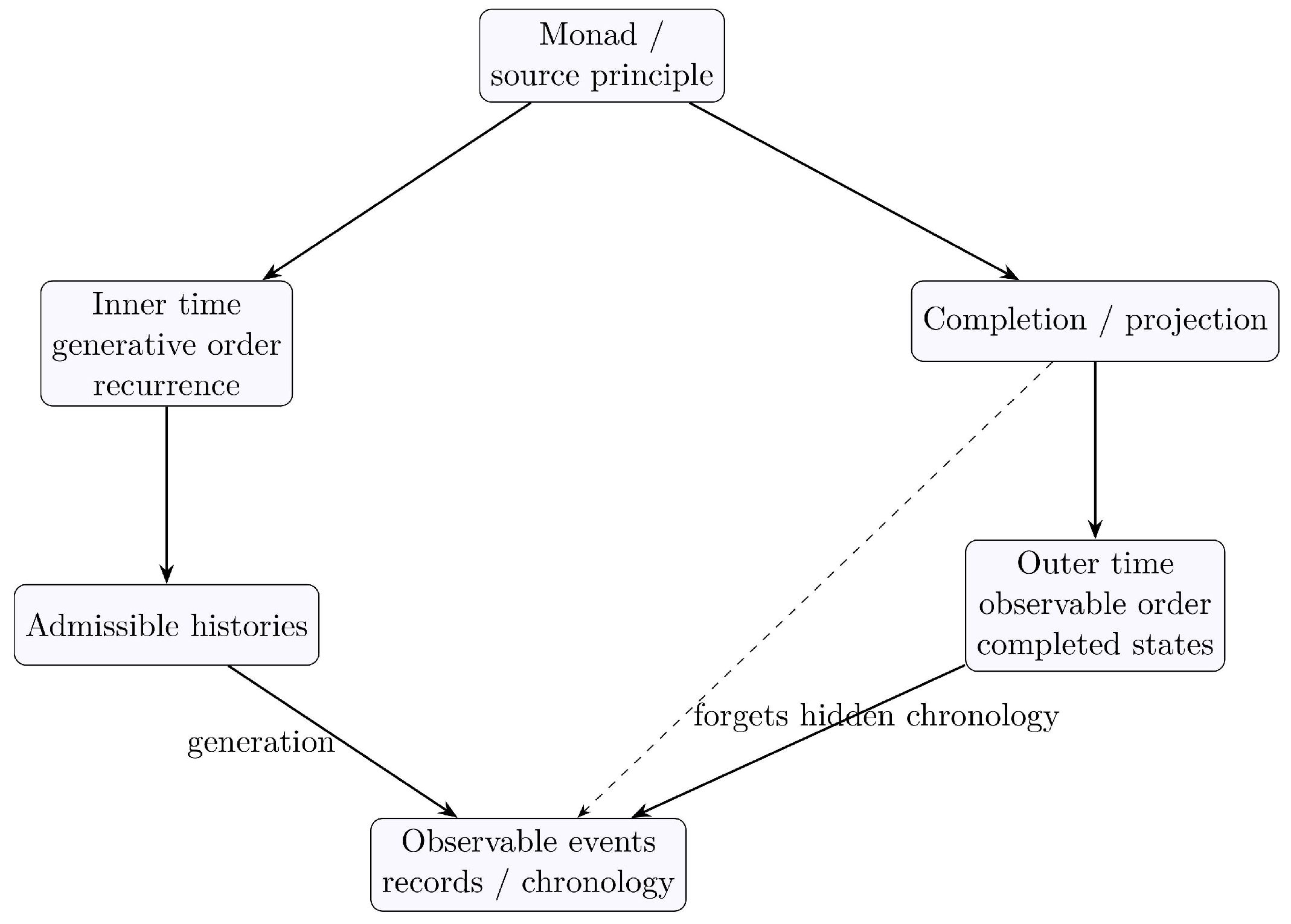
Figure 2.
The three two-dimensional real quadratic carriers classified in Theorem 5. The circular and hyperbolic branches are the two nondegenerate cases relevant to phase structure and causal readout, while the nilpotent case appears as a degenerate boundary.
Figure 2.
The three two-dimensional real quadratic carriers classified in Theorem 5. The circular and hyperbolic branches are the two nondegenerate cases relevant to phase structure and causal readout, while the nilpotent case appears as a degenerate boundary.
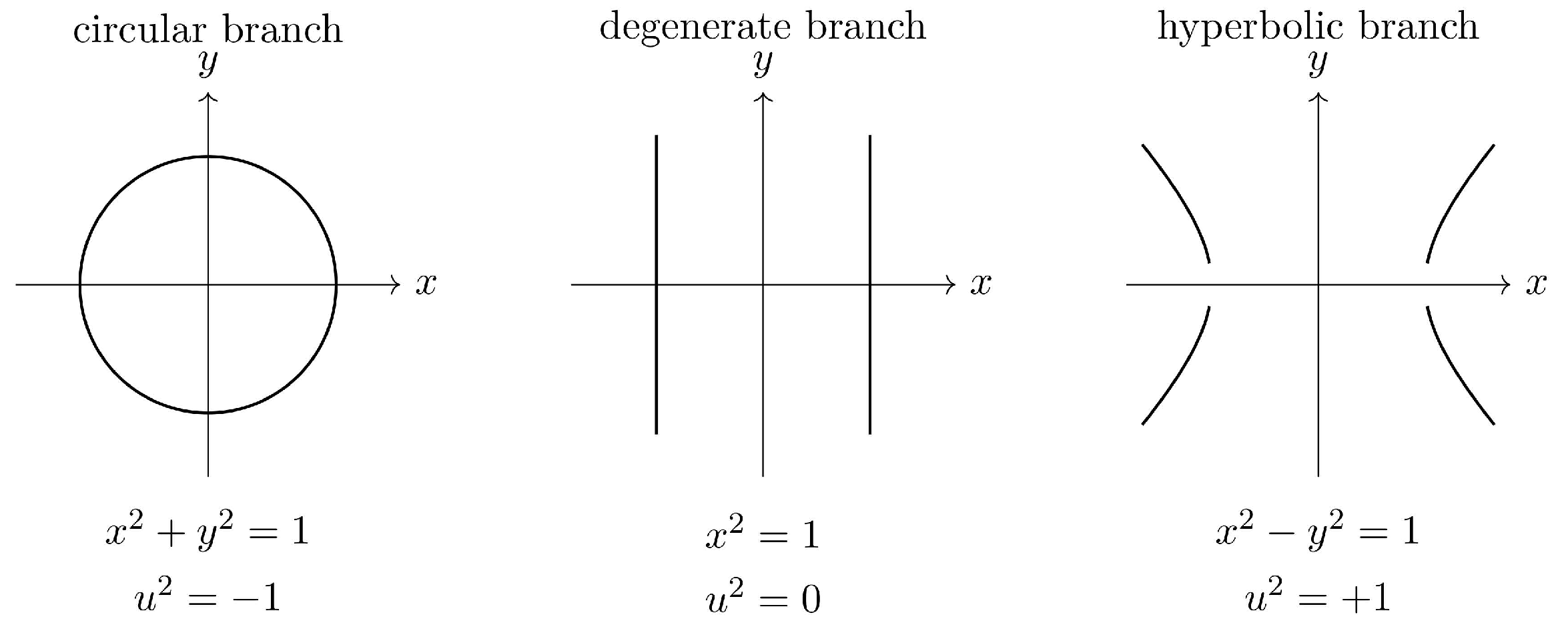
Disclaimer/Publisher’s Note: The statements, opinions and data contained in all publications are solely those of the individual author(s) and contributor(s) and not of MDPI and/or the editor(s). MDPI and/or the editor(s) disclaim responsibility for any injury to people or property resulting from any ideas, methods, instructions or products referred to in the content. |
© 2026 by the authors. Licensee MDPI, Basel, Switzerland. This article is an open access article distributed under the terms and conditions of the Creative Commons Attribution (CC BY) license (http://creativecommons.org/licenses/by/4.0/).
Copyright: This open access article is published under a Creative Commons CC BY 4.0 license, which permit the free download, distribution, and reuse, provided that the author and preprint are cited in any reuse.


