

Submitted:
20 April 2026
Posted:
21 April 2026
You are already at the latest version
Abstract
Background/Objectives: Body posture and temperament share common neurophysiological determinants related to muscle tone regulation, motor activity and behavioural reactivity. Despite this shared biological basis, posture has primarily been investigated within biomechanics and medicine, whereas temperament, in psychology. Integrating these perspectives may not only improve psychomotor development understanding, but also provide a foundation for more individualised preventive and rehabilitation strategies. The study aim was to analyse the relationship between body posture and temperament types in adolescents and determine posture type prevalence in the sagittal plane, particularly focusing on potential clinical relevance. Methods: The study included 272 students aged 16-17 years. Body posture was assessed using the DIERS Formetric III 4D system based on rasterstereography, enabling non-invasive three-dimensional spinal curvature analysis. Nine posture types were identified based on thoracic kyphosis and lumbar lordosis parameters. Temperament traits were evaluated using the Pavlovian Temperament Survey, assessing excitation and inhibition strength, and mobility of nervous processes. Statistical analyses included descriptive statistics and chi-square tests, with significance at p < 0.05. Results: Normal spinal curvature configuration was observed in 27.6% of participants, while 72.4% presented deviations. The most common pattern was reduced thoracic kyphosis combined with normal or reduced lumbar lordosis, indicating predominance of flattened physiological spinal curvatures. Melancholic temperament was the most frequent type in both groups (40.1% in participants with abnormal posture and 37.3% in those demonstrating normal posture). No statistically significant associations between posture type and temperament were found in the majority of configurations (p > 0.05). A significant relationship was identified between reduced thoracic kyphosis and increased lumbar lordosis (p = 0.024), with predominance of melancholic and sanguine types (40% each). A significant result was also observed for increased thoracic kyphosis with reduced lumbar lordosis (p = 0.001); however, this finding should be interpreted cautiously due to the small sample size. Conclusions: Adolescent body posture is characterised by high variability and predominance of abnormal patterns. Relationship between posture and temperament appear selective rather than general. Temperament may act as a modulating factor in postural regulation, particularly in specific spinal curvature configurations. These findings suggest incorporating temperamental characteristics into postural assessment may support development of more individualised prevention and rehabilitation strategies in adolescents.
Keywords:
body posture
; temperament
; thoracic kyphosis
; lumbar lordosis
; rasterstereography
; prevention
; rehabilitation
1. Introduction
Investigating the relationship between body posture and temperament types is justified not only by theoretical considerations, but also due to its potential clinical relevance for preventive and rehabilitation strategies. Body posture is a complex psychomotor habit that develops during childhood as a result of interactions between multiple mechanisms regulated by the central nervous system [1,2,3]. These include the regulation of postural and muscle tone, balance control, integration of sensory input and coordination of muscular activity [4,5]. This process leads to the formation of relatively stable motor and postural patterns that enable efficient maintenance of body alignment when subjected to gravitational forces and in dynamically changing environmental conditions [6,7]. Temperament, in turn, represents a biologically determined characteristic of central nervous system functioning, reflected in individual differences regarding emotional reactivity, psychomotor activity and responsiveness to environmental stimuli [8,9,10]. These traits are associated with the properties of excitation and inhibition processes, as well as their balance and mobility within the nervous system [8,9]. From a neurophysiological perspective, temperament may influence regulatory mechanisms responsible for muscle tone organisation, core stability, postural control and the development of motor patterns [11,12,13]. Consequently, it may act as an important modulating factor shaping individual postural strategies.
The school-age period is particularly important from a developmental standpoint, as it is characterised by intensive motor development and consolidation of postural habits [12,13]. At the same time, relatively stable temperamental traits emerge, which may influence levels of physical activity, movement patterns and adaptation to environmental demands, including those related to school conditions [9,10]. Therefore, analysing the interaction between posture and temperament may contribute to achieving a deeper understanding of the mechanisms underlying psychomotor development and variability in postural control.
Despite these premises, body posture and temperament have typically been examined in previous research separately, within different scientific paradigms. Studies on posture have predominantly been focused on biomechanical and environmental determinants [13,14,15], whereas temperament has been investigated mainly within psychological frameworks [8,9,10]. As a result, there is a clear lack of integrative approaches that consider the shared neurophysiological basis of these phenomena within a unified research model. Moreover, the potential role of temperament as a factor modulating postural control and influencing individual responses to preventive or therapeutic interventions remains insufficiently explored [3,11]. From a clinical perspective, incorporating temperamental traits into the analysis of postural determinants may have important practical implications. Better comprehension of the relationship between temperament and postural regulation mechanisms may support the development of more individualised approaches in prevention, rehabilitation and health education. In particular, recognising individual neurophysiological predispositions may facilitate the design of targeted interventions aimed at improving postural control, optimising muscle tone and enhancing motor function. Consequently, such an approach may increase the effectiveness of strategies for preventing postural disorders and supporting proper motor development in children and adolescents [16,17,18].
Therefore, the aim of the present study was to analyse the relationship between body posture and temperament types in adolescents. In particular, the study sought to identify temperament configurations—understood as patterns of central nervous system regulatory properties—that may be associated with specific postural strategies and have potential relevance for the development of individualised preventive and rehabilitation programmes.
2. Materials and Methods
2.1. Participant Characteristics
The study comprised 272 secondary school students aged 16-17 years. The research was conducted at the Posturology Laboratory of Collegium Medicum, Jan Kochanowski University in Kielce. Prior to participation, both the students and their parents or legal guardians were given information on the aim and procedures of the study, as well as their right to withdraw at any stage. Inclusion required written informed consent from the participants as well as their parents or legal guardians. The study was conducted in conditions ensuring the participants’ psychological comfort. Ethical approval was obtained from the Bioethics Committee of Collegium Medicum, Jan Kochanowski University in Kielce (No. 55/2021). The inclusion criteria were: age 16-17 years, attending a secondary school, absence of diagnosed congenital musculoskeletal disorders or central nervous system diseases that could affect psychomotor development, lack of physical or intellectual disability, and written informed consent for participation from the participants’ parents or legal guardians.
2.2. Methods and Research Instruments
A diagnostic survey method was used in the study. Body posture measurement and questionnaire techniques were applied. The research instruments included the DIERS Formetric III 4D optoelectronic system and the Pavlovian Temperament Survey (PTS).
Assessment of body posture types
Assessment of body posture was performed using the DIERS Formetric III 4D system, which enables three-dimensional analysis of the back surface based on rasterstereography [20]. During the examination, a light grid pattern is projected onto the back surface, and its deformation is recorded by a digital camera [19,20,21,22]. On this basis, a three-dimensional model of the back surface is created, and parameters regarding the spatial alignment of the spine and pelvis are calculated [20].
An advantage of this method is the absence of exposure to ionising radiation, which allows to carry out repeated follow-up measurements [20]. The system enables objective assessment of body statics, spinal curvatures, trunk rotation and pelvic alignment [20,21,22].
The examination was performed in a dimly lit room to eliminate light interference. Participants stood at a distance of approximately 2-3 metres from the device in a relaxed, habitual standing position. The subjects wore only shorts, and reflective elements were removed prior to the measurement.
The measurement was performed using DiCAM software using the ‘Average mode’, in which 12 consecutive images are recorded and then averaged. This procedure increases the accuracy and repeatability of the results. Based on the obtained data, the following parameters were analysed: thoracic kyphosis and lumbar lordosis angles, and nine body posture types were identified (Figure 1) [20].
Assessment of temperament type
Temperament traits were assessed using the PTS developed by J. Strelau, A. Angleitner and B. Zawadzki [8]. This instrument is used to diagnose behavioural characteristics regarding the basic properties of the nervous system in accordance with the concept of nervous system types [9].
The PTS enables assessment of three basic nervous system properties: strength of excitation (SE)—the body’s ability to respond to strong and long-lasting stimuli; strength of inhibition (SI)—the ability to suppress and control responses; and mobility of nervous processes (MNP)—the ability to rapidly change responses in reaction to changing environmental conditions [9].
The questionnaire consists of 57 statements, rated on a four-point response scale. Scores are calculated by summing points in individual scales and then interpreting the results in relation to sten norms [9].
Based on the configuration of nervous system properties, four classical temperament types are distinguished: sanguine, phlegmatic, choleric, and melancholic [8,9,10].
Statistical analysis
Statistical analysis was performed using standard methods applied to quantitative and qualitative variables. Continuous variables were described using the arithmetic mean, standard deviation, median, minimum and maximum values, and 95% confidence intervals. The normality of distribution was assessed using the Shapiro-Wilk test. For qualitative variables, such as body posture types and temperament types, frequencies and percentages were calculated. Relationships between variables were analysed using Pearson’s chi-square (χ²) test in contingency tables. In the case of small subgroup sizes, the results were interpreted with caution due to the limitations of the χ² test. The effect size for analyses based on categorical variables was estimated using Cramér’s V coefficient, which is a measure of association strength independent of sample size. The interpretation of the coefficient was based on conventional thresholds: values of approximately 0.1 indicate a small effect, approx. 0.3 a medium effect and above 0.5, a large effect. The level of statistical significance was set at p < 0.05. All analyses were performed using licensed Statistica 13.3 software.
3. Results
In the analysed group of 272 students aged 16-17 years, considerable variability concerning body posture configuration in the sagittal plane was observed. Only 75 participants (27.6%) presented a normal spinal curvature pattern, whereas the majority of respondents—197 individuals (72.4%)—exhibited various deviations from the norm. The most frequently observed abnormalities were configurations associated with reduced thoracic kyphosis, coexisting with either normal or reduced lumbar lordosis. The distribution of posture types indicates a predominance of patterns characterised by flattening of physiological spinal curvatures, which may suggest a predominance of global stabilisation strategies over segmental postural control. The analysis of the relationship between posture type and temperament type showed that among children with abnormal posture, the most frequent temperament was melancholic—79 individuals (40.1%). In the case of children with normal posture, this temperament type also predominated—28 participants (37.3%). Other temperament types occurred less frequently: phlegmatic (26.4% in the abnormal posture group), sanguine (23.4%), and choleric (10.2%) (Table 1).
A detailed analysis of body posture structure in relation to temperament revealed variability in the frequency of individual spinal curvature configurations. In the majority of the analysed cases, these differences did not reach a level of statistical significance (p > 0.05), indicating a lack of clear relationships between temperament type and most of the examined posture types. However, a statistically significant association was found for the configuration involving reduced thoracic kyphosis and increased lumbar lordosis (p = 0.024). In this situation, a clearly higher proportion of individuals with melancholic and sanguine temperament types was observed (40% each), compared to the remaining ones (10% each). Additionally, statistical significance was noted for a rarely occurring configuration characterised by increased thoracic kyphosis and reduced lumbar lordosis (p = 0.001). Nonetheless, due to the very small sample size, the interpretation of this result should be carried out with caution.
In summary, the obtained results indicate a clear predominance of abnormal body posture patterns in the studied population as well as moderate, selective associations between specific posture configurations and temperament types. The most pronounced relationship concerns the configuration of reduced thoracic kyphosis and increased lumbar lordosis, which may suggest the involvement of neurophysiological mechanisms related to the regulation of muscle tone and nervous system reactivity in the development of body posture (Table 2).
The effect sizes estimated using Cramér’s V coefficient indicate that the majority of the analysed associations between body posture type and temperament are characterised by a small effect size (V = 0.060.26). Moderate effect sizes (V ≈ 0.35) were observed only for configurations involving reduced thoracic kyphosis combined with either normal or increased lumbar lordosis, which confirms the selective nature of the observed relationships. The high coefficient value (V = 1.00) observed for one configuration most likely resulted from the very small subgroup size and therefore, is of no interpretative relevance (Table 3).
4. Discussion
The obtained results confirm that sagittal plane body posture in adolescents aged 16-17 years is characterised by considerable inter-individual variability, and the predominance of deviations from the physiological pattern indicates the widespread occurrence of non-optimal postural strategies in this population [10,13,14]. The finding that only 27.6% of participants presented a normal spinal curvature configuration is consistent with the literature, in which an increasing prevalence of postural disorders among adolescents is highlighted. This is primarily associated with a sedentary lifestyle, limited physical activity and prolonged static loads related to school conditions [10,13].
A particularly important finding of the present study is the predominance of configurations associated with reduced thoracic kyphosis, often accompanied by normal or reduced lumbar lordosis. This pattern may be interpreted as a manifestation of global stabilisation strategies prevailing over precise segmental control [1,3,12]. From a neurophysiological perspective, it may reflect less selective activation of the muscular system, associated with reduced function of the deep stabilising muscles and increased compensatory activity of the superficial ones, leading to flattening of physiological spinal curvatures and reduced postural efficiency [23,24,25]. From a clinical standpoint, such patterns may require targeted interventions focused on restoring segmental control, improving neuromuscular coordination and optimising muscle tone distribution.
The inclusion of temperament as a variable represents a significant extension of the classical biomechanical approach to body posture and is consistent with the concept of integrating neurophysiological and behavioural determinants in the assessment of postural control. The obtained results suggest that, in most cases, the relationships between temperament and posture type did not reach statistical significance, indicating the absence of a universal association between these variables. At the same time, a detailed analysis revealed variability in the frequency of specific spinal curvature configurations across temperament types, suggesting a selective rather than general relationship. A statistically significant association was identified for the configuration involving reduced thoracic kyphosis and increased lumbar lordosis (p = 0.024), with a predominance of melancholic and sanguine temperament types (40% each). Additionally, statistical significance was observed for a rarely occurring configuration characterised by increased thoracic kyphosis and reduced lumbar lordosis (p = 0.001); however, due to the very small sample size, this result should be interpreted with caution and requires confirmation in studies with greater statistical power.
Interpretation of these findings should be grounded in the regulatory properties of the central nervous system [8,9]. The melancholic temperament—characterised by high emotional reactivity and low resistance to stimuli—may predispose individuals to increased muscle tension and postural rigidity. In contrast, the sanguine temperament—associated with high mobility of nervous processes—may favour greater variability in postural strategies and more frequent compensatory adaptations [8,9,10]. These observations suggest that different temperament profiles may be associated with distinct patterns of neuromuscular regulation, which can be of relevance when designing individualised therapeutic approaches. At the same time, the lack of significant associations in most configurations indicates that temperament does not directly determine body posture. It should rather be considered a modulating factor interacting with biomechanical, environmental and behavioural determinants [24]. Therefore, body posture should be interpreted as the result of a complex, multi-level regulatory system. The relatively high proportion of melancholic temperament in both normal and abnormal posture groups further supports the relative independence of temperament distribution and posture quality, limiting the possibility of simple causal interpretations and highlighting the need for multivariate analytical models.
An important aspect of interpretation is also the role of compensatory mechanisms. According to contemporary biomechanical and neurophysiological models, changes in one segment of the spine lead to adaptive modifications in other elements of the kinetic chain [23]. Thus, posture should be interpreted not as a set of isolated curvature abnormalities but as a global strategy of muscular tone organisation and postural control. This perspective is particularly relevant in the context of clinical practice, where the entire postural system should be addressed in therapeutic interventions and not only isolated segments.
The applied classification of nine posture types represents a more advanced approach than the traditional dichotomous division into normal and abnormal posture. It enables identification of specific compensatory patterns and their interpretation in the context of sensorimotor integration, consistent with concepts of modern posturology.
Recent evidence also indicates that body composition and sensory integration processes significantly influence postural control mechanisms in children, further supporting the multifactorial nature of postural organisation during development [25,26,27,28].
The novelty of the present study lies in the application of an integrated analytical model combining objective three-dimensional posture assessment with a neurophysiological conceptualisation of temperament. This approach allows posture to be interpreted not as a static morphological feature, but as a dynamic regulatory phenotype resulting from neuromuscular tone organisation and nervous system properties. Importantly, such a perspective creates a foundation for translating research findings into clinical practice. The practical implications of the findings are directly aligned with the concept of individualised prevention and rehabilitation strategies. Incorporating temperamental characteristics into postural assessment may support more precise identification of risk profiles and enable the design of targeted interventions tailored to individual neurophysiological predispositions. In particular, rehabilitation programmes may benefit from integrating strategies aimed at improving segmental stabilisation, optimising breathing patterns, enhancing motor control and regulating muscle tone, while also considering behavioural and psychophysiological factors.
However, several research limitations must be acknowledged. The cross-sectional design of the study prevents causal inference. The small size of some subgroups reduces statistical power, particularly for rare posture configurations. Temperament assessment based on questionnaires, despite standardisation, may be subject to response bias. Additionally, the homogeneity of the study population limits generalisability.
In future research, longitudinal designs should be adopted to analyse posture changes in relation to temperament over time and additional variables, such as physical activity, deep muscle function, breathing patterns and psychosocial factors, should be included. The application of machine learning methods to identify complex patterns of interaction between posture and neurophysiological traits also appears promising.
In conclusion, the relationship between body posture and temperament is complex and selective. Temperament does not act as a direct determinant of posture but rather functions a modulating factor within a multifactorial system of postural regulation. These findings support the need for integrated, individualised approaches in the prevention and rehabilitation of postural disorders in adolescents.
5. Conclusions
Body posture in adolescents aged 16-17 years is highly variable, with a predominance of abnormal patterns, indicating substantial influence of contemporary environmental factors on the development of non-optimal postural strategies. The most common finding—flattening of physiological spinal curvatures, particularly reduced thoracic kyphosis—reflects the predominance of global stabilisation strategies over segmental control and supports the interpretation of posture as an expression of neuromuscular tone organisation. The relationship between posture and temperament appears selective rather than universal. Temperament does not directly determine posture but acts as a modulating factor within a multifactorial system of postural regulation, as reflected by the limited predictive value of the dominant melancholic temperament. From a clinical perspective, these findings support the inclusion of temperamental characteristics in postural assessment and intervention planning. This may facilitate the development of more individualised prevention and rehabilitation strategies aimed at improving segmental stabilisation, motor control and muscle tone regulation. The results also highlight the need for further longitudinal and multivariate studies to support the development of integrated diagnostic and therapeutic models.
Author Contributions
J.W.: Conceptualisation, data collection and analysis, formal analysis, methodology. M.G.: Methodology, data collection, data curation, writing-review and editing. K.M.: Formal analysis, statistical analysis, data curation, writing-review and editing. P.S.: Data collection, investigation, project administration. K.B.: Data collection, validation, resources. J.B.: Data curation, visualisation, writing-review and editing. M.M.-M.: Methodology, writing-review and editing.
Institutional Review Board Statement
All research procedures were performed according to the applicable 1964 Declaration of Helsinki, and its later amendments, and after obtaining approval from the Bioethics Committee at the Regional Medical Chamber No. 5/2015.04.08 at 3:00 p.m.
Informed Consent Statement
Written, informed consent was obtained from all subjects involved in the study prior to its initiation.
Data Availability Statement
The data and materials supporting the conclusions of this article can be found within the article.
Conflicts of Interest
The authors have no conflict of interest to declare regarding the publication of this paper.
References
- Saavedra, S.; Woollacott, M.; van Donkelaar, P. Multisensory Contributions to Postural Control in Children. Front. Hum. Neurosci. 2020, 14, 569486. [Google Scholar]
- Lacquaniti, F.; Bosco, G.; Gravano, S.; et al. Multisensory integration and body schema development. Curr. Biol. 2022, 32, R175–R188. [Google Scholar]
- Hadders-Algra, M. Early human motor development: From variation to the ability to vary and adapt. Neurosci. Biobehav. Rev. 2018, 90, 411–427. [Google Scholar] [CrossRef]
- Pavão, S.L.; Santos, A.N.; Woollacott, M.H.; Rocha, N.A.C.F. Assessment of postural control in children with cerebral palsy: A review. Res. Dev. Disabil. 2013, 34(5), 1367–1375. [Google Scholar] [CrossRef] [PubMed]
- De Los Ríos-Calonge, J.; Barbado, D.; Prat-Luri, A.; Juan-Recio, C.; Heredia-Elvar, J.R.; Elvira, J.L.L.; Vera-Garcia, F.J. Are trunk stability and endurance determinant factors for whole-body dynamic balance in physically active young males? Scand. J. Med. Sci. Sports 2024, 34(3), e14588. [Google Scholar] [CrossRef] [PubMed]
- Yan, S.; Hameeduddin, I.; Lim, H.; Dee, W.; Keefer, R.; Rojas, A.M.; Rymer, W.Z.; Wu, M. Motor variability predicts motor learning of improved trunk postural control through repeated trunk perturbations during walking in children with cerebral palsy. J. Neurophysiol. 2025, 134(6), 2099–2111. [Google Scholar] [CrossRef]
- Hadders-Algra, Mijna. Early human motor development: From variation to the ability to vary and adapt. Neurosci. Biobehav. Rev. 2018, 90, 411–427. [Google Scholar] [CrossRef]
- Strelau, J.; Zawadzki, B.; Angleitner, A. The Pavlovian Temperament Survey (PTS): Theoretical assumptions and psychometric properties. Eur. J. Pers. 1999, 13, 187–202. [Google Scholar]
- Strelau, J. Temperament: A Psychological Perspective; Springer: New York, USA, 2008. [Google Scholar]
- Rothbart, M.K. Temperament, development, and personality. Curr. Dir. Psychol. Sci. 2007, 16, 207–212. [Google Scholar] [CrossRef]
- Latash, M.L.; Yamagata, M. Recent advances in the neural control of movements: Lessons for functional recovery. Phys. Ther. Res. 2021, 25(1), 1–11. [Google Scholar]
- Zoccante, L.; Ciceri, M.L.; Chamitava, L.; et al. Postural Control in Childhood: Investigating the Neurodevelopmental Gradient Hypothesis. Int. J. Environ. Res. Public Health 2021, 18(4), 1693. [Google Scholar] [CrossRef] [PubMed]
- Araújo, C.L.; Moreira, A.; Carvalho, G.S. Postural Education Programmes with School Children: A Scoping Review. Sustainability 2023, 15, 10422. [Google Scholar] [CrossRef]
- Czaprowski, D.; Gwiazdowska-Czubak, K.; Tyrakowski, M.; Kędra, A. Sagittal body alignment in sitting position in children is not affected by generalized joint hypermobility. Sci. Rep. 2021, 11, 13748. [Google Scholar] [CrossRef]
- Hou, C.; Chen, K.; Zhou, T.; et al. Assessment of sagittal spinopelvic alignment in asymptomatic Chinese juveniles and adolescents: a large cohort study and comparative meta-analysis. Sci. Rep. 2021, 16, 656. [Google Scholar]
- Kocjan, J.; Adamek, M.; Gzik-Zroska, B.; Czyżewski, D.; Rydel, M. Network of Breathing. Multifunctional Role of the Diaphragm: Adv. Respir. Med. 2017, 85(4), 224–232. [Google Scholar]
- Hadders-Algra, M. Early human motor development: variability, adaptation and individual differences. Neurosci Biobehav Rev. 2018, 90, 1–15. [Google Scholar]
- Kolar, P.; Šulc, J.; Kynčl, M.; et al. Postural function of the diaphragm. J. Orthop. Sports Phys. Ther. 2012, 42, 352–362. [Google Scholar] [CrossRef]
- Drerup, B.; Hierholzer, E. Back shape measurement using video rasterstereography and three-dimensional reconstruction of spinal shape. Clin. Biomech. 1994, 9, 28–36. [Google Scholar] [CrossRef]
- Wilczyński, J. Own typology of body posture based on DIERS Formetric III 4D. J. Clin. Med. 2025, 14, 501. [Google Scholar] [CrossRef] [PubMed]
- Szumilas, P.; Bieniek, K.; Markowski, K.; Bąk, J. Types of body posture and refractive errors in school-aged children. Med. Rehabil. 2025, 29(2), 21–26. [Google Scholar]
- Harzmann, H. Methode und klinische Einsatzmöglichkeiten der dreidimensionalen Rückenoberflächenvermessung mit der Videorasterstereographie (VRS). Orthopädie (IGEL) 2001, 81–104. (in German). [Google Scholar]
- Kendall, F.P.; McCreary, E.K.; Provance, P.G. Muscles: Testing and Function with Posture and Pain; Lippincott Williams & Wilkins: Baltimore, USA, 2005. [Google Scholar]
- Sahrmann, S. Diagnosis and Treatment of Movement Impairment Syndromes; Mosby: St. Louis, USA, 2002. [Google Scholar]
- Page, P.; Frank, C.C.; Lardner, R. Assessment and Treatment of Muscle Imbalance: The Janda Approach; Human Kinetics: Champaign, USA, 2010. [Google Scholar]
- Rico-González, M.; Gómez-Carmona, C.D.; Ouergui, I.; Ardigò, L.P. Machine learning methods in posture-related applications in children up to 12 years old: A systematic review. Bioeng. (Basel) 2025, 12(12), 1311. [Google Scholar] [CrossRef] [PubMed]
- Habik-Tatarowska, N.; Szumilas, P. The impact of body composition on the development of sensory integration deficits in children - analysis of correlations and the importance of preventive measures. Med. Rehabil. 2025, 29(3), 27–39. [Google Scholar] [CrossRef]
- Bieniek, K.; Szumilas, P.; Markowski, K. Analysis of relationships between body posture and body composition in children aged 10-12 years. Med. Rehabil. 2025, 29(4), 38–45. [Google Scholar] [CrossRef]
Figure 1.
Body posture types [20].
Figure 1.
Body posture types [20].
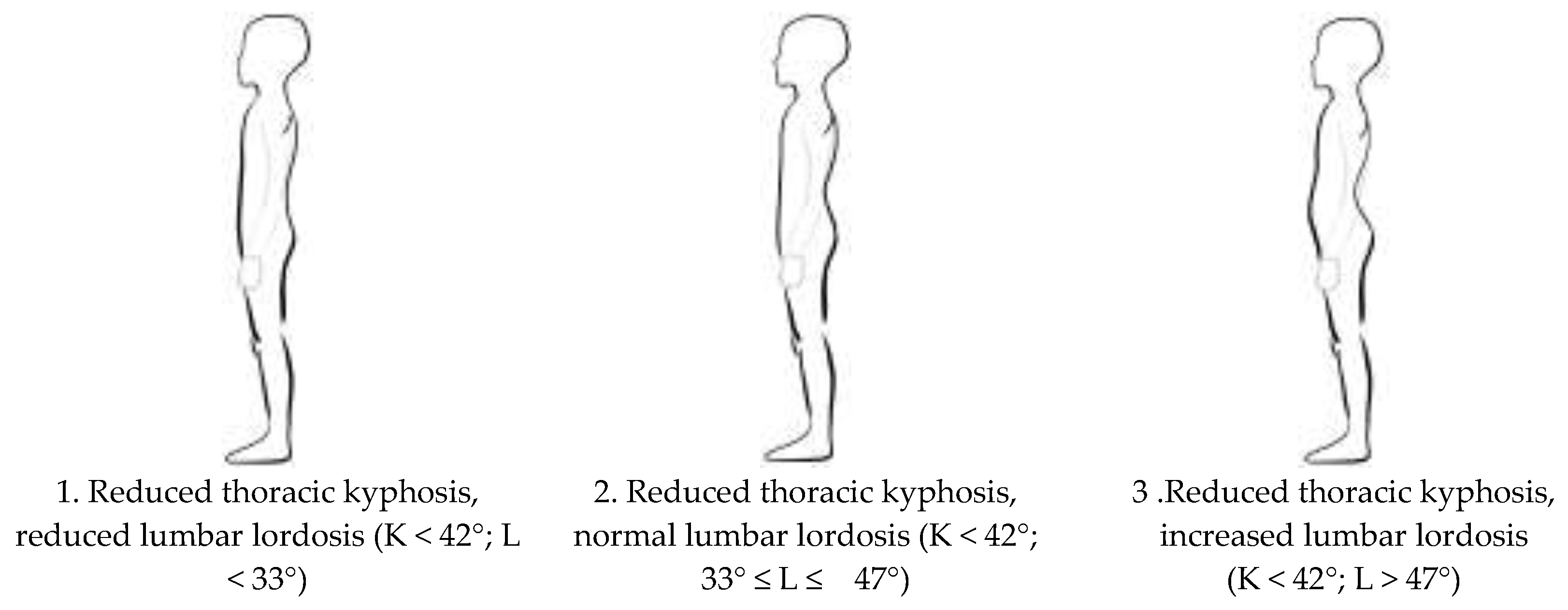
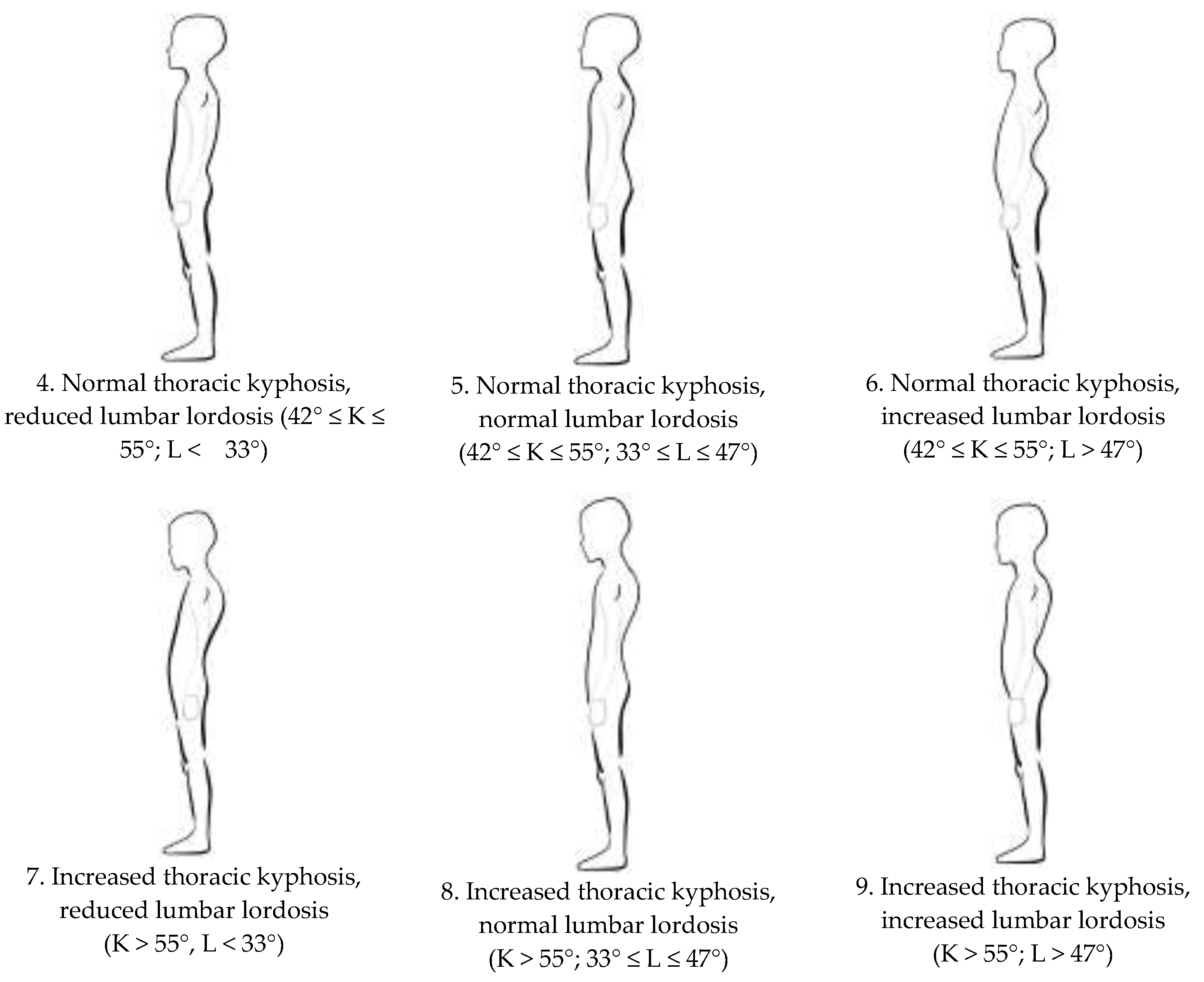

Table 1.
Prevalence of normal and abnormal sagittal plane postures across temperament types (boys).
| Body posture type | Total | ||||
| Temperament type | Normal | Abnormal | |||
| N | % | N | % | ||
| 1 - Melancholic | 28 | 37.3 | 79 | 40.1 | 107 |
| 2 - Choleric | 1 | 1.3 | 20 | 10.2 | 21 |
| 3 - Sanguine | 23 | 30.7 | 46 | 23.4 | 69 |
| 4 - Phlegmatic | 23 | 30.7 | 52 | 26.4 | 75 |
| Total | 75 | 100 | 197 | 100 | 272 |
Table 2.
Body posture and temperament types.
| Body posture | Melancholic | Sanguine | Phlegmatic | Choleric | p-value | ||||
| N | % | N | % | N | % | N | % | ||
| Reduced kyphosis, reduced lordosis | 28 | 36 | 18 | 23 | 23 | 29 | 9 | 12 | 0.90 |
| Reduced kyphosis, normal lordosis | 26 | 57 | 8 | 17 | 8 | 17 | 4 | 9 | 0.08 |
| Reduced kyphosis, increased lordosis | 4 | 40 | 4 | 40 | 1 | 10 | 1 | 10 | 0.024 |
| Normal kyphosis, reduced lordosis | 21 | 47 | 12 | 27 | 10 | 22 | 2 | 4 | 0.91 |
| Normal physiological spinal curvature | 28 | 37 | 23 | 31 | 23 | 31 | 1 | 1 | 0.083 |
| Normal kyphosis, increased lordosis | 6 | 35 | 5 | 29 | 4 | 24 | 2 | 12 | 0.85 |
| Increased kyphosis, normal lordosis | 6 | 32 | 6 | 32 | 5 | 26 | 2 | 11 | 0.086 |
| Increased kyphosis, increased lordosis | 4 | 31 | 1 | 8 | 5 | 38 | 3 | 23 | 0.85 |
| Increased kyphosis, reduced lordosis | 2 | 100 | 0 | 100 | 0 | 100 | 0 | 100 | 0.001 |
| Total | 125 | 77 | 79 | 24 | |||||
Table 3.
Effect sizes calculated using Cramér’s coefficient.
| Body posture types | N | χ² | Cramér’s V | Interpretation |
| Reduced kyphosis, reduced lordosis | 78 | 8.7 | 0.19 | Small effect |
| Reduced kyphosis, normal lordosis | 46 | 16.6 | 0.35 | Moderate effect |
| Reduced kyphosis, increased lordosis | 10 | 3.6 | 0.35 | Moderate effect |
| Normal kyphosis, reduced lordosis | 45 | 10.6 | 0.28 | Small/moderate effect |
| Normal physiological spinal curvatures | 75 | 14.1 | 0.25 | Small effect |
| Normal kyphosis, increased lordosis | 17 | 1.3 | 0.16 | Small effect |
| Increased kyphosis, normal lordosis | 19 | 0.2 | 0.06 | Negligible |
| Increased kyphosis, increased lordosis | 13 | 2.7 | 0.26 | Small effect |
| Increased kyphosis, reduced lordosis | 2 | 6.0 | 1.00 | Artifact (N=2) |
Disclaimer/Publisher’s Note: The statements, opinions and data contained in all publications are solely those of the individual author(s) and contributor(s) and not of MDPI and/or the editor(s). MDPI and/or the editor(s) disclaim responsibility for any injury to people or property resulting from any ideas, methods, instructions or products referred to in the content. |
© 2026 by the authors. Licensee MDPI, Basel, Switzerland. This article is an open access article distributed under the terms and conditions of the Creative Commons Attribution (CC BY) license (http://creativecommons.org/licenses/by/4.0/).
Copyright: This open access article is published under a Creative Commons CC BY 4.0 license, which permit the free download, distribution, and reuse, provided that the author and preprint are cited in any reuse.


