

Submitted:
17 April 2026
Posted:
21 April 2026
You are already at the latest version
Abstract
Dixit et al. proposed an asymptotic drag scaling for zero-pressure-gradient flat-plate turbulent boundary layers based on the approximation M∼Uτ2δ, where M is the kinematic momentum rate through the boundary layer, Uτ is the friction velocity, and δ is the boundary-layer thickness. In the present paper, an explicit Reynolds-number-dependent correction to this approximation is derived from the logarithmic mean-velocity profile. Integration of the log law across the layer yields M∼Uτ2δf(Reτ), where Reτ=δUτ/ν is the friction Reynolds number and f(Reτ) is given analytically. Application of the correction to the dataset compiled by Dixit et al. shows that the corrected scaling gives an exponent closer to the asymptotic value −1/2 than the uncorrected formulation. The correction should be viewed as a leading-order amendment, since the derivation uses the logarithmic law outside its strict range of validity.
Keywords:
asymptotic drag scaling
; zero-pressure-gradient turbulent boundary layers
; logarithmic mean-velocity profile
; reynolds-number-dependent correction term
1. Introduction
Skin-friction scaling in canonical wall-bounded turbulence remains a central problem in fluid mechanics because drag directly determines pressure loss, pumping power, and aerodynamic performance. For zero-pressure-gradient (ZPG) turbulent boundary layers, Dixit et al. [1] recently proposed a compact asymptotic drag law based on the kinematic momentum rate through the boundary layer,
where is the boundary-layer thickness, U is the mean streamwise velocity, z is the wall-normal coordinate, and is the friction velocity. The attractiveness of Equation (1) lies in its simplicity. However, if the mean streamwise velocity obeys a logarithmic law over a substantial part of the boundary layer, then the integral in Equation (1) should retain a weak but systematic dependence on the friction Reynolds number .
The purpose of the present paper is to derive this missing Reynolds-number dependence and to assess its effect on the scaling proposed in Ref. [1]. The resulting amendment is small enough that the original scaling remains a useful first approximation, but large enough that it materially affects the exponent inferred from finite-Reynolds-number data. This interpretation is consistent with earlier scaling work in wall turbulence, where weak Reynolds-number dependencies can influence the apparent asymptotic behavior [3,4].
The paper is organized as follows. In Section 2, the correction term is derived from the logarithmic law for the mean streamwise velocity. In Section 3, the correction is applied to the measurements compiled by Dixit et al. [1]. The implications and limitations are discussed in Section 4, and the conclusions are given in Section 5.
2. Derivation of the Correction Term
As a starting point, I introduce the logarithmic law in the form used by Marusic et al. [2]:
where , , is the kinematic viscosity, is the von Kármán constant, and A is an additive constant that depends on wall condition. Equation (2) does not hold arbitrarily close to the wall or throughout the outer wake region, but it is nevertheless informative to ask what correction follows if it is used as a leading-order approximation for the layer integral defining M.
Using , so that , Equation (2) becomes
Substitution into Equation (1) gives
where and have been used.
The factor in square brackets in Equation (4) was effectively treated as constant in Ref. [1]. Figure 1 shows that this is not supported by the data: varies systematically with and increases by roughly a factor of three over approximately two decades in . The two curves shown correspond to:
- Red solid line: original log-law constants from Ref. [2], and .
- Black dashed line: fitted constants, and .
This motivates the amended scaling
where
The fitted constants provide a substantially larger coefficient of determination than the original constants, see Table 1. These fitted values should be interpreted as effective parameters within the simplified full-layer model, not as replacement universal constants.
The asymptotic scaling law derived in Ref. [1] is
where
is the dimensionless drag and
scales as the friction Reynolds number squared.
3. Application of the Correction Term
I first fit all measurements in Ref. [1] to
where C and D are fit parameters. The results are summarized in Table 2 and Figure 2. Equations (7) and (8) in Ref. [1] are discrete power-law models fitted over lower and higher ranges, whereas Equation (9) in Ref. [1] is a continuous model across the full range. The continuous model reported in Ref. [1] has a slightly larger coefficient of determination than either discrete fit.
The next two fits include the correction term , either with the original log-law constants,
or with the fitted log-law constants,
The results are shown in Table 2 and Figure 3. The fit quality remains essentially unchanged, but the fitted exponents are now much closer to the asymptotic value . This suggests that the deviation from in Equation (11) is not only a finite-Reynolds-number effect in the available data, but also partly a consequence of omitting the correction term.
4. Discussion
Comparison of the fit based on Equation (11) with those based on Equations (12) and (13) shows that the correction term scales only weakly with over the available data range:
This explains why the corrected fits remain close to power laws while nevertheless shifting the exponent toward .
For the correction term based on the original log-law constants, the fitted prefactor is close to unity (; Table 2). This motivates the approximate closed-form relation
which reproduces the data rather well despite the simplicity of the model.
The limitations of the approach should remain explicit. First, Equation (4) is based on using the logarithmic law across the full boundary-layer thickness, so it neglects both the viscous sublayer and the outer wake contribution. A more complete composite profile would likely modify the numerical coefficients in . Second, the additive constant A depends on wall condition, and part of the high- scatter in Figure 1 may therefore reflect differences in effective roughness or in the definitions used across the underlying experiments. In this sense, the present result is best interpreted as a leading-order asymptotic amendment to the drag scaling of Ref. [1], rather than as a complete theory for the mean-velocity profile.
5. Conclusions
A correction term to the asymptotic drag scaling in ZPG turbulent boundary layers has been derived by integrating the logarithmic mean-velocity law across the boundary layer. The resulting amendment, , shows that the ratio is not constant but increases systematically with friction Reynolds number. When applied to the dataset of Dixit et al. [1], the correction moves the fitted drag exponent closer to the asymptotic value while preserving an excellent fit quality. The main contribution of the present analysis is therefore to identify an explicit Reynolds-number dependence that is hidden when M is approximated solely by .
A natural next step would be to repeat the derivation using a composite inner–outer profile, so that the separate contributions from the logarithmic region and the wake region can be quantified more systematically.
Funding
This research received no external funding.
Data Availability Statement
Data availability is not applicable to this article as no new data were created or analysed.
Conflicts of Interest
The author declares no conflict of interest.
References
- Dixit, S.A.; Gupta, A.; Choudhary, H.; Singh, A.K.; Prabhakaran, T. Asymptotic scaling of drag in flat-plate turbulent boundary layers. Phys. Fluids 2020, 32, 041702. [Google Scholar] [CrossRef]
- Marusic, A.; Monty, J.P.; Hultmark, M.; Smits, A.J. On the logarithmic region in wall turbulence. J. Fluid Mech. 2013, 716, R3. [Google Scholar] [CrossRef]
- Basse, N.T. Scaling of global properties of fluctuating and mean streamwise velocities in pipe flow: Characterization of a high Reynolds number transition region. Phys. Fluids 2021, 33, 065127. [Google Scholar] [CrossRef]
- Basse, N.T. Scaling of global properties of fluctuating streamwise velocities in pipe flow: Impact of the viscous term. Phys. Fluids 2021, 33, 125109. [Google Scholar] [CrossRef]
Figure 1.
as a function of . Blue circles are measurements from Table I in Ref. [1]. The red solid line uses the original log-law constants from Ref. [2], while the black dashed line uses fitted constants.
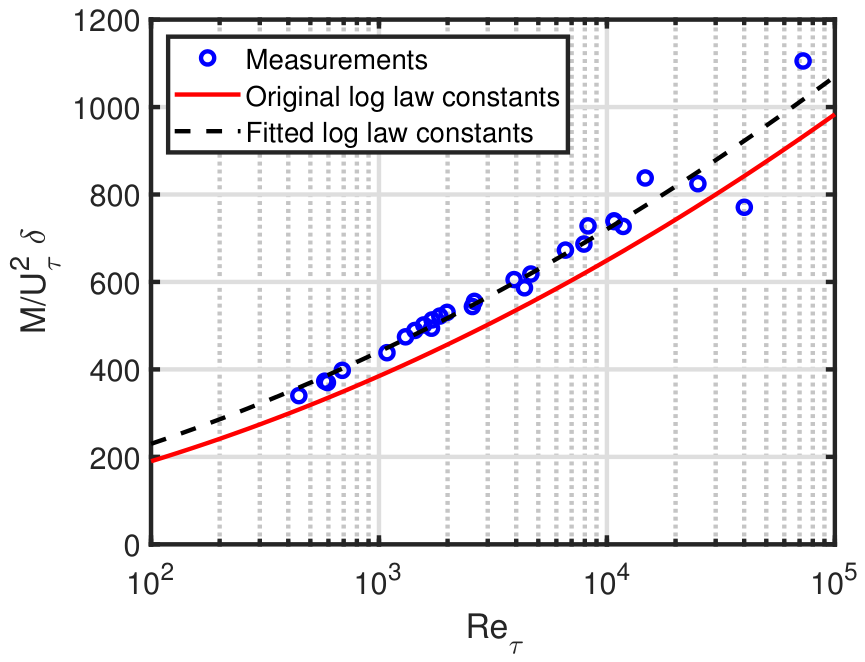
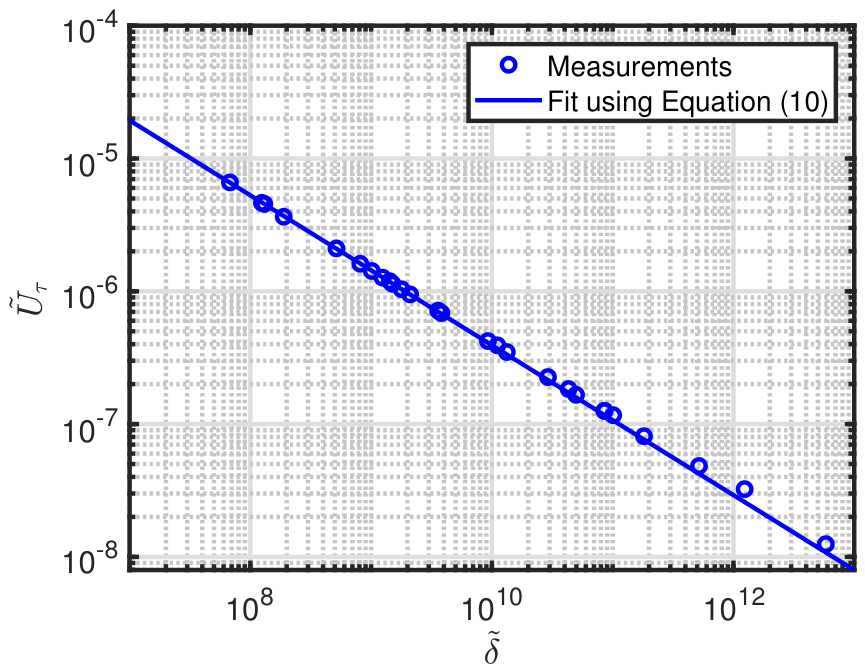
Figure 3.
Measurements from Ref. [1] with correction terms applied and fits to Equations (12) and (13).
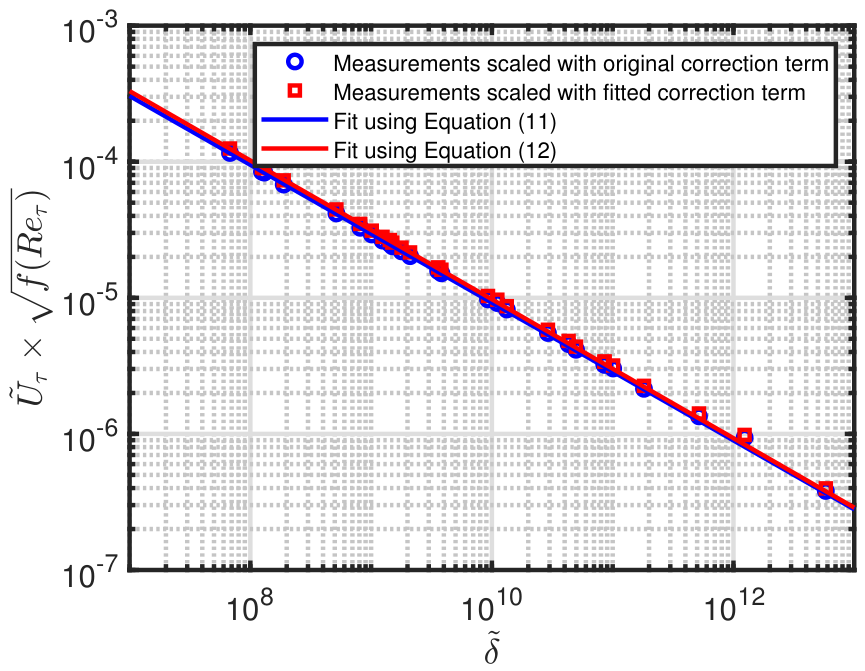

Table 1.
Log-law parameters and coefficient of determination () for .
| Log-law constants | A | ||
|---|---|---|---|
| Original | 0.39 | 4.3 | 0.80464 |
| Fitted | 0.39 | 5.7 | 0.94960 |
Table 2.
Fit parameters and coefficient of determination () for the fits in Ref. [1] and in the present work.
Table 2.
Fit parameters and coefficient of determination () for the fits in Ref. [1] and in the present work.
| Equation | C | D | |
|---|---|---|---|
| Equation (7) in Ref. [1] | 0.15144 | -0.55745 | 0.99982 |
| Equation (8) in Ref. [1] | 0.10869 | -0.54261 | 0.99992 |
| Equation (9) in Ref. [1] | – | – | 0.99998 |
| Equation (11) | 0.17291 | -0.56439 | 0.99991 |
| Equation (12) | 1.06598 | -0.50629 | 0.99992 |
| Equation (13) | 1.23257 | -0.51017 | 0.99992 |
Disclaimer/Publisher’s Note: The statements, opinions and data contained in all publications are solely those of the individual author(s) and contributor(s) and not of MDPI and/or the editor(s). MDPI and/or the editor(s) disclaim responsibility for any injury to people or property resulting from any ideas, methods, instructions or products referred to in the content. |
© 2026 by the authors. Licensee MDPI, Basel, Switzerland. This article is an open access article distributed under the terms and conditions of the Creative Commons Attribution (CC BY) license (http://creativecommons.org/licenses/by/4.0/).
Copyright: This open access article is published under a Creative Commons CC BY 4.0 license, which permit the free download, distribution, and reuse, provided that the author and preprint are cited in any reuse.


