

Submitted:
19 April 2026
Posted:
21 April 2026
You are already at the latest version
Abstract
Vero cells are an validated continuous substrate for human viral vaccine manufacturing. Decades of performance improvements have relied on extrinsic process optimization; however, intrinsic genomic instability, including segmental aneuploidy and dynamic chromatin rearrangements, are currently limiting the durability of engineered phenotypes under sustained viral burden and bioreactor stress. In this Perspective, we examine how a conceptual transition from empirical permissiveness toward genome-informed architectural redesign could substantially expand the manufacturing capabilities of the Vero platform. We organize the emerging landscape of Vero cell engineering across three interdependent functional layers: the membrane interface, where receptor redesign and suspension adaptation extend viral entry range and culture scalability; the cytoplasmic foundry, where metabolic flux management, ER stress buffering, and temporally controlled apoptosis modulation address production bottlenecks; and the nuclear blueprint, where epigenetic insulation and genomic precision engineering determine the long-term durability of all upstream gains. We further discuss how infection-responsive dynamic logic circuits and the systematic identification of Vero-specific genomic safe harbors could shift the paradigm from static trait installation toward a continuously programmable, conditionally responsive manufacturing architecture. Collectively, these advances suggest a pathway for transitioning the Vero lineage from a passive biological substrate into a programmable platform capable of meeting the accelerated timelines and distributed manufacturing imperatives of modern global health preparedness.
Keywords:
vaccine
; vero cells
; cellular engineering
; gene editing
1. Introduction
Established in 1962, Vero cells became a major continuous substrate for viral vaccine manufacturing as production moved away from variable primary monkey kidney cultures toward more standardized cell-based systems [1,2,3,4]. A defining biological feature of the lineage is a homozygous deletion affecting the type I interferon locus, which contributes to broad susceptibility to diverse viruses and has long supported its utility in virology and vaccine production [5,6]. At the same time, Vero cells have retained an unusually important regulatory position among continuous substrates, with an established safety record within defined passage limits and extensive use in the manufacture of vaccines such as inactivated poliovirus, rabies, and rotavirus vaccines [7,8,9,10,11].
However, the historical success of Vero cells has depended more on empirical permissiveness and process adaptation than on systematic redesign of the host cell itself [12,13,14,15]. Such distinction has become increasingly important, as contemporary vaccine and viral-vector manufacturing demands not only permissiveness, but also stable performance under high cell density, infection-associated metabolic burden, and industrial scale-up conditions [16,17,18,19,20]. Currently, the most accessible engineering layer is the membrane interface, where receptor availability and anchorage dependence directly influence host range, infection efficiency, and culture format [19,21,22,23,24]; yet improvements at this boundary propagate inward by reshaping intracellular stress and, ultimately, the durability of engineered phenotypes [25,26,27,28]. Meanwhile, Vero cells display genomic plasticity, including karyotypic variation and stress-associated chromatin remodeling, which may limit the long-term stability of inserted traits or regulatory circuits [29,30]. Therefore, we frame this Perspective around Vero cell engineering across the membrane interface, cytoplasmic foundry and the nuclear blueprint (Figure 1), hence discuss how dynamic control logic and genome-context-aware integration may help convert a historically permissive substrate into a more programmable manufacturing platform.
2. Current Landscape and Methods of Genetic Engineering Vero Cells
2.1. Engineering the Membrane Interface: From Viral Entry to Suspension Adaptation
Currently, the cellular membrane is regarded as a programmable, intelligent interface through which extracellular materials, signaling cues, and viral particles are selectively negotiated. In wild-type Vero cells, receptor composition reflects species-specific evolutionary history rather than rational optimization for industrial vaccine manufacturing. A conceptual shift from passive permissiveness to active reprogramming has therefore emerged as the guiding principle of membrane interface engineering. Underneath such shift, membrane receptors are hence treated as modular components whose composition and density can be redesigned to align viral entry efficiency with defined bioprocessing constraints. To reflect in a more direct way, we created Table 1 for comparing and contrasting.
Membrane-located receptor transplantation has proven to be a direct and effective strategy for overcoming host-range limitations. Introduction of SLAM (CD150) enabled productive infection of measles virus [21] and canine distemper virus [31], while expression of KREMEN1 facilitated Coxsackievirus A6 entry [32].These cases demonstrate that supplementation of missing entry receptors achieves 10⁶ - 10⁸ TCID₅₀ / mL titers in specific Vero systems at proof-of-concept scale, though systematic industrial-scale validation remains needed, however such demonstration still avoided regulatory complexities associated with the application of more infectious, but tumor-derived cellines such as RD cells. For viruses relying predominantly on endocytic pathways, including EV71, kinetic bottlenecks have been relieved through increased membrane anchor density, as demonstrated by SCARB2 overexpression producing order-of-magnitude yield improvements [22]. Comparable gains in viral attachment and internalization have been observed following AXL [33] or TIM-1 [34] expression for filoviruses and ICAM1 augmentation for rhinovirus replication [35]. Receptor density amplification therefore represents a highly efficient lever for enhancing volumetric productivity. However, diminishing returns have been documented when single-receptor augmentation is applied to viruses with multi-factorial entry requirements or extremely low infectious inputs. In the case of SARS-CoV-2, efficient entry required coordinated expression of ACE2 and the priming protease TMPRSS2 rather than receptor amplification singly, resulting in a 1.6-fold overall improvement in viral isolation efficiency and a 2.6-fold increase in ultra-low-load clinical specimens [36]. Meanwhile, membrane programmability has been extended toward intrinsic biosafety. Disruption of CD155 rendered Vero cells non-permissive to poliovirus, thereby establishing a genetic barrier compatible with WHO GAPIII containment standards [37].
In parallel, morphological engineering has addressed the anchorage dependence intrinsic to Vero cells. Traditional suspension adaptation relied on prolonged environmental selection, including gradual suppression of cadherin-mediated aggregation [19]. Although empirically successful, such approaches provide limited control over phenotypic stability and genomic robustness. A transition toward genotype-driven suspension engineering has therefore been pursued. Anchorage-independent survival requires coordinated activation of anoikis-resistance pathways. IGF-1 has been shown to sustain viability through persistent activation of the PI3K/Akt axis [38]. Targeted downregulation of CDH18 weakens intercellular adhesion [39], while PTEN knockdown markedly reduces matrix attachment strength [40]. Through such interventions, homogeneous suspension cultures exceeding 107 cells per milliliter have been established [23]. Nevertheless, transcriptomic and metabolic analyses reveal an intrinsic vulnerability underlying suspension phenotypes. Adaptation to anchorage independence is accompanied by broad suppression of adhesion and extracellular matrix programs, including cadherins, tight junction components, and versican. Loss of physical anchoring cues imposes chronic cellular stress, necessitating compensatory activation of unfolded protein response pathways. Persistent upregulation of stress markers such as DDIT3 (CHOP) and CHAC1 indicates sustained endoplasmic reticulum strain [41], while downregulation of signaling receptors, including FGFR2, requires exogenous FGF2 supplementation to partially restore proliferative capacity [24]. Paradoxically, the genetic modifications enabling scalable suspension entrench the cells within a persistent stress-adaptation loop.
Collectively, membrane interface engineering, encompassing both receptor repertoire expansion and morphological reconfiguration, has yielded substantial gains in viral permissiveness and scalable culture formats. However, these interventions remain fundamentally static. While surface receptor overexpression alleviates entry barriers, it theoretically imposes an additional burden on limited ER folding capacity shared with viral glycoproteins [25], potentially precipitating premature secretory stress [26,42,43]. Suspension adaptation alleviates aggregation constraints yet might activates chronic stress-response pathways [44]. Therefore, principally, any membrane-level enhancement must be paired with cytoplasmic-nuclear safeguards to prevent stress-driven epigenetic silencing of engineered traits [27,28]. Long-term industrial robustness therefore depends on resolving the intracellular and genomic cascades inevitably triggered by boundary-level reprogramming [45].
2.2. The Cytoplasmic Foundry: Capacity, Stress Handling, and Survival Trade-Offs
Post-fusion viral replication imposes coordinated demands on intracellular trafficking, metabolic flux [46], protein folding [13], and survival control [44], suggesting the cytoplasm often emerges as a central bottleneck in Vero manufacturing contexts. Under acute infection, Vero cells exhibit increased ATP consumption [47], substantial lactate accumulation [48], and pronounced ER stress [42], indicating that intracellular capacity frequently limits volumetric output. Expanding ER capacity via XBP1s overexpression enhances glycoprotein secretion under high-load conditions [49]. Anti-apoptotic reinforcement via BCL-XL extends productive lifespan [50], validated in Vero systems where CRISPR-mediated ISG15 deletion increased influenza and rVSV yields 70- to 87-fold [51]. Meanwhile, dual IFNG/IFNGR1 knockout enhanced replication of interferon-sensitive viruses by up to 3-fold [52], as well as UPR axis modulation represents a rational strategy to resolve folding bottlenecks under industrial MOI [24].
On the other hand, constitutive cytoplasmic manipulation appears to yield conditional gains. While BCL-XL overexpression extends replication windows, unresolved ER stress could potentially compromise assembly fidelity. Under sustained burden, apoptosis-resistant but metabolically strained cells have been observed in other systems to accumulate defective interfering particles and incomplete virions [53,54]. In parallel, apoptosis blockade is known to occasionally redirect death toward necrotic pathways [55], which could in theory release host cell proteins and genomic DNA directly into the bioreactor [56] and thereby increase downstream processing burden. Although these observations rely largely on cross-system extrapolation rather than direct industrial Vero validation, they suggest that apoptosis suppression without upstream stress mitigation carries the risk of displacing the bottleneck from replication kinetics to downstream processing.
Therefore, we propose that relying solely on cytoplasmic reinforcement may represent a capacity-limited strategy rather than a comprehensive structural solution. Static survival edits can transiently elevate output, but they do not inherently reconcile productivity with biosafety or eliminate cumulative transcriptional drift. At the same time, durable apoptosis resistance inevitably raises tumorigenicity concerns within the strict regulatory framework of vaccine substrates. Industrial robustness is therefore likely to depend upon temporally controlled, genomically anchored interventions that can coordinate survival, folding capacity, and replication fidelity within a stable nuclear architecture.
2.3. The Nuclear Blueprint: Genomic Stability and Precision Engineering
As Vero cell engineering advances from permissiveness optimization toward durable manufacturability [57], the nucleus becomes the decisive determinant of phenotypic persistence [58], population uniformity [59], and long-term passaging stability [60]. Nuclear engineering extends beyond simple gene disruption; it encompasses rational optimization of promoters, enhancers, codon architecture, chromatin-opening elements, and epigenetic insulators that collectively define transcriptional topology under stress. Whereas membrane and cytoplasmic interventions function as execution layers modulating entry, folding, and survival kinetics, while nuclear modifications restructure the transcriptional command architecture [61,62]. These changes govern how engineered traits are inherited, buffered, or progressively attenuated under sustained viral burden and bioreactor stress [51]. Consequently, genomic location, chromatin accessibility, and epigenetic landscape delimit the permissible boundaries of phenotypic stability, making long-term robustness therefore inseparable from genomic context.
Targeted nuclear perturbations in Vero cells illustrate how redesign at the transcriptional command layer can measurably reshape viral productivity. CRISPR/Cas-mediated knockout of nuclear regulators such as EMX2 has been reported to markedly enhance rotavirus replication and vaccine antigen yield, with homozygous deletions exhibiting superior performance relative to heterozygous counterparts [9]. Parallel strategies address transcriptional durability rather than pathway removal. Incorporation of chromatin-opening elements such as miniUCOE upstream of EF1α or CMV promoters has been shown in Vero-like production systems to reduce CpG methylation-associated silencing and sustain transgene expression across serial passages despite progressive heterochromatinization [63]. Similar durability-oriented designs, including modulation of p53/ATM/ATR signaling axes and editing of intrinsic restriction factors [64,65,66], demonstrate that nuclear tools, such as CRISPR [9], RNAi-derived persistent knockdowns [67], or recombinase-based targeted insertions [68], can install phenotypes that are initially robust at the DNA level and functionally advantageous during early production phases.
However, early-passage success frequently conceals a deeper instability. In Vero cells, stable sequence integration does not ensure sustained transcriptional output. Over extended passaging, engineered lines commonly exhibit expression drift , mosaicism, and clone-to-clone heterogeneity [13,29,51], phenomena rarely attributable to physical loss of edited loci. Translation of localized nuclear edits into durable industrial phenotypes is further constrained by the intrinsic genomic plasticity of Vero cells. Extended passaging repeatedly reveals expression drift and phenotypic heterogeneity, conclusions largely extrapolated from limited-scale or non-Vero model systems, phenomena that are rarely attributable to physical loss of the engineered sequence itself [69,70]. Instead, sustained viral amplification and bioreactor-associated stress may induce global chromatin remodeling [66,71], redistribution of histone modifications [66], and widespread transcriptional repression [65]. DNA methylation, heterochromatin spreading, and promoter-independent silencing repeatedly emerge as dominant mechanisms underlying long-term transgene attenuation, demonstrating that reliance on strong constitutive promoters is insufficient to secure sustained output [69,70,72]. Collectively, these findings indicate that collaboration with epigenetic context, rather than promoter strength in isolation, ultimately dictates expression longevity.
Superimposed upon these epigenetic constraints, higher-order genome organization exerts a decisive influence on engineering outcomes. Vero cells exhibit karyotypic instability, segmental aneuploidy, and evolving nuclear topology during serial passage, continuously reshaping regulatory neighborhoods [13,29]. Randomly integrated loci may become repositioned relative to Topologically Associating Domains (TADs), decoupled from enhancer networks, or exposed to repressive compartments as nuclear architecture remodels [30,73,74]. Such structural plasticity, while biologically adaptive, directly undermines batch-to-batch reproducibility and amplifies regulatory uncertainty in large-scale manufacturing.
Together, these dynamics suggest that Vero engineering might no longer proceed as isolated trait optimization. Membrane and cytoplasmic interventions resolve immediate constraints, yet the nucleus functions as the integrative command layer determining whether engineered gains persist under multidimensional stress. Advancement toward a programmable Vero platform requires coordinated strategies stabilizing genomic context, enforcing spatial insulation, and enabling dynamic control.
3. Toward a Fully Programmable and Scalable Vero Cell Platform
3.1. Engineering Robustness Under Multidimensional Stress and Regulatory Constraints
In industrial biomanufacturing, cellular robustness is not ordinarily treated as an intrinsic property, but is more often established through deliberate engineering. Chinese Hamster Ovary cells provide the clearest precedent. In that system, metabolic overflow has been reduced, apoptosis has been restrained, and culture longevity has been extended, with corresponding gains in viable cell density, process duration, and product output under fed-batch and perfusion conditions [75,76]. Such gains were not obtained merely by accelerating biosynthesis, but by preserving functional stability under prolonged metabolic and oxidative stress, as a result of which the cells were progressively converted into robust biological factories [77].
Even in the CHO, however, robustness engineering has not been unconstrained [78]. Anti-apoptotic interventions can improve manufacturing performance, yet they also alter growth control, death commitment, and long-term population behavior [79,80]. For such reasons, current strategies are generally interpreted within the comparatively permissive framework of recombinant protein production rather than within the tighter safety logic that governs vaccine substrates. The CHO literature therefore illustrates not only that stress can be engineered away, but also that the acceptability of doing so depends strongly on the product class and the regulatory context [80,81]. Vero cells, however, occupy a markedly different position. Their industrial value was established primarily through viral permissiveness, broad regulatory familiarity, and suitability for human vaccine manufacture, rather than through sustained platform optimization for stress tolerance, clonal uniformity, or scalable robustness [3,82,83]. Accordingly, the crucial challenge in Vero engineering has not been whether more survival, more biomass, and more persistence would be useful, but whether such traits can be introduced without materially altering the safety identity of the substrate.
Some progress has certainly been made, although mostly at the level of process adaptation rather than deep cellular redesign [16]. Microcarrier systems [84], fixed-bed bioreactors [8], serum-free media [85], perfusion strategies [86], and more recently suspension-adapted Vero platforms [17] have each been used to reduce scale-up burden, increase cell density, or improve volumetric productivity. Suspension Vero culture is particularly attractive because it simplifies manufacturing and can improve productivity when infection is performed at higher cell density, especially under perfusion-supported conditions [18,87]. Indeed, recent comprehensive characterization of a suspension Vero line demonstrated viabilities and densities compatible with bioreactor scaling, yet transcriptomic profiling revealed that this morphological adaptation requires broad suppression of adhesion programs alongside a persistent, compensatory upregulation of ER stress markers such as DDIT3/CHOP, locking the cells into a chronic stress-adaptation loop [88]. Yet these advances remain partially analogous to what has been achieved in CHO, because the environment surrounding the cell is more often improved than the cell itself, as shear can be mitigated, oxygen transfer can be managed, and inhibitory metabolites can be diluted or removed, while the underlying liabilities of the host remain largely intact [16]. In agitated systems, Vero cells are still vulnerable to hydrodynamic stress associated with stirring and sparging, whereas in high-density cultures oxygen limitation, nutrient heterogeneity, lactate accumulation, and ammonia buildup continue to narrow the physiological margin for productive infection [20,89]. Meanwhile, during the replication phase, viral production appropriates host biosynthetic capacity and progressively depletes essential cellular resources, after which cell death becomes structurally embedded in the process itself [90]. Recent multi-omics evidence further confirms that such viral burden does not merely deplete metabolic reserves, but induces large-scale chromatin remodeling and persistent transcriptional reprogramming that fundamentally reshape the regulatory landscape of the host genome [30].
A similar limitation has been observed when more direct engineering has been attempted. Productivity-enhancing knockdown or knockout strategies have been reported in small-scale studies, suggesting that Vero may in principle be amenable to rational host engineering [12,91]. This approach has recently advanced to genome-wide CRISPR/Cas9 loss-of-function screens that systemically identify novel pro- and anti-viral host factors (e.g., SERPINB1, TMEM236) [92], alongside targeted interventions such as fibronectin knockout that directly alleviate host-cell protein burden during downstream purification [93]. However, gains have proved difficult to stabilize across Vero sublines [67], and stress tolerance appears limited by a broader mismatch among genome annotation, lineage heterogeneity, and long-term stability [16]. Regulatory concerns become sharper when CHO-like solutions are considered more seriously, since permanent attenuation of apoptosis or constitutive enhancement of survival signaling in a vaccine substrate is more likely to be evaluated through the lens of tumorigenicity, genomic instability, and cell-substrate qualification [81,83]. The presence of endogenous simian retroviral sequences in Vero genomes further reinforces that caution [94], , while high-throughput sequencing has been advanced as an important tool for adventitious virus detection in biological products [95]. Consequently, any modified Vero line would require comprehensive adventitious-agent screening, substantially increasing the Chemistry, Manufacturing, and Controls burden associated with substrate qualification. The principal barrier is therefore not merely that multiple liabilities coexist, but that the most intuitive routes to robustness are either operational rather than intrinsic, or biologically plausible yet regulatorily difficult to defend, thereby shifting the center of gravity toward programmable intracellular control.
3.2. From Static Optimization to Dynamic Control: Engineering Conditional Logic
(Note: The engineering strategies proposed below represent testable hypotheses drawn from broader synthetic biology precedents, providing a conceptual framework for future validation in Vero cells.)
The stringent regulatory barriers and multidimensional stresses outlined previously suggest that future Vero cell engineering will likely need to move beyond purely static genomic interventions. In conventional recombinant protein platforms, constitutive overexpression, inducible-expression platforms, and durable attenuation of cell-death pathways have all been actively developed to sustain output and process stability, including cumate- and Tet-based control systems in CHO cells and explicit anti-apoptosis engineering strategies for improved perfusion performance [77,96,97]. However, in continuous cell substrates for vaccine manufacturing, the same logic becomes more difficult to defend, because permanent enhancement of survival or impaired apoptotic commitment is more readily scrutinized through the lenses of tumorigenicity, genomic stability, and cell-substrate qualification [81,98]. Under such constraints, the solution may lie in the temporal dimension: not perpetual survival, but transient support delivered only when viral burden and ER stress become limiting. On the other hand, if such regulation is to remain practical at manufacturing scale, the trigger would ideally be endogenous and directly coupled to the viral life cycle rather than imposed by exogenous chemical induction [99].
Instead of simply relying on constitutive promoters, such strategies would need to leverage synthetic biology to create infection-responsive logic gates, especially because Vero cells carry a large homozygous deletion encompassing the type I interferon gene cluster, which already places antiviral signaling in an unusual genomic context [100,101]. A more programmable route would be to exploit protease-dependent synthetic switches, allowing virus-associated protease activity to cleave and release membrane-anchored synthetic transcription factors. Such feasibility is supported by engineered receptor platforms in mammalian cells, including SNIPR-related and other modular receptor systems, in which membrane-tethered modules are conditionally liberated and converted into transcriptional outputs once activating thresholds are reached [102,103]. Translated into Vero cells, similar design logic suggests a testable hypothesis:replication-associated protease activity might serve as the endogenous trigger that initiates nuclear circuit activation at the point of maximal production stress..
Upon viral infection reaching such a threshold, the liberated synthetic effectors could be designed not merely as simple on/off switches for transient anti-apoptotic buffering, but as programmable interfaces with the epigenetic and transcriptional architecture discussed previously. By coupling protease-sensitive modules to dCas9-based transcriptional effectors such as VPR or KRAB, the host nucleus could in principle be reprogrammed in real time, extending the programmable activation framework already established in mammalian cells [104]. In such a cascade, peak viral replication could theoretically be leveraged to open selected chromatin regions at metabolic or UPR-buffering loci, including XBP1-linked stress-response nodes, while temporarily repressing competing host-defense programs [105]. Meanwhile, the broader design logic closely parallels recently described feedback-responsive XBP1s circuits that dynamically modulate the unfolded protein response without requiring constitutive activation [49]. At the same time, several implementation barriers remain substantial: protease specificity differs across viral families, large dCas9 cargos complicate delivery architecture, threshold calibration would likely need to be optimized for each virus-cell combination, and circuit performance would still need to remain stable through banking and passaging [106,107,108,109].
However, even low-level leakage during uninfected seed-train culture could theoretically alter baseline epigenetic state, making resting-state repression as important as induced-state performance for vaccine substrates. UCOE-based insulation may help stabilize expression, but it does not by itself eliminate basal activity, so conditional circuits will likely require particularly stringent off-state control to preserve seed-line purity [98,108,110,111,112]. Accordingly, the bottleneck shifts from circuit design to genomic placement, and a practical next step would be the identification of Vero-specific genomic safe harbors combined with insulated expression cassettes, much as safe-harbor mapping has already been pursued in CHO to identify chromatin regions with enhanced genetic and epigenetic stability [113,114].
3.3. Genomic Precision as the Integrative Bottleneck
The concept of Genomic Safe Harbor originally belonged to the language of gene therapy, where it denoted a locus able to support durable transgene expression without materially disturbing endogenous regulation, genome integrity, or cell phenotype [115]. Classic examples, including AAVS1 and ROSA26, became influential precisely because they combined expression competence with relative functional neutrality across repeated engineering studies [116]. However, as the concept expanded into industrial cell engineering, particularly within Chinese Hamster Ovary systems, the defining criteria has slightly shifted: a useful harbor is increasingly evaluated by whether it remains transcriptionally permissive, copy-number stable, and industrially productive under high-yield manufacturing conditions [113,117]. Hilliard and Lee [113] made such a conceptual transition unusually visible by defining CHO safe harbors through active and stable three-dimensional chromatin features, effectively reducing the practical search space to a fraction of the genome, while subsequent studies extended the same logic toward stable hotspot compendia and flexible landing-pad platforms for evaluating expression cassettes across multiple loci [118]. Consequently, safe-harbor discovery has begun to acquire cell-line-specific styles: human and stem-cell contexts still foreground insertional neutrality and oncogenic distance [115], whereas CHO increasingly foregrounds robust expression from loci that remain stable enough for process development [117].
On the other hand, Vero engineering appeared not to be following similar trajectory. The reason appears unlikely to be a simple delay; rather, a continuous vaccine substrate is judged under a much sharper regulatory lens than a purified-protein host, with explicit concern for tumorigenicity, genomic stability, and rigorous substrate qualification [98]. Furthermore, the Vero genome itself already exhibits pronounced karyotypic instability, subline divergence, aneuploidy, and structural rearrangement [101]. or the Vero platform, the central question is not merely where a construct can be expressed, but how to define a harbor safe enough to satisfy vaccine-substrate scrutiny and transcriptionally active enough to remain useful. Such a tension makes the direct transplantation of CHO hotspot logic inherently difficult, arguably explaining why the Vero lineage still lacks a mature safe-harbor paradigm of its own [117].
Despite the obvious advantages of targeted integration, several historical and biological constraints might elucidate why systematic safe-harbor discovery did not emerge earlier in Vero cells. Historically, the lineage was developed and optimized not as a platform for durable recombinant expression, but as a continuous vaccine cell substrate operated largely in adherent or microcarrier-based formats; accordingly, the dominant engineering objectives were viral permissiveness, cultivation scalability, and manufacturing robustness rather than the identification of chromosomal loci for predictable transgene deployment [15,16,24]. Such an architectural focus matters at a fundamental level. Systematic safe-harbor discovery becomes strategically central only when the long-term behavior of an inserted transgene is a primary product attribute. By contrast, the Vero lineage has traditionally been treated as a qualified biological substrate, where acceptability is judged primarily through empirical safety characterization and process control [98]. The underlying challenge is further complicated by the fact that Vero is not a genomically uniform entity: whole-genome and subline-resolved analyses have revealed copy-number variation and structural divergence across the lineage, weakening any simple assumption that a highly active locus identified in one background would be automatically portable across others [14,101]. From a contemporary perspective, an apparent paradox emerges: a cell line utilized for more than six decades has only relatively recently acquired foundational genomic resources at higher resolution, while much of the expanding omics literature remains organized around infection biology or subline characterization rather than around a unified engineering atlas [119,120].
By contrast, CHO has already moved toward epigenome-guided hotspot frameworks in which locus selection is treated as a formal engineering problem [117]. However, such an asymmetry between the two systems might now become less prohibitive. Not only have high-quality multi-omics determinations of Vero cells been frequently conducted in recent years [121], but genome sequence-based, prediction-guided artificial intelligence models, such as AlphaGenome, are beginning to make computational prioritization of candidate loci conceptually possible, although sequence-only inference remains limited when Vero subline chromatin topology is unstable [122]. Accordingly, topologically aware frameworks, including Enformer [123], Borzoi [124], and Orca [125], may be more informative for integrating Hi-C or ATAC-seq feedback into Vero-specific locus prioritization, particularly where long-range cis-regulatory interactions are likely to matter.
Yet the fact that Vero-specific safe-harbor discovery has become newly conceivable does not imply that it will be straightforward in practice. A first foreseeable translational challenge is that current sequence-to-function frameworks, including AlphaGenome and related methodological predecessors, have been trained primarily on human and murine regulatory data [122,123,124]. When such models are transferred to Vero cells, the problem is not merely one of species difference in the abstract, but of domain shift into a non-human primate cell system with documented subline-level genomic divergence [101,126]. Existing cross-species regulatory modeling work already suggests that while transferability can be substantial without being complete, genome-specific activity remains a real source of residual error [126]. It is therefore likely that useful Vero-specific prediction will depend less on direct transplantation of pre-trained models than on iterative refinement through experimentally grounded feedback. A second profound challenge is that safe-harbor suitability cannot be judged solely by the pre-integration state of an apparently favorable locus, because the insertion of a large regulatory cassette may itself reshape the local spatial environment. Therefore, early progress will probably require a calibration strategy in which prediction is repeatedly confronted with empirical manufacturing outcomes. To convert theoretical predictions into an executable engineering roadmap, we propose that Vero-specific safe-harbor identification should integrate predictive modeling with empirical validation across four fundamental design dimensions (Figure 2).
Ultimately, variables including boundary distance, local interaction topology, and chromatin openness are unlikely to function as fixed computational filters at the beginning. Rather, they will more plausibly emerge through repeated cycles of prediction, biological correction, and re-parameterization.
3.4. From Cell Lines to Manufacturing Platforms: The Public Health Imperative
Integration of stress-tolerance engineering, conditional regulatory logic, and validated genomic safe harbors reframes Vero cells from permissive substrates into programmable manufacturing infrastructure. In mammalian cell-line development, random genomic integration is associated with positional effects, copy-number heterogeneity, and substantial clone-to-clone expression variability, all of which enlarge Chemistry, Manufacturing, and Controls (CMC) uncertainty [127,128]. For continuous cell substrates, such uncertainty is not merely technical, because Master Cell Bank qualification requires extensive characterization related to tumorigenicity, adventitious agents, and stability across passage history [10,129]. Regulatory burden therefore scales, at least in part, with the indeterminacy of the genomic backbone being advanced into manufacturing.
A standardized Vero chassis containing a validated genomic safe harbor linked to an RMCE-compatible landing pad would address that problem at its source. In CHO and other mammalian systems, site-specific integration and recombinase-mediated cassette exchange have been used to reduce clonal heterogeneity, preserve genomic context, and enable repeated cassette replacement without re-randomizing the insertion environment [127]. Under such a framework, regulatory uncertainty would not disappear, but it could shift away from repeated substrate re-establishment and toward payload-specific evaluation within a pre-characterized cellular backbone [128]. CMC development would thus become more platform-iterative and less substrate-reconstructive.
Such translational relevance is perhaps most tangible in two specific scenarios. First, highly pathogenic H5-subtype avian influenza strains, which impose compressed timelines and often attenuated replication kinetics in conventional substrates, may benefit from genomic safe harbor-anchored chassis whose transcriptional stability under accelerated passaging could reduce the cumulative genetic drift risk that currently complicates seed-strain qualification at pandemic scale [130]. Second, structurally complex antigen formats such as HCMV VLP candidates, whose assembly depends on coordinated multi-glycoprotein folding and stoichiometric co-expression, impose ER burdens that infection-responsive XBP1s-linked cytoplasmic buffering could theoretically help mitigate without constitutively altering baseline cellular homeostasis [131,132,133]. Meanwhile, the significance of such a conceptual transition extends beyond single-process optimization; it bears directly on manufacturing readiness during outbreak responses. Global initiatives, including frameworks analogous to CEPI’s 100 Days Mission, increasingly emphasize the importance of scalable and distributed manufacturing capacity [134]. Such an objective becomes inherently difficult to realize when each production site must independently derive and revalidate product-specific producer clones, thereby multiplying Chemistry, Manufacturing, and Controls (CMC) uncertainties. A regulator-familiar, genomically standardized Vero platform could theoretically support a more decentralized manufacturing model. Under such a framework, distinct facilities would operate from fixed genomic coordinates and a shared safety profile, exchanging pathogen-specific payloads as needed. Consequently, the practical value of Vero safe harbors lies in converting a historically empirical substrate into a modular platform, yielding biological behavior that is highly portable, reproducible, and rapidly deployable for continuous vaccine production.

Table 1.
Representative Genetic Engineering Strategies in Vero Cells and Their Associated Manufacturing Trade-offs. Interventions at the membrane, cytoplasmic, and nuclear layers frequently enhance specific viral permissiveness, production capacity, or transient transcriptional output. However, such static modifications often introduce secondary bioprocessing constraints, structural instabilities, or regulatory complexities.
Table 1.
Representative Genetic Engineering Strategies in Vero Cells and Their Associated Manufacturing Trade-offs. Interventions at the membrane, cytoplasmic, and nuclear layers frequently enhance specific viral permissiveness, production capacity, or transient transcriptional output. However, such static modifications often introduce secondary bioprocessing constraints, structural instabilities, or regulatory complexities.
| Engineering Layer & Component | Biological Intervention | Primary Manufacturing Benefit | Inherent Trade-off / Implementation Barrier | Reference |
| Membrane Interface | SLAM (CD150) / KREMEN1 knock-in | Circumvents host-range limitations (e.g., Measles, Coxsackievirus) to enable productive infection without relying on tumor-derived cell lines. | Receptor amplification potentially imposes additional burden on limited endoplasmic reticulum (ER) folding capacity, precipitating premature secretory stress. | [21,32] |
| Membrane Interface | SCARB2 / AXL / TIM-1 overexpression | Relieves entry kinetic bottlenecks (e.g., for EV71, filoviruses), producing order-of-magnitude yield improvements. | Yields diminishing returns for viruses with multi-factorial entry requirements or extremely low infectious inputs (e.g., SARS-CoV-2 requiring coordinated ACE2/TMPRSS2). | [22,33,34,35,36] |
| Membrane Interface | CD155 disruption | Renders cells non-permissive to poliovirus, establishing intrinsic biosafety barriers compatible with WHO GAPIII containment standards. | Narrows the broad-spectrum permissiveness characteristic of the platform, requiring separate maintenance of distinct engineered sublines. | [37] |
| Membrane Interface | CDH18 / PTEN downregulation & IGF-1 activation | Weakens intercellular adhesion and activates anoikis resistance, enabling high-density suspension cultivation. | Broad suppression of anchoring cues triggers compensatory, chronic ER stress-adaptation loops (e.g., DDIT3/CHOP upregulation), entrenching cells in persistent stress. | [38,39,40,41] |
| Cytoplasmic Foundry | XBP1s overexpression | Expands ER buffering capacity, significantly enhancing viral glycoprotein secretion under high-load conditions. | Constitutive stress-response activation globally alters host metabolic homeostasis, potentially disrupting baseline cellular functions prior to viral infection. | [49] |
| Cytoplasmic Foundry | BCL-XL overexpression | Delays apoptotic commitment, significantly extending the productive viral replication window. | Prolonged strain risks the accumulation of defective interfering particles and incomplete virions, while exacerbating tumorigenicity concerns for vaccine substrates. | [50] |
| Cytoplasmic Foundry | ISG15 deletion / IFNG–IFNGR1 knockout | Dramatically amplifies volumetric yields for highly interferon-sensitive viruses (e.g., influenza, rVSV) by removing residual host defense. | Apoptosis blockade without upstream stress mitigation may redirect death toward necrotic pathways, releasing host cell proteins/DNA and inflating downstream processing burdens. | [51] |
| Nuclear Blueprint | EMX2 knockout / Restriction factor editing | Remodels the transcriptional command layer to measurably reshape early-passage viral productivity. | Fails to ensure sustained transcriptional output; relies on physical locus disruption rather than enduring epigenetic collaboration. | [52] |
| Nuclear Blueprint | miniUCOE incorporation (Upstream of EF1α/CMV) | Reduces CpG methylation-associated silencing, sustaining transgene expression across serial passages. | Requires integration into randomly distributed loci, leaving circuits vulnerable to position effects, subline heterogeneity, and broader chromatin neighborhood remodeling. | [63] |
| Nuclear Blueprint | Static Recombinase / RMCE integration | Enables targeted cassette exchange to reduce clone-to-clone heterogeneity and preserve genomic context. | Still limited by the intrinsic karyotypic instability of Vero cells if not anchored within explicitly validated, stress-resilient Genomic Safe Harbors (GSHs). | [127] |
4. Discussion & Conclusions
Over more than six decades of use, Vero cells have been established as indispensable vaccine substrates largely through empirical permissiveness rather than rational architectural design. Yet permissiveness is not equivalent to industrial robustness: under extended passaging, high viral burden, oxidative stress, and bioreactor-associated shear, the durability of engineered phenotypes becomes increasingly constrained by epigenetic silencing, copy-number fluctuation, and structural genome plasticity. In this context, receptor optimization and cytoplasmic reinforcement can improve performance, but they remain execution-layer interventions whose long-term value is ultimately conditioned by nuclear integration context. The central implication of this review is therefore that durable Vero engineering cannot be achieved through isolated trait repair alone; it requires an integrative genomic framework in which conditional regulatory circuits and productivity-enhancing modules are anchored within validated Vero-specific genomic safe harbors capable of preserving transcriptional activity and regulatory insulation across manufacturing stress states.
The major challenge, however, is translational rather than merely conceptual. Although gene-therapy and CHO-based manufacturing studies have shown that safe harbors can be defined through exclusion criteria, spatial rules, and longitudinal transcriptional validation, those principles cannot be transferred directly into Vero cells without accounting for lineage-specific aneuploidy, structural divergence, and the stricter safety logic applied to continuous vaccine substrates. Accordingly, future progress will depend on combining Vero-centered multi-omics, iterative computational prediction, and targeted empirical validation to identify loci that are not only transcriptionally permissive, but also regulatorily defensible over industrially relevant passage histories. Such transition beyond cell-line engineering singly, as pandemic-response initiatives such as CEPI’s 100 Days Mission depend on manufacturing platforms that are more standardized, comparable, and rapidly deployable than empirically derived clone-by-clone workflows can readily support. In that sense, the evolution of Vero cells from historically permissive hosts into programmable manufacturing platforms should be understood not as incremental optimization, but as a necessary modernization of the cellular infrastructure underlying future vaccine preparedness.
References
- Yasumura, Y.; Kawakita, Y. Studies on SV40 in tissue culture: Preliminary step for cancer research in vitro. Nihon Rinsho 1963, 21, 1201–1215. [Google Scholar]
- Sweet, B.H.; Hilleman, M.R. The vacuolating virus, SV 40. Proceedings of the Society for Experimental Biology and Medicine 1960, 105, 420–427. [Google Scholar] [CrossRef] [PubMed]
- Barrett, P.N.; Mundt, W.; Kistner, O.; Howard, M.K. Vero cell platform in vaccine production: moving towards cell culture-based viral vaccines. Expert Rev Vaccines 2009, 8, 607–618. [Google Scholar] [CrossRef]
- Petricciani, J. Should continuous cell lines be used as substrates for biological products? Developments in Biological Standardization 1987, 66, 3–12. [Google Scholar]
- Desmyter, J.; Melnick, J.L.; Rawls, W.E. Defectiveness of interferon production and of rubella virus interference in a line of African green monkey kidney cells (Vero). Journal of virology 1968, 2, 955–961. [Google Scholar] [CrossRef]
- Emeny, J.M.; Morgan, M.J. Regulation of the interferon system: evidence that Vero cells have a genetic defect in interferon production. Journal of General Virology 1979, 43, 247–252. [Google Scholar] [CrossRef]
- Montagnon, B.; Fanget, B.; Vincent-Falquet, J. Industrial-scale production of inactivated poliovirus vaccine prepared by culture of Vero cells on microcarrier. Reviews of infectious diseases 1984, 6, S341–S344. [Google Scholar] [CrossRef]
- Rourou, S.; van Der Ark, A.; Majoul, S.; Trabelsi, K.; van Der Velden, T.; Kallel, H. A novel animal-component-free medium for rabies virus production in Vero cells grown on Cytodex 1 microcarriers in a stirred bioreactor. Applied microbiology and biotechnology 2009, 85, 53–63. [Google Scholar] [CrossRef]
- Orr-Burks, N.; Murray, J.; Wu, W.; Kirkwood, C.D.; Todd, K.V.; Jones, L.; Bakre, A.; Wang, H.; Jiang, B.; Tripp, R.A. Gene-edited vero cells as rotavirus vaccine substrates. Vaccine X 2019, 3, 100045. [Google Scholar] [CrossRef]
- Peden, K. Development of Quantitative Assays to Evaluate the Safety of Cell Substrates and Vaccines. Available online: https://www.fda.gov/vaccines-blood-biologics/science-research-biologics/development-quantitative-assays-evaluate-safety-cell-substrates-and-vaccines (accessed on April 12).
- Barrett, P.N.; Terpening, S.J.; Snow, D.; Cobb, R.R.; Kistner, O. Vero cell technology for rapid development of inactivated whole virus vaccines for emerging viral diseases. Expert Rev Vaccines 2017, 16, 883–894. [Google Scholar] [CrossRef]
- Murray, J.; Todd, K.V.; Bakre, A.; Orr-Burks, N.; Jones, L.; Wu, W.; Tripp, R.A. A universal mammalian vaccine cell line substrate. PLoS One 2017, 12, e0188333. [Google Scholar] [CrossRef] [PubMed]
- Sene, M.A.; Xia, Y.; Kamen, A.A. Comparative Transcriptomic Analyses of a Vero Cell Line in Suspension versus Adherent Culture Conditions. Int J Cell Biol 2023, 2023, 9364689. [Google Scholar] [CrossRef] [PubMed]
- Sene, M.A.; Kiesslich, S.; Djambazian, H.; Ragoussis, J.; Xia, Y.; Kamen, A.A. Haplotype-resolved de novo assembly of the Vero cell line genome. NPJ Vaccines 2021, 6, 106. [Google Scholar] [CrossRef] [PubMed]
- Chen, A.K.-L.; Poh, S.L.; Dietzsch, C.; Roethl, E.; Yan, M.L.; Ng, S.K. Serum-free microcarrier based production of replication deficient Influenza vaccine candidate virus lacking NS1 using Vero cells. BMC Biotechnology 2011, 11, 81. [Google Scholar] [CrossRef]
- Kiesslich, S.; Kamen, A.A. Vero cell upstream bioprocess development for the production of viral vectors and vaccines. Biotechnol Adv 2020, 44, 107608. [Google Scholar] [CrossRef]
- Kiesslich, S.; Losa, J.P.V.-C.; Gélinas, J.-F.; Kamen, A.A. Serum-free production of rVSV-ZEBOV in Vero cells: Microcarrier bioreactor versus scale-X™ hydro fixed-bed. Journal of Biotechnology 2020, 310, 32–39. [Google Scholar] [CrossRef]
- Shen, C.F.; Guilbault, C.; Li, X.; Elahi, S.M.; Ansorge, S.; Kamen, A.; Gilbert, R. Development of suspension adapted Vero cell culture process technology for production of viral vaccines. Vaccine 2019, 37, 6996–7002. [Google Scholar] [CrossRef]
- Rourou, S.; Ben Zakkour, M.; Kallel, H. Adaptation of Vero cells to suspension growth for rabies virus production in different serum free media. Vaccine 2019, 37, 6987–6995. [Google Scholar] [CrossRef]
- Thomassen, Y.E.; Rubingh, O.; Wijffels, R.H.; van der Pol, L.A.; Bakker, W.A. Improved poliovirus D-antigen yields by application of different Vero cell cultivation methods. Vaccine 2014, 32, 2782–2788. [Google Scholar] [CrossRef]
- Hashimoto, K.; Ono, N.; Tatsuo, H.; Minagawa, H.; Takeda, M.; Takeuchi, K.; Yanagi, Y. SLAM (CD150)-independent measles virus entry as revealed by recombinant virus expressing green fluorescent protein. Journal of virology 2002, 76, 6743–6749. [Google Scholar] [CrossRef]
- Li, X.; Fan, P.; Jin, J.; Su, W.; An, D.; Xu, L.; Sun, S.; Zhang, Y.; Meng, X.; Gao, F. Establishment of cell lines with increased susceptibility to EV71/CA16 by stable overexpression of SCARB2. Virology journal 2013, 10, 250. [Google Scholar] [CrossRef] [PubMed]
- Ji, W.; Chen, Z.; Zhou, J.; Yue, X.; Qiao, Z.; Wang, J. Advances in Serum-Free Suspension Culture Technology for Animal Cells and Their Applications. Vaccines (Basel) 2025, 13. [Google Scholar] [CrossRef] [PubMed]
- Bourigault, L.; Bresson, C.; Jean, C.; Chevalard, C.; Kloutz, M.; Soulet, D.; Pelissier, F.; Richard, S.; Bassard, I.; Seve, N.; et al. Characterization of a suspension Vero cell line for viral vaccine production. NPJ Vaccines 2025, 10, 114. [Google Scholar] [CrossRef]
- Mazel-Sanchez, B.; Iwaszkiewicz, J.; Bonifacio, J.P.; Silva, F.; Niu, C.; Strohmeier, S.; Eletto, D.; Krammer, F.; Tan, G.; Zoete, V. Influenza A viruses balance ER stress with host protein synthesis shutoff. Proceedings of the National Academy of Sciences 2021, 118, e2024681118. [Google Scholar] [CrossRef] [PubMed]
- He, B. Viruses, endoplasmic reticulum stress, and interferon responses. Cell Death & Differentiation 2006, 13, 393–403. [Google Scholar] [CrossRef]
- Dupont, S.; Morsut, L.; Aragona, M.; Enzo, E.; Giulitti, S.; Cordenonsi, M.; Zanconato, F.; Le Digabel, J.; Forcato, M.; Bicciato, S. Role of YAP/TAZ in mechanotransduction. Nature 2011, 474, 179–183. [Google Scholar] [CrossRef]
- Elosegui-Artola, A.; Andreu, I.; Beedle, A.E.; Lezamiz, A.; Uroz, M.; Kosmalska, A.J.; Oria, R.; Kechagia, J.Z.; Rico-Lastres, P.; Le Roux, A.-L. Force triggers YAP nuclear entry by regulating transport across nuclear pores. Cell 2017, 171, 1397–1410. e1314. [Google Scholar] [CrossRef]
- Andreani, N.; Renzi, S.; Piovani, G.; Ajmone Marsan, P.; Bomba, L.; Villa, R.; Ferrari, M.; Dotti, S. Potential neoplastic evolution of Vero cells: in vivo and in vitro characterization. Cytotechnology 2017, 69, 741–750. [Google Scholar] [CrossRef]
- Venu, V.; Roth, C.; Adikari, S.H.; Small, E.M.; Starkenburg, S.R.; Sanbonmatsu, K.Y.; Steadman, C.R. Multi-omics analysis reveals the dynamic interplay between Vero host chromatin structure and function during vaccinia virus infection. Commun Biol 2024, 7, 721. [Google Scholar] [CrossRef]
- Feng, N.; Liu, Y.; Wang, J.; Xu, W.; Li, T.; Wang, T.; Wang, L.; Yu, Y.; Wang, H.; Zhao, Y. Canine distemper virus isolated from a monkey efficiently replicates on Vero cells expressing non-human primate SLAM receptors but not human SLAM receptor. BMC veterinary research 2016, 12, 160. [Google Scholar] [CrossRef]
- Zhang, D.; Zou, Y.; Wu, J.; Xu, L.; Ke, Z.; Wu, Y.; Zhou, Z.; Fang, M.; Chen, L.; Xu, H.; et al. Construction of a Vero cell line expression human KREMEN1 for the development of CVA6 vaccines. Virol J 2025, 22, 12. [Google Scholar] [CrossRef]
- Hunt, C.L.; Kolokoltsov, A.A.; Davey, R.A.; Maury, W. The Tyro3 receptor kinase Axl enhances macropinocytosis of Zaire ebolavirus. J Virol 2011, 85, 334–347. [Google Scholar] [CrossRef]
- Brunton, B.; Rogers, K.; Phillips, E.K.; Brouillette, R.B.; Bouls, R.; Butler, N.S.; Maury, W. TIM-1 serves as a receptor for Ebola virus in vivo, enhancing viremia and pathogenesis. PLoS Negl Trop Dis 2019, 13, e0006983. [Google Scholar] [CrossRef] [PubMed]
- van den Braak, W.J.P.; Monica, B.; Limpens, D.; Rockx-Brouwer, D.; de Boer, M.; Oosterhoff, D. Construction of a Vero Cell Line Expressing Human ICAM1 for the Development of Rhinovirus Vaccines. Viruses 2022, 14. [Google Scholar] [CrossRef] [PubMed]
- Kinoshita, H.; Yamamoto, T.; Kuroda, Y.; Inoue, Y.; Miyazaki, K.; Ohmagari, N.; Tokita, D.; Nguyen, P.H.A.; Yamada, S.; Harada, S.; et al. Improved efficacy of SARS-CoV-2 isolation from COVID-19 clinical specimens using VeroE6 cells overexpressing TMPRSS2 and human ACE2. Sci Rep 2024, 14, 24858. [Google Scholar] [CrossRef]
- Okemoto-Nakamura, Y.; Someya, K.; Yamaji, T.; Saito, K.; Takeda, M.; Hanada, K. Poliovirus-nonsusceptible Vero cell line for the World Health Organization global action plan. Sci Rep 2021, 11, 6746. [Google Scholar] [CrossRef] [PubMed]
- Luey, B.C.; May, F.E. Insulin-like growth factors are essential to prevent anoikis in oestrogen-responsive breast cancer cells: importance of the type I IGF receptor and PI3-kinase/Akt pathway. Molecular cancer 2016, 15, 8. [Google Scholar] [CrossRef]
- Pech, S.; Rehberg, M.; Janke, R.; Benndorf, D.; Genzel, Y.; Muth, T.; Sickmann, A.; Rapp, E.; Reichl, U. Tracking changes in adaptation to suspension growth for MDCK cells: cell growth correlates with levels of metabolites, enzymes and proteins. Appl Microbiol Biotechnol 2021, 105, 1861–1874. [Google Scholar] [CrossRef]
- Chu, C.; Bottaro, D.P.; Betenbaugh, M.J.; Shiloach, J. Stable Ectopic Expression of ST6GALNAC5 Induces Autocrine MET Activation and Anchorage-Independence in MDCK Cells. PLoS One 2016, 11, e0148075. [Google Scholar] [CrossRef]
- Sun, J.; Ren, H.; Wang, J.; Xiao, X.; Zhu, L.; Wang, Y.; Yang, L. CHAC1: a master regulator of oxidative stress and ferroptosis in human diseases and cancers. Frontiers in Cell and Developmental Biology 2024, 12, 1458716. [Google Scholar] [CrossRef]
- Ron, D.; Walter, P. Signal integration in the endoplasmic reticulum unfolded protein response. Nature reviews Molecular cell biology 2007, 8, 519–529. [Google Scholar] [CrossRef] [PubMed]
- Sun, Z.; Brodsky, J.L. Protein quality control in the secretory pathway. Journal of Cell Biology 2019, 218, 3171–3187. [Google Scholar] [CrossRef] [PubMed]
- Deng, Z.; Wang, H.; Liu, J.; Deng, Y.; Zhang, N. Comprehensive understanding of anchorage-independent survival and its implication in cancer metastasis. Cell Death & Disease 2021, 12, 629. [Google Scholar] [CrossRef]
- Zhang, B.; Li, S.; Liu, J.; Su, W.; Zhang, X.; Ren, X.; Zhao, T.; Huang, Q.; Ge, Z.; Wei, J. Phenotypes and Multi-omics Reveal Changes and Molecular Mechanism of Suspension Adaptation of HEK293 Cells: Structural Remodelling, Metabolic Reconstruction and Stress Resistance; 2026. [Google Scholar]
- Sanchez, E.L.; Lagunoff, M. Viral activation of cellular metabolism. Virology 2015, 479, 609–618. [Google Scholar] [CrossRef]
- Liu, X.; Li, F.; Zhang, J.; Wang, L.; Wang, J.; Wen, Z.; Wang, Z.; Shuai, L.; Wang, X.; Ge, J. The ATPase ATP6V1A facilitates rabies virus replication by promoting virion uncoating and interacting with the viral matrix protein. Journal of biological chemistry 2021, 296, 100096. [Google Scholar] [CrossRef]
- Clark, S.A.; Vazquez, A.; Furiya, K.; Splattstoesser, M.K.; Bashmail, A.K.; Schwartz, H.; Russell, M.; Bhark, S.-J.; Moreno, O.K.; McGovern, M. Rewiring of the host cell metabolome and lipidome during lytic gammaherpesvirus infection is essential for infectious-virus production. Journal of virology 2023, 97, e00506-00523. [Google Scholar] [CrossRef]
- Barrios, D.; Bachhav, B.; Carlos-Alcalde, W.; Llanos, C.D.; Zhou, W.; Segatori, L. Feedback-responsive cell factories for dynamic modulation of the unfolded protein response. Nature communications 2025, 16, 4106. [Google Scholar] [CrossRef]
- Zehnle, P.M.; Wu, Y.; Koleci, N.; Bohler, S.; Erlacher, M. Lentivirus-Mediated BCL-XL Overexpression Inhibits Stem Cell Apoptosis during Ex Vivo Expansion and Provides Competitive Advantage Following Xenotransplantation. International Journal of Molecular Sciences 2024, 25, 4105. [Google Scholar] [CrossRef]
- Sène, M.A.; Xia, Y.; Kamen, A.A. From functional genomics of vero cells to CRISPR-based genomic deletion for improved viral production rates. Biotechnology and Bioengineering 2022, 119, 2794–2805. [Google Scholar] [CrossRef]
- Kim, S.; Nowakowska, A.; Kim, Y.B.; Shin, H.Y. Integrated CRISPR-Cas9 system-mediated knockout of IFN-γ and IFN-γ receptor 1 in the Vero cell line promotes viral susceptibility. International Journal of Molecular Sciences 2022, 23, 8217. [Google Scholar] [CrossRef]
- Frensing, T.; Heldt, F.S.; Pflugmacher, A.; Behrendt, I.; Jordan, I.; Flockerzi, D.; Genzel, Y.; Reichl, U. Continuous influenza virus production in cell culture shows a periodic accumulation of defective interfering particles. PloS one 2013, 8, e72288. [Google Scholar] [CrossRef] [PubMed]
- Tapia, F.; Laske, T.; Wasik, M.A.; Rammhold, M.; Genzel, Y.; Reichl, U. Production of defective interfering particles of influenza A virus in parallel continuous cultures at two residence times—insights from qPCR measurements and viral dynamics modeling. Frontiers in bioengineering and biotechnology 2019, 7, 275. [Google Scholar] [CrossRef] [PubMed]
- Galluzzi, L.; Vitale, I.; Aaronson, S.A.; Abrams, J.M.; Adam, D.; Agostinis, P.; Alnemri, E.S.; Altucci, L.; Amelio, I.; Andrews, D.W. Molecular mechanisms of cell death: recommendations of the Nomenclature Committee on Cell Death 2018. Cell Death & Differentiation 2018, 25, 486–541. [Google Scholar] [CrossRef]
- Tait, A.S.; Hogwood, C.E.; Smales, C.M.; Bracewell, D.G. Host cell protein dynamics in the supernatant of a mAb producing CHO cell line. Biotechnology and Bioengineering 2012, 109, 971–982. [Google Scholar] [CrossRef]
- Kiesslich, S. Development of a Vero cell platform for rVSV vector production; McGill University (Canada), 2021. [Google Scholar]
- Khan, O.; Tanuj, G.N.; Choravada, D.R.; Rajak, K.K.; Chandra Sekar, S.; Lingaraju, M.C.; Dhara, S.K.; Gupta, P.K.; Mishra, B.P.; Dutt, T. N6-methyladenosine RNA modification in host cells regulates peste des petits ruminants virus replication. Microbiology Spectrum 2023, 11, e02666-02622. [Google Scholar] [CrossRef]
- Mazhed, Z.; Vasilenko, V.; Siniugina, A.; Kaa, K.; Motov, A.; Pokidova, K.; Ivin, Y.; Piniaeva, A.; Khapchaev, Y.; Chernov, K. Intensification of Vero cell adherence to microcarrier particles during cultivation in a wave bioreactor. Frontiers in Bioengineering and Biotechnology 2025, 13, 1542060. [Google Scholar] [CrossRef]
- Kiesslich, S.; Kim, G.N.; Shen, C.F.; Kang, C.Y.; Kamen, A.A. Bioreactor production of rVSV-based vectors in Vero cell suspension cultures. Biotechnology and bioengineering 2021, 118, 2649–2659. [Google Scholar] [CrossRef]
- Rozelle, D.K.; Filone, C.M.; Kedersha, N.; Connor, J.H. Activation of stress response pathways promotes formation of antiviral granules and restricts virus replication. Molecular and Cellular Biology 2014, 34, 2003–2016. [Google Scholar] [CrossRef]
- Nagorska, A.; Tomás, R.M.; Tasnim, A.; Robb, N.C.; Gibson, M.I. Cryopreserved Kidney Epithelial (Vero) Cell Monolayers for Rapid Viral Quantification, Enabled by a Combination of Macromolecular Cryoprotectants. Biomacromolecules 2024, 25, 5352–5358. [Google Scholar] [CrossRef]
- Kwak, C.S.; Oflaz, F.E.; Qiu, J.; Wang, X. Human stem cell-specific epigenetic signatures control transgene expression. Biochimica et Biophysica Acta (BBA)-Gene Regulatory Mechanisms 2024, 1867, 195063. [Google Scholar] [CrossRef]
- Fedak, E.A.; Adler, F.R.; Abegglen, L.M.; Schiffman, J.D. ATM and ATR activation through crosstalk between DNA damage response pathways. Bulletin of mathematical biology 2021, 83, 38. [Google Scholar] [CrossRef] [PubMed]
- Baer, A.; Austin, D.; Narayanan, A.; Popova, T.; Kainulainen, M.; Bailey, C.; Kashanchi, F.; Weber, F.; Kehn-Hall, K. Induction of DNA damage signaling upon Rift Valley fever virus infection results in cell cycle arrest and increased viral replication. Journal of Biological Chemistry 2012, 287, 7399–7410. [Google Scholar] [CrossRef] [PubMed]
- Victor, J.; Deutsch, J.; Whitaker, A.; Lamkin, E.N.; March, A.; Zhou, P.; Botten, J.W.; Chatterjee, N. SARS-CoV-2 triggers DNA damage response in Vero E6 cells. Biochemical and biophysical research communications 2021, 579, 141–145. [Google Scholar] [CrossRef]
- Hoeksema, F.; Karpilow, J.; Luitjens, A.; Lagerwerf, F.; Havenga, M.; Groothuizen, M.; Gillissen, G.; Lemckert, A.; Jiang, B.; Tripp, R. Enhancing viral vaccine production using engineered knockout vero cell lines–A second look. Vaccine 2018, 36, 2093–2103. [Google Scholar] [CrossRef]
- Freitas, F.B.; Simões, M.; Frouco, G.; Martins, C.; Ferreira, F. Towards the generation of an ASFV-pA104R DISC mutant and a complementary cell line—a potential methodology for the production of a vaccine candidate. Vaccines 2019, 7, 68. [Google Scholar] [CrossRef]
- Rival-Gervier, S.; Lo, M.Y.; Khattak, S.; Pasceri, P.; Lorincz, M.C.; Ellis, J. Kinetics and epigenetics of retroviral silencing in mouse embryonic stem cells defined by deletion of the D4Z4 element. Molecular Therapy 2013, 21, 1536–1550. [Google Scholar] [CrossRef]
- Alhaji, S.Y.; Ngai, S.C.; Abdullah, S. Silencing of transgene expression in mammalian cells by DNA methylation and histone modifications in gene therapy perspective. Biotechnology and Genetic Engineering Reviews 2019, 35, 1–25. [Google Scholar] [CrossRef]
- McCreery, K.P.; Stubb, A.; Stephens, R.; Fursova, N.A.; Cook, A.; Kruse, K.; Michelbach, A.; Biggs, L.C.; Keikhosravi, A.; Nykänen, S. Mechano-osmotic signals control chromatin state and fate transitions in pluripotent stem cells. Nature Cell Biology 2025, 27, 1757–1770. [Google Scholar] [CrossRef]
- Feng, Y.-Q.; Desprat, R.; Fu, H.; Olivier, E.; Lin, C.M.; Lobell, A.; Gowda, S.N.; Aladjem, M.I.; Bouhassira, E.E. DNA methylation supports intrinsic epigenetic memory in mammalian cells. PLoS genetics 2006, 2, e65. [Google Scholar] [CrossRef]
- Bandyopadhyay, A.A.; O’Brien, S.A.; Zhao, L.; Fu, H.Y.; Vishwanathan, N.; Hu, W.S. Recurring genomic structural variation leads to clonal instability and loss of productivity. Biotechnology and bioengineering 2019, 116, 41–53. [Google Scholar] [CrossRef]
- Migliaccio, A.R.; Bengra, C.; Ling, J.; Pi, W.; Li, C.; Zeng, S.; Keskintepe, M.; Whitney, B.; Sanchez, M.; Migliaccio, G. Stable and unstable transgene integration sites in the human genome: extinction of the Green Fluorescent Protein transgene in K562 cells. Gene 2000, 256, 197–214. [Google Scholar] [CrossRef] [PubMed]
- Tang, D.; Lam, C.; Bauer, N.; Auslaender, S.; Snedecor, B.; Laird, M.W.; Misaghi, S. Bax and Bak knockout apoptosis-resistant Chinese hamster ovary cell lines significantly improve culture viability and titer in intensified fed-batch culture process. Biotechnology Progress 2022, 38, e3228. [Google Scholar] [CrossRef] [PubMed]
- Lu, H.; Zhang, T.; Lyu, R.; Hou, B.; Fan, T.; Yang, H.; Na, J. Effects of blocking apoptosis and lactic acid metabolism pathways on robustness and foreign protein expression of CHO cells. Sheng wu gong cheng xue bao= Chinese journal of biotechnology 2025, 41, 3098–3109. [Google Scholar]
- MacDonald, M.A.; Nöbel, M.; Martínez, V.S.; Baker, K.; Shave, E.; Gray, P.P.; Mahler, S.; Munro, T.; Nielsen, L.K.; Marcellin, E. Engineering death resistance in CHO cells for improved perfusion culture. Proceedings of MAbs; p. 2083465.
- Torres, M.; Mcconnaughie, D.; Akhtar, S.; Gaffney, C.E.; Fievet, B.; Ingham, C.; Stockdale, M.; Dickson, A.J. Engineering mammalian cell growth dynamics for biomanufacturing. Metabolic Engineering 2024, 82, 89–99. [Google Scholar] [CrossRef]
- Zustiak, M.P.; Jose, L.; Xie, Y.; Zhu, J.; Betenbaugh, M.J. Enhanced transient recombinant protein production in CHO cells through the co-transfection of the product gene with Bcl-xL. Biotechnology journal 2014, 9, 1164–1174. [Google Scholar] [CrossRef]
- Baek, E.; Noh, S.M.; Lee, G.M. Anti-apoptosis engineering for improved protein production from CHO cells. In Heterologous Protein Production in CHO Cells: Methods and Protocols; Springer, 2017; pp. 71–85. [Google Scholar]
- Rodrigues, A.F.; Soares, H.R.; Guerreiro, M.R.; Alves, P.M.; Coroadinha, A.S. Viral vaccines and their manufacturing cell substrates: New trends and designs in modern vaccinology. Biotechnology journal 2015, 10, 1329–1344. [Google Scholar] [CrossRef]
- Organization, W.H. Acceptability of cell substrates for production of biologicals: report of a WHO study group [meeting held in Geneva from 18 to 19 November 1986]. 1987. [Google Scholar]
- Organization, W.H. Requirements for continuous cell lines used for biological substances. WHO Tech Rep Ser 1987, 745, 99–115. [Google Scholar]
- Berry, J.M. Optimisation of Vero cell growth and productivity in microcarrier cultures; 1996. [Google Scholar]
- Rourou, S.; Ayed, Y.B.; Trabelsi, K.; Majoul, S.; Kallel, H. An animal component free medium that promotes the growth of various animal cell lines for the production of viral vaccines. Vaccine 2014, 32, 2767–2769. [Google Scholar] [CrossRef]
- Sousa, M.; Fenge, C.; Rupprecht, J.; Tappe, A.; Greller, G.; Alves, P.; Carrondo, M.; Roldão, A. Process intensification for Peste des Petites Ruminants Virus vaccine production. Vaccine 2019, 37, 7041–7051. [Google Scholar] [CrossRef]
- Shen, C.F.; Gilbert, R.; Burney, E.; Mehdy Elahi, S.; Lanthier, S.; Kamen, A.; Loignon, M. Suspension Vero cell culture technology for high titer production of viral vaccines. 2022. [Google Scholar]
- Mattos, D.A.; Silva, M.V.; Gaspar, L.P.; Castilho, L.R. Increasing Vero viable cell densities for yellow fever virus production in stirred-tank bioreactors using serum-free medium. Vaccine 2015, 33, 4288–4291. [Google Scholar] [CrossRef] [PubMed]
- Ursache, R.V.; Thomassen, Y.E.; van Eikenhorst, G.; Verheijen, P.J.; Bakker, W.A. Mathematical model of adherent Vero cell growth and poliovirus production in animal component free medium. Bioprocess and biosystems engineering 2015, 38, 543–555. [Google Scholar] [CrossRef] [PubMed]
- Wu, W.; Orr-Burks, N.; Karpilow, J.M.; Tripp, R.A. Development of improved vaccine cell lines against rotavirus. Scientific Data 2017, 4. [Google Scholar] [CrossRef]
- Zhu, Y.; Sullender, M.E.; Campbell, D.E.; Wang, L.; Lee, S.; Kawagishi, T.; Hou, G.; Dizdarevic, A.; Jais, P.H.; Baldridge, M.T. CRISPR/Cas9 screens identify key host factors that enhance rotavirus reverse genetics efficacy and vaccine production. npj Vaccines 2024, 9, 211. [Google Scholar] [CrossRef]
- Cahn, J.K.B.; Ludwicki, H.; Shingler, J.; Gulvin, S.; Zhang, Y.; Kristopeit, A.; Ton, C.; Winters, M.A.; Wagner, J.M.; Moore, J. CRISPR-Editing of the Vero Cell Line Improves Processability of Live Virus Vaccines by Enabling Targeted Proteolysis of Fibronectin. Biotechnol Bioeng 2025, 122, 2082–2092. [Google Scholar] [CrossRef]
- Fukumoto, H.; Hishima, T.; Hasegawa, H.; Saeki, H.; Kuroda, M.; Katano, H. Evaluation of Vero-cell-derived simian endogenous retrovirus infection in humans by detection of viral genome in clinicopathological samples and commercialized vaccines and by serology of Japanese general population. Vaccine 2016, 34 24, 2700–2706. [Google Scholar] [CrossRef]
- Cheval, J.; Muth, E.; Gonzalez, G.; Coulpier, M.; Beurdeley, P.; Cruveiller, S.; Eloit, M. Adventitious Virus Detection in Cells by High-Throughput Sequencing of Newly Synthesized RNAs: Unambiguous Differentiation of Cell Infection from Carryover of Viral Nucleic Acids. mSphere 2019, 4. [Google Scholar] [CrossRef]
- Baek, E.; Noh, S.M.; Kim, S.H.; Lee, G.M. Antiapoptosis Engineering for Improved Protein Production from CHO Cells. Methods in molecular biology 2025, 2853, 103–117. [Google Scholar]
- Poulain, A.; Perret, S.; Malenfant, F.; Mullick, A.; Massie, B.; Durocher, Y. Rapid protein production from stable CHO cell pools using plasmid vector and the cumate gene-switch. Journal of biotechnology 2017, 255, 16–27. [Google Scholar] [CrossRef]
- Lîebert, M.A. Guidance for Industry: Characterization and Qualification of Cell Substrates and Other Biological Starting Materials Used in the Production of Viral Vaccines for the Prevention and Treatment of Infectious Diseases. Biotechnology Law Report 2006, 25, 697–723. [Google Scholar] [CrossRef]
- Kallunki, T.; Barišić, M.; Jäättelä, M.; Liu, B. How to Choose the Right Inducible Gene Expression System for Mammalian Studies? Cells 2019, 8. [Google Scholar] [CrossRef] [PubMed]
- Osada, N.; Kohara, A.; Yamaji, T.; Hirayama, N.; Kasai, F.; Sekizuka, T.; Kuroda, M.; Hanada, K. The Genome Landscape of the African Green Monkey Kidney-Derived Vero Cell Line. DNA Research: An International Journal for Rapid Publication of Reports on Genes and Genomes 2014, 21, 673–683. [Google Scholar] [CrossRef] [PubMed]
- Konishi, K.; Yamaji, T.; Sakuma, C.; Kasai, F.; Endo, T.; Kohara, A.; Hanada, K.; Osada, N. Whole-Genome Sequencing of Vero E6 (VERO C1008) and Comparative Analysis of Four Vero Cell Sublines. Frontiers in Genetics 2022, 13. [Google Scholar] [CrossRef]
- Zhu, I.; Liu, R.; Garcia, J.M.; Hyrenius-Wittsten, A.; Piraner, D.I.; Alavi, J.; Israni, D.V.; Liu, B.; Khalil, A.S.; Roybal, K.T. Modular design of synthetic receptors for programmed gene regulation in cell therapies. Cell 2022, 185 8, 1431–1443.e1416. [Google Scholar] [CrossRef]
- Piraner, D.I.; Abedi, M.H.; Duran Gonzalez, M.J.; Chazin-Gray, A.M.; Lin, A.; Zhu, I.; Ravindran, P.T.; Schlichthaerle, T.; Huang, B.; Bearchild, T.H.; et al. Engineered receptors for soluble cellular communication and disease sensing. Nature 2024, 638, 805–813. [Google Scholar] [CrossRef]
- Chavez, A.; Scheiman, J.; Vora, S.; Pruitt, B.W.; Tuttle, M.; Iyer, E.P.R.; Lin, S.; Kiani, S.; Guzman, C.D.; Wiegand, D.J.; et al. Highly-efficient Cas9-mediated transcriptional programming. Nature methods 2014, 12, 326–328. [Google Scholar] [CrossRef]
- Cai, R.; Lv, R.; Shi, X.e.; Yang, G.; Jin, J. CRISPR/dCas9 Tools: Epigenetic Mechanism and Application in Gene Transcriptional Regulation. International Journal of Molecular Sciences 2023, 24. [Google Scholar] [CrossRef]
- Zimak, J.; Wagoner, Z.W.; Nelson, N.; Waechtler, B.; Schlosser, H.; Kopecky, M.; Wu, J.; Zhao, W. Epigenetic silencing directs expression heterogeneity of stably integrated multi-transcript unit genetic circuits. Scientific Reports 2021, 11. [Google Scholar] [CrossRef]
- Cabera, A.; Edelstein, H.I.; Glykofrydis, F.; Love, K.S.; Palacios, S.; Tycko, J.; Zhang, M.; Lensch, S.; Shields, C.E.; Livingston, M.; et al. The sound of silence: Transgene silencing in mammalian cell engineering. Cell systems 2022, 13 12, 950–973. [Google Scholar] [CrossRef]
- Sizer, R.E.; White, R.J. Use of ubiquitous chromatin opening elements (UCOE) as tools to maintain transgene expression in biotechnology. Computational and Structural Biotechnology Journal 2022, 21, 275–283. [Google Scholar] [CrossRef]
- Lau, C.-H.; Suh, Y. In vivo epigenome editing and transcriptional modulation using CRISPR technology. Transgenic Research 2018, 27, 489–509. [Google Scholar] [CrossRef] [PubMed]
- ICH, H.U. Derivation and Characterisation of Cell Substrates Used for Production of Biotechnological/Biological Products; ICH, 2001. [Google Scholar]
- Doan, C.C.; Le, T.L.; Ho, N.Q.C.; Hoang, N.S. Effects of ubiquitous chromatin opening element (UCOE) on recombinant anti-TNFα antibody production and expression stability in CHO-DG44 cells. Cytotechnology 2021, 74, 31–49. [Google Scholar] [CrossRef] [PubMed]
- Ng, S.H.S.; Gisonni-Lex, L.; Azizi, A. New approaches for characterization of the genetic stability of vaccine cell lines. Human Vaccines & Immunotherapeutics 2017, 13, 1669–1672. [Google Scholar] [CrossRef]
- Hilliard, W.; Lee, K.H. Systematic identification of safe harbor regions in the CHO genome through a comprehensive epigenome analysis. Biotechnol Bioeng 2021, 118, 659–675. [Google Scholar] [CrossRef]
- Hertel, O.; Neuss, A.; Busche, T.; Brandt, D.; Kalinowski, J.; Bahnemann, J.; Noll, T. Enhancing stability of recombinant CHO cells by CRISPR/Cas9-mediated site-specific integration into regions with distinct histone modifications. Frontiers in Bioengineering and Biotechnology 2022, 10. [Google Scholar] [CrossRef]
- Sadelain, M.; Papapetrou, E.P.; Bushman, F.D. Safe harbours for the integration of new DNA in the human genome. Nature Reviews Cancer 2011, 12, 51–58. [Google Scholar] [CrossRef]
- Shin, S.; Kim, S.H.; Shin, S.; Grav, L.M.; Pedersen, L.E.; Lee, J.S.; Lee, G.M. Comprehensive Analysis of Genomic Safe Harbors as Target Sites for Stable Expression of the Heterologous Gene in HEK293 Cells. ACS synthetic biology 2020. [Google Scholar] [CrossRef]
- Zeh, N.; Schmidt, M.; Schulz, P.; Fischer, S. The new frontier in CHO cell line development: From random to targeted transgene integration technologies. Biotechnology advances 2024, 108402. [Google Scholar] [CrossRef]
- Szkodny, A.C.; Lee, K.H. A Flexible Hybrid Site-Specific Integration-Based Expression System in CHO Cells for Higher-Throughput Evaluation of Monoclonal Antibody Expression Cassettes. Biotechnology Journal 2025, 20. [Google Scholar] [CrossRef]
- Campos, J.H.; Alves, G.V.; Maricato, J.T.; Braconi, C.T.; Antoneli, F.; Janini, L.M.R.; Briones, M.R.S. The epitranscriptome of Vero cells infected with SARS-CoV-2 assessed by direct RNA sequencing reveals m6A pattern changes and DRACH motif biases in viral and cellular RNAs. Frontiers in Cellular and Infection Microbiology 2022, 12. [Google Scholar] [CrossRef]
- Nyayanit, D.A.; Sarkale, P.; Baradkar, S.; Patil, S.; Yadav, P.D.; Shete-Aich, A.; Kalele, K.; Gawande, P.; Majumdar, T.; Jain, R.; et al. Transcriptome & viral growth analysis of SARS-CoV-2-infected Vero CCL-81 cells. The Indian Journal of Medical Research 2020, 152, 70–76. [Google Scholar] [PubMed]
- Roth, C.; Venu, V.; Bacot, S.; Starkenburg, S.R.; Steadman, C.R. SLUR(M)-py: a SLURM powered Pythonic pipeline for parallel processing of 3D (Epi)genomic profiles. Epigenomics 2025, 17, 1233–1247. [Google Scholar] [CrossRef] [PubMed]
- Avsec, Ž; Latysheva, N.; Cheng, J.; Novati, G.; Taylor, K.R.; Ward, T.; Bycroft, C.; Nicolaisen, L.; Arvaniti, E.; Pan, J.; et al. Advancing regulatory variant effect prediction with AlphaGenome. Nature 2026, 649, 1206–1218. [Google Scholar] [CrossRef]
- Avsec, Ž; Agarwal, V.; Visentin, D.; Ledsam, J.R.; Grabska-Barwinska, A.; Taylor, K.R.; Assael, Y.; Jumper, J.M.; Kohli, P.; Kelley, D.R. Effective gene expression prediction from sequence by integrating long-range interactions. Nature Methods 2021, 18, 1196–1203. [Google Scholar] [CrossRef]
- Linder, J.; Srivastava, D.; Yuan, H.; Agarwal, V.; Kelley, D.R. Predicting RNA-seq coverage from DNA sequence as a unifying model of gene regulation. Nat Genet 2025, 57, 949–961. [Google Scholar] [CrossRef]
- Zhou, J. Sequence-based modeling of three-dimensional genome architecture from kilobase to chromosome scale. Nature genetics 2022, 54, 725–734. [Google Scholar] [CrossRef]
- Kelley, D.R. Cross-species regulatory sequence activity prediction. PLoS Computational Biology 2019, 16. [Google Scholar] [CrossRef]
- Lee, J.S.; Kallehauge, T.B.; Pedersen, L.E.; Kildegaard, H.F. Site-specific integration in CHO cells mediated by CRISPR/Cas9 and homology-directed DNA repair pathway. Sci Rep 2015, 5, 8572. [Google Scholar] [CrossRef]
- Mayrhofer, P.; Kratzer, B.; Sommeregger, W.; Steinfellner, W.; Reinhart, D.; Mader, A.; Turan, S.; Qiao, J.; Bode, J.; Kunert, R. Accurate comparison of antibody expression levels by reproducible transgene targeting in engineered recombination-competent CHO cells. Applied Microbiology and Biotechnology 2014, 98, 9723–9733. [Google Scholar] [CrossRef]
- World Health Organization. Recommendations for the evaluation of animal cell cultures as substrates for the manufacture of biological medicinal products and for the characterization of cell banks. In WHO Technical Report Series; World Health Organization: Geneva, 2013; Volume No. 978, Annex 3. [Google Scholar]
- Bartlett, M.L.; Palese, P.; Davis, M.F.; Vermund, S.H.; Bréchot, C.; Evans, J.D.; Sauer, L.M.; Osterhaus, A.; Pekosz, A.; Nelson, M. Enhancing the response to avian influenza in the US and globally. The Lancet Regional Health–Americas 2025, 46. [Google Scholar] [CrossRef]
- Siddiquey, M.N.; Zhang, H.; Nguyen, C.C.; Domma, A.J.; Kamil, J.P. The human cytomegalovirus endoplasmic reticulum-resident glycoprotein UL148 activates the unfolded protein response. Journal of Virology 2018, 92. [Google Scholar] [CrossRef] [PubMed]
- Isler, J.A.; Skalet, A.H.; Alwine, J.C. Human cytomegalovirus infection activates and regulates the unfolded protein response. Journal of virology 2005, 79, 6890–6899. [Google Scholar] [CrossRef]
- Stahl, S.; Burkhart, J.M.; Hinte, F.; Tirosh, B.; Mohr, H.; Zahedi, R.P.; Sickmann, A.; Ruzsics, Z.; Budt, M.; Brune, W. Cytomegalovirus downregulates IRE1 to repress the unfolded protein response. PLoS pathogens 2013, 9, e1003544. [Google Scholar] [CrossRef]
- Dzau, V.; Swaminathan, S.; Baker, C.; Bright, R.A.; Castillo, J.; Chuan, T.C.; Draghia-Akli, R.; Eardley-Patel, R.; Gao, G.F.; Ishii, K. The 100 Days Mission: how a new medical-countermeasures network can deliver equity and innovation. The Lancet 2023, 402, 1507–1510. [Google Scholar] [CrossRef]
Figure 1.
The Three-Layer Conceptual Framework for Vero Cell Engineering. The framework organizes engineering strategies across three interdependent functional layers. Left: The Membrane Interface governs viral entry efficiency and culture format scalability through receptor reprogramming (e.g., SLAM, SCARB2, ACE2/TMPRSS2) and suspension adaptation (e.g., anoikis resistance via CDH18/PTEN modulation). Middle: The Cytoplasmic Foundry addresses intracellular production bottlenecks by managing metabolic flux, buffering endoplasmic reticulum (ER) stress (e.g., XBP1s overexpression), and modulating apoptosis timing (e.g., BCL-XL, ISG15 deletion). Right: The Nuclear Blueprint determines the long-term durability of engineered phenotypes through epigenetic insulation (e.g., UCOE elements), precision editing (e.g., CRISPR/Cas9), and integration into validated genomic safe harbors (GSHs). Arrows indicate the propagation of stress and regulatory signals between layers, emphasizing that durable manufacturing robustness requires coordinated, context-aware engineering rather than isolated trait optimization.
Figure 1.
The Three-Layer Conceptual Framework for Vero Cell Engineering. The framework organizes engineering strategies across three interdependent functional layers. Left: The Membrane Interface governs viral entry efficiency and culture format scalability through receptor reprogramming (e.g., SLAM, SCARB2, ACE2/TMPRSS2) and suspension adaptation (e.g., anoikis resistance via CDH18/PTEN modulation). Middle: The Cytoplasmic Foundry addresses intracellular production bottlenecks by managing metabolic flux, buffering endoplasmic reticulum (ER) stress (e.g., XBP1s overexpression), and modulating apoptosis timing (e.g., BCL-XL, ISG15 deletion). Right: The Nuclear Blueprint determines the long-term durability of engineered phenotypes through epigenetic insulation (e.g., UCOE elements), precision editing (e.g., CRISPR/Cas9), and integration into validated genomic safe harbors (GSHs). Arrows indicate the propagation of stress and regulatory signals between layers, emphasizing that durable manufacturing robustness requires coordinated, context-aware engineering rather than isolated trait optimization.
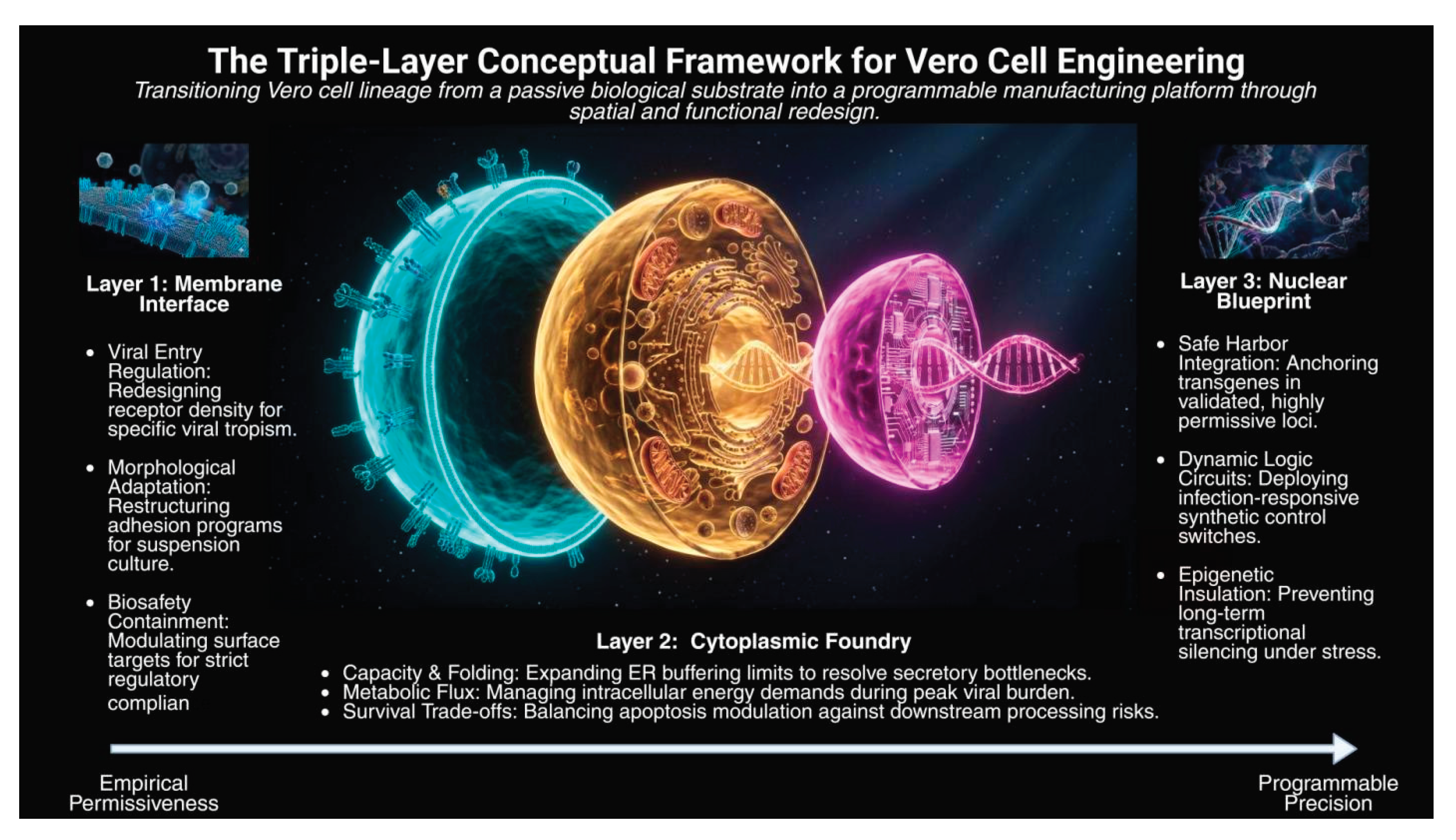
Figure 2.
Proposed Genome-Wide, AI-assisted, quad-layered GSH Filter. Candidate loci derived from genome-wide sequencing are refined through AI-assisted prioritization, chromatin and topological filtering, regulatory safety screening, and experimental validation. The iterative structure reflects the need for feedback-guided recalibration when translating computational predictions into experimentally validated safe harbor loci.
Figure 2.
Proposed Genome-Wide, AI-assisted, quad-layered GSH Filter. Candidate loci derived from genome-wide sequencing are refined through AI-assisted prioritization, chromatin and topological filtering, regulatory safety screening, and experimental validation. The iterative structure reflects the need for feedback-guided recalibration when translating computational predictions into experimentally validated safe harbor loci.
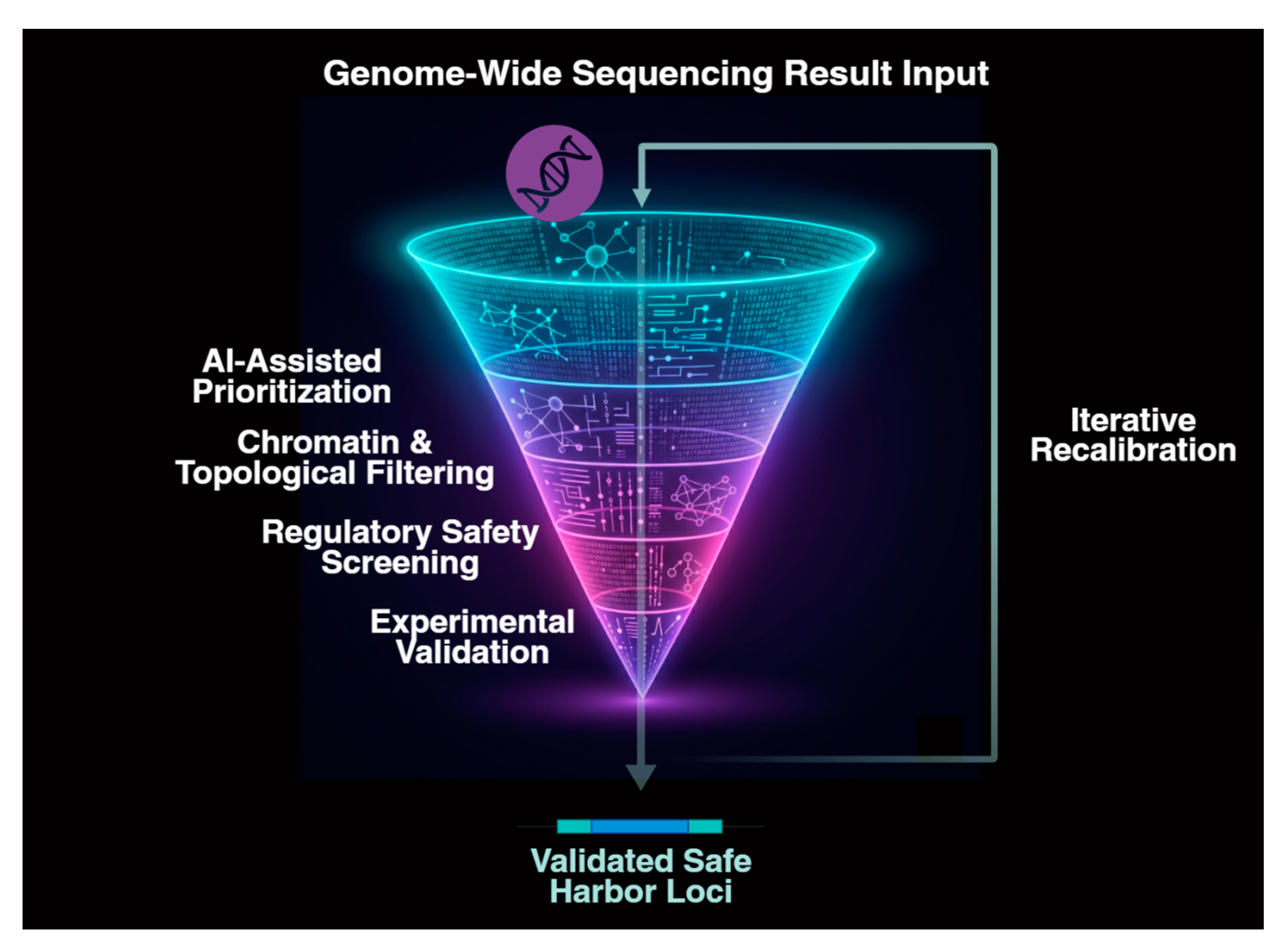
Disclaimer/Publisher’s Note: The statements, opinions and data contained in all publications are solely those of the individual author(s) and contributor(s) and not of MDPI and/or the editor(s). MDPI and/or the editor(s) disclaim responsibility for any injury to people or property resulting from any ideas, methods, instructions or products referred to in the content. |
© 2026 by the author. Licensee MDPI, Basel, Switzerland. This article is an open access article distributed under the terms and conditions of the Creative Commons Attribution (CC BY) license.
Copyright: This open access article is published under a Creative Commons CC BY 4.0 license, which permit the free download, distribution, and reuse, provided that the author and preprint are cited in any reuse.


