

Submitted:
17 April 2026
Posted:
21 April 2026
You are already at the latest version
Abstract
Anthropogenic/artificial light at night (ALAN) may have detrimental effects on individual organisms, ecosystem structure and integrity, and human sleep and circadian rhythms. The wavelength dependence of diverse biological photosensory systems is thus an appropriate consideration when quantifying ALAN. We propose spectral weighting functions for biological detection in animals (BA(λ)) and all organisms (BE(λ)) based on established features of biological spectral sensitivity. Light metrics employing B(λ) provide a biologically relevant way to measure ALAN and evaluate solutions to reduce it through spectral tuning.
Keywords:
light
; light at night
; ALAN
; light pollution
; anthropogenic light
; artificial light
; photoreceptor
; photopigment
; phototaxis
; biological rhythms
; chronobiology
Access to electricity has spread anthropogenic/artificial light at night (ALAN) worldwide, raising concerns about harm to ecosystems and human health[1]. This has created a need to consider ALAN as a pollutant, monitor its distribution, and ameliorate its impact by decreasing light output, restricting light to places and times at which it is required, and by spectral tuning away from wavelengths with highest potential for damage[2,3]. To measure and reduce ALAN’s impact most effectively, we need methods of quantification that account for how light varies in both intensity and wavelength composition. Since biological systems are not equally responsive to all wavelengths, predicting biological effects requires weighting functions that match the spectral sensitivity of the organisms or processes under consideration.
ALAN is often quantified in terms of its illuminance (unit: lux), a standard lighting metric familiar to lighting professionals, decision makers and the public. Illuminance, and related photometric quantities of luminous intensity (unit: candela) and luminous flux (unit: lumen), use a wavelength weighting function V(s) (Figure 1) peaking at 555 nm. Now 100 years old, V(λ) is an idealized efficiency curve for perceived brightness in a ‘standard’ human adult observer in bright light. As the myriad effects of ALAN on the living world do not reliably follow the wavelength sensitivity of V(λ), measuring light this way can underestimate biological sensitivity to sources with strong output outside the green-yellow range (~555 nm), and wrongly treat different lights as equivalent when they have different biological potency (Figure 1). In this paper, we present an attempt by experts in light measurement, photobiology, and ecological light pollution to agree an alternative to V(λ) more relevant for ALAN’s effects on human health and ecosystems.
Biological Wavelength Sensitivity
Any spectral weighting function for unwanted biological effects of ALAN should build upon what is already known about the consequences of light pollution and their photosensory origins. Defining wavelength sensitivity for the damaging effects of ALAN on the living world is inherently challenging. Photosensitivity is widespread among the estimated ∼8.7 million eukaryotic species worldwide[4]. Moreover, it is common for organisms to have multiple, spectrally distinct, photoreceptive mechanisms and to combine their output in complex ways to allow responses over a wide range of intensities/wavelengths or to extract higher level features such as colour. Accordingly, different phenotypic (behavioural or physiological) responses to light even within a single organism often have divergent spectral sensitivity[5]. Furthermore, the ultimate impacts of light pollution will be defined by the complex inter-relationships between species, with damaging effects on one species likely often having secondary or tertiary effects on others (see for example [6,7,8,9]).
The most valuable information about wildlife spectral sensitivity would be for ecosystem level impacts. While a number of papers have demonstrated consequences of light pollution on interactions between species (e.g.[10,11,12,13,14,15,16]), few have specifically examined how light spectrum impacts these interactions[17,18,19,20,21,22,23]. Given the paucity of ecosystem level assessments of wavelength sensitivity, several authors have assembled compilations of spectral sensitivities and phenotypic responses in multiple species in order to examine and draw conclusions about the general likelihood of different parts of the electromagnetic spectrum to elicit biological impact[24,25,26,27,28,29]. Following that lead we here consider the general features of spectral sensitivity in the living world.
Unwanted effects of ALAN in animals include disruptions to: daily, lunar, tidal and seasonal rhythmicity; navigation; food web interactions; reproductive behaviour; recognition of conspecifics; and species community composition[30,31]. Action spectra for light pollution-relevant phenotypic responses in animals reveal great variation in wavelength sensitivity[32,33,34] reflecting diversity in this aspect of animal photoreception. Responses to ALAN in animals will be produced primarily by the opsin family of light activated G-protein coupled receptors, which support both vision and accessory neurophysiological responses to light. Cryptochrome photopigments, however, also contribute to circadian and other timing functions and magneto-orientation in some species[35,36]. Cryptochromes show maximal sensitivity in blue/UV-A portions of the spectrum. Opsin-based visual pigments have spectral sensitivities composed of two broad superimposed curves, creating a main bell-shaped curve with a short wavelength shoulder[33]. The position of the main peak shows great variability from below 340 nm to above 600 nm[23]. Spectral filtering can meanwhile shift functional peak sensitivity to much longer wavelengths than implied by their pigment (λmax)[37,38,39]often to >600 nm. In addition, many freshwater fish have visual pigments based on vitamin A2, which may also shift peak sensitivity to above 600 nm[40]. At the extreme, there are rare examples of photoreceptors peaking as far up as 640 nm[41,42]. Additional diversity in wavelength sensitivity for animals is provided by the tendency of visual systems to combine photoreceptor outputs in complex ways, including spectral opponency.
Humans represent a particular case among animals, both because human health receives special attention, and because so much is known about our photosensitivity. While the specific impact of outdoor ALAN on human health is hard to quantify[43,44,45,46,47], there is reason for concern. Epidemiological data correlate exposure to light at night (including in some cases outdoor ALAN) with poor health, including increased incidence of various cancers[44,45], cardiometabolic disease[46,47,48,49,50,51], neuropsychiatric disorders[43,52], disrupted sleep[53] and all-cause mortality[54,55]. One accepted origin of such effects is disruption of sleep and circadian systems and associated alterations in neuroendocrine, autonomic and other homeostatic processes[56,57,58,59,60]. Levels of nocturnal illumination in the range of those commonly encountered on residential streets, while typically lower than indoors, can engage these effects[61,62]. Such circadian and related physiological effects of light in humans primarily arise via a specialised class of intrinsically photosensitive retinal ganglion cells (ipRGCs) that express the photopigment melanopsin[63,64]. Expert consensus frameworks[62,65] and an international measurement standard (CIE S026[66]) have addressed the problem of wavelength weighting for ipRGC-influenced responses. Those concluded that melanopic irradiance, calculated by applying a wavelength weighting function peaking in the blue part of the spectrum (around 490 nm), is the best currently available predictor for effects of light on these aspects of human biology.
The impact of light pollution on plants and microorganisms has been less studied[6,67,68,69]. Nevertheless, ALAN has been reported to alter the timing of germination, flowering and bud burst, impact biomass, pollination and fruit set, and alter phyllosphere microbial diversity [6,10,70,71,72,73]. Adverse effects of ALAN can impact plant and microorganism communities by disrupting circadian and seasonal control, with knock-on effects on rhythms in processes such as water loss and carbon partitioning[14,74,75], vertical migration in aquatic microorganisms[76], cold acclimation[77], and reproductive timing[78]. Temporal shifts in floral development may misalign flower and pollinator availability and expose reproductive structures to adverse temperatures. Both plants and microorganisms possess arrays of photopigments absorbing light across a broad spectrum from <300 nm to >900 nm to produce these effects[79,80,81]. At shorter wavelengths the UV RESISTANCE LOCUS 8 (UVR8) protein provides UV-B sensitivity, while cryptochromes, phototropins, and other light-oxygen-voltage sensing (LOV) domain proteins are sensitive across blue/UVA. Phytochromes show red/far-red photo-reversibility and in some species extended long-wavelength[82,83] or broader spectral[84] sensitivity. In archaea, bacteria, fungi and algae, sensory rhodopsins are used for orientation, light-regulated development and photoprotection. These light sensors generally show maximal absorbance below 600 nm, although some may have high sensitivity to longer wavelengths[85,86].
In the aquatic environment, the optical properties of the water and its constituents are an additional determinant of spectral sensitivity for all forms of life. Incident light, measured at the surface, is scattered and absorbed as it passes through the water column. Water itself optimally transmits wavelengths between 400 and 500 nm[87], but dissolved/suspended matter can apply strong additional filtration, as can phytoplankton and algae[88]. Dissolved organic matter, such as humic substances, for example, can shift freshwater peak transparency to longer wavelengths above 550 nm[86]. The water constituents, and therefore the spectral properties of water, can vary according to weather, season, climate and time of day (e.g. algal blooms) and be impacted by anthropogenic activities and climate change[89,90]. Species wavelength sensitivity often reflects optical properties of their environment. For example, fish or turtles in clear marine waters are often more responsive to shorter wavelengths than species living in freshwater stained by humic substances[91,92]. In turbid waters, more broad-spectrum responsiveness has been reported e.g.[27,93]. Spectral sensitivity can also change during ontogeny, particularly in amphibiotic species transitioning from aquatic to terrestrial habitats or when this involves transitions between fresh and oceanic water[94,95].
Spectral Weighting Function for Biological Light Detection
Faced with the abundance of biological responses to light and the diversity in photoreceptor wavelength sensitivity, one might question the purpose of any ‘catch all’ spectral weighting function. Each damaging effect of ALAN will have its own wavelength dependence that will, by necessity, be imperfectly approximated by a spectral sensitivity function hoping to also encompass other phenotypic responses with their own distinct wavelength dependence. However, the case for ‘least-worst’ generic measures of light pollution is strong. Firstly, a spectral weighting function is a powerful tool in the armoury of those charged with measuring and manipulating light. Such a function allows light to be quantified in a single dimension - effective light dose – that allows ‘apples and apples’ comparisons between divergent light spectra. As such, it facilitates simple quantification of ALAN and the appearance of quantitative engineering standards. By encompassing differences in spectral power distributions within a single measure of effective light dose it also allows appropriate emphasis on spectral engineering as a component of mitigation methods. With these advantages in mind, what are the options for defining a spectral weighting function for unwanted biological impacts of ALAN?
We have seen that the most commonly applied wavelength weighting in light quantification (V(λ)) imposes bias in favour of light close to its peak at 555 nm (Figure 1). Given the abundance of photoreceptive mechanisms and diversity of responses to ALAN, it is tempting to address this inadvertent bias by replacing V(λ) with a solution imposing no bias whatsoever, by employing a flat response setting sensitivity equal to 1 across the extent of visible light (360-800 nm). That approach would capture the important concept that all ALAN is potentially detectable by living organisms and that no wavelengths are ‘safe’. The implicit assumption that all portions of the visible spectrum are equally damaging, however, does not accord with what is known for biological photosensitivity where, for instance, it is much more common to encounter photoreceptors with high sensitivity to 500 than 800 nm [23].
The best approach to encompassing biases in wavelength sensitivity across the living world would be to start from descriptions of spectral sensitivity for damaging impacts of ALAN. Unfortunately, the number of defined action spectra for pollution effects is small when viewed against the range and complexity of potential impacts. Furthermore, because constructing such action spectra in the wild is challenging, such an action spectrum database will always be incomplete and biased towards those responses that are easier to measure. Single phenotypic action spectra are also an imperfect substitute for ecosystem-level impacts. Welfare of a single species may be impacted by multiple phenotypic effects on that species as well as ALAN impacts on other species, including its symbiotic micro-organisms (holobiont). Within any environment, unwanted effects of ALAN will then encompass multiple phenotypic responses across numerous species whose relative importance may vary over space and time. As a result, the prevailing light pollution wavelength sensitivity in an environment will be a composite of spectral sensitivity functions for individual effects whose relative importance is hard to discern and likely inherently labile. Such circumstances require an alternative ‘least-worst’ approach to approximating biological wavelength sensitivity.
A pragmatic solution is to replace V(λ) with a curve defined according to the wavelength biases of biological photoreceptors. We already know much about photoreceptor wavelength sensitivity across organisms (see above) and the quality of that information will grow over time. Strictly speaking such a curve is a tool aiming to quantify light in terms of its biological detection potential, rather than its polluting impact. Using that curve as an achievable solution to measuring ALAN in a manner relevant for biological impacts requires the assumption that detection is the first step in damage. That seems reasonable, but it is important to acknowledge that it is a compromise. Not all aspects of detection are equally likely to result in damage and downstream processing of photoreceptor outputs could impact phenotypic wavelength sensitivity. Keeping these caveats in mind, we nonetheless consider a biological wavelength weighting function B(λ) designed according to the known spectral sensitivity of photoreceptors in organisms that may be adversely affected by ALAN as the most viable approach.
Building B(l) from photopigment spectral sensitivity faces the challenge of accounting for the substantial diversity in this parameter within and between species. As outlined above, plants and microorganisms share photopigment classes that are distinct from those of animals. We therefore first consider animals separate from plants+microorganisms. In animals, while cryptochromes likely always respond primarily to light below 500 nm [96], opsin-based visual pigments show substantial diversity in wavelength sensitivity. The most complete currently available dataset of opsin visual pigments for terrestrial animals[24] reveals that maximum sensitivity (lmax) of individual pigments covers a wide spectral range, from UV to>600 nm (Figure 2A). That dataset has been summarised as a global mean spectral sensitivity profile, which represents a potential extension of a previously proposed ‘actinic power’ spectral response function for individual light pollution effects [25]. The corresponding profile shows peak sensitivity at 520 nm and has higher sensitivity across shorter wavelengths. The underlying dataset[24], by necessity, reflects those species and aspects of photosensitivity that have been subject to scientific investigation rather than an unbiased survey of animal photoreception. Moreover, vertebrate rod opsins (responsible for dim light vision) are under-represented, and it excludes aquatic species and ‘non-visual’ photopigments including melanopsins and cryptochromes. As several of those known omissions tend to have shorter wavelength sensitivity, we propose adopting a precautionary assumption that shorter wavelengths have generally high capacity for animal detection. Conversely, we accept the relative rarity of very long wavelength sensitivity in the database as being broadly representative of the situation across animals. A wavelength weighting function capturing these concepts would have maximum sensitivity across middle and shorter wavelengths and fall away at longer wavelengths. In defining the decay in sensitivity over longer wavelengths we work from the observations that this portion of the global mean wavelength sensitivity plot[24] resembles the long wavelength limb of a standard opsin-based pigment nomogram[97], and that >95% of invertebrate (and 99% of vertebrate) opsin pigments in the dataset [24] have lmax <590nm. For simplicity we capture these features using a logistic function describing the relationship between relative sensitivity to photon flux (y) and wavelength (x) of animals (y=1/(1+10^(0.026*(x-590))); Figure 2B whose slope recreates the long wavelength limb of an opsin photopigment nomogram and has 50% sensitivity at 590nm. Because it does not approach zero until very long wavelengths (Supplementary Figure 1) this function accounts for the fact that some animals are highly sensitivity to longer wavelengths.
The logistic function in Figure 2B aims to approximate the relative sensitivity of animals to photon flux (photons/s) as a function of wavelength. As physical light measurement technologies commonly measure radiant flux (units W), we present a final function (termed BA(λ)) expressing spectral sensitivity as a function of radiant flux corrected to the wavelength-dependent photon energy (Figure 2B solid line; Supplementary Table 1).
Beyond animals, physiology of light detection become more diverse and there is at least as much difference across plants and micro-organisms as between these groups and animals. Although photosynthetic processes are common in these groups, the major detrimental light pollution impacts are likely photosensory in origin. It follows that these will originate from sensory photoreceptors (UVR8; blue-light receptive cryptochromes, phototropins, and related LOV and blue-light-utilising FAD domain receptors; and the biological inactive, Pr, form of phytochrome)[96,98,99,100]. These pigments show rather stable spectral dependent activation across many species (Figure 2C). Given how little is known about the relative importance of these diverse photoreceptor mechanisms as an origin for damaging effects of ALAN, attempts to account for them in light measurement carry a high level of uncertainty. Assuming equal weighting produces a function that defines the wavelengths of light that these groups of organisms may show high sensitivity to (BP(λ); Figure 2D).
The final, most difficult, challenge is to produce a single curve suitable for all organisms. In principle, this would be based upon a combination of BA(λ) and Bp(λ). Simply summing them provides a function representing one approach to the biological sensitivity to light environment (BE(λ); Figure 2E). This definition of BE provides responsiveness across the spectrum with bias towards shorter wavelengths, matching a reasonable qualitative summary of biological photodetection mechanisms. The implicit assumption, however, that each of the input photoreceptive mechanisms makes, on average, an equal contribution to damaging effects of ALAN is not based upon empirical evidence and may be regarded as unlikely. Applying different weightings to the four constituent curves (animal, UVR8, phytochrome and cryptochrome) reveals the extent to which such a composite curve is sensitive to assumptions regarding the relative importance of these photoreceptor classes to estimates of aggregate biological spectral sensitivity (Supplementary Figure 2). Thus, while BE(λ) may be regarded as a first attempt to encompass all biological photosensitivity, the degree of uncertainty in its derivation should be acknowledged.
Features and Applications
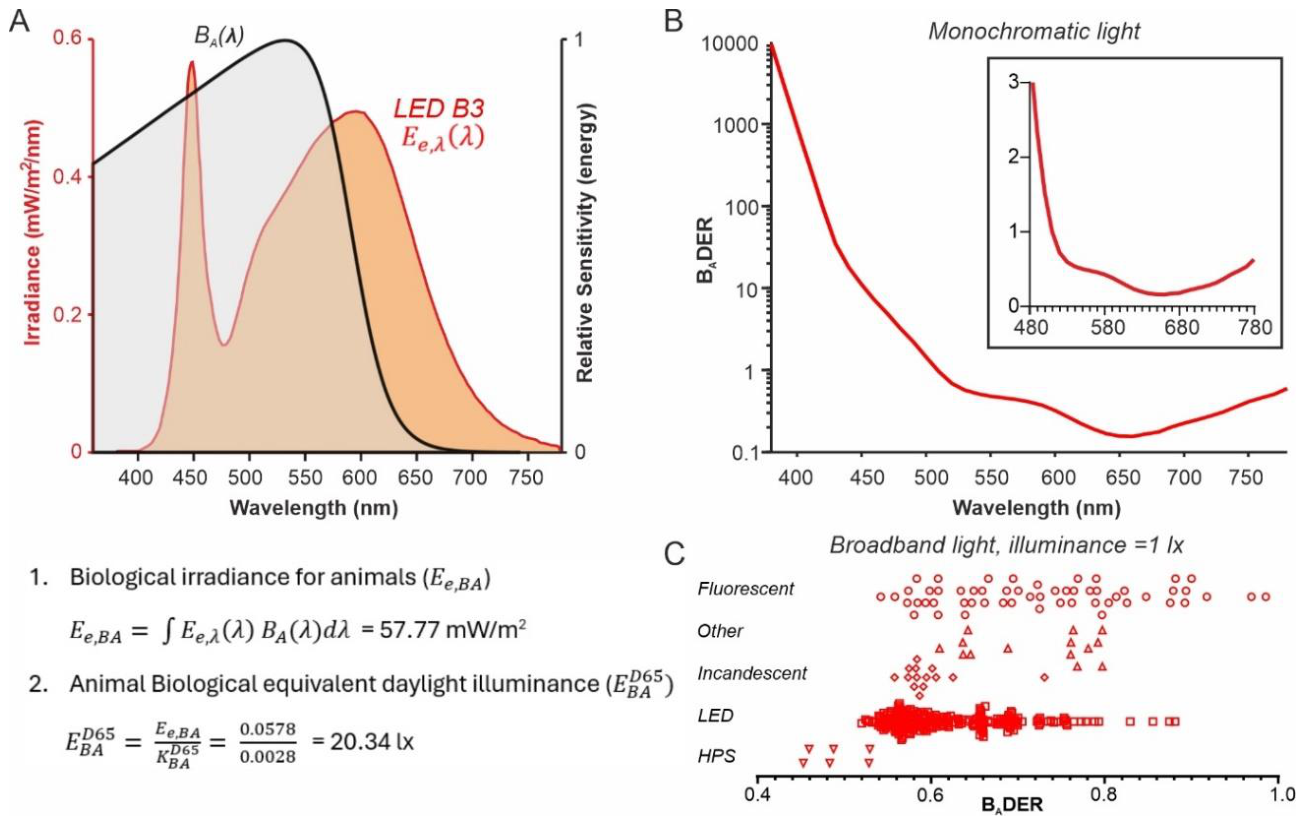
In principle, either of the functions BA(λ) or BE(λ) presented above (or future modifications of them) can be applied to provide biologically relevant measures of light. For simplicity we show here how this may be achieved for the animal function, BA(λ), as this is probably of greatest relevance for current light pollution considerations. Applying BA(λ) as a weighting function to spectral power density measures and integrating across wavelength will return a quantity that may be termed ‘Biological Irradiance’ for animals (= W/ m2; Figure 3A (Equation 1)). Thus, represents an estimate of the effective irradiance for animals.
The CIE standard S026[66] introduced the concept of equivalent daylight illuminance (EDI) as a method of describing such irradiance measures in units that are more intuitive for many people. In brief, EDI quantifies light in terms of the illuminance of ‘daylight’ (in practice a CIE defined spectral power distribution called D65[101]) required to produce the target irradiance. A similar approach has been proposed for wildlife [24]. Equation 2 applies this to ‘biological irradiance’ to calculate biological EDI ( units = lx). In this way, a biological EDI of 1 lx signifies that the light being measured has the same ‘biological irradiance’ as daylight at illuminance of 1 lx.
A further application of such a spectral weighting function is to rank light sources according to their relative biological potency. Faced with a stipulation to achieve a particular (il)luminance, which light source can achieve this with lowest biological irradiance? The biological daylight equivalent methodology described above can be extended to any photometric unit (lux, lumens, candela, and the like). Dividing such measures by their corresponding photometric quantities then provides a straightforward measure of relative efficacy for biological detection (Biological (Animal) daylight efficacy ratio, BADER). High BADER is thus a feature of light sources producing high biological EDI for a given illuminance. The biological efficacy for nominal monochromatic sources (Figure 3B) confirms that longer wavelengths are favoured for minimising biological impact. This outcome is consistent with current pollution reduction advice to choose longer wavelength lights where possible [102,103,104,105].
Metrics applying BA(λ) thus provide an opportunity to compare light environments and light sources quantitatively. From a lighting design perspective, by quantifying the potential benefits of spectrum engineering, it also reveals the limitations of that approach. Light across the visible spectrum contributes to biological irradiance, highlighting that there is no part of the spectrum that does not have the potential for biological impact. Across a range of standard ‘white’ light sources, biological efficacy for animals varies between 0.45 and 1 (Figure 3C), highlighting the benefits to be gained by choosing the right source but also the importance of minimising light irrespective of the source used.
We provide an online resource to calculate biological irradiance, biological EDI and biological daylight efficacy ratio from spectral power measurements (https://alphaopics.shinyapps.io/ecological_light_toolbox/). In due course it would be helpful to have devices that measure Biological Irradiance directly. BA(λ) is qualitatively consistent with the current advice for mitigating light pollution viz that light of any wavelength should be regarded as polluting but that light sources with less short wavelength are preferred[102,103,104,105] (but see also[106,107]). BA(λ) also produces values that are qualitatively consistent with other proposed metrics relevant for light pollution. Thus, across a bank of standard ‘white’ light sources, biological efficacy is strongly correlated with colour temperature, melanopic efficacy and starlight index[108] (Supplementary Figure 3A-C).
Concerns and Considerations
BA(λ) and BE(λ) represent attempts to provide evidence-based weighting functions for sensory detection of ALAN. Both the logic applied to producing these functions and the information upon which they are based are available for challenge and improvement. Nonetheless, any version of B(λ) will be a catch-all and, as such, will provide an imperfect prediction of effective light dose for any single effect of ALAN. It follows that, where there are particular light pollution impacts to avoid, quantification should ideally employ a more specific wavelength sensitivity function matched to the relevant phenotypic action spectrum[25]. This could include cases in which a more precise description of light pollution spectral sensitivity is available (e.g. circadian and sleep disruption in humans) or where portions of the spectrum are known to have specific relevance (e.g. firefly courtship). Similarly, where empirical data exist regarding the best light sources for mitigating particular unwanted effects it may be sensible to apply that knowledge in lighting design even if it produces higher biological irradiance. These caveats notwithstanding, the principles underlying generation of B(λ) should ensure reasonable outcomes for many polluting responses whose action spectrum is not exactly matched by that function. Thus, for example, although neither the green turtle nor dipteran attraction action spectra reproduced in Figure 1 are closely aligned to BA(λ), ranking light according to BADER represents a reasonable prediction of efficacy for eliciting either of these effects of pollution (Supplementary Figure 3E&F).
It may be appropriate to generate variants of B(λ) functions according to the specific context of light exposure. That strategy has been adopted for V(λ) where e.g. age-dependent corrections account for predictable changes in human spectral sensitivity. Similar wavelength-dependent correction factors may be applied to B(λ) where concern is focussed on a particular group of species or to account for known biases in light propagation. In aquatic environments these could approximate filtering properties of the water column[109] and, on land, the wavelength dependence of skyglow[110]. There may be systematic differences in photosensory spectral sensitivity for animals in marine, freshwater, arid, arctic, tropical, alpine, rural, and suburban ecosystems, and according to season or other conditions. Higher light intensities engage different response systems, meaning that wavelength sensitivity may also differ depending on absolute light intensity. To ensure compatibility with any such refined versions of B(λ) to appear in future, and allow ready conversion to photometric and radiometric measures, we recommend recording spectral power distribution whenever possible.
Defining biological wavelength sensitivity from the properties of individual photoreceptors does not account for the possibility of spectral opponency (‘colour vision’) produced by antagonistic interactions downstream[111]. Provided that light levels fall between threshold and saturation points for the photoreceptors involved, the outcome of such spectral opponency is a product of spectrum but not intensity. Consequently, it does not fall within the scope of metrics such as Biological EDI that are designed to quantify effective intensity. Nevertheless, it is worth considering the extent to which such colour vision mechanisms may produce especial sensitivity to parts of the spectrum assigned low sensitivity in BA(λ). Lack of broad comparative quantifications makes it difficult to determine the degree to which colour vision would conflict with the BA(λ) function. Colour-opponent chromatic processing can roughly be described as the difference between two spectral inputs, and the range of hues depends on the total spectral range and the overlap between opponent channels. For human colour vision this means that we experience red between 620 and 750 nm although our red sensitive cones peak at 564 nm. For most other animals, this long wave shift is much smaller because the opponent overlap is smaller. It follows that most colour vision would produce sensitivity to parts of the spectrum already covered by the animal curve (Figure 2B) and further extension towards longer wavelengths would not change BA(λ) by very much.
The B(λ) curves describe sensitivity to visible light (360nm to 800nm). Importantly, this does not imply that electromagnetic radiation outside this range is biologically inert. The DNA and protein damage potential of shorter wavelengths is reason enough to argue against their inadvertent release. Meanwhile as plants, microorganisms and animals can all display sensitivity to near and far infra-red radiation[82,83], the potential biological impact of longer wavelengths should receive separate consideration.
Conclusions
B(λ) curves represent a best attempt to describe biological wavelength sensitivity. While certainly imperfect for any single damaging effect of ALAN they avoid the bias towards 555nm of V(λ) and are based on the best currently available knowledge of biological photosensitivity. We argue therefore that they represent a useful spectral weighting function for measurement applications considering the biological impacts of ALAN. The biological irradiance metric can facilitate descriptions of the intensity dependence of responses to ALAN and be used to normalise intensity when exploring the effects of changing spectra. Data collected in such a way will be available for subsequent meta-analyses aimed at defining acceptable thresholds for ALAN and refining the B(λ) functions.
Given the current focus of concern and regulation towards minimising effects on animals we anticipate that BA(λ) will be of greater immediate utility than BE(λ). BA(λ) also has the advantage of incorporating fewer extrapolations from known properties of biological photosensitivity than BE(λ) (in which the relative contribution of different photoreceptor classes to the combined function is arbitrarily defined). Nonetheless, we hope that our description of BE(λ) is a useful step in the process of also considering the contribution of plants and micro-organisms to detrimental effects of ALAN. Across a basket of ‘white’ light sources the biological daylight efficacy ratio for BE(λ) is positively correlated with that BA(λ) (Supplementary Figure 3D), highlighting that much of the wavelength bias of plants+microorganisms is accounted for by the animal function. The exception is at very long wavelengths in which the inclusion of phytochromes boosts sensitivity for BE(λ). Accordingly, accounting for plants and microorganisms in lighting designs aiming to minimise unwanted effects of ALAN may require applying an additional penalty to light sources with strong long wavelength output (Supp Figure 3). Further observational and interventional studies on all aspects of biological light pollution are required, but there is a particular need for more community ecology studies of all types, and particularly ones encompassing cross-species interactions considering plant-animal interactions, the role of ecosystem engineers/habitat formers, and the holobiont. We hope that those will be able to inform refinements to BE(λ) to the extent that it provides best possible predictions for ecosystem level impacts of ALAN and could eventually supercede BA(λ) as a tool for quantification.
Acknowledgments
This work represents the outcome of a workshop receiving financial and in-kind support from University of Manchester, Liv Sidse Jansen Memorial Foundation, Bioclocks UK (BBSRC BB/Y006194/1), The Netherlands BioClock (NWO-ORC NWA.1292.19.077), and International Commission on Illumination (CIE). We are grateful to Drs Luke Price (UK Health Security Agency) and Avalon Owen (Harvard University) for their contributions to formulating these ideas and comments on the manuscript.
Conflicts of interest
RJL – none. TMB –none. GCB- has a current unlicensed patent (USPTO 7678140 B2). He has received research grant funding and equipment donations from PhotoPharmics Inc. and is a paid member of the PhotoPharmics Scientific Advisory Board. He is a Scholar and Consultant for the Nova Institute. AD-declares the following potential conflicts of interest in the past five years (2022–2026). Academic roles: Member of Joint Technical Committee 20 (JTC20) of the International Commission on Illumination (CIE); Division Reporter (DR6-50) of the International Commission on Illumination (CIE). DMD – none. KAF – none. KJG - serves as an uncompensated member of the board of directors of DarkSky International. PH – none. FH – none. AJ – none. EK – none. CK – dues paying member of DarkSky International, uncompensated member of CIE TC4-48 until 2021. TL – none. EM – none. D-EN – none. GO – none. NWR- none. BS – none. KS – serves as an uncompensated member of the expert team obtrusive lighting of the Dutch Light Science Foundation (NSVV). PT-is an employee of Thorn Lighting. RAH – none.
References
- Linares Arroyo, H.; Abascal, A.; Degen, T.; Aube, M.; Espey, B.R.; Gyuk, G.; et al. Monitoring, trends and impacts of light pollution. Nature Reviews Earth and Environment 2024, 5, 427–30. [Google Scholar] [CrossRef]
- Gaston, K.J.; Davies, T.W.; Bennie, J.; Hopkins, J. Reducing the ecological consequences of night-time light pollution: options and developments. Journal of Applied Ecology 2012, 49(6), 1256–66. [Google Scholar] [CrossRef] [PubMed]
- Holker, F.; Bolliger, J.; Davies, T.W.; Giavi, S.; Jechow, A.; Kalinkat, G.; et al. 11 pressing research questions on how light pollution affects biodiversity. Frontiers in Ecology and Evolution 2021, 9, 767177. [Google Scholar] [CrossRef]
- Mora, C.; Tittensor, D.P.; Adl, S.; Simpson, A.G.; Worm, B. How many species are there on Earth and in the ocean? PLoS Biol. 2011, 9(8), e1001127. [Google Scholar] [CrossRef] [PubMed] [PubMed Central]
- Alaasam, V.J.; Kernbach, M.E.; Miller, C.R.; Ferguson, S.M. The Diversity of Photosensitivity and its Implications for Light Pollution. Integr Comp Biol. 2021, 61(3), 1170–81. [Google Scholar] [CrossRef] [PubMed]
- Bennie, J.; Davies, T.W.; Cruse, D.; Inger, R.; Gaston, K.J. Cascading effects of artificial light at night: resource-mediated control of herbivores in a grassland ecosystem. Philos Trans R Soc Lond B Biol Sci. 2015, (1667), 370. [Google Scholar] [CrossRef] [PubMed] [PubMed Central]
- Hermas, C.I.; Litovski, I.; De Pastors, M.; Visser, M.E.; Spoelstra, K. Artificial light at night drives diel activity patterns of synanthropic pipistrelle bats and their prey. Science of the Total Environment 2024, 940, 173699. [Google Scholar] [CrossRef] [PubMed]
- Cieraad, E.; Strange, E.; Flink, M.; Schrama, M.; Spoelstra, K. Artificial light at night affects plant–herbivore interactions. Journal of Applied Ecology 2023, 60, 400–10. [Google Scholar] [CrossRef]
- Levy, O.; Fernandes de Barros Marangoni, L.; Benichou, J.I.C.; Rottier, C.; Beraud, E.; Grover, R.; et al. Artificial light at night (ALAN) alters the physiology and biochemistry of symbiotic reef building corals. Environmental Pollution 2020, 266(2), 114987. [Google Scholar] [CrossRef]
- Knop, E.; Zoller, L.; Ryser, R.; Gerpe, C.; Horler, M.; Fontaine, C. Artificial light at night as a new threat to pollination. Nature 2017, 548(7666), 206–9. [Google Scholar] [CrossRef] [PubMed]
- Giavi, S.; Fontaine, C.; Knop, E. Impact of artificial light at night on diurnal plant-pollinator interactions. Nat Commun. 2021, 12(1), 1690. [Google Scholar] [CrossRef] [PubMed] [PubMed Central]
- Seymoure, B.; Dell, A.; Holker, F.; Kalinkat, G. A framework for untangling the consequences of artificial light at night on species interactions. Philos Trans R Soc Lond B Biol Sci. 2023, 378(1892), 20220356. [Google Scholar] [CrossRef] [PubMed] [PubMed Central]
- Manfrin, A.; Singer, G.; Larsen, S.; Weiss, N.; van Grunsven, R.H.; Weiss, N.-S.; et al. Artificial Light at Night Affects Organism Flux across Ecosystem Boundaries and Drives Community Structure. Fronteirs in Envrionmental Science 2017, 5, 00061. [Google Scholar] [CrossRef]
- Holker, F.; Wurzbacher, C.; Weissenborn, C.; Monaghan, M.T.; Holzhauer, S.I.; Premke, K. Microbial diversity and community respiration in freshwater sediments influenced by artificial light at night. Philos Trans R Soc Lond B Biol Sci. 2015, (1667), 370. [Google Scholar] [CrossRef] [PubMed] [PubMed Central]
- Grubisic, M.; Singer, G.; Cristina Bruno, M.; van Grunsven, R.H.; Manfrin, A.; Monaghan, M.T.; et al. Artificial light at night decreases biomass and alters community composition of benthic primary producers in a sub-alpine stream. Limnology and Oceanography 2017, 62(6), 2799–810. [Google Scholar] [CrossRef]
- Sanders, D.; Kehoe, R.; Cruse, D.; van Veen, F.J.F.; Gaston, K.J. Low Levels of Artificial Light at Night Strengthen Top-Down Control in Insect Food Web. Curr Biol. 2018, 28(15), 2474–8 e3. [Google Scholar] [CrossRef] [PubMed]
- Grubisic, M.; van Grunsven, R.H.A.; Manfrin, A.; Monaghan, M.T.; Holker, F. A transition to white LED increases ecological impacts of nocturnal illumination on aquatic primary producers in a lowland agricultural drainage ditch. Environmental Pollution 2018, 240, 630–8. [Google Scholar] [CrossRef]
- Boom, M.P.; Spoelstra, K.; Biere, A.; Knop, E.; Visser, M.E. Pollination and fruit infestation under artificial light at night:light colour matters. Sci Rep. 2020, 10(1), 18389. [Google Scholar] [CrossRef] [PubMed] [PubMed Central]
- Parkinson, E.; Tiegs, S.D. Spectral composition of light-emitting diodes impacts aquatic and terrestrial invertebrate communities with potential implications for cross-ecosystem subsidies. Philos Trans R Soc Lond B Biol Sci. 2023, 378(1892), 20220361. [Google Scholar] [CrossRef] [PubMed] [PubMed Central]
- Spoelstra, K.; Teurlincx, S.; Courbois, M.; Hopkins, Z.M.; Visser, M.E.; Jones, T.M.; et al. Long-term exposure to experimental light affects the ground-dwelling invertebrate community, independent of light spectra. Philos Trans R Soc Lond B Biol Sci. 2023, 378(1892), 20220364. [Google Scholar] [CrossRef] [PubMed] [PubMed Central]
- Spoelstra, K.; van Grunsven, R.H.; Donners, M.; Gienapp, P.; Huigens, M.E.; Slaterus, R.; et al. Experimental illumination of natural habitat--an experimental set-up to assess the direct and indirect ecological consequences of artificial light of different spectral composition. Philos Trans R Soc Lond B Biol Sci. 2015, (1667), 370. [Google Scholar] [CrossRef] [PubMed] [PubMed Central]
- Tao, Y.; Wolinska, J.; Holker, F.; Agha, R. Light intensity and spectral distribution affect chytrid infection of cyanobacteria via modulation of host fitness. Parasitology 2020, 147(11), 1206–15. [Google Scholar] [CrossRef] [PubMed] [PubMed Central]
- Sanders, D.; Baker, D.J.; Cruse, D.; Bell, F.; van Veen, F.J.F.; Gaston, K.J. Spectrum of artificial light at night drives impact of a diurnal species in insect food web. Sci Total Environ. 2022, 831, 154893. [Google Scholar] [CrossRef] [PubMed]
- Longcore, T. A compendium of photopigment peak sensitivities and visual spectral response curves of terrestrial wildlife to guide design of outdoor nighttime lighting. Basic and Applied Ecology 2023, 73, 40–50. [Google Scholar] [CrossRef]
- Longcore, T.; Rodriguez, A.; Witherington, B.E.; Penniman, J.F.; Herf, L.; Herf, M. Rapid assessment of lamp spectrum to quantify ecological effects of light at night. Journal of Experimental Zoology - A 2018, 329(8-9), 511–21. [Google Scholar] [CrossRef]
- Yang, Y.; Liu, Q.; Pan, C.; Chen, J.; Xu, B.; Liu, K.; et al. Species sensitivities to artificial light at night: A phylogenetically controlled multilevel meta-analysis on melatonin suppression. Ecology Letters 2024, 27(2), e14387. [Google Scholar] [CrossRef]
- Kuhne, J.L.; van Grunsven, R.H.A.; Jechow, A.; Holker, F. Impact of Different Wavelengths of Artificial Light at Night on Phototaxis in Aquatic Insects. Integrative and Comparative Biology 2021, 61(3), 1182–90. [Google Scholar] [CrossRef]
- Seymoure, B.M.; Linares, C.; White, J. Connecting spectral radiometry of anthropogenic light.
- sources to the visual ecology of organisms. Journal of Zoology 2019, 308(2), 93–110. [CrossRef]
- Davies, T.W.; Bennie, J.; Inger, R.; de Ibarra, N.H.; Gaston, K.J. Artificial light pollution: are shifting spectral signatures changing the balance of species interactions? Glob Chang Biol. 2013, 19(5), 1417–23. [Google Scholar] [CrossRef] [PubMed] [PubMed Central]
- Sanders, D.; Frago, E.; Kehoe, R.; Patterson, C.; Gaston, K.J. A meta-analysis of biological impacts of artificial light at night. Nat Ecol Evol. 2021, 5(1), 74–81. [Google Scholar] [CrossRef] [PubMed]
- Meah, R.J.; Sumner-Rooney, L.; Venables, S.V.; Lloyd-How, S.T.; Massy, R.; Hawkes, W.L.S.; et al. Light pollution creates multiple threats to the movement ecology of nocturnal arthropod taxa. Curr Biol. 2026, 36(2), 541–8 e4. [Google Scholar] [CrossRef] [PubMed]
- Meszaros, A.; Kriska, G.; Egri, A. Wavelength-specific negatively phototactic responses of the burrowing mayfly larvae Ephoron virgo. J Exp Biol. 2024, (10) Epub 20240521, 227. [Google Scholar] [CrossRef] [PubMed]
- Przyrembel, C.; Keller, B.; Neumeyer, C. Trichromatic color vision in the salamander (Salamandra salamandra). J Comp Physiol A 1995, 176, 575–86. [Google Scholar] [CrossRef]
- Witherington, B.E.; Bjorndal, K.A. Influences of Wavelength and Intensity on Hatchling Sea Turtle Phototaxis: Implications for Sea-Finding Behavior. Copeia 1991, 1991(4), 1060–9. [Google Scholar] [CrossRef]
- Zurl, M.; Poehn, B.; Rieger, D.; Krishnan, S.; Rokvic, D.; Veedin Rajan, V.B.; et al. Two light sensors decode moonlight versus sunlight to adjust a plastic circadian/circalunidian clock to moon phase. Proc Natl Acad Sci U S A 2022, 119(22), e2115725119. [Google Scholar] [CrossRef] [PubMed] [PubMed Central]
- Yoshii, T.; Hermann-Luibl, C.; Helfrich-Forster, C. Circadian light-input pathways in Drosophila. Commun Integr Biol. 2016, 9(1), e1102805. [Google Scholar] [CrossRef] [PubMed Central]
- Wilby, D.; Roberts, N.W. Optical influence of oil droplets on cone photoreceptor sensitivity. J Exp Biol. 2017, 220 Pt 11, 1997–2004. [Google Scholar] [CrossRef] [PubMed Central]
- Cronin, T.W. Visual Ecology. The Senses: A Comprehensive Reference 2008, 211–45. [Google Scholar]
- Belusic, G.; Ilic, M.; Meglic, A.; Pirih, P. Red-green opponency in the long visual fibre photoreceptors of brushfoot butterflies (Nymphalidae). Proc Biol Sci. 2021, 288(1961), 20211560. [Google Scholar] [CrossRef] [PubMed] [PubMed Central]
- Jokela-Maatta, M.; Viljanen, M.; Nevela, N.; Donner, K.; Bronmark, C. Photoreceptors and eyes of pikeperch Sander lucioperca, pike Esox lucius, perch Perca fluviatilis and roach Rutilus rutilus from a clear and a brown lake. Journal of Fish Biology 2018, 95(1), 200–13. [Google Scholar] [CrossRef]
- Stavenga, D.G.; Arikawa, K. Photoreceptor spectral sensitivities of the Small White butterfly Pieris rapae crucivora interpreted with optical modeling. J Comp Physiol A Neuroethol Sens Neural Behav Physiol. 2011, 197(4), 373–85. [Google Scholar] [CrossRef] [PubMed] [PubMed Central]
- Palacios, A.G.; Varela, F.J.; Srivastava, R.; Goldsmith, T.H. Spectral sensitivity of cones in the goldfish, Carassius auratus. Vision Res. 1998, 38(14), 2135–46. [Google Scholar] [CrossRef] [PubMed]
- Deprato, A.; Haldar, P.; Navarro, J.F.; Harding, B.N.; Lacy, P.; Maidstone, R.; et al. Associations between light at night and mental health: A systematic review and meta-analysis. Sci Total Environ. 2025, 974, 179188. [Google Scholar] [CrossRef] [PubMed]
- Palomar-Cros, A.; Deprato, A.; Papantoniou, K.; Straif, K.; Lacy, P.; Maidstone, R.; et al. Indoor and outdoor artificial light-at-night (ALAN) and cancer risk: A systematic review and meta-analysis of multiple cancer sites and with a critical appraisal of exposure assessment. Sci Total Environ. 2024, 955, 177059. [Google Scholar] [CrossRef] [PubMed]
- Ma, S.; Alsabawi, Y.; El-Serag, H.B.; Thrift, A.P. Exposure to Light at Night and Risk of Cancer: A Systematic Review, Meta-Analysis, and Data Synthesis. Cancers (Basel) 2024, (15) Epub 20240726, 16. [Google Scholar] [CrossRef] [PubMed] [PubMed Central]
- Palomar-Cros, A.; Espinosa, A.; Bara, S.; Sanchez, A.; Valentin, A.; Cirach, M.; et al. Outdoor artificial light-at-night and cardiometabolic disease risk: an urban perspective from the Catalan GCAT cohort study. Am J Epidemiol 2024, Epub 20240819. [Google Scholar] [CrossRef] [PubMed]
- Fan, M.; Yuan, J.; Zhang, S.; Fu, Q.; Lu, D.; Wang, Q.; et al. Association between outdoor artificial light at night and metabolic diseases in middle-aged to older adults-the CHARLS survey. Front Public Health 2025, 13, 1515597. [Google Scholar] [CrossRef] [PubMed] [PubMed Central]
- Obayashi, K.; Saeki, K.; Iwamoto, J.; Okamoto, N.; Tomioka, K.; Nezu, S.; et al. Exposure to light at night, nocturnal urinary melatonin excretion, and obesity/dyslipidemia in the elderly: a cross-sectional analysis of the HEIJO-KYO study. J Clin Endocrinol Metab. 2013, 98(1), 337–44. [Google Scholar] [CrossRef] [PubMed]
- Obayashi, K.; Tai, Y.; Yamagami, Y.; Saeki, K. Associations between indoor light pollution and unhealthy outcomes in 2,947 adults: Cross-sectional analysis in the HEIJO-KYO cohort. Environ Res. 2022, 215 Pt 2, 114350. [Google Scholar] [CrossRef] [PubMed]
- Obayashi, K.; Yamagami, Y.; Kurumatani, N.; Saeki, K. Bedroom lighting environment and incident diabetes mellitus: a longitudinal study of the HEIJO-KYO cohort. Sleep Med. 2020, 65, 1–3. [Google Scholar] [CrossRef] [PubMed]
- Obayashi, K.; Yamagami, Y.; Tatsumi, S.; Kurumatani, N.; Saeki, K. Indoor light pollution and progression of carotid atherosclerosis: A longitudinal study of the HEIJO-KYO cohort. Environ Int. 2019, 133 Pt B, 105184. [Google Scholar] [CrossRef] [PubMed]
- Burns, A.C.; Windred, D.P.; Rutter, M.K.; Olivier, P.; Vetter, C.; Saxena, R.; et al. Day and night light exposure are associated with psychiatric disorders: an objective light study. Nature Mental Health 2023, 1(11), 853–62. [Google Scholar] [CrossRef]
- Sakhvidi, M.J.Z.; Mehrparvar, A.; Zare, F.; Rahmanian, M.; Yang, J.; Ebrahimi, A.S.; et al. Association between exposure to outdoor light at night and sleep habits in Shahedieh Cohort Study: A cross-sectional analysis. Environmental Pollution 2025, 385, 127144. [Google Scholar] [CrossRef]
- Windred, D.P.; Burns, A.C.; Lane, J.M.; Olivier, P.; Rutter, M.K.; Saxena, R.; et al. Brighter nights and darker days predict higher mortality risk: A prospective analysis of personal light exposure in. Proc Natl Acad Sci U S A 2024, 121(43), e2405924121. [Google Scholar] [CrossRef] [PubMed Central]
- Sun, S.; Cao, W.; Ge, Y.; Ran, J.; Sun, F.; Zeng, Q.; et al. Outdoor light at night and risk of coronary heart disease among older adults: a prospective cohort study. Eur Heart J. 2021, 42(8), 822–30. [Google Scholar] [CrossRef] [PubMed]
- Lunn, R.M.; Blask, D.E.; Coogan, A.N.; Figueiro, M.G.; Gorman, M.R.; Hall, J.E.; et al. Health consequences of electric lighting practices in the modern world: A report on the National Toxicology Program’s workshop on shift work at night, artificial light at night, and circadian disruption. Sci Total Environ. 2017, 607-608, 1073–84. [Google Scholar] [CrossRef] [PubMed] [PubMed Central]
- Mason, I.C.; Boubekri, M.; Figueiro, M.G.; Hasler, B.P.; Hattar, S.; Hill, S.M.; et al. Circadian Health and Light: A Report on the National Heart, Lung, and Blood Institute’s Workshop. J Biol Rhythms 2018, 33(5), 451–7. [Google Scholar] [CrossRef] [PubMed] [PubMed Central]
- Stevens, R.G.; Brainard, G.C.; Blask, D.E.; Lockley, S.W.; Motta, M.E. Breast cancer and circadian disruption from electric lighting in the modern world. CA Cancer J Clin. 2014, 64(3), 207–18. [Google Scholar] [CrossRef] [PubMed] [PubMed Central]
- Chellappa, S.L.; Vujovic, N.; Williams, J.S.; Scheer, F. Impact of Circadian Disruption on Cardiovascular Function and Disease. Trends Endocrinol Metab. 2019, 30(10), 767–79. [Google Scholar] [CrossRef] [PubMed] [PubMed Central]
- Parameswaran, G.; Ray, D.W. Sleep, circadian rhythms, and type 2 diabetes mellitus. Clin Endocrinol (Oxf) 2021. [Google Scholar] [CrossRef] [PubMed]
- Brown, T.M. Melanopic illuminance defines the magnitude of human circadian light responses under a wide range of conditions. J Pineal Res. 2020, e12655. [Google Scholar] [CrossRef] [PubMed]
- Brown, T.M.; Brainard, G.C.; Cajochen, C.; Czeisler, C.A.; Hanifin, J.P.; Lockley, S.W.; et al. Recommendations for daytime, evening, and nighttime indoor light exposure to best support physiology, sleep, and wakefulness in healthy adults. PLoS Biol. 2022, 20(3), e3001571. [Google Scholar] [CrossRef] [PubMed] [PubMed Central]
- Do, M.T.H. Melanopsin and the Intrinsically Photosensitive Retinal Ganglion Cells: Biophysics to Behavior. Neuron. 2019, 104(2), 205–26. [Google Scholar] [CrossRef] [PubMed]
- Paul, S.; Brown, T. Direct effects of the light environment on daily neuroendocrine control. J Endocrinol. 2019, 243, R1–R18. [Google Scholar] [CrossRef] [PubMed]
- Lucas, R.J.; Peirson, S.N.; Berson, D.M.; Brown, T.M.; Cooper, H.M.; Czeisler, C.A.; et al. Measuring and using light in the melanopsin age. Trends in neurosciences 2014, 37(1), 1–9. [Google Scholar] [CrossRef] [PubMed]
- CIE. S 026/E CIE System for Metrology of Optical Radiation for ipRGC-Influenced Responses to Light. CIE Central Bureau: Vienna, 2018.
- Briggs, W.R. Physiology of plant responses to artifical light. In Ecological Consequences of Artificial Light at Night; Rich, C., Longcore, T., Eds.; Island Press: Washington, Covelo, London, 2006; pp. 389–412. [Google Scholar]
- Heinen, R. A spotlight on the phytobiome: plant-mediated interactions in an illuminated world. Basic and Applied Ecology 2021, 57, 146–58. [Google Scholar] [CrossRef]
- Maggi, E.; Bongiorni, L.; Fontanini, D.; Capocchi, A.; Dal Bello, M.; Giacomelli, A.; et al. Artifical light at night erases positive interactions across trophic levels. Functional Ecology 2019, 34(3), 694–706. [Google Scholar] [CrossRef]
- Bennie, J.; Davis, T.W.; Cruse, D.; Gaston, K.J. Ecological effects of artificial light at night on wild plants. Journal of Ecology 2016, 104, 611. [Google Scholar] [CrossRef]
- Bennie, J.; Cruse, T.W.; Bell, F.; Gaston, K.J. Artificial light at night alters grassland vegetation species composition and phenology. Journal of Applied Ecology 2018, 55, 442–50. [Google Scholar] [CrossRef]
- Ffrench-Constant, R.H.; Somers-Yeates, R.; Bennie, J.; Economou, T.; Hodgson, D.; Spalding, A.; et al. Light pollution is associated with earlier tree budburst across the United Kingdom. Proc Biol Sci. 2016, (1833), 283. [Google Scholar] [CrossRef] [PubMed] [PubMed Central]
- Alsanius, B.W.; Bergstrand, K.-J.; Hartmann, R.; Gharaie, S.; Wohanka, W.; Dorais, M.; et al. Ornamental flowers in new light: Artificial lighting shapes the microbial phyllosphere community structure of greenhouse grown sunflowers (Helianthus annus L.). Scientia Horticulturae 2017, 216, 234–47. [Google Scholar] [CrossRef]
- Costa, J.M.; Candia, A.N.; Sellaro, R. Open All Night Long: the dark side of stomatal control. Journal of Experimental Botany 2014, 167, 289–94. [Google Scholar] [CrossRef]
- Graf, A.; Smith, A.M. Starch and the clock: the dark side of plant productivity. Trends in Plant Science 2011, 16, 169–75. [Google Scholar] [CrossRef]
- Haro, S.; Bohorquez, J.; Lara, M.; Garcia-Robledo, E.; Gonzalez, C.J.; Crespo, J.M.; et al. Diel patterns of microphytobenthic primary production in intertidal sediments: the role of photoperiod on the vertical migration circadian rhythm. Sci Rep. 2019, 9(1), 13376. [Google Scholar] [CrossRef] [PubMed] [PubMed Central]
- Jabbur, M.L.; Bratton, B.P.; Johnson, C.H. Bacteria can anticipate the seasons: Photoperiodism in cyanobacteria. Science 2024, 385(6713), 1105–11. [Google Scholar] [CrossRef] [PubMed] [PubMed Central]
- Wang, F.; Han, T.; Jeffrey Chen, Z. Circadian and photoperiodic regulation of the vegetative to reproductive transition in plants. Commun Biol. 2024, 7(1), 579. [Google Scholar] [CrossRef] [PubMed] [PubMed Central]
- Paik, I.; Huq, E. Plant photoreceptors: Multi-functional sensory proteins and their signaling networks. Semin Cell Dev Biol. 2019, 92, 114–21. [Google Scholar] [CrossRef] [PubMed] [PubMed Central]
- Yu, Z.; Fischer, R. Light sensing and responses in fungi. Nat Rev Microbiol 2019, 17(1), 25–36. [Google Scholar] [CrossRef] [PubMed]
- Fraikin, G.Y.; Strakhovskaya, M.G.; Belenikina, N.S.; Rubin, A.B. Bacterial photosensory proteins: Regulatory functions and optogenetic applications. Microbiology 2015, 84, 461–72. [Google Scholar] [CrossRef]
- Casal, J.J.; Candia, A.N.; Sellaro, R. Light perception and signalling by phytochrome. Journal of Experimental Botany 2014, 65, 2835–45. [Google Scholar] [CrossRef]
- Karniol, B.; Vierstra, R.D. The pair of bacteriophytochromes from Agrobacterium tumefaciens are histidine kinases with opposing photobiological properties. Proc Natl Acad Sci U S A 2003, 100(5), 2807–12. [Google Scholar] [CrossRef] [PubMed Central]
- Rockwell, N.C.; Duanmu, D.; Martin, S.S.; Bachy, C.; Price, D.C.; Bhattacharya, D.; et al. Eukaryotic algal phytochromes span the visible spectrum. Proc Natl Acad Sci U S A 2014, 111(10), 3871–6. [Google Scholar] [CrossRef] [PubMed] [PubMed Central]
- Ernst, O.P.; Lodowski, D.T.; Elstner, M.; Hegemann, P.; Brown, L.S.; Kandori, H. Microbial and animal rhodopsins: structures, functions, and molecular mechanisms. Chem Rev. 2014, 114(1), 126–63. [Google Scholar] [CrossRef] [PubMed Central]
- Broser, M.; Busse, W.; Spreen, A.; Reh, M.; Bernal Sierra, Y.A.; Hwang, S.; et al. Diversity of rhodopsin cyclases in zoospore-forming fungi. Proc Natl Acad Sci U S A 2023, 120(44), e2310600120. [Google Scholar] [CrossRef] [PubMed] [PubMed Central]
- Mobley, C.D. Light and water: radiative transfer in natural waters 1994.
- Stomp, M.; Huisman, J.; De Jongh, F.; Veraart, A.J.; Gerla, D.; Rijkeboer, M.; et al. Adaptive divergence in pigment composition promotes phytoplankton biodiversity. Nature 2004, 432(7013), 104–7. [Google Scholar] [CrossRef] [PubMed]
- Holker, F.; Jechow, A.; Schroer, S.; Tockner, K.; Gessner, M.O. Light pollution of freshwater ecosystems: principles, ecological impacts and remedies. Philos Trans R Soc Lond B Biol Sci. 2023, 378(1892), 20220360. [Google Scholar] [CrossRef] [PubMed] [PubMed Central]
- Davies, T.W.; Smyth, T. Darkening of the global ocean. Global Change Biology 2025, 31(5), e70227. [Google Scholar] [CrossRef]
- Loew, E.R.; Lythgoe, J.N. The ecology of colour vision. Endeavour 1985, 9(4), 170–4. [Google Scholar] [CrossRef] [PubMed]
- Wyneken, J.; Salmon, M. Linking Ecology, Morphology, and Behavior to Conservation: Lessons Learned from Studies of Sea Turtles. Integr Comp Biol. 2020, 60(2), 440–55. [Google Scholar] [CrossRef] [PubMed]
- Grubisic, M.; Haim, A.; Bhusal, P.; D’ominoni, D.M.; Gabriel, K.M.; Jechow, A.; et al. Light pollution, circadian photoreception, and melatonin in vertebrates. Sustainability 2019, 11(22), 6400. [Google Scholar] [CrossRef]
- Egri, A.; Meszaros, A.; Kriska, G. Spectral sensitivity transition in the compound eyes of a twilight-swarming mayfly and its visual ecological implications. Proc Biol Sci. 2022, 289(1973), 20220318. [Google Scholar] [CrossRef] [PubMed] [PubMed Central]
- Chou, A.; Lin, C.; Cronin, T.W. Visual metamorphoses in insects and malacostracans: transitions between an aquatic and terrestrial life. Arthropod Structure and Development 2020, 100974. [Google Scholar] [CrossRef]
- Kutta, R.J.; Archipowa, N.; Johannissen, L.O.; Jones, A.R.; Scrutton, N.S. Vertebrate Cryptochromes are Vestigial Flavoproteins. Sci Rep. 2017, 7, 44906. [Google Scholar] [CrossRef] [PubMed] [PubMed Central]
- Govardovskii, V.I.; Fyhrquist, N.; Reuter, T.; Kuzmin, D.G.; Donner, K. In search of the visual pigment template. Vis Neurosci. 2000, 17(4), 509–28. [Google Scholar] [CrossRef] [PubMed]
- Christie, J.M.; Arvai, A.S.; Baxter, K.J.; Heilmann, M.; Pratt, A.J.; O’Hara, A.; et al. Plant UVR8 photoreceptor senses UV-B by tryptophan-mediated disruption of cross-dimer salt bridges. Science 2012, 335(6075), 1492–6. [Google Scholar] [CrossRef] [PubMed Central]
- Butler, W.L.; Hendricks, S.B.; Siegelman, H.W. Action spectra of phytochrome in vitro. Photochemistry and Photobiology 1964, 3, 521–8. [Google Scholar] [CrossRef]
- Banerjee, R.; Schleicher, E.; Meier, S.; Viana, R.M.; Pokorny, R.; Ahmad, M.; et al. The signaling state of Arabidopsis cryptochrome 2 contains flavin semiquinone. J Biol Chem. 2007, 282(20), 14916–22. [Google Scholar] [CrossRef] [PubMed]
- Bureau, C.C., Ed.; Colorimetry 4th Edition 2018, 015.
- Richtlijn Lichthinder [Internet]. 2020. Available online: https://www.nsvv.nl/publicaties/richtlijn-lichthinder-2020/.
- IES. 2025. Available online: https://www.ies.org/advocacy/light-at-night/.
- DarkSkyInternational. Solutions to light pollution. 2023. Available online: https://darksky.org/resources/what-is-light-pollution/light-pollution-solutions/.
- McDermott, A. Light pollution is fixable. Can researchers and policymakers work together to dim the lights? Proc Natl Acad Sci U S A 2023, 120(27), e2309539120. [Google Scholar] [CrossRef] [PubMed] [PubMed Central]
- Owens, A.C.; Pocock, M.J.; Seymoure, B.M. Current evidence in support of insect-friendly lighting practice. Current Opinion in Insect Science 2024, 66, 101276. [Google Scholar] [CrossRef] [PubMed]
- Czarnecka, M.; Grubisic, M.; Pilotto, F.; Jechow, A.; Holker, F. Colours of the Night: Spectrum-Specific Impacts of Light Pollution on Biota. Glob Chang Biol. 2025, 31(10), e70569. [Google Scholar] [CrossRef] [PubMed]
- Aube, M.; Roby, J.; Kocifaj, M. Evaluating potential spectral impacts of various artificial lights on melatonin suppression, photosynthesis, and star visibility. PLoS One 2013, 8(7), e67798. [Google Scholar] [CrossRef] [PubMed] [PubMed Central]
- Jerlov, N.G. Classification of sea water in terms of quanta irradiance. ICES Journal of Marine Science 1977, 37(3), 281–7. [Google Scholar] [CrossRef]
- Aube, M. Physical behaviour of anthropogenic light propagation into the nocturnal environment. Philos Trans R Soc Lond B Biol Sci 2015, (1667), 370. [Google Scholar] [CrossRef] [PubMed] [PubMed Central]
- Kelber, A.; Osorio, D. From spectral information to animal colour vision: experiments and concepts. Proc Biol Sci. 2010, 277(1688), 1617–25. [Google Scholar] [CrossRef] [PubMed] [PubMed Central]
- Charvalakis, G.A.; Stavenga, D.G.; Visser, M.E.; Spoelstra, K.; Hut, R.A. Intensity and colour of artificial light at night affect insect attraction in a taxon-dependent manner. Insect conservation and diversity 2025, 1–10. [Google Scholar] [CrossRef]
- IES. Spectral Calculator. 2025. Available online: https://www.ies.org/standards/standards-toolbox/tm-30-spectral-calculator/.
Figure 1.
Transition from low pressure sodium (LPS) to warm white LED (Correlated Colour Temperature=3400K) lighting could change light pollution potential even if illuminance is matched. A. The wavelength weighting function V() (orange) plotted against spectral photon flux distributions for LPS (red) and LED (blue) sources producing illuminance of 1 lx. B, C. The same spectral photon flux distributions plotted alongside the spectral sensitivity of green turtle hatchling (B; from[34]) or Diptera (e.g. flies, mosquitos, midges) (C; from[112]) phototaxis. D. Despite equal illuminance and similar total photon flux, the two sources differ ~10-fold in effective irradiance for hatchling and >30-fold for Diptera phototaxis (calculated by applying phototaxis action spectrum (B) as a normalization function prior to integrating across wavelength).
Figure 1.
Transition from low pressure sodium (LPS) to warm white LED (Correlated Colour Temperature=3400K) lighting could change light pollution potential even if illuminance is matched. A. The wavelength weighting function V() (orange) plotted against spectral photon flux distributions for LPS (red) and LED (blue) sources producing illuminance of 1 lx. B, C. The same spectral photon flux distributions plotted alongside the spectral sensitivity of green turtle hatchling (B; from[34]) or Diptera (e.g. flies, mosquitos, midges) (C; from[112]) phototaxis. D. Despite equal illuminance and similar total photon flux, the two sources differ ~10-fold in effective irradiance for hatchling and >30-fold for Diptera phototaxis (calculated by applying phototaxis action spectrum (B) as a normalization function prior to integrating across wavelength).
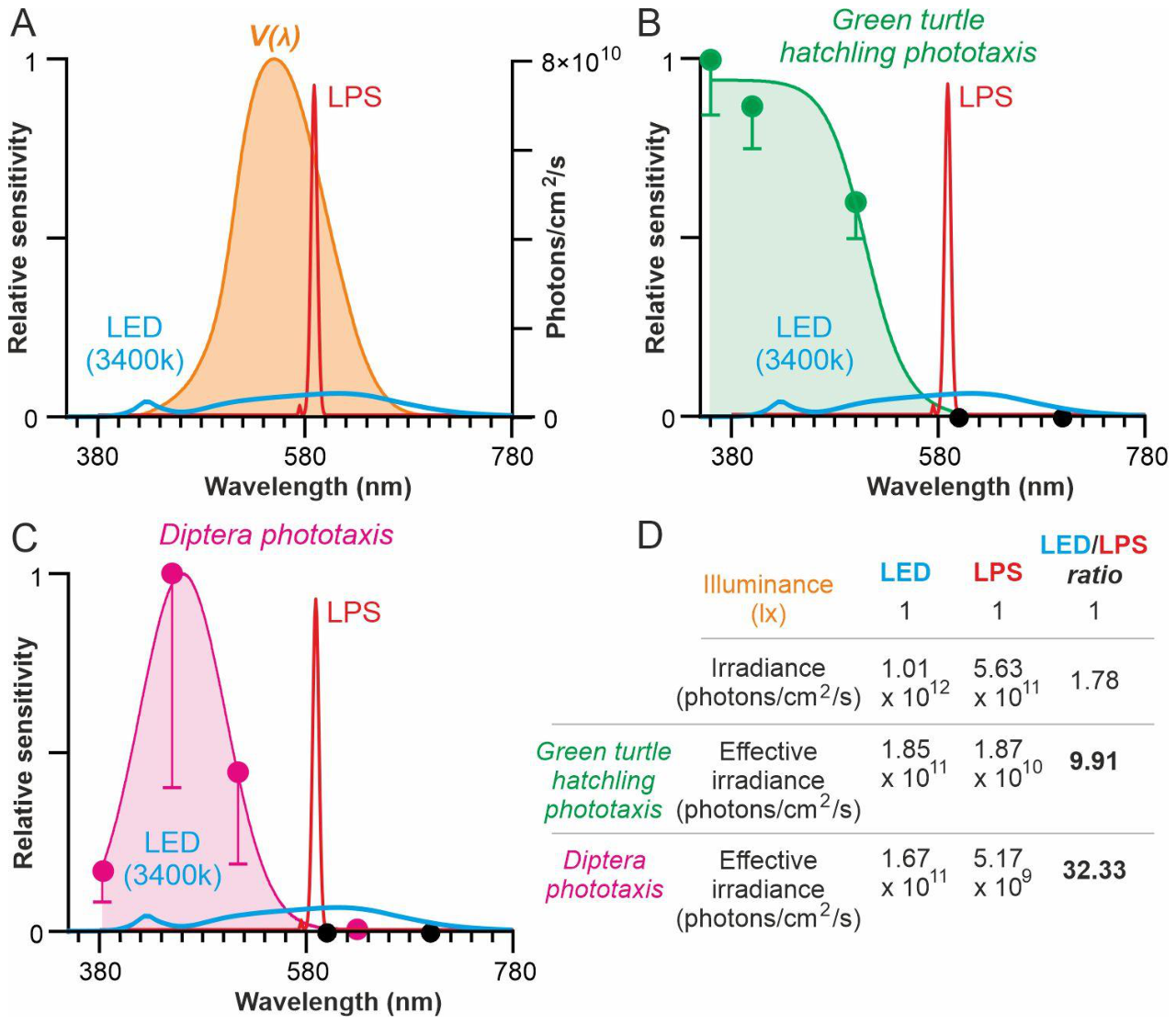
Figure 2.
Wavelength normalisation functions () for biological photosensory responses. A. Opsin photopigments in a large collated dataset[24] from Arthropoda (top) and Chordata (bottom) plotted according to their wavelength of peak sensitivity to photon flux (λmax) represented as individual datapoints above normalised frequency distributions. Dotted vertical line marks the wavelength (590nm) encompassing >95% of arthropod opsin λmax. B. Relative sensitivity of animals to photons as a function of wavelength (thin dashed line) as defined by a logistic function Correction for photon energy provides a final BA(λ) function (thick solid line) expressing sensitivity as a function of radiant flux (energy) as a function of wavelength. C. Normalised sensitivity to photon flux across wavelength for the three major types of plant photoreceptors; UVR8 (magenta), cryptochrome (as representative of flavoproteins, blue) and red-sensitive phytochrome (Pr, red). D. An integrated plant wavelength sensitivity function produced by adding sensitivity profiles in (A) across the visible range (thin dashed line) and final weighting for radiant flux as a function of wavelength, following correction for photon energy (BP(λ), thick solid line). E. Environmental sensitivity weighting function for all classes of organism produced by summing the sensitivity estimates for plants and animals (thin dashed line, sum of curves in B and D respectively) and correcting for photon energy to derive the final weighting for radiant flux as a function of wavelength (BE(λ), thick solid line).
Figure 2.
Wavelength normalisation functions () for biological photosensory responses. A. Opsin photopigments in a large collated dataset[24] from Arthropoda (top) and Chordata (bottom) plotted according to their wavelength of peak sensitivity to photon flux (λmax) represented as individual datapoints above normalised frequency distributions. Dotted vertical line marks the wavelength (590nm) encompassing >95% of arthropod opsin λmax. B. Relative sensitivity of animals to photons as a function of wavelength (thin dashed line) as defined by a logistic function Correction for photon energy provides a final BA(λ) function (thick solid line) expressing sensitivity as a function of radiant flux (energy) as a function of wavelength. C. Normalised sensitivity to photon flux across wavelength for the three major types of plant photoreceptors; UVR8 (magenta), cryptochrome (as representative of flavoproteins, blue) and red-sensitive phytochrome (Pr, red). D. An integrated plant wavelength sensitivity function produced by adding sensitivity profiles in (A) across the visible range (thin dashed line) and final weighting for radiant flux as a function of wavelength, following correction for photon energy (BP(λ), thick solid line). E. Environmental sensitivity weighting function for all classes of organism produced by summing the sensitivity estimates for plants and animals (thin dashed line, sum of curves in B and D respectively) and correcting for photon energy to derive the final weighting for radiant flux as a function of wavelength (BE(λ), thick solid line).
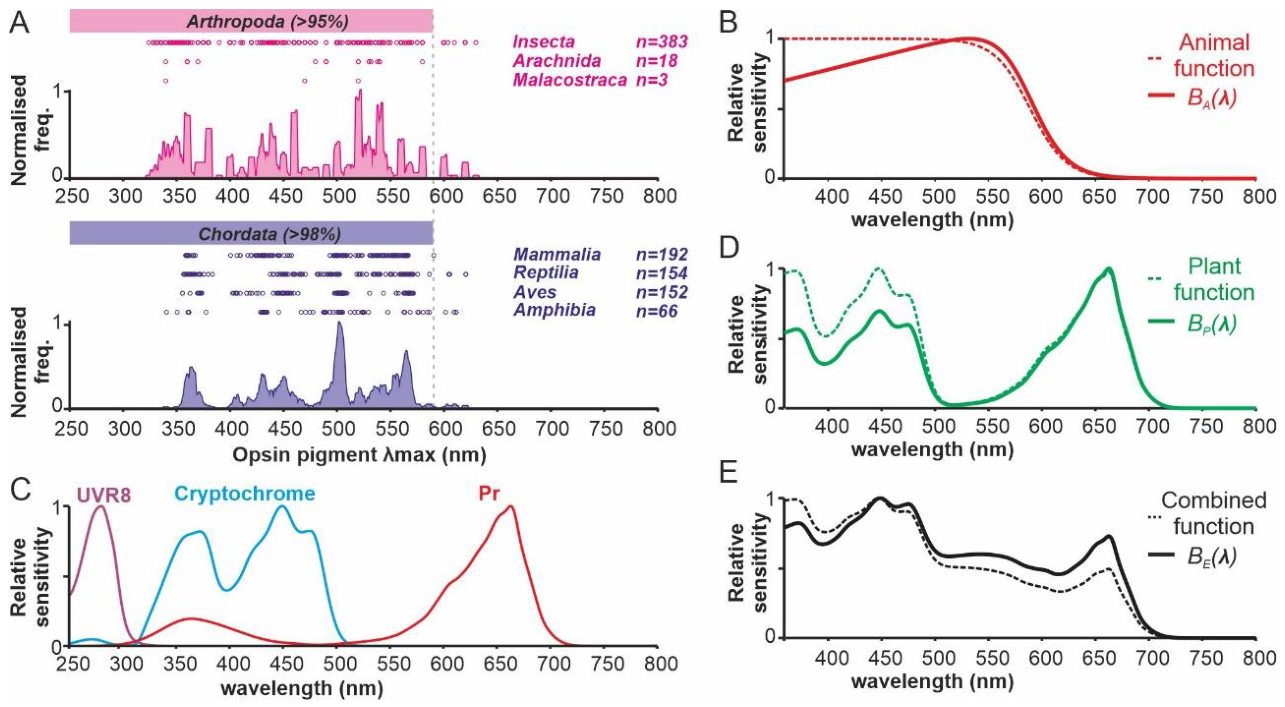
Figure 3.
Calculating and applying biological irradiance. A. Spectral power distribution for a white LED source at 30 lx illuminance (orange curve) against (grey). Animal-specific biological irradiance for this light (: W/m2) can be calculated according to equation 1 by weighting spectral power distribution () with , and expressed as an equivalent daylight illuminance ( lx) by correcting according to the polluting efficacy of luminous radiation for daylight ( which is a constant equal to 2.8401 mW/lm, derived by weighting 1 lumen of daylight (D65) by and integrating across wavelengths) following equation 2. B. Animal-specific biological irradiance daylight efficacy ratio (BADER; the ratio of to photopic illuminance) as a function of wavelength for monochromatic light plotted on a log scale (inset shows middle to long wavelength region on a linear scale). C. BADER for a range of standard incandescent (diamonds), broadband LED (squares), fluorescent (circles), high pressure sodium (HPS; inverted triangles) and other (triangles) sources[113] illustrates the scope for reducing biological irradiance by choosing the right source.
Figure 3.
Calculating and applying biological irradiance. A. Spectral power distribution for a white LED source at 30 lx illuminance (orange curve) against (grey). Animal-specific biological irradiance for this light (: W/m2) can be calculated according to equation 1 by weighting spectral power distribution () with , and expressed as an equivalent daylight illuminance ( lx) by correcting according to the polluting efficacy of luminous radiation for daylight ( which is a constant equal to 2.8401 mW/lm, derived by weighting 1 lumen of daylight (D65) by and integrating across wavelengths) following equation 2. B. Animal-specific biological irradiance daylight efficacy ratio (BADER; the ratio of to photopic illuminance) as a function of wavelength for monochromatic light plotted on a log scale (inset shows middle to long wavelength region on a linear scale). C. BADER for a range of standard incandescent (diamonds), broadband LED (squares), fluorescent (circles), high pressure sodium (HPS; inverted triangles) and other (triangles) sources[113] illustrates the scope for reducing biological irradiance by choosing the right source.
Disclaimer/Publisher’s Note: The statements, opinions and data contained in all publications are solely those of the individual author(s) and contributor(s) and not of MDPI and/or the editor(s). MDPI and/or the editor(s) disclaim responsibility for any injury to people or property resulting from any ideas, methods, instructions or products referred to in the content. |
© 2026 by the authors. Licensee MDPI, Basel, Switzerland. This article is an open access article distributed under the terms and conditions of the Creative Commons Attribution (CC BY) license (http://creativecommons.org/licenses/by/4.0/).
Copyright: This open access article is published under a Creative Commons CC BY 4.0 license, which permit the free download, distribution, and reuse, provided that the author and preprint are cited in any reuse.


