

Submitted:
17 April 2026
Posted:
20 April 2026
You are already at the latest version
Abstract
Background: Tissue expanders with metallic ports are commonly used in postmastectomy breast reconstruction but can produce significant CT artifacts, which impair accurate de-lineation of target volumes during radiotherapy planning. The Motiva Flora® expander incorporates an integrated RFID (radiofrequency identification) valve, designed to be magnet-free and MRI-conditional, potentially minimizing image distortion and im-proving the precision of treatment planning. This pilot study aims to quantitatively compare the extent of CT image distortion observed in radiotherapy simulation scans between conventional metallic-valve expanders and RFID-valve expanders, evaluating their impact on radiotherapy planning quality. Methods: Between January 2024 and September 2025, fourteen consecutive patients who underwent postmastectomy two-stage breast reconstruction followed by adjuvant RT at Hospital Santa Maria della Misericordia (Udine, Italy) were included. Seven patients received Motiva Flora® tissue expanders with a non-metallic RFID port, and seven received Mentor CPX4® expanders with a conventional metallic port. The volume of areas with a significant level of artifacts (Artifact Volume) was quantitatively evaluated by delineating the CT image area of distortion caused by the valve. Moreover, a comparison of the ratio between artifact volume and Clinical Target Volume (Artifact volume/CTV volume) between expander types to assess potential imaging-related distortions has been made. Group comparisons of volume ratio were performed using Welch’s t-test. Results: Patients reconstructed with Motiva Flora® showed a mean artifact volume of 24.5 ± 10.3 cc, whereas those with Mentor CPX4® expanders presented a mean artifact volume of 64.2 ± 38.1 cc. The ratio between artifact volume and Clinical Target Volume (CTV) was lower in patients reconstructed with Motiva expanders compared to those reconstructed with Mentor expanders and this difference resulted significative at the Wilch’s t-test (p=0.046). Conclusions: The reduced CT distortion observed with the RFID valve–equipped Motiva Flora suggests a superior radiological compatibility compared to conventional metallic-port expanders, with po-tential to enhance the accuracy of radiotherapy planning.
Keywords:
non-metallic valve expander
; RFID valve
; post-mastectomy radiotherapy
; two-stage reconstruction
; Motiva Flora
1. Introduction
Post-mastectomy breast reconstruction is a fundamental component of comprehensive breast cancer care, providing both aesthetic restoration and well-documented psychological benefits (reference). Beyond the restoration of body image, breast reconstruction has been shown to significantly improve quality of life, self-esteem, and social reintegration, making it an integral part of the oncologic treatment pathway rather than a purely reconstructive option. Alongside immediate direct-to-implant (DTI) reconstruction and autologous flap, the two-stage reconstructive approach remains widely adopted. This approach continues to represent a versatile and reliable strategy, particularly in complex oncologic scenarios, allowing surgeons to optimize soft tissue conditions before definitive reconstruction. This strategy involves placement of a temporary tissue expander, either in a submuscular or prepectoral plane, followed by a second-stage procedure to replace the expander with a permanent implant or an autologous flap(Cordeiro & Jazayeri, 2016). The choice between submuscular and prepectoral positioning is typically influenced by patient-specific factors, including mastectomy flap thickness, oncologic considerations, and surgeon preference, with increasing adoption of prepectoral techniques in recent years due to improved biomaterials and reduced animation deformity.
In patients requiring postmastectomy Radiation therapy (PMRT), the two-stage approach provides additional advantages. Radiotherapy remains a cornerstone in reducing local recurrence rates in high-risk breast cancer patients; however, it is also associated with well-known adverse effects on reconstructed tissues, including fibrosis, capsular contracture, and impaired wound healing. Delivering Radiation Therapy to a temporary expander rather than a definitive implant allows clinician to assess tissue response prior to final reconstruction, potentially guiding a shift toward autologous reconstruction, which remains the gold standard in irradiated patients. This staged strategy therefore offers a degree of flexibility, enabling individualized reconstructive planning based on the biological response to radiation and minimizing the risk of long-term complications.
However, conventional tissue expanders frequently contain metallic components, most commonly titanium or stainless-steel ports, which generate significant computed tomography (CT) artifacts that degrade image quality that may interfere with target delineation and in general impact radiotherapy planning accuracy [2,3,4]. These artifacts typically manifest as streaking and beam hardening effects, which can obscure adjacent anatomical structures and compromise the visualization of critical organs at risk. In particular, Hounsfield Unit (HU) distortion caused by metallic ports introduces uncertainties in dose calculation in the region around the device affecting its consistency. Such inaccuracies may lead to suboptimal dose distribution, with potential risks of underdosing the target volume or overdosing surrounding healthy tissues, ultimately impacting treatment efficacy and safety.
To address these limitations, the Motiva Flora® expander was developed with a non-metallic RFID (Radio Frequency Identification) port designed to reduce imaging artifacts and improve CT-based radiotherapy planning [5,6]. By eliminating metallic components, this device aims to provide more homogeneous imaging characteristics, facilitating more accurate contouring and dose calculation. Furthermore, the integration of RFID technology allows non-invasive identification and localization of the port, potentially improving intraoperative and postoperative management without compromising imaging quality.
The aim of the present study was to quantitatively compare CT image distortion between Motiva Flora® expanders and traditional metallic-port expanders in patients undergoing PMRT, evaluating their impact on artifact volume and target delineation. We hypothesized that the use of a non-metallic port would significantly reduce artifact burden and improve radiotherapy planning precision, thereby supporting its adoption in patients requiring adjuvant irradiation.
2. Materials and Methods
2.1. Study Design and Patients’ Selection
This retrospective study assessed the impact of two different types of breast tissue expander on CT image quality in the setting of adjuvant Radiation Therapy (RT).
Between January 2024 and September 2025, fourteen consecutive patients who underwent postmastectomy two-stage breast reconstruction followed by adjuvant RT at Hospital Santa Maria della Misericordia – ASUFC (Udine, Italy) were included. Seven patients received Motiva Flora® tissue expanders with a non-metallic RFID port, and seven received Mentor CPX4® expanders with a conventional metallic port. CT simulation data were available for all cases. Patients with previous chest wall irradiation or incomplete imaging were excluded.
2.2. Surgical Technique and Radiotherapy Procedure
At the time of mastectomy, a submuscular tissue expander was placed beneath the pectoralis major muscle. The muscle was elevated from the chest wall to create a submuscular pocket, and the inferior border of the pectoralis major was sutured to an acellular dermal matrix (ADM), following a dual-plane reconstruction technique. Expansion began three weeks postoperatively and continued until the desired volume was achieved. The final expansion volume was maintained for at least six months to allow tissue stabilization prior to the second-stage reconstruction. The definitive reconstructive procedure consisted of either replacement of the expander with a permanent implant or conversion to autologous reconstruction. Radiotherapy planning was performed using CT-based simulation according to institutional protocols. Target volumes and organs at risk were delineated using AI-assisted contouring tools, followed by manual review and validation by experienced radiation oncologists. Treatment plans were calculated by medical physicists using advanced dose calculation algorithms to optimize target coverage while minimizing exposure to surrounding healthy tissues.
2.3. Evaluation Parameter and Statistical Analysis
CT artifacts were delineated as the apparent low-density volume surrounding the expander port, expressed in cubic centimeters (cc). The results of the segmentation process were independently verified by two medical physicists with high expertise in breast radiotherapy planning. The primary endpoint of the current work was the analysis of the quality of planning imaging with the two generation of submuscular tissue expanders. The volume of areas with a significant level of artifacts (Artifact Volume) was quantitatively evaluated by delineating the CT image area of distortion caused by the valve. Secondary endpoint included a comparison of the ratio between Artifact Volume and Clinical Target Volume (Artifact Volume/CTV volume) between expander types to assess potential imaging-related distortions (Figure 1). Differences in volume ratio between the 2 groups of expanders were evaluated using Welch’s t-test, which was chosen due to unequal variances and small sample size.
3. Results
A total of 14 patients were included in the analysis: 7 reconstructed with Motiva Flora® expanders and 7 with Mentor CPX4® expanders. In Table 1 are reported the quantitative measurements for each patient.
Following Radiation Therapy, six patients underwent delayed autologous reconstruction with a DIEP flap, one patient underwent implant-based reconstruction, and five patients are currently awaiting definitive reconstructive decisions. Two expanders were removed (1 for infection, 1 for capsular contracture) and there is a pending decision on 5 patients. Medium post Radiation therapy follow up was 12.3 months.
3.1. Quantitative Analysis
The mean Clinical Target Volume (CTV) was 593.5 ± 240.8 cc for Motiva Flora® and 607.7 ± 211.2 cc for Mentor CPX4® expanders.
Patients reconstructed with Motiva Flora® showed a mean artifact volume of 24.5 ± 10.3 cc (range 4.4–38.3 cc), whereas those with Mentor CPX4® expanders presented a mean artifact volume of 64.2 ± 38.1 cc (range 13.8–120.4 cc). We analyzed the ratio between artifact volume and Clinical Target Volume (CTV). It was lower in patients reconstructed with Motiva expanders compared to those reconstructed with Mentor expanders. The mean artifact-to-CTV ratio was 0.051(SD=0.0319) for Motiva expanders and 0.107 (SD=0.0556) for Mentor expanders. At the Wilch’s t-test a statistically significant difference between the group means has been found (p=0.046, Figure 2).
4. Discussion
In this study, we demonstrate that non-metallic RFID-port tissue expanders reduce CT-simulation imaging artifacts. These findings reinforce the concept that expander design—specifically port composition—plays a critical role in imaging fidelity and radiotherapy planning accuracy in reconstructed breasts. Importantly, our results highlight how seemingly minor device-related characteristics can have clinically meaningful downstream effects on oncologic treatment planning, underscoring the need for closer integration between reconstructive surgery and radiation oncology. [1] From a radiotherapy perspective, metallic ports composed of titanium or stainless steel are well known to induce beam-hardening effects and Hounsfield Unit (HU) distortion, which can propagate beyond the immediate vicinity of the implant and compromise image quality across the chest wall. These artifacts degrade image quality and can make it difficult to delineate the true anatomical interface between the expander, pectoralis muscle, ribs, and adjacent organs at risk, such as the heart and lungs, particularly in left-sided breast cancers. This issue is particularly relevant in contemporary radiotherapy, where increasing emphasis is placed on highly conformal techniques and precise dose sculpting around critical structures. Even when modern treatment planning systems incorporate artifact-reduction algorithms or density overrides, residual uncertainties often persist, potentially affecting dose calculation accuracy and contouring reproducibility [2,9,10,11,12]. Such uncertainties may introduce interobserver variability and reduce the robustness of treatment planning, particularly in borderline anatomical regions. The non-metallic RFID port of the Motiva Flora® expander significantly mitigates these limitations by reducing density heterogeneity within the reconstructed breast. The markedly smaller artifact volume observed in our cohort translated into clearer visualization of soft tissues and bony landmarks, facilitating more confident delineation of clinical target volumes. This improved visualization may also enhance consistency across planning sessions and between operators, an aspect that is increasingly recognized as critical in modern radiotherapy workflows.
In our cohort, Motiva Flora® expanders exhibited a lower artifact-to-CTV ratio compared to Mentor expanders, indicating a reduced relative artifact burden with respect to the target volume. This reduction translated into clearer visualization of the surrounding soft tissue, facilitating more confident delineation of clinical target volumes. The use of a normalized metric such as the artifact-to-CTV ratio further strengthens the clinical relevance of our findings, as it contextualizes artifact burden in relation to the actual treatment volume rather than as an isolated parameter.
Beyond target definition, artifact reduction carries important dosimetric implications. Beam-hardening artifacts can alter HU values used for electron density mapping, potentially leading to local dose perturbations, especially in intensity-modulated radiotherapy (IMRT) techniques. Inaccurate electron density assignment may result in clinically relevant deviations in dose distribution, particularly in regions where steep dose gradients are required. The relevance of expander-related artifacts becomes even more pronounced in the context of emerging radiotherapy modalities. In proton therapy, metallic components can cause substantial range uncertainties due to their high density and sharp interfaces, resulting in unpredictable dose deposition and potential compromise of target coverage or increased exposure to organs at risk. As proton therapy becomes more widely adopted for selected breast cancer patients, especially those with left-sided disease or high cardiac risk, the use of low-density, non-metallic expanders may represent an enabling factor for safe and effective treatment delivery [13]. In this context, expander design may evolve from a purely reconstructive consideration to a determinant factor in selecting optimal radiotherapy modalities.
From a reconstructive standpoint, the two-stage approach in patients requiring PMRT offers strategic flexibility. Delivering radiotherapy to a temporary expander rather than a definitive implant allows surgeons to evaluate tissue tolerance to irradiation before committing to a final reconstructive modality. This adaptability is particularly valuable in patients with unpredictable soft-tissue responses, where delayed decision-making can optimize both aesthetic and functional outcomes.
At our institution, PMRT is integrated into a multidisciplinary treatment algorithm involving Plastic Surgery, Radiation Oncology, and Medical Physics. All patients in this series underwent submuscular expander placement, reflecting our preference for enhanced soft-tissue coverage and protection of the implant in the irradiated field. This approach also provides an additional layer between the expander and the skin envelope, which may be advantageous in mitigating radiation-induced complications. While prepectoral reconstruction has gained increasing popularity and has shown promising results in carefully selected patients, concerns persist regarding higher rates of seroma formation, wound complications, and implant loss following PMRT. These concerns are amplified in irradiated fields, where compromised vascularity and tissue quality may exacerbate complication profiles. In irradiated settings, submuscular reconstruction remains a conservative and reproducible option that aligns well with radiotherapy requirements [14,15]. Autologous reconstruction continues to represent the gold standard for patients undergoing PMRT. In our cohort, the majority of patients ultimately underwent delayed DIEP flap reconstruction, consistent with extensive evidence demonstrating lower long-term complication rates, improved durability, and superior patient-reported outcomes compared with implant-based reconstruction in irradiated breasts [16,17]. This preference reflects a broader trend toward delayed autologous reconstruction in irradiated patients, aiming to minimize the deleterious effects of radiation on final reconstructive outcomes. The use of vascularized autologous tissue provides robust coverage of the chest wall, mitigates radiation-induced fibrosis, and reduces the risk of capsular contracture or reconstructive failure. Nevertheless, patient preference, comorbidities, and oncologic factors necessitate individualized reconstructive planning, and implant-based reconstruction may still be appropriate in selected cases.
Improved pre-treatment CT imaging quality and so more precise target and organ-at-risk delineation could limit unnecessary radiation exposure to surrounding healthy tissues, including the internal mammary vessels, which are critical recipient vessels for subsequent autologous breast reconstruction. Preservation of these vessels may be particularly relevant in patients planned for autologous reconstruction, where radiation-induced vascular damage can negatively affect surgical outcomes. This aspect further reinforces the importance of considering future reconstructive steps during initial radiotherapy planning, highlighting the longitudinal nature of breast cancer care.
This study has several limitations. Its retrospective design and relatively small sample size limit the generalizability of the findings. Additionally, while artifact volume was quantitatively assessed, a comprehensive dosimetric analysis evaluating dose distribution differences and clinical outcomes was beyond the scope of this work. Moreover, potential confounding variables such as differences in patient anatomy, expander positioning, and radiotherapy planning techniques could not be fully controlled. Future prospective studies with larger patient cohorts, standardized contouring protocols, and detailed dosimetric endpoints are needed to further elucidate the clinical impact of artifact reduction on radiotherapy accuracy and long-term reconstructive outcomes.
Despite these limitations, our findings provide clinically relevant evidence supporting the use of non-metallic RFID port expanders in patients undergoing PMRT. By significantly improving CT image quality without altering target volumes, this technology enhances radiotherapy planning precision while preserving reconstructive flexibility. Ultimately, the adoption of imaging-compatible reconstructive devices may contribute to a paradigm shift toward more integrated, patient-specific treatment pathways. As breast cancer treatment continues to evolve toward increasingly personalized, multidisciplinary care, the integration of reconstructive devices optimized for radiotherapy represents a meaningful step toward improving both oncologic safety and reconstructive outcomes.
Conclusions
The present study demonstrates that the use of non-metallic RFID-port tissue expanders is associated with a significant reduction in CT-simulation imaging artifacts in patients undergoing postmastectomy radiotherapy. This improvement in image quality translates into clearer visualization of anatomical structures, facilitating more accurate delineation of clinical target volumes and adjacent organs at risk. By minimizing density heterogeneity and Hounsfield Unit distortion, non-metallic expanders address a well-recognized limitation of conventional metallic-port devices, thereby enhancing the reliability and reproducibility of radiotherapy planning.
Beyond the technical advantages in imaging, these findings have meaningful clinical implications. Improved target definition and reduced uncertainty in dose calculation may contribute to more precise radiation delivery, potentially limiting unintended exposure to surrounding healthy tissues such as the heart, lungs, and internal mammary vessels. This is particularly relevant in left-sided breast cancer and in patients at increased cardiovascular risk, where even small dosimetric improvements may translate into long-term clinical benefit. Furthermore, the reduction of artifact-related uncertainties may support the broader adoption of advanced radiotherapy techniques, including intensity-modulated radiotherapy and proton therapy, where accuracy in tissue characterization is critical for optimal dose distribution.
From a reconstructive perspective, the integration of imaging-compatible expanders reinforces the importance of a multidisciplinary approach to breast cancer care. The two-stage reconstructive strategy, when combined with devices optimized for radiotherapy, offers a unique opportunity to maintain flexibility in surgical planning while simultaneously optimizing oncologic treatment. In this context, expander selection should not be viewed solely as a reconstructive decision but rather as a component of a comprehensive therapeutic pathway that includes surgical, oncologic, and radiophysical considerations.
Importantly, the use of non-metallic expanders may also have downstream benefits for patients undergoing delayed autologous reconstruction. Improved preservation of critical vascular structures and more accurate radiation delivery may enhance the quality of recipient vessels and soft tissues, potentially reducing complication rates and improving long-term reconstructive outcomes. As such, the choice of expander may influence not only the immediate reconstructive course but also subsequent surgical options and success.
While the present study is limited by its retrospective design and relatively small sample size, it provides quantitative evidence supporting the clinical utility of non-metallic RFID-port expanders in the setting of postmastectomy radiotherapy. Future prospective investigations incorporating detailed dosimetric analyses and long-term clinical outcomes are needed to further validate these findings and to establish standardized guidelines for device selection in this patient population.
Ultimately, as breast cancer treatment continues to evolve toward increasingly personalized and multidisciplinary care, the adoption of technologies that bridge reconstructive and oncologic needs will be essential. Non-metallic tissue expanders represent a promising step in this direction, offering the potential to improve both radiotherapy precision and reconstructive outcomes without compromising either domain.
Author Contributions
Conceptualization, G.G.C., E.M., G.P., and A.S.; methodology, G.G.C., E.M., C.G., and A.P.; formal analysis, G.G.C., E.M., C.G., and A.P.; investigation, G.G.C., G.P., and A.S.; data curation, G.G.C., E.M., C.G., and A.P.; writing—original draft preparation, G.G.C., G.P., and E.M.; writing—review and editing, A.S., C.G., and A.P.; supervision, G.G.C. and E.M.; project administration, G.G.C. All authors have read and agreed to the published version of the manuscript.
Funding
This research received no external funding.
Institutional Review Board Statement
The study was conducted in accordance with the Declaration of Helsinki, and approved by the Institutional Review Board of the Medical Deparment of Udine University (protocol code IRB 90/2026, date of approval 20.03.2026).
Informed Consent Statement
Patient consent was waived due to the retrospective nature of the study and the use of anonymized data.
Data Availability Statement
The data presented in this study are available from the corresponding author on reasonable request.
Conflicts of Interest
The authors declare no conflicts of interest.
Abbreviations
The following abbreviations are used in this manuscript:
| ADM | Acellular Dermal Matrix; |
| CT | Computed Tomography; |
| CTV | Clinical Target Volume; |
| DIEP | Deep Inferior Epigastric Perforator; |
| DTI | Direct-to-Implant; |
| HU | Hounsfield Unit; |
| IMRT | Intensity-Modulated Radiotherapy; |
| MRI | Magnetic Resonance Imaging; |
| PMRT | Postmastectomy Radiotherapy; |
| RFID | Radiofrequency Identification; |
| RT | Radiotherapy. |
References
- Cordeiro, P. G.; Jazayeri, L. Two-stage implant-based breast reconstruction: An evolution of the conceptual and technical approach over a two-decade period. Plast. Reconstr. Surg. 2016, vol. 138(no. 1), 1–11. [Google Scholar] [CrossRef]
- Peng, J. L.; et al. Tissue Assignment and Dosimetric Influence for Breast Radiotherapy With Metallic Port in Breast Tissue Expander Using Acurosxb Algorithms. Int. J. Radiat. Oncol. 2021, vol. 111(no. 3), e144–e145. [Google Scholar] [CrossRef]
- Akdeniz, Y.; Yegingil, I.; Yegingil, Z. Effects of metal implants and a metal artifact reduction tool on calculation accuracy of AAA and Acuros XB algorithms in small fields. Med. Phys. 2019, vol. 46(no. 11), 5326–5335. [Google Scholar] [CrossRef]
- Liang, Y.; Xu, H.; Tang, W.; Du, X. The impact of metal implants on the dose and clinical outcome of radiotherapy (Review). Mol. Clin. Oncol. 2024, vol. 21(no. 4), 1–10. [Google Scholar] [CrossRef]
- Bayasgalan, M.; Munhoz, A. M.; Shellock, F. G. Breast tissue expander with radiofrequency identification port: Assessment of MRI issues. Am. J. Roentgenol. 2020, vol. 215(no. 1), 159–164. [Google Scholar] [CrossRef]
- Schiaffino, S.; et al. MRI-Conditional Breast Tissue Expander: First In-Human Multi-Case Assessment of MRI-Related Complications and Image Quality. J. Clin. Med. 2023, vol. 12(no. 13). [Google Scholar] [CrossRef]
- Vinsensia, M. Incidence and Risk Assessment of Capsular Contracture in Breast Cancer Patients following Post-Mastectomy Radiotherapy and Implant-Based Reconstruction. Cancers (Basel) 2024, vol. 16(no. 2). [Google Scholar] [CrossRef]
- Rong, Y. Advancements in Radiation Therapy Treatment Workflows for Precision Medicine: A Review and Forward Looking. Int. J. Radiat. Oncol. 2025, vol. 122(no. 4), 1022–1034. [Google Scholar] [CrossRef]
- Yoon, J.; Xie, Y.; Heins, D.; Zhang, R. Modeling of the metallic port in breast tissue expanders for photon radiotherapy. J. Appl. Clin. Med. Phys. 2018, vol. 19(no. 3), 205–214. [Google Scholar] [CrossRef]
- Hwang, N. H.; Kim, M.; Lee, N. K.; Lee, S.; Hwang, J. Dosimetric Effect of Injection Ports in Tissue Expanders on Post-Mastectomy Volumetric Modulated Arc Therapy (VMAT) Planning for Left-Sided Breast Cancer. Appl. Sci. 2022, vol. 12(no. 13). [Google Scholar] [CrossRef]
- Lee, H. Y.; et al. Critical Factors of Dose Distribution in Breast Cancer Tomotherapy With Metallic Port Breast Tissue Expander: Image Correction, Delivery Mode, and Volume Impact. Technol. Cancer Res. Treat. 2022, vol. 21, 1–9. [Google Scholar] [CrossRef] [PubMed]
- Mizuno, N.; et al. Determination of the appropriate physical density of internal metallic ports in temporary tissue expanders for the treatment planning of post-mastectomy radiation therapy. J. Radiat. Res. 2018, vol. 59(no. 2), 190–197. [Google Scholar] [CrossRef] [PubMed]
- Tran, E. T.; Newbury, P.; Newpower, M.; Ortega, H.; Malouff, T. D.; Henson, C. Implementation of Proton Radiation Treatment Exclusion Volume Because of Inconsistent Location of Breast Expander Titanium Port. Adv. Radiat. Oncol. 2025, vol. 10(no. 12), 101876. [Google Scholar] [CrossRef] [PubMed]
- Parmeshwar, N.; Knox, J. A.; Piper, M. L. Evaluation of Pre-Pectoral Direct-to-Implant Breast Reconstruction with Post-Mastectomy Radiation: A Systematic Review and Meta-Analysis. J. Clin. Med. vol. 14(no. 14), 1–11, 2025. [CrossRef] [PubMed]
- Zhang, X.; Ning, S.; Zhang, Y. Complications After Prepectoral Versus Subpectoral Breast Reconstruction in Patients Receiving Postmastectomy Radiation Therapy: A Systematic Review and Meta-Analysis. Aesthetic Plast. Surg. 2024, vol. 48(no. 21), 4421–4429. [Google Scholar] [CrossRef] [PubMed]
- Clemens, M. W.; Kronowitz, S. J. Current perspectives on radiation therapy in autologous and prosthetic breast reconstruction. Gland Surg. 2015, vol. 4(no. 3), 222–31. [Google Scholar] [CrossRef]
- Emanuele Lisa, V.; et al. The Effect of Adjuvant Radiotherapy on One- and Two-Stage Prosthetic Breast Reconstruction and on Autologous Reconstruction: A Multicenter Italian Study among 18 Senonetwork Breast Centres. Breast J. 2023, vol. 2023. [Google Scholar] [CrossRef] [PubMed]
Figure 1.
Representative axial CT images showing artifact generation from tissue expanders: (a) Mentor CPX4® expander with metallic port, demonstrating pronounced beam-hardening artifacts; (b) Motiva Flora® expander with non-metallic RFID port, showing reduced artifact burden.
Figure 1.
Representative axial CT images showing artifact generation from tissue expanders: (a) Mentor CPX4® expander with metallic port, demonstrating pronounced beam-hardening artifacts; (b) Motiva Flora® expander with non-metallic RFID port, showing reduced artifact burden.
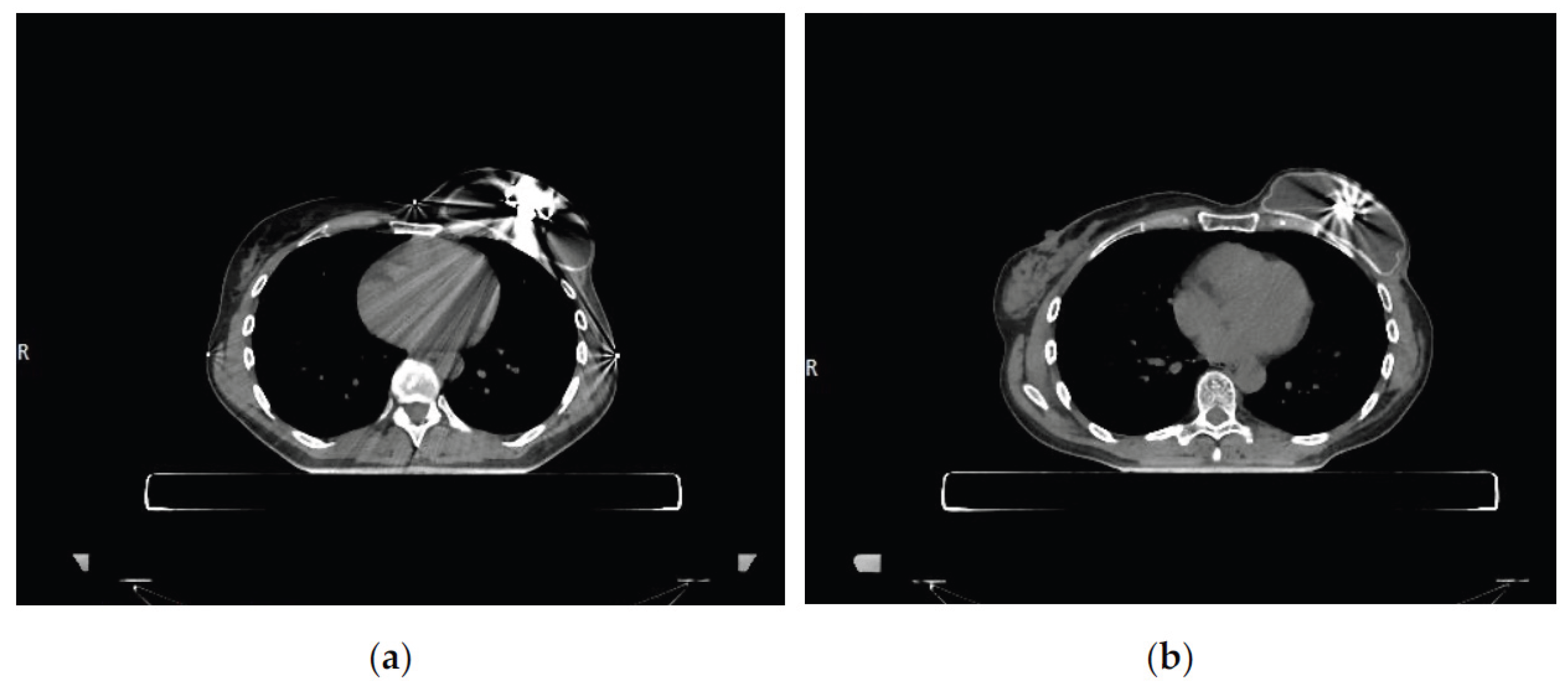
Figure 2.
Comparison of the mean artifact-to-CTV ratio between Mentor CPX4® expanders and Motiva Flora®.
Figure 2.
Comparison of the mean artifact-to-CTV ratio between Mentor CPX4® expanders and Motiva Flora®.
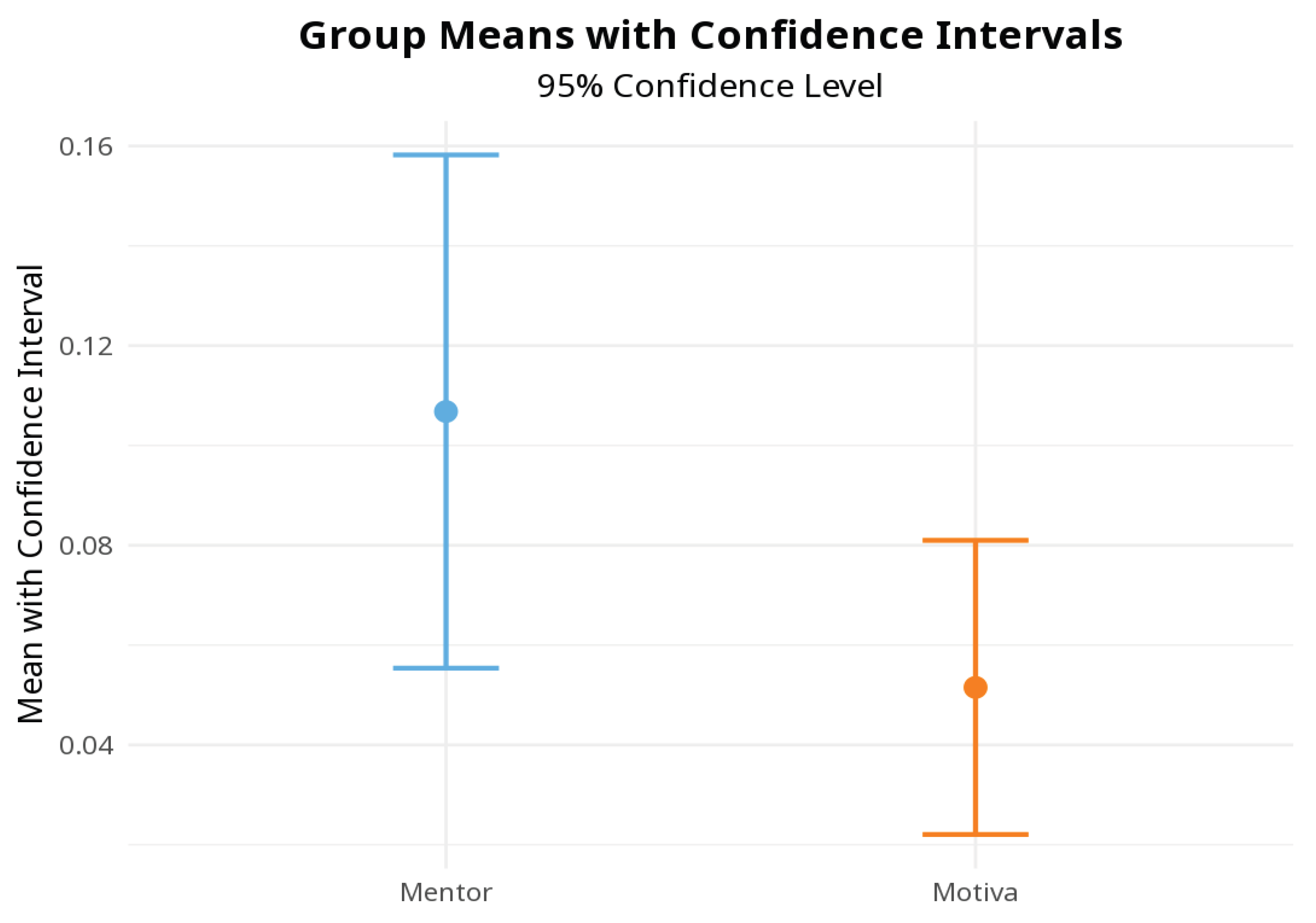

Table 1.
Individual patient data including expander type, CT artifact volume (cc), Clinical Target Volume (CTV, cc), and artifact-to-CTV ratio.
Table 1.
Individual patient data including expander type, CT artifact volume (cc), Clinical Target Volume (CTV, cc), and artifact-to-CTV ratio.
| ID pazient | Type | Artifact expander (cc) | CTV (cc) | Artifact expander / CTV |
|---|---|---|---|---|
| 1 | Motiva | 23,4 | 910,9 | 0,0257 |
| 2 | Motiva | 23,3 | 602,3 | 0,0387 |
| 3 | Motiva | 23,8 | 553,0 | 0,0430 |
| 4 | Motiva | 29,7 | 351,9 | 0,0844 |
| 5 | Motiva | 4,4 | 928,8 | 0,0047 |
| 6 | Motiva | 38,3 | 440,3 | 0,0870 |
| 7 | Motiva | 28,3 | 367,1 | 0,0771 |
| 8 | Mentor | 77,2 | 484,1 | 0,1595 |
| 9 | Mentor | 104,3 | 811,7 | 0,1285 |
| 10 | Mentor | 120,4 | 665,1 | 0,1810 |
| 11 | Mentor | 50,1 | 580,0 | 0,0864 |
| 12 | Mentor | 13,8 | 387,7 | 0,0356 |
| 13 | Mentor | 44,4 | 386,5 | 0,1149 |
| 14 | Mentor | 39,1 | 938,5 | 0,0417 |
Disclaimer/Publisher’s Note: The statements, opinions and data contained in all publications are solely those of the individual author(s) and contributor(s) and not of MDPI and/or the editor(s). MDPI and/or the editor(s) disclaim responsibility for any injury to people or property resulting from any ideas, methods, instructions or products referred to in the content. |
© 2026 by the authors. Licensee MDPI, Basel, Switzerland. This article is an open access article distributed under the terms and conditions of the Creative Commons Attribution (CC BY) license (http://creativecommons.org/licenses/by/4.0/).
Copyright: This open access article is published under a Creative Commons CC BY 4.0 license, which permit the free download, distribution, and reuse, provided that the author and preprint are cited in any reuse.


