

Submitted:
19 April 2026
Posted:
20 April 2026
You are already at the latest version
Abstract
Uniform control systems, that is multivariable control systems with identical transfer functions of separate channels and rigid cross-connections, are widespread in modern industry and technology, including such fields as mechatronics and robotics, electrical and aerospace engineering, chemical and power industry, and many others. In the paper, a sensitivity analysis of uniform control systems to small variations of parameters is given from the perspective of the characteristic transfer functions (CTFs) method. The formulas are derived determining the sensitivity functions of the CTFs and the canonical basis axes to small variations of parameters of uniform systems. The relations between the sensitivity functions of the open-loop and closed-loop uniform control systems are established. An illustrative example is considered concerning the sensitivity of control systems of multirotor un-manned aerial vehicles to small degradations of the motors’ effeciency.
Keywords:
multivariable control system
; uniform system
; characteristic transfer functions
; canonical basis
; sensitivity
; parameter perturbation
1. Introduction
The paper can be considered as a logical continuation of the research presented in [1] and is devoted to sensitivity analysis of a special class of multi-input and multi-output (MIMO) control systems called uniform systems. Uniform control systems are widespread in various technical applications, such as aerospace engineering, robotics, chemical and power industry, and many others [2,3,4]. The main structural feature of the uniform systems is that their separate channels have identical transfer functions, and the cross-connections are rigid, i.e. are characterized by a square numerical matrix [4].
The issue of sensitivity analysis of uniform systems to small perturbations of parameters is discussed from the perspective of the Characteristic Transfer Functions (CTFs) (or Characteristic Gain Loci) method which was proposed by A.G. Macfarlane and his colleagues in 1979s [5,6,7,8]. The CTFs method allows one to associate with an N-dimensional MIMO system a set of N independent single-input single-output (SISO) characteristic systems and, thereby, to reduce the stability analysis and design of an interconnected MIMO system to stability analysis and design of N SISO systems [3,4,9].
The sensitivity of characteristic gain loci was first considered in the paper by I. Postlethwaite [10]. The introduced in [10] sensitivity indices characterize the sensitivity of the gain loci to small perturbations of the return-ratio matrix of the MIMO system. The task of robustness of MIMO systems, where the plant is described using the CTFs method, is addressed in [11]. In that paper, a sophisticated two-stage design procedure to improve the system’s robustness is proposed based on the notion of commutative controller [8]. At the first stage, a dynamic pre-compensator is designed which transforms the plant transfer matrix into a normal matrix. At the second stage, a commutative controller is designed for the normalized plant. If the design is correct, then the CTFs of the pre-compensated plant and the commutative controller are multiplied together. Unfortunately, it is mostly impossible to find a realizable matrix compensator that transforms the transfer matrix of the plant into a normal matrix.
A systematic treatment of sensitivity of multivariable control systems from the perspective of the CTFs method is given in [1]. The formulas are derived determining the sensitivity functions of the CTFs and canonical basis axes to small variations of parameters of general type MIMO control systems. The relations between the sensitivity functions of the open-loop and closed-loop MIMO systems are established. However, the results obtained in [1], having generic character, do not allow one to take into account peculiar structural features of some special classes of multivariable control systems. First of all, that concerns the uniform systems which structurally always comprise two different matrix blocks – a scalar transfer matrix of identical separate channels and a numerical matrix of rigid cross-connections. That is why it is important to discern the parameter perturbations of these two blocks since the small perturbations of the transfer functions of separate channels do not affect the canonical basis of the uniform system, and, on the contrary, small perturbations of the numerical matrix of cross-connections change, besides the canonical axes, only the equivalent “gains” of the CTFs of the open-loop system.
Detailed analysis of the above-mentioned points is considered in this paper, which is organized as follows. The canonical representation of uniform control systems is presented in Section 2. Section 3 addresses the sensitivity analysis of uniform control systems to small variations of parameters. The situations of the parameter perturbations of the transfer functions of separate channels and those of the cross-connections matrix are treated separately. Section 4 presents an example of sensitivity analysis of control systems of multirotor unmanned aerial vehicles (UAVs) to small degradations of motors’ efficiency.
2. Canonical Representation of Uniform Control Systems
In Figure 1, stand for the Laplace transforms of the N-dimensional input, output, and error vector signals , respectively (we shall regard them as elements of some N-dimensional complex space ); is a scalar transfer function of separate channels, which is a proper rational function in complex variable , and is a numerical matrix of order describing cross-connections.
coincides, up to the complex scalar multiplier , with the numerical matrix of cross-connections . This leads to interesting structural and dynamic properties of uniform MIMO systems and allows separating them into an individual class of multivariable control systems [4].
The output and error vectors, where
are related to the input vector by the following operator equations:
where
are the transfer function matrices of the closed-loop uniform system with respect to output and error signals, and is the unit matrix. The transfer matrices and (3) are usually called sensitivity function matrix and complementary sensitivity function matrix [2,3,4].
Based on the method of CTFs, the transfer matrix of the open-loop MIMO system (1) can be represented, using dyadic notation and similarity transformation, in the following canonical forms [4]:
where the complex scalar functions
are the CTFs of the open-loop system (further, for simplicity, all are assumed distinct); are linearly-independent normalized eigenvectors of which constitute the canonical basis of the open-loop uniform system; are vectors dual to (vectors of the dual basis), and the constant modal matrix is composed of column-vectors .
Substitution the canonical representations of (4) into the complementary sensitivity function matrix and the sensitivity function matrix (3) yields [4]
Inspection of (4)-(7) shows that the canonical basis of the closed-loop uniform system coincides with the canonical basis of the open-loop system [4,5,6]. Moreover, the CTFs of the closed-loop MIMO system with respect to the output and error are related to by the very same relationships as common transfer functions of open-loop and closed-loop SISO control systems. Geometrically, all this is illustrated in Figure 2 and Figure 3.
The stability of the uniform system in Figure 1 is determined by roots of the characteristic equation [2,3,4,5]
It is clear from (8) that the uniform system in Figure 1 is stable if all N SISO characteristic systems are stable. Hence, the stability analysis of an N -dimensional uniform system is reduced to stability analysis of N independent characteristic systems which can be performed using standard methods of classical feedback control, for example, using the Nyquist criterion [9].
3. Sensitivity of Characteristic Transfer Functions and Canonical Basis Axes of Uniform Systems
In this section, we address the influence of small variations of the system parameters on the dynamics and structural features of uniform systems. In general, this problem is solved by special methods of sensitivity theory [12,13,14,15,16]. Below, the problem of uniform systems sensitivity is considered from the positions of the CTFs method. The main attention is paid to the sensitivity functions of SISO characteristic systems and canonical basis axes in the case of small variations of the uniform system’s parameters.
Let us assume that the open-loop transfer matrix of the uniform system in Figure 1 depends continuously on varying parameters , forming the vector . In what follows, to emphasize the dependence of on we shall write . Denote by the vector of nominal values of , and by - the vector of variations, i.e. assume . Let us know the CTFs and canonical basis of the uniform system with the nominal values . A question arises, how the CTFs and canonical basis are changed in case of small variations of parameters , i.e. for ? We solve this task as a first approximation, based on the perturbation theory of linear operators in finite-dimension Hilbert spaces [17,18].
Due to specific structural features of uniform control systems, we shall discuss two different cases, concerning the sensitivity of the CTFs and canonical basis axes to the parameters variations.
The first case concerns the sensitivity of the uniform system to the changes of m parameters of the transfer functions . In this case, the scalar transfer matrix should be replaced by a diagonal matrix , where each m-dimensional vector has the form . Obviously, for unperturbed system (if all are zero) we have . The second case concerns the situation when the varying parameters are elements of numerical matrix of cross-connections, i.e. , where is an m-dimensional vector. In both cases, we will assume that the transfer functions or the matrix depend continuously on parameters or .
Let, because of parameters perturbations, the transfer matrix can be expressed as
where is the variation of caused by the perturbations .
3.1. Open-Loop Uniform System
Consider first the sensitivity of the CTFs and canonical basis axes of the open-loop system.
3.1.1. Sensitivity of CTFs to Small Perturbations of the Transfer Functions
In this case, for each i we have
i = 1,2,…,N
and the transfer matrix (9) has the following form:
where
and is an -dimensional vector with components .
As we assume continuous dependence of on , the variation in (12) can be represented for small with the help of the Taylor series
where
are the first-order sensitivity functions of the transfer function with respect to variations , evaluated for the nominal vector . The dots in (13) and in what follows mean that the terms of the higher order of smallness, as compared with , are omitted.
As the transfer functions are assumed differentiable with respect to , the following expansions for the CTFs are valid:
where
are the unknown first-order sensitivity functions of the CTFs .
Since (15) are the “eigenvalues” of the perturbed matrix (11), and allowing for (10), we can write down
Allowing for and we have immediately
that is the sensitivity function of the ith characteristic system of the open-loop uniform system with respect to non-identical variations of parameters of transfer functions are equal to the corresponding sensitivities of multiplied by the eigenvalue .
3.1.2. Sensitivity of the Open-Loop Uniform System to Small Perturbations of the Cross-Connection Matrix R
Let us proceed to the case of parameters variations of the numerical matrix of cross-connections R. Matrix R in this case can be written in the form:
Since the continuous dependence of on is assumed, the variation in (19) can be represented as
where
are the sensitivity matrices of with respect to variations .
On the other hand, we have for canonical basis axes (eigenvectors of R) and factors (eigenvalues of R) the following expressions:
where
are the unknown sensitivity vectors of the ith canonical basis axis with respect to the variation of the rth parameter , and
where
are the sensitivity functions of the ith eigenvalue with respect to the variation of .
Since (22) and (24) are the eigenvectors and eigenvalues of the perturbed matrix (11) and allowing for (13) we can write down
Performing the multiplication and comparing the first-order terms with respect to the corresponding perturbations in both sides of (26), we get the following system of equations:
Multiply, in the form of scalar product, both sides of (27) by the vector dual to the eigenvector of the unperturbed uniform system. Recalling that the first vector in the scalar product should be taken as complex conjugate, we obtain
Note that the matrix in (19) has the canonical representation
Conjugation of this matrix yields
From here, it is clear that the eigenvalue of corresponds to the dual eigenvector . Therefore
Substituting (31) into (28) and conjugating both sides in (28), yields the final expression for the sensitivity function :
It is important to note that for any fixed the right sides in (32) represent (for ) the diagonal elements of the matrix (21), where the latter is evaluated in the basis composed of the vectors . Hence, the sensitivity functions of eigenvalues with respect to small perturbations of the th parameter are equal to the diagonal elements of the sensitivity matrix (21) evaluated in the canonical basis of the unperturbed uniform system.
Proceed now to calculation of the sensitivity vectors (23) of the canonical basis axes of the open-loop system. Multiplication of both sides of (27) by the dual vectors yields after some simple transformations:
where are the elements of the th column (except for ) of the matrix (21), represented in the canonical basis of the unperturbed system. Notice that the scalar products on the left side of (33) are the coordinates of the vector along the th axis of the initial canonical basis. It is easy to show, using the normalizing condition for the varied eigenvector (22) [17], that the coordinate of along the th axis is equal to zero. Therefore, we can write
Thus, expressions (32) – (34) determine the sensitivity functions of the “factors” of the CTFs of the open-loop uniform system and the sensitivity vectors of the canonical axes with respect to small perturbations of the parameters of the matrix . These expressions show that for evaluating and it is enough to find the representation
of the matrices (21) in the canonical basis of the unperturbed uniform system. The diagonal elements of the matrix (35) are equal to the sensitivity functions (25), and the non-diagonal elements , after dividing by the differences , give the coordinates of the sensitivity vectors (23) in the mentioned basis.
3.2. Closed-Loop Uniform System
In this section we discuss the sensitivity functions of the closed-loop uniform systems and their relation to the corresponding sensitivity functions of open-loop systems. For brevity, only the case of sensitivity transfer matrix will be considered. The case of complementary transfer matrix can be treated analogously.
3.2.1. Sensitivity of the CTFs of Closed-Loop Uniform Systems with Respect to Parameters Variations of the Transfer Functions
In this case, the canonical representation of the sensitivity transfer matrix via the similarity transformation has the form:
where
are the CTFs of .
Since the modal matrix C of uniform systems is constant, we immediately get from (36) the following expressions for sensitivity of CTFs (37) with respect to parameter variations of transfer functions :
or, allowing for (16),
where
Thus, as can be seen from (39), the sensitivity functions of CTFs of the open-loop and closed-loop uniform systems in case of parameters variations of the transfer functions are related by the same expressions as in the common SISO case [9].
3.2.2. Sensitivity of the Closed-Loop Uniform Systems to Variation of Elements of the Cross-Connections Matrix R.
Consider now the sensitivity of the transfer matrix (3). Assume that because of parameter perturbations the initial transfer matrix becomes
where is the variation of caused by the perturbations .
Let us find the expression for assuming that the corresponding variation of the open-loop uniform system is known. In that case, the matrix in (3) can be represented in the form
It is easy to see from (3) and (41) that the variation is equal to the difference of the inverse transfer matrices and , i.e.
Multiplying this relation from the left by and from the right by we get
from which, taking into account (40), after simple algebraic transformations we obtain the following expression for the variation of the transfer matrix caused by the variation :
In principle, this expression is valid for any, not necessarily small, variations . Recalling that the task above was solved as a first approximation, that is preserving only the terms linear with respect to , let us determine this approximation for . To this end, expand the inverse matrix on the right side of (41) into the infinite Neumann series [18]:
This series converges for , which always takes place in practice for small . Substituting (44) in (43) and neglecting the terms of higher order of smallness gives a first approximation for the variation
Due to the continuous dependence of the transfer matrix on parameters the variation can be written in the form
where
are the first-order sensitivity matrices of the transfer matrix with respect to the variations of the th parameter . Then, based on (45), (46), and (21), we find the following formulae establishing relationships between the sensitivity matrices (21) and (47) of the open-loop and closed-loop MIMO system transfer matrices
The CTFs of the closed-loop MIMO system have the following form:
Expand these functions into the Taylor series:
where
are the first-order sensitivity functions of the CTFs with respect to the variations of the th parameter .
Since the canonical bases of the open-loop and closed-loop MIMO systems coincide, the expansion (22) is also valid for the axes of the closed-loop system, where the designations should be introduced instead of . Proceeding as in analyzing the open-loop uniform system it is easy to show that for evaluating and it is necessary to find the representation of the matrices (47) in the canonical basis of the unperturbed uniform system. That representation has the form
The diagonal elements of the matrix are equal to the sensitivity functions (50), and non-diagonal elements , divided by the differences , yield the sensitivity vectors of the th canonical basis axis of the closed-loop uniform system.
Expressions (48) and (51) enable us to determine the relationship between sensitivity functions of the open-loop and closed-loop uniform system, i.e., to determine the effect caused on the system sensitivity by the introduction of feedback loop. Substituting (48) into (51) and using the canonical representation of the transfer matrix (7) we get after simple transformations:
From here, finding the diagonal elements on the right side, we get the same expression (50):
Expressions (53) relate the sensitivity functions of the closed-loop and open-loop SISO characteristic systems and are completely analogous to those well-known in the classical control theory [9]. If we let , then from (53) it is clear that for those frequencies for which (usually it is the low-frequency region), the introduction of feedback decreases the sensitivity of the CTFs to parameters variations. In the high-frequency region, where , the sensitivity of the closed- and open-loop CTFs is approximately the same. Finally, in the region of the resonance frequencies, where , the feedback deteriorates the sensitivity of the CTFs.
The non-diagonal elements of the matrix (52) have the form
Dividing both sides of (54) by the differences , we obtain the following equalities:
But according to the stated above, the left-hand terms in (55) are equal (for some ) to the coordinates of the sensitivity vectors of the th canonical axis of the closed-loop uniform system, and the right-hand terms are equal to the coordinates of the sensitivity vectors of the corresponding (in fact, the same) axis of the open-loop system. Besides, all these coordinates are determined with respect to the same canonical basis of the unperturbed uniform system.
Consequently, the vectors and are equal, i.e. the introduction of feedback does not affect the sensitivity of canonical basis axes of the uniform system to small variations of parameters.
It should be noted that the results of the last sections have more general character and can be used in cases when both the parameters of the transfer function w(s) and of the matrix R are perturbed simultaneously.
4. Example
Let us consider the sensitivity of control systems of multirotor UAVs. Two typical examples of multirotor UAVs – a quadcopter and an octocopter - are shown in Figure 4, where the number of rotors (motors) is denoted NR [19,20]. Irrespective of the number , the flight altitude and the vector of rotation angles (roll , pitch , and yaw ) are usually chosen as four control variables in the underactuated control systems of multirotor UAVs [19,20].
Below, we shall assume that the angles and angular velocities of the UAV are so small that nonlinear terms in the dynamics equations of rotational motions can be neglected, cosines of all rotation angles are approximately equal to one, and sines are zero. On these conditions, the dynamics equations of multirotor UAVs take on the following linear form [19,20]:
Denoting by the -dimensional vector of thrusts (), the mapping of to the vector can be written in a matrix form
where the full-rank numerical matrix (often called a control allocation matrix [19]) depends on the UAV’s geometry, number of rotors, etc. [19,20], and are the motors’ efficiency degradation parameters. For properly functioning motors the matrix is equal to the identity matrix (or , to indicate the order of the matrix ). Actually, is a matrix of kinematic cross-connections between separate channels of the control system.
Commonly, the matrix regulator in such systems is taken in the form
where is a constant matrix, and are scalar transfer functions of the regulators in separate channels. In practice, the standard Proportional-Integral-Derivative (PID) regulators [9] are usually used as in (60). In what follows, we shall assume for simplicity that all regulators are identical, that is .
It is appropriate to transform the matrix block diagram in Figure 5 to equivalent four-dimensional form in Figure 6, where the vectors , of size and the diagonal matrix are given by the following expressions:
where the components of the three-dimensional vector in the four-dimensional vector are the roll , pitch , and yaw angles, i.e. .
Figure 6.
Transformed block diagram of the UAV’s control system.
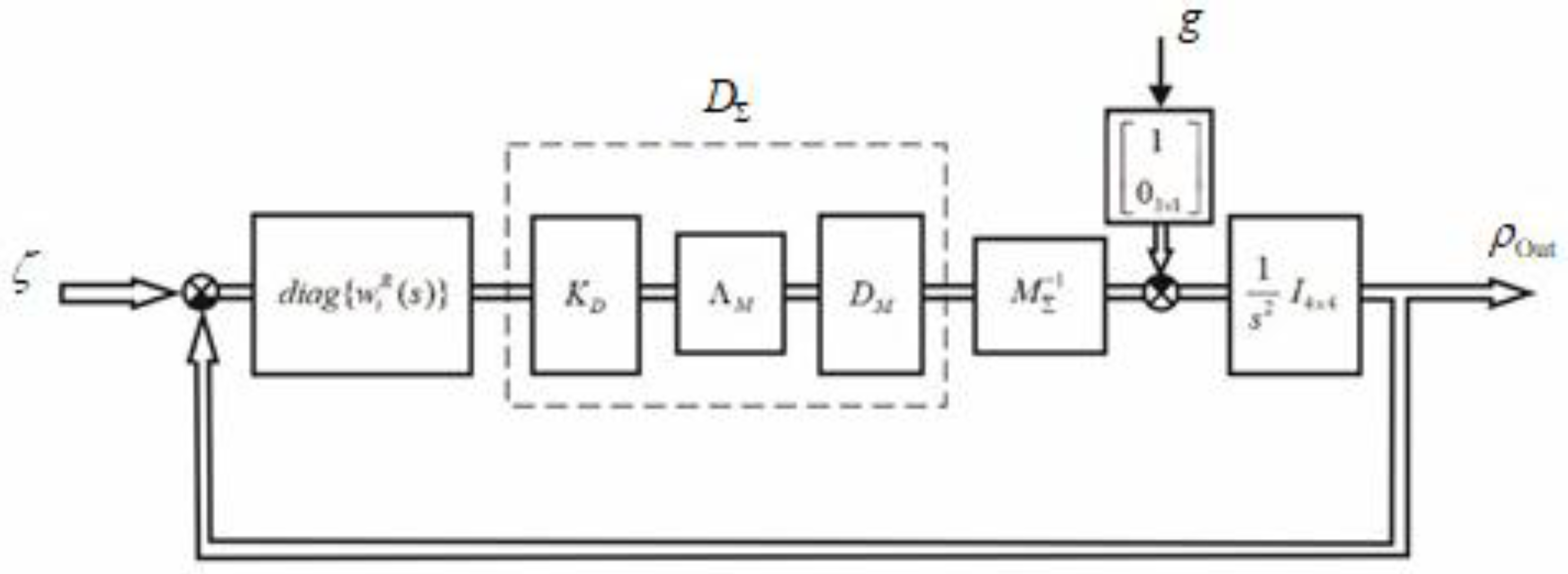
Let us denote the following numerical matrix:
Consequently, the control systems of multirotor UAVs belong to the class of uniform systems.
The matrix in (62) is usually chosen as
where denotes the Moore-Penrose pseudoinverse of ( for ) [19,20].
In case of ideal motors (if ), from (62) and (65) we have for any , i.e. kinematic cross-connections between four separate channels of the control system in Figure 6 are compensated and the control system splits into four isolated identical SISO systems (Figure 7). For that reason, the regulator (60), which incorporates a matrix part (65), is usually called decoupling regulator [2,3,4].
On the other hand, if there are some motors’ efficiency degradations, i.e. if , then the matrix (62) is not an identity matrix and the control system of the UAV belongs to the class of uniform systems.
As a typical example, consider the control system of a quadcopter with the so-called I4 scheme of the motors’ allocation and the following parameters: , , . Matrices and in this case are equal to
and the matrix (65) is
The identical proportional-derivative (PD) regulators with the first order filter in the separate channels are taken in the form:
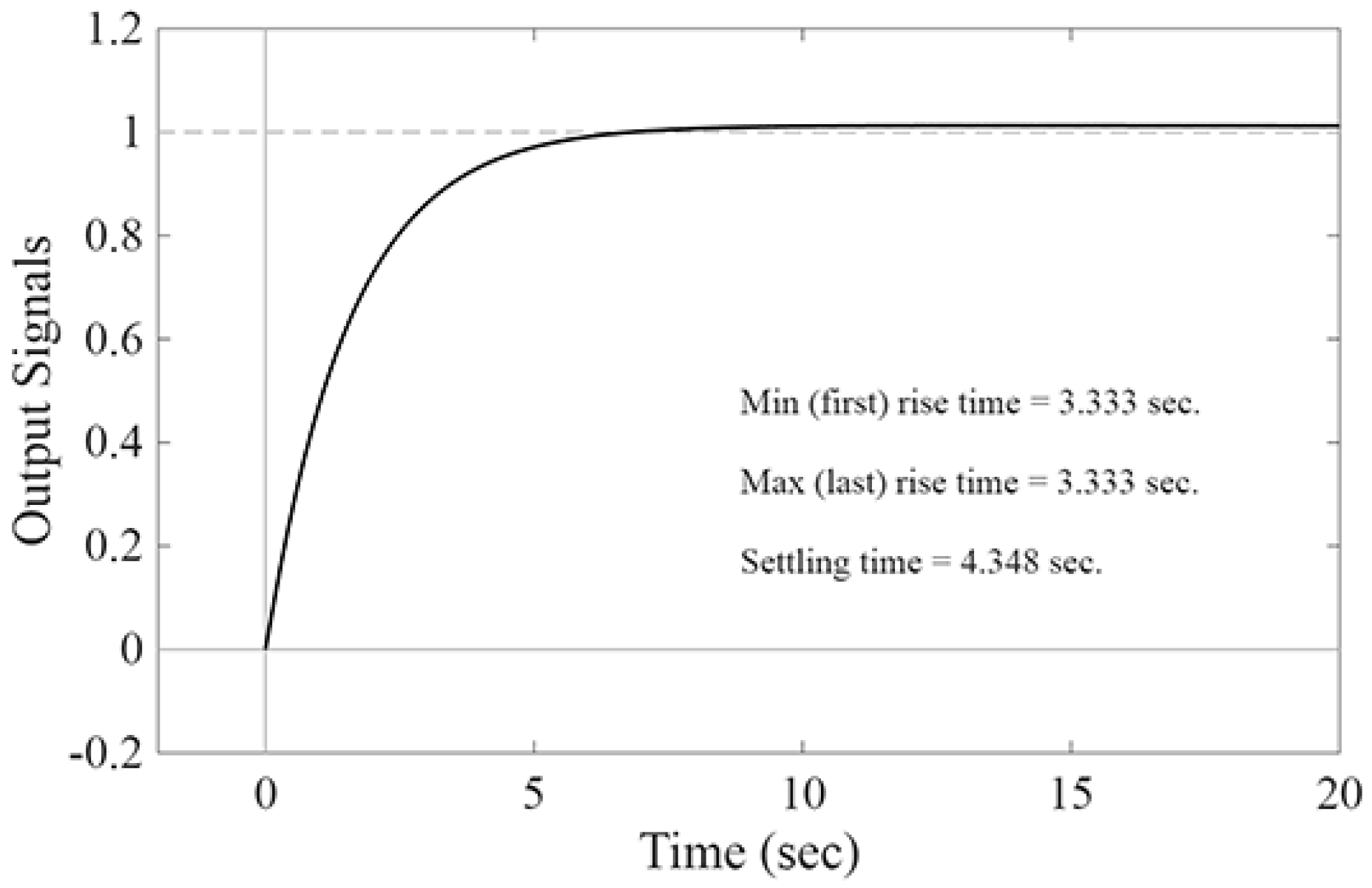
The frequency and step response characteristics of the separate channels in case of ideal motors (when ) are shown in Figure 8, Figure 9 and Figure 10. The black line in Figure 8 is the graph of the plant, the blue line represents the PD regulator (68), and the transfer function of the resulting open-loop channel is shown by the brown line.
Figure 8.
Nyquist plots of the isolated channels ().
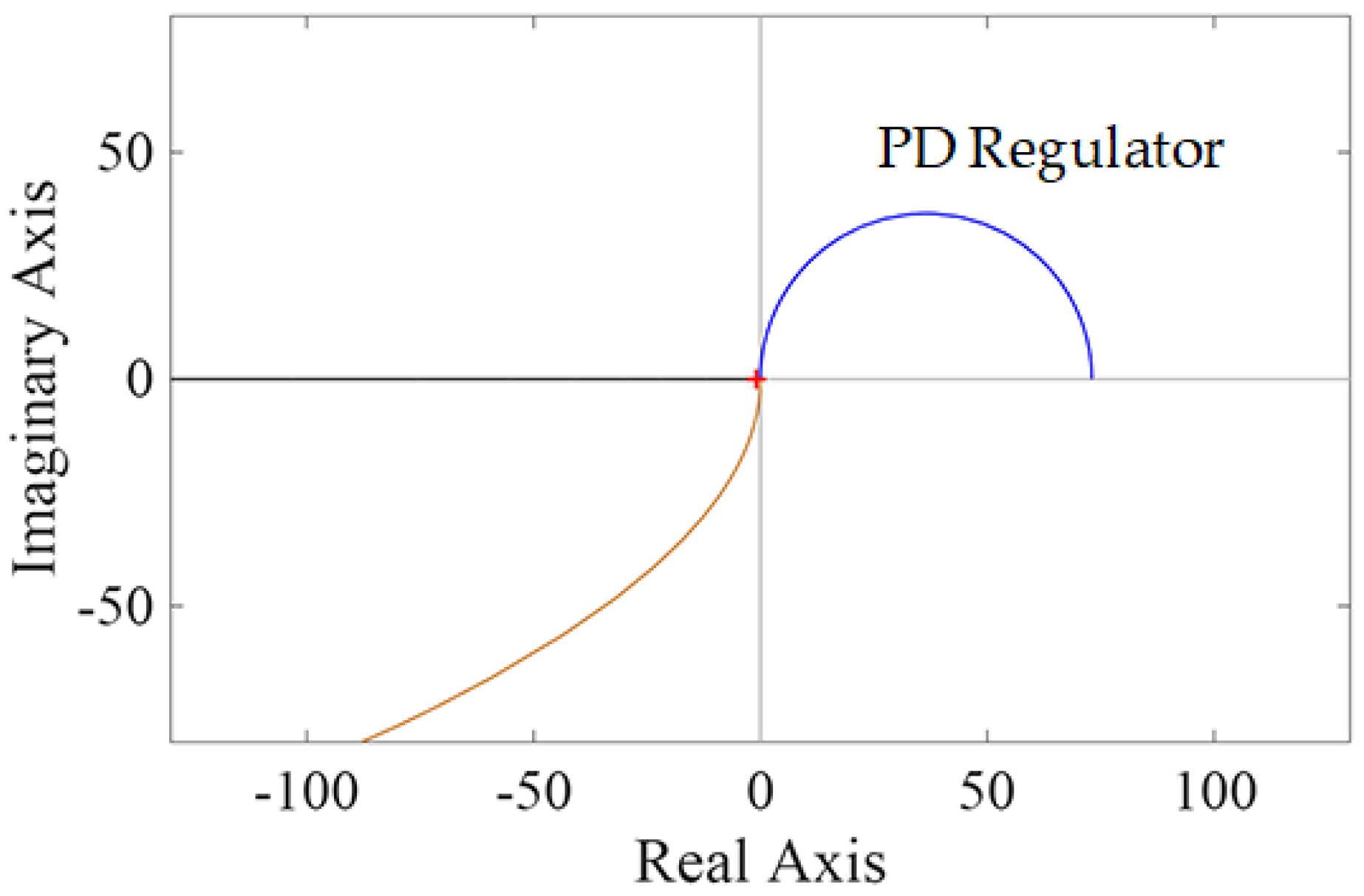
Figure 9.
Frequency-response characteristic of the complementary sensitivity function.
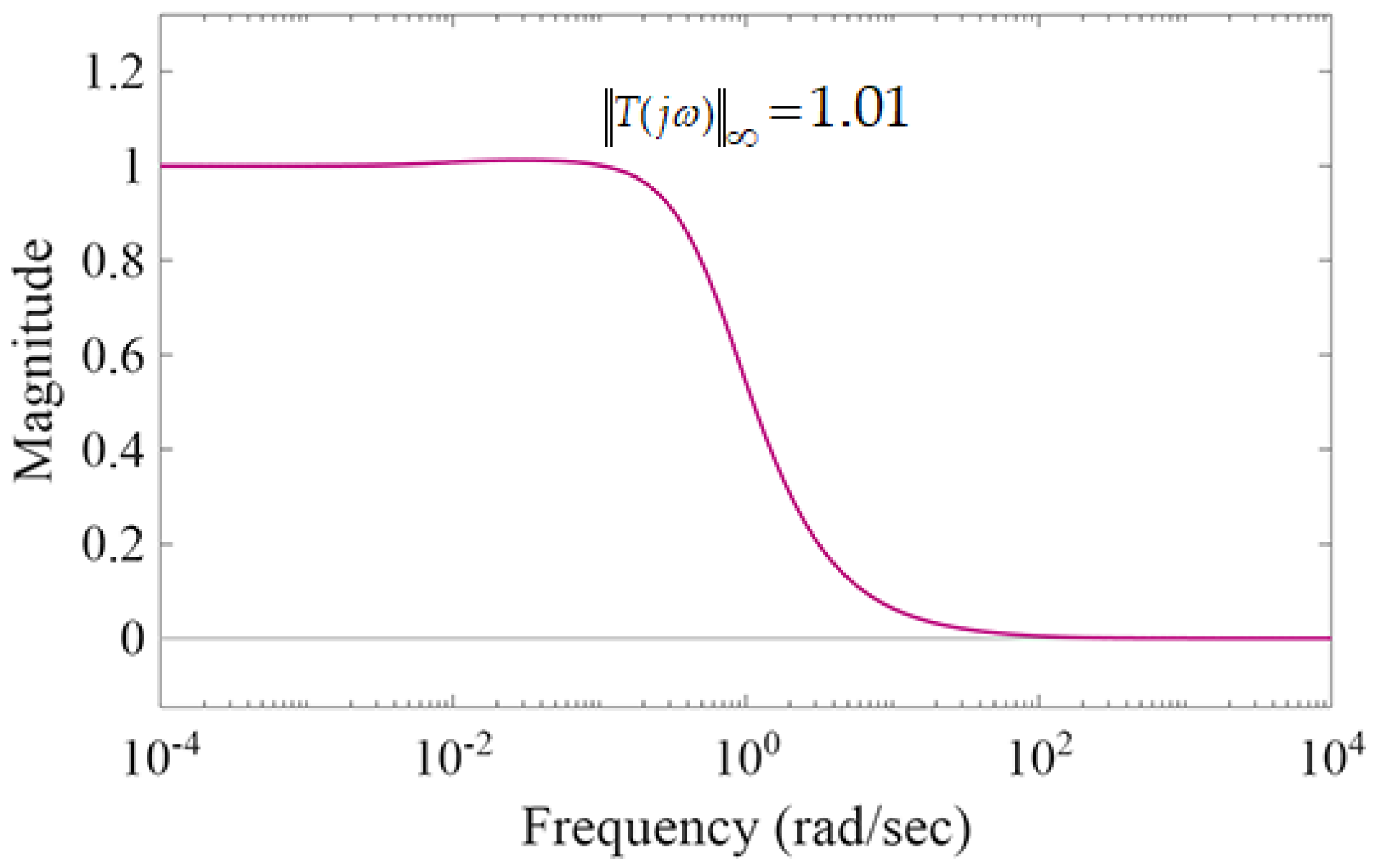
Figure 10.
Step response of the isolated channels in case .
Let us suppose now that the matrix in (59) has the following form
Suppose also that the matrix in (60) is an identity matrix . Practically, this means that the cross-connections between separate channels are not compensated and are described by the matrix
The eigenvalues of this matrix are complex-conjugated and equal to
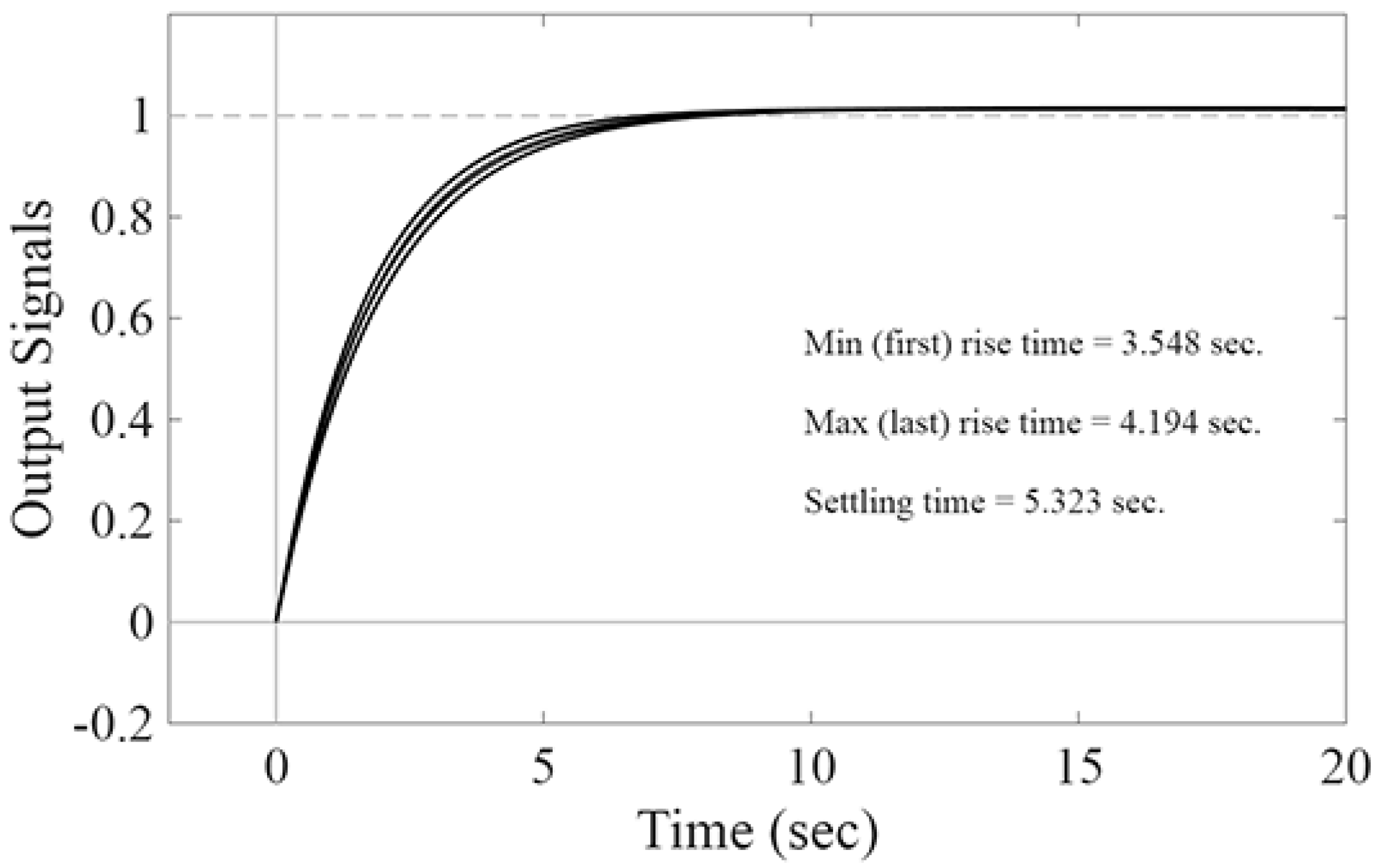
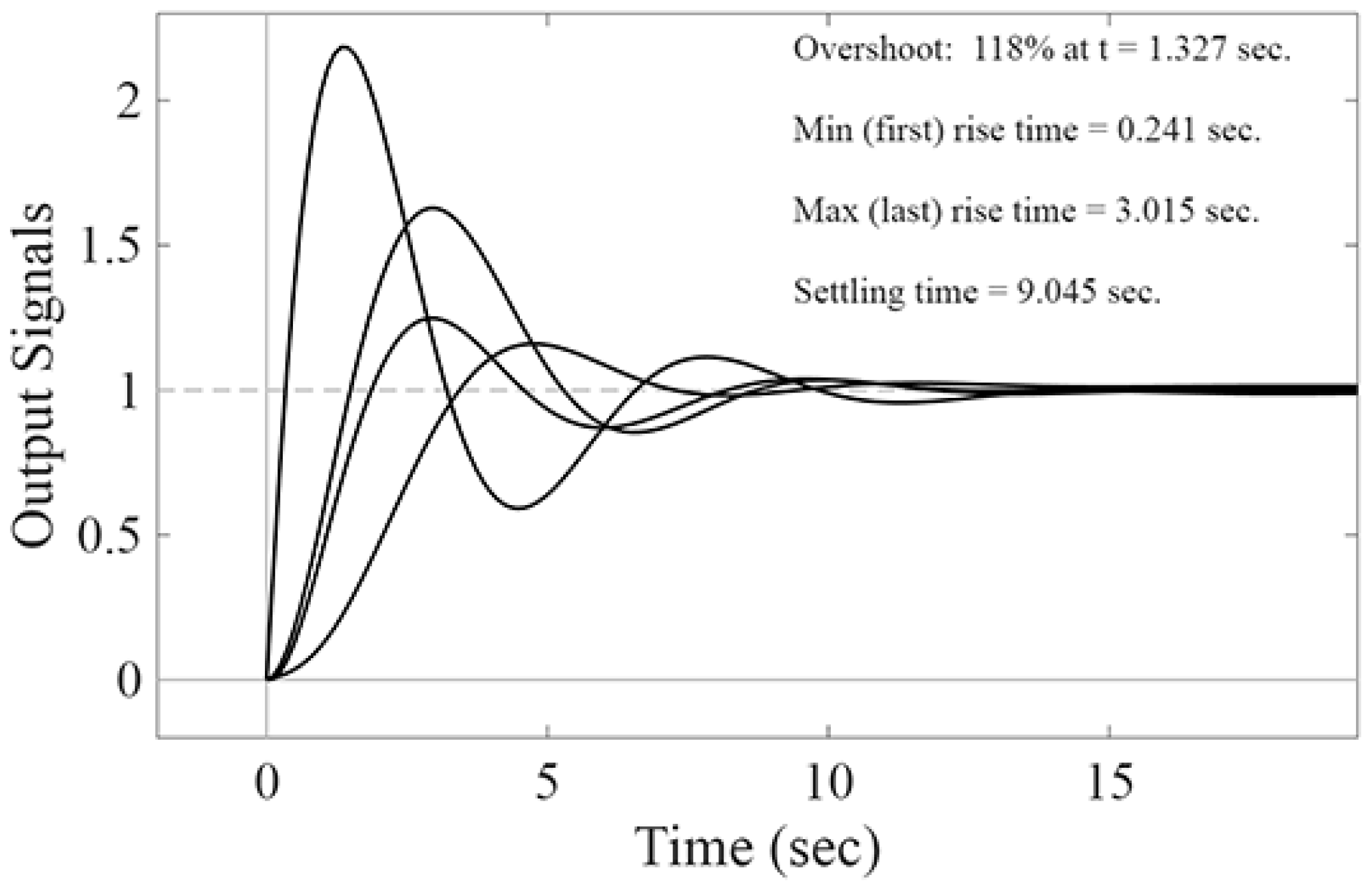
The frequency response and step response characteristics of the quadcopter control system with cross-connections matrix (70) are shown in Figure 11, Figure 12 and Figure 13. In Figure 11, the four black lines are the graphs of the plant, the blue line represents the identical PD regulators (68) in separate channels, and the gain loci of the corrected system are shown by brown lines. The vinous lines in Figure 12 represent the majorant and minorant of the generalized frequency response characteristics and the black lines depict the complementary sensitivity functions of the closed-loop characteristic systems.
Let us analyze now the sensitivity of the closed-loop control system with the cross-connection matrix (70) to small degradations of motors’ parameters . For brevity, below we present the results only for the sensitivities and of eigenvalues (71) and eigenvectors of the matrix (70) with respect to small degradations of the efficiency of the first motor (with respect to small negative perturbations of ).
The calculations yield the following results:
The sensitivity functions with respect to loss of efficiency of other motors are determined analogously.
Finally, we discuss the case when the matrix in (62) is taken as in (65) and there are motors’ efficiency degradations, i.e. . The cross-connections matrix in this case can be written in the form of similarity transformation
where
As can be seen from (72) and (73), the columns of the matrix constitute the canonical basis of the cross-connected control system in Figure 5 and Figure 6, and the parameters are the “gains” of the CTFs in (5). Moreover, the form of the matrix (35) in which shows that in this case we have
where is a matrix in which the th entry on the principal diagonal is one () and all other entries are zero (). Consequently, if and , then the small degradation of the th motor’s efficiency does not affect at a first approximation the canonical basis of the uniform system and the “gains” of the CTFs for . Besides, the sensitivity of the th eigenvalue is equal to one, that is small degradations of lead to the same degradations of eigenvalue .
Figure 14.
Nyquist plots of the isolated channels in case and .
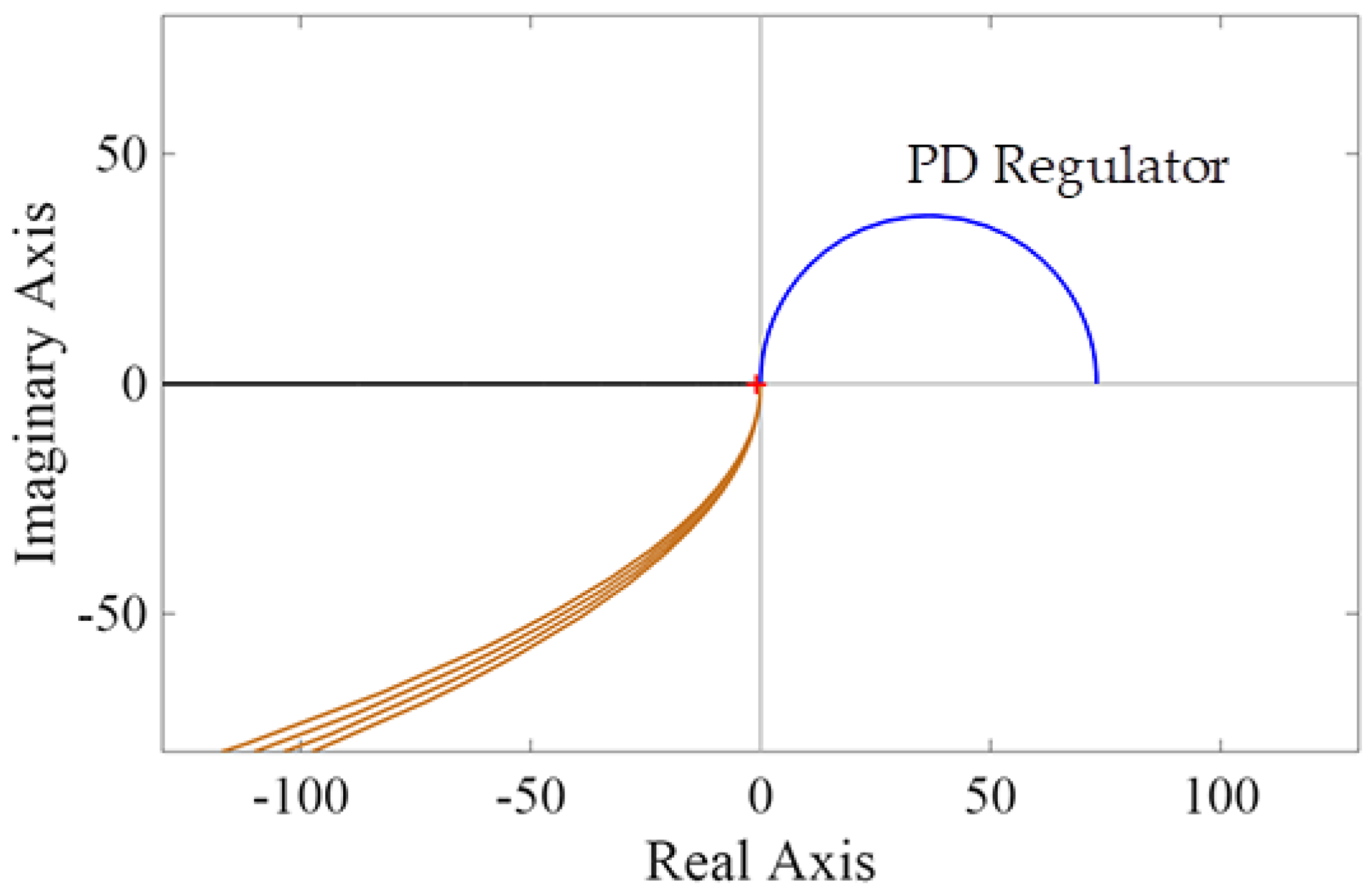
Figure 15.
Generalized frequency-response characteristics of the complementary sensitivity function matrix.
Figure 15.
Generalized frequency-response characteristics of the complementary sensitivity function matrix.
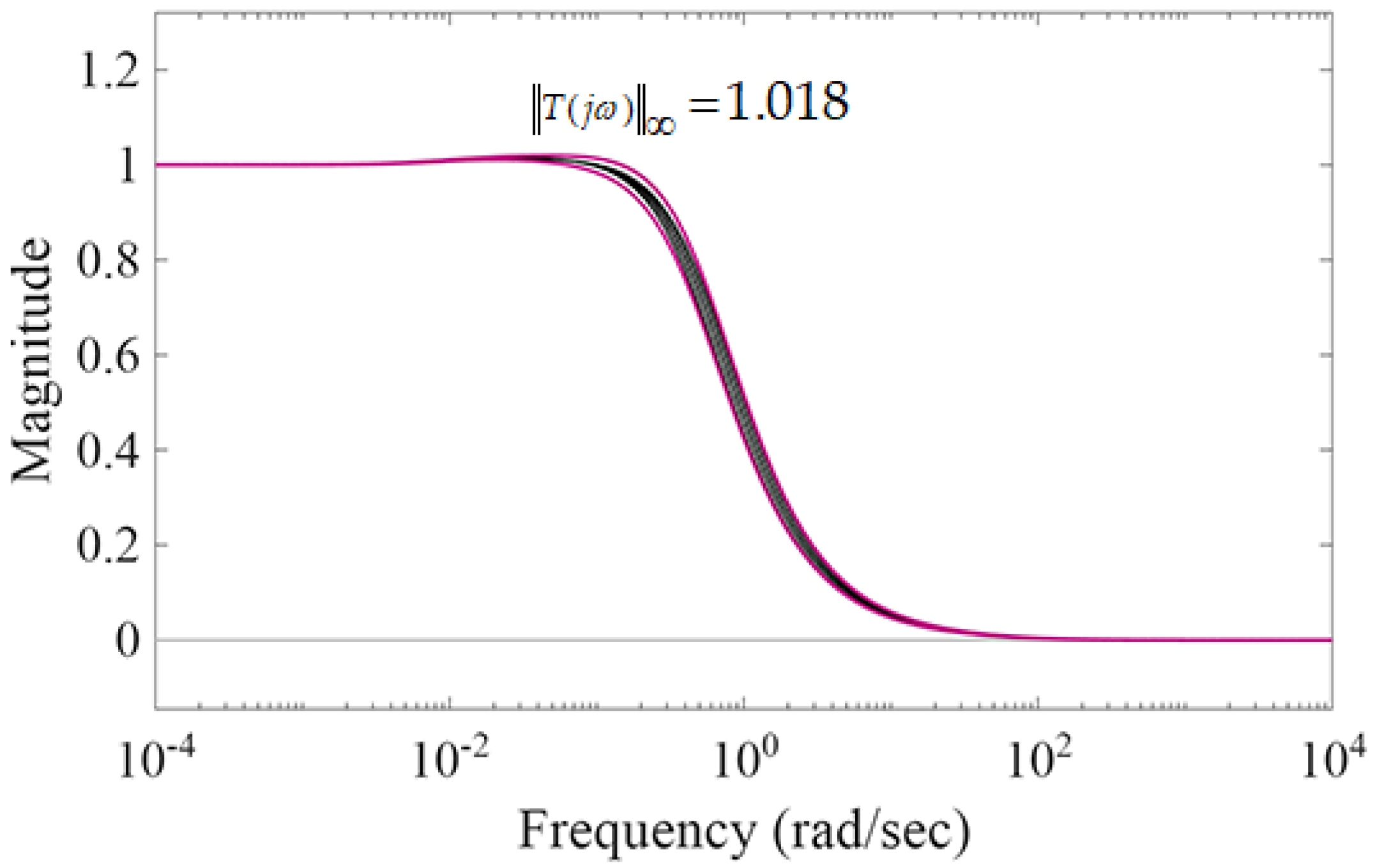
Figure 16.
Step responses of the control system in case and .
5. Discussion
In the paper, the issue of sensitivity of uniform control systems is discussed from the position of the CTFs method. In a sense, the results of the paper can be regarded as an extension to uniform systems of the results presented in [1] and concerning the sensitivity of the CTFs and canonical basis axes of general type MIMO systems. The point is that, as compared with general type MIMO systems, uniform systems always comprise structurally two different matrix blocks, specifically, a scalar transfer matrix of identical separate channels and a numerical matrix of rigid cross-connections. The parameter perturbations of these two blocks result in distinguishable changes of the CTFs and canonical basis axes of uniform systems. In the paper, these two situations are treated separately, and the formulas are derived determining the sensitivity of the CTFs and canonical basis axes when parameter perturbations are completely concentrated in the transfer matrix of separate channels or in the numerical matrix of cross-connections.
Practical application of the results is demonstrated by the sensitivity analysis of control system of a quadcopter to small degradations of the motors’ efficiency.
The numerical calculations and modeling of dynamics of the quadcopter control system presented in Figure 8 – Figure 16 are obtained by a software package MIMO Control Toolbox which is being developed at the Aerial Robotics Center of the National Polytechnic University of Armenia [20]. The toolbox works in the MATLAB environment and is designed for analysis and design of MIMO control systems in robotic , mechatronics, and in other fields. The central feature of the MIMO Control Toolbox is that the design of any N-dimensional MIMO control system is reduced to the design of a certain fictitious SISO control system. Another key feature of the toolbox is that it includes about 250 new MATLAB classes (objects) describing all the main structural types of MIMO control systems known from scientific and technical literature.
The frequency and time response characteristics of the quadcopter’s control system in Figure 11, Figure 12, Figure 13, Figure 14, Figure 15 and Figure 16 were obtained with the help of a special interactive graphical user interface (GUI) which is a part of the package MIMO Control Toolbox. That GUI can be viewed as an extension to multivariable case of the well-known GUI Control Systems Designer in MATLAB [21]. The MIMO Control Toolbox can be used both as a computer-aided control systems design tool in various areas of industry and technics, and for teaching the fundamentals of classical and modern feedback control at educational institutions.
Author Contributions
Conceptualization, O.G., N.N., A.D. and V.M..; methodology, O.G., N.N., A.D.; software, O.G., D.D., M.H., V.M.; validation, O.O., M.D., D.D., M.H.; formal analysis, D.D., M.H.; investigation, O.G., N.N., A.D., D.D., M.H.; data curation, O.O., M.D., V.M.; writing—original draft preparation, O.G. and A.D.; writing—review and editing, O.G. and A.D.; visualization, A.D., O.O., M.D.; supervision, O.G.; project administration, O.G., A.D.; All authors have read and agreed to the published version of the manuscript.
Funding
This research received no external funding
Data Availability Statement
The original contributions presented in this study are included in the article. Further inquiries can be directed to the corresponding author.
Conflicts of Interest
The authors declare no conflicts of interest.
Abbreviations:
The following abbreviations are used in this manuscript:
| MIMO | Multi-Input Multi-Output | |
| SISO | Single-Input Single-Output | |
| UAV | Unmanned Aerial Vehicle | |
| PID | Proportional-Integral-Derivative | |
| GUI | Graphical User Interface |
References
- Gasparyan, O.; Nersisyan, N.; Buniatyan, L.; Ohanyan, O.; Darakhchyan, M.; Begoyan, K.; Danielyan, D.; Harutyunyan, M. On Sensitivity of Characteristic Transfer Functions of Multivariable Control Systems. 2026. preprints. [CrossRef]
- Skogestad, S.; Postlethwaite, I. Multivariable Feedback Control: Analysis and Design, 2nd ed.; Wiley-Interscience: UK, 2005; 592p. [Google Scholar]
- Maciejowski, J.M. Multivariable Feedback Design; Addison-Wesley Longman Publishing Company: Boston, 1989; 448p. [Google Scholar]
- Gasparyan, O.N. Linear and nonlinear multivariable feedback control: A classical approach; John Wiley & Sons: United Kingdom, 2008; 341p. [Google Scholar]
- Macfarlane, A.G.J.; Belletrutti, J.J. The characteristic locus design method. Automatica 1973, 9, 575–588. [Google Scholar] [CrossRef]
- MacFarlane, A.G.J.; Postlethwaite, I. Characteristic frequency functions and characteristic gain functions. International Journal of Control 1977, 26, 265–278. [Google Scholar] [CrossRef]
- MacFarlane, A.G.J.; Kouvaritakis, B. A design technique for linear multivariable feedback systems. International Journal of Control 1977, 25, 837–874. [Google Scholar] [CrossRef]
- MacFarlane, A.G.J. Commutative controller: a new technique for the design of multivariable control systems. Electronics Letters 1970, 6, 121–123. [Google Scholar] [CrossRef]
- Dorf, R.C.; Bishop, R.H. Modern control systems, 14th ed.; Pearson: United Kingdom, 2022; 1032p. [Google Scholar]
- Postlethwaite, I. Sensitivity of the characteristic gain loci. Automatica 1982, 18, 709–712. [Google Scholar] [CrossRef]
- Moreira, M.V.; Basilio, J.C. Characteristic locus method robustness improvement through optimal static normalizing pre-compensation. International Journal of Robust and Nonlinear Control 2010, 20, 371–386. [Google Scholar] [CrossRef]
- Tomovic, R.; Vulkobratovic, M. General sensitivity theory; North- Holland, 1972; 258p. [Google Scholar]
- Eslami, M. Theory of sensitivity in dynamic systems: an Introduction; Springer-Verlag: Berlin, 1994; 601p. (in English) [Google Scholar]
- Rozenvasser, E.N.; Yusupov, R.M. Sensitivity of Automatic Control Systems, 1st Edition ed.; Boca Raton, 1999; 456p. [Google Scholar] [CrossRef]
- Cruz, J.; Perkins, W. A new approach to the sensitivity problem in multivariable feedback system design. IEEE Transactions on Automatic Control 1964, 9, 216–223. [Google Scholar] [CrossRef]
- Morgan, B. Sensitivity analysis and synthesis of multivariable systems. IEEE Transactions on Automatic Control 1966, 11, 506–512. [Google Scholar] [CrossRef]
- Gelfand, I.M. Lectures on Linear Algebra (Dover Publications, no. 1); Interscience Publishers: New York, 1989; 208p. [Google Scholar]
- Kato Tosio, Perturbation theory for linear operators (Grundlehren der mathematischen Wissenschaften: a series of comprehensive studies in mathematics); Springer: Berlin, 2012; 643p.
- Mahony, R.; Kumar, V.; Corke, P. Multirotor Aerial Vehicles: Modeling, Estimation, and Control of Quadrotor. IEEE Robotics & Automation Magazine 2012, 19, 20–32. [Google Scholar] [CrossRef]
- Gasparyan, O.N.; Darbinyan, H.G. Adaptive System of Compensation of Motors’ Partial Degradations of Multirotor UAVs. In Modern Problems of Robotics; Yuschenko, A., Ed.; Springer International Publishing: Cham, 2021; pp. 207–219. [Google Scholar] [CrossRef]
- Gasparyan, O.N.; Simonyan, T.A.; Buniatyan, L.M.; Karapetyan, A.K. A New Toolbox for Computer-Aided Analysis and Design of Multivariable Control Systems in Robotics and Mechatronics. SSRG International Journal of Electrical and Electronics Engineering 2026, 13, 169–177. [Google Scholar] [CrossRef]
- Control System Toolbox User’s Guide; MathWorks: South Natick, 2025; 1936p.
Figure 1.
Matrix block diagram of a uniform MIMO system.
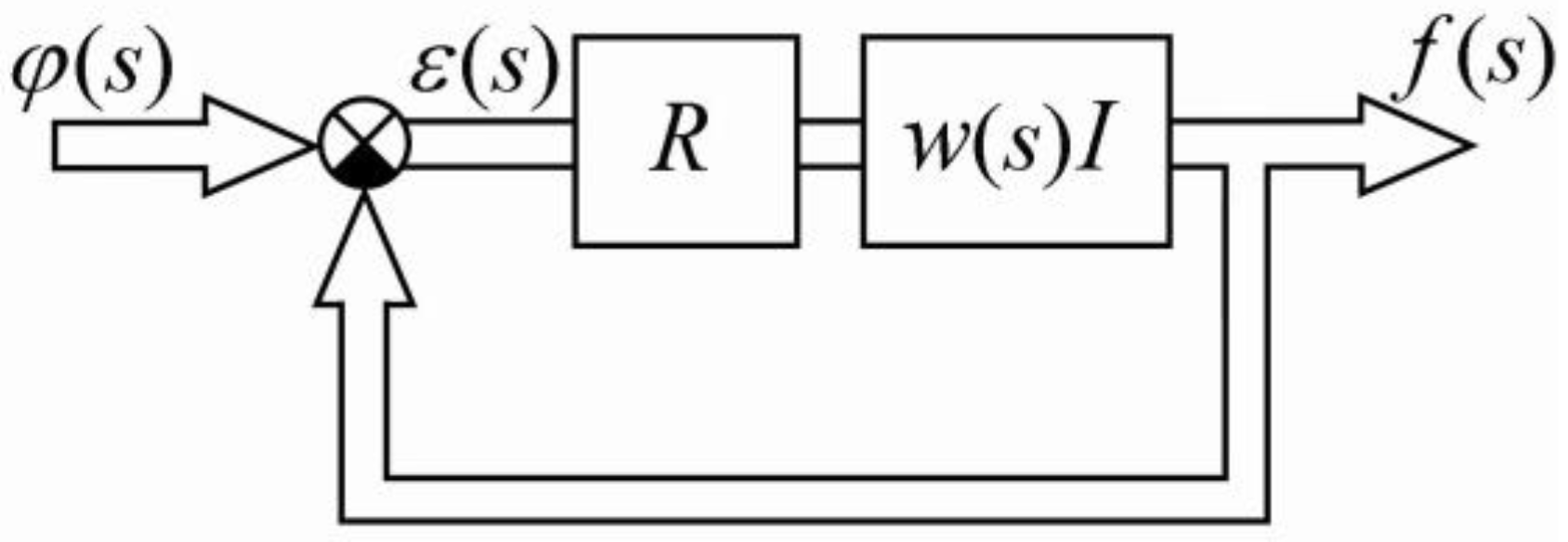
Figure 2.
Canonical representation of the open-loop uniform system.
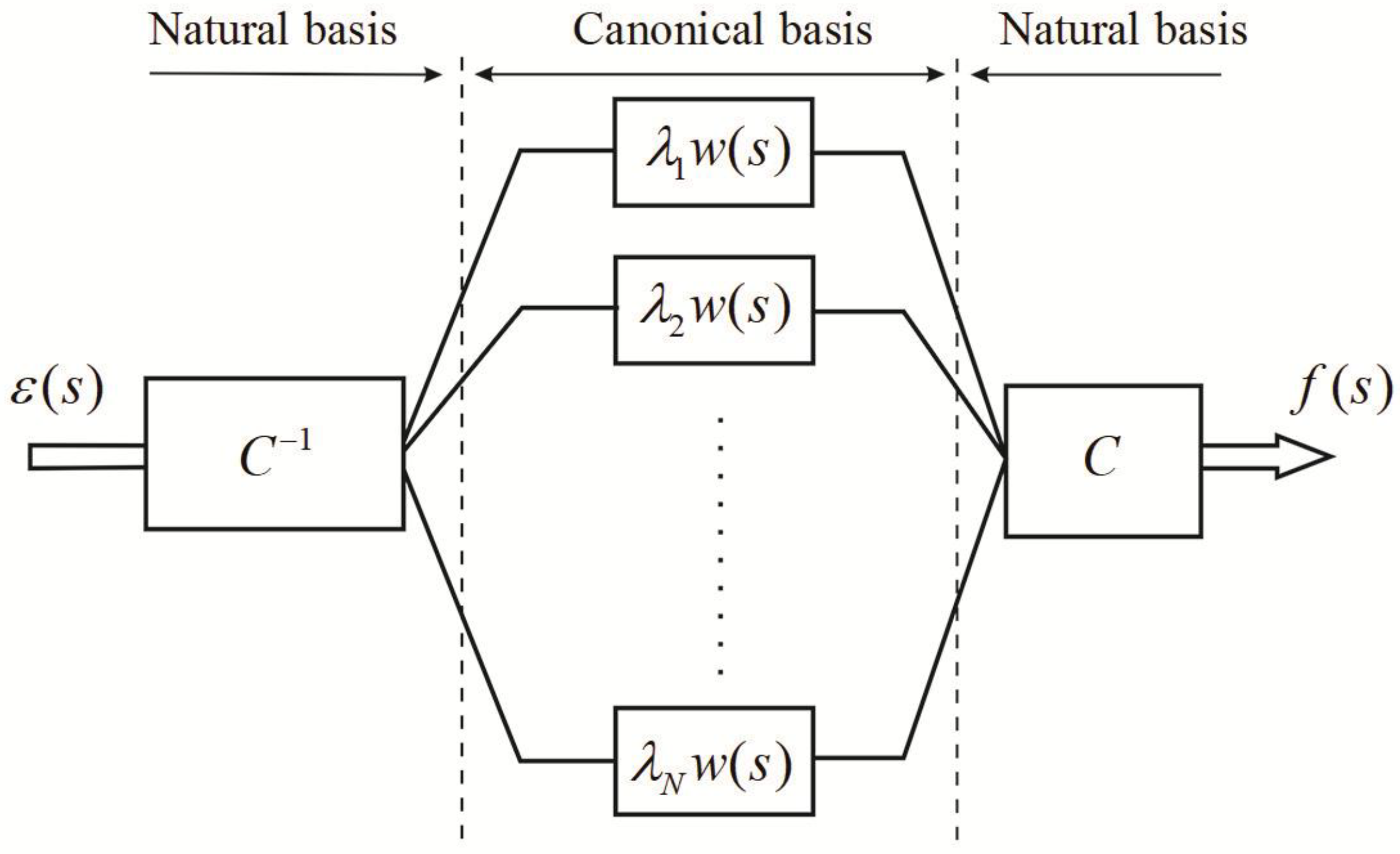
Figure 3.
Canonical representation of the closed-loop uniform system.
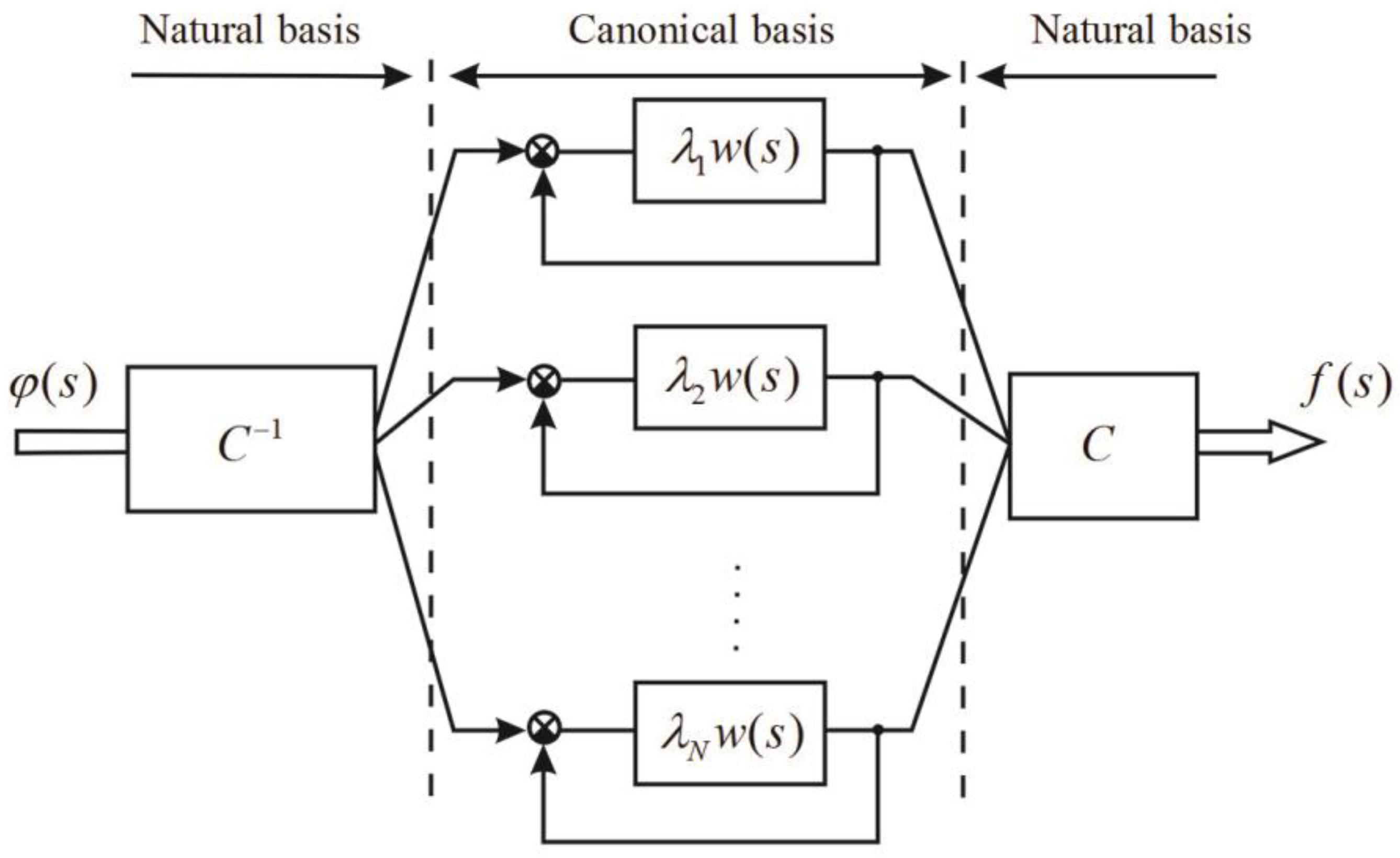
Figure 4.
Multorotor UAVs: (a) quadcopter (NR= 4), (b) octocopter (NR = 8).
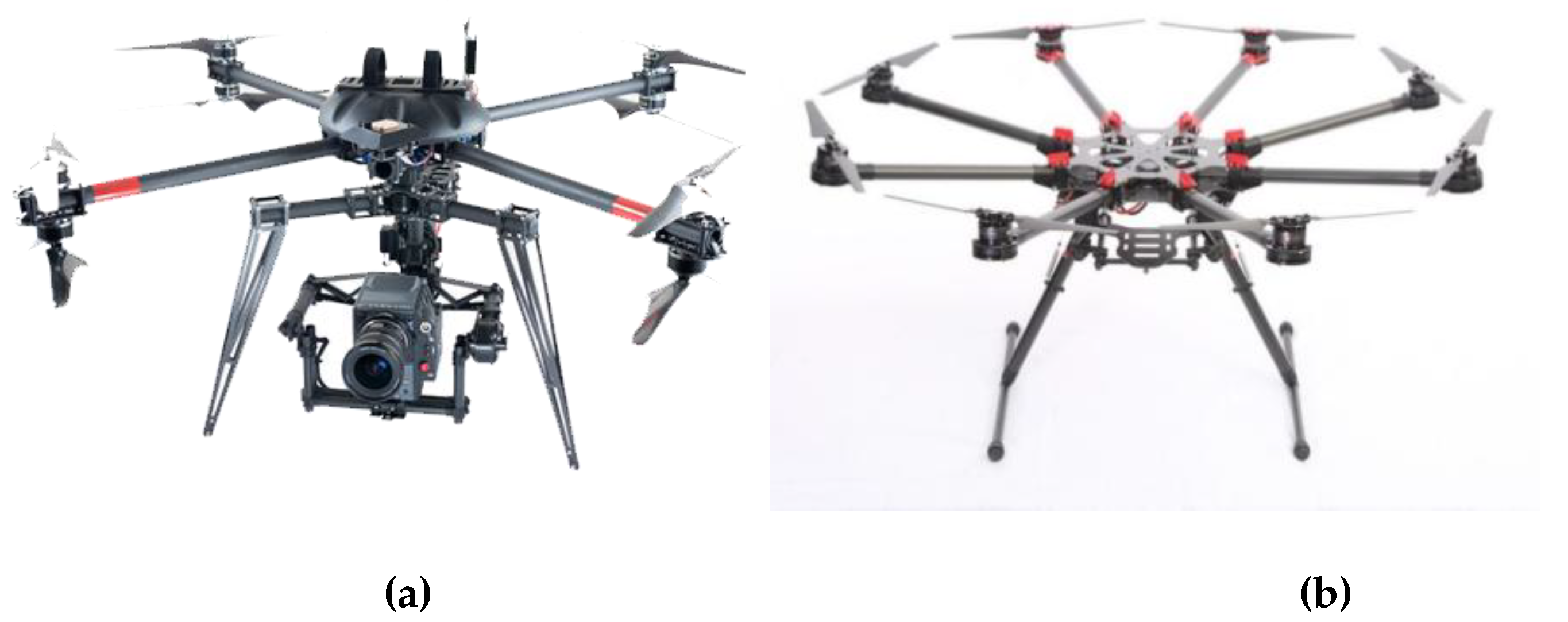
Figure 5.
Matrix block diagram of the linear control system of the UAV.
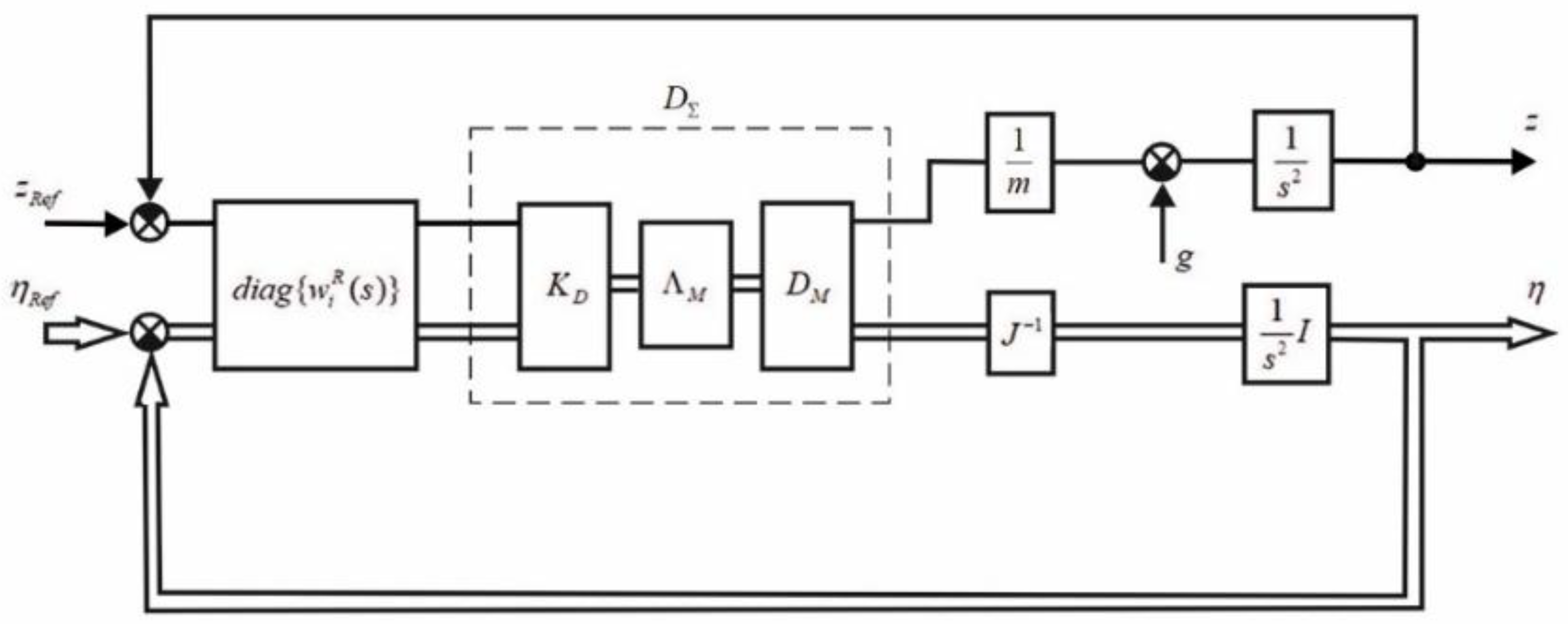
Figure 7.
Block diagram of isolated separate channels in case of ideal motors ().
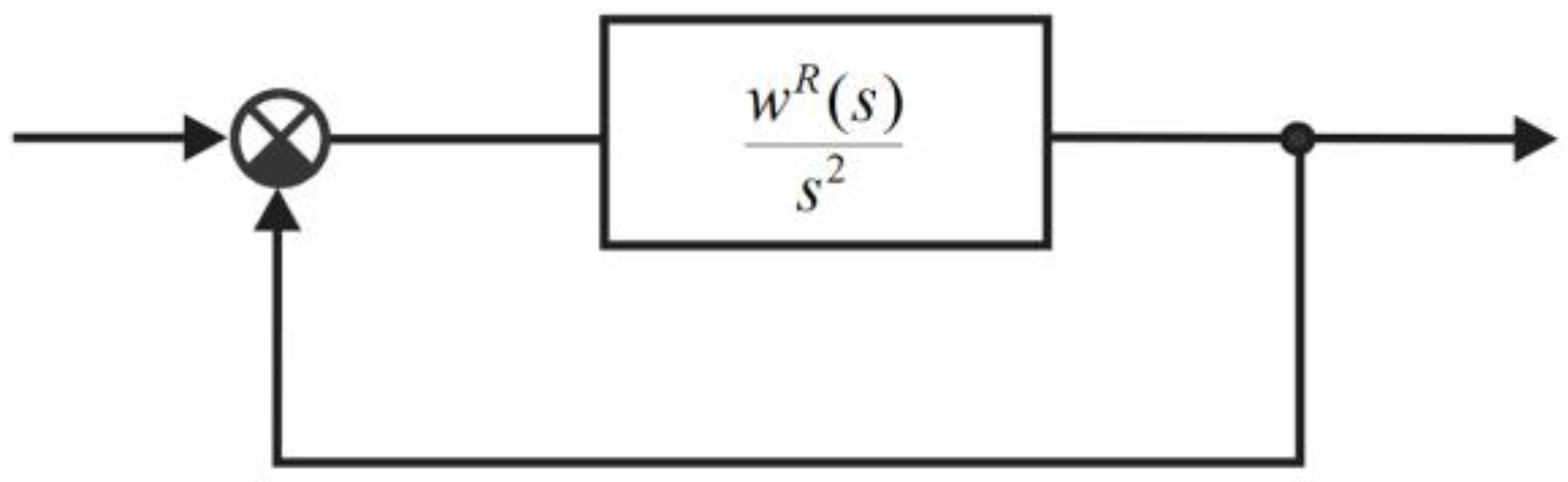
Figure 11.
Nyquist plots of the CTFs.
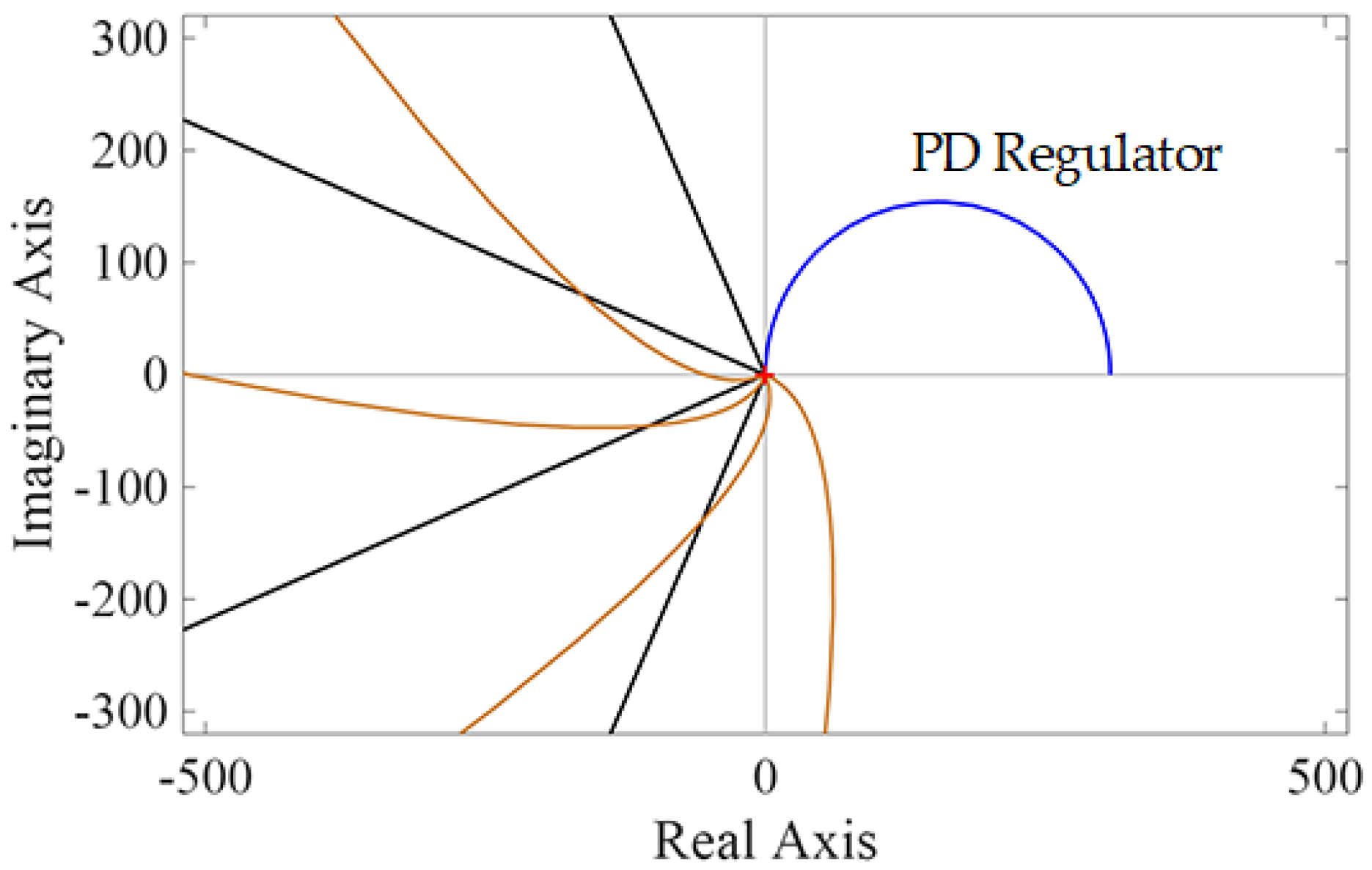
Figure 12.
Generalized frequency-response characteristics of the complementary sensitivity function matrix.
Figure 12.
Generalized frequency-response characteristics of the complementary sensitivity function matrix.
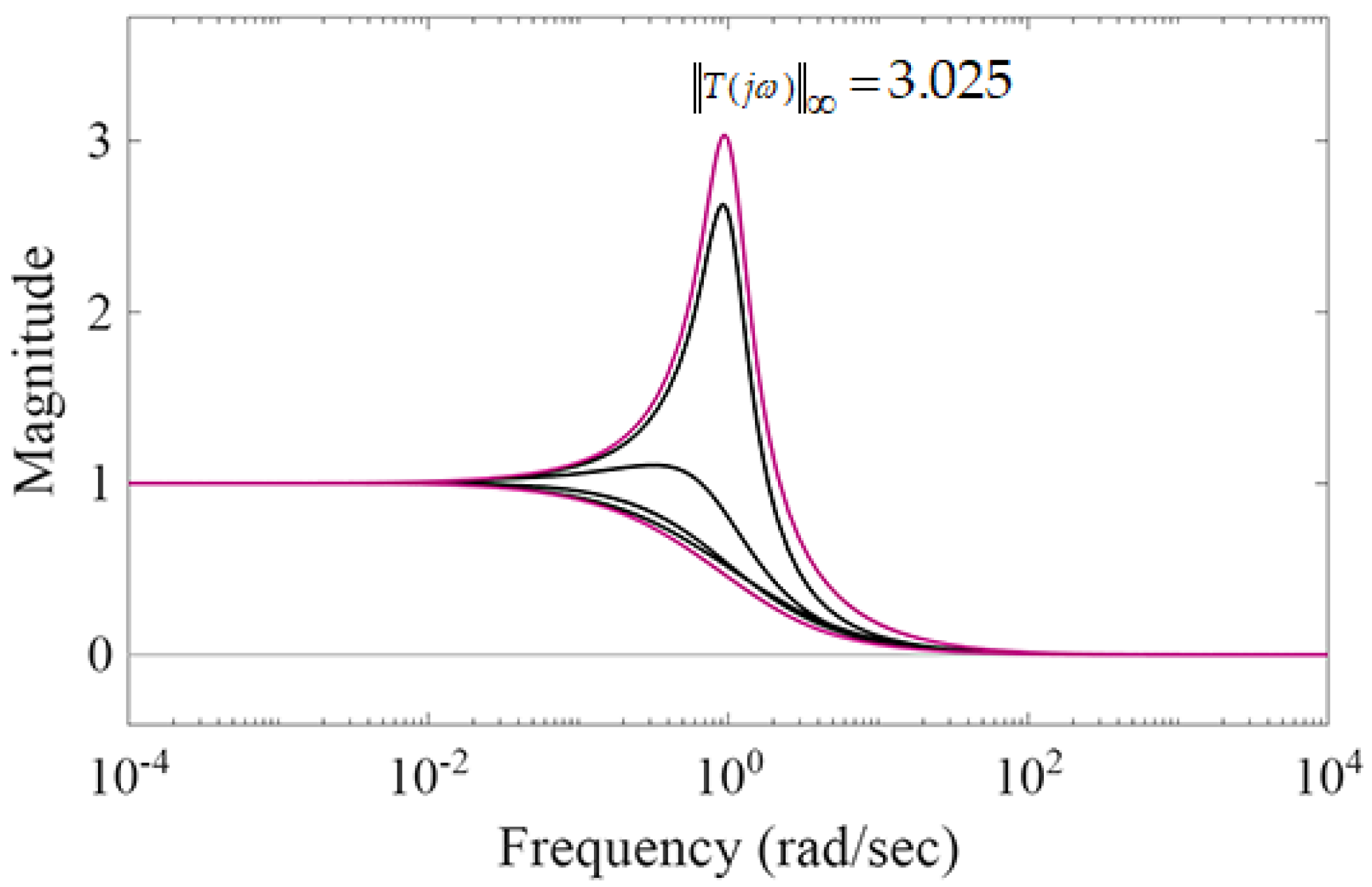
Figure 13.
Step responses of the control system ().in case and .
Disclaimer/Publisher’s Note: The statements, opinions and data contained in all publications are solely those of the individual author(s) and contributor(s) and not of MDPI and/or the editor(s). MDPI and/or the editor(s) disclaim responsibility for any injury to people or property resulting from any ideas, methods, instructions or products referred to in the content. |
© 2026 by the authors. Licensee MDPI, Basel, Switzerland. This article is an open access article distributed under the terms and conditions of the Creative Commons Attribution (CC BY) license (http://creativecommons.org/licenses/by/4.0/).
Copyright: This open access article is published under a Creative Commons CC BY 4.0 license, which permit the free download, distribution, and reuse, provided that the author and preprint are cited in any reuse.


