

Submitted:
19 April 2026
Posted:
20 April 2026
You are already at the latest version
Abstract
In response to the contradiction between the insufficient flexibility of nuclear power under the high proportion of renewable energy grid connection and the increasing demand for system frequency regulation, this paper proposes a coordinated operation model of nuclear storage consortium, using all-vanadium REDOX flow batteries as the flexibility transformation solution. Referring to the PJM market and the Guangdong electricity market mechanism, a two-tier optimization model for the nuclear energy storage consortium to participate in the electricity-secondary frequency regulation market is constructed. The upper layer optimizes the scale of energy storage configuration, and the lower layer realizes joint clearing based on the SCUC-SCED framework, taking into account the nuclear frequency regulation safety share constraint and energy storage performance coefficient. The case analysis shows that the configuration of 70 MW/70 MWh vanadium REDOX flow batteries can increase the annualized net income of the consortium by 2.8429 million yuan, mainly by shifting the nuclear power regulation space from the energy market to the high-value frequency regulation market. The study verified the feasibility of the nuclear storage synergy model in enhancing market competitiveness while ensuring nuclear safety, providing a quantitative reference for the flexibility transformation of nuclear power and the design of power market mechanisms.
Keywords:
nuclear storage consortium
; all-vanadium REDOX flow battery
; combined clearing
; double-layer optimization
; economic analysis
1. Introduction
Under the background of global energy low-carbon transition and high-proportion renewable energy grid integration, China’s “dual carbon” goal clearly states that the proportion of non-fossil energy consumption will exceed 80% by 2060[1], and it is expected that new energy will become the main body of power supply by 2035. Under the “dual carbon” goal, the power industry is vigorously developing new energy dominated by wind and photovoltaic power, and establishing a clean, low-carbon new power system. However, the strong volatility and high uncertainty of new energy power generation have increased the flexibility demand of the power system, prominent frequency safety issues, and a surge in demand for fast frequency regulation resources[2,3].
As a low-carbon and stable baseload power source, nuclear power has become increasingly important in strategic status, and its installed capacity in operation is expected to reach about 200 million kilowatts by 2035[4,5,6]. In the scenario of high-proportion renewable energy grid integration, the net load fluctuation of the power system is severe, the “duck curve” effect is significant, and the system’s demand for flexible regulation resources has increased substantially[7]. This is in sharp contradiction with the characteristics of nuclear power such as “high investment and low marginal cost” (which requires maintaining a high load factor[8]) and the physical and safety constraints of pressurized water reactor cores (linear ramping rate ≤5%/min, etc.[9]). Forced deep frequency regulation will cause economic losses and safety risks[10], so improving nuclear power flexibility has become a key bottleneck.
The reform of electricity marketization and the development of energy storage technology provide a solution path. It is expected that a national unified electricity market system will be built by 2035, and the joint clearing mechanism of electricity energy and ancillary services can improve the efficiency of resource allocation[11]; in the first half of 2023, the proportion of national power auxiliary service fees in on-grid electricity fees has reached nearly 2%, and it will continue to grow with the increase of new energy permeability[12], creating profit space for flexible resources. Vanadium Redox Flow Battery (VRFB), with its intrinsic safety, ultra-long cycle life and cost reduction advantages[13,14,15], has become an ideal choice for nuclear power flexibility transformation. Through the collaborative mode of “nuclear power baseload + energy storage regulation”, the overall planning of safety and flexibility can be realized.
Existing research has made phased progress in the fields of nuclear power flexible operation, energy storage frequency regulation performance modeling and the mechanism of the ancillary service market. In terms of research results, foreign countries focus on the technical feasibility verification of nuclear power load tracking, while domestic studies focus on the impact analysis of flexible operation on system safety and economy. However, both types of studies are limited to the technical characteristics of nuclear power plants, and have not carried out collaborative optimization research on the nuclear-storage consortium system within the framework of market clearing. Market mechanism research has formed a multi-dimensional exploration pattern. In the field of inter-provincial markets, reference [16] proposes a standby transaction construction scheme, which realizes the rational allocation of tie-line capacity through the energy-standby joint optimization model to ensure standby deliverability; in the field of coping with new energy uncertainty, references [17,18] construct a wind-solar-thermal-storage spot-frequency regulation joint transaction strategy, combined with scenario generation and distributed algorithm for solution. Reference [19] uses normal cloud mixed skewed distribution to describe wind power prediction errors, and balances safety and economy through chance-constrained programming. Reference [20] establishes a distributionally robust bilateral chance-constrained model based on source-load fuzzy sets, and derives the uncertain power marginal price; in low-carbon operation optimization, reference [21] proposes a multi-stage clearing mechanism and multi-market equilibrium strategy for electricity-carbon-green certificate coordination; in the aspect of energy storage participation mechanism, reference [22] establishes an independent energy storage electricity energy-full-process frequency regulation joint clearing model. Reference [23] designs the dynamic frequency regulation capacity declaration boundary considering the state of charge of energy storage. Reference [24] proposes the market coupling factor based on the duality principle, providing theoretical support for the transparent electricity price mechanism.
Existing studies have made certain progress in nuclear power flexible operation, energy storage frequency regulation modeling and electricity energy-ancillary service joint clearing, but there are still deficiencies: first, energy storage is mostly regarded as an independent market subject, lacking collaborative modeling with power sources with strict safety constraints such as nuclear power; second, nuclear-storage collaboration research mostly focuses on arbitrage analysis on the power plant side, and rarely incorporates it into the joint clearing framework to systematically evaluate its market performance; third, research on the economy of nuclear-storage consortium under the mature joint clearing mechanism is relatively limited, and there is still a lack of quantitative analysis for high new energy permeability scenarios.
Based on this, this paper refers to the mature electric energy/secondary frequency regulation joint clearing mechanism of the PJM market in the United States and the power market of Guangdong Province, and constructs a two-layer optimization model for the nuclear-storage joint entity to participate in the market, considering nuclear power safety constraints and the performance coefficient of energy storage for frequency regulation. Under a unified joint clearing framework, the optimal energy storage configuration scale of the nuclear-storage joint entity and its economic performance are systematically analyzed. The feasibility and potential advantages of nuclear power configuring energy storage to participate in the frequency regulation market under the established joint clearing mechanism are also evaluated, providing quantitative references for the design of related mechanisms and the selection of technical paths.
2. Mode Design of Nuclear-Storage Consortium Participating in the Market
2.1. Research Framework and Technical Route
The research logic of this paper follows a progressive system of “mechanism design - collaborative optimization - simulation verification”. Firstly, it clarifies the complementary and collaborative characteristics of the nuclear storage consortium in participating in the joint clearing of electric energy and secondary frequency regulation, and construct the corresponding market settlement and value recovery framework; on this basis, build a bi-level optimization framework, the upper level realizes the collaborative configuration optimization of the rated power and energy capacity of the energy storage system through the investment decision model, and the lower level uses Security Constrained Unit Commitment (SCUC) and Security Constrained Economic Dispatch (SCED) to simulate the joint clearing process of the energy/frequency regulation market; finally, based on the price signals generated by the clearing results, quantitatively evaluate the improvement effect of the nuclear-storage collaborative mode on system flexibility and market competitiveness. The specific technical route is shown in Figure 1.
2.2. Definition and Market Positioning of Nuclear-Storage Consortium
To alleviate the contradiction between insufficient flexibility of nuclear power and the high-performance demand of the frequency regulation market, this paper proposes a collaborative operation mode of nuclear-storage consortium. The nuclear-storage consortium refers to an organizational form in which nuclear power units and energy storage systems participate in the electricity market as a unified market subject, jointly participating in the electricity energy market and the secondary frequency regulation ancillary service market.
At the physical level, the energy storage system and the nuclear power unit are connected to the power grid through the same grid connection point, and the charging and discharging power of the energy storage and the output power of the nuclear power form the net injection power at the grid connection point, thus providing the basis for the collaborative regulation within the consortium. At the market level, the nuclear-storage consortium conducts unified quotation and settlement as a single subject: the energy market is settled according to the net injection power of the consortium and the clearing electricity price; the secondary frequency regulation market is settled for frequency regulation income according to the equivalent frequency regulation capacity considering the performance coefficient. At the operation level, the nuclear-storage consortium coordinates the energy storage charging and discharging behavior and frequency regulation capacity reservation under the premise of satisfying nuclear power safety constraints, realizing the collaborative optimization of multi-market income.
Compared with the mode where nuclear power and energy storage participate in the market separately, the nuclear-storage consortium has three advantages:
(1) The energy storage provides fast flexibility support, improving the overall frequency regulation capacity without breaking nuclear safety constraints.
(2) Unified quotation and settlement reduce transaction complexity and management costs.
(3) Expand the collaborative optimization space of the energy market and ancillary service market, improving comprehensive economy.
2.3. Energy Market Participation Mechanism of Nuclear-Storage Consortium
The operation characteristics of the nuclear-storage consortium in the energy market are manifested as: adjusting the net injection power of the consortium through energy storage charging and discharging. The net injection power at any time period is jointly determined by the output power of the nuclear power unit and the charging and discharging power of the energy storage. Nuclear power mainly undertakes stable baseload power supply, and its output change is limited by safety constraints; energy storage realizes energy arbitrage through inter-temporal energy transfer: in low-price periods, energy storage absorbs part of nuclear power generation for charging to reduce net injection; in high-price periods, energy storage discharges and superimposes with nuclear power output to increase net injection, thereby obtaining peak-valley price difference income.
To ensure operational compliance, this paper assumes that the energy source for energy storage charging is only nuclear power generation, and the consortium does not purchase electricity from the external power grid, avoiding policy disputes caused by cross-market arbitrage. The consortium participates in clearing with a unified energy quotation, and its energy market income is determined by the net injection power and the corresponding clearing electricity price. In addition to energy arbitrage, energy storage can also reserve power margin during charging and discharging to participate in frequency regulation, realizing energy-frequency regulation coordinated operation.
2.4. Secondary Frequency Regulation Participation Mechanism of Nuclear-Storage Consortium
2.4.1. Frequency Regulation Service Demand and Performance Evaluation
Secondary frequency regulation refers to the ancillary service in which the power system balances the real-time load and power generation deviation and maintains system frequency stability within the minute-level time scale through the Automatic Generation Control (AGC) system. Frequency regulation demand usually includes upward frequency regulation demand and downward frequency regulation demand, corresponding to the situations where the system needs to increase or decrease active power output respectively. Due to the significant differences in response speed, regulation accuracy and continuous tracking capability of different types of resources, the frequency regulation market usually introduces the frequency regulation performance coefficient ki to quantitatively evaluate the frequency regulation capacity of resources.
2.4.2. Nuclear Power Frequency Regulation Safety Constraints and Share Limitations
Nuclear power units face strict safety and fuel integrity constraints during power regulation. Frequent or large-amplitude power changes may cause fluctuations in core power distribution and accumulation of equipment thermal stress, reducing the reactor operation safety margin. Therefore, the participation of nuclear power units in secondary frequency regulation services must be strictly limited. Taking into account the limited frequency regulation capability of nuclear power under the condition of ensuring safety, this paper introduces nuclear power frequency regulation share limitation at the market mechanism level, that is, nuclear power units are only allowed to bear a limited proportion of frequency regulation capacity in the system frequency regulation demand. Specifically, the proportion of the frequency regulation capacity of nuclear power units in the total system frequency regulation demand shall not exceed 5%.
In the nuclear-storage consortium mode, the energy storage system, as a fast regulation resource, can bear most of the frequency regulation demand; nuclear power units only provide a small amount of auxiliary frequency regulation capacity within the allowable range of safety margin. This mechanism effectively improves the overall frequency regulation capacity and market competitiveness of the consortium without breaking the nuclear safety boundary.
2.4.3. The Bidirectional Frequency Modulation Operation Mode of Nuclear and Energy Storage Coordination
The frequency regulation operation mode of the nuclear-storage consortium reflects the collaborative coupling of energy services and frequency regulation services in the time dimension. The energy storage system can provide bidirectional frequency regulation services under different working conditions according to its operating state.
During the energy storage charging period, it participates in downward frequency regulation services by reserving part of the power margin. When the system frequency is high or the load is lower than the prediction, the energy storage charges to absorb excess electric energy; during the energy storage discharging period, it participates in upward frequency regulation services by reserving discharge margin. When the system frequency is low or the load is higher than the prediction, the energy storage discharges to inject electric energy into the power grid.
Within the nuclear-storage consortium, the frequency regulation capacity allocation follows the principle of “energy storage-based, nuclear power-assisted”. The energy storage system undertakes the main frequency regulation task by virtue of its advantages of fast response speed and high regulation accuracy; nuclear power units only provide limited frequency regulation support within the scope allowed by safe operation constraints. This division of labor gives full play to the technical advantages of different resources and maximizes the frequency regulation capacity of the consortium.
3. Joint Clearing Model of Nuclear-Storage Consortium Participating in Electricity Energy/Secondary Frequency Regulation Market
To describe the optimal energy storage configuration and operation income of the nuclear-storage consortium under the joint clearing mechanism of the electricity energy market and the secondary frequency regulation ancillary service market, this paper constructs a bi-level optimization framework of “upper-level investment configuration decision - lower-level market operation clearing”.
The upper-level model is from the perspective of the nuclear-storage consortium investors, with the goal of maximizing the annualized net income, and the decision variables are the rated power and rated capacity of energy storage; under the given energy storage configuration scheme, the lower-level model simulates the market operation and system dispatching process, adopts the two-stage modeling of SCUC-SCED to realize the joint clearing of electricity energy/secondary frequency regulation, outputs the output of each unit, frequency regulation capacity allocation and marginal clearing price, and then feeds back to the upper level to calculate the consortium’s income and cost. This framework can realize the closed-loop optimization of “configuration - clearing - income evaluation” of the nuclear-storage consortium under the premise of ensuring the consistency of system safety constraints and market mechanisms.
This paper adopts the uniform marginal price mechanism to settle the main energy, frequency regulation capacity and frequency regulation mileage respectively. For each time period t, the supply curve is constructed from low to high according to the quotation of each unit in the corresponding market. When the cumulative supply meets the demand, the quotation of the marginal resource is determined as the clearing price of the market: the energy market price is determined by the marginal energy resources meeting the load demand; the frequency regulation capacity and frequency regulation mileage prices are determined by the marginal frequency regulation resources meeting the equivalent frequency regulation capacity demand and equivalent mileage demand respectively.
3.1. Upper Model: Maximum Annualized Net Benefit for the Nuclear Storage Consortium
3.1.1. Upper-Level Objective Function
The upper-level model aims to maximize the annualized net return of the nuclear storage complex, with decision variables including rated power PEss and rated capacity Ecap. The annualized net income is composed of energy market income, frequency regulation market income and annualized investment and operation-related costs, which can be expressed as equations (1) -(4):
Where Rannual is the annual income of the nuclear-storage consortium; Iannual is the annual investment cost of the nuclear-storage consortium; Rnuc,E is the daily income of the nuclear power energy market; Rnuc,cap is the daily income of the nuclear power frequency regulation capacity market; Rnuc,mil is the daily income of the nuclear power frequency regulation mileage market; Ress,E is the daily net income of the energy storage energy market; Ress,cap is the daily net income of the energy storage frequency regulation capacity market; Ress,mil is the daily net income of the energy storage frequency regulation mileage market; cpower is the unit cost of energy storage power; cenergy is the unit cost of energy storage capacity; r is the annual discount rate; n is the service life of energy storage, PESS is the rated power of energy storage, EESS is the rated capacity of energy storage.
3.1.2. Constraint Conditions
The constraint conditions of the upper-level model are formulas (5)-(7):
3.2. Lower-Level Model: SCUC-SCED Joint Clearing of Electricity Energy-Secondary Frequency Regulation Market
3.2.1. Lower-Level Objective Function
The lower-level model describes the joint clearing process from the perspective of the system operator, adopting a two-stage structure: the first stage SCUC determines the start-stop plan of thermal power units; the second stage SCED optimizes the continuous output, frequency regulation capacity and energy storage operation state under the established start-stop state, realizing the joint configuration of energy-frequency regulation. The objective functions of SCUC and SCED are expressed as formulas (8)-(9):
Where Cenergy is the energy market cost, Cfreq is the frequency regulation market cost, is the energy storage cycle loss cost, is the market participation cost of the nuclear-storage consortium, and is the start-stop cost of thermal power units.
1) Energy Market Cost
The energy market cost is determined by the power generation of various power generation resources in each time period and their corresponding quotations, which is expressed as formula (10):
Among them, T is the time period within a day, N is the total number of nuclear power units, n=2, 3…, N represents the remaining nuclear power units except nuclear power unit 1, G represents the set of thermal power units, Pn(t) and Pg(t) are the output of nuclear power and thermal power units in time period t respectively, Pren(t) is the new energy output, and , , cren are the corresponding quotation parameters. Nuclear power unit 1, as part of the nuclear-storage consortium, its energy market cost is included in the market participation cost of the nuclear-storage consortium and is not counted repeatedly here.
2) Frequency Regulation Market Cost
The frequency regulation market cost includes frequency regulation capacity cost and frequency regulation mileage cost, which is expressed as formula (11):
Among them, (t) and (t) are the upward and downward frequency regulation capacity provided by nuclear power unit n respectively, (t) and (t) are the upward and downward frequency regulation capacity provided by thermal power unit g respectively, (t), (t), (t) and (t) are the corresponding frequency regulation mileage, and , , , are the corresponding quotation parameters of the frequency regulation mileage market.
3) Energy Storage Cycle Loss Cost Modeling
Considering that the energy storage system will generate battery cycle loss in the process of energy transaction and frequency regulation service, this paper adopts a throughput-based cycle cost model[25] to avoid double charging problems caused by multi-market participation. The energy storage cycle loss cost is expressed as formula (12):
Among them, Pch(t) and Pdis(t) are the energy storage charging and discharging power respectively, and ccycle is the cycle cost coefficient per unit throughput.
4) Market Participation Cost of Nuclear-Storage Consortium
The nuclear-storage consortium is composed of nuclear power unit 1 and the energy storage system, participating in both the energy market and the frequency regulation market as a single market subject. Its market participation cost includes the energy market marginal opportunity cost and the frequency regulation market quotation cost, expressed as formula (13):
Among them, is the energy market quotation parameter of the nuclear-storage consortium, P1(t) is the output of nuclear power unit 1, is the frequency regulation capacity market quotation parameter of the nuclear-storage consortium, is the frequency regulation mileage market quotation parameter of the nuclear-storage consortium, and are the upward and downward frequency regulation capacity of the nuclear-storage consortium respectively, and are the upward and downward frequency regulation mileage of the nuclear-storage consortium respectively.
3.2.2. Constraint Conditions
1) Energy Balance Constraint (including nuclear-storage consortium) is formula (14):
Among them, L(t) is the system load demand.
2) Secondary Frequency Regulation Demand Constraint (considering performance coefficient)
To describe the differences in frequency regulation performance of different resources, the frequency regulation performance coefficient ki is introduced. The system must strictly satisfy formulas (15)-(16) in each time period:
Among them, Rup(t) and Rdown(t) represent the system upward frequency regulation demand and downward frequency regulation demand respectively. The frequency regulation performance coefficient ki (i=n, g, ESS) is used to convert the physical frequency regulation capacity provided by different resources into equivalent frequency regulation capacity.
3) Nuclear Power Frequency Regulation Safety Share Constraint
To ensure the safe operation of nuclear power, the upper limit constraint of nuclear power frequency regulation share is introduced as formulas (17)-(18):
Among them, αnuc is the upper limit of the proportion of nuclear power frequency regulation.
4) Energy Storage Constraints
The energy storage system cannot be in charging and discharging states at the same time period, and its operation must satisfy formulas (19)-(23):
Among them, uch(t) and udis(t) are binary variables of charging and discharging states, PESS is the rated power of energy storage, and are the upward and downward frequency regulation capacity of energy storage respectively.
5) Energy Storage SOC Evolution Constraint
Considering the impact of frequency regulation services on the state of charge of energy storage, and satisfying the upper and lower limit constraints of SOC, the SOC evolution equation is expressed as formulas (24)-(26):
Among them, ηch and ηdis are the charging and discharging efficiency respectively, m is the mileage coefficient corresponding to the unit frequency regulation capacity.
6) Nuclear-Storage Consortium Power Coupling Constraint
The net injection power of the nuclear-storage consortium to the power grid must satisfy formulas (27)-(28):
Among them, is the maximum output of nuclear power.
7) Thermal Power Unit Operation Constraints
Thermal power units must satisfy the upper and lower output limits, ramping constraints, minimum start-stop time constraints and start-stop logic constraints. Specifically, they include formulas (29)-(31):
Among them, ug(t) is the start-up state variable of the thermal power unit, and are the minimum and maximum output of the thermal power unit respectively, and are the upper and lower ramping rate limits of the thermal power unit.
8) Nuclear Power Unit Operation Constraints
All nuclear power units (including nuclear power unit 1 and other nuclear power units) must satisfy the upper and lower output limits and ramping constraints as formulas (32)-(33):
Among them, and are the minimum and maximum output of nuclear power units respectively, and Rs is the ramping rate limit of nuclear power units.
4. Case Analysis
4.1. Simulation Parameters
To verify the effectiveness of the above model, this paper constructs a case based on a provincial power system. The system includes 6 nuclear power units and 88 thermal power units. The energy storage is configured on the nuclear power side and connected to the grid connection point of nuclear power unit 1 to form a nuclear-storage consortium. Considering that the nuclear power scenario has higher safety requirements, vanadium redox flow battery is selected as the energy storage technology route, and its cost parameters are shown in Table 1[26,27].
In terms of market quotation, considering that the actual market quotation data is not public, this paper refers to the calculation data of reference [28]: the thermal power frequency regulation mileage quotation is 35-80 yuan/MW, the thermal power frequency regulation capacity quotation is 45-105 yuan/MWh, the nuclear-storage consortium frequency regulation mileage quotation is 15 yuan/MW, and the mileage quotation of other nuclear power units is 80-105 yuan/MW. The energy market quotation follows: the nuclear power quotation is 375-378 yuan/MWh, which is lower than the second-step quotation of thermal power to reflect the baseload characteristics; thermal power adopts piecewise linear quotation, and the average quotations of the three segments are 253.8, 481.2 and 741.2 yuan/MWh respectively; new energy participates in the energy market with near-zero marginal cost; the quotation of energy storage is consistent with that of nuclear power unit 1 to reflect the unified quotation of the consortium. The frequency regulation performance coefficients are set as follows: nuclear power 0.5, thermal power 0.7, energy storage 1.8. The typical daily load curve is shown in Figure 2, and the frequency regulation capacity demand is shown in Figure 3. The model is implemented in the MATLAB/YALMIP environment and solved by Gurobi.
4.2. Energy Storage Configuration Optimization Results
The upper level is an investment decision problem, aiming at maximizing the annualized net income of the nuclear-storage consortium, and performing enumeration optimization on the energy storage capacity EESS (0-100MWh) and power ratio C (1-4) with a step size of 5 MWh to calculate the economic indicators under different configurations.
To further evaluate the impact of energy storage configuration on the economy of the nuclear-storage consortium, Table 2 shows the comparison of key indicators before and after the introduction of energy storage.
Through the comparative analysis in Table 2, it can be found that the annualized net income of the nuclear-storage consortium is 2951.5232 million yuan/year, which is 2.8429 million yuan/year higher than that of the scenario without energy storage (2948.6803 million yuan/year), with an increase of about 0.096%. Although the growth rate is relatively limited, considering the huge installed capacity and long-term operation characteristics of nuclear power units, this income increase still has significant economic value. From the perspective of income structure, after the introduction of energy storage, the income of the nuclear-storage consortium in the energy market increased to 2950.0182 million yuan/year, an increase of 1.3379 million yuan/year compared with the scenario without energy storage, which is mainly due to the energy storage system optimizing the output curve of nuclear power units through peak shaving and valley filling. More importantly, the energy storage system enables the nuclear-storage consortium to obtain the ability to participate in the frequency regulation ancillary service market, achieving a frequency regulation market income of 27.7476 million yuan/year, this portion of the revenue is an important source of the additional income after the energy storage configuration. However, the gains are partially offset by factors such as the investment and operation costs of the energy storage. Therefore, the annualized net income increment is 2.8429 million yuan per year. At the same time, this result also profoundly reveals the significant incentive effect of the joint clearing mechanism on nuclear power equipped with energy storage, verifying the feasibility and economic value of nuclear power combined with energy storage participating in the frequency regulation ancillary service market, and providing important practical ideas for nuclear power enterprises to expand profit space and improve comprehensive benefits in the electricity market. Figure 4 shows the change of annualized net income of the nuclear-storage consortium with energy storage capacity under different energy storage power ratios.
It can be seen from Figure 4 that according to the analysis results of the three-dimensional scatter diagram of energy storage system configuration optimization, within the tested parameter space, the configuration scheme of 70 MW/70 MWh achieves the peak of annual net income, which is 2951.5232 million yuan/year, better than other configuration schemes. With the power or capacity deviating from this optimal combination, whether it is further increased or decreased, the annual net income decreases to varying degrees, indicating that excessive configuration will lead to investment redundancy, while insufficient configuration is difficult to fully release the energy storage benefits.
4.3. Analysis of Market Clearing Results
The following analysis is carried out based on the optimal energy storage configuration scheme (70 MW/70 MWh) determined by the upper level, and the operation results of the lower-level SCUC-SCED joint clearing model are analyzed in detail.
4.3.1. Energy Market
As shown in Figure 5, it shows the dynamic balance relationship between the output characteristics of various power sources in the system and the load demand under the optimal energy storage configuration conditions. From the perspective of output structure, thermal power units still undertake the main regulation and power supply tasks of the system, and their output shows obvious following characteristics with load changes; the new energy output reaches the peak in the noon period within a day, effectively supporting the system load, but its regulation capacity is limited due to output fluctuation constraints. The output proportion of the nuclear-storage consortium in the energy market is small, and it remains stable overall without participating in significant load regulation. Combined with the analysis of the secondary frequency regulation market mechanism, this result shows that the improvement of system economy by nuclear-storage configuration is not mainly reflected in the energy market level, but by enhancing the system frequency regulation flexibility through energy storage, and reflecting its value in the ancillary service market. From the perspective of overall power balance, the nuclear-storage consortium, traditional nuclear power, thermal power and new energy form a diversified complementary power source structure of “baseload + peak regulation + flexibility”, jointly ensuring the safe and stable operation of the system, and providing important support for the safe and economic operation of the power system with high proportion of new energy.
It can be seen from the typical daily energy market clearing price curve shown in Figure 6 that the energy market clearing price remains in a stable range of 260-290 yuan/MWh in most time periods, but there is an obvious price spike in the morning peak period (time periods 7-9), reaching a maximum of 424.5 yuan/MWh. During the period from 7:00 to 9:00 in the morning, residential living electricity demand and industrial production electricity demand overlap, and the system load shows a rapid ramping characteristic. The dispatching needs to start gas turbines or coal-fired peak regulation units with high marginal costs to meet the short-term high load demand. The fuel costs and start-stop costs of these units directly push up the market clearing price; after entering the noon period, the photovoltaic power generation output increases rapidly. Due to the marginal cost of new energy power generation being close to zero, the access of a large amount of clean energy power makes high-cost units gradually withdraw from the market clearing, and the price drops accordingly; in the evening period, the reduction of photovoltaic power generation leads to the increase of thermal power unit input, and the price rises slightly. From the perspective of price fluctuation range, the daily peak-valley price difference is about 166.1 yuan/MWh, and the high-price period lasts only 3 hours. This price curve shape indicates that the overall supply and demand balance of the system is good, and there is no long-term structural capacity shortage. The price fluctuation is mainly driven by short-term regulation demand.
Based on the above energy market price characteristics, the arbitrage space of the energy storage system participating in the energy market through the “low-charge and high-discharge” strategy is obviously restricted. The comprehensive charging and discharging efficiency of energy storage is usually 85%-90%, which means that there is about 10%-15% of power loss for each complete charging and discharging cycle, and each cycle will cause battery capacity attenuation and be converted into a single cycle cost of about 5-8 yuan/MWh. Considering the conversion loss and cycle cost, the actual net income space of a single charging and discharging cycle of energy storage is less than 36 yuan/MWh under the current price fluctuation level.
Based on the above characteristics, for the nuclear-storage consortium, it is more in line with the economic operation logic under the joint clearing mechanism to maintain the stable baseload operation state of nuclear power units, and let the energy storage system undertake fast and frequent regulation tasks, transferring the regulation capacity to the frequency regulation and other ancillary service markets to participate in competition.
4.3.2. Frequency Regulation Capacity Market
Figure 7 and Figure 8 show the supply and demand balance of upward/downward frequency regulation capacity of the system within a 24-hour dispatching cycle respectively. It can be seen from Figure 7 that the system’s upward frequency regulation demand shows a significant double-peak characteristic, reaching the first peak interval in time periods 6-12, with a maximum of about 3000 MW, then dropping to the trough of about 1500 MW in time periods 17-20, and rising again to about 1800 MW in time periods 21-24. Thermal power upward frequency regulation units, as the main frequency regulation resources, their output curves are highly consistent with the upward frequency regulation demand, with the output reaching 4300 MW during the peak demand period and dropping to about 2000 MW during the trough demand period. The upward frequency regulation units of the nuclear-energy consortium maintain a relatively stable and low output level, serving as auxiliary frequency regulation resources to effectively supplement thermal power units, realizing the economic and efficient allocation of frequency regulation resources.
Figure 8 depicts the supply and demand dynamics of downward frequency regulation capacity. Compared with the upward frequency regulation demand, the downward frequency regulation demand shows higher intensity in the noon period (time periods 11-15) and the evening period (time periods 17-20), with a peak close to 2800 MW. This distribution characteristic is closely related to the penetration level of new energy: in the noon when photovoltaic output surges, the upward regulation space of the system is limited, and the demand for downward frequency regulation capacity rises accordingly. Experimental data show that the coordinated output of thermal power, energy storage and nuclear power resources always covers the frequency regulation demand curve in each time period without capacity shortage, which proves the effectiveness of the proposed dispatching strategy in maintaining the system frequency stability.
Comprehensive analysis of the two figures shows that although the energy storage system accounts for a limited proportion in absolute capacity, it participates in system frequency regulation during the peak demand and periods with large change rates, playing a significant role of “making up for shortages and improving efficiency”. In addition, nuclear power units maintain a relatively stable basic regulation power in this scenario, forming a complementary multi-energy frequency regulation structure with thermal power and energy storage, jointly ensuring the frequency safety margin of the power grid under high-proportion new energy access.
The frequency regulation capacity market clearing price is shown in Figure 9. The frequency regulation capacity market clearing price shows significant structural differences. The downward frequency regulation price remains above 120 yuan/MW throughout the day, always higher than the upward frequency regulation price, indicating that the downward regulation resources of the system have higher scarcity value. The local high points of the upward frequency regulation price are mainly concentrated in the morning load ramping period (time periods 8-11), reaching a maximum of 122 yuan/MW. The physical cause of this phenomenon is that during the morning peak period, the system’s electricity load rises sharply, and conventional units need to give priority to responding to the power generation instructions of the energy market to track the load curve. At this time, the ramping rate of the units is limited, and most of the capacity is occupied by energy demand, leading to a short-term rise in the marginal supply cost. In contrast, the downward frequency regulation price shows a highly positive correlation with photovoltaic output. In the afternoon when photovoltaic power generation is abundant, the downward frequency regulation price continues to rise and maintains at the highest level of 180 yuan/MW throughout the day. Its core driving mechanism is that the high proportion of photovoltaic output in the noon greatly squeezes the power generation space of thermal power, forcing thermal power units to operate at the critical edge of minimum output for a long time. Under this working condition, the margin for further downward deep regulation of the units is extremely scarce, and the tight supply-demand relationship leads to an increase in the market clearing price of downward frequency regulation.
5. Conclusions
Aiming at the contradiction between insufficient flexibility of nuclear power and the growing demand for system frequency regulation under the background of high-proportion new energy grid integration, facing the scenario of China’s electricity market joint clearing mechanism in the long-term future, this paper constructs a bi-level optimization model for the nuclear-storage consortium participating in the electricity energy/secondary frequency regulation ancillary service market. The upper-level model aims to maximize the annualized net income of the nuclear-storage consortium and determine the optimal energy storage configuration scale; the lower-level model realizes market joint clearing based on the SCUC-SCED framework, considering nuclear power frequency regulation safety share constraints and energy storage frequency regulation performance coefficients.
The research shows that configuring a vanadium redox flow battery energy storage system on the nuclear power plant side can construct a collaborative operation mode of “nuclear power baseload + energy storage regulation”, which significantly improves the market competitiveness of the consortium under the premise of ensuring nuclear safety.
The case analysis verifies the significant improvement effect of energy storage configuration on the economy of the nuclear-storage consortium, and reveals the resource allocation characteristics of the nuclear-storage coordinated participation in the electricity energy - secondary frequency regulation market under the joint clearing mechanism. That is, under the constraint of nuclear power safety, the energy storage takes on the main flexibility regulation function, while the nuclear power maintains base load operation and participates in frequency regulation services to a limited extent. This paper innovatively incorporates the nuclear-storage consortium into the market clearing framework for collaborative optimization, breaking through the limitation of existing studies that regard energy storage as an independent subject, and providing theoretical reference and quantitative basis for the energy storage configuration investment decision of nuclear power enterprises, the optimization of electricity market mechanism design, and the value realization path of nuclear power in the future power system.
Author Contributions
G.Q.: writing—review & editing, conceptualization, funding acquisition; Y.Wu.: methodology, writing—original draft preparation, investigation; D.L.: resources, validation, formal Analysis; Y.Wang: data curation, writing—original draft preparation; B.Z.: writing—original draft preparation, visualization; C.W.: supervision, investigation; J.X.: project administration, funding acquisition; H.L.: conceptualization, methodology, supervision, resources. All authors have read and agreed to the published version of the manuscript.
Funding
This research was funded by the State Key Laboratory of Nuclear Power Safety Technology and Equipment, China General Nuclear Power Corporation (CGN).
Data Availability Statement
The data that support the findings of this study are available on request from the corresponding author.
Acknowledgments
The authors would like to acknowledge the financial support provided by the State Key Laboratory of Nuclear Power Safety Technology and Equipment (Grant No. 007-EC-B-2024-C84-P.B.10-02492). We also extend our sincere gratitude to the researchers and engineers at the North China Electric Power University and China General Nuclear Power Engineering Co., Ltd. for their valuable technical support and discussions.
Conflicts of Interest
Authors Ge Qin, Dongyuan Li and Jiaoshen Xu were employed by the State Key Laboratory of Nuclear Power Safety Technology and Equipment, China Nuclear Power Engineering Co., Ltd. The remaining authors declare that the research was conducted in the absence of any commercial or financial relationships that could be construed as a potential conflict of interest.
References
- National Energy Administration. Accelerating the Construction of a New Energy System[EB/OL]. (2025 12 22)[2026 01 15].https://www.nea.gov.cn/20251222/66a44a06b779474684d365aa79e50380/c.html.
- Chen Guoping, Li Mingjie, Xu Tao, et al. Discussion on Technical Bottlenecks and Safety Risks of New Energy Development[J]. Proceedings of the CSEE, 2017, 37(1): 20-27.
- Sun Huadong, Xu Tao, Guo Qiang, et al. Analysis of the UK “8·9” Blackout Accident and Enlightenment to China’s Power Grid[J]. Proceedings of the CSEE, 2019, 39(21): 6183-6192. [CrossRef]
- China Nuclear Energy Industry Association. China Nuclear Energy Development Report (2020)[R]. Beijing: China Nuclear Energy Industry Association, 2020.
- Shu Yinbiao. The Status and Role of Nuclear Power in the New Power System[J]. China Nuclear Industry, 2024(06): 9-12.
- Tang Chuanbao, Chai Xiaoming, Zhu Yonghui, et al. Development Opportunities and Challenges of China’s Nuclear Power Equipment Under the Background of “Dual Carbon”[J]. Nuclear Power Engineering, 2025, 46(05): 205-210.
- Chen Yue, Chen Lianfu, Huang Hongxu, et al. Joint Trading Clearing Method of Electricity Energy-Flexible Ramping Service Considering Energy Storage and Demand-Side Resources Participation[J/OL]. Southern Power System Technology, 1-10[2026-01-12]. https://link.cnki.net/urlid/44.1643.TK.20250901.1043.016. [CrossRef]
- Song Guang, Wang Rui, Zhang Li. Economic Analysis of Third-Generation Nuclear Power Participating in Electricity Market Transactions[J]. China Power Enterprise Management, 2021, (04): 70-73.
- Zeng Sen. Economic Analysis of Nuclear Power Units Participating in Power Grid Peak Regulation[D]. North China Electric Power University (Beijing), 2016.
- Mu Tiegang. Research on Coordination Method of Nuclear Reactor Power Distribution and Power Control[D]. Harbin Engineering University, 2012.
- Mo D ,Chen M ,Li Q , et al. Research on joint clearing of energy and ancillary service in the day-ahead market considering the weights of ancillary services[J]. Frontiers in Energy Research, 2025, 131583300-1583300.
- National Energy Administration. Operation Status of National Power Auxiliary Service Market in the First Half of 2023[EB/OL]. (2023-09-08)[2023-10-25]. http://www.nea.gov.cn/2023-09/08/c_1310741297.htm.
- Zhang Huamin. Technical Progress, Price Analysis and Prospect of Vanadium Redox Flow Battery Systems with Different Energy Storage Durations[J]. Energy Storage Science and Technology, 2022, 11(09): 2772-2780.
- Li Jianlin, Mei Yanzhu, Wang Qian, et al. Research Status and Prospect of Vanadium Redox Flow Battery Modeling[J]. Energy Storage Science and Technology, 2025, 14(12): 4618-4631.
- Zheng Yanchun, Shan Chaolun, Zhang Jinbin. Research Status and Development Prospect of Long-Duration Energy Storage Systems[J]. Southern Energy Construction, 2024, 11(02): 93-101.
- Yang Fuwang, Yang Zhifang. Joint Optimization Clearing Method of Inter-provincial Energy-Reserve Considering Tie-Line Capacity Reserve Reservation[J/OL]. Transactions of China Electrotechnical Society, 1-17[2026-01-14]. https://doi.org/10.19595/j.cnki.1000-6753.tces.250399.
- Zhang Mengyuan. Research on Wind-Solar-Storage Joint Trading Strategy Based on Distributed Alternating Direction Method of Multipliers[D]. North China University of Technology, 2025.
- Li Jianlin, Zhang Mengyuan, Wang Qian, et al. Spot-Frequency Regulation Market Joint Clearing Strategy Considering Wind-Solar Uncertainty[J]. Electric Power Engineering Technology, 2025, 44(03): 53-63.
- Bai Liuxing, Wu Feiyu, Ye Luyang, et al. Electricity Spot Market Joint Clearing Model Considering Wind Power Uncertainty[J]. Integrated Smart Energy, 2025, 47(05): 73-83.
- Cai Qinqin, Xu Ying, Yi Zhongkai, et al. Joint Market Clearing Model and Uncertain Pricing Method Based on Distributionally Robust Bilateral Chance Constraints[J]. Transactions of China Electrotechnical Society, 2025, 40(23): 7515-7531.
- Wang Benke. Research on Low-Carbon Operation Optimization Strategy of Power System Based on Electricity Market[D]. Jiangsu University of Science and Technology, 2025.
- Huang Hankun, Wang Xiuli, Zhang Hengyuan, et al. Joint Clearing Model of Electricity Energy and Full-Process Frequency Regulation Market Participated by Independent Energy Storage[J]. Journal of Xi’an Jiaotong University, 2025, 59(01): 17-27.
- Li Jiacheng, Zhai Wenjuan, Dou Xun, et al. Research on Joint Clearing Method of Electricity Energy and Frequency Regulation Market Considering Dynamic Declaration of Multi-Type Energy Storage Frequency Regulation Capacity[J]. Power System Technology, 2024, 48(07): 2833-2841.
- Liu Yue, Zhang Zhong, Yin Zhenbin, et al. Analysis of Electricity Price Coupling Mechanism in Joint Clearing of Electricity Energy and Ancillary Service Markets[J]. Automation of Electric Power Systems, 2024, 48(23): 76-86.
- Wen Peng. Research on Optimization Strategy of Wind-Solar-Storage Station Considering Dual Uncertainty and Energy Storage Loss[D]. Guangxi University, 2025.
- Liu Yang, Teng Weijun, Gu Qingfa, et al. Levelized Cost of Electricity and Economic Analysis of Large-Scale Multi-type Electrochemical Energy Storage[J]. Energy Storage Science and Technology, 2023, 12(01): 312-318.
- Liu Jian. Economic Analysis of Energy Storage Technology Adapting to Renewable Energy Consumption[J]. Energy Storage Science and Technology, 2022, 11(01): 397-404.
- Wang Zimou. Research on Declaration Strategy of Independent Energy Storage Power Station Participating in Electricity Energy and Frequency Regulation Markets[D]. North China Electric Power University (Beijing), 2024.
Figure 1.
Technical Route Diagram.
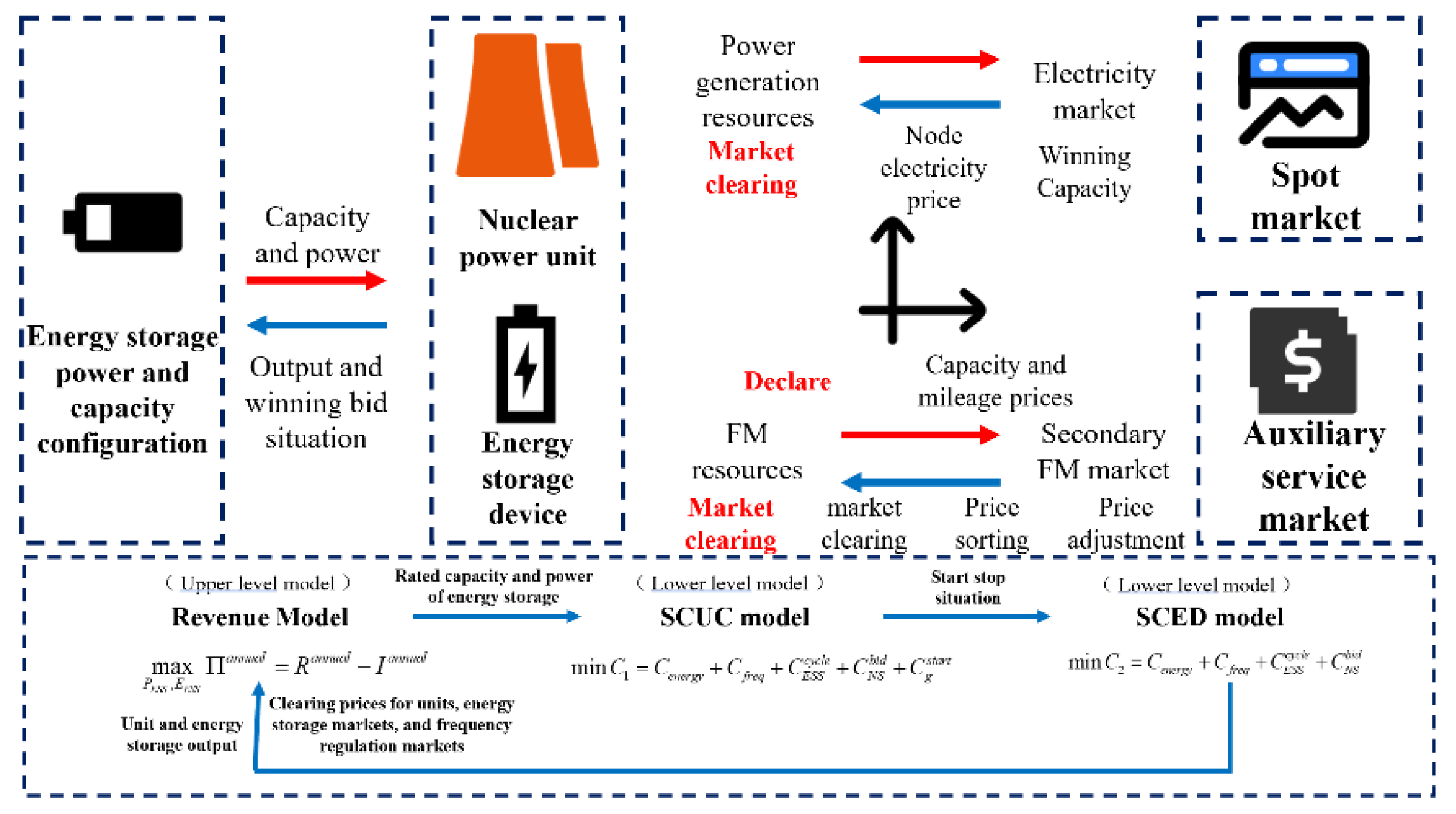
Figure 2.
System Load Curve.
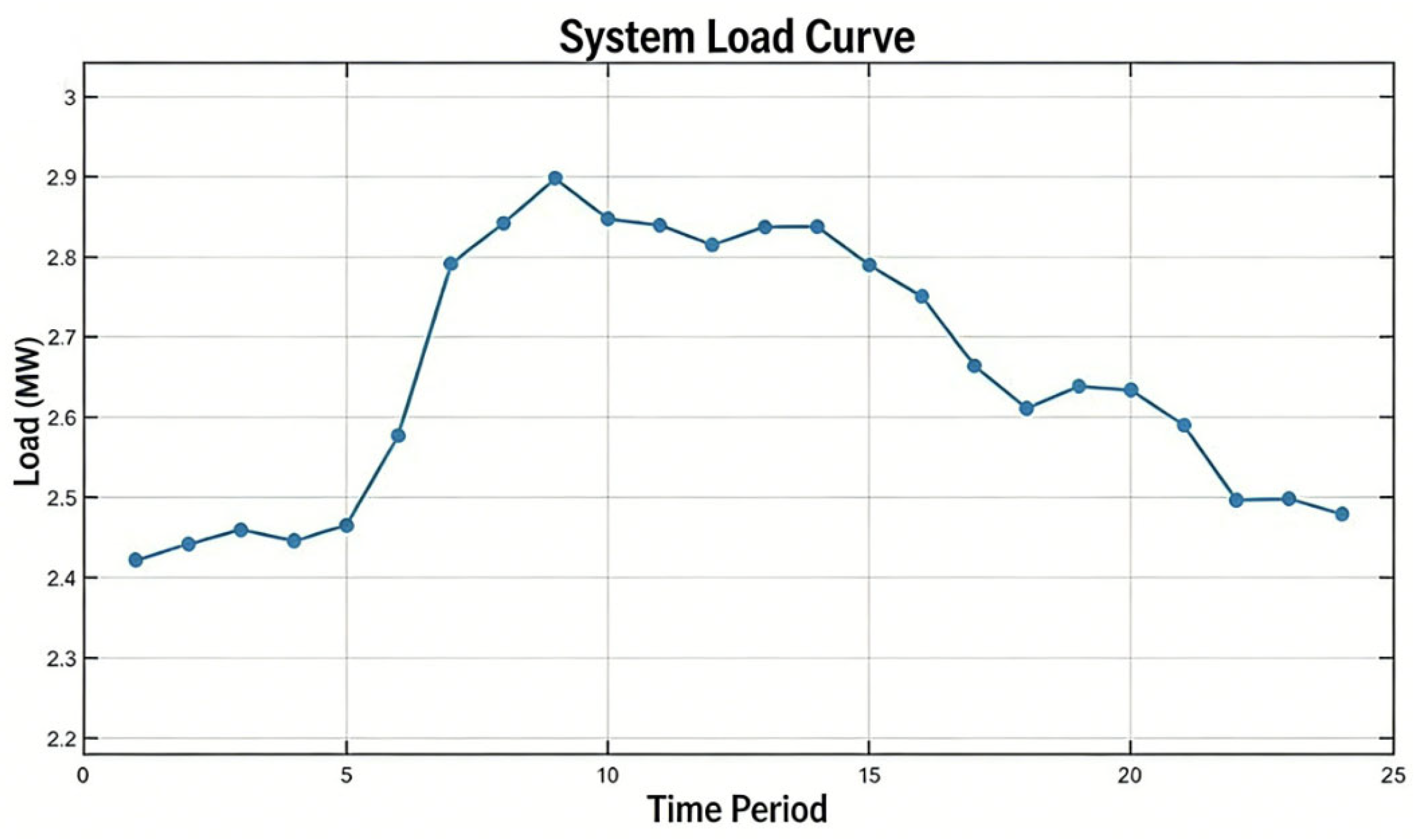
Figure 3.
System Frequency Modulation Capacity Requirements.
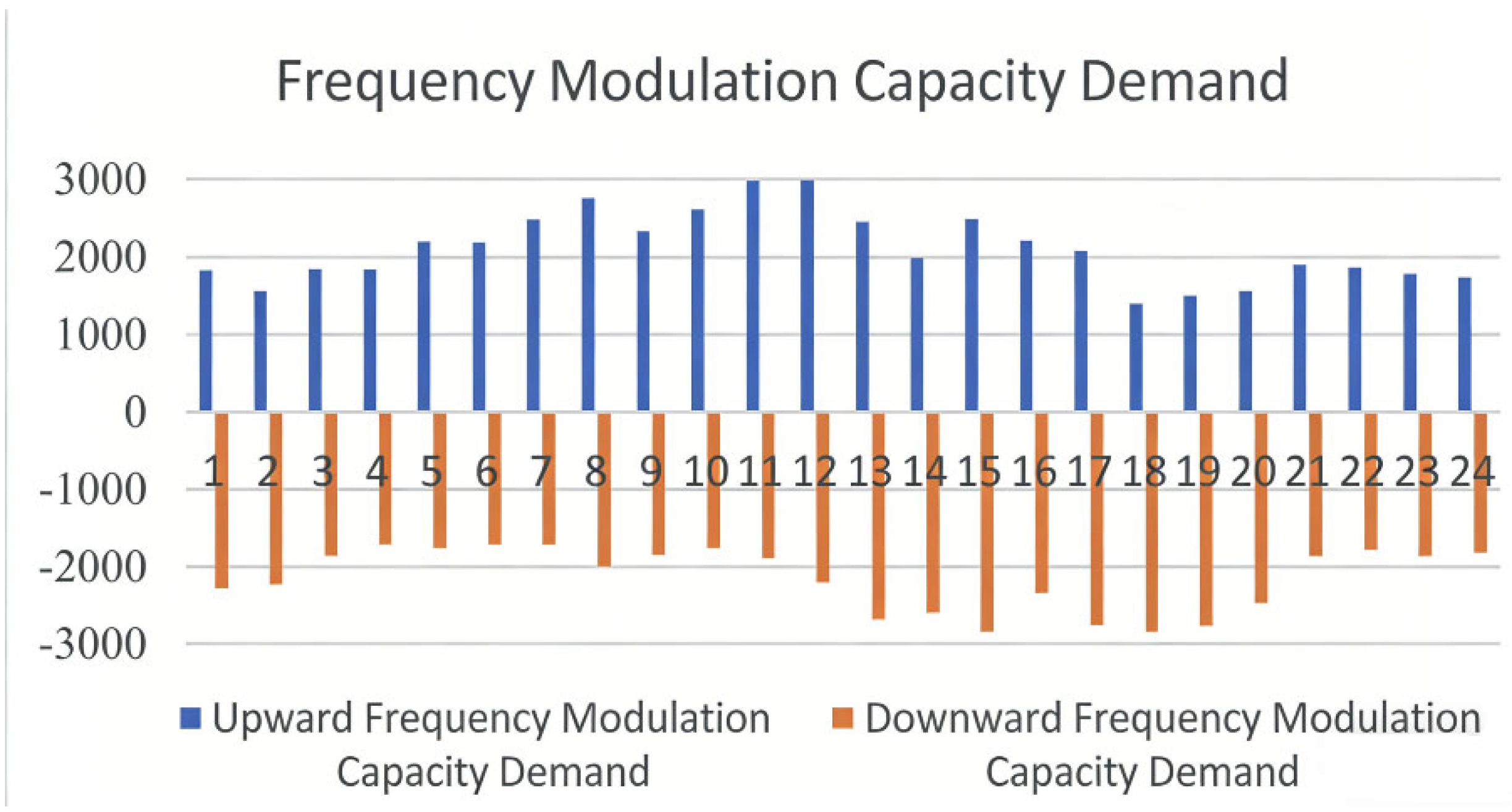
Figure 4.
System Frequency Modulation Capacity Requirements.
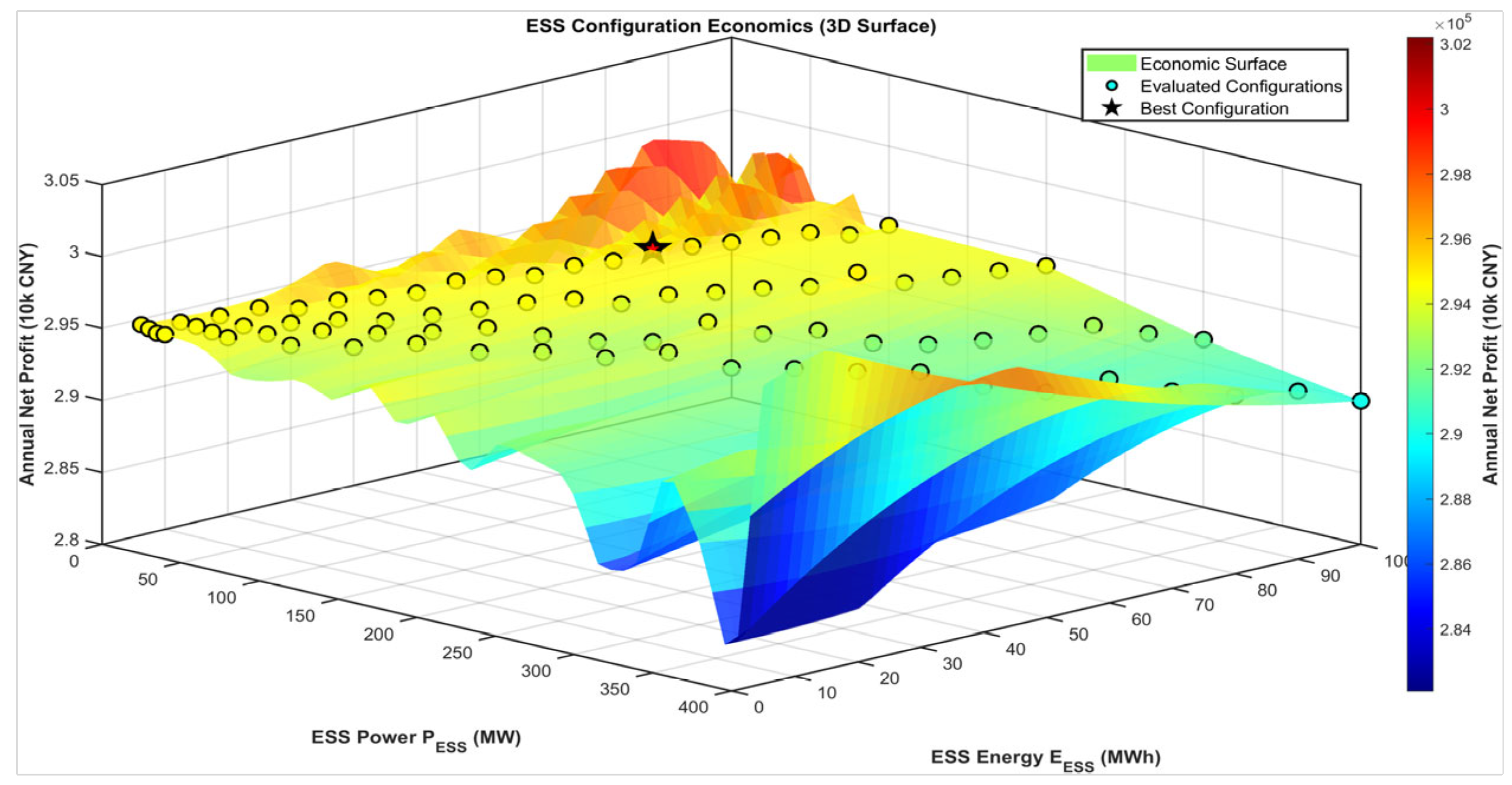
Figure 5.
Energy Output Curve of Various Resources on a Typical Day.
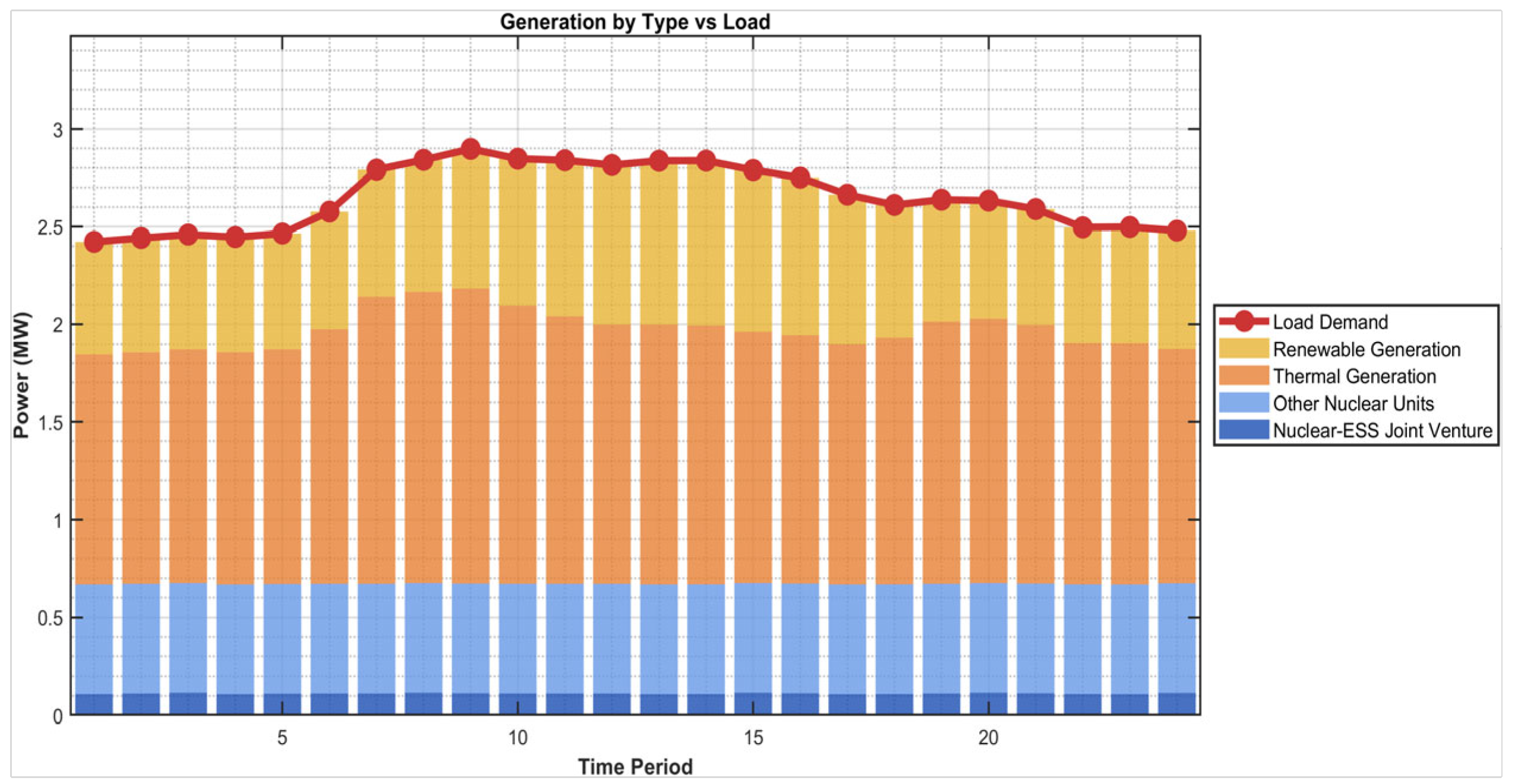
Figure 6.
Energy Market Clearing Price.
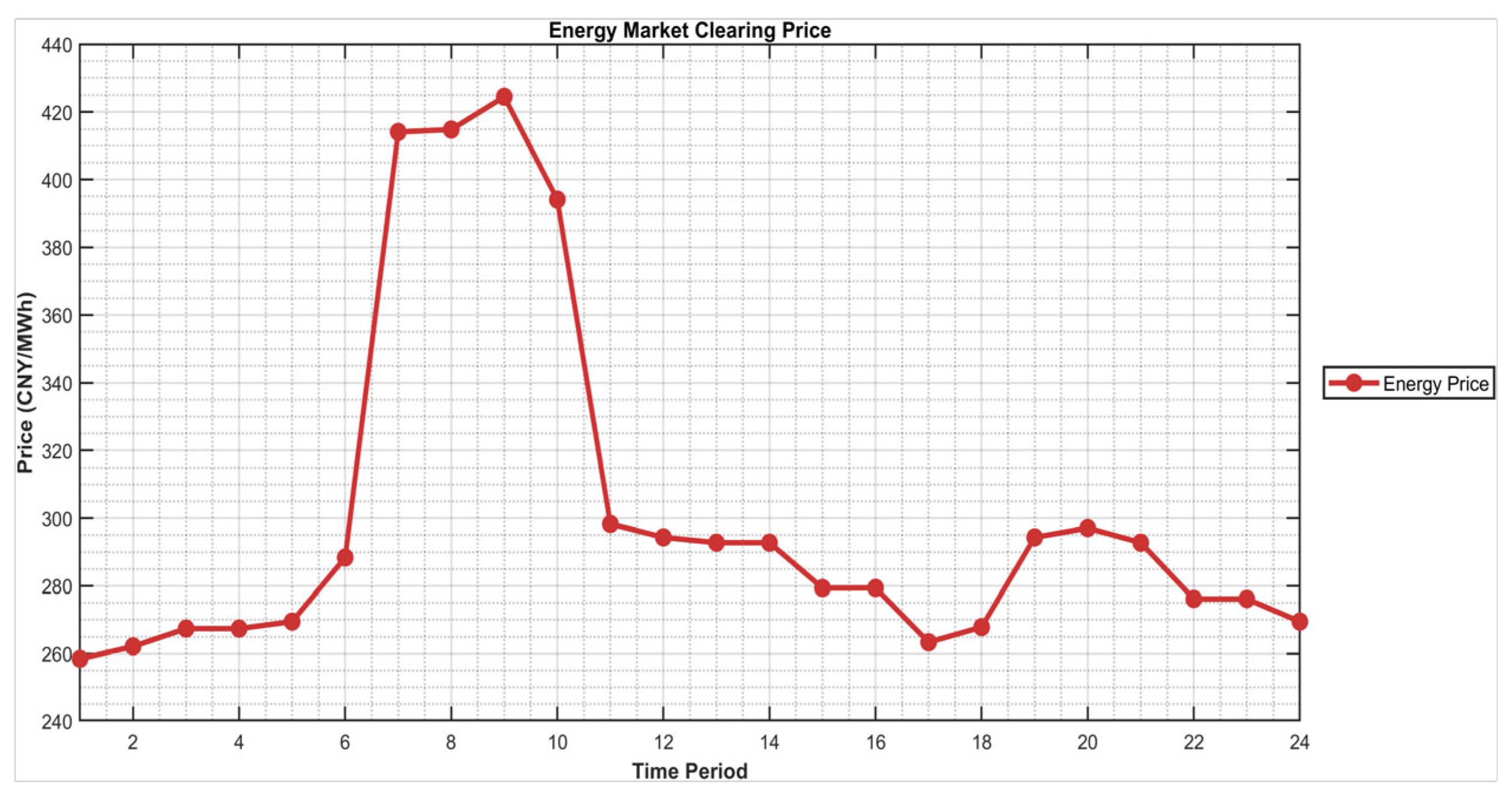
Figure 7.
Upward Frequency Regulation Capacity Demand and Supply.
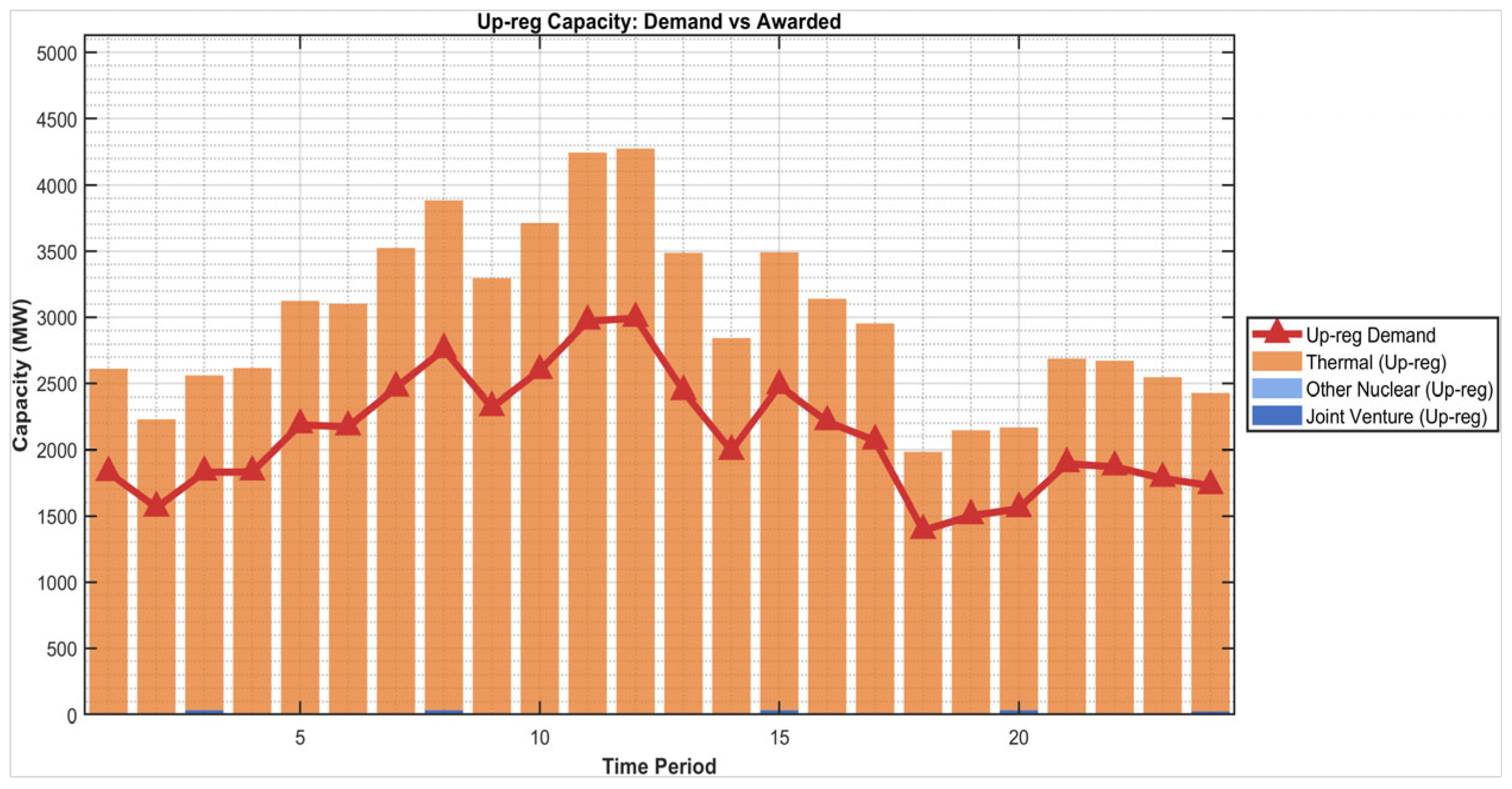
Figure 8.
Downward Frequency Regulation Capacity Demand and Unit Output. .
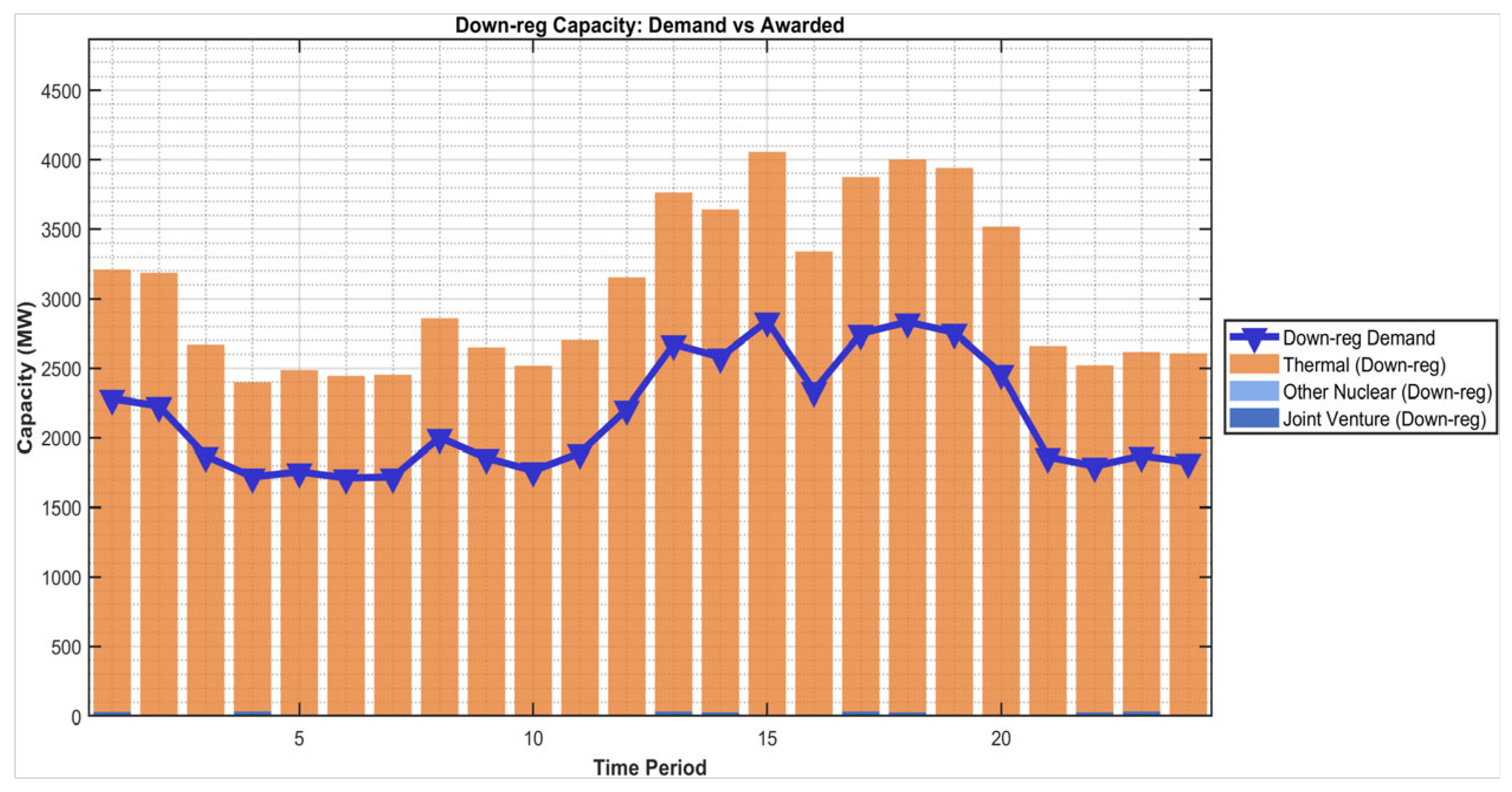
Figure 9.
Frequency Regulation Capacity Market Clearing Price.
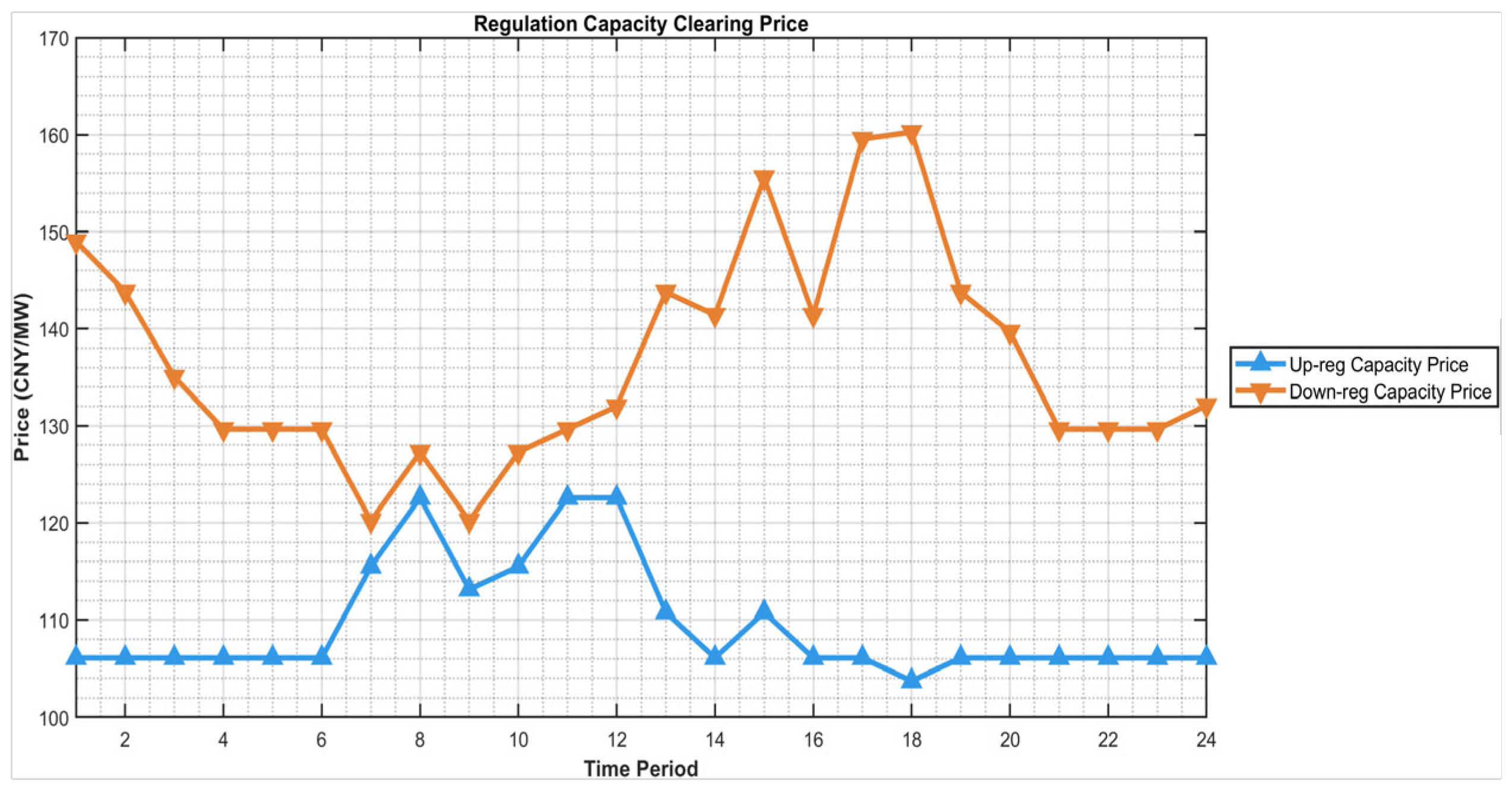

Table 1.
Input Parameter Settings of Energy Storage System.
| Power cost (yuan/MW) | Capacity cost (yuan/MWh) | Cycle cost (yuan/MWh) | Discount rate / % | Energy storage life / year |
|---|---|---|---|---|
| 1800000 | 2500000 | 50 | 6 | 20 |
Table 2.
Economic Comparison of Nuclear-Storage Consortium Before and After Introducing Energy Storage.
Table 2.
Economic Comparison of Nuclear-Storage Consortium Before and After Introducing Energy Storage.
| Indicators | No energy storage scenario | Optimal energy storage configuration scenario |
|---|---|---|
| Annualized net return (in ten thousand yuan per year) | 294868.03 | 295152.32 |
| Energy market revenue (ten thousand yuan/year) | 294868.03 | 295001.82 |
| Frequency modulation market revenue (ten thousand yuan per year) | 0 | 2774.76 |
Disclaimer/Publisher’s Note: The statements, opinions and data contained in all publications are solely those of the individual author(s) and contributor(s) and not of MDPI and/or the editor(s). MDPI and/or the editor(s) disclaim responsibility for any injury to people or property resulting from any ideas, methods, instructions or products referred to in the content. |
© 2026 by the authors. Licensee MDPI, Basel, Switzerland. This article is an open access article distributed under the terms and conditions of the Creative Commons Attribution (CC BY) license (http://creativecommons.org/licenses/by/4.0/).
Copyright: This open access article is published under a Creative Commons CC BY 4.0 license, which permit the free download, distribution, and reuse, provided that the author and preprint are cited in any reuse.


